
Canada Security Services Market Size, Share, Trends and Forecast by Service Type, End User, and Region, 2026-2034
Canada Security Services Market Size, Share, Trends & Forecast (2026-2034)
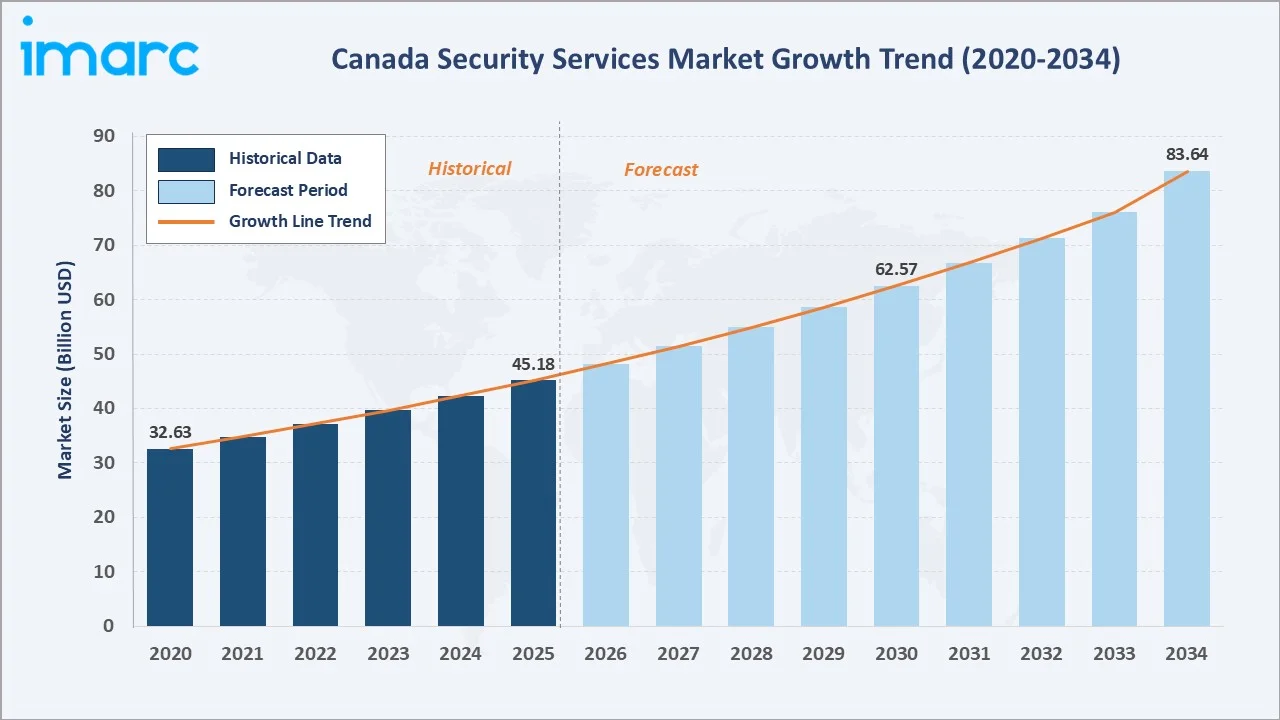
The Canada security services market reached USD 45.18 Billion in 2025 and is projected to reach USD 83.64 Billion by 2034, growing at a CAGR of 6.73% during 2026-2034. The market is driven by rising cybersecurity awareness, increasing adoption of cloud computing and IoT that necessitates robust security solutions, and regulatory compliance requirements that encourage organizations to invest in advanced security services.
Physical Security dominates at 41.8%. Commercial end users lead at 32.8%. Ontario commands 38.6% of the national market share.
Market Snapshot
|
Metric |
Value |
|
Market Size (2025) |
USD 45.18 Billion |
|
Forecast Market Size (2034) |
USD 83.64 Billion |
|
CAGR (2026-2034) |
6.73% |
|
Base Year |
2025 |
|
Historical Period |
2020-2025 |
|
Forecast Period |
2026-2034 |
|
Dominant Service Type |
Physical Security (41.8%, 2025) |
|
Dominant End User |
Commercial (32.8%, 2025) |
|
Leading Region |
Ontario (38.6%, 2025) |
The market expanded from USD 32.63 Billion in 2020 to USD 45.18 Billion in 2025, anchored at USD 62.57 Billion in 2030 and forecast to reach USD 83.64 Billion by 2034. Rising urbanization, growing corporate security budgets, and mandatory regulatory compliance have sustained steady demand growth despite inflationary pressures in 2022-2023 that temporarily constrained discretionary security spending.
To get more information on this market, Request Sample
Physical Security leads segment growth as sustained demand for manned guarding, mobile patrol, and event security expands across Ontario and Quebec. Security Equipment and Technology grows fastest driven by biometric access control adoption, AI-enabled surveillance cameras, and smart city initiatives across Canadian urban centers.
Executive Summary
The Canada security services market reached USD 45.18 Billion in 2025, representing one of North America's steadily growing safety and protection sectors, driven by the convergence of physical and digital security requirements across commercial, industrial, and residential applications. The market is projected to reach USD 83.64 Billion by 2034.
Physical Security at 41.8% dominates by capturing the full spectrum of manned guarding, mobile patrol, event security, and specialized K9 services across all end-user categories. Commercial end users at 32.8% lead through high-value procurement across corporate offices, retail establishments, banks, hospitals, and educational institutions. Ontario at 38.6% commands national leadership through its concentration of corporate headquarters, financial institutions, and government facilities.
Key Market Insights
|
Insight |
Data |
|
Dominant Service Type |
Physical Security – 41.8% share (2025) |
|
Dominant End User |
Commercial – 32.8% market share (2025) |
|
Leading Region |
Ontario – 38.6% market share (2025) |
|
Market Opportunity |
AI-integrated surveillance; smart parking systems; asset tracking; cybersecurity-physical convergence |
Key Analytical Observations Supporting the Above Data:
- Physical Security at 41.8%: Physical Security dominates as it encompasses the full range of manned guarding, mobile patrol, event security, and crowd management services. Its widespread procurement by corporations, government agencies, and financial institutions across Ontario and Quebec reinforces segment demand.
- Commercial at 32.8%: The commercial segment leads due to high-volume security procurement by corporate offices, retail chains, banks, hospitals, and educational institutions, particularly in major metropolitan areas such as Toronto, Montreal, and Calgary.
- Ontario at 38.6%: Ontario leads the national market through its concentration of Canada's largest corporations, federal government facilities, financial centers, and critical infrastructure requiring comprehensive physical and technology-based security solutions.
Canada Security Services Market Overview
The Canada security services market encompasses the design, provision, and management of all physical security, technology-based security, consulting, asset tracking, and smart parking solutions serving commercial, residential, industrial, government, and individual clients across Canadian provinces.
The ecosystem integrates physical security service companies, technology hardware manufacturers, software and platform developers, consulting and risk management firms, asset tracking solution providers, government regulatory bodies, and end-user procurement organizations. Macroeconomic factors include rising urban crime rates, growing corporate governance mandates, government public safety investments, and adoption of AI-enabled security technologies.
Market Dynamics
To evaluate market opportunities, Request Sample
Market Drivers
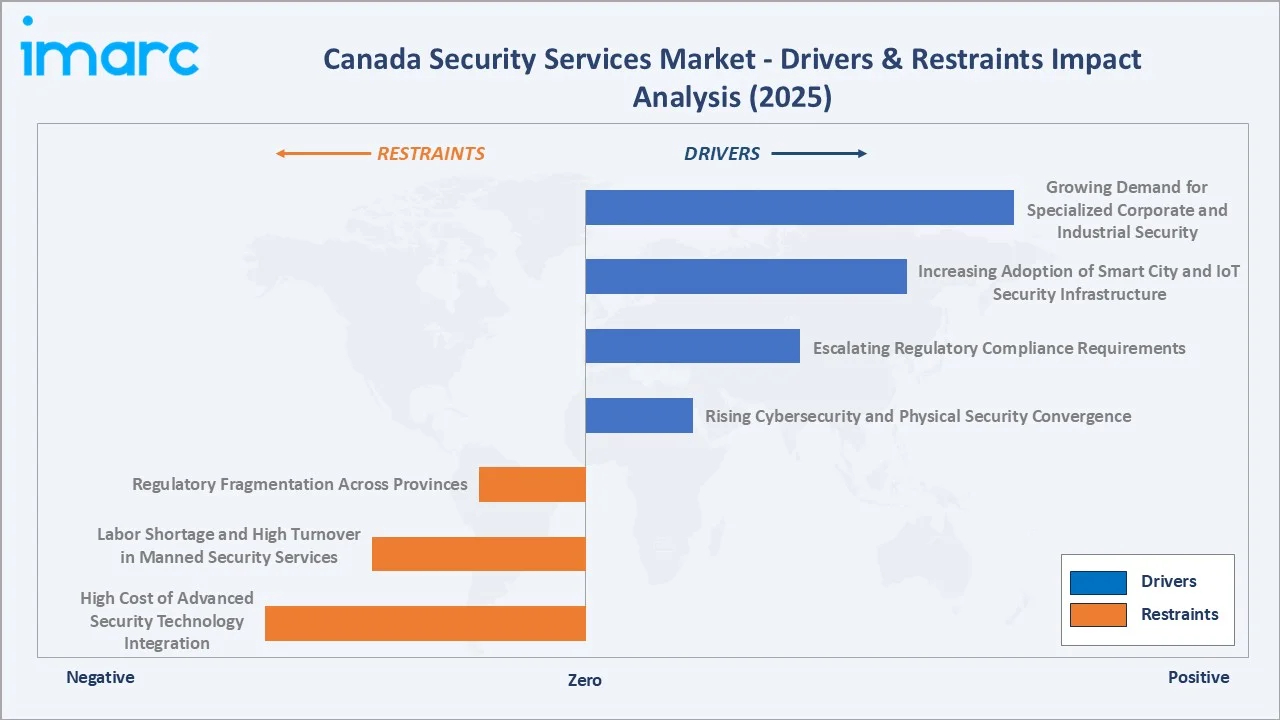
- Rising Cybersecurity and Physical Security Convergence: The convergence of cyber and physical security is accelerating as organizations integrate access control, surveillance, and cybersecurity protocols into unified platforms. Canadian businesses facing both digital and physical threats are investing in comprehensive security contracts, increasing the total addressable market for integrated security providers. According to the Canadian Centre for Cyber Security, cyber incidents increased 81% in 2020, driving sustained security budget expansion.
- Escalating Regulatory Compliance Requirements: Requirements such as PIPEDA and provincial privacy regulations compel organizations to maintain robust security frameworks and incident response capabilities. Security service providers play a critical role in helping businesses manage diverse compliance requirements and protect sensitive data. The Office of the Privacy Commissioner of Canada recorded a sustained increase in compliance-related complaints, driving security service procurement across financial, healthcare, and government sectors.
- Increasing Adoption of Smart City and IoT Security Infrastructure: Municipal governments and private developers are deploying IoT-connected surveillance systems, smart access control, and AI-powered monitoring tools as part of smart city programs. This creates structural growth in Security Equipment and Technology demand, particularly for biometric access, facial recognition systems, and AI-integrated video surveillance across Ontario and British Columbia.
- Growing Demand for Specialized Corporate and Industrial Security: Demand has surged from oil, gas, and manufacturing sectors, particularly in Alberta, as companies increase spending on site protection and safety services. Corporate offices and industrial facilities are expanding security service budgets to address rising workplace incidents, theft, and the need for specialized K9 and mobile patrol services in large-scale facilities.
Market Restraints
- High Cost of Advanced Security Technology Integration: Deployment of AI-powered surveillance, biometric systems, and integrated security platforms requires significant capital investment in hardware, software, and specialized IT infrastructure. Smaller businesses and residential clients face cost barriers that limit adoption of advanced technology-based security solutions, constraining growth in the Security Equipment and Technology segment.
- Labor Shortage and High Turnover in Manned Security Services: The security guard and patrol industry faces chronic staffing challenges, with high turnover rates, licensing requirements, and rising wage expectations creating operational constraints for physical security providers. Labor cost inflation directly reduces profit margins and limits capacity expansion for manned guarding service companies across Canada's major urban markets.
- Regulatory Fragmentation Across Provinces: Security service licensing, guard certification, and privacy compliance requirements vary significantly across Canadian provinces, increasing administrative complexity and compliance costs for national service providers. This fragmentation limits economies of scale and creates barriers for smaller regional providers seeking to expand into new provincial markets.
Market Opportunities
- AI and Machine Learning Integration in Surveillance Systems: AI-driven video analytics, behavioral recognition, and anomaly detection are creating high-value opportunities in the Security Equipment and Technology segment. Canadian smart city programs and corporate campus security modernization initiatives are generating structured procurement cycles for next-generation AI-integrated surveillance platforms with managed service components.
- Expansion of Asset Tracking and Smart Parking Solutions: Asset tracking systems for logistics, healthcare, and construction sectors, combined with smart parking management solutions for urban municipalities, represent fast-growing adjacencies to traditional security services. Canadian cities investing in smart mobility infrastructure and logistics firms managing high-value inventory fleets are generating incremental demand.
Market Challenges
- Increasing Competition from Technology-First Security Entrants: Global technology companies and software-defined security platforms are entering the Canadian market with scalable, lower-cost monitoring and access control solutions that compete with traditional manned guarding providers. This competitive dynamic is compressing margins in the physical security segment while accelerating technology adoption requirements for incumbent service providers.
- Data Privacy Compliance in Surveillance Deployments: Expanding AI-powered facial recognition and video surveillance deployments face increasing scrutiny from Canadian privacy regulators. Compliance with evolving privacy legislation creates additional legal and operational complexity for security technology providers, potentially slowing deployment timelines and increasing solution development costs.
Emerging Market Trends
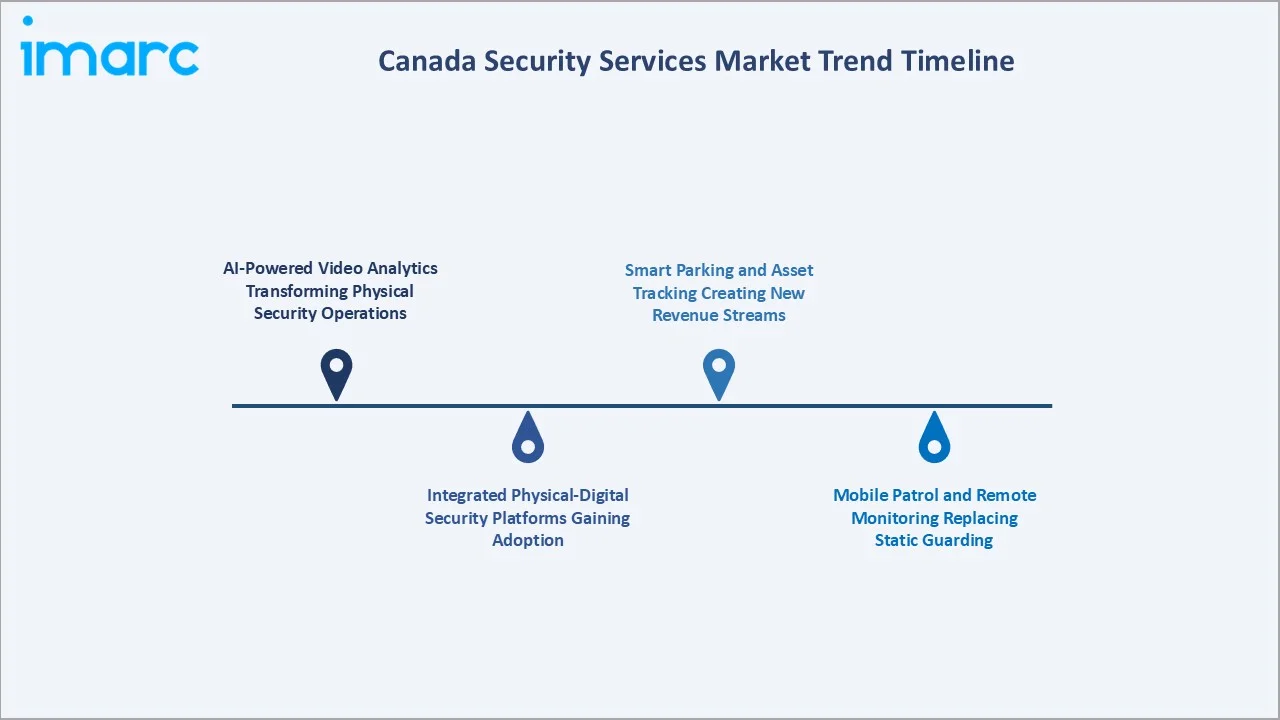
1. AI-Powered Video Analytics Transforming Physical Security Operations
AI-integrated video analytics platforms are replacing traditional passive surveillance with proactive threat detection. Canadian security service providers are deploying computer vision systems that automatically identify unauthorized access, detect behavioral anomalies, and generate real-time alerts, reducing response times and enabling more efficient deployment of physical security personnel across large commercial and industrial facilities.
2. Integrated Physical-Digital Security Platforms Gaining Adoption
Enterprise clients are consolidating physical access control, video surveillance, cybersecurity monitoring, and incident response capabilities into unified security management platforms. This integration trend is driving higher contract values as security service providers expand from standalone manned guarding to comprehensive managed security service engagements covering both physical and digital threat vectors.
3. Mobile Patrol and Remote Monitoring Replacing Static Guarding
Cost-efficiency requirements and labor availability constraints are accelerating the shift from static guard deployments to technology-enabled mobile patrol and remote monitoring solutions. Canadian security companies are investing in monitoring centers, patrol vehicle fleets, and remote video verification systems that allow greater geographic coverage with fewer on-site personnel, improving service economics for providers and clients.
4. Smart Parking and Asset Tracking Creating New Revenue Streams
Smart parking management systems and IoT-based asset tracking solutions are emerging as high-growth adjacencies for traditional security service providers. Canadian municipalities implementing smart city programs and logistics operators managing high-value asset inventories are generating incremental procurement demand for integrated tracking, monitoring, and security management services.
Industry Value Chain Analysis
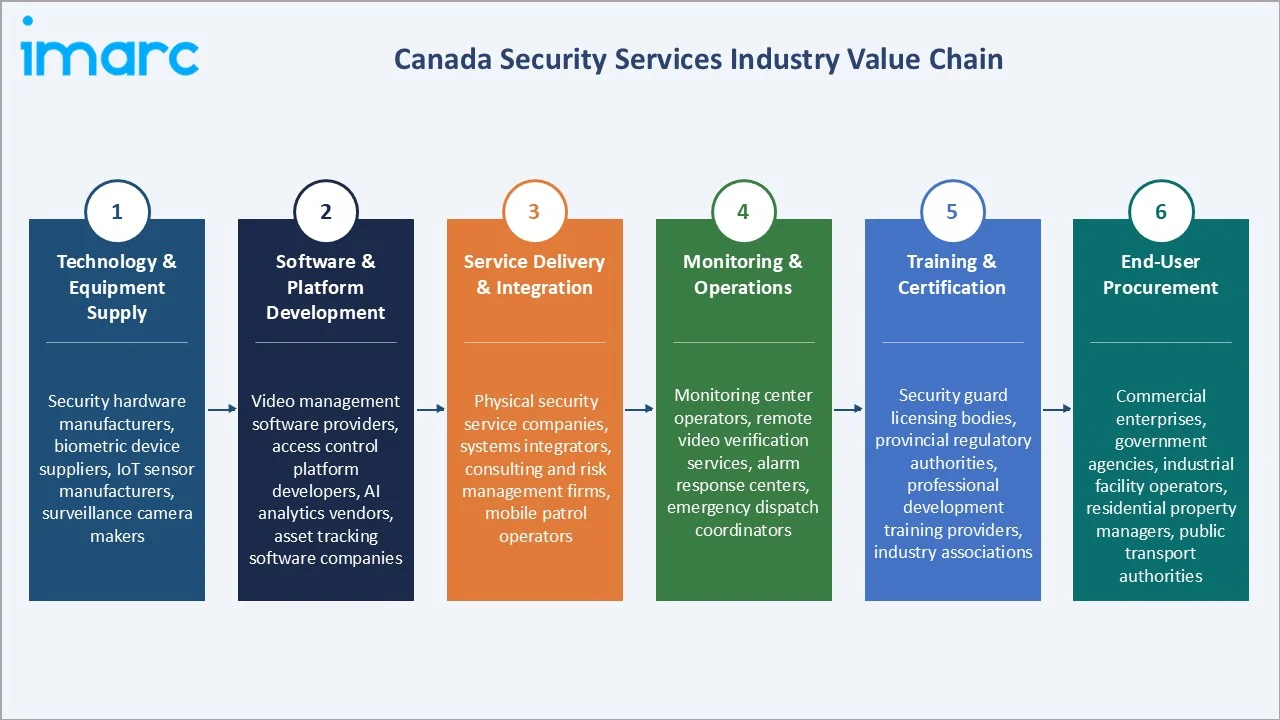
The Canada security services value chain integrates technology hardware supply, software platform development, service delivery and integration, monitoring and operations, training and certification, and end-user procurement across the full security services ecosystem.
|
Stage |
Key Participants |
|
Technology & Equipment Supply |
Security hardware manufacturers, biometric device suppliers, IoT sensor manufacturers, surveillance camera makers |
|
Software & Platform Development |
Video management software providers, access control platform developers, AI analytics vendors, asset tracking software companies |
|
Service Delivery & Integration |
Physical security service companies, systems integrators, consulting and risk management firms, mobile patrol operators |
|
Monitoring & Operations |
Monitoring center operators, remote video verification services, alarm response centers, emergency dispatch coordinators |
|
Training & Certification |
Security guard licensing bodies, provincial regulatory authorities, professional development training providers, industry associations |
|
End-User Procurement |
Commercial enterprises, government agencies, industrial facility operators, residential property managers, public transport authorities |
The service delivery and integration tier is the value chain's highest-revenue segment, encompassing the full range of manned guarding, mobile patrol, consulting, and technology-integrated managed security services. The monitoring and operations tier is experiencing rapid consolidation as remote video verification and AI-powered monitoring centers scale national coverage capabilities.
Technology Landscape in the Canada Security Services Industry
AI-Powered Video Surveillance Technology
AI-powered video surveillance technology integrates computer vision, behavioral analytics, and automated alert systems into physical security operations. This technology reduces reliance on manual monitoring by enabling automated detection of unauthorized access, crowd anomalies, and perimeter breaches. Its adoption across corporate campuses, retail environments, and public spaces is accelerating demand for integrated security platforms combining hardware and AI-driven software.
Biometric Access Control Technology
Biometric access control technology encompasses fingerprint, facial recognition, iris scanning, and voice authentication systems that replace traditional keycard and PIN-based access methods. These systems provide superior identity verification, audit trail capabilities, and integration with broader security management platforms. Growing adoption across corporate offices, healthcare facilities, and government buildings is driving Security Equipment and Technology segment growth.
Cloud-Based Security Management Platforms
In January 2024, Nanalysis Scientific Corp.'s subsidiary K'(Prime) Technologies secured a five-year USD 160 million contract with the Canadian Air Transport Security Authority (CATSA) for security services, highlighting the scale of technology-integrated security contracts in Canada. Cloud-based platforms enable remote monitoring, centralized alert management, and scalable security operations. Their cost-effectiveness and accessibility are driving adoption among small and medium-sized commercial clients seeking enterprise-grade security capabilities.
Market Segmentation Analysis
The report covers the following segments:
|
Segment Category |
Leading Segment |
Market Share |
Year |
|
Service Type |
Physical Security |
41.8% |
2025 |
|
End User |
Commercial |
32.8% |
2025 |
|
Region |
Ontario |
38.6% |
2025 |

By Service Type
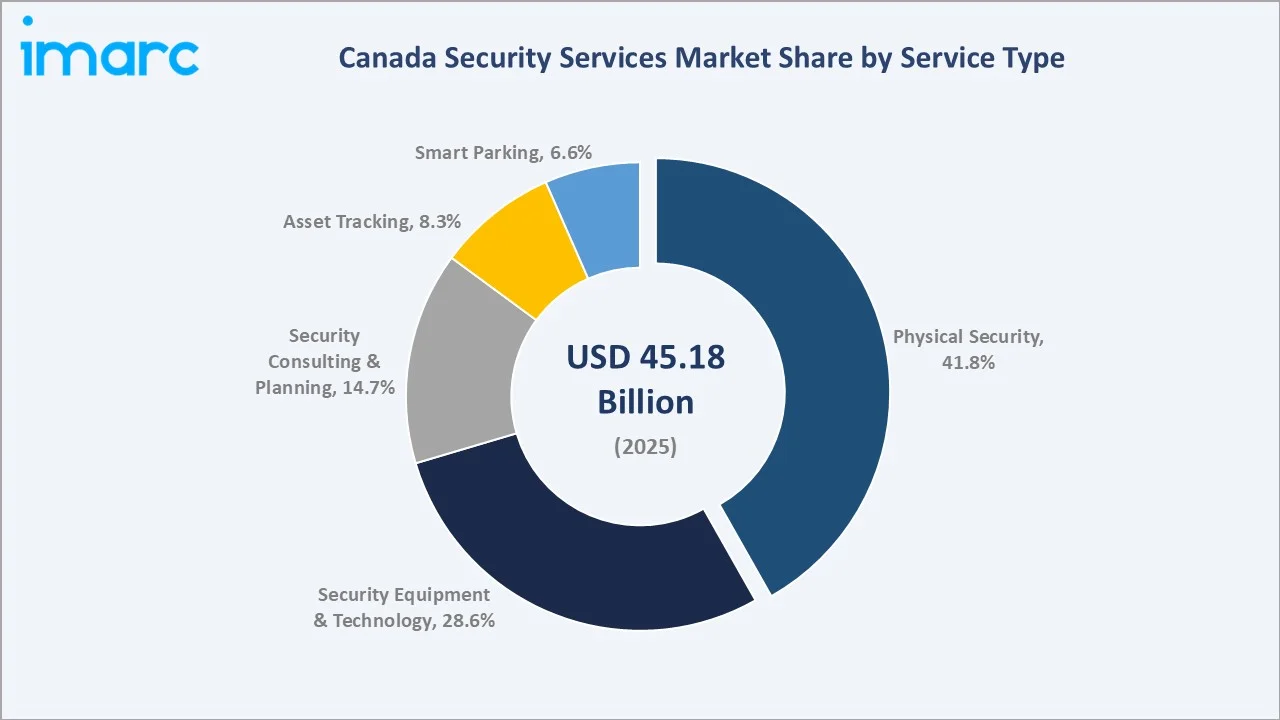
Physical Security leads at 41.8% in 2025, encompassing the full spectrum of manned guarding, personal and private security, escorts, mobile patrol, event security, crowd management, K9 security, police support services, airport security, and traffic control services – the most commercially diverse and highest-revenue service category in the Canada security services market.
To access detailed market analysis, Request Sample
Security Equipment and Technology at 28.6% captures access control systems including KeyFobs, biometric access, facial recognition, and visitor management, plus surveillance systems including video surveillance and alarm systems. Security Consulting and Planning at 14.7% includes loss prevention, investigation consulting, security risk management, and roadside assistance. Asset Tracking at 8.3% and Smart Parking at 6.6% represent the fastest-growing adjacent categories driven by IoT adoption and smart city investments across Canadian municipalities.
By End User
Commercial end users lead at 32.8% through procurement by corporate offices, educational institutions, hospitals and clinics, retail establishments, and banks and financial institutions. The commercial segment's above-market growth reflects growing enterprise security budget allocations and increasing adoption of integrated physical-digital security programs across Canada's largest employers and institutions.
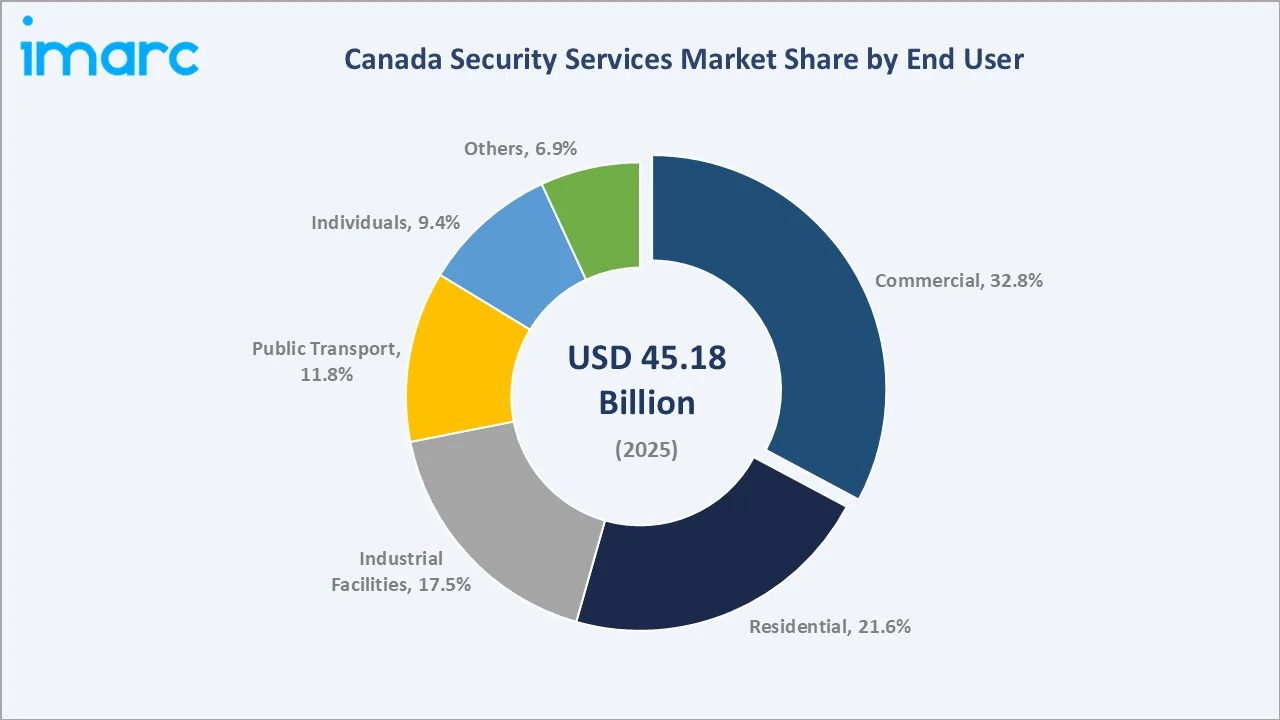
Residential at 21.6% captures individual homes and colony and society security deployments, driven by growing personal safety awareness and smart home security adoption across suburban markets. Industrial Facilities at 17.5% represent Alberta's energy sector and national manufacturing base. Public Transport at 11.8% is growing as transit authorities invest in surveillance and access control modernization. Individuals at 9.4% capture the personal protection market.
Regional Market Insights
|
Region |
Share (2025) |
Key Security Market Drivers & Characteristics |
|
Ontario |
38.6% |
Driven by concentration of corporate headquarters, financial institutions, federal government facilities, and critical infrastructure in Toronto and Ottawa metropolitan areas |
|
Quebec |
24.1% |
Driven by Montreal's commercial density, Quebec government agency security procurement, and growing demand for bilingual security service delivery |
|
Alberta |
15.3% |
Driven by energy sector industrial facility security, oil and gas site protection, and growing Calgary and Edmonton commercial security demand |
|
British Columbia |
13.2% |
Driven by Vancouver's technology sector corporate security, port and logistics facility protection, and expanding residential security adoption |
|
Others |
8.8% |
Emerging provinces including Manitoba, Saskatchewan, and Atlantic Canada with growing public sector and industrial security procurement |
Ontario, at 38.6%, leads through Canada's largest concentration of corporate headquarters, financial district security demand, and federal government facility protection requirements in Ottawa. Quebec, at 24.1%, reflects Montreal's commercial density and Quebec provincial government security service procurement across diverse public sector facilities.
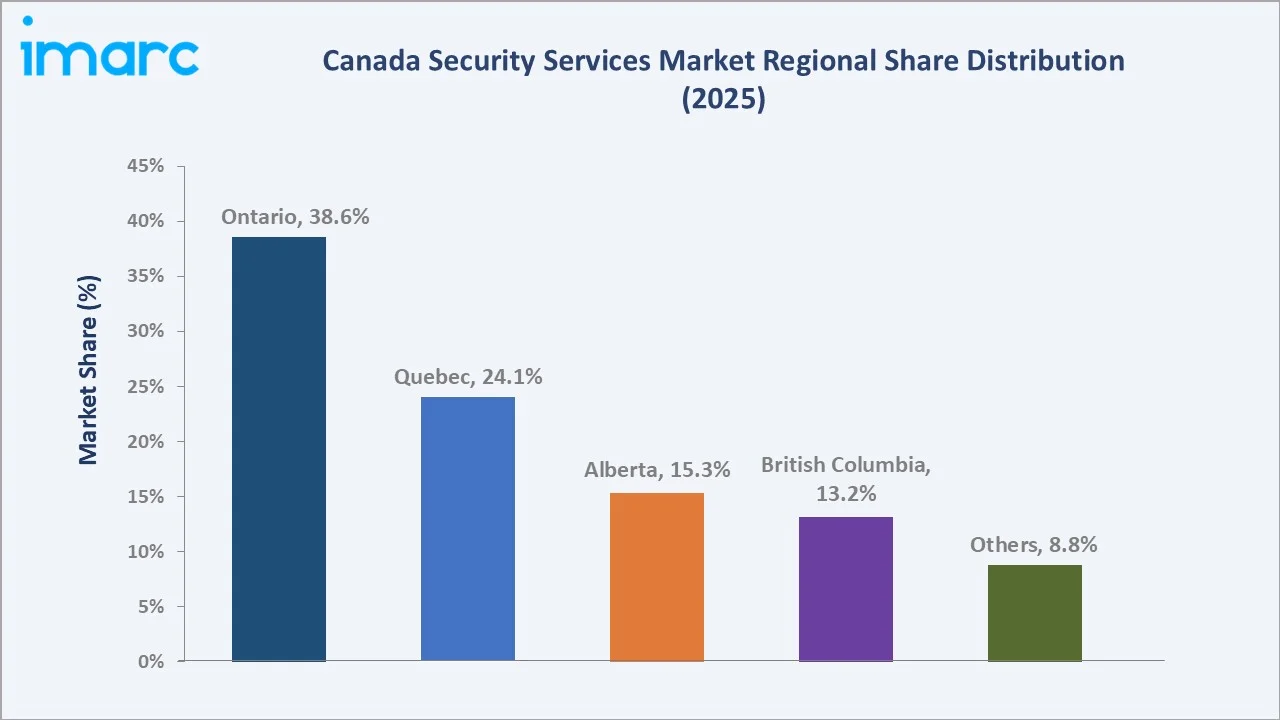
Alberta, at 15.3%, is driven by energy sector industrial security requirements and growing Calgary and Edmonton commercial markets. British Columbia, at 13.2%, reflects Vancouver's growing technology sector corporate security demand, port and logistics facility protection, and increasing residential security adoption. Other provinces collectively at 8.8% represent early-stage but growing markets driven by public sector procurement and resource industry site protection.
Competitive Landscape
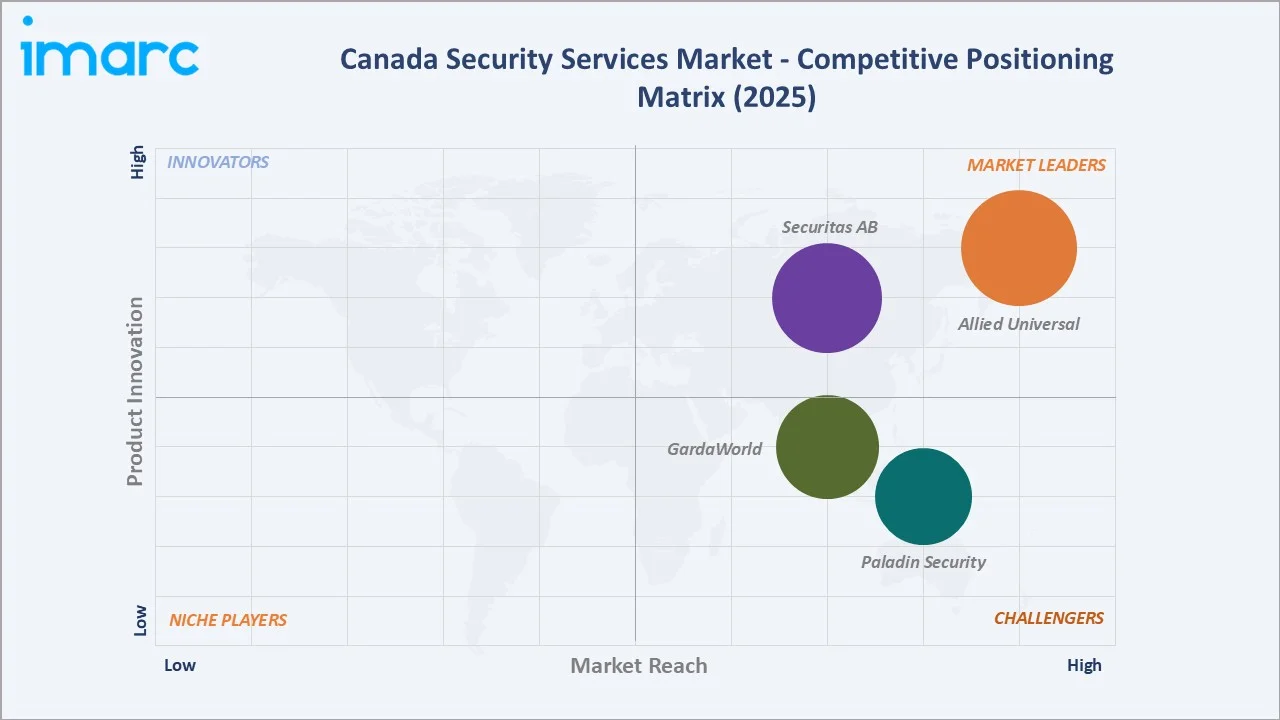
The Canada security services market competitive landscape is moderately consolidated, with three distinct competitive tiers: national full-service security companies, regional specialists, and technology-first entrants offering platform-based security monitoring and access control solutions.
|
Company Name |
Key Products/Services |
Market Position |
Core Strength |
|
Allied Universal |
Manned Guarding, Mobile Patrol, Technology Solutions |
Market Leader |
Largest security services provider in North America with extensive Canadian market penetration |
|
Securitas AB |
On-site Guarding, Electronic Security, Remote Monitoring |
Market Leader |
Global leader with strong Canadian operations and technology integration focus |
|
GardaWorld |
Physical Security, Cash Services, Risk Management |
Strong Challenger |
World's largest privately-owned security company with strong Canadian domestic presence |
|
Paladin Security |
Security Guard Services, Consulting, Technology |
Strong Challenger |
Leading Canadian-owned security company with national operational presence |
Key players include Allied Universal, Securitas AB, GardaWorld, Paladin Security, and others.
Key Company Profiles
Allied Universal
Allied Universal is a US-headquartered global security and facility services company operating as one of the largest security services provider in North America with extensive Canadian operations spanning manned guarding, technology solutions, and mobile patrol services.
- Key Products: Manned guarding, mobile patrol, event security, technology-based security solutions, and facility services.
- Strategic Focus: Expanding integrated physical and technology security solutions, combining manned guarding with AI-powered monitoring, access control, and cybersecurity services for enterprise and government clients.
Securitas AB
Securitas AB is a Sweden-headquartered global security services provider with significant Canadian operations, offering on-site guarding, mobile and remote guarding, electronic security, fire and safety, and corporate risk management services across multiple industry sectors.
- Key Products: On-site guarding, mobile guarding, remote video monitoring, electronic security systems, fire and safety services, and corporate risk management.
- Strategic Focus: Technology integration across all security service lines, expanding remote monitoring and electronic security capabilities while leveraging AI-driven analytics to deliver higher-value managed security services.
Market Concentration Analysis
The Canada security services market is moderately concentrated at the national full-service provider level. The top three key players collectively account for an estimated 35-45% of total Canadian security service revenues, with the balance distributed across regional specialists, niche technology providers, and small-to-medium local security companies.
Provincial licensing fragmentation creates natural market barriers that protect regional specialists from pure national competition, sustaining a dual-tier competitive structure of national leaders and entrenched regional operators. Market concentration is expected to increase moderately over the forecast period through acquisition consolidation by leading national providers seeking technology capability expansion and geographic coverage completion.
Investment & Growth Opportunities
Highest Growth Segments
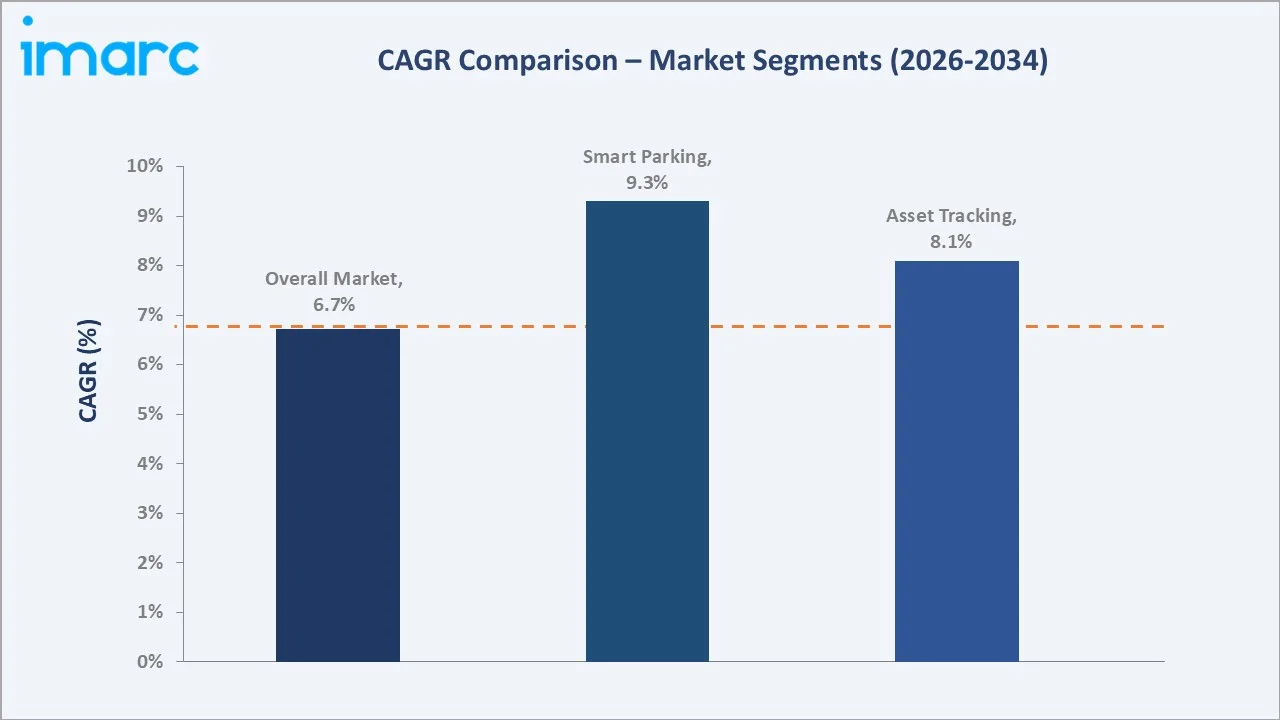
Smart Parking solutions at ~9.3% CAGR, Asset Tracking platforms at ~8.1% CAGR, Security Equipment and Technology at ~7.8% CAGR, Security Consulting and Planning at ~6.5% CAGR, and Physical Security at ~6.2% CAGR represent the principal growth investment vectors through 2034. AI-integrated surveillance system deployment and biometric access control modernization programs represent the highest per-contract value opportunities within Security Equipment and Technology.
Emerging Investment Opportunities
Smart city security infrastructure in Toronto, Montreal, Vancouver, and Calgary represents the market's most structurally significant emerging investment theme, as municipal governments commit multi-year capital programs for AI-powered public surveillance, smart traffic management, and integrated emergency response coordination, creating structured long-term procurement cycles for technology-capable security service providers.
Investment Themes
- Technology-integrated managed security services: Combining AI-powered surveillance, remote monitoring, and physical guard deployment into single managed service contracts generates premium contract values and multi-year renewal dynamics, representing the highest-margin growth segment for Canadian security service providers pursuing enterprise and government client expansion.
- Indigenous community and northern Canada security services: Growing First Nations community governance and resource development activity is creating demand for specialized security services across remote and northern Canadian locations, representing an underserved market with limited current competition and structurally growing procurement requirements.
Future Market Outlook (2026-2034)
The Canada security services market is projected to grow from USD 45.18 Billion in 2025 to USD 83.64 Billion by 2034, delivering a 6.73% CAGR over the forecast period. The market's anchor value of USD 62.57 Billion in 2030 represents a Canadian security services industry at its most transformative commercial inflection, as AI-integrated security platforms displace purely manual service delivery models, smart city deployments generate new long-duration public sector contracts, and industrial security expands in Alberta and Atlantic Canada.
Three structural forces define market growth through 2034. The physical-digital security convergence creates expanding multi-service contracts as organizations consolidate cybersecurity and physical security procurement. The smart city infrastructure buildout across Ontario, Quebec, and British Columbia generates long-duration public sector security technology contracts. The industrial security expansion in Alberta and Atlantic Canada's emerging energy sector creates new high-value manned guarding and monitoring service markets that sustain above-market growth in those regions.
Research Methodology
Primary Research
Primary research comprised structured interviews with 45+ industry stakeholders (2025), including Chief Security Officers, physical security service company executives, government procurement leads, technology platform vendors, and regulatory compliance specialists across Canada's major provincial security markets.
Secondary Research
Secondary research encompassed company annual reports; Statistics Canada industry surveys; Public Safety Canada annual reports; Office of the Privacy Commissioner of Canada PIPEDA compliance reports; Canadian Security Association (CANASA) market data; provincial security services licensing authority reports; IBISWorld Canada security services industry analysis. Over 50 secondary sources reviewed.
Forecasting Models
Market revenue forecasts developed using a bottom-up segmentation model: (i) provincial security service procurement by sector; (ii) average contract values by service type and end user category; (iii) technology adoption penetration rates for advanced security platforms; (iv) regulatory compliance investment multiples applied to base security service expenditure forecasts.
Canada Security Services Market Report Coverage:
| Report Features | Details |
|---|---|
| Base Year of the Analysis | 2025 |
| Historical Period | 2020-2025 |
| Forecast Period | 2026-2034 |
| Units | Billion USD |
| Scope of the Report | Exploration of Historical Trends and Market Outlook, Industry Catalysts and Challenges, Segment-Wise Historical and Future Market Assessment:
|
| Service Types Covered |
|
| End Users Covered |
|
| Regions Covered | Ontario, Quebec, Alberta, British Columbia, Others |
| Companies Covered | Allied Universal, Securitas AB, GardaWorld, Paladin Security, etc. |
| Customization Scope | 10% Free Customization |
| Post-Sale Analyst Support | 10-12 Weeks |
| Delivery Format | PDF and Excel through Email (We can also provide the editable version of the report in PPT/Word format on special request) |
Key Benefits for Stakeholders:
- IMARC’s industry report offers a comprehensive quantitative analysis of various market segments, historical and current market trends, market forecasts, and dynamics of the Canada security services market from 2020-2034.
- The research report provides the latest information on the market drivers, challenges, and opportunities in the Canada security services market.
- Porter's five forces analysis assist stakeholders in assessing the impact of new entrants, competitive rivalry, supplier power, buyer power, and the threat of substitution. It helps stakeholders to analyze the level of competition within the Canada security services industry and its attractiveness.
- Competitive landscape allows stakeholders to understand their competitive environment and provides an insight into the current positions of key players in the market.
Frequently Asked Questions About the Canada Security Services Market Report
The Canada security services market reached USD 45.18 Billion in 2025, driven by Physical Security at 41.8%, Commercial end users at 32.8%, and Ontario commanding 38.6% national market share through its concentration of corporate, financial, and government security procurement.
The Canada security services market grows at 6.73% CAGR during 2026-2034, reaching USD 83.64 Billion by 2034. This growth reflects AI integration in surveillance, smart city security deployments, and expanding regulatory compliance security requirements across all end-user categories.
Physical Security leads at 41.8%, capturing the full range of manned guarding, mobile patrol, event security, K9 security, and airport security services. Physical Security continues to command the highest revenue share through sustained demand from commercial, industrial, and government clients.
Commercial end users lead at 32.8% through procurement by corporate offices, retail establishments, hospitals, educational institutions, and banks, all requiring comprehensive security programs covering physical guarding and technology-based monitoring across multiple locations.
Ontario leads at 38.6% through Canada's largest concentration of corporate headquarters, financial institutions, and federal government facilities requiring comprehensive security services across the Toronto and Ottawa metropolitan areas.
Leading companies include Allied Universal, Securitas AB, GardaWorld, Paladin Security, and others.
The Canada security services market is projected to reach USD 62.57 Billion by 2030, driven by AI-powered surveillance adoption, smart city security infrastructure investments in major urban centers, and expanding industrial facility security requirements across Alberta and British Columbia.
Need more help?
- Speak to our experienced analysts for insights on the current market scenarios.
- Include additional segments and countries to customize the report as per your requirement.
- Gain an unparalleled competitive advantage in your domain by understanding how to utilize the report and positively impacting your operations and revenue.
- For further assistance, please connect with our analysts.
 Request Customization
 Speak to an Analyst
 Request Brochure
 Inquire Before Buying
Benefits of Customization
- Personalize this research
- Triangulate with your data
- Get data as per your format and definition
- Gain a deeper dive into a specific application, geography, customer, or competitor
- Any level of personalization
Get in Touch With Us
UNITED STATES
Phone: +1-201-971-6302
INDIA
Phone: +91-120-433-0800
UNITED KINGDOM
Phone: +44-753-714-6104
Email: [email protected]
Client Testimonials




.webp)




.webp)













Related Reports

Choose your plan
*Please note that the prices mentioned below are starting prices for each bundle type. Kindly contact our team for further details.*
Single User License
- 1 User License, Access on 2 Devices
- PDF Report + Excel Dataset (Password Protected)
- Lifetime Access
- No Printing Rights
- 10% Free Report Customization
- 10–12 Weeks of Analyst Support
Five User License
- Access for 5 Users, 2 Devices per User
- PDF Report + Excel Dataset (Password Protected)
- Lifetime Access
- Dedicated Account Manager
- 12–14 Weeks of Analyst Support
- No Printing Rights
- 15% Free Report Customization
- 25% Discount on Your Next Purchase
Corporate User License
- Unlimited User Access (Within Your Organization)
- PDF Report + Excel Dataset
- Lifetime Access
- Dedicated Account Manager
- 14–20 Weeks of Analyst Support
- No Printing Rights
- 20% Free Report Customization
- 30% Discount on Your Next Purchase
Essential Insights
What's included:
3 reports
- Lifetime Access
- PDF Reports
- Excel Datasets
- 2 Weeks of Free Analyst Support
- 2 User Licenses
- Access on 2 Devices
- Printing Rights
- Complimentary PowerPoint (PPT) Version
- Complimentary License Upgrade
Professional Access
What's included:
5 reports
- Lifetime Access
- PDF Reports
- Excel Datasets
- 8 Weeks of Free Analyst Support
- 2 User Licenses
- Access on 2 Devices
- Printing Rights
- Complimentary PowerPoint (PPT) Version
- Complimentary License Upgrade
Business Advantage
What's included:
8 reports
- Lifetime Access
- PDF Reports
- Excel Datasets
- 14 Weeks of Free Analyst Support
- 2 User Licenses
- Access on 2 Devices
- Printing Rights
- Complimentary PowerPoint (PPT) Version
- Complimentary License Upgrade
Enterprise Intelligence
What's included:
10 reports
- Lifetime Access
- PDF Reports
- Excel Datasets
- 20 Weeks of Free Analyst Support
- 2 User Licenses
- Access on 2 Devices
- Printing Rights
- Complimentary PowerPoint (PPT) Version
- Complimentary License Upgrade