
Europe Biomass Gasification Market Size, Share, Trends and Forecast by Source and Country, 2026-2034
Europe Biomass Gasification Market Size, Share, Trends & Forecast (2026-2034)
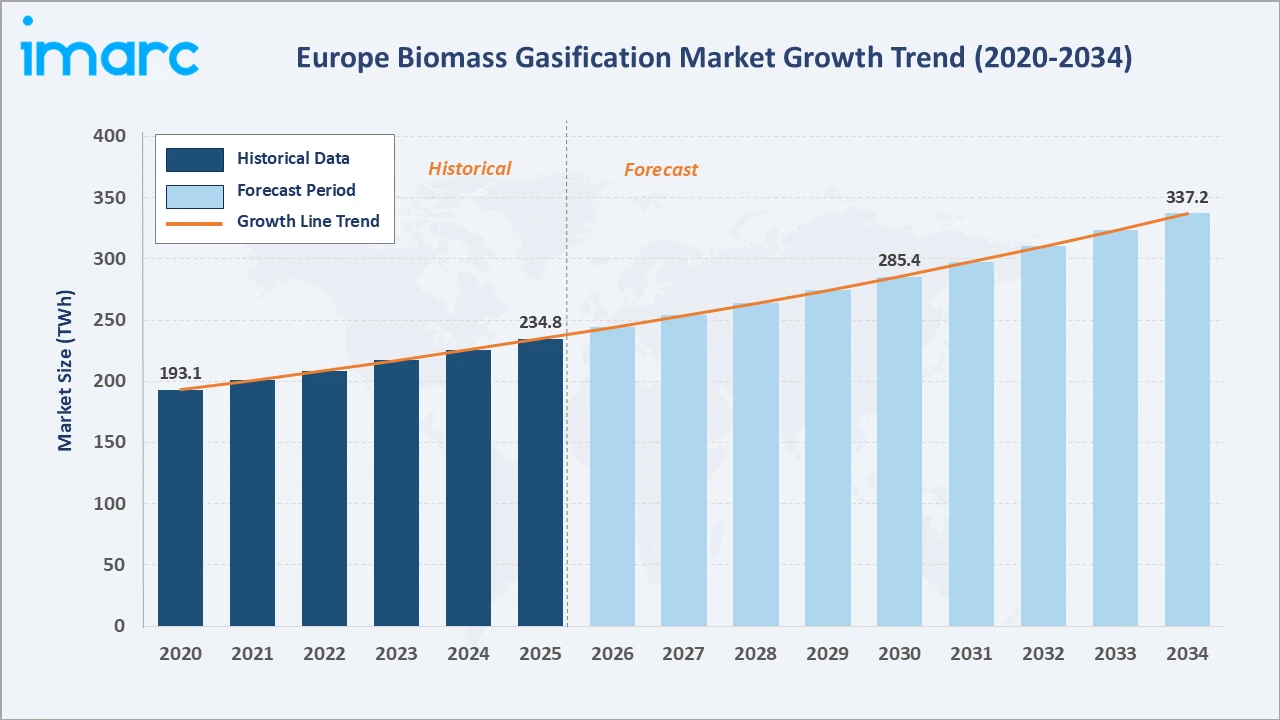
The Europe biomass gasification market reached a volume of 234.8 TWh in 2025 and is projected to attain 337.2 TWh by 2034, exhibiting a CAGR of 3.98% during 2026-2034. Strengthening decarbonization policy and expanding waste-to-energy capacity are driving adoption, reinforced by the European Commission's REPowerEU plan, which targets 35 Billion cubic meters of biomethane production across the EU by 2030.
Solid biomass leads the source segment at 52.8% and Germany commands 29.7% country-wise share.
Market Snapshot
|
Metric |
Value |
|
Market Size (2025) |
234.8 TWh |
|
Forecast Market Size (2034) |
337.2 TWh |
|
CAGR (2026-2034) |
3.98% |
|
Base Year |
2025 |
|
Historical Period |
2020-2025 |
|
Forecast Period |
2026-2034 |
|
Largest Country |
Germany (29.7%, 2025) |
|
Second Largest Country |
France (18.6%, 2025) |
|
Leading Source |
Solid Biomass (52.8%, 2025) |
The Europe biomass gasification market expanded from 193.1 TWh in 2020 to 234.8 TWh in 2025, driven by rising renewable heat and power mandates, growing municipal waste diversion targets, and steady modernization of aging combustion assets. Anchored at 285.4 TWh in 2030, the forecast to 337.2 TWh by 2034 is supported by accelerating biomethane grid injection, expanding syngas-to-fuel pathways, and a maturing regulatory environment across member states.
To get more information on this market, Request Sample
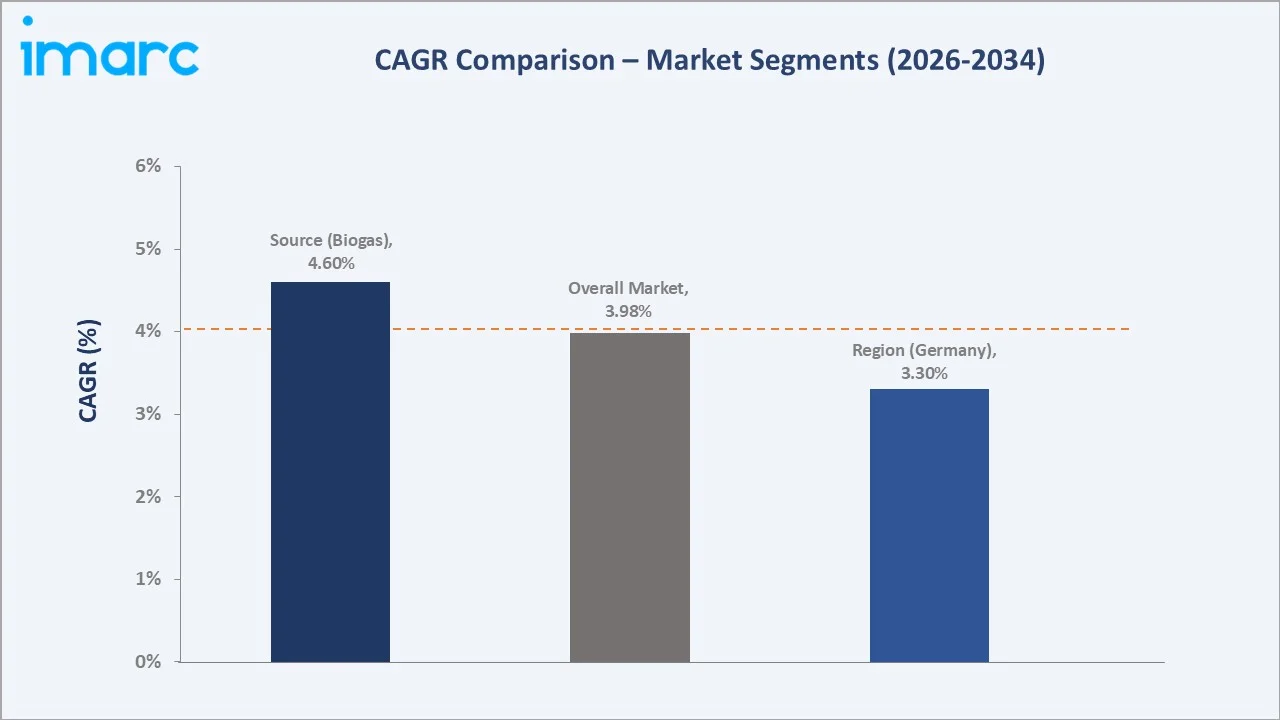
CAGR trajectories across source and country sub-segments show liquid biomass and Spain expanding faster than the overall 3.98% market CAGR, driven by feedstock diversification, catch-up national investment, and growing cross-border technology transfer among established European gasification developers.
Executive Summary
The Europe biomass gasification market is on a steady growth trajectory from 193.1 TWh in 2020 to 337.2 TWh by 2034. The industry has evolved from small-scale combined heat and power (CHP) installations toward integrated syngas, biomethane, and advanced fuel-conversion platforms serving utilities, municipalities, and industrial off-takers across the region.
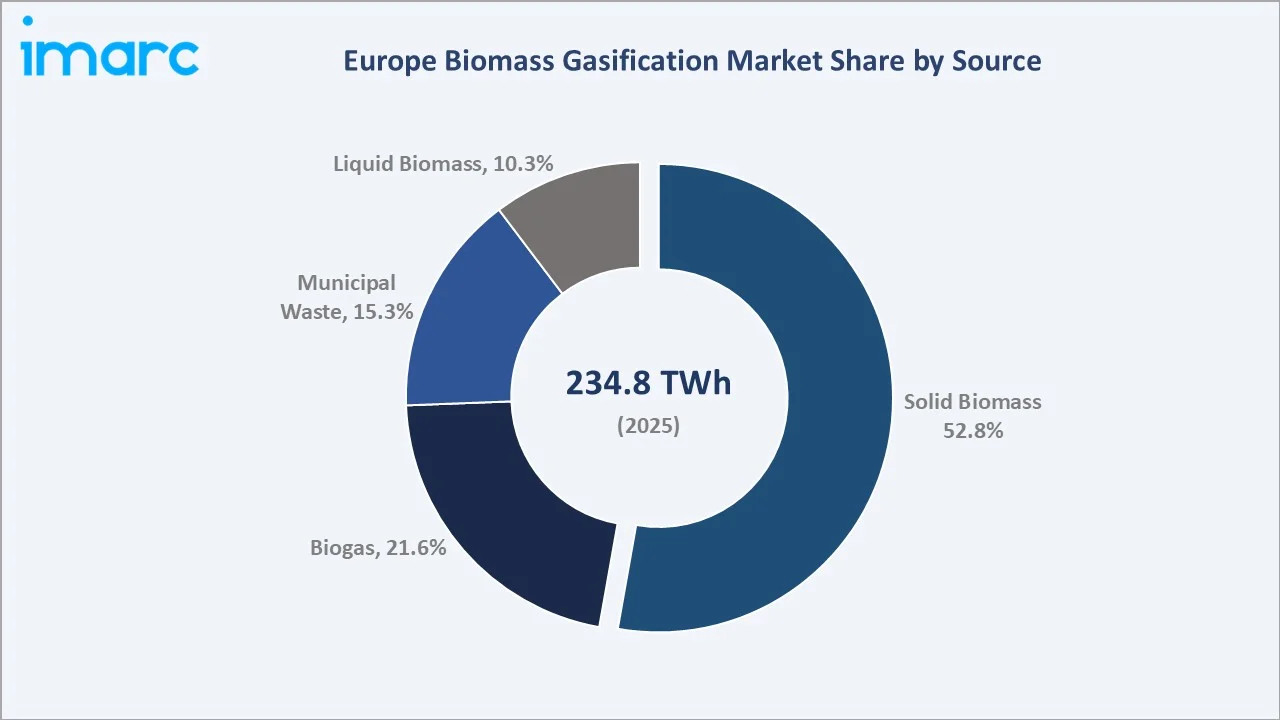
Solid biomass dominates the source segment at 52.8% in 2025, supported by abundant forestry residues and established supply chains. Germany leads the country-level landscape at 29.7%, reflecting its dense industrial base and mature bioenergy policy framework.
Key Market Insights
|
Insight |
Data |
|
Leading Source |
Solid Biomass - 52.8% share (2025) |
|
Second Largest Source |
Biogas - 21.6% share (2025) |
|
Leading Country |
Germany - 29.7% share (2025) |
|
Second Largest Country |
France - 18.6% share (2025) |
|
Top Companies |
Valmet, ANDRITZ, thyssenkrupp AG, SYNCRAFT GmbH |
Key Analytical Observations Supporting the Above Data:
- Solid biomass dominance at 52.8% is anchored by wide availability of forestry residues, sawmill by-products, and agricultural woody biomass, supported by mature handling and feeding infrastructure across established European plants.
- Biogas at 21.6% benefits from deep integration with agricultural and municipal organic-waste streams, complementing anaerobic digestion capacity already installed across Germany, France, and the Benelux region.
- Germany's 29.7% country lead reflects its dense industrial base, well-developed feed-in tariff history, and concentration of gasification technology suppliers headquartered in the country and neighboring Austria.
Europe Biomass Gasification Market Overview
Biomass gasification is a thermochemical process that converts solid or liquid biomass and organic waste into syngas, which can be combusted for power and heat or upgraded into biomethane and synthetic fuels. The European market spans fixed-bed, fluidized-bed, and entrained-flow gasifiers deployed across utility, industrial, and municipal applications.
The regional ecosystem integrates feedstock suppliers, technology and equipment providers, EPC contractors, utilities, regulators, and financing institutions. Macroeconomic factors, including energy security policy, carbon pricing, and rural development funding, continue to shape investment decisions across member states.
Market Dynamics
To evaluate market opportunities, Request Sample
Market Drivers
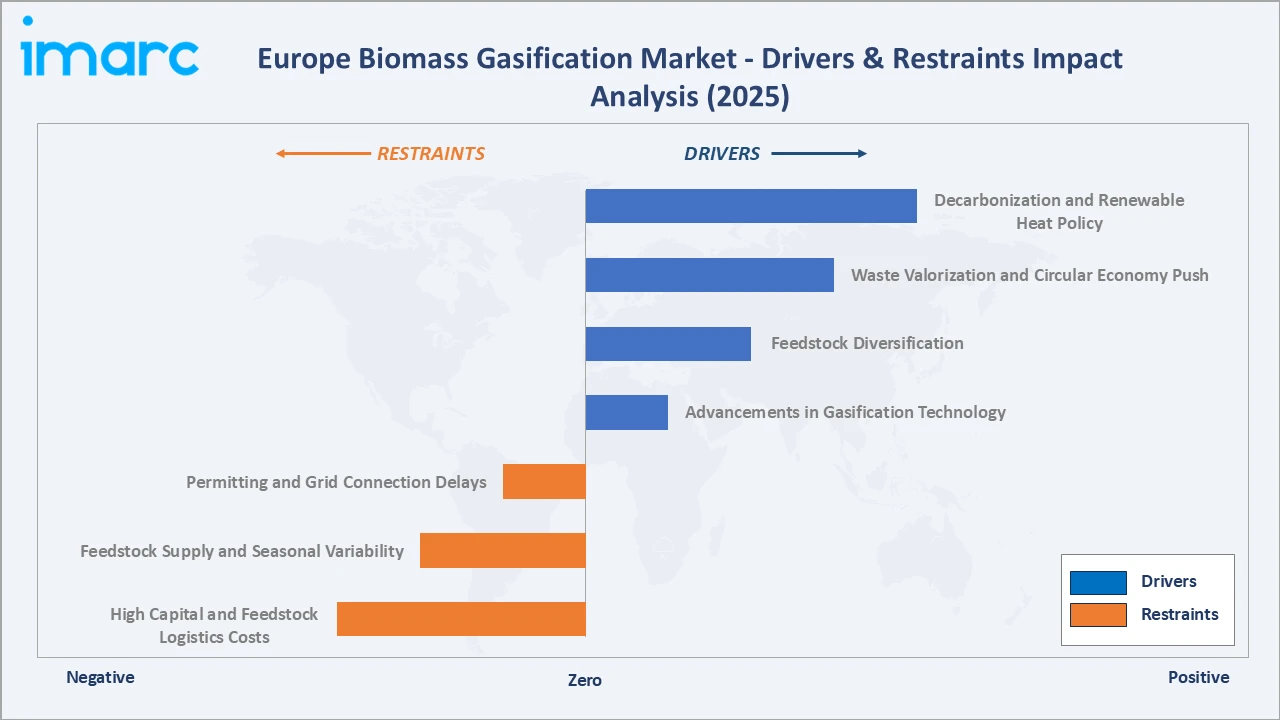
- Decarbonization and Renewable Heat Policy: National renewable energy directives and carbon-neutrality targets are pushing utilities and municipalities toward biomass-based dispatchable power and heat generation as a complement to intermittent wind and solar capacity. The proportion of renewable energy sources in EU energy use rose from 12.5% in 2010 to 26.2% in 2025.
- Waste Valorization and Circular Economy Push: Tightening landfill diversion rules across the EU are accelerating adoption of gasification for municipal and industrial waste streams that are otherwise difficult to recycle.
- Feedstock Diversification: Growing use of agricultural residues, energy crops, and liquid biomass alongside traditional woody feedstock is widening the addressable resource base for gasification developers.
- Advancements in Gasification Technology: Continuous improvements in gasifier efficiency, emissions control, and feedstock flexibility are enhancing the commercial viability of biomass gasification across power, heat, and industrial applications.
Market Restraints
- High Capital and Feedstock Logistics Costs: Gasification plants require significant upfront investment, and feedstock collection, drying, and transport logistics add meaningful operating cost pressure, particularly for smaller distributed installations.
- Feedstock Supply and Seasonal Variability: Regional dependence on agricultural and forestry residues exposes operators to seasonal supply fluctuations and competition from other biomass end-uses such as pellet manufacturing.
- Permitting and Grid Connection Delays: Lengthy environmental permitting processes and constrained grid or gas-network connection capacity in several member states are slowing project timelines.
Market Opportunities
- Advanced Syngas-to-Fuel Conversion: Growing interest in Fischer-Tropsch and methanation pathways creates opportunities to convert syngas into synthetic natural gas, higher-hydrogen syngas streams, and drop-in transport fuels.
- Small-Scale Distributed CHP: Modular gasification-CHP systems present opportunities for municipalities and rural cooperatives to secure localized, dispatchable renewable heat and power.
Market Challenges
- Technology Standardization: Wide variation in gasifier design and syngas cleaning approaches across vendors complicates plant benchmarking and slows large-scale replication of proven designs.
- Competing Renewable Pathways: Gasification competes for policy attention and capital with anaerobic digestion, green hydrogen electrolysis, and direct electrification, each vying for the same decarbonization budgets.
Emerging Market Trends
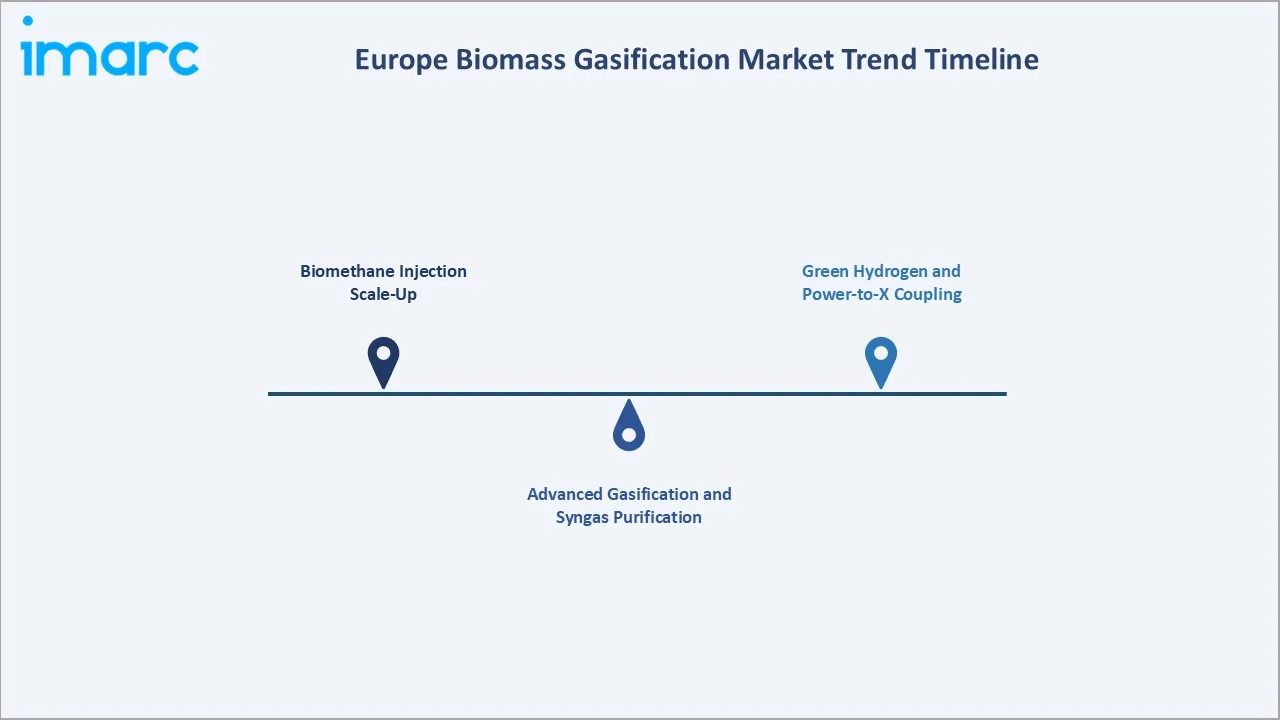
1. Biomethane Injection Scale-Up
Developers are increasingly coupling gasification with methanation units to inject bio-synthetic natural gas directly into existing gas grids, supported by expanding national injection tariffs and connection frameworks.
2. Advanced Gasification and Syngas Purification
Next-generation fluidized-bed and plasma-assisted gasifiers are improving syngas quality and tar reduction, lowering downstream cleaning costs and broadening the range of usable feedstocks.
3. Green Hydrogen and Power-to-X Coupling
Pilot projects are exploring hybrid configurations that combine gasification-derived syngas with electrolytic hydrogen to produce synthetic fuels, positioning gasification within broader Power-to-X value chains.
Industry Value Chain Analysis
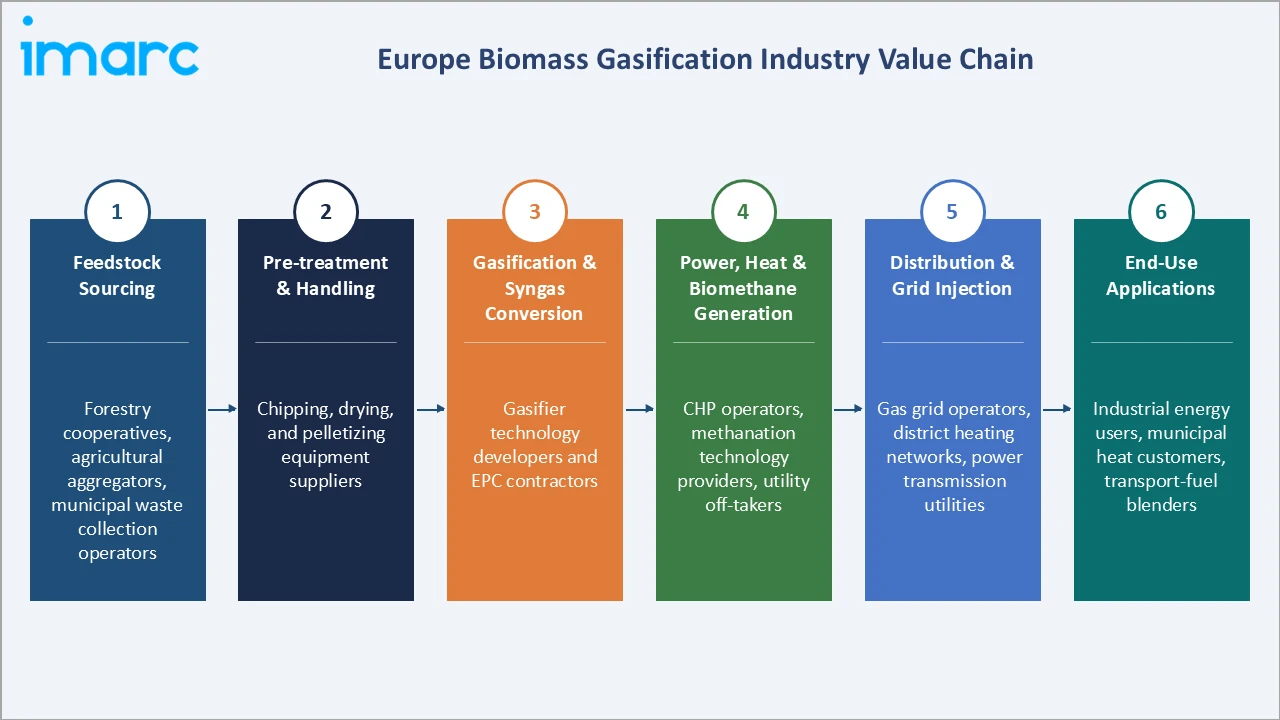
The Europe biomass gasification value chain spans six stages, from feedstock sourcing through end-use application. Technology providers and plant developers capture the largest share of value-add, while distribution and grid-injection infrastructure increasingly shape competitive positioning as biomethane pathways scale.
|
Stage |
Key Players / Examples |
|
Feedstock Sourcing |
Forestry cooperatives, agricultural aggregators, and municipal waste collection operators supplying woody, agricultural, and organic residues |
|
Pre-treatment & Handling |
Chipping, drying, and pelletizing equipment suppliers preparing feedstock for consistent gasifier performance |
|
Gasification & Syngas Conversion |
Gasifier technology developers and EPC contractors engineering fixed-bed, fluidized-bed, and entrained-flow systems |
|
Power, Heat & Biomethane Generation |
CHP operators, methanation technology providers, and utility off-takers |
|
Distribution & Grid Injection |
Gas grid operators, district heating networks, and power transmission utilities |
|
End-Use Applications |
Industrial energy users, municipal heat customers, and transport-fuel blenders |
Vertically integrated developers with proprietary gasifier designs and direct utility relationships are best positioned to capture value as biomethane and syngas-derived fuel pathways scale across the region.
Technology Landscape in the Europe Biomass Gasification Industry
Gasifier Design Innovation
Fluidized-bed and dual fluidized-bed gasifiers are gaining preference over legacy fixed-bed designs for their fuel flexibility and scalability, enabling operators to process a wider mix of woody, agricultural, and waste-derived feedstocks.
Syngas Cleaning and Materials Innovation
Advances in tar-cracking catalysts and ceramic filtration materials are improving syngas purity, reducing maintenance downtime, and extending the operating life of downstream turbines and methanation units.
Digital Monitoring and Smart Connectivity
Remote sensor networks and predictive-maintenance platforms are helping operators optimize gasifier temperature profiles and feedstock blending in real time, reducing unplanned outages across distributed plant fleets.
Automation and Process Control
Increasing use of automated feedstock handling and control-loop optimization is lowering labor intensity and improving consistency across small and mid-scale CHP installations.
Market Segmentation Analysis
The report covers the following segments:
|
Segment Category |
Leading Segment |
Market Share |
Year |
|
Source |
Solid Biomass |
52.8% |
2025 |
|
Region |
Germany |
29.7% |
2025 |

By Source
Solid biomass commands a 52.8% majority share in 2025, driven by abundant forestry and sawmill residue availability, established handling infrastructure, and compatibility with both fixed-bed and fluidized-bed gasifier designs across the region.
To access detailed market analysis, Request Sample
Biogas follows at 21.6%, benefiting from integration with existing anaerobic digestion feedstock supply chains in agricultural regions of Germany and France.
Regional Market Insights
|
Country |
Share (2025) |
Key Growth Drivers |
|
Germany |
29.7% |
Strong industrial base, mature bioenergy policy, dense concentration of gasification technology suppliers |
|
France |
18.6% |
Supportive renewable gas injection tariffs, expanding agricultural feedstock base, national biomethane roadmap |
|
United Kingdom |
17.1% |
Landfill diversion targets, growing waste-to-energy investment, expanding renewable heat incentive schemes |
|
Italy |
13.8% |
Rising municipal waste valorization needs, expanding biomethane grid injection framework, agricultural residue availability |
|
Spain |
10.9% |
Accelerating renewable energy investment, favorable climate for energy-crop feedstock, expanding rural bioenergy programs |
|
Others |
9.9% |
Gradual policy alignment with EU renewable gas targets and growing cross-border technology adoption |
Germany at 29.7% in 2025 leads the country-level landscape, supported by a dense industrial base, long-established renewable feed-in support, and the presence of several leading gasification technology developers headquartered in the country and neighboring Austria.
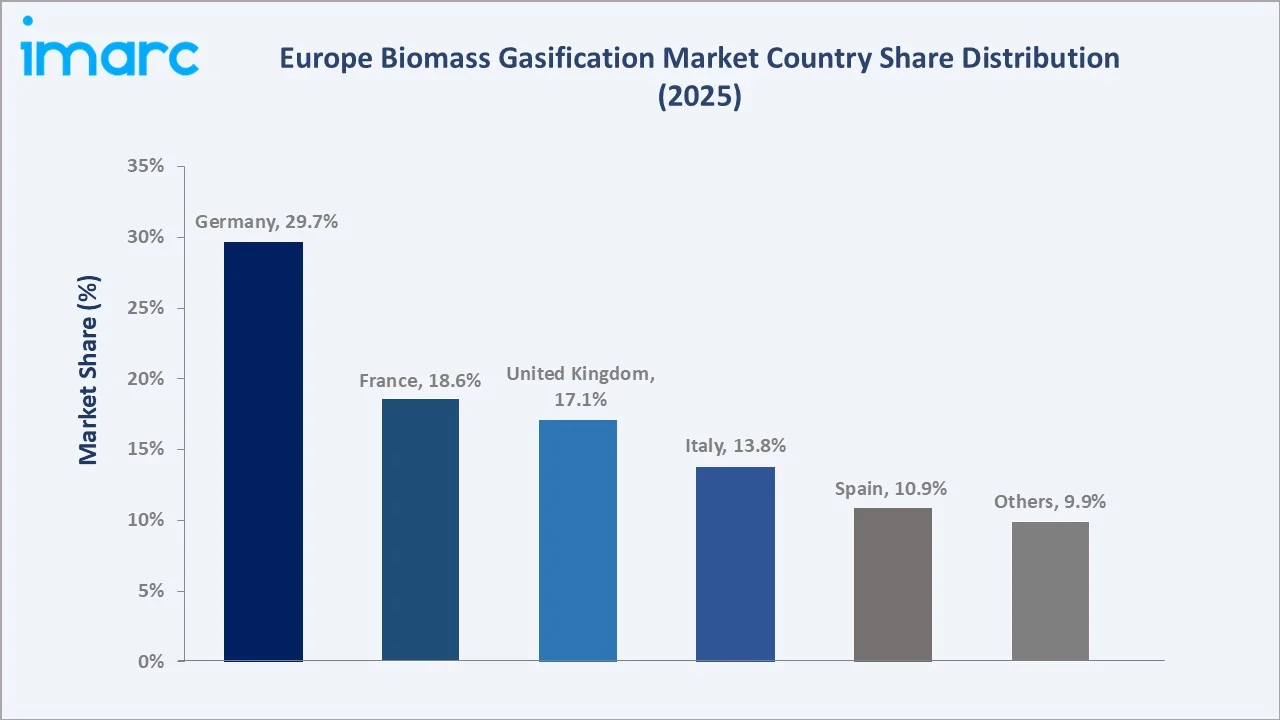
Spain at 10.9% is the fastest growing country. Expanding rural bioenergy programs, favorable feedstock availability, and accelerating renewable investment are supporting above-average national expansion through 2034.
Competitive Landscape
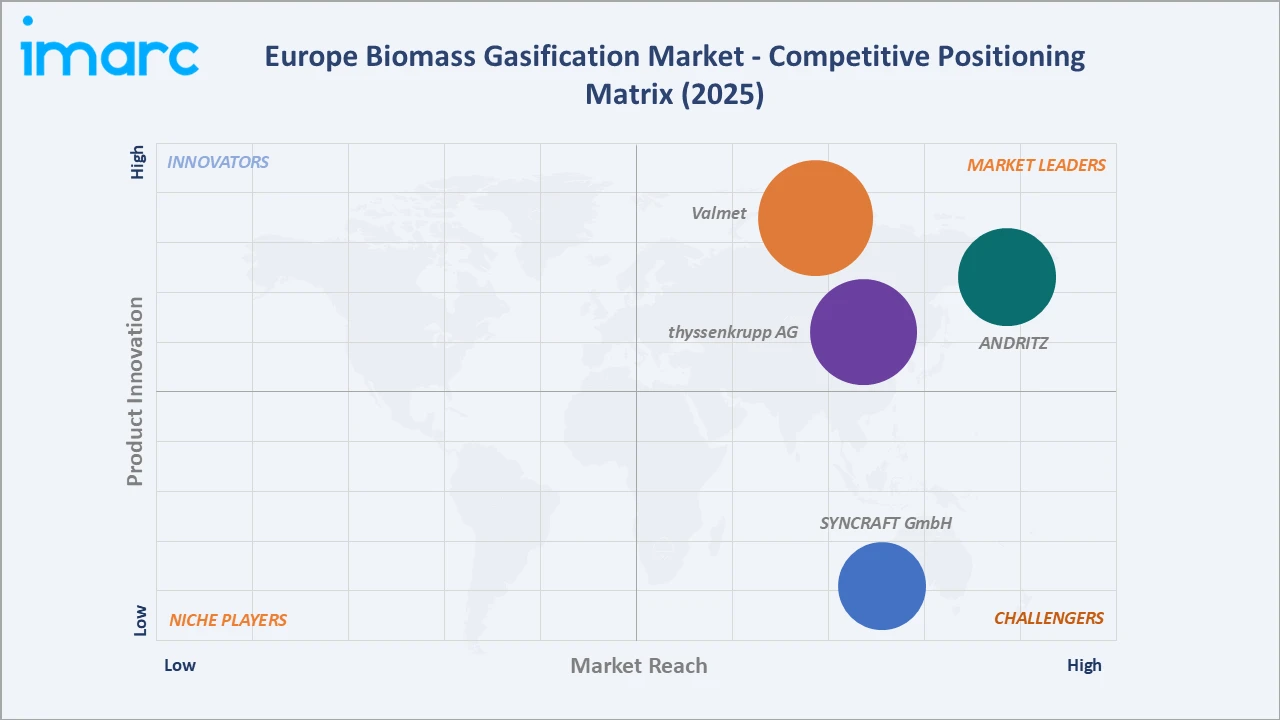
The Europe biomass gasification market is moderately fragmented, with established European engineering groups leading large-scale plant deployment while specialized technology developers compete on niche gasifier designs and modular small-scale systems. Technology proprietary know-how, EPC track record, and feedstock flexibility form the key competitive differentiators.
|
Company Name |
Brand / Key Product |
Position |
Strategic Focus |
|
Valmet |
Valmet Gasifier |
Leader |
Technology-driven gasification and bioenergy plant developer with broad European project portfolio |
|
ANDRITZ |
ANDRITZ Carbona Gasifiers |
Leader |
Diversified industrial technology group offering integrated gasification and biomass power solutions |
|
thyssenkrupp AG |
thyssenkrupp Uhde PRENFLO Gasification |
Leader |
Large-scale industrial gasification and engineering group with global project execution capability |
|
SYNCRAFT GmbH |
The Reversepowerplant |
Challenger |
Austrian manufacturer of floating fixed-bed wood gasification CHP plants |
Key players include Valmet, ANDRITZ, thyssenkrupp AG, and SYNCRAFT GmbH, among others.
Key Company Profiles
Valmet
Valmet is a global technology group headquartered in Finland, supplying gasification, boiler, and bioenergy plant solutions to utilities and industrial customers. The company has a long track record of delivering biomass power and CHP installations across Europe.
- Product Portfolio: Valmet Gasifier and related biomass boiler systems for power, heat, and industrial steam applications.
- Recent Developments: Valmet has continued expanding its biomass gasification and district heating portfolio through advanced gasification technologies and digital automation solutions that improve plant efficiency, operational flexibility, and lifecycle performance.
- Strategic Focus: Strengthening its European bioenergy footprint through fuel-flexible gasification and boiler technology, while expanding service and automation offerings for existing plant operators.
ANDRITZ
ANDRITZ is a diversified industrial technology group headquartered in Austria, offering gasification, boiler, and bioenergy solutions to power and industrial customers. The company's technology portfolio supports biomass power and gasification projects across multiple markets.
- Product Portfolio: ANDRITZ Carbona gasifiers and related biomass combustion systems integrated with the group's broader energy and environmental technology portfolio.
- Recent Developments: The company continues to expand its renewable energy and circular-economy technology offerings across its operations.
- Strategic Focus: Growing its bioenergy and gasification presence through integrated engineering capability and long-standing customer relationships across the industrial base.
thyssenkrupp AG
thyssenkrupp AG is a Germany-headquartered industrial engineering group whose technology businesses provide large-scale gasification and process engineering solutions. The company brings global EPC and licensing experience to complex gasification and syngas conversion projects.
- Product Portfolio: thyssenkrupp Uhde PRENFLO gasification technology for syngas production and downstream fuel and chemical applications.
- Recent Developments: The company continues to pursue engineering and licensing opportunities across its global gasification and process technology portfolio.
- Strategic Focus: Leveraging global engineering scale and process-technology depth to capture large industrial gasification and syngas conversion contracts.
Market Concentration Analysis
The Europe biomass gasification market is moderately fragmented, with the leading three developers, Valmet, ANDRITZ, and thyssenkrupp AG, accounting for a meaningful share of large-scale project activity, while specialized firms compete on modular and small-scale system design.
Barriers to entry include high engineering and capital intensity, the need for proven syngas cleaning performance, and long project development and permitting timelines. These factors favor established engineering groups with strong balance sheets and reference-plant track records.
Consolidation is expected to continue gradually as larger industrial groups acquire specialized gasification technology developers to broaden their renewable energy and circular-economy portfolios, while smaller technology licensors pursue partnership-based growth models.
Investment & Growth Opportunities
Fastest-Growing Segments
Liquid biomass is the fastest-growing source segment, supported by rising interest in advanced biofuel and synthetic-fuel conversion pathways. Its compatibility with flexible gasification technologies and growing availability from industrial and agricultural waste streams further strengthen its adoption across Europe.
Emerging Markets
Spain represents the fastest-growing country, anchored by expanding rural bioenergy programs, favorable feedstock availability, and accelerating alignment with EU renewable gas and circular-economy targets.
Venture & Investment Trends
Investment is concentrating in advanced syngas purification technology, modular small-scale gasification-CHP systems, and biomethane grid-injection infrastructure, supported by EU funding mechanisms tied to the REPowerEU biomethane scale-up agenda.
Future Market Outlook (2026-2034)
The Europe biomass gasification market is forecast to expand from 234.8 TWh in 2025 to 337.2 TWh by 2034 at a CAGR of 3.98%, adding roughly 102.4 TWh of incremental market volume over the forecast period.
Three forces will shape the market through 2034: continued policy support for renewable heat and biomethane injection, maturing syngas purification and gasifier technology, and deeper integration with circular-economy waste valorization frameworks.
By 2034, the Europe biomass gasification market is expected to be defined by larger, more fuel-flexible plants integrated with biomethane and syngas-to-fuel conversion pathways, supporting the region's broader decarbonization and energy security objectives.
Research Methodology
Primary Research
Primary research included structured interviews with gasification technology developers, plant operators, utility procurement teams, and regulatory specialists, validating market sizing, segment share, and country-level demand patterns.
Secondary Research
Secondary sources included European Commission energy policy publications, European Biogas Association market updates, national renewable energy agency data, and technology developers' public disclosures and project announcements.
Forecasting Models
Market forecasts used top-down and bottom-up models combining installed and planned gasification capacity, feedstock availability, regulatory transition scenarios, and macroeconomic variables, with scenario analysis addressing policy pace and feedstock cost variability.
Report Coverage:
| Report Features | Details |
|---|---|
| Base Year of the Analysis | 2025 |
| Historical Period | 2020-2025 |
| Forecast Period | 2026-2034 |
| Units | TWh |
| Scope of the Report | Exploration of Historical Trends and Market Outlook, Industry Catalysts and Challenges, Segment-Wise Historical and Future Market Assessment:
|
| Sources Covered | Solid Biomass, Biogas, Municipal Waste, Liquid Biomass |
| Countries Covered | Germany, France, United Kingdom, Italy, Spain, Others |
| Companies Covered | Valmet, ANDRITZ, thyssenkrupp AG, SYNCRAFT GmbH, etc. |
| Customization Scope | 10% Free Customization |
| Post-Sale Analyst Support | 10-12 Weeks |
| Delivery Format | PDF and Excel through Email (We can also provide the editable version of the report in PPT/Word format on special request) |
Frequently Asked Questions About the Europe Biomass Gasification Market Report
The Europe biomass gasification market reached a volume of 234.8 TWh in 2025, supported by decarbonization policy, waste valorization mandates, and expanding biomethane grid injection infrastructure.
The market is projected to grow at a CAGR of 3.98% from 2026-2034, reaching 337.2 TWh, supported by expanding syngas-to-fuel conversion and policy-backed renewable gas targets.
Solid biomass leads at 52.8% in 2025, driven by abundant forestry residues, established handling infrastructure, and compatibility with both fixed-bed and fluidized-bed gasifier designs.
Germany commands 29.7% in 2025, led by a dense industrial base, mature bioenergy policy, and concentration of leading gasification technology suppliers in the country.
Spain is the fastest-growing country, supported by expanding rural bioenergy programs, favorable feedstock availability, and accelerating renewable energy investment through 2034.
Leading players include Valmet, ANDRITZ, thyssenkrupp AG, and SYNCRAFT GmbH, among others.
Advances in fluidized-bed gasifier design, tar-cracking catalysts, and digital process monitoring are improving plant efficiency, syngas purity, and feedstock flexibility across the industry.
High capital and feedstock logistics costs, seasonal feedstock supply variability, and lengthy permitting and grid connection timelines remain key restraints for developers.
Need more help?
- Speak to our experienced analysts for insights on the current market scenarios.
- Include additional segments and countries to customize the report as per your requirement.
- Gain an unparalleled competitive advantage in your domain by understanding how to utilize the report and positively impacting your operations and revenue.
- For further assistance, please connect with our analysts.
 Request Customization
 Speak to an Analyst
 Request Brochure
 Inquire Before Buying
Benefits of Customization
- Personalize this research
- Triangulate with your data
- Get data as per your format and definition
- Gain a deeper dive into a specific application, geography, customer, or competitor
- Any level of personalization
Get in Touch With Us
UNITED STATES
Phone: +1-201-971-6302
INDIA
Phone: +91-120-433-0800
UNITED KINGDOM
Phone: +44-753-714-6104
Email: [email protected]
Client Testimonials




.webp)




.webp)













Related Reports

Choose your plan
*Please note that the prices mentioned below are starting prices for each bundle type. Kindly contact our team for further details.*
Single User License
- 1 User License, Access on 2 Devices
- PDF Report + Excel Dataset (Password Protected)
- Lifetime Access
- No Printing Rights
- 10% Free Report Customization
- 10–12 Weeks of Analyst Support
Five User License
- Access for 5 Users, 2 Devices per User
- PDF Report + Excel Dataset (Password Protected)
- Lifetime Access
- Dedicated Account Manager
- 12–14 Weeks of Analyst Support
- No Printing Rights
- 15% Free Report Customization
- 25% Discount on Your Next Purchase
Corporate User License
- Unlimited User Access (Within Your Organization)
- PDF Report + Excel Dataset
- Lifetime Access
- Dedicated Account Manager
- 14–20 Weeks of Analyst Support
- No Printing Rights
- 20% Free Report Customization
- 30% Discount on Your Next Purchase
Essential Insights
What's included:
3 reports
- Lifetime Access
- PDF Reports
- Excel Datasets
- 2 Weeks of Free Analyst Support
- 2 User Licenses
- Access on 2 Devices
- Printing Rights
- Complimentary PowerPoint (PPT) Version
- Complimentary License Upgrade
Professional Access
What's included:
5 reports
- Lifetime Access
- PDF Reports
- Excel Datasets
- 8 Weeks of Free Analyst Support
- 2 User Licenses
- Access on 2 Devices
- Printing Rights
- Complimentary PowerPoint (PPT) Version
- Complimentary License Upgrade
Business Advantage
What's included:
8 reports
- Lifetime Access
- PDF Reports
- Excel Datasets
- 14 Weeks of Free Analyst Support
- 2 User Licenses
- Access on 2 Devices
- Printing Rights
- Complimentary PowerPoint (PPT) Version
- Complimentary License Upgrade
Enterprise Intelligence
What's included:
10 reports
- Lifetime Access
- PDF Reports
- Excel Datasets
- 20 Weeks of Free Analyst Support
- 2 User Licenses
- Access on 2 Devices
- Printing Rights
- Complimentary PowerPoint (PPT) Version
- Complimentary License Upgrade