
Europe Polyols Market Size, Share, Trends and Forecast by Type, Application, Industry, and Country, 2026-2034
Europe Polyols Market Size, Share, Trends & Forecast (2026-2034)
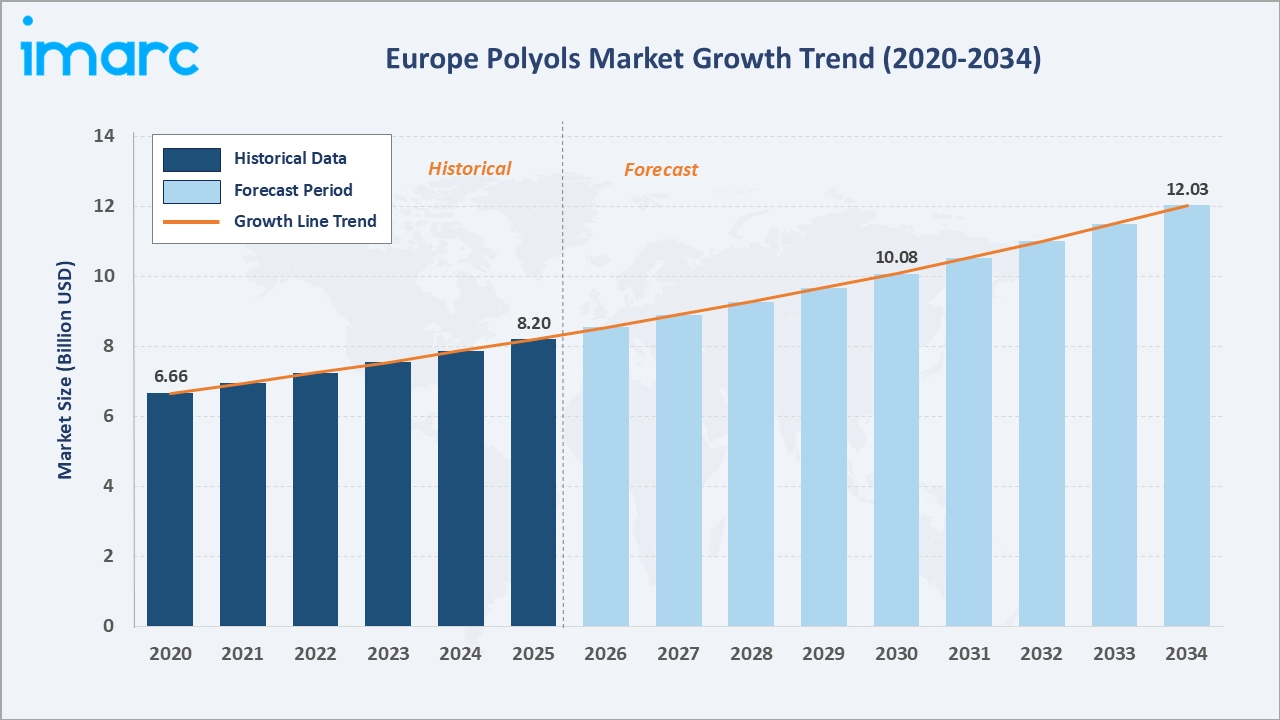
The Europe polyols market grew from USD 8.20 Billion in 2025 to USD 8.54 Billion in 2026. The market is further expected to reach USD 10.08 Billion by 2030 and USD 12.03 Billion by 2034, registering a CAGR of 4.23% during 2026-2034.
The market is driven by stringent EU energy efficiency mandates, rising demand for polyurethane foam in construction and automotive sectors, bio-based polyol innovation, and expanding flexible foam applications. Polyether Polyols lead at 63.5%, Building & Construction at 24.6%, and Germany commands 27.8% of the market.
Market Snapshot
|
Metric |
Value |
|
Base Year Market Size (2025) |
USD 8.20 Billion |
|
Market Size (2026) |
USD 8.54 Billion |
|
Forecast Market Size (2034) |
USD 12.03 Billion |
|
CAGR (2026-2034) |
4.23% |
|
Base Year |
2025 |
|
Historical Period |
2020-2025 |
|
Forecast Period |
2026-2034 |
|
Dominant Type |
Polyether Polyols (63.5%, 2025) |
|
Dominant Industry |
Building & Construction (24.6%, 2025) |
|
Leading Country |
Germany (27.8%, 2025) |
The Europe polyols market grew from USD 6.66 Billion in 2020 to USD 8.20 Billion in 2025 and is estimated to reach USD 8.54 Billion in 2026. The market is further expected to reach USD 10.08 Billion by 2030 and USD 12.03 Billion by 2034. Europe polyols market is commercially anchored in the region's mature polyurethane foam manufacturing base, supported by EU regulatory mandates driving energy efficiency in construction and automotive lightweighting. Germany's 27.8% share reflects its outsized chemical manufacturing and automotive OEM presence, while France and the UK contribute through construction and packaging demand.
To get more information on this market, Request Sample
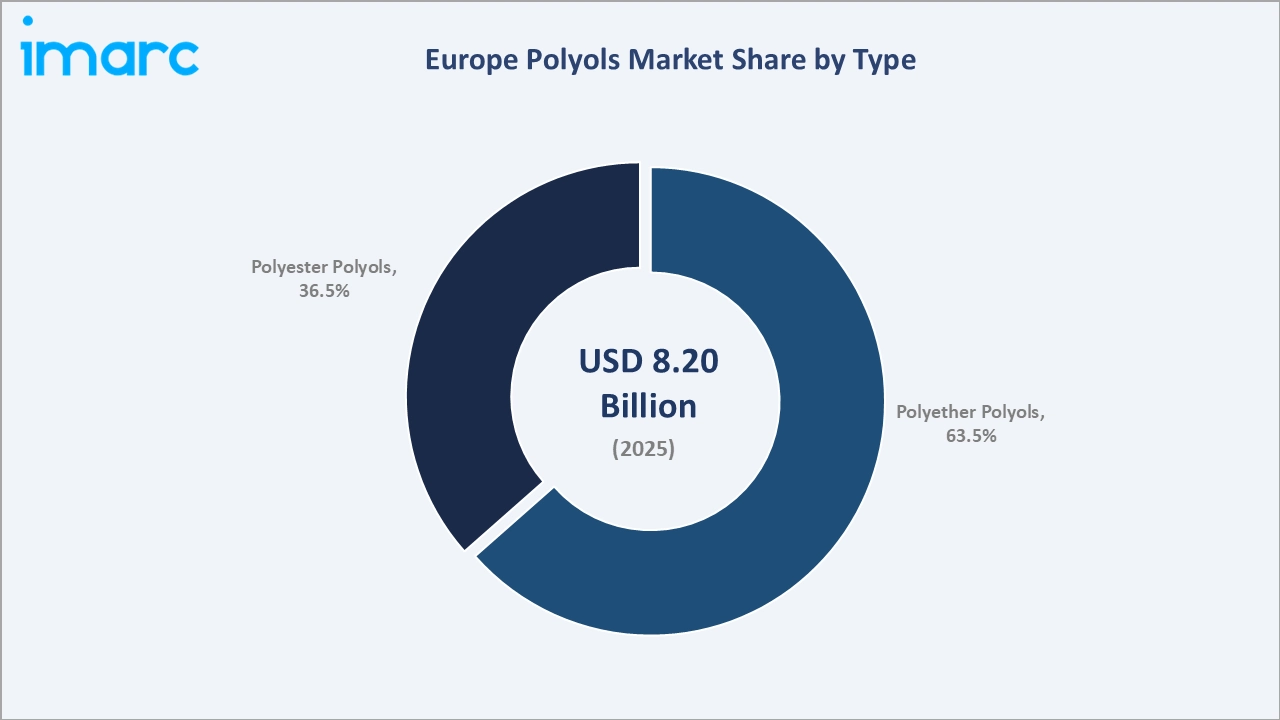
Polyether Polyols at 63.5% dominate through their dominant use in rigid and flexible polyurethane foam for insulation and furniture. Building & Construction at 24.6% leads industry demand through EU thermal performance standards. Germany's 27.8% reflects the highest concentration of polyol producers, compounders, and polyurethane foam converters in Europe.
Executive Summary
The Europe polyols market expanded from USD 8.20 Billion in 2025 to an estimated USD 8.54 Billion in 2026, positioning it as one of Europe's most strategically significant specialty chemical segments. The market is underpinned by robust demand from construction insulation, automotive interior systems, flexible furniture foam, and a rapidly growing bio-based polyol segment aligned with EU sustainability mandates. The market is projected to reach USD 12.03 Billion by 2034 at 4.23% CAGR.
Key Market Insights
|
Insight |
Data |
|
Dominant Type |
Polyether Polyols – 63.5% share (2025) |
|
Dominant Industry |
Building & Construction – 24.6% share (2025) |
|
Leading Country |
Germany – 27.8% share (2025) |
|
Market Opportunity |
Bio-based polyols from renewable feedstocks; recycled-content polyols from chemical PET/PU recycling; rigid foam for EPBD-compliant building renovation; EV battery thermal management foam |
Key Analytical Observations:
- Polyether Polyols at 63.5%: Dominates through superior performance in flexible foam and rigid foam, lower production costs relative to polyester variants, and better hydrolytic stability that makes polyether the preferred base chemistry for high-volume polyurethane applications across Europe's foam converting industry.
- Building & Construction at 24.6%: Leads industry demand through Europe's largest thermal insulation renovation market globally, driven by EU Energy Performance of Buildings Directive mandates requiring member states to retrofit millions of existing buildings to near-zero energy standards, creating structural polyurethane rigid foam demand growth that is policy-guaranteed through 2034.
- Germany at 27.8%: Commands regional leadership through Europe's largest chemical industry cluster, the highest concentration of automotive OEMs and Tier-1 suppliers driving polyurethane seating and interior demand collectively anchor Europe's polyol supply and processing chain.
Europe Polyols Market Overview
Europe polyols market is positioned at the intersection of the EU's two most commercially compelling chemical market forces: the energy efficiency building renovation wave mandated by the EPBD, and the automotive transition to electric vehicles requiring lightweight structural foam and battery thermal management materials. Both create durable, policy-backed polyol demand.
The market ecosystem integrates petrochemical feedstock producers, polyol synthesizers, foam formulators, downstream converters, and a growing bio-based and recycled polyol startup layer. Europe's strict REACH chemical regulations and PFAS restrictions are simultaneously raising barriers and accelerating innovation toward sustainable polyol chemistries with cleaner environmental profiles.
Market Dynamics
To evaluate market opportunities, Request Sample
Market Drivers
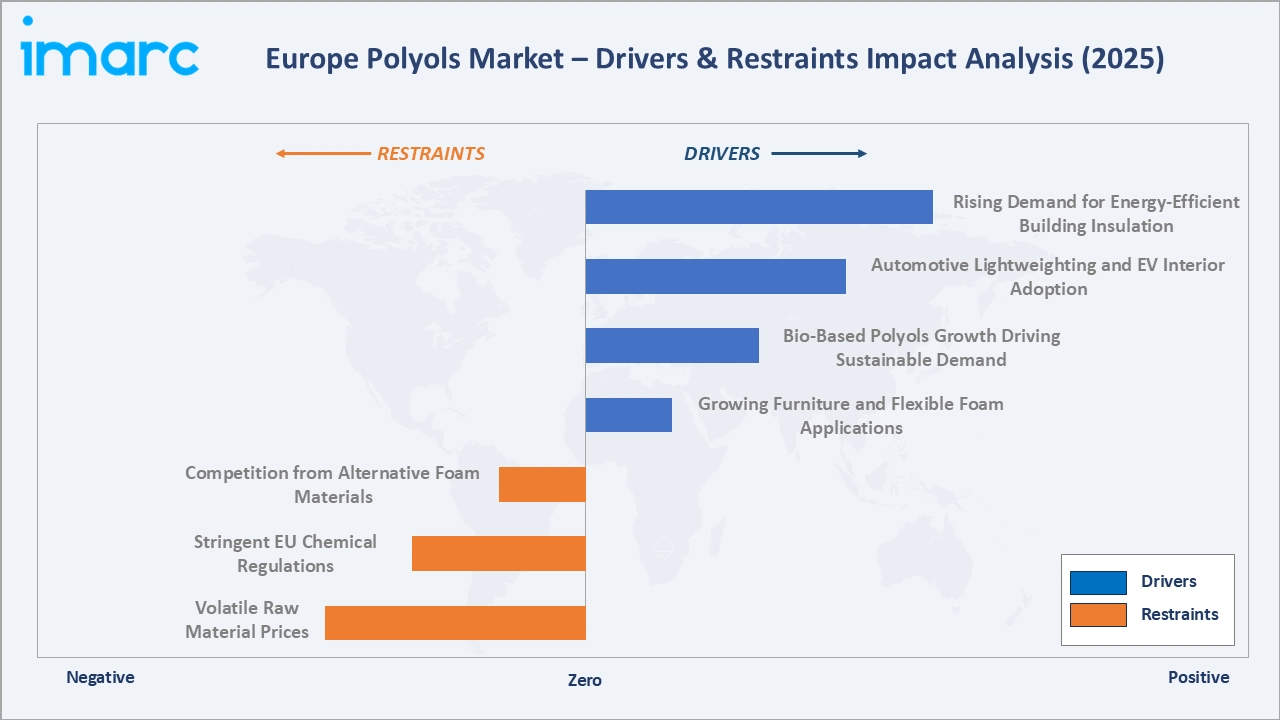
- Rising Demand for Energy-Efficient Building Insulation: EU Energy Performance of Buildings Directive (EPBD) recast mandates near-zero energy performance for new and renovated buildings across all 27 member states, creating a structural renovation wave that directly drives rigid polyurethane foam insulation demand—the performance insulation material of choice for roof, wall, and floor applications where space-efficient high-R-value insulation is required.
- Automotive Lightweighting and EV Interior Adoption: Europe's fleet CO₂ emission reduction targets under EU Regulation 2019/631 mandate average fleet emissions of 95 g CO₂/km for passenger cars, driving OEMs to systematically lightweight vehicle structures using polyurethane foam for seating, headliners, door panels, and acoustic insulation that reduces vehicle mass while maintaining safety and comfort standards. Every new EV platform contains 15-25 kg of polyurethane components, sustaining automotive polyol demand through the transition from ICE to electric drivetrains.
- Bio-Based Polyols Growth Driving Sustainable Demand: European polyol producers are commercialising bio-based polyols from castor oil, soybean oil, palm oil, and lignocellulosic biomass in response to EU Green Deal sustainability mandates, corporate ESG commitments, and downstream customer sustainability procurement requirements that are increasingly mandating renewable-content materials in foam supply chains. EU taxonomy-aligned capital is funding bio-polyol capacity expansion, creating a structurally growing premium segment within Europe's polyol market that sustains above-market CAGR through 2034.
- Growing Furniture and Flexible Foam Applications: Europe's mature furniture industry—second globally by production value after China—sustains significant polyether polyol demand for flexible slabstock and molded foam used in upholstered seating, mattresses, and bedding products that collectively represent the largest end-use application for flexible polyurethane foam. Post-pandemic home improvement investment, rising interior design premiums, and EU circular economy requirements driving foam formulation toward longer-life, recyclable foam systems are sustaining flexible foam polyol demand above pre-pandemic trends.
Market Restraints
- Volatile Raw Material Prices: Polyol production is critically dependent on propylene oxide (PO) as the primary monomer for polyether polyols and adipic acid and diols for polyester polyols—both petrochemical derivatives subject to crude oil price volatility and supply chain disruptions that create unpredictable production cost swings of 15-40% within annual cycles. Europe's energy crisis of 2022-2023, which drove natural gas prices to 10x pre-crisis levels, severely compressed polyol producer margins by simultaneously increasing energy-intensive PO production costs and ethylene oxide feedstock costs, illustrating the structural energy cost vulnerability of European polyol manufacturing relative to Middle Eastern and Asian competitors with access to lower-cost feedstocks.
- Stringent EU Chemical Regulations: EU REACH regulation's expanding Substances of Very High Concern (SVHC) candidate list, combined with proposed restrictions on per- and polyfluoroalkyl substances (PFAS) used as foam blowing agent components, creates ongoing reformulation requirements for polyol system houses that involve significant R&D cost, regulatory dossier preparation, and supply chain qualification cycles that can take 18-36 months per substance restriction. The EU Chemical Strategy for Sustainability's ambition to restrict entire chemical classes rather than individual substances creates regulatory uncertainty that discourages long-term capital commitment to polyol capacity expansion in European facilities when alternative jurisdictions with lighter chemical regulation offer more predictable investment environments.
- Competition from Alternative Foam Materials: Polyurethane foam faces growing material substitution pressure from phenolic foam, expanded polystyrene (EPS), mineral wool, and aerogel insulation in building applications where fire performance standards, sustainability certifications, and evolving EU construction product regulations create competitive windows for alternative insulation materials. In automotive applications, natural fibre composites, expanded polypropylene (EPP), and structural foam alternatives are making commercial inroads in applications previously dominated by polyurethane, creating substitution pressure that requires polyol producers to continuously innovate system performance to defend market position.
Market Opportunities
- Chemical Recycling of PU Foam Creating Recycled-Content Polyol Market: Chemolysis and glycolysis of post-consumer polyurethane foam waste creates polyols-from-waste that satisfy EU circular economy content requirements and allow foam producers to achieve recycled-content sustainability claims, creating a premium market segment growing at above-primary-market CAGR as recycling infrastructure scales.
- CO₂-Based Polyols Enabling Carbon Capture Value Chain: Covestro's cardyon technology uses CO₂ captured from industrial processes as a 20% feedstock replacement for petroleum in polyether polyol production, creating a commercially viable carbon capture utilisation pathway that aligns with EU carbon pricing policy and commands sustainability premiums from downstream customers with net-zero procurement commitments.
Market Challenges
- European Energy Cost Disadvantage vs. Asian and Middle Eastern Producers: Europe's structural energy cost premium—natural gas prices 3-5x US equivalents even post-2022 crisis normalization—creates a persistent production cost disadvantage for European polyol manufacturers relative to Middle Eastern PO producers and Asian polyol exporters, threatening European production capacity utilization and encouraging import substitution in commodity polyol grades.
- PFAS Restriction Impact on Blowing Agent Chemistry: Proposed EU-wide PFAS restrictions covering HFO blowing agents used in rigid polyurethane foam systems require system house reformulation across the entire rigid foam product portfolio, creating significant technical, commercial, and regulatory compliance investment requirements on compressed timelines with uncertain regulatory finalization dates.
Emerging Market Trends
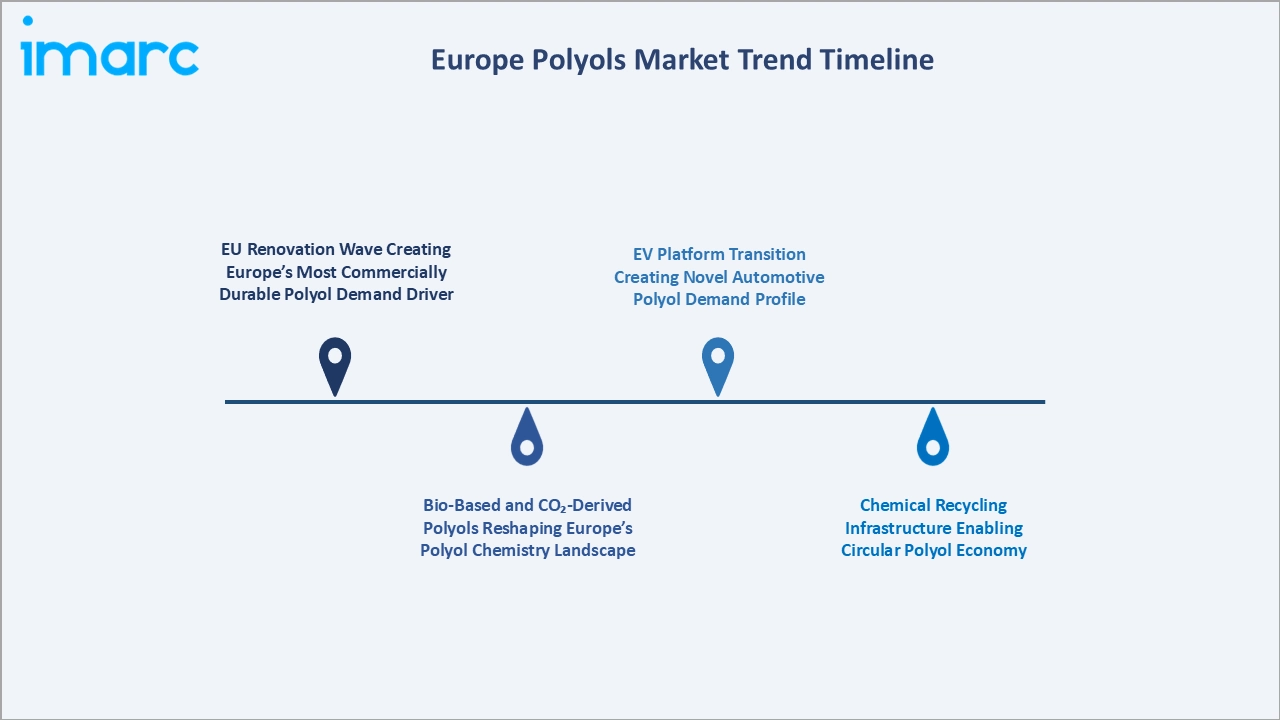
1. EU Renovation Wave Creating Europe's Most Commercially Durable Polyol Demand Driver
The EU Renovation Wave—targeting doubling of annual building renovation rates to 2030 under the EPBD recast—creates the most commercially durable polyol demand driver in Europe's construction history, as deep energy renovation requiring high-R-value insulation systematically favours polyurethane rigid foam over competing materials due to superior lambda values at commercially viable thicknesses.
2. Bio-Based and CO₂-Derived Polyols Reshaping Europe's Polyol Chemistry Landscape
European polyol producers are accelerating commercialization of bio-based polyols and CO₂-utilization polyols that deliver equivalent performance to petroleum-derived grades while satisfying EU Green Deal sustainability mandates and corporate net-zero procurement commitments. Covestro, BASF, and multiple bio-polyol startups are achieving commercial-scale production at premium but narrowing price differentials versus conventional polyols.
3. EV Platform Transition Creating Novel Automotive Polyol Demand Profile
Electric vehicle platforms create structurally distinct polyol demand from ICE vehicles: battery thermal management foam, acoustic foam for EV-specific noise profiles, lightweight structural foam for battery enclosure reinforcement, and improved comfort foam for longer-duration EV travel. Europe's target of 100% zero-emission new car sales by 2035 guarantees a sustained EV-specific polyol demand expansion replacing declining ICE foam volume.
4. Chemical Recycling Infrastructure Enabling Circular Polyol Economy
Investment in polyurethane foam chemical recycling—through glycolysis, hydrolysis, and aminolysis of post-consumer rigid and flexible foam—is creating the technical and commercial infrastructure for a circular polyol economy in Europe, where recycled-content polyols meet EU circular economy targets and allow foam producers to achieve recycled-content claims required by sustainable construction certification schemes.
Industry Value Chain Analysis
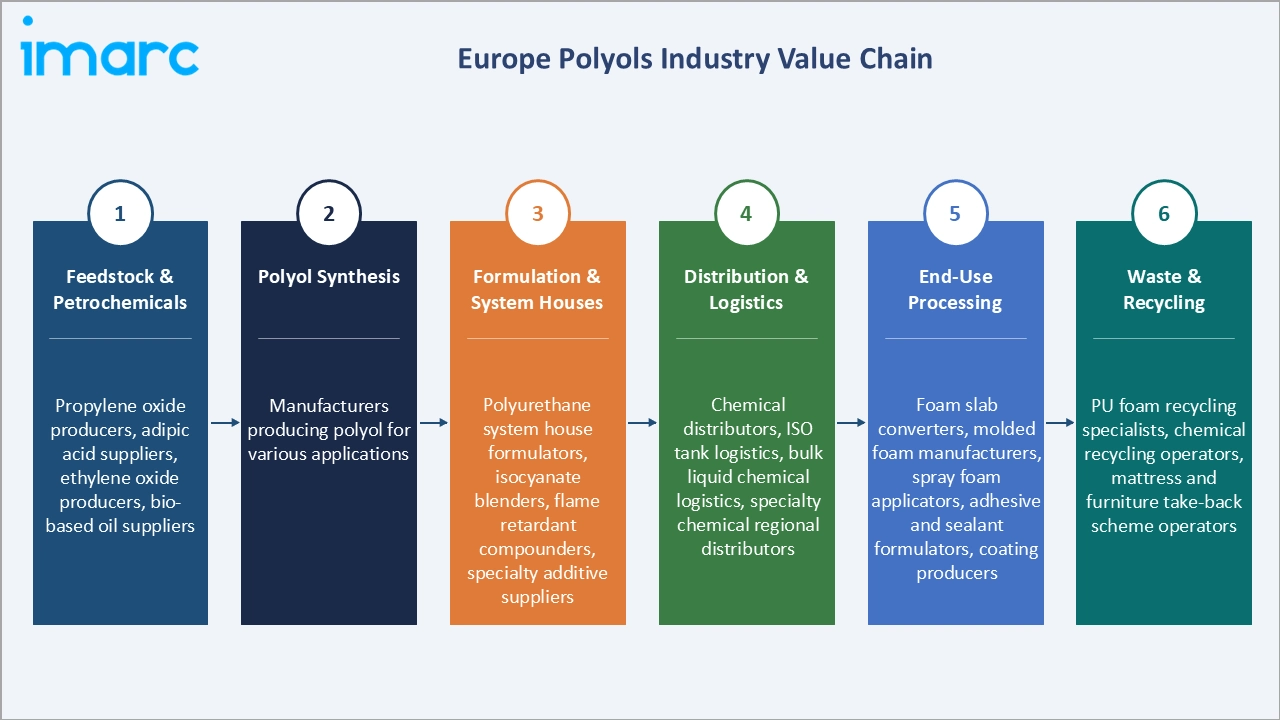
Europe polyols value chain is vertically integrated from petrochemical feedstocks through polyol synthesis, system house formulation, foam converting, and end-use fabrication—with the chemical synthesis and system house stages capturing the highest value addition and intellectual property concentration. The value chain is evolving toward bio-based feedstock integration at the upstream stage.
|
Stage |
Key Participants |
|
Feedstock & Petrochemicals |
Propylene oxide producers, adipic acid suppliers, ethylene oxide producers, bio-based oil suppliers |
|
Polyol Synthesis |
Manufacturers producing polyol for various applications |
|
Formulation & System Houses |
Polyurethane system house formulators, isocyanate blenders, flame retardant compounders, specialty additive suppliers |
|
Distribution & Logistics |
Chemical distributors, ISO tank logistics, bulk liquid chemical logistics, specialty chemical regional distributors |
|
End-Use Processing |
Foam slab converters, molded foam manufacturers, spray foam applicators, adhesive and sealant formulators, coating producers |
|
Waste & Recycling |
PU foam recycling specialists, chemical recycling operators, mattress and furniture take-back scheme operators |
The system house formulation stage is Europe's highest-value-added polyol processing layer, where polyol blends, catalysts, surfactants, and blowing agents are combined into application-specific polyurethane systems sold at 30-80% premium over commodity polyol prices—representing the primary commercial battleground for differentiation among Europe's major polyol producers.
Technology Landscape in the Europe Polyols Industry
CO₂-Based Polyol Synthesis Technology
Covestro's cardyon platform represents the commercial-scale breakthrough in CO₂-based polyol synthesis, where CO₂ replaces 20% of petroleum-derived propylene oxide in polyether polyol production. The technology uses zinc dicarboxylate catalyst systems to copolymerize CO₂ with propylene oxide at commercially viable rates, creating polyols with embedded carbon capture that satisfy EU sustainability requirements.
Bio-Based Polyol Fermentation and Transesterification
Bio-based polyols are produced through transesterification of vegetable oils and fermentation of bio-derived diols. Castor oil-derived polyols achieve near-drop-in replacement for petroleum polyester polyols in specific rigid foam applications, while soy-based polyols achieve 20-30% bio-content in flexible foam without performance compromise.
Chemical Recycling and Polyol Recovery
Glycolysis technology recovers polyols from post-consumer PU foam waste by reacting waste foam with glycols at elevated temperatures, yielding recycled polyols with functional properties suitable for re-entry into foam formulations. European recycling capacity is scaling through EU circular economy investment, with Covestro, Recticel, and specialist recyclers developing commercial glycolysis operations targeting mattress and insulation board recovery streams.
Market Segmentation Analysis
The report covers the following segments:
|
Segment Category |
Leading Segment |
Market Share |
Year |
|
Type |
Polyether Polyols |
63.5% |
2025 |
|
Industry |
Building & Construction |
24.6% |
2025 |
|
Application |
Flexible Polyurethane Foams |
🔒 |
2025 |
|
Country |
Germany |
27.8% |
2025 |

By Type
Polyether Polyols lead at 63.5% (2025). Polyether polyols produced by ring-opening polymerization of propylene oxide and ethylene oxide dominate through superior cost-performance balance in flexible and rigid polyurethane foam applications.
To access detailed market analysis, Request Sample
Polyester Polyols at 36.5% serve applications requiring superior mechanical properties, oil resistance, and adhesion—including polyurethane adhesives, coatings, elastomers, and specialty rigid foam for refrigeration insulation where polyester chemistry provides performance advantages that justify 15-25% price premium over polyether equivalents.
By Industry
Building & Construction leads at 24.6% (2025) through EU regulatory-mandated demand for thermal insulation in the EPBD renovation wave, with polyurethane rigid foam board and spray foam systems representing the highest-performance insulation technology for Europe's building stock renovation program targeting near-zero energy performance across millions of existing residential and commercial buildings.
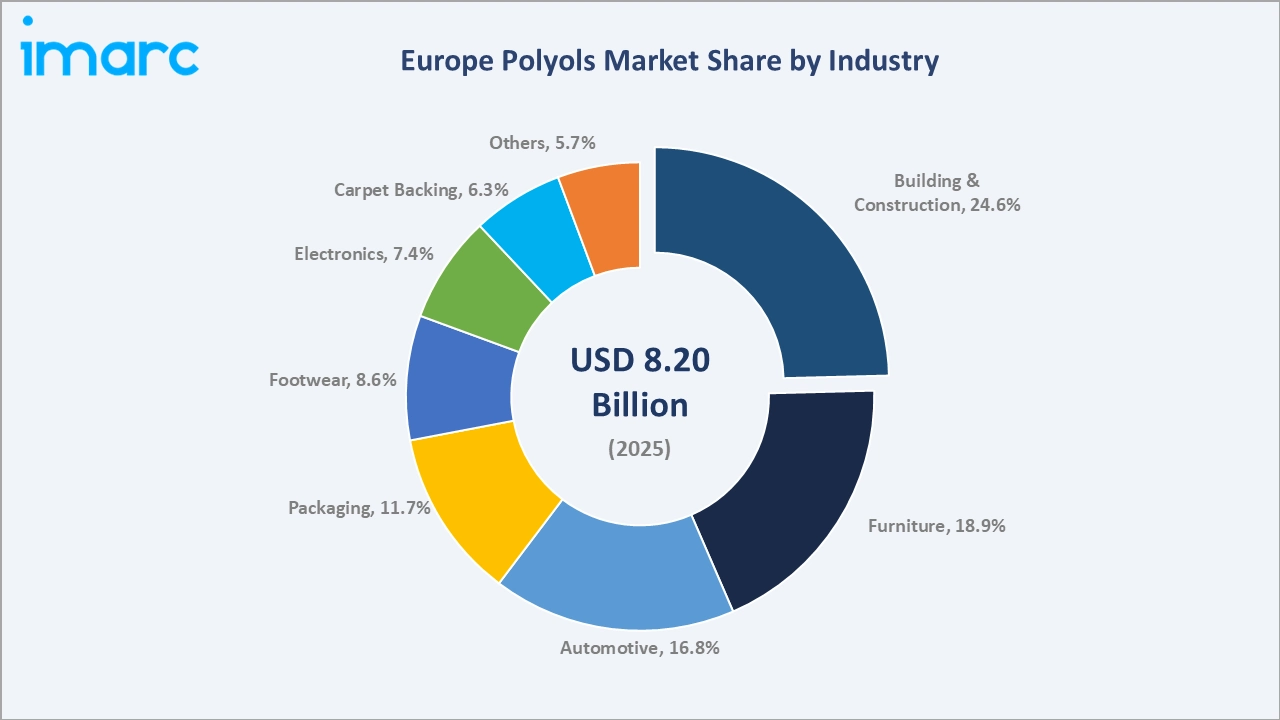
Furniture at 18.9% and Automotive at 16.8% are the second and third largest segments. Packaging at 11.7% drives polyol demand through polyurethane protective and thermal packaging growth. Footwear at 8.6%, Electronics at 7.4%, Carpet Backing at 6.3%, and Others at 5.7% represent diverse end-use applications collectively sustaining broad polyol demand diversification across Europe's industrial base.
Regional Market Insights
|
Country |
Share (2025) |
Key Europe Polyols Market Drivers & Characteristics |
|
Germany |
27.8% |
Europe's largest polyol producer and consumer; anchored by BASF, Covestro, LANXESS, and the world's highest concentration of automotive OEMs driving polyurethane foam demand. |
|
France |
21.6% |
Strong building renovation demand under French Rénov' scheme; major flexible foam manufacturing base for furniture and automotive seating; Arkema specialty polyol production. |
|
United Kingdom |
18.7% |
Significant flexible foam manufacturing and construction insulation market; post-Brexit chemical regulations creating both barriers and domestic production incentives. |
|
Italy |
12.5% |
Major furniture manufacturing hub (global top-3); rigid foam for construction; Coim Group domestic presence anchoring polyester polyol production and distribution. |
|
Spain |
10.4% |
Growing construction market with EU Renovation Fund investment; automotive supply chain polyol demand; wind energy blade manufacturing using specialty polyol composites. |
|
Others |
9.0% |
Netherlands, Belgium, Poland (growing automotive supply chain), Nordics (cold climate insulation demand) and other EU markets. |
Germany's 27.8% market leadership reflects both supply-side and demand-side concentration, various chemical production companies collectively make Germany the supply anchor of Europe's polyol market, while Germany's automotive OEM cluster creates the highest per-capita automotive polyol demand density in Europe.
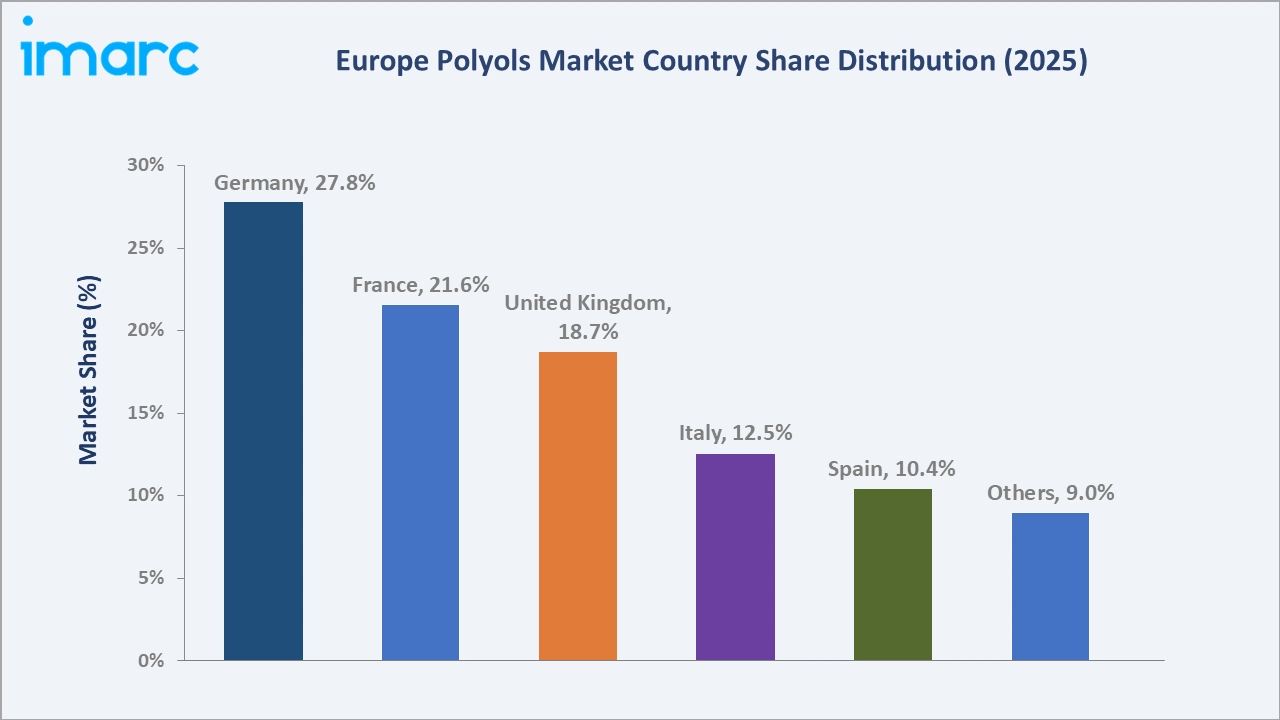
France's 21.6% reflects the French government's MaPrimeRénov' building renovation program that directly drive rigid polyurethane foam insulation demand. Italy's 12.5% is anchored in its globally significant furniture manufacturing cluster in the Brianza district and the Veneto region, which collectively represent Europe's largest flexible foam converting concentration.
Competitive Landscape
Europe polyols competitive landscape is dominated by the three largest integrated polyol producers with European manufacturing, R&D, and system house operations—competing alongside other key players across commodity and specialty polyol segments. Competition is intensifying through bio-based polyol innovation, circular chemistry, and system house differentiation.
|
Company |
Key Products |
Market Position |
Core Strength |
|
BASF |
Lupranol, Lupraphen |
Market Leader |
Europe's largest integrated polyol producer with the broadest portfolio from commodity polyether to bio-based Sovermol series, supported by BASF's Verbund production integration at Ludwigshafen enabling structural cost advantages. |
|
Covestro AG |
Arcol, Acclaim, Hyperlite, Desmophen |
Market Leader |
Pioneer of CO₂-based polyol technology through the cardyon platform; comprehensive MDI/TDI integration enabling system house solutions; strong automotive and construction market positions in Germany and across Europe. |
|
Dow |
Voranol, HYPERLITE, Specflex |
Strong Challenger |
Dow's Voranol brand is Europe's most widely specified polyether polyol for flexible foam; HYPERLITE technology enables 15% density reduction in automotive foam, creating differentiated lightweighting value proposition for European OEMs. |
|
Huntsman International LLC. |
Daltopir, Jeffol, Terol, Jeffrox |
Strong Challenger |
Fully integrated MDI/polyol system house capability through HUNTSMAN Building Products and Automotive divisions; strong position in construction spray foam and automotive multi-component systems across Europe. |
|
LANXESS |
Adiprene, Vibrance polyols |
Market Challenger |
Specialty polyurethane prepolymers and polyester polyols for high-performance elastomers, coatings, and engineering applications; strong position in automotive sealing, mining equipment, and industrial elastomer end-uses. |
|
Coim Group |
Synthoester, Synthoflexan |
Market Participant |
Italian specialty polyester polyol producer serving furniture, footwear, and automotive fabric lamination markets; strong domestic Italian distribution and European specialty distribution network from Offanengo headquarters. |
Key players include BASF, Covestro AG, Dow, Huntsman International LLC., LANXESS, Coim Group, and others.
Key Company Profiles
BASF
BASF is the world's largest chemical company and Europe's market-leading polyol producer, operating Europe's most integrated polyol production infrastructure at the Ludwigshafen Verbund site and across multiple European production facilities.
- Key Products: Lupranol, Lupraphen
- Strategic Focus: BASF is investing in digital system house service platforms that provide European foam converters with AI-assisted formulation support, processing parameter optimization, and regulatory compliance documentation, creating service-layer differentiation above the commodity polyol price competition that increasingly erodes margins in high-volume flexible foam polyol grades. The company's Verbund integration at Ludwigshafen, where propylene oxide, ethylene oxide, and polyol synthesis share infrastructure, utilities, and logistics, sustains structural cost advantages over standalone polyol producers in an energy-cost-constrained European chemical environment.
Covestro AG
Covestro AG is a German specialty chemical company spun off from Bayer in 2015, occupying the position of Europe's most innovation-forward polyol producer through the commercial-scale cardyon CO₂-polyol platform and comprehensive integration of MDI isocyanate production with polyol system house operations that enables fully specified polyurethane systems for construction, automotive, and furniture markets.
- Key Products: Arcol, Acclaim, Hyperlite, Desmophen
- Strategic Focus: Covestro is building proprietary circular economy polyol infrastructure through partnerships with European PU foam recyclers, targeting recycled-content polyol reintegration into Desmophen coating grades and Bayfit automotive foam systems that satisfy OEM recycled-content procurement requirements.
Market Concentration Analysis
Europe polyols market is moderately concentrated at the commodity polyether polyol tier, where top three key players collectively command an estimated 50-60% of European polyether polyol production capacity by volume. The polyester polyol segment is more fragmented, with other key players, and multiple regional producers competing across specialty applications.
Market concentration dynamics are evolving through two opposing forces: continued scale consolidation among top-3 producers investing in bio-based and CO₂-polyol technology leadership, while simultaneous fragmentation emerges from bio-polyol startups and chemical recycling operators entering the premium recycled-content polyol segment with differentiated sustainable chemistry that large producers have not fully commercialized.
Investment & Growth Opportunities
Highest Growth Segments
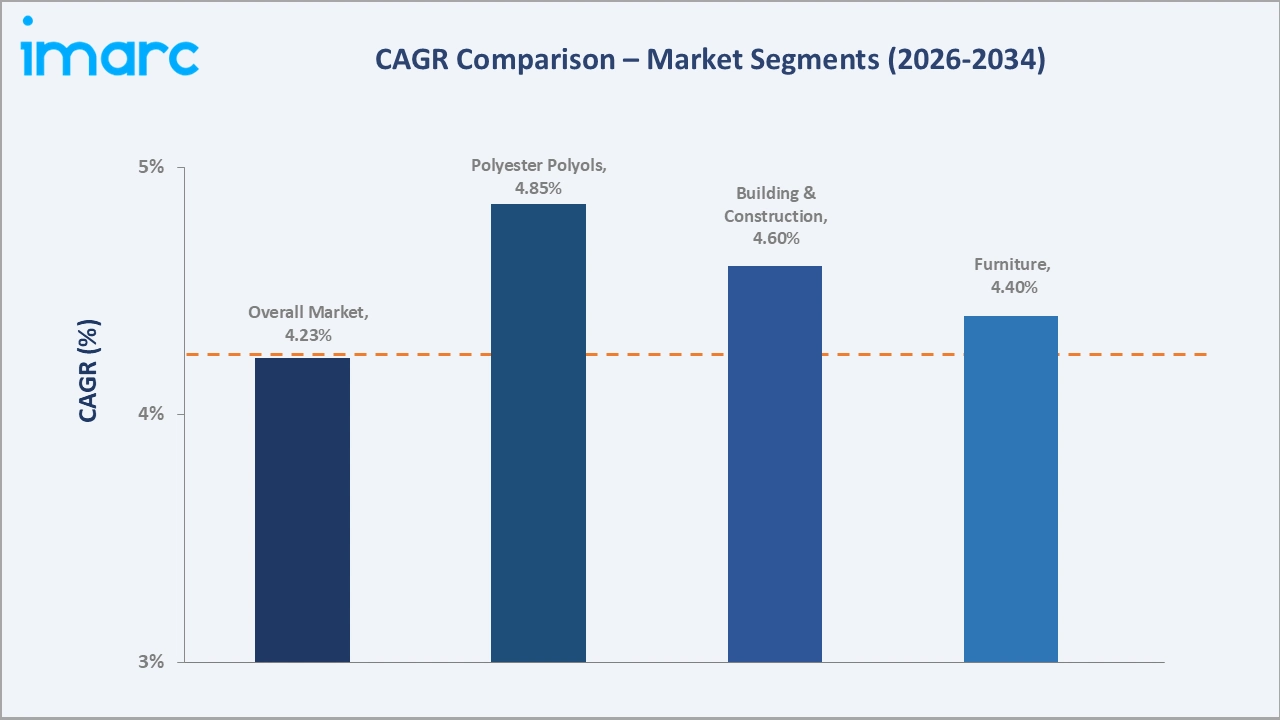
Polyester polyols (~4.85% CAGR through specialty construction and EV applications), Building & Construction (~4.60% CAGR through EPBD renovation mandate), and Germany (~4.30% CAGR through automotive EV transition and renovation) represent Europe's highest-growth polyol investment vectors through 2034.
Emerging Investment Opportunities
Europe's chemical recycling of polyurethane foam waste represents the highest-CAGR emerging polyol investment opportunity, where glycolysis and hydrolysis technologies create recycled-content polyols from the 2+ million tonnes of PU foam waste generated annually, satisfying EU circular economy requirements and commanding 15-30% premiums over virgin polyol grades.
Investment Themes
- EU Renovation Wave infrastructure investment for rigid polyurethane spray foam and board insulation system houses, targeting the 35 million building renovation program that creates contracted polyol demand growth through 2034 independent of broader construction market cyclicality.
- Bio-based polyol capacity expansion aligned with EU taxonomy-eligible sustainable chemical investment, capturing premium pricing from downstream foam producers with mandatory bio-content procurement requirements under corporate sustainability commitments and EU construction product regulations.
Future Market Outlook (2026-2034)
The Europe polyols market is projected to grow from USD 8.20 Billion in 2025 to USD 8.54 Billion in 2026, reaching USD 12.03 Billion by 2034, registering a CAGR of 4.23% during 2026-2034. The market's anchor of USD 10.08 Billion by 2030 represents the structural inflection where bio-based polyols achieve cost parity with petroleum grades, chemical recycling polyols achieve commercial scale, and EV-specific polyol applications grow from niche to mainstream volume in Europe's automotive supply chain.
Three structural forces define Europe polyols market growth through 2034: EU regulatory mandate-driven construction renovation creating guaranteed rigid foam polyol demand; automotive EV transition sustaining and transforming automotive polyol demand profiles; and bio-based and circular economy chemistry creating premium growth segments above the commodity polyol market CAGR.
Research Methodology
Primary Research
Primary research comprised structured interviews with Europe polyols industry stakeholders including polyol plant directors, system house formulators, foam converting executives, procurement managers at OEM and construction companies, bio-polyol startup founders, and regulatory advisors across Germany, France, UK, Italy, and Spain. Over 45 stakeholder interviews conducted.
Secondary Research
Secondary research encompassed ECHA chemical substance databases, EU chemical production statistics (Eurostat), company annual reports, CEFIC European Chemical Industry Council data, IPUA (Isocyanates and Polyols Users Association) market data, EU building renovation policy documents, and automotive fleet CO₂ regulatory databases. Over 60 secondary sources reviewed.
Forecasting Models
Market revenue forecasts were developed using a demand-side aggregation model: European polyurethane foam production volume by end-use segment multiplied by polyol content coefficients per foam type, aggregated across all EU member states. EU EPBD renovation targets, automotive production forecasts, and furniture production indices applied as demand multipliers by segment.
Europe Polyols Market Report Coverage:
| Report Features | Details |
|---|---|
| Base Year of the Analysis | 2025 |
| Historical Period | 2020-2025 |
| Forecast Period | 2026-2034 |
| Units | Billion USD |
| Scope of the Report |
Exploration of Historical Trends and Market Outlook, Industry Catalysts and Challenges, Segment-Wise Historical and Future Market Assessment:
|
| Types Covered | Polyether Polyols, Polyester Polyols |
| Applications Covered | Flexible Polyurethane Foams, Rigid Polyurethane Foams, CASE (Coatings, Adhesives, Sealants & Elastomers), Others |
| Industries Covered | Carpet Backing, Packaging, Furniture, Automotive, Building & Construction, Electronics, Footwear, Others |
| Countries Covered | Germany, France, United Kingdom, Italy, Spain, Others |
| Companies Covered | BASF, Covestro AG, Dow, Huntsman International LLC., LANXESS, Coim Group, etc. |
| Customization Scope | 10% Free Customization |
| Post-Sale Analyst Support | 10-12 Weeks |
| Delivery Format | PDF and Excel through Email (We can also provide the editable version of the report in PPT/Word format on special request) |
Frequently Asked Questions About the Europe Polyols Market Report
Europe polyols market size is estimated at USD 8.54 Billion in 2026, driven by EU Energy Performance of Buildings Directive renovation mandates, automotive lightweighting requirements, bio-based polyol innovation, and flexible foam demand from Europe's furniture and automotive seating manufacturing base.
Europe polyols market grows at 4.23% CAGR during 2026-2034, reaching USD 12.03 Billion by 2034. Growth is sustained by EPBD-mandated construction renovation driving rigid foam demand, EV platform adoption sustaining automotive polyol volume, bio-based polyol premiumization, and chemical recycling infrastructure scaling to create a circular polyol economy at commercial scale.
Polyether Polyols leads at 63.5% through dominant performance in flexible and rigid polyurethane foam applications, lower cost versus polyester equivalents, superior hydrolytic stability, and established European supply chain infrastructure.
Building & Construction leads at 24.6% through EU Energy Performance of Buildings Directive mandates requiring near-zero energy performance for renovated buildings, driving rigid polyurethane foam insulation demand that benefits from unique lambda value performance advantages over EPS and mineral wool at commercially viable thicknesses.
Germany leads at 27.8% through Europe's highest concentration of polyol producers, the world's highest automotive OEM density creating integrated polyurethane foam demand, and Germany's Federal Climate Action Programme driving building renovation investment.
Leading companies include BASF, Covestro AG, Dow, Huntsman International LLC., LANXESS, Coim Group, and others.
Europe polyols market is projected to reach approximately USD 10.08 Billion by 2030, with bio-based polyols achieving near cost parity with petroleum grades, chemical recycling polyols reaching commercial scale through glycolysis infrastructure investment, EV-specific polyol applications growing to mainstream automotive volumes, and EPBD renovation programs entering peak demand phase.
Need more help?
- Speak to our experienced analysts for insights on the current market scenarios.
- Include additional segments and countries to customize the report as per your requirement.
- Gain an unparalleled competitive advantage in your domain by understanding how to utilize the report and positively impacting your operations and revenue.
- For further assistance, please connect with our analysts.
 Request Customization
 Speak to an Analyst
 Request Brochure
 Inquire Before Buying
Benefits of Customization
- Personalize this research
- Triangulate with your data
- Get data as per your format and definition
- Gain a deeper dive into a specific application, geography, customer, or competitor
- Any level of personalization
Get in Touch With Us
UNITED STATES
Phone: +1-201-971-6302
INDIA
Phone: +91-120-433-0800
UNITED KINGDOM
Phone: +44-753-714-6104
Email: [email protected]
Client Testimonials




.webp)




.webp)













Related Reports

Choose your plan
*Please note that the prices mentioned below are starting prices for each bundle type. Kindly contact our team for further details.*
Single User License
- 1 User License, Access on 2 Devices
- PDF Report + Excel Dataset (Password Protected)
- Lifetime Access
- No Printing Rights
- 10% Free Report Customization
- 10–12 Weeks of Analyst Support
Five User License
- Access for 5 Users, 2 Devices per User
- PDF Report + Excel Dataset (Password Protected)
- Lifetime Access
- Dedicated Account Manager
- 12–14 Weeks of Analyst Support
- No Printing Rights
- 15% Free Report Customization
- 25% Discount on Your Next Purchase
Corporate User License
- Unlimited User Access (Within Your Organization)
- PDF Report + Excel Dataset
- Lifetime Access
- Dedicated Account Manager
- 14–20 Weeks of Analyst Support
- No Printing Rights
- 20% Free Report Customization
- 30% Discount on Your Next Purchase
Essential Insights
What's included:
3 reports
- Lifetime Access
- PDF Reports
- Excel Datasets
- 2 Weeks of Free Analyst Support
- 2 User Licenses
- Access on 2 Devices
- Printing Rights
- Complimentary PowerPoint (PPT) Version
- Complimentary License Upgrade
Professional Access
What's included:
5 reports
- Lifetime Access
- PDF Reports
- Excel Datasets
- 8 Weeks of Free Analyst Support
- 2 User Licenses
- Access on 2 Devices
- Printing Rights
- Complimentary PowerPoint (PPT) Version
- Complimentary License Upgrade
Business Advantage
What's included:
8 reports
- Lifetime Access
- PDF Reports
- Excel Datasets
- 14 Weeks of Free Analyst Support
- 2 User Licenses
- Access on 2 Devices
- Printing Rights
- Complimentary PowerPoint (PPT) Version
- Complimentary License Upgrade
Enterprise Intelligence
What's included:
10 reports
- Lifetime Access
- PDF Reports
- Excel Datasets
- 20 Weeks of Free Analyst Support
- 2 User Licenses
- Access on 2 Devices
- Printing Rights
- Complimentary PowerPoint (PPT) Version
- Complimentary License Upgrade