
GCC Automated Construction Equipment Market Report by Autonomy Type (Semi-Autonomous, Fully Autonomous), Type (Earth Moving Equipment, Material Handling Equipment, Building and Road Construction Equipment, and Others), Application (Road Construction, Building Construction, Excavation, Site Monitoring, and Others), and Country 2026-2034
Market Overview:
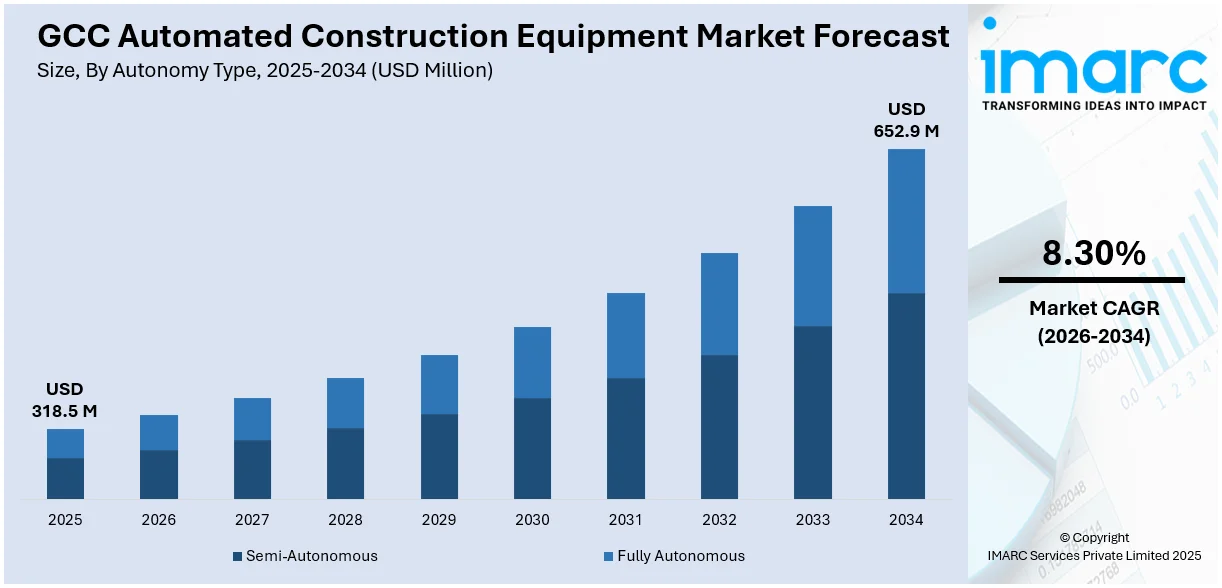
GCC automated construction equipment market size reached USD 318.5 Million in 2025. Looking forward, IMARC Group expects the market to reach USD 652.9 Million by 2034, exhibiting a growth rate (CAGR) of 8.30% during 2026-2034. The ongoing advancements in robotics, artificial intelligence (AI), and sensor technologies, which have enabled the development of more sophisticated and capable automated construction equipment, are driving the market.
|
Report Attribute
|
Key Statistics
|
|---|---|
|
Base Year
|
2025 |
|
Forecast Years
|
2026-2034
|
|
Historical Years
|
2020-2025
|
| Market Size in 2025 | USD 318.5 Million |
| Market Forecast in 2034 | USD 652.9 Million |
| Market Growth Rate (2026-2034) | 8.30% |
Automated construction equipment refers to machinery and tools that utilize advanced technologies to perform tasks traditionally carried out by human operators in the construction industry. These machines incorporate sensors, artificial intelligence, and automation systems to execute various construction processes with precision and efficiency. Examples include autonomous excavators, bulldozers, and cranes equipped with GPS, LiDAR, and computer vision systems. Automated construction equipment enhances safety by reducing the need for human intervention in hazardous environments. It also increases productivity, lowers operational costs, and improves overall project timelines. As technology continues to advance, the integration of automation in construction equipment is expected to play a pivotal role in shaping the future of the construction industry, offering benefits in terms of speed, accuracy, and overall project management.
To get more information on this market Request Sample
GCC Automated Construction Equipment Market Trends:
The automated construction equipment market in GCC is experiencing robust growth, driven by various factors that collectively shape the industry's landscape. Firstly, advancements in technology have played a pivotal role in fostering automation, enhancing the efficiency and precision of construction processes. As sensors, artificial intelligence, and machine learning become increasingly sophisticated, construction equipment can operate with greater autonomy, reducing the need for manual intervention. Moreover, the rising emphasis on safety in the construction sector has propelled the demand for automated equipment. These machines are equipped with advanced safety features, minimizing the risks associated with construction activities and ensuring a safer working environment. Additionally, the growing awareness of environmental sustainability has led to a surge in demand for construction equipment that is not only efficient but also eco-friendly. Automated equipment often incorporates energy-efficient technologies, aligning with the regional push towards greener construction practices. Furthermore, the need for faster project completion and cost-effectiveness has driven construction companies to adopt automated solutions. Automated equipment significantly accelerates construction timelines, leading to quicker project deliveries and cost savings. In conclusion, the automated construction equipment market in GCC is thriving, fueled by technological innovations, safety concerns, environmental considerations, and the pursuit of efficiency in construction processes.
GCC Automated Construction Equipment Market Segmentation:
IMARC Group provides an analysis of the key trends in each segment of the market, along with forecasts at the regional and country levels for 2026-2034. Our report has categorized the market based on autonomy type, type, and application.

Autonomy Type Insights:
- Semi-Autonomous
- Fully Autonomous
The report has provided a detailed breakup and analysis of the market based on the autonomy type. This includes semi-autonomous and fully autonomous.
Type Insights:
- Earth Moving Equipment
- Material Handling Equipment
- Building and Road Construction Equipment
- Others
A detailed breakup and analysis of the market based on the type have also been provided in the report. This includes earth moving equipment, material handling equipment, building and road construction equipment, and others.
Application Insights:
Access the comprehensive market breakdown Request Sample
- Road Construction
- Building Construction
- Excavation
- Site Monitoring
- Others
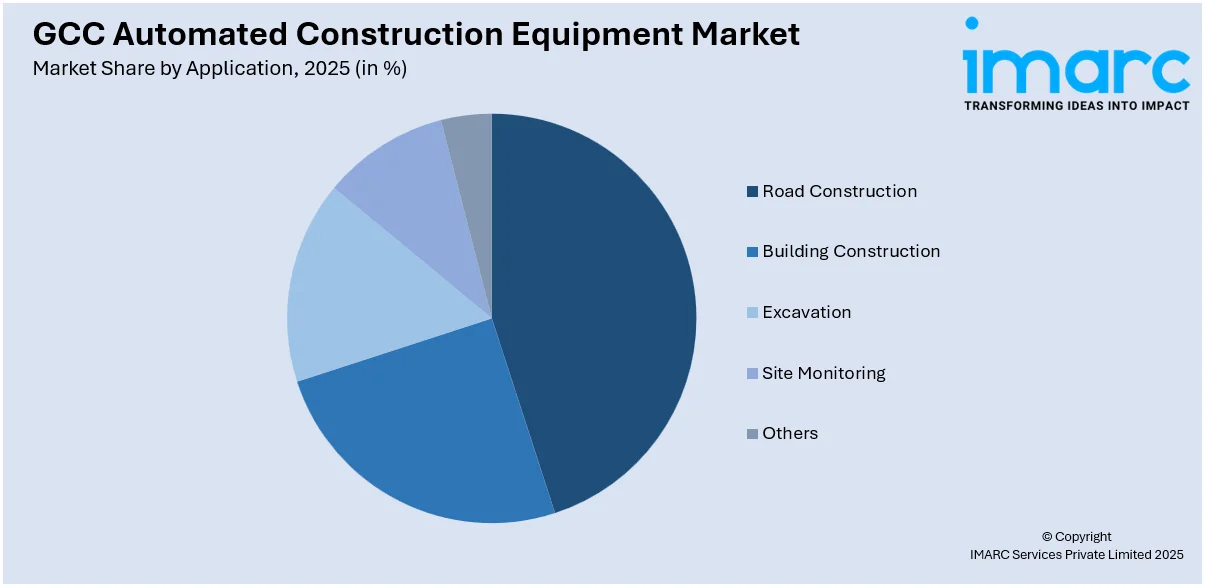
The report has provided a detailed breakup and analysis of the market based on the application. This includes road construction, building construction, excavation, site monitoring, and others.
Country Insights:
- Saudi Arabia
- United Arab Emirates
- Qatar
- Kuwait
- Oman
- Bahrain
The report has also provided a comprehensive analysis of all the major regional markets, which include Saudi Arabia, United Arab Emirates, Qatar, Kuwait, Oman, and Bahrain.
Competitive Landscape:
The market research report has also provided a comprehensive analysis of the competitive landscape in the market. Competitive analysis such as market structure, key player positioning, top winning strategies, competitive dashboard, and company evaluation quadrant has been covered in the report. Also, detailed profiles of all major companies have been provided.
GCC Automated Construction Equipment Market Report Coverage:
| Report Features | Details |
|---|---|
| Base Year of the Analysis | 2025 |
| Historical Period | 2020-2025 |
| Forecast Period | 2026-2034 |
| Units | Million USD |
| Scope of the Report | Exploration of Historical Trends and Market Outlook, Industry Catalysts and Challenges, Segment-Wise Historical and Future Market Assessment:
|
| Autonomy Types Covered | Semi-Autonomous, Fully Autonomous |
| Types Covered | Earth Moving Equipment, Material Handling Equipment, Building and Road Construction Equipment, Others |
| Applications Covered | Road Construction, Building Construction, Excavation, Site Monitoring, Others |
| Countries Covered | Saudi Arabia, United Arab Emirates, Qatar, Kuwait, Oman, Bahrain |
| Customization Scope | 10% Free Customization |
| Post-Sale Analyst Support | 10-12 Weeks |
| Delivery Format | PDF and Excel through Email (We can also provide the editable version of the report in PPT/Word format on special request) |
Key Benefits for Stakeholders:
- IMARC’s industry report offers a comprehensive quantitative analysis of various market segments, historical and current market trends, market forecasts, and dynamics of the GCC automated construction equipment market from 2020-2034.
- The research report provides the latest information on the market drivers, challenges, and opportunities in the GCC automated construction equipment market.
- Porter's five forces analysis assist stakeholders in assessing the impact of new entrants, competitive rivalry, supplier power, buyer power, and the threat of substitution. It helps stakeholders to analyze the level of competition within the GCC automated construction equipment industry and its attractiveness.
- Competitive landscape allows stakeholders to understand their competitive environment and provides an insight into the current positions of key players in the market.
Frequently Asked Questions About the GCC Automated Construction Equipment Market Report
The GCC automated construction equipment market reached a value of USD 318.5 Million in 2025.
The market is projected to grow at a CAGR of 8.30% during 2026-2034, reaching USD 652.9 Million by 2034.
Key growth drivers include rapid technological advancements in automation, increasing focus on construction safety, rising demand for eco-friendly equipment, and need for faster project completion with improved cost efficiency.
The report covers segmentation by autonomy type, type, application, and country. Each segment includes detailed market size and forecast analysis.
Key trends include integration of artificial intelligence and machine learning, adoption of sensor-enabled autonomous machinery, the growing use of energy-efficient systems, and increasing shift toward precision-driven construction operations.
Need more help?
- Speak to our experienced analysts for insights on the current market scenarios.
- Include additional segments and countries to customize the report as per your requirement.
- Gain an unparalleled competitive advantage in your domain by understanding how to utilize the report and positively impacting your operations and revenue.
- For further assistance, please connect with our analysts.
 Request Customization
 Speak to an Analyst
 Request Brochure
 Inquire Before Buying
Benefits of Customization
- Personalize this research
- Triangulate with your data
- Get data as per your format and definition
- Gain a deeper dive into a specific application, geography, customer, or competitor
- Any level of personalization
Get in Touch With Us
UNITED STATES
Phone: +1-201-971-6302
INDIA
Phone: +91-120-433-0800
UNITED KINGDOM
Phone: +44-753-714-6104
Email: sales@imarcgroup.com
Client Testimonials




.webp)




.webp)













Related Reports

Choose your plan
*Please note that the prices mentioned below are starting prices for each bundle type. Kindly contact our team for further details.*
Single User License
- 1 User License, Access on 2 Devices
- PDF Report + Excel Dataset (Password Protected)
- Lifetime Access
- No Printing Rights
- 10% Free Report Customization
- 10–12 Weeks of Analyst Support
Five User License
- Access for 5 Users, 2 Devices per User
- PDF Report + Excel Dataset (Password Protected)
- Lifetime Access
- Dedicated Account Manager
- 12–14 Weeks of Analyst Support
- No Printing Rights
- 15% Free Report Customization
- 25% Discount on Your Next Purchase
Corporate User License
- Unlimited User Access (Within Your Organization)
- PDF Report + Excel Dataset
- Lifetime Access
- Dedicated Account Manager
- 14–20 Weeks of Analyst Support
- No Printing Rights
- 20% Free Report Customization
- 30% Discount on Your Next Purchase
Essential Insights
What's included:
3 reports
- Lifetime Access
- PDF Reports
- Excel Datasets
- 2 Weeks of Free Analyst Support
- 2 User Licenses
- Access on 2 Devices
- Printing Rights
- Complimentary PowerPoint (PPT) Version
- Complimentary License Upgrade
Professional Access
What's included:
5 reports
- Lifetime Access
- PDF Reports
- Excel Datasets
- 8 Weeks of Free Analyst Support
- 2 User Licenses
- Access on 2 Devices
- Printing Rights
- Complimentary PowerPoint (PPT) Version
- Complimentary License Upgrade
Business Advantage
What's included:
8 reports
- Lifetime Access
- PDF Reports
- Excel Datasets
- 14 Weeks of Free Analyst Support
- 2 User Licenses
- Access on 2 Devices
- Printing Rights
- Complimentary PowerPoint (PPT) Version
- Complimentary License Upgrade
Enterprise Intelligence
What's included:
10 reports
- Lifetime Access
- PDF Reports
- Excel Datasets
- 20 Weeks of Free Analyst Support
- 2 User Licenses
- Access on 2 Devices
- Printing Rights
- Complimentary PowerPoint (PPT) Version
- Complimentary License Upgrade