
GCC Data Center Construction Market Size, Share, Trends and Forecast by Construction Type, Data Center Type, Tier Standards, Vertical, and Country, 2026-2034
GCC Data Center Construction Market Size, Share, Trends & Forecast (2026-2034)
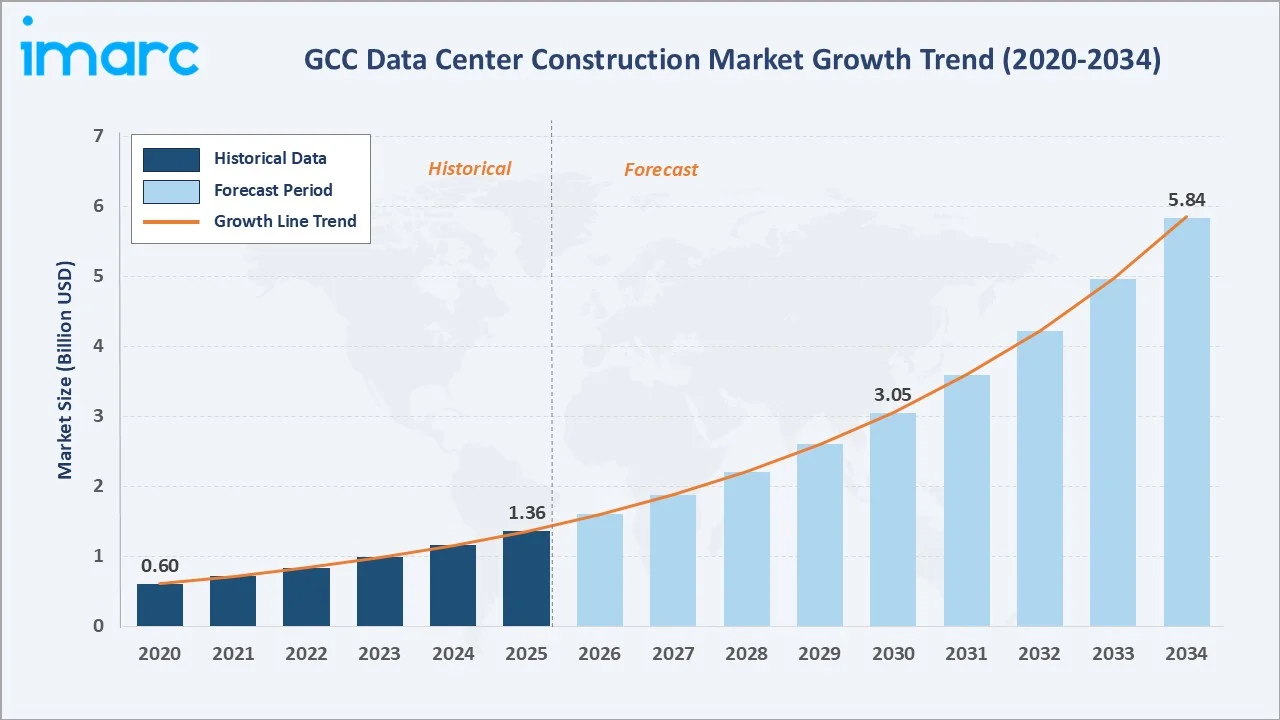
The GCC data center construction market reached USD 1.36 Billion in 2025 and is projected to reach USD 5.84 Billion by 2034, growing at a CAGR of 17.60% during 2026-2034. Accelerating hyperscaler cloud region investments, Vision 2030 and UAE Industrial Strategy 2031 digital infrastructure mandates, surging AI workload demand requiring high-density data center builds, and strict data sovereignty localization laws are the primary growth catalysts.
Market Snapshot
|
Metric |
Value |
| Market Size (2025) |
USD 1.36 Billion |
|
Forecast Market Size (2034) |
USD 5.84 Billion |
|
CAGR (2026-2034) |
17.60% |
|
Base Year |
2025 |
|
Historical Period |
2020-2025 |
|
Forecast Period |
2026-2034 |
Saudi Arabia leads regionally with a 37.9% market share in 2025, anchored by the Kingdom's National Data Center Strategy targeting 1.5 GW of capacity by 2030 and ICS Arabia's first phase 65 MW Desert Dragon facility in Al-Kharj. Electrical construction commands the largest construction type share at 56.8%, while large-scale data centers lead with 46.5% as hyperscaler and colocation operators drive campus-scale developments across the region.
To get more information on this market, Request Sample
The GCC data center construction market is underpinned by three structural forces: hyperscaler cloud region investment commitments from Microsoft, Google, Oracle, and AWS creating sustained campus-scale construction demand, GCC governments' AI-first digital strategies mandating sovereign-compute infrastructure at national scale, and data localization regulations across Saudi Arabia, UAE, Qatar, and Oman requiring in-country data hosting that drives captive domestic construction activity.
Executive Summary
The GCC data center construction market is experiencing exceptional growth, driven by the region's rapid transition to a digital economy underpinned by AI infrastructure investment, cloud localization, and smart city ambitions. The market was valued at USD 1.36 Billion in 2025 and is forecast to reach USD 5.84 Billion by 2034 at a CAGR of 17.60%.
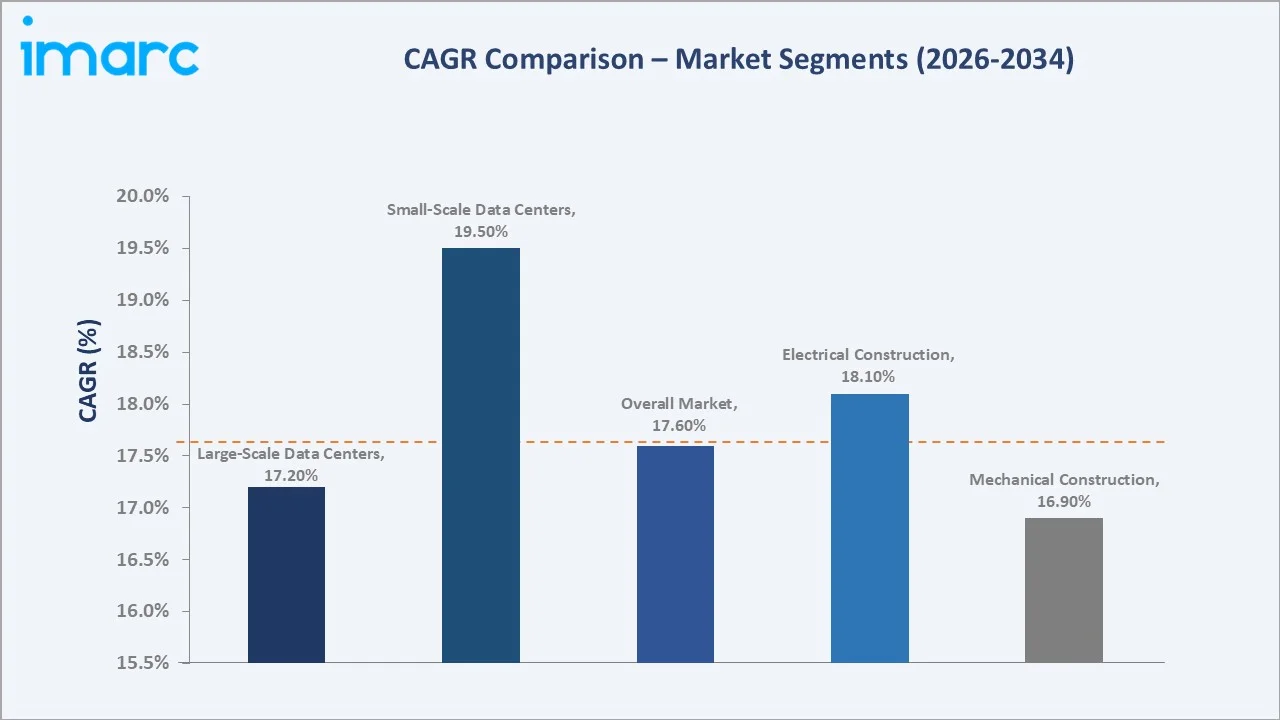
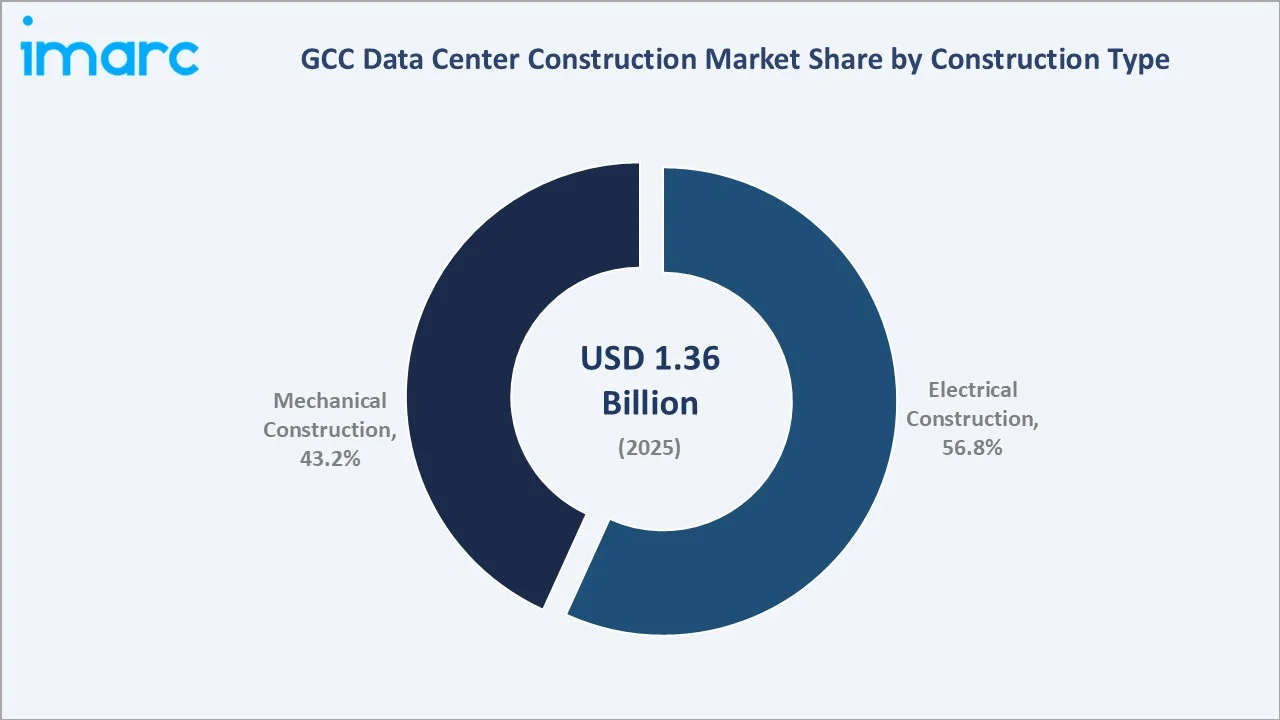
Electrical construction dominates at 56.8% in 2025, encompassing high-voltage and low-voltage switchgear installation, uninterruptible power supply (UPS) systems, standby diesel generators, power distribution units (PDUs), and busway distribution that form the mission-critical power infrastructure backbone of every data center build. Mechanical construction at 43.2% covers the precision cooling systems that maintain server temperatures within operational thresholds across GCC's high-ambient-temperature operating environment.
Large-scale data centers lead facility type at 46.5%, driven by hyperscaler and national sovereign cloud campuses requiring 20 MW to 200+ MW of critical IT load. Medium-scale facilities at 32.1% serve colocation and enterprise cloud deployments, while small-scale facilities at 21.4% support edge computing, government branch offices, and enterprise data processing.
Key Market Insights
|
Insight |
Data |
| Largest Construction Type |
Electrical Construction – 56.8% share (2025) |
| Fastest Growing Construction Type |
Electrical Construction – ~18.1% CAGR (2026-2034) |
|
Largest Data Center Type |
Large-Scale Data Center – 46.5% share (2025) |
| Fastest Growing Data Center Type |
Small-Scale Data Center – ~19.5% CAGR (2026-2034) |
|
Leading Country |
Saudi Arabia – 37.9% share (2025) |
| Top Companies | ACS Group, AECOM, DPR Construction, Jacobs Solutions Inc. |
Key Analytical Observations Supporting The Above Data:
- Electrical construction accounts for 56.8% of GCC data center construction spend in 2025. This dominance reflects the capital intensity of mission-critical power infrastructure, a 100 MW hyperscale facility in the GCC typically allocates 35–40% of total construction cost to electrical works, encompassing 33 kV or 132 kV primary substations, 1,500–2,000 kVA diesel generator sets per MW of critical load, and structured power distribution cabling.
- Large-scale data centers command 46.5% of the GCC construction market in 2025, reflecting the region's concentration of hyperscaler-led investment. Microsoft's UAE Central region, Google Cloud's Saudi Arabia region, and Oracle's Abu Dhabi and Muscat facilities, all represent 60 MW to 200+ MW campus-scale builds that individually represent USD 200 Million to USD 1 Billion+ in construction value.
- Saudi Arabia's 37.9% regional leadership (2025) is underpinned by its National Data Center Strategy released in June 2025, which targets 1.5 gigawatts of data center capacity by 2030. This program alone implies USD 4–6 Billion in data center construction expenditure over five years, establishing the Kingdom as the GCC's single largest data center construction market by an expanding margin through 2034.
- Small-scale data centers are expected to be the fastest-growing facility type segment at approximately 19.5% CAGR, driven by edge computing deployments for smart city IoT infrastructure, government branch office digitalization, and enterprise digital transformation programs.
GCC Data Center Construction Market Overview
Data center construction encompasses the planning, engineering, procurement, and construction of facilities designed to house information technology infrastructure, including computing servers, networking equipment, and storage systems. In the GCC context, data center construction projects range from enterprise-grade co-location facilities of 1–5 MW critical IT load to hyperscale campuses of 100–500 MW, requiring specialist civil, structural, electrical, and mechanical engineering capability combined with deep understanding of GCC-specific site constraints.
Macroeconomic enablers include GCC governments' combined data center investment commitments exceeding USD 50 Billion through 2030, grid modernization programs expanding available power for data center connections in Saudi Arabia and UAE, and 5G network rollout creating the connectivity backbone for distributed data center architectures across the region. The GCC's proximity to subsea cable landing stations provides strategic data center location advantages for regional connectivity hubs.
Market Dynamics
To evaluate market opportunities, Request Sample
Market Drivers
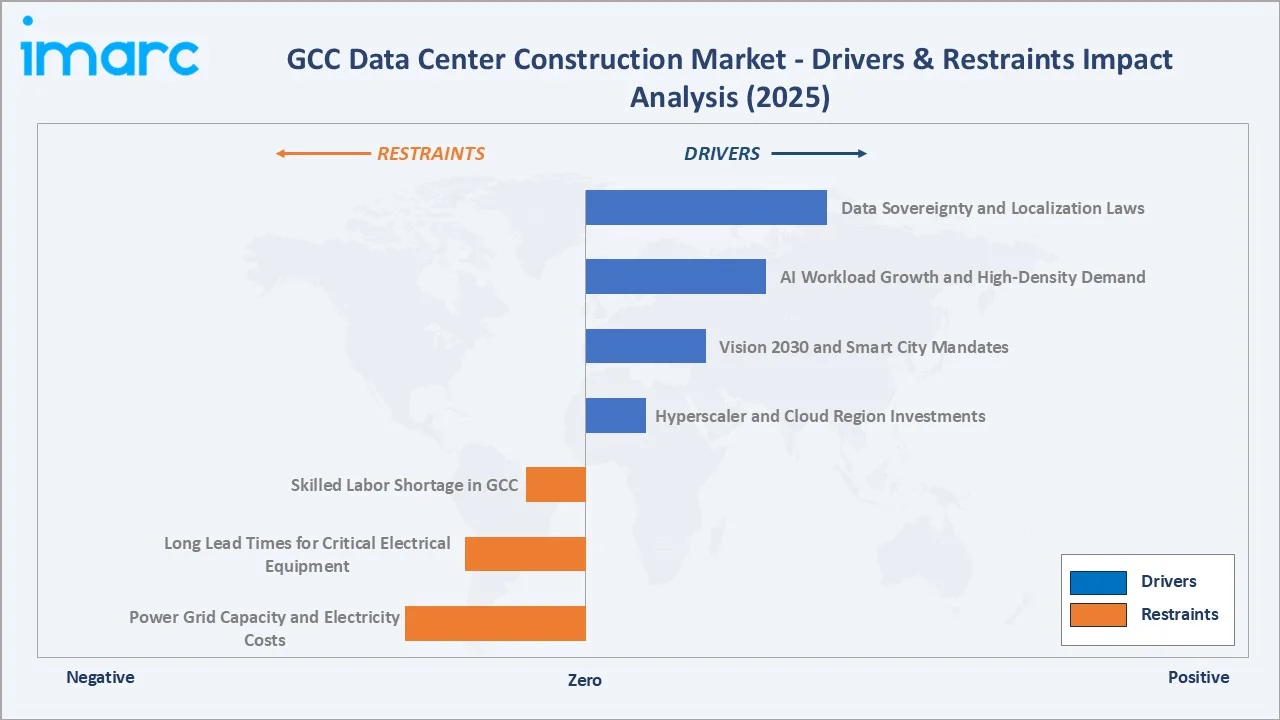
- Hyperscaler and Cloud Region Investments: Microsoft's USD 15.2 Billion UAE AI and cloud infrastructure commitment, Google Cloud's new cloud region in Dammam, and AWS's expanded GCC footprint across UAE and Saudi Arabia collectively represent over USD 10 Billion in committed hyperscaler investment requiring large-scale data center construction across GCC member states.
- Vision 2030 and Smart City Mandates: Saudi Arabia's National Data Center Strategy (June 2025) targets 1.5 GW of total data center capacity by 2030, requiring approximately 750–1,000 MW of new construction over five years. UAE's UAE Digital Government Strategy 2025 mandates federal cloud-first IT procurement backed by UAE-sovereign data center infrastructure.
- AI Workload Growth and High-Density Demand: The deployment of AI computing infrastructure is fundamentally changing data center construction specifications across the GCC. New AI-ready facilities require reinforced floor loading, liquid cooling distribution infrastructure, higher-capacity electrical distribution, and enhanced structural support for dense rack arrays.
- Data Sovereignty and Localization Laws: Saudi Arabia's Data Center Regulation requiring domestic hosting of government-sensitive data, UAE's Federal Personal Data Protection Law mandating GCC-region storage for UAE citizen data, Qatar's data residency requirements, and Oman's Personal Data Protection Law collectively create mandatory domestic construction demand from multinational corporations.
Market Restraints
- Power Grid Capacity and Electricity Costs: GCC national grids, while being expanded, face capacity constraints in providing the large, reliable power connections required by hyperscale data center campuses. Saudi Arabia's planned data center capacity of 1.5 GW represents 3–5% of the Kingdom's current total generation capacity, a significant allocation requiring dedicated grid infrastructure investment and connection timelines of 18–36 months that create bottlenecks in data center delivery schedules.
- Long Lead Times for Critical Electrical Equipment: Global supply chain constraints for large power transformers, medium-voltage switchgear, and generator sets create critical path scheduling risks for GCC data center construction projects. With GCC projects competing for the same equipment supply chains as North American, European, and Asian hyperscale campuses, procurement lead time management is the most significant execution risk for GCC construction timelines.
- Skilled Labor Shortage in GCC: Data center construction requires specialist electrical and mechanical subcontractors with data-center-specific competency that are in limited supply within the GCC's existing construction workforce. International specialist trade contractors must be imported for critical works, increasing construction cost and creating workforce management complexity under GCC nationalization programs.
Market Opportunities
- Liquid Cooling Infrastructure Build-Out: AI data centers require direct-to-chip liquid cooling distribution units (CDUs), rear-door heat exchangers, and in some cases single-phase or two-phase immersion cooling infrastructure that represents a new, high-margin construction segment distinct from traditional CRAC/CRAH mechanical installation.
- Prefabricated and Modular Data Center Construction: Prefabricated modular data center modules can reduce GCC data center construction timelines from 24–36 months to 9–18 months while reducing site labor requirements by 30–40%. Schneider Electric's EcoStruxure modular data center platforms are gaining traction in GCC projects, particularly for edge and enterprise builds where speed-to-capacity is prioritized over bespoke design optimization.
Market Challenges
- Extreme Climate and Cooling Efficiency Requirements: The GCC's extreme ambient temperatures impose stringent demands on data center cooling design. Free-air cooling and economizer systems widely deployed in Northern European and North American facilities are not feasible for most GCC locations, requiring chiller-based mechanical cooling that carries higher capital cost, greater water consumption, and higher Power Usage Effectiveness (PUE) than comparable temperate-climate facilities.
- Coordination Between Utility, Civil, and Technology Workstreams: GCC data center construction projects involve coordination between local utility companies, civil and structural contractors, specialist MEP subcontractors, IT infrastructure integrators, and government permit authorities, all subject to varying timelines and regulatory requirements across six GCC jurisdictions.
Emerging Market Trends
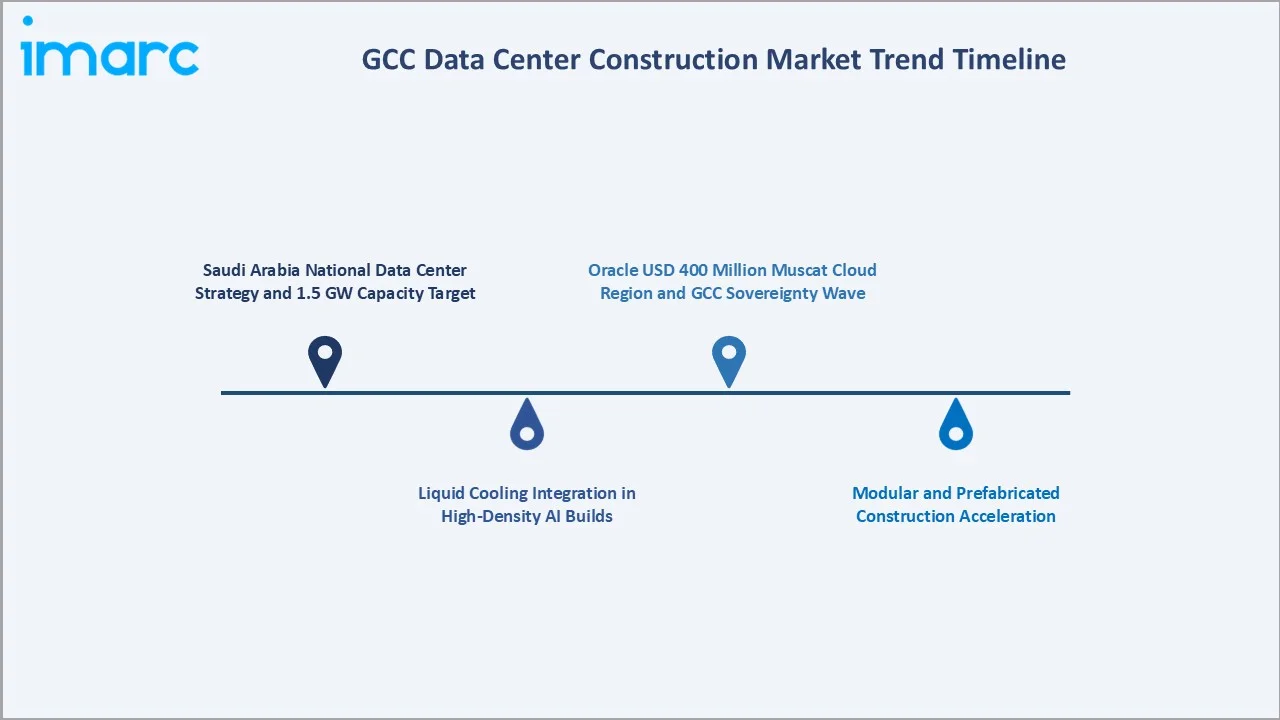
1. Saudi Arabia National Data Center Strategy and 1.5 GW Capacity Target
In June 2025, Saudi Arabia's Ministry of Communications and Information Technology (MCIT) and SDAIA unveiled the National Data Center Strategy, setting the target of building up to 1.5 gigawatts of data center capacity by 2030 to position the Kingdom as a regional leader in cloud computing and AI infrastructure. In November 2025, ICS Arabia commenced construction on the first of three planned data centers directly executing against this national strategy.
2. Liquid Cooling Integration in High-Density AI Builds
AI-specific data center construction in the GCC is rapidly transitioning from traditional raised-floor air cooling to hybrid and liquid cooling architectures. NVIDIA GB200 NVL72 and GB300 systems requiring 120+ kW per rack are being specified in new Saudi Arabia and UAE hyperscaler builds, mandating cooling distribution units (CDUs) with capacity for direct-to-chip liquid cooling loops, reinforced floor loading for immersion tank installations, and enhanced drainage infrastructure.
3. Modular and Prefabricated Construction Acceleration
Prefabricated data center modules are gaining adoption in GCC projects as developers seek to compress construction timelines in a constrained specialist labor market. Schneider Electric's EcoStruxure prefabricated modules and Vertiv's containerized infrastructure solutions are being integrated into GCC builds, enabling parallel factory fabrication and site preparation that reduces on-critical-path construction duration.
4. Oracle USD 400 Million Muscat Cloud Region and GCC Sovereignty Wave
Oman's Personal Data Protection Law directly triggered Oracle's commitment to a USD 400 Million Muscat cloud region slated for Q2 2026, exemplifying how GCC data sovereignty legislation is catalyzing data center construction investment in markets previously overlooked by hyperscalers. This pattern is repeating across Qatar, Kuwait, and Bahrain, creating a multi-country construction demand wave that sustains the GCC market's high CAGR.
Industry Value Chain Analysis
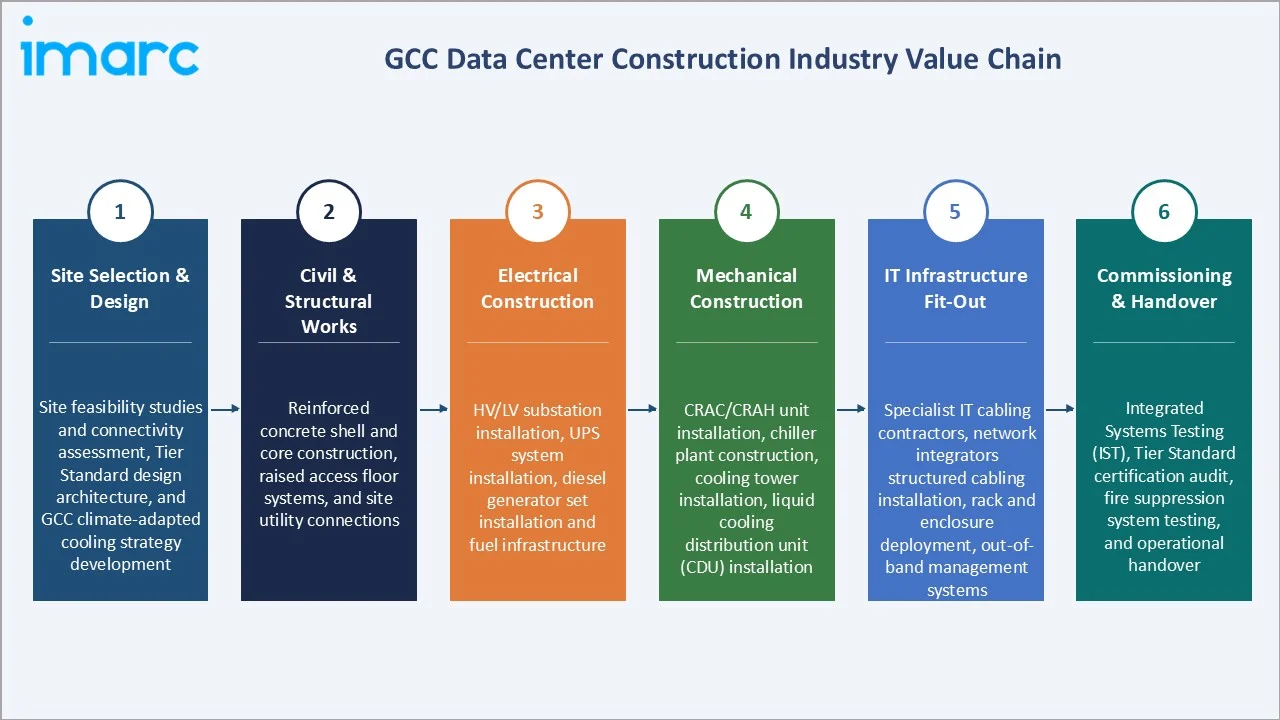
The GCC data center construction value chain spans site assessment and design through commissioning and facility handover, with each stage requiring specialist engineering expertise, GCC-specific climate knowledge, and regulatory compliance across six distinct national permitting frameworks.
|
Stage |
Key Players / Examples |
| Site Selection & Design | Site feasibility studies and connectivity assessment, Tier Standard design architecture, and GCC climate-adapted cooling strategy development |
| Civil & Structural Works | Reinforced concrete shell and core construction, raised access floor systems, and site utility connections |
| Electrical Construction |
HV/LV substation installation, UPS system installation, diesel generator set installation and fuel infrastructure |
|
Mechanical Construction |
CRAC/CRAH unit installation, chiller plant construction, cooling tower installation, liquid cooling distribution unit (CDU) installation |
| IT Infrastructure Fit-Out |
Specialist IT cabling contractors, network integrators structured cabling installation, rack and enclosure deployment, out-of-band management systems |
| Commissioning & Handover | Integrated Systems Testing (IST), Tier Standard certification audit, fire suppression system testing, and operational handover |
Technology Landscape in the GCC Data Center Construction Industry
Power Infrastructure: High-Redundancy Electrical Systems
Mission-critical electrical infrastructure represents the largest single cost component in GCC data center construction at 35–45% of total project budget. High-voltage primary substations supply the facility boundary, with N+1 or 2N redundant transformer banks stepping down to 11 kV or 400 V distribution. Double-conversion online UPS systems provide millisecond-level ride-through during utility supply disturbances.
Mechanical Construction: Precision Cooling for High-Ambient Climates
GCC data center mechanical construction must contend with ambient conditions incompatible with free-air cooling, requiring chiller-based mechanical cooling systems as the primary thermal management approach. Air-cooled and water-cooled centrifugal chiller plants operating at COP values of 4.0–6.0 at GCC ambient temperatures form the core cooling plant, supplemented by precision air conditioning units distributed within the white space.
Modular and Prefabricated Construction Technology
Prefabricated data center modules are deployed in GCC projects to accelerate delivery timelines in a constrained specialist construction labor market. Schneider Electric's EcoStruxure prefabricated modules containerized cooling solutions are operational across GCC enterprise and edge deployments. Factory prefabrication reduces on-site electrical and mechanical installation labor by 30–40%, compresses overall project schedules by 6–12 months, and improves construction quality consistency compared to fully site-built approaches.
Building Information Modelling (BIM) and Digital Construction
Leading GCC data center construction contractors are deploying Building Information Modelling (BIM) Level 2 and Level 3 workflows for GCC data center projects, enabling clash detection between complex electrical, mechanical, and structural systems before site installation. BIM-coordinated models reduce on-site rework and enable laser scanning verification of as-built conditions against design intent.
Market Segmentation Analysis
The report covers the following segments:
|
Segment Category |
Leading Segment |
Market Share |
Year |
| Construction Type | Electrical Construction |
56.8% |
2025 |
| Data Center Type | Large-Scale Data Center |
46.5% |
2025 |
| Tier Standards |
🔒 |
🔒 |
2025 |
| Vertical | 🔒 |
🔒 |
2025 |
|
Country |
Saudi Arabia |
37.9% |
2025 |

By Construction Type
The construction type segment is analyzed across electrical construction (56.8%) and mechanical construction (43.2%). Electrical construction leads reflecting the high capital cost of mission-critical power infrastructure that represents the largest single cost element in GCC data center builds, particularly as AI workloads drive rack power densities upward.
To access detailed market analysis, Request Sample
Mechanical construction encompasses the chiller plants, hot-aisle containment, cooling towers, and an increasing proportion of liquid cooling distribution infrastructure required to manage heat rejection in the GCC's high-ambient environment. Electrical construction is growing slightly faster at approximately 18.1% CAGR versus mechanical construction at 16.9%, driven by the rapid escalation of facility power densities from AI deployments requiring proportionally higher electrical infrastructure investment per square meter.
By Data Center Type
The data center type segment is led by large-scale data centers (46.5%), followed by medium-scale data centers (32.1%), and small-scale data centers (21.4%). Large-scale facilities dominate due to hyperscaler cloud region campus investments each representing 60–200+ MW of critical IT load capacity across Saudi Arabia and UAE.
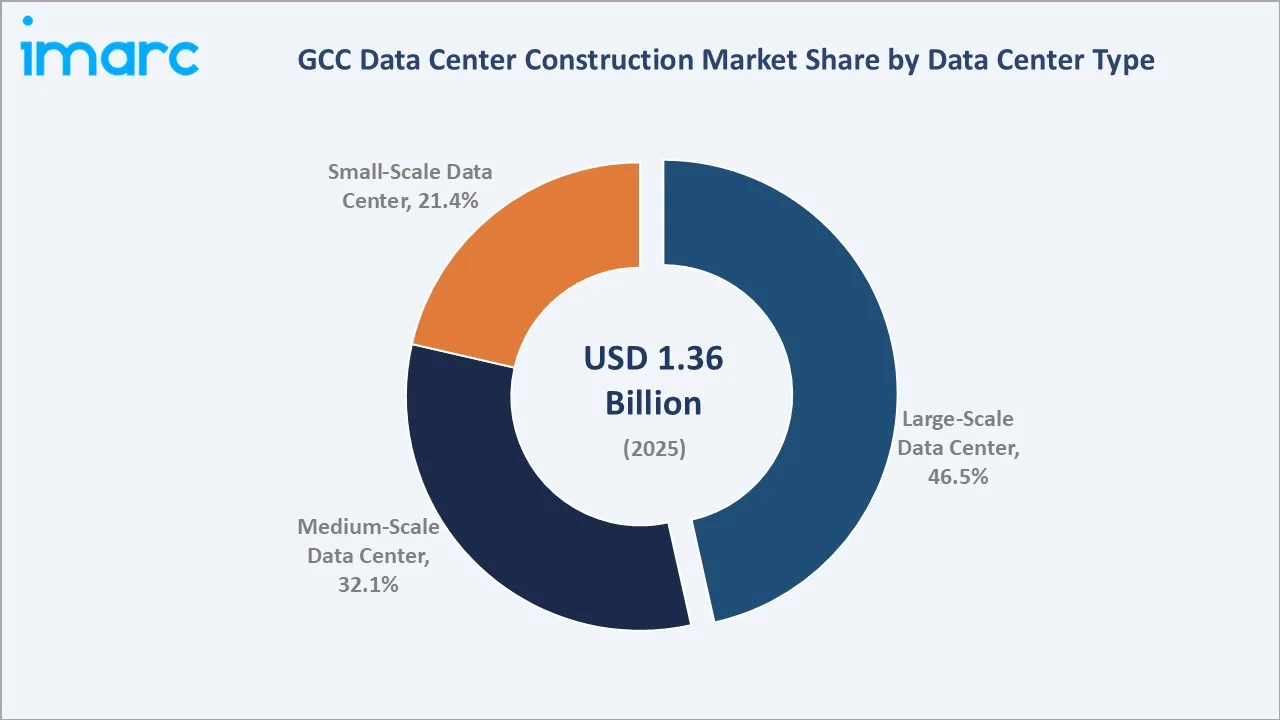
Medium-scale data centers at 32.1% serve GCC colocation operators and national cloud platforms requiring 5–20 MW facilities with full Tier III redundancy. Small-scale data centers at 21.4% serve enterprise and government edge deployments, supporting NEOM's distributed compute architecture, government branch digitalization, and enterprise Tier II facilities within corporate campuses.
Regional Market Insights
Saudi Arabia's 37.9% market leadership in 2025 reflects the Kingdom's position as the GCC's single largest active data center construction market, anchored by the National Data Center Strategy targeting 1.5 GW of capacity by 2030 and multiple concurrent hyperscaler region builds.
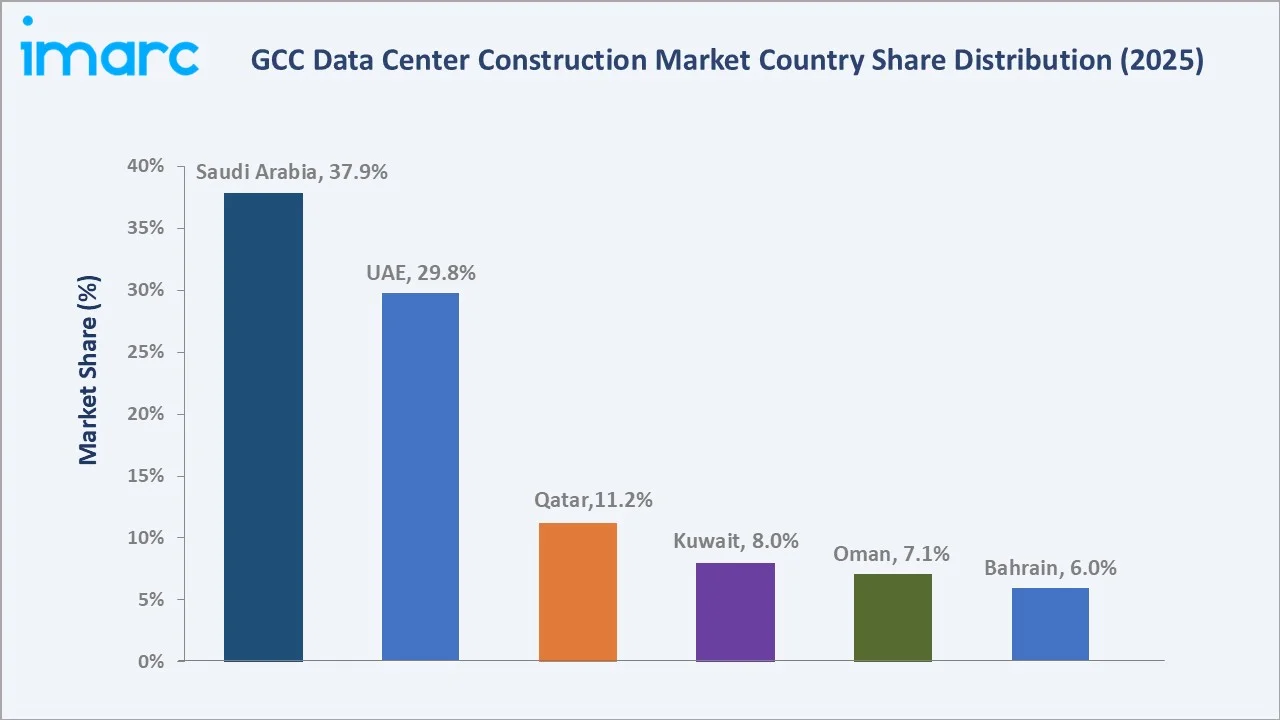
UAE at 29.8% represents the GCC's most established data center market by operational maturity, with Oracle, Microsoft, AWS, and Google all maintaining operational cloud regions that are undergoing capacity expansion to meet growing workload demand.
| Country |
Share (2025) |
Key Growth Drivers |
| Saudi Arabia |
37.9% |
National data center strategy supporting large-scale infrastructure investment; hyperscaler regional expansion programs; smart city development creating dedicated compute demand |
|
UAE |
29.8% |
Sovereign cloud investment driving major capacity additions; expanding hyperscaler cloud region footprints; rapid colocation facility growth attracting international operators |
|
Qtar |
11.2% |
Data residency legislation driving colocation demand growth; 5G smart infrastructure rollout supporting edge compute requirements; smart city compute expansion |
|
Kuwait |
8.0% |
Data protection regulatory framework driving compliance-led investment; banking and energy sector digital transformation infrastructure programs; 5G connectivity expansion |
| Oman |
7.1% |
Major hyperscaler cloud region investment expanding local infrastructure capacity; personal data protection law accelerating cloud and colocation adoption; national digital economy vision; enterprise digitalization programs |
| Bahrain |
6.0% |
Established hyperscaler cloud region supporting ongoing capacity expansion; data governance framework driving compliance investment; fintech digital infrastructure growth |
Competitive Landscape
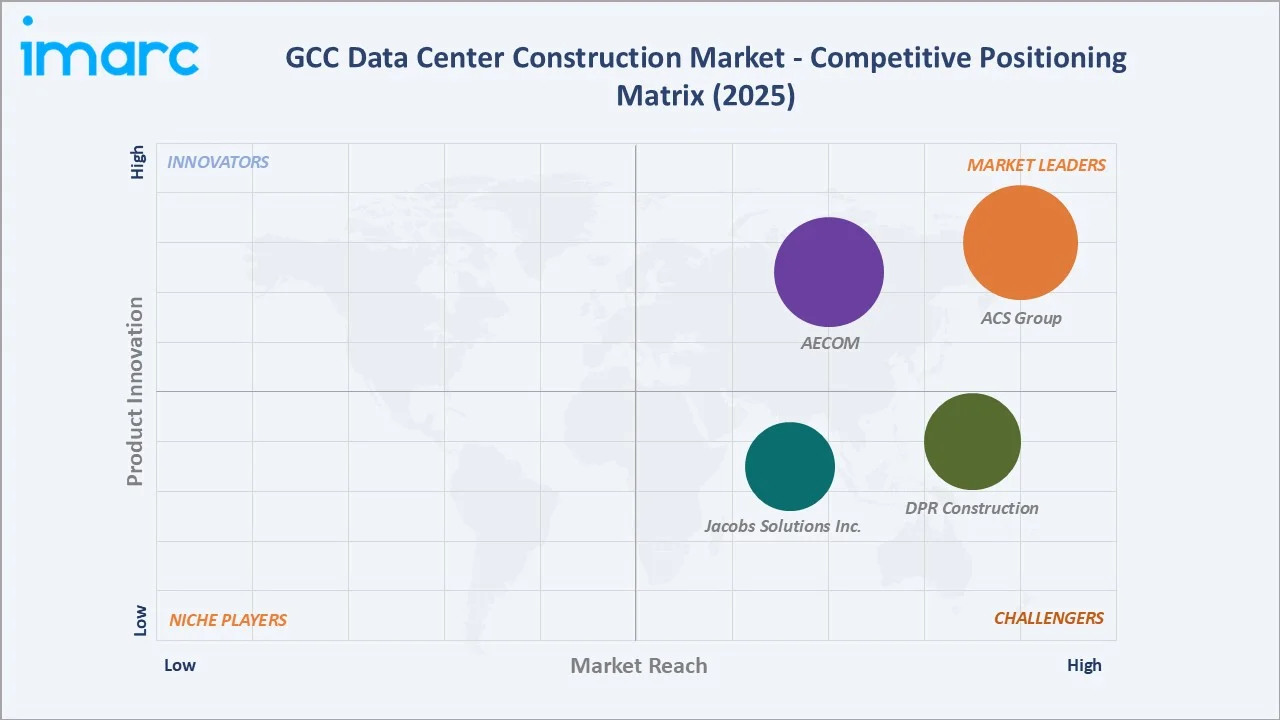
The GCC data center construction market is moderately concentrated, with global construction and engineering majors competing for large-scale hyperscaler and government contracts, while specialist data-center-focused contractors serve mid-market colocation and enterprise builds.
|
Company Name |
Solutions/Services |
Market Position |
Core Strength |
| ACS Group | Preconstruction, Construction Management, Project Management. Lean Construction |
Market Leader |
Design-build excellence; EMEA and GCC hyperscaler campus delivery; Mega-campus capability |
| AECOM | Virtual data management via the cloud, Mitigating operating control system vulnerabilities |
Market Leader |
Integrated design and construction management; Tier Standard engineering expertise; GCC public sector relationships; BIM and digital delivery capability |
| DPR Construction |
Environmental Health & Safety, Design-to-Build, Preconstruction, Prefabrication, Virtual Design and Construction |
Strong Challenger |
Tech-focused mission-critical delivery; direct-to-chip liquid cooling expertise; modular construction integration; AI data center design-build track record |
| Jacobs Solutions Inc. | Augmented Delivery, Consulting & Advisory, Digital Advisory, Design for Design-Build, Design & Engineering, Program Management | Strong Challenger |
Program management and owner's engineer services; GCC government infrastructure project expertise; electrical and mechanical engineering depth |
Global construction majors with established data-center-specific delivery capability and established GCC relationships dominate large hyperscaler and national cloud campus contracts. Specialist MEP contractors serve as key subcontractors on large projects or as primary contractors on medium-scale enterprise and colocation builds.
Key Company Profiles
ACS Group
ACS Group’s subsidiary HOCHTIEF AG which further operates Turner Construction Company, is the world's leading data center construction contractor by active project value. The company’s GCC operations deliver hyperscaler campus builds and sovereign cloud infrastructure projects across Saudi Arabia and UAE.
- Service Portfolio: Design-build data center construction; construction management; preconstruction and early contractor involvement (ECI); specialist electrical and mechanical commissioning; program management for multi-phase hyperscale campuses.
- Recent Developments: In May 2026, Turner Construction recorded USD 12.1 billion in new orders in Q1 2026, up 48% year over year, while work-in-place revenue rose 25% to USD 7.7 billion. This was driven mainly by data center, healthcare, and commercial projects, with Turner securing 10 projects valued at more than USD 1 billion each during 2026.
- Strategic Focus: GCC hyperscaler campus construction expansion; AI-ready high-density data center delivery (40–120 kW/rack); liquid cooling mechanical construction capability investment; early procurement to mitigate long lead equipment timelines in GCC delivery programs.
AECOM
AECOM is one of the world's largest infrastructure engineering and construction management firms, with a strong GCC presence across government and commercial data center projects. The company provides integrated design, program management, owner's engineer, and construction management services for data center clients.
- Service Portfolio: Data center design and engineering; program management and project controls; owner's engineer and technical advisory; commissioning management; Tier Standard design and certification support; BIM and digital twin integration.
- Recent Developments: In May 2026, AECOM announced that fiscal Q2 2026 profit increased 25.4% to USD 179.86 million, while revenue rose 1% to USD 3.8 billion and backlog reached USD 26.2 billion. Growth was supported by data centers, AI-enabled contracts, and power infrastructure.
- Strategic Focus: Saudi Arabia National Data Center Strategy program delivery; UAE sovereign cloud infrastructure design; integration of digital construction (BIM Level 3) across GCC data center projects; sustainability and PUE optimization for high-ambient GCC environments.
Market Concentration Analysis
The GCC data center construction market exhibits moderate concentration. The contractors lock in design-build contracts 24 months before groundbreaking through early contractor involvement, compressing procurement by up to nine months and creating first-mover advantages on GCC hyperscaler programs.
Market consolidation is occurring through two dynamics: global construction majors building data-center-specific delivery teams and GCC regional offices to capture the high-growth market, and specialist data center MEP contractors expanding from European home markets into the GCC through hyperscaler client relationships. The Saudi Arabia market is emerging as the GCC's most competitive construction market for data-center-focused contractors, with multiple international firms establishing Riyadh operations in 2024–2025.
Investment & Growth Opportunities
Fastest Growing Segments
Small-scale data center construction for edge and enterprise deployments (~19.5% CAGR), AI-ready high-density large-scale campus construction (~18.5% CAGR), liquid cooling MEP installation within mechanical construction (~22%+ CAGR), and Oman and Qatar new market entry construction programs (~20%+ CAGR) represent the highest-growth investment vectors through 2034.
Emerging Market Expansion
Saudi Arabia's secondary cities represent an incremental data center construction opportunity exceeding USD 1 Billion annually by 2028 as the National Data Center Strategy is executed beyond the Riyadh hub. Oman's Oracle-anchored Muscat construction program creates a new GCC data center construction market with subsequent capacity additions anticipated from colocation operators following the Oracle sovereign build.
Venture and Institutional Investment Trends
- GCC sovereign wealth funds are directly investing in data center development companies and colocation platforms that require sustained construction programs, creating long-duration construction demand visibility that enables general contractors to underwrite GCC office establishment and talent pipeline investment.
- Hyperscaler data center campus builds in GCC are structured as 10–25 year ground leases with guaranteed construction programs in 50–100 MW phases, providing construction contractors with multi-year revenue visibility that justifies establishment of dedicated GCC delivery teams and local supply chains for long-lead equipment procurement.
Future Market Outlook (2026-2034)
The GCC data center construction market is positioned for sustained, high-growth expansion through 2034. From a base of USD 1.36 Billion in 2025, the market is projected to reach USD 5.84 Billion by 2034 at a CAGR of 17.60%, representing total incremental value creation of USD 4.48 Billion.
This trajectory is underpinned by Saudi Arabia's 1.5 GW National Data Center Strategy, hyperscaler multi-billion-dollar GCC cloud region commitments, and the irreversible trend toward domestic data hosting driven by GCC sovereign data laws.
Electrical construction's share within the total market is projected to remain dominant at 55–58%, while mechanical construction's share grows modestly to 43–45% as liquid cooling infrastructure increases mechanical construction intensity per project. Small-scale and edge data center construction will be the fastest-growing segment by facility count, with NEOM's distributed intelligence architecture and GCC government branch digitalization driving 200–300 new small-scale builds annually by 2030.
Research Methodology
Primary Research
Primary research comprised structured interviews with over 80 industry participants in 2024–2025, including data center developers, construction project managers, specialist MEP subcontractors, owner's engineers, government digital infrastructure program directors, and utility connection planning managers across Saudi Arabia, UAE, Qatar, Kuwait, Oman, and Bahrain. Expert input validated market sizing, construction type spending ratios, and data center type development pipeline projections.
Secondary Research
Secondary research encompassed GCC national data center strategy documents, MCIT and TDRA regulatory publications, hyperscaler investor disclosures and GCC cloud region investment announcements, data center developer project pipeline databases, construction tender databases covering GCC MEP and civil works contracts, Uptime Institute Tier Standard certification records, and industry publications from Data Centre Magazine, DCD, and Schneider Electric white papers on GCC data center design standards.
Forecasting Models
Market size estimations were derived using top-down and bottom-up forecasting, incorporating GCC data center capacity pipeline projections (MW announced and under construction), construction cost benchmarks per MW across large, medium, and small-scale facility types (adjusted for GCC cooling cost premium over temperate-climate markets), and construction type spending ratios validated against project cost breakdowns from completed GCC data center builds.
GCC Data Center Construction Market Report Coverage:
| Report Features | Details |
|---|---|
| Base Year of the Analysis | 2025 |
| Historical Period | 2020-2025 |
| Forecast Period | 2026-2034 |
| Units | Billion USD |
| Scope of the Report | Exploration of Historical and Forecast Trends, Industry Catalysts and Challenges, Segment-Wise Historical and Predictive Market Assessment:
|
| Construction Types Covered | Electrical Construction, Mechanical Construction |
| Data Center Types Covered | Small-Scale Data Center, Medium-Scale Data Center, Large-Scale Data Center |
| Tier Standards Covered | Tier I and II, Tier III, Tier IV |
| Verticals Covered | Public Sector, Oil and Energy, Media and Entertainment, IT and Telecommunication, Banking, Financial Services and Insurance (BFSI), Healthcare, Retail, Others |
| Countries Covered | Saudi Arabia, United Arab Emirates, Qatar, Kuwait, Oman, Bahrain |
| Companies Covered | ACS Group, AECOM, DPR Construction, Jacobs Solutions Inc., etc. |
| Customization Scope | 10% Free Customization |
| Post-Sale Analyst Support | 10-12 Weeks |
| Delivery Format | PDF and Excel through Email (We can also provide the editable version of the report in PPT/Word format on special request) |
Key Benefits for Stakeholders:
- IMARC’s industry report offers a comprehensive quantitative analysis of various market segments, historical and current market trends, market forecasts, and dynamics of the GCC data center construction market from 2020-2034.
- The research report provides the latest information on the market drivers, challenges, and opportunities in the GCC data center construction market.
- Porter's five forces analysis assist stakeholders in assessing the impact of new entrants, competitive rivalry, supplier power, buyer power, and the threat of substitution. It helps stakeholders to analyze the level of competition within the GCC data center construction industry and its attractiveness.
- Competitive landscape allows stakeholders to understand their competitive environment and provides an insight into the current positions of key players in the market.
Frequently Asked Questions About the GCC Data Center Construction Market Report
The GCC data center construction market reached USD 1.36 Billion in 2025and is projected to reach USD 5.84 Billion by 2034.
The market is expected to grow at a CAGR of 17.60% during 2026-2034, driven by hyperscaler cloud region investments, Saudi Arabia's National Data Center Strategy, AI workload infrastructure demand, and GCC data sovereignty laws mandating in-country hosting.
Saudi Arabia leads with a 37.9% market share in 2025, anchored by the June 2025 National Data Center Strategy, ICS Arabia's Desert Dragon facility construction in Al-Kharj, and concurrent hyperscaler cloud region builds collectively represent the GCC's highest single-country data center construction activity.
Electrical construction dominates with a 56.8% share in 2025, driven by the high capital cost of mission-critical power infrastructure, which represents the single largest cost category in GCC data center builds, particularly as AI workloads drive rack power densities toward 40–120 kW per rack.
Large-scale data centers hold the largest share at 46.5%, driven by hyperscaler cloud region campus investments that individually contribute USD 600 Million to USD 3 Billion in construction value across Saudi Arabia and UAE.
Some of the key players include ACS Group, AECOM, DPR Construction, and Jacobs Solutions Inc..
Key drivers include hyperscaler cloud region investments, Saudi Arabia's National Data Center Strategy, AI workload demand, GCC data sovereignty laws mandating in-country data hosting, and smart city programs across NEOM, Masdar City, and Lusail.
Key challenges include power grid capacity constraints and long utility connection timelines, global supply chain lead times for critical electrical equipment, skilled data-center-specialist construction labor shortages in the GCC, extreme ambient temperatures.
Need more help?
- Speak to our experienced analysts for insights on the current market scenarios.
- Include additional segments and countries to customize the report as per your requirement.
- Gain an unparalleled competitive advantage in your domain by understanding how to utilize the report and positively impacting your operations and revenue.
- For further assistance, please connect with our analysts.
 Request Customization
 Speak to an Analyst
 Request Brochure
 Inquire Before Buying
Benefits of Customization
- Personalize this research
- Triangulate with your data
- Get data as per your format and definition
- Gain a deeper dive into a specific application, geography, customer, or competitor
- Any level of personalization
Get in Touch With Us
UNITED STATES
Phone: +1-201-971-6302
INDIA
Phone: +91-120-433-0800
UNITED KINGDOM
Phone: +44-753-714-6104
Email: [email protected]
Client Testimonials




.webp)




.webp)













Related Reports

Choose your plan
*Please note that the prices mentioned below are starting prices for each bundle type. Kindly contact our team for further details.*
Single User License
- 1 User License, Access on 2 Devices
- PDF Report + Excel Dataset (Password Protected)
- Lifetime Access
- No Printing Rights
- 10% Free Report Customization
- 10–12 Weeks of Analyst Support
Five User License
- Access for 5 Users, 2 Devices per User
- PDF Report + Excel Dataset (Password Protected)
- Lifetime Access
- Dedicated Account Manager
- 12–14 Weeks of Analyst Support
- No Printing Rights
- 15% Free Report Customization
- 25% Discount on Your Next Purchase
Corporate User License
- Unlimited User Access (Within Your Organization)
- PDF Report + Excel Dataset
- Lifetime Access
- Dedicated Account Manager
- 14–20 Weeks of Analyst Support
- No Printing Rights
- 20% Free Report Customization
- 30% Discount on Your Next Purchase
Essential Insights
What's included:
3 reports
- Lifetime Access
- PDF Reports
- Excel Datasets
- 2 Weeks of Free Analyst Support
- 2 User Licenses
- Access on 2 Devices
- Printing Rights
- Complimentary PowerPoint (PPT) Version
- Complimentary License Upgrade
Professional Access
What's included:
5 reports
- Lifetime Access
- PDF Reports
- Excel Datasets
- 8 Weeks of Free Analyst Support
- 2 User Licenses
- Access on 2 Devices
- Printing Rights
- Complimentary PowerPoint (PPT) Version
- Complimentary License Upgrade
Business Advantage
What's included:
8 reports
- Lifetime Access
- PDF Reports
- Excel Datasets
- 14 Weeks of Free Analyst Support
- 2 User Licenses
- Access on 2 Devices
- Printing Rights
- Complimentary PowerPoint (PPT) Version
- Complimentary License Upgrade
Enterprise Intelligence
What's included:
10 reports
- Lifetime Access
- PDF Reports
- Excel Datasets
- 20 Weeks of Free Analyst Support
- 2 User Licenses
- Access on 2 Devices
- Printing Rights
- Complimentary PowerPoint (PPT) Version
- Complimentary License Upgrade