
India Bitumen Market Size, Share, Trends and Forecast by Product Type, Viscosity Grade, Application, and Region, 2026-2034
India Bitumen Market Size, Share, Trends & Forecast (2026-2034)
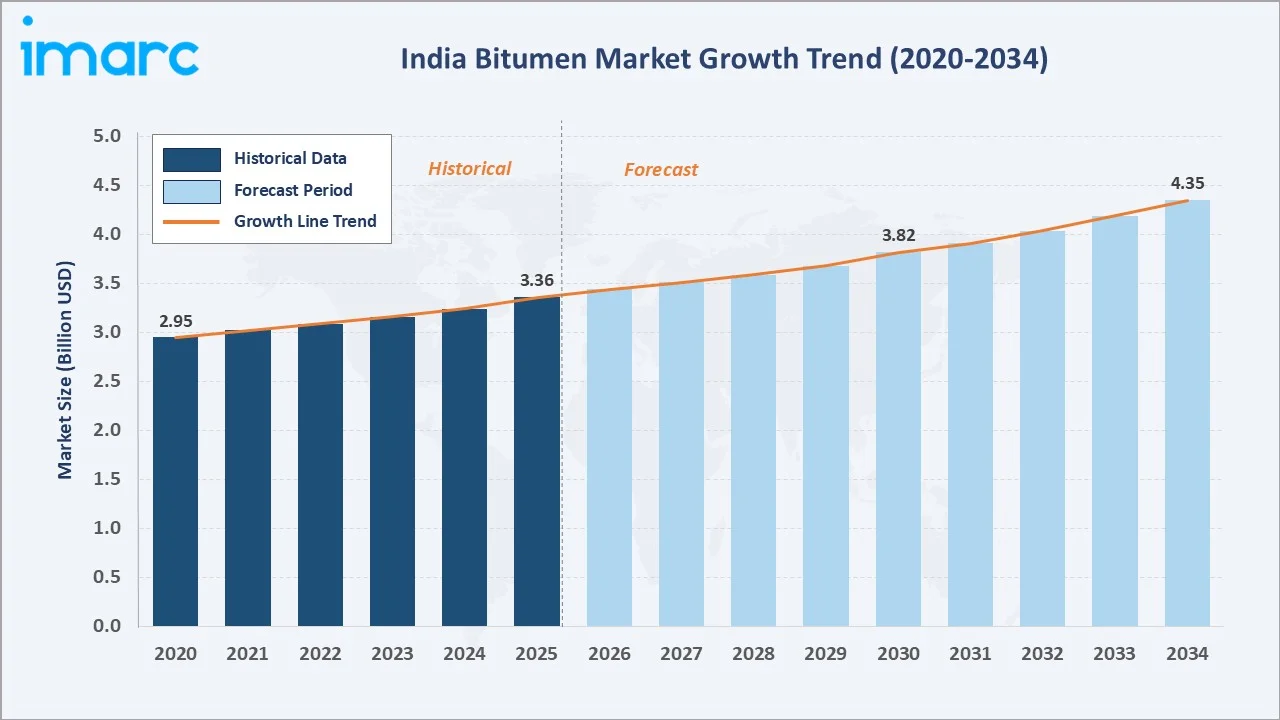
The India bitumen market grew from USD 3.36 Billion in 2025 to USD 3.45 Billion in 2026 and is projected to reach USD 4.35 Billion by 2034, growing at a CAGR of 2.59% during 2026-2034. The market is driven by large-scale national highway construction, urban road development, and increasing government investment in infrastructure. Paving dominates at 82.5%. Roadways applications lead at 88.5%. North India commands 38.0% of the market share.
Market Snapshot
|
Metric |
Value |
|
Base Year Market Size (2025) |
USD 3.36 Billion |
| Market Size (2026) | USD 3.45 Billion |
|
Forecast Market Size (2034) |
USD 4.35 Billion |
|
CAGR (2026-2034) |
2.59% |
|
Base Year |
2025 |
|
Historical Period |
2020-2025 |
|
Forecast Period |
2026-2034 |
|
Dominant Product Type |
Paving (82.5%, 2025) |
|
Dominant Application |
Roadways (88.5%, 2025) |
|
Leading Region |
North India (38.0%, 2025) |
The India bitumen market expanded from USD 2.95 Billion in 2020 to USD 3.36 Billion in 2025 and an estimated USD 3.45 Billion in 2026, anchored at USD 3.82 Billion in 2030, and forecast to reach USD 4.35 Billion by 2034. India's post-COVID infrastructure recovery and sustained highway expansion programs drove above-trend bitumen market growth through 2022-2025.
To get more information on this market, Request Sample
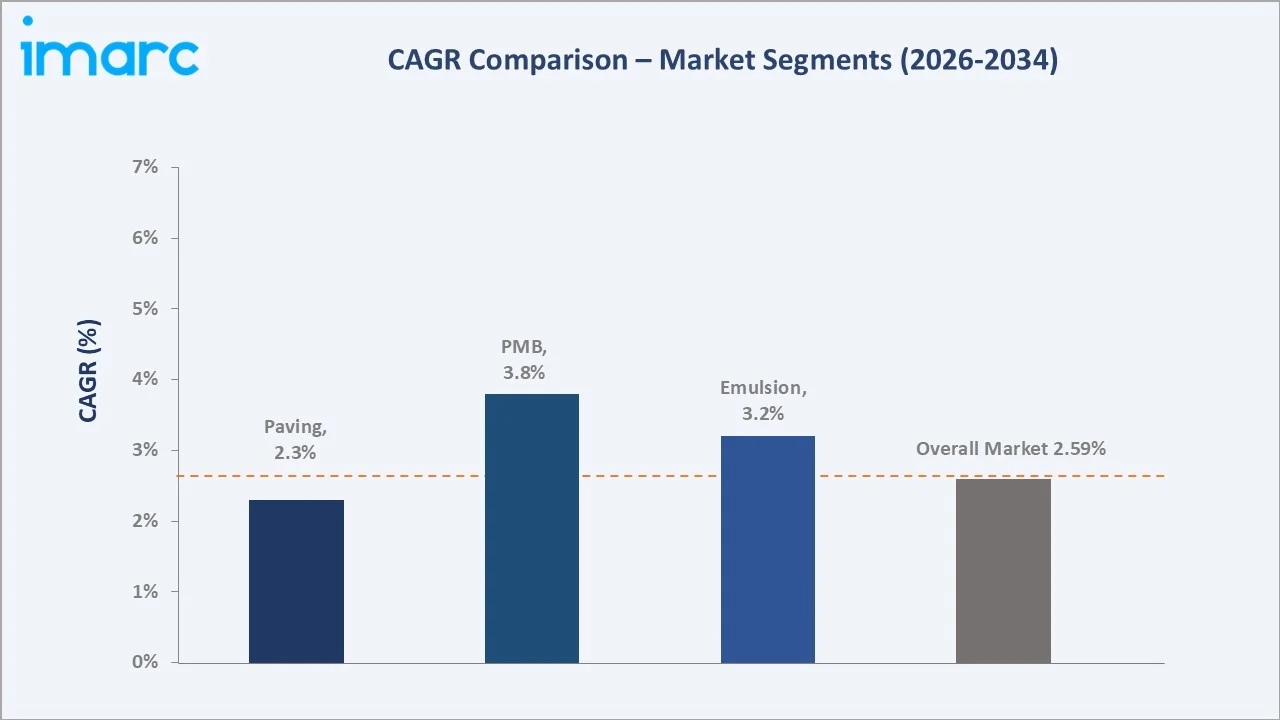
Polymer Modified Binders grow fastest at approximately 3.8% CAGR as expressways and premium road projects demand superior performance bitumen. Paving maintains dominance through the scale of national highway construction.
Executive Summary
The India bitumen market, which increased from USD 3.36 Billion in 2025 to an estimated USD 3.45 Billion in 2026, representing one of the most dynamic pavement materials markets in Asia. The market encompasses paving bitumen, polymer modified binders, emulsions, oxidized bitumen, penetration grade, and cutback bitumen serving road construction, waterproofing, adhesives, and insulation applications.
Paving at 82.5% dominates through India's massive national highway and urban road construction demand. Roadways at 88.5% lead through the foundational role of bitumen as the primary pavement binder. North India at 38.0% leads through dense national highway networks and major urban agglomerations.
Key Market Insights
|
Insight |
Data |
|
Dominant Product Type |
Paving – 82.5% share (2025) |
|
Dominant Application |
Roadways – 88.5% market share (2025) |
|
Leading Region |
North India – 38.0% market share |
|
Market Opportunity |
Bio-bitumen; polymer modified binders; recycled bitumen; smart roads; warm mix asphalt; rural road connectivity |
Key Analytical Observations Supporting the Above Data:
- Paving at 82.5%: Paving dominates due to India's massive highway expansion under NHDP and PM Gati Shakti programs, sustained demand from urban road construction, and established supply chains from domestic refineries including IOC, HPCL, BPCL, and MRPL.
- Roadways at 88.5%: Roadways dominate because bitumen is the primary binder for asphalt paving across national highways, state highways, and urban roads. India's focus on expanding its national highway network to 200,000 km creates sustained large-volume demand.
- North India at 38.0%: North India leads through high-density road construction in Uttar Pradesh, Rajasthan, Punjab, Haryana, and Delhi NCR, combined with significant NHAI project activity on major highway corridors.
India Bitumen Market Overview
The India bitumen market encompasses the production, distribution, and application of bituminous materials across road construction, waterproofing, adhesive, and insulation end-uses. The market includes viscosity grade bitumen, polymer modified binders, bitumen emulsions, oxidized bitumen, penetration grade, and cutback bitumen types.
Macroeconomic factors include India's ambitious infrastructure investment targets, population growth, rapid urbanization, and government commitment to road connectivity. The National Infrastructure Pipeline and PM Gati Shakti National Master Plan are creating structural demand for bitumen through 2034.
Market Dynamics
To evaluate market opportunities, Request Sample
Market Drivers
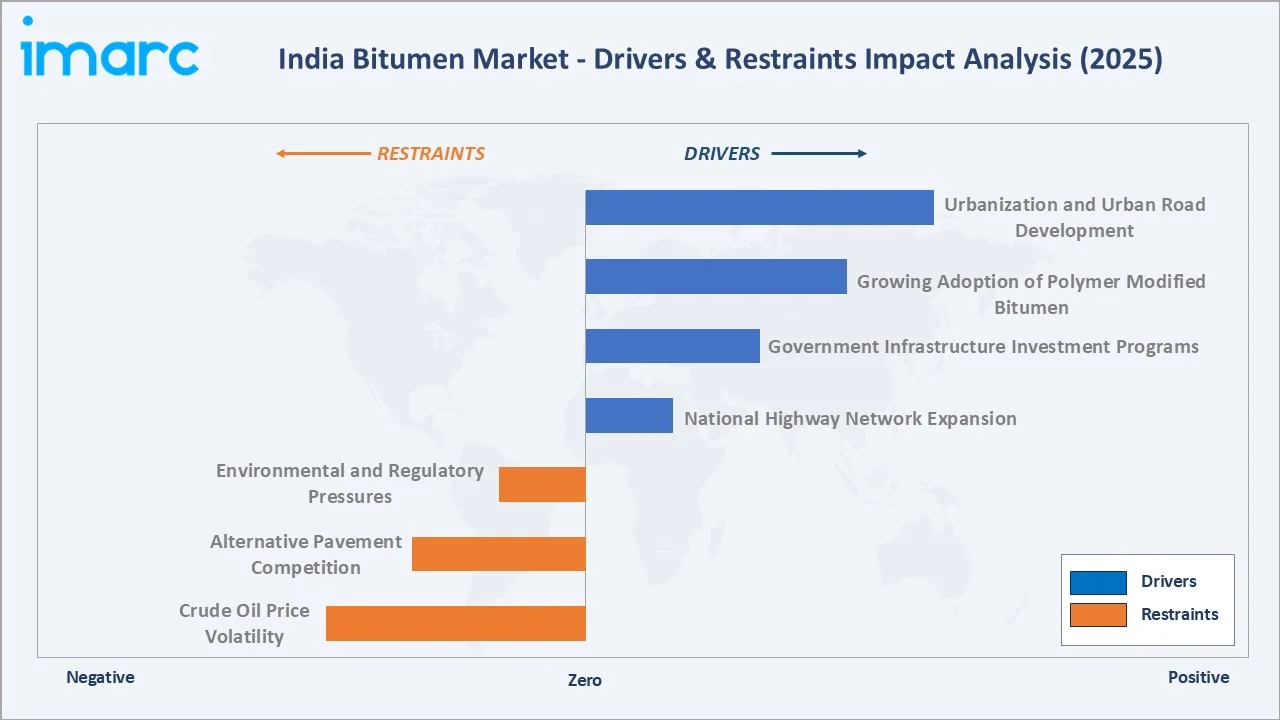
- National Highway Network Expansion: India's road construction program is among the world's largest, with the National Highways Authority of India targeting expansion to 200,000 km. Sustained highway investment creates large-volume bitumen demand from contractors, driving consistent market growth.
- Government Infrastructure Investment Programs: PM Gati Shakti and the National Infrastructure Pipeline represent multi-year, government-mandated infrastructure commitments generating above-trend bitumen consumption across simultaneous highway, state road, and urban road projects.
- Growing Adoption of Polymer Modified Bitumen: Increasing use of polymer modified binders for expressways, high-traffic corridors, and urban roads is creating a rapidly expanding higher-value product segment. Performance specifications for premium road projects are driving PMB adoption.
- Urbanization and Urban Road Development: Rapid urbanization, Smart Cities Mission investment, and expanding vehicle fleets are generating sustained bitumen demand for urban arterial roads, flyovers, and urban expressways across tier-1 and tier-2 cities.
Market Restraints
- Crude Oil Price Volatility: Bitumen pricing is directly linked to crude oil markets. Price volatility creates cost instability for road contractors and state government road programs, disrupting procurement timing and project economics.
- Alternative Pavement Competition: Cement concrete pavement is gaining adoption in high-traffic urban roads, industrial zones, and select highway applications where long-term maintenance economics may favour rigid pavement over bituminous construction.
- Environmental and Regulatory Pressures: Growing regulatory focus on bitumen fume emissions, VOC content in cutback bitumen, and the environmental impact of bitumen production is creating compliance requirements for producers and contractors.
Market Opportunities
- Bio-Bitumen and Sustainable Pavements: Bio-bitumen from lignin and agricultural residues offers a pathway to reduce carbon emissions in road construction. India's first national highway with lignin bio-bitumen was inaugurated on NH44 in December 2024, allowing up to 15% blending with conventional bitumen.
- Warm Mix Asphalt and Recycled Technologies: Warm mix asphalt additives reduce energy consumption and emissions by lowering mixing temperatures. Combined with reclaimed asphalt pavement recycling programs, these technologies align with India's green highway objectives.
Market Challenges
- Seasonal Demand Concentration: India's bitumen consumption is concentrated in the October-May construction season, creating logistical challenges for storage and supply chain management during the monsoon period when road construction effectively halts.
- Quality and Supply Chain Issues: Bitumen quality consistency remains a challenge across India's fragmented supply chain, with adulteration, non-standard grades, and inadequate storage infrastructure increasing road maintenance costs and undermining pavement performance.
Emerging Market Trends
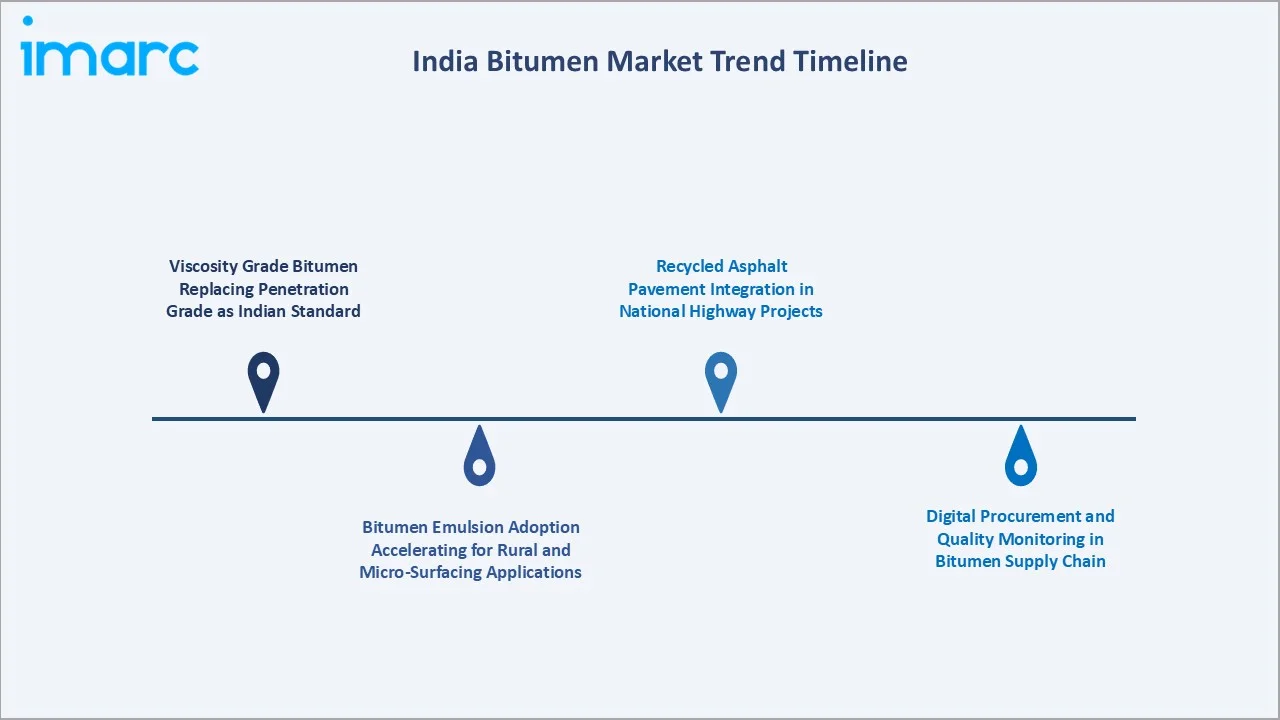
1. Viscosity Grade Bitumen Replacing Penetration Grade as Indian Standard
India's transition from penetration grade to viscosity grade bitumen under IS 73:2013 is creating a market-wide product upgrade cycle. VG-10, VG-20, VG-30, and VG-40 grades are replacing the older 60/70 and 80/100 grades, improving pavement performance across India's diverse climate zones.
2. Bitumen Emulsion Adoption Accelerating for Rural and Micro-Surfacing Applications
Bitumen emulsion is gaining adoption in rural road programs, surface dressing, and micro-surfacing applications under PMGSY. Emulsions offer safety advantages through reduced heating requirements, enabling cold mix applications suitable for remote sites with limited equipment.
3. Digital Procurement and Quality Monitoring in Bitumen Supply Chain
Digital transformation through government e-procurement platforms, IoT-based temperature monitoring in tankers, and digital quality certification is improving supply chain transparency, reducing quality issues, and enabling better demand forecasting for refiners and distributors.
4. Recycled Asphalt Pavement Integration in National Highway Projects
India's NHAI is promoting reclaimed asphalt pavement incorporation in rehabilitation projects. RAP utilization with fresh bitumen reduces material costs and waste, aligning with circular economy objectives while creating new requirements for bitumen compatibility with recycled materials.
Industry Value Chain Analysis
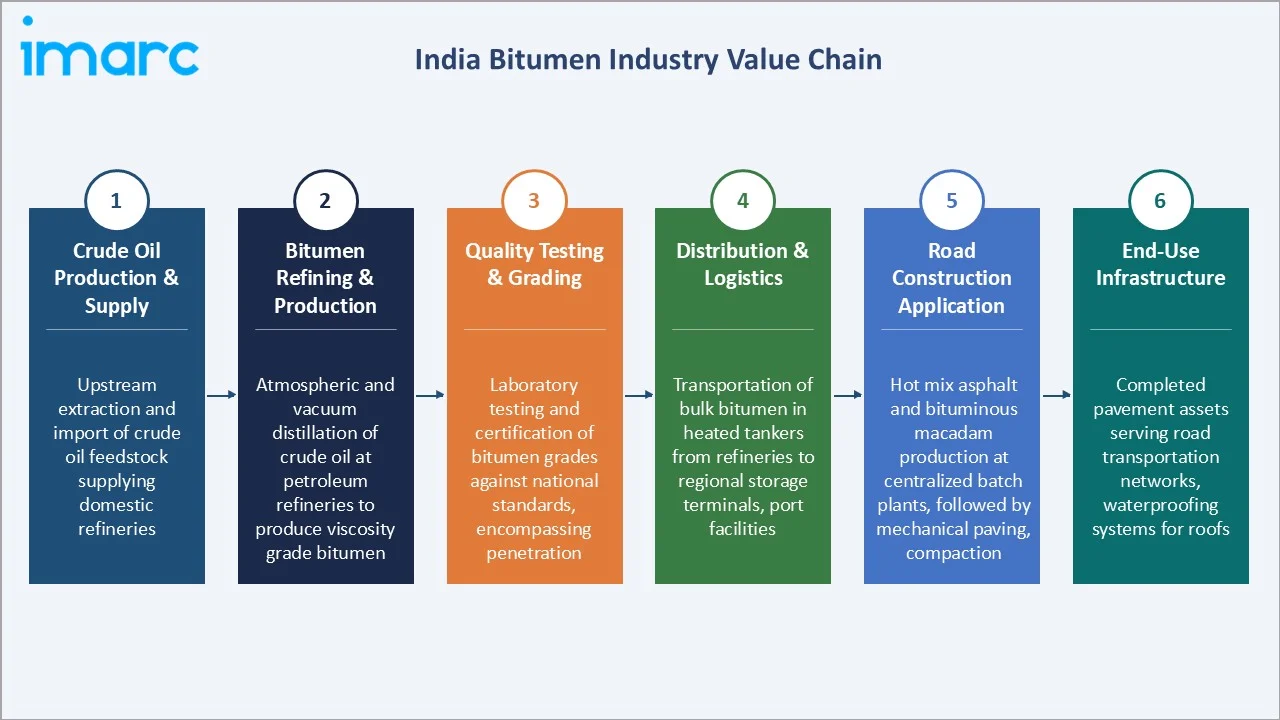
The India bitumen value chain integrates crude oil supply and refinery processing, bitumen production and grading, quality testing and certification, distribution and logistics, road construction application, and end-use infrastructure maintenance. Domestic refineries including IOC, HPCL, BPCL, MRPL, and NRL constitute the primary production tier.
|
Stage |
Key Participants |
|
Crude Oil Production & Supply |
Upstream extraction and import of crude oil feedstock supplying domestic refineries, encompassing both onshore and offshore production fields and international crude import infrastructure at major coastal ports. |
|
Bitumen Refining & Production |
Atmospheric and vacuum distillation of crude oil at petroleum refineries to produce viscosity grade bitumen, polymer modified binders, and specialty bitumen grades, including quality grading and blending operations. |
|
Quality Testing & Grading |
Laboratory testing and certification of bitumen grades against national standards, encompassing penetration, viscosity, softening point, ductility, and flash point testing by accredited testing bodies and in-plant quality control facilities. |
|
Distribution & Logistics |
Transportation of bulk bitumen in heated tankers from refineries to regional storage terminals, port facilities, and construction site depots, supported by temperature-controlled storage infrastructure and transparent price assessment benchmarks. |
|
Road Construction Application |
Hot mix asphalt and bituminous macadam production at centralized batch plants, followed by mechanical paving, compaction, and quality control for national highways, expressways, state roads, and urban arterial networks. |
|
End-Use Infrastructure |
Completed pavement assets serving road transportation networks, waterproofing systems for roofs, basements and underground structures, pipe corrosion protection coatings, industrial adhesives, and flooring applications across public and private sectors. |
The refining and production stage is the most strategically significant tier, as domestic refinery capacity directly determines bitumen price and availability. S&P Global Platts's CFR India price assessments launched in October 2024 for VG-30 and VG-40 delivered to West and East coast ports support transparent import pricing.
Technology Landscape in the India Bitumen Industry
Biturox Technology for Premium Grade Bitumen Production
Biturox technology, adopted by MRPL in its new Mangaluru unit commissioned in December 2024, enables continuous bitumen oxidation to produce consistent VG-40 and specialty grades. This technology improves quality control, increases production efficiency, and supports flexible grade switching.
Polymer Modification Technology for PMB Production
SBS and Crumb Rubber Modifier technologies enable production of polymer modified bitumen meeting IRC:SP:53 specifications. PMB technology investment is accelerating as expressway specifications increasingly mandate modified bitumen for wearing courses.
Warm Mix Asphalt Additive Technology
Warm mix additives including synthetic waxes, chemical additives, and foam bitumen systems enable asphalt production and compaction at temperatures 20-30°C lower than conventional hot mix asphalt, reducing energy consumption and extending the paving season.
Market Segmentation Analysis
The report covers the following segments:
|
Segment Category |
Leading Segment |
Market Share |
Year |
|
Product Type |
Paving |
82.5% |
2025 |
|
Viscosity Grade |
VG30 |
48.5% |
2025 |
|
Application |
Roadways |
88.5% |
2025 |
|
Region |
North India |
38.0% |
2025 |

By Product Type
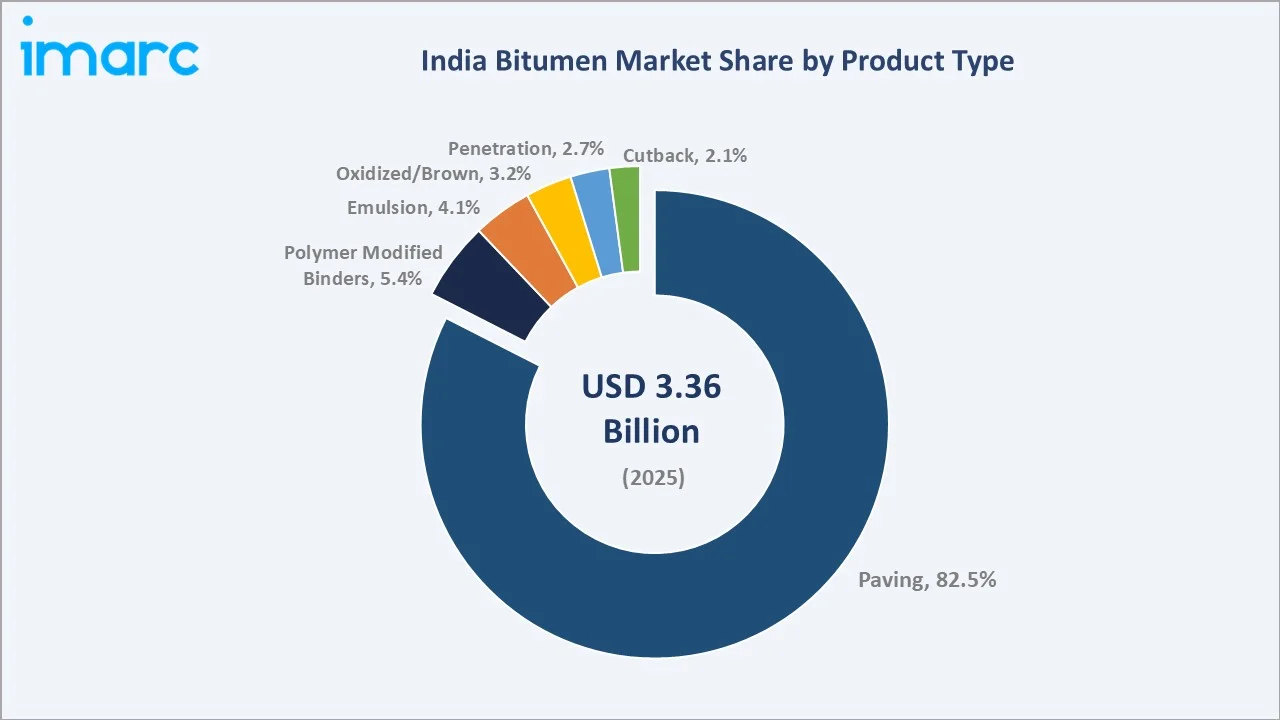
Paving leads at 82.5% (2025). The paving segment encompasses viscosity grade bitumen VG-10, VG-20, VG-30, and VG-40 serving national highway, state highway, and urban road construction as the primary pavement binder. India's road construction program scale sustains paving bitumen's dominant position.
To access detailed market analysis, Request Sample
Polymer Modified Binders at 5.4% grow fastest at approximately 3.8% CAGR as expressway specifications mandate premium grades. Emulsion at 4.1% benefits from rural road programs. Oxidized/Blown at 3.2% serves waterproofing applications. Penetration grade at 2.7% is declining as viscosity grade standards replace older specifications.
By Application
Roadways lead at 88.5% (2025). The roadways segment encompasses national highways, state highways, district roads, urban roads, and rural connectivity roads served under PMGSY, Smart Cities Mission, and state government programs.
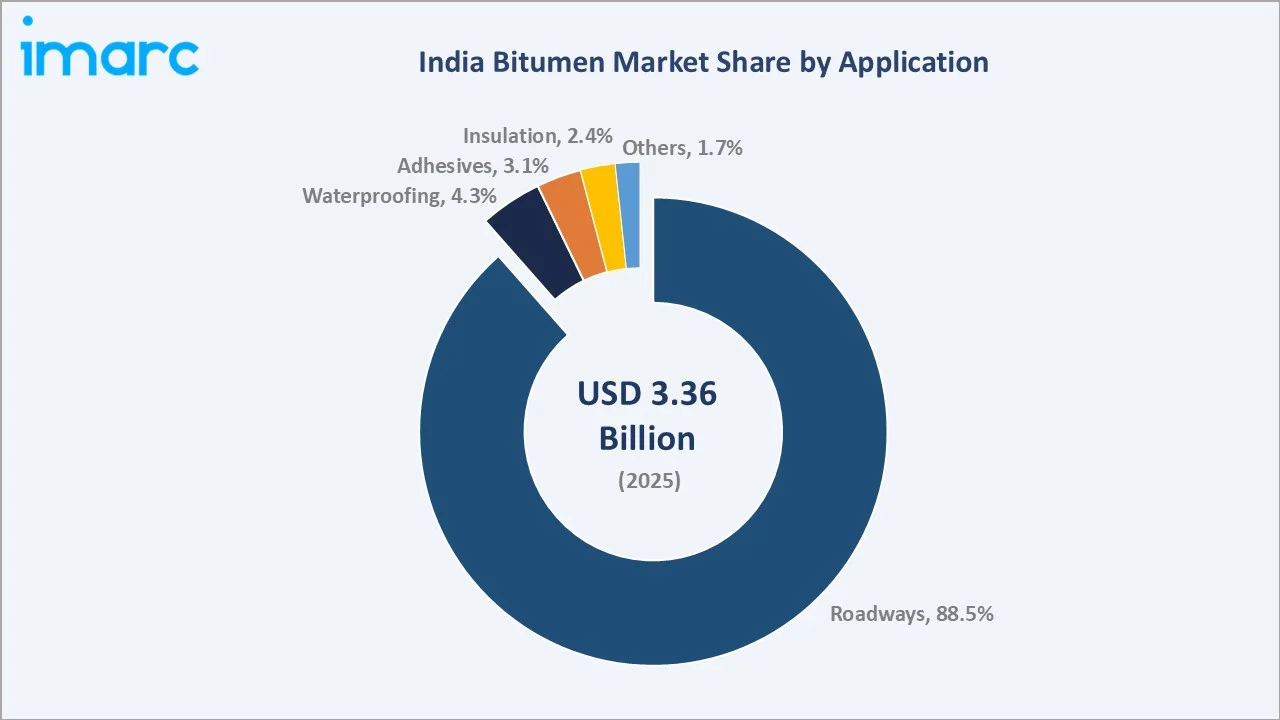
Waterproofing at 4.3% includes roofing, basement, and underground structure waterproofing. Adhesives at 3.1% serve flooring, pipe coating, and industrial bonding. Insulation at 2.4% encompasses pipe insulation and corrosion protection applications.
Regional Market Insights
|
Region |
Share (2025) |
Key Drivers & Characteristics |
|
North India |
38.0% |
Driven by major national highway projects, dense urban road networks in Delhi NCR, and high construction activity in UP, Rajasthan, Punjab, and Haryana. |
|
West India |
27.4% |
Supported by Maharashtra and Gujarat highway expansion, Mumbai-Pune and coastal road projects, and proximity to HPCL and BPCL Mumbai refinery bitumen supply. |
|
South India |
22.1% |
Driven by Karnataka, Tamil Nadu, Andhra Pradesh, and Telangana road construction, MRPL supply capability, and urban road investment in Bengaluru, Chennai, and Hyderabad. |
|
East India |
12.5% |
Supported by connectivity programs in West Bengal, Bihar, Odisha, and Northeast India, with NRL Numaligarh refinery serving the northeast bitumen market. |
North India's 38.0% market leadership is anchored by high-density national highway corridor development, including the Delhi-Mumbai Industrial Corridor and major expressway projects in Uttar Pradesh and Rajasthan. West India's 27.4% reflects strong refinery supply infrastructure and active coastal highway development.
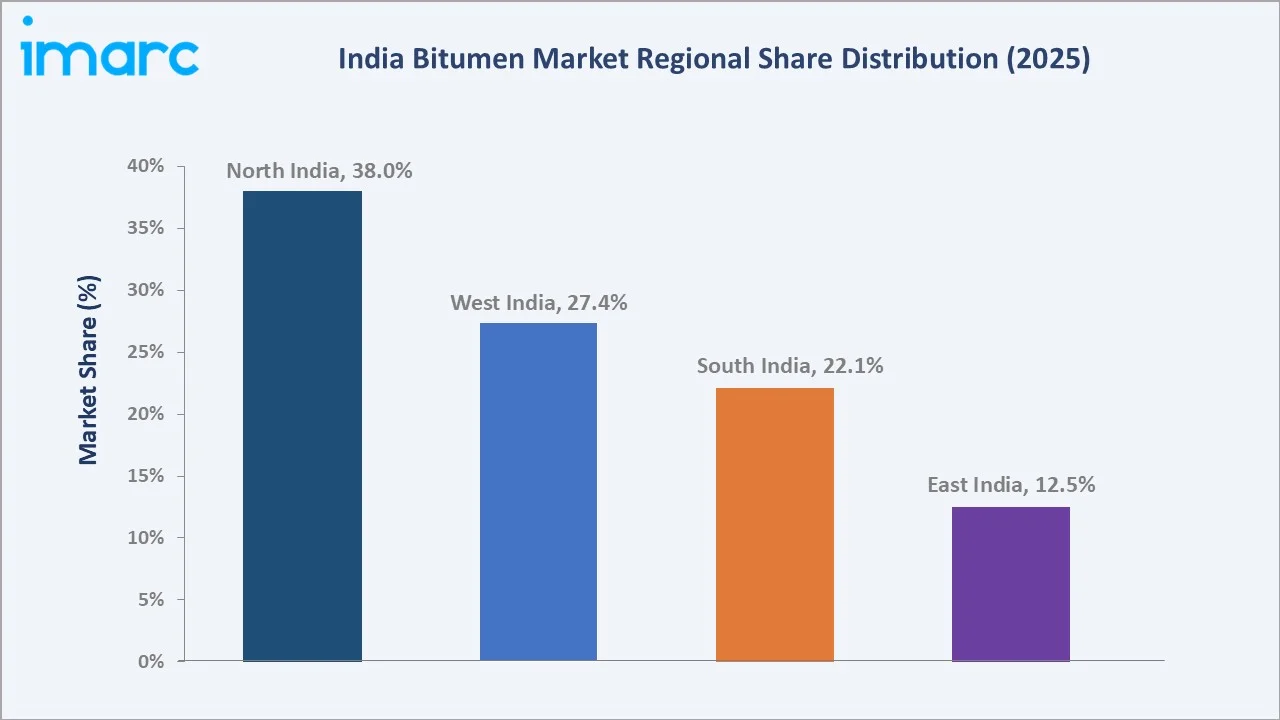
South India's 22.1% encompasses substantial highway activity in Karnataka and Tamil Nadu alongside MRPL's expanded bitumen production capacity. East India at 12.5% represents the most commercially dynamic growth sub-region through Northeast India connectivity programs.
Competitive Landscape
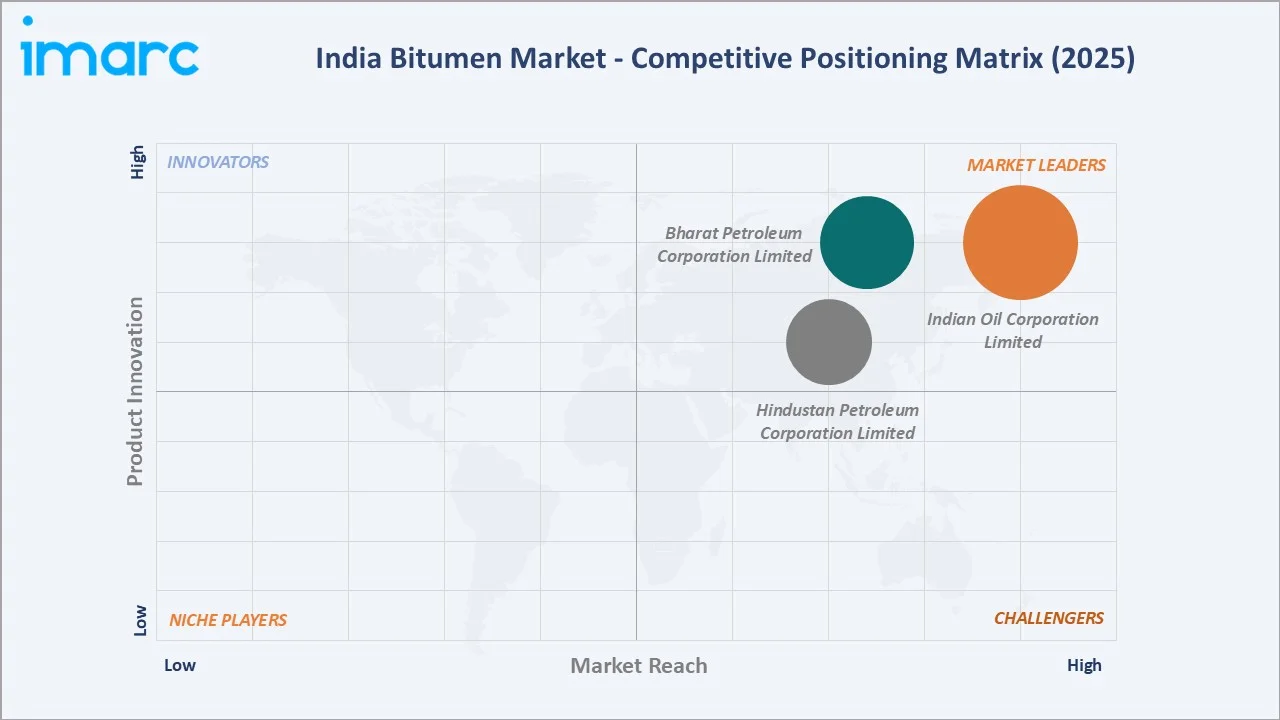
The India bitumen market competitive landscape encompasses domestic petroleum refineries, international bitumen traders, polymer modified binder producers, and specialty bitumen product companies. Indian public sector refineries dominate production capacity while international traders serve import pricing benchmarks.
|
Company Name |
Key Products |
Market Position |
Core Strength |
|
Indian Oil Corporation Limited |
VG-40, PMB, Bitumen Emulsion |
Market Leader |
Largest domestic refining capacity with multiple bitumen-producing refineries including Haldia, Mathura, Barauni, and Guwahati, providing national distribution coverage. |
|
Hindustan Petroleum Corporation Limited |
VG-10, VG-30, VG-40, Crumb Rubber Modified Bitumen (CRMB), Polymer Modified Bitumen (PMB) |
Market Leader |
Mumbai refinery bitumen output serving West India with extensive dealer network and bitumen emulsion capabilities for road maintenance contracts. |
|
Bharat Petroleum Corporation Limited |
VG-30, VG-40, CRM-PMB, Emulsion |
Market Leader |
Mumbai refinery bitumen production with polymer modification capability and nationwide distribution infrastructure serving highway contractors. |
Public sector refinery dominance creates stable supply but limited innovation incentives. International traders and specialty companies provide technology-differentiated products for premium segments. Market concentration is high at the production tier with IOC, HPCL, and BPCL controlling the majority of domestic output.
Key Company Profiles
Indian Oil Corporation Limited
Indian Oil Corporation Limited is India's largest petroleum refiner and dominant bitumen producer, operating multiple refineries with bitumen production capabilities serving all major regional markets.
- Key Products: VG-30, VG-40 viscosity grade bitumen, SBS polymer modified bitumen, bitumen emulsion grades.
- Recent Developments: In November 2025, IndianOil Total Pvt. Ltd. (ITPL), the 50:50 joint venture between Indian Oil Corporation and TotalEnergies, inaugurated a new greenfield Bitumen Derivatives Plant at Gummidipoondi near Chennai. The facility manufactures high-performance road construction materials including Polymer Modified Bitumen (PMB), Crumb Rubber Modified Bitumen (CRMB), and Bitumen Emulsions, strengthening supply capabilities for infrastructure projects across southern India.
- Strategic Focus: Capacity expansion, quality enhancement through refinery upgrades, and development of specialty bitumen products including bio-bitumen blends and warm mix asphalt additives.
Hindustan Petroleum Corporation Limited
Hindustan Petroleum Corporation Limited is one of India's leading petroleum refiners with significant bitumen production at its Mumbai refinery, serving West India and national markets through dealer networks and direct contractor supply.
- Key Products: VG-10, VG-30, VG-40, SBS and CRMB polymer modified bitumen, SS-1 and RS-1 emulsion grades.
- Recent Developments: In June 2026, Agarwal Industrial Corporation Limited won a ₹477.5 crore contract from Hindustan Petroleum Corporation Limited (HPCL) to supply approximately 1.30 lakh metric tonnes of VG-30 and VG-40 bulk bitumen, reinforcing HPCL's role in meeting India's growing bitumen demand for road infrastructure projects.
- Strategic Focus: Expanding polymer modified bitumen supply for expressway projects, developing warm mix asphalt compatible bitumen grades, and improving East and South India distribution reach.
Bharat Petroleum Corporation Limited
Bharat Petroleum Corporation Limited is a major Indian petroleum refiner with bitumen production at Mumbai refinery, offering a comprehensive range including crumb rubber modified polymer bitumen targeting the rapidly growing premium segment.
- Key Products: VG-30, VG-40, Crumb Rubber Modified PMB, SBS PMB, bitumen emulsion grades.
- Recent Developments: In June 2025, Bharat Petroleum Corporation Limited (BPCL) approved a joint venture with Tiki Tar and Shell India Pvt. Ltd. to manufacture and market value-added bitumen products, reinforcing its strategy to expand its footprint in India's growing specialty bitumen market.
- Strategic Focus: Premium polymer modified bitumen for expressway projects, crumb rubber modification technology, and sustainable bitumen products aligned with India's green highway initiatives.
Market Concentration Analysis
The India bitumen market is highly concentrated at the production tier, with public sector refineries IOC, HPCL, and BPCL controlling the large majority of domestic bitumen output. Import competition from Gulf exporters is facilitated by S&P Global Platts CFR India price assessments launched in October 2024 for VG-30 and VG-40 delivered to West and East coast ports. Market concentration creates stable supply but limits price competition at the production tier.
Investment & Growth Opportunities
Highest Growth Segments
Polymer Modified Binders (approximately 3.8% CAGR), bitumen emulsion for rural and maintenance applications (approximately 3.2% CAGR), bio-bitumen blends (approximately 15% CAGR from small base), warm mix asphalt additives (approximately 12% CAGR), and recycled asphalt pavement bitumen formulations represent the highest-growth investment vectors through 2034.
Emerging Investment Opportunities
Northeast India infrastructure connectivity represents a high-growth sub-regional bitumen market opportunity. Road construction activity in Assam, Arunachal Pradesh, Manipur, and Meghalaya supported by government priority investment and NRL bitumen supply is creating above-national-average demand growth.
Investment Themes
- Bio-bitumen development for Indian road specifications: India's demonstration of lignin bio-bitumen on NH44 opens investment opportunities in agricultural waste-based bitumen additives. Companies developing bio-bitumen blends compatible with BIS and IRC specifications by 2026-2027 are positioned for government procurement preference as sustainability mandates strengthen.
- Bitumen emulsion technology investment for rural road programs: India's PMGSY rural road program and urban road maintenance programs create large addressable markets for bitumen emulsion as a cold-application alternative to hot bitumen. Emulsion plant investment combined with contractor partnerships creates recurring revenue from government road maintenance contracts.
Future Market Outlook (2026-2034)
The India bitumen market is projected to grow from USD 3.36 Billion in 2025 to USD 3.45 Billion in 2026, reaching USD 4.35 Billion by 2034, registering a CAGR of 2.59% during 2026–2034. The market's anchor value of USD 3.82 Billion in 2030 reflects sustained government infrastructure investment commitments.
Three structural forces define growth through 2034. Infrastructure investment as national policy ensures government-mandated, multi-year, budget-committed highway construction demand. Urbanization creates road capacity demand in tier-1 to tier-3 cities. Technology transition from penetration grade to viscosity grade and progressive PMB adoption supports market value growth above volume growth.
Research Methodology
Primary Research
Primary research comprised structured interviews with 45+ industry stakeholders (2025) including refinery business development managers, road contractor procurement heads, bitumen distributor and logistics operators, NHAI project engineers, and regional bitumen market specialists.
Secondary Research
Secondary research encompassed Ministry of Road Transport & Highways reports, BIS bitumen standards documentation, IRC guidelines, CRRI research publications, S&P Global Platts bitumen price assessments, company annual reports, and India refinery capacity data. Over 50 secondary sources reviewed.
Forecasting Models
Market revenue forecasts developed using a segment bottom-up model: (i) paving bitumen demand linked to highway construction spending forecasts; (ii) specialty product segment growth rates calibrated to technology adoption curves; (iii) regional demand allocation based on infrastructure investment distribution.
India Bitumen Market Report Coverage:
| Report Features | Details |
|---|---|
| Base Year of the Analysis | 2025 |
| Historical Period | 2020-2025 |
| Forecast Period | 2026-2034 |
| Units | Billion USD |
| Scope of the Report |
Exploration of Historical Trends and Market Outlook, Industry Catalysts and Challenges, Segment-Wise Historical and Future Market Assessment:
|
| Product Types Covered | Paving, Penetration, Oxidized/Blown, Cutback, Emulsion, Polymer Modified Binders |
| Viscosity Grades Covered | VG10, VG30, VG40, Others |
| Applications Covered | Roadways, Waterproofing, Adhesives, Insulation, Others |
| Regions Covered | North India, South India, East India, West India |
| Companies Covered | Indian Oil Corporation Limited, Hindustan Petroleum Corporation Limited, Bharat Petroleum Corporation Limited, etc. |
| Customization Scope | 10% Free Customization |
| Post-Sale Analyst Support | 10-12 Weeks |
| Delivery Format | PDF and Excel through Email (We can also provide the editable version of the report in PPT/Word format on special request) |
Key Benefits for Stakeholders:
- IMARC’s industry report offers a comprehensive quantitative analysis of various market segments, historical and current market trends, market forecasts, and dynamics of the India bitumen market from 2020-2034.
- The research report provides the latest information on the market drivers, challenges, and opportunities in the India bitumen market.
- Porter's five forces analysis assist stakeholders in assessing the impact of new entrants, competitive rivalry, supplier power, buyer power, and the threat of substitution. It helps stakeholders to analyze the level of competition within the India bitumen industry and its attractiveness.
- Competitive landscape allows stakeholders to understand their competitive environment and provides an insight into the current positions of key players in the market.
Frequently Asked Questions About the India Bitumen Market Report
The India bitumen market size is estimated at USD 3.45 Billion in 2026. The market is driven by national highway expansion, PM Gati Shakti infrastructure investment, and growing polymer modified bitumen demand for expressway construction.
The market grows at 2.59% CAGR during 2026-2034, reaching USD 4.35 Billion by 2034. Polymer Modified Binders grow fastest at approximately 3.8% CAGR through expressway specification upgrades.
Paving leads at 82.5% through India's enormous road construction program scale and national highway network expansion targeting 200,000 km.
Roadways lead at 88.5% through the foundational role of bitumen as the primary pavement binder in India's asphalt road construction program across national, state, district, urban, and rural roads.
North India leads at 38.0% through major national highway corridor development, Delhi NCR urban road construction, and high-density infrastructure investment in Uttar Pradesh, Rajasthan, Punjab, and Haryana.
Leading companies include Indian Oil Corporation Limited, Hindustan Petroleum Corporation Limited, and Bharat Petroleum Corporation Limited, among others.
The market is projected to reach approximately USD 3.82 Billion by 2030, with VG-grade standardization complete, polymer modified binder adoption mainstream for expressways, bio-bitumen scaling to commercial volumes, and Northeast India connectivity programs at peak construction intensity.
Need more help?
- Speak to our experienced analysts for insights on the current market scenarios.
- Include additional segments and countries to customize the report as per your requirement.
- Gain an unparalleled competitive advantage in your domain by understanding how to utilize the report and positively impacting your operations and revenue.
- For further assistance, please connect with our analysts.
 Request Customization
 Speak to an Analyst
 Request Brochure
 Inquire Before Buying
Benefits of Customization
- Personalize this research
- Triangulate with your data
- Get data as per your format and definition
- Gain a deeper dive into a specific application, geography, customer, or competitor
- Any level of personalization
Get in Touch With Us
UNITED STATES
Phone: +1-201-971-6302
INDIA
Phone: +91-120-433-0800
UNITED KINGDOM
Phone: +44-753-714-6104
Email: [email protected]
Client Testimonials




.webp)




.webp)













Related Reports

Choose your plan
*Please note that the prices mentioned below are starting prices for each bundle type. Kindly contact our team for further details.*
Single User License
- 1 User License, Access on 2 Devices
- PDF Report + Excel Dataset (Password Protected)
- Lifetime Access
- No Printing Rights
- 10% Free Report Customization
- 10–12 Weeks of Analyst Support
Five User License
- Access for 5 Users, 2 Devices per User
- PDF Report + Excel Dataset (Password Protected)
- Lifetime Access
- Dedicated Account Manager
- 12–14 Weeks of Analyst Support
- No Printing Rights
- 15% Free Report Customization
- 25% Discount on Your Next Purchase
Corporate User License
- Unlimited User Access (Within Your Organization)
- PDF Report + Excel Dataset
- Lifetime Access
- Dedicated Account Manager
- 14–20 Weeks of Analyst Support
- No Printing Rights
- 20% Free Report Customization
- 30% Discount on Your Next Purchase
Essential Insights
What's included:
3 reports
- Lifetime Access
- PDF Reports
- Excel Datasets
- 2 Weeks of Free Analyst Support
- 2 User Licenses
- Access on 2 Devices
- Printing Rights
- Complimentary PowerPoint (PPT) Version
- Complimentary License Upgrade
Professional Access
What's included:
5 reports
- Lifetime Access
- PDF Reports
- Excel Datasets
- 8 Weeks of Free Analyst Support
- 2 User Licenses
- Access on 2 Devices
- Printing Rights
- Complimentary PowerPoint (PPT) Version
- Complimentary License Upgrade
Business Advantage
What's included:
8 reports
- Lifetime Access
- PDF Reports
- Excel Datasets
- 14 Weeks of Free Analyst Support
- 2 User Licenses
- Access on 2 Devices
- Printing Rights
- Complimentary PowerPoint (PPT) Version
- Complimentary License Upgrade
Enterprise Intelligence
What's included:
10 reports
- Lifetime Access
- PDF Reports
- Excel Datasets
- 20 Weeks of Free Analyst Support
- 2 User Licenses
- Access on 2 Devices
- Printing Rights
- Complimentary PowerPoint (PPT) Version
- Complimentary License Upgrade