
India Credit Card Payment Market Size, Share, Trends and Forecast by Card Type, Provider, Application, and Region, 2026-2034
India Credit Card Payment Market Size, Share, Trends & Forecast (2026-2034)
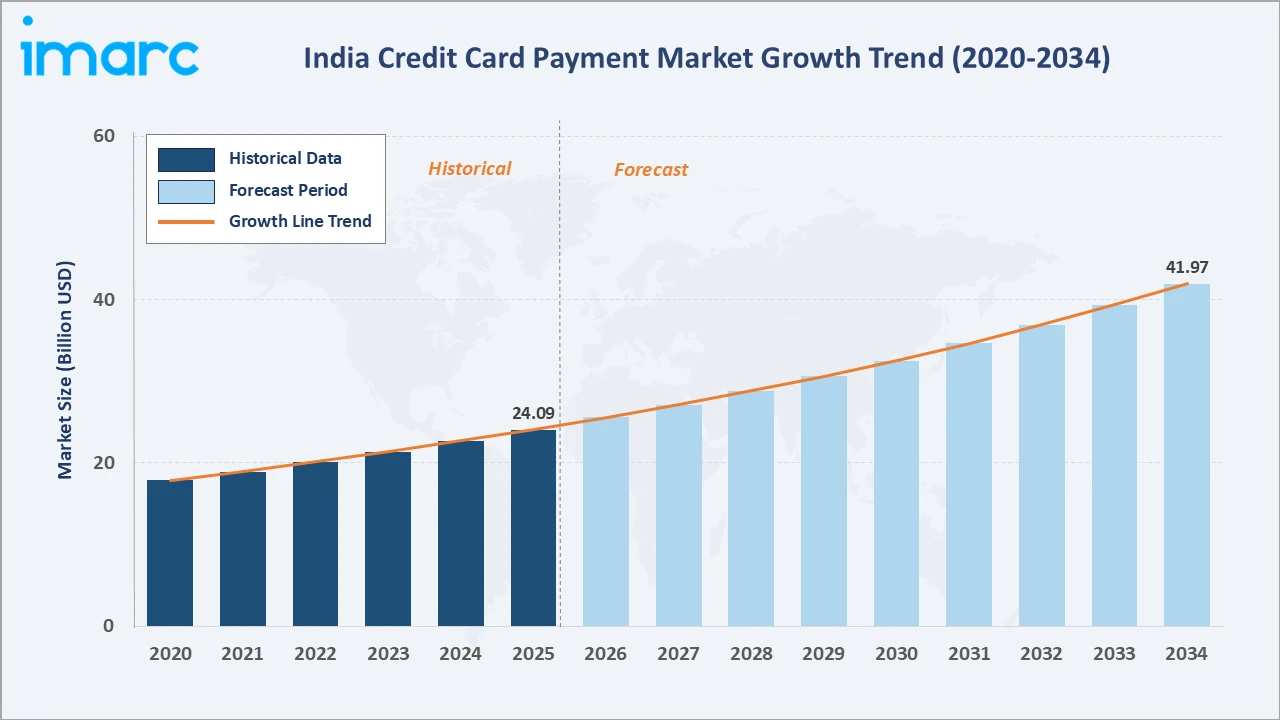
The India credit card payment market grew from USD 24.09 Billion in 2025 to USD 25.57 Billion in 2026 and is projected to reach USD 41.97 Billion by 2034, growing at a CAGR of 6.17% during 2026-2034. Demand is broadening as organized retail, e-commerce, travel, fuel and dining move household spending onto card rails, and as issuers deepen coverage of existing banking relationships instead of relying on new-to-credit customers alone. Rising card issuance, higher average spend per active card and wider merchant acceptance together lift billed volumes across the credit card payments market. Modernization through tokenization, contactless acceptance and UPI-linked credit instruments is shortening checkout time and pulling small merchants into card acceptance. Supportive regulatory direction on network choice and interoperability is widening the addressable base, while credit-led consumption and the steady formalization of household spending reshape how payments are made. Portfolio quality discipline and co-branded distribution now shape supply as much as pricing does, and the shift toward premium and lifestyle cards is raising value per account across the country.
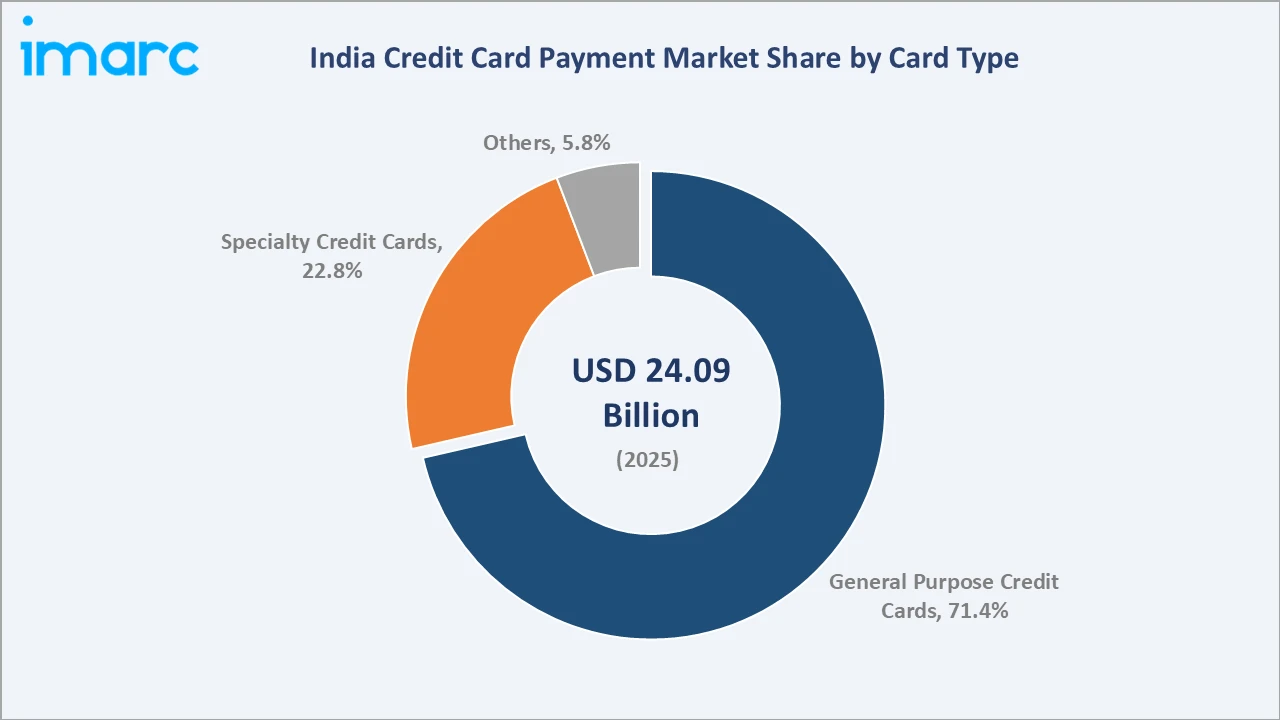
Supporting growth factors include rising card issuance, wider merchant acceptance and premium co-branded programs. General purpose credit cards dominate at 71.4%. Visa leads at 41.6%. West India commands 34.9% of the regional market share.
Market Snapshot
| Metric | Value |
|---|---|
| Base Year Market Size (2025) | USD 24.09 Billion |
| Market Size (2026) | USD 25.57 Billion |
| Forecast Market Size (2034) | USD 41.97 Billion |
| CAGR (2026-2034) | 6.17% |
| Base Year | 2025 |
| Historical Period | 2020-2025 |
| Forecast Period | 2026-2034 |
| Dominant Card Type | General Purpose Credit Cards (71.4%, 2025) |
| Dominant Provider | Visa (41.6%, 2025) |
| Leading Region | West India (34.9%, 2025) |
The market size increased from USD 17.85 Billion in 2020 to USD 24.09 Billion in 2025 and is estimated to reach USD 25.57 Billion in 2026. The market is further expected to grow to USD 32.50 Billion by 2030 and USD 41.97 Billion by 2034. Its commercial distinctiveness rests on a bank-led issuing model that cross-sells cards into existing deposit relationships, backed by a dense merchant acceptance network and a rewards-driven consumer culture.
To get more information on this market, Request Sample
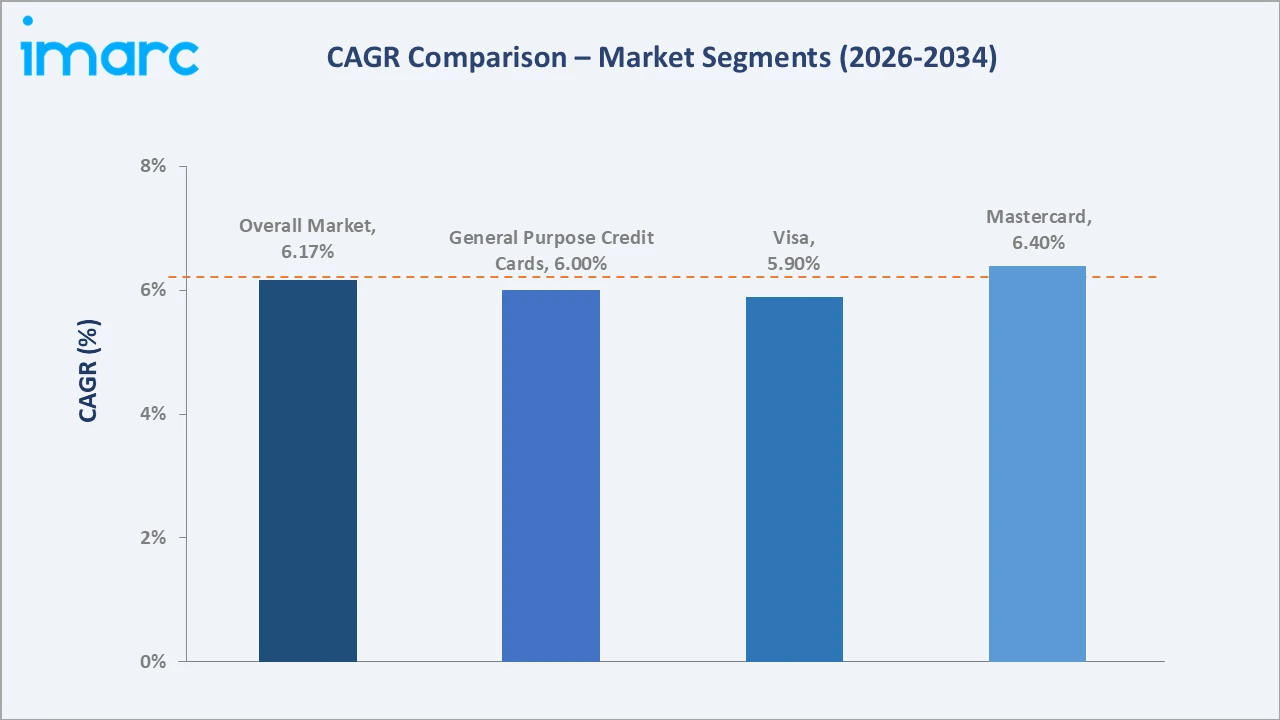
Specialty credit cards at ~6.9% CAGR and Mastercard at ~6.4% CAGR are the fastest-growing segments, supported by rising demand for customized card offerings, expanding digital payment adoption, and the surging acceptance of cashless transactions across India.
Executive Summary
The India credit card payment market expanded from USD 24.09 Billion in 2025 to an estimated USD 25.57 Billion in 2026, with demand anchored in salaried and affluent urban households, e-commerce and travel spending, fuel and dining, and a fast-widening base of small merchants that now accept cards. The fastest-developing areas are specialty and co-branded credit cards, credit instruments linked to UPI, and premium tiers where annual fees and interchange are richer, each outpacing the overall market because they combine new customer acquisition with higher spend per account. Issuers are also cross-selling more aggressively into existing deposit and loan relationships, which lowers acquisition cost and raises activation rates. Tokenization, contactless acceptance and digital onboarding continue to compress the time between application and first transaction. The market is projected to reach USD 41.97 Billion by 2034. General purpose credit cards at 71.4% lead through mass retail issuance. Visa at 41.6% leads network share through acceptance depth. West India leads regionally at 34.9% on financial services concentration and merchant density.
Key Market Insights
| Insight | Data |
|---|---|
| Dominant Card Type | General Purpose Credit Cards - 71.4% share (2025) |
| Dominant Provider | Visa - 41.6% market share (2025) |
| Leading Region | West India - 34.9% share (2025) |
| Market Opportunity | Credit on UPI, small merchant acceptance, specialty and co-branded cards, tier II and III expansion |
Key Analytical Observations Supporting the Above Data:
- General purpose credit cards at 71.4%: Mass retail issuance, everyday merchant acceptance and broadly comparable reward structures keep the core card segment dominant, and its spread across income groups gives issuers a stable base for upgrades and cross-sell.
- Visa at 41.6%: Wide domestic and international acceptance footprint, together with long-standing issuer agreements, makes the network the default choice for premium and travel-led programs where overseas usability matters to cardholders.
- West India at 34.9%: Mumbai and Pune concentrate financial services employers, high per-capita spending and the deepest card-accepting merchant base, which lifts both acquisition rates and average spend per active card.
India Credit Card Payment Market Overview
The India credit card payment market links issuers, card networks, processors, merchants and cardholders through a four-party model in which banks carry credit risk while networks supply acceptance, authorization and settlement. Demand comes from salaried and affluent urban households, small business owners who use cards for working capital, and corporate travel and expense programs. Supply is concentrated among a small group of large private and public sector banks, with a pure-play card issuer and co-branding partners widening distribution through retail, fuel, travel and e-commerce tie-ups. Card economics depend on interchange, annual fees, revolving interest and merchant discount rates, so issuers balance acquisition incentives against portfolio quality. The India credit card market therefore competes on rewards, distribution and underwriting rather than on price alone, and scale in transaction data and collections is the main structural advantage.
Market Dynamics
To evaluate market opportunities, Request Sample
Market Drivers
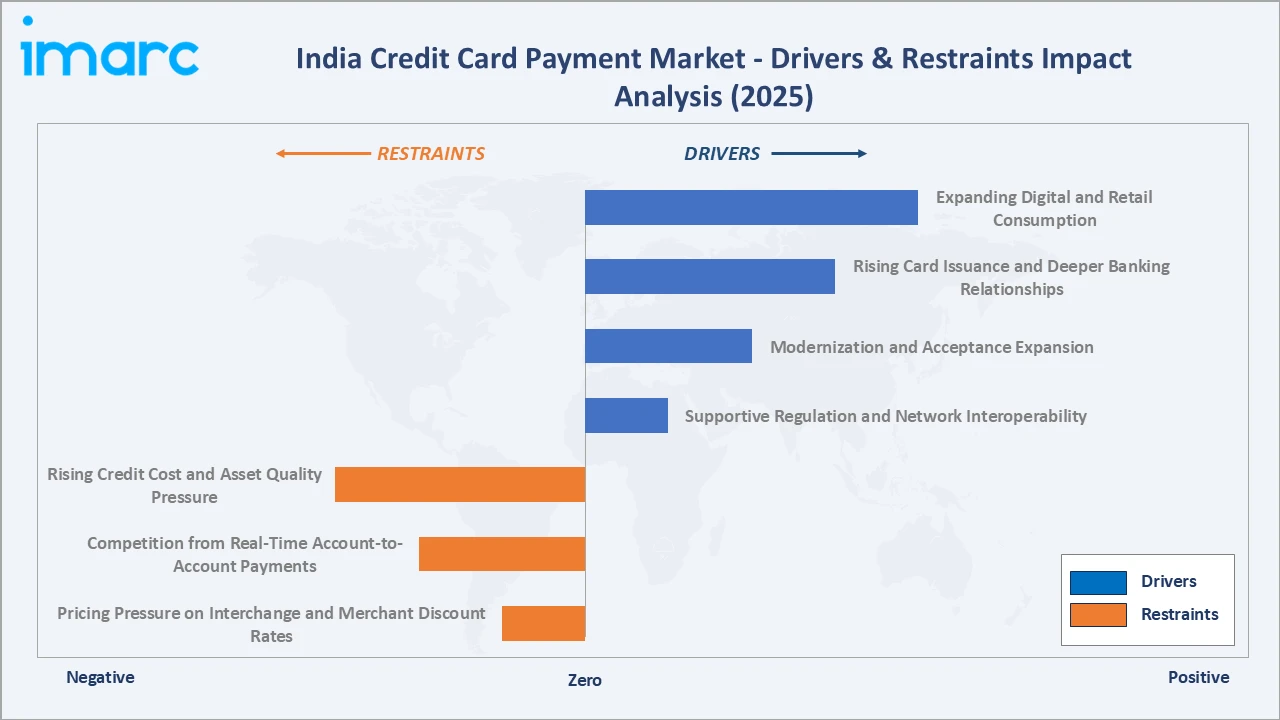
- Expanding Digital and Retail Consumption: As per IMARC Group, the India e-commerce market grew from USD 129.72 Billion in 2025 to USD 155.20 Billion in 2026. Organized retail, e-commerce, food delivery, travel and fuel together represent a growing share of household spending, and each of these categories settles disproportionately on card rails. As consumption moves from cash to digital channels, billed volume per active card rises without a matching increase in the card base, which improves issuer economics and supports premium tiers where fees and interchange are richer.
- Rising Card Issuance and Deeper Banking Relationships: Issuers are shifting from open-market sourcing toward cross-sell, using salary accounts, home and auto loan customers and pre-approved segments as the primary acquisition pool. This lowers sourcing cost, improves activation and reduces early delinquencies, because applicant data is already available inside the bank. Wider distribution through mobile apps and relationship managers brings cards to customers who never applied through agents. As the base of active cards grows and dormant accounts are reactivated, total billed volume compounds, giving issuers a larger interest and fee pool to reinvest in rewards and acceptance building across the country.
- Modernization and Acceptance Expansion: Tokenization, contactless cards, soft point-of-sale terminals and QR-based acceptance have lowered the cost of enrolling merchants, particularly small retailers that could not justify dedicated hardware. Instant digital onboarding lets a customer receive a virtual card and transact within minutes of approval. Real-time authorization and cloud switching reduce decline rates and checkout friction, which lifts completion rates in online commerce. These improvements raise both the number of acceptance points and the share of transactions that end up on credit cards, directly expanding the addressable volume base for the credit card payment market.
- Supportive Regulation and Network Interoperability: Regulatory direction on card network choice, data localization and interoperable payment infrastructure has widened the addressable base without loosening consumer protection. Rules requiring issuers to offer multiple networks give domestic schemes a route into portfolios that were previously tied to a single provider, and linking credit instruments to real-time payment rails extends card credit to merchants that accept only QR codes. Standardized dispute handling and stronger fraud accountability improve consumer confidence. Together these measures keep participation open, encourage competition on service quality, and support steady growth in card-based payment volumes across organized and semi-organized retail.
Market Restraints
- Rising Credit Cost and Asset Quality Pressure: Unsecured retail portfolios are sensitive to income shocks, job transitions and interest rate cycles, and delinquency in credit card books rises faster than in secured lending. Issuers responding with tighter underwriting and lower initial credit limits slow new account growth and reduce activation among thin-file customers. Reward-heavy acquisition can attract customers who transact for benefits rather than to borrow, which distorts portfolio yield. Managing this balance limits how aggressively issuers can pursue volume, and it constrains growth in the smaller-ticket and lower-income segments where credit risk is hardest to price accurately.
- Competition from Real-Time Account-to-Account Payments: Instant bank-to-bank payment rails have become the default for small-ticket retail, peer transfers and many merchant categories, reducing the everyday use case that once anchored card volumes. Merchants favor these channels because they avoid interchange cost, and customers value the simplicity of paying directly from a bank balance. Cards retain an advantage in credit, rewards and dispute protection, but the migration of routine transactions away from plastic compresses the volume base and forces issuers to defend share through richer benefits and targeted merchant offers.
- Pricing Pressure on Interchange and Merchant Discount Rates: Merchant discount rates are negotiated tightly, particularly with large online merchants that can route transactions across channels, and regulatory attention on interchange keeps downward pressure on issuer revenue. Smaller merchants resist card acceptance where the effective cost exceeds their margin. Because a large share of card revenue comes from interchange and fees rather than interest, compression at the merchant end flows directly into program economics and limits the funding available for reward programs, co-branded partnerships and acceptance incentives in price-sensitive categories.
Market Opportunities
- Credit Linked to Real-Time Payment Rails: Allowing credit instruments to be used on QR-based payment networks extends card credit to the millions of merchants that accept only instant bank transfers. This widens the addressable merchant base without requiring terminal deployment, and it gives issuers a route into small-ticket, high-frequency categories where conventional cards were rarely used. Issuers that build credit-on-UPI products with disciplined limits can capture everyday spend, deepen engagement among existing customers and reach new-to-credit borrowers with transaction data that improves risk assessment over time, gradually expanding the credit card payments market.
- Small Merchant and Smaller City Acceptance: Acceptance infrastructure outside large metros remains uneven, with many retailers in tier II and tier III towns relying on QR codes or cash. Lower-cost terminals, smartphone-based acceptance and aggregator onboarding make card acceptance viable at much smaller ticket sizes. Each new merchant category that accepts cards converts a recurring cash flow into billable volume, and issuers benefit twice, first through higher transaction counts and second through stronger card usage among customers who previously used cards only for large purchases in cities.
Market Challenges
- Fraud, Chargebacks and Cybersecurity: Card-not-present fraud, account takeover and phishing attacks scale with digital transaction volume, and each incident carries chargeback cost, remediation expense and reputational risk. Issuers must fund continuous investment in behavioral analytics, device fingerprinting and customer authentication while keeping checkout friction low. Coordinating fraud controls across issuers, networks and merchants adds operational complexity, and liability rules shift risk unpredictably between parties. Smaller issuers without in-house analytics capability are disproportionately exposed and often absorb losses that larger players can detect and block earlier.
- Acquisition Cost and Reward Economics: Competition for the same affluent customer has pushed welcome benefits and milestone rewards upward, lengthening payback periods and narrowing margins on new accounts. Customers readily switch portfolios for better benefits, which raises attrition and reduces lifetime value. Funding rich rewards requires rising interchange or fee income, and both are under pressure, so issuers face a structural trade-off between acquiring scale and protecting profitability. Managing this balance without eroding the value proposition that attracted the customer in the first place is a persistent commercial challenge.
Emerging Market Trends
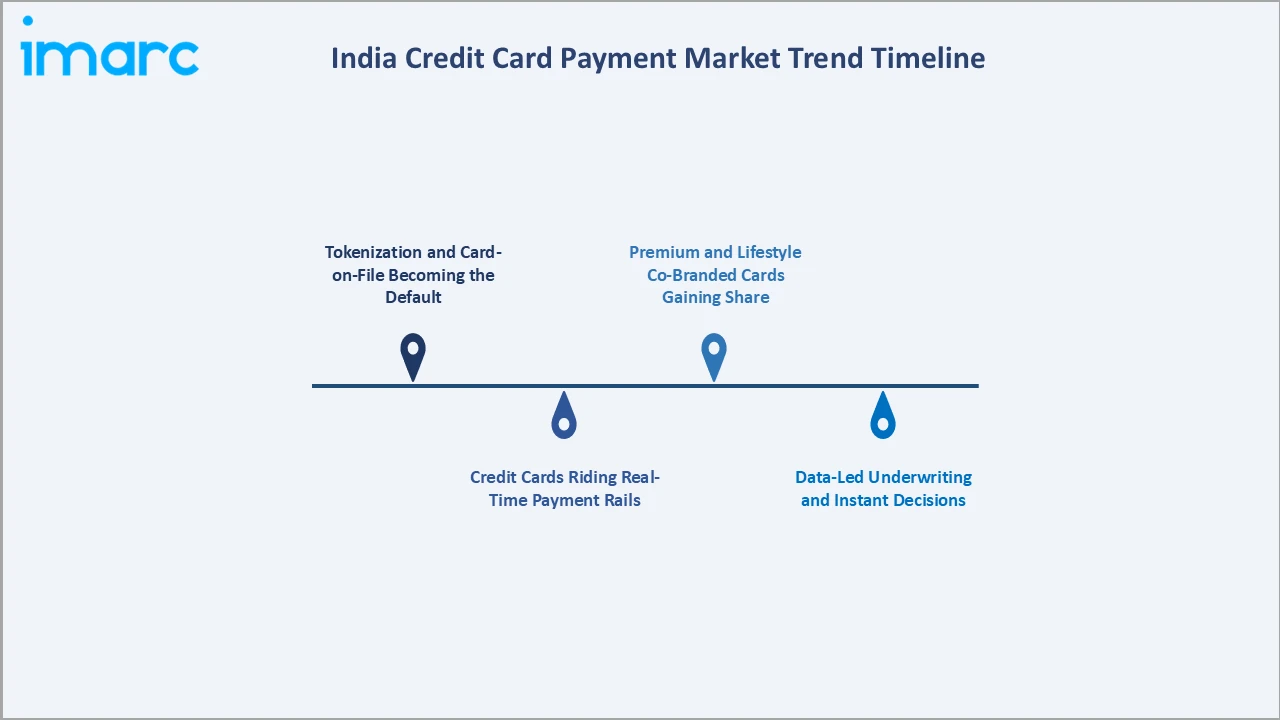
1. Tokenization and Card-on-File Becoming the Default
Storing a tokenized card rather than the underlying number has moved from compliance requirement to standard practice across issuers, merchants and networks. Tokens reduce exposure when merchant databases are breached, and they simplify repeat purchases because the credential survives card replacement. For issuers, tokenization improves authorization success rates and provides richer data on where a card is stored and used. Merchants gain higher checkout completion and fewer disputes. The commercial effect is a stickier relationship, since a tokenized card saved across multiple platforms becomes the default payment method, and switching cost rises with every additional stored credential.
2. Credit Cards Riding Real-Time Payment Rails
Linking credit instruments to QR-based payment networks has opened small-ticket merchant categories that were previously closed to cards. Customers can now pay a street vendor or a small workshop on credit without a terminal, and the issuer sees the transaction data in real time. Issuers are designing lighter credit products with smaller limits for this channel, aimed at everyday spend rather than large purchases. Acceptance expands at almost no infrastructure cost, which is particularly relevant outside major metros. The main constraints are merchant discount economics and the need for underwriting that can price risk on thin-file customers using transaction behavior rather than credit history.
3. Premium and Lifestyle Co-Branded Cards Gaining Share
Travel, fuel, grocery and e-commerce co-branded programs are growing faster than the general purpose base because they combine a defined customer segment with partner-funded rewards. Premium tiers with annual fees, lounge access and milestone benefits attract higher-spending customers and produce better engagement than broad cashback offers. Issuers increasingly treat the co-brand partner as an acquisition channel rather than a marketing add-on, negotiating joint onboarding, shared analytics and co-funded campaigns. The risk is concentration, since partner performance directly affects portfolio growth, but the economics are attractive because acquisition cost is shared and rewards are partly funded outside the issuer's balance sheet.
4. Data-Led Underwriting and Instant Decisions
Issuers are replacing manual review with models that combine bureau data, existing banking behavior, device signals and transaction patterns to reach a credit decision in seconds. Instant approval followed by immediate virtual card issuance shortens the path from application to first transaction to minutes, which lifts activation sharply. Behavioral monitoring after issuance allows limits to be adjusted dynamically, either upward for customers who demonstrate disciplined repayment or downward when stress signals appear. The commercial gain is twofold: lower acquisition cost per activated account and earlier detection of deterioration, both of which matter more as unsecured portfolios grow and competition for good-quality borrowers intensifies.
Industry Value Chain Analysis
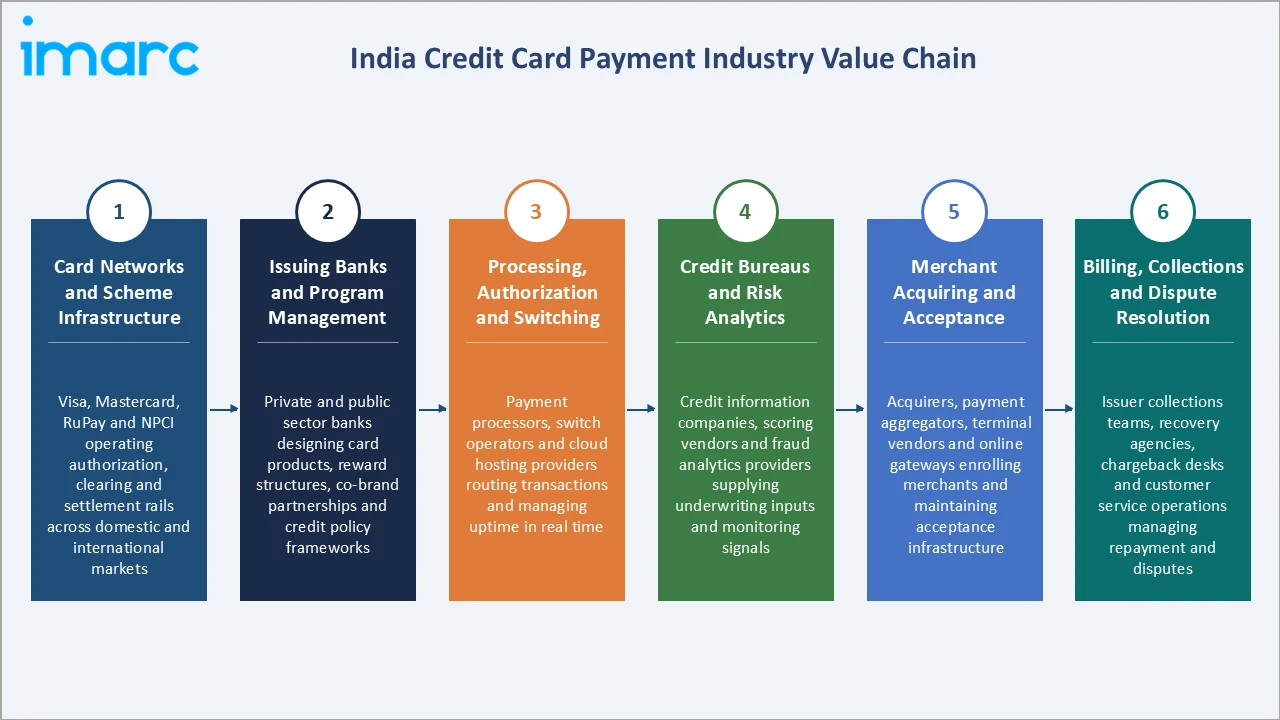
The industry value chain spans card network infrastructure, issuing and program management, transaction processing and switching, credit assessment, merchant acquiring, and billing and collections. Value is added as authorization data, credit risk information and reward economics are layered onto each transaction before settlement reaches the merchant.
| Stage | Key Participants |
|---|---|
| Card Networks and Scheme Infrastructure | Visa, Mastercard, RuPay and NPCI operating authorization, clearing and settlement rails across domestic and international markets |
| Issuing Banks and Program Management | Private and public sector banks designing card products, reward structures, co-brand partnerships and credit policy frameworks |
| Processing, Authorization and Switching | Payment processors, switch operators and cloud hosting providers routing transactions and managing uptime in real time |
| Credit Bureaus and Risk Analytics | Credit information companies, scoring vendors and fraud analytics providers supplying underwriting inputs and monitoring signals |
| Merchant Acquiring and Acceptance | Acquirers, payment aggregators, terminal vendors and online gateways enrolling merchants and maintaining acceptance infrastructure |
| Billing, Collections and Dispute Resolution | Issuer collections teams, recovery agencies, chargeback desks and customer service operations managing repayment and disputes |
Issuing and portfolio management is the most commercially critical stage, because underwriting standards, reward funding and collections discipline decide whether a card program earns a return once interchange, funding cost and credit losses are netted out.
Technology Landscape in the India Credit Card Payment Industry
Tokenization and Secure Credential Management
Network tokenization replaces the primary account number with a device-specific token that is useless if intercepted, and it has become the default for mobile wallets, in-app payments and stored merchant credentials. Issuers manage token lifecycles centrally, so a reissued card keeps working across saved credentials without customer intervention. The technology cuts fraud losses at merchants, improves authorization approval rates because tokens carry richer context, and reduces the operational cost of card replacement. Regulators in India have pushed tokenization as a data protection measure, which accelerated adoption across large merchants and marketplaces. The commercial result is a more durable card-on-file relationship and a measurable reduction in checkout abandonment.
Contactless, Tap-to-Pay and QR Interoperability
Near-field communication cards and smartphone-based tap-to-pay have shortened counter transactions dramatically, and acceptance is now common across retail, transport and fuel. The more significant shift is interoperability, where the same credit account can be used through a physical card, a mobile wallet or a QR code linked to real-time payment rails. Merchants benefit because one account covers multiple acceptance modes, while issuers gain visibility into small-ticket spending that previously went to cash. On-device provisioning also lets an approved applicant pay immediately without waiting for a physical card, which lifts activation among digitally acquired customers and shortens the revenue ramp on new accounts.
AI-Based Fraud Detection and Real-Time Risk Scoring
Machine learning models score each authorization against behavioral history, merchant category, device fingerprint and network-level signals, deciding in milliseconds whether to approve, challenge or decline. Models improve as fraud patterns evolve, and they can distinguish genuine unusual spending from genuine misuse more accurately than static rules. Issuers use the same infrastructure for post-transaction monitoring, watching for early signs of credit stress and adjusting limits before losses accumulate. The technology reduces false declines, which protects legitimate revenue, and it lowers fraud losses, which protects margin. Smaller issuers increasingly buy these capabilities as managed services rather than building in-house data science teams.
Cloud-Native Issuing and API Platforms
Modern card management platforms separate the core ledger from product configuration, letting issuers launch a new card variant, change reward rules or add a co-brand partner through configuration rather than a lengthy system rebuild. Open APIs connect the issuer to partners, aggregators and merchant platforms, which shortens integration time for co-branded programs. Real-time ledgers support instant limit changes and immediate visibility of spend, both of which matter for credit-on-UPI and small-ticket products. Cloud deployment also improves resilience during peak transaction periods. The commercial benefit is faster product cycles and lower technology cost per program, which matters most for mid-sized issuers competing against larger balance sheets.
Market Segmentation Analysis
The report covers the following segments:
| Segment Category | Leading Segment | Market Share | Year |
|---|---|---|---|
| Card Type | General Purpose Credit Cards | 71.4% | 2025 |
| Provider | Visa | 41.6% | 2025 |
| Application | 🔒 | 🔒 | 2025 |
| Region | West India | 34.9% | 2025 |

By Card Type
General purpose credit cards lead at 71.4% (2025). These cards are accepted across all merchant categories and are issued at scale to salaried and self-employed customers. Broad usability, comparable reward structures and inclusion in most co-brand and upgrade paths keep the segment central to issuer portfolios.
To access detailed market analysis, Request Sample
Specialty credit cards are the fastest-growing card type, driven by travel, fuel, grocery and lifestyle co-branded programs that target defined customer segments. Partner-funded rewards, higher annual fees and stronger engagement allow specialty cards to grow faster than the broad general purpose base.
By Provider
Visa leads at 41.6% (2025). Its acceptance network covers the widest set of domestic and international merchants, which matters for travel-led and premium programs. Long-standing agreements with the largest issuers keep it the default network for high-value portfolios and overseas usability.
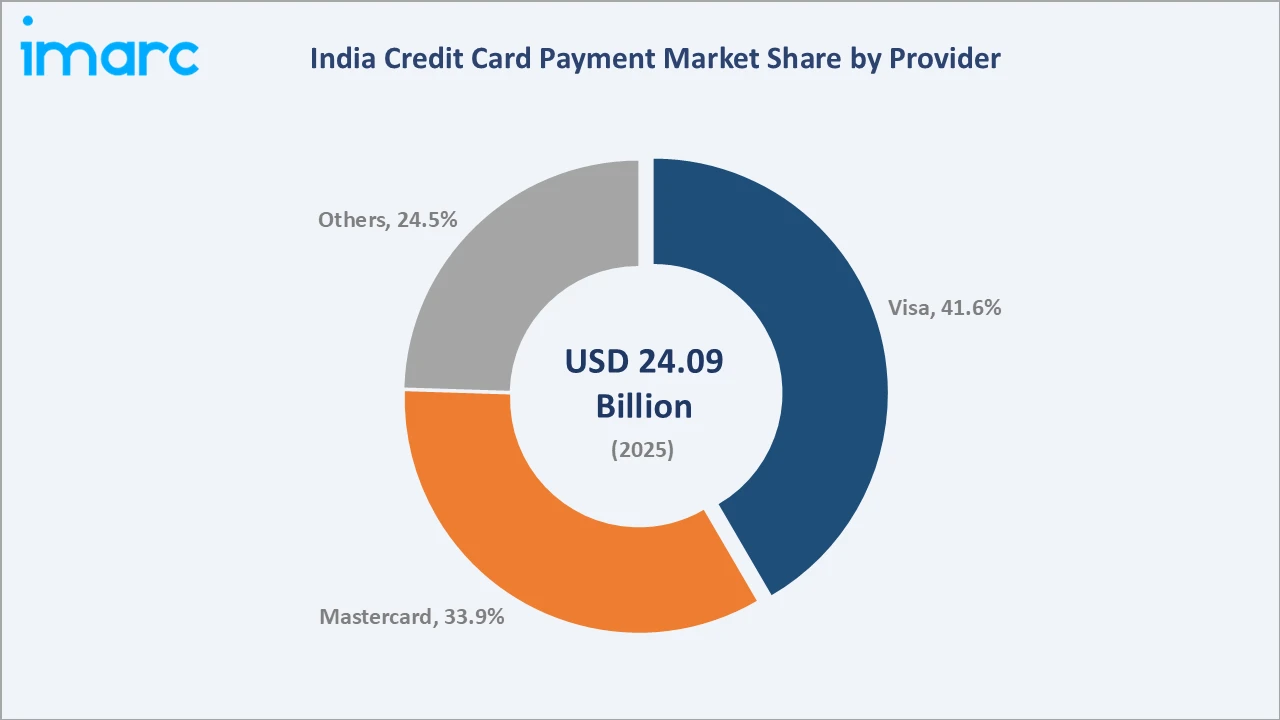
Mastercard is the fastest-growing provider, supported by co-branded and premium program wins, deeper penetration in mid-sized issuer portfolios, and domestic scheme partnerships that expand acceptance without displacing international capability.
Regional Market Insights
| Region | Share (2025) | Key Drivers & Characteristics |
|---|---|---|
| West India | 34.9% | Mumbai and Pune financial services clusters, highest card penetration, largest affluent base and deepest merchant acceptance |
| North India | 27.6% | Delhi NCR corporate density, government and institutional spending, strong e-commerce and travel-led premium card issuance |
| South India | 24.3% | Bengaluru, Hyderabad and Chennai technology workforce, high digital payment adoption and above-average spend per card |
| East India | 13.2% | Kolkata and eastern industrial belts, lower penetration and acceptance depth, but faster relative growth from a small base |
West India accounts for 34.9% of the market, supported by Mumbai's financial services cluster, Pune's salaried professional base and the country's deepest card-accepting merchant network, which lifts both acquisition and spend in the credit card payments market. North India holds 27.6%, where Delhi NCR's corporate density, government and institutional spending, and heavy e-commerce and travel activity support premium card issuance.
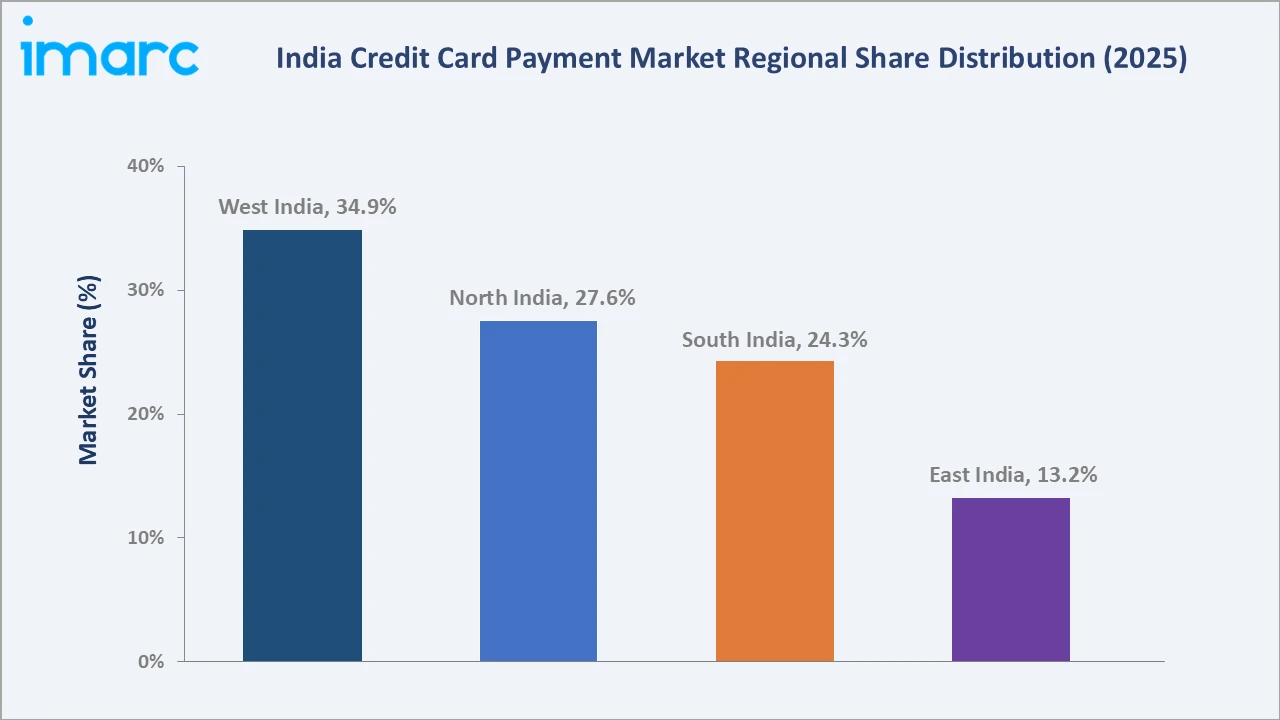
South India contributes 24.3%, driven by technology, pharmaceutical and start-up clusters in Bengaluru, Hyderabad and Chennai that favor digital-first card use and high average spend per active account. East India at 13.2% is the least penetrated region, with demand concentrated in Kolkata and industrial belts, though improving acceptance and rising issuance are lifting it faster than the national average.
Competitive Landscape
The competitive landscape combines large private and public sector issuers, a pure-play card issuer, global card networks and a widening set of co-branding partners. Competition turns on rewards, distribution reach, underwriting quality and digital onboarding. Issuers pursue the same affluent customer through co-branded programs with retailers, airlines and e-commerce platforms, while networks compete for issuer portfolios and acceptance depth.
| Company | Key Brands | Market Position | Core Strength |
|---|---|---|---|
| HDFC Bank Limited | HDFC Bank Credit Cards (Infinia, Regalia, Millennia, Pixel) | Market Leader | Large cards-in-force base with deep retail distribution and strong cross-sell into deposit relationships |
| State Bank of India | SimplyCLICK, SBI Card Elite, Prime, Aurum | Strong Challenger | Pure-play issuer with large open-market sourcing and wide co-branded program portfolio |
| ICICI Bank Limited | Amazon Pay ICICI Card, Coral | Strong Challenger | Digital-first issuance and one of the largest e-commerce co-branded card portfolios |
| Axis Bank Limited | Axis Bank Credit Cards, Magnus, Flipkart Axis Bank Card, Neo | Established Player | Premium franchise strengthened by the acquired Citi India consumer card portfolio |
The most commercially significant competitive dynamic is the contest for premium and co-branded portfolios, where issuers compete less on interest rates than on reward richness, partner access and onboarding speed. Co-brand partners now negotiate revenue sharing, joint marketing and data access, which raises the cost of winning a marquee program but also shares acquisition cost. Regulatory direction on card network choice is reshaping these arrangements, because issuers must offer multiple networks and cannot lock a portfolio to a single scheme. Networks respond by deepening issuer support and by partnering with domestic schemes. Meanwhile credit linked to real-time payment rails is creating a second front, where issuers with strong transaction data can reach small merchants directly. Scale in data, collections and distribution, rather than brand recall alone, decides who can hold margin through the forecast period.
Key Company Profiles
HDFC Bank Limited
HDFC Bank Limited is India's largest private sector bank and the country's leading credit card issuer by cards in force and card spend. Its card franchise spans mass, premium and super-premium tiers, and distribution runs through a nationwide branch network, mobile banking and co-branded partnerships, with cross-sell into a very large deposit and loan customer base.
- Key Brands: HDFC Bank Credit Cards: Infinia, Regalia, Millennia, Pixel.
- Recent Developments: In June 2025, PhonePe and HDFC Bank Limited launched a new co-branded credit card on the RuPay network. This card facilitates UPI payments and signifies PhonePe's entrance into the co-branded credit card market.
- Strategic Focus: The bank is prioritizing cross-sell into existing deposit and loan relationships over open-market sourcing, deepening premium and lifestyle co-branded programs, and investing in data-led underwriting and collections analytics. Expanding credit-on-UPI usage and maintaining portfolio quality through tighter unsecured credit norms are the two areas receiving the most management attention.
State Bank of India
State Bank of India is an Indian public sector banking and financial services institution. The bank offers a wide range of banking products and services, including retail banking, corporate banking, loans, investment services and credit cards through its subsidiary, SBI Cards and Payment Services Limited.
- Key Brands: SimplyCLICK, SBI Card Elite, Prime, Aurum.
- Recent Developments: In October 2026, Air India and SBI Cards and Payment Services Limited declared a collaboration to create a new co-branded credit card program powered by Visa that would provide an appealing array of travel and lifestyle perks to members of Air India's Maharaja Club loyalty program.
- Strategic Focus: The bank is focused on improving yield through premium mix, growing open-market sourcing through digital channels, and strengthening risk analytics for early delinquency detection.
ICICI Bank Limited
ICICI Bank Limited is one of India's largest private sector banks and a leading card issuer, with a portfolio built substantially around e-commerce and lifestyle co-branded programs alongside its core proprietary card range. Digital onboarding through its mobile app and instant credit decisioning support rapid acquisition and activation.
- Key Brands: Amazon Pay ICICI Bank Credit Card, Coral.
- Recent Developments: ICICI Bank Limited continues to strengthen its credit card portfolio through digital banking initiatives, product enhancements and strategic partnerships aimed at improving customer acquisition, engagement and payment convenience.
- Strategic Focus: The bank is emphasizing digital-first issuance, partner-led acquisition through large e-commerce and travel platforms, and analytics-driven limit management. Broadening acceptance among small merchants and sustaining portfolio quality in unsecured lending are the stated priorities supporting its card growth through the forecast period.
Market Concentration Analysis
The market is moderately concentrated. HDFC Bank Limited, State Bank of India, ICICI Bank Limited, and Axis Bank Limited together account for the majority of cards in force and card spend, and the leading issuer holds an estimated 20% to 25% share by billed volume. Scale in distribution, transaction data and collections, rather than brand recall alone, determines who can sustain rich rewards without damaging portfolio quality.
Two opposing forces are reshaping concentration. Incumbents are consolidating share through premium franchises, marquee co-branded portfolios and cross-sell into existing deposit bases, which raises the cost of competing at scale. At the same time, credit linked to real-time payment rails, fintech-enabled issuance and network choice rules are lowering entry barriers, allowing smaller issuers and new partners to win discrete customer pools and fragment share at the entry level.
Regulatory oversight on unsecured lending and credit card issuance is also influencing competitive strategies, encouraging issuers to prioritize underwriting discipline and sustainable customer acquisition. Going forward, competitive positioning is expected to depend on digital capabilities, partnership ecosystems, product differentiation and the ability to maintain asset quality while expanding transaction volumes.
Investment & Growth Opportunities
Highest Growth Segments
Specialty credit cards at ~6.9% CAGR, Mastercard at ~6.4% CAGR, others (provider) at ~6.3% CAGR, general purpose credit cards at ~6.0% CAGR, Visa at ~5.9% CAGR and others (card type) at ~5.4% CAGR are the primary investment vectors through 2034. These segments grow fastest because demand pull is concentrating where a defined customer segment can be reached through a partner that shares acquisition cost, and where reward funding sits partly outside the issuer's balance sheet. Capacity and productivity gains from tokenization, cloud-native issuing and instant decisioning raise activation rates and revenue per account while lowering the cost of serving each new customer. Modernization support, including low-cost acceptance and credit linked to real-time rails, extends the addressable merchant base far beyond conventional terminal deployment. Policy direction on network choice and interoperability opens portfolios that were previously locked to a single scheme. Capital is therefore concentrating in specialty and co-branded programs, small merchant acceptance and data infrastructure, where engagement and yield gains convert most directly into returns through 2034.
Emerging Investment Opportunities
The most dynamic emerging opportunity is credit linked to real-time payment rails, which lets a card account be used at merchants that accept only QR codes. It scales fastest in small-ticket, high-frequency categories where terminal deployment never made economic sense, and where transaction data improves underwriting over time.
Investment Themes
- Specialty and co-branded programs: Partner-funded rewards and defined customer segments lower acquisition cost and lift yield, making these portfolios the most efficient route to premium growth.
- Acceptance and small merchant expansion: Low-cost terminals and QR-linked credit convert recurring cash flows into billable volume, widening the base without proportional infrastructure spend.
- Data, underwriting and fraud analytics: Better scoring raises approval rates on good risk while cutting losses, and it is the capability that decides whether growth in unsecured lending stays profitable.
Future Market Outlook (2026-2034)
The India credit card payment market is projected to grow from USD 24.09 Billion in 2025 to USD 25.57 Billion in 2026, reaching USD 41.97 Billion by 2034, registering a CAGR of 6.17% during 2026-2034. The market's anchor value of USD 32.50 Billion in 2030 reflects steady issuance growth, wider acceptance and rising spend per card rather than a single demand shock, with West India and North India sustaining leadership as merchant networks and premium franchises deepen.
Three structural forces define market growth through 2034 the formalization of household and small business spending onto card rails; the interoperability of credit with real-time payment infrastructure; and data-led underwriting that widens credit access without loosening portfolio discipline. Increasing digital acceptance infrastructure and the expansion of merchant networks are further supporting card penetration across urban and semi-urban markets. Additionally, rising consumer preference for flexible payment options, reward-led spending and convenient credit access is strengthening transaction activity across customer segments.
Research Methodology
Primary Research
Primary research involved detailed interviews with credit card product heads at Indian banks, executives at standalone issuers, payment network representatives, processors and merchant acquirers. Discussions focused on issuance strategies, customer acquisition channels, reward economics, acceptance expansion, transaction patterns and underwriting practices across key regions.
Secondary Research
Secondary research incorporated issuer annual reports, regulatory disclosures, central bank payment statistics, card network publications, industry association reports and payment ecosystem studies. These sources were cross-referenced to assess market developments and establish card type, provider and regional splits for the India credit card payment market.
Forecasting Models
Forecasting combined cards-in-force and average spend-per-card modelling with merchant acceptance expansion, digital payment adoption and credit cycle scenarios. Historical trends, issuer performance and evolving consumer payment preferences were assessed to develop year-wise market estimates from 2026 to 2034 and segment growth trajectories aligned with the overall market CAGR.
India Credit Card Payment Market Report Coverage:
| Report Features | Details |
|---|---|
| Base Year of the Analysis | 2025 |
| Historical Period | 2020-2025 |
| Forecast Period | 2026-2034 |
| Units | Billion USD |
| Scope of the Report |
Exploration of Historical Trends and Market Outlook, Industry Catalysts and Challenges, Segment-Wise Historical and Future Market Assessment:
|
| Card Types Covered | General Purpose Credit Cards, Specialty Credit Cards, Others |
| Providers Covered | Visa, Mastercard, Others |
| Applications Covered | Food and Groceries, Health and Pharmacy, Restaurants and Bars, Consumer Electronics, Media and Entertainment, Travel and Tourism, Others |
| Regions Covered | North India, South India, East India, West India |
| Companies Covered | HDFC Bank Limited, State Bank of India, ICICI Bank Limited, Axis Bank Limited, etc. |
| Customization Scope | 10% Free Customization |
| Post-Sale Analyst Support | 10-12 Weeks |
| Delivery Format | PDF and Excel through Email (We can also provide the editable version of the report in PPT/Word format on special request) |
Key Benefits for Stakeholders:
- IMARC’s industry report offers a comprehensive quantitative analysis of various market segments, historical and current market trends, market forecasts, and dynamics of the India credit card payment market from 2020-2034.
- The research report provides the latest information on the market drivers, challenges, and opportunities in the India credit card payment market.
- Porter's five forces analysis assist stakeholders in assessing the impact of new entrants, competitive rivalry, supplier power, buyer power, and the threat of substitution. It helps stakeholders to analyze the level of competition within the India credit card payment industry and its attractiveness.
- Competitive landscape allows stakeholders to understand their competitive environment and provides an insight into the current positions of key players in the market.
Frequently Asked Questions About the India Credit Card Payment Market Report
The market reached USD 24.09 Billion in 2025 and an estimated USD 25.57 Billion in 2026, supported by rising card issuance, wider merchant acceptance, growing e-commerce and travel spending, and cross-sell into existing banking relationships.
The market is expected to register a CAGR of 6.17% during 2026-2034, reaching USD 41.97 Billion by 2034 on acceptance expansion and premium card growth.
General purpose credit cards lead with a 71.4% share in 2025, reflecting mass retail issuance, broad merchant acceptance and reward structures comparable across income groups and customer segments.
Visa leads the provider segment with a 41.6% share in 2025, supported by the widest domestic and international acceptance network and long-standing agreements with the largest issuing banks.
West India leads with a 34.9% regional share in 2025, driven by Mumbai and Pune financial services clusters, the highest card penetration and the deepest merchant acceptance network in the country.
Leading companies include HDFC Bank Limited, State Bank of India, ICICI Bank Limited, and Axis Bank Limited, among others.
The market is projected to reach USD 32.50 Billion by 2030, driven by credit linked to real-time payment rails, small merchant acceptance, premium co-branded cards and rising spend per active card.
Specialty credit cards at ~6.9% CAGR and Mastercard at ~6.4% CAGR are the fastest-growing segments, alongside credit on UPI and small merchant acceptance.
Need more help?
- Speak to our experienced analysts for insights on the current market scenarios.
- Include additional segments and countries to customize the report as per your requirement.
- Gain an unparalleled competitive advantage in your domain by understanding how to utilize the report and positively impacting your operations and revenue.
- For further assistance, please connect with our analysts.
 Request Customization
 Speak to an Analyst
 Request Brochure
 Inquire Before Buying
Benefits of Customization
- Personalize this research
- Triangulate with your data
- Get data as per your format and definition
- Gain a deeper dive into a specific application, geography, customer, or competitor
- Any level of personalization
Get in Touch With Us
UNITED STATES
Phone: +1-201-971-6302
INDIA
Phone: +91-120-433-0800
UNITED KINGDOM
Phone: +44-753-714-6104
Email: [email protected]
Client Testimonials



















Related Reports

Choose your plan
*Please note that the prices mentioned below are starting prices for each bundle type. Kindly contact our team for further details.*
Single User License
- 1 User License, Access on 2 Devices
- PDF Report + Excel Dataset (Password Protected)
- Lifetime Access
- No Printing Rights
- 10% Free Report Customization
- 10–12 Weeks of Analyst Support
Five User License
- Access for 5 Users, 2 Devices per User
- PDF Report + Excel Dataset (Password Protected)
- Lifetime Access
- Dedicated Account Manager
- 12–14 Weeks of Analyst Support
- No Printing Rights
- 15% Free Report Customization
- 25% Discount on Your Next Purchase
Corporate User License
- Unlimited User Access (Within Your Organization)
- PDF Report + Excel Dataset
- Lifetime Access
- Dedicated Account Manager
- 14–20 Weeks of Analyst Support
- No Printing Rights
- 20% Free Report Customization
- 30% Discount on Your Next Purchase
Essential Insights
What's included:
3 reports
- Lifetime Access
- PDF Reports
- Excel Datasets
- 2 Weeks of Free Analyst Support
- 2 User Licenses
- Access on 2 Devices
- Printing Rights
- Complimentary PowerPoint (PPT) Version
- Complimentary License Upgrade
Professional Access
What's included:
5 reports
- Lifetime Access
- PDF Reports
- Excel Datasets
- 8 Weeks of Free Analyst Support
- 2 User Licenses
- Access on 2 Devices
- Printing Rights
- Complimentary PowerPoint (PPT) Version
- Complimentary License Upgrade
Business Advantage
What's included:
8 reports
- Lifetime Access
- PDF Reports
- Excel Datasets
- 14 Weeks of Free Analyst Support
- 2 User Licenses
- Access on 2 Devices
- Printing Rights
- Complimentary PowerPoint (PPT) Version
- Complimentary License Upgrade
Enterprise Intelligence
What's included:
10 reports
- Lifetime Access
- PDF Reports
- Excel Datasets
- 20 Weeks of Free Analyst Support
- 2 User Licenses
- Access on 2 Devices
- Printing Rights
- Complimentary PowerPoint (PPT) Version
- Complimentary License Upgrade