
India Electrical Switches Market Size, Share, Trends and Forecast by Type, Distribution Channel, Switch Type, Application, and Region, 2026-2034
India Electrical Switches Market Size, Share, Trends & Forecast (2026-2034)
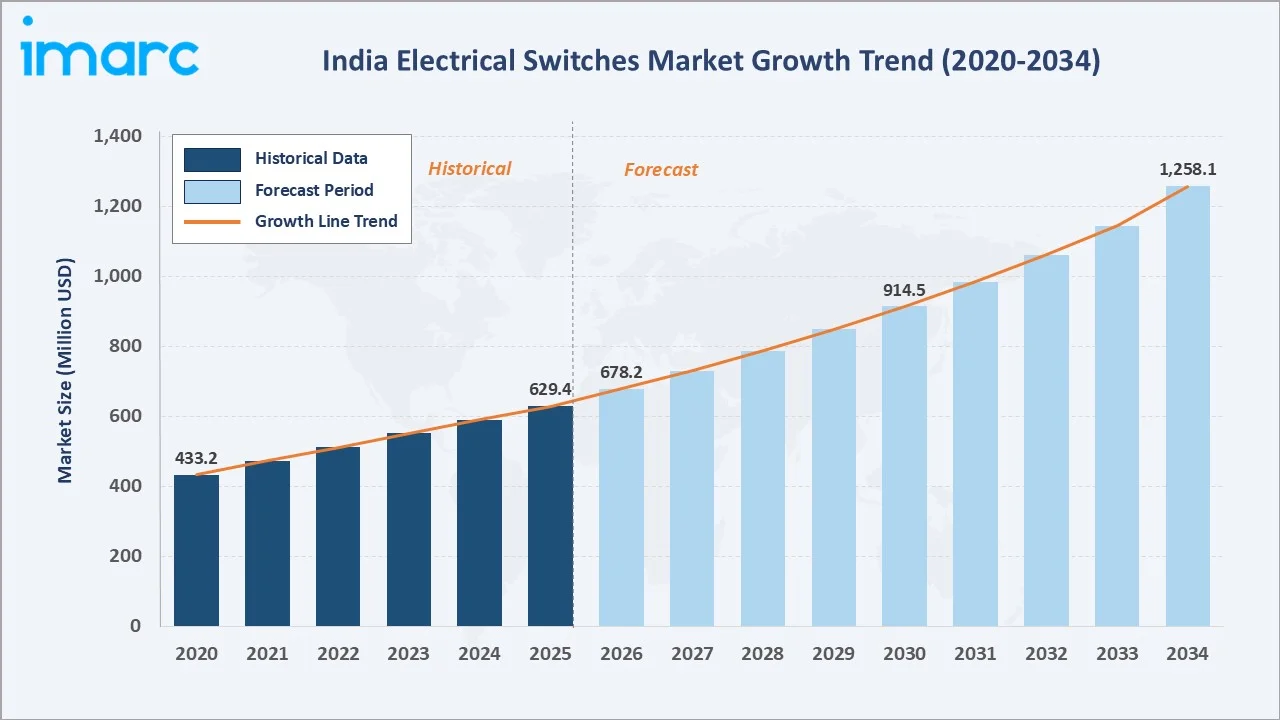
The India electrical switches market grew from USD 629.4 Million in 2025 to USD 678.2 Million in 2026 and is projected to reach USD 1,258.1 Million by 2034, growing at a CAGR of 7.76% during 2026-2034. The market is driven by rapid urbanization, rising infrastructure investments, government electrification schemes, and growing consumer preference for modular and smart electrical switches across residential, commercial, and industrial segments.
Smart home adoption, real estate expansion, and rising demand for aesthetically superior and energy-efficient switches are further supporting market growth. Modular switches dominate at 68.4%. Retail Stores lead distribution at 58.7%. West India commands 30.8% of the national market share.
Market Snapshot
|
Metric |
Value |
|
Base Year Market Size (2025) |
USD 629.4 Million |
|
Market Size (2026) |
USD 678.2 Million |
|
Forecast Market Size (2034) |
USD 1,258.1 Million |
|
CAGR (2026-2034) |
7.76% |
|
Base Year |
2025 |
|
Historical Period |
2020-2025 |
|
Forecast Period |
2026-2034 |
|
Dominant Type |
Modular (68.4%, 2025) |
|
Dominant Distribution Channel |
Retail Stores (58.7%, 2025) |
|
Leading Region |
West India (30.8%, 2025) |
The India electrical switches market size increased from USD 433.2 Million in 2020 to USD 629.4 Million in 2025 and is estimated to reach USD 678.2 Million in 2026. The market is further expected to grow to USD 914.5 Million by 2030 and USD 1,258.1 Million by 2034, driven by one of Asia's most active construction markets, a rapidly expanding smart home technology segment, and a large government-driven rural electrification base creating structural volume demand across all product tiers.
To get more information on this market, Request Sample
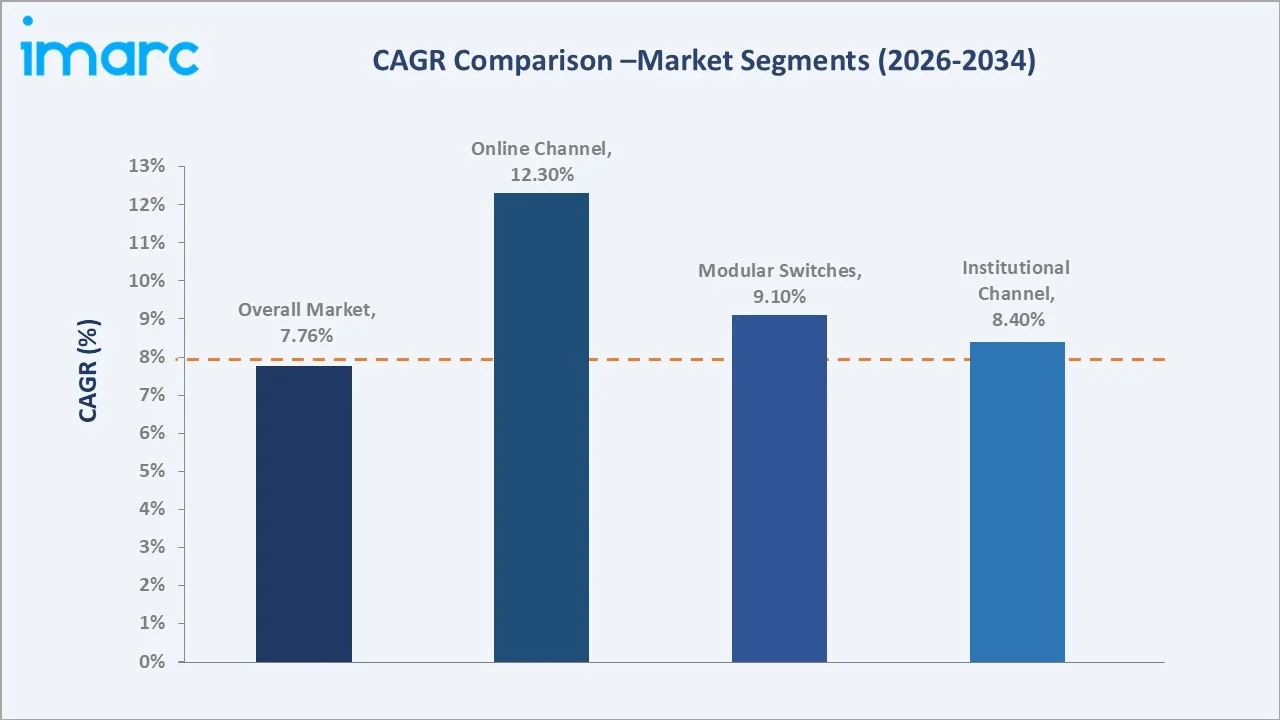
The online distribution channel grows fastest at ~12.3% CAGR through e-commerce penetration and direct-to-consumer brand expansion. The modular segment grows at ~9.1% CAGR driven by rising premium residential construction and smart home adoption across urban and semi-urban India.
Executive Summary
The India electrical switches market expanded from USD 629.4 Million in 2025 to an estimated USD 678.2 Million in 2026, positioning it among the most dynamic electrical hardware markets in Asia. The market's growth is underpinned by India's large urban construction base, enduring government infrastructure investment, and rising consumer preference for modular and smart electrical fittings. The India electrical switches market is projected to reach USD 1,258.1 Million by 2034. Modular at 68.4% leads through superior safety compliance and aesthetic appeal. Retail Stores at 58.7% reflect established distribution network dominance. West India leads regionally at 30.8%.
Key Market Insights
|
Insight |
Data |
|
Dominant Type |
Modular – 68.4% share (2025) |
|
Dominant Distribution Channel |
Retail Stores – 58.7% market share (2025) |
|
Leading Region |
West India – 30.8% share (2025) |
|
Market Opportunity |
Smart switch integration; IoT-enabled home automation; Tier-2/3 city premium expansion; online distribution growth |
Key Analytical Observations Supporting the Above Data:
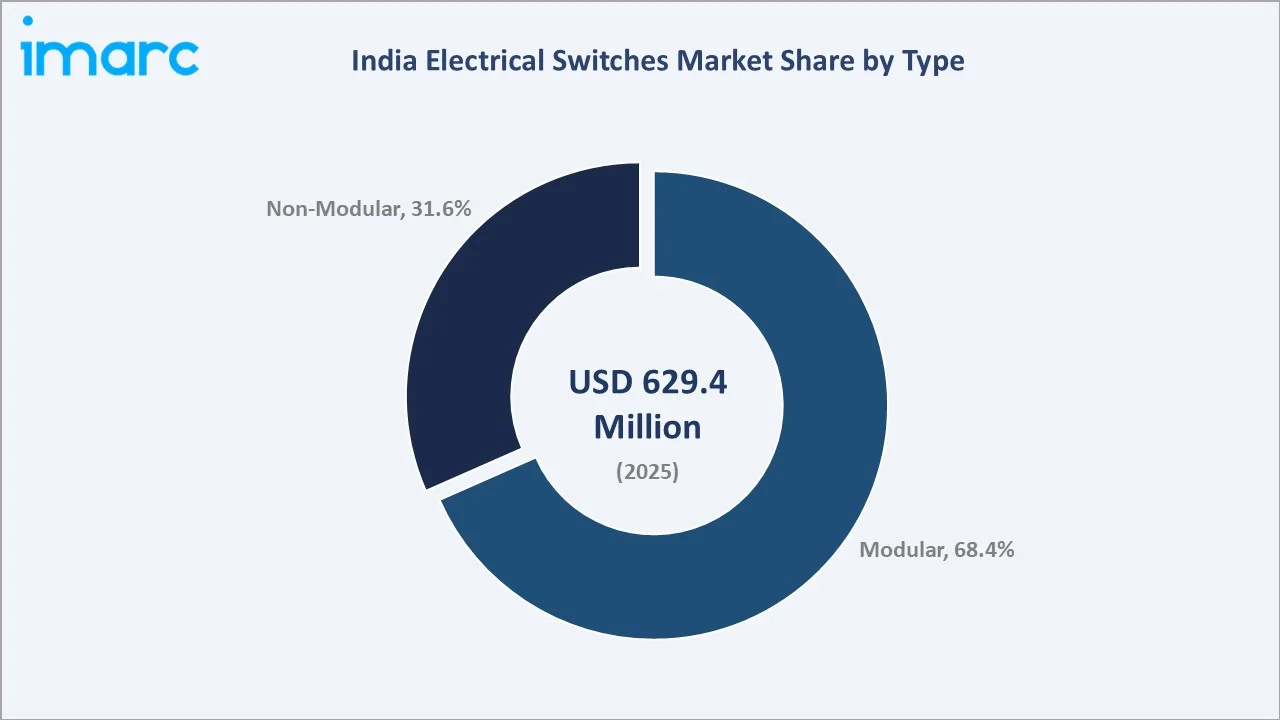
- Modular at 68.4%: The modular segment dominates due to superior safety ratings, concealed wiring compatibility, fire-retardant materials, and modern aesthetics preferred in premium residential and commercial construction projects across urban India.
- Retail Stores at 58.7%: Hardware and electrical retail stores remain the preferred procurement channel, especially for contractors and project purchasers, supported by electrician recommendation networks and retailer incentive programs across urban and semi-urban markets.
- West India at 30.8%: West India leads due to Mumbai's dense urban construction pipeline, Gujarat's strong industrial and commercial real estate development, Maharashtra's large affordable housing activity, and Pune's technology sector-driven premium residential demand.
India Electrical Switches Market Overview
India electrical switches market is commercially positioned at a unique intersection: one of the world's fastest-growing urban construction markets creating volume demand for electrical fittings, an active government electrification agenda expanding the addressable market, and a rapidly evolving consumer preference for premium, safe, and smart electrical switches. The market's commercial structure is characterized by extraordinary product stratification from basic non-modular switches to IoT-enabled smart switches.
The India electrical switches ecosystem integrates domestic manufacturers, multinational brand subsidiaries, organized retail distribution, institutional procurement, and a rapidly growing e-commerce channel. Macroeconomic factors include rising disposable incomes, urbanization, government housing targets, and smart city infrastructure investment.
Market Dynamics
To evaluate market opportunities, Request Sample
Market Drivers
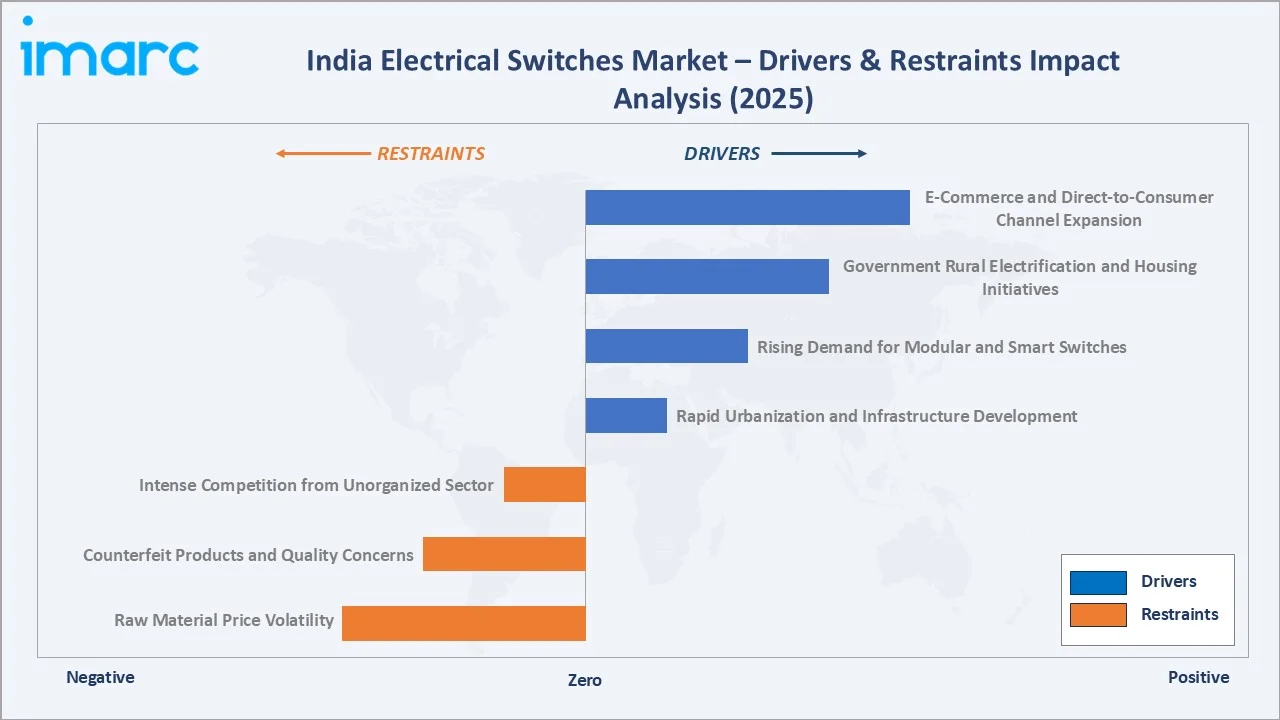
- Rapid Urbanization and Infrastructure Development: India's urbanization rate and large-scale infrastructure projects are driving consistent demand for quality electrical switches across residential and commercial construction. Government capital expenditure programmes directly support construction activity and switch demand. Expanding highway, railway, and urban transit infrastructure projects are creating substantial non-residential electrical switch procurement across the country.
- Rising Demand for Modular and Smart Switches: Consumers increasingly prefer modular switches for safety, aesthetics, and multi-functional capabilities including USB charging ports and smart connectivity. Smart switches with wireless and voice-assistant integration are creating a high-margin premium category, driven by growing home automation adoption among urban professionals and technology-conscious consumers across Tier-1 and Tier-2 cities.
- Government Rural Electrification and Housing Initiatives: Government schemes have expanded the addressable market significantly by electrifying previously unconnected households and constructing new affordable housing, driving volume demand for switches across Tier-3 and rural markets. The affordable housing programme target directly translates into structured switch procurement by government agencies and housing developers, creating predictable and large-volume demand for manufacturers.
- E-Commerce and Direct-to-Consumer Channel Expansion: Digital platforms are enabling electrical switch brands to reach Tier-2 and Tier-3 consumers directly, reducing distribution costs and driving brand awareness in markets previously served only by unorganized local suppliers. Online channels create new competitive dynamics enabling nationwide reach with lower capital requirements than traditional retail network expansion.
Market Restraints
- Intense Competition from the Unorganized Sector: The unorganized segment continues to offer price-competitive alternatives, particularly in rural and semi-urban markets, limiting organized brands' penetration and margin expansion in lower-tier geographies. Unorganized manufacturers with lower compliance costs can undercut organized brand pricing significantly, creating structural competitive challenges for premium brands across price-sensitive consumer segments.
- Counterfeit Products and Quality Concerns: Proliferation of counterfeit electrical switches poses safety risks and creates pricing pressure on genuine manufacturers, undermining consumer trust and brand equity in the mass-market segment. Counterfeit products create post-installation safety hazards, leading to increased warranty and liability costs for genuine manufacturers operating in the organized segment.
- Raw Material Price Volatility: Fluctuating prices of copper, thermoplastics, silver alloys, and other key inputs create margin pressure and complicate pricing strategies for manufacturers, particularly smaller players with limited hedging capabilities. Global supply chain disruptions affecting raw material availability create additional inventory management challenges, requiring manufacturers to maintain higher safety stocks.
Market Opportunities
- Smart Home and IoT Switch Integration: Growing adoption of home automation systems creates premium demand for smart, app-controlled switches and dimmers, representing a high-margin growth opportunity for technology-forward manufacturers. The smart home market's rapid growth is creating a structural upgrade cycle as consumers replace conventional switches with smart-enabled variants compatible with voice assistants, mobile apps, and home automation ecosystems.
- Tier-2 and Tier-3 City Premium Switch Expansion: Increasing affluence and aspirational lifestyles in smaller cities create first-generation demand for modular and branded switches, as organized retail networks expand geographic reach into previously underserved markets. Rising per capita incomes in smaller cities are enabling consumers to specify modular switches in home construction and renovation projects for the first time.
Market Challenges
- Certification Compliance and Standardization: Ensuring consistent product quality and safety certification compliance across a fragmented manufacturing base remains challenging, particularly for smaller manufacturers entering the organized segment. The regulatory compliance burden creates higher operating costs for small and medium manufacturers, disadvantaging them relative to large organized players with dedicated compliance infrastructure.
- Price Sensitivity in the Mass Market Segment: A large segment of consumers in rural and semi-urban markets prioritizes affordability over brand, design, or features, limiting premium product penetration and requiring manufacturers to maintain dual product strategies across price tiers. Competing on price alone in the mass market undermines brand equity and margin, forcing manufacturers to invest simultaneously in premium and economy product lines.
Emerging Market Trends
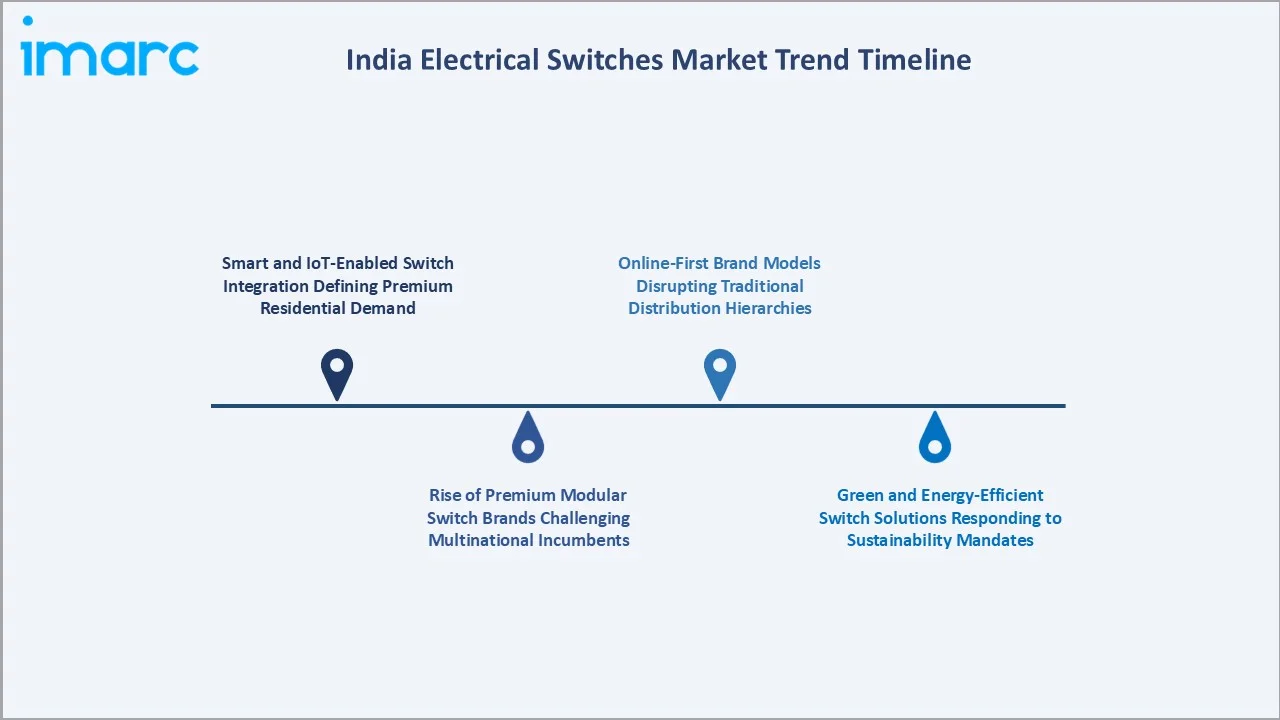
1. Smart and IoT-Enabled Switch Integration Defining Premium Residential Demand
Smart switches with wireless connectivity and voice-assistant compatibility are transforming the premium residential segment. Consumers integrating home automation systems are driving volume demand for connected switches, creating a structurally differentiated growth segment above traditional modular switches as home automation adoption accelerates across urban India.
2. Rise of Premium Modular Switch Brands Challenging Multinational Incumbents
Domestic manufacturers are increasingly launching premium modular switch ranges with competitive features at lower price points than multinational brands. Local players are leveraging manufacturing cost advantages, established electrician networks, and deep distribution penetration to compete effectively against international brands in the growing mid-premium residential and commercial segment.
3. Green and Energy-Efficient Switch Solutions Responding to Sustainability Mandates
Manufacturers are introducing energy-monitoring switches, EV-charging-compatible sockets, and low-power indicator switches to meet green building standards. These energy-efficient product categories address both regulatory compliance requirements and growing consumer demand for sustainable electrical products in residential and commercial construction projects.
4. Online-First Brand Models Disrupting Traditional Distribution Hierarchies
New electrical switch brands are launching through e-commerce platforms, bypassing traditional retail hierarchies and reaching consumers in Tier-2 and Tier-3 cities more efficiently. Online-first brands are building consumer trust through transparent safety certification display and customer review accumulation on major e-commerce platforms, creating alternative growth pathways for smaller manufacturers.
Industry Value Chain Analysis
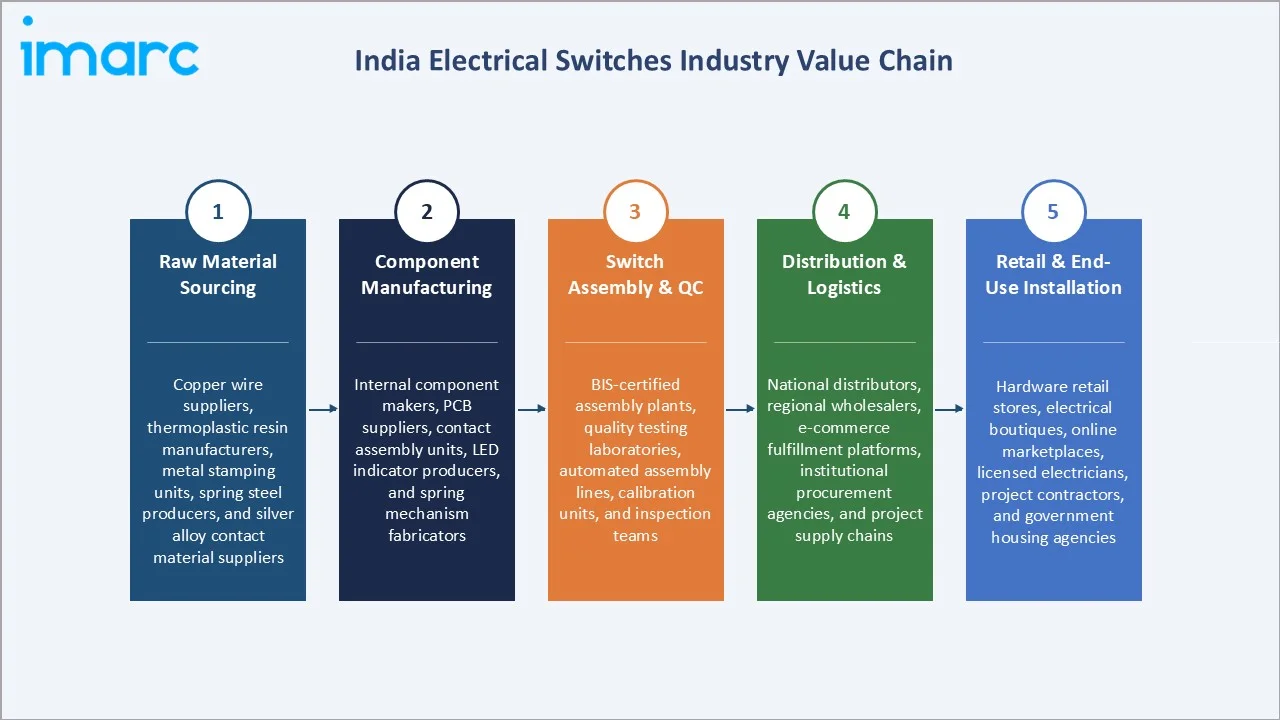
The India electrical switches value chain spans raw material sourcing, component manufacturing, switch assembly and quality control, organized distribution, and end-use installation. The value chain's commercial structure creates a competitive dynamic where vertically integrated domestic manufacturers compete against import-reliant premium brands at different price points.
|
Stage |
Key Participants |
|
Raw Material Sourcing |
Copper wire suppliers, thermoplastic resin manufacturers, metal stamping units, spring steel producers, and silver alloy contact material suppliers |
|
Component Manufacturing |
Internal component makers, PCB suppliers, contact assembly units, LED indicator producers, and spring mechanism fabricators |
|
Switch Assembly & QC |
BIS-certified assembly plants, quality testing laboratories, automated assembly lines, calibration units, and inspection teams |
|
Distribution & Logistics |
National distributors, regional wholesalers, e-commerce fulfillment platforms, institutional procurement agencies, and project supply chains |
|
Retail & End-Use Installation |
Hardware retail stores, electrical boutiques, online marketplaces, licensed electricians, project contractors, and government housing agencies |
The distribution and retail stage is the most commercially consequential in the India electrical switches value chain, where brand investment in retailer incentive programs, point-of-sale merchandising, and electrician preference programs determines market share outcomes in India's fragmented electrical hardware retail landscape.
Technology Landscape in the India Electrical Switches Industry
Conventional Modular Switch Technology
Conventional modular switch technology encompasses fire-retardant polycarbonate frames, silver-alloy contact mechanisms, child-proof shutter systems, and concealed screw designs. This technology forms the commercial backbone of India's premium residential switch market, combining safety standards compliance with aesthetic versatility at competitive price points accessible to a broad consumer base.
Smart and Wireless-Enabled Switch Technology
Smart switch technology integrating wireless connectivity enables remote control, scheduling, energy monitoring, and voice-assistant compatibility. The adoption of smart-enabled technology across Indian residential electrical products reflects growing consumer awareness of connected home ecosystems and the expanding availability of affordable smart home platforms compatible with electrical switches.
Energy Monitoring and EV-Compatible Socket Technology
Advanced switch plates with integrated energy consumption monitoring, surge protection, and EV charging socket compatibility are emerging as premium product categories, addressing both green building compliance requirements and the growing EV charging infrastructure demand across residential and commercial applications in India's rapidly electrifying mobility market.
Market Segmentation Analysis
The report covers the following segments:
|
Segment Category |
Leading Segment |
Market Share |
Year |
|
Type |
Modular |
68.4% |
2025 |
|
Distribution Channel |
Retail Stores |
58.7% |
2025 |
|
Switch Type |
🔒 |
🔒 |
2025 |
|
Application |
🔒 |
🔒 |
2025 |
|
Region |
West India |
30.8% |
2025 |

By Type
Modular leads at 68.4% (2025). The modular segment encompasses India's most commercially preferred switch category, combining superior aesthetics, multi-functionality, enhanced safety compliance, and easy maintenance. Modular switches are the standard specification in premium housing, commercial interiors, and hospitality projects across urban India.
To access detailed market analysis, Request Sample
Non-Modular at 31.6% continues to serve price-sensitive rural and semi-urban markets, industrial applications, and replacement demand in existing housing stock. The segment's share is gradually declining as modular adoption accelerates through affordable housing construction quality improvements and government specification mandates.
By Distribution Channel
Retail Stores lead at 58.7% (2025). Hardware and electrical retail stores remain the dominant procurement channel for both project-based bulk purchases and individual consumer replacement demand, supported by electrician recommendation networks and retailer brand incentive programs across urban and semi-urban markets.
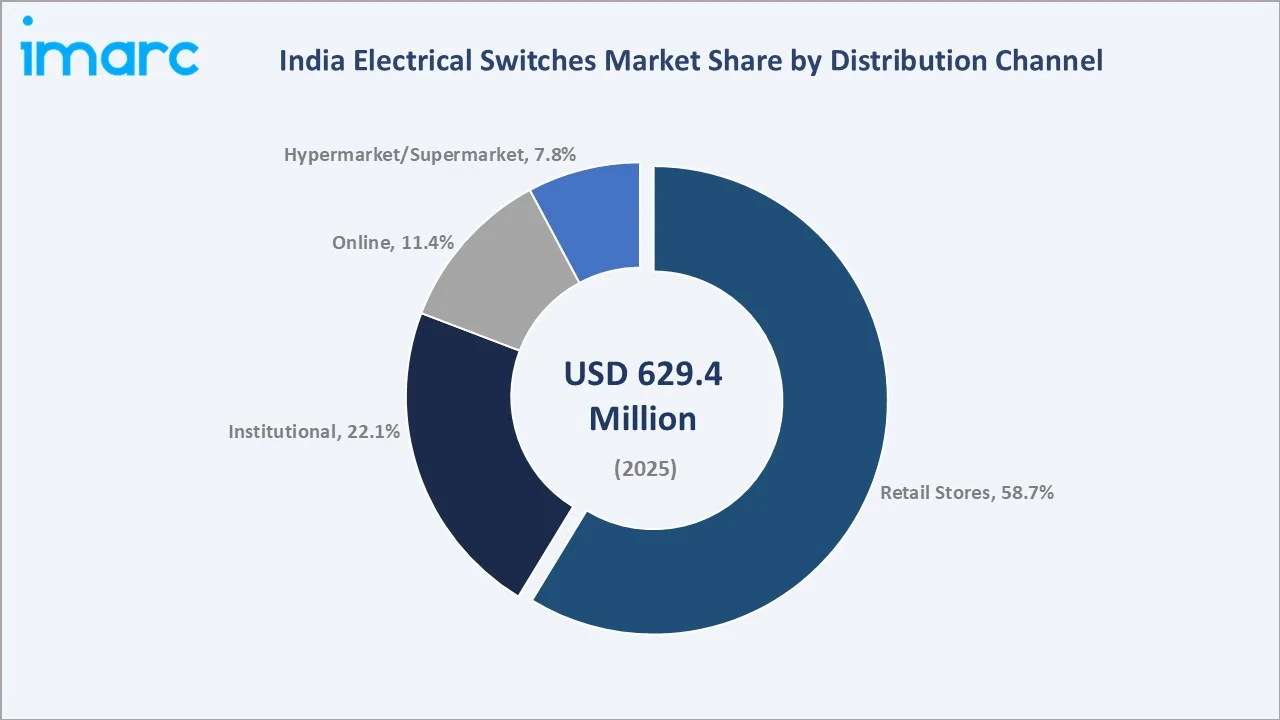
Institutional channel at 22.1% represents bulk procurement by construction developers, government infrastructure agencies, and commercial building contractors. Online at 11.4% is the fastest-growing channel at ~12.3% CAGR. Hypermarket/Supermarket at 7.8% caters to consumer impulse and home improvement purchase occasions in organized retail environments.
Regional Market Insights
|
Region |
Share (2025) |
Key India Electrical Switches Market Drivers & Characteristics |
|
West India |
30.8% |
Driven by Mumbai's dense commercial construction, Gujarat's industrial expansion, and Maharashtra's large affordable housing activity under government housing programmes. |
|
North India |
28.4% |
Supported by Delhi-NCR's premium residential developments, UP's mass housing programmes, and government smart city infrastructure investment across major cities. |
|
South India |
24.2% |
Reflects strong premium residential demand from technology sector wealth, commercial real estate growth, and industrial corridor construction activity driving switch procurement. |
|
East India |
16.6% |
Rising disposable incomes, industrial development, and increasing exposure to organized electrical brands gradually driving premium switch adoption across the region. |
West India's 30.8% market leadership reflects Mumbai's dense high-rise residential and commercial construction pipeline, Gujarat's industrial township development, and Maharashtra's large affordable housing programme scale. North India's 28.4% reflects Delhi-NCR's sustained premium residential construction activity and UP's mass housing programme volume.
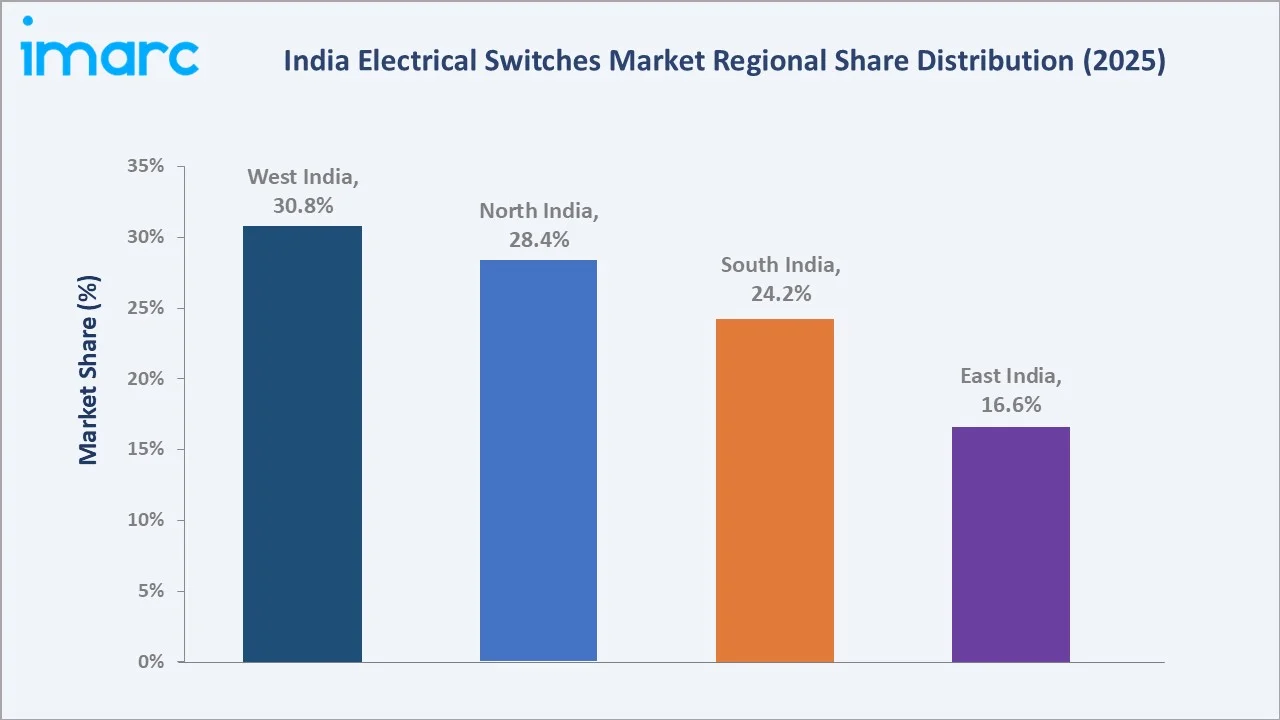
South India's 24.2% reflects technology sector wealth creating premium switch demand and manufacturing sector driving industrial electrical switch consumption. East India's 16.6% is the most commercially underdeveloped region but is growing above the overall market CAGR as urban renewal and industrial growth create structured organized-market demand.
Competitive Landscape
The competitive landscape of India's electrical switches market is characterized by a mix of dominant domestic and multinational players and a large unorganized sector. The premium segment creates a separate competitive structure driven by brand investment, product innovation, and distribution reach. Competition is intensifying through smart technology integration and geographic expansion.
|
Company |
Key Brands |
Market Position |
Core Strength |
|
Havells India Ltd. |
Apogee, Athena, Signia, Magnus, Adiva, YU, Signia Smart, Apogee Smart |
Market Leader |
Extensive distribution network and integrated manufacturing across premium and mid-range modular switch segments. |
|
Legrand |
Living Now, Arteor Advance, Arteor, Myrius, Lyncus, Mylinc, Allzy |
Strong Challenger |
Premium international brand with strong commercial and hospitality segment presence backed by design-led innovation. |
|
Schneider Electric |
AvatarON, Clipsal X, Livia, Miluz Lara, Miluz ZeTa, Opale, Unica Pure, Unica X, ZENcelo, Unica Pure Plus, Miluz Lara |
Strong Challenger |
Global engineering leader with deep institutional and industrial segment expertise and premium smart-home positioning. |
|
ABB |
Snieo, Adiya, Tvisha, Tvisha Antibacterial, LIORA Plus, IVIE, Zenit, Millenium |
Innovator |
Technology-forward manufacturer emphasizing sustainability and safety innovation across its modular switch product range. |
|
Finolex Cables |
Finotouch, Feriha, Premium Plus, Grazo |
Market Player |
Strong rural and semi-urban distribution backed by established electrical brand trust and contractor network. |
|
GM Modular Pvt. Ltd. |
Adore, Aer9, I-Fi, I-Touch, Smart Switch, Zenova, Ziano, Zicono, Zurico, Aer Nova, Slimo |
Market Player |
Domestic premium modular specialist with a strong electrician network and project-segment focus across urban markets. |
Key players include Havells India Ltd., Legrand, Schneider Electric, ABB, Finolex Cables, GM Modular Pvt. Ltd., and others.
Key Company Profiles
Havells India Ltd.
Havells India Ltd. is India's leading consumer electrical products company and a dominant force in the electrical switches market, known for its strong brand presence, extensive pan-India distribution network, and premium-to-mass product portfolio spanning Crabtree, Reo, and Standard switch ranges.
- Key Brands: Apogee, Athena, Signia, Magnus, Adiva, YU, Signia Smart, Apogee Smart
- Recent Developments: In April 2021, Havells India introduced an anti-viral and anti-bacterial switch range under its Crabtree brand, incorporating ViruzSafe technology. The company stated that the technology could eliminate 92.5% of viruses on the switch surface within one minute of exposure.
- Strategic Focus: Maintaining market leadership through diversified price-tier coverage spanning economy, modular, and premium smart switches; electrician loyalty and training programs to strengthen contractor network relationships; and continuous investment in product innovation to support premiumization trends in residential and commercial electrical fitments across India.
Legrand
Legrand is a global specialist in electrical and digital building infrastructure, with a strong India presence through its premium Myrius, Arteor, and Céliane modular switch ranges, holding a strong position in the commercial, hospitality, and premium residential segments.
- Key Brands: Living Now, Arteor Advance, Arteor, Myrius, Lyncus, Mylinc, Allzy
- Recent Developments: In August 2023, Legrand introduced Allzy, a feature-rich modular switch range designed for the mass-market segment. The range combines modern design with convenience features such as remote control, USB charging options, soft-touch low-noise switches, and safety-shuttered sockets.
- Strategic Focus: Leveraging design-led innovation and premium brand positioning to grow its commercial real estate and hospitality sector business; expanding smart building integration capabilities through compatible switch platform partnerships; and increasing geographic reach into Tier-2 premium residential markets through authorized dealer network expansion.
Market Concentration Analysis
India electrical switches market is moderately concentrated in the premium and modular segment, with the key players commanding significant combined organized-market share, while the overall market remains fragmented due to the unorganized sector's estimated 30–35% presence in the mass and rural segment.
Market concentration is evolving through two opposing forces: organized brand consolidation through premium product launches, smart technology integration, and geographic expansion into Tier-2/3 cities on one hand, and continued unorganized sector resilience through price competitiveness in mass residential and rural markets on the other.
Investment & Growth Opportunities
Highest Growth Segments
Online channel (~12.3% CAGR), smart/IoT switch segment (~15–18% CAGR from a smaller base), institutional procurement (~8.4% CAGR), modular switch affordable housing segment (~9.10% CAGR), and Tier-2 city premium switch retail (~9–11% CAGR) represent India's highest-growth electrical switch investment vectors through 2034.
Emerging Investment Opportunities
India's smart switch and home automation integration market, growing at 15–18% annually, represents the most attractive high-margin investment opportunity. IoT-enabled switches compatible with voice-assistant platforms and home automation hubs are creating a premium product segment with significantly higher average selling prices and margins than conventional modular switches.
Investment Themes
- Smart switch and home automation integration platform development for India's rapidly growing premium residential segment: Manufacturers and technology companies investing in wireless-protocol-compatible switch ranges are positioned to capture above-market margin growth as India's smart home market accelerates through 2034, creating premium product categories with significantly differentiated margin profiles.
- Tier-2 and Tier-3 city distribution network expansion for organized brand market share capture: India's smaller cities represent the most commercially underserved organized switch market, with growing consumer demand for branded and safety-certified products over unorganized alternatives creating a large and structurally growing addressable market opportunity.
Future Market Outlook (2026-2034)
The India electrical switches market is projected to grow from USD 629.4 Million in 2025 to USD 678.2 Million in 2026, reaching USD 1,258.1 Million by 2034, registering a CAGR of 7.76% during 2026–2034. The market's anchor value of approximately USD 914.5 Million in 2030 reflects a structural inflection point for India's electrical switches industry, as smart home adoption moves into the mainstream residential segment and online distribution gains significant market share.
Three structural forces define India's electrical switches market growth through 2034: India's sustained infrastructure and housing investment creating volume demand; consumer premiumization driving modular and smart switch adoption; and digital commerce expansion democratizing organized brand access across geographies previously served only by unorganized suppliers.
Research Methodology
Primary Research
Primary research comprised structured interviews with India electrical switches industry stakeholders, including product managers, sales directors, channel distributors, licensed electricians, real estate procurement managers, and institutional buyers across North, West, South, and East India, covering mass-market, modular, and premium smart switch segments.
Secondary Research
Secondary research encompassed India electrical hardware import-export data, BIS certification reports, company annual reports, industry event proceedings, real estate sector construction data, government housing scheme progress reports, and investor presentations. Over 45 secondary sources were reviewed.
Forecasting Models
Market revenue forecasts were developed using a construction activity-linked demand model: India's residential and commercial construction square footage pipeline multiplied by switch density per construction type and average switch ASP per segment, creating total market revenue by segment aggregation with government scheme multiplier applied across affordable housing segments.
India Electrical Switches Market Report Coverage:
| Report Features | Details |
|---|---|
| Base Year of the Analysis | 2025 |
| Historical Period | 2020-2025 |
| Forecast Period | 2026-2034 |
| Units | Million USD |
| Scope of the Report |
Exploration of Historical Trends and Market Outlook, Industry Catalysts and Challenges, Segment-Wise Historical and Future Market Assessment:
|
| Types Covered | Modular, Non-Modular |
| Distribution Channels Covered | Retail Stores, Institutional, Hypermarket/Supermarket, Online |
| Switch Types Covered | 1-Way, Dimmer/Regulator, 2-Way, Push Bell, Motor Starter, Others |
| Applications Covered | Residential, Non-Residential |
| Regions Covered | North India, South India, East India, West India |
| Companies Covered | Havells India Ltd., Legrand, Schneider Electric, ABB, Finolex Cables, GM Modular Pvt. Ltd., etc. |
| Customization Scope | 10% Free Customization |
| Post-Sale Analyst Support | 10-12 Weeks |
| Delivery Format | PDF and Excel through Email (We can also provide the editable version of the report in PPT/Word format on special request) |
Key Benefits for Stakeholders:
- IMARC’s industry report offers a comprehensive quantitative analysis of various market segments, historical and current market trends, market forecasts, and dynamics of the India electrical switches market from
2020-2034. - The research report provides the latest information on the market drivers, challenges, and opportunities in the India electrical switches market.
- Porter's five forces analysis assist stakeholders in assessing the impact of new entrants, competitive rivalry, supplier power, buyer power, and the threat of substitution. It helps stakeholders to analyze the level of competition within the India electrical switches industry and its attractiveness.
- Competitive landscape allows stakeholders to understand their competitive environment and provides an insight into the current positions of key players in the market.
Frequently Asked Questions About the India Electrical Switches Market Report
India electrical switches market size is estimated at USD 678.2 Million in 2026, driven by urbanization, smart home adoption, and infrastructure growth. Government electrification initiatives and rising demand for modular and smart switches further support market expansion across residential, commercial, and industrial segments.
India electrical switches market grows at 7.76% CAGR during 2026-2034, reaching USD 1,258.1 Million by 2034. Growth is sustained by infrastructure investment, housing construction, rural electrification completion, and smart switch adoption acceleration across urban and semi-urban segments.
Modular switches lead at 68.4% through superior safety compliance, modern aesthetics, multi-functional features, and strong contractor and developer specification preference across residential and commercial construction projects in India.
Retail Stores lead at 58.7% through established hardware and electrical retail network dominance, supported by electrician recommendation systems and retailer brand incentive programs across urban and semi-urban markets nationwide.
West India leads at 30.8% through Mumbai's dense construction pipeline, Gujarat's industrial development, and Maharashtra's large affordable housing programme creating consistent structural volume demand for electrical switches.
Leading companies include Havells India Ltd., Legrand, Schneider Electric, ABB, Finolex Cables, GM Modular Pvt. Ltd., and others.
India electrical switches market is projected to reach approximately USD 914.5 Million by 2030, with smart switch adoption accelerating, online distribution gaining structural share, and Tier-2/3 city premium switch demand emerging as the most commercially dynamic growth segment through the decade.
Three priority investment opportunities: smart switch and home automation integration platform development targeting India's premium residential segment; Tier-2/3 city organized distribution network expansion; and online-first brand development capturing India's fastest-growing distribution channel at ~12.3% CAGR through 2034.
Need more help?
- Speak to our experienced analysts for insights on the current market scenarios.
- Include additional segments and countries to customize the report as per your requirement.
- Gain an unparalleled competitive advantage in your domain by understanding how to utilize the report and positively impacting your operations and revenue.
- For further assistance, please connect with our analysts.
 Request Customization
 Speak to an Analyst
 Request Brochure
 Inquire Before Buying
Benefits of Customization
- Personalize this research
- Triangulate with your data
- Get data as per your format and definition
- Gain a deeper dive into a specific application, geography, customer, or competitor
- Any level of personalization
Get in Touch With Us
UNITED STATES
Phone: +1-201-971-6302
INDIA
Phone: +91-120-433-0800
UNITED KINGDOM
Phone: +44-753-714-6104
Email: [email protected]
Client Testimonials























Related Reports

Choose your plan
*Please note that the prices mentioned below are starting prices for each bundle type. Kindly contact our team for further details.*
Single User License
- 1 User License, Access on 2 Devices
- PDF Report + Excel Dataset (Password Protected)
- Lifetime Access
- No Printing Rights
- 10% Free Report Customization
- 10–12 Weeks of Analyst Support
Five User License
- Access for 5 Users, 2 Devices per User
- PDF Report + Excel Dataset (Password Protected)
- Lifetime Access
- Dedicated Account Manager
- 12–14 Weeks of Analyst Support
- No Printing Rights
- 15% Free Report Customization
- 25% Discount on Your Next Purchase
Corporate User License
- Unlimited User Access (Within Your Organization)
- PDF Report + Excel Dataset
- Lifetime Access
- Dedicated Account Manager
- 14–20 Weeks of Analyst Support
- No Printing Rights
- 20% Free Report Customization
- 30% Discount on Your Next Purchase
Essential Insights
What's included:
3 reports
- Lifetime Access
- PDF Reports
- Excel Datasets
- 2 Weeks of Free Analyst Support
- 2 User Licenses
- Access on 2 Devices
- Printing Rights
- Complimentary PowerPoint (PPT) Version
- Complimentary License Upgrade
Professional Access
What's included:
5 reports
- Lifetime Access
- PDF Reports
- Excel Datasets
- 8 Weeks of Free Analyst Support
- 2 User Licenses
- Access on 2 Devices
- Printing Rights
- Complimentary PowerPoint (PPT) Version
- Complimentary License Upgrade
Business Advantage
What's included:
8 reports
- Lifetime Access
- PDF Reports
- Excel Datasets
- 14 Weeks of Free Analyst Support
- 2 User Licenses
- Access on 2 Devices
- Printing Rights
- Complimentary PowerPoint (PPT) Version
- Complimentary License Upgrade
Enterprise Intelligence
What's included:
10 reports
- Lifetime Access
- PDF Reports
- Excel Datasets
- 20 Weeks of Free Analyst Support
- 2 User Licenses
- Access on 2 Devices
- Printing Rights
- Complimentary PowerPoint (PPT) Version
- Complimentary License Upgrade