
India Gold Loan Market Size, Share, Trends and Forecast by Market Type, Type of Lenders, Application, and Region, 2026-2034
India Gold Loan Market Size, Share, Trends & Forecast (2026-2034)
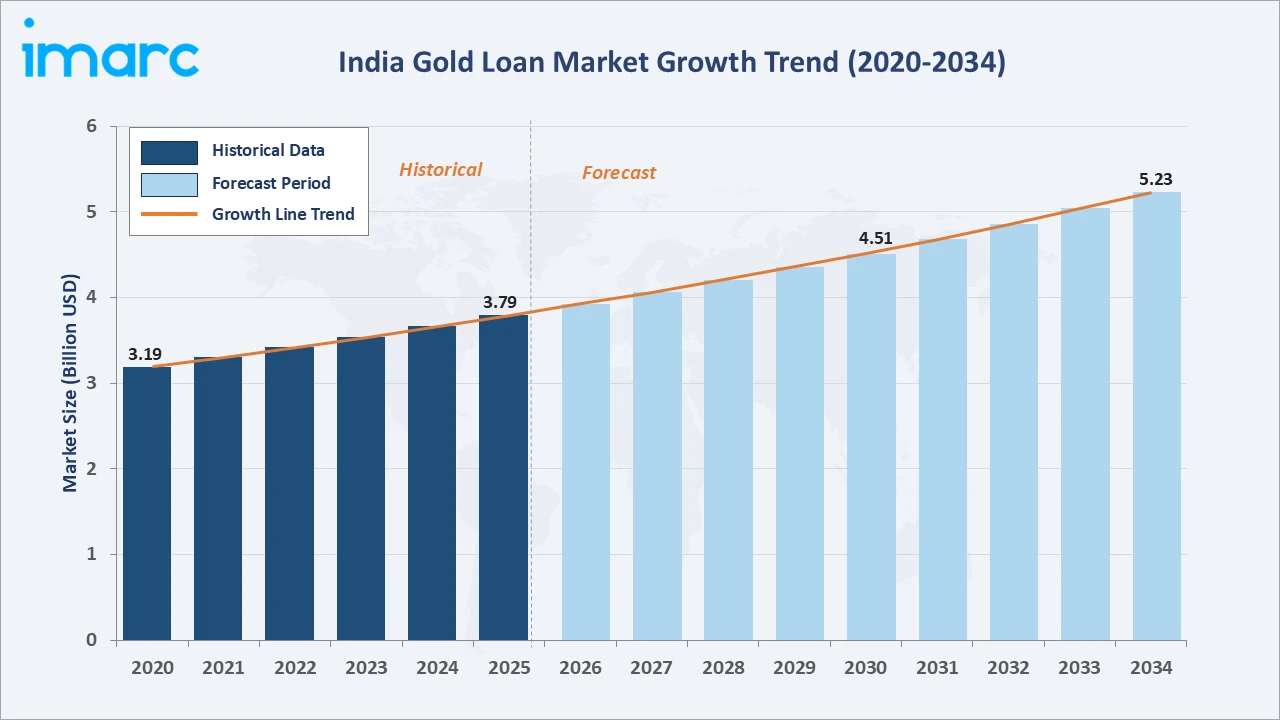
The India gold loan market size increased from USD 3.79 Billion in 2025 to USD 3.97 Billion in 2026 and is projected to reach USD 5.23 Billion by 2034, growing at a CAGR of 3.50% during 2026-2034. The market is driven by India's deep-rooted cultural affinity for gold as a readily accepted form of collateral, rising gold prices that expand loan eligibility, and the rapid expansion of bank and NBFC branch networks into semi-urban and rural India. The Reserve Bank of India's revised Lending Against Gold and Silver Collateral Directions, effective April 2026, are reshaping underwriting and disbursal practices across the sector. Organized lenders dominate at 78.4%. NBFCs lead the lender base at 45.2%. South India commands 38.6% of the national market share.
Market Snapshot
|
Metric |
Value |
|
Base Year Market Size (2025) |
USD 3.79 Billion |
| Market Size (2026) | USD 3.97 Billion |
|
Forecast Market Size (2034) |
USD 5.23 Billion |
|
CAGR (2026-2034) |
3.50% |
|
Base Year |
2025 |
|
Historical Period |
2020-2025 |
|
Forecast Period |
2026-2034 |
|
Dominant Market Type |
Organized (78.4%, 2025) |
|
Dominant Type of Lender |
NBFCs (45.2%, 2025) |
|
Leading Region |
South India (38.6%, 2025) |
The India gold loan market expanded from an estimated USD 3.19 Billion in 2020 to USD 3.79 Billion in 2025 and an estimated USD 3.97 Billion in 2026, is anchored at USD 4.51 Billion in 2030, and is forecast to reach USD 5.23 Billion by 2034. The COVID-19 period accelerated demand for quick, collateral-based liquidity as households and small businesses turned to gold loans over unsecured credit. This structural shift toward formal gold-backed lending has sustained steady market growth through 2022-2025.
To get more information on this market, Request Sample
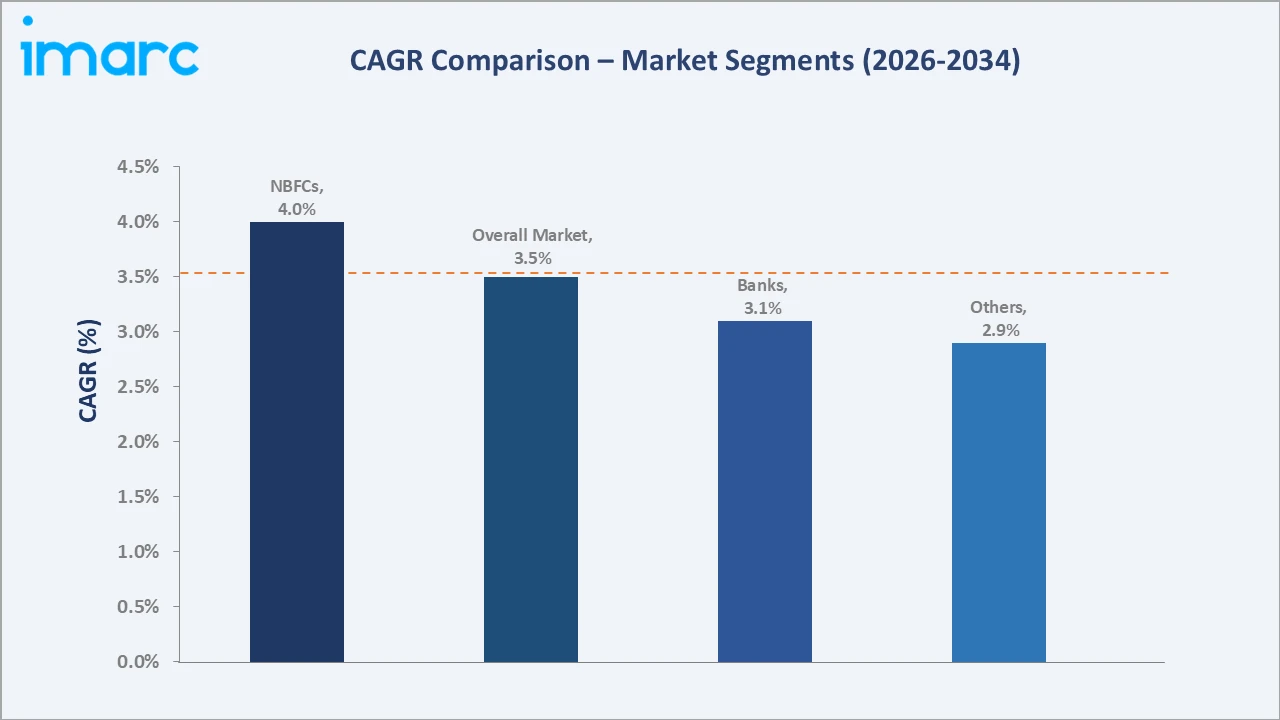
NBFCs grow fastest among lender categories at ~4.0% CAGR as specialized gold-loan NBFCs continue to out-expand banks in rural and semi-urban branch density. Banks grow at ~3.1% CAGR, supported by co-lending tie-ups with NBFCs and digital gold loan product launches.
Executive Summary
The India gold loan market, which increased from USD 3.79 Billion in 2025 to an estimated USD 3.97 Billion in 2026, representing one of the most resilient and culturally anchored segments of the country's retail credit landscape. The market encompasses gold appraisal and valuation services, secured lending by banks and NBFCs, collateral custody and insurance, digital loan origination platforms, and collection and auction infrastructure that together convert household gold holdings into formal, short-tenure credit.
Organized lenders at 78.4% dominate through regulatory trust, standardized valuation, and expanding digital access. NBFCs at 45.2% lead the lender base through the foundational role of specialized gold-loan companies in rural penetration and rapid disbursal. South India, at 38.6%, leads through Kerala, Tamil Nadu, and Andhra Pradesh's deep historical gold-holding culture and dense specialized-NBFC branch networks.
Key Market Insights
|
Insight |
Data |
|
Dominant Market Type |
Organized - 78.4% share (2025) |
|
Dominant Type of Lender |
NBFCs - 45.2% market share (2025) |
|
Leading Region |
South India - 38.6% market share |
|
Market Opportunity |
Digital gold loan platforms; bank-NBFC co-lending; rural financial inclusion; MSME gold-backed credit; gold monetization linkages; AI-based valuation |
Key Analytical Observations Supporting the Above Data:
- Organized Lenders at 78.4%: The organized segment dominates due to regulatory oversight, standardized loan-to-value norms, and growing borrower preference for transparent, RBI-regulated institutions over informal moneylenders. Formal lenders offer faster disbursal, secure custody, and clear repayment terms, encouraging continued migration from unorganized channels.
- NBFCs at 45.2%: NBFCs dominate because their business model is purpose-built around gold-backed lending, with dense branch networks in gold-holding regions, simplified documentation, and same-day disbursal. These specialized players maintain strong asset quality due to low loan-to-value ratios and short tenures.
- South India at 38.6%: South India dominates the market due to its historically high per-capita gold ownership, strong cultural association between gold and financial security, and the regional headquarters of India's largest gold-loan NBFCs. The region's dense branch infrastructure and high borrower familiarity further reinforce its leading position.
India Gold Loan Market Overview
The India gold loan market encompasses the origination, underwriting, disbursal, and servicing of short-tenure credit secured against household gold jewellery and ornaments. The market spans collateral valuation and purity testing, loan-to-value computation, secure vault custody, digital and branch-based origination channels, and collection and auction processes for defaulted accounts.
Macroeconomic factors include rising domestic gold prices, expanding formal credit penetration in rural and semi-urban India, and increasing financial inclusion initiatives. In addition, RBI's tiered loan-to-value framework, growing MSME demand for quick working-capital credit, and continued digitization of loan origination are accelerating adoption of formal gold loan products nationwide.
Market Dynamics
To evaluate market opportunities, Request Sample
Market Drivers
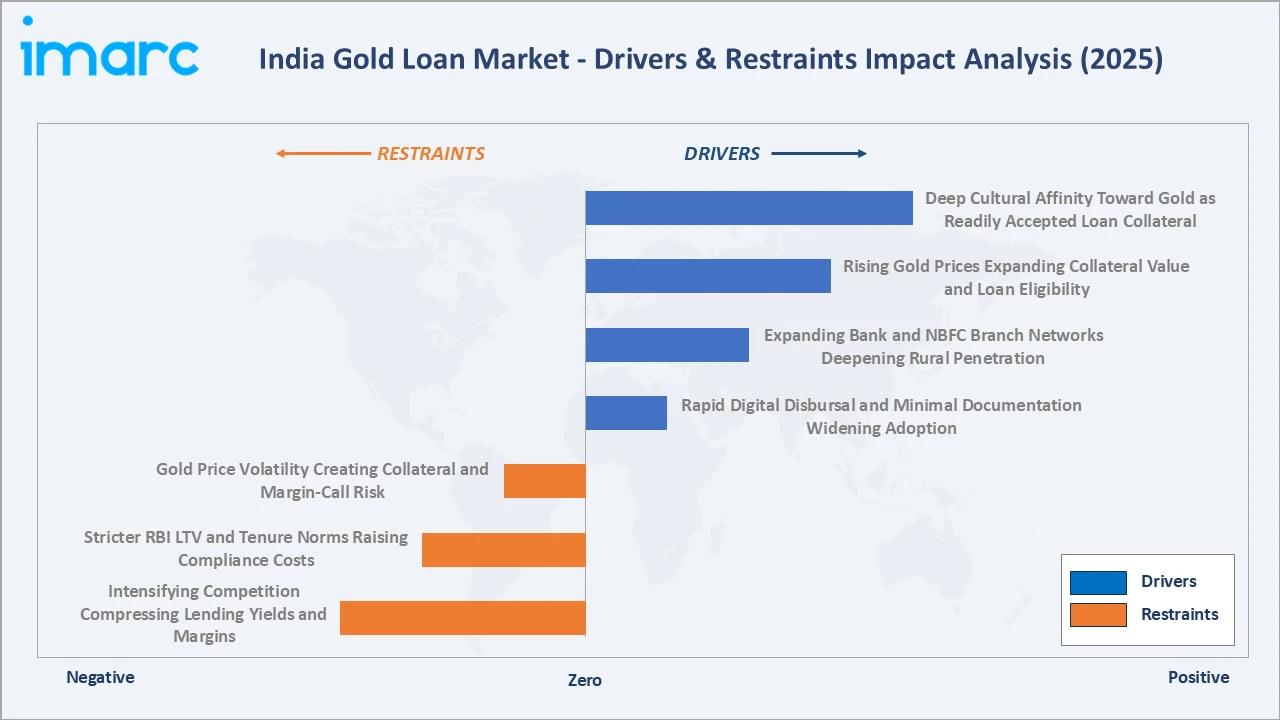
- Deep Cultural Affinity Toward Gold as Readily Accepted Loan Collateral: Gold holds a unique position in Indian households as both an investment and a store of family wealth, making it the most trusted and universally accepted form of loan collateral. This cultural comfort allows lenders to disburse loans within minutes with minimal documentation, driving strong and consistent demand across income segments. India's household gold stock, estimated at over 27,000 tonnes, remains substantially under-monetized through formal lending, representing a deep and durable demand base for the organized gold loan sector.
- Rising Gold Prices Expanding Collateral Value and Loan Eligibility: Sustained increases in domestic gold prices directly expand the loan amount borrowers can access against the same quantity of pledged jewellery. Elevated gold prices through 2025 and into 2026 have pushed average ticket sizes higher and improved lender yields on renewed and top-up loans, reinforcing gold loans as an efficient liquidity option for households and small businesses.
- Expanding Bank and NBFC Branch Networks Deepening Rural Penetration: Leading gold loan NBFCs and banks continue to expand branch networks into semi-urban and rural geographies where gold ownership is high but formal credit penetration remains limited. In FY26, Muthoot Finance added new branches across its group network, taking its consolidated branch count beyond 7,600, reinforcing last-mile access to formal gold-backed credit in underserved markets.
- Rapid Digital Disbursal and Minimal Documentation Widening Adoption: Digital gold loan platforms, doorstep gold evaluation services, and e-KYC-enabled onboarding have significantly reduced turnaround times and documentation requirements. This convenience is drawing younger, digitally native borrowers to formal gold loan products as a fast alternative to unsecured personal loans.
Market Restraints
- Gold Price Volatility Creating Collateral and Margin-Call Risk: Sharp corrections in gold prices reduce the value of pledged collateral relative to outstanding loan amounts, exposing lenders to under-collateralization risk and borrowers to potential margin calls or partial auctions. This volatility requires lenders to maintain conservative loan-to-value buffers, which can constrain loan sizes during price downturns.
- Stricter RBI LTV and Tenure Norms Raising Compliance Costs: The RBI's Lending Against Gold and Silver Collateral Directions, effective April 2026, introduce a tiered loan-to-value structure, mandatory borrower presence during valuation, standardized auction procedures, and a 12-month cap on bullet-repayment tenures. Compliance with these enhanced disclosure, valuation, and recovery requirements increases operational costs for lenders, particularly smaller regional players.
- Intensifying Competition Compressing Lending Yields and Margins: The entry of new banks, small finance banks, and fintech-enabled lenders into the gold loan space has intensified price-based competition, pushing interest rates lower and compressing net interest margins for established players. This is prompting incumbents to compete increasingly on service quality, digital convenience, and customer retention rather than price alone.
Market Opportunities
- Bank-NBFC Co-Lending Partnerships: Co-lending arrangements between banks and specialized gold-loan NBFCs combine banks' lower cost of funds with NBFCs' underwriting expertise and branch density, enabling faster scale-up in underpenetrated regions while sharing credit risk and improving capital efficiency for both partners.
- Digital Gold Loan Platforms and Doorstep Services: The extension of digital gold loan origination, video-based valuation, and doorstep collateral pickup services opens access to urban, digitally engaged borrowers and reduces dependency on physical branch visits, supporting lower-cost customer acquisition and higher renewal rates.
Market Challenges
- Auction and Recovery Process Transparency: Ensuring transparent, borrower-notified auction processes for defaulted loans under the RBI's revised framework requires investment in borrower communication systems, particularly for lenders historically relying on manual auction procedures.
- Balancing Financial Inclusion with Prudent Risk Management: Extending gold loan access to first-time, rural, and low-income borrowers while maintaining asset quality and complying with tiered LTV norms requires investment in borrower education and localized risk assessment.
Emerging Market Trends
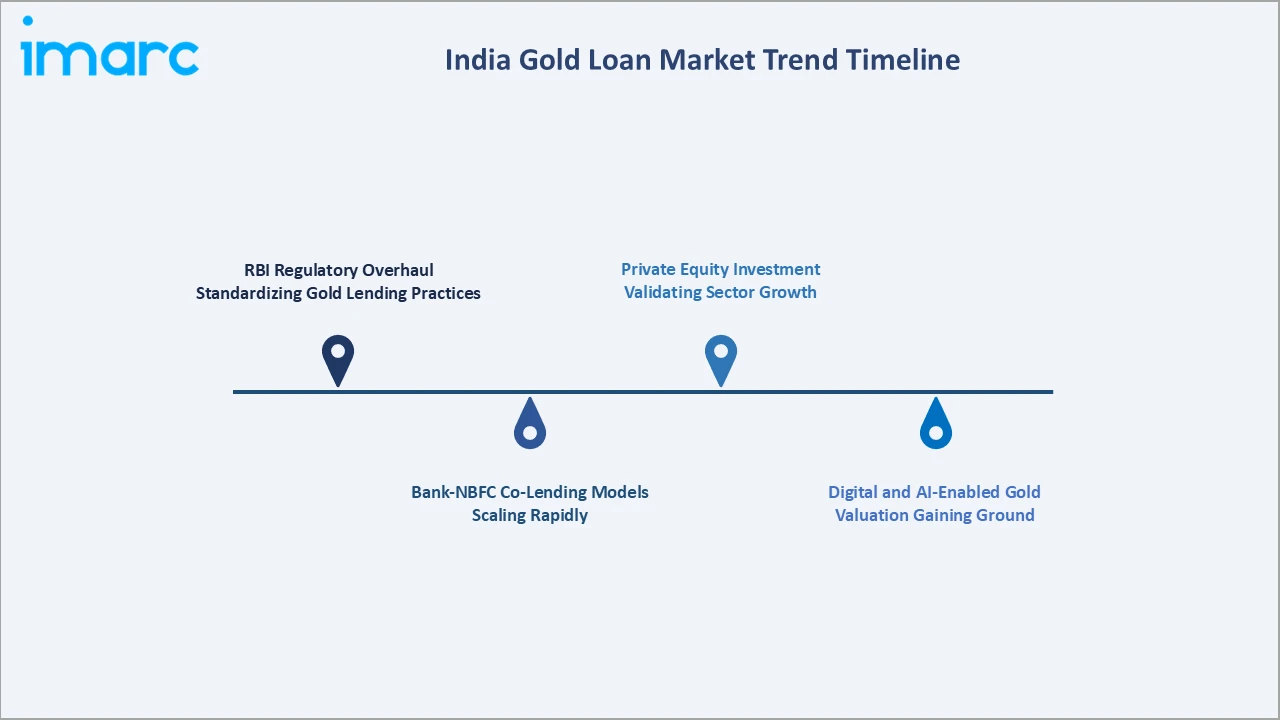
1. RBI Regulatory Overhaul Standardizing Gold Lending Practices
The Reserve Bank of India's Lending Against Gold and Silver Collateral Directions, effective April 1, 2026, replace the earlier flat 75% loan-to-value cap with a tiered structure offering up to 85% LTV on smaller loans. The framework also mandates borrower presence during valuation, standardized auction procedures, and return of pledged gold within seven working days of repayment, backed by a daily penalty for delays. These reforms are expected to improve borrower trust and accelerate migration from unorganized to organized lenders.
2. Bank-NBFC Co-Lending Models Scaling Rapidly
Co-lending partnerships between commercial banks and specialized gold-loan NBFCs are scaling as banks seek exposure to high-yield, well-collateralized gold lending while NBFCs access lower-cost bank funding. These partnerships are expanding loan origination capacity without proportionate increases in NBFC balance-sheet funding costs.
3. Private Equity Investment Validating Sector Growth
Global private equity investors are increasingly viewing the India gold loan market as a resilient, high-growth opportunity. In March 2025, Bain Capital entered into a definitive agreement to invest approximately INR 4,385 crore in Manappuram Finance for an 18% stake with a mandatory open offer for an additional 26%, a transaction that received RBI approval in March 2026. This marks one of the largest private equity investments in India's gold loan sector to date.
4. Digital and AI-Enabled Gold Valuation Gaining Ground
Lenders are increasingly deploying digital valuation tools, video-based gold appraisal, and AI-assisted purity estimation to speed up loan processing while maintaining valuation accuracy. These technologies are also improving branch productivity, with leading NBFCs reporting significant year-on-year increases in average loan AUM per branch.
Industry Value Chain Analysis
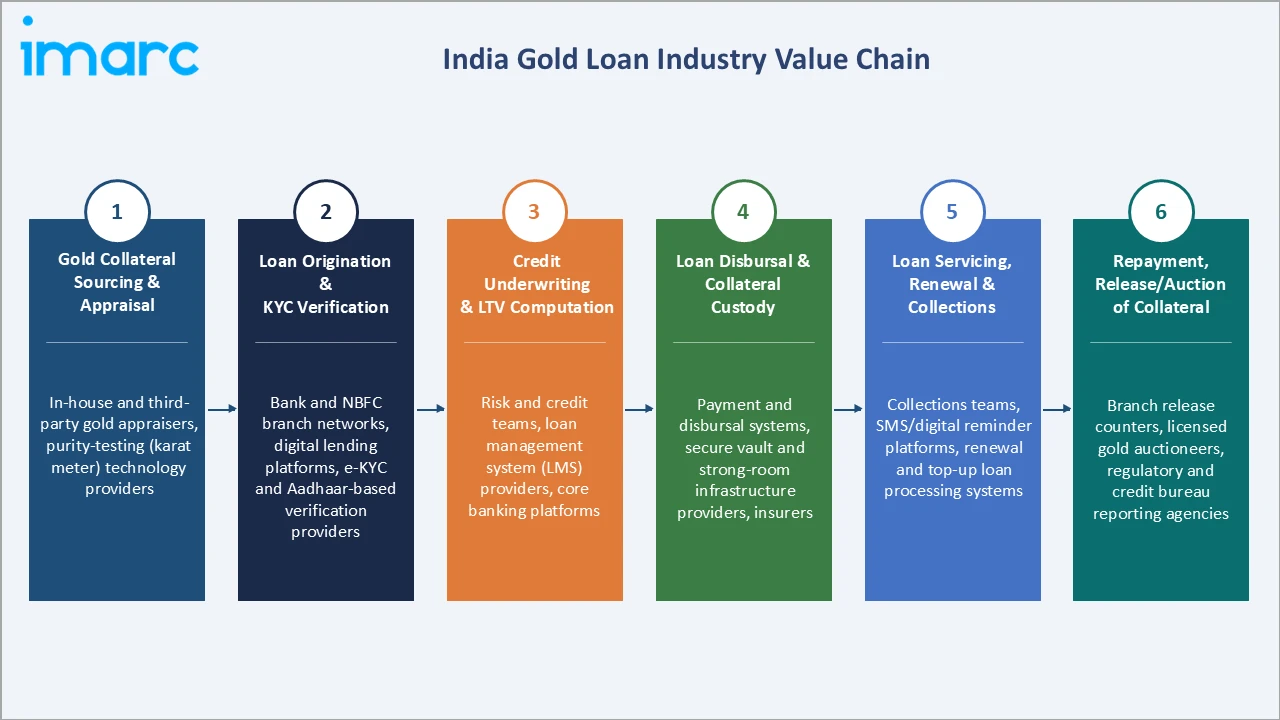
The India gold loan value chain integrates gold collateral sourcing and appraisal, loan origination and KYC verification, credit underwriting and loan-to-value computation, loan disbursal and collateral custody, loan servicing and collections, and final repayment or auction of collateral.
|
Stage |
Key Participants |
|
Gold Collateral Sourcing & Appraisal |
In-house and third-party gold appraisers, purity-testing (karat meter) technology providers |
|
Loan Origination & KYC Verification |
Bank and NBFC branch networks, digital lending platforms, e-KYC and Aadhaar-based verification providers |
|
Credit Underwriting & LTV Computation |
Risk and credit teams, loan management system (LMS) providers, core banking platforms |
|
Loan Disbursal & Collateral Custody |
Payment and disbursal systems, secure vault and strong-room infrastructure providers, insurers |
|
Loan Servicing, Renewal & Collections |
Collections teams, SMS/digital reminder platforms, renewal and top-up loan processing systems |
|
Repayment, Release/Auction of Collateral |
Branch release counters, licensed gold auctioneers, regulatory and credit bureau reporting agencies |
The credit underwriting and loan-to-value computation stage is the value chain's most technically complex and commercially differentiated phase, particularly under RBI's revised tiered LTV framework. The gold appraisal and purity-testing layer directly determine collateral value and, therefore, sanctioned loan amounts. Collection and renewal infrastructure sustains the high asset quality that characterizes formal gold-backed lending.
Technology Landscape in the India Gold Loan Industry
Digital Gold Loan Origination Platforms
Digital gold loan origination platforms enable end-to-end loan applications, e-KYC verification, and instant in-principle approval through mobile and web applications. These platforms reduce branch dependency and turnaround time, allowing lenders to serve digitally engaged urban borrowers alongside traditional branch-based customers. Leading NBFCs have integrated digital gold loan journeys into their core mobile banking and lending applications.
Video-Based and AI-Assisted Gold Valuation
Video-based valuation and AI-assisted purity estimation tools allow lenders to conduct preliminary gold assessment remotely before a customer visits a branch or a doorstep executive is dispatched. These technologies improve appraisal consistency, reduce fraud risk, and support compliance with RBI's mandate for borrower presence during valuation.
Core Banking and Loan Management System Integration
Real-time core banking integration connects gold loan branches to central servers, enabling centralized monitoring of loan-to-value ratios, renewal schedules, and collateral custody across large branch networks. These systems support the operational scale required by lenders operating thousands of branches while maintaining regulatory compliance and asset-quality oversight.
Market Segmentation Analysis
The report covers the following segments:
|
Segment Category |
Leading Segment |
Market Share |
Year |
|
Market Type |
Organized |
78.4% |
2025 |
|
Type of Lenders |
NBFCs |
45.2% |
2025 |
|
Application |
Investment |
58.3% |
2025 |
|
Region |
South India |
38.6% |
2025 |

By Market Type
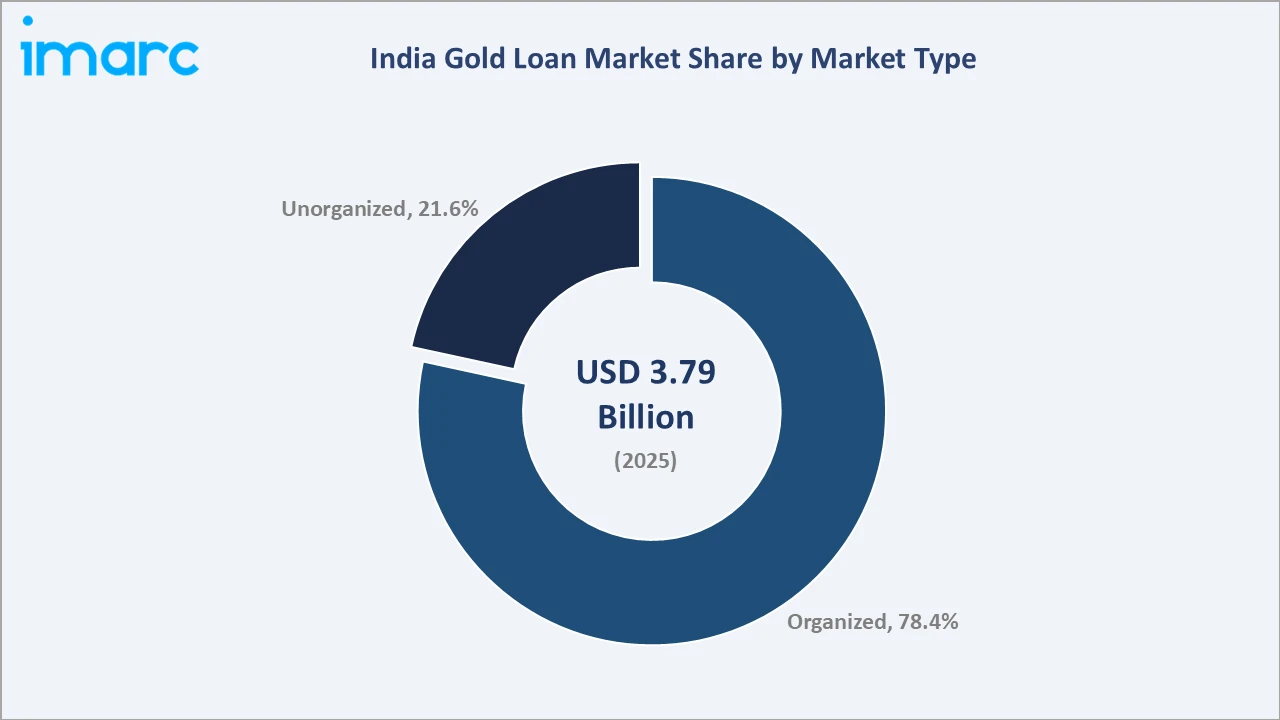
Organized lenders lead at 78.4% (2025). The organized segment encompasses commercial banks, NBFCs, and cooperative institutions operating under RBI's regulatory framework, offering standardized valuation, transparent documentation, and formal recourse mechanisms.
To access detailed market analysis, Request Sample
The unorganized segment at 21.6% encompasses local moneylenders, pawnbrokers, and informal gold-backed lending arrangements, particularly prevalent in rural and semi-urban markets with limited formal branch access. The unorganized segment's share is expected to continue narrowing as organized lenders expand rural penetration and RBI's regulatory reforms improve borrower trust in formal channels.
By Type of Lenders
NBFCs lead at 45.2% (2025). The NBFC segment encompasses specialized gold-loan companies whose business model is purpose-built around rapid, collateral-based lending, supported by extensive branch networks concentrated in gold-holding regions of South and West India.
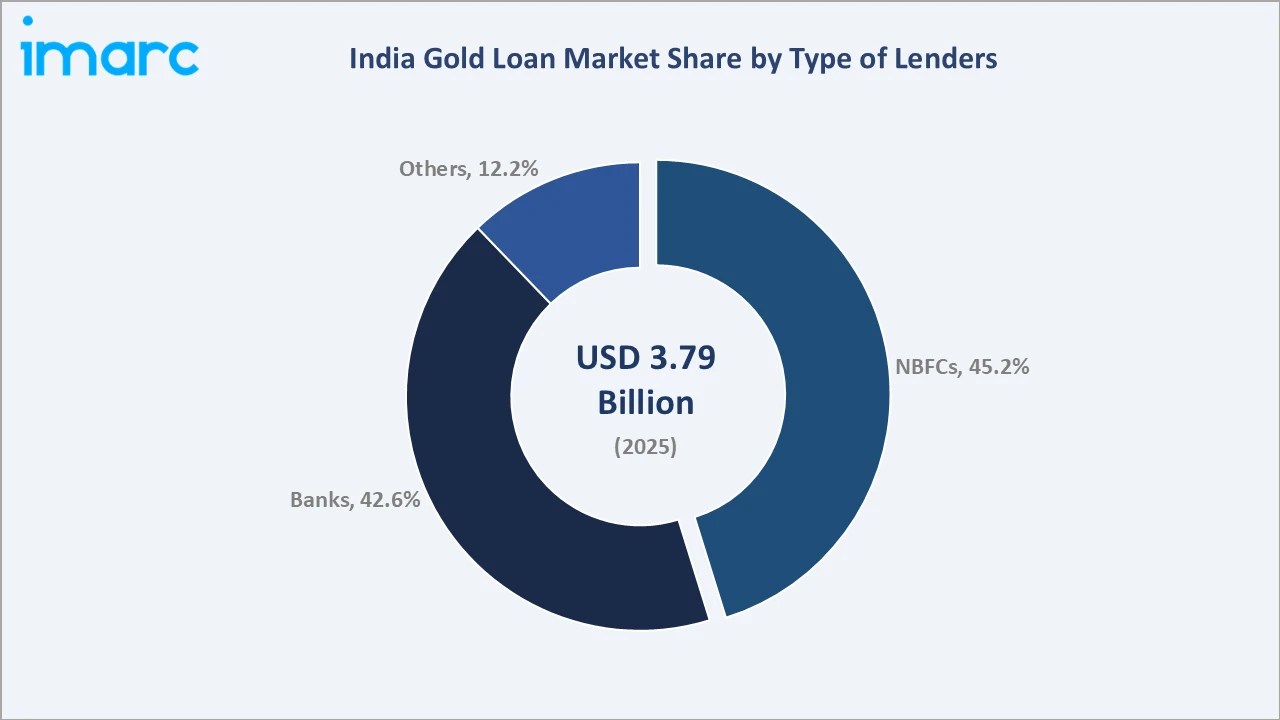
Banks at 42.6% leverage lower cost of funds, extensive branch infrastructure, and cross-selling opportunities with existing deposit and loan customers to compete closely with specialized NBFCs. Others at 12.2% encompass cooperative banks, small finance banks, and fintech-enabled lending platforms operating in the gold loan space.
Regional Market Insights
|
Region |
Share (2025) |
Key India Gold Loan Market Drivers & Characteristics |
|
South India |
38.6% |
Driven by deep historical gold-holding culture, dense NBFC branch networks, and high borrower familiarity with gold-backed credit in Kerala, Tamil Nadu, Karnataka, and Andhra Pradesh. |
|
North India |
24.8% |
Supported by growing bank branch penetration, rising urban and semi-urban gold loan awareness, and expanding co-lending partnerships across Delhi NCR, Uttar Pradesh, and Rajasthan. |
|
West India |
22.5% |
Driven by strong MSME credit demand, high gold ownership among trading and business communities, and expanding digital gold loan adoption in Maharashtra and Gujarat. |
|
East India |
14.1% |
Supported by increasing financial inclusion initiatives, rising rural gold loan penetration, and expanding NBFC and bank branch networks across West Bengal, Odisha, and Bihar. |
South India's 38.6% market leadership is anchored by the region's dense concentration of gold-loan NBFC headquarters and branch networks, alongside deeply embedded cultural gold-holding practices. North India's 24.8% reflects rapid bank branch expansion and rising digital gold loan adoption in metropolitan centers.
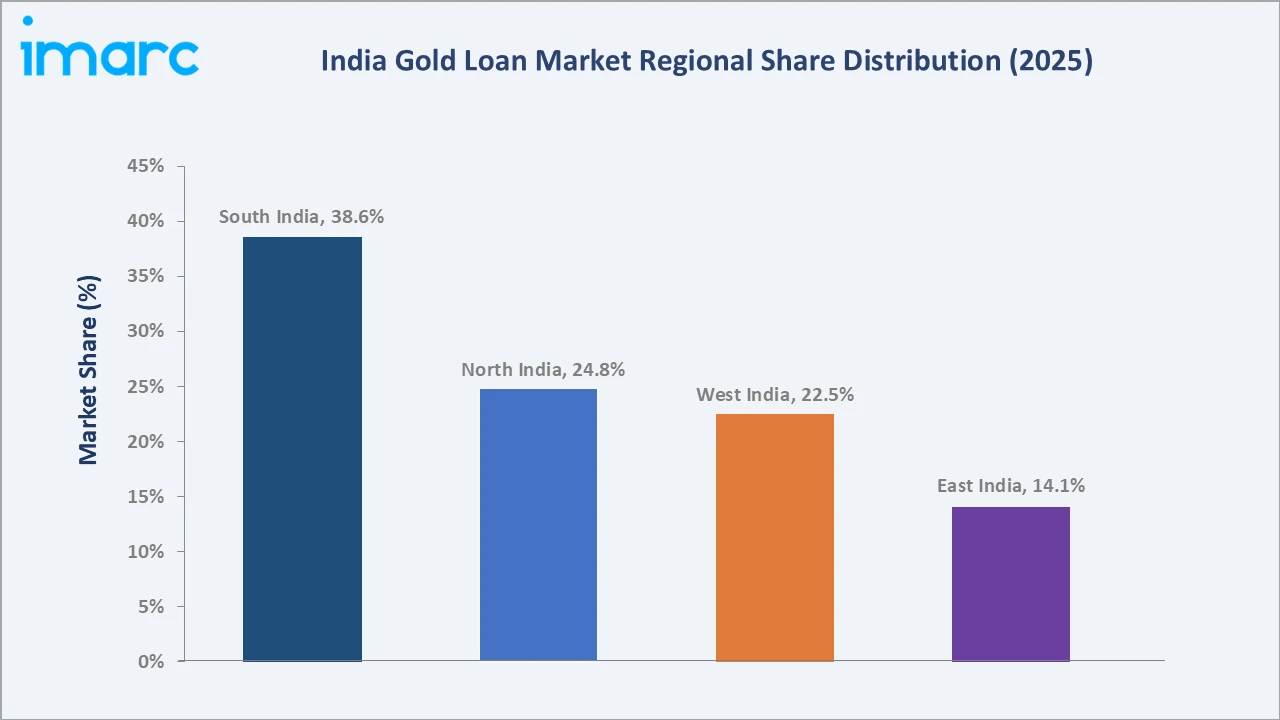
West India's 22.5% encompasses strong MSME and trading-community demand for quick working-capital credit against gold. East India, at 14.1%, is the fastest-growing region by branch expansion as lenders target historically underpenetrated rural markets.
Competitive Landscape
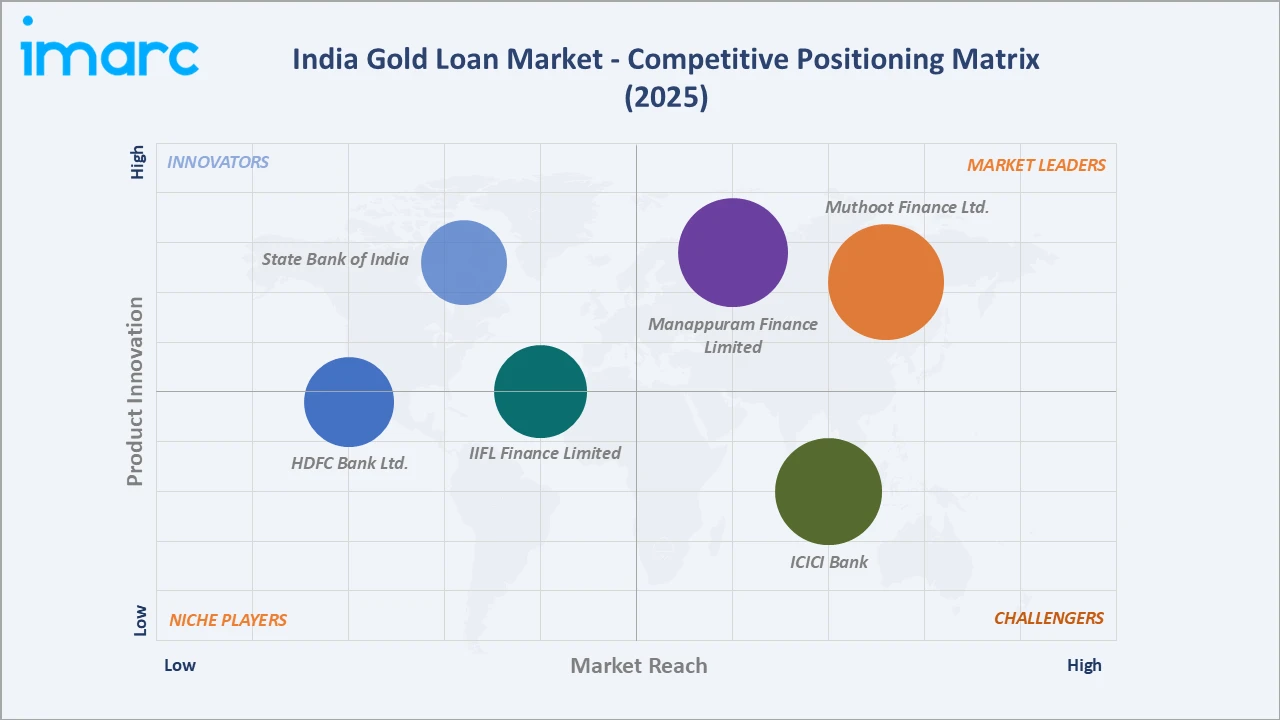
The India gold loan market competitive landscape encompasses distinct tiers: specialized gold-loan NBFCs, large private and public sector banks, small finance banks, and emerging fintech-enabled lending platforms.
|
Company Name |
Key Products |
Market Position |
Core Strength |
|
Muthoot Finance Ltd. |
Gold Loan |
Market Leader |
Muthoot Finance plays a central role in the gold loan market as India's largest gold-loan NBFC by loan portfolio, backed by an extensive branch network and consistently strong asset quality. |
|
Manappuram Finance Limited |
Gold Loan |
Market Leader |
Manappuram Finance is the second-largest gold-loan NBFC in India, strengthened by a strategic Bain Capital investment supporting accelerated branch expansion and digital transformation. |
|
IIFL Finance Limited |
IIFL Gold Loan, Doorstep Gold Loan |
Established Player |
IIFL Finance combines a diversified NBFC lending portfolio with a rapidly growing gold loan business supported by digital and doorstep service capabilities. |
|
HDFC Bank Ltd. |
HDFC Bank Gold Loan |
Established Player |
HDFC Bank leverages its extensive branch and digital banking network to cross-sell gold loans to its large existing retail customer base. |
|
State Bank of India |
SBI Gold Loan, SBI Realty Gold Loan |
Established Player |
State Bank of India offers gold loans through India's largest public sector branch network, supported by competitive interest rates and YONO digital integration. |
|
ICICI Bank |
ICICI Bank Gold Loan |
Challenger |
ICICI Bank combines competitive gold loan pricing with strong digital banking infrastructure to serve urban and semi-urban retail customers. |
Specialized NBFC concentration in South India creates a durable competitive advantage for Muthoot Finance and Manappuram Finance through branch density, brand trust, and decades of gold-lending expertise. Consolidation and private equity investment reflect investor confidence in the sector's long-term growth trajectory, with the Bain Capital-Manappuram transaction marking one of the largest private equity deals in Indian gold-loan history.
Key Company Profiles
Muthoot Finance Ltd.
Muthoot Finance Ltd. is India's largest gold-loan focused NBFC, providing secured lending against gold jewellery alongside money transfer, microfinance, and vehicle finance services across a nationwide branch network.
- Key Products: Muthoot Gold Loan, Muthoot Online Gold Loan, Muthoot Business Loans.
- Recent Developments: In February 2026, Muthoot Finance increased its FY2026 gold-loan growth forecast to 30–35%, from its earlier estimate of 15%, as demand benefited from high gold prices and tighter conditions in unsecured lending. Its standalone loan AUM rose 51% year-on-year to ₹1.48 lakh crore.
- Strategic Focus: Centered on expanding branch density in underpenetrated rural markets, improving per-branch productivity through digital tools, and maintaining disciplined asset quality across its gold-loan portfolio.
Manappuram Finance Limited
Manappuram Finance Limited is India's second-largest gold-loan NBFC, offering secured gold lending alongside microfinance, vehicle finance, and money transfer services through a nationwide branch network.
- Key Products: Manappuram Gold Loan, Online Gold Loan, Manappuram Money Transfer.
- Recent Developments: In March 2025, Bain Capital entered into a definitive agreement to invest approximately INR 4,385 crore in Manappuram Finance for an 18% stake with a mandatory open offer for an additional 26%; the transaction received RBI approval and an initial equity infusion of INR 2,740 crore was completed in March 2026.
- Strategic Focus: Focused on accelerating gold loan AUM growth, strengthening branch infrastructure, and enhancing governance and digital capability with support from its new strategic investor.
IIFL Finance Limited
IIFL Finance Limited is a diversified non-banking financial company with a rapidly expanding gold loan business, complementing its broader retail and MSME lending portfolio.
- Key Products: IIFL Gold Loan, Doorstep Gold Loan, IIFL Gold Loan digital application.
- Strategic Focus: Centered on scaling digital gold loan origination, expanding doorstep valuation and disbursal services, and deepening presence in urban and semi-urban markets.
Market Concentration Analysis
The India gold loan market is moderately concentrated at the organized-lender tier, with the top five NBFCs and banks collectively accounting for a substantial share of formal gold loan disbursals, while the unorganized sector remains highly fragmented across local moneylenders and pawnbrokers. Market concentration is expected to increase gradually as private equity investment and RBI's regulatory reforms favor well-capitalized, compliance-ready lenders.
Investment & Growth Opportunities
Highest Growth Segments
NBFC-originated gold loans (~4.0% CAGR), digital and doorstep gold loan origination (~6-8% CAGR from a growing base), bank-NBFC co-lending partnerships (~7-9% CAGR), and MSME gold-backed working capital credit (~5-6% CAGR) represent the highest-growth India gold loan investment vectors through 2034.
Emerging Investment Opportunities
Rural and semi-urban financial inclusion represents the largest near-term India gold loan opportunity. Lenders that establish dense branch networks and digital onboarding capability in East India and North India's underpenetrated markets are positioned for above-market growth as formal credit penetration deepens.
Investment Themes
- Bank-NBFC co-lending platform development: Co-lending structures combine banks' lower cost of funds with NBFCs' gold-lending underwriting expertise, enabling faster origination scale-up without proportionate increases in balance-sheet funding costs.
- Digital and AI-enabled gold valuation platform investment: Video-based and AI-assisted valuation tools help lenders comply with RBI's borrower-presence mandate while improving appraisal consistency and branch turnaround time.
Future Market Outlook (2026-2034)
The India gold loan market is projected to grow from USD 3.79 Billion in 2025 to USD 3.97 Billion in 2026, reaching USD 5.23 Billion by 2034, registering a CAGR of 3.50% during 2026-2034. The market's anchor value of USD 4.51 Billion in 2030 represents a gold loan industry that has fully absorbed RBI's tiered LTV and borrower-protection framework, with organized lenders having further consolidated share from unorganized channels, digital and AI-enabled valuation having become mainstream across leading NBFCs and banks, and bank-NBFC co-lending having scaled into a standard origination model across the sector.
Three structural forces define India gold loan market growth through 2034 with strong confidence. India's deep, multi-generational cultural affinity for gold as both an investment and a trusted form of collateral creates a demand base that is durable and largely insulated from broader consumer-credit cycles. RBI's regulatory standardization is simultaneously improving borrower trust in formal lenders and raising compliance costs, favoring well-capitalized, technology-enabled players. Rising financial inclusion and digital access are extending formal gold loan availability into historically underpenetrated rural and semi-urban markets, particularly in East and North India.
Research Methodology
Primary Research
Primary research comprised structured interviews with 40+ industry stakeholders (2025-2026) including Chief Risk Officers, Business Development Heads, gold-loan branch operations leaders, NBFC and bank senior management, and regional gold loan market specialists.
Secondary Research
Secondary research encompassed RBI regulatory circulars and directions, company annual reports and investor presentations, gold price and bullion market data, NBFC and banking sector publications, and industry association reports. Over 50 secondary sources were reviewed.
Forecasting Models
Market revenue forecasts were developed using a segment bottom-up model: (i) market-type component (organized and unorganized); (ii) lender-type component (banks, NBFCs, and others); (iii) regional component.
India Gold Loan Market Report Coverage:
| Report Features | Details |
|---|---|
| Base Year of the Analysis | 2025 |
| Historical Period | 2020-2025 |
| Forecast Period | 2026-2034 |
| Units | Billion USD |
| Scope of the Report | Exploration of Historical Trends and Market Outlook, Industry Catalysts and Challenges, Segment-Wise Historical and Future Market Assessment:
|
| Market Types Covered | Organized, Unorganized |
| Type of Lenders Covered | Banks, NBFCs, Others |
| Applications Covered | Investment, Collecting |
| Regions Covered | North India, South India, East India, West India |
| Companies Covered | Muthoot Finance Ltd., Manappuram Finance Limited, IIFL Finance Limited, HDFC Bank Ltd., State Bank of India, ICICI Bank, etc. |
| Customization Scope | 10% Free Customization |
| Post-Sale Analyst Support | 10-12 Weeks |
| Delivery Format | PDF and Excel through Email (We can also provide the editable version of the report in PPT/Word format on special request) |
Key Benefits for Stakeholders:
- IMARC’s industry report offers a comprehensive quantitative analysis of various market segments, historical and current market trends, market forecasts, and dynamics of the India gold loan market from 2020-2034.
- The research report provides the latest information on the market drivers, challenges, and opportunities in the India gold loan market.
- Porter's five forces analysis assist stakeholders in assessing the impact of new entrants, competitive rivalry, supplier power, buyer power, and the threat of substitution. It helps stakeholders to analyze the level of competition within the India gold loan industry and its attractiveness.
- Competitive landscape allows stakeholders to understand their competitive environment and provides an insight into the current positions of key players in the market.
Frequently Asked Questions About the India Gold Loan Market Report
The India gold loan market size is estimated at USD 3.97 Billion in 2026. The market is driven by India's deep cultural affinity for gold as loan collateral, rising gold prices, expanding branch networks, and increasing digital access to formal credit.
The market grows at 3.50% CAGR during 2026-2034, reaching USD 5.23 Billion by 2034. NBFCs grow fastest among lender categories at ~4.0% CAGR through continued rural and semi-urban branch expansion.
Organized lenders lead at 78.4% through regulatory trust, standardized valuation practices, and continued migration of borrowers away from informal moneylenders and pawnbrokers.
NBFCs lead at 45.2% through the foundational role of specialized gold-loan companies in rapid disbursal, dense branch networks, and deep expertise in gold-backed underwriting.
South India leads at 38.6% through its historically high per-capita gold ownership and the concentration of leading gold-loan NBFC headquarters and branch networks in the region.
Leading companies include Muthoot Finance Ltd., Manappuram Finance Limited, IIFL Finance Limited, HDFC Bank Ltd., State Bank of India and ICICI Bank, among others.
The market is projected to reach approximately USD 4.51 Billion by 2030, with RBI's tiered LTV framework fully implemented, digital and AI-enabled valuation scaling across leading lenders, and bank-NBFC co-lending established as a standard origination model.
The RBI's Lending Against Gold and Silver Collateral Directions, effective April 1, 2026, introduce a tiered loan-to-value structure of up to 85% for smaller loans, mandatory borrower presence during valuation, a 12-month cap on bullet-repayment tenures, and a requirement to return pledged gold within seven working days of repayment.
Need more help?
- Speak to our experienced analysts for insights on the current market scenarios.
- Include additional segments and countries to customize the report as per your requirement.
- Gain an unparalleled competitive advantage in your domain by understanding how to utilize the report and positively impacting your operations and revenue.
- For further assistance, please connect with our analysts.
 Request Customization
 Speak to an Analyst
 Request Brochure
 Inquire Before Buying
Benefits of Customization
- Personalize this research
- Triangulate with your data
- Get data as per your format and definition
- Gain a deeper dive into a specific application, geography, customer, or competitor
- Any level of personalization
Get in Touch With Us
UNITED STATES
Phone: +1-201-971-6302
INDIA
Phone: +91-120-433-0800
UNITED KINGDOM
Phone: +44-753-714-6104
Email: [email protected]
Client Testimonials




.webp)




.webp)













Related Reports

Choose your plan
*Please note that the prices mentioned below are starting prices for each bundle type. Kindly contact our team for further details.*
Single User License
- 1 User License, Access on 2 Devices
- PDF Report + Excel Dataset (Password Protected)
- Lifetime Access
- No Printing Rights
- 10% Free Report Customization
- 10–12 Weeks of Analyst Support
Five User License
- Access for 5 Users, 2 Devices per User
- PDF Report + Excel Dataset (Password Protected)
- Lifetime Access
- Dedicated Account Manager
- 12–14 Weeks of Analyst Support
- No Printing Rights
- 15% Free Report Customization
- 25% Discount on Your Next Purchase
Corporate User License
- Unlimited User Access (Within Your Organization)
- PDF Report + Excel Dataset
- Lifetime Access
- Dedicated Account Manager
- 14–20 Weeks of Analyst Support
- No Printing Rights
- 20% Free Report Customization
- 30% Discount on Your Next Purchase
Essential Insights
What's included:
3 reports
- Lifetime Access
- PDF Reports
- Excel Datasets
- 2 Weeks of Free Analyst Support
- 2 User Licenses
- Access on 2 Devices
- Printing Rights
- Complimentary PowerPoint (PPT) Version
- Complimentary License Upgrade
Professional Access
What's included:
5 reports
- Lifetime Access
- PDF Reports
- Excel Datasets
- 8 Weeks of Free Analyst Support
- 2 User Licenses
- Access on 2 Devices
- Printing Rights
- Complimentary PowerPoint (PPT) Version
- Complimentary License Upgrade
Business Advantage
What's included:
8 reports
- Lifetime Access
- PDF Reports
- Excel Datasets
- 14 Weeks of Free Analyst Support
- 2 User Licenses
- Access on 2 Devices
- Printing Rights
- Complimentary PowerPoint (PPT) Version
- Complimentary License Upgrade
Enterprise Intelligence
What's included:
10 reports
- Lifetime Access
- PDF Reports
- Excel Datasets
- 20 Weeks of Free Analyst Support
- 2 User Licenses
- Access on 2 Devices
- Printing Rights
- Complimentary PowerPoint (PPT) Version
- Complimentary License Upgrade