
India Personal Loan Market Size, Share, Trends, and Forecast by Provider, Tenure, Interest Rate, and Region, 2026-2034
India Personal Loan Market Size, Share, Trends & Forecast (2026-2034)
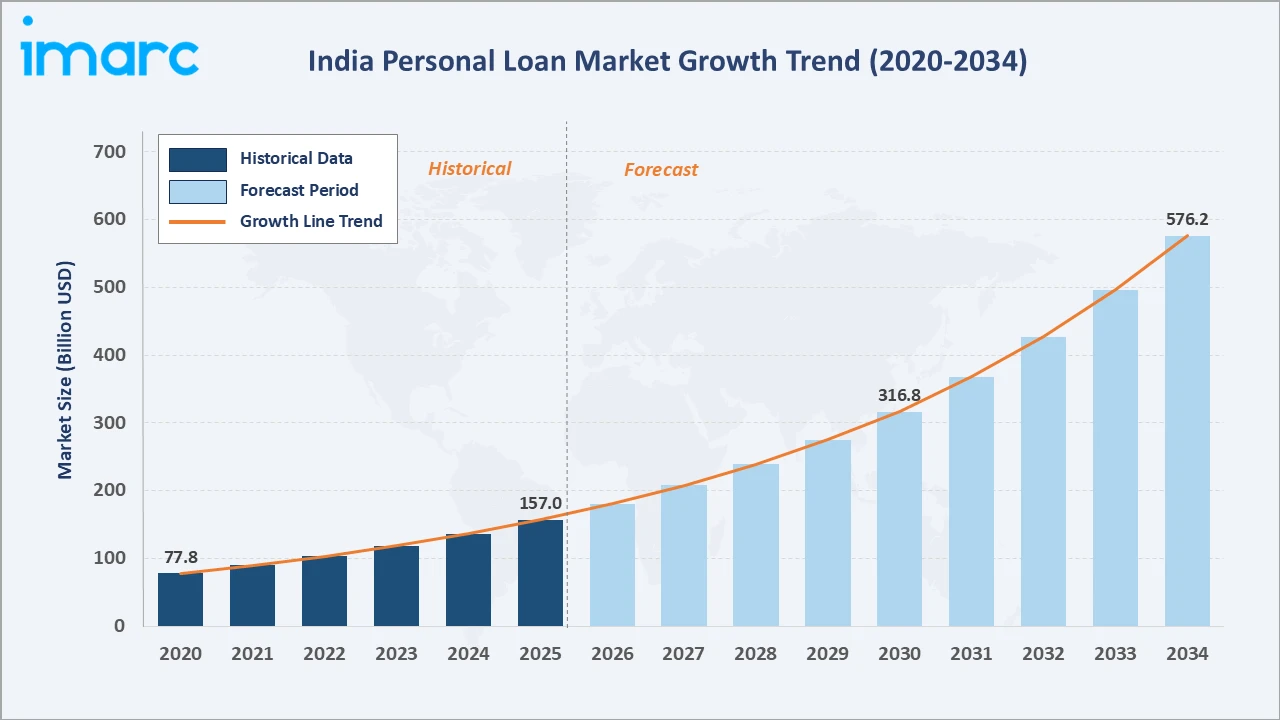
The India personal loan market grew from USD 157.0 Billion in 2025 to USD 187.4 Billion in 2026 and is projected to reach USD 576.2 Billion by 2034, growing at a CAGR of 15.08% during 2026-2034. Rapid digital lending expansion, rising disposable incomes, and growing demand for instant, collateral-free credit across urban and semi-urban India drive growth. Banks dominate at 63.7%, while NBFCs command 36.3%. The 12–36 Months tenure segment leads at 48.6%. West India accounts for the largest regional share at 31.7%.
Market Snapshot
|
Metric |
Value |
|
Base Year Market Size (2025) |
USD 157.0 Billion |
|
Market Size (2026) |
USD 187.4 Billion |
|
Forecast Market Size (2034) |
USD 576.2 Billion |
|
CAGR (2026-2034) |
15.08% |
|
Base Year |
2025 |
|
Historical Period |
2020-2025 |
|
Forecast Period |
2026-2034 |
|
Dominant Provider |
Bank (63.7%, 2025) |
|
Dominant Tenure |
12–36 Months (48.6%, 2025) |
|
Leading Region |
West India (31.7%, 2025) |
The market expanded from USD 77.8 Billion in 2020 to USD 157.0 Billion in 2025 and an estimated USD 187.4 Billion in 2026, more than doubling in five years, with the market projected to reach USD 316.8 Billion in 2030 and USD 576.2 Billion by 2034. The post-pandemic surge in digital lending adoption created structural tailwinds that have sustained high personal credit disbursement growth throughout the historical period and into the forecast horizon.
To get more information on this market, Request Sample
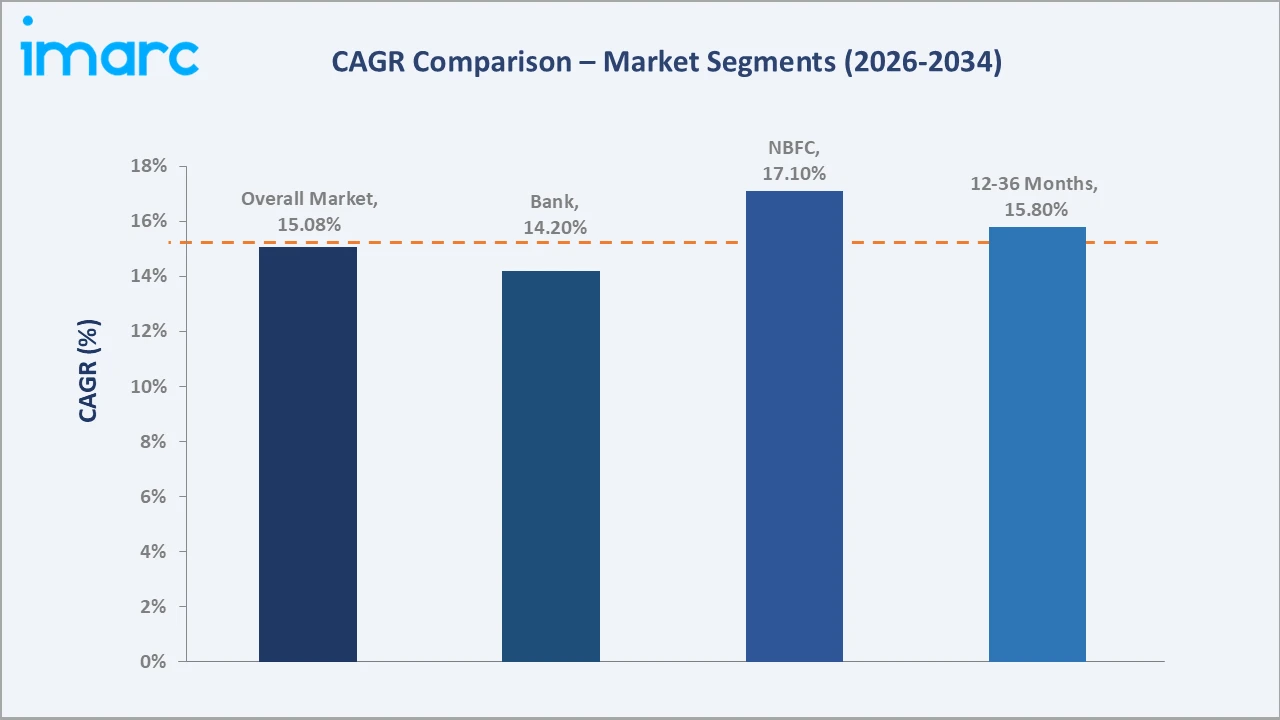
The NBFC and fintech segment grows fastest at ~17.1% CAGR as digital-first lenders penetrate underserved borrower segments through AI-driven underwriting. The 12–36 Months tenure band grows at above-market rates as mainstream salaried professionals increasingly opt for medium-term EMI structures for consumption and lifestyle financing purposes.
Executive Summary
The India personal loan market, which increased from USD 157.0 Billion in 2025 to an estimated USD 187.4 Billion in 2026, representing one of South Asia's fastest-growing consumer credit segments driven by structural demographic tailwinds, digital infrastructure expansion, and an evolving formal credit ecosystem. The market is projected to reach USD 576.2 Billion by 2034.
Banks at 63.7% dominate through extensive branch networks, competitive interest rates, and institutional trust. The 12–36 Months tenure at 48.6% reflects mainstream borrower preference for medium-term EMI structures. West India at 31.7% leads regionally through Mumbai's financial hub concentration and high per-capita income in Maharashtra and Gujarat.
Key Market Insights
|
Insight |
Data |
|
Dominant Provider |
Bank – 63.7% share (2025) |
|
Dominant Tenure |
12–36 Months – 48.6% market share (2025) |
|
Leading Region |
West India – 31.7% market share (2025) |
|
Market Opportunity |
Embedded finance; co-lending; rural digital lending; MSME credit; BNPL convergence |
Key Analytical Observations Supporting the Above Data:
- Bank at 63.7%: Banks dominate by offering competitive interest rates (10%–16% p.a.), large loan amounts, and stringent risk frameworks that attract creditworthy salaried borrowers. Public sector banks serve government employees while private sector banks target urban professionals through AI-powered instant loan ecosystems.
- 12–36 Months at 48.6%: This tenure band aligns with mainstream borrower repayment capacity for mid-ticket expenses including home renovation, consumer durables, travel, and wedding financing. Medium tenures balance EMI affordability with total interest cost, driving sustained segment dominance.
- West India at 31.7%: West India leads through Maharashtra and Gujarat's high urbanization, superior formal employment rates, deep NBFC penetration, and Mumbai's role as India's financial capital creating concentrated personal credit demand across all income segments.
India Personal Loan Market Overview
The India personal loan market encompasses unsecured retail credit extended by banks, non-banking financial companies (NBFCs), and fintech platforms to individuals for personal consumption, emergency financing, lifestyle expenses, and short-term liquidity requirements across India's diverse borrower segments.
The ecosystem integrates scheduled commercial banks, RBI-registered NBFCs, credit bureaus (CIBIL, Experian, Equifax), digital lending aggregators, payment infrastructure providers (UPI, NACH), and regulatory bodies including the Reserve Bank of India and the Indian Banks' Association. Macroeconomic factors include rising disposable incomes, expanding smartphone penetration, UPI-driven digital payment infrastructure, and formal credit ecosystem deepening.
Market Dynamics
To evaluate market opportunities, Request Sample
Market Drivers
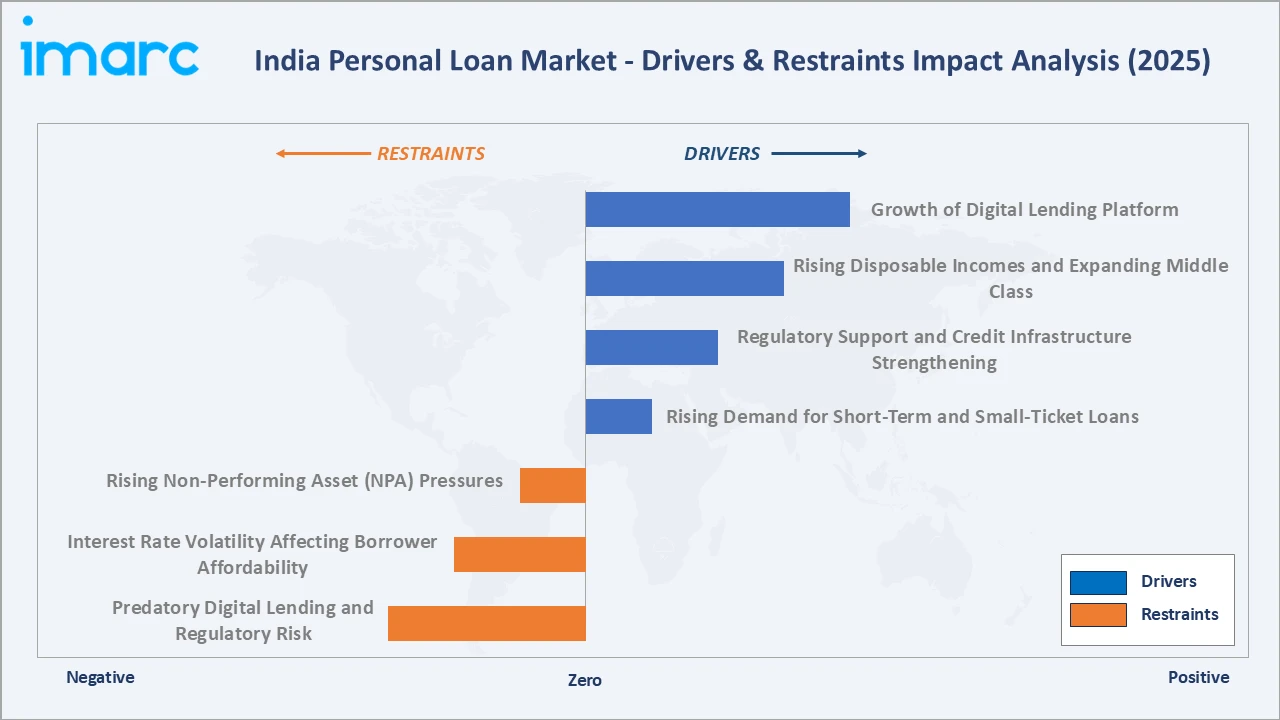
- Growth of Digital Lending Platforms: AI-powered loan origination platforms have compressed approval timelines from days to minutes, enabling personal loan access for previously unbanked borrowers. Digital-first NBFCs use alternative credit scoring via UPI transaction history and GST data.
- Rising Disposable Incomes and Expanding Middle Class: India's per-capita income growth is accelerating consumer credit demand across urban and semi-urban households. A rising salaried workforce demands instant access to unsecured credit for lifestyle, education, and medical needs. India's middle class is expanding the pool of creditworthy borrowers. Banks and NBFCs are launching specialized salary-linked products to capture this growing segment.
- Regulatory Support and Credit Infrastructure Strengthening: RBI's digital lending guidelines have standardized practices and increased institutional confidence in digital personal lending. India's Account Aggregator framework enables real-time financial data sharing, allowing lenders to access bank statements and income data digitally. These improvements are structurally expanding personal loan penetration across income brackets and geographies.
- Rising Demand for Short-Term and Small-Ticket Loans: Demand for micro-personal loans between INR 10,000 and INR 2 Lakh is growing rapidly, driven by gig workers and first-time borrowers in Tier 2 and Tier 3 cities. In October 2024, Hero FinCorp offered instant personal loans up to INR 5 Lakh for medical, wedding, and travel needs at competitive rates. NBFCs deploy mobile-first platforms with minimal documentation requirements. BNPL convergence further accelerates short-duration credit adoption.
Market Restraints
- Rising Non-Performing Asset (NPA) Pressures: Post-pandemic delinquencies prompted the RBI to raise risk weights on consumer credit, increasing capital requirements and constraining loan growth for banks and NBFCs. Higher provisioning obligations compress net interest margins for smaller lenders with thin capital buffers. Rising NPA levels among digital lenders targeting thin-file borrowers raise underwriting costs industry-wide. Regulatory pressure to maintain risk reserves is slowing personal loan portfolio expansion for capital-constrained NBFCs.
- Interest Rate Volatility Affecting Borrower Affordability: Floating rate personal loans are directly impacted by RBI repo rate changes, with each 50-basis point increase raising EMI burdens and reducing loan affordability. Rate hike cycles trigger pre-closures disrupting lender portfolio yield targets. Interest rate uncertainty suppresses demand for larger loans at extended tenures. NBFCs with higher funding costs face greater margin compression than banks, reducing competitive pricing capability during rising rate environments.
- Predatory Digital Lending and Regulatory Risk: Unauthorized lending apps prompted RBI to tighten digital lending norms, increasing compliance costs for legitimate NBFCs and fintech lenders. Regulatory responses to predatory practices create uncertainty constraining growth for compliant lenders serving underserved segments. Reputational damage from malpractices raises borrower skepticism and customer acquisition costs. Potential rate caps and collection restrictions represent structural risk to NBFC profitability in the personal loan segment.
Market Opportunities
- Embedded Finance and Co-Lending Partnerships: Banks and NBFCs embedding personal loan offers within telecom and salary platforms represent a large, untapped distribution opportunity. In January 2025, Bajaj Finance partnered with Airtel to reach 375 million customers, demonstrating embedded finance scale. The RBI co-lending framework enables banks to leverage NBFC distribution at a 60:40 risk-sharing ratio, expanding access while combining low bank funding costs with last-mile NBFC underwriting.
- Underserved Rural and Semi-Urban Borrower Segments: Formal credit penetration below 15% in rural India represents a large opportunity for digital lenders using alternative data underwriting. UPI creates transaction histories enabling credit scoring for first-time rural borrowers. India Post Payments Bank's partnership with Aditya Birla Capital for loan referrals across 650 million rural touchpoints illustrates embedded lending scale. Digital lenders with scalable underwriting are well-positioned as mobile internet reaches Tier 3 and Tier 4 towns.
Market Challenges
- Credit Concentration in Urban Markets Limiting Penetration: Personal loan growth remains concentrated in metro cities where formal employment documentation and credit histories are available. Extending credit to informal-sector workers without verifiable income is a fundamental challenge limiting market expansion. Urban concentration means most lenders compete for the same creditworthy pool, compressing interest rate spreads. Meaningful rural penetration requires investment in alternative data infrastructure, agent networks, and vernacular digital interfaces.
- Data Privacy and Cybersecurity Risks in Digital Lending: Digital loan origination creates cybersecurity risks including data breaches and identity fraud causing material losses for lenders. India's Digital Personal Data Protection Act 2023 imposes new data handling obligations increasing compliance costs for digital lenders. Inconsistent security standards across proliferating platforms raise systemic risk of large-scale data compromises affecting millions of borrowers. These challenges require ongoing technology investment that disproportionately burdens smaller NBFCs with limited capital resources.
Emerging Market Trends
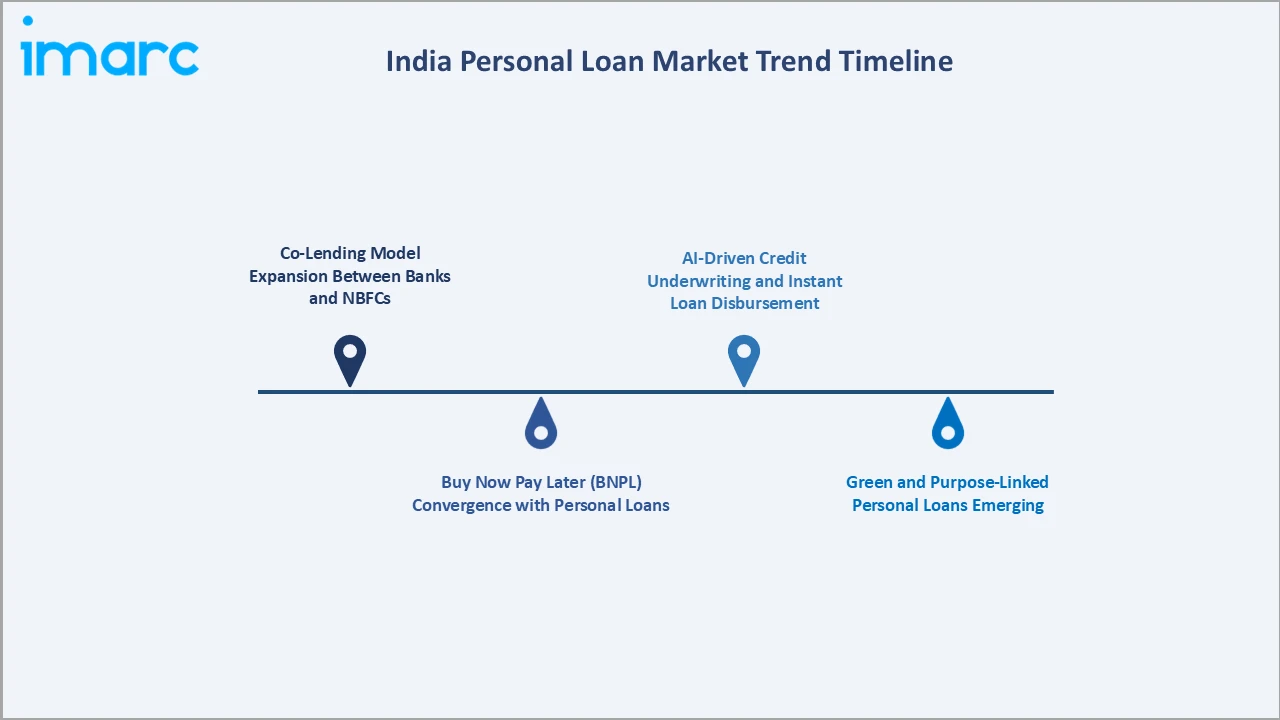
1. AI-Driven Credit Underwriting and Instant Loan Disbursement
Machine learning models analyzing UPI transaction patterns, account aggregator data, and behavioral signals are enabling sub-minute loan approvals for digital personal loan platforms. HDFC Bank's 10-second pre-approved disbursement and SBI's YONO instant loan reflect this shift toward algorithmic underwriting. As AI accuracy improves with growing training data, credit underwriting costs are declining while approval rates for thin-file borrowers increase.
2. Co-Lending Model Expansion Between Banks and NBFCs
RBI's co-lending framework allows banks to leverage NBFC distribution at 60:40 risk-sharing ratios, enabling personal loan penetration beyond traditional bank networks. This model combines banks' low funding costs with NBFCs' last-mile underwriting capabilities, reaching Tier 3 cities and informal sector segments. Co-lending partnerships are proliferating rapidly, with large public sector banks increasingly partnering with digital NBFCs to expand retail personal loan portfolios.
3. Buy Now Pay Later (BNPL) Convergence with Personal Loans
BNPL platforms are evolving into short-duration personal loan providers as RBI mandates NBFC-level regulatory compliance for deferred payment products. This convergence blurs product boundaries, compelling fintech lenders to upgrade infrastructure while retaining seamless embedded credit experiences. The BNPL-to-personal loan evolution creates a large segment of digitally-onboarded borrowers with repayment track records who can be cross-sold into larger personal loan products over time.
4. Green and Purpose-Linked Personal Loans Emerging
Banks are launching personal loan products for EV purchases, solar installation, and energy-efficient appliance financing at concessional rates as part of ESG mandates and product differentiation strategies. As consumer awareness of sustainable financing rises and government EV subsidy schemes expand, purpose-linked personal loans are creating new product categories for environmentally conscious urban borrowers. Green personal loan products offer banks a strategic differentiation opportunity in an increasingly commoditized lending market.
Industry Value Chain Analysis
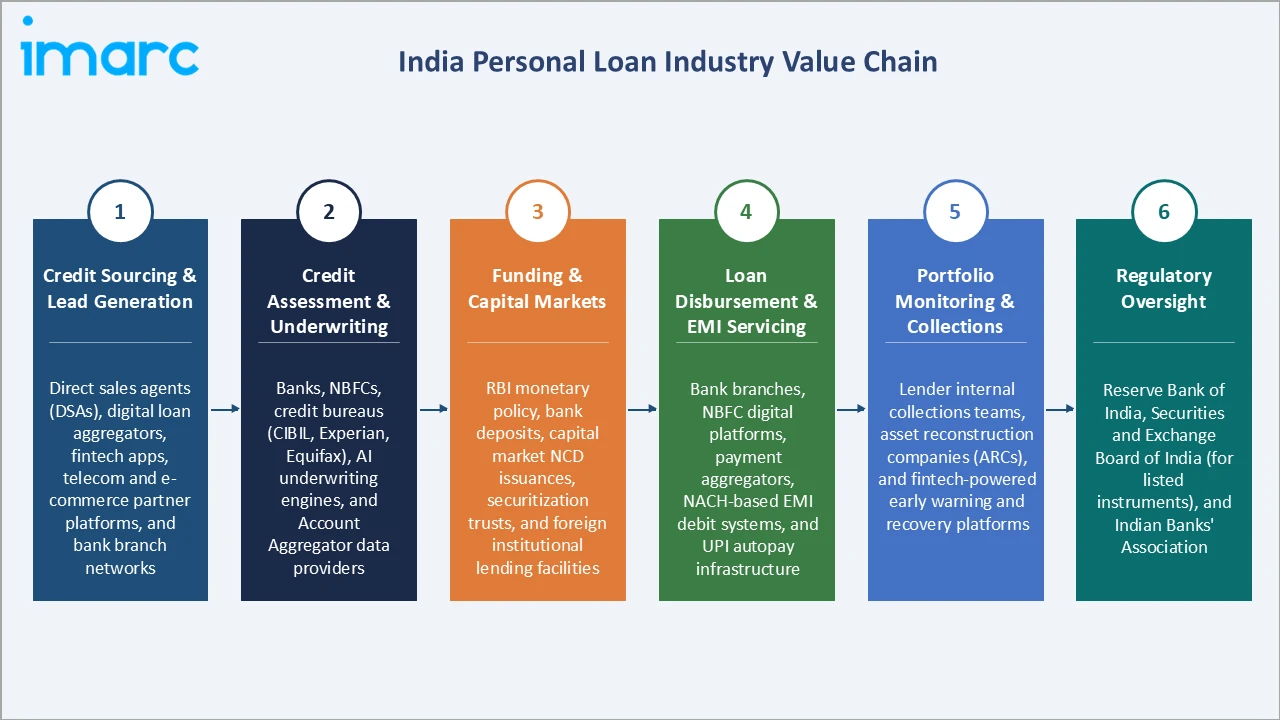
The India personal loan value chain integrates credit sourcing, underwriting, funding, disbursement, portfolio monitoring, and collections. The commercial architecture is consolidating toward digital-first platforms integrating origination through collections within a single technology stack, displacing fragmented legacy systems.
|
Stage |
Key Participants |
|
Credit Sourcing & Lead Generation |
Direct sales agents (DSAs), digital loan aggregators, fintech apps, telecom and e-commerce partner platforms, and bank branch networks |
|
Credit Assessment & Underwriting |
Banks, NBFCs, credit bureaus (CIBIL, Experian, Equifax), AI underwriting engines, and Account Aggregator data providers |
|
Funding & Capital Markets |
RBI monetary policy, bank deposits, capital market NCD issuances, securitization trusts, and foreign institutional lending facilities |
|
Loan Disbursement & EMI Servicing |
Bank branches, NBFC digital platforms, payment aggregators, NACH-based EMI debit systems, and UPI autopay infrastructure |
|
Portfolio Monitoring & Collections |
Lender internal collections teams, asset reconstruction companies (ARCs), and fintech-powered early warning and recovery platforms |
|
Regulatory Oversight |
Reserve Bank of India, Securities and Exchange Board of India (for listed instruments), and Indian Banks' Association |
The credit assessment and underwriting stage is most commercially critical, where alternative data integration increasingly determines competitive differentiation. The portfolio monitoring tier is experiencing rapid technology adoption as lenders deploy early warning systems to predict delinquency before it crystallizes into NPA.
Technology Landscape in the India Personal Loan Industry
Artificial Intelligence and Machine Learning Credit Scoring
AI and ML models analyze thousands of borrower data variables including bank statements, UPI transaction histories, social media behavior, and device metadata to generate predictive credit scores for thin-file and no-file borrowers, enabling personal loan origination for previously unbanked segments. These models continuously improve with growing training data, reducing default prediction error while increasing approval rates for underserved borrower profiles across income segments.
Account Aggregator Framework
RBI's Account Aggregator framework enables borrowers to share consented financial data across institutions in real time, dramatically reducing loan application friction and compressing underwriting timelines from days to minutes. Lenders can access bank statements, insurance, investment, and pension data instantly with borrower consent, enabling more accurate income verification and credit decision quality for personal loan applications across all ticket sizes.
Video-Based Digital KYC and eKYC Technology
Video Customer Identification Process (V-CIP) enables fully remote borrower onboarding without physical documentation submission, combined with Aadhaar-based eKYC for instant identity verification through India's UIDAI biometric database. Digital KYC eliminates branch visits, reduces onboarding costs by approximately 70–80% versus physical processes, and enables 24/7 personal loan applications. This technology is fundamental to the personal loan market's expansion into semi-urban and rural markets where branch infrastructure is limited.
Market Segmentation Analysis
The report covers the following segments:
|
Segment Category |
Leading Segment |
Market Share |
Year |
|
Provider |
Bank |
63.7% |
2025 |
|
Tenure |
12–36 Months |
48.6% |
2025 |
|
Interest Rate |
🔒 |
🔒 |
2025 |
|
Region |
West India |
31.7% |
2025 |

By Provider
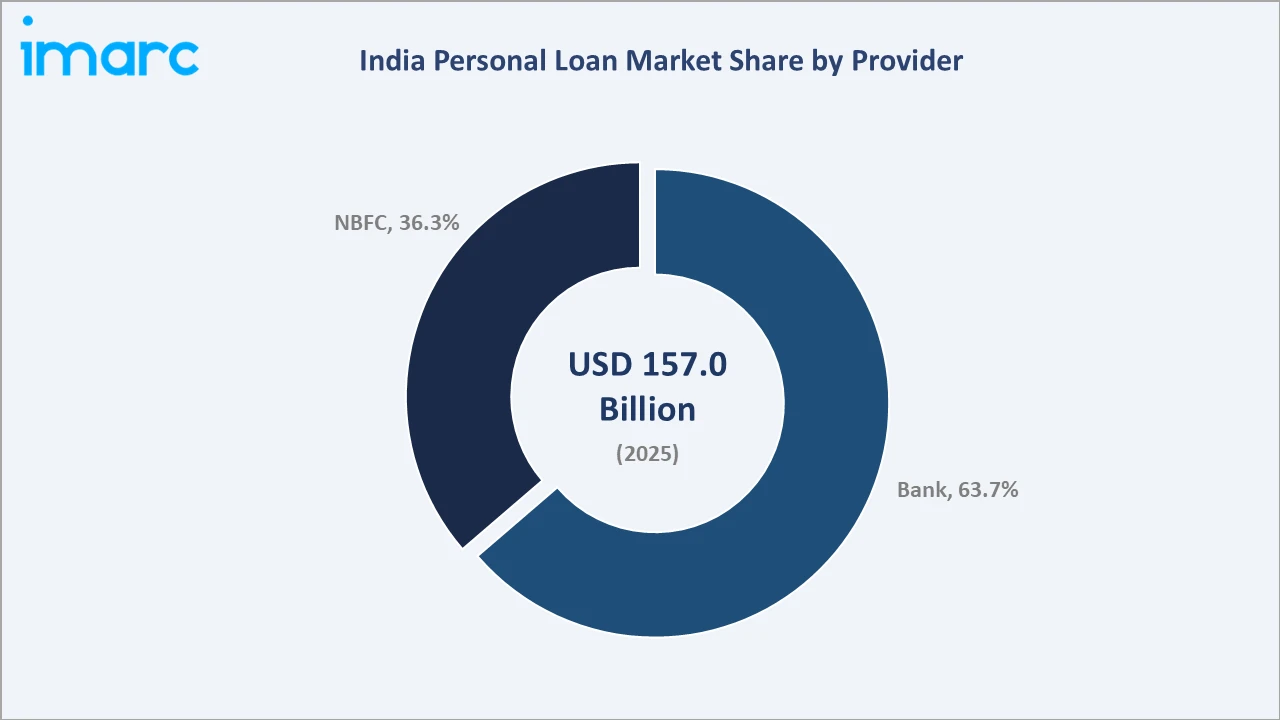
Banks lead at 63.7% in 2025, anchored by State Bank of India, HDFC Bank, ICICI Bank, and Axis Bank, which collectively command the majority of institutional personal loan disbursements through extensive distribution networks, competitive funding costs, and AI-powered loan origination infrastructure.
To access detailed market analysis, Request Sample
NBFCs at 36.3% are growing faster than banks by targeting underserved borrower segments, self-employed professionals, and gig workers through AI-driven alternative data underwriting models. Bajaj Finance, Tata Capital, and emerging fintech NBFCs are leading NBFC market share expansion through digital channels and co-lending partnerships with banks.
By Tenure
The 12–36 Months segment leads at 48.6% in 2025, reflecting mainstream salaried borrower preference for medium-term EMI structures that balance monthly payment affordability with total interest cost for mid-ticket personal loan amounts ranging from INR 1 Lakh to INR 5 Lakh.
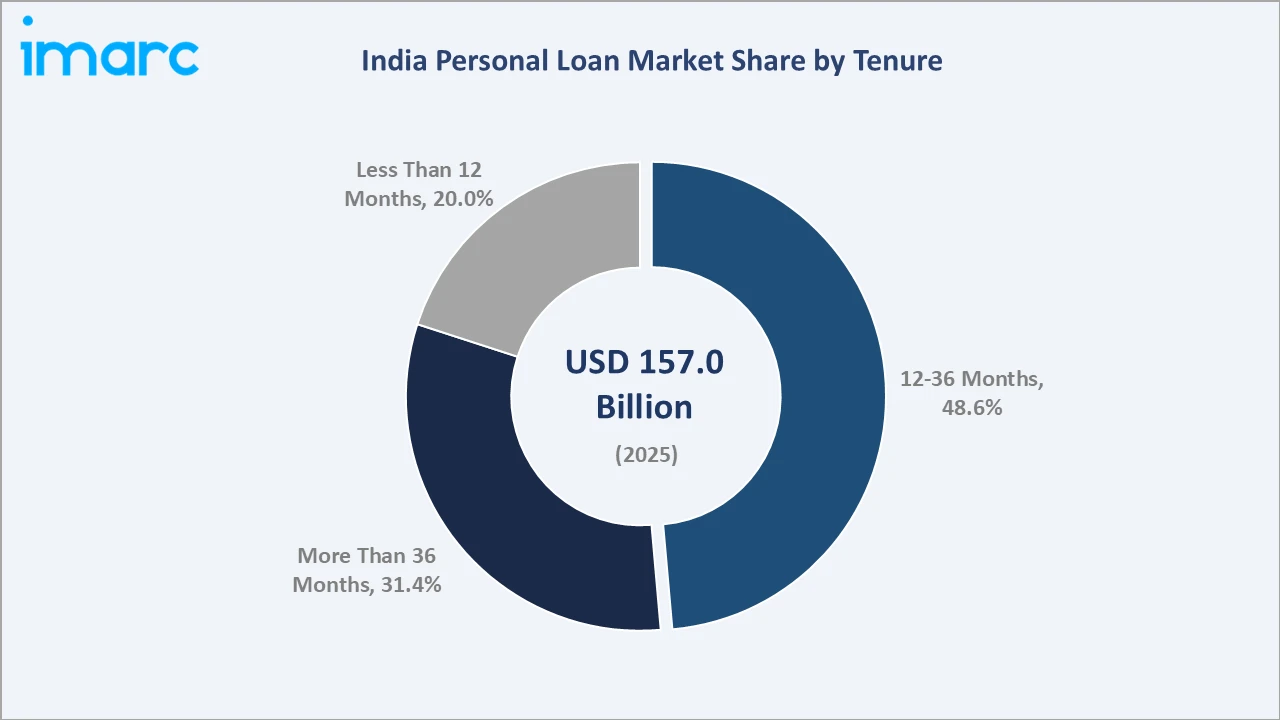
More Than 36 Months at 31.4% captures larger loan amounts for home renovation, education, and debt consolidation purposes where borrowers prioritize lower monthly EMI over shorter repayment periods. Less than 12 Months at 20.0% represents the fast-growing micro-loan and emergency credit segment led by digital NBFCs and fintech lenders.
Regional Market Insights
|
Region |
Share (2025) |
Key Personal Loan Market Drivers & Characteristics |
|
West India |
31.7% |
Driven by Mumbai's financial services concentration, high per-capita income in Maharashtra and Gujarat, deep NBFC penetration, and large formal salaried workforce |
|
South India |
27.8% |
Driven by IT industry income growth in Bengaluru and Hyderabad, high financial literacy, strong credit bureau coverage, and growing digital lending platform adoption |
|
North India |
25.6% |
Supported by Delhi-NCR's large formal employment base, government employee lending via SBI and PNB, and expanding digital lending reach into Tier 2 cities |
|
East India |
14.9% |
Emerging region with growing formal credit demand driven by Kolkata and Bhubaneswar economic expansion, NBFC micro-lending penetration, and rising digital financial services adoption |
West India, at 31.7%, leads through Maharashtra and Gujarat's combined economic output, high urban density, and deep financial services infrastructure. South India, at 27.8%, reflects technology sector income growth and superior digital banking adoption across IT corridor cities.
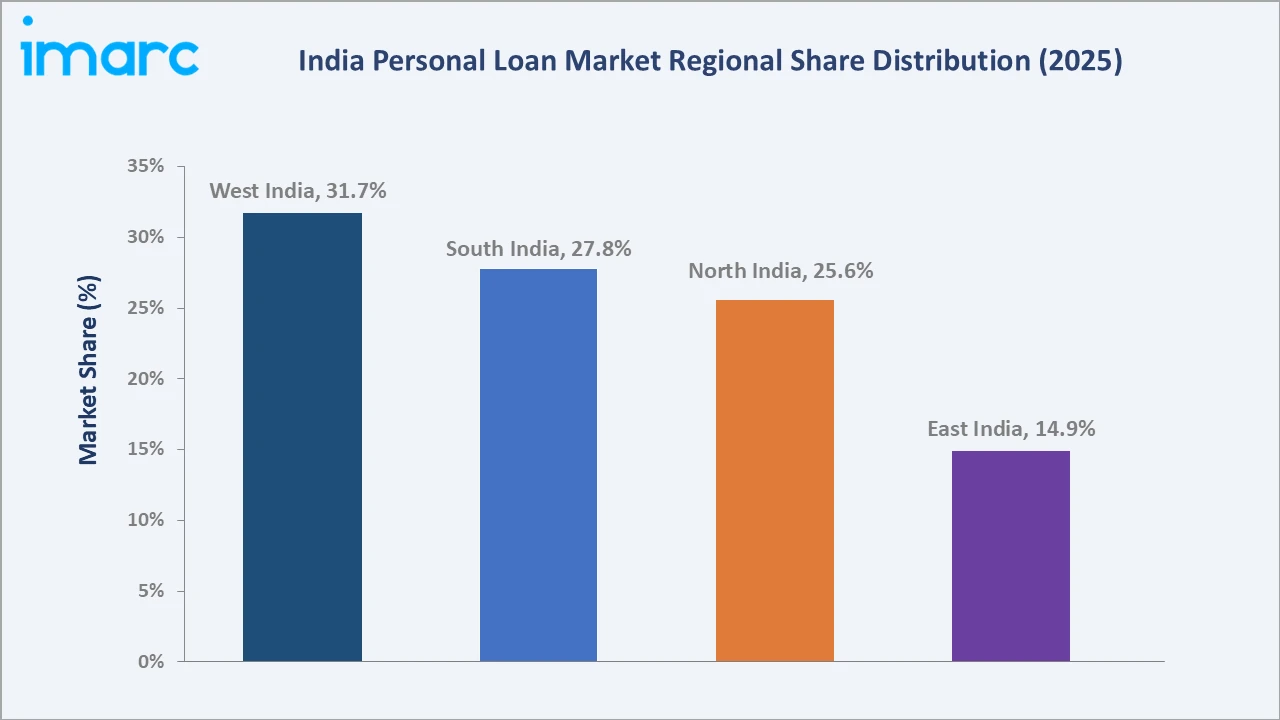
North India, at 25.6%, reflects Delhi-NCR's large formal employment base and government employees' preferential access to subsidized personal loan schemes through public sector banks. East India, at 14.9%, is the fastest-emerging region as NBFCs and microfinance institutions extend personal credit reach into West Bengal and Odisha.
Competitive Landscape
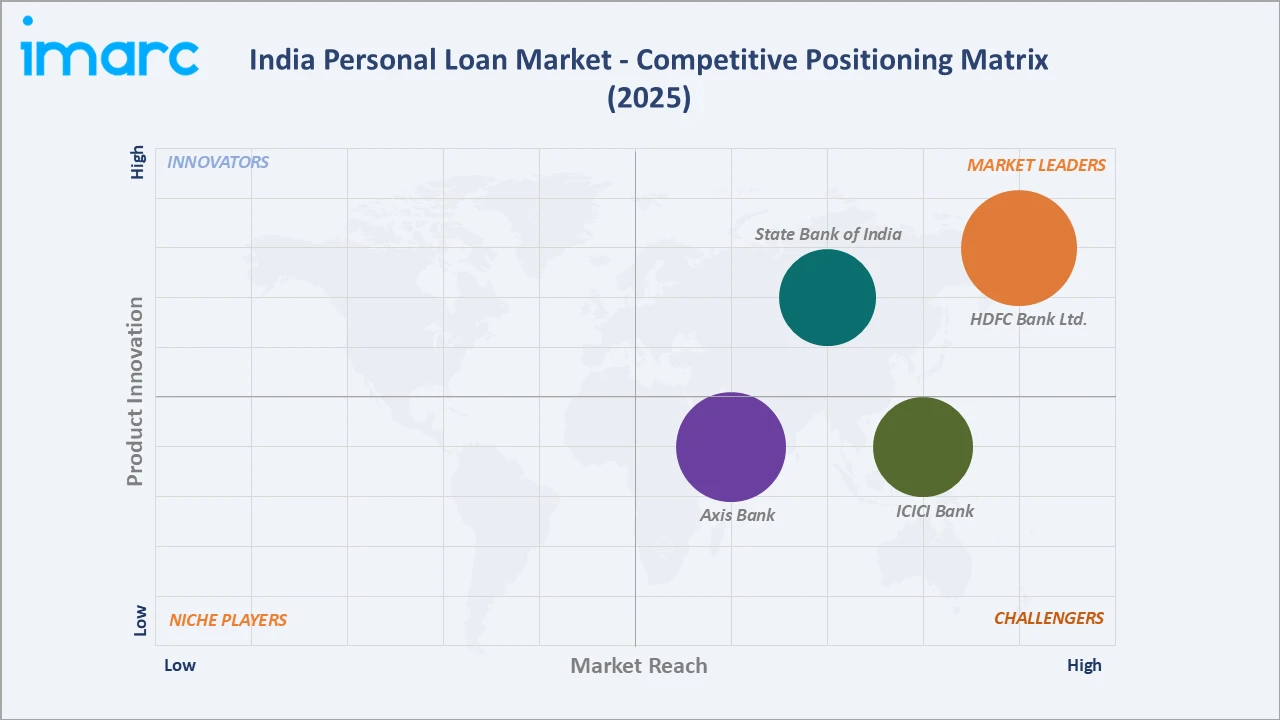
The India personal loan market competitive landscape is moderately concentrated at the institutional lender level, featuring three distinct tiers: large public sector banks serving government employees and mass-market borrowers, private sector banks targeting urban salaried professionals, and digitally native NBFCs and fintech lenders addressing underserved and thin-file borrower segments.
|
Company Name |
Key Products |
Market Position |
Core Strength |
|
State Bank of India |
Real-Time Xpress Credit, YONO Personal Loan, Pension Loan |
Market Leader |
Largest public sector bank; unmatched government employee reach; lowest rates for salaried borrowers |
|
HDFC Bank Ltd. |
Personal Loan for Salaried, XPRESS Personal Loan, Mega Personal Loan |
Market Leader |
India's leading private bank; 10-second disbursal for pre-approved customers; AI-powered approval system |
|
ICICI Bank |
Personal Loan, Insta Personal Loan |
Strong Challenger |
Fully digital loan journey; zero-branch-visit approval for pre-approved customers; deep analytics capability |
|
Axis Bank |
Instant Personal Loan, Axis ASAP Loan |
Strong Challenger |
Fast-growing personal loan book; competitive pricing for salaried segment; expanding digital reach |
Key players include State Bank of India, HDFC Bank Ltd., ICICI Bank, Axis Bank, and others.
Key Company Profiles
State Bank of India
State Bank of India (SBI) is India's largest public sector bank and the dominant institutional personal loan provider by outstanding portfolio, serving government employees, pensioners, and salaried professionals through the widest branch and digital distribution network in the country.
- Key Products: SBI Xpress Credit Personal Loan, YONO Instant Personal Loan, SBI Pension Loan, SBI Personal Loan for Non-Salaried Borrowers.
- Strategic Focus: SBI is expanding digital loan origination through YONO while retaining government employee dominance through preferential Xpress Credit rates and exclusive public sector schemes. The bank is deepening co-lending arrangements with NBFCs to extend personal loan reach into semi-urban and rural segments. SBI is investing in AI-powered credit scoring targeting sub-30-second digital loan approvals, enabling it to compete with private sector banks on speed while retaining its unmatched distribution advantage.
HDFC Bank Ltd.
HDFC Bank is India's largest private sector bank by assets and a leading personal loan provider, targeting salaried professionals in urban and semi-urban markets through industry-leading AI-powered digital underwriting and instant disbursement infrastructure.
- Key Products: HDFC Bank Personal Loan for Salaried, Pre-approved Instant Personal Loanx, Mega Personal Loan, Loan Against Salary.
- Strategic Focus: HDFC Bank is scaling AI-powered pre-approved personal loan disbursement to sub-10-second processing for existing account customers while expanding through fintech aggregators and salary platforms. Behavioral analytics predict personal loan demand before customers actively apply, enabling proactive personalized offers. HDFC Bank prioritizes pricing power through superior digital experience, targeting high-credit-score urban professionals who value speed over marginal rate differences.
Market Concentration Analysis
The India personal loan market is moderately concentrated at the institutional level, with the top five banks collectively accounting for approximately 50–55% of total outstanding personal loan portfolios. The NBFC segment accounts for an additional 20–25% of market revenue. Market concentration is declining over the forecast period as digital lending platforms, co-lending models, and fintech NBFCs enable new entrants to scale without branch infrastructure. RBI's risk weight increase on unsecured consumer credit from November 2023 created temporary concentration benefits for well-capitalized large banks while constraining smaller NBFC growth.
Investment & Growth Opportunities
Highest Growth Segments
NBFC and fintech personal lending (~17–22% CAGR), micro-personal loans below INR 1 Lakh (~25–30% CAGR from smaller base), rural digital lending (~20%+ CAGR), embedded finance personal loans through non-financial platforms (~30%+ CAGR from nascent base), and co-lending platform infrastructure (~25% CAGR) represent the highest-growth investment vectors through 2034.
Emerging Investment Opportunities
Account Aggregator-powered underwriting platforms enabling real-time data-based credit decisions for India's 450 million thin-file borrowers represent the market's most scalable technology investment opportunity. Co-lending infrastructure connecting banks and NBFCs through standardized technology interfaces offers a capital-efficient model for expanding personal loan penetration without direct balance sheet risk.
Investment Themes
- Account Aggregator infrastructure for alternative data-driven underwriting as a sustainable competitive advantage: The Account Aggregator ecosystem enables real-time financial data sharing, compressing underwriting costs by 40–60% for digital lenders while improving credit accuracy across thin-file segments. Lenders with deep AA integration and proprietary alternative data models create defensible underwriting moats that competitors relying solely on traditional bureau scores cannot easily replicate.
- Rural and semi-urban lending infrastructure, capturing India's fastest-growing credit penetration market: India's rural personal loan market, serving 700 million individuals with limited formal credit access, represents the industry's largest long-term expansion opportunity as UPI and digital infrastructure reach second-tier towns at scale. Lenders with scalable digital underwriting, vernacular mobile interfaces, and low-cost agent-assisted origination models are positioned to capture a disproportionate share of this emerging market.
Future Market Outlook (2026-2034)
The India personal loan market is projected to grow from USD 157.0 Billion in 2025 to USD 187.4 Billion in 2026 and further to USD 576.2 Billion by 2034, delivering a 15.08% CAGR. The anchor value of USD 316.8 Billion in 2030 marks the industry's most transformative inflection point, where digital origination becomes the dominant channel, NBFC co-lending becomes the standard operating model, and rural credit penetration begins scaling meaningfully.
Three structural forces define India personal loan market growth through 2034. The demographic dividend—65% of the population below 35 years—creates long-term personal credit demand as young consumers build income streams and credit histories. UPI and Account Aggregator infrastructure reaching 900 million Indians creates the backbone for nationwide personal lending. India's economic formalization drive expands the underwritten borrower universe by integrating informal-sector workers into formal payment systems.
Research Methodology
Primary Research
Primary research comprised structured interviews with 55+ industry stakeholders (2025), including Chief Credit Officers; NBFC personal loan segment heads; fintech lending platform founders; RBI-regulated entity compliance officers; digital lending association representatives; and credit bureau data scientists.
Secondary Research
Secondary research encompassed RBI Annual Reports and DBIE credit data; NABARD financial inclusion reports; CIBIL credit market indicator publications; FICCI-EY banking sector reports; company annual reports and NCD filings; Ministry of Finance financial inclusion data; Digital Lenders Association of India publications; and banking sector analyst research. Over 65 secondary sources reviewed.
Forecasting Models
Market revenue forecasts developed using a credit demand bottom-up model: (i) addressable working population by income segment; (ii) credit penetration rate by region and provider type; (iii) average loan size by tenure segment; (iv) projected disbursement volumes adjusted for NPA write-offs and prepayment rates; (v) regulatory risk weight adjustment for capital-constrained growth scenarios across the 2026–2034 forecast horizon.
India Personal Loan Market Report Coverage:
| Report Features | Details |
|---|---|
| Base Year of the Analysis | 2025 |
| Historical Period | 2020-2025 |
| Forecast Period | 2026-2034 |
| Units | Billion USD |
| Scope of the Report |
Exploration of Historical Trends and Market Outlook, Industry Catalysts and Challenges, Segment-Wise Historical and Future Market Assessment:
|
| Providers Covered | Bank, Non-Banking Financial Company (NBFC) |
| Tenures Covered | Less than 12 Months, 12-36 Months, More Than 36 Months |
| Interest Rates Covered | 10%-15%, 16%-20%, Above 20%. |
| Regions Covered | North India, South India, East India, West India |
| Companies Covered | State Bank of India, HDFC Bank Ltd., ICICI Bank, Axis Bank, etc. |
| Customization Scope | 10% Free Customization |
| Post-Sale Analyst Support | 10-12 Weeks |
| Delivery Format | PDF and Excel through Email (We can also provide the editable version of the report in PPT/Word format on special request) |
Key Benefits for Stakeholders:
- IMARC’s industry report offers a comprehensive quantitative analysis of various market segments, historical and current market trends, market forecasts, and dynamics of the India personal loan market from 2020-2034.
- The research report provides the latest information on the market drivers, challenges, and opportunities in the India personal loan market.
- Porter's five forces analysis assist stakeholders in assessing the impact of new entrants, competitive rivalry, supplier power, buyer power, and the threat of substitution. It helps stakeholders to analyze the level of competition within the India personal loan industry and its attractiveness.
- Competitive landscape allows stakeholders to understand their competitive environment and provides an insight into the current positions of key players in the market.
Frequently Asked Questions About the India Personal Loan Market Report
The India personal loan market size is estimated at USD 187.4 Billion in 2026, driven by the Bank provider segment dominant at 63.7%, the 12–36 Months tenure segment leading at 48.6%, digital lending platform expansion attracting millions of first-time personal loan borrowers, West India commanding 31.7% market share through Maharashtra and Gujarat's combined financial services concentration, and NBFCs growing at above-market rates through AI-powered alternative data underwriting.
The India personal loan market grows at 15.08% CAGR during 2026-2034, reaching USD 576.2 Billion by 2034. This growth reflects digital lending platform scaling, rising disposable incomes expanding the creditworthy borrower pool, co-lending model proliferation, rural digital credit penetration, and embedded finance distribution creating new personal loan origination channels outside traditional banking infrastructure.
Banks lead at 63.7%, with SBI, HDFC Bank, ICICI Bank, and Axis Bank commanding the majority of institutional personal loan disbursements. Banks' competitive advantage lies in lower funding costs, established borrower trust, large branch and digital distribution networks, and competitive interest rates for prime salaried borrowers.
The 12–36 Months segment leads at 48.6%, reflecting mainstream salaried borrower preference for medium-term EMI structures aligned with consumption financing for lifestyle, medical, and home renovation purposes. This segment grows at above-market CAGR as NBFCs and fintechs specifically design product EMI schedules to target this tenure sweet spot.
West India leads at 31.7% through Mumbai's financial hub concentration, Maharashtra and Gujarat's high per-capita income, and deep NBFC market penetration. South India at 27.8% is the second-largest region driven by IT sector income growth and high financial literacy in Bengaluru and Hyderabad.
Leading companies include State Bank of India, HDFC Bank Ltd., ICICI Bank, Axis Bank, and others.
Need more help?
- Speak to our experienced analysts for insights on the current market scenarios.
- Include additional segments and countries to customize the report as per your requirement.
- Gain an unparalleled competitive advantage in your domain by understanding how to utilize the report and positively impacting your operations and revenue.
- For further assistance, please connect with our analysts.
 Request Customization
 Speak to an Analyst
 Request Brochure
 Inquire Before Buying
Benefits of Customization
- Personalize this research
- Triangulate with your data
- Get data as per your format and definition
- Gain a deeper dive into a specific application, geography, customer, or competitor
- Any level of personalization
Get in Touch With Us
UNITED STATES
Phone: +1-201-971-6302
INDIA
Phone: +91-120-433-0800
UNITED KINGDOM
Phone: +44-753-714-6104
Email: [email protected]
Client Testimonials




.webp)




.webp)













Related Reports

Choose your plan
*Please note that the prices mentioned below are starting prices for each bundle type. Kindly contact our team for further details.*
Single User License
- 1 User License, Access on 2 Devices
- PDF Report + Excel Dataset (Password Protected)
- Lifetime Access
- No Printing Rights
- 10% Free Report Customization
- 10–12 Weeks of Analyst Support
Five User License
- Access for 5 Users, 2 Devices per User
- PDF Report + Excel Dataset (Password Protected)
- Lifetime Access
- Dedicated Account Manager
- 12–14 Weeks of Analyst Support
- No Printing Rights
- 15% Free Report Customization
- 25% Discount on Your Next Purchase
Corporate User License
- Unlimited User Access (Within Your Organization)
- PDF Report + Excel Dataset
- Lifetime Access
- Dedicated Account Manager
- 14–20 Weeks of Analyst Support
- No Printing Rights
- 20% Free Report Customization
- 30% Discount on Your Next Purchase
Essential Insights
What's included:
3 reports
- Lifetime Access
- PDF Reports
- Excel Datasets
- 2 Weeks of Free Analyst Support
- 2 User Licenses
- Access on 2 Devices
- Printing Rights
- Complimentary PowerPoint (PPT) Version
- Complimentary License Upgrade
Professional Access
What's included:
5 reports
- Lifetime Access
- PDF Reports
- Excel Datasets
- 8 Weeks of Free Analyst Support
- 2 User Licenses
- Access on 2 Devices
- Printing Rights
- Complimentary PowerPoint (PPT) Version
- Complimentary License Upgrade
Business Advantage
What's included:
8 reports
- Lifetime Access
- PDF Reports
- Excel Datasets
- 14 Weeks of Free Analyst Support
- 2 User Licenses
- Access on 2 Devices
- Printing Rights
- Complimentary PowerPoint (PPT) Version
- Complimentary License Upgrade
Enterprise Intelligence
What's included:
10 reports
- Lifetime Access
- PDF Reports
- Excel Datasets
- 20 Weeks of Free Analyst Support
- 2 User Licenses
- Access on 2 Devices
- Printing Rights
- Complimentary PowerPoint (PPT) Version
- Complimentary License Upgrade