
India Hot Melt Adhesive Market Size, Share, Trends and Forecast by Product, Application, and Region, 2026-2034
India Hot Melt Adhesive Market Size, Share, Trends & Forecast (2026-2034)
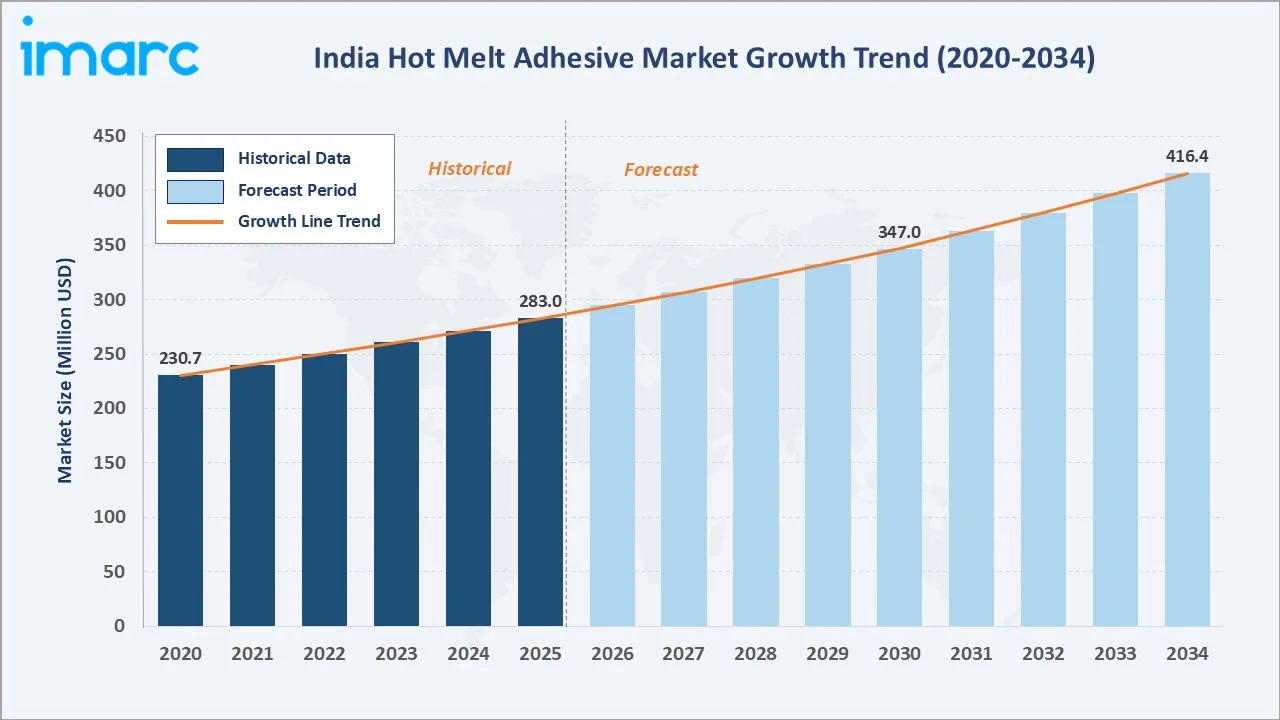
The India hot melt adhesive market size increased from USD 283.0 Million in 2025 to USD 300.4 Million in 2026 and is projected to reach USD 416.4 Million by 2034, exhibiting a CAGR of 4.17% during 2026-2034. Rising packaging consumption, expanding automotive component assembly, and a shift away from solvent-based bonding systems are the primary drivers shaping the market growth.
Ethylene-vinyl acetate (EVA) leads the product segment at 42.6%, packaging dominates the application segment at 39.8%, and West India commands 35.4% regional share.
Market Snapshot
|
Metric |
Value |
|
Base Year Market Size (2025) |
USD 283.0 Million |
| Market Size (2026) | USD 300.4 Million |
|
Forecast Market Size (2034) |
USD 416.4 Million |
|
CAGR (2026-2034) |
4.17% |
|
Base Year |
2025 |
|
Historical Period |
2020-2025 |
|
Forecast Period |
2026-2034 |
|
Largest Region |
West India (35.4%, 2025) |
|
Second Largest Region |
North India (27.8%, 2025) |
|
Leading Product |
Ethylene-Vinyl Acetate (EVA) (42.6%, 2025) |
|
Leading Application |
Packaging (39.8%, 2025) |
The India hot melt adhesive market expanded from USD 230.7 Million in 2020 to USD 283.0 Million in 2025 reaching an estimated USD 300.4 Million in 2026, driven by growing flexible packaging consumption, rising automotive component output, and increasing substitution of solvent-based adhesives in assembly lines. Anchored at USD 347.0 Million in 2030, the forecast to USD 416.4 Million by 2034 is supported by accelerating e-commerce-linked packaging demand, expanding non-woven hygiene manufacturing, and continued growth in engineered wood and furniture production.
To get more information on this market, Request Sample
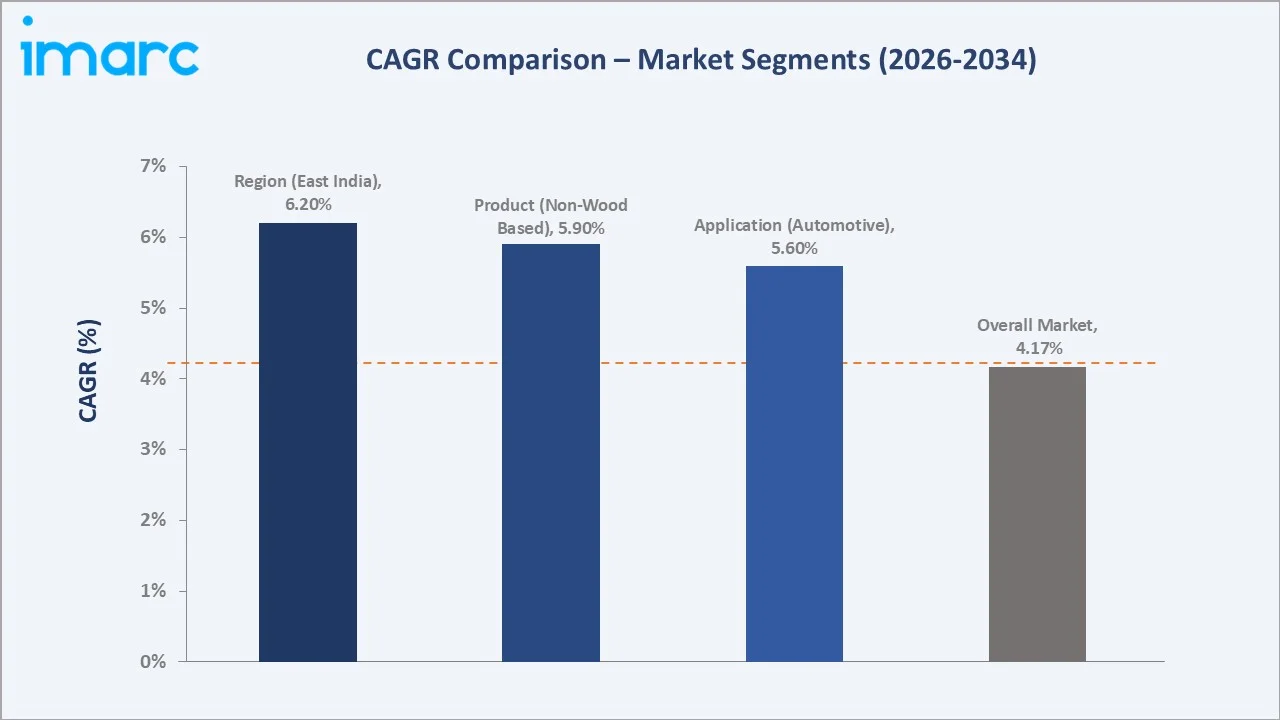
CAGR trajectories across product, application, and regional sub-segments show non-wood based and East India expanding faster than the overall 4.17% market CAGR, driven by sustainability-linked formulation shifts, growing automotive lightweighting demand, and rising manufacturing activity in emerging eastern industrial clusters.
Executive Summary
The India hot melt adhesive market is on a steady growth trajectory, expanding from USD 230.7 Million in 2020 to an estimated USD 300.4 Million in 2026, reaching USD 416.4 Million by 2034. The industry has moved from a narrow base of solvent-borne and water-based bonding systems toward faster-curing, low-emission hot melt formulations used across packaging, assembly, woodworking, and non-woven applications.
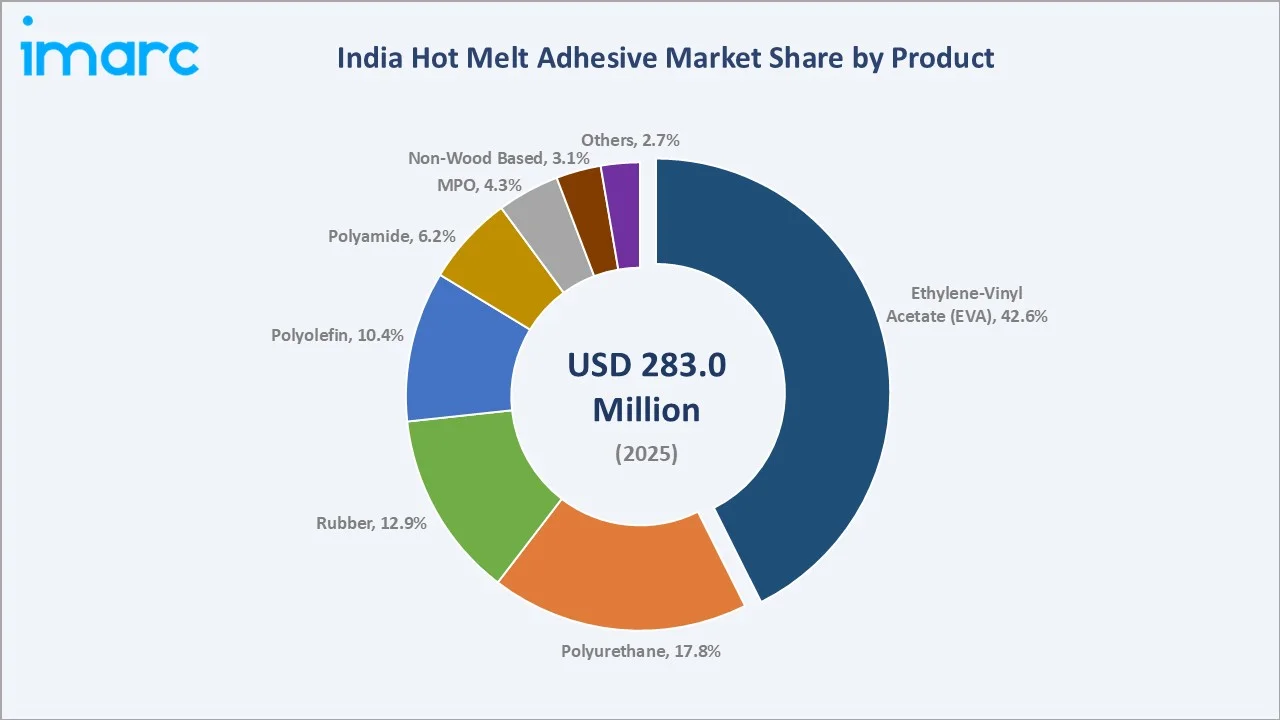
Ethylene-vinyl acetate (EVA) dominates the product segment at 42.6% in 2025, supported by its versatility, cost efficiency, and broad compatibility with packaging and woodworking substrates. Packaging leads the application segment at 39.8%, fueled by rapid growth in e-commerce-linked carton sealing and flexible pouch lamination. West India commands 35.4% of the regional share, led by concentrated packaging and automotive manufacturing clusters in Gujarat and Maharashtra.
Key Market Insights
|
Insight |
Data |
|
Leading Product |
Ethylene-Vinyl Acetate (EVA) - 42.6% share (2025) |
|
Second Largest Product |
Polyurethane - 17.8% share (2025) |
|
Leading Application |
Packaging - 39.8% share (2025) |
|
Second Largest Application |
Assembly - 18.5% share (2025) |
|
Leading Region |
West India - 35.4% share (2025) |
|
Second Largest Region |
North India - 27.8% share (2025) |
|
Top Companies |
H.B. Fuller Company, Henkel AG & Co. KGaA, Arkema S.A., 3M, Pidilite Industries Ltd., Dow Inc. |
Key Analytical Observations Expanding On the Data Above:
- Ethylene-vinyl acetate (EVA) dominance at 42.6% is supported by the material's broad compatibility with packaging films, corrugated substrates, and woodworking joints, along with its comparatively lower cost versus specialty polyurethane and polyamide grades.
- Polyurethane at 17.8% is expanding as automotive and footwear assembly lines increasingly favor reactive polyurethane hot melts for their higher bond strength and heat resistance in structural bonding applications.
- Packaging leadership at 39.8% reflects the scale of India's packaging and logistics ecosystem, with rising demand for efficient bonding solutions across flexible packaging, cartons, labels, and case sealing applications.
- Assembly at 18.5% benefits from rising output across automotive interiors, electronics enclosures, and consumer durables, where hot melt systems replace mechanical fasteners for faster line speeds.
- West India at 35.4% dominates regional share, anchored by Gujarat and Maharashtra, which host concentrated packaging converting, automotive component, and chemical manufacturing capacity.
India Hot Melt Adhesive Market Overview
Hot melt adhesive is a thermoplastic bonding compound applied in molten form that sets rapidly on cooling, eliminating the need for solvents or extended curing time. In India, the market spans ethylene-vinyl acetate (EVA), polyurethane, rubber, polyolefin, polyamide, MPO, and non-wood based formulations, applied across packaging, assembly, woodworking, non-wovens, automotive, tape and labels, and bookbinding uses.
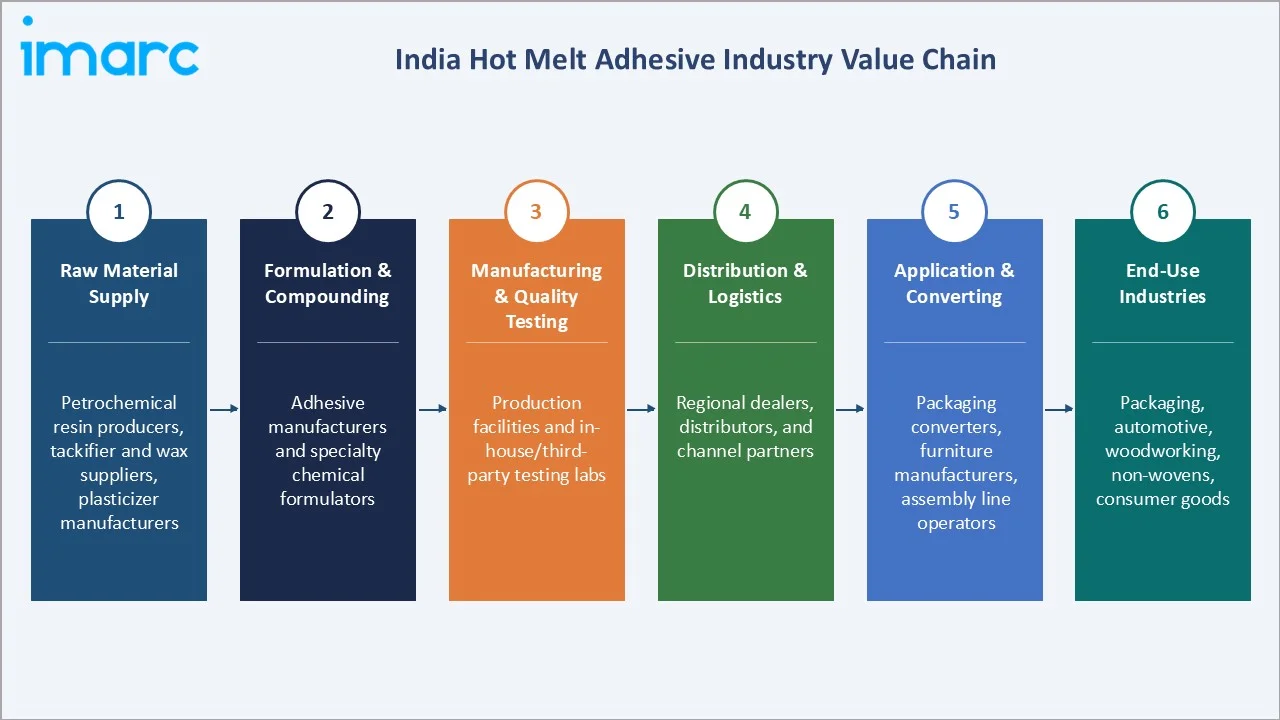
The domestic ecosystem integrates petrochemical resin and tackifier suppliers, adhesive formulators, dispensing equipment manufacturers, converters and OEMs, distribution partners, and regulatory bodies such as the Bureau of Indian Standards, together enabling delivery of fast-curing bonding solutions across an evolving packaging and manufacturing landscape.
Market Dynamics
To evaluate market opportunities, Request Sample
Market Drivers
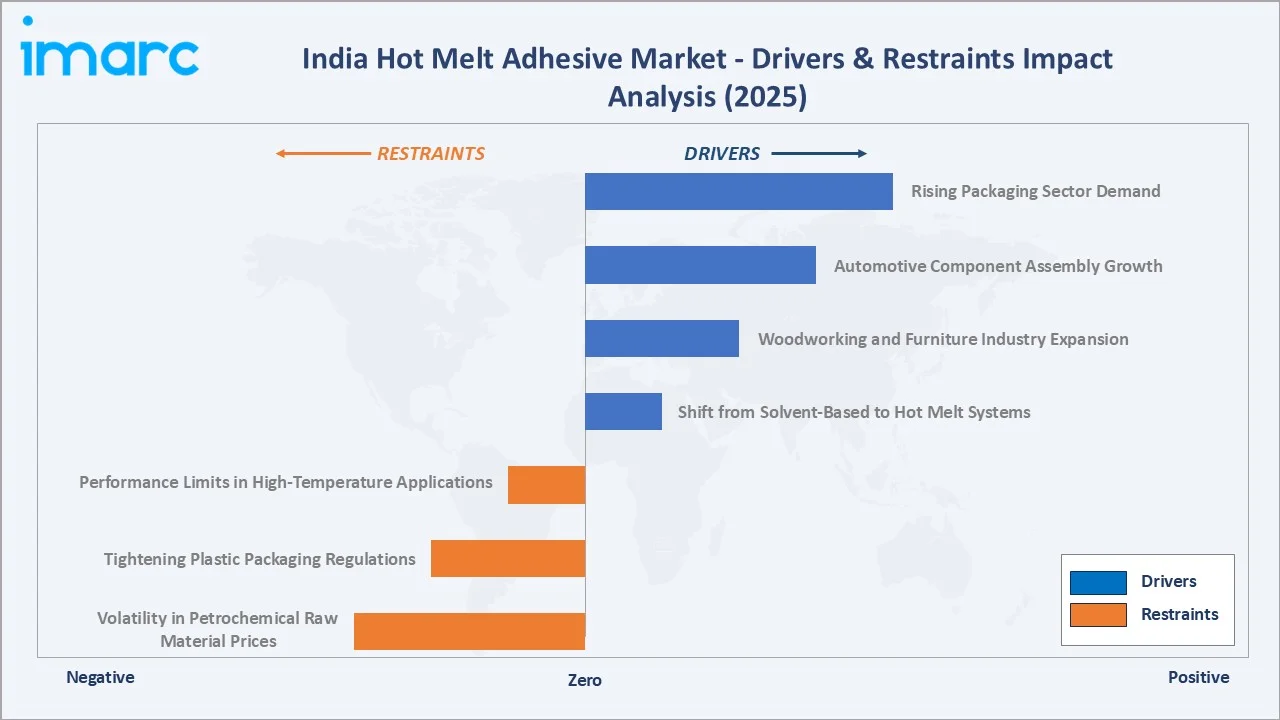
- Rising Packaging Sector Demand: Growth in organized retail, food and beverage packaging, and e-commerce-linked carton and pouch sealing is lifting consumption of EVA and polyolefin based hot melt systems across converting lines.
- Automotive Component Assembly Growth: Expanding vehicle and component production is increasing demand for polyurethane hot melts in interior trim, filter, and structural bonding applications. The Production-Linked Incentive Scheme for the automobile and auto component industry had attracted investments worth roughly INR 44,326 Crore and generated close to 67,820 jobs as of March 31, 2026, according to the Ministry of Heavy Industries, supporting expanded domestic component manufacturing capacity.
- Woodworking and Furniture Industry Expansion: Rising urban housing completions and organized furniture retail are increasing demand for polyamide and EVA hot melt edge-banding and laminating adhesives.
- Shift from Solvent-Based to Hot Melt Systems: Manufacturers are transitioning from solvent-borne adhesives toward hot melt formulations to reduce volatile organic compound emissions, cut drying time, and improve line productivity.
Market Restraints
- Volatility in Petrochemical Raw Material Prices: Hot melt adhesive formulations depend on ethylene, propylene, and resin derivatives whose prices fluctuate with crude oil movements, compressing formulator margins and complicating cost planning.
- Tightening Plastic Packaging Regulations: Increasing restrictions on single-use plastics and growing emphasis on recyclable and compostable packaging are encouraging packaging manufacturers to reassess adhesive formulations, potentially limiting demand for certain conventional hot melt adhesive systems.
- Performance Limits in High-Temperature Applications: Hot melt adhesives can soften under sustained heat exposure, limiting their suitability in certain automotive under-hood and industrial applications where thermoset or reactive systems are preferred.
Market Opportunities
- Bio-Based and Low-Carbon Formulations: Growing sustainability commitments among packaging and consumer goods brands are creating demand for bio-based tackifiers and reduced-fossil-content hot melt systems.
- Non-Woven Hygiene Product Manufacturing: Expanding domestic diaper and sanitary product manufacturing capacity presents opportunities for specialized construction and elastic-attachment hot melt adhesives.
Market Challenges
- Fragmented Unorganized Converting Base: A large share of packaging and woodworking converters remain unorganized, limiting adoption of standardized, higher-performance adhesive systems and complicating distribution economics.
- Import Dependence for Specialty Resins: Limited domestic capacity for certain specialty tackifiers and polymers requires imports, exposing formulators to currency fluctuations and global supply-chain disruptions.
Emerging Market Trends
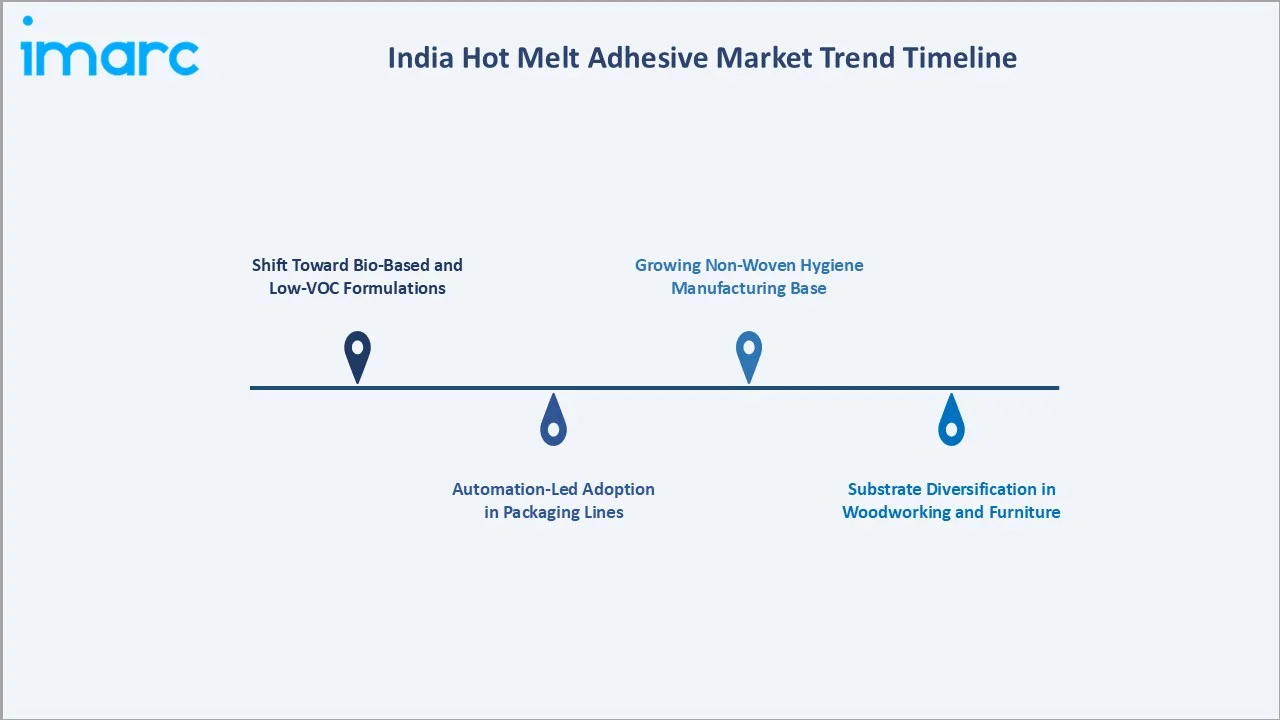
1. Shift Toward Bio-Based and Low-VOC Formulations
Formulators are increasingly investing in bio-based tackifiers and reduced-fossil-content resin systems to align with packaging brand sustainability commitments and tightening emissions norms. This transition is also encouraging closer collaboration between resin suppliers and adhesive manufacturers on renewable feedstock sourcing.
2. Automation-Led Adoption in Packaging Lines
Rising deployment of automated case-sealing and pouch-lamination equipment across organized retail and food and beverage packaging is favoring hot melt systems over solvent-based alternatives, given their compatibility with high-speed dispensing equipment and shorter set times.
3. Growing Non-Woven Hygiene Manufacturing Base
Expanding domestic production of diapers, sanitary products, and adult incontinence items is increasing demand for elastic-attachment and core-construction hot melt adhesives.
4. Substrate Diversification in Woodworking and Furniture
Rising use of engineered wood panels, laminates, and edge-banding materials in organized furniture manufacturing is expanding the addressable base for polyamide and EVA hot melt systems beyond traditional solid-wood applications.
Industry Value Chain Analysis
The India hot melt adhesive value chain spans six stages, from raw material supply through end-use application. Formulation and compounding capture the highest value-add, while manufacturing and quality testing capabilities increasingly determine sustainable competitive position as buyers demand consistent bond performance across substrates.
|
Stage |
Key Players / Examples |
|
Raw Material Supply |
Petrochemical resin producers, tackifier and wax suppliers, and plasticizer manufacturers supplying formulation inputs |
|
Formulation & Compounding |
Adhesive manufacturers and specialty chemical formulators developing product-specific hot melt grades |
|
Manufacturing & Quality Testing |
Production facilities and in-house or third-party testing labs validating bond strength and compliance |
|
Distribution & Logistics |
Regional dealers, distributors, and channel partners supplying converters and OEMs across states |
|
Application & Converting |
Packaging converters, furniture manufacturers, and assembly line operators applying adhesives |
|
End-Use Industries |
Packaging, automotive, woodworking, non-wovens, and consumer goods manufacturers |
Formulators with proprietary resin blends and direct application-engineering relationships with large converters capture greater value than distributors reliant on commodity-grade formulations.
Technology Landscape in the India Hot Melt Adhesive Industry
Reactive and High-Performance Polyurethane Systems
Moisture-curing reactive polyurethane hot melts are gaining share in structural and automotive bonding applications where higher heat resistance and long-term bond durability are required beyond what conventional EVA systems can deliver.
Low-Application-Temperature Formulations
Formulators are developing lower melt-viscosity, reduced-application-temperature hot melt grades that cut energy consumption on dispensing equipment and improve worker safety on high-speed packaging lines.
Bio-Based Resin and Tackifier Development
Research into bio-based tackifying resins derived from renewable feedstocks is advancing as formulators respond to packaging brand sustainability mandates and evolving regulatory expectations around recycled and renewable content.
Market Segmentation Analysis
The report covers the following segments:
|
Segment Category |
Leading Segment |
Market Share |
Year |
|
Product |
Ethylene-Vinyl Acetate (EVA) |
42.6% |
2025 |
|
Application |
Packaging |
39.8% |
2025 |
|
Region |
West India |
35.4% |
2025 |

By Product
Ethylene-vinyl acetate (EVA) commands a 42.6% majority share in 2025, driven by its cost efficiency, broad substrate compatibility, and established use across packaging and woodworking applications. The segment benefits from wide processor familiarity and mature domestic compounding capacity.
To access detailed market analysis, Request Sample
Polyurethane at 17.8% in 2025 is expanding fastest among the larger product categories, supported by growing use in automotive interior assembly and footwear bonding where higher heat resistance and bond strength are required.
By Application
Packaging leads the application segment with 39.8% share in 2025, reflecting the scale of India's e-commerce and organized retail packaging activity. The segment benefits from low per-unit adhesive cost, compatibility with high-speed case- and carton-sealing equipment, and continued growth in flexible pouch lamination.
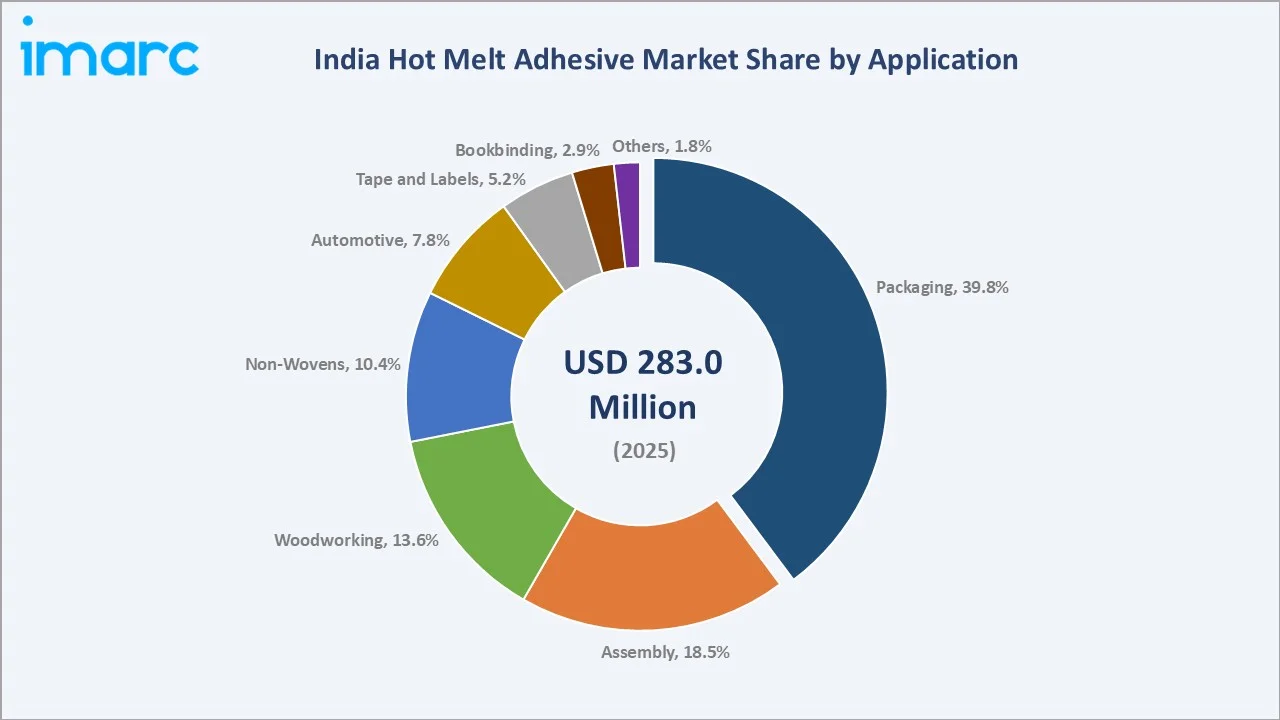
Assembly holds 18.5% share, driven by automotive interior, electronics, and consumer durable manufacturing.
Regional Market Insights
|
Region |
Share (2025) |
Key Growth Drivers |
|
West India |
35.4% |
Concentrated packaging converting and automotive component manufacturing clusters, strong chemical industry presence, and established export infrastructure |
|
North India |
27.8% |
Growing organized furniture and woodworking manufacturing, expanding automotive and consumer durable production, and rising warehousing activity |
|
South India |
24.1% |
Rising electronics and automotive assembly investment, strong packaging demand from food and beverage manufacturing, and growing industrial diversification |
|
East India |
12.7% |
Emerging industrial manufacturing base, expanding packaging and non-woven production capacity, and rising tier-2 city consumption |
West India at 35.4% in 2025 leads the regional landscape, anchored by Gujarat and Maharashtra. Dense chemical and petrochemical manufacturing infrastructure, concentrated automotive and packaging converting capacity, and established port-linked export logistics support sustained regional leadership.
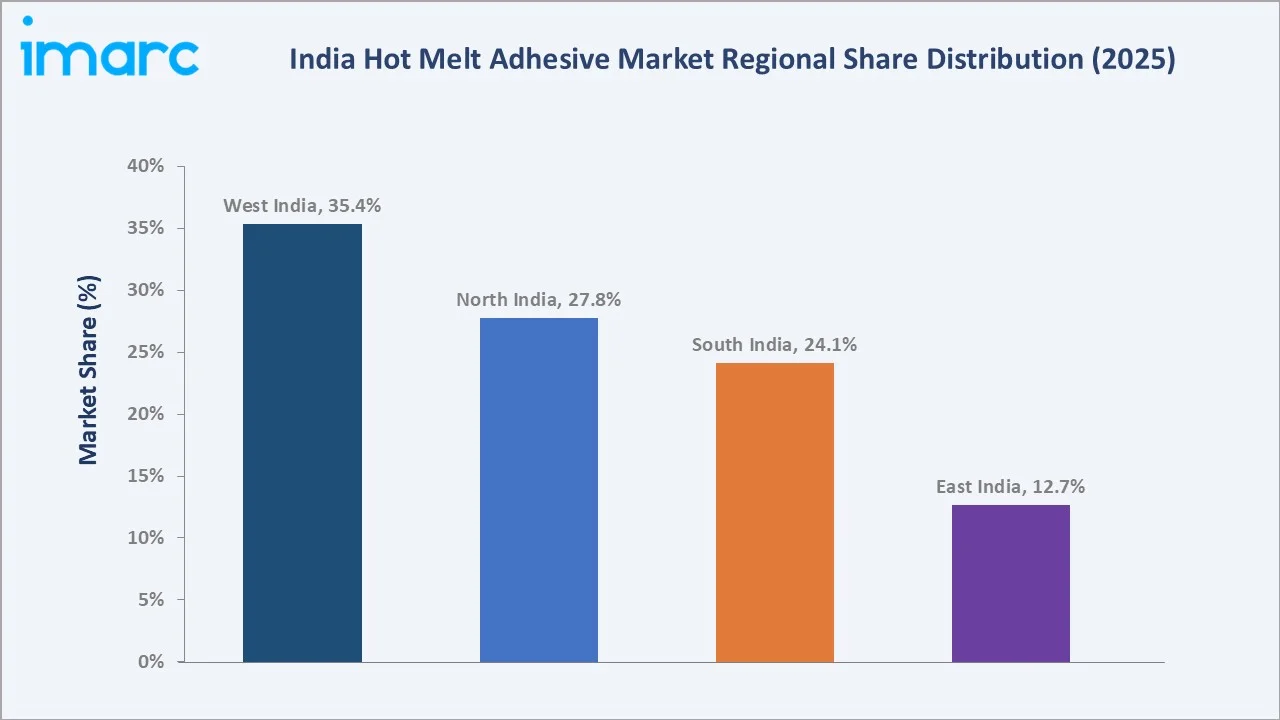
East India, though currently the smallest regional contributor at 12.7% share, is the fastest growing region through 2034. Expanding industrial manufacturing investment, rising packaging and non-woven production capacity, and growing tier-2 and tier-3 city consumption are accelerating regional expansion over the forecast period.
Competitive Landscape
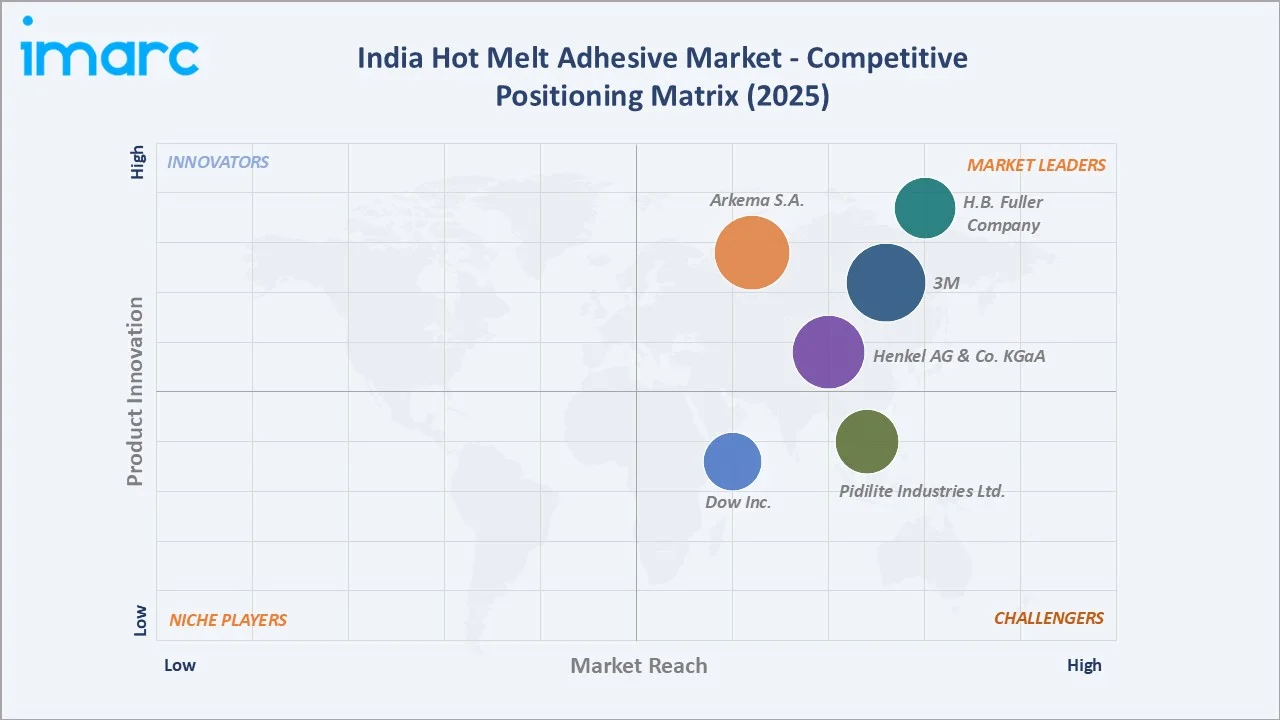
The India hot melt adhesive market is moderately fragmented, with multinational adhesive majors competing alongside India's largest domestic adhesives manufacturer across packaging, automotive, and woodworking applications. Product breadth, application engineering support, and distribution reach form the key competitive differentiators.
|
Company Name |
Brand / Key Product |
Position |
Strategic Focus |
|
H.B. Fuller Company |
H.B. Fuller Hot Melt Adhesives |
Leader |
Global adhesives major expanding packaging and hygiene hot melt capacity |
|
Henkel AG & Co. KGaA |
Henkel Adhesive Technologies |
Leader |
Broad-portfolio innovation leader with strong automotive and electronics focus |
|
Arkema S.A. |
Bostik Specialty Hot Melt Adhesives |
Leader |
Sustainability-focused hot melt technologies for assembly and hygiene |
|
3M |
3M Hot Melt Adhesives |
Leader |
Innovation-driven portfolio spanning packaging, furniture, and electronics |
|
Pidilite Industries Ltd. |
Fevicol / Fevicol Jowat |
Challenger |
Leading adhesives manufacturer scaling domestic hot melt production |
|
Dow Inc. |
Dow Hot Melt Adhesives |
Challenger |
Diversified materials science leader expanding sustainable hot melt raw materials and formulations |
Key players include H.B. Fuller Company, Henkel AG & Co. KGaA, Arkema S.A., 3M, Pidilite Industries Ltd., and Dow Inc., among others.
Key Company Profiles
H.B. Fuller Company
H.B. Fuller Company is a global adhesives manufacturer headquartered in Minnesota, United States, serving packaging, hygiene, woodworking, and general assembly customers worldwide, including in India.
- Product Portfolio: A broad hot melt adhesive range spanning packaging, non-woven hygiene, woodworking, and general assembly applications, supported by application-specific technical service.
- Recent Developments: The company continues to expand its packaging and hygiene adhesive capacity in India, supported by growing e-commerce and FMCG-linked packaging demand.
- Strategic Focus: Deepening India market penetration through localized technical service and expanded packaging and hygiene adhesive capacity.
Henkel AG & Co. KGaA
Henkel AG & Co. KGaA is a German multinational company with a dedicated adhesive technologies business serving packaging, consumer goods, automotive, and electronics customers worldwide.
- Product Portfolio: Hot melt adhesive systems for packaging, consumer goods, automotive, and electronics assembly applications.
- Recent Developments: The company continues to strengthen its adhesive technologies portfolio and broaden its footprint across key Asian markets, including India.
- Strategic Focus: Strengthening technical service infrastructure in India while advancing sustainable hot melt formulations.
Arkema S.A.
Arkema S.A. is a French specialty chemicals and materials company whose adhesives business serves packaging, industrial assembly, and non-woven hygiene applications worldwide, including India.
- Product Portfolio: Hot melt adhesive systems for packaging, non-woven hygiene, and industrial assembly applications.
- Recent Developments: The company continues to advance sustainability-focused adhesive technologies across its global markets, including India.
- Strategic Focus: Growing presence in India's packaging and hygiene adhesive segments through sustainability-linked formulations.
Market Concentration Analysis
The India hot melt adhesive market is moderately fragmented. The leading multinational players account for a meaningful but not dominant share of total demand, with numerous regional and unorganized formulators serving smaller converters across packaging and woodworking applications.
Barriers to entry include the need for application-engineering capability, established converter relationships, and consistent access to petrochemical resin and tackifier inputs. These factors favor established multinational players and well-capitalized domestic manufacturers with technical service infrastructure.
Consolidation is gradually advancing as global adhesive majors deepen local manufacturing partnerships to reduce import dependence and strengthen application-specific technical support for Indian converters.
Investment & Growth Opportunities
Fastest-Growing Segments
Non-wood based is expanding fastest among product categories, driven by sustainability-linked formulation shifts. Automotive is the next-fastest growing application category, supported by rising component assembly and lightweighting initiatives.
Emerging Markets
East India is the fastest growing region through 2034, anchored by expanding industrial manufacturing investment and rising packaging and non-woven production capacity. The market represents meaningful untapped opportunity for formulators able to deliver cost-effective, application-specific hot melt systems.
Investment Trends
Investment is concentrated in local manufacturing partnerships that reduce import dependence, application-engineering laboratories that support faster spec-in with converters, and bio-based tackifier development aligned with tightening packaging sustainability requirements.
Future Market Outlook (2026-2034)
The India hot melt adhesive market is forecast to expand from USD 283.0 Million in 2025 to USD 300.4 Million in 2026 and is forecast to reach USD 416.4 Million by 2034 at a CAGR of 4.17%, adding roughly USD 133.4 Million in incremental market value over the forecast period.
Three forces will shape the market through 2034: continued substitution of solvent-based adhesives with faster-curing hot melt systems; expanding bio-based and low-VOC formulation development; and deepening local manufacturing partnerships that reduce reliance on imported specialty resins.
By 2034, the market is expected to be defined by broader adoption across automated packaging and assembly lines, with non-wood based and automotive-linked applications accounting for a meaningfully higher share of overall demand.
Research Methodology
Primary Research
Primary research included structured interviews with adhesive formulators, packaging and automotive converters, distribution partners, and industry association representatives, validating market sizing, segment mix, and regional demand patterns.
Secondary Research
Secondary sources included Bureau of Indian Standards publications, Central Pollution Control Board notifications on plastic waste management, Society of Indian Automobile Manufacturers production and sales data, Ministry of Heavy Industries scheme disclosures, and industry association publications.
Forecasting Models
Market forecasts used top-down and bottom-up models combining end-use industry output trends, packaging and automotive production data, regional manufacturing capacity, and regulatory transition scenarios. Scenario analysis addressed raw material price volatility and regulatory compliance timelines.
India Hot Melt Adhesive Market Report Coverage:
| Report Features | Details |
|---|---|
| Base Year of the Analysis | 2025 |
| Historical Period | 2020-2025 |
| Forecast Period | 2026-2034 |
| Units | Million USD |
| Scope of the Report |
Exploration of Historical Trends and Market Outlook, Industry Catalysts and Challenges, Segment-Wise Historical and Future Market Assessment:
|
| Products Covered | Ethylene-Vinyl Acetate (EVA), Polyurethane, Rubber, Polyolefin, Polyamide, MPO, Non-Wood Based, Others |
| Applications Covered | Packaging, Assembly, Woodworking, Automotive, Non-Wovens, Bookbinding, Tape and Labels, Others |
| Regions Covered | North India, South India, East India, West India |
| Companies Covered | H.B. Fuller Company, Henkel AG & Co. KGaA, Arkema S.A., 3M, Pidilite Industries Ltd., Dow Inc., etc. |
| Customization Scope | 10% Free Customization |
| Post-Sale Analyst Support | 10-12 Weeks |
| Delivery Format | PDF and Excel through Email (We can also provide the editable version of the report in PPT/Word format on special request) |
Key Benefits for Stakeholders:
- IMARC’s industry report offers a comprehensive quantitative analysis of various market segments, historical and current market trends, market forecasts, and dynamics of the India hot melt adhesive market from 2020-2034.
- The research report provides the latest information on the market drivers, challenges, and opportunities in the India hot melt adhesive market.
- Porter's five forces analysis assist stakeholders in assessing the impact of new entrants, competitive rivalry, supplier power, buyer power, and the threat of substitution. It helps stakeholders to analyze the level of competition within the India hot melt adhesive industry and its attractiveness.
- Competitive landscape allows stakeholders to understand their competitive environment and provides an insight into the current positions of key players in the market.
Frequently Asked Questions About the India Hot Melt Adhesive Market Report
The India hot melt adhesive market size is estimated at USD 300.4 Million in 2026, driven by rising packaging consumption, automotive assembly growth, and the shift from solvent-based to hot melt bonding systems.
The market is projected to grow at a CAGR of 4.17% from 2026-2034, reaching USD 416.4 Million, supported by expanding e-commerce packaging demand and automotive component manufacturing.
Ethylene-vinyl acetate (EVA) leads the product segment at 42.6% in 2025, driven by cost efficiency, broad substrate compatibility, and established use across packaging and woodworking applications.
Packaging dominates the application segment at 39.8% in 2025, fueled by e-commerce growth, organized retail expansion, and rising carton- and pouch-sealing demand.
West India commands 35.4% in 2025, led by concentrated packaging and automotive manufacturing clusters in Gujarat and Maharashtra.
Leading players include H.B. Fuller Company, Henkel AG & Co. KGaA, Arkema S.A., 3M, Pidilite Industries Ltd., and Dow Inc., among others.
Tightening recycled-content requirements for plastic packaging are prompting formulators to validate bond performance on recycled substrates and accelerate development of bio-based and low-VOC adhesive systems.
Rising vehicle and component production, supported by government incentive schemes, is increasing demand for polyurethane hot melt systems in interior trim and structural bonding applications.
Need more help?
- Speak to our experienced analysts for insights on the current market scenarios.
- Include additional segments and countries to customize the report as per your requirement.
- Gain an unparalleled competitive advantage in your domain by understanding how to utilize the report and positively impacting your operations and revenue.
- For further assistance, please connect with our analysts.
 Request Customization
 Speak to an Analyst
 Request Brochure
 Inquire Before Buying
Benefits of Customization
- Personalize this research
- Triangulate with your data
- Get data as per your format and definition
- Gain a deeper dive into a specific application, geography, customer, or competitor
- Any level of personalization
Get in Touch With Us
UNITED STATES
Phone: +1-201-971-6302
INDIA
Phone: +91-120-433-0800
UNITED KINGDOM
Phone: +44-753-714-6104
Email: [email protected]
Client Testimonials




.webp)




.webp)













Related Reports

Choose your plan
*Please note that the prices mentioned below are starting prices for each bundle type. Kindly contact our team for further details.*
Single User License
- 1 User License, Access on 2 Devices
- PDF Report + Excel Dataset (Password Protected)
- Lifetime Access
- No Printing Rights
- 10% Free Report Customization
- 10–12 Weeks of Analyst Support
Five User License
- Access for 5 Users, 2 Devices per User
- PDF Report + Excel Dataset (Password Protected)
- Lifetime Access
- Dedicated Account Manager
- 12–14 Weeks of Analyst Support
- No Printing Rights
- 15% Free Report Customization
- 25% Discount on Your Next Purchase
Corporate User License
- Unlimited User Access (Within Your Organization)
- PDF Report + Excel Dataset
- Lifetime Access
- Dedicated Account Manager
- 14–20 Weeks of Analyst Support
- No Printing Rights
- 20% Free Report Customization
- 30% Discount on Your Next Purchase
Essential Insights
What's included:
3 reports
- Lifetime Access
- PDF Reports
- Excel Datasets
- 2 Weeks of Free Analyst Support
- 2 User Licenses
- Access on 2 Devices
- Printing Rights
- Complimentary PowerPoint (PPT) Version
- Complimentary License Upgrade
Professional Access
What's included:
5 reports
- Lifetime Access
- PDF Reports
- Excel Datasets
- 8 Weeks of Free Analyst Support
- 2 User Licenses
- Access on 2 Devices
- Printing Rights
- Complimentary PowerPoint (PPT) Version
- Complimentary License Upgrade
Business Advantage
What's included:
8 reports
- Lifetime Access
- PDF Reports
- Excel Datasets
- 14 Weeks of Free Analyst Support
- 2 User Licenses
- Access on 2 Devices
- Printing Rights
- Complimentary PowerPoint (PPT) Version
- Complimentary License Upgrade
Enterprise Intelligence
What's included:
10 reports
- Lifetime Access
- PDF Reports
- Excel Datasets
- 20 Weeks of Free Analyst Support
- 2 User Licenses
- Access on 2 Devices
- Printing Rights
- Complimentary PowerPoint (PPT) Version
- Complimentary License Upgrade