
India Leather Goods Market Size, Share, Trends and Forecast by Product, Material, Price, Distribution Channel, and Region, 2026-2034
India Leather Goods Market Size, Share, Trends & Forecast (2026-2034)
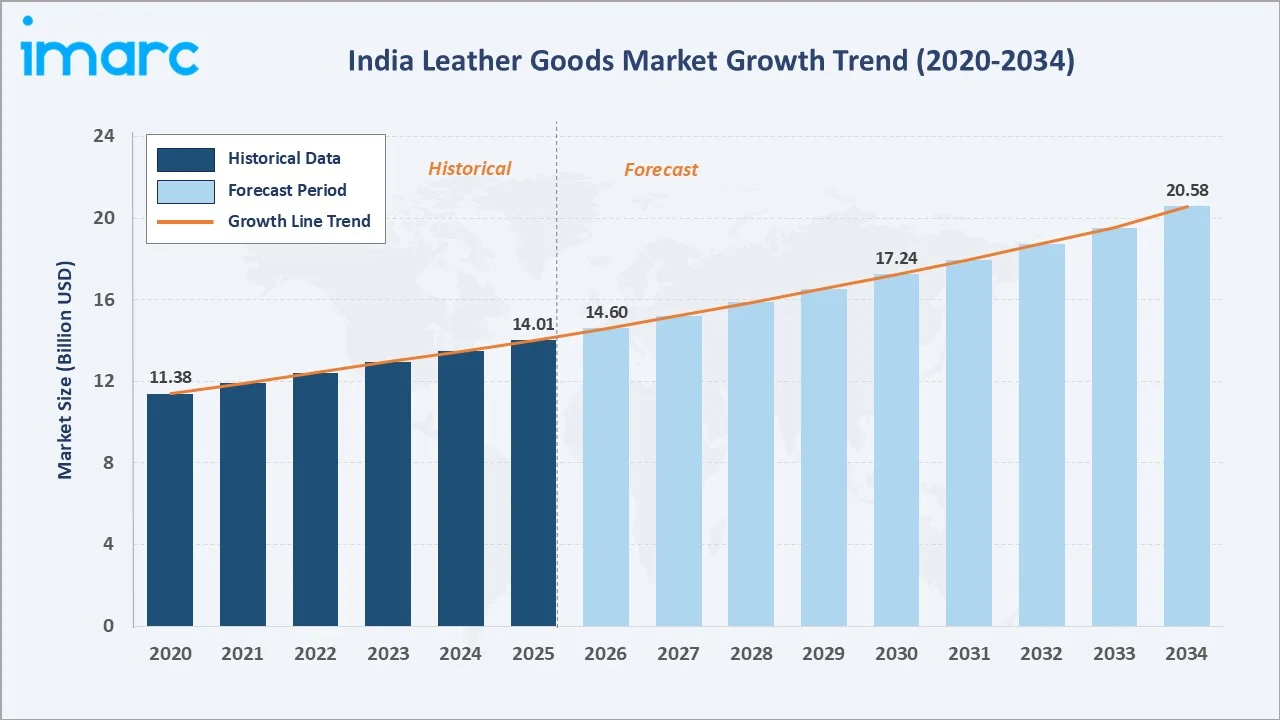
The India leather goods market grew from USD 14.01 Billion in 2025 to USD 14.60 Billion in 2026 and is projected to reach USD 20.58 Billion by 2034, growing at a CAGR of 4.24% during 2026-2034. The market is driven by rising demand for premium leather accessories, growing fashion consciousness, e-commerce expansion, and increasing exports supported by government incentives and skilled craftsmanship.
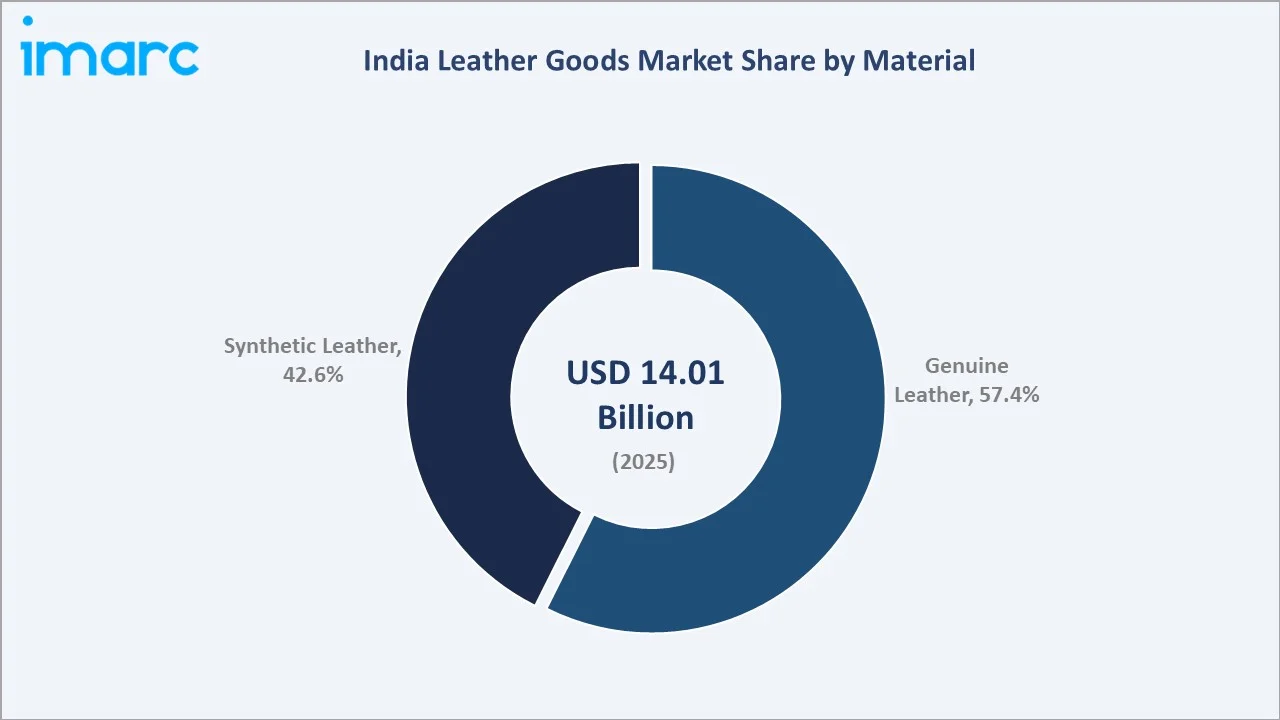
Genuine Leather leads with 57.4% material share. Mass Products dominate at 71.5% of price segmentation. West India commands 30.4% of the national market share, supported by strong manufacturing clusters and organized retail density.
Market Snapshot
|
Metric |
Value |
|
Base Year Market Size (2025) |
USD 14.01 Billion |
|
Market Size (2026) |
USD 14.60 Billion |
|
Forecast Market Size (2034) |
USD 20.58 Billion |
|
CAGR (2026-2034) |
4.24% |
|
Base Year |
2025 |
|
Historical Period |
2020-2025 |
|
Forecast Period |
2026-2034 |
|
Dominant Material |
Genuine Leather (57.4%, 2025) |
|
Dominant Price Segment |
Mass Products (71.5%, 2025) |
|
Leading Region |
West India (30.4%, 2025) |
The India leather goods market size increased from USD 11.38 Billion in 2020 to USD 14.01 Billion in 2025, and is estimated to reach USD 14.60 Billion in 2026. The market is further expected to grow to USD 17.24 Billion by 2030 and USD 20.58 Billion by 2034, underpinned by India's strong leather manufacturing base, rising domestic consumption, and expanding export footprint in Europe and North America.
To get more information on this market, Request Sample
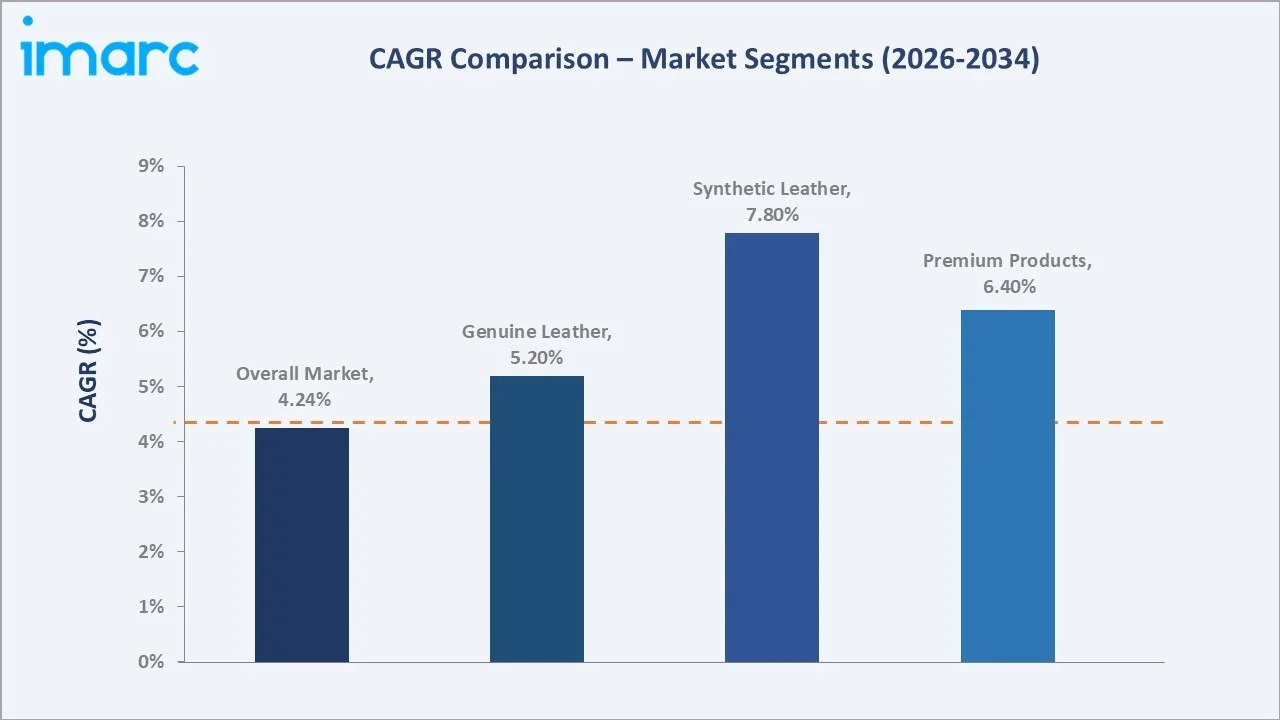
Synthetic leather grows fastest at ~7.8% CAGR as sustainability concerns, animal welfare awareness, and improving PU-based material quality drive adoption across footwear, accessories, and upholstery. The premium products segment grows at ~6.4% CAGR through rising aspirational consumption and global brand entry into Indian retail.
Executive Summary
The India leather goods market expanded from USD 14.01 Billion in 2025 to an estimated USD 14.60 Billion in 2026, positioning it among Asia's most significant leather consumer and exporter markets. Growth is underpinned by rising middle-class disposable incomes, growing fashion consciousness, e-commerce proliferation, and government-backed export promotion schemes supporting India's leather manufacturing clusters.
The market is projected to reach USD 20.58 Billion by 2034 at a CAGR of 4.24%. Genuine Leather at 57.4% leads material share. Mass Products at 71.5% reflect the large price-sensitive domestic consumer base. West India leads regionally at 30.4%, driven by organized retail density and strong manufacturing presence in Maharashtra and Gujarat.
Key Market Insights
|
Insight |
Data |
|
Dominant Material |
Genuine Leather – 57.4% share (2025) |
|
Dominant Price Segment |
Mass Products – 71.5% market share (2025) |
|
Leading Region |
West India – 30.4% share (2025) |
|
Market Opportunity |
Premium product expansion; synthetic/vegan leather growth; e-commerce D2C channels; export market diversification |
Key Analytical Observations Supporting the Above Data:
- Genuine Leather at 57.4%: Genuine leather dominates due to superior durability, aesthetic appeal, and brand premium command. Top-grain and full-grain leather products are the preferred choice for premium footwear, bags, and wallets across urban consumers seeking quality and longevity.
- Mass Products at 71.5%: Mass products dominate reflecting India's large price-sensitive consumer base. Affordable leather footwear, belts, and wallets sold through organized retail chains and local markets represent the volume core of India's leather goods market.
- West India at 30.4%: West India leads through Mumbai's dense premium retail network, Gujarat's strong leather accessories manufacturing cluster, and Maharashtra's large, organized footwear retail base driving both domestic consumption and export procurement activity.
India Leather Goods Market Overview
India leather goods market is positioned at the intersection of one of Asia's oldest and most skilled leather manufacturing traditions, a rapidly growing urban consumer base, and a globally competitive export platform. The market spans footwear, bags, wallets, belts, upholstery, luggage, and accessories across genuine and synthetic leather material categories.
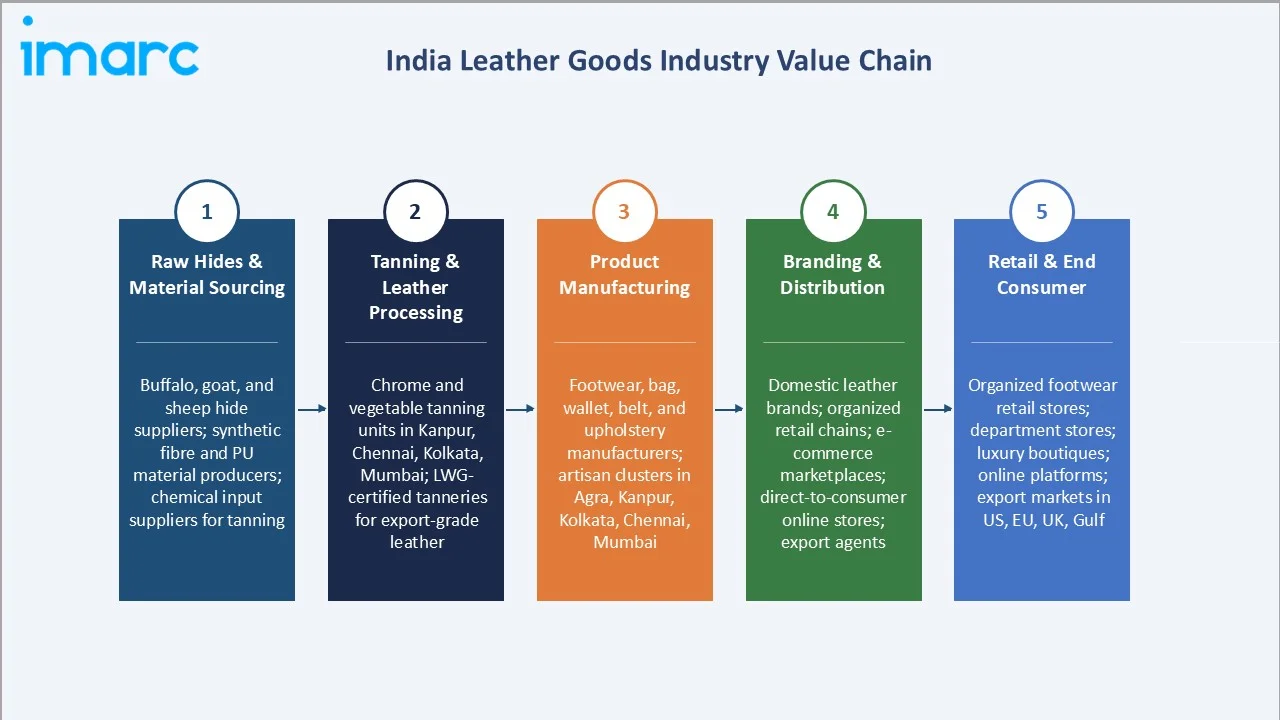
The ecosystem integrates raw hide and material suppliers, tanning and processing units, product manufacturers, brand-building entities, organized retail and e-commerce platforms, and end consumers across domestic and export markets. Government initiatives including Make in India, Leather Cluster Development, and export incentive schemes support the industry's global competitiveness.
Market Dynamics
To evaluate market opportunities, Request Sample
Market Drivers
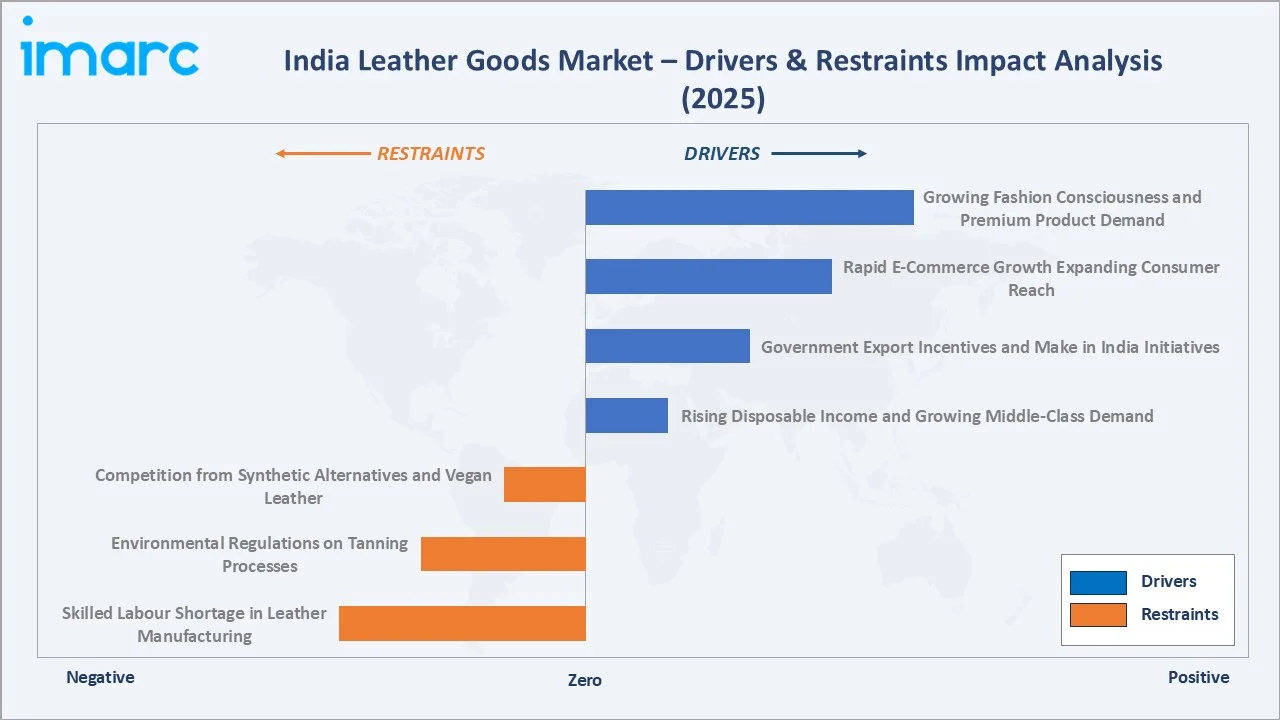
- Rising Disposable Income and Growing Middle-Class Demand: India's expanding middle-class population and rising disposable incomes are supporting demand for leather products across footwear, handbags, wallets, belts, and other accessories. Increasing urbanization, changing lifestyles, and greater exposure to global fashion trends are encouraging consumers to purchase branded and quality-focused leather goods.
- Government Export Incentives and Make in India Initiatives: Government initiatives aimed at strengthening domestic manufacturing, supporting leather clusters, and promoting exports are contributing to the development of India's leather goods industry. Investments in production capabilities, skill development, and export infrastructure are helping manufacturers improve product quality and expand their presence in international markets.
- Rapid E-Commerce Growth Expanding Consumer Reach: The expansion of e-commerce and digital retail platforms is improving consumer access to leather goods across metropolitan as well as Tier-2 and Tier-3 cities. Online marketplaces and direct-to-consumer brands are enabling manufacturers and smaller leather businesses to reach wider customer bases without relying extensively on physical retail networks.
- Growing Fashion Consciousness and Premium Product Demand: Rising social media influence, international travel exposure, and brand consciousness among India's young urban population are driving demand for premium and luxury leather goods. In June 2023, GARRTEN launched a luxury leather accessories collection featuring full-grain and saffiano leather products handcrafted by local artisans, reflecting the growing demand for quality-focused premium leather brands in the Indian market.
Market Restraints
- Competition from Synthetic Alternatives and Vegan Leather: Improving quality and reducing cost of PU-based synthetic and bio-based vegan leather products are creating substitution pressure on genuine leather goods, particularly in price-sensitive mass market segments. Growing animal welfare awareness and environmental consciousness among younger consumers are accelerating preference shifts toward non-animal material alternatives, limiting genuine leather market expansion.
- Environmental Regulations on Tanning Processes: Stricter environmental regulations targeting effluent discharge from chrome tanning operations are increasing compliance costs for Indian leather manufacturers, particularly smaller tanneries in Kanpur and Tamil Nadu clusters. Regulatory pressure is driving industry-wide investment in chrome-free and water treatment infrastructure, adding operational costs that compress margins for manufacturers already competing on price.
- Skilled Labour Shortage in Leather Manufacturing: The shortage of trained artisans and skilled workers in leather cutting, stitching, and finishing is constraining production capacity expansion for premium and export-grade leather goods manufacturers. Aging workforce demographics in traditional leather clusters and limited vocational training infrastructure for leather-specific skills are creating structural supply-side bottlenecks that restrict output growth.
Market Opportunities
- Premium and Luxury Leather Goods Segment Expansion: Rising affluence, growing HNWI population, and increasing exposure to international luxury brands are creating significant opportunity for premium leather goods brands in India. In October 2024, Valentino launched an India-exclusive edition of its VSLING bag featuring intricate hand embroidery on premium leather, signalling growing luxury brand confidence in the Indian consumer market.
- Export Market Diversification and New Geography Penetration: India's competitive leather manufacturing cost base, skilled craftsmanship, and improving certification compliance create significant opportunity to penetrate new export geographies including Japan, South Korea, and Gulf markets, reducing concentration risk from existing European and US market dependence.
Market Challenges
- Raw Material Price Volatility and Supply Chain Disruptions: Fluctuating prices of raw hides, chemical inputs for tanning, and synthetic fibre materials create margin pressure for leather goods manufacturers with limited backward integration. Global supply chain disruptions and livestock population dynamics directly impact raw hide availability and pricing, creating input cost uncertainty.
- Counterfeit Products and Brand Equity Dilution: The proliferation of counterfeit leather goods imitating established domestic and international brands undermines consumer trust, creates pricing pressure on genuine manufacturers, and limits organized brand premium realization, particularly in online and semi-organized retail channels.
Emerging Market Trends
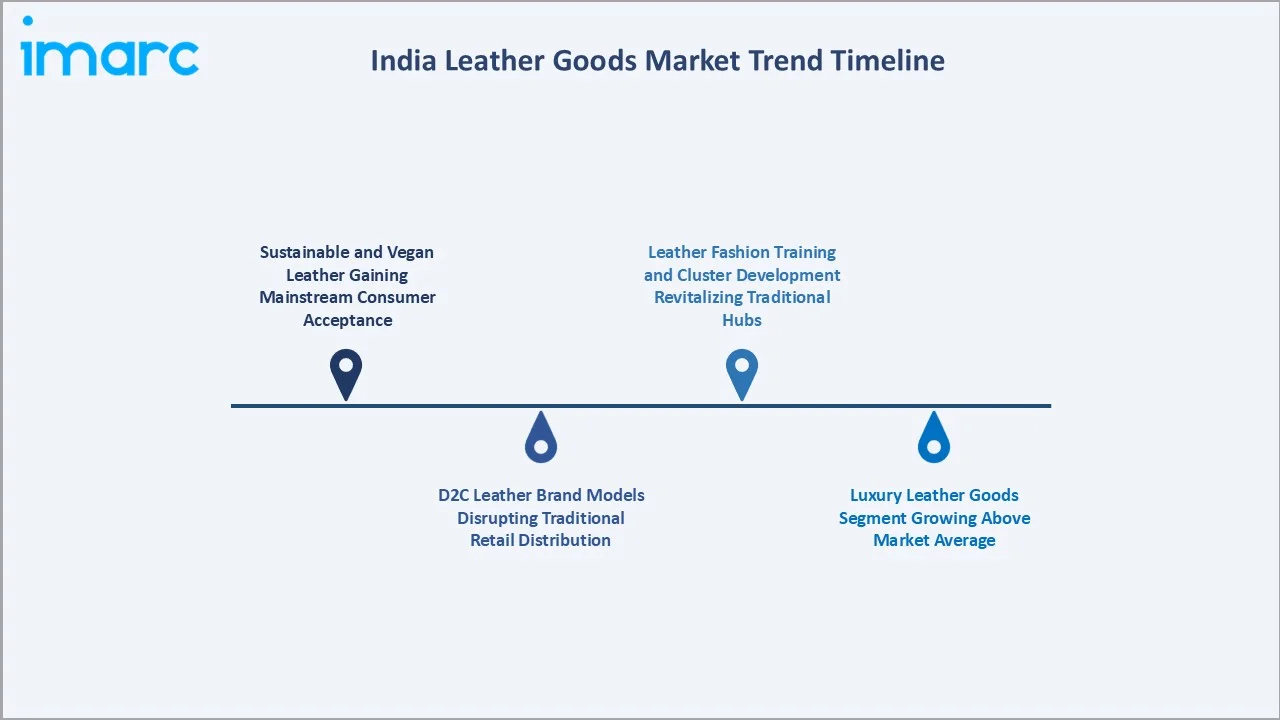
1. Sustainable and Vegan Leather Gaining Mainstream Consumer Acceptance
Bio-based leather alternatives derived from pineapple, mushroom, and cactus fibres are gaining commercial traction in India's premium consumer segment. Growing environmental consciousness and animal welfare advocacy are accelerating retailer and brand adoption of certified sustainable material alternatives alongside conventional genuine leather products.
2. D2C Leather Brand Models Disrupting Traditional Retail Distribution
Digital-native D2C leather brands are building direct consumer relationships through social media marketing, personalization, and artisan storytelling, bypassing conventional multi-tier retail distribution. D2C channels are enabling premium pricing for craft-focused leather goods brands while building brand communities with strong repeat purchase loyalty.
3. Luxury Leather Goods Segment Growing Above Market Average
India's luxury leather goods market is growing significantly above the overall market CAGR as rising HNWI wealth, increasing international travel, and social media luxury brand exposure drive aspirational purchase behaviour. Global luxury brands are expanding their India presence through mono-brand boutiques and e-commerce platforms targeting premium urban consumers.
4. Leather Fashion Training and Cluster Development Revitalizing Traditional Hubs
In December 2024, the Indian Government announced plans to launch a leather fashion training centre in Kanpur's Leather Cluster, funded by Exim Bank, to revitalize the local industry. The initiative supports over 2,500 SMEs and 200,000 jobs, generating Rs 9,000 crore annually primarily through exports, reflecting government commitment to leather sector modernization.
Industry Value Chain Analysis
The India leather goods value chain spans raw hide sourcing, chrome and vegetable tanning, product manufacturing, brand building and distribution, and end consumer retail across domestic and export markets. India's value chain is notable for its depth — the country is both a major raw hide supplier and finished goods manufacturer, creating integrated value-chain opportunities for domestic brands.
|
Stage |
Key Participants |
|
Raw Hides & Material Sourcing |
Buffalo, goat, and sheep hide suppliers; synthetic fibre and PU material producers; chemical input suppliers for tanning |
|
Tanning & Leather Processing |
Chrome and vegetable tanning units in Kanpur, Chennai, Kolkata, Mumbai; LWG-certified tanneries for export-grade leather |
|
Product Manufacturing |
Footwear, bag, wallet, belt, and upholstery manufacturers; artisan clusters in Agra, Kanpur, Kolkata, Chennai, Mumbai |
|
Branding & Distribution |
Domestic leather brands; organized retail chains; e-commerce marketplaces; direct-to-consumer online stores; export agents |
|
Retail & End Consumer |
Organized footwear retail stores; department stores; luxury boutiques; online platforms; export markets in US, EU, UK, Gulf |
The branding and distribution stage is the most commercially consequential, where manufacturers' investment in brand building, organized retail presence, and e-commerce capability determines consumer price realization and market share capture in India's rapidly evolving leather goods retail landscape.
Technology Landscape in the India Leather Goods Industry
Computer-Aided Design and Automated Cutting Technology
CAD-based design systems and automated leather cutting machines are replacing manual pattern-making and cutting in export-grade manufacturing facilities, improving material yield, reducing waste, and accelerating product development cycles. These technologies are enabling Indian manufacturers to compete more effectively with automated manufacturing hubs in China and Vietnam.
Chrome-Free and Sustainable Tanning Technologies
Vegetable tanning, wet-white chrome-free tanning, and bio-based chemical alternatives are being adopted by India's export-focused tanneries to meet EU REACH compliance requirements and Leather Working Group certification standards. These technologies are opening new premium market access opportunities for Indian leather exporters in environmentally conscious European and North American markets.
E-Commerce Personalization and Direct-to-Consumer Technology
AI-powered personalization engines, virtual try-on tools, and made-to-order digital platforms are enabling leather goods brands to offer customization at scale through e-commerce channels. These technologies are creating premium pricing opportunities for D2C leather brands by delivering personalized consumer experiences that mass-market retail channels cannot match.
Market Segmentation Analysis
The report covers the following segments:
|
Segment Category |
Leading Segment |
Market Share |
Year |
|
Material |
Genuine Leather |
57.4% |
2025 |
|
Price |
Mass Products |
71.5% |
2025 |
|
Product |
🔒 |
🔒 |
2025 |
|
Distribution Channel |
🔒 |
🔒 |
2025 |
|
Region |
West India |
30.4% |
2025 |

By Material
Genuine Leather leads at 57.4% (2025). Genuine leather dominates India's leather goods market through superior durability, natural breathability, and premium aesthetic appeal preferred across footwear, handbags, wallets, and belts. Top-grain and split-grain leather variants serve both premium and mid-range consumer segments across organized and unorganized retail channels.
To access detailed market analysis, Request Sample
Synthetic Leather at 42.6% is the faster-growing material segment at ~7.8% CAGR through improving PU and PVC-based material quality, lower price points, and growing vegan and sustainability-conscious consumer preference. Bio-based leather alternatives are the highest-growth synthetic sub-segment, growing from a small base as material technology advances.
By Price
Mass Products lead at 71.5% (2025). Mass products dominate reflecting India's large price-sensitive domestic consumer base purchasing affordable leather footwear, accessories, and bags through organized retail chains, local markets, and e-commerce platforms. Mass segment brands compete primarily on value, availability, and design relevance for aspirational middle-class consumers.
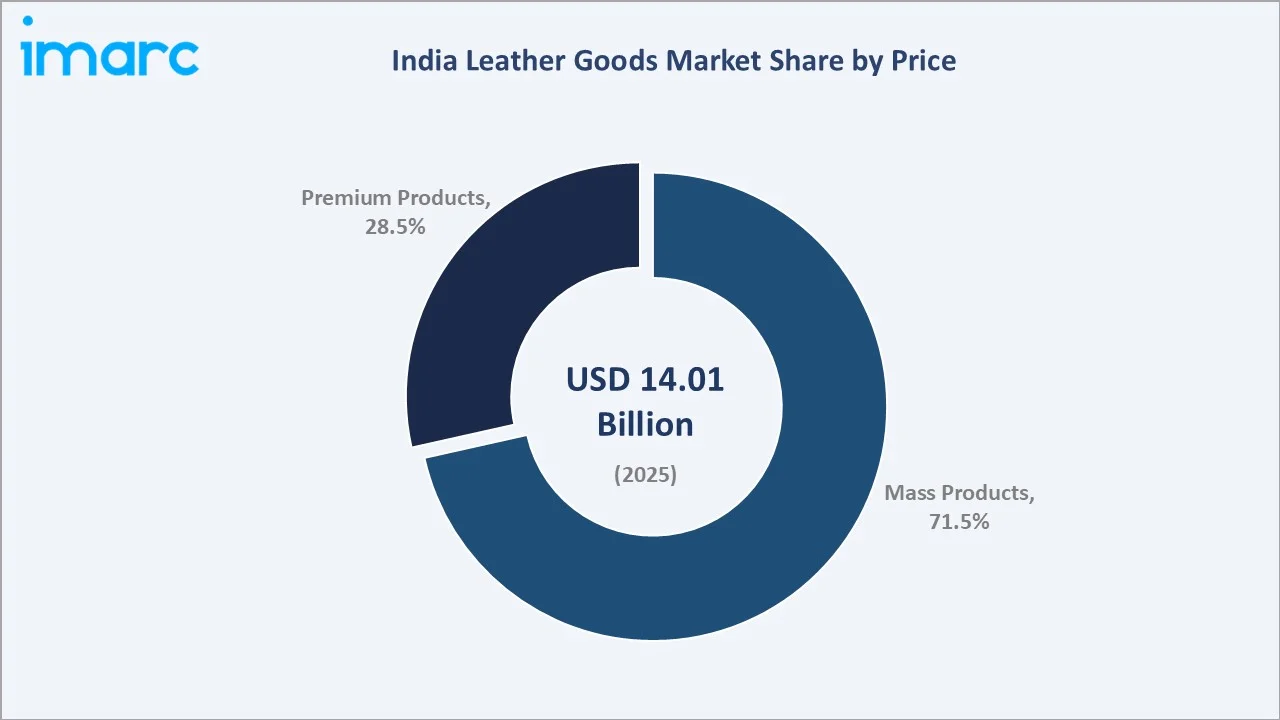
Premium Products at 28.5% is the faster-growing price segment at ~6.4% CAGR, driven by India's expanding affluent consumer base, luxury brand market entry, and growing brand consciousness among urban professionals. Premium leather goods encompass luxury handbags, premium footwear, and high-end accessories from both domestic and international brands.
Regional Market Insights
|
Region |
Share (2025) |
Key India Leather Goods Market Drivers & Characteristics |
|
West India |
30.4% |
Driven by Mumbai's premium retail density, Gujarat's leather accessories manufacturing cluster, and Maharashtra's large organized footwear retail base supporting both domestic consumption and export procurement. |
|
North India |
27.8% |
Supported by India's largest leather manufacturing cluster in Kanpur and Agra, Delhi-NCR's organized luxury retail presence, and strong footwear and accessories export activity to Europe and the US. |
|
South India |
24.1% |
Reflects Tamil Nadu's significant leather and footwear manufacturing export base, Karnataka's growing organized retail market, and Andhra Pradesh's leather goods production supporting domestic and international supply. |
|
East India |
17.7% |
Growing through Kolkata's Bantala Leather Complex tannery cluster, West Bengal's artisan leather goods tradition, and increasing organized retail penetration in metro and Tier-2 city markets. |
West India's 30.4% market leadership reflects Mumbai's status as India's premium retail capital with the highest concentration of luxury and organized footwear retail, combined with Gujarat's strong leather accessories and belt manufacturing clusters. North India's 27.8% reflects the Kanpur-Agra leather belt's manufacturing scale and Delhi-NCR's organized retail and export market access.
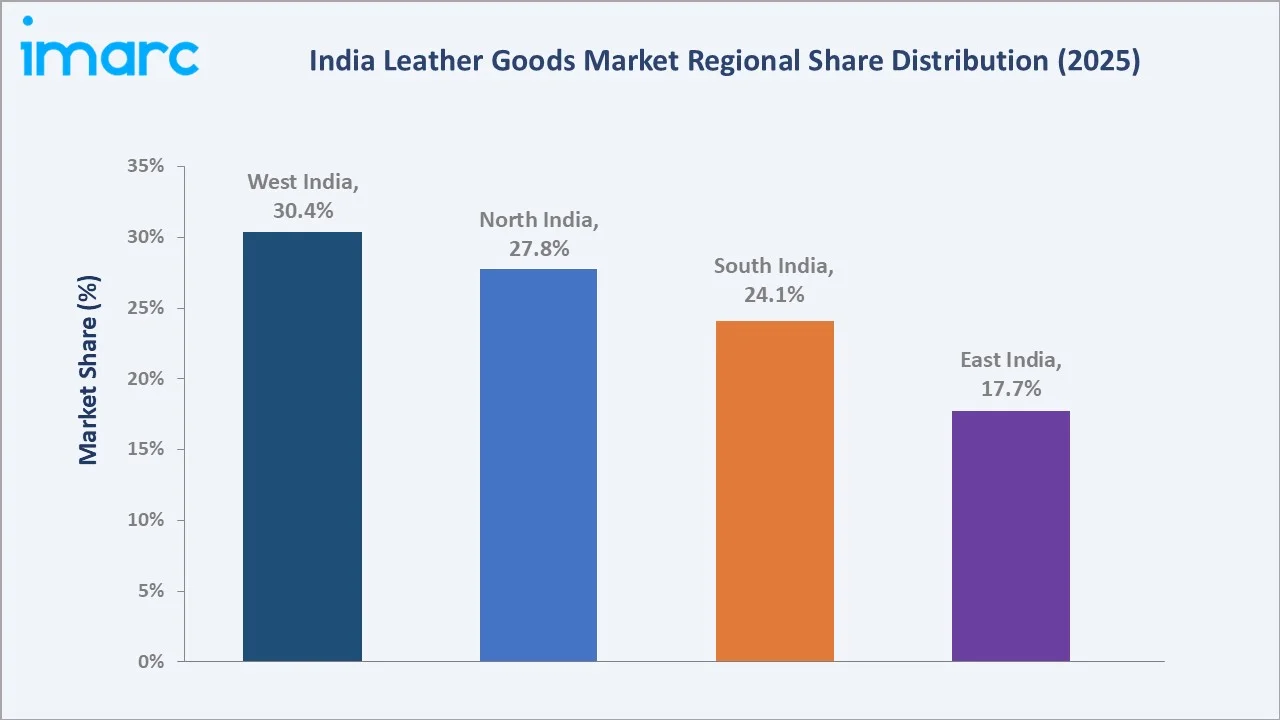
South India's 24.1% reflects Tamil Nadu's dominant position in leather and footwear exports, with Chennai functioning as both a manufacturing and retail hub for the region. East India's 17.7% is growing through Kolkata's established tannery complex at Bantala and West Bengal's artisan leather goods tradition creating organized manufacturing capacity for both domestic and export markets.
Competitive Landscape
India leather goods market competitive landscape is characterized by a mix of large organized domestic manufacturers, multinational brand subsidiaries, artisan exporters, and a substantial unorganized sector. Competition spans mass-market footwear retail to premium accessories, with organized players intensifying brand investment, retail network expansion, and e-commerce capability development.
|
Company |
Key Products |
Market Position |
Core Strength |
|
Bata Brand |
Footwear, leather bags, accessories |
Market Leader |
India's largest branded footwear retailer with a strong cross-price-tier portfolio spanning economy, casual, and premium segments; deep pan-India retail reach across metro, Tier-2, and Tier-3 cities positions Bata as the dominant organized footwear brand by store count and consumer recall |
|
Metro Brands Limited |
Premium footwear, accessories |
Strong Challenger |
Leading premium footwear retail chain operating with strong organized retail presence and rapidly growing e-commerce capability; Metro's premiumization strategy, expanding accessory category, and Tier-2 city store rollout support sustained above-market revenue growth in the organized footwear segment |
|
Woodland (Aero Club) Private Limited |
Outdoor leather footwear, accessories |
Strong Challenger |
Iconic outdoor lifestyle leather brand with a strong pan-India retail network; trusted for durability-focused premium footwear, leather accessories, and apparel across outdoor, adventure, and everyday casual occasions |
|
Khadim India Ltd. |
Affordable footwear, accessories |
Strong Challenger |
Strong Tier-2 and Tier-3 city distribution network; wide affordable leather and synthetic footwear range trusted by price-sensitive consumers nationwide; Khadim's franchise-led expansion model enables rapid geographic reach with lower capital deployment than company-operated retail formats |
|
Mirza International Limited |
Footwear, accessories |
Strong Challenger |
Fully vertically integrated leather goods company with captive tanning, manufacturing, and retail operations providing high cost and quality control advantage |
Key players include Bata Brand, Metro Brands Limited, Woodland (Aero Club) Private Limited, Khadim India Ltd., Mirza International Limited, and others.
Key Company Profiles
Bata Brand
Bata is India's largest branded footwear retailer and manufacturer, operating across urban and semi-urban India and offering a comprehensive range of leather and synthetic footwear, bags, and accessories across economy to premium price tiers.
- Key Products: Bata Power (sport and casual footwear); North Star (youth casual footwear); Hush Puppies and Marie Claire (premium lifestyle footwear); leather bags, belts, wallets, and accessories across Bata-branded and licensed international categories.
- Strategic Focus: Maintaining market leadership through nationwide retail network expansion and premiumization strategy; accelerating e-commerce and D2C channel investment to capture digitally native consumer segments; and expanding the premium and mid-premium leather footwear portfolio to compete with global sports and lifestyle brands in India's growing organized footwear market.
Metro Brands Limited
Metro Brands Limited is one of India's leading premium footwear retail chains, operating Metro Shoes, Mochi, Walkway, and FitFlop brand outlets across India's Tier-1 and expanding Tier-2 cities, offering premium leather and synthetic footwear and accessories for men, women, and children.
- Key Products: Metro Shoes (premium leather formal and casual footwear); Mochi (contemporary fashion footwear and accessories); Walkway (affordable fashion footwear); FitFlop (premium comfort footwear); leather handbags, wallets, and accessories across brand tiers.
- Strategic Focus: Expanding organized premium footwear retail network into Tier-2 and Tier-3 cities to capture growing aspirational consumer demand; strengthening e-commerce sales through digital marketing and online-exclusive product collections; and growing the accessories category within existing retail footprint to increase basket size per customer visit.
Market Concentration Analysis
India leather goods market is fragmented across organized and unorganized segments, with the key players commanding significant combined organized-market share in their respective categories. The overall market remains highly fragmented due to a large unorganized sector, artisan producers, and regional brand players across footwear, accessories, and luggage sub-categories.
Market concentration is gradually increasing as organized brands expand geographic reach, invest in brand building, and gain share from unorganized suppliers through quality consistency, warranty support, and organized retail experience. However, the pace of concentration is moderated by the unorganized sector's pricing advantage and deep local distribution penetration in rural and semi-urban markets.
Investment & Growth Opportunities
Highest Growth Segments
Synthetic and vegan leather materials (~7.8% CAGR), premium leather goods (~6.4% CAGR through HNWI growth and luxury brand entry), e-commerce D2C leather brands (~12–15% CAGR from smaller base), women's fashion leather accessories (~8% CAGR), and export market diversification into Gulf and Asia-Pacific geographies represent the highest-growth India leather goods investment vectors through 2034.
Emerging Investment Opportunities
India's women's fashion leather accessories market, growing at ~8% annually, represents the most commercially underpenetrated high-margin investment opportunity. Organized domestic brands targeting premium women's handbags, wallets, and fashion accessories are generating strong brand loyalty and above-category-average margin realization in a segment historically dominated by unorganized and international players.
Investment Themes
- Sustainable and vegan leather product development targeting India's environmentally conscious premium consumer segment: Brands and manufacturers investing in LWG-certified sustainable leather, chrome-free tanning, and bio-based alternative materials are positioned to capture growing specification-grade demand from conscious consumers and export markets with stringent sustainability requirements.
- E-commerce D2C brand development targeting Tier-2 and Tier-3 city premium leather goods consumers: India's Tier-2 and Tier-3 cities represent the most commercially underserved premium leather goods market, with growing consumer aspiration and e-commerce infrastructure enabling organized branded reach at lower cost than physical retail expansion.
Future Market Outlook (2026-2034)
The India leather goods market is projected to grow from USD 14.01 Billion in 2025 to USD 14.60 Billion in 2026, reaching USD 20.58 Billion by 2034, registering a CAGR of 4.24% during 2026–2034. The market's midpoint value of approximately USD 17.24 Billion in 2030 reflects a structural inflection as premium segment growth accelerates, synthetic leather achieves material share parity, and e-commerce penetration transforms distribution across all categories.
Three structural forces define India leather goods market growth through 2034: India's expanding middle class and rising aspirational consumption creating volume demand; premiumization dynamics driving value growth above volume growth in organized segments; and digital commerce expansion enabling organized brands to reach consumers across India's 800+ Tier-2 and Tier-3 cities at unprecedented scale.
Research Methodology
Primary Research
Primary research comprised structured interviews with India leather goods industry stakeholders, including brand managers, retail directors, export agents, raw material suppliers, tannery operators, and institutional buyers across North, West, South, and East India, covering footwear, accessories, luggage, and apparel leather goods categories.
Secondary Research
Secondary research encompassed India leather industry export data from CLE, IBEF reports, company annual reports, retail industry publications, luxury brand market entry announcements, e-commerce platform data, and investor presentations. Over 45 secondary sources were reviewed and cross-referenced.
Forecasting Models
Market revenue forecasts were developed using a consumer expenditure-linked demand model: India's household disposable income growth multiplied by leather goods category share of consumer spending per income tier, with e-commerce penetration multiplier and export growth adjustment applied across material and price sub-segments.
India Leather Goods Market Report Coverage:
| Report Features | Details |
|---|---|
| Base Year of the Analysis | 2025 |
| Historical Period | 2020-2025 |
| Forecast Period | 2026-2034 |
| Units | Billion USD |
| Scope of the Report |
Exploration of Historical Trends and Market Outlook, Industry Catalysts and Challenges, Segment-Wise Historical and Future Market Assessment:
|
| Products Covered |
|
| Materials Covered |
|
| Prices Covered | Premium Products, Mass Products |
| Distribution Channels Covered | Clothing and Sportswear Retailers, Departmental Stores, Supermarkets and Hypermarkets, Online Stores, Others |
| Regions Covered | North India, South India, East India, West India |
| Companies Covered | Bata Brand, Metro Brands Limited, Woodland (Aero Club) Private Limited, Khadim India Ltd., Mirza International Limited, etc. |
| Customization Scope | 10% Free Customization |
| Post-Sale Analyst Support | 10-12 Weeks |
| Delivery Format | PDF and Excel through Email (We can also provide the editable version of the report in PPT/Word format on special request) |
Key Benefits for Stakeholders:
- IMARC’s industry report offers a comprehensive quantitative analysis of various market segments, historical and current market trends, market forecasts, and dynamics of the India leather goods market from 2020-2034.
- The research report provides the latest information on the market drivers, challenges, and opportunities in the India leather goods market.
- Porter's five forces analysis assist stakeholders in assessing the impact of new entrants, competitive rivalry, supplier power, buyer power, and the threat of substitution. It helps stakeholders to analyze the level of competition within the India leather goods industry and its attractiveness.
- Competitive landscape allows stakeholders to understand their competitive environment and provides an insight into the current positions of key players in the market.
Frequently Asked Questions About the India Leather Goods Market Report
India leather goods market size is estimated at USD 14.60 Billion in 2026, driven by rising disposable incomes, e-commerce expansion, and growing fashion consciousness. Export growth, government incentives, and increasing premium product demand further support continued market expansion.
India leather goods market grows at 4.24% CAGR during 2026-2034, reaching USD 20.58 Billion by 2034. Growth is sustained by domestic consumption expansion, premium segment acceleration, export market development, and synthetic leather material adoption across all product categories.
Genuine Leather leads at 57.4% through superior durability, aesthetic appeal, and premium brand command, particularly across organized retail footwear, premium handbags, and lifestyle accessories segments targeting India's growing aspirational middle-class and affluent consumers.
Mass Products lead at 71.5% reflecting India's large price-sensitive domestic consumer base purchasing affordable leather footwear, accessories, and bags through organized retail chains, local unorganized markets, and value-focused e-commerce channels across all four regions.
West India leads at 30.4% through Mumbai's premium retail density, Gujarat's leather accessories manufacturing cluster, and Maharashtra's large organized footwear retail base supporting both domestic consumption volume and export procurement activity.
Leading companies include Bata Brand, Metro Brands Limited, Woodland (Aero Club) Private Limited, Khadim India Ltd., Mirza International Limited, and others.
India leather goods market is projected to reach approximately USD 17.24 Billion by 2030, with premium segment growth accelerating, synthetic leather achieving significant material share, e-commerce distribution gaining structural dominance, and export market diversification expanding India's global leather goods footprint.
Three priority investment opportunities: sustainable and vegan leather product development for premium and export markets; women's fashion leather accessories brand building targeting India's rapidly growing affluent women consumer segment; and e-commerce D2C brand development capturing India's Tier-2 and Tier-3 city premium leather goods demand at~12–15% CAGR through 2034.
Need more help?
- Speak to our experienced analysts for insights on the current market scenarios.
- Include additional segments and countries to customize the report as per your requirement.
- Gain an unparalleled competitive advantage in your domain by understanding how to utilize the report and positively impacting your operations and revenue.
- For further assistance, please connect with our analysts.
 Request Customization
 Speak to an Analyst
 Request Brochure
 Inquire Before Buying
Benefits of Customization
- Personalize this research
- Triangulate with your data
- Get data as per your format and definition
- Gain a deeper dive into a specific application, geography, customer, or competitor
- Any level of personalization
Get in Touch With Us
UNITED STATES
Phone: +1-201-971-6302
INDIA
Phone: +91-120-433-0800
UNITED KINGDOM
Phone: +44-753-714-6104
Email: [email protected]
Client Testimonials




.webp)




.webp)













Related Reports

Choose your plan
*Please note that the prices mentioned below are starting prices for each bundle type. Kindly contact our team for further details.*
Single User License
- 1 User License, Access on 2 Devices
- PDF Report + Excel Dataset (Password Protected)
- Lifetime Access
- No Printing Rights
- 10% Free Report Customization
- 10–12 Weeks of Analyst Support
Five User License
- Access for 5 Users, 2 Devices per User
- PDF Report + Excel Dataset (Password Protected)
- Lifetime Access
- Dedicated Account Manager
- 12–14 Weeks of Analyst Support
- No Printing Rights
- 15% Free Report Customization
- 25% Discount on Your Next Purchase
Corporate User License
- Unlimited User Access (Within Your Organization)
- PDF Report + Excel Dataset
- Lifetime Access
- Dedicated Account Manager
- 14–20 Weeks of Analyst Support
- No Printing Rights
- 20% Free Report Customization
- 30% Discount on Your Next Purchase
Essential Insights
What's included:
3 reports
- Lifetime Access
- PDF Reports
- Excel Datasets
- 2 Weeks of Free Analyst Support
- 2 User Licenses
- Access on 2 Devices
- Printing Rights
- Complimentary PowerPoint (PPT) Version
- Complimentary License Upgrade
Professional Access
What's included:
5 reports
- Lifetime Access
- PDF Reports
- Excel Datasets
- 8 Weeks of Free Analyst Support
- 2 User Licenses
- Access on 2 Devices
- Printing Rights
- Complimentary PowerPoint (PPT) Version
- Complimentary License Upgrade
Business Advantage
What's included:
8 reports
- Lifetime Access
- PDF Reports
- Excel Datasets
- 14 Weeks of Free Analyst Support
- 2 User Licenses
- Access on 2 Devices
- Printing Rights
- Complimentary PowerPoint (PPT) Version
- Complimentary License Upgrade
Enterprise Intelligence
What's included:
10 reports
- Lifetime Access
- PDF Reports
- Excel Datasets
- 20 Weeks of Free Analyst Support
- 2 User Licenses
- Access on 2 Devices
- Printing Rights
- Complimentary PowerPoint (PPT) Version
- Complimentary License Upgrade