
India Next Generation Search Engines Market Size, Share, Trends and Forecast by Platform Type, Distribution Channel, End User, and Region, 2026-2034
India Next Generation Search Engines Market Size, Share, Trends & Forecast (2026-2034)
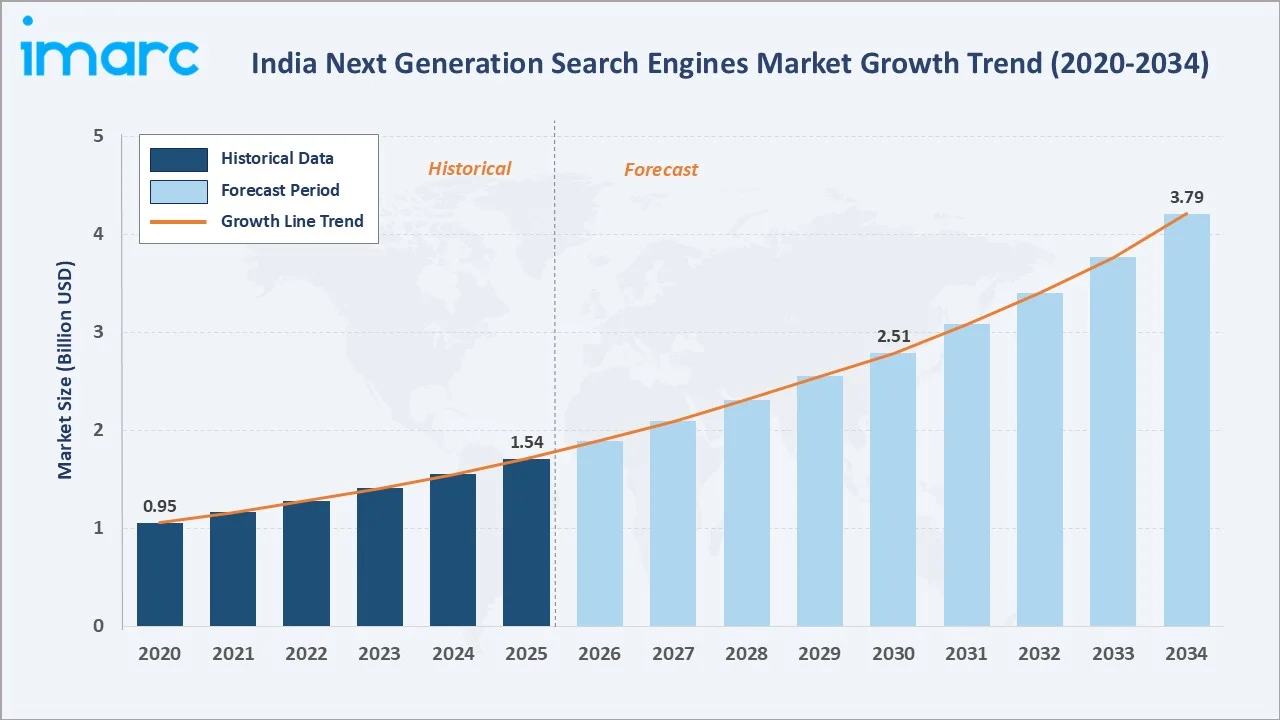
The India next generation search engines market reached USD 1.54 Billion in 2025 and is projected to reach USD 3.79 Billion by 2034, growing at a CAGR of 10.19% during 2026-2034. The market is driven by the rapid adoption of AI-powered search technologies, increasing internet penetration, and growing demand for personalized, conversational, and multilingual search experiences. In India, the total number of internet subscribers increased from 1017.81 million at the end of September 2025 to 1028.61 million at the end of December 2025, creating a massive user pool that relies on digital search for information, commerce, education, and entertainment. This expanding online population is driving demand for next generation search engines that offer AI-powered, multilingual, voice-enabled, and personalized search experiences capable of handling diverse user queries at scale. Mobile leads platform at 61.8%. Online leads distribution channel at 84.6%. North India leads regionally at 32.8%.
Market Snapshot
|
Metric |
Value |
|
Market Size (2025) |
USD 1.54 Billion |
|
Forecast Market Size (2034) |
USD 3.79 Billion |
|
CAGR (2026-2034) |
10.19% |
|
Base Year |
2025 |
|
Historical Period |
2020-2025 |
|
Forecast Period |
2026-2034 |
|
Dominant Platform Type |
Mobile (61.8%, 2025) |
|
Dominant Distribution Channel |
Online (84.6%, 2025) |
|
Leading Region |
North India (32.8%, 2025) |
India next generation search engines market is showing strong growth, rising from USD 0.95 Billion in 2020 to USD 1.54 Billion in 2025. The market is projected to reach USD 3.79 Billion by 2034, supported by rapid internet adoption, AI-powered search, voice search, and multilingual query capabilities. The USD 2.51 Billion market size in 2030 indicates a shift toward wider enterprise and consumer adoption of advanced, personalized, and conversational search platforms.
To get more information on this market, Request Sample
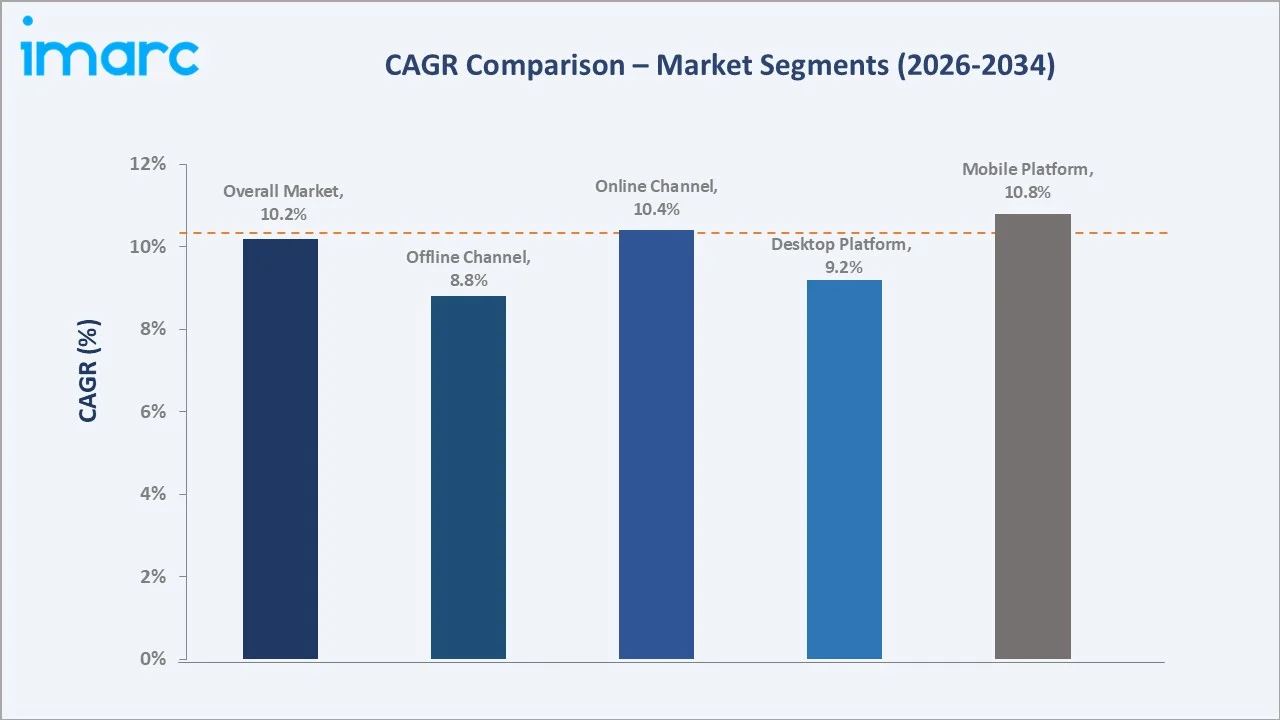
Mobile platform grows fastest at ~10.8% CAGR through Android smartphones, UPI-integrated voice search, and rural internet users. Online distribution grows at ~10.4% CAGR through cloud SaaS AI search API, enterprise subscription, and programmatic ad delivery.
Executive Summary
The India next generation search engines market is expanding steadily, driven by rising internet penetration, AI adoption, and growing demand for conversational and multilingual search. The market grew from USD 0.95 Billion in 2020 to USD 1.54 Billion in 2025 and is forecast to reach USD 3.79 Billion by 2034. Growth is supported by enterprise digital transformation, voice search, generative AI integration, and personalized search experiences. Increasing online content consumption and India’s large digital user base will continue to strengthen market demand. Mobile at 61.8% leads through India's smartphone-first internet user base. Online at 84.6% dominates through SaaS AI search API and programmatic delivery. North India leads at 32.8% through the Delhi NCR enterprise B2B and government digital programme.
Key Market Insights
|
Insight |
Data |
|
Dominant Platform Type |
Mobile - 61.8% share (2025) |
|
Dominant Distribution Channel |
Online - 84.6% market share (2025) |
|
Leading Region |
North India - 32.8% share (2025) |
|
Market Opportunity |
India language LLM-powered search; enterprise knowledge management AI search; voice-first rural Bharat AI search; e-commerce AI product discovery |
Key Analytical Observations Supporting the Above Data:
- Mobile at 61.8%: The mobile segment dominates due to India’s mobile-first internet usage and widespread smartphone adoption. Rising voice search, app-based browsing, and vernacular search queries further strengthen mobile-led demand.
- Online at 84.6%: The online segment dominates due to India’s expanding internet user base and growing reliance on web-based search for shopping, education, news, entertainment, and services. Rising AI-powered, real-time, and personalized search usage further strengthens online platform demand.
- North India at 32.8%: North India dominates regionally due to its large urban internet user base, strong enterprise digital adoption, and high concentration of businesses, education hubs, and government services. Rising mobile search, vernacular content consumption, and e-commerce activity further support regional demand.
India Next Generation Search Engines Market Overview
India next generation search engines market operates within the broader India AI market as the fastest-growing AI segment through the largest user touchpoint market position. The market is commercially unique because it combines AI-driven discovery with India’s mobile-first, multilingual user base. Its value lies in delivering personalized, conversational, voice-enabled, and vernacular search experiences across diverse consumer and enterprise needs. Growing digital commerce, online education, fintech, and government services make advanced search a critical digital infrastructure layer.
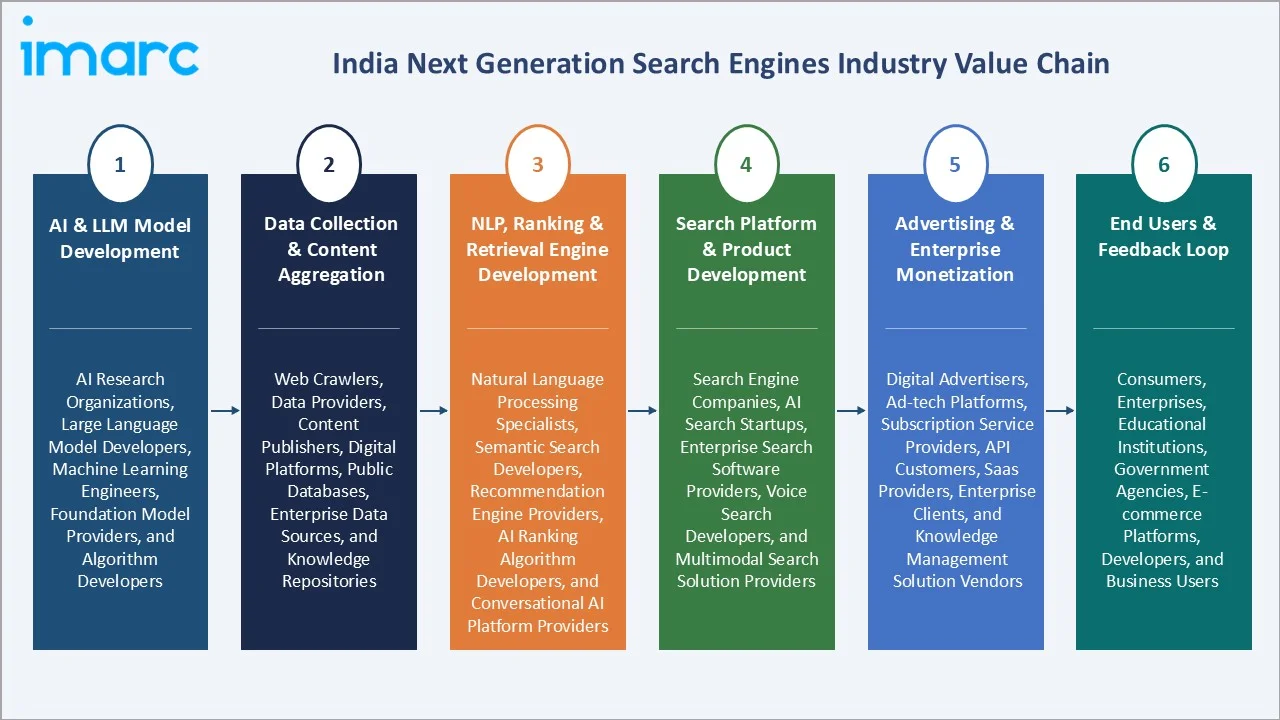
India next generation search engine ecosystem integrates AI and LLM models and infrastructure, search engine platform and product development, content and data index providers, ad technology and revenue monetization, and consumer, enterprise, and publisher ecosystems. Macroeconomic factors include higher digital consumption, enterprise technology spending, and online service adoption.
Market Dynamics
To evaluate market opportunities, Request Sample
Market Drivers
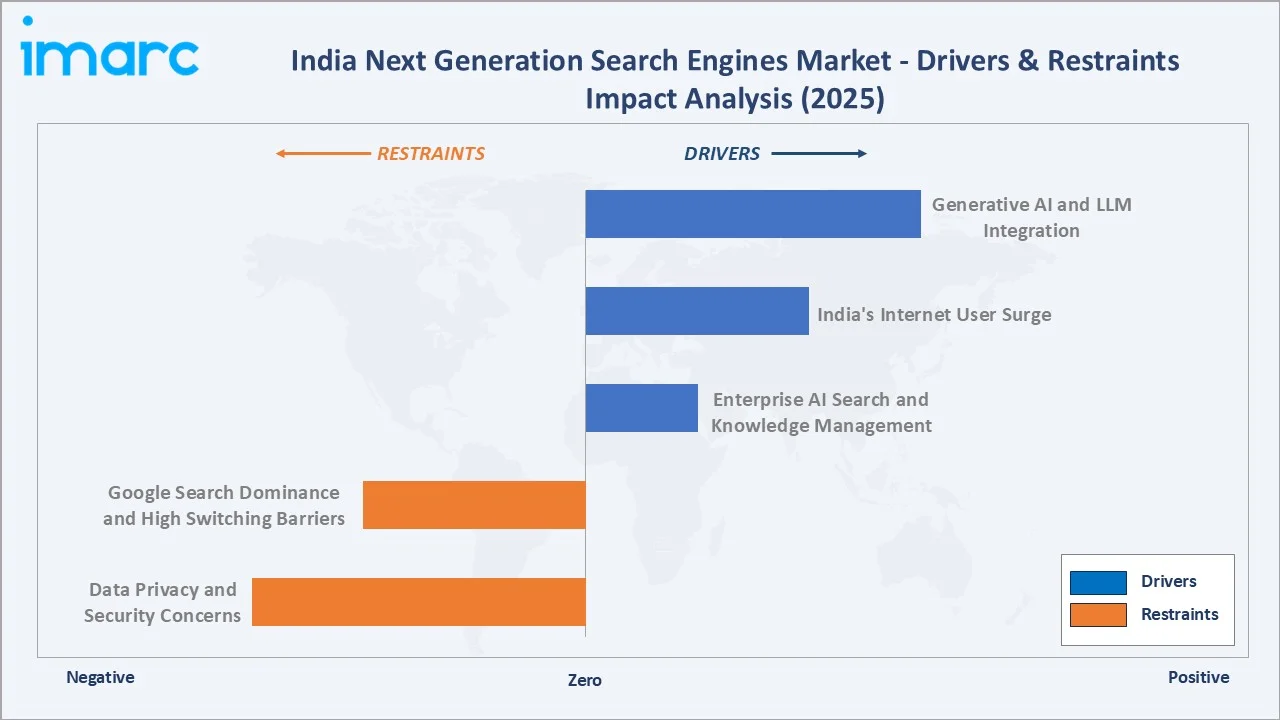
- Generative AI and LLM Integration: Nearly 47% of Indian enterprises now have multiple GenAI use cases live, while 23% remain in the pilot phase, indicating a clear shift from experimentation to implementation. Businesses are increasingly integrating AI into core workflows to achieve measurable outcomes, with 76% of leaders expecting GenAI to create significant business impact and 63% feeling prepared to use it effectively. These generative AI and LLM integrations are shifting search from keyword-based results to conversational, context-aware answers. These technologies improve query understanding, summarization, personalization, and multilingual responses for India’s diverse user base. Enterprises are also adopting AI search for internal knowledge discovery, customer support, and content retrieval. As users increasingly expect faster, more accurate, and human-like search experiences, demand for AI-enabled search platforms continues to rise.
- India's Internet User Surge: India’s internet subscribers increased from 1017.81 million at the end of September 2025 to 1028.61 million at the end of December 2025, creating a massive base of users searching for information, products, services, entertainment, and education online. As more users come from Tier-2 and Tier-3 cities, demand is rising for multilingual, voice-enabled, and personalized search experiences. Higher mobile internet usage is also increasing real-time and location-based search activity. This expanding digital population strengthens the need for AI-powered next generation search engines that can deliver faster, more relevant, and context-aware results.
- Enterprise AI Search and Knowledge Management: Enterprise AI search and knowledge management are driving the market as Indian businesses increasingly need faster access to internal documents, customer data, reports, and operational knowledge. AI-powered search helps employees retrieve relevant insights, summarize information, and improve decision-making. Growing digital transformation across IT, BFSI, healthcare, retail, and manufacturing is increasing adoption. This is expanding demand for secure, enterprise-grade next generation search platforms.
Market Restraints
- Google Search Dominance and High Switching Barriers: Google Search’s strong market position creates high switching barriers for new next generation search engines in India. Users are already familiar with Google’s interface, ecosystem integration, and default placement across browsers and smartphones. This makes it difficult for emerging AI search platforms to attract and retain users, even if they offer advanced features. As a result, new entrants may need strong differentiation, partnerships, or niche enterprise use cases to gain traction.
- Data Privacy and Security Concerns: Data privacy concerns are hampering the market as next generation search engines rely heavily on user data, browsing behavior, and enterprise information to deliver personalized results. Users and businesses may hesitate to adopt AI-powered search tools due to risks around data misuse, consent, and sensitive information exposure. Compliance with India’s evolving data protection framework can also increase operational complexity for search providers. These concerns may slow adoption, especially in sectors such as BFSI, healthcare, government, and enterprise knowledge management.
Market Opportunities
- Expansion of Voice Search and Conversational AI Platforms: Expansion of voice search and conversational AI platforms represents a significant opportunity due to the country's mobile-first internet ecosystem and linguistic diversity. Voice-based search enables users to interact naturally in regional languages, making digital services more accessible to first-time and non-English-speaking internet users. In April 2024, PhonePe’s Indus Appstore launched an AI-powered Voice Search feature that supports English and 10 Indian languages. The feature allows users to discover apps through voice commands in their preferred language, using AI and machine learning to accurately understand diverse accents, speech patterns, and deliver relevant search results. This supports the expansion of voice search and conversational AI platforms by showing rising demand for regional-language, voice-led digital discovery in India.
- Personalized Search and Recommendation Engines: Personalized search and recommendation engines delivering highly relevant results based on user behavior, preferences, location, and search history. These systems enhance user engagement, improve content discovery, and increase conversion rates across e-commerce, media, education, and digital services. AI-driven personalization is particularly valuable in India's diverse and multilingual digital ecosystem, where user needs vary significantly across regions and demographics. As businesses increasingly focus on customer experience and targeted engagement, demand for personalized search capabilities is expected to grow substantially.
Market Challenges
- Monetization Uncertainty for AI-Powered Search Platforms: Monetization uncertainty is challenging because AI-powered search platforms often require high infrastructure, model training, and cloud computing costs. Unlike traditional search, revenue models around ads, subscriptions, enterprise licensing, or API access are still evolving. Users may expect free access, while businesses may hesitate to pay without a clear ROI. This can slow investment, profitability, and long-term scalability for next generation search providers in India.
- User Trust and Accuracy Concerns in Generative Search Results: User trust and accuracy concerns challenge the market because generative search can sometimes produce incorrect, biased, or unsupported answers. Inaccurate results can reduce user confidence, especially for finance, healthcare, education, and legal queries. Search providers must invest in source grounding, fact-checking, and transparent citations to build credibility. Until accuracy improves, many users and enterprises may continue relying on traditional search platforms.
Emerging Market Trends
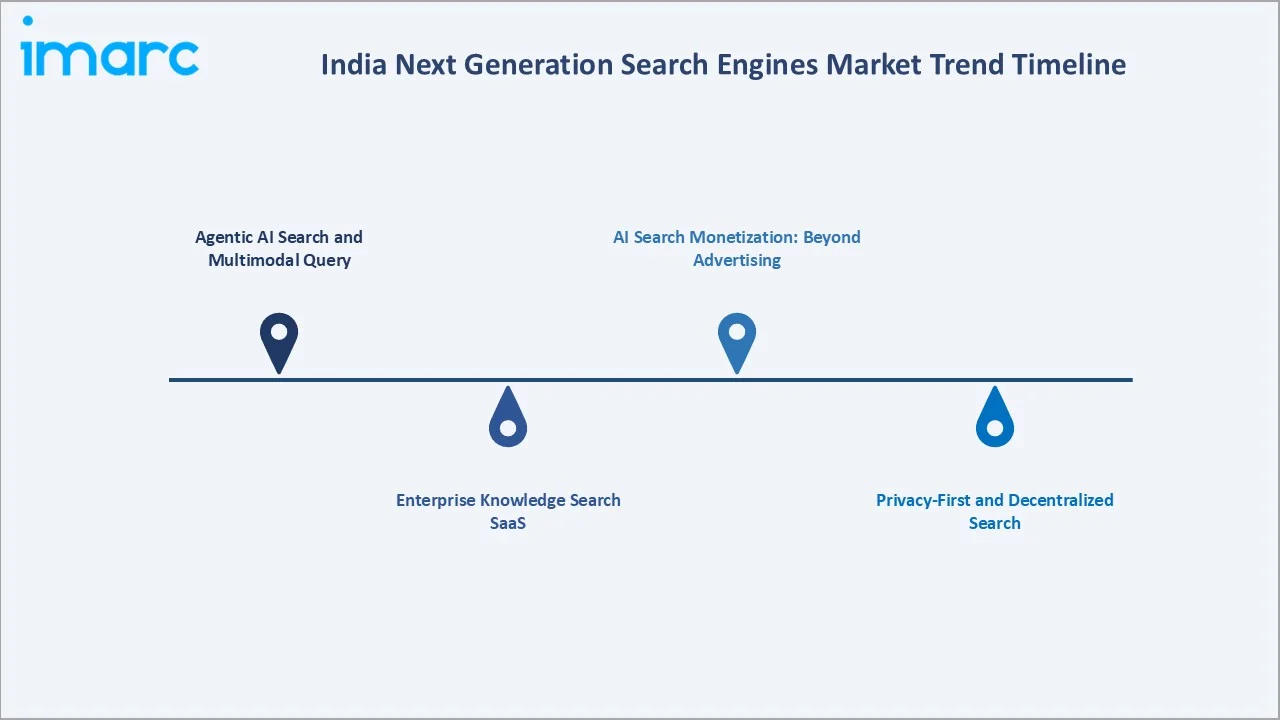
1. Agentic AI Search and Multimodal Query
Agentic AI search and multimodal query are emerging as search platforms move beyond text-based results to task-oriented assistance. These systems can understand text, voice, images, documents, and user intent to deliver more contextual answers. In India, this is important for mobile-first users, vernacular queries, e-commerce discovery, education, and enterprise workflows. In February 2026, EY India launched EY.ai Generative Studio, a next-generation AI platform designed to help enterprises adopt agentic AI and scale deployments up to 10x faster. The platform supports secure, governed, and scalable innovation across diverse enterprise data environments, while offering on-premises deployment options to improve data control, compliance, and security. As AI agents become capable of searching, summarizing, comparing, and completing actions, next generation search engines are evolving into intelligent digital assistants.
2. Enterprise Knowledge Search SaaS
Enterprise knowledge search SaaS is emerging as companies need faster ways to search internal documents, emails, reports, policies, and customer data. AI-powered SaaS platforms help employees retrieve relevant information, summarize content, and improve decision-making. In India, adoption is rising across IT, BFSI, healthcare, retail, and manufacturing as firms digitize workflows. This trend is shifting search from basic keyword retrieval to secure, enterprise-grade knowledge intelligence.
3. Privacy-First and Decentralized Search
Privacy-first and decentralized search is emerging as users and enterprises become more concerned about data security, consent, and personal information tracking. These platforms reduce dependence on centralized data collection and offer greater control over user data. In India, this trend is gaining relevance with rising digital adoption and stricter data protection expectations. It creates opportunities for search providers that can combine AI-powered discovery with secure, transparent, and privacy-focused search experiences.
4. AI Search Monetization: Beyond Advertising
AI search monetization beyond advertising is emerging as platforms explore revenue models such as subscriptions, enterprise licensing, API access, and premium AI assistants. This shift is important because generative search often reduces traditional ad-click opportunities while increasing computing costs. In India, businesses may pay for specialized AI search tools that improve productivity, customer support, and knowledge discovery. This trend is pushing next generation search engines toward value-added, service-based monetization models.
Industry Value Chain Analysis
India next generation search engines value chain integrates AI & LLM model development, data collection & content aggregation, NLP, ranking & retrieval engine development, search platform & product development, advertising & enterprise monetization, and end users & feedback loop.
|
Stage |
Key Participants |
|
AI & LLM Model Development |
AI research organizations, large language model developers, machine learning engineers, foundation model providers, and algorithm developers. |
|
Data Collection & Content Aggregation |
Web crawlers, data providers, content publishers, digital platforms, public databases, enterprise data sources, and knowledge repositories. |
|
NLP, Ranking & Retrieval Engine Development |
Natural language processing specialists, semantic search developers, recommendation engine providers, AI ranking algorithm developers, and conversational AI platform providers. |
|
Search Platform & Product Development |
Search engine companies, AI search startups, enterprise search software providers, voice search developers, and multimodal search solution providers. |
|
Advertising & Enterprise Monetization |
Digital advertisers, ad-tech platforms, subscription service providers, API customers, SaaS providers, enterprise clients, and knowledge management solution vendors. |
|
End Users & Feedback Loop |
Consumers, enterprises, educational institutions, government agencies, e-commerce platforms, developers, and business users. |
The AI & LLM model development and NLP, ranking engine development segments are the most value-added parts of the value chain. This stage creates the core intellectual property through large language models, semantic search capabilities, recommendation engines, and conversational AI technologies. It determines search accuracy, personalization, multilingual support, and user experience, making it the primary source of competitive differentiation and long-term value creation.
Technology Landscape in the India Next Generation Search Engines Industry
Natural Language Processing (NLP) and Semantic Search
Natural Language Processing (NLP) and semantic search enable search platforms to understand user intent, context, and meaning rather than relying solely on keywords. These technologies improve the accuracy of multilingual, conversational, and voice-based queries, which is critical in India's diverse linguistic environment. Semantic search also enhances personalization and delivers more relevant results by analyzing relationships between concepts and user behavior. As AI adoption grows, NLP-driven search is becoming a core differentiator for both consumer and enterprise search platforms.
Search Copilots and AI Assistants
Search copilots and AI assistants are transforming search from information retrieval into intelligent task assistance. These AI-powered systems can understand complex queries, summarize information, provide recommendations, and perform multi-step actions through natural conversations. In June 2026, Amazon India introduced an AI-powered Seller Assistant, a free 24/7 tool available in English and Hinglish that helps sellers manage their businesses through natural conversations. Built on Amazon Bedrock and powered by Amazon Nova foundation models and Anthropic Claude, the assistant provides personalized guidance, business insights, answers to selling-related queries, and decision-making support, making advanced AI capabilities accessible to a large number of MSMEs. Such developments are accelerating the adoption of AI copilots across consumer and enterprise search platforms in India.
Knowledge Graph and Graph-Based Search Technologies
Knowledge graph and graph-based search technologies map relationships between people, places, organizations, products, and concepts. Instead of matching keywords alone, these systems understand connections and context, enabling more accurate and relevant search results. In India, this is particularly valuable for multilingual content, enterprise knowledge management, and complex information discovery across diverse data sources. As AI-powered search evolves, knowledge graphs are becoming a foundational technology for semantic search, personalization, and conversational AI experiences.
Market Segmentation Analysis
The report covers the following segments:
|
Segment Category |
Leading Segment |
Market Share |
Year |
|
Platform Type |
Mobile |
61.8% |
2025 |
|
Distribution Channel |
Online |
84.6% |
2025 |
|
End User |
🔒 |
🔒 |
2025 |
|
Region |
North India |
32.8% |
2025 |

By Platform Type
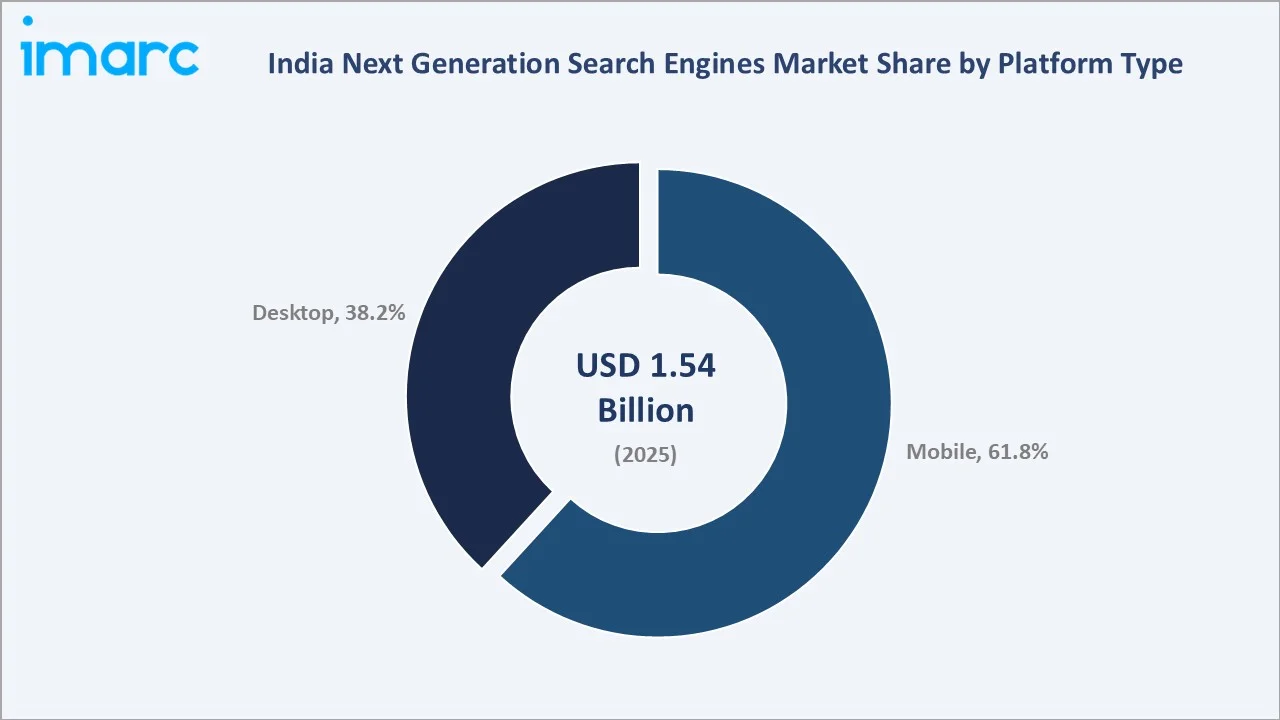
Mobile leads at 61.8% (2025), due to the country’s mobile-first internet usage and rapid smartphone adoption. Most users access search engines through mobile browsers, apps, and voice-enabled assistants. Rising use of regional-language search, location-based discovery, and conversational AI on smartphones further strengthens mobile demand. Growth in e-commerce, digital payments, entertainment, and social media also keeps mobile search volumes significantly higher than desktop-based search.
To access detailed market analysis, Request Sample
Desktop at 38.2% reflects India's enterprise IT professionals, developers, and government researchers' preferred complex AI search through Perplexity Pro, Microsoft Copilot for Enterprise, and Google Workspace AI.
By Distribution Channel
Online leads at 84.6% (2025), due to India’s expanding internet user base and rising dependence on digital platforms for information, shopping, education, entertainment, and services. Most next generation search activity occurs through web platforms, mobile apps, e-commerce portals, and cloud-based AI tools. Growing real-time content discovery, personalized recommendations, and AI-powered search experiences further strengthen online demand. Enterprise adoption of online AI search and SaaS-based knowledge platforms also supports segment leadership.
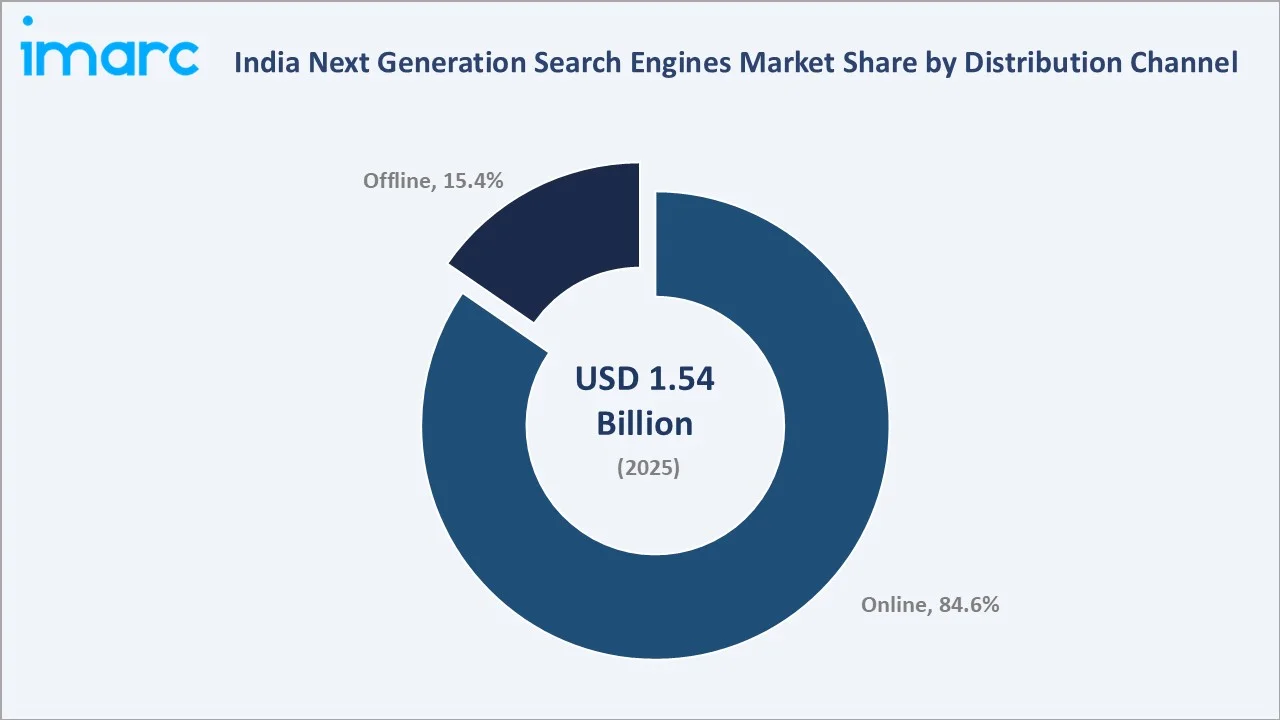
Offline at 15.4% encompasses enterprise on-premise AI search deployment and AI search training and consulting service.
Regional Market Insights
|
Region |
Share (2025) |
Key India Next Generation Search Engines Market Drivers & Characteristics |
|
North India |
32.8% |
Driven by a large internet user base, strong enterprise digital adoption, and a concentration of technology firms, educational institutions, and government organizations. |
|
West India |
26.9% |
Strong adoption of enterprise AI solutions, fintech platforms, e-commerce, and digital advertising is driving demand for advanced search and knowledge discovery technologies. |
|
South India |
23.4% |
Growing use of AI, cloud computing, SaaS platforms, and multilingual search solutions supports continued market expansion. |
|
East India |
16.9% |
Supported by increasing internet penetration, smartphone adoption, and digital service usage across emerging urban centers. |
North India leads the market with a 32.8% share, supported by strong enterprise digital adoption, government platforms, education hubs, and a large internet user base. West India follows with 26.9%, driven by fintech, e-commerce, BFSI, and digital advertising demand.
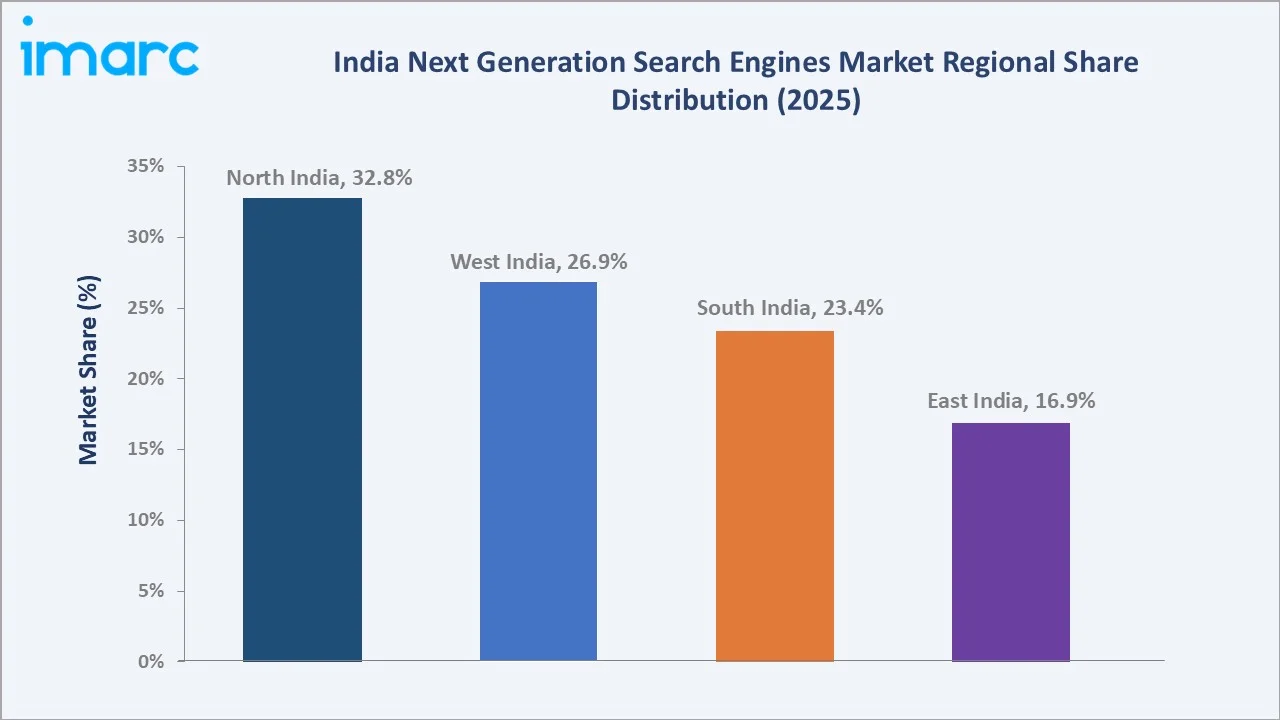
South India holds 23.4%, supported by its strong IT, SaaS, startup, and AI ecosystem. East India accounts for 16.9%, with growth supported by rising smartphone penetration, vernacular search demand, online education, and expanding digital services.
Competitive Landscape
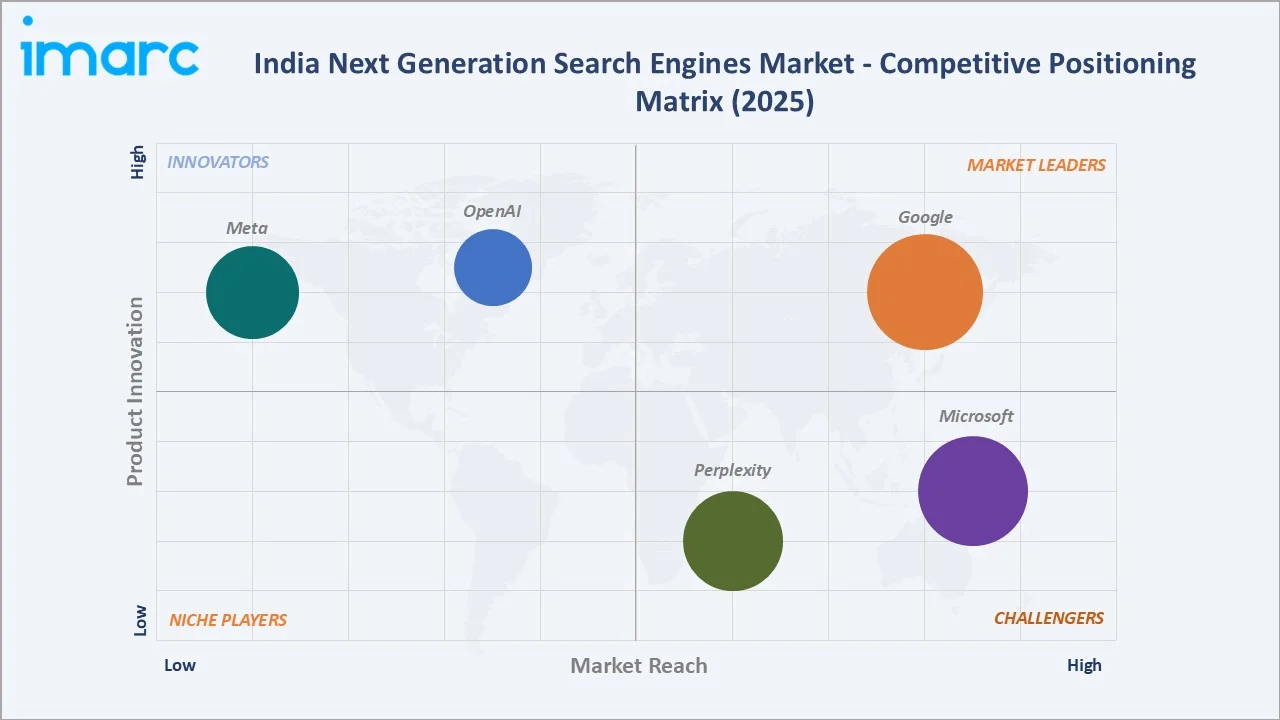
The India next generation search engines market is highly competitive, led by global technology companies with strong AI, cloud, and search capabilities. Competition is increasingly centered on generative AI integration, conversational search, multilingual support, and enterprise knowledge discovery solutions. Established players benefit from large user bases, extensive data ecosystems, and significant R&D investments, while startups focus on niche AI search applications and privacy-centric offerings.
|
Company |
Key Products |
Market Position |
Core Strength |
|
|
AI Overviews, Gemini |
Market Leader |
Google is actively transforming its search engine in India into a personalized, AI-driven assistant, treating the country as a global testbed for next generation search technology. |
|
Microsoft |
Microsoft Bing, Copilot |
Strong Challenger |
Microsoft is playing a pivotal, transformative role in shaping next generation search engines in India by integrating artificial intelligence (AI) into its core search and productivity tools, treating India as a strategic hub with significant investments. |
|
OpenAI |
ChatGPT |
Innovator |
OpenAI is playing a pivotal role in the transformation of search engines in India, moving from a text-based, keyword-driven model to a conversational, AI-driven, and hyper-localized experience. |
|
Perplexity |
Perplexity |
Strong Challenger |
Perplexity is rapidly redefining the search landscape in India, shifting the paradigm from link-based browsing to AI-native, conversational "answer engines". |
|
Meta |
Meta AI |
Innovator |
Meta is playing a transformative, high-stakes role in shaping India's next generation search landscape, moving beyond social media to become a primary AI-driven information ecosystem. Meta is actively developing its own AI-powered search engine, utilizing its proprietary web crawler to crawl data for Meta AI on WhatsApp, Instagram, and Facebook. |
India's next generation search competitive landscape is evolving through Indic-language specialization, WhatsApp AI distribution moat, and enterprise SaaS AI search.
Key Company Profiles
Google is the dominant player in the India next generation search engines market, offering a comprehensive ecosystem of AI-powered search, cloud computing, advertising, and digital productivity solutions. The company continues to enhance its search capabilities through generative AI, natural language processing, semantic search, and multimodal query understanding.
- Key Products: AI Overviews, Gemini.
- Recent Developments: In June 2025, Google introduced its advanced AI Mode search experience in India, enabling users to search through more natural, detailed, and complex queries. Earlier tested in the US, the feature is now available in English through Search Labs, where users can try early Google Search tools and provide feedback. Once enabled, AI Mode appears as a new tab in Search and the Google app, using Gemini 2.5 to support text, voice, and image-based queries with enhanced reasoning capabilities.
- Strategic Focus: Integrating Generative AI, Gemini models, and multimodal search capabilities to deliver more conversational, context-aware, and personalized search experiences.
Microsoft
Microsoft is a leading participant in the India next generation search engines market through its AI-powered search, cloud computing, and enterprise productivity ecosystem. The company operates Bing, which integrates advanced generative AI and large language models to deliver conversational, multimodal, and context-aware search experiences.
- Key Products: Microsoft Bing, Copilot.
- Strategic Focus: Emphasizing generative AI, multimodal search, and conversational experiences that enable users to interact through text, voice, and images.
Market Concentration Analysis
The India next generation search engines market is highly concentrated, with a few global technology companies accounting for a significant share of search traffic, AI infrastructure, and enterprise search deployments. Established players benefit from extensive user bases, large-scale data ecosystems, advanced AI models, and substantial R&D investments. Market leadership is increasingly influenced by capabilities in generative AI, multimodal search, conversational interfaces, and cloud-based knowledge management. While dominant firms maintain strong competitive advantages, emerging startups and niche providers are gaining traction through enterprise AI search, privacy-focused solutions, and industry-specific applications. Competition is expected to intensify as AI-driven search becomes a core component of India's digital economy.
Investment & Growth Opportunities
Highest Growth Segments
Mobile platform (~10.8% CAGR), Indic language AI search (~15-20% CAGR from smaller base), enterprise knowledge SaaS (~12-14% CAGR), E-commerce AI product discovery (~12-15% CAGR), and agentic AI search (~20-25% CAGR from small base) represent India next gen search highest-growth investment vectors through 2034.
Investment Themes
- Enterprise knowledge management AI search SaaS: Focuses on AI-powered search platforms that help organizations retrieve, organize, and analyze information across documents, emails, databases, and enterprise applications. Growing digital transformation and the need for faster decision-making are driving demand for enterprise search SaaS solutions across IT, BFSI, healthcare, and manufacturing sectors.
- Voice-first rural Bharat AI search: Targets India's rapidly expanding rural internet user base through voice-enabled and regional-language AI search experiences. As millions of first-time internet users prefer speaking rather than typing, voice-first search platforms can unlock significant growth opportunities in digital services, e-commerce, education, agriculture, and financial inclusion.
Future Market Outlook (2026-2034)
India next generation search engines market is expected to grow strongly from USD 1.54 Billion in 2025 to USD 3.79 Billion by 2034, registering a 10.19% CAGR. The USD 2.51 Billion market size in 2030 indicates a mainstream inflection point, where AI-powered, conversational, and personalized search moves beyond early adoption. Growth will be supported by generative AI, voice search, multilingual search, and enterprise knowledge management solutions. Rising internet users, mobile-first behavior, and digital business adoption will further strengthen demand. By 2034, next generation search is expected to become a core layer of India’s consumer and enterprise digital ecosystem.
Three structural forces define India’s next generation search market through 2034: AI-led search transformation, mobile-first digital adoption, and enterprise knowledge automation. Generative AI and LLMs are shifting search from keyword results to conversational, contextual, and multimodal answers. India’s large mobile and multilingual user base is driving demand for voice-enabled and vernacular search. At the same time, enterprises are adopting AI search SaaS to improve knowledge discovery, productivity, and decision-making.
Research Methodology
Primary Research
Primary research comprised interviews and discussions with search engine providers, AI platform developers, cloud service companies, enterprise software vendors, digital marketing professionals, and industry experts. These interactions helped assess adoption trends, technology preferences, monetization strategies, and enterprise demand for AI-powered search solutions. Insights from stakeholders were used to validate market size estimates, growth drivers, competitive dynamics, and future opportunities in the India next generation search engines market.
Secondary Research
Secondary research encompassed company reports, industry publications, government digital policy documents, AI adoption studies, internet usage data, and technology news sources. It also included analysis of cloud, GenAI, search engine, and enterprise SaaS trends. These sources helped validate market growth, competitive positioning, technology landscape, and future demand patterns.
Forecasting Models
India next generation search engines market revenue forecasts were developed using ad revenue and the SaaS subscription model: India digital advertising market forecast with AI search advertising share of total India digital ad spend multiplied by programmatic AI search CPM and CPC rate.
India Next Generation Search Engines Market Report Coverage:
| Report Features | Details |
|---|---|
| Base Year of the Analysis | 2025 |
| Historical Period | 2020-2025 |
| Forecast Period | 2026-2034 |
| Units | Billion USD |
| Scope of the Report |
Exploration of Historical Trends and Market Outlook, Industry Catalysts and Challenges, Segment-Wise Historical and Future Market Assessment:
|
| Platform Types Covered | Mobile, Desktop |
| Distribution Channels Covered | Online, Offline |
| End Users Covered | Personal, Commercial |
| Regions Covered | North India, South India, East India, West India |
| Companies Covered | Google, Microsoft, OpenAI, Perplexity, Meta, etc. |
| Customization Scope | 10% Free Customization |
| Post-Sale Analyst Support | 10-12 Weeks |
| Delivery Format | PDF and Excel through Email (We can also provide the editable version of the report in PPT/Word format on special request) |
Key Benefits for Stakeholders:
- IMARC’s industry report offers a comprehensive quantitative analysis of various market segments, historical and current market trends, market forecasts, and dynamics of the India next generation search engines market from 2020-2034.
- The research report provides the latest information on the market drivers, challenges, and opportunities in the India next generation search engines market.
- Porter's five forces analysis assist stakeholders in assessing the impact of new entrants, competitive rivalry, supplier power, buyer power, and the threat of substitution. It helps stakeholders to analyze the level of competition within the India next generation search engines industry and its attractiveness.
- Competitive landscape allows stakeholders to understand their competitive environment and provides an insight into the current positions of key players in the market.
Frequently Asked Questions About the India Next Generation Search Engines Market Report
The India next generation search engines market reached USD 1.54 Billion in 2025, driven by rapid internet growth, mobile-first usage, and rising demand for AI-powered, conversational, and personalized search experiences. Generative AI, LLMs, voice search, and multilingual capabilities are transforming how users discover information online. Enterprise adoption of AI for knowledge management, customer support, and productivity is also strengthening market demand. Growth in e-commerce, fintech, edtech, and digital public services further supports next generation search adoption.
The India next generation search engines market grows at 10.19% CAGR during 2026-2034, reaching USD 3.79 Billion by 2034. The CAGR reflects generative AI mainstream adoption, Indic language LLM scaling, enterprise knowledge SaaS, agentic AI search, and India's internet user expansion.
Mobile leads at 61.8% due to the country's mobile-first internet ecosystem and widespread smartphone adoption. Most users access search services through mobile apps, browsers, voice assistants, and AI-powered tools, making smartphones the primary gateway for next generation search experiences.
Online leads at 84.6% as most next generation search activity occurs through web platforms, mobile apps, cloud-based AI tools, and digital service portals. Rising use of e-commerce, online education, fintech, entertainment, and real-time information discovery continues to strengthen online search demand.
North India leads at 32.8% due to its large internet user base, strong enterprise digitization, and concentration of government, education, and business services. Rising mobile search, vernacular content consumption, and AI adoption across urban centers further support regional leadership.
Leading companies include Google, Microsoft, OpenAI, Perplexity, and Meta, among others.
The market is projected to reach USD 2.51 Billion by 2030, indicating that next generation search engines are moving toward mainstream adoption in India. Growth will be supported by AI-powered search, voice and vernacular queries, and enterprise knowledge management solutions. This milestone reflects stronger integration of generative AI, personalization, and conversational search across consumer and business use cases.
Three priority investment opportunities include enterprise knowledge management AI search SaaS, voice-first rural Bharat AI search, and generative AI-powered search platforms. These areas are benefiting from growing enterprise digitization, rising internet penetration in regional markets, and increasing adoption of conversational AI. As organizations and consumers demand more personalized, multilingual, and context-aware search experiences, these segments are expected to attract significant investment and innovation.
Need more help?
- Speak to our experienced analysts for insights on the current market scenarios.
- Include additional segments and countries to customize the report as per your requirement.
- Gain an unparalleled competitive advantage in your domain by understanding how to utilize the report and positively impacting your operations and revenue.
- For further assistance, please connect with our analysts.
 Request Customization
 Speak to an Analyst
 Request Brochure
 Inquire Before Buying
Benefits of Customization
- Personalize this research
- Triangulate with your data
- Get data as per your format and definition
- Gain a deeper dive into a specific application, geography, customer, or competitor
- Any level of personalization
Get in Touch With Us
UNITED STATES
Phone: +1-201-971-6302
INDIA
Phone: +91-120-433-0800
UNITED KINGDOM
Phone: +44-753-714-6104
Email: [email protected]
Client Testimonials




.webp)




.webp)













Related Reports

Choose your plan
*Please note that the prices mentioned below are starting prices for each bundle type. Kindly contact our team for further details.*
Single User License
- 1 User License, Access on 2 Devices
- PDF Report + Excel Dataset (Password Protected)
- Lifetime Access
- No Printing Rights
- 10% Free Report Customization
- 10–12 Weeks of Analyst Support
Five User License
- Access for 5 Users, 2 Devices per User
- PDF Report + Excel Dataset (Password Protected)
- Lifetime Access
- Dedicated Account Manager
- 12–14 Weeks of Analyst Support
- No Printing Rights
- 15% Free Report Customization
- 25% Discount on Your Next Purchase
Corporate User License
- Unlimited User Access (Within Your Organization)
- PDF Report + Excel Dataset
- Lifetime Access
- Dedicated Account Manager
- 14–20 Weeks of Analyst Support
- No Printing Rights
- 20% Free Report Customization
- 30% Discount on Your Next Purchase
Essential Insights
What's included:
3 reports
- Lifetime Access
- PDF Reports
- Excel Datasets
- 2 Weeks of Free Analyst Support
- 2 User Licenses
- Access on 2 Devices
- Printing Rights
- Complimentary PowerPoint (PPT) Version
- Complimentary License Upgrade
Professional Access
What's included:
5 reports
- Lifetime Access
- PDF Reports
- Excel Datasets
- 8 Weeks of Free Analyst Support
- 2 User Licenses
- Access on 2 Devices
- Printing Rights
- Complimentary PowerPoint (PPT) Version
- Complimentary License Upgrade
Business Advantage
What's included:
8 reports
- Lifetime Access
- PDF Reports
- Excel Datasets
- 14 Weeks of Free Analyst Support
- 2 User Licenses
- Access on 2 Devices
- Printing Rights
- Complimentary PowerPoint (PPT) Version
- Complimentary License Upgrade
Enterprise Intelligence
What's included:
10 reports
- Lifetime Access
- PDF Reports
- Excel Datasets
- 20 Weeks of Free Analyst Support
- 2 User Licenses
- Access on 2 Devices
- Printing Rights
- Complimentary PowerPoint (PPT) Version
- Complimentary License Upgrade