
India Smart Manufacturing Market Size, Share, Trends and Forecast by Component, Technology, End Use, and Region, 2026-2034
India Smart Manufacturing Market Size, Share, Trends & Forecast (2026-2034)
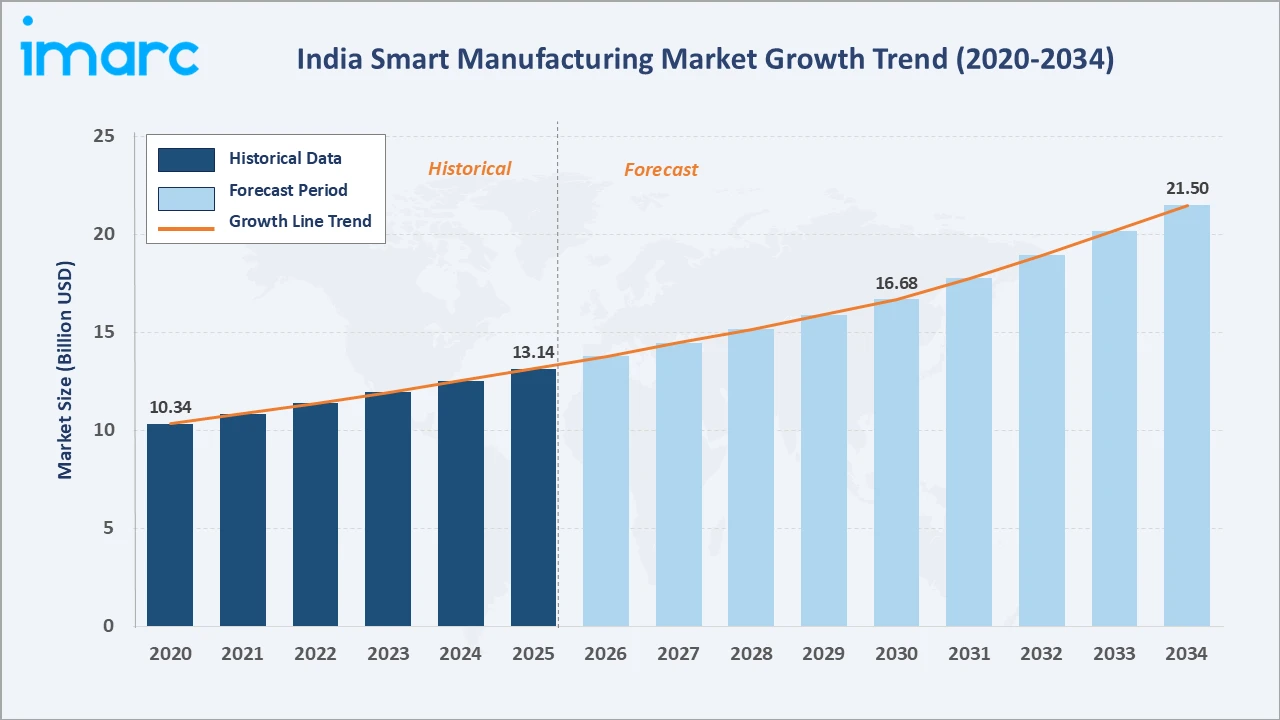
The India smart manufacturing market size increased from USD 13.14 Billion in 2025 to USD 14.67 Billion in 2026 and is projected to reach USD 21.50 Billion by 2034, growing at a CAGR of 4.90% during 2026-2034. Hardware leads components at 52.5%, Automotive leads end use at 24.5%, and West and Central India leads regionally at 32.0%.
Market Snapshot
|
Metric |
Value |
|
Base Year Market Size (2025) |
USD 13.14 Billion |
|
Market Size (2026) |
USD 14.67 Billion |
|
Forecast Market Size (2034) |
USD 21.50 Billion |
|
CAGR (2026-2034) |
4.90% |
|
Base Year |
2025 |
|
Historical Period |
2020-2025 |
|
Forecast Period |
2026-2034 |
|
Dominant Component |
Hardware (52.5%, 2025) |
|
Dominant End Use |
Automotive (24.5%, 2025) |
|
Leading Region |
West and Central India (32.0%, 2025) |
The market expanded from an estimated USD 10.34 Billion in 2020 to USD 13.14 Billion in 2025 and an estimated USD 14.67 Billion in 2026, anchored at USD 16.68 Billion in 2030 and forecast to reach USD 21.50 Billion by 2034. Steady digital adoption across automotive and electronics manufacturing hubs continues to underpin this consistent growth trajectory.
To get more information on this market, Request Sample
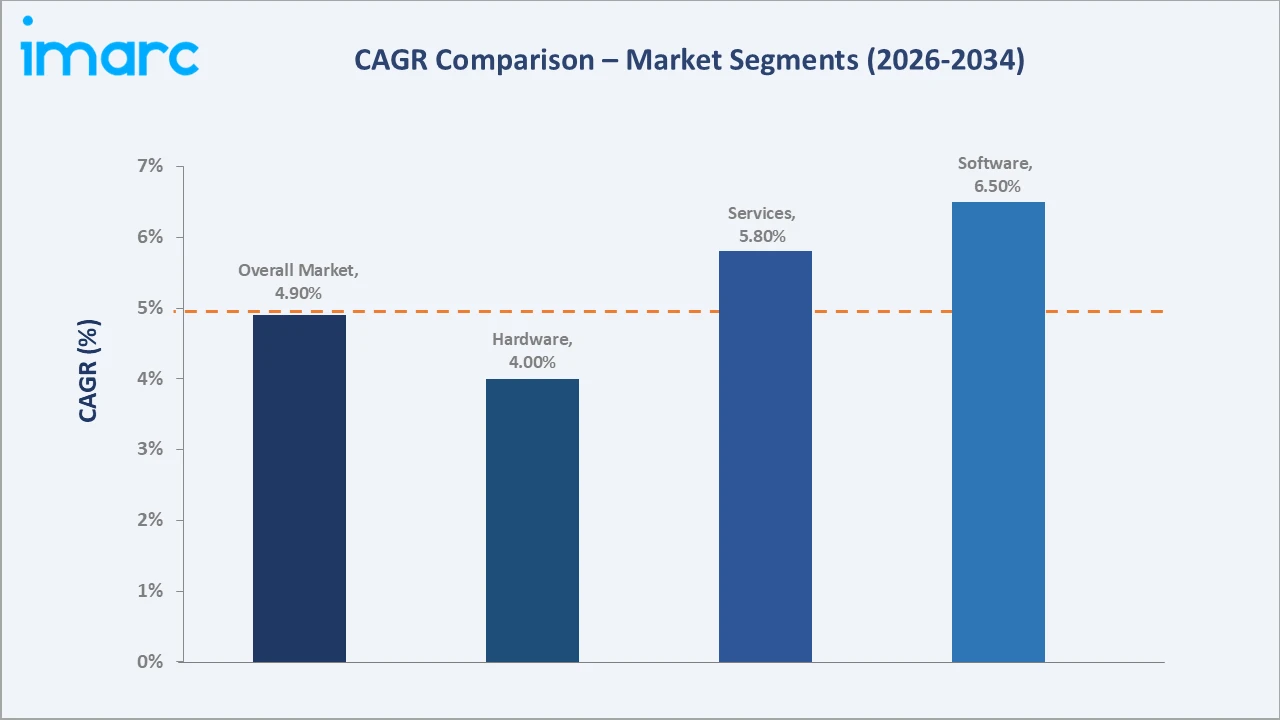
Software grows fastest among components at ~6.5% CAGR as manufacturers prioritize MES, analytics, and AI platforms over standalone hardware purchases. Electronics leads end-use growth at ~7.0% CAGR, driven by expanding semiconductor and electronics assembly capacity nationwide.
Executive Summary
The India smart manufacturing market, which increased from USD 13.14 Billion in 2025 to an estimated USD 14.67 Billion in 2026, reflecting the country's accelerating shift toward connected, data-driven production supported by Make in India, the Production Linked Incentive (PLI) scheme, and rising Industry 4.0 investment across automotive, electronics, and industrial equipment manufacturing. The market is projected to reach USD 21.50 Billion by 2034.
Hardware at 52.5% dominates the component mix as sensors, PLCs, and robotics form the foundation of factory digitalization, while Software at 29.4% is scaling fastest as manufacturers adopt MES, AI, and analytics platforms. Automotive at 24.5% leads end use through large-scale automated assembly adoption, and West and Central India at 32.0% leads regionally through the region's dense industrial manufacturing base and strong logistics connectivity.
Key Market Insights
|
Insight |
Data |
|
Dominant Component |
Hardware - 52.5% share (2025) |
|
Dominant End Use |
Automotive - 24.5% market share (2025) |
|
Leading Region |
West and Central India - 32.0% market share (2025) |
|
Market Opportunity |
AI-driven predictive maintenance; 5G private networks; digital twin platforms; cloud-based MES for SMEs; cybersecurity-as-a-service |
Key Analytical Observations Supporting the Above Data:
- Hardware at 52.5%: Hardware dominates as sensors, PLCs, robotics, and machine vision systems form the essential physical foundation for factory digitalization across Indian manufacturing plants, particularly in automotive and industrial equipment production.
- Automotive at 24.5%: The automotive segment leads end-use demand as Indian OEMs and component suppliers scale automated, connected assembly lines to meet export quality standards and domestic production targets.
- West and Central India at 32.0%: This region leads through its dense concentration of automotive, chemicals, and industrial manufacturing clusters, supported by strong industrial infrastructure and port connectivity.
India Smart Manufacturing Market Overview
The India smart manufacturing market encompasses the hardware, software, and services used to digitalize manufacturing operations across automotive, electronics, industrial equipment, chemicals, aerospace, healthcare, food and agriculture, and oil and gas production facilities nationwide.
The ecosystem integrates sensor and automation hardware suppliers, IIoT and MES software providers, systems integrators, cloud and connectivity infrastructure providers, manufacturing OEMs, and regulatory bodies setting Industry 4.0 and data standards. Government programmes, rising labour costs, and global competitiveness pressures are key macroeconomic drivers.
Manufacturing digitalization spending in India remains concentrated among large enterprises and export-oriented producers, though increasing technology affordability and government support are gradually extending adoption into smaller manufacturing operations across the country.
Market Dynamics
To evaluate market opportunities, Request Sample
Market Drivers
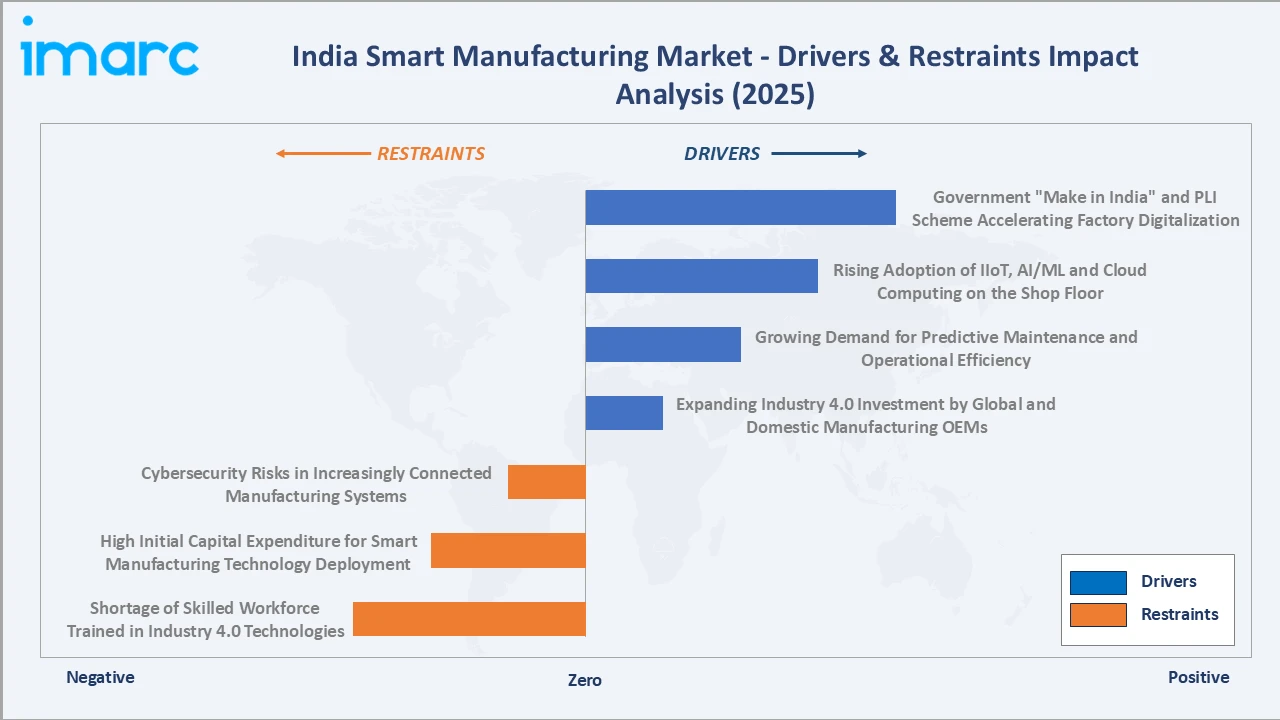
- Government “Make in India” and PLI Scheme Accelerating Factory Digitalization: The Production Linked Incentive scheme and Make in India initiative are encouraging manufacturers to modernize plants with connected, digitally monitored production lines to qualify for incentives and improve export competitiveness, directly boosting smart manufacturing technology adoption. These programmes are also incentivizing capital investment in domestic sensor, robotics, and automation component manufacturing, reducing reliance on imported hardware. As eligibility criteria increasingly reward measurable productivity and quality gains, manufacturers are accelerating digitalization timelines to remain compliant and competitive.
- Rising Adoption of IIoT, AI/ML and Cloud Computing on the Shop Floor: Increasing deployment of industrial IoT sensors, AI-based analytics, and cloud platforms is enabling real-time monitoring, predictive maintenance, and data-driven decision-making, encouraging manufacturers across sectors to invest further in connected production systems. Falling sensor and connectivity hardware costs are making shop-floor digitalization economically viable even for mid-sized manufacturers. As more production data becomes available, manufacturers are increasingly layering AI-based quality control and yield optimization tools on top of existing IIoT infrastructure.
- Growing Demand for Predictive Maintenance and Operational Efficiency: Manufacturers are increasingly prioritizing predictive maintenance solutions to reduce unplanned downtime and improve asset utilization, driving sustained demand for sensor-based monitoring hardware and analytics software across automotive and industrial equipment plants. Unplanned downtime remains a significant cost burden for high-volume production lines, pushing plant managers to adopt condition-based monitoring over traditional scheduled maintenance. This shift is also extending equipment lifecycles and lowering total spare parts and maintenance expenditure over time.
- Expanding Industry 4.0 Investment by Global and Domestic Manufacturing OEMs: Global and domestic OEMs are increasing capital allocation toward Industry 4.0 infrastructure, including robotics, digital twins, and automated quality control, to strengthen India's position as a global manufacturing and export hub. Several multinational manufacturers are establishing new greenfield facilities in India that are digitally native from inception, rather than retrofitting legacy plants. This trend is setting new benchmarks for automation intensity that domestic manufacturers are increasingly expected to match.
Market Restraints
- High Initial Capital Expenditure for Smart Manufacturing Technology Deployment: The upfront cost of sensors, software licensing, systems integration, and workforce retraining remains high, limiting adoption among small and medium manufacturers operating with constrained capital budgets. Return-on-investment timelines for full-scale digitalization projects can extend beyond typical capital planning horizons, making budget approval difficult for smaller manufacturing units. Many manufacturers consequently adopt smart manufacturing technologies in phased, lower-cost increments rather than comprehensive plant-wide rollouts.
- Shortage of Skilled Workforce Trained in Industry 4.0 Technologies: A limited pool of workers skilled in IIoT, data analytics, and automation systems is slowing implementation timelines and increasing dependency on external integrators for plant digitalization projects. This skills gap is particularly acute outside major industrial hubs, where technical training infrastructure remains limited. Manufacturers are increasingly partnering with vocational institutes and technology vendors to build internal digital competency rather than relying solely on external contractors.
- Cybersecurity Risks in Increasingly Connected Manufacturing Systems: As factory systems become more interconnected, exposure to cyberattacks and data breaches increases, requiring additional investment in security infrastructure that can delay or complicate digitalization initiatives. Legacy operational technology systems were not originally designed with cybersecurity in mind, making retrofitted connectivity a particular point of vulnerability. Manufacturers handling sensitive production data face additional compliance burdens that can further slow digitalization rollouts.
Market Opportunities
- 5G-Enabled Private Networks in Manufacturing Plants: Expansion of 5G private network infrastructure can enable ultra-low-latency machine communication and wireless automation, creating new deployment opportunities for smart manufacturing technology providers across large industrial campuses. Private 5G networks can eliminate much of the wiring complexity associated with traditional factory automation, shortening plant commissioning timelines. Early deployments in large industrial campuses are demonstrating measurable gains in machine responsiveness and wireless robotics coordination.
- AI-Driven Digital Twin Adoption in Tier-2 and Tier-3 Manufacturing Clusters: Extending digital twin and simulation technologies beyond large enterprises into smaller manufacturing clusters can unlock a substantial underserved customer base for platform and integration providers. Lower-cost, modular digital twin offerings tailored to smaller production lines could significantly widen the addressable market beyond large enterprise deployments. Vendors that successfully simplify implementation for smaller manufacturers stand to capture meaningful first-mover advantage in this segment.
Market Challenges
- Interoperability Issues Between Legacy Machinery and New Smart Systems: Many Indian factories operate with older equipment that lacks native connectivity, requiring costly retrofitting and creating integration complexity for smart manufacturing technology deployment. Retrofitting legacy machinery with sensors and connectivity modules often requires customized engineering work rather than standardized solutions, extending project timelines. This complexity disproportionately affects older industrial clusters where equipment replacement cycles have historically been longer.
- Data Privacy and Standardization Challenges Across Fragmented Vendor Ecosystems: The absence of unified data standards across hardware and software vendors complicates system integration and raises data governance concerns for manufacturers adopting multi-vendor smart manufacturing solutions. Manufacturers operating multi-vendor technology stacks often face additional integration costs to reconcile incompatible data formats and communication protocols. The lack of standardized data governance frameworks also complicates compliance as manufacturers increasingly handle sensitive production and customer data.
Emerging Market Trends
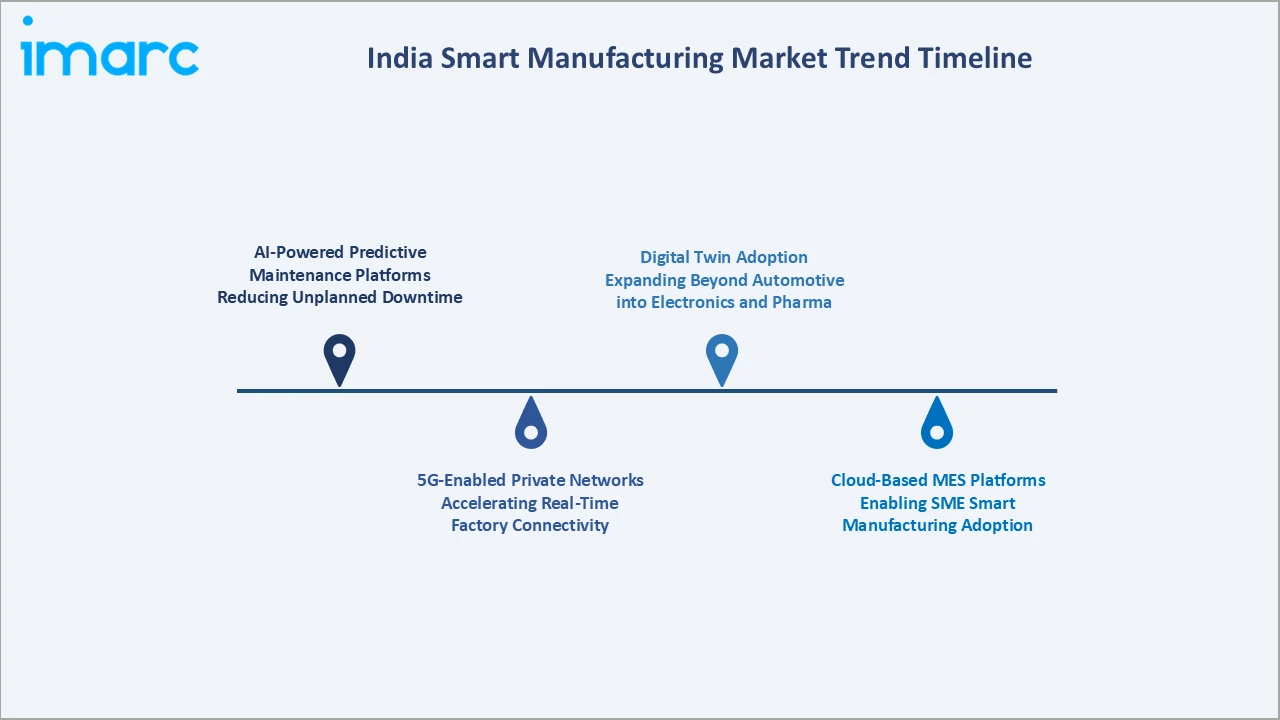
1. AI-Powered Predictive Maintenance Platforms Reducing Unplanned Downtime
AI-powered predictive maintenance platforms are gaining traction as manufacturers seek to minimize unplanned downtime and extend equipment life. These systems combine sensor data with machine learning to forecast failures before they occur, improving overall equipment effectiveness across automotive and process industries.
2. 5G-Enabled Private Networks Accelerating Real-Time Factory Connectivity
5G-enabled private networks are being deployed within large manufacturing campuses to support ultra-reliable, low-latency communication between machines, robots, and control systems, enabling more responsive automation and reducing reliance on wired infrastructure.
3. Digital Twin Adoption Expanding Beyond Automotive into Electronics and Pharma
Digital twin technology, initially concentrated in automotive manufacturing, is expanding into electronics assembly and pharmaceutical production as manufacturers seek virtual simulation capabilities to optimize production before physical implementation.
4. Cloud-Based MES Platforms Enabling SME Smart Manufacturing Adoption
Cloud-based manufacturing execution systems are lowering the cost and complexity of smart manufacturing adoption for small and medium enterprises, enabling real-time production visibility without large upfront infrastructure investment.
Industry Value Chain Analysis
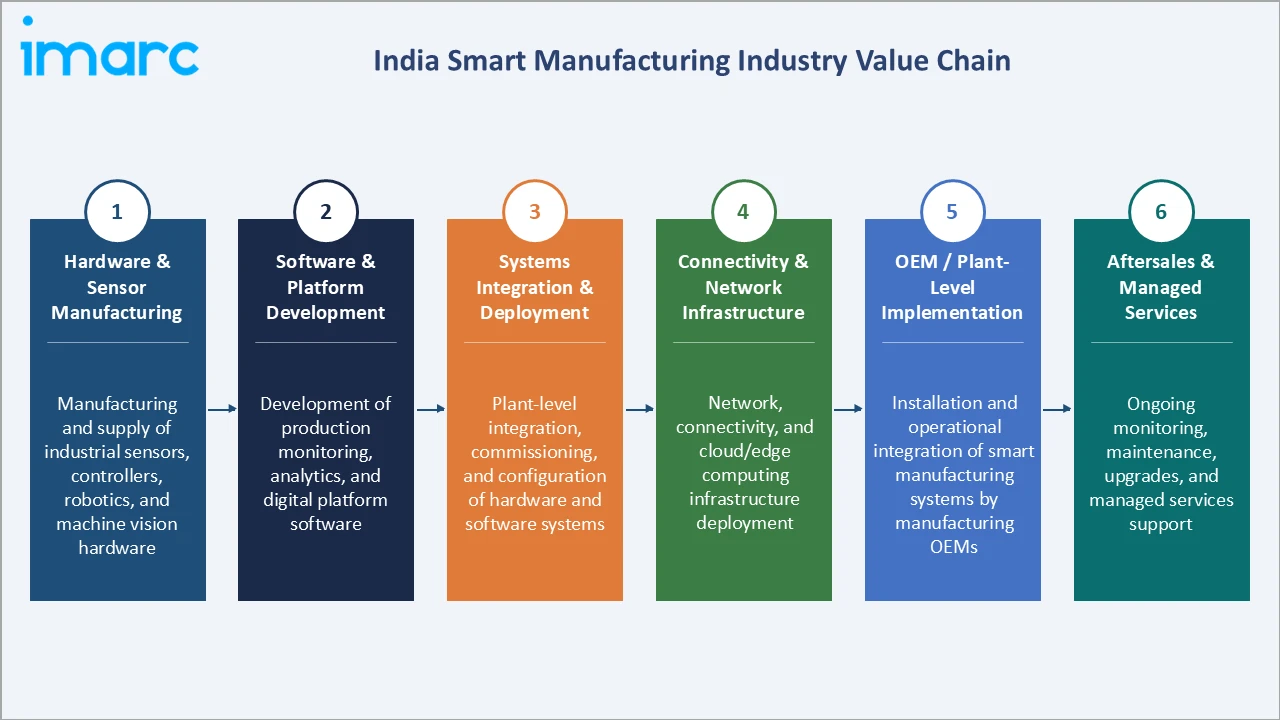
The India smart manufacturing value chain integrates hardware and sensor manufacturing, software and platform development, systems integration, connectivity infrastructure, OEM-level implementation, and aftersales support. Commercial activity is increasingly consolidating around integrated hardware-software-service bundles rather than standalone component sales.
|
Stage |
Key Participants |
|
Hardware & Sensor Manufacturing |
Manufacturing and supply of industrial sensors, controllers, robotics, and machine vision hardware |
|
Software & Platform Development |
Development of production monitoring, analytics, and digital platform software |
|
Systems Integration & Deployment |
Plant-level integration, commissioning, and configuration of hardware and software systems |
|
Connectivity & Network Infrastructure |
Network, connectivity, and cloud/edge computing infrastructure deployment |
|
OEM / Plant-Level Implementation |
Installation and operational integration of smart manufacturing systems by manufacturing OEMs |
|
Aftersales & Managed Services |
Ongoing monitoring, maintenance, upgrades, and managed services support |
The software and platform development tier is experiencing the value chain's fastest growth as manufacturers shift spending from one-time hardware purchases toward recurring software and analytics subscriptions.
Technology Landscape in the India Smart Manufacturing Industry
Industrial Internet of Things (IIoT) Platforms
Industrial Internet of Things platforms connect sensors, machines, and control systems to enable real-time data collection and remote monitoring across production facilities. Their ability to support predictive maintenance and process optimization is driving broad adoption across automotive and electronics manufacturing.
Artificial Intelligence and Machine Learning Analytics
AI and machine learning analytics enable manufacturers to convert shop-floor data into actionable insights, supporting predictive maintenance, quality control, and production scheduling optimization. Growing data volumes from connected equipment are accelerating demand for advanced analytics capabilities.
Cloud-Based Manufacturing Execution Systems (MES)
Cloud-based MES platforms provide centralized production visibility, work order management, and quality tracking without heavy on-premises infrastructure. Their scalability and lower upfront cost are making them increasingly attractive to small and medium manufacturers.
Market Segmentation Analysis
The report covers the following segments:
|
Segment Category |
Leading Segment |
Market Share |
Year |
|
Component |
Hardware |
52.5% |
2025 |
|
Technology |
Programmable Logic Controller |
22.8% |
2025 |
|
End Use |
Automotive |
24.5% |
2025 |
|
Region |
West and Central India |
32.0% |
2025 |

By Component
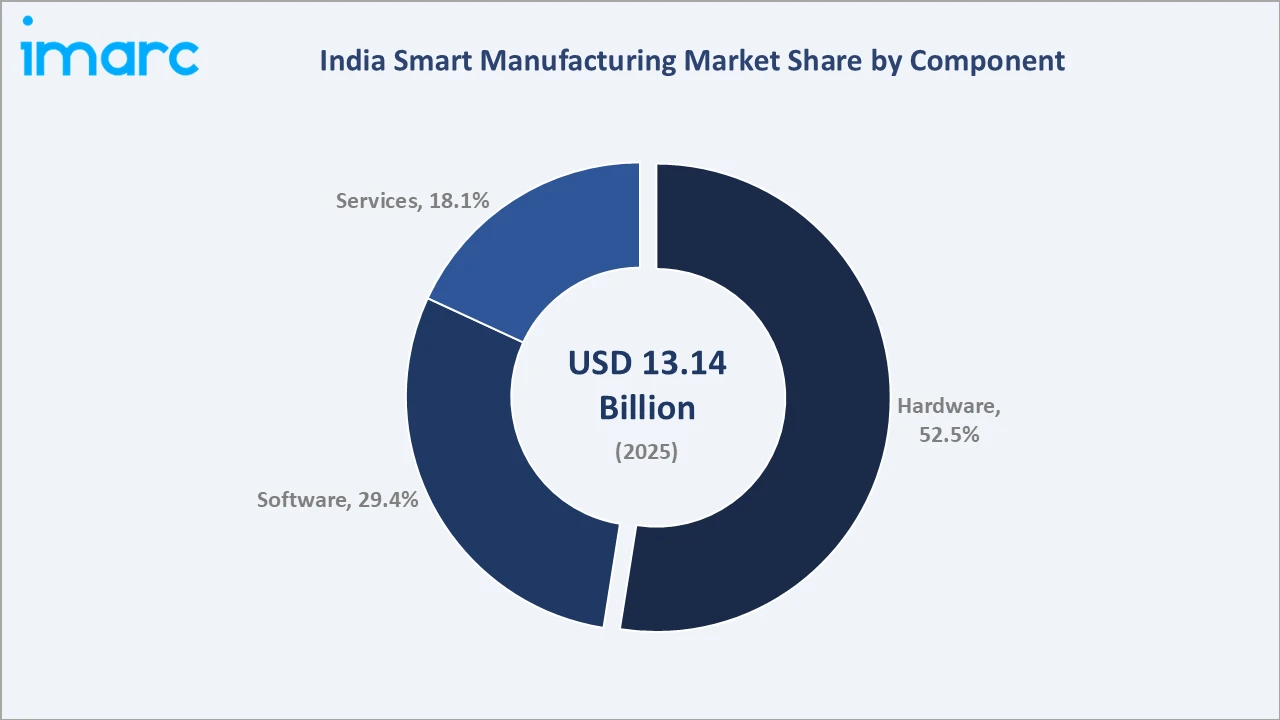
Hardware leads at 52.5% in 2025, encompassing sensors, PLCs, robotics, and machine vision systems that form the physical backbone of factory digitalization across Indian manufacturing plants.
To access detailed market analysis, Request Sample
Software at 29.4% is the fastest-growing component as manufacturers increasingly prioritize MES, AI analytics, and digital twin platforms. Services at 18.1% covers systems integration, consulting, and managed support essential to successful deployment.
By End Use
Automotive leads end use at 24.5% through large-scale automated assembly line adoption among domestic and export-focused vehicle and component manufacturers. Electronics at 17.8% follows closely, driven by expanding semiconductor and electronics assembly capacity nationwide.
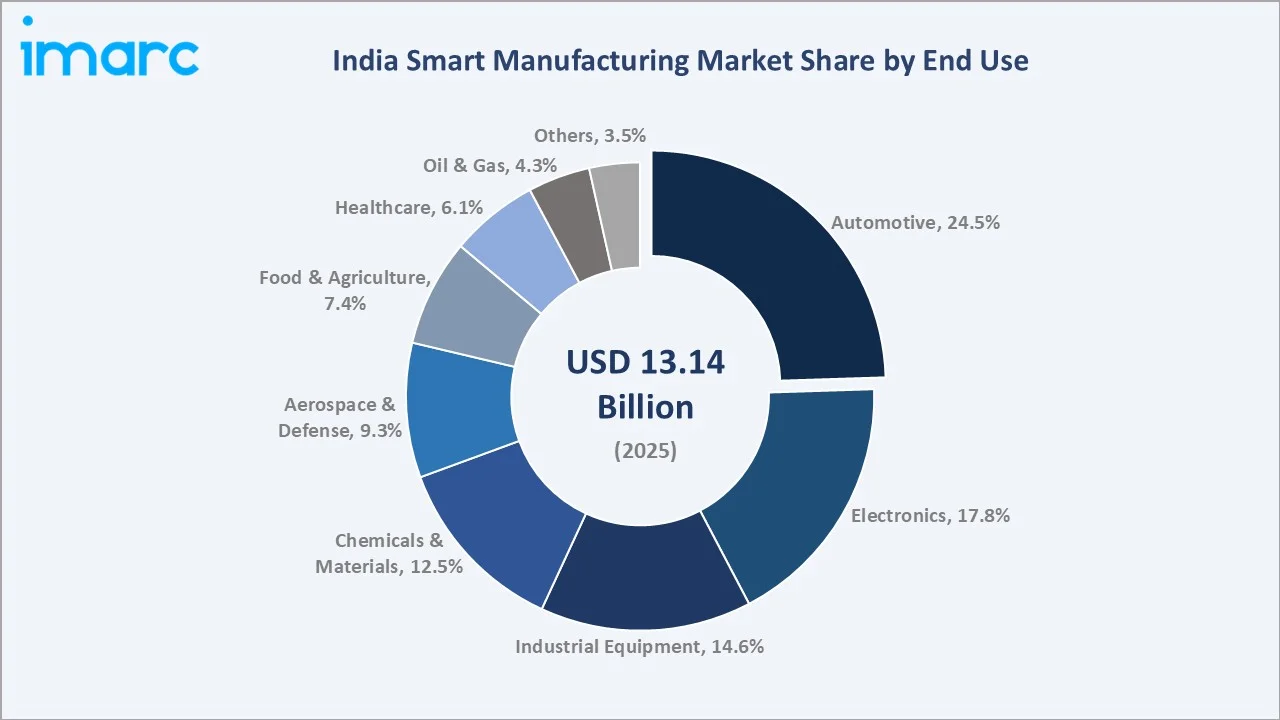
Industrial Equipment at 14.6% and Chemicals and Materials at 12.5% reflect steady automation adoption in process-heavy industries, while Aerospace and Defense at 9.3% is expanding on the back of domestic manufacturing and defence production initiatives.
Regional Market Insights
|
Region |
Share (2025) |
Key Smart Manufacturing Market Drivers & Characteristics |
|
West and Central India |
32.0% |
Driven by strong industrial manufacturing infrastructure, dense automotive and process industry concentration, and well-established logistics and port connectivity |
|
South India |
27.8% |
Supported by expanding electronics and technology manufacturing capacity, strong engineering talent availability, and growing precision and aerospace manufacturing investment |
|
North India |
24.1% |
Driven by expanding automotive and industrial equipment manufacturing activity and increasing government-led digitalization initiatives |
|
East and Northeast India |
16.1% |
Emerging through rising industrial investment, expanding infrastructure development, and growing manufacturing corridor initiatives |
West and Central India, at 32.0%, leads through its dense industrial manufacturing base and strong logistics infrastructure. South India, at 27.8%, reflects the region's growing electronics and technology manufacturing strength.
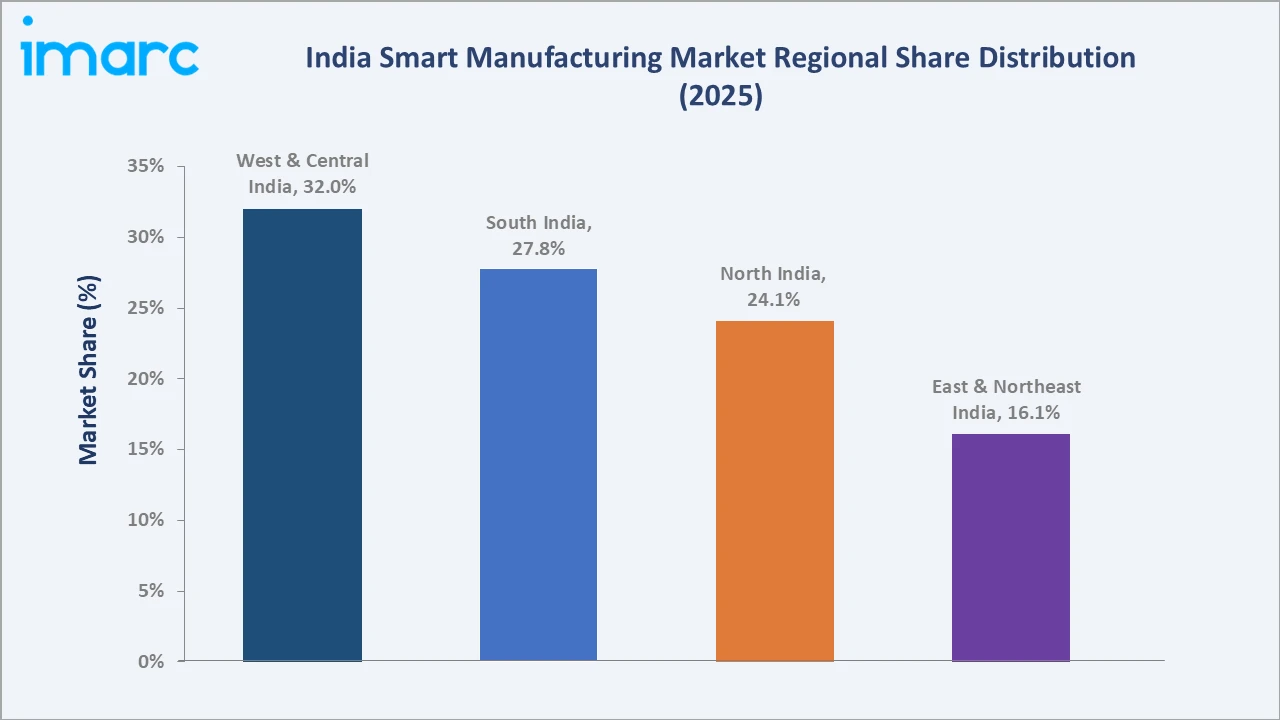
North India, at 24.1%, benefits from its expanding industrial base and government-led digitalization programmes. East and Northeast India, at 16.1%, represents an early-stage but growing market supported by emerging manufacturing corridor investments.
Competitive Landscape
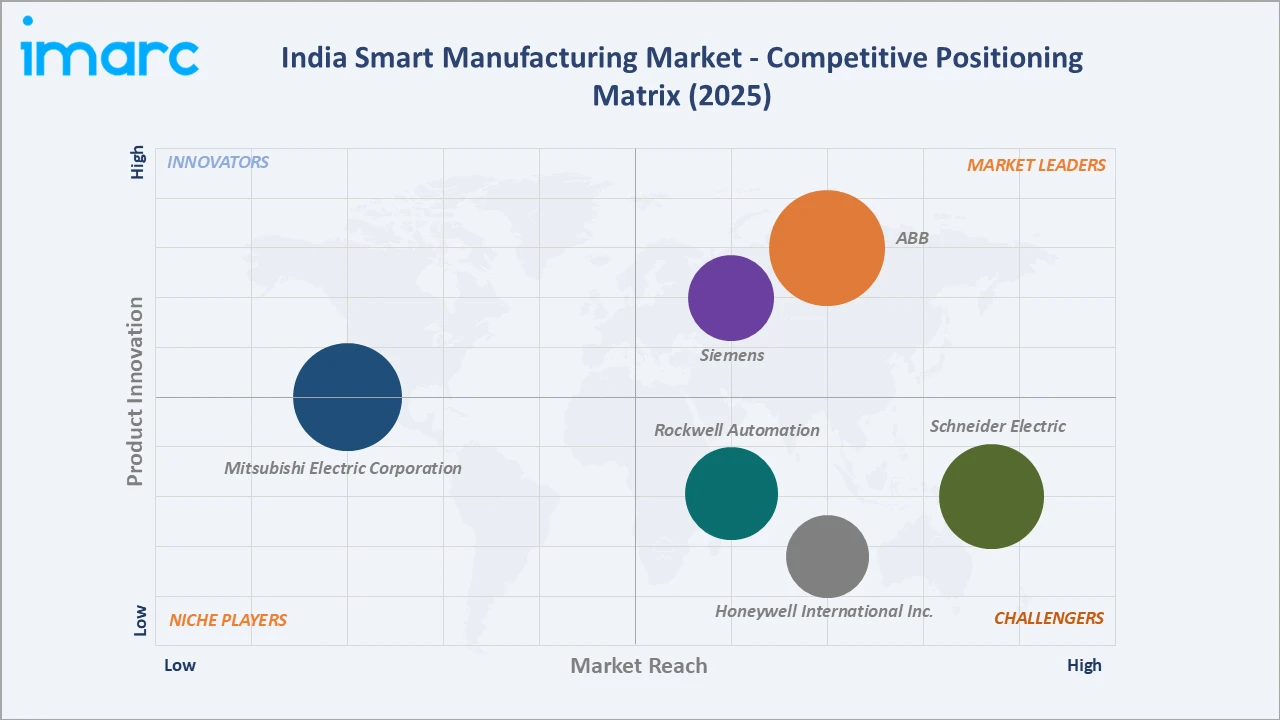
The India smart manufacturing market competitive landscape is moderately concentrated, led by global automation and industrial technology majors offering integrated hardware, software, and services portfolios alongside domestic systems integrators and speciality technology providers.
|
Company Name |
Key Products |
Market Position |
Core Strength |
|
Siemens |
Digital Industries Software, SIMATIC PLCs, MindSphere IIoT Platform |
Market Leader |
Siemens offers an integrated hardware, software, and automation portfolio spanning the full smart manufacturing technology stack. |
|
ABB |
ABB Ability, Industrial Robotics, RobotStudio |
Market Leader |
ABB specializes in industrial automation, robotics, and digital solutions for connected manufacturing operations. |
|
Honeywell International Inc. |
Honeywell Forge, Industrial Cybersecurity Solutions |
Strong Challenger |
Honeywell combines industrial software, cybersecurity, and automation solutions for manufacturing digitalization. |
|
Rockwell Automation |
FactoryTalk, Plex Smart Manufacturing Platform |
Strong Challenger |
Rockwell Automation focuses on integrated control systems and cloud-based manufacturing execution software. |
|
Schneider Electric |
EcoStruxure, Industrial Automation Solutions |
Strong Challenger |
Schneider Electric provides energy management and industrial automation platforms for connected factories. |
|
Mitsubishi Electric Corporation |
MELSEC PLCs, e-F@ctory Solutions |
Established Player |
Mitsubishi Electric Corporation offers factory automation products and integrated e-F@ctory digitalization solutions. |
Key players include Siemens, ABB, Honeywell International Inc., Rockwell Automation, Schneider Electric, Mitsubishi Electric Corporation, and others.
Key Company Profiles
Siemens
Siemens is a Germany-based industrial technology company with a strong presence in the India smart manufacturing market through its Digital Industries division and integrated automation and software portfolio.
- Key Products: Digital Industries Software, SIMATIC PLCs, MindSphere IIoT Platform.
- Strategic Focus: Expanding integrated hardware-software offerings combining automation, digital twin, and cloud-based analytics for Indian manufacturing customers. The company continues to broaden its India-specific solution portfolio to address the needs of both large enterprise manufacturers and expanding mid-sized production facilities. Siemens is also investing in local partner and integrator networks to extend its implementation and support capacity nationwide.
ABB
ABB is a global automation and robotics technology company with an established presence in the India smart manufacturing market through its industrial automation and digital solutions business.
- Key Products: ABB Ability, Industrial Robotics, RobotStudio.
- Strategic Focus: Expanding robotics and digital automation solutions for Indian discrete manufacturing customers. The company is prioritizing investment in India-based robotics manufacturing and engineering capacity to better serve regional demand. ABB is also expanding its digital services portfolio to support customers transitioning from standalone automation toward fully connected production environments.
Honeywell International Inc.
Honeywell International Inc. is a US-based technology company with a growing presence in the India smart manufacturing market through its industrial software and cybersecurity solutions.
- Key Products: Honeywell Forge, Industrial Cybersecurity Solutions.
- Strategic Focus: Strengthening its industrial software and cybersecurity portfolio for connected manufacturing operations across India. The company continues to invest in India-specific industrial cybersecurity capabilities as manufacturers increasingly digitize sensitive production data. Honeywell is also expanding its software partnerships with domestic systems integrators to broaden deployment reach beyond large enterprise accounts.
Market Concentration Analysis
The India smart manufacturing market is moderately concentrated, with key players collectively accounting for a meaningful share of enterprise-level automation and software revenue. Domestic systems integrators and speciality software providers account for a growing share of small and medium manufacturer deployments. Market concentration is expected to gradually decline as domestic technology providers scale their offerings and capture share in Tier-2 and Tier-3 manufacturing clusters. Competitive intensity is expected to increase as domestic software providers introduce more affordable, India-specific platforms tailored to local manufacturing workflows, gradually narrowing the technology and pricing gap between global majors and emerging domestic competitors.
Investment & Growth Opportunities
Highest Growth Segments
Software (~6.5% CAGR), Electronics end use (~7.0% CAGR), Services (~5.8% CAGR), AI-driven predictive maintenance platforms, and 5G-enabled private network infrastructure represent the highest-growth investment vectors through 2034.
Emerging Investment Opportunities
Cloud-based MES platforms targeting small and medium manufacturers represent a significant underserved opportunity, as this segment has historically been priced out of enterprise-grade smart manufacturing software, creating a structurally growing addressable market through 2034.
Investment Themes
- AI and Analytics Platform Investment for Manufacturing Software Providers: Investment in AI-driven analytics capabilities allows software providers to differentiate their MES and IIoT platforms, capturing higher-margin recurring revenue as manufacturers shift from hardware to software spending.
- Tier-2 and Tier-3 Manufacturing Cluster Digitalization: India's expanding manufacturing base beyond major industrial hubs creates a substantial opportunity for providers offering affordable, scalable smart manufacturing solutions suited to smaller manufacturing operations.
Future Market Outlook (2026-2034)
The India smart manufacturing market is projected to grow from USD 13.14 Billion in 2025 to USD 14.67 Billion in 2026, reaching USD 21.50 Billion by 2034, delivering a 4.90% CAGR over the forecast period. By 2030, the market is expected to reach approximately USD 16.68 Billion as AI-driven analytics, digital twin platforms, and 5G-enabled connectivity become standard components of new manufacturing deployments across India.
Three structural forces will define market growth through 2034. Government-led Make in India and PLI incentives will continue channelling capital toward manufacturing modernization. The shift from hardware-centric to software- and services-centric spending will reshape vendor revenue mixes. Expanding digitalization among Tier-2 and Tier-3 manufacturers will create an additional demand pool beyond large enterprise adoption.
Research Methodology
Primary Research
Primary research comprised structured interviews with industry stakeholders, including plant digitalization leads, automation engineers, IIoT platform specialists, and manufacturing OEM technology heads across India.
Secondary Research
Secondary research encompassed company annual reports, government Make in India and PLI scheme documentation, industry association publications, and India manufacturing sector data from relevant ministries and trade bodies.
Forecasting Models
Market revenue forecasts were developed using a bottom-up model incorporating manufacturing sector digitalization spending by industry vertical, technology adoption rates by component, and regional industrial output data.
India Smart Manufacturing Market Report Coverage:
| Report Features | Details |
|---|---|
| Base Year of the Analysis | 2025 |
| Historical Period | 2020-2025 |
| Forecast Period | 2026-2034 |
| Units | Billion USD |
| Scope of the Report | Exploration of Historical Trends and Market Outlook, Industry Catalysts and Challenges, Segment-Wise Historical and Future Market Assessment:
|
| Components Covered | Hardware, Software, Services |
| Technologies Covered | Machine Execution Systems, Programmable Logic Controller, Enterprise Resource Planning, SCADA, Discrete Control Systems, Human Machine Interface, Machine Vision, 3D Printing, Product Lifecycle Management, Plant Asset Management |
| End Uses Covered | Automotive, Aerospace and Defense, Chemicals and Materials, Healthcare, Industrial Equipment, Electronics, Food and Agriculture, Oil and Gas, Others |
| Regions Covered | North India, West and Central India, South India, East and Northeast India |
| Companies Covered | Siemens, ABB, Honeywell International Inc., Rockwell Automation, Schneider Electric, Mitsubishi Electric Corporation, etc. |
| Customization Scope | 10% Free Customization |
| Post-Sale Analyst Support | 10-12 Weeks |
| Delivery Format | PDF and Excel through Email (We can also provide the editable version of the report in PPT/Word format on special request) |
Key Benefits for Stakeholders:
- IMARC’s industry report offers a comprehensive quantitative analysis of various market segments, historical and current market trends, market forecasts, and dynamics of the India smart manufacturing market from 2020-2034.
- The research report provides the latest information on the market drivers, challenges, and opportunities in the India smart manufacturing market.
- Porter's five forces analysis assist stakeholders in assessing the impact of new entrants, competitive rivalry, supplier power, buyer power, and the threat of substitution. It helps stakeholders to analyze the level of competition within the India smart manufacturing industry and its attractiveness.
- Competitive landscape allows stakeholders to understand their competitive environment and provides an insight into the current positions of key players in the market.
Frequently Asked Questions About the India Smart Manufacturing Market Report
The India smart manufacturing market size is estimated at USD 14.67 Billion in 2026, driven by Hardware's dominant 52.5% component share, Automotive's leading 24.5% end-use share, and West and Central India's leading 32.0% regional share.
The market is projected to grow at a CAGR of 4.90% during 2026-2034, reaching USD 21.50 Billion by 2034, driven by rising Industry 4.0 investment and expanding digitalization across manufacturing sectors.
Hardware leads at 52.5% in 2025, encompassing sensors, PLCs, robotics, and machine vision systems that form the foundation of factory digitalization.
Automotive leads at 24.5% through large-scale automated assembly adoption among domestic and export-focused vehicle and component manufacturers.
West and Central India leads at 32.0%, driven by its dense automotive, chemicals, and industrial manufacturing base and strong logistics connectivity.
Leading companies include Siemens, ABB, Honeywell International Inc., Rockwell Automation, Schneider Electric, Mitsubishi Electric Corporation, and others.
The market is projected to reach approximately USD 16.68 Billion by 2030, with AI-driven predictive maintenance and 5G-enabled connectivity gaining broader adoption across manufacturing plants.
Three priority investment opportunities: AI and analytics platform development for manufacturing software providers, Tier-2 and Tier-3 manufacturing cluster digitalization, and cloud-based MES platforms for small and medium manufacturers.
Need more help?
- Speak to our experienced analysts for insights on the current market scenarios.
- Include additional segments and countries to customize the report as per your requirement.
- Gain an unparalleled competitive advantage in your domain by understanding how to utilize the report and positively impacting your operations and revenue.
- For further assistance, please connect with our analysts.
 Request Customization
 Speak to an Analyst
 Request Brochure
 Inquire Before Buying
Benefits of Customization
- Personalize this research
- Triangulate with your data
- Get data as per your format and definition
- Gain a deeper dive into a specific application, geography, customer, or competitor
- Any level of personalization
Get in Touch With Us
UNITED STATES
Phone: +1-201-971-6302
INDIA
Phone: +91-120-433-0800
UNITED KINGDOM
Phone: +44-753-714-6104
Email: [email protected]
Client Testimonials




.webp)




.webp)













Related Reports

Choose your plan
*Please note that the prices mentioned below are starting prices for each bundle type. Kindly contact our team for further details.*
Single User License
- 1 User License, Access on 2 Devices
- PDF Report + Excel Dataset (Password Protected)
- Lifetime Access
- No Printing Rights
- 10% Free Report Customization
- 10–12 Weeks of Analyst Support
Five User License
- Access for 5 Users, 2 Devices per User
- PDF Report + Excel Dataset (Password Protected)
- Lifetime Access
- Dedicated Account Manager
- 12–14 Weeks of Analyst Support
- No Printing Rights
- 15% Free Report Customization
- 25% Discount on Your Next Purchase
Corporate User License
- Unlimited User Access (Within Your Organization)
- PDF Report + Excel Dataset
- Lifetime Access
- Dedicated Account Manager
- 14–20 Weeks of Analyst Support
- No Printing Rights
- 20% Free Report Customization
- 30% Discount on Your Next Purchase
Essential Insights
What's included:
3 reports
- Lifetime Access
- PDF Reports
- Excel Datasets
- 2 Weeks of Free Analyst Support
- 2 User Licenses
- Access on 2 Devices
- Printing Rights
- Complimentary PowerPoint (PPT) Version
- Complimentary License Upgrade
Professional Access
What's included:
5 reports
- Lifetime Access
- PDF Reports
- Excel Datasets
- 8 Weeks of Free Analyst Support
- 2 User Licenses
- Access on 2 Devices
- Printing Rights
- Complimentary PowerPoint (PPT) Version
- Complimentary License Upgrade
Business Advantage
What's included:
8 reports
- Lifetime Access
- PDF Reports
- Excel Datasets
- 14 Weeks of Free Analyst Support
- 2 User Licenses
- Access on 2 Devices
- Printing Rights
- Complimentary PowerPoint (PPT) Version
- Complimentary License Upgrade
Enterprise Intelligence
What's included:
10 reports
- Lifetime Access
- PDF Reports
- Excel Datasets
- 20 Weeks of Free Analyst Support
- 2 User Licenses
- Access on 2 Devices
- Printing Rights
- Complimentary PowerPoint (PPT) Version
- Complimentary License Upgrade