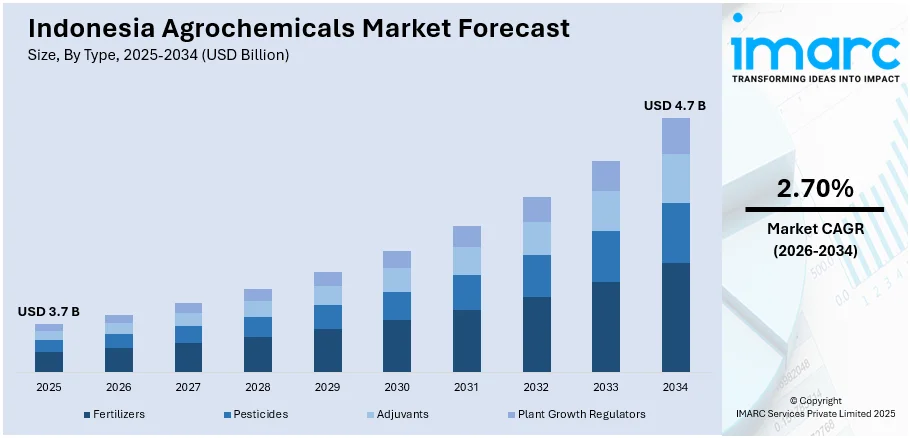
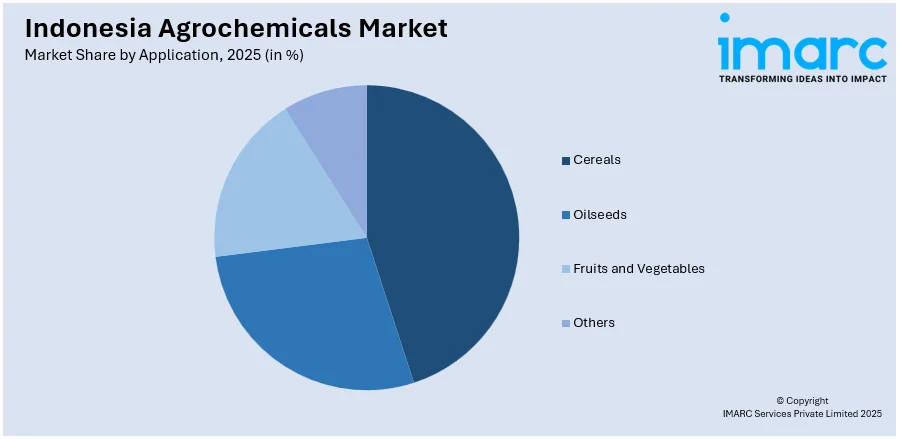
The Indonesia agrochemicals market grew from USD 3.66 Billion in 2025 to USD 3.80 Billion in 2026 and is projected to reach USD 4.66 Billion by 2034, growing at a CAGR of 2.70% during 2026-2034. The market is driven by the rising demand for high-quality agricultural products, government investment in modernizing farming practices, integration of precision farming technologies, and growing awareness about bio-based alternatives. Indonesia spans approximately 5.18 million km², comprising about 1.91 million km² of land and 3.26 million km² of water. The country consists of more than 17,500 islands across 38 provinces and had a population of around 281.6 million in 2024. Its extensive land resources, large population, and geographically dispersed agricultural areas support significant demand for food and commercial crop production. Fertilizers lead at 46.8% by type, cereals dominate at 35.7% by application, and Java holds the largest regional share at 42.6%.
|
Metric |
Value |
|
Base Year Market Size (2025) |
USD 3.66 Billion |
|
Market Size (2026) |
USD 3.80 Billion |
|
Forecast Market Size (2034) |
USD 4.66 Billion |
|
CAGR (2026-2034) |
2.70% |
|
Base Year |
2025 |
|
Historical Period |
2020-2025 |
|
Forecast Period |
2026-2034 |
|
Dominant Type |
Fertilizers (46.8%, 2025) |
|
Dominant Application |
Cereals (35.7%, 2025) |
|
Leading Region |
Java (42.6%, 2025) |
The Indonesia agrochemicals market size increased from USD 3.21 billion in 2020 to USD 3.66 billion in 2025 and is estimated to reach USD 3.80 Billion in 2026, supported by Indonesia's position as one of the largest agricultural producers. The market is projected to reach USD 4.18 billion by 2030 and USD 4.66 billion by 2034.

To get more information on this market, Request Sample
Plant growth regulators grow at ~3.1% CAGR through precision agriculture adoption. Adjuvants grow at ~2.9% CAGR through improved pesticide efficacy requirements. Pesticides grow at ~2.8% CAGR driven by pest pressure in rice and palm oil crops. Fertilizers, the largest segment, align with the overall 2.70% market CAGR.

The Indonesia agrochemicals market is witnessing sustained growth, underpinned by the nation's status as Southeast Asia's largest economy and one of the most productive agricultural territories. Indonesia's agricultural sector contributes approximately 13% of GDP, creating robust and recurring demand for fertilizers, pesticides, adjuvants, and plant growth regulators across rice, palm oil, rubber, coffee, and horticultural value chains. Fertilizers at 46.8% lead through subsidized rice and staple crop productivity programs. Cereals at 35.7% lead by application through rice cultivation demand. Java leads regionally at 42.6%.
|
Insight |
Data |
|
Dominant Type |
Fertilizers - 46.8% share (2025) |
|
Dominant Application |
Cereals - 35.7% market share (2025) |
|
Leading Region |
Java - 42.6% share (2025) |
|
Key Market Opportunity |
Government fertilizer subsidies and precision farming integration |
|
Key Sustainability Trend |
Bio-based agrochemical R&D and integrated pest management adoption |
- Fertilizers at 46.8%: Fertilizers dominate through Indonesia's large-scale government subsidy program, which provides subsidized urea, NPK, and organic fertilizers to smallholder farmers. Rice cultivation across Java and Sumatra requires intensive fertilization cycles per cropping season.
- Cereals at 35.7%: Cereals lead as Indonesia is one of the largest rice producers and consumers. Annual rice cultivation generates persistent demand for nitrogen fertilizers, fungicides, herbicides, and insecticides across all major crop cycles. Government rice self-sufficiency targets reinforce structural agrochemical demand for the cereal crop segment.
- Java at 42.6%: Java dominates due to its status as Indonesia's most intensively cultivated agricultural island, highest population density requiring maximum food production, superior irrigation infrastructure, and concentration of farmer cooperative networks and agrochemical distribution centers.
The Indonesia agrochemicals market encompasses a comprehensive range of chemical and biological products applied in agriculture to optimize crop productivity, protect crops from pests, diseases, and weeds, and regulate plant growth cycles. Product categories include fertilizers (nitrogen, phosphate, potassium, compound NPK, and organic), pesticides (insecticides, herbicides, fungicides, nematicides, and rodenticides), adjuvants (surfactants, spreaders, and stickers), and plant growth regulators (auxins, cytokinins, gibberellins).

The market is shaped by Indonesia's diverse agricultural landscape spanning lowland rice paddies, highland horticulture, vast palm oil and rubber plantations, and tropical fruit and vegetable production systems. Key macroeconomic drivers include the national government's food security agenda, commodity export growth targets, modernization of smallholder agriculture, and the expansion of industrial plantation agriculture.

To evaluate market opportunities, Request Sample

In October 2024, Indonesia’s National Research and Innovation Agency (BRIN) is advancing eco-friendly biopesticide development to promote sustainable cultivation of vegetables, fruits, and ornamental plants, supporting horticultural activities across more than 110 million hectares. The development of eco-friendly biopesticides highlights a growing shift toward sustainable crop protection solutions in Indonesia. Increasing emphasis on reducing chemical pesticide use and supporting horticultural productivity is expected to accelerate the adoption of biological and environmentally friendly agrochemicals.
Standard NPK fertilizers are increasingly supplemented by specialty micronutrient formulations including zinc, boron, and silicon products that address specific soil deficiency patterns across Indonesian agricultural regions. Slow-release and controlled-release fertilizer technologies are gaining commercial adoption in higher-value horticultural and plantation crop applications. These specialty products command significant price premiums over commodity fertilizers and are expected to grow faster than the overall fertilizer segment through 2034.
Digital agricultural platforms are transforming agrochemical distribution and application in Indonesia. Drone-based spraying services are expanding rapidly, reducing pesticide waste while improving canopy coverage. In October 2025, Terra Drone Indonesia secured TKDN certification for its locally developed G20 agricultural drone, enabling greater participation in government projects and easier access to domestic components. The company plans to expand drone-based agricultural spraying services across Indonesia. These precision approaches are supported by government fintech-agritech partnerships targeting smallholder farmers through cooperative distribution networks.
Indonesia's palm oil and rubber plantation sectors face increasing international pressure for sustainability certification that restricts use of certain hazardous pesticides. This is driving plantation companies to reformulate their crop protection programs around approved lower-risk pesticide classes and bio-based alternatives. Leading agrochemical companies are responding with plantation-specific product portfolios that maintain efficacy while meeting certification requirements, creating a premium product segment aligned with sustainability standards.
The Indonesia agrochemicals value chain integrates raw material sourcing, formulation and R&D, manufacturing and blending, regulatory approval, distribution and retail, and farm-level application across fertilizer, pesticide, adjuvant, and plant growth regulator categories.
|
Stage |
Key Participants |
|
Raw Material Sourcing |
Chemical precursor importers, nitrogen and phosphate mining companies, potash traders, and raw active ingredient suppliers. |
|
Formulation & R&D |
Agrochemical R&D centers, formulation laboratories, university research institutions, and bio-agrochemical development organizations. |
|
Manufacturing & Blending |
Agrochemical manufacturing plants, contract blending facilities, Indonesia production units, and specialty formulation operators. |
|
Regulatory Approval |
Ministry of Agriculture registration bodies, pesticide testing laboratories, and regulatory affairs specialists. |
|
Distribution & Retail |
Retail networks, agricultural cooperatives, wholesale distributors, and e-commerce agritech platforms. |
|
Farm-Level Application |
Smallholder farmers, plantation companies, farmer cooperatives, and agricultural extension officers providing field guidance. |
Distribution and retail represent the most commercially critical stage in the Indonesia agrochemicals value chain, as Indonesia's fragmented smallholder farming structure requires an extensive last-mile distribution network through agricultural supply stores, cooperatives, and village-level agents. Manufacturers that build trusted retail channel relationships, provide farmer education, and ensure product authenticity through supply chain controls achieve superior market penetration and competitive advantage in the Indonesian agrochemicals market.
Indonesia's agrochemical industry is rapidly integrating precision agriculture technologies including drone-based aerial spraying, GPS-guided variable-rate applicators, and IoT soil and weather monitoring systems. Agricultural drone spraying services have expanded to cover significant areas across Java's rice paddies and Sumatra's plantation crops, delivering pesticide waste reduction and improved coverage uniformity. Mobile-based crop advisory platforms and remote soil testing services are enabling data-driven fertilizer and pesticide recommendations for smallholder farmers previously reliant solely on distributor guidance.
Indonesian R&D institutions and university agricultural faculties are developing commercially viable biopesticide formulations from local botanical and microbial sources. Encapsulation technology is extending bioactive ingredient shelf life, a critical barrier to adoption in tropical climate conditions. Slow-release fertilizer polymer coating technology is being adapted for tropical conditions by Indonesian manufacturers, improving nutrient use efficiency in high-rainfall paddy systems where conventional fertilizers face high leaching losses.
Indonesia's Ministry of Agriculture is implementing QR code-based product traceability systems for subsidized fertilizers to combat counterfeiting and ensure subsidy beneficiary verification. Blockchain-based supply chain platforms are being piloted for tracking agrochemical products from manufacturer to farm level, improving accountability and reducing the prevalence of counterfeit products. These regulatory technology investments are improving market integrity and creating data infrastructure that supports evidence-based policy for agrochemical program optimization.
The report covers the following segments:
|
Segment Category |
Leading Segment |
Market Share |
Year |
|
Type |
Fertilizers |
46.8% |
2025 |
|
Application |
Cereals |
35.7% |
2025 |
|
Region |
Java |
42.6% |
2025 |
Fertilizers lead at 46.8% (2025), driven by government subsidy programs, intensive rice cultivation, and large-scale palm oil and rubber plantation fertilization requirements across Indonesia's agricultural landscape.

To access detailed market analysis, Request Sample
Pesticides at 38.2% reflect high pest pressure in tropical agricultural conditions and persistent insect, fungal, and weed management needs across rice, palm oil, vegetables, and fruit crops. Adjuvants at 8.4% support pesticide formulation effectiveness improvement. Plant growth regulators at 6.6% reflect growing adoption in precision horticulture and commercial plantation crop management applications.
Cereals lead at 35.7% (2025), through the dominant role of rice cultivation across Indonesia's paddy fields requiring multiple fertilization and pest protection cycles annually.

Oilseeds at 31.4% reflect Indonesia's global leadership in palm oil production, which requires intensive fertilizer and pesticide programs across oil palm plantations. Fruits and vegetables at 22.8% represent the fastest-growing application segment driven by rising domestic consumption and export market demand for high-quality horticultural products. Others at 10.1% include plantation crops such as rubber, cocoa, coffee, and sugar cane.
|
Region |
Share (2025) |
Key Indonesia Agrochemicals Market Drivers & Characteristics |
|
Java |
42.6% |
Reflecting the highest agricultural intensity, largest paddy cultivation area, most developed distribution networks, and concentration of smallholder cooperatives and government agricultural extension services. |
|
Sumatra |
28.3% |
Reflecting the dominant palm oil and rubber plantation footprint, large-scale commercial estate agrochemical demand, and major rice cultivation areas in North and South Sumatra provinces. |
|
Kalimantan |
13.2% |
Reflecting the rapidly expanding oil palm plantation sector, growing smallholder farming integration, and increasing agrochemical adoption driven by plantation company extension programs. |
|
Sulawesi |
9.1% |
Reflecting cocoa, corn, and rice cultivation demand, growing horticulture sector development, and expanding farmer access to agrochemical distribution through provincial cooperative networks. |
|
Others |
6.8% |
Reflecting agricultural activity, with growing government support for food security programs driving incremental agrochemical market development. |
Java's 42.6% dominance reflects its status as Indonesia's most intensively cultivated island, with multiple rice cropping cycles per year generating disproportionate agrochemical demand relative to land area. Sumatra's 28.3% reflects the island's massive palm oil and rubber plantation economy, where Indonesia and multinational agrochemical companies maintain large commercial operations.

Kalimantan's 13.2% reflects the island's ongoing palm oil plantation expansion, which continues to create new agrochemical demand as estates mature and require intensive fertilization and crop protection programs. Sulawesi's 9.1% captures the island's diverse agricultural base, including cocoa, corn, and wet rice cultivation. The others at 6.8% includes emerging agricultural development across Papua, Maluku, and eastern Indonesian provinces supported by national food estate programs.
The Indonesia agrochemicals market features a competitive mix of multinational corporations, state-owned enterprises, and domestic private manufacturers. Market leadership is primarily held by international companies with broad product portfolios, regulatory expertise, and farmer education capabilities. Competition is intensifying through digital distribution, precision agriculture partnerships, and bio-agrochemical product launches.
|
Company |
Key Products |
Market Position |
Core Strength |
|
Bayer AG |
Adengo, Alion, Decis, Fox Xpro, Laudis, Luna, Movento, Nativo, Roundup, Sivanto, Velum |
Market Leader |
Bayer AG plays a leading role in Indonesia’s agrochemical and crop protection sector through Bayer Indonesia, providing essential agricultural inputs and advanced manufacturing. |
|
PT Petrokimia Gresik |
SP-36, Phonska, Petroganik, ZA Subsidi, Pupuk Urea Subsidi, Petro Biofertil, Phonska Plus, Petro Niphos, ZK, ZA, Petro Ningrat, Petro Nitrat |
Market Leader |
PT Petrokimia Gresik is the most complete state-owned fertilizer and agricultural chemical producer in Indonesia, driving national food security and sustainable farming. |
|
BASF |
Acrobat 50 WP, Cabrio Top 60 WG, Cabrio 250 EC, Cevya 400 SC, Insure Max 510 FS, Melyra 200/200 SC, Merivon 250/250 SC |
Market Leader |
BASF Indonesia operates as a major market leader in the Indonesian agrochemicals and crop protection sector. |
|
Pupuk Indonesia (Persero) |
Ammonia, Urea, NPK, ZK, |
Established Player |
PT Pupuk Indonesia (Persero) is the state-owned enterprise that acts as the backbone of Indonesia’s agricultural and agrochemical sector, serving as the government's sole mandated agent. |
|
FMC Corporation |
Ammate 150 EC, Arrivo 30 EC, Bestox 50 EC, Cronus 18 EC, Elevest 106/159 SC, Fury 50 EC, Marshal 200 EC, Marshal 200 SC, Marshal 5 GR, Pounce 20 EC |
Established Player |
FMC Corporation is one of the leading agricultural sciences companies, and it plays a critical, top-tier role in the Indonesian agrochemicals market |
Companies across the competitive landscape are investing in farmer education programs, digital advisory platforms, bio-agrochemical product development, and sustainable agriculture certification support. The market is expected to see further consolidation as multinational companies pursue distributor acquisitions and local manufacturer partnerships to strengthen rural distribution capabilities and product registration efficiencies.

Bayer CropScience is a division of Bayer AG, one of the largest life sciences companies, and holds a leading position in Indonesia's crop protection market. Its product portfolio spans a comprehensive range of herbicides, fungicides, insecticides, and seed treatment products covering rice, palm oil, rubber, vegetables, and fruit crops. Bayer's Integrated Crop Management (ICM) programs for Indonesian rice farmers combine agronomic advice, resistance management, and precision application guidance with its proprietary pesticide brands. In Indonesia,
BASF is a chemical company and one of the largest agrochemical producers, operating in Indonesia through BASF Indonesia with crop protection products for rice, palm oil, plantation crops, and horticulture. BASF's Indonesia portfolio is anchored by its rice herbicide, fungicide, and insecticide products that address key pest and disease challenges. BASF's innovation pipeline focuses on biological products and sustainable chemistry solutions that align with Indonesia's growing export certification requirements and Ministry of Agriculture sustainability initiatives.
The Indonesia agrochemicals market exhibits a dual structure: high concentration in the subsidized fertilizer segment dominated by state-owned companies and their subsidiaries, and moderate competition in the crop protection segment led by multinational companies. The top five companies collectively account for approximately 55-60% of total market revenues in 2025, with the remaining share distributed among domestic manufacturers, importers, and specialty product suppliers. Market concentration in the crop protection segment is expected to moderate slightly through 2034 as domestic generic manufacturers increase their registration capabilities and bio-agrochemical entrants establish commercial scale.
Fruits and vegetables application (~3.5% CAGR), plant growth regulators (~3.1% CAGR), bio-based agrochemicals, specialty micronutrient fertilizers, and precision application services represent the highest-growth investment vectors in the Indonesia agrochemicals market through 2034.
The Indonesia agrochemicals market is projected to grow from USD 3.66 Billion in 2025 to USD 3.80 Billion in 2026, reaching USD 4.66 Billion by 2034, exhibiting a CAGR of 2.70% during 2026-2034. The market is projected to reach an anchor value of USD 4.18 Billion by 2030, representing the mid-period milestone at which precision farming adoption reaches meaningful scale and bio-agrochemical products achieve commercial traction across major crop systems.
Three structural forces will define the Indonesia agrochemicals market through 2034. First, Indonesia's food security agenda and expanding agricultural export targets will sustain strong agrochemical demand. Second, the progressive adoption of precision farming technologies, including GPS-guided application equipment, drone spraying services, soil sensor networks, and mobile-based advisory platforms, will gradually improve agrochemical use efficiency without reducing overall market value. Third, the transition toward sustainable agriculture driven by export certification requirements and domestic environmental awareness will accelerate bio-agrochemical product development and market differentiation, creating premium growth segments.
Primary research comprised in-depth interviews with agrochemical manufacturers, import distributors, retailer networks, farmer cooperatives, plantation company procurement managers, Ministry of Agriculture officials, and agricultural industry analysts. These discussions validated market size estimates, assessed regional distribution patterns, evaluated competitive dynamics, and provided insights into regulatory developments, technology adoption, and future growth opportunities in the Indonesia agrochemicals market.
Secondary research encompassed Indonesia Ministry of Agriculture statistics, agricultural census data, company annual reports, pesticide registration databases, agricultural data, certification reports, international agrochemical company financial disclosures, and industry publications focused on Southeast Asian and Indonesian agricultural markets.
Forecasting models incorporated historical agrochemical market revenue data, Indonesian agricultural production volume trends, government subsidy program projections, export commodity price forecasts, and macroeconomic indicators including agricultural GDP growth and rural income development. Both top-down and bottom-up approaches were applied across fertilizer and crop protection segments, validated through primary research to ensure forecast alignment with sector-specific market drivers.
| Report Features | Details |
|---|---|
| Base Year of the Analysis | 2025 |
| Historical Period | 2020-2025 |
| Forecast Period | 2026-2034 |
| Units | Billion USD |
| Scope of the Report | Exploration of Historical and Forecast Trends, Industry Catalysts and Challenges, Segment-Wise Historical and Predictive Market Assessment:
|
| Types Covered | Fertilizers, Pesticides, Adjuvants, Plant Growth Regulators |
| Applications Covered | Cereals, Oilseeds, Fruits and Vegetables, Others |
| Regions Covered | Java, Sumatra, Kalimantan, Sulawesi, Others |
| Companies Covered | Bayer AG, PT Petrokimia Gresik, BASF, Pupuk Indonesia (Persero), FMC Corporation, etc. |
| Customization Scope | 10% Free Customization |
| Post-Sale Analyst Support | 10-12 Weeks |
| Delivery Format | PDF and Excel through Email (We can also provide the editable version of the report in PPT/Word format on special request) |
The Indonesia agrochemicals market size is estimated at USD 3.80 Billion in 2026, driven by rising agricultural productivity demand, government fertilizer subsidies, expanding palm oil and rice cultivation areas, and progressive integration of precision farming technologies across smallholder and commercial agricultural systems.
The Indonesia agrochemicals market is projected to grow at a CAGR of 2.70% during 2026-2034, sustained by food security policy support, agricultural export growth, expanding horticultural production, and growing adoption of specialty fertilizers and bio-based crop protection products.
The market is projected to reach approximately USD 4.18 Billion by 2030, representing the mid-period milestone at which precision farming technologies achieve meaningful adoption scale and bio-agrochemical products establish commercial traction across major Indonesian crop systems.
Fertilizers lead with a 46.8% share in 2025, driven by government subsidy programs distributing subsidized urea and NPK to smallholder rice and corn farmers, combined with large-volume commercial fertilization requirements from Indonesia's extensive palm oil and rubber plantation sector.
Cereals dominate with a 35.7% share in 2025, reflecting Indonesia's status as one of the largest rice producers, with paddy cultivation generating persistent demand for fertilizers, herbicides, fungicides, and insecticides across multiple annual crop cycles.
Java leads with a 42.6% share in 2025, driven by its status as Indonesia's most intensively cultivated island with multiple rice cropping cycles per year, superior irrigation infrastructure, highest cooperative network density, and concentration of agrochemical distribution infrastructure.
Key players include Bayer AG, PT Petrokimia Gresik, BASF, Pupuk Indonesia (Persero), and FMC Corporation, among others.
The Indonesia agrochemicals market is projected to reach USD 4.66 Billion by 2034, supported by ongoing fertilizer demand from rice and palm oil cultivation, specialty agrochemical segment growth, export certification-driven bio-product adoption, and increasing horticultural application requirements.
*Please note that the prices mentioned below are starting prices for each bundle type. Kindly contact our team for further details.*
3 reports
5 reports
8 reports
10 reports