
Japan Automotive Lighting Market Size, Share, Trends and Forecast by Technology, Vehicle Type, Sales Channel, Application, and Region, 2026-2034
Japan Automotive Lighting Market Size, Share, Trends & Forecast (2026-2034)
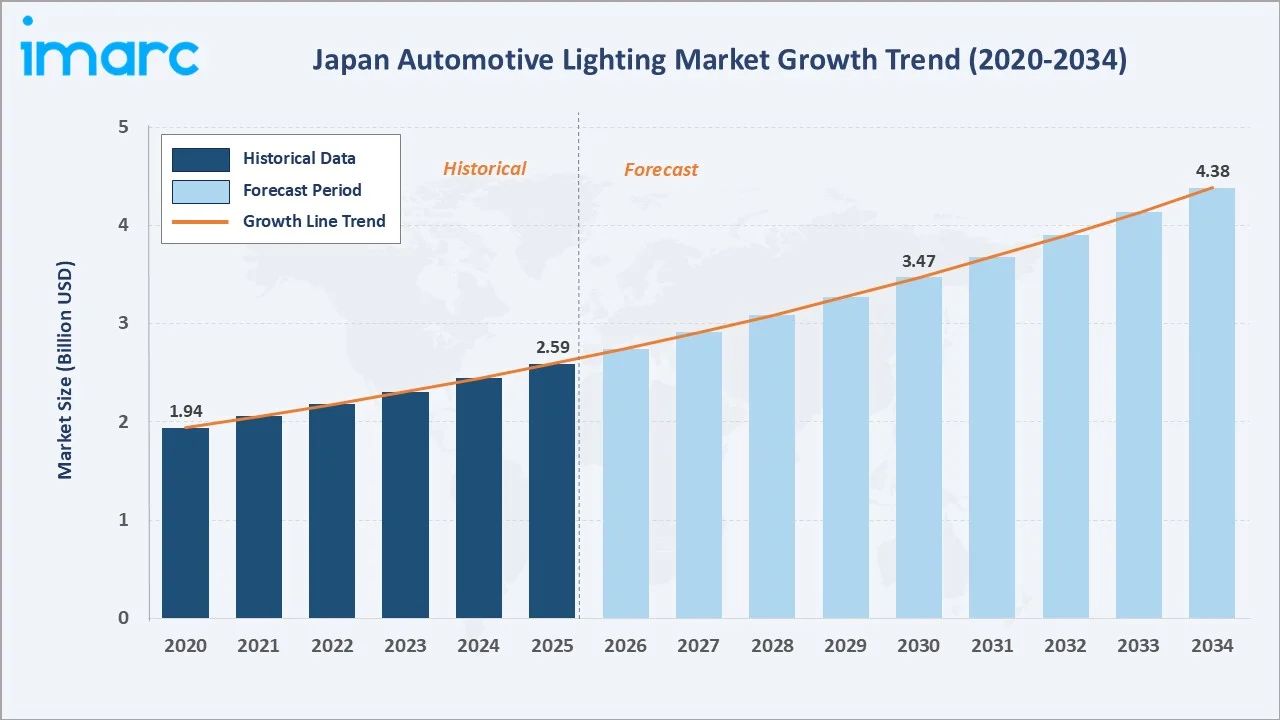
The Japan automotive lighting market reached USD 2.59 Billion in 2025 and is projected to reach USD 4.38 Billion by 2034, growing at a CAGR of 6.00% during 2026-2034. The market is driven by rapid LED technology adoption, accelerating EV and hybrid vehicle production, rising demand for premium adaptive lighting systems, and ADAS integration mandates. New vehicle sales in Japan reached 4.57 million units in 2025, increasing by 3.26% from 4.42 million units in 2024. This growth is supporting the market, as higher vehicle production and registrations directly increase OEM demand for headlights, taillights, daytime running lights, and interior lighting systems. LED dominates technology at 68.7%. Front lighting/headlamps lead applications at 46.8%. The Kanto region leads regionally at 34.7%.
Market Snapshot
|
Metric |
Value |
|
Market Size (2025) |
USD 2.59 Billion |
|
Forecast Market Size (2034) |
USD 4.38 Billion |
|
CAGR (2026-2034) |
6.00% |
|
Base Year |
2025 |
|
Historical Period |
2020-2025 |
|
Forecast Period |
2026-2034 |
|
Dominant Technology |
LED (68.7%, 2025) |
|
Leading Application |
Front Lighting/Headlamps (46.8%, 2025) |
|
Leading Region |
Kanto Region (34.7%, 2025) |
The Japan automotive lighting market has grown steadily from USD 1.94 Billion in 2020 to USD 2.59 Billion in 2025, driven by the rapid displacement of halogen technology by LED systems, expanding hybrid and battery electric vehicle (BEV) production, and strong consumer demand for premium aesthetic lighting including daytime running lights (DRL), ambient interior lighting, and OLED tail lamp systems. The market is projected to reach USD 3.47 Billion by 2030 and USD 4.38 Billion by 2034.
To get more information on this market, Request Sample
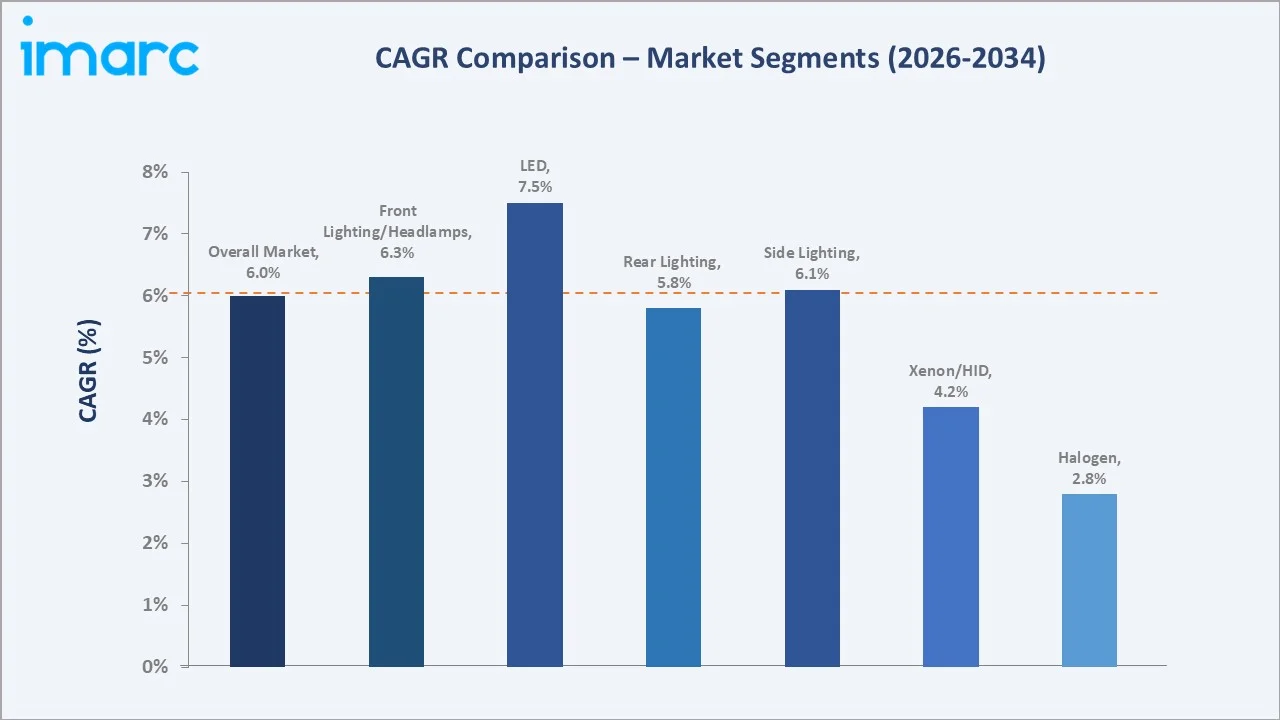
LED technology grows at ~7.5% CAGR as it captures remaining halogen replacement volume and gains market share in advanced adaptive and pixel-level lighting systems. Front lighting/headlamps grow at ~6.3% CAGR through adaptive matrix LED and laser headlamp adoption. Rear lighting grows at ~5.8% CAGR through OLED tail lamp and dynamic turn signal adoption across premium and mass-market vehicle segments.
Executive Summary
The Japan automotive lighting market is one of the most technologically advanced in Asia, driven by the country's dominant automotive manufacturing sector and its world-class automotive component supplier ecosystem. LED technology dominates at 68.7%, having systematically displaced halogen across new vehicle platforms. Front lighting leads application at 46.8%, reflecting the premium positioning and complex engineering of modern adaptive LED and laser headlamp systems. The Kanto region leads at 34.7% (2025) through the concentration of Toyota's major vehicle production facilities and Tokyo's dense automotive component supplier and R&D ecosystem.
Key Market Insights
|
Insight |
Data |
|
Dominant Technology |
LED - 68.7% share (2025) |
|
Leading Application |
Front Lighting/Headlamps - 46.8% share (2025) |
|
Leading Region |
Kanto Region - 34.7% share (2025) |
|
Market Opportunity |
Adaptive matrix LED; OLED; LiDAR-integrated lighting; EV-optimized systems. |
Key Analytical Observations Supporting the Above Data:
- LED at 68.7%: LED technology dominates Japan's automotive lighting market through its superior energy efficiency (critical for EV range optimization), longer operational lifespan, design flexibility enabling thin signature lighting elements, and rapidly declining component costs that have made LED standard equipment across mainstream vehicle price points.
- Front Lighting/Headlamps at 46.8%: Front lighting/headlamps lead application share due to their complex engineering requirements, premium pricing (adaptive matrix LED headlamp systems command significant unit ASPs), ADAS integration importance for pedestrian detection, and growing regulatory mandates for adaptive driving beam (ADB) systems across Japanese vehicle safety standards.
- Kanto Region at 34.7%: The Kanto region leads through Tokyo's concentration of automotive OEM headquarters, R&D centers, tier-1 supplier facilities, and aftermarket distribution hubs. Its proximity to major vehicle production centers and Japan's largest consumer market makes it the primary commercial and innovation hub for automotive lighting industry activities.
Japan Automotive Lighting Market Overview
The Japan automotive lighting market encompasses all externally and internally mounted lighting systems for passenger vehicles and commercial vehicles, spanning three technology categories, LED, Halogen, and Xenon/HID, and four application areas: front lighting/headlamps, rear lighting, side lighting, and interior lighting. Products serve OEM supply to vehicle manufacturers and the aftermarket replacement and customization segment. Japan's automotive lighting sector benefits from world-class engineering talent, precision manufacturing capabilities, and deep OEM-tier supplier integration that collectively sustain its technology leadership in adaptive lighting, miniaturization, and optical system design.
Market Dynamics
To evaluate market opportunities, Request Sample
Market Drivers
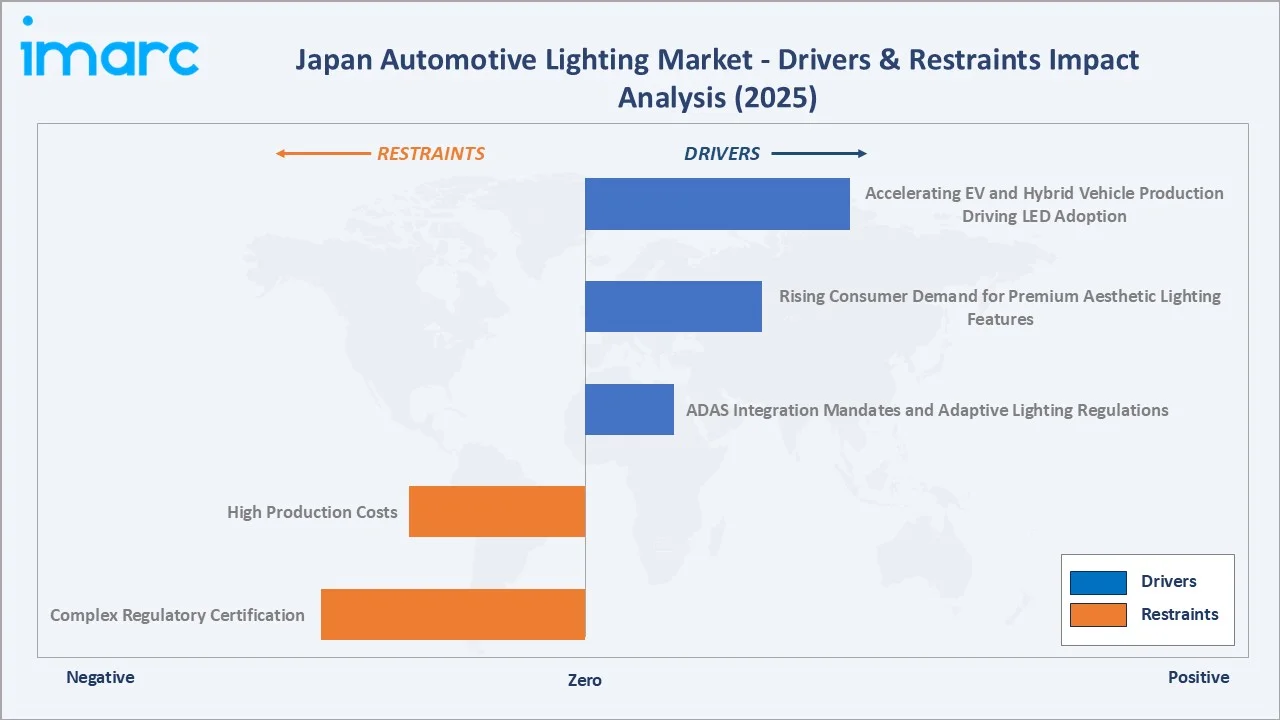
- Accelerating EV and Hybrid Vehicle Production Driving LED Adoption: In 2024, 59,736 new electric vehicles (EVs) were sold in Japan, accounting for approximately 1.35% of the country’s total new vehicle sales during the year. Battery electric vehicle (BEV) sales in Japan reached 61,000 units in 2025, representing a 1.67% increase from approximately 60,000 units in 2024. EV platforms mandate energy-efficient LED lighting systems to minimize battery draw and maximize driving range. Hybrid platforms similarly favor LED over halogen for energy management optimization.
- Rising Consumer Demand for Premium Aesthetic Lighting Features: Japanese consumers demonstrate strong preference for premium lighting aesthetics, including signature LED daytime running light patterns, ambient interior lighting with color customization, sequential LED turn signals, and distinctive OLED tail lamp designs. Automakers are differentiating vehicle models through exclusive lighting signatures, creating a premium lighting premiumization cycle that drives continuous LED system value escalation.
- ADAS Integration Mandates and Adaptive Lighting Regulations: Japan's national ADAS adoption roadmap and alignment with regulations are compelling OEMs to adopt sophisticated adaptive matrix LED headlamp systems. These systems use cameras and forward-looking sensors to identify oncoming vehicles, pedestrians, and cyclists, automatically shaping the high-beam pattern to avoid glare while maintaining maximum road illumination.
Market Restraints
- High Production Costs: Adaptive matrix LED headlamp systems, incorporating micro-LED pixel arrays, complex optical modules, and integrated control electronics, command significantly higher manufacturing costs than conventional LED or halogen headlamps. These cost premiums constrain adoption to upper-mid and premium vehicle price bands, limiting the volume potential of the highest-value lighting technology variants and creating a bifurcated market where entry-level vehicles continue using simpler single-point LED or halogen systems.
- Complex Regulatory Certification: Automotive lighting products sold in Japan must comply with safety standards, technical standards, and increasingly with vehicle lighting regulations as Japan harmonizes with global automotive safety frameworks. The multi-stage certification process adds 12-24 months to product development lead times and significant certification cost burdens for new technology introductions.
Market Opportunities
- Adaptive Driving Beam (ADB) and Pixel-Level LED Headlamp Technology: Japan's regulatory adoption of ADB standards and the government's road map for active safety lighting mandates creates a substantial market opportunity for suppliers developing pixel-level LED matrix headlamp systems. ADB headlamp system and micro-LED pixel lighting research exemplify Japanese supplier investment in next-generation adaptive headlamp technologies that will drive significant ASP increases and revenue growth.
- LiDAR-Integrated Automotive Lighting Systems: The convergence of automotive lighting and LiDAR sensor functions into integrated front-of-vehicle modules represents an emerging opportunity for leading Japanese lighting suppliers. In April 2024, KOITO developed a short-range automotive LiDAR in collaboration with Cepton and secured an order from a global OEM. The system will be used for surrounding-area monitoring in Level 4 autonomous vehicles, supporting advanced ADAS and autonomous driving applications. Japan's leadership in both automotive lighting and LiDAR sensor development positions domestic suppliers to lead this integration trend through 2034.
Market Challenges
- LED Price Erosion Partially Offsetting Volume Growth Revenue Impact: Rapid LED technology commoditization is creating average selling price (ASP) pressure that partially offsets the revenue benefit of unit volume growth. As LED headlamp systems transition from premium to standard equipment across mainstream vehicle price bands, the per-unit revenue contribution declines. Suppliers must continuously migrate to higher-value adaptive matrix LED and intelligent lighting modules to maintain revenue growth rates ahead of unit volume expansion and commodity LED price deflation.
- Semiconductor Supply Chain Vulnerability and Component Shortages: Automotive lighting systems, particularly advanced LED matrix headlamps with integrated electronic control units, rely on specialized semiconductor components that have experienced significant supply disruptions. The global semiconductor shortage impacted Japanese automotive lighting production timelines, and the ongoing challenge of securing stable supplies of automotive-grade LED drivers, microcontrollers, and power management ICs continues to create supply chain risk for lighting system manufacturers and OEM assembly plants.
Emerging Market Trends
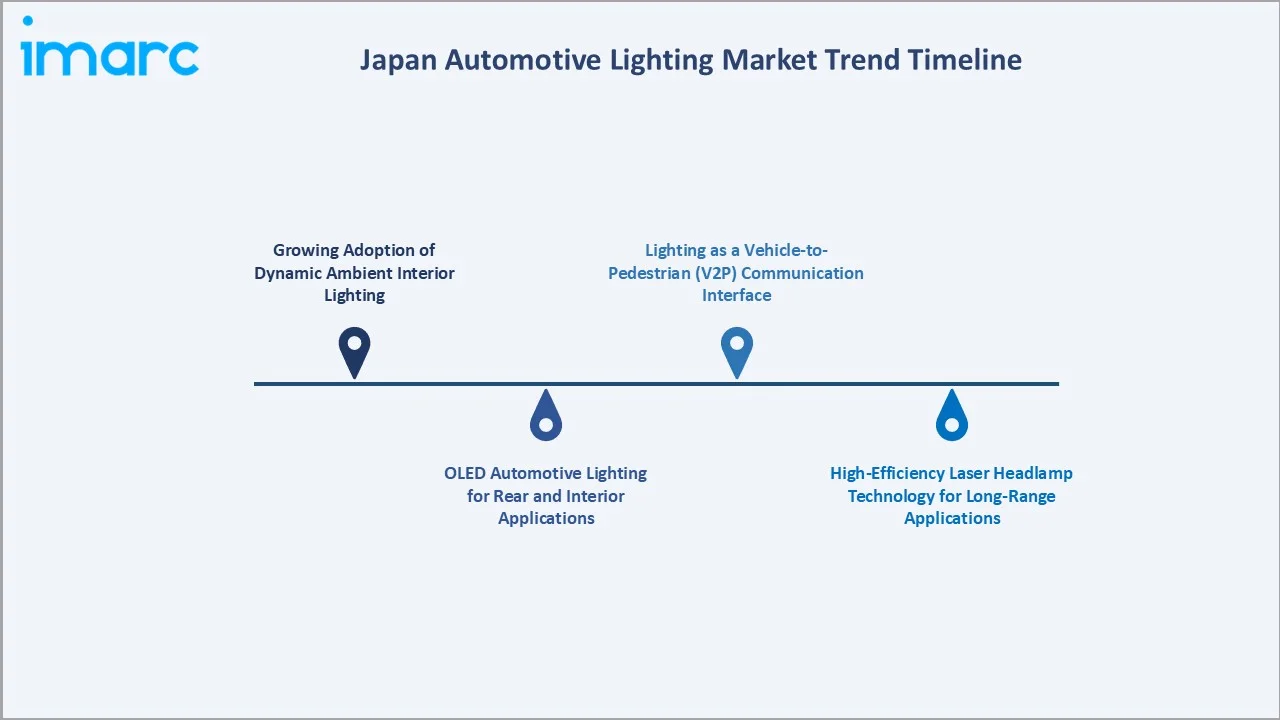
1. Growing Adoption of Dynamic Ambient Interior Lighting
In January 2026, Toyoda Gosei introduced an LED interior lighting unit that projects moving light patterns inside vehicles, debuting on Toyota’s Lexus RZ BEV. The system uses three lamps to create animated illumination effects on the door panels, enhancing cabin comfort and ambience. The launch reflects a shift toward advanced LED systems that deliver animated and customizable lighting effects inside vehicle cabins. This trend is gaining traction in premium and electric vehicles as manufacturers focus on improving interior aesthetics, passenger comfort, and personalized in-cabin experiences.
2. OLED Automotive Lighting for Rear and Interior Applications
Organic LED (OLED) lighting technology is gaining adoption in Japanese automotive rear lighting and interior ambient applications. OLED's ultra-thin profile (as thin as 1.5mm), homogeneous surface luminescence, and flexible substrate capability enable new design freedom for distinctive tail lamp signatures and wraparound light installations. Lexus has pioneered automotive OLED application in Japan, using OLED panels in premium model tail lamps. Domestic suppliers are investing in automotive-grade OLED production capability to serve growing OEM demand.
3. Lighting as a Vehicle-to-Pedestrian (V2P) Communication Interface
Japan's automated driving development roadmap is integrating automotive lighting systems as active vehicle-to-pedestrian (V2P) and vehicle-to-environment communication channels. External light displays using LED pixel arrays to project symbols, arrows, or messages onto road surfaces ahead of autonomous vehicles are being developed to communicate vehicle intent to pedestrians and cyclists.
4. High-Efficiency Laser Headlamp Technology for Long-Range Applications
Laser-based headlamps are emerging as an advanced automotive lighting solution due to their ability to deliver higher brightness and longer illumination range than conventional systems. Their compact size and high energy efficiency also support flexible vehicle styling and reduced power consumption. This technology is particularly relevant for premium, electric, and high-performance vehicles, where enhanced nighttime visibility and advanced lighting functionality are becoming key differentiators.
Industry Value Chain Analysis
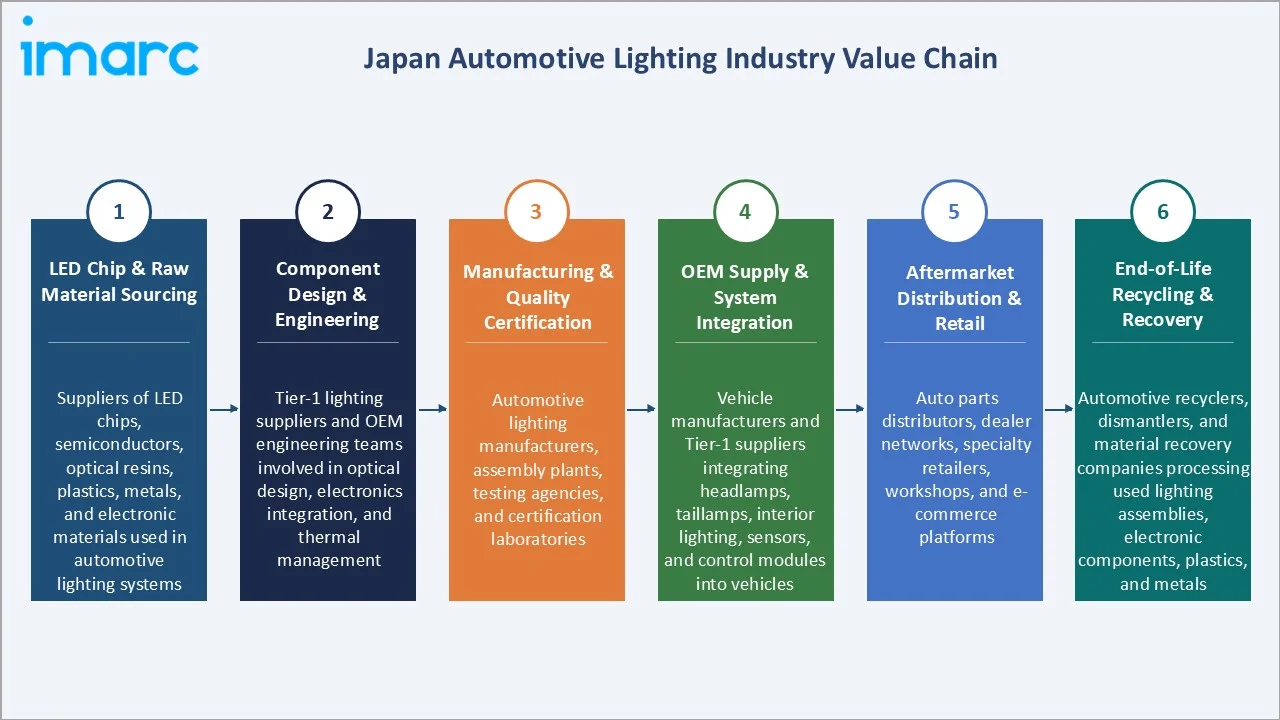
The Japan automotive lighting market value chain integrates LED chip and raw material sourcing, component design and optical engineering, manufacturing and regulatory certification, OEM supply and system integration, aftermarket distribution and retail, and end-of-life recycling and material recovery.
|
Stage |
Key Participants |
|
LED Chip & Raw Material Sourcing |
Suppliers of LED chips, semiconductors, optical resins, plastics, metals, and electronic materials used in automotive lighting systems. |
|
Component Design & Engineering |
Tier-1 lighting suppliers and OEM engineering teams involved in optical design, electronics integration, and thermal management. |
|
Manufacturing & Quality Certification |
Automotive lighting manufacturers, assembly plants, testing agencies, and certification laboratories. |
|
OEM Supply & System Integration |
Vehicle manufacturers and Tier-1 suppliers integrating headlamps, taillamps, interior lighting, sensors, and control modules into vehicles. |
|
Aftermarket Distribution & Retail |
Auto parts distributors, dealer networks, specialty retailers, workshops, and e-commerce platforms. |
|
End-of-Life Recycling & Recovery |
Automotive recyclers, dismantlers, and material recovery companies processing used lighting assemblies, electronic components, plastics, and metals. |
OEM supply and system integration represents the highest-value stage, as the technical complexity of ADAS-integrated adaptive lighting systems requires intensive collaborative development between lighting tier-1 suppliers and OEM vehicle engineering teams. Manufacturing and quality certification is the most rigorous stage, given Japan's automotive quality standards that represent the global benchmark for lighting system durability, photometric consistency, and functional safety performance.
Technology Landscape in the Japan Automotive Lighting Industry
LED Technology and Adaptive Matrix Systems
LED automotive lighting technology in Japan has evolved through three generations: first-generation single-point LED DRL and position lights; second-generation multi-LED headlamp clusters and tail lamp arrays; and third-generation adaptive matrix LED systems with pixel-level beam control. The transition to matrix LED is creating significant value chain evolution, as the LED chip count per headlamp unit increases from single-digit to hundreds or thousands of independently controlled micro-LED pixels.
Xenon/HID Technology and Transition Dynamics
Xenon/HID technology is a transitional technology between halogen and LED adoption. HID systems deliver superior luminous flux and a more natural color temperature than halogen while costing less than advanced matrix LED systems. However, HID technology is structurally declining as LED achieves comparable light output at lower energy consumption and with superior adaptability for intelligent lighting functions. New vehicle program adoption of HID in Japan is effectively zero, with the segment sustained by aftermarket replacement demand.
OLED Technology for Premium Automotive Lighting
OLED technology represents Japan's frontier automotive lighting innovation for rear and interior applications. Japan's expertise in consumer electronics OLED production is being adapted to automotive-grade durability requirements. Automotive OLED panels require operating temperature ranges from 40°C to +105°C, vibration resistance exceeding automotive shock test standards, and 10-year operational lifespans. Japanese lighting suppliers are investing in automotive OLED module development to serve premium model programs.
Market Segmentation Analysis
The report covers the following segments:
|
Segment Category |
Leading Segment |
Market Share |
Year |
|
Technology |
LED |
68.7% |
2025 |
|
Vehicle Type |
🔒 |
🔒 |
2025 |
|
Sales Channel |
🔒 |
🔒 |
2025 |
|
Application |
Front Lighting/Headlamps |
46.8% |
2025 |
|
Region |
Kanto Region |
34.7% |
2025 |

By Technology
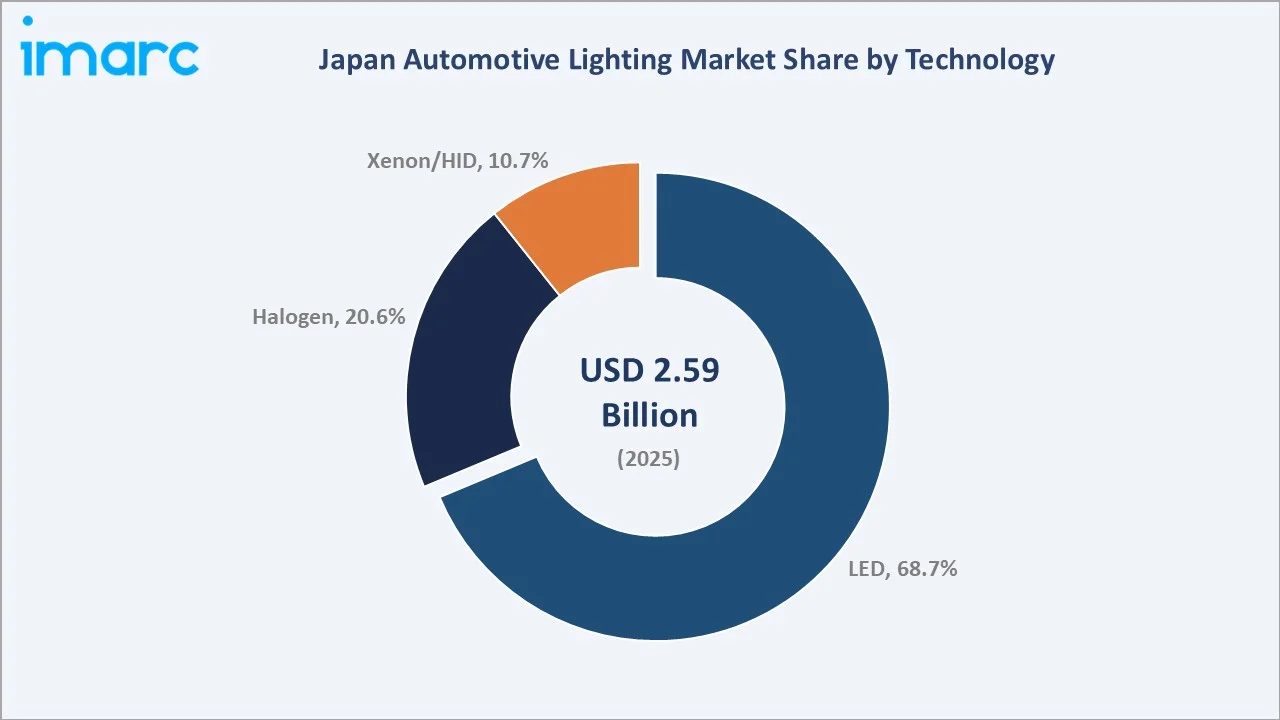
LED technology dominates at 68.7% (2025), driven by universal OEM adoption across new vehicle programs, energy efficiency imperative from EV platform proliferation, and declining LED system costs that have made LED the standard technology across all vehicle price segments. LED grows at ~7.5% CAGR through 2034, the fastest technology CAGR, as adaptive matrix LED penetration increases, and the LED segment captures progressively higher ASPs from advanced system evolution.
To access detailed market analysis, Request Sample
Halogen retains 20.6% share primarily through the aftermarket replacement segment and residual new vehicle fitment in commercial vehicles and entry-level passenger cars. Halogen technology declines at approximately -2.8% CAGR as new vehicle programs eliminate halogen and the replacement market gradually shrinks in line with the declining halogen vehicle fleet. Xenon/HID at 10.7% is similarly in structural decline, sustained by luxury vehicle service replacement demand and a small residual new vehicle fitment in specific model applications.
By Application
Front lighting/headlamps lead at 46.8% (2025), reflecting the complex engineering, high component value, and safety criticality of modern LED headlamp systems incorporating adaptive beam control, ADAS camera integration, and distinctive signature design elements. Front lighting grows at ~6.3% CAGR through 2034, driven by ADB regulatory adoption, laser headlamp penetration into premium segments, and vehicle-to-environment communication system integration.
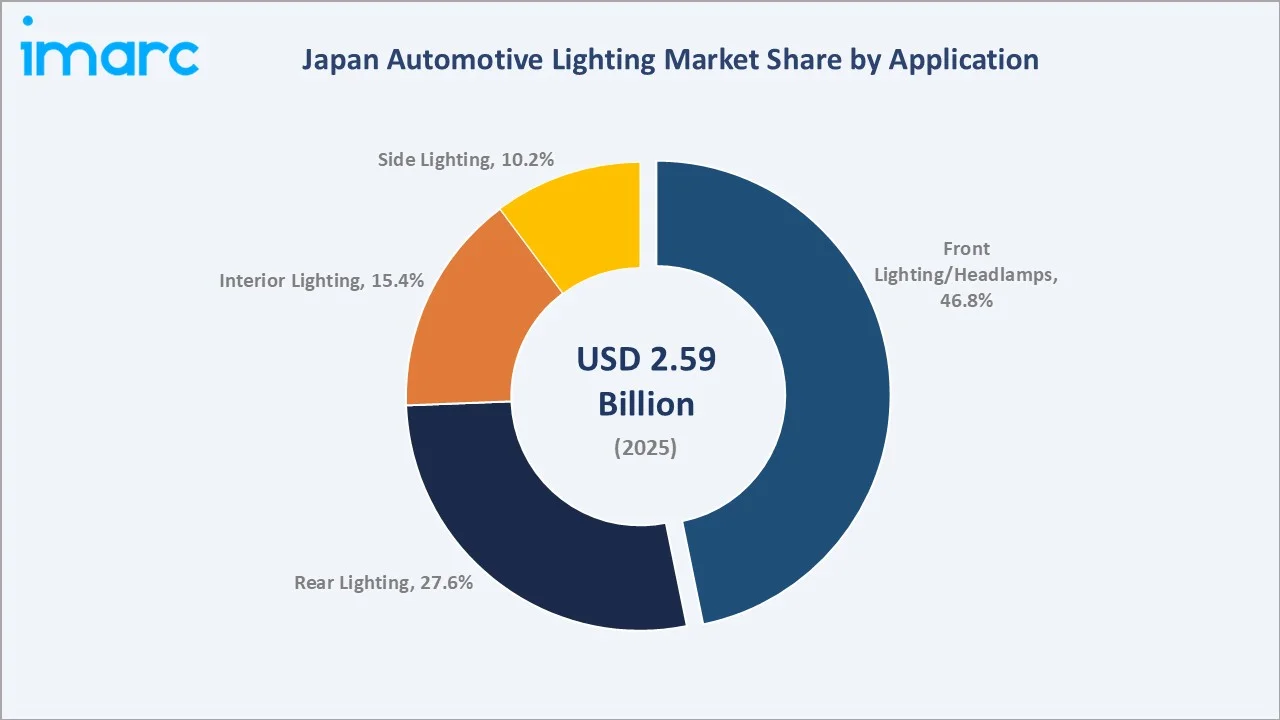
Rear lighting at 27.6% reflects growing OLED tail lamp adoption, expanding LED sequential turn signal use, and high-brightness LED stop lamp requirements. Interior lighting at 15.4% is growing rapidly through expanding ambient LED cabin lighting adoption across premium brand vehicles. Side lighting at 10.2% encompasses LED turn signals, side marker lights, and emerging puddle lamp and side projector functions.
Regional Market Insights
|
Region |
Share (2025) |
Key Japan Automotive Lighting Market Drivers & Characteristics |
|
Kanto Region |
34.7% |
Reflecting the concentration of automotive OEM headquarters, major R&D centers, tier-1 supplier facilities, and Japan's largest automotive aftermarket distribution network. |
|
Central/Chubu Region |
21.8% |
Reflecting Toyota's manufacturing heartland in Aichi Prefecture, and the dense automotive component supplier ecosystem supporting the largest automaker's domestic production base. |
|
Kansai/Kinki Region |
18.9% |
Reflecting significant vehicle assembly operations, substantial tier-1 supplier manufacturing, and electronics and semiconductor companies supplying LED components and control systems to lighting manufacturers. |
|
Kyushu-Okinawa Region |
8.6% |
Reflecting vehicle assembly plants in Fukuoka and Miyazaki prefectures; growing automotive component manufacturing investment. |
|
Tohoku Region |
6.4% |
Reflecting manufacturing facilities in Miyagi and Iwate prefectures; automotive lighting component manufacturing activity; post-earthquake recovery investment in automotive supply chain infrastructure. |
|
Chugoku Region |
5.7% |
Reflecting Mazda's headquarters and primary vehicle production facilities in Hiroshima; Mazda's vertically integrated supply chain driving regional automotive lighting demand concentration. |
|
Hokkaido Region |
2.4% |
Reflecting limited automotive manufacturing activity; primarily aftermarket lighting demand driven by Hokkaido's large commercial vehicle fleet and harsh winter driving conditions requiring robust lighting system performance. |
|
Shikoku Region |
1.5% |
Reflecting limited automotive OEM manufacturing; primarily aftermarket replacement and service demand; remote geographic location from Japan's main automotive production corridors constrains industrial lighting segment development. |
The Kanto region's 34.7% leadership reflects the decisive influence of corporate headquarters concentration in Tokyo and surrounding prefectures combined with Japan's largest automotive aftermarket retail market. The Central/Chubu region's 21.8% reflects the actual manufacturing reality of Japan's automotive lighting industry, where Koito Manufacturing's flagship plants and Toyota's primary vehicle assembly operations are geographically co-located in Aichi Prefecture.
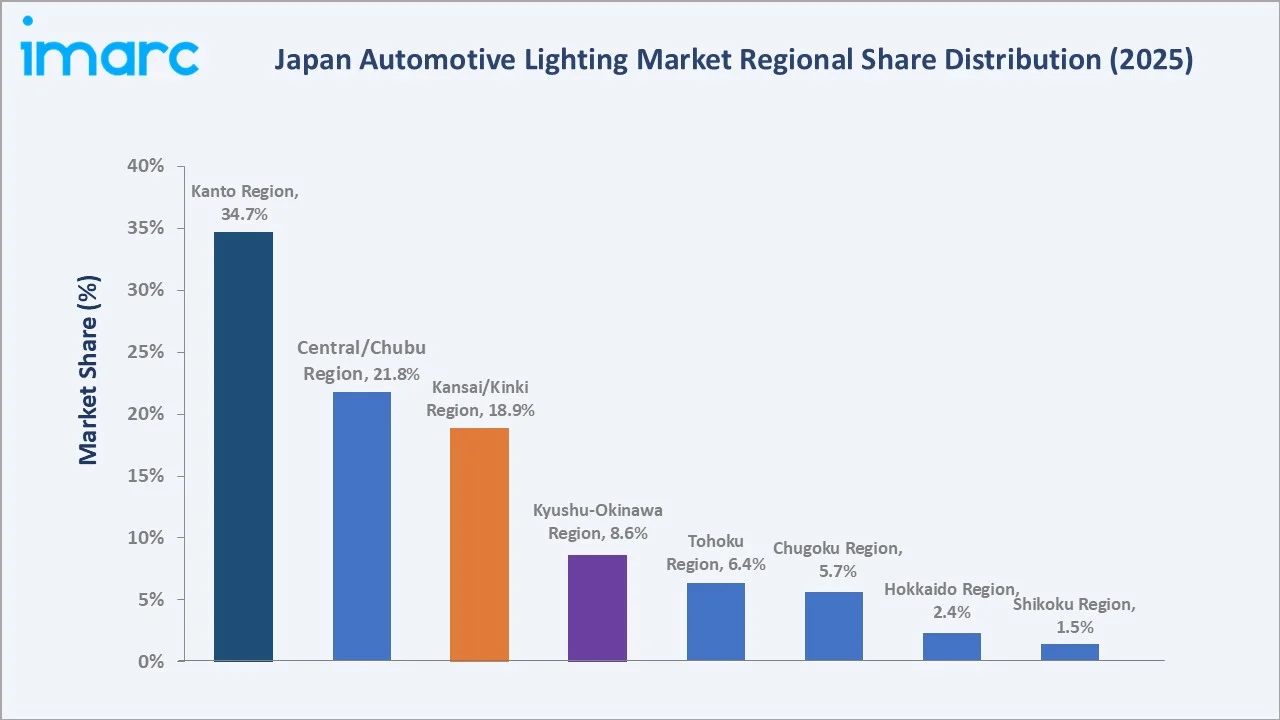
The Kansai/Kinki region's 18.9% reflects its role as Japan's second major automotive manufacturing zone, hosting production operations alongside major electronics companies that supply LED components and automotive electronics to lighting system manufacturers. Kyushu-Okinawa's 8.6% is growing as the region emerges as a new automotive and semiconductor manufacturing hub, with expanding assembly capacity and TSMC establishing a major semiconductor facility that will supply automotive-grade LED driver ICs.
Competitive Landscape
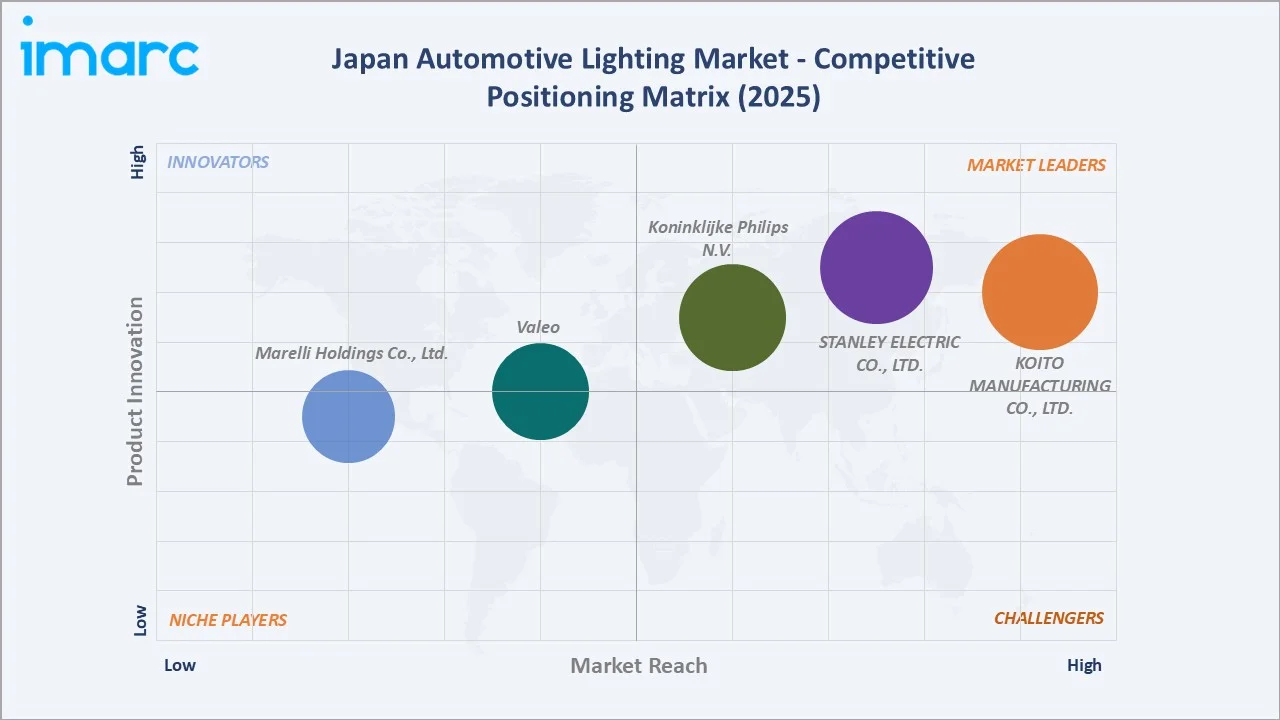
Japan automotive lighting market is characterized by high concentration among a small number of world-class tier-1 suppliers who maintain dominant OEM supply positions through deep long-term partnerships with Japanese automakers and continuous technology leadership in LED, adaptive matrix, and next-generation lighting systems.
|
Company |
Key Products |
Market Position |
Core Strength |
|
KOITO MANUFACTURING CO., LTD. |
LED Headlamps, Halogen Headlamps, Fog Lamps, LED Rear Combination Lamps, High-Mounted Stop Lamps, Side Turn Signal Lamps |
Market Leader |
Koito Manufacturing Co., Ltd. is a dominant leader and pioneer in the Japanese automotive lighting industry, holding a high share in headlamps. |
|
STANLEY ELECTRIC CO., LTD. |
Headlamp & Turn Signal Lamp, Rear Combination Lamp, Multi-reflector Headlamps |
Market Leader |
Stanley Electric Co., Ltd. plays a leading role in the development, design, and production of automotive lighting equipment. |
|
Koninklijke Philips N.V. |
Car lights, Motorcycle lights, LED Inspection lamps |
Market Leader |
Koninklijke Philips N.V. operates as a recognized key player and component supplier in the Japan automotive lighting and adaptive lighting systems. |
|
Valeo |
LED Rear Lighting, Interior lighting, Head Lamps, Rear Combination Lamps |
Established Player |
Valeo, through its subsidiary Ichikoh Industries, supplies automotive lamps to major Japanese automakers. |
|
Marelli Holdings Co., Ltd. |
Front Lighting, Rear Lighting |
Established Player |
Marelli Holdings Co., Ltd. develops advanced vehicle lighting technologies through its combined Japanese and Italian engineering roots. |
Competition in Japan's automotive lighting market is primarily driven by technology leadership in adaptive LED systems, ADAS integration capability, and long-term OEM relationship depth. Koito Manufacturing and Stanley maintain dominant positions through their proprietary LED technology platforms and exclusive/preferred supplier status, while international players compete through specific technology niches and portfolio segments.
Key Company Profiles
KOITO MANUFACTURING CO., LTD.
KOITO MANUFACTURING CO., LTD. is one of the largest automotive lighting manufacturers, with primary production facilities in Shizuoka and Aichi prefectures. As Toyota Group's primary lighting partner and a global tier-1 supplier to major OEMs across Asia, Koito leads Japan's automotive lighting market through proprietary adaptive matrix LED headlamp technology, laser headlamp development, and deep integration with Toyota's electrified vehicle platform lighting requirements.
- Key Products: LED Headlamps, Halogen Headlamps, Fog Lamps, LED Rear Combination Lamps, High-Mounted Stop Lamps, Side Turn Signal Lamps.
- Strategic Focus: Advancing pixel-level ADB matrix LED technology; developing LiDAR-integrated headlamp modules, expanding EV-platform-specific LED system portfolios, strengthening global supply capabilities in North America and Europe to serve Toyota's global production expansion.
STANLEY ELECTRIC CO., LTD.
STANLEY ELECTRIC CO., LTD. is one of Japan's largest automotive lighting manufacturers, headquartered in Tokyo with production facilities across Japan, China, North America, and Southeast Asia. As Honda's primary lighting partner, Stanley supplies LED headlamps, tail lamps, interior lighting, and specialty lighting products across Honda's global vehicle lineup. The company is a leader in OLED automotive lighting research and development, having made significant investments in automotive-grade OLED panel production capability for premium vehicle rear lighting applications. Stanley Electric's strong LED technology R&D capabilities position it as a key innovation driver in Japan's automotive lighting market.
- Key Products: Headlamp & Turn Signal Lamp, Rear Combination Lamp, Multi-reflector Headlamps.
- Strategic Focus: Developing automotive-grade OLED lighting production capability, advancing adaptive LED headlamp technology, expanding smart interior ambient lighting systems for Honda's premium vehicles, growing international production capacity in alignment with Honda's global manufacturing footprint.
Market Concentration Analysis
Japan automotive lighting market is highly concentrated at the OEM supply level, with KOITO MANUFACTURING CO., LTD. and STANLEY ELECTRIC CO., LTD. collectively accounting for an estimated 65-75% of domestic OEM lighting supply revenue. This concentration reflects Japan's business model, where Koito and Stanley maintain exclusive or preferred supplier relationships with Toyota Group and Honda Group, respectively. The aftermarket segment is more fragmented, with domestic specialists competing across retailer and dealer channels. International specialist suppliers compete in specific OEM programs and technology niches. Consolidation at the global automotive tier-1 level is reshaping competitive dynamics and creating larger, better-resourced entities capable of competing with Koito's technology investment capability.
Investment & Growth Opportunities
Highest Growth Segments
LED adaptive matrix headlamp systems (~7.5% CAGR est.), OLED rear and interior lighting (~9%+ CAGR est.), LiDAR-integrated headlamp modules, smart ambient interior LED systems for EV platforms, and ADB-compliant adaptive headlamp technology represent Japan's highest-priority automotive lighting investment vectors through 2034.
Investment Themes
- Next-Generation Adaptive Pixel LED Technology Investment: The regulatory adoption of ADB requirements and consumer premium aesthetic preferences create a high-value product development investment opportunity in pixel-level LED headlamp systems. Companies investing in micro-LED pixel array manufacturing, optical system integration, and software-defined beam control algorithms are positioned to capture the highest ASP lighting systems as adaptive matrix LED transitions from luxury to mid-range mainstream vehicles through 2034.
- EV-Platform Integrated Lighting System Development: Battery electric vehicle platforms create new lighting system architecture opportunities, as the absence of a traditional combustion powertrain enables fundamentally different front-end vehicle designs with integrated lighting and sensor modules. Investment in EV-native headlamp and tail lamp system architectures that optimize energy management, enable new exterior design languages, and integrate emerging vehicle-to-environment communication functions will be critical for maintaining supplier relevance through Japan's EV transition.
Future Market Outlook (2026-2034)
The Japan automotive lighting market is projected to grow from USD 2.59 Billion in 2025 to USD 4.38 Billion by 2034, delivering a 6.00% CAGR over the forecast period through LED technology ASP escalation via adaptive matrix systems, EV platform proliferation, OLED rear lighting adoption, and intelligent vehicle-to-environment lighting function development. The market's anchor value of USD 3.47 Billion in 2030 represents the inflection point at which adaptive matrix LED headlamps achieve mainstream adoption across mid-range vehicle platforms and Japan's EV transition vehicle production.
Three structural forces are expected to define the Japan automotive lighting market through 2034. First, Japan's EV and hybrid vehicle production surge will drive universal LED system adoption across all new vehicle platforms. Second, ADAS regulatory evolution will transform automotive lighting from passive illumination systems to active safety and vehicle communication platforms. Third, premium aesthetic lighting differentiation will continue as a key vehicle brand identity and consumer purchasing factor in Japan's automotive market.
Research Methodology
Primary Research
Primary research comprised in-depth interviews with senior executives from Japan's tier-1 automotive lighting manufacturers, OEM lighting engineering teams at major Japanese automakers, LED component suppliers, automotive electronics specialists, regulatory affairs consultants, and industry analysts specializing in Japan's automotive sector. Discussions validated market size estimates, assessed technology and application segment dynamics, evaluated competitive positioning, and gathered qualitative insights on ADAS integration trends, EV platform lighting requirements, and regulatory developments.
Secondary Research
Secondary research encompassed company annual reports and investor presentations, vehicle safety standard publications, Japan Automobile Manufacturers Association (JAMA) production statistics, ADB regulation documents, technical standards, automotive industry trade publications, LED technology research journals, and reputed market intelligence publications. These resources were used to analyze market trends, technology adoption trajectories, competitive positioning, and regional market dynamics across Japan's automotive lighting industry.
Forecasting Models
Forecasting models were developed using historical market revenue data (2020-2025), Japan vehicle production forecasts by technology type, LED system ASP trajectories, adaptive matrix headlamp technology adoption curves, ADAS regulatory timeline analysis, and macroeconomic automotive market indicators. The analysis incorporated both top-down and bottom-up approaches, validated through primary research cross-referencing, to generate reliable Japan automotive lighting market forecasts through 2034.
Japan Automotive Lighting Market Report Coverage:
| Report Features | Details |
|---|---|
| Base Year of the Analysis | 2025 |
| Historical Period | 2020-2025 |
| Forecast Period | 2026-2034 |
| Units | Billion USD |
| Scope of the Report |
Exploration of Historical Trends and Market Outlook, Industry Catalysts and Challenges, Segment-Wise Historical and Future Market Assessment:
|
| Technologies Covered | Halogen, Xenon/HID, LED |
| Vehicle Types Covered | Passenger Vehicle, Commercial Vehicle |
| Sales Channels Covered | Original Equipment Manufacturers, Aftermarket |
| Applications Covered | Front Lighting/Headlamps, Rear Lighting, Side Lighting, Interior Lighting |
| Regions Covered | Kanto Region, Kansai/Kinki Region, Central/ Chubu Region, Kyushu-Okinawa Region, Tohoku Region, Chugoku Region, Hokkaido Region, Shikoku Region |
| Companies Covered | KOITO MANUFACTURING CO., LTD., STANLEY ELECTRIC CO., LTD., Koninklijke Philips N.V., Valeo, Marelli Holdings Co., Ltd., etc. |
| Customization Scope | 10% Free Customization |
| Post-Sale Analyst Support | 10-12 Weeks |
| Delivery Format | PDF and Excel through Email (We can also provide the editable version of the report in PPT/Word format on special request) |
Key Benefits for Stakeholders:
- IMARC’s industry report offers a comprehensive quantitative analysis of various market segments, historical and current market trends, market forecasts, and dynamics of the Japan automotive lighting market from 2020-2034.
- The research report provides the latest information on the market drivers, challenges, and opportunities in the Japan automotive lighting market.
- Porter's five forces analysis assist stakeholders in assessing the impact of new entrants, competitive rivalry, supplier power, buyer power, and the threat of substitution. It helps stakeholders to analyze the level of competition within the Japan automotive lighting industry and its attractiveness.
- Competitive landscape allows stakeholders to understand their competitive environment and provides an insight into the current positions of key players in the market.
Frequently Asked Questions About the Japan Automotive Lighting Market Report
The Japan automotive lighting market reached USD 2.59 Billion in 2025, driven by rapid LED technology adoption across all new vehicle programs, accelerating EV and hybrid vehicle production, ADAS-integrated adaptive headlamp system demand, and Japan's world-class automotive lighting supplier ecosystem.
The market is projected to grow at a CAGR of 6.00% during 2026-2034, reaching USD 4.38 Billion by 2034. Growth is driven by LED adaptive matrix headlamp adoption, EV platform LED proliferation, OLED rear lighting expansion, and ADB regulatory mandates across Japanese OEM vehicle platforms.
LED technology leads at 68.7% (2025) and is growing at ~7.5% CAGR through 2034, driven by EV energy efficiency requirements, adaptive matrix headlamp adoption, and rapidly declining LED system costs that have made LED standard equipment across all new vehicle price segments in Japan.
Front lighting/headlamps lead at 46.8% (2025) due to the complex engineering, premium pricing, and safety criticality of modern adaptive LED headlamp systems.
The Kanto region leads at 34.7% (2025) through the concentration of automotive OEM headquarters, major R&D centers, and Japan's largest automotive aftermarket distribution network in the Tokyo metropolitan area.
Leading companies include KOITO MANUFACTURING CO., LTD., STANLEY ELECTRIC CO., LTD., Koninklijke Philips N.V., Valeo, and Marelli Holdings Co., Ltd., among others.
The Japan automotive lighting market is projected to reach approximately USD 3.47 Billion by 2030, representing the mainstream adoption of adaptive matrix LED headlamps across mid-range vehicles and Japan's EV production transition.
Priority investment opportunities include next-generation adaptive pixel LED headlamp technology development, EV-platform integrated lighting system architecture, LiDAR-lighting module integration, automotive-grade OLED panel production capability, and smart ambient interior LED system development for Toyota and Lexus premium vehicle platforms.
Need more help?
- Speak to our experienced analysts for insights on the current market scenarios.
- Include additional segments and countries to customize the report as per your requirement.
- Gain an unparalleled competitive advantage in your domain by understanding how to utilize the report and positively impacting your operations and revenue.
- For further assistance, please connect with our analysts.
 Request Customization
 Speak to an Analyst
 Request Brochure
 Inquire Before Buying
Benefits of Customization
- Personalize this research
- Triangulate with your data
- Get data as per your format and definition
- Gain a deeper dive into a specific application, geography, customer, or competitor
- Any level of personalization
Get in Touch With Us
UNITED STATES
Phone: +1-201-971-6302
INDIA
Phone: +91-120-433-0800
UNITED KINGDOM
Phone: +44-753-714-6104
Email: [email protected]
Client Testimonials




.webp)




.webp)













Related Reports

Choose your plan
*Please note that the prices mentioned below are starting prices for each bundle type. Kindly contact our team for further details.*
Single User License
- 1 User License, Access on 2 Devices
- PDF Report + Excel Dataset (Password Protected)
- Lifetime Access
- No Printing Rights
- 10% Free Report Customization
- 10–12 Weeks of Analyst Support
Five User License
- Access for 5 Users, 2 Devices per User
- PDF Report + Excel Dataset (Password Protected)
- Lifetime Access
- Dedicated Account Manager
- 12–14 Weeks of Analyst Support
- No Printing Rights
- 15% Free Report Customization
- 25% Discount on Your Next Purchase
Corporate User License
- Unlimited User Access (Within Your Organization)
- PDF Report + Excel Dataset
- Lifetime Access
- Dedicated Account Manager
- 14–20 Weeks of Analyst Support
- No Printing Rights
- 20% Free Report Customization
- 30% Discount on Your Next Purchase
Essential Insights
What's included:
3 reports
- Lifetime Access
- PDF Reports
- Excel Datasets
- 2 Weeks of Free Analyst Support
- 2 User Licenses
- Access on 2 Devices
- Printing Rights
- Complimentary PowerPoint (PPT) Version
- Complimentary License Upgrade
Professional Access
What's included:
5 reports
- Lifetime Access
- PDF Reports
- Excel Datasets
- 8 Weeks of Free Analyst Support
- 2 User Licenses
- Access on 2 Devices
- Printing Rights
- Complimentary PowerPoint (PPT) Version
- Complimentary License Upgrade
Business Advantage
What's included:
8 reports
- Lifetime Access
- PDF Reports
- Excel Datasets
- 14 Weeks of Free Analyst Support
- 2 User Licenses
- Access on 2 Devices
- Printing Rights
- Complimentary PowerPoint (PPT) Version
- Complimentary License Upgrade
Enterprise Intelligence
What's included:
10 reports
- Lifetime Access
- PDF Reports
- Excel Datasets
- 20 Weeks of Free Analyst Support
- 2 User Licenses
- Access on 2 Devices
- Printing Rights
- Complimentary PowerPoint (PPT) Version
- Complimentary License Upgrade