
Japan Data Center Construction Market Size, Share, Trends and Forecast by Construction Type, Data Center Type, Tier Standard, Vertical, and Region, 2026-2034
Japan Data Center Construction Market Size, Share, Trends & Forecast (2026-2034)
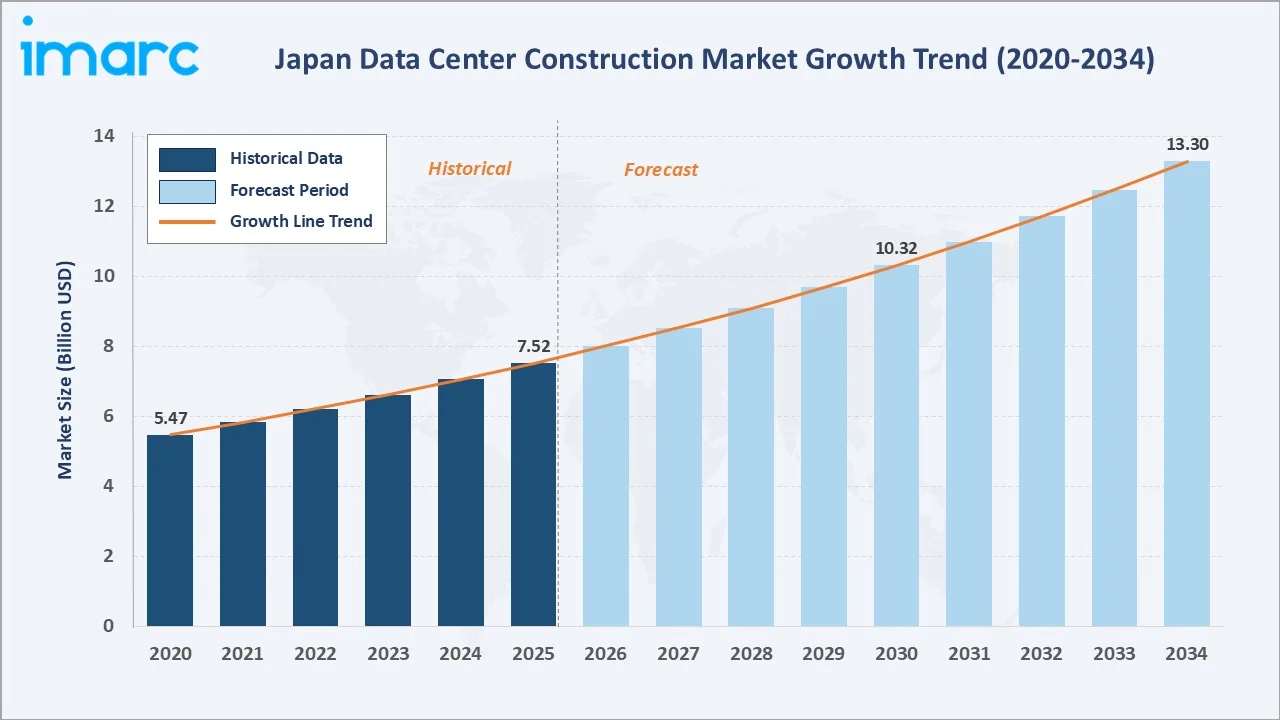
The Japan data center construction market size increased from USD 7.52 Billion in 2025 to USD 8.01 Billion in 2026 and is projected to reach USD 13.30 Billion by 2034, exhibiting a CAGR of 6.54% during 2026-2034. Expanding hyperscale and cloud capacity requirements, rising government-backed digital infrastructure investment, and accelerating electrical and mechanical build-out are the primary drivers shaping market growth.
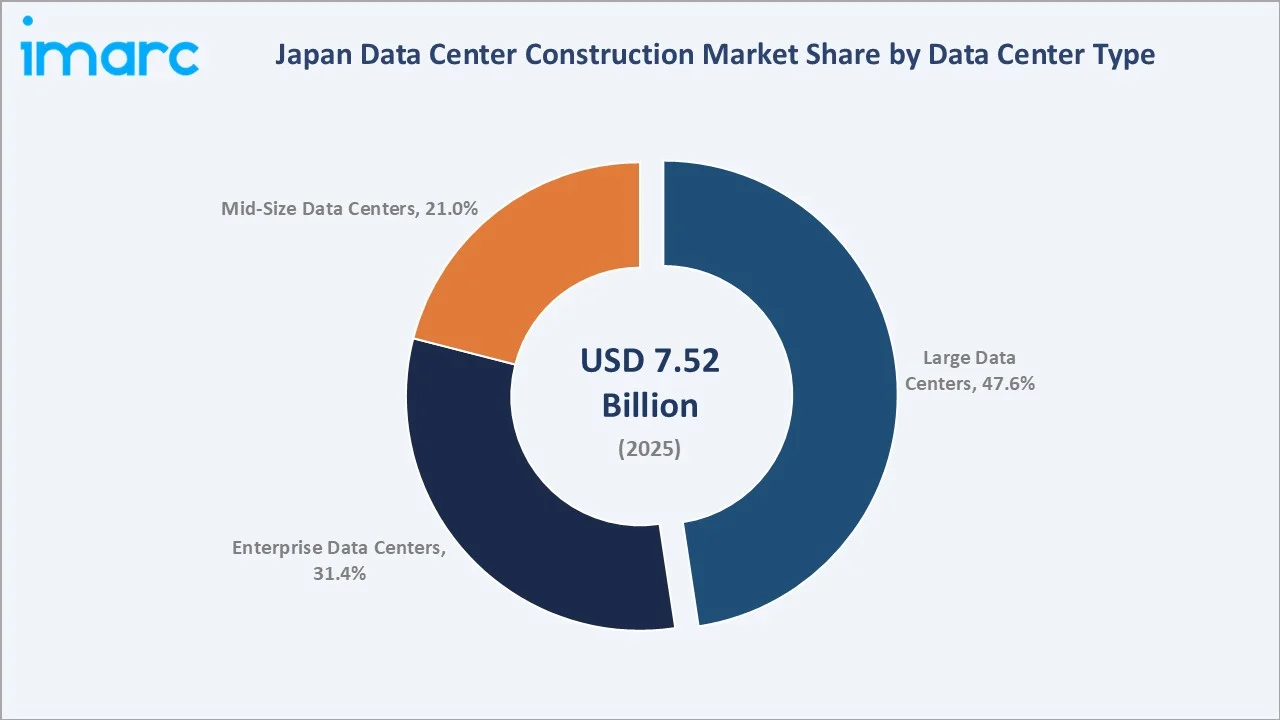
Large data centers lead the data center type segment at 47.6%, electrical construction dominates the construction type segment at 56.8%, and Kanto Region commands 48.2% of regional share.
Market Snapshot
|
Metric |
Value |
|
Base Year Market Size (2025) |
USD 7.52 Billion |
| Market Size (2026) | USD 8.01 Billion |
|
Forecast Market Size (2034) |
USD 13.30 Billion |
|
CAGR (2026-2034) |
6.54% |
|
Base Year |
2025 |
|
Historical Period |
2020-2025 |
|
Forecast Period |
2026-2034 |
|
Largest Region |
Kanto Region (48.2%, 2025) |
|
Second Largest Region |
Kansai/Kinki Region (17.4%, 2025) |
|
Leading Data Center Type |
Large Data Centers (47.6%, 2025) |
|
Leading Construction Type |
Electrical Construction (56.8%, 2025) |
The Japan data center construction market expanded from USD 5.47 Billion in 2020 to USD 7.52 Billion in 2025 and an estimated USD 8.01 Billion in 2026, driven by steady colocation build-out, enterprise IT modernization, and early hyperscale campus development across Kanto Region and Kansai/Kinki Region. Anchored at USD 10.32 Billion in 2030, the forecast to USD 13.30 Billion by 2034 is supported by accelerating cloud infrastructure investment, wider adoption of liquid cooling-ready mechanical systems, and continued electrical infrastructure upgrades across major metropolitan hubs.
To get more information on this market, Request Sample
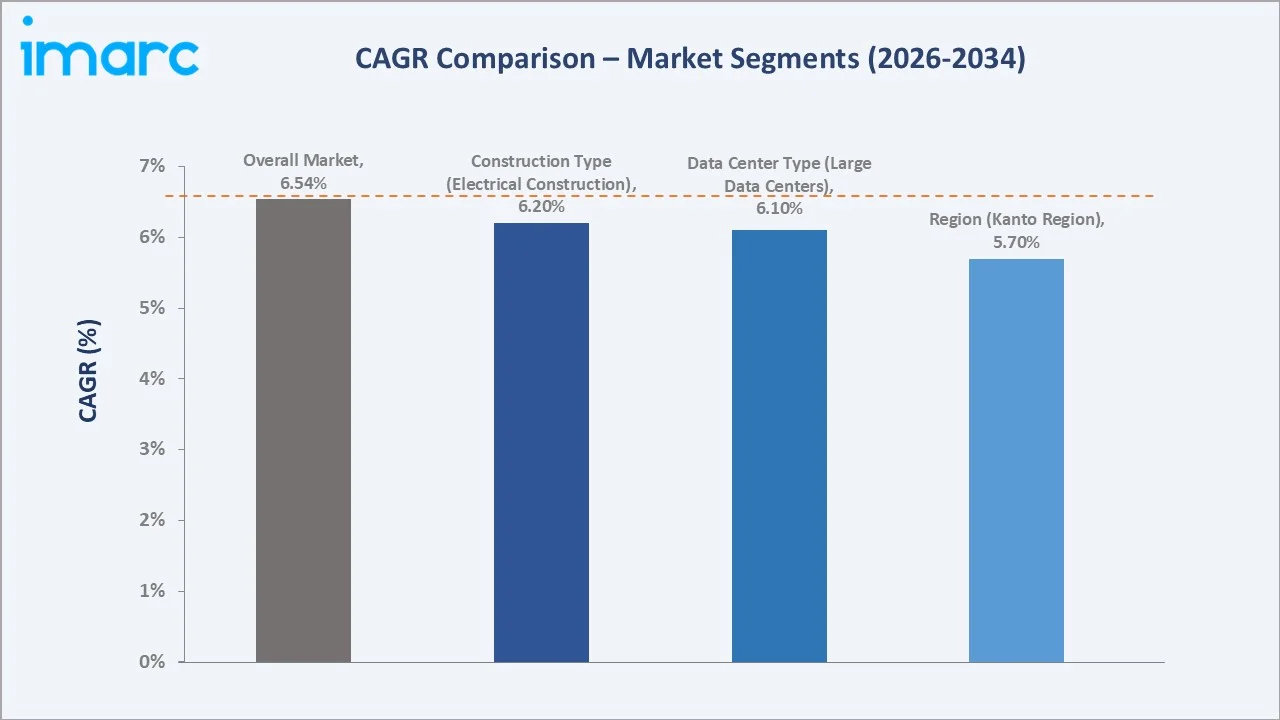
CAGR trajectories across data center type, construction type, and regional sub-segments show Kansai/Kinki Region, mid-size data centers, and mechanical construction expanding faster than the overall 6.54% market CAGR, driven by regional diversification, edge deployment, and rising demand for advanced cooling infrastructure to support high-density AI workloads.
Executive Summary
The Japan data center construction market is on a steady growth trajectory, expanding from USD 5.47 Billion in 2020 to an estimated USD 8.01 Billion in 2026 and reaching USD 13.30 Billion by 2034. The industry has shifted from conventional enterprise server rooms toward large-scale, purpose-built facilities engineered for seismic resilience, high power density, and advanced cooling. Rising cloud adoption, generative AI compute demand, and enterprise digitalization are reshaping construction specifications across Japan's major metropolitan hubs.
Large data centers lead the data center type segment at 47.6% in 2025, supported by hyperscale campus development and economies of scale in electrical and mechanical build-out. Electrical construction commands 56.8% of the construction type segment, reflecting the capital intensity of power distribution, backup generation, and substation-linked infrastructure. Kanto Region commands 48.2% of regional share in 2025, anchored by Tokyo's dense hyperscale and colocation footprint.
Key Market Insights
|
Insight |
Data |
|
Largest Data Center Type |
Large Data Centers - 47.6% share (2025) |
|
Second Largest Data Center Type |
Enterprise Data Centers - 31.4% share (2025) |
|
Leading Construction Type |
Electrical Construction - 56.8% share (2025) |
|
Second Largest Construction Type |
Mechanical Construction - 43.2% share (2025) |
|
Leading Region |
Kanto Region - 48.2% share (2025) |
|
Second Largest Region |
Kansai/Kinki Region - 17.4% share (2025) |
|
Top Companies |
Obayashi Corporation, KAJIMA CORPORATION, Shimizu Corporation, Taisei Corporation, Daiwa House Industry Co., Ltd. |
Key Analytical Observations Expanding On The Data Above:
- Large data centers dominance at 47.6% is supported by hyperscale campus development, favorable economies of scale in electrical and mechanical build-out, and sustained demand from cloud and colocation operators seeking large, contiguous power capacity.
- Enterprise data centers at 31.4% continue to serve financial institutions, manufacturers, and public-sector organizations that require dedicated, on-premise or near-premise infrastructure for regulatory and latency-sensitive workloads.
- Electrical construction leadership at 56.8% reflects the capital intensity of substations, backup generation, uninterruptible power systems, and high-voltage distribution required to support dense server deployments.
- Mechanical construction at 43.2% is expanding as operators upgrade cooling, ventilation, and fire-suppression systems to support higher rack densities associated with AI training and inference workloads.
- Kanto Region at 48.2% dominates regional share, anchored by Tokyo's dense hyperscale and colocation footprint, mature fiber connectivity, and concentrated financial and technology sector demand.
Japan Data Center Construction Market Overview
Data center construction in Japan encompasses the design, engineering, and physical construction of facilities that house server, storage, and networking infrastructure, spanning large data centers, enterprise data centers, and mid-size data centers built to meet hyperscale, colocation, and enterprise IT requirements. The market spans electrical construction, covering power distribution, backup generation, and substation-linked infrastructure, and mechanical construction, covering cooling, ventilation, and fire-suppression systems.
Japan's ecosystem integrates general contractors and EPC firms, mechanical-electrical-plumbing equipment suppliers, land and real estate developers, power and utility providers, regulatory and government bodies, and data center operators and hyperscale cloud providers. Together, these participants deliver seismic-resilient, high-density facilities suited to Japan's distinct geological and regulatory environment.
Market Dynamics
To evaluate market opportunities, Request Sample
Market Drivers
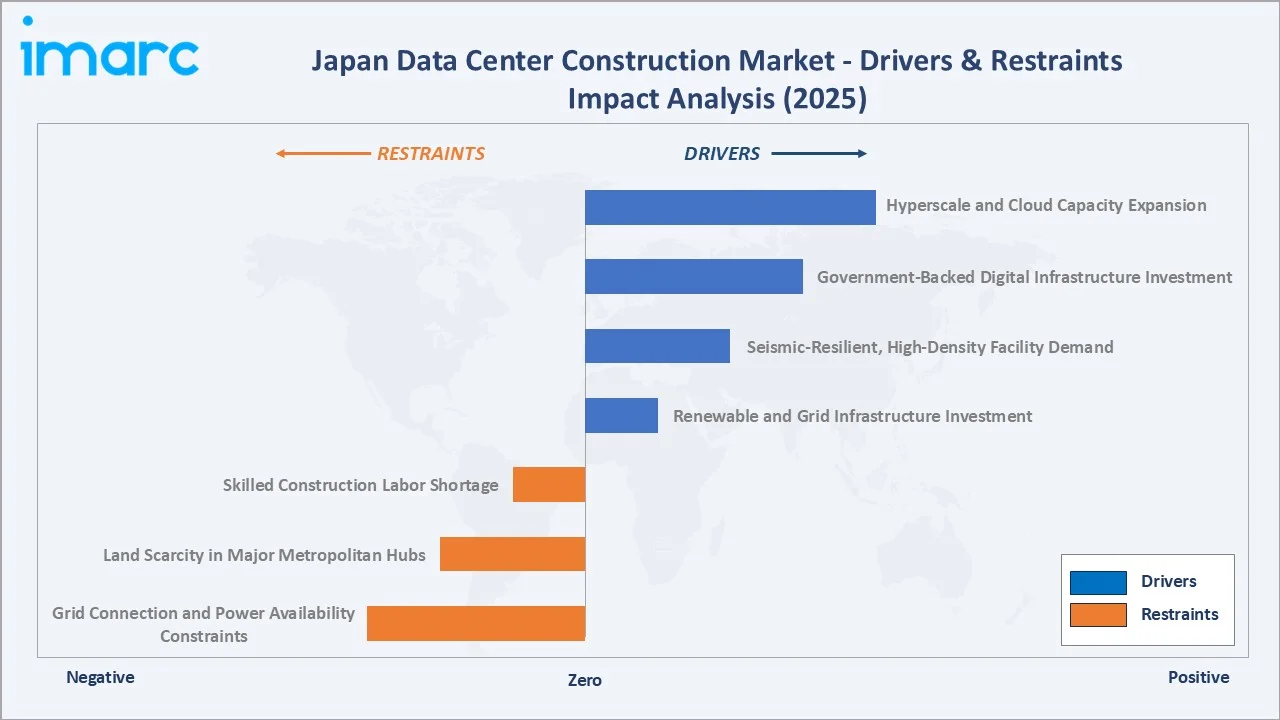
- Hyperscale and Cloud Capacity Expansion: Rapid growth in cloud computing and generative AI adoption is driving hyperscale operators to commission large-scale, design-build data center campuses across Japan's major metropolitan corridors. As per IMARC Group, the Japan generative AI market size was valued at USD 1,014.6 Million in 2025.
- Government-Backed Digital Infrastructure Investment: In December 2025, Japan's Ministry of Economy, Trade and Industry introduced a clean-energy capital expenditure subsidy of 210 Billion Yen (USD 1.34 Billion) over five years starting in fiscal 2026. Such initiatives are encouraging the development of energy-efficient, AI-ready data center facilities while supporting long-term expansion of Japan's digital infrastructure.
- Seismic-Resilient, High-Density Facility Demand: Japan's earthquake-prone geology requires advanced base-isolation and structural engineering, pushing construction specifications and costs higher while favoring contractors with proven seismic expertise.
- Renewable and Grid Infrastructure Investment: Utility-led investment in substations and transmission capacity is expanding the power headroom available for new data center construction across both established and emerging regions.
Market Restraints
- Grid Connection and Power Availability Constraints: Limited grid capacity and lengthy power connection timelines in major metropolitan areas can delay new data center construction and encourage developers to consider alternative regions with better power availability.
- Land Scarcity in Major Metropolitan Hubs: Rising land premiums in Kanto Region and Kansai/Kinki Region are increasing site acquisition costs and pushing new campuses toward secondary metros and greenfield sites.
- Skilled Construction Labor Shortage: An aging construction workforce and competition for specialized electrical, mechanical, and seismic engineering talent are constraining project schedules and increasing labor costs.
Market Opportunities
- Regional and Secondary-Market Expansion: Developers are increasingly evaluating Central/Chubu Region, Kyushu-Okinawa Region, and Hokkaido Region for new campuses, supported by lower land costs and government-backed regional development incentives.
- Modular and Prefabricated Construction Adoption: Prefabricated, factory-built data center modules present opportunities to compress delivery timelines and expand capacity in markets outside the traditional Tokyo-Osaka corridor.
Market Challenges
- Community and Regulatory Siting Pushback: Local residents and municipal authorities in some prefectures have raised concerns over noise, land use, and environmental impact, complicating permitting and site selection for new facilities.
- Rising Construction and Input Costs: Elevated steel, concrete, and electrical component costs, combined with wage inflation across the construction sector, are compressing contractor margins and lengthening project bidding cycles.
Emerging Market Trends
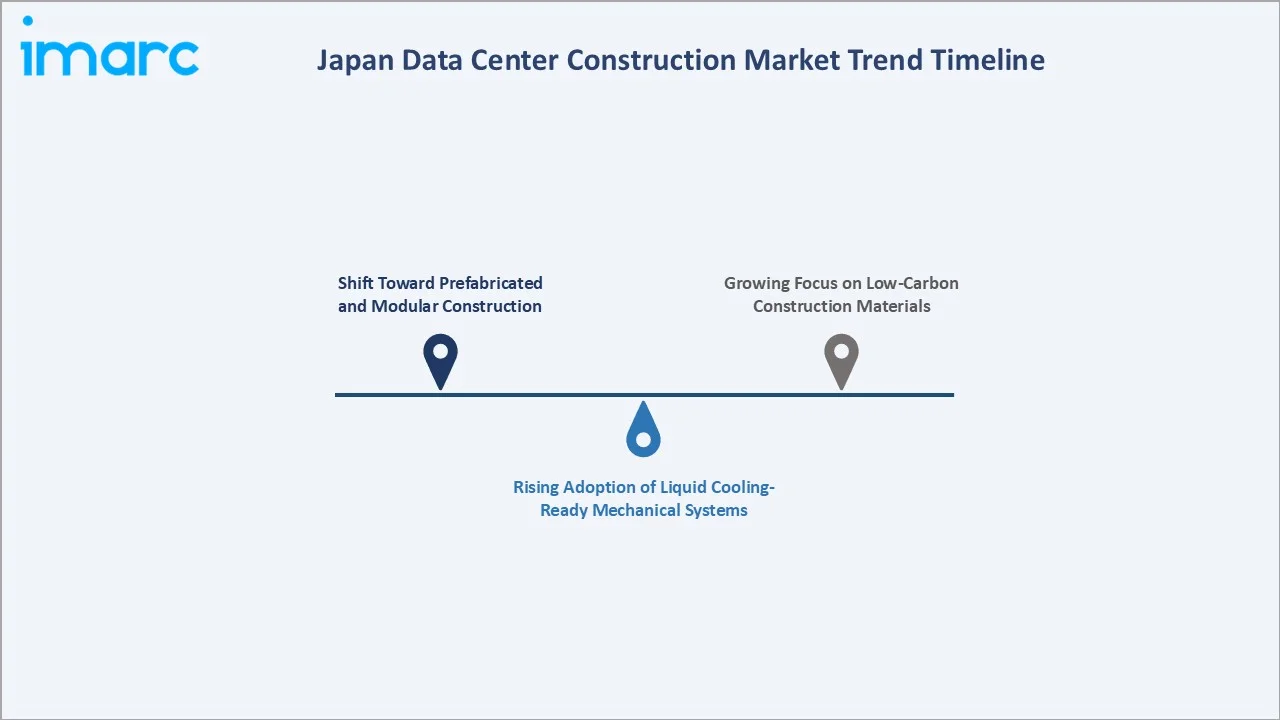
1. Shift Toward Prefabricated and Modular Construction
Developers are increasingly adopting prefabricated, factory-assembled data center modules to shorten construction timelines and accelerate project deployment. Companies are also expanding investments in modular facilities and large-scale data center campuses to meet growing demand for digital infrastructure across Japan.
2. Rising Adoption of Liquid Cooling-Ready Mechanical Systems
Higher rack densities associated with AI training workloads are pushing contractors to design mechanical systems capable of supporting liquid cooling from the outset, rather than retrofitting facilities after commissioning, reshaping mechanical construction specifications across the market.
3. Growing Focus on Low-Carbon Construction Materials
Hyperscale clients are increasingly requesting low-carbon concrete and other decarbonized building materials, prompting general contractors to adapt structural specifications and supply chains to meet sustainability commitments across new data center projects.
Industry Value Chain Analysis
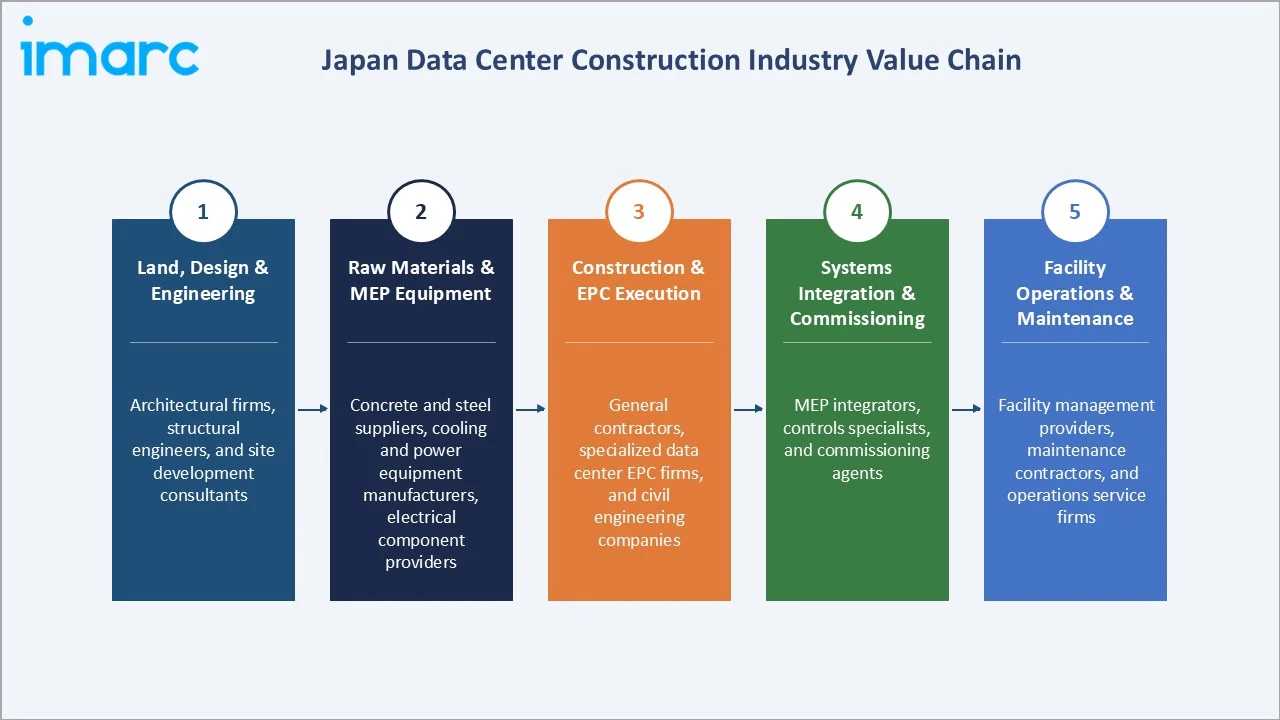
The Japan data center construction value chain spans five stages from land and design through to facility operations. Construction and EPC execution, along with systems integration, capture the highest value-add, while land, design, and engineering increasingly determine schedule and cost outcomes in this seismically constrained market.
|
Stage |
Key Players / Examples |
|
Land, Design & Engineering |
Architectural firms, structural engineers, and site development consultants |
|
Raw Materials & MEP Equipment |
Concrete and steel suppliers, cooling and power equipment manufacturers, electrical component providers |
|
Construction & EPC Execution |
General contractors, specialized data center EPC firms, and civil engineering companies |
|
Systems Integration & Commissioning |
MEP integrators, controls specialists, and commissioning agents |
|
Facility Operations & Maintenance |
Facility management providers, maintenance contractors, and operations service firms |
Contractors with in-house seismic engineering, electrical design, and cooling integration capabilities are positioned to capture greater value than firms reliant on third-party subcontractors, particularly for large-scale hyperscale campus projects.
Technology Landscape in the Japan Data Center Construction Industry
Seismic and Structural Engineering
Base-isolation systems, ultra-high-strength steel, and reinforced foundation designs are standard specifications for data center construction in Japan, given the country's high seismic activity. These systems add cost and complexity but are essential to securing uptime commitments for hyperscale and colocation clients.
Cooling and Mechanical Systems
Contractors are increasingly designing mechanical systems around liquid cooling readiness, high-efficiency air handling, and redundant chiller configurations to support the higher power densities associated with AI training and inference infrastructure.
Electrical and Power Distribution
Modern electrical construction integrates redundant substation feeds, uninterruptible power systems, and modular backup generation, supporting the tier-based reliability standards that hyperscale and enterprise clients require.
Modular and Prefabricated Construction
Factory-assembled electrical and mechanical modules are shortening on-site construction timelines and enabling contractors to standardize quality across projects in both established and emerging regional markets.
Market Segmentation Analysis
The report covers the following segments:
|
Segment Category |
Leading Segment |
Market Share |
Year |
|
Construction Type |
Electrical Construction |
56.8% |
2025 |
|
Data Center Type |
Large Data Centers |
47.6% |
2025 |
|
Tier Standards |
🔒 |
🔒 |
2025 |
|
Vertical |
🔒 |
🔒 |
2025 |
|
Region |
Kanto Region |
48.2% |
2025 |

By Data Center Type
Large data centers command a 47.6% majority share in 2025, driven by hyperscale campus development, deep power and fiber connectivity, and economies of scale that lower per-megawatt construction costs. The segment benefits from sustained hyperscaler capital deployment and long-term colocation lease commitments.
To access detailed market analysis, Request Sample
Enterprise data centers hold 31.4% share in 2025, serving organizations with dedicated compliance, latency, or data-sovereignty requirements.
By Construction Type
Electrical construction leads with 56.8% share in 2025, reflecting the capital intensity of substations, backup generation, and high-voltage distribution systems required to support dense server deployments across large and enterprise facilities.
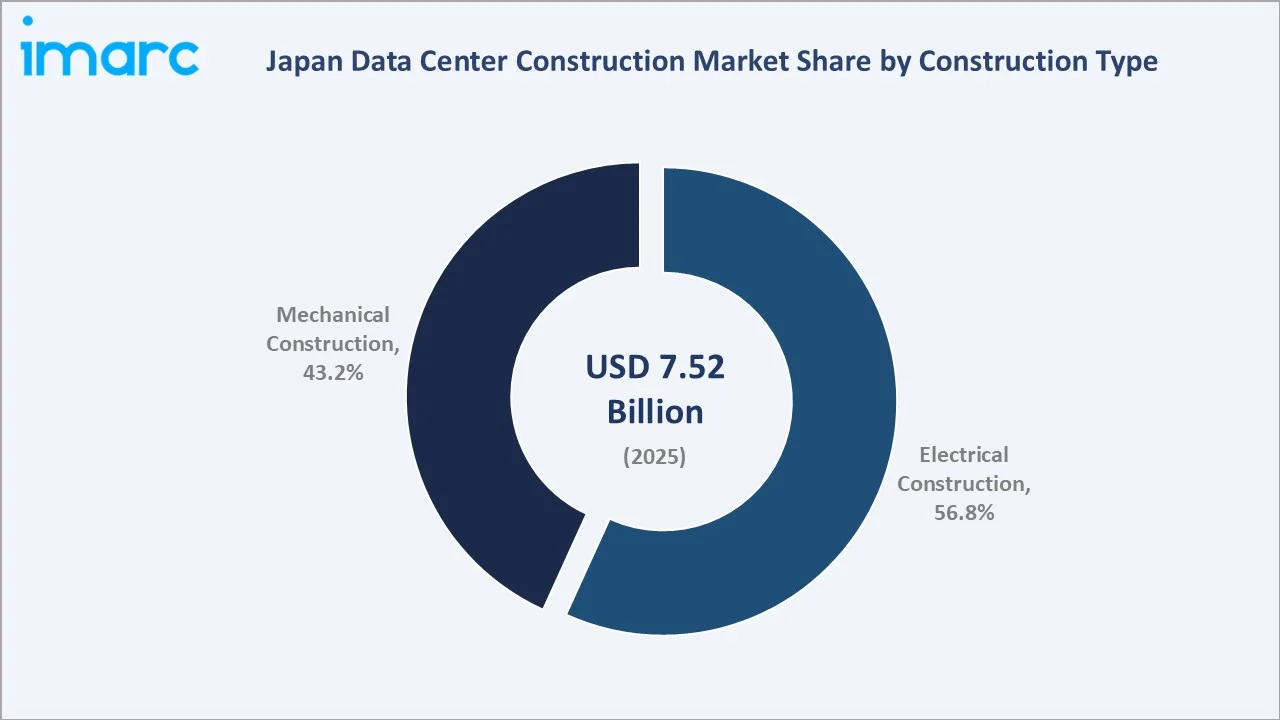
Mechanical construction at 43.2% is growing at a faster pace than electrical construction, driven by rising investment in liquid cooling-ready systems, ventilation upgrades, and fire-suppression infrastructure needed to support higher rack densities.
Regional Market Insights
|
Region |
Share (2025) |
Key Growth Drivers |
|
Kanto Region |
48.2% |
Dense hyperscale and colocation demand, concentrated financial and technology sector activity, and extensive fiber and power infrastructure |
|
Kansai/Kinki Region |
17.4% |
Rising diversification toward Osaka, expanding grid and substation capacity, and growing enterprise and cloud demand |
|
Central/Chubu Region |
14.3% |
Manufacturing-linked digitalization, automotive and industrial IT demand, and expanding logistics connectivity |
|
Kyushu-Okinawa Region |
6.8% |
Emerging semiconductor-linked demand, lower land costs, and government-backed regional development incentives |
|
Hokkaido Region |
4.9% |
Cooler climate advantages for energy-efficient cooling, renewable power availability, and land affordability |
|
Tohoku Region |
3.7% |
Renewable energy access, reconstruction-linked infrastructure investment, and growing interest from regional data hub developers |
|
Chugoku Region |
2.8% |
Industrial base digitalization, port and logistics connectivity, and gradual colocation expansion |
|
Shikoku Region |
1.9% |
Early-stage regional digitalization, government decentralization incentives, and niche colocation development |
Kanto Region at 48.2% in 2025 leads the regional landscape, anchored by Tokyo's dense hyperscale and colocation footprint, mature fiber connectivity, and a large concentration of financial and technology sector demand in the country.
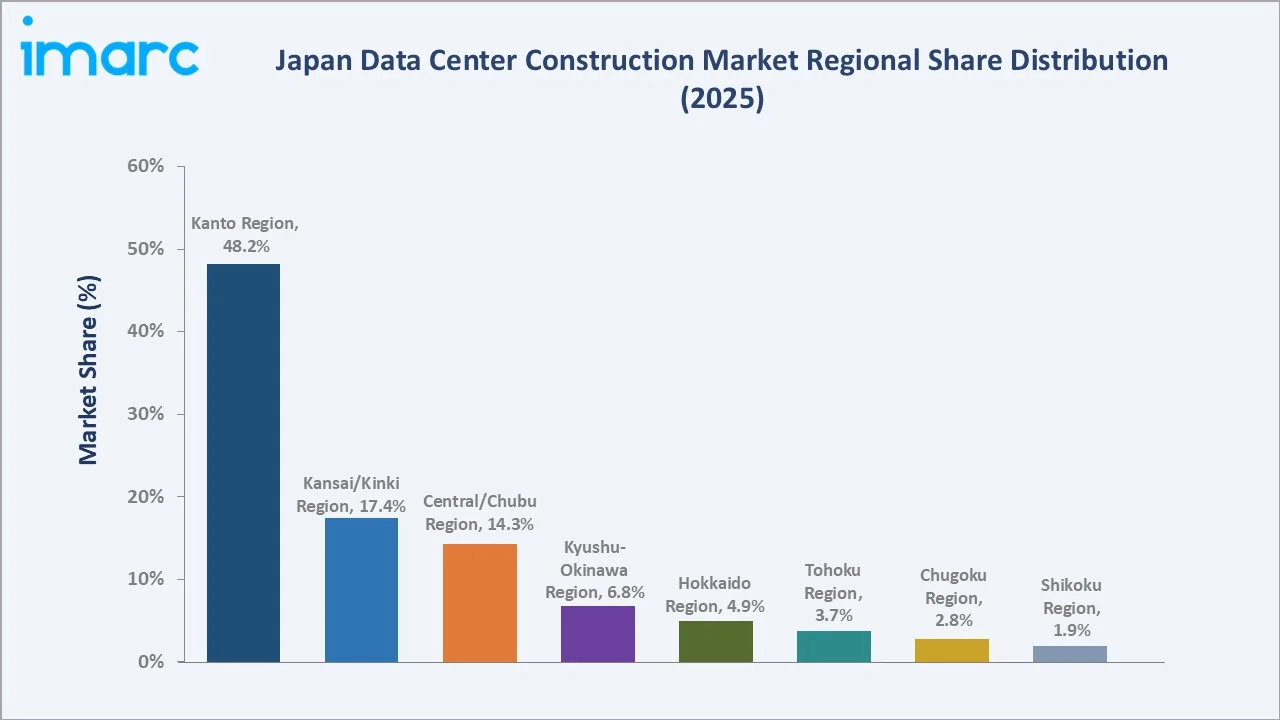
Kansai/Kinki Region at 17.4% is the second largest region, supported by expanding hyperscale developments, strong enterprise demand, and improving digital infrastructure.
Competitive Landscape
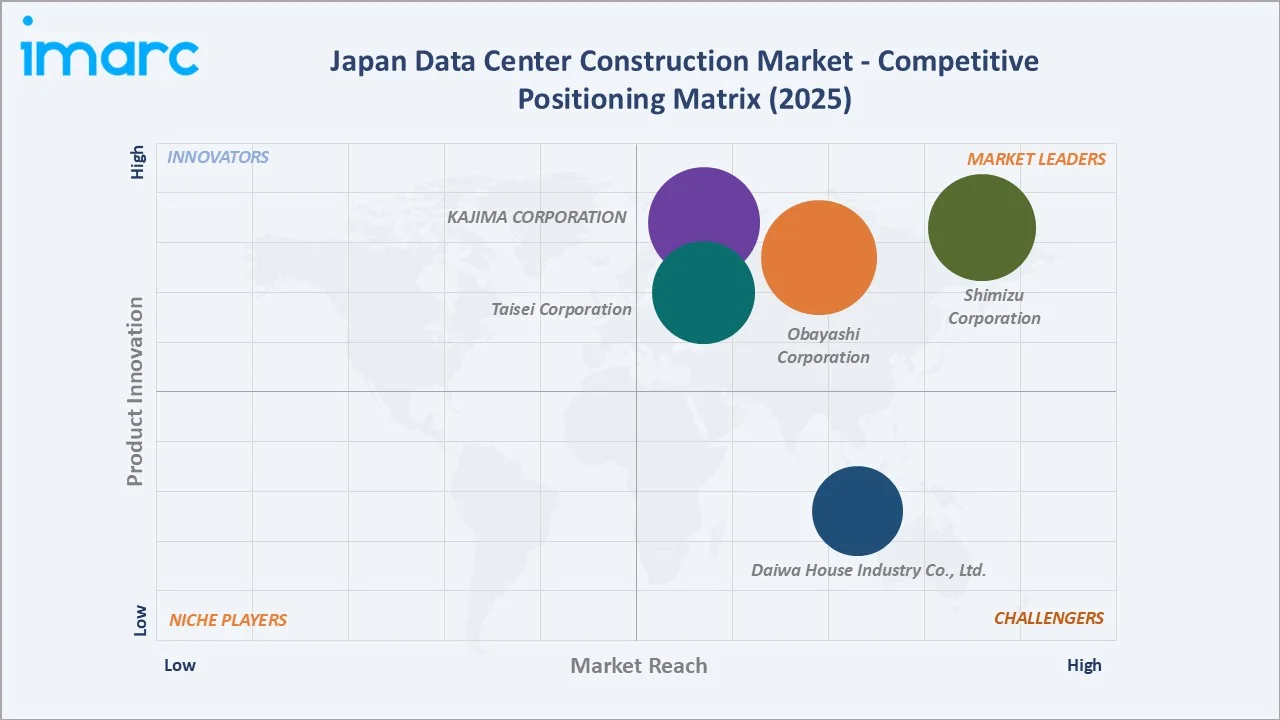
The Japan data center construction market is moderately concentrated, with a small group of large, established general contractors capturing the majority of hyperscale and mission-critical construction contracts, while mid-size and modular specialists compete on regional reach and delivery speed. Seismic engineering expertise, project financing capacity, and hyperscale client relationships form the key competitive moats in this market.
|
Company Name |
Brand / Key Product |
Position |
Strategic Focus |
|
Obayashi Corporation |
CleanCrete™ |
Leader |
Expanding critical-environment construction capacity and low-carbon building materials for hyperscale clients |
|
KAJIMA CORPORATION |
KAJIMA DESIGN |
Leader |
Scaling design-build capacity with seismic-resistant and high-density power engineering |
|
Shimizu Corporation |
Shimizu Smart Site |
Leader |
Broadening decarbonized construction materials and delivery capabilities for large-scale digital infrastructure |
|
Taisei Corporation |
T-eConcrete® |
Leader |
Building optionality through real estate alliances and renewable energy-linked project financing |
|
Daiwa House Industry Co., Ltd. |
DProject Data Center (DPDC) |
Challenger |
Accelerating delivery timelines through modular construction and regional market expansion |
Key players include Obayashi Corporation, KAJIMA CORPORATION, Shimizu Corporation, Taisei Corporation, and Daiwa House Industry Co., Ltd., among others.
Key Company Profiles
Obayashi Corporation
Obayashi Corporation is a leading Japanese general contractor headquartered in Tokyo, with a long-standing track record in large-scale civil engineering, building construction, and mission-critical facility delivery, including data centers and semiconductor plants.
- Product Portfolio: Design-build data center and critical-environment construction services incorporating the company's low-carbon concrete technologies.
- Recent Developments: The company continues to strengthen its mission-critical construction portfolio by expanding data center project capabilities and supporting the development of advanced digital infrastructure across Japan.
- Strategic Focus: Expanding mission-critical construction capacity and low-carbon building materials while deepening relationships with hyperscale cloud clients across Japan.
KAJIMA CORPORATION
KAJIMA CORPORATION is one of Japan's oldest and largest general contractors, headquartered in Tokyo, with extensive experience across civil engineering, architecture, and advanced facility construction, including data centers and industrial facilities.
- Product Portfolio: Design-build and EPC services for data center campuses delivered under its KAJIMA DESIGN technology and services brand.
- Recent Developments: KAJIMA CORPORATION continues to expand its portfolio of data center and advanced facility projects, applying its seismic engineering and high-density power delivery expertise to hyperscale and colocation clients.
- Strategic Focus: Scaling design-build capacity for hyperscale and colocation clients while integrating seismic and high-density power engineering expertise.
Shimizu Corporation
Shimizu Corporation is a major Japanese general contractor headquartered in Tokyo, active in building construction, civil engineering, and industrial facility delivery, with a growing portfolio of data center and logistics projects.
- Product Portfolio: Data center new-build and industrial facility construction services delivered through Shimizu Smart Site.
- Recent Developments: Shimizu Corporation continues to expand its data center and industrial facility construction portfolio, applying advanced construction technologies and sustainable materials to large-scale digital infrastructure projects.
- Strategic Focus: Broadening decarbonized construction materials and delivery capabilities for large-scale digital infrastructure clients.
Market Concentration Analysis
The Japan data center construction market is moderately concentrated, with the top five general contractors, Obayashi Corporation, KAJIMA CORPORATION, Shimizu Corporation, Taisei Corporation, and Daiwa House Industry Co., Ltd., collectively securing a substantial share of large-scale hyperscale and mission-critical construction contracts.
Barriers to entry include the need for seismic-resilient structural engineering expertise, large-scale project financing capacity, specialized cooling and electrical integration skills, and established relationships with hyperscale and colocation clients. These factors favor established, well-capitalized general contractors over smaller regional builders.
Consolidation is gradually accelerating as leading contractors expand critical-environment construction capabilities through acquisitions and partnerships, while smaller and modular-focused players compete on delivery speed and regional presence outside Kanto Region and Kansai/Kinki Region.
Investment & Growth Opportunities
Fastest-Growing Segments
Mid-size data centers and mechanical construction are expanding faster than the overall market, driven by regional diversification, edge-computing deployment, and rising demand for advanced cooling infrastructure to support AI workloads.
Emerging Markets
Kansai/Kinki Region is the fastest growing region, anchored by expanding substation capacity. Central/Chubu Region and Kyushu-Okinawa Region represent additional untapped opportunity for contractors able to deliver region-specific, cost-competitive construction services.
Venture & Investment Trends
Capital is increasingly flowing into modular and prefabricated construction platforms, renewable-linked project financing structures, and specialized electrical and mechanical subcontractors that support hyperscale build-out across both established and emerging Japanese regions.
Future Market Outlook (2026-2034)
The Japan data center construction market is forecast to expand from USD 7.52 Billion in 2025 to USD 8.01 Billion in 2026 and is forecast to reach USD 13.30 Billion by 2034 at a CAGR of 6.54%, adding roughly USD 5.78 Billion in incremental market value over the forecast period.
Four forces will shape the market through 2034: continued hyperscale and cloud capacity expansion; broader adoption of liquid cooling-ready mechanical systems; deeper integration of renewable and grid infrastructure investment; and gradual regional diversification beyond the Kanto and Kansai/Kinki corridors.
By 2034, the Japan data center construction market is expected to be defined by higher-density, seismic-resilient facilities, a growing share of mechanical construction activity, and an expanding pipeline of projects across Central/Chubu Region, Kyushu-Okinawa Region, and Hokkaido Region, as developers seek land and power availability beyond the capital region.
Research Methodology
Primary Research
Primary research included structured interviews with general contractor executives, MEP equipment suppliers, data center developers, and regulatory specialists, validating market sizing, segment mix, and regional demand patterns.
Secondary Research
Secondary sources included Ministry of Economy, Trade and Industry publications, Ministry of Land, Infrastructure, Transport and Tourism data, industry association reports, and annual reports, press releases, and investor presentations from listed construction companies.
Forecasting Models
Market forecasts used top-down and bottom-up models combining construction pipeline data, hyperscale investment commitments, segment mix evolution, and macroeconomic variables. Scenario analysis addressed grid-connection timelines, land availability, and regional diversification pace.
Japan Data Center Construction Market Report Coverage:
| Report Features | Details |
|---|---|
| Base Year of the Analysis | 2025 |
| Historical Period | 2020-2025 |
| Forecast Period | 2026-2034 |
| Units | Billion USD |
| Scope of the Report |
Exploration of Historical and Forecast Trends, Industry Catalysts and Challenges, Segment-Wise Historical and Predictive Market Assessment:
|
| Construction Types Covered | Electrical Construction, Mechanical Construction |
| Data Center Types Covered | Mid-Size Data Centers, Enterprise Data Centers, Large Data Centers |
| Tier Standards Covered | Tier I and II, Tier III, Tier IV |
| Verticals Covered | Public Sector, Oil and Energy, Media and Entertainment, IT and Telecommunication, Banking, Financial Services and Insurance (BFSI), Healthcare, Retail, Others |
| Regions Covered | Kanto Region, Kansai/Kinki Region, Central/ Chubu Region, Kyushu-Okinawa Region, Tohoku Region, Chugoku Region, Hokkaido Region, Shikoku Region |
| Companies Covered | Obayashi Corporation, KAJIMA CORPORATION, Shimizu Corporation, Taisei Corporation, Daiwa House Industry Co. Ltd., etc. |
| Customization Scope | 10% Free Customization |
| Post-Sale Analyst Support | 10-12 Weeks |
| Delivery Format | PDF and Excel through Email (We can also provide the editable version of the report in PPT/Word format on special request) |
Key Benefits for Stakeholders:
- IMARC’s industry report offers a comprehensive quantitative analysis of various market segments, historical and current market trends, market forecasts, and dynamics of the Japan data center construction market from 2020-2034.
- The research report provides the latest information on the market drivers, challenges, and opportunities in the Japan data center construction market.
- Porter's five forces analysis assist stakeholders in assessing the impact of new entrants, competitive rivalry, supplier power, buyer power, and the threat of substitution. It helps stakeholders to analyze the level of competition within the Japan data center construction industry and its attractiveness.
- Competitive landscape allows stakeholders to understand their competitive environment and provides an insight into the current positions of key players in the market.
Frequently Asked Questions About the Japan Data Center Construction Market Report
The Japan data center construction market size is estimated at USD 8.01 Billion in 2026, driven by hyperscale expansion, cloud adoption, and seismic-resilient facility demand.
The market is projected to grow at a CAGR of 6.54% from 2026-2034, reaching USD 13.30 Billion, supported by hyperscale build-out and electrical infrastructure upgrades.
Large data centers lead at 47.6% in 2025, driven by hyperscale campus development and growing cloud infrastructure investment. Their ability to support high-capacity computing and AI workloads continues to strengthen demand across major metropolitan regions.
Electrical construction dominates at 56.8% in 2025, reflecting power distribution and backup infrastructure needs.
Electrical construction dominates at 56.8% in 2025, reflecting power distribution and backup infrastructure needs.
Kanto Region commands 48.2% share in 2025, anchored by Tokyo's dense hyperscale and colocation footprint and mature digital infrastructure.
Kansai/Kinki Region, holding 17.4% share in 2025, is expanding fastest as operators diversify toward Osaka amid Kanto land and grid constraints.
Leading players include Obayashi Corporation, KAJIMA CORPORATION, Shimizu Corporation, Taisei Corporation, and Daiwa House Industry Co., Ltd., among others.
Growth is driven by hyperscale and cloud capacity expansion, government-backed digital infrastructure programs, seismic-resilient building demand, and renewable grid investment.
Need more help?
- Speak to our experienced analysts for insights on the current market scenarios.
- Include additional segments and countries to customize the report as per your requirement.
- Gain an unparalleled competitive advantage in your domain by understanding how to utilize the report and positively impacting your operations and revenue.
- For further assistance, please connect with our analysts.
 Request Customization
 Speak to an Analyst
 Request Brochure
 Inquire Before Buying
Benefits of Customization
- Personalize this research
- Triangulate with your data
- Get data as per your format and definition
- Gain a deeper dive into a specific application, geography, customer, or competitor
- Any level of personalization
Get in Touch With Us
UNITED STATES
Phone: +1-201-971-6302
INDIA
Phone: +91-120-433-0800
UNITED KINGDOM
Phone: +44-753-714-6104
Email: [email protected]
Client Testimonials




.webp)




.webp)













Related Reports

Choose your plan
*Please note that the prices mentioned below are starting prices for each bundle type. Kindly contact our team for further details.*
Single User License
- 1 User License, Access on 2 Devices
- PDF Report + Excel Dataset (Password Protected)
- Lifetime Access
- No Printing Rights
- 10% Free Report Customization
- 10–12 Weeks of Analyst Support
Five User License
- Access for 5 Users, 2 Devices per User
- PDF Report + Excel Dataset (Password Protected)
- Lifetime Access
- Dedicated Account Manager
- 12–14 Weeks of Analyst Support
- No Printing Rights
- 15% Free Report Customization
- 25% Discount on Your Next Purchase
Corporate User License
- Unlimited User Access (Within Your Organization)
- PDF Report + Excel Dataset
- Lifetime Access
- Dedicated Account Manager
- 14–20 Weeks of Analyst Support
- No Printing Rights
- 20% Free Report Customization
- 30% Discount on Your Next Purchase
Essential Insights
What's included:
3 reports
- Lifetime Access
- PDF Reports
- Excel Datasets
- 2 Weeks of Free Analyst Support
- 2 User Licenses
- Access on 2 Devices
- Printing Rights
- Complimentary PowerPoint (PPT) Version
- Complimentary License Upgrade
Professional Access
What's included:
5 reports
- Lifetime Access
- PDF Reports
- Excel Datasets
- 8 Weeks of Free Analyst Support
- 2 User Licenses
- Access on 2 Devices
- Printing Rights
- Complimentary PowerPoint (PPT) Version
- Complimentary License Upgrade
Business Advantage
What's included:
8 reports
- Lifetime Access
- PDF Reports
- Excel Datasets
- 14 Weeks of Free Analyst Support
- 2 User Licenses
- Access on 2 Devices
- Printing Rights
- Complimentary PowerPoint (PPT) Version
- Complimentary License Upgrade
Enterprise Intelligence
What's included:
10 reports
- Lifetime Access
- PDF Reports
- Excel Datasets
- 20 Weeks of Free Analyst Support
- 2 User Licenses
- Access on 2 Devices
- Printing Rights
- Complimentary PowerPoint (PPT) Version
- Complimentary License Upgrade