
Japan Electric Vehicle Charging Station Market Size, Share, Trends and Forecast by Charging Station Type, Vehicle Type, Installation Type, Charging Level, Connector Type, Application, and Region, 2026-2034
Japan Electric Vehicle Charging Station Market Size, Share, Trends & Forecast (2026-2034)
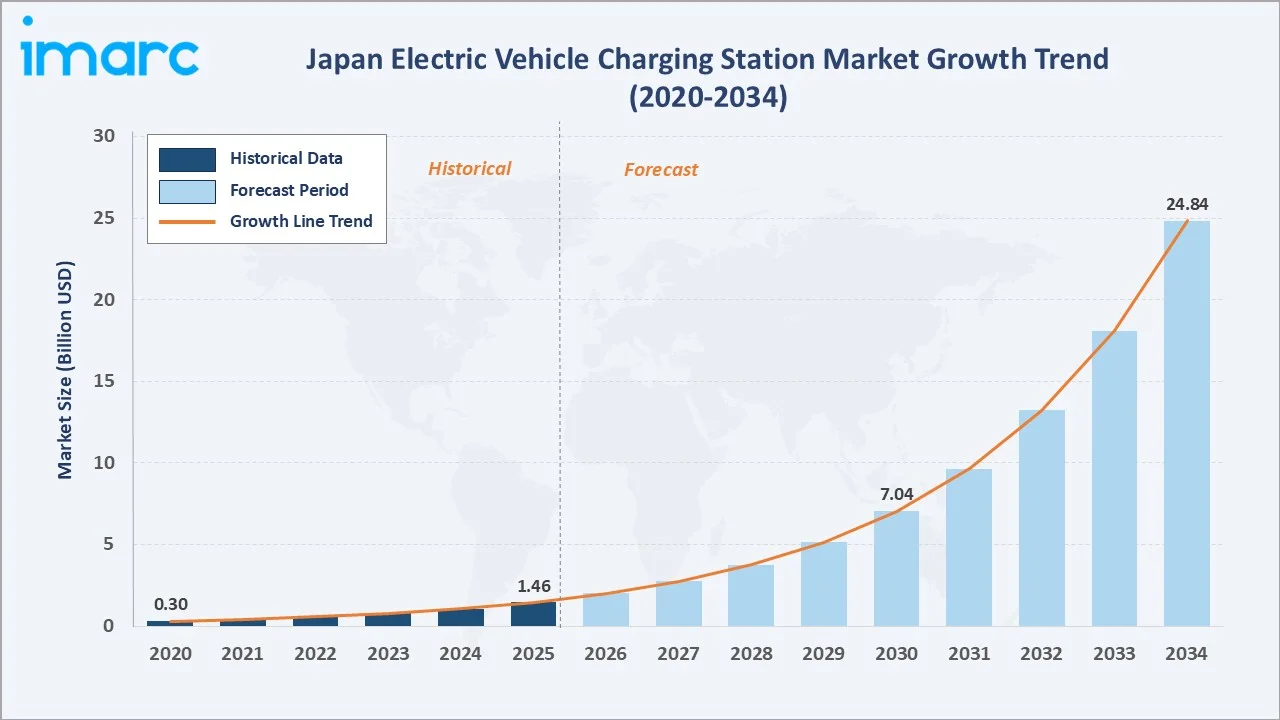
The Japan electric vehicle charging station market size increased from USD 1.46 Billion in 2025 to USD 2.00 Billion in 2026 and is projected to reach USD 24.84 Billion by 2034, growing at a CAGR of 37.05% during 2026-2034. The market is driven by rising EV adoption, strong government subsidies, and Japan's 2050 carbon neutrality mandate. AC Charging dominates at 56.8%, BEV leads demand at 61.7%, and the Kanto Region commands 35.8% market share in 2025.
Market Snapshot
|
Metric |
Value |
|
Base Year Market Size (2025) |
USD 1.46 Billion |
| Market Size (2026) | USD 2.00 Billion |
|
Forecast Market Size (2034) |
USD 24.84 Billion |
|
CAGR (2026-2034) |
37.05% |
|
Base Year |
2025 |
|
Historical Period |
2020-2025 |
|
Forecast Period |
2026-2034 |
|
Dominant Charging Station Type |
AC Charging (56.8%, 2025) |
|
Dominant Vehicle Type |
Battery Electric Vehicle – BEV (61.7%, 2025) |
|
Leading Region |
Kanto Region (35.8%, 2025) |
The market expanded from USD 0.30 Billion in 2020 to USD 1.46 Billion in 2025 and an estimated USD 2.00 Billion in 2026, anchored at USD 7.04 Billion in 2030 and forecast to reach USD 24.84 Billion by 2034. Japan’s 2024 regulatory update enabling 1,000V ultra-fast charging unlocked a new infrastructure investment cycle, accelerating DC charging deployment while residential AC charging continued steady baseline expansion.
To get more information on this market, Request Sample
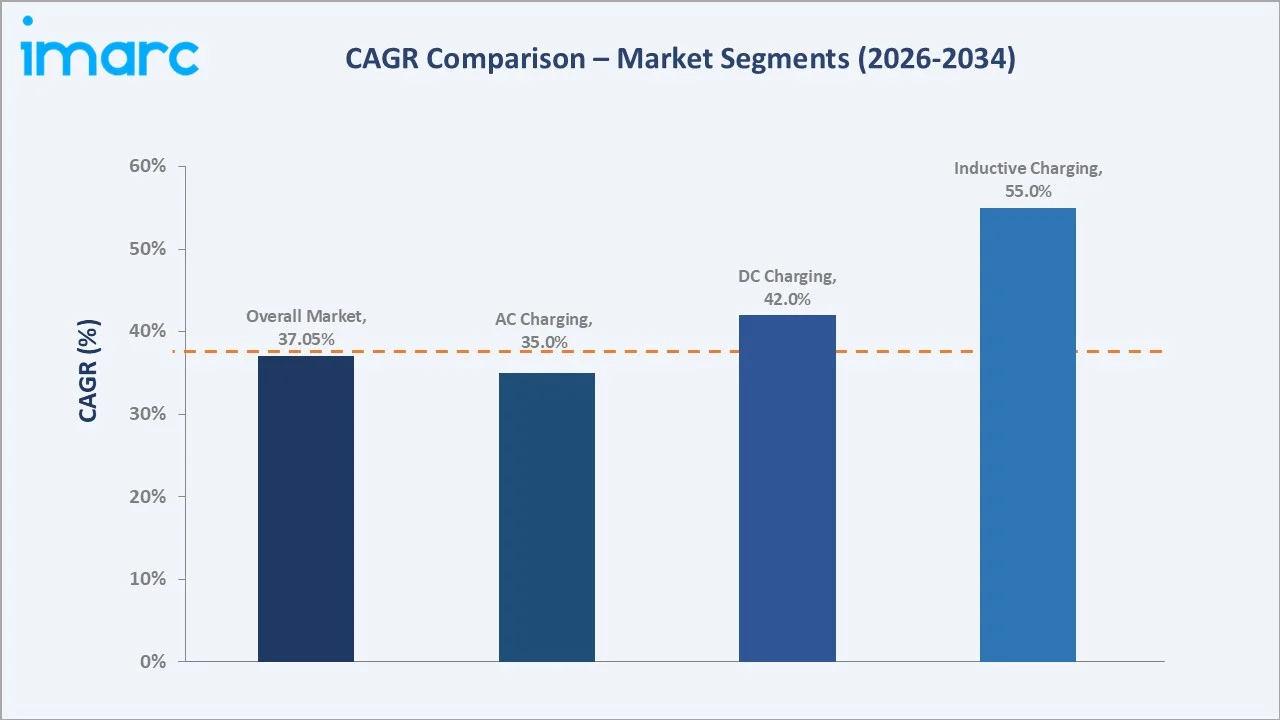
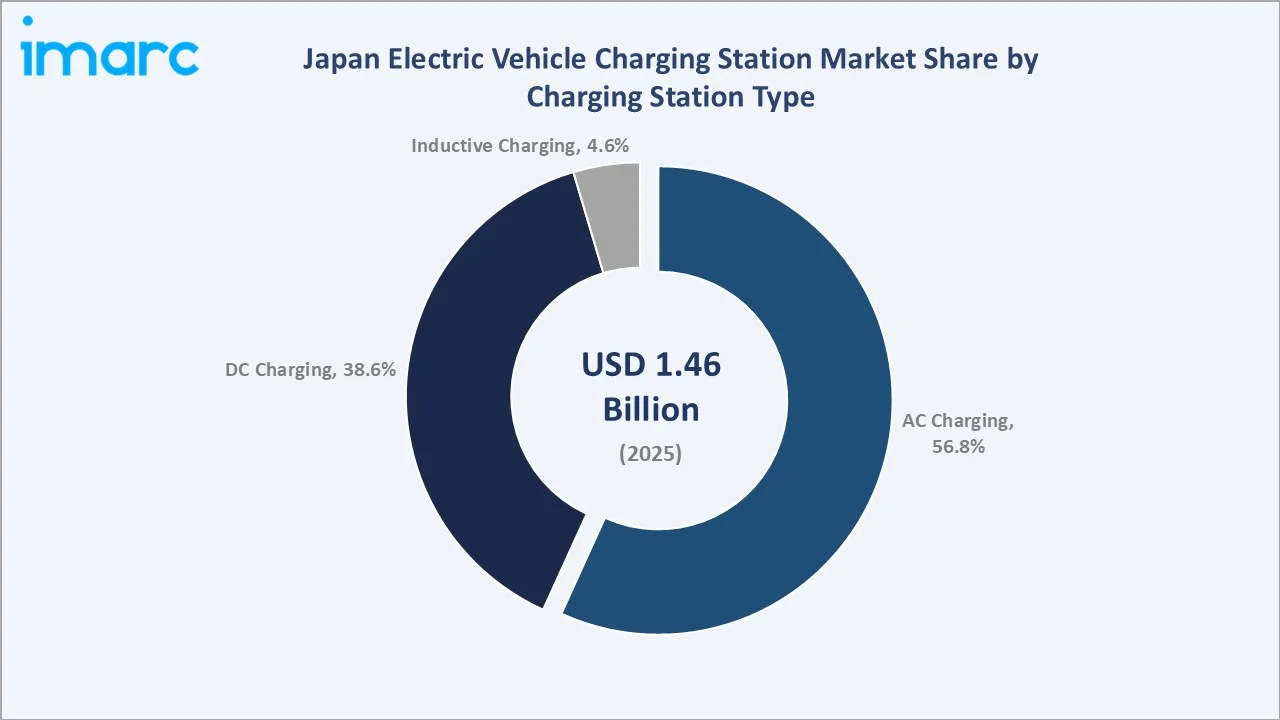
AC Charging grows at ~35% CAGR as residential and workplace charging expands alongside Japan’s BEV fleet. DC Charging grows at ~42% CAGR through ultra-fast highway corridor deployment. Inductive Charging is the highest-growth emerging segment at ~55% CAGR as wireless charging-compatible vehicle platforms enter the market.
Executive Summary
The Japan electric vehicle charging station market grew from USD 1.46 Billion in 2025 to an estimated USD 2.00 Billion in 2026, representing one of Asia's fastest-growing EV infrastructure markets. Charging stations are the critical enabler of BEV adoption, removing range anxiety through nationwide public coverage. The market is projected to reach USD 24.84 Billion by 2034.
AC Charging at 56.8% dominates through Japan's dense urban residential and workplace charging base. BEV at 61.7% leads vehicle-type demand as automakers accelerate full battery-electric model launches. Kanto Region at 35.8% commands market leadership through Tokyo's EV fleet concentration and proactive municipal infrastructure investment.
Key Market Insights
|
Insight |
Data |
|
Dominant Charging Station Type |
AC Charging – 56.8% share (2025) |
|
Dominant Vehicle Type |
Battery Electric Vehicle (BEV) – 61.7% market share (2025) |
|
Leading Region |
Kanto Region – 35.8% market share (2025) |
|
Market Opportunity |
Ultra-fast DC corridors; V2G integration; rural coverage; smart charging networks |
Key Analytical Observations Supporting the Above Data:
- AC Charging at 56.8%: Dominates due to widespread compatibility with residential and commercial Level 2 installations, lower infrastructure cost, and suitability for overnight and workplace charging. AC infrastructure benefits from government subsidies for home charger installation and mandatory workplace charging provisions in new building codes, making it the foundation of Japan’s national charging strategy.
- BEV at 61.7%: Leads demand as Japan’s automakers accelerate BEV model launches, and the government's 2035 ICE phase-out target drives consumer transition. Government subsidies for BEV purchase accelerate fleet replacement, while expanding public charging infrastructure reduces range anxiety. Fleet electrification targets for taxis and delivery vehicles further compound BEV charging demand.
- Kanto Region at 35.8%: Commands market leadership through Tokyo's high EV fleet density and proactive municipal charging rollouts. Tokyo's mandate requiring new residential buildings to include EV charging points creates sustained infrastructure investment. The region's population density maximizes station utilization rates, supporting commercial viability for charging network operators.
Japan Electric Vehicle Charging Station Market Overview
The Japan EV charging station market encompasses the design, installation, operation, and maintenance of all charging infrastructure including AC chargers, DC fast chargers, and inductive wireless charging systems deployed across residential, commercial, highway, and public locations nationwide.
The ecosystem integrates charging equipment manufacturers, energy utilities, EV OEMs, grid operators, network software platform providers, and government regulators setting national infrastructure targets. Macroeconomic factors include Japan’s 2050 carbon neutrality commitment, rising fuel prices, automaker electrification pledges, and government capital support programs for charging deployment.
Market Dynamics
To evaluate market opportunities, Request Sample
Market Drivers
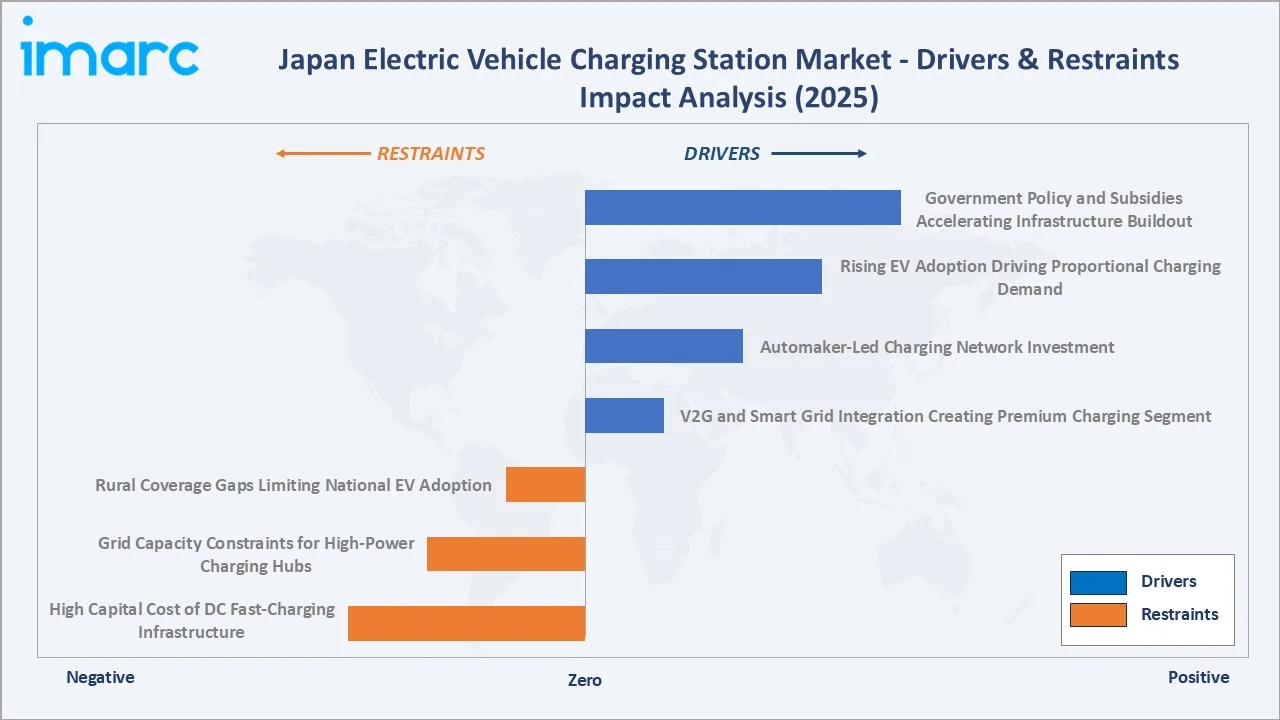
- Government Policy and Subsidies Accelerating Infrastructure Buildout: Japan’s government committed to expanding EV charging stations to 15 million units by 2030, backed by direct subsidies for station installation, tax incentives for commercial operators, and mandates requiring new buildings to include EV charging. The Ministry of Economy, Trade and Industry (METI) funds fast-charger deployment on national highways. The Green Innovation Fund provides capital grants for ultra-fast charging technology development, while municipal governments match national subsidy programs with local co-investment schemes, accelerating deployment nationwide.
- Rising EV Adoption Driving Proportional Charging Demand: Japan’s EV sales are growing rapidly as automakers including Toyota, Nissan, Honda, and Mitsubishi expand BEV portfolios and the government's 2035 ICE phase-out drives structural consumer transition. Every incremental BEV registration creates durable, recurring charging infrastructure demand. Japan's target of 100% electrified new vehicle sales by 2035 establishes a policy-anchored structural demand floor for charging station deployment, ensuring sustained market growth independent of fuel price cycles.
- Automaker-Led Charging Network Investment: Major Japanese OEMs including Toyota, Nissan, and Honda are investing directly in public charging network expansion as a competitive differentiator to address range anxiety. Nissans CHAdeMO fast-charger network and Toyota's destination charging hub partnerships create supply-side acceleration independent of government subsidy. OEM-branded charging networks also create customer-loyalty ecosystems that strengthen brand-switching barriers, incentivizing continued network-expansion investment as BEV model volumes scale.
- V2G and Smart Grid Integration Creating Premium Charging Segment: Vehicle-to-grid technology creates a premium charging station segment commanding higher per-unit revenue and attracting utility company investment. Smart charging capabilities enabling dynamic load management, time-of-use tariff optimization, and renewable energy integration justify premium infrastructure pricing.
Market Restraints
- High Capital Cost of DC Fast-Charging Infrastructure: DC fast-charger installation costs in Japan range from USD 30,000 to over USD 150,000 per unit including grid connection, limiting deployment to locations with viable business models. This capital barrier concentrates DC charging along highways and urban commercial centers, creating regional coverage gaps. The higher power electronics costs of 350 kW ultra-fast chargers under Japan’s 1,000V framework further extend payback periods, requiring higher utilization rates to achieve commercial viability.
- Grid Capacity Constraints for High-Power Charging Hubs: High-power charging hubs requiring simultaneous multi-unit DC fast charging impose substantial grid upgrade costs on local distribution networks, requiring transformer upgrades and cable reinforcement that extend deployment timelines by 12-36 months. These infrastructure prerequisites slow the scaling of ultra-fast charging hubs and increase total project costs, particularly in rural areas where existing grid infrastructure cannot support high-power EV charging.
- Rural Coverage Gaps Limiting National EV Adoption: Despite high urban charging density, Japan’s rural prefectures maintain significant infrastructure gaps that discourage EV adoption among non-urban consumers. This geographic coverage asymmetry creates a self-reinforcing constraint where limited rural demand reduces infrastructure investment, which in turn limits rural EV adoption. Cold-climate regions like Hokkaido face additional challenges of reduced battery range in winter conditions, requiring higher charging station density to provide equivalent range assurance.
Market Opportunities
- Ultra-Fast DC Charging Corridor Development: Japan’s regulatory update enabling 1,000V ultra-fast charging opens a high-value infrastructure investment corridor along national expressways. e-Mobility Power and Takaoka Toko's joint development of 350 kW CHAdeMO chargers targets this premium segment, enabling 10-minute partial-charge cycles for mainstream BEV platforms. Highway charging corridor investment commands superior per-unit economics driven by high utilization rates from intercity travelers, creating a commercially self-sustaining fast-changing business model.
- Wireless Inductive Charging Commercialization: Inductive charging represents one of the highest-growth emerging segments as Japan’s major OEMs develop wireless charging-compatible vehicle platforms. Public transit fleet operators and parking facility owners represent early commercial deployment targets, creating recurring revenue models for wireless charging operators.
Market Challenges
- CHAdeMO-CCS Standard Competition Creating Infrastructure Fragmentation: Japan’s CHAdeMO standard faces competitive pressure from the global CCS standard adopted by European and US automakers, creating a dual-standard environment that increases infrastructure complexity and cost. Station operators must install multi-standard equipment to serve both CHAdeMO-compatible Japanese OEM vehicles and CCS-compatible imported EVs, raising per-station capital cost. Standard fragmentation also complicates planning of uniform national charging networks and creates consumer confusion regarding charger compatibility.
- EV Charging Business Model Viability Under Current Utilization Rates: Public charging station operators face commercial viability challenges at current EV penetration rates, with many public stations achieving insufficient utilization to recover capital and operating costs without government subsidy support. Average public charger utilization rates in Japan remain below commercial breakeven for standalone DC fast chargers outside premium highway locations, requiring operators to rely on government grants or energy company cross-subsidization to sustain network operations.
Emerging Market Trends
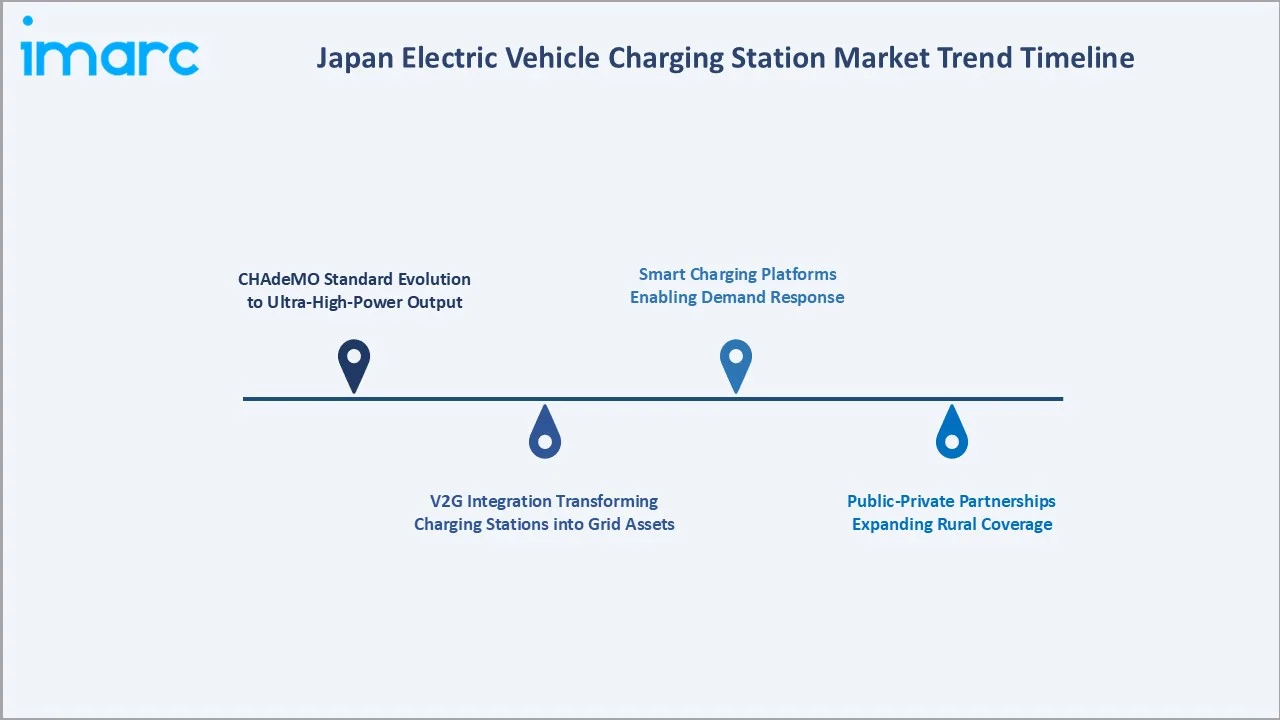
1. CHAdeMO Standard Evolution to Ultra-High-Power Output
Japan’s CHAdeMO Association is advancing the standard to support up to 400 kW outputs. In June 2024, Japan updated regulations to permit 1,000V charging infrastructure. e-Mobility Power and Takaoka Toko are commercializing 350 kW CHAdeMO units. This trend supports DC charging segment expansion and Japan's competitiveness in next-generation fast-changing technology.
2. V2G Integration Transforming Charging Stations into Grid Assets
Vehicle-to-grid integration converts charging stations into bidirectional grid assets with revenue streams beyond conventional charging fees. Nissan's Energy Share service, launched in February 2024, enables commercial and municipal fleets to monetize EV battery capacity. This V2G capability transforms the charging station business model from cost center to revenue-generating infrastructure, attracting utility company co-investment.
3. Smart Charging Platforms Enabling Demand Response
Smart charging platforms using AI-based demand management allow operators to optimize charging schedules based on grid conditions, electricity tariffs, and renewable energy availability. In October 2024, Mitsubishi Corporation launched Japan’s first EV smart-charging service, rewarding Outlander PHEV users with electricity bill discounts for off-peak charging and supporting renewable energy utilization.
4. Public-Private Partnerships Expanding Rural Coverage
Government-industry partnerships are systematically extending charging coverage into rural prefectures and tourist destinations where commercial deployment is not yet viable. Hokkaido, Shikoku, and Chugoku regions receive targeted investment through PPP frameworks combining national subsidy, municipal co-investment, and private operator revenue-sharing, addressing coverage gaps that limit EV adoption outside metropolitan areas.
Industry Value Chain Analysis
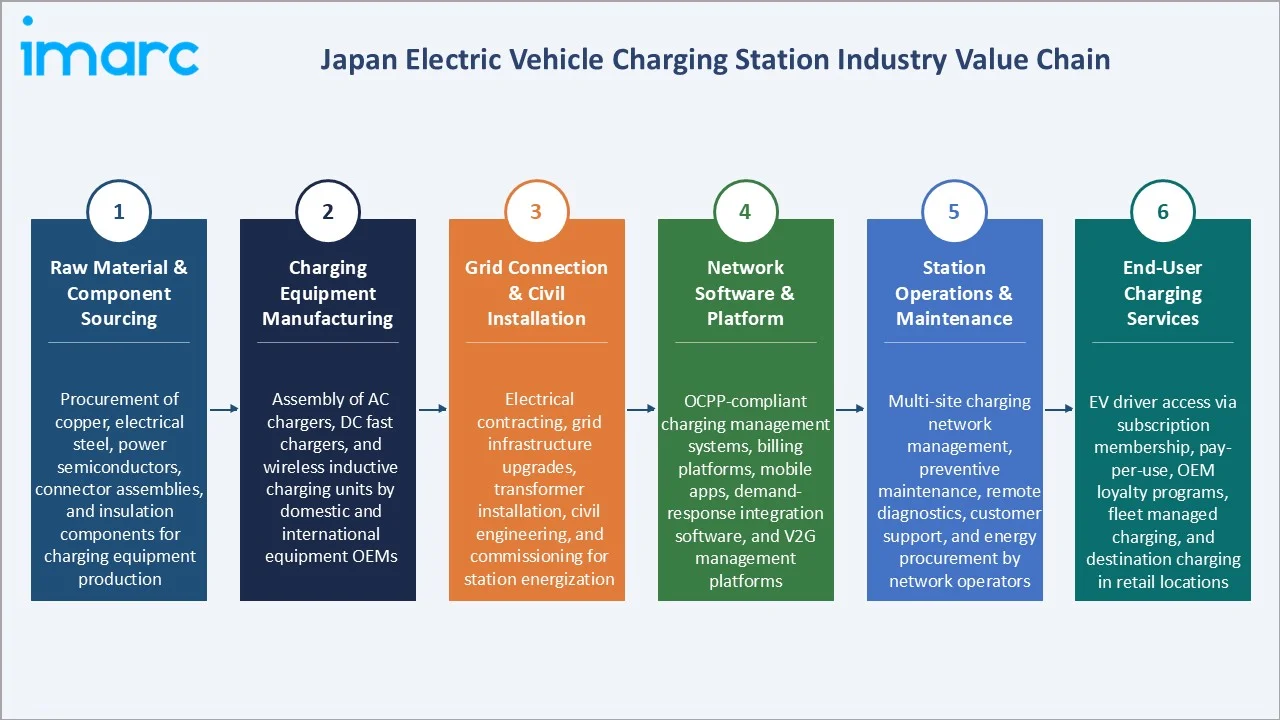
The EV charging station value chain integrates power electronics and component manufacturing, charging equipment assembly, grid connection and installation, network software development, station operations and maintenance, and end-user charging services. The commercial architecture is consolidating toward integrated hardware-software-service bundles as operators seek recurring revenue models.
|
Stage |
Key Participants |
|
Raw Material & Component Sourcing |
Procurement of copper, electrical steel, power semiconductors, connector assemblies, and insulation components for charging equipment production |
|
Charging Equipment Manufacturing |
Assembly of AC chargers, DC fast chargers, and wireless inductive charging units by domestic and international equipment OEMs |
|
Grid Connection & Civil Installation |
Electrical contracting, grid infrastructure upgrades, transformer installation, civil engineering, and commissioning for station energization |
|
Network Software & Platform |
OCPP-compliant charging management systems, billing platforms, mobile apps, demand-response integration software, and V2G management platforms |
|
Station Operations & Maintenance |
Multi-site charging network management, preventive maintenance, remote diagnostics, customer support, and energy procurement by network operators |
|
End-User Charging Services |
EV driver access via subscription membership, pay-per-use, OEM loyalty programs, fleet managed charging, and destination charging in retail locations |
The grid connection tier represents the most commercially critical bottleneck in Japan’s EV charging value chain, with utility coordination timelines determining deployment speed for DC fast-charging projects. The network software platform tier is experiencing the most rapid commercial innovation as operators compete on user experience, billing flexibility, and grid service revenue capabilities.
Technology Landscape in the Japan EV Charging Station Industry
AC Charging Technology
AC charging delivers alternating current to the vehicles onboard charger for battery storage. Level 2 AC charging at 7.4-22 kW represents Japan's dominant installed base, suited for residential and workplace overnight charging. AC infrastructure requires lower installation cost and simpler grid connection, supporting mass deployment across high-density urban areas.
DC Fast Charging Technology
DC fast charging delivers direct current at 50-350 kW outputs directly to the battery. CHAdeMO remains Japan’s primary DC connector standard, supported by all major domestic OEMs. The 2024 regulatory update enabling 1,000V infrastructure supports next-generation 350 kW+ deployment, enabling 10-minute charge cycles for next-generation BEV platforms commercially developed by e-Mobility Power and Takaoka Toko.
Inductive Wireless Charging Technology
Wireless inductive charging transfers power electromagnetically between a ground pad and a vehicle receiver, enabling fully automatic charging without physical connectors. Current commercial deployments support up to 11 kW for passenger vehicles, with bus and commercial EV systems at 50-100 kW under development. Japan’s SAE J2954 standardization supports cross-brand interoperability across vehicle brands.
Market Segmentation Analysis
The report covers the following segments:
|
Segment Category |
Leading Segment |
Market Share |
Year |
|
Charging Station Type |
AC Charging |
56.8% |
2025 |
|
Vehicle Type |
Battery Electric Vehicle (BEV) |
61.7% |
2025 |
|
Installation Type |
🔒 |
🔒 |
2025 |
|
Charging Level |
🔒 |
🔒 |
2025 |
|
Connector Type |
🔒 |
🔒 |
2025 |
|
Application |
🔒 |
🔒 |
2025 |
|
Region |
Kanto Region |
35.8% |
2025 |

By Charging Station Type
AC Charging leads at 56.8% in 2025, capturing Japan’s large residential and commercial slow-charging installed base. AC charging's lower cost, universal vehicle compatibility, and suitability for overnight and workplace charging make it the foundation of Japan's national infrastructure strategy.
To access detailed market analysis, Request Sample
DC Charging at 38.6% is the fastest-growing segment, driven by highway corridor expansion, commercial fleet fast-charging requirements, and the 2024 ultra-high-voltage regulatory framework enabling 350 kW+ deployments. Inductive Charging at 4.6% represents the emerging technology segment with growth driven by OEM wireless charging vehicle platform adoption and commercial parking facility deployments.
By Vehicle Type
Battery Electric Vehicle (BEV) leads at 61.7% in 2025, reflecting Japan’s accelerating structural shift from plug-in hybrid and hybrid powertrains toward full battery electric vehicles. BEV adoption growth directly multiplies charging session frequency and energy throughput, driving superior per-station revenue compared to PHEV and HEV charging use cases.
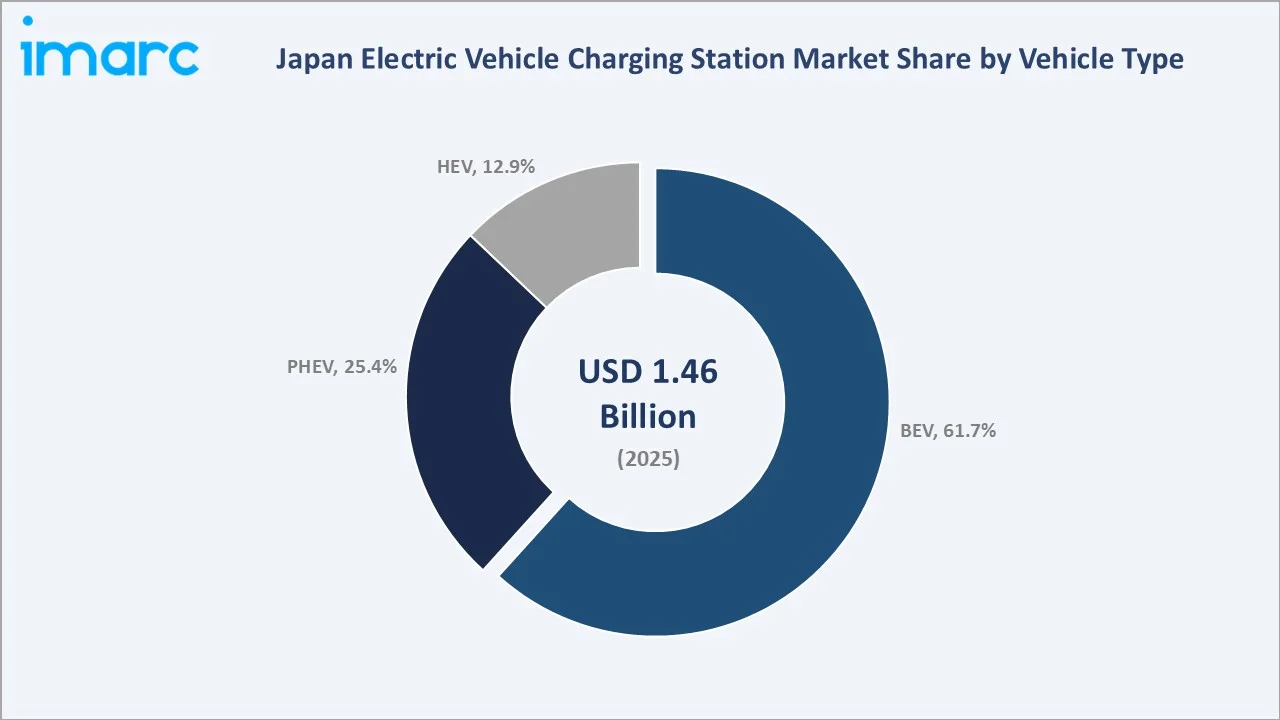
Plug-in Hybrid Electric Vehicle (PHEV) at 25.4% continues generating substantial charging demand through Japan’s large existing PHEV fleet, including Mitsubishi Outlander PHEV and Toyota RAV4 PHEV. Hybrid Electric Vehicle (HEV) at 12.9% represents conventional hybrid infrastructure demand from models with limited external charging capability.
Regional Market Insights
|
Region |
Share (2025) |
Key EV Charging Market Drivers & Characteristics |
|
Kanto Region |
35.8% |
Tokyo high EV fleet density, proactive municipal charging mandates, government fleet electrification, and dense population supporting high station utilization rates |
|
Kansai/Kinki Region |
18.4% |
Osaka and Kyoto EV adoption, commercial district workplace charging, regional government subsidy programs, and tourism destination charging infrastructure |
|
Central/Chubu Region |
15.6% |
Automotive manufacturing concentration around Nagoya, Toyota Group fleet electrification, and highway corridor fast-charger deployment along the Tokaido route |
|
Kyushu-Okinawa Region |
9.2% |
Regional EV adoption incentives, Kyushu manufacturing base electrification, and government-led rural charging coverage programs for underserved prefectures |
|
Tohoku Region |
6.7% |
Post-disaster reconstruction infrastructure investment, regional clean energy goals, and cold-climate charging technology development for harsh winter conditions |
|
Chugoku Region |
5.8% |
Urban-rural infrastructure mix driving diverse charging needs; Hiroshima urban charging expansion and highway route coverage development |
|
Hokkaido Region |
4.7% |
Cold-climate EV infrastructure focus, tourism EV fleet charging, and sustainable transport initiatives for eco-tourism across Hokkaido national parks |
|
Shikoku Region |
3.8% |
Eco-tourism EV charging integration, renewable energy-powered station deployment, and PPP frameworks for rural coverage expansion |
The Kanto Region at 35.8% leads through Tokyos EV fleet density, government fleet electrification mandates, and concentration of both corporate charging operators and EV-adopting consumers. The Kansai/Kinki Region at 18.4% reflects Osaka's commercial charging market and Kyoto's tourism-driven EV mobility initiatives.
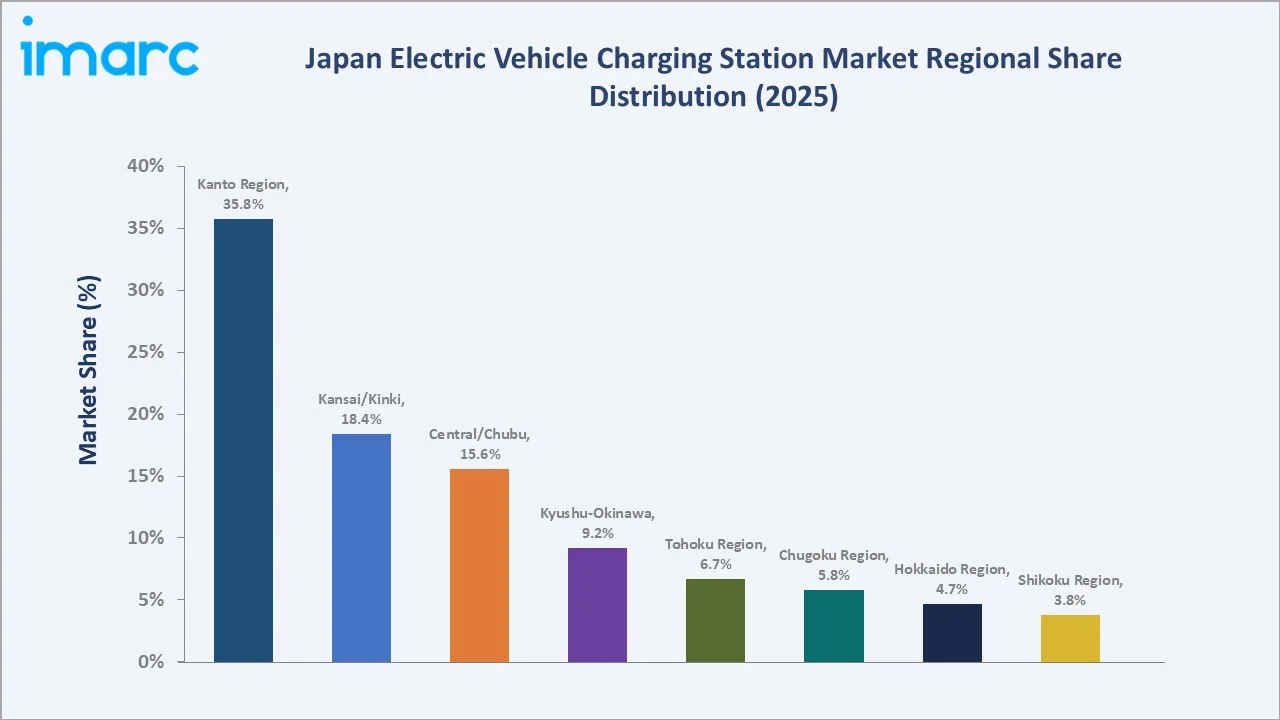
The Central/Chubu Region at 15.6% benefits from Toyota Groups fleet electrification programs and dense highway charging infrastructure along Japan's Tokaido corridor. Kyushu-Okinawa at 9.2% and Tohoku at 6.7% represent growth markets receiving targeted government investment to close urban-rural coverage gaps through nationally coordinated infrastructure expansion programs.
Competitive Landscape
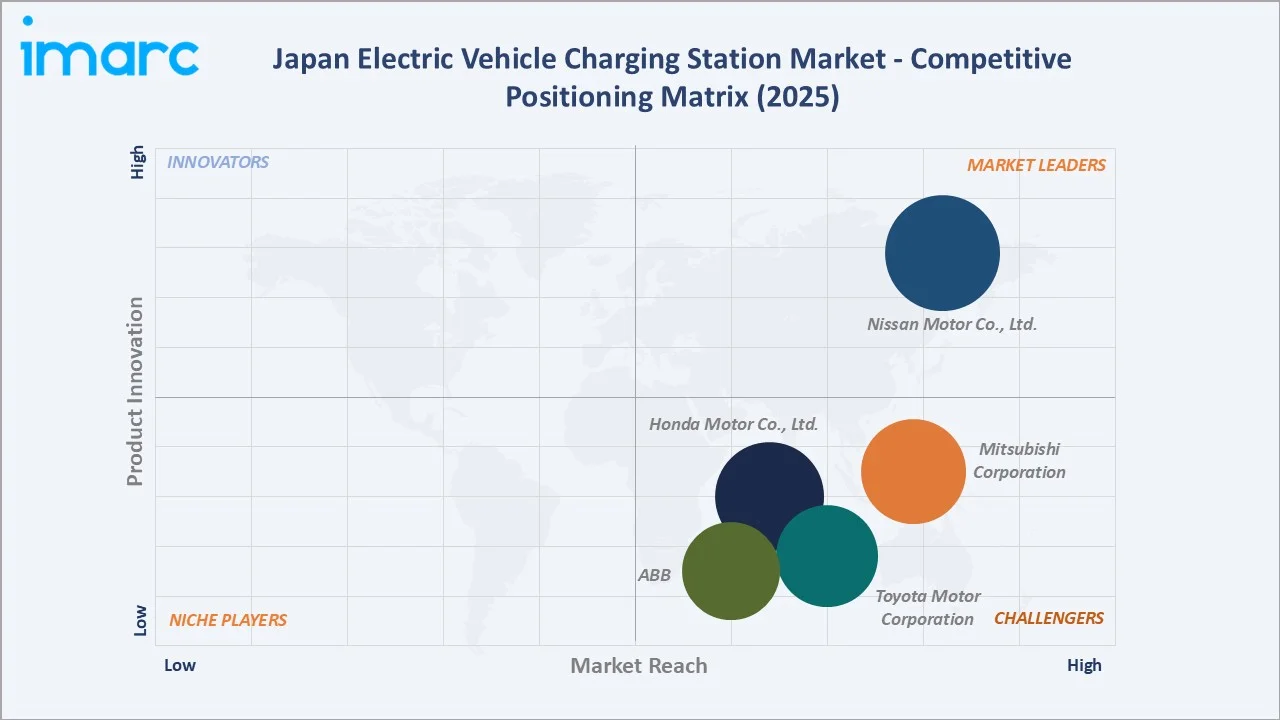
The Japan electric vehicle charging station market competitive landscape is moderately concentrated with domestic automaker-affiliated networks, energy utility operators, and specialized infrastructure providers competing across AC, DC, and emerging wireless segments. Key players invest in network scale, smart charging software, and V2G capabilities as primary market differentiators.
|
Company Name |
Key Products |
Market Position |
Core Strength |
|
Nissan Motor Co., Ltd. |
Home energy solutions, Vehicle to Grid, On-the-go Charging |
Market Leader |
Pioneer of V2G commercial services in Japan; extensive CHAdeMO fast-charger network |
|
Mitsubishi Corporation |
EV smart-charging platform, demand-response management, PHEV charging services |
Strong Challenger |
First-mover in connected EV smart-charging with demand-response integration and electricity bill optimization for commercial operators |
|
Toyota Motor Corporation |
Destination chargers, workplace charging networks, CHAdeMO station partnerships |
Strong Challenger |
Largest vehicle OEM charging network sponsor; extensive workplace and destination charging rollout aligned with BEV fleet growth targets |
|
Honda Motor Co., Ltd. |
Smart charging systems, V2G pilot programs, residential AC chargers |
Strong Challenger |
Collaborating with Kaluza, Altna, and MC Retail Energy on AI-based smart charging integrating renewable energy availability signals |
|
ABB |
Terra CE 54 DC fast chargers, AC equipment, multi-standard ultra-fast chargers |
Strong Challenger |
Leading international charging hardware supplier; installed at Haneda Airport; supports CHAdeMO, CCS, and Type 2 AC standards |
Key players include Nissan Motor Co., Ltd., Mitsubishi Corporation, Toyota Motor Corporation, Honda Motor Co., Ltd., ABB, and others.
Key Company Profiles
Nissan Motor Co., Ltd.
Nissan Motor Co., Ltd. is a Japan-based global automotive manufacturer with a leading position in Japan’s EV charging market through its LEAF EV heritage, extensive CHAdeMO public charging network, and pioneering V2G commercial services delivered under the Nissan Energy brand.
- Key Products: CHAdeMO DC fast charger, Nissan Energy Share V2G commercial service for fleet and municipal operators seeking grid-integrated EV energy management.
- Recent Developments: In February 2024, Nissan launched the Energy Share service in Japan, enabling businesses and municipalities to optimize EV battery charging and discharging for energy savings, grid stability support, and corporate sustainability target alignment through intelligent energy management.
- Strategic Focus: Scaling V2G commercial deployments across municipal and corporate fleet customers, expanding CHAdeMO public fast-charging to support Nissan Ariya and next-generation BEV models, and deepening integration between vehicle and energy services to build recurring revenue streams. The company is investing in bidirectional charging hardware that enables EV owners to sell stored energy back to the grid, creating financial incentives that accelerate BEV adoption among cost-conscious consumers.
Mitsubishi Corporation
Mitsubishi Corporation is a Japan-based global trading and investment company with a growing presence in Japan’s EV charging market through connected smart charging platform development and energy management services aligned with Japan's grid modernization and carbon neutrality objectives.
- Key Products: EV smart-charging service platform utilizing connected technologies for demand-response optimization, Outlander PHEV charging network management, and commercial fleet energy scheduling integrated with electricity market pricing signals.
- Recent Developments: In October 2024, Mitsubishi Corporation launched Japan’s first EV smart-charging service using connected vehicle technologies to adjust charging times based on electricity pricing and usage patterns, rewarding Outlander PHEV customers with electricity bill discounts and reducing peak-hour grid demand.
- Strategic Focus: Expanding smart charging platform capabilities to additional vehicle models and scaling commercial fleet operator client base, integrating renewable energy procurement with charging demand management for corporate sustainability clients seeking Scope 2 emissions reduction. Mitsubishi Corporation is building partnerships with real estate developers to deploy managed charging infrastructure at commercial buildings, parking facilities, and logistics hubs across Japan’s major metropolitan areas.
Market Concentration Analysis
The Japan EV charging station market is moderately concentrated, with Nissan, Toyota-affiliated networks, and energy utility operators collectively accounting for approximately 50-60% of public charging station installed base. OEM-affiliated networks represent the dominant distribution channel for fast-charging deployment, while independent operators hold stronger positions in AC residential and commercial segments.
Market concentration is expected to moderate over the forecast period as government subsidies attract new entrants, international hardware suppliers expand Japan operations, and convenience store chains and retail operators deploy charging as a customer amenity across high-footfall commercial locations.
Investment & Growth Opportunities
Highest Growth Segments
DC Charging infrastructure (~42% CAGR) through ultra-fast corridor deployment; Inductive Wireless Charging (~55% CAGR from small 2025 base) through OEM wireless charging vehicle platforms; V2G-enabled smart charging stations (~50%+ CAGR) creating grid service revenue; BEV-dedicated charging hubs in Kanto and Kansai metropolitan areas; and highway ultra-fast charging networks under Japan’s 1,000V infrastructure framework represent the highest-growth investment vectors through 2034.
Emerging Investment Opportunities
Fleet charging-as-a-service represents Japan’s highest-value emerging investment opportunity. Commercial EV fleets—delivery vehicles, taxis, and municipal buses—require managed charging infrastructure with V2G capabilities. Per-station contract values for managed fleet charging solutions range USD 50,000-500,000, generating recurring service revenue above conventional public station economics with predictable long-term cash flows under multi-year fleet contracts.
Investment Themes
- Ultra-fast DC charging corridor investment along Japan's national expressways targeting 350 kW+ CHAdeMO deployment: Japan's 2024 1,000V regulatory framework enables ultra-fast charging hub development at highway service areas on the Tomei and Meishin expressways. Operators investing in this corridor gain first-mover location advantage as Japan's BEV fleet grows to support ultra-fast charging demand, with superior utilization rates from intercity travelers improving investment return profiles.
- Smart charging software platform development integrating V2G and renewable energy optimization: Japan's electricity market liberalization creates commercial conditions for smart charging platforms generating grid service revenue alongside conventional charging fees. Platform operators building smart charging subscriptions from fleet and residential customers create recurring revenue independent of energy throughput volume, with higher margins than hardware-only charging business models.
Future Market Outlook (2026-2034)
The Japan electric vehicle charging station market is projected to grow from USD 1.46 Billion in 2025 to USD 2.00 Billion in 2026, reaching USD 24.84 Billion by 2034, delivering a 37.05% CAGR over the forecast period. Japan’s 2035 ICE phase-out mandate and 15-million-charger national target create a policy-anchored demand floor for infrastructure investment through the entire forecast horizon, providing investment confidence that sustains private capital deployment beyond government grant programs.
Three structural forces define Japan's EV charging market growth through 2034. Japan's BEV fleet transition from hybrid-dominant creates an accelerating and durable charging demand cycle as new BEV registrations each year add to cumulative infrastructure requirements. Ultra-fast DC charging technology advancement through Japan’s 1,000V framework is expected to trigger a premium infrastructure upgrade cycle as existing highway stations are replaced by 150-350 kW units. Japan's V2G and smart grid integration creates an additional revenue layer above conventional per-session charging economics, improving station financial returns and accelerating private investment.
Research Methodology
Primary Research
Primary research comprised structured interviews with 50+ industry stakeholders (2025), including EV charging network operators, automaker electrification leads, energy utility executives, government infrastructure program officers, and commercial fleet electrification managers across Japan's major metropolitan and regional markets.
Secondary Research
Secondary research encompassed METI EV infrastructure policy documents, Japan Automobile Manufacturers Association production data, CHAdeMO Association technical standards and deployment statistics, IEA Global EV Outlook 2025, company annual reports, and local government EV charging deployment plans. Over 60 secondary sources reviewed.
Forecasting Models
Market revenue forecasts developed using EV registration-based bottom-up model: (i) Japan BEV/PHEV registration forecast by vehicle segment; (ii) charging station deployment ratio per EV registration by region; (iii) average revenue per station by type; (iv) smart charging and V2G service revenue premium adjustment for next-generation station categories with bidirectional grid integration capabilities.
Japan Electric Vehicle Charging Station Market Report Scope:
| Report Features | Details |
|---|---|
| Base Year of the Analysis | 2025 |
| Historical Period | 2020-2025 |
| Forecast Period | 2026-2034 |
| Units | Billion USD |
| Scope of the Report |
Exploration of Historical Trends and Market Outlook, Industry Catalysts and Challenges, Segment-Wise Historical and Future Market Assessment:
|
| Charging Station Types Covered | AC Charging, DC Charging, Inductive Charging |
| Vehicle Types Covered | Battery Electric Vehicle (BEV), Plug-in Hybrid Electric Vehicle (PHEV), Hybrid Electric Vehicle (HEV) |
| Installation Types Covered | Portable Charger, Fixed Charger |
| Charging Levels Covered | Level 1, Level 2, Level 3 |
| Connector Types Covered | Combines Charging Station (CCS), CHAdeMO, Normal Charging, Tesla Supercharger, Type-2 (IEC 621196), Others |
| Applications Covered | Residential, Commercial |
| Regions Covered | Kanto Region, Kansai/Kinki Region, Central/ Chubu Region, Kyushu-Okinawa Region, Tohoku Region, Chugoku Region, Hokkaido Region, Shikoku Region |
| Companies Covered | Nissan Motor Co., Ltd., Mitsubishi Corporation, Toyota Motor Corporation, Honda Motor Co., Ltd., ABB, etc. |
| Customization Scope | 10% Free Customization |
| Post-Sale Analyst Support | 10-12 Weeks |
| Delivery Format | PDF and Excel through Email (We can also provide the editable version of the report in PPT/Word format on special request) |
Key Benefits for Stakeholders:
- IMARC’s report offers a comprehensive quantitative analysis of various market segments, historical and current market trends, Japan electric vehicle charging station market outlook, and dynamics of the market from 2020-2034.
- The research study provides the latest information on the market drivers, challenges, and opportunities in the Japan electric vehicle charging station market.
- Porter's Five Forces analysis assists stakeholders in assessing the impact of new entrants, competitive rivalry, supplier power, buyer power, and the threat of substitution. It helps stakeholders to analyze the level of competition within the Japan electric vehicle charging station industry and its attractiveness.
- Competitive landscape allows stakeholders to understand their competitive environment and provides an insight into the current positions of key players in the market.
Frequently Asked Questions About the Japan Electric Vehicle Charging Station Market Report
The Japan EV charging station market size is estimated at USD 2.00 Billion in 2026, driven by AC Charging at 56.8%, BEV demand at 61.7%, and Kanto Region leadership at 35.8%. Japan's government mandate for 15 million chargers by 2030 and the 2035 ICE phase-out target anchor structural demand. The market expanded from USD 0.30 Billion in 2020, reflecting consistent infrastructure buildout under national EV promotion policies.
The Japan EV charging station market grows at 37.05% CAGR during 2026-2034, reaching USD 24.84 Billion by 2034. This growth rate reflects Japan's compressed electrification timeline, government infrastructure investment, the transition from slow-charging to ultra-fast charging infrastructure, and the emergence of V2G commercial services creating premium revenue streams above conventional charging economics.
AC Charging leads at 56.8%, capturing Japan’s extensive residential and workplace slow-charging installed base driven by lower installation costs and universal vehicle compatibility. DC Charging at 38.6% is the growing segment through ultra-fast highway corridor deployment. Inductive Charging at 4.6% represents the highest-growth emerging technology segment through 2034.
Battery Electric Vehicle (BEV) leads at 61.7% as Japan's automakers accelerate BEV model launches and the 2035 ICE phase-out mandate drives consumer transition. PHEV at 25.4% represents Japan's substantial plug-in hybrid fleet demand from models including Mitsubishi Outlander PHEV and Toyota RAV4 PHEV.
The Kanto Region leads at 35.8% through Tokyos high EV concentration, dense population, and proactive municipal charging infrastructure investment. The Kansai/Kinki Region at 18.4% and Central/Chubu Region at 15.6% follow as major EV adoption and automotive manufacturing markets with strong regional government support programs.
Leading companies include Nissan Motor Co., Ltd., Mitsubishi Corporation, Toyota Motor Corporation, Honda Motor Co., Ltd., ABB, and others.
The Japan EV charging station market is projected to reach USD 7.04 Billion by 2030, with ultra-fast DC charging stations representing most new deployment value as Japan approaches its 15-million-charger national target. BEV penetration accelerating toward the 2035 ICE phase-out mandate will drive continued demand growth, with V2G-enabled smart charging stations becoming commercially mainstream across fleet and commercial operator segments.
Need more help?
- Speak to our experienced analysts for insights on the current market scenarios.
- Include additional segments and countries to customize the report as per your requirement.
- Gain an unparalleled competitive advantage in your domain by understanding how to utilize the report and positively impacting your operations and revenue.
- For further assistance, please connect with our analysts.
 Request Customization
 Speak to an Analyst
 Request Brochure
 Inquire Before Buying
Benefits of Customization
- Personalize this research
- Triangulate with your data
- Get data as per your format and definition
- Gain a deeper dive into a specific application, geography, customer, or competitor
- Any level of personalization
Get in Touch With Us
UNITED STATES
Phone: +1-201-971-6302
INDIA
Phone: +91-120-433-0800
UNITED KINGDOM
Phone: +44-753-714-6104
Email: [email protected]
Client Testimonials




.webp)




.webp)













Related Reports

Choose your plan
*Please note that the prices mentioned below are starting prices for each bundle type. Kindly contact our team for further details.*
Single User License
- 1 User License, Access on 2 Devices
- PDF Report + Excel Dataset (Password Protected)
- Lifetime Access
- No Printing Rights
- 10% Free Report Customization
- 10–12 Weeks of Analyst Support
Five User License
- Access for 5 Users, 2 Devices per User
- PDF Report + Excel Dataset (Password Protected)
- Lifetime Access
- Dedicated Account Manager
- 12–14 Weeks of Analyst Support
- No Printing Rights
- 15% Free Report Customization
- 25% Discount on Your Next Purchase
Corporate User License
- Unlimited User Access (Within Your Organization)
- PDF Report + Excel Dataset
- Lifetime Access
- Dedicated Account Manager
- 14–20 Weeks of Analyst Support
- No Printing Rights
- 20% Free Report Customization
- 30% Discount on Your Next Purchase
Essential Insights
What's included:
3 reports
- Lifetime Access
- PDF Reports
- Excel Datasets
- 2 Weeks of Free Analyst Support
- 2 User Licenses
- Access on 2 Devices
- Printing Rights
- Complimentary PowerPoint (PPT) Version
- Complimentary License Upgrade
Professional Access
What's included:
5 reports
- Lifetime Access
- PDF Reports
- Excel Datasets
- 8 Weeks of Free Analyst Support
- 2 User Licenses
- Access on 2 Devices
- Printing Rights
- Complimentary PowerPoint (PPT) Version
- Complimentary License Upgrade
Business Advantage
What's included:
8 reports
- Lifetime Access
- PDF Reports
- Excel Datasets
- 14 Weeks of Free Analyst Support
- 2 User Licenses
- Access on 2 Devices
- Printing Rights
- Complimentary PowerPoint (PPT) Version
- Complimentary License Upgrade
Enterprise Intelligence
What's included:
10 reports
- Lifetime Access
- PDF Reports
- Excel Datasets
- 20 Weeks of Free Analyst Support
- 2 User Licenses
- Access on 2 Devices
- Printing Rights
- Complimentary PowerPoint (PPT) Version
- Complimentary License Upgrade