
Japan ICT Market Size, Share, Trends and Forecast by Spending, Technology, and Region, 2026-2034
Japan ICT Market Size, Share, Trends & Forecast (2026-2034)
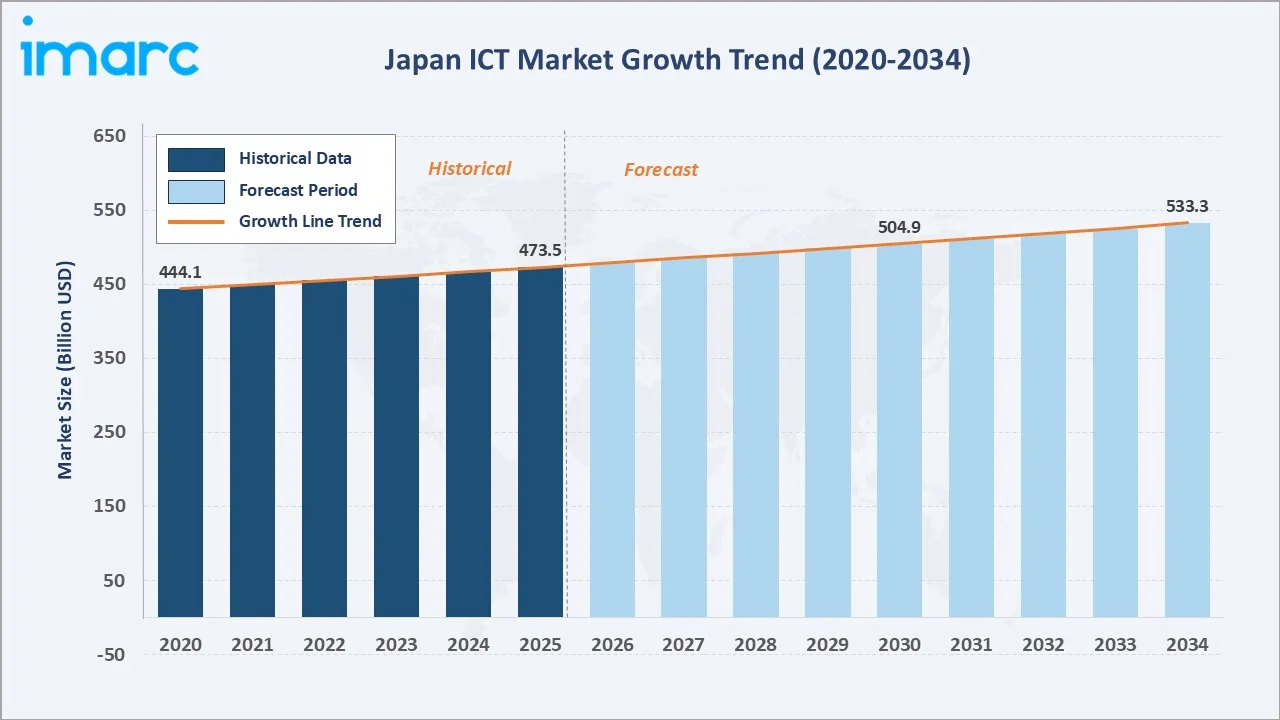
The Japan ICT market size increased from USD 473.5 Billion in 2025 to USD 481.4 Billion in 2026 and is projected to reach USD 533.3 Billion by 2034, growing at a CAGR of 1.29% during 2026-2034. Growth is supported by rising adoption of IoT-enabled devices, sustained government spending on digital infrastructure, and the continued shift of enterprises toward cloud-based and mobility-driven operating models. Communication leads the spending breakup at 34.8%, reflecting Japan's mature telecom and 5G network investment base, while Cloud Computing leads the technology breakup at 29.8% as organizations accelerate workload migration. Kanto commands 39.4% of the market, anchored by Tokyo's concentration of corporate headquarters, data centers, and telecom infrastructure.
Market Snapshot
|
Metric |
Value |
|
Base Year Market Size (2025) |
USD 473.5 Billion |
| Market Size (2026) | USD 481.4 Billion |
|
Forecast Market Size (2034) |
USD 533.3 Billion |
|
CAGR (2026-2034) |
1.29% |
|
Base Year |
2025 |
|
Historical Period |
2020-2025 |
|
Forecast Period |
2026-2034 |
|
Leading Spending Category |
Communication (34.8%, 2025) |
|
Leading Technology Category |
Cloud Computing (29.8%, 2025) |
|
Leading Region |
Kanto (39.4%, 2025) |
The market expanded from USD 444.1 Billion in 2020 to USD 473.5 Billion in 2025 and an estimated USD 481.4 Billion in 2026, a gain moderated by Japan's already-mature ICT base relative to faster-growing emerging Asian markets. Anchored at USD 504.9 Billion in 2030, the market is forecast to reach USD 533.3 Billion by 2034, as steady digitalization spending, 5G network densification, and rising cybersecurity investment offset the drag of a shrinking domestic workforce on overall technology budgets.
To get more information on this market, Request Sample
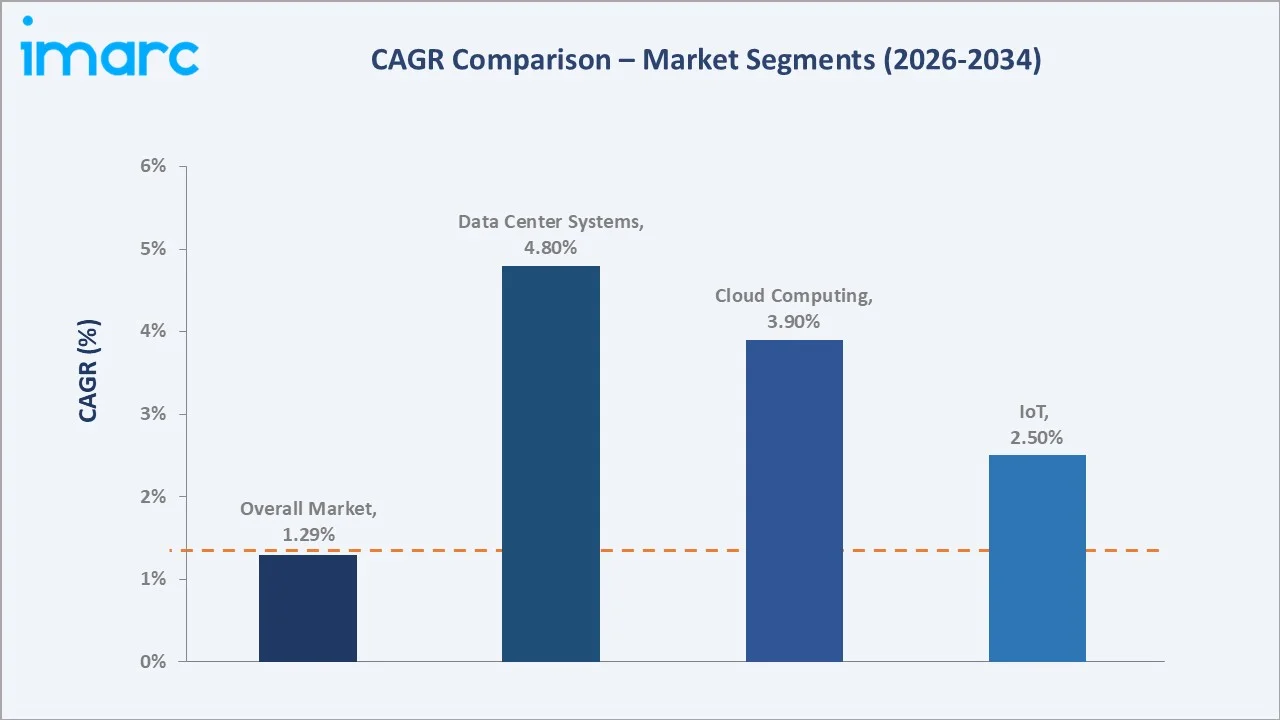
CAGR performance varies meaningfully across spending and technology categories. Data Center Systems and Cloud Computing post the fastest projected growth as organizations expand cloud-linked infrastructure, while Devices trails as hardware spending matures and replacement cycles lengthen.
Executive Summary
The Japan ICT market, which increased from USD 473.5 Billion in 2025 to an estimated USD 481.4 Billion in 2026, representing one of Asia-Pacific's largest and most mature information and communications technology markets, underpinned by advanced telecom infrastructure, a highly digitized corporate sector, and sustained public-sector modernization programs. The market is projected to reach USD 533.3 Billion by 2034, growing at a CAGR of 1.29% during 2026-2034.
Communication leads the spending breakup at 34.8%, reflecting continued investment in 5G network expansion, enterprise connectivity, and telecom infrastructure upgrades. Cloud Computing leads the technology breakup at 29.8%, as Japanese enterprises and government agencies accelerate migration away from legacy on-premises systems. Kanto leads regionally at 39.4%, driven by Tokyo's concentration of corporate headquarters, data centers, and financial-sector ICT demand, followed by Kinki/Kansai at 18.8% and Chubu at 15.2%.
Key Market Insights
|
Insight |
Data |
|
Leading Spending Category |
Communication - 34.8% share (2025) |
|
Leading Technology Category |
Cloud Computing - 29.8% share (2025) |
|
Leading Region |
Kanto - 39.4% share (2025) |
|
Market Opportunity |
AI-integrated cloud migration; Society 5.0 e-governance expansion; SaaS/TaaS adoption; cybersecurity modernization; regional data center investment |
Key Analytical Observations Supporting the Above Data:
- Communication at 34.8%: The Communication category dominates spending as Japanese carriers and enterprises continue investing in 5G densification, fixed-line broadband upgrades, and enterprise network modernization, sustaining the segment's position as the largest ICT spending pool.
- Cloud Computing at 29.8%: Cloud Computing leads the technology breakup as Japanese enterprises and government bodies accelerate migration from legacy on-premises infrastructure toward scalable, subscription-based platforms, supported by hyperscale data center expansion across the country.
- Kanto at 39.4%: Kanto dominates regionally due to Tokyo's concentration of corporate headquarters, financial institutions, and data center capacity, which together generate the highest density of enterprise and government ICT spending nationwide.
Japan ICT Market Overview
The Japan ICT market encompasses the devices, software, IT services, data center systems, and communication infrastructure that enable Japanese enterprises, government bodies, and consumers to access, store, transmit, and process digital information. It spans consumer and enterprise hardware, enterprise software platforms, IT consulting and systems integration services, cloud and on-premises data center systems, and fixed-line, mobile, and broadband communication networks. As one of the world's most digitally advanced economies, Japan combines a highly developed telecom infrastructure with a corporate sector that has historically invested heavily in on-premises IT, a legacy base that is now steadily transitioning toward cloud-delivered alternatives.
The ecosystem integrates device manufacturers, enterprise software vendors, systems integrators, telecom carriers, cloud and data center operators, and government bodies setting digital policy and cybersecurity standards. Macroeconomic factors shaping the market include Japan's shrinking working-age population, sustained corporate digital transformation spending, and government-led initiatives such as Society 5.0 and the E-Japan e-governance strategy.
Regulatory oversight of the market is anchored by Japan's Ministry of Internal Affairs and Communications, which sets telecom licensing, spectrum allocation, and data protection policy, alongside the Digital Agency's role in coordinating government-wide digital transformation. This regulatory backdrop, combined with Japan's advanced fixed and mobile network infrastructure, provides a stable foundation for continued enterprise and public-sector ICT investment through the forecast period.
Market Dynamics
To evaluate market opportunities, Request Sample
Market Drivers
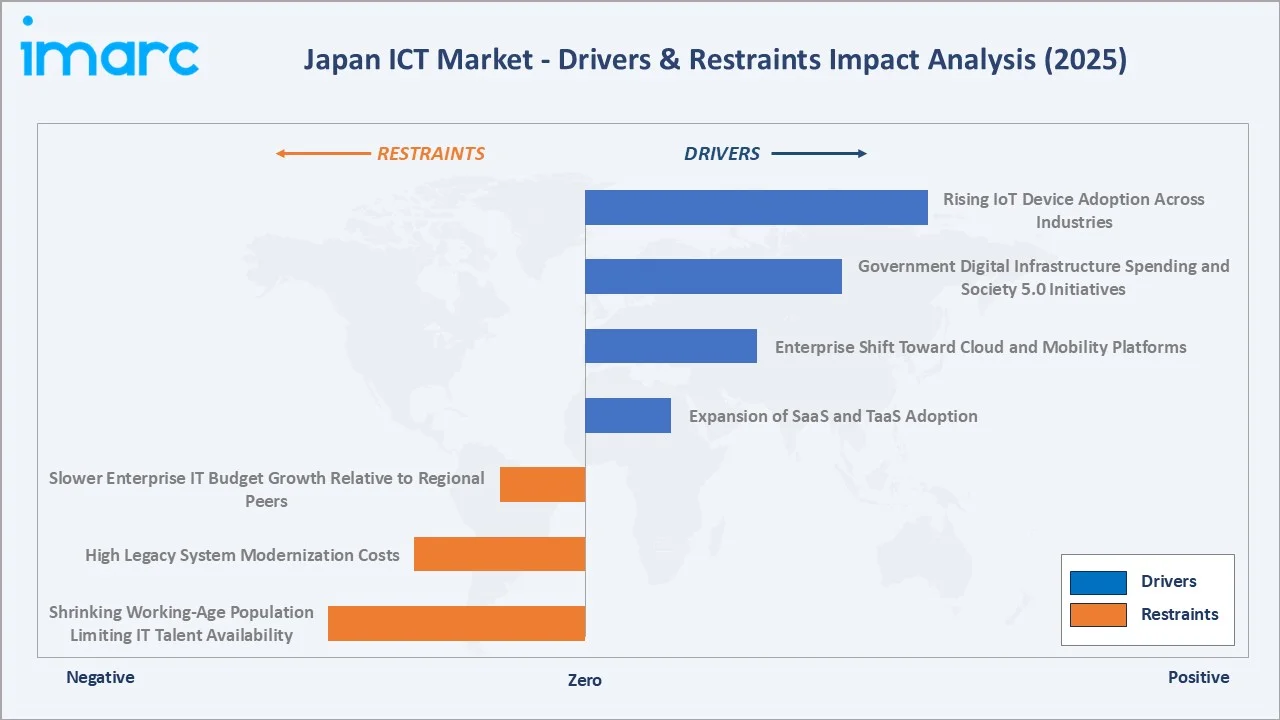
- Rising IoT Device Adoption Across Industries: Rising adoption of IoT-enabled devices across consumer electronics, manufacturing, agriculture, and construction is expanding the installed base of connected endpoints requiring network connectivity, data management, and security software, directly increasing demand for ICT hardware, platforms, and supporting services across Japan.
- Government Digital Infrastructure Spending and Society 5.0 Initiatives: Sustained government expenditure on modernizing public-sector infrastructure, combined with the Society 5.0 strategy's emphasis on integrating digital technology into economic and social systems, is catalyzing demand for e-governance platforms, secure networks, and connected public services nationwide.
- Enterprise Shift Toward Cloud and Mobility Platforms: Japanese organizations are increasingly adopting cloud-based and mobility-driven operating models to reduce infrastructure costs and improve operational flexibility, a shift that is accelerating investment in cloud computing platforms, enterprise software, and managed IT services across both private and public sectors.
- Expansion of SaaS and TaaS Adoption: The growing emergence of Software-as-a-Service and Telecommunication-as-a-Service delivery models is lowering the barrier to technology adoption for small and mid-sized enterprises, further driving investment in IT services and communication infrastructure across the Japanese economy.
Market Restraints
- Shrinking Working-Age Population Limiting IT Talent Availability: Japan's declining and aging working-age population is constraining the supply of skilled IT professionals, which can slow enterprise digital transformation projects, raise labor costs for systems integration and IT services work, and limit the pace of large-scale technology deployments.
- High Legacy System Modernization Costs: Many Japanese enterprises and government agencies continue to operate on aging legacy IT systems; the capital expenditure and operational complexity required to modernize these systems can delay cloud migration and broader digital transformation initiatives, particularly among smaller organizations with constrained IT budgets.
- Slower Enterprise IT Budget Growth Relative to Regional Peers: Japan's mature ICT base and modest overall economic growth translate into comparatively slower enterprise IT budget expansion relative to faster-growing Asia-Pacific markets, moderating the pace of new technology adoption across several spending categories.
Market Opportunities
- AI-Integrated Cloud and Data Center Expansion: Growing enterprise interest in artificial intelligence applications is creating opportunities for cloud providers and data center operators to expand AI-optimized infrastructure, supporting new revenue streams beyond traditional storage and compute services.
- Cybersecurity Modernization Across Critical Infrastructure: Rising cyber-threat exposure across financial, industrial, and government systems is opening opportunities for security software and managed security service providers to expand their presence within Japan's critical infrastructure and enterprise base.
Market Challenges
- Intensifying Competition from Global Hyperscale Cloud Providers: Domestic IT services and data center operators face intensifying competition from global hyperscale cloud providers expanding their Japanese data center footprint, pressuring pricing and market share for local technology and communication service providers.
- Data Sovereignty and Cross-Border Data Governance Complexity: Evolving data sovereignty expectations and cross-border data governance requirements add compliance complexity for multinational technology vendors and domestic enterprises alike, increasing the operational burden associated with cloud and data center deployments.
Emerging Market Trends
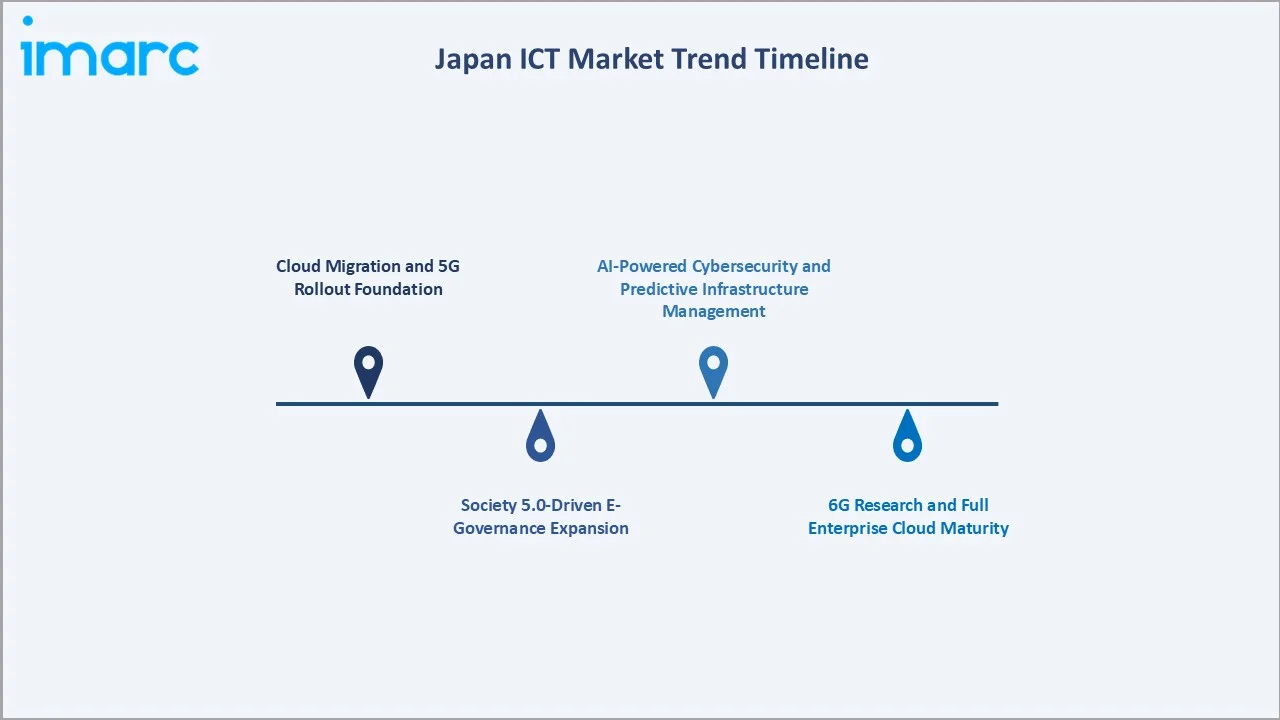
1. Cloud Migration and 5G Rollout Foundation
Japanese enterprises and telecom carriers built the foundation for sustained ICT growth between 2020 and 2023 through early cloud migration programs and nationwide 5G network rollout, establishing the connectivity and infrastructure base that continues to support Communication and Cloud Computing spending today.
2. Society 5.0-Driven E-Governance Expansion
Japan's Society 5.0 strategy continues to expand local e-governance projects that emphasize citizen participation, digital feedback, and self-evaluation of online government services. This is broadening public-sector demand for secure digital platforms, connected infrastructure, and citizen-facing applications, reinforcing government ICT spending as a structural growth pillar for the market.
3. AI-Powered Cybersecurity and Predictive Infrastructure Management
Enterprises and public-sector bodies are increasingly deploying AI-powered security and predictive infrastructure management tools to identify vulnerabilities and anticipate system failures before they occur, a trend that is reinforcing Security's position within the technology breakup and supporting continued IT services demand.
4. 6G Research and Full Enterprise Cloud Maturity
Looking toward the later forecast years, early-stage 6G research alongside full enterprise cloud maturity is expected to extend Japan's connectivity leadership, supporting continued investment across the Communication and Cloud Computing categories through 2034.
Industry Value Chain Analysis
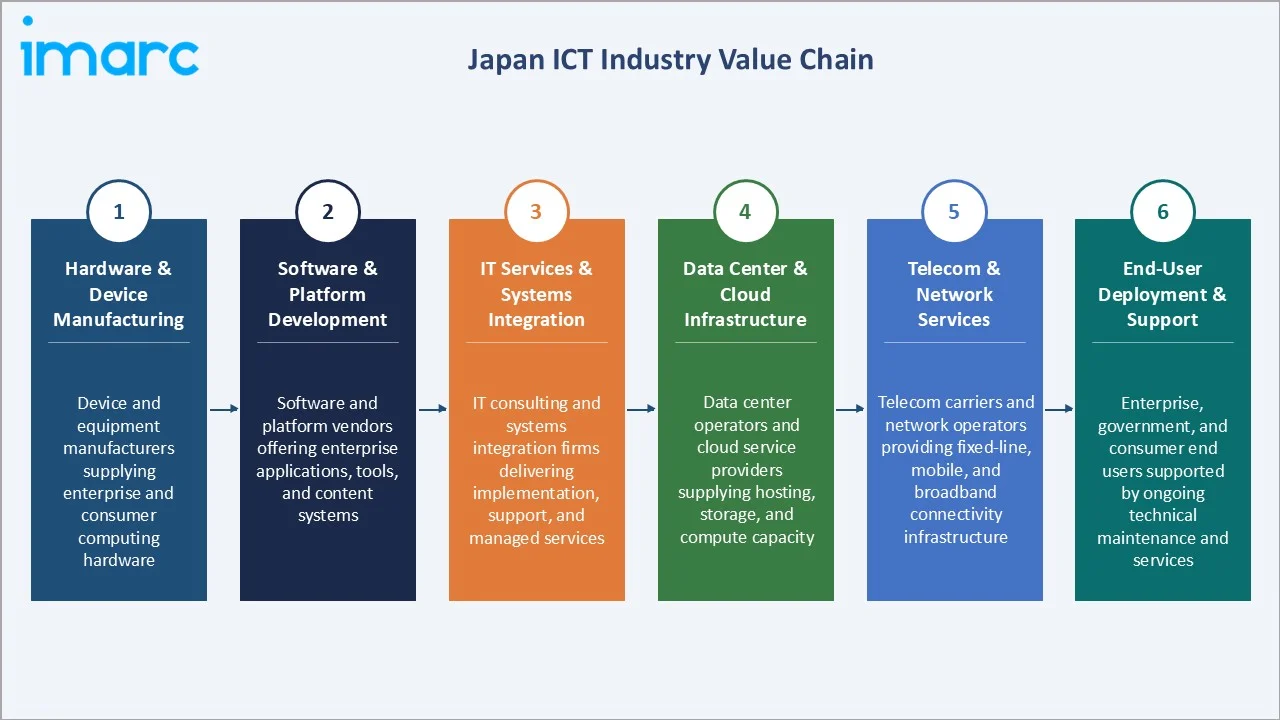
The Japan ICT value chain integrates hardware and device manufacturing, software and platform development, IT services and systems integration, data center and cloud infrastructure, telecom and network services, and end-user deployment and support. The value chain's commercial architecture continues to shift toward integrated, cloud-delivered service models.
|
Stage |
Key Participants |
|
Hardware & Device Manufacturing |
Device and equipment manufacturers supplying enterprise and consumer computing hardware |
|
Software & Platform Development |
Software and platform vendors offering enterprise applications, tools, and content systems |
|
IT Services & Systems Integration |
IT consulting and systems integration firms delivering implementation, support, and managed services |
|
Data Center & Cloud Infrastructure |
Data center operators and cloud service providers supplying hosting, storage, and compute capacity |
|
Telecom & Network Services |
Telecom carriers and network operators providing fixed-line, mobile, and broadband connectivity infrastructure |
|
End-User Deployment & Support |
Enterprise, government, and consumer end users supported by ongoing technical maintenance and services |
The data center and cloud infrastructure stage is the value chain's fastest-evolving link, as organizations continue migrating workloads from on-premises systems toward scalable, subscription-based platforms.
Technology Landscape in the Japan ICT Industry
Cloud Computing Technology
Cloud computing platforms enable Japanese enterprises and government bodies to migrate workloads away from legacy on-premises infrastructure toward scalable, subscription-based systems, reducing capital expenditure while improving operational flexibility and disaster resilience. Hybrid and multi-cloud architectures are increasingly favored by large enterprises seeking to balance performance, cost, and data residency requirements across domestic and global providers.
AI-Powered Security Technology
AI-powered security technology enables real-time threat detection and predictive vulnerability management, helping enterprises and public-sector bodies protect increasingly complex, interconnected digital infrastructure against evolving cyber-threats. Adoption is expanding beyond large enterprises into mid-sized organizations as managed security service offerings lower the cost and complexity of deployment.
5G and IoT Connectivity Technology
Continued 5G network densification is expanding the connectivity backbone required to support enterprise IoT deployments across manufacturing, logistics, and smart-city applications, reinforcing demand within both the Communication spending category and the IoT technology category. Early-stage 6G research is also underway, positioning Japan to sustain its connectivity leadership into the next decade.
Market Segmentation Analysis
The report covers the following segments:
|
Segment Category |
Leading Segment |
Market Share |
Year |
|
Spending |
Communication |
34.8% |
2025 |
|
Technology |
Cloud Computing |
29.8% |
2025 |
|
Region |
Kanto |
39.4% |
2025 |

By Spending
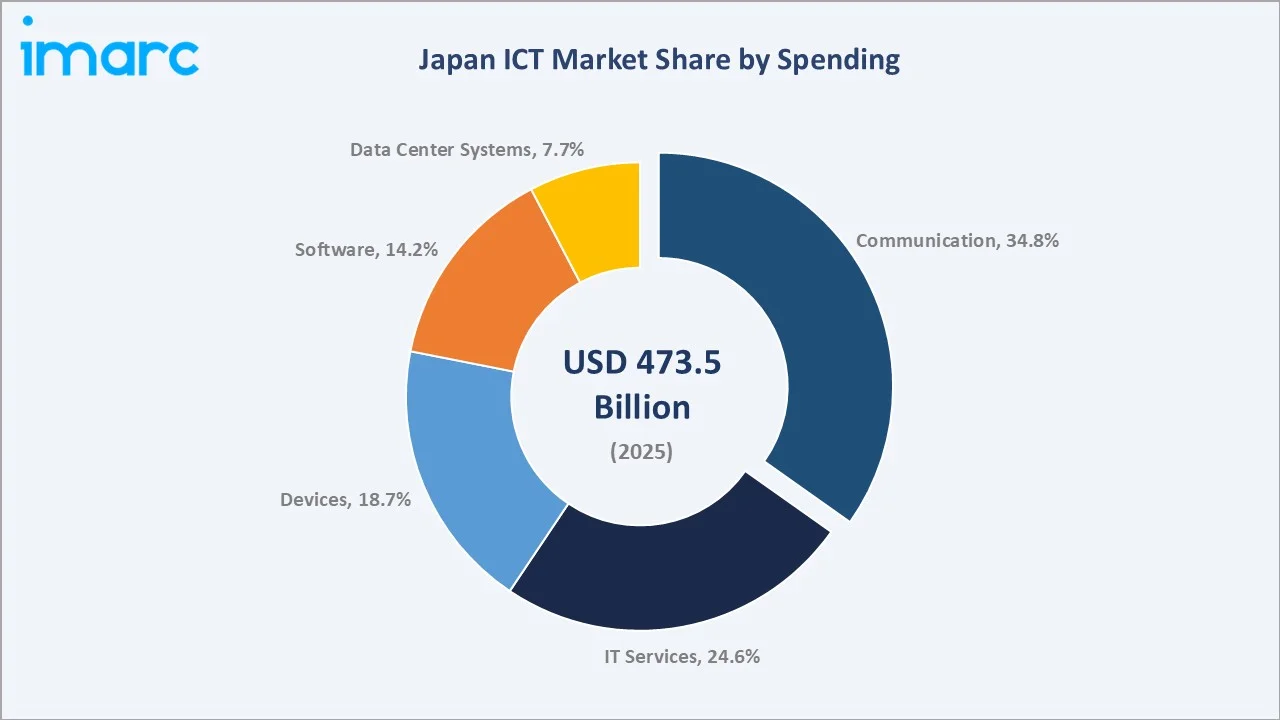
The Communication category leads at 34.8% in 2025, encompassing telecom carrier network investment, enterprise connectivity, and broadband infrastructure spending, the largest single spending pool within the Japan ICT market. IT Services follows at 24.6%, reflecting sustained demand for consulting, systems integration, and managed services.
To access detailed market analysis, Request Sample
Devices at 18.7% capture enterprise and consumer hardware spending, while Software at 14.2% reflects enterprise application and platform investment. Data Center Systems, at 7.7%, represents the smallest but fastest-growing category as organizations expand cloud-linked storage and compute capacity.
By Technology
Cloud Computing leads at 29.8% in 2025, as Japanese enterprises and government bodies continue migrating workloads away from legacy on-premises systems toward scalable subscription-based platforms. Security follows at 22.4%, reflecting sustained investment in protecting enterprise and government systems against rising cyber-threat exposure.
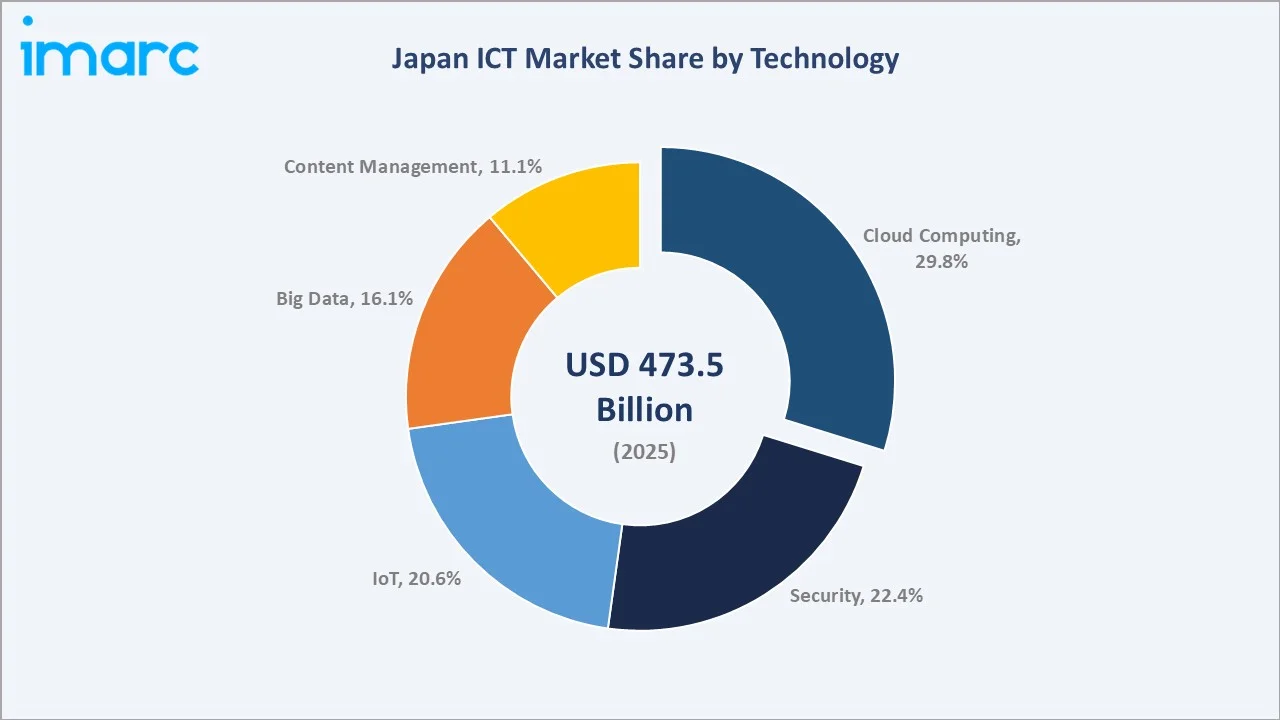
IoT at 20.6% reflects the expanding base of connected devices across industrial and consumer applications, while Big Data at 16.1% supports analytics-driven decision-making across enterprise functions. Content Management, at 11.1%, reflects continued investment in digital content platforms and enterprise information systems.
Regional Market Insights
|
Region |
Share (2025) |
Key Characteristics |
|
Kanto |
39.4% |
Leading region, anchored by Tokyo's corporate and telecom base |
|
Kinki/Kansai |
18.8% |
Second-largest region, supported by research and industrial hubs |
|
Chubu |
15.2% |
Manufacturing-led regional ICT demand centered on Nagoya |
|
Kyushu (incl. Okinawa) |
8.4% |
Growing electronics and semiconductor manufacturing base |
|
Tohoku |
6.3% |
Developing regional connectivity and infrastructure investment |
|
Chugoku |
5.1% |
Steady regional ICT demand supported by utility and industrial users |
|
Hokkaido |
4.2% |
Emerging regional data center and infrastructure investment |
|
Shikoku |
2.6% |
Smallest regional market, led by local government digitization |
Kanto, at 39.4%, leads through Tokyo's dense concentration of corporate headquarters, data centers, and financial-sector ICT demand. Kinki/Kansai, at 18.8%, and Chubu, at 15.2%, represent the next-largest regional markets, supported by established research, industrial, and manufacturing bases. Together, these three regions account for more than seventy percent of national ICT spending, underscoring the concentration of Japan's digital economy around its principal metropolitan and industrial centers.
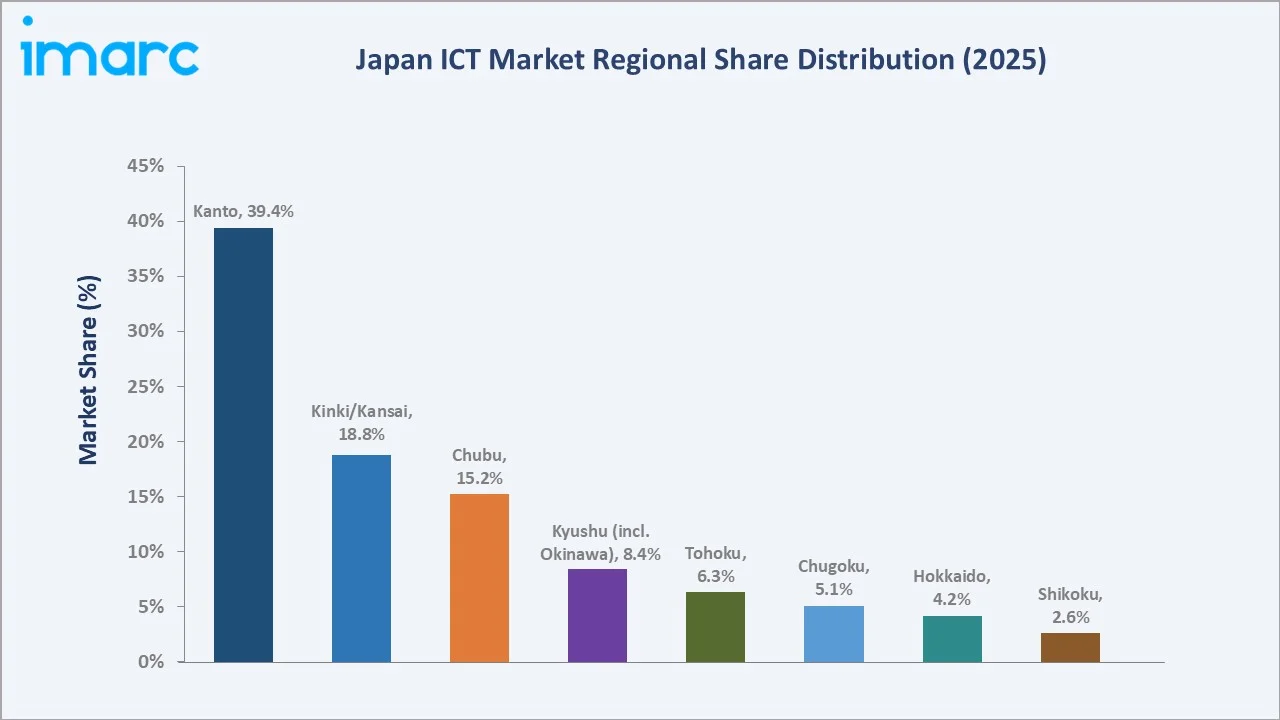
Kyushu (incl. Okinawa), at 8.4%, Tohoku, at 6.3%, Chugoku, at 5.1%, Hokkaido, at 4.2%, and Shikoku, at 2.6%, represent smaller but steadily developing regional ICT markets driven by local digitization and infrastructure investment.
Competitive Landscape
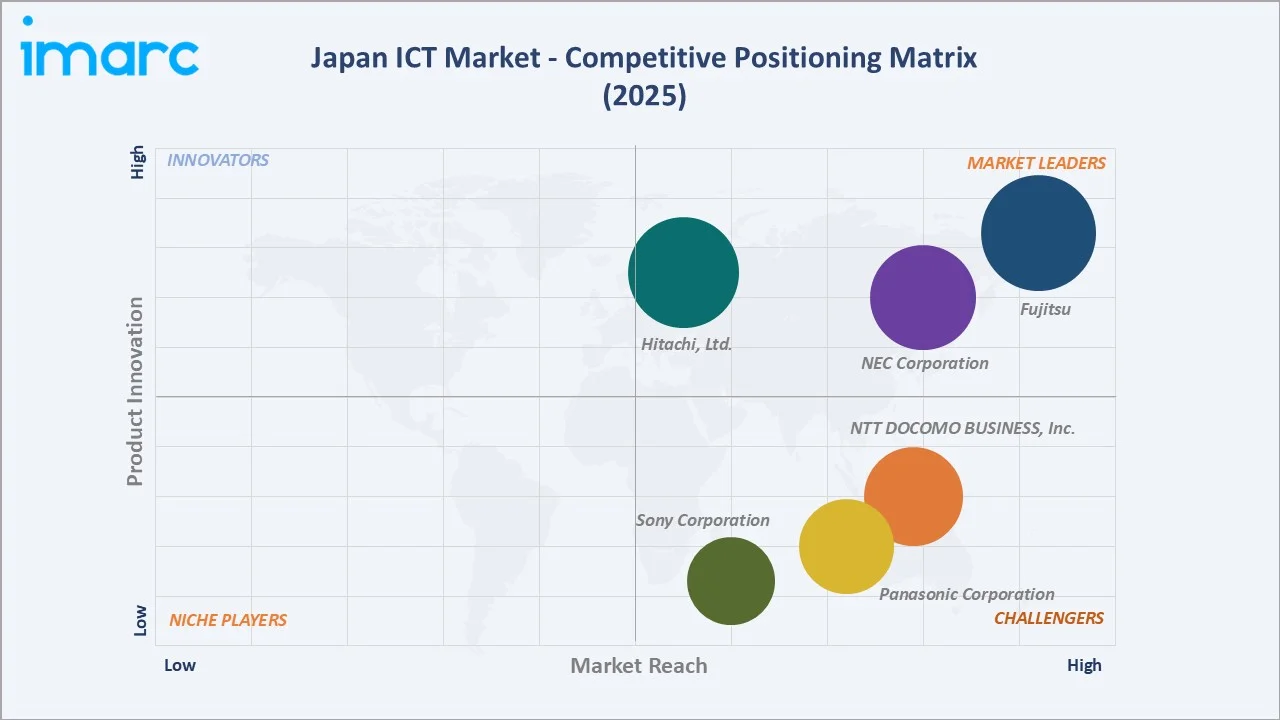
The Japan ICT market competitive landscape is moderately concentrated, comprising diversified domestic conglomerates offering integrated hardware, software, and services portfolios, global IT services and cloud providers competing for enterprise accounts, and telecom carriers supplying the underlying network infrastructure.
|
Company Name |
Key Offerings |
Market Position |
Core Strength |
|
Fujitsu |
IT services, enterprise hardware, cloud and AI-driven digital transformation solutions |
Market Leader |
Broad enterprise and public-sector IT services footprint across Japan |
|
Hitachi, Ltd. |
Lumada digital platform, social infrastructure IT, and data-driven industrial solutions |
Market Leader |
Strong integration of IT and operational technology across infrastructure sectors |
|
NEC Corporation |
IT services, telecom network equipment, and AI and biometric technology solutions |
Market Leader |
Deep telecom and public safety systems expertise |
|
NTT DOCOMO BUSINESS, Inc. |
Telecom network services, data center, and managed cloud connectivity solutions |
Strong Challenger |
Nationwide telecom network infrastructure and data center footprint |
|
Panasonic Corporation |
Consumer and enterprise ICT devices, sensors, and connected hardware solutions |
Strong Challenger |
Established device manufacturing and hardware distribution scale |
|
Sony Corporation |
Consumer electronics, imaging sensors, and networked entertainment platforms |
Strong Challenger |
Leading consumer device brand with strong sensor and imaging technology base |
Key players include Fujitsu, Hitachi, Ltd., NEC Corporation, NTT DOCOMO BUSINESS, Inc., Panasonic Corporation, Sony Corporation, and others.
Key Company Profiles
Fujitsu
Fujitsu is a Japan-based technology company with a broad enterprise and public-sector presence across the Japan ICT market through its IT services, hardware, and digital transformation portfolio, serving clients across finance, manufacturing, and government.
- Key Offerings: Enterprise IT services, systems integration, cloud platforms, and AI-driven digital transformation solutions.
- Strategic Focus: Expanding cloud, AI, and data-driven consulting services for enterprise and government clients while strengthening its systems integration and managed services portfolio across Japan.
Hitachi, Ltd.
Hitachi is a Japan-based industrial and technology conglomerate with a strong presence in the ICT market through its Lumada digital platform and social infrastructure IT solutions, spanning energy, transportation, and manufacturing clients.
- Key Offerings: Lumada digital platform, data analytics, and IT-operational technology integration solutions for infrastructure and industrial clients.
- Strategic Focus: Expanding integration of information technology and operational technology across social infrastructure, energy, and industrial sectors in Japan and globally.
Market Concentration Analysis
The Japan ICT market is moderately concentrated at the enterprise IT services and telecom infrastructure level, with key players collectively representing a substantial share of domestic enterprise and public-sector IT services revenue. Global providers such as IBM Japan Ltd are expanding their presence through cloud and AI consulting capabilities, while device manufacturers compete primarily within the Devices spending category. Market concentration is expected to gradually decline as global hyperscale cloud providers expand their Japanese data center footprint and compete for cloud infrastructure spending.
Investment & Growth Opportunities
Highest Growth Segments
Data Center Systems and Cloud Computing represent the highest-growth categories through 2034, driven by continued enterprise workload migration and expanding hosting and compute demand. Security follows closely as rising cyber-threat exposure sustains investment across financial, industrial, and government systems. Within spending categories, IT Services and Software are also expected to grow above the overall market CAGR as organizations expand managed services and application investment.
Emerging Investment Opportunities
Regional data center development outside the core Kanto region represents an emerging opportunity, as operators seek lower-cost, disaster-resilient sites in regions such as Hokkaido and Tohoku. Managed cybersecurity services for small and mid-sized enterprises also represent a growing opportunity, as smaller organizations increasingly outsource security operations rather than build in-house capability.
Investment Themes
- AI-integrated cloud infrastructure expansion: Data center operators and cloud providers investing in AI-optimized infrastructure are positioned to capture incremental enterprise demand as Japanese organizations scale AI adoption beyond pilot deployments.
- Cybersecurity and managed security services: Rising cyber-threat exposure across financial, industrial, and government systems is creating sustained investment demand for security software and managed security service providers across the Japanese market.
- Telecom-to-cloud service convergence: Telecom carriers extending their network infrastructure into managed cloud and data center services represent an investment theme that blends stable connectivity revenue with higher-growth cloud service margins.
Future Market Outlook (2026-2034)
The Japan ICT market is projected to grow from USD 473.5 Billion in 2025 to USD 481.4 Billion in 2026, and is projected to reach USD 533.3 Billion by 2034, delivering a 1.29% CAGR over the forecast period. The market's anchor value of USD 504.9 Billion in 2030 reflects steady, mature-market growth rather than rapid expansion, with Cloud Computing and Security expected to continue gaining share within the technology breakup as enterprises deepen digital transformation investment.
Two structural forces define market growth through 2034. Sustained government digitization spending under Society 5.0 and related e-governance initiatives will continue supporting Communication and IT Services demand, while Japan's shrinking working-age population will keep reinforcing automation, AI, and cloud-based efficiency investment as enterprises seek to offset labor constraints with technology.
Research Methodology
Primary Research
Primary research comprised structured interviews with industry stakeholders, including enterprise IT decision-makers, telecom infrastructure leads, cloud and data center operators, and cybersecurity specialists across Japan.
Secondary Research
Secondary research encompassed company annual reports, government digital policy publications, telecom regulator data, and industry association reports covering the Japan ICT market's spending, technology, and regional segments.
Forecasting Models
Market revenue forecasts were developed using a bottom-up model incorporating historical spending trends by category, technology adoption curves, and regional ICT infrastructure investment patterns, adjusted for macroeconomic and demographic factors specific to Japan, including the country's shrinking working-age population and sustained public-sector digitization budgets.
Report Coverage:
| Report Features | Details |
|---|---|
| Base Year of the Analysis | 2025 |
| Historical Period | 2020-2025 |
| Forecast Period | 2026-2034 |
| Units | Billion USD |
| Scope of the Report | Exploration of Historical Trends and Market Outlook, Industry Catalysts and Challenges, Segment-Wise Historical and Future Market Assessment:
|
| Spendings Covered | Devices, Software, IT Services, Data Center Systems, Communication |
| Technologies Covered | IOT, Big Data, Cloud Computing, Content Management, Security |
| Region Covered | Kanto, Hokkaido, Tohoku, Chubu, Kinki/Kansai, Chugoku, Shikoku, Kyushu (incl. Okinawa) |
| Companies Covered | Fujitsu, Hitachi, Ltd., NEC Corporation, NTT DOCOMO BUSINESS, Inc., Panasonic Corporation, Sony Corporation, etc. |
| Customization Scope | 10% Free Customization |
| Post-Sale Analyst Support | 10-12 Weeks |
| Delivery Format | PDF and Excel through Email (We can also provide the editable version of the report in PPT/Word format on special request) |
Frequently Asked Questions About the Japan ICT Market Report
The Japan ICT market size is estimated at USD 481.4 Billion in 2026, driven by the Communication spending category dominant at 34.8%, Cloud Computing technology leading at 29.8%, and Kanto commanding 39.4% of regional market share.
The Japan ICT market grows at 1.29% CAGR during 2026-2034, reaching USD 533.3 Billion by 2034. This growth reflects sustained government digitization spending, 5G network densification, enterprise cloud migration, and rising cybersecurity investment.
The Communication category leads at 34.8%, capturing the largest single spending pool in the Japan ICT market, followed by IT Services at 24.6% and Devices at 18.7%. This category is supported by continued 5G network investment and enterprise connectivity upgrades.
Cloud Computing leads at 29.8% through the highest technology spending share and continued enterprise workload migration, followed by Security at 22.4% and IoT at 20.6%. Cloud Computing also grows fastest at approximately 3.9% CAGR through accelerating enterprise migration away from legacy systems.
Kanto leads at 39.4% through Tokyo's concentration of corporate headquarters, financial institutions, and data center capacity, generating the highest density of enterprise and government ICT spending nationwide.
Leading companies include Fujitsu, Hitachi, Ltd., NEC Corporation, NTT DOCOMO BUSINESS, Inc., Panasonic Corporation, Sony Corporation, and others.
The Japan ICT market is projected to reach approximately USD 504.9 Billion by 2030, with cloud migration reaching broader enterprise scale, 5G densification continuing, and AI-powered cybersecurity adoption expanding across critical infrastructure.
Three priority investment opportunities: AI-integrated cloud and data center infrastructure expansion, cybersecurity and managed security services for enterprise and government clients, and regional data center development outside the core Kanto region.
Need more help?
- Speak to our experienced analysts for insights on the current market scenarios.
- Include additional segments and countries to customize the report as per your requirement.
- Gain an unparalleled competitive advantage in your domain by understanding how to utilize the report and positively impacting your operations and revenue.
- For further assistance, please connect with our analysts.
 Request Customization
 Speak to an Analyst
 Request Brochure
 Inquire Before Buying
Benefits of Customization
- Personalize this research
- Triangulate with your data
- Get data as per your format and definition
- Gain a deeper dive into a specific application, geography, customer, or competitor
- Any level of personalization
Get in Touch With Us
UNITED STATES
Phone: +1-201-971-6302
INDIA
Phone: +91-120-433-0800
UNITED KINGDOM
Phone: +44-753-714-6104
Email: [email protected]
Client Testimonials




.webp)




.webp)













Related Reports

Choose your plan
*Please note that the prices mentioned below are starting prices for each bundle type. Kindly contact our team for further details.*
Single User License
- 1 User License, Access on 2 Devices
- PDF Report + Excel Dataset (Password Protected)
- Lifetime Access
- No Printing Rights
- 10% Free Report Customization
- 10–12 Weeks of Analyst Support
Five User License
- Access for 5 Users, 2 Devices per User
- PDF Report + Excel Dataset (Password Protected)
- Lifetime Access
- Dedicated Account Manager
- 12–14 Weeks of Analyst Support
- No Printing Rights
- 15% Free Report Customization
- 25% Discount on Your Next Purchase
Corporate User License
- Unlimited User Access (Within Your Organization)
- PDF Report + Excel Dataset
- Lifetime Access
- Dedicated Account Manager
- 14–20 Weeks of Analyst Support
- No Printing Rights
- 20% Free Report Customization
- 30% Discount on Your Next Purchase
Essential Insights
What's included:
3 reports
- Lifetime Access
- PDF Reports
- Excel Datasets
- 2 Weeks of Free Analyst Support
- 2 User Licenses
- Access on 2 Devices
- Printing Rights
- Complimentary PowerPoint (PPT) Version
- Complimentary License Upgrade
Professional Access
What's included:
5 reports
- Lifetime Access
- PDF Reports
- Excel Datasets
- 8 Weeks of Free Analyst Support
- 2 User Licenses
- Access on 2 Devices
- Printing Rights
- Complimentary PowerPoint (PPT) Version
- Complimentary License Upgrade
Business Advantage
What's included:
8 reports
- Lifetime Access
- PDF Reports
- Excel Datasets
- 14 Weeks of Free Analyst Support
- 2 User Licenses
- Access on 2 Devices
- Printing Rights
- Complimentary PowerPoint (PPT) Version
- Complimentary License Upgrade
Enterprise Intelligence
What's included:
10 reports
- Lifetime Access
- PDF Reports
- Excel Datasets
- 20 Weeks of Free Analyst Support
- 2 User Licenses
- Access on 2 Devices
- Printing Rights
- Complimentary PowerPoint (PPT) Version
- Complimentary License Upgrade