
Japan Luxury Fashion Market Size, Share, Trends and Forecast by Product Type, Distribution Channel, End User, and Region, 2026-2034
Japan Luxury Fashion Market Size, Share, Trends & Forecast (2026-2034)
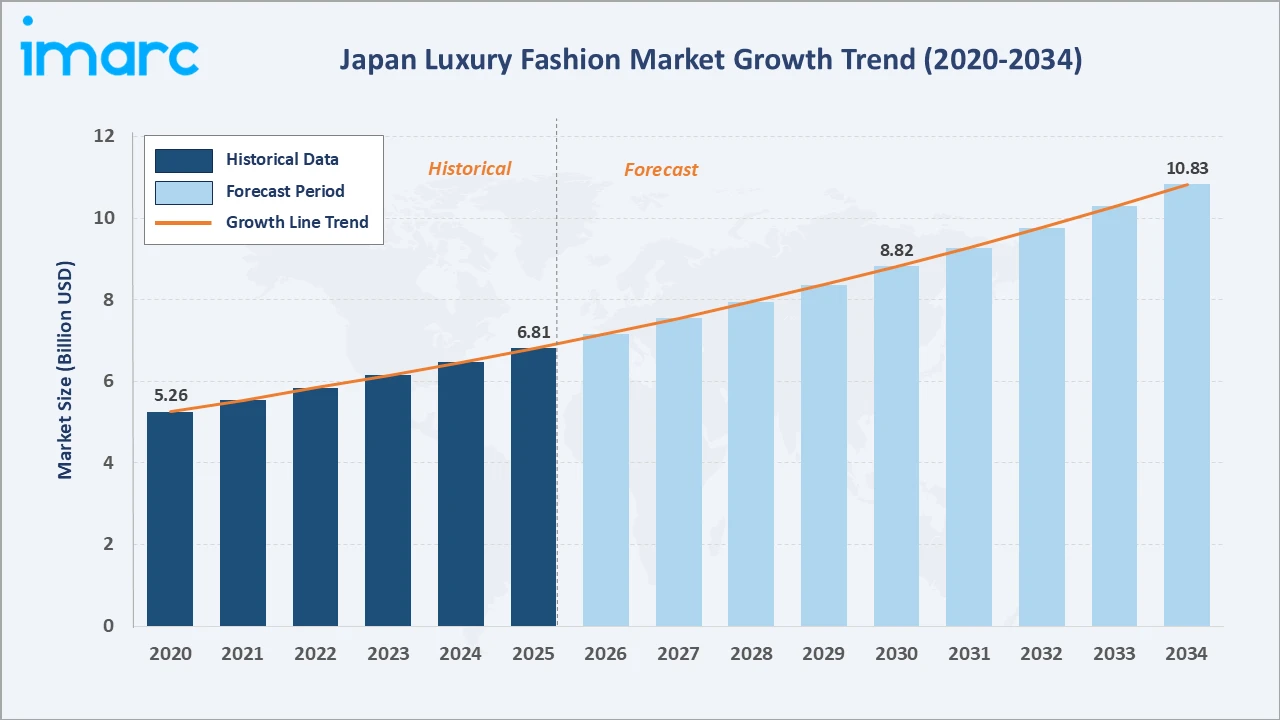
The Japan luxury fashion market grew from USD 6.81 Billion in 2025 to USD 7.17 Billion in 2026. The market is further expected to grow to USD 8.82 Billion by 2030 and USD 10.83 Billion by 2034, registering a CAGR of 5.29% during 2026-2034.
The market is driven by record inbound tourism and duty-free luxury spending, the enduring global prestige of Japanese craftsmanship and brand heritage, rising High Net Worth Individual (HNWI) spending, and the rapid expansion of digital luxury retail platforms. Accessories command 47.0% share, Store-Based channels lead at 78.0%, and the Kanto Region commands 34.0% of the national market.
Market Snapshot
|
Metric |
Value |
|
Base Year Market Size (2025) |
USD 6.81 Billion |
|
Market Size (2026) |
USD 7.17 Billion |
|
Forecast Market Size (2034) |
USD 10.83 Billion |
|
CAGR (2026-2034) |
5.29% |
|
Base Year |
2025 |
|
Historical Period |
2020-2025 |
|
Forecast Period |
2026-2034 |
|
Dominant Product Type |
Accessories (47.0%, 2025) |
|
Dominant Distribution Channel |
Store-Based (78.0%, 2025) |
|
Leading Region |
Kanto Region (34.0%, 2025) |
The Japan luxury fashion market size increased from USD 5.26 Billion in 2020 to USD 6.81 Billion in 2025 and is estimated to reach USD 7.17 Billion in 2026. The market is further expected to grow to USD 8.82 Billion by 2030 and USD 10.83 Billion by 2034. Japan luxury fashion market is commercially distinctive among global luxury markets, combining one of Asia's most mature domestic luxury consumer bases, a rapidly expanding inbound tourist-driven duty-free luxury spending surge propelled by yen depreciation, and a growing certified pre-owned luxury segment that creates novel commercial dynamics above the primary market.
To get more information on this market, Request Sample
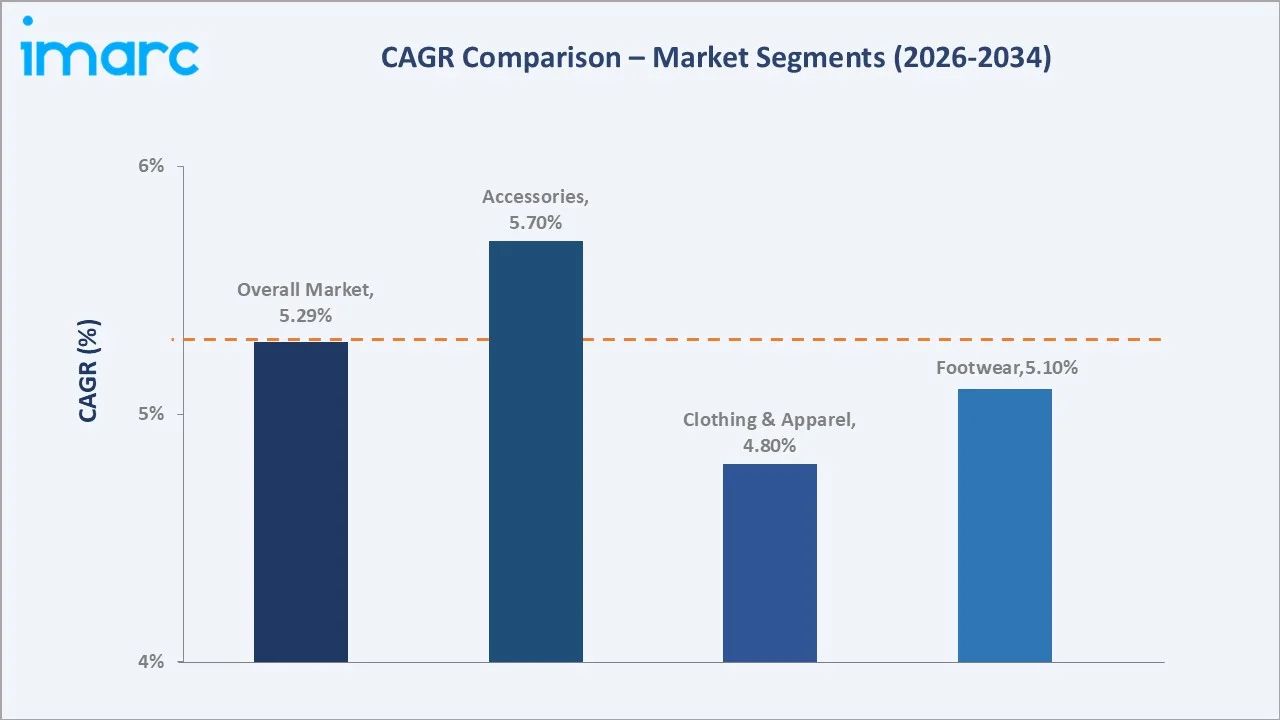
The accessories segment grows at ~5.7% CAGR through Japan's dominant consumer demand for luxury handbags, watches, jewellery, and belts from both domestic HNWIs and international tourists. Store-based distribution maintains leadership through Japan's uniquely service-intensive luxury retail culture anchored in Ginza and Omotesando flagship boutiques. The Kanto Region's 34.0% leadership reflects Tokyo's unmatched flagship density and inbound tourist spending concentration.
Executive Summary
The Japan luxury fashion market expanded from USD 6.81 Billion in 2025 to an estimated USD 7.17 Billion in 2026, positioning it among Asia's most commercially significant luxury fashion markets by value. The market's scale is underpinned by Japan's deep luxury brand loyalty culture, the enduring commercial significance of luxury goods as status and gifting items, and rising HNWI demand for international premium and heritage luxury brands. These structural demand drivers are supporting the expansion of the luxury accessories and ready-to-wear segments at rates that outpace Japan's overall GDP growth.
The market is projected to reach USD 10.83 Billion by 2034. Accessories at 47.0% lead through dominant consumer demand for luxury handbags and jewellery. Store-Based at 78.0% reflects Japan's high-touch luxury retail culture. Kanto Region leads regionally at 34.0%.
Key Market Insights
|
Insight |
Data |
|
Leading Product Type |
Accessories – 47.0% share (2025) |
|
Leading Distribution Channel |
Store-Based – 78.0% market share (2025) |
|
Leading Region |
Kanto Region – 34.0% share (2025) |
|
Market Opportunity |
Non-store digital luxury channel expansion; Tier-2 city boutique rollout; Gen Z digital luxury engagement; Certified pre-owned luxury segment growth |
Key Analytical Observations Supporting the Above Data:
- Accessories at 47.0%: The accessories segment dominates due to the exceptional aspirational and gifting value of luxury handbags, watches, jewellery, and belts among Japan's consumers. International tourists further amplify accessories demand at duty-free counters and airport luxury boutiques, creating a dual demand engine that sustains the segment's structural commercial leadership.
- Store-Based at 78.0%: Japan's uniquely high-touch luxury retail culture, anchored in department store luxury floors and flagship boutiques in Ginza and Omotesando, maintains brick-and-mortar dominance. Japan's consumer expectation for immersive in-store service experiences sustains store preference above digital alternatives.
- Kanto Region at 34.0%: Kanto leads due to Tokyo's unmatched concentration of luxury flagship stores, Japan's highest HNWI density, and peak inbound tourist spending at Tokyo's duty-free and airport luxury channels. The region's commercial infrastructure creates a structurally dominant luxury consumption geography.
Japan Luxury Fashion Market Overview
Japan luxury fashion market is commercially positioned at a unique intersection: one of Asia's most culturally embedded luxury consumption markets where brand heritage and craftsmanship are deeply valued, a surging inbound tourist luxury spending channel driven by record visitor volumes and yen depreciation, and a rapidly expanding certified pre-owned segment that creates new commercial dynamics. The market's commercial structure is characterized by Japan's extraordinary service excellence expectations and price stratification.
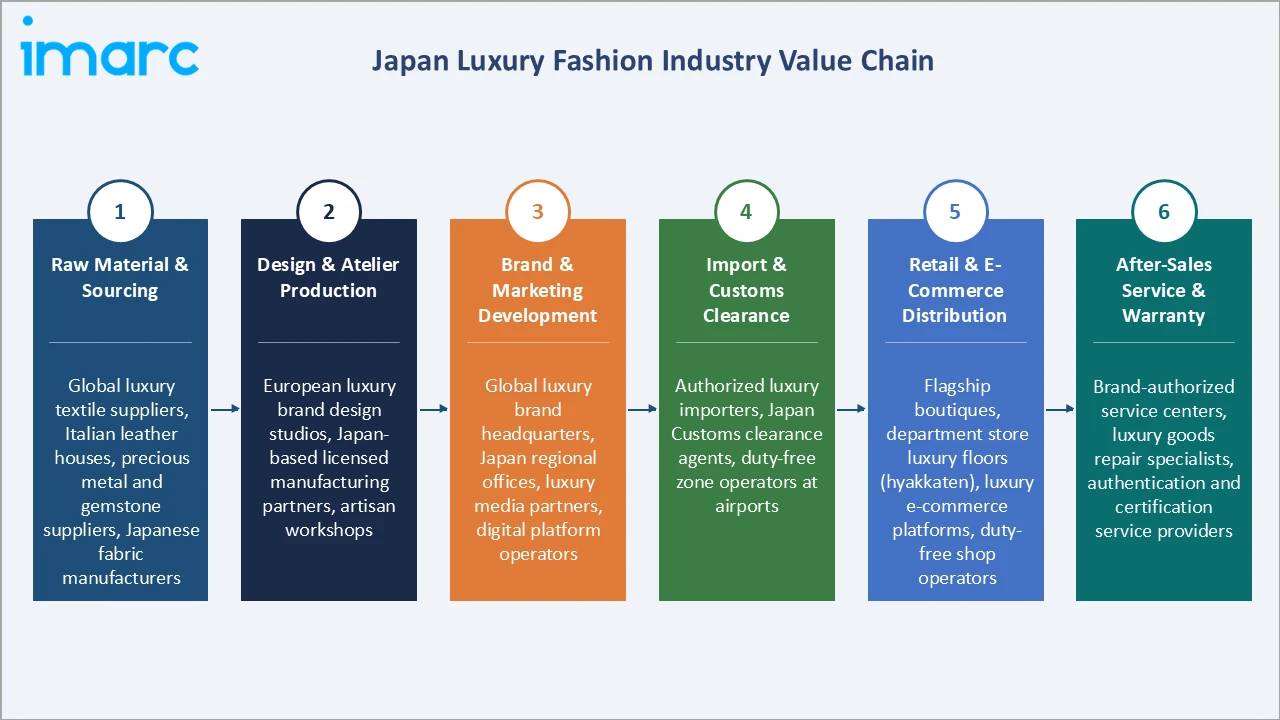
Japan luxury fashion ecosystem integrates global luxury brand flagships, department store luxury floors, duty-free operators at airports and designated zones, luxury e-commerce platforms, and a formalizing pre-owned certified market. Macroeconomic factors include rising HNWI wealth, record inbound tourism, ongoing yen depreciation, and growing Gen Z premium brand engagement.
Market Dynamics
To evaluate market opportunities, Request Sample
Market Drivers
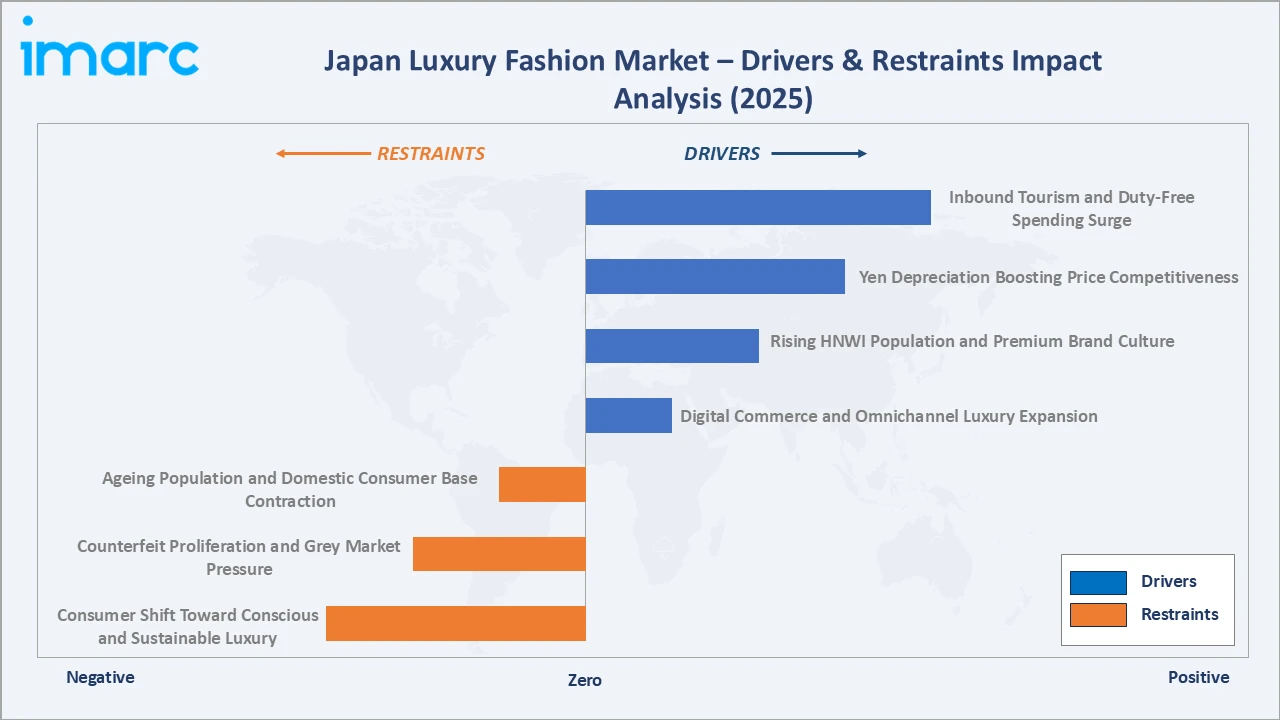
- Inbound Tourism and Duty-Free Spending Surge: Record inbound tourism—surpassing 35 million annual visitors—has driven extraordinary duty-free luxury spending, with Tokyo's Ginza flagship stores and Narita, Haneda, Kansai, and Chubu airports emerging as key luxury acquisition points. The yen's sustained weakness against the USD and EUR has structurally increased Japan's luxury goods price competitiveness, making globally priced luxury items significantly less expensive in yen terms for overseas visitors. This currency-driven pricing advantage creates a structural uplift that consistently exceeds domestic consumption growth, with international tourists now representing a commercially indispensable demand segment for Japan's luxury fashion market.
- Yen Depreciation Boosting Price Competitiveness: The yen's prolonged depreciation cycle since 2022 has positioned Japan as one of the most price-competitive luxury shopping destinations globally, making internationally priced luxury goods significantly more affordable for foreign visitors when converted from USD, EUR, or CNY. This structural pricing advantage has accelerated tourist luxury acquisition volumes, with department store luxury floors and duty-free operators reporting above-market revenue growth driven by visiting consumers. The currency effect is expected to sustain a structural tourist demand advantage even if the yen partially recovers, as brand concentration and product exclusivity factors remain commercially compelling for international buyers.
- Rising HNWI Population and Premium Brand Culture: Japan's High Net Worth Individual (HNWI) population has grown steadily, supported by asset appreciation in Tokyo real estate, equity markets, and a broadening wealth distribution across Japan's major metropolitan areas. This expanding affluent class drives above-average per-capita luxury consumption in accessories, jewellery, ready-to-wear, and bespoke fashion, sustaining domestic luxury demand independent of tourist spending fluctuations. Japan's deeply embedded luxury brand culture—characterized by exceptional brand loyalty, high repurchase frequency, and an above-global per-capita luxury spending pattern—creates a structurally resilient domestic demand foundation.
- Digital Commerce and Omnichannel Luxury Expansion: Leading luxury brands have accelerated omnichannel investments in Japan, integrating flagship store experiences with digital platforms, LINE-based CRM, luxury e-commerce apps, and social commerce channels targeting Japan's digitally sophisticated consumers. Brands investing in seamless omnichannel journeys—where digital discovery converts to in-store experience and post-purchase digital engagement sustains loyalty, are capturing disproportionate share of Japan's next generation luxury consumer.
Market Restraints
- Ageing Population and Domestic Consumer Base Contraction: Japan's declining and ageing population creates a structural headwind for domestic luxury consumption volume growth. The shrinking working-age population limits the formation of new domestic luxury consumer cohorts, increasing reliance on tourist spending and HNWI concentration to sustain market growth rates above demographic trends. Japan's fertility rate below replacement level creates a long-term commercial challenge for brands dependent on domestic consumer base expansion, requiring strategic investment in younger consumer engagement through Gen Z digital channels and lifestyle marketing.
- Counterfeit Proliferation and Grey Market Pressure: Japan's luxury market faces persistent counterfeit proliferation, particularly through online secondhand marketplaces and grey market import channels, creating pricing inconsistencies that undermine authorized dealer pricing authority and erode brand equity with first-time buyers. Authentication technology investment, including blockchain certification and NFC chip embedding, is increasingly deployed by leading brands to strengthen certified product identification and differentiate authorized purchases from counterfeit and parallel import alternatives. The regulatory environment is gradually tightening, with Japan Customs strengthening enforcement protocols and platforms implementing stricter seller verification, but enforcement remains commercially insufficient to eliminate the grey market's pricing impact on authorized retail.
- Consumer Shift Toward Conscious and Sustainable Luxury: A growing segment of Japanese consumers are shifting toward conscious and purposeful luxury spending, prioritizing experience, sustainability, circular economy participation, and certified pre-owned over new primary luxury purchases. This behavioral shift reshapes demand patterns, reducing new product sales volume while expanding adjacent segments such as certified resale, luxury rental, and experience-based luxury consumption. Brands must balance their traditional new-product revenue model with sustainability commitments and circular economy initiatives to maintain relevance among Japan's evolving luxury consumer values hierarchy.
Market Opportunities
- Certified Pre-Owned Luxury Market Expansion: Japan's certified pre-owned luxury market is growing, driven by authentication platform investment, sustainability preferences, and collector demand for heritage European luxury goods. Platforms are formalizing the pre-owned luxury segment into a commercially structured, technology-authenticated channel that provides consumer confidence and brand-like service standards. This segment allows consumers to access luxury and high-end goods at comparatively lower entry costs while ensuring authenticity through certification, attracting both value-oriented luxury buyers and collector-grade vintage enthusiasts seeking rare heritage pieces.
- Regional Tier-2 City Luxury Boutique Expansion: Growing affluence and aspirational lifestyles in Osaka, Fukuoka, Sapporo, Nagoya, and regional tier-2 cities create commercially significant opportunities for luxury boutique expansion beyond Tokyo's over-retailed flagship district. Brands that have historically concentrated distribution in Kanto can capture underserved high-net-worth consumers in Kansai, Chubu, Kyushu, and Hokkaido regional markets—geographies where luxury retail infrastructure significantly under-represents the existing local HNWI population. Regional luxury expansion enables brands to diversify revenue concentration away from Tokyo's tourist-dependent commercial dynamics, creating a more structurally resilient domestic revenue base grounded in local HNWI consumption.
Market Challenges
- Currency Volatility and Import Price Dynamics: Japan's luxury market is acutely sensitive to yen volatility, which creates a dual commercial dynamic: while yen weakness benefits inbound tourists by reducing effective luxury prices, it simultaneously increases import costs for luxury goods destined for the domestic consumer market, creating pricing pressure on brands that must balance tourist price competitiveness with domestic consumer affordability. Rapid currency swings destabilize pricing strategy, complicating price harmonization decisions and creating inventory cost management challenges for importers and authorized distributors. The commercial complexity of managing Japan's yen-denominated pricing strategy alongside global brand price harmonization requirements creates ongoing operational tension that requires sophisticated financial hedging, dynamic pricing frameworks, and continuous monitoring of currency impact on competitive positioning relative to grey market and tourist purchase alternatives.
- Extremely High Consumer Quality and Service Standards: Japanese consumers maintain among the world's highest luxury product quality expectations and service standards—a commercial reality that requires brands to invest significantly more per unit of revenue in staff training, store aesthetics, packaging quality, after-sales service, and repair capability than in any other national luxury market. Falling short of Japan's luxury retail service standard significantly damages brand reputation and reduces repurchase frequency in a market characterized by exceptionally high word-of-mouth influence on luxury purchase decisions. Brands successfully meeting Japan's luxury service standard command exceptional consumer loyalty and pricing authority, creating a commercially virtuous cycle of premium service justifying premium prices, but the ongoing operational investment required to maintain these standards create a structural cost premium in Japan above all other global luxury markets.
Emerging Market Trends
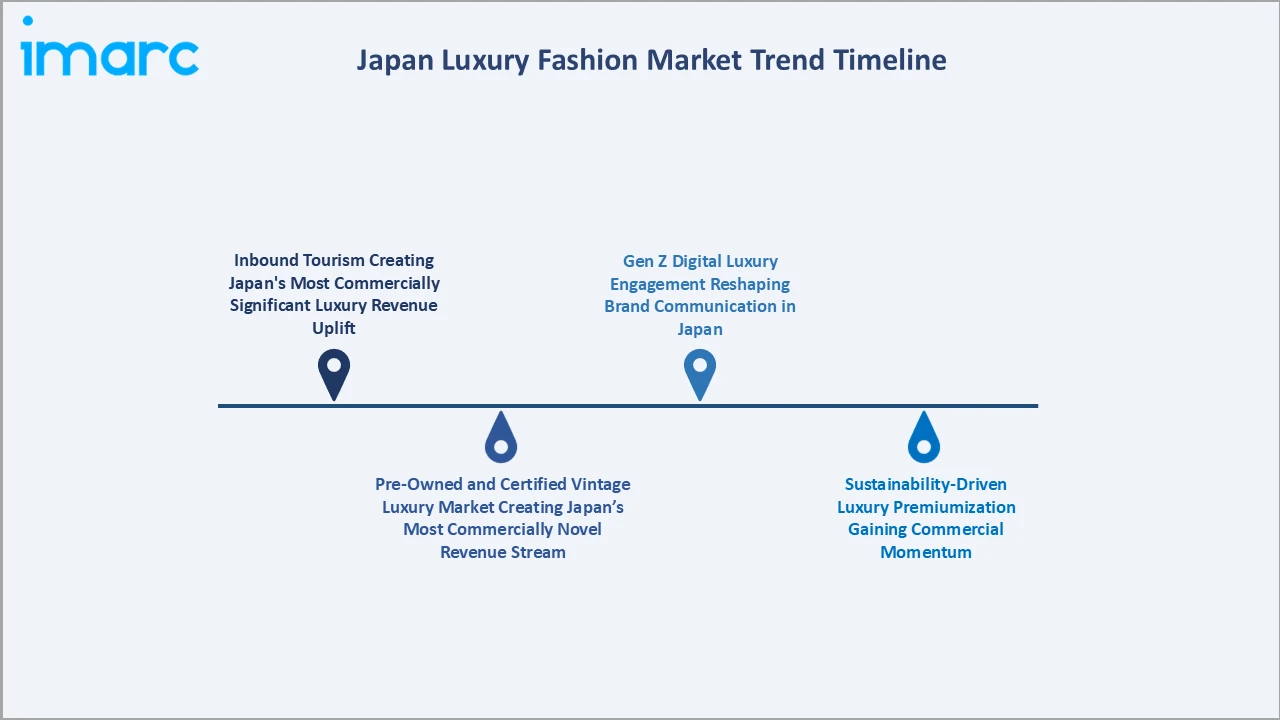
1. Inbound Tourism Creating Japan's Most Commercially Significant Luxury Revenue Uplift
Record inbound tourism has become Japan luxury fashion market's most commercially significant growth driver, with tourist duty-free spending in Ginza flagship stores and airport luxury boutiques creating above-domestic-growth luxury revenue increments. Brands are investing in multilingual staff, international payment facilitation, and duty-free exclusive product ranges to maximize tourist wallet capture.
2. Pre-Owned and Certified Vintage Luxury Market Creating Japan's Most Commercially Novel Revenue Stream
Japan's pre-owned luxury market, anchored by platforms such as Mercari, Komehyo, and Brandear, is formalizing into a structurally significant certified resale segment growing at 20-25% annually. Authenticated vintage pieces from heritage European houses command premiums, creating a collector-grade market.
3. Gen Z Digital Luxury Engagement Reshaping Brand Communication in Japan
Japanese Gen Z luxury consumers, the fastest-growing new consumer cohort despite demographic headwinds engage primarily through digital channels. Brands investing in digital storytelling, limited digital drops, and social commerce integration are driving purchase intent among Japan's next-generation luxury consumer. This generational transition is compelling brands to operate dual-channel strategies that simultaneously maintain the high-touch in-store service tradition valued by established HNWI consumers while building digital discovery and purchase infrastructure for younger affluent consumers whose luxury journey begins and increasingly converts online.
4. Sustainability-Driven Luxury Premiumization Gaining Commercial Momentum
Sustainability has become a premium differentiator in Japan's luxury fashion segment, with environmentally conscious consumers selecting brands with transparent supply chains, responsible material sourcing, and credible circular economy initiatives. Brands communicating sustainability commitments through certified materials, repair and restoration programs, and responsible packaging command stronger consumer loyalty and reduced-price sensitivity.
Industry Value Chain Analysis
Japan luxury fashion value chain is one of the most service-intensive of any consumer product category globally. The value chain's commercial structure creates Japan's unique luxury market dynamic, where globally manufactured luxury goods are distributed through Japan's extraordinarily high-service retail infrastructure creating per-square-meter luxury sales productivity that exceeds all other global luxury markets.
|
Stage |
Key Participants |
|
Raw Material & Sourcing |
Global luxury textile suppliers, Italian leather houses, precious metal and gemstone suppliers, Japanese fabric manufacturers |
|
Design & Atelier Production |
European luxury brand design studios, Japan-based licensed manufacturing partners, artisan workshops |
|
Brand & Marketing Development |
Global luxury brand headquarters, Japan regional offices, luxury media partners, digital platform operators |
|
Import & Customs Clearance |
Authorized luxury importers, Japan Customs clearance agents, duty-free zone operators at airports |
|
Retail & E-Commerce Distribution |
Flagship boutiques, department store luxury floors (hyakkaten), luxury e-commerce platforms, duty-free shop operators |
|
After-Sales Service & Warranty |
Brand-authorized service centers, luxury goods repair specialists, authentication and certification service providers |
Technology Landscape in the Japan Luxury Fashion Industry
Digital Commerce and Omnichannel Integration
Luxury brands in Japan are integrating digital platforms with physical flagship experiences through LINE-based CRM, luxury app commerce, and social media-driven discovery that expand brand reach to digital-native consumers. Virtual try-on, AI-powered personal styling, and exclusive digital drops are reshaping luxury purchase journeys, enabling brands to deliver personalized luxury experiences at scale.
Authentication and Anti-Counterfeit Technology
Blockchain-based authentication, NFC chip embedding in luxury products, and AI-powered authentication platforms are addressing Japan's counterfeit challenge and building consumer confidence in certified channels. Brands and pre-owned marketplaces are investing in technology-verified authenticity to strengthen consumer trust and protect brand equity across both primary and secondary market channels.
Smart Retail and Experiential Technology
Japan's luxury flagships are investing in experiential retail technology, including immersive brand storytelling installations, digital personalization kiosks, and data-driven clienteling tools that enable sales associates to deliver hyper-personalized service at the individual consumer level. These investments sustain Japan's luxury retail service excellence at operational scale, enabling brands to maintain the high-touch personal service standard that Japanese luxury consumers expect while expanding the consumer base beyond what purely human-staffed service models can accommodate.
Market Segmentation Analysis
The report covers the following segments:
|
Segment Category |
Leading Segment |
Market Share |
Year |
|
Product Type |
Accessories |
47.0% |
2025 |
|
Distribution Channel |
Store-Based |
78.0% |
2025 |
|
End User |
🔒 |
🔒 |
2025 |
|
Region |
Kanto Region |
34.0% |
2025 |

By Product Type
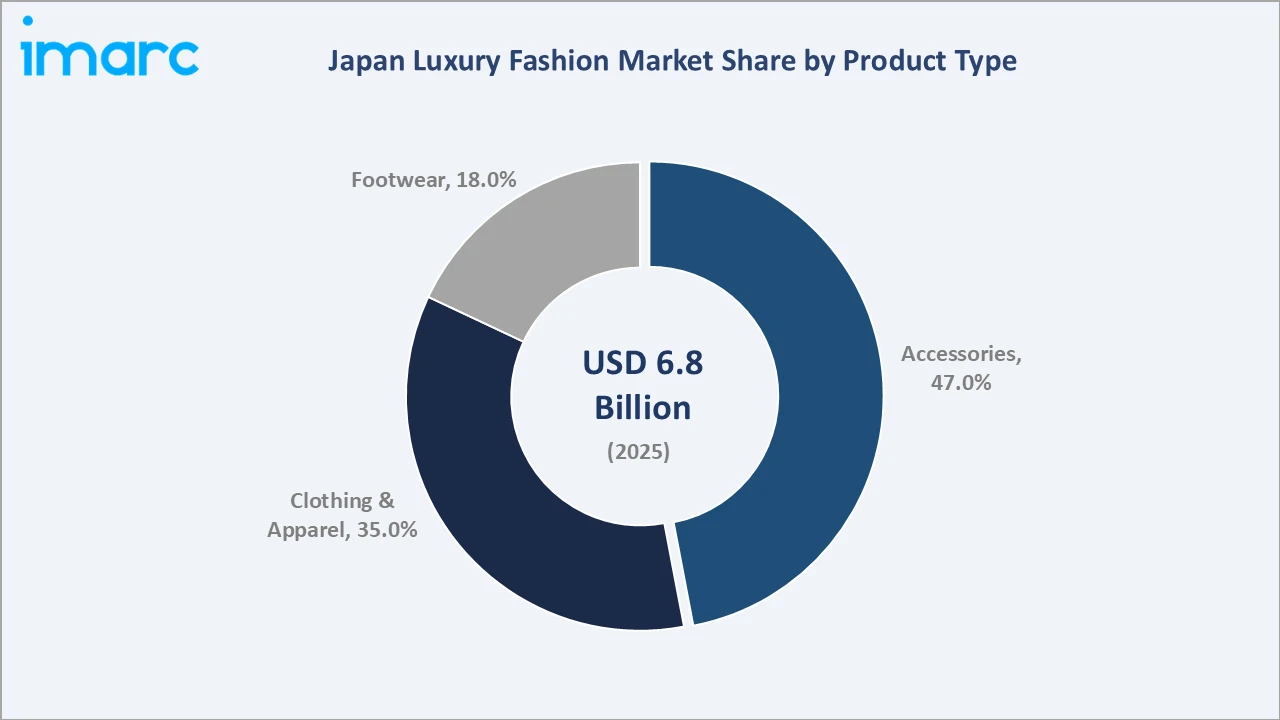
Accessories lead at 47.0% (2025). The accessories segment encompasses Japan's most commercially dominant luxury category, including handbags, watches, jewellery, belts, and scarves commanding the highest aspirational, gifting, and investment value among Japan's luxury consumers.
To access detailed market analysis, Request Sample
Clothing and Apparel at 35.0% serves Japan's fashion-conscious urban professional and luxury collector segments, with heritage ready-to-wear from European luxury houses commanding strong domestic loyalty. Footwear at 18.0% grows steadily, driven by limited-edition luxury sneaker culture among younger affluent consumers and designer footwear demand from Japan's fashion-forward premium segment.
By Distribution Channel
Store-Based leads at 78.0% (2025). Japan's uniquely high-touch luxury retail culture maintains brick-and-mortar dominance through service excellence that digital channels cannot yet replicate. The in-store model, with dedicated sales associates, elaborate gift-wrapping culture, and immersive brand experience investments, sustains strong consumer preference for physical luxury retail across all age and income cohorts.
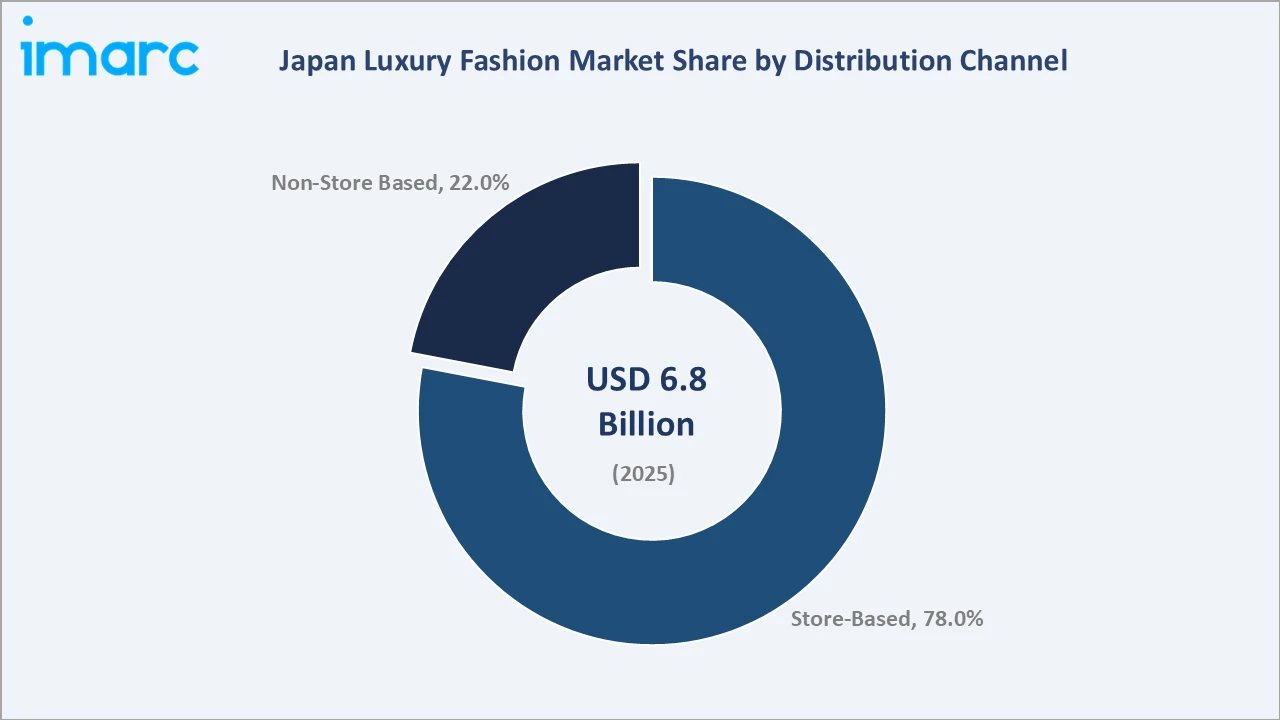
Non-Store Based at 22.0%, driven by luxury e-commerce platform expansion, social commerce, and exclusive digital drops targeting Japan's digitally sophisticated Gen Z and Millennial luxury consumers.
Regional Market Insights
|
Region |
Share (2025) |
Key Japan Luxury Fashion Market Drivers & Characteristics |
|
Kanto Region |
34.0% |
Driven by Tokyo's flagship luxury concentration in Ginza and Omotesando, Japan's highest HNWI density, and peak inbound tourist luxury spending. |
|
Kansai/Kinki Region |
20.0% |
Osaka and Kyoto anchor this region; Osaka's luxury retail cluster and Kyoto's heritage-driven luxury appreciation create a structurally distinct demand profile. |
|
Central/Chubu Region |
17.0% |
Nagoya's concentrated luxury market with Japan's highest per-capita luxury vehicle ownership correlating with above-national fashion luxury spend. |
|
Kyushu-Okinawa Region |
10.0% |
Fukuoka's growing luxury retail cluster and inbound Korea-Japan tourist travel support luxury fashion demand above national per-capita average. |
|
Tohoku Region |
7.0% |
Rising disposable incomes and growing access to luxury brands support emerging demand for premium fashion across Sendai and regional cities. |
|
Chugoku Region |
6.0% |
Hiroshima's commercial activity supports moderate luxury fashion demand, with department store luxury floors serving the region's affluent consumers. |
|
Shikoku Region |
4.0% |
Smaller but growing market with urban luxury retail development in Matsuyama and Takamatsu supporting aspirational luxury consumption. |
|
Hokkaido Region |
2.0% |
Sapporo's tourism and skiing luxury segment support premium fashion demand, particularly in winter-oriented luxury lifestyle accessories and travel goods. |
Kanto Region's 34.0% market leadership reflects Tokyo's unmatched concentration of global luxury flagship stores, Japan's highest HNWI density, and the peak inbound tourist spending that Narita and Haneda airports and Ginza's duty-free infrastructure channel through Tokyo's retail ecosystem. Kansai/Kinki Region's 20.0% reflects Osaka's Shinsaibashi luxury retail development and Kyoto's heritage-oriented premium consumption culture.
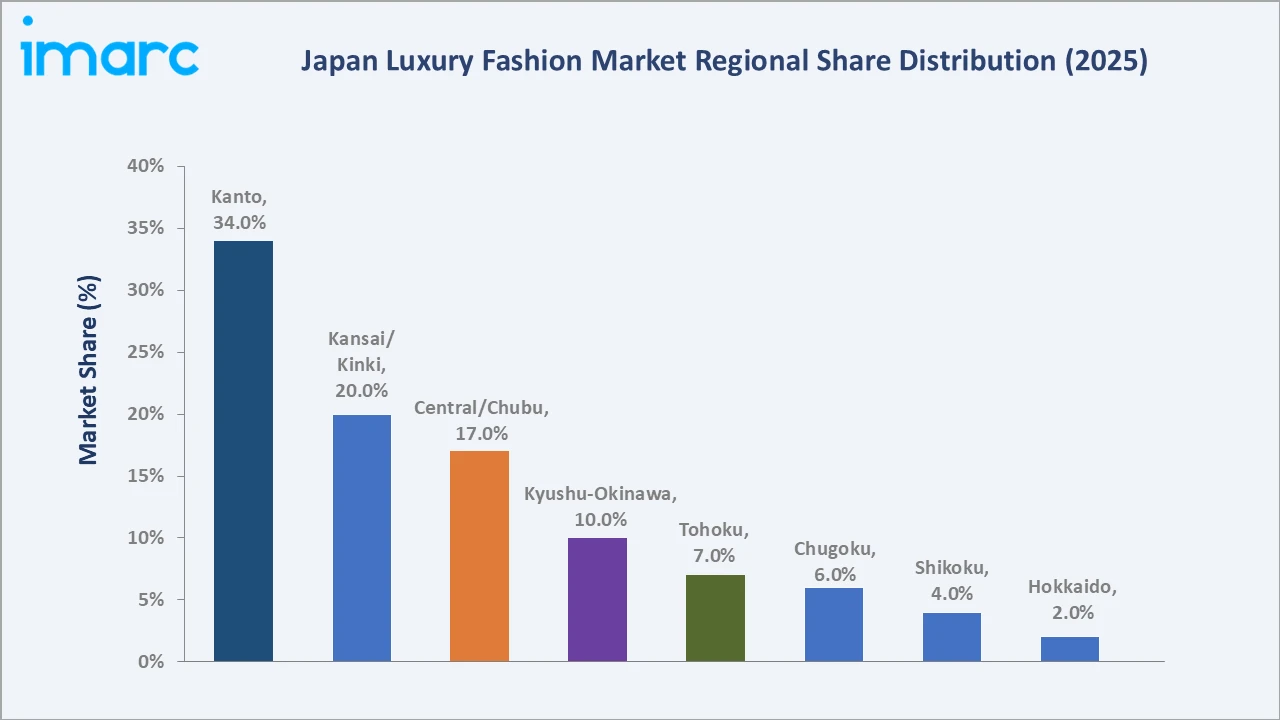
Central/Chubu Region's 17.0% is anchored by Nagoya's distinctive luxury consumption profile, where above-national luxury automotive ownership correlates with fashion luxury spend. Kyushu-Okinawa at 10.0% is growing fastest among secondary regions through Fukuoka's luxury retail development and inbound Korean tourist spending.
Competitive Landscape
Japan luxury fashion competitive landscape is defined by global European luxury conglomerates competing alongside independent luxury houses and Japan-origin premium brands. Competition is intensifying through digital channel investment, limited-edition drops, duty-free luxury activations, and the growing certified pre-owned segment that creates alternative competitive dynamics outside the primary luxury market.
|
Company |
Key Brands |
Market Position |
Core Strength |
|
Kering |
Gucci, Saint Laurent, Bottega Veneta, Balenciaga |
Strong Challenger |
Kering's diversified luxury brand portfolio captures distinct consumer segments—from Gucci's fashion-forward positioning to Bottega Veneta's artisan craft premium—across Japan's varied luxury consumer cohorts. |
|
Compagnie Financière Richemont SA |
Cartier, Van Cleef & Arpels, Dunhill |
Innovator |
Richemont leads Japan's luxury accessories and jewellery segment through Cartier's status as Japan's most commercially dominant luxury jewellery brand among HNWI and gifting occasion buyers. |
|
Hermès |
Hermès |
Innovator |
Hermès' ultra-exclusivity strategy creates Japan's highest resale value premium market, with Birkin and Kelly bags commanding significant collector premiums that sustain brand positioning above peers. |
|
Prada S.P.A. |
Prada, Miu Miu |
Market Participant |
Prada's intellectual fashion positioning and Miu Miu's growing Gen Z resonance create a dual-segment market presence across Japan's premium fashion and accessible luxury consumer cohorts. |
Key players include Kering, Compagnie Financière Richemont SA, Hermès, Prada S.P.A., and others.
Key Company Profiles
Kering
Kering is a French multinational luxury group and the world's second-largest luxury goods conglomerate, with a diversified brand portfolio spanning fashion, leather goods, jewellery, and eyewear.
- Key Brands: Gucci, Saint Laurent, Bottega Veneta, Balenciaga, among others
- Strategic Focus: Kering is rationalizing its Japan store network to concentrate investment in flagship-quality retail environments in Ginza, Omotesando, and Shinsaibashi, prioritizing elevated in-store client experiences and higher sales density over distribution scale — a deliberate repositioning toward the premium boutique model that Japan's HNWI consumers reward with above-average repurchase frequency and brand loyalty.
Hermès
Hermès maintains Japan's most commercially exclusive luxury fashion market position, with a deliberate supply scarcity strategy that creates the highest resale premium market for Birkin and Kelly bags among all luxury accessories categories in Japan, sustaining exceptional brand desirability above peers.
- Key Brands: Hermès
- Recent Developments: In June 2026, Hermès opened a new store at The Landmark Nagoya Sakae in Nagoya, Japan. The store's design draws inspiration from local craftsmanship, traditional fabrics, and regional colours, reflecting the brand's focus on integrating local cultural influences into its retail spaces.
- Strategic Focus: Sustaining ultra-exclusivity positioning through deliberate supply constraint and controlled boutique expansion that maintains brand scarcity and desirability—refusing to over-distribute in response to demand surges that would dilute the brand's commercial positioning as Japan's most exclusive luxury fashion house.
Market Concentration Analysis
Japan luxury fashion market is highly concentrated at the ultra-luxury tier, with the key players commanding an estimated 45-55% of Japan's total luxury fashion market by value. The market is moderately fragmented in the premium and accessible luxury tiers, where international brands, and domestic premium labels compete for share through brand differentiation and distribution investments.
Market concentration is evolving through two opposing forces: the continued flagship expansion and portfolio diversification of major luxury conglomerates maintaining or growing their combined market share through multi-brand consumer reach, while Japan's luxury segment is gradually decentralizing through digital commerce growth enabling independent luxury labels and Japan-origin premium brands to access premium consumers outside the hyakkaten distribution channel that historically concentrated market share among established international luxury houses.
Investment & Growth Opportunities
Highest Growth Segments
Non-Store Based distribution (~6.8% CAGR through digital luxury commerce expansion), Accessories segment (~5.7% CAGR through tourist and HNWI demand), Footwear (~5.1% CAGR through Gen Z luxury sneaker culture), certified pre-owned luxury market (~20-25% CAGR from rapidly expanding base), and Kansai/Kyushu regional luxury retail expansion (~7-9% CAGR through underserved HNWI geography) represent Japan's highest-growth luxury fashion investment vectors through 2034.
Emerging Investment Opportunities
Japan's certified pre-owned luxury market, growing at 20-25% annually, represents the highest-CAGR luxury investment opportunity in Japan's fashion sector. The pre-owned market's growth is driven by authentication technology enabling consumer confidence, Japan's cultural mottainai tradition supporting sustainable consumption, and collectors' diversification interest in vintage and heritage European luxury goods as alternative investment assets.
Investment Themes
- Duty-free luxury concession investment in Japan's major international airports—Narita, Haneda, Kansai, and Chubu—capturing the extraordinary tourist wallet concentration at these high-velocity luxury acquisition points, where above-domestic-retail luxury purchase rates from Japan's record inbound visitor volumes create above-national-market revenue growth.
- Certified pre-owned luxury platform investment for Japan's most commercially dynamic luxury segment, requiring authentication technology, repair and restoration service capability, and warranty infrastructure that creates investable technology-enabled business models above traditional primary market retail distribution.
Future Market Outlook (2026-2034)
The Japan luxury fashion market is projected to grow from USD 6.81 Billion in 2025 to USD 7.17 Billion in 2026, reaching USD 10.83 Billion by 2034, registering a CAGR of 5.29% during 2026-2034. The market's anchor value of USD 8.82 Billion in 2030 represents Japan luxury fashion industry at a structural inflection, where non-store digital commerce is becoming a primary channel for tier-2 city premium buyers, the certified pre-owned segment is achieving mainstream commercial scale, and Gen Z luxury consumers are graduating from entry-level aspirational purchases to core luxury brand engagement.
Research Methodology
Primary Research
Primary research comprised structured interviews with Japan luxury fashion industry stakeholders, including Boutique Directors, CEO and Managing Partners, Brand Managers, duty-free retail operators, pre-owned luxury platform executives, e-commerce category managers, and consumer survey data from Japan luxury fashion buyers across Kanto, Kansai, Chubu, and Kyushu regions, including HNWI luxury buyers, tourist luxury purchasers, and Gen Z premium consumers.
Secondary Research
Secondary research encompassed Japan luxury goods import-export statistics, Japan Tourism Agency visitor expenditure data, company annual reports, Japan Luxury Brand Association market analysis, luxury fashion platform transaction data, investor presentations, and Japan consumer sentiment surveys. Over 50 secondary sources were reviewed and cross-referenced for data triangulation.
Forecasting Models
Market revenue forecasts were developed using a dual-model approach: a domestic consumer income stratification model (Japan HNWI population by wealth segment multiplied by luxury purchase frequency and average ticket size per segment) combined with a tourist spending model (inbound visitor volume by origin country multiplied by per-visitor luxury expenditure). Segment-level growth rates were applied through bottom-up aggregation validated against historical market data.
Japan Luxury Fashion Market Report Coverage:
| Report Features | Details |
|---|---|
| Base Year of the Analysis | 2025 |
| Historical Period | 2020-2025 |
| Forecast Period | 2026-2034 |
| Units | Billion USD |
| Scope of the Report | Exploration of Historical and Forecast Trends, Industry Catalysts and Challenges, Segment-Wise Historical and Predictive Market Assessment:
|
| Product Types Covered |
|
| Distribution Channels Covered | Store-Based, Non-Store Based |
| End Users Covered | Men, Women, Unisex |
| Regions Covered | Kanto Region, Kansai/Kinki Region, Central/ Chubu Region, Kyushu-Okinawa Region, Tohoku Region, Chugoku Region, Hokkaido Region, Shikoku Region |
| Companies Covered | Kering, Compagnie Financière Richemont SA, Hermès, Prada S.P.A., etc. |
| Customization Scope | 10% Free Customization |
| Post-Sale Analyst Support | 10-12 Weeks |
| Delivery Format | PDF and Excel through Email (We can also provide the editable version of the report in PPT/Word format on special request) |
Key Benefits for Stakeholders:
- IMARC’s industry report offers a comprehensive quantitative analysis of various market segments, historical and current market trends, market forecasts, and dynamics of the Japan luxury fashion market from 2020-2034.
- The research report provides the latest information on the market drivers, challenges, and opportunities in the Japan luxury fashion market.
- Porter's five forces analysis assist stakeholders in assessing the impact of new entrants, competitive rivalry, supplier power, buyer power, and the threat of substitution. It helps stakeholders to analyze the level of competition within the Japan luxury fashion industry and its attractiveness.
- Competitive landscape allows stakeholders to understand their competitive environment and provides an insight into the current positions of key players in the market.
Frequently Asked Questions About the Japan Luxury Fashion Market Report
Japan luxury fashion market size is estimated at USD 7.17 Billion in 2026, driven by record inbound tourism, yen depreciation boosting tourist price competitiveness, and strong HNWI domestic consumption. Japan's deep luxury brand culture, duty-free shopping infrastructure, and rapidly growing certified pre-owned segment further support market expansion across Kanto, Kansai, and emerging regional luxury markets.
Japan luxury fashion market grows at 5.29% CAGR during 2026-2034, reaching USD 10.83 Billion by 2034. Overall growth is sustained by Japan's inbound tourism-driven duty-free spending, HNWI wealth expansion, non-store digital commerce adoption at ~6.8% CAGR, and regional luxury retail development in Kansai and Kyushu creating above-national-market CAGR in underserved luxury geographies.
Accessories leads at 47.0% through Japan's dominant consumer demand for luxury handbags, watches, jewellery, and belts. Accessories serve both domestic HNWI purchase occasions and international tourist duty-free acquisition—dual demand channels creating structural market leadership above apparel and footwear segments, with the tourist-driven accessories demand component growing fastest through Japan's record inbound visitor volumes.
Store-Based leads at 78.0% through Japan's uniquely high-touch luxury retail culture, anchored in department store luxury floors (hyakkaten) and flagship boutiques in Ginza and Omotesando. Japan's consumer expectation for immersive in-store service—including dedicated sales associates, elaborate gift wrapping, and post-purchase follow-up—sustains brick-and-mortar dominance above digital channel share across all luxury consumer cohorts.
Kanto Region leads at 34.0% through Tokyo's unmatched concentration of luxury flagship stores in Ginza and Omotesando, Japan's highest HNWI density, and peak inbound tourist spending at Tokyo's duty-free and airport luxury channels. Kanto's commercial infrastructure—luxury department store floors, dedicated brand boutiques, and a thriving duty-free ecosystem—creates a structurally dominant luxury consumption geography within Japan.
Leading companies include Kering, Compagnie Financière Richemont SA, Hermès, Prada S.P.A., and others.
Japan luxury fashion market is projected to reach approximately USD 8.82 Billion by 2030, with non-store digital commerce growing as luxury e-commerce platforms become primary channels for tier-2 city premium buyers, the certified pre-owned luxury segment achieving mainstream commercial scale through authentication technology, and regional luxury retail expansion in Kansai and Kyushu contributing above-national-average growth.
Need more help?
- Speak to our experienced analysts for insights on the current market scenarios.
- Include additional segments and countries to customize the report as per your requirement.
- Gain an unparalleled competitive advantage in your domain by understanding how to utilize the report and positively impacting your operations and revenue.
- For further assistance, please connect with our analysts.
 Request Customization
 Speak to an Analyst
 Request Brochure
 Inquire Before Buying
Benefits of Customization
- Personalize this research
- Triangulate with your data
- Get data as per your format and definition
- Gain a deeper dive into a specific application, geography, customer, or competitor
- Any level of personalization
Get in Touch With Us
UNITED STATES
Phone: +1-201-971-6302
INDIA
Phone: +91-120-433-0800
UNITED KINGDOM
Phone: +44-753-714-6104
Email: [email protected]
Client Testimonials




.webp)




.webp)













Related Reports

Choose your plan
*Please note that the prices mentioned below are starting prices for each bundle type. Kindly contact our team for further details.*
Single User License
- 1 User License, Access on 2 Devices
- PDF Report + Excel Dataset (Password Protected)
- Lifetime Access
- No Printing Rights
- 10% Free Report Customization
- 10–12 Weeks of Analyst Support
Five User License
- Access for 5 Users, 2 Devices per User
- PDF Report + Excel Dataset (Password Protected)
- Lifetime Access
- Dedicated Account Manager
- 12–14 Weeks of Analyst Support
- No Printing Rights
- 15% Free Report Customization
- 25% Discount on Your Next Purchase
Corporate User License
- Unlimited User Access (Within Your Organization)
- PDF Report + Excel Dataset
- Lifetime Access
- Dedicated Account Manager
- 14–20 Weeks of Analyst Support
- No Printing Rights
- 20% Free Report Customization
- 30% Discount on Your Next Purchase
Essential Insights
What's included:
3 reports
- Lifetime Access
- PDF Reports
- Excel Datasets
- 2 Weeks of Free Analyst Support
- 2 User Licenses
- Access on 2 Devices
- Printing Rights
- Complimentary PowerPoint (PPT) Version
- Complimentary License Upgrade
Professional Access
What's included:
5 reports
- Lifetime Access
- PDF Reports
- Excel Datasets
- 8 Weeks of Free Analyst Support
- 2 User Licenses
- Access on 2 Devices
- Printing Rights
- Complimentary PowerPoint (PPT) Version
- Complimentary License Upgrade
Business Advantage
What's included:
8 reports
- Lifetime Access
- PDF Reports
- Excel Datasets
- 14 Weeks of Free Analyst Support
- 2 User Licenses
- Access on 2 Devices
- Printing Rights
- Complimentary PowerPoint (PPT) Version
- Complimentary License Upgrade
Enterprise Intelligence
What's included:
10 reports
- Lifetime Access
- PDF Reports
- Excel Datasets
- 20 Weeks of Free Analyst Support
- 2 User Licenses
- Access on 2 Devices
- Printing Rights
- Complimentary PowerPoint (PPT) Version
- Complimentary License Upgrade