
Japan Non-Alcoholic Beverage Market Size, Share, Trends and Forecast by Product Type, Packaging Type, Distribution Channel, and Region, 2026-2034
Japan Non-Alcoholic Beverage Market Size, Share, Trends & Forecast (2026-2034)
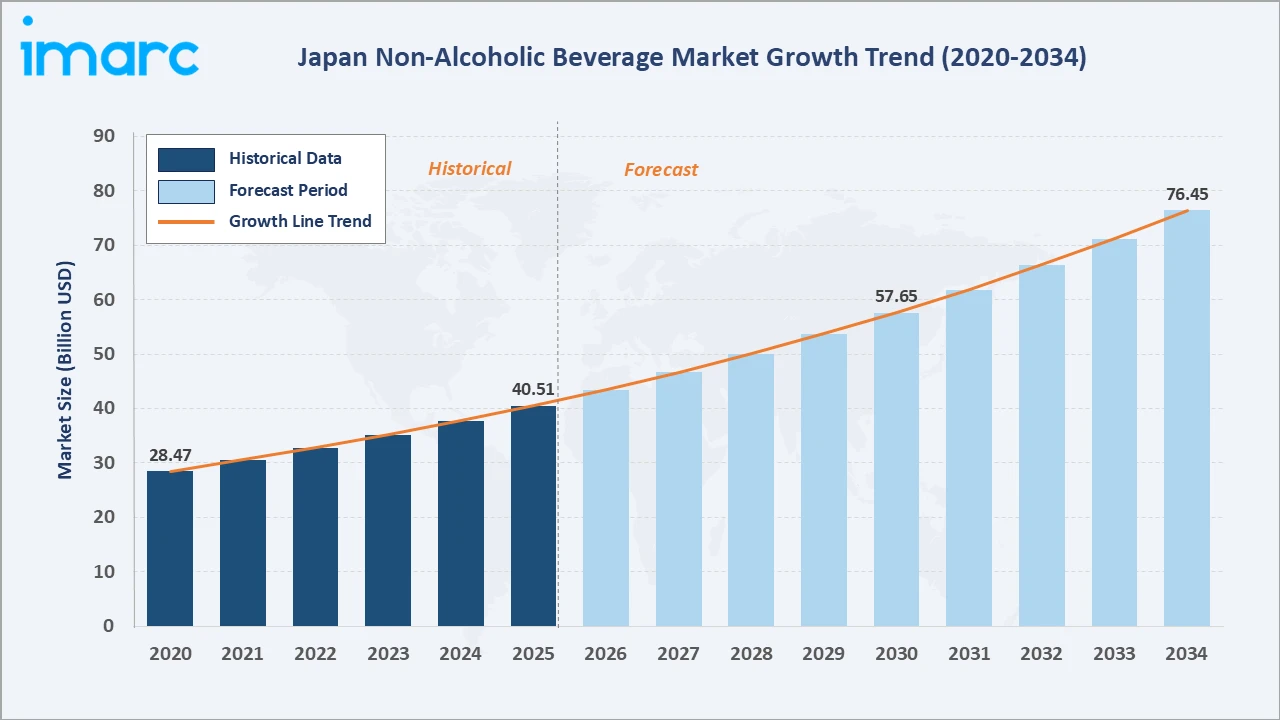
The Japan non-alcoholic beverage market size increased from USD 40.51 Billion in 2025 to USD 43.48 Billion in 2026 and is projected to reach USD 76.45 Billion by 2034, exhibiting a CAGR of 7.31% during 2026-2034. Growth is anchored by rising health-conscious consumption, functional beverage innovation, and Japan's uniquely dense retail and vending distribution infrastructure.
Market Snapshot
|
Metric |
Value |
|
Base Year Market Size (2025) |
USD 40.51 Billion |
| Market Size (2026) | USD 43.48 Billion |
|
Forecast Market Size (2034) |
USD 76.45 Billion |
|
CAGR (2026-2034) |
7.31% |
|
Base Year |
2025 |
|
Historical Period |
2020-2025 |
|
Forecast Period |
2026-2034 |
|
Dominant Product Type |
RTD Tea and Coffee (31.6%, 2025) |
|
Dominant Packaging Type |
Bottles (47.5%, 2025) |
|
Leading Region |
Kanto Region (38.9%, 2025) |
The market expanded from USD 28.47 Billion in 2020 to USD 40.51 Billion in 2025 and an estimated USD 43.48 Billion in 2026, is projected to reach USD 57.65 Billion by 2030 and USD 76.45 Billion by 2034, supported by rising health-conscious and functional beverage demand. This trajectory reflects consistent double-digit growth in functional and premium sub-categories, even as legacy carbonated and juice categories grow more modestly.
To get more information on this market, Request Sample
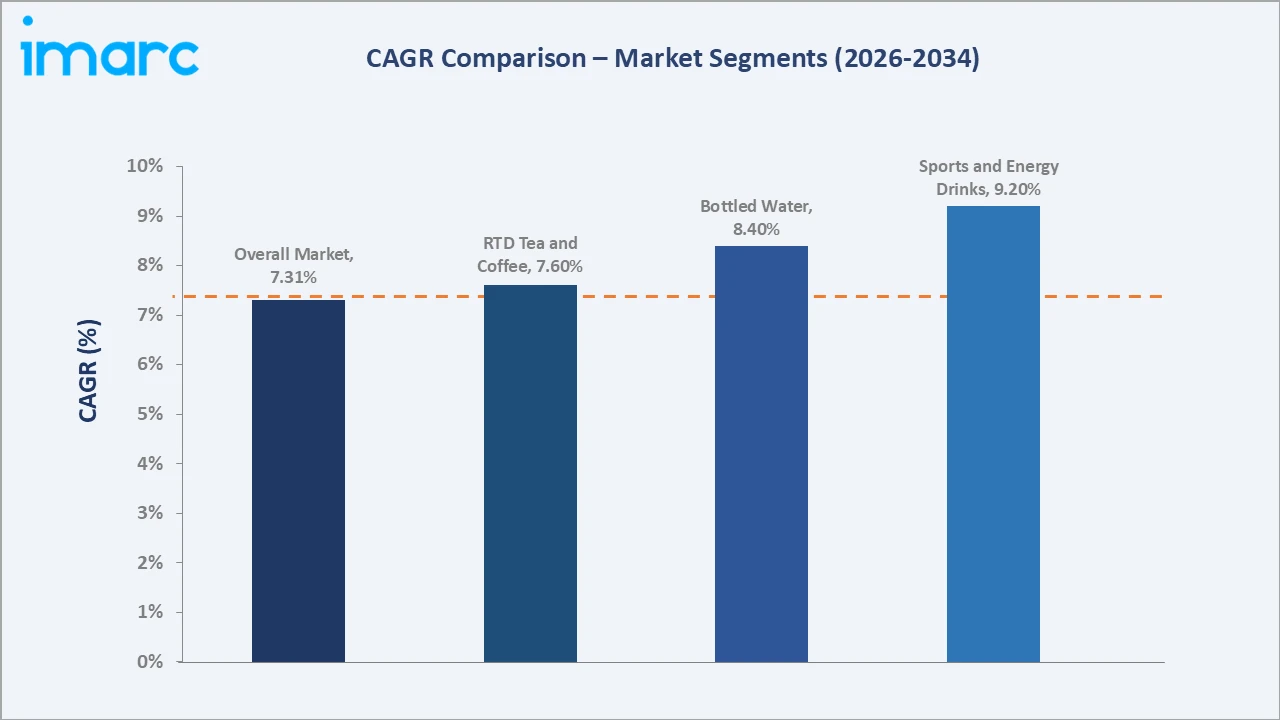
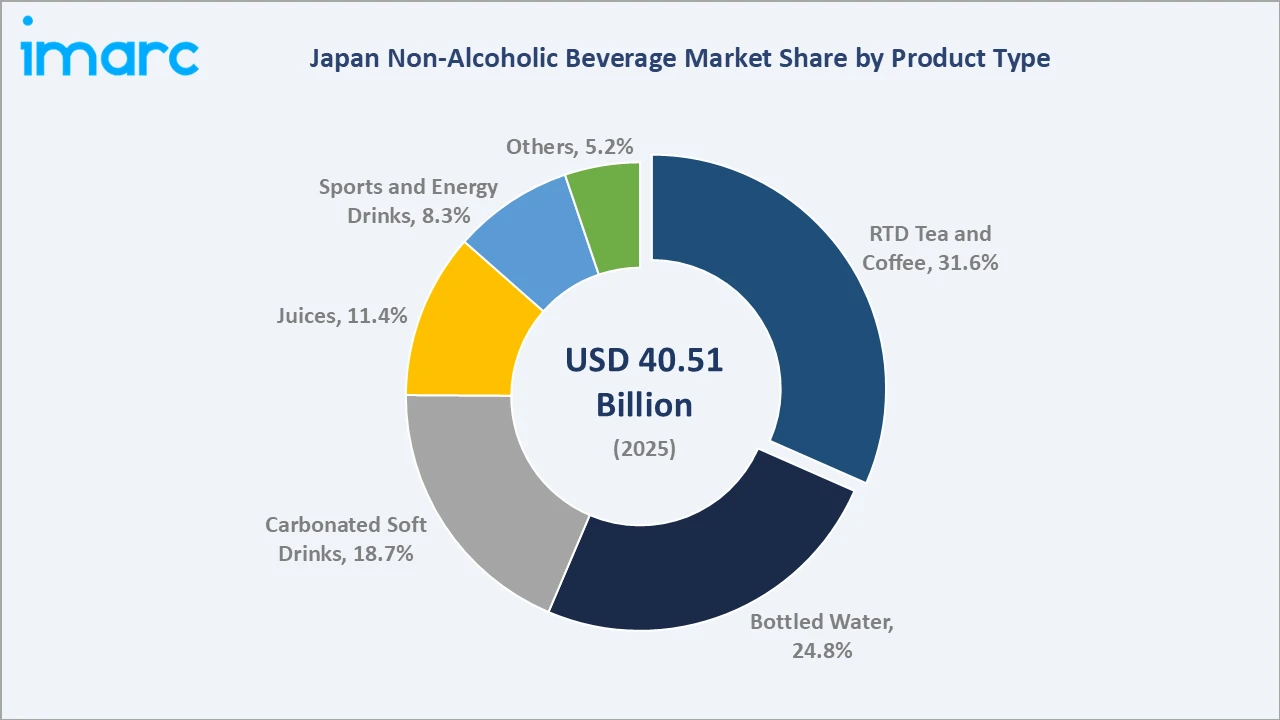
RTD tea and coffee lead product demand at 31.6% as vending machine and convenience retail infrastructure sustains frequent purchase occasions.
Executive Summary
The Japan non-alcoholic beverage market, which increased from USD 40.51 Billion in 2025 to an estimated USD 43.48 Billion in 2026, reflecting sustained consumer transition toward healthier, functional, and low-sugar beverage formats. Growth over the historical period was underpinned by rising disposable income, an aging but health-attentive population, and continuous product innovation from leading domestic manufacturers. Looking ahead, the market is expected to nearly double by 2034 as functional beverage adoption broadens beyond early adopters into mainstream consumption.
Bottles at 47.5% dominate packaging given compatibility with Japan's vending network, while the Kanto region leads regional consumption at 38.9%. Manufacturers are increasingly prioritizing sustainable packaging investment and functional product innovation as the primary levers for differentiation and margin expansion through the forecast period.
Key Market Insights
|
Insight |
Data |
|
Dominant Product Type |
RTD Tea and Coffee - 31.6% share (2025) |
|
Dominant Packaging Type |
Bottles - 47.5% market share (2025) |
|
Leading Region |
Kanto Region - 38.9% market share (2025) |
|
Market Opportunity |
Functional and fortified RTD innovation; sustainable carton and recycled-PET packaging; premium RTD coffee and tea formats. |
Key Analytical Observations Supporting the Above Data:
- RTD Tea and Coffee at 31.6%: Dominates through deep-rooted daily consumption habits and vending machine distribution density.
- Bottles at 47.5%: Leads packaging owing to convenience, resealability, and compatibility with retail and vending infrastructure.
- Kanto Region at 38.9%: Leads regional demand through population density, urbanization, and concentrated retail presence.
Japan Non-Alcoholic Beverage Market Overview
The Japan non-alcoholic beverage market encompasses the production, distribution, and retail of soft drinks including RTD tea and coffee, bottled water, carbonated soft drinks, juices, and sports and energy drinks. The market has evolved from a volume-driven, largely undifferentiated category into a highly innovation-intensive industry shaped by health, sustainability, and premiumization trends.
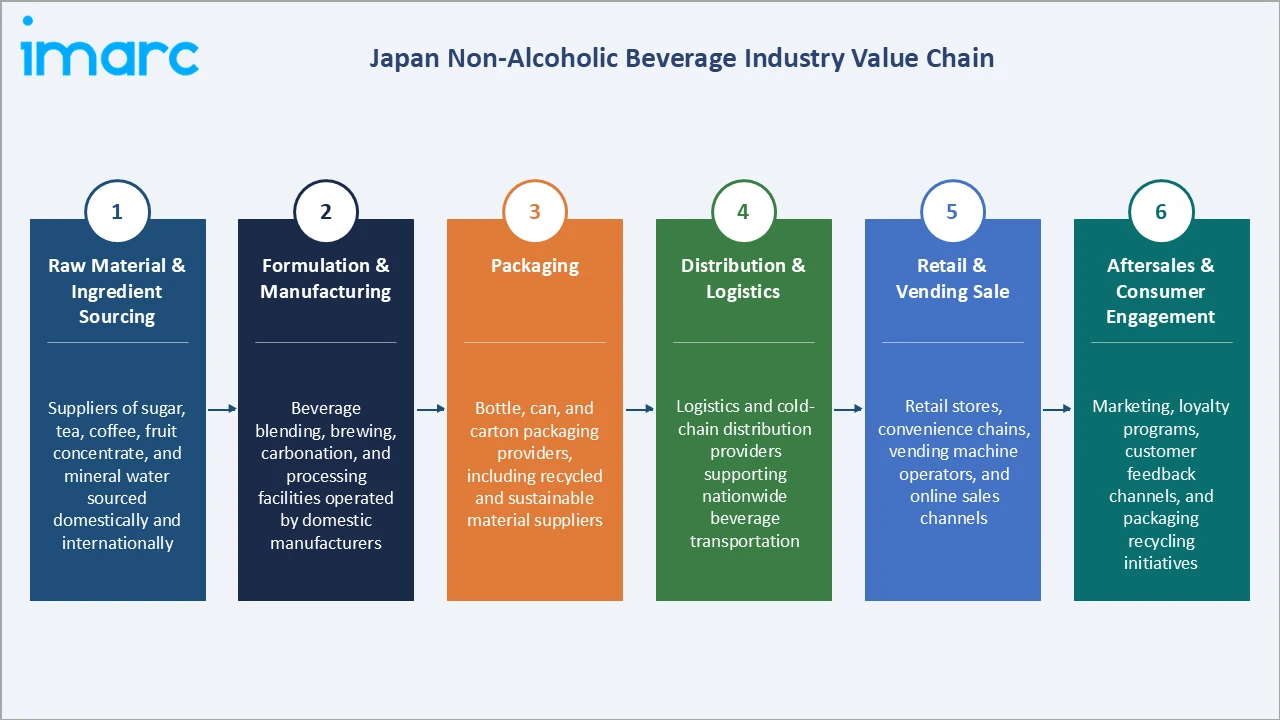
The ecosystem integrates raw material and ingredient suppliers, beverage manufacturers, packaging providers, and distribution and retail/vending channels serving Japan's dense urban consumer base. Close coordination between manufacturers and retail partners enables rapid rollout of seasonal and limited-edition products, a distinguishing feature of the Japanese beverage retail environment. This tightly integrated ecosystem also supports faster feedback loops between consumer preference shifts and new product development cycles.
Market Dynamics
To evaluate market opportunities, Request Sample
Market Drivers
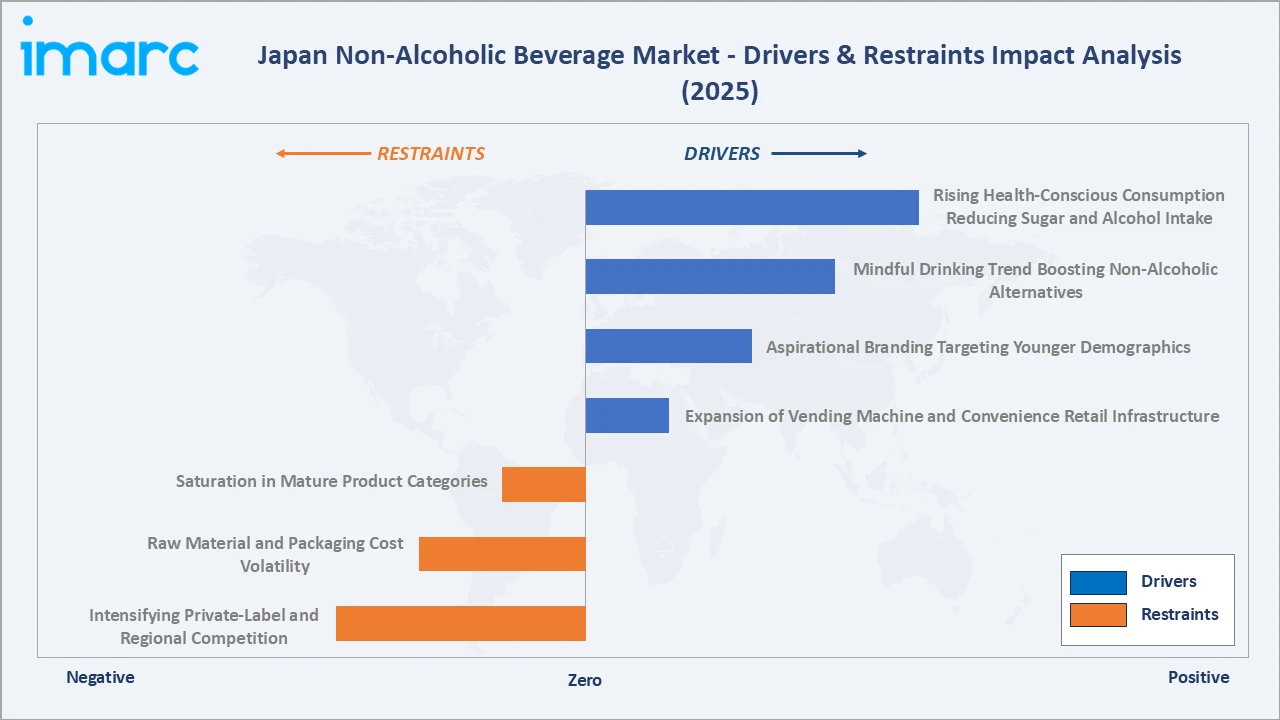
- Rising Health-Conscious Consumption Reducing Sugar and Alcohol Intake: Japanese consumers are shifting toward low-sugar, additive-free, functional beverages supporting hydration and wellness, driving sustained demand across RTD tea, coffee, and water segments. This shift is reinforced by government public-health campaigns promoting reduced sugar intake and by retailers dedicating more shelf space to low- and no-sugar variants. Manufacturers are responding with continuous reformulation cycles, using natural sweeteners and taste-masking technology to preserve flavor while lowering calorie content. As a result, low-sugar and functional sub-categories are growing meaningfully faster than the overall market average.
- Mindful Drinking Trend Boosting Non-Alcoholic Alternatives: The mindful drinking movement is encouraging consumers to seek sophisticated non-alcoholic alternatives for social occasions, prompting premium non-alcoholic product formulations. Younger urban professionals in particular are moderating alcohol consumption while still seeking flavorful, elevated beverage experiences at bars, restaurants, and social gatherings. This has opened space for premium RTD tea, artisanal soda, and botanical-infused beverages positioned as sophisticated alternatives. Beverage companies are increasingly partnering with hospitality venues to expand distribution of these premium non-alcoholic formats.
- Aspirational Branding Targeting Younger Demographics: Marketing strategies positioning non-alcoholic beverages as trendy and aspirational resonate with younger, health-conscious, socially aware consumers, expanding category penetration. Social media-driven campaigns and influencer collaborations are proving particularly effective at reaching Gen Z and millennial buyers who value brand authenticity and wellness positioning. Limited-edition packaging, collaborations with lifestyle brands, and experiential marketing at events are further strengthening brand recall. This aspirational positioning is helping premium and functional beverage lines command higher price points.
- Expansion of Vending Machine and Convenience Retail Infrastructure: Japan's extensive vending machine network and convenience store density provide unmatched accessibility, supporting frequent purchases and steady category growth. With hundreds of thousands of vending machines nationwide, beverage brands benefit from continuous, low-friction access points that drive impulse purchase behavior throughout the day. Convenience store chains are also expanding private-label and exclusive beverage lines, further increasing retail touchpoints. Smart vending technology, including cashless payment and inventory analytics, is improving replenishment efficiency and category performance.
Market Restraints
- Saturation in Mature Product Categories: Established categories such as carbonated soft drinks and bottled water face slowing volume growth in a mature, highly penetrated market, limiting incremental expansion. Per-capita consumption in these legacy categories has largely plateaued, forcing manufacturers to compete primarily on innovation and marketing rather than category expansion. This saturation is compressing margins as companies increase promotional spending to defend market share. Long-term growth in these segments increasingly depends on premiumization and functional reformulation rather than volume growth.
- Raw Material and Packaging Cost Volatility: Fluctuating prices of sugar, PET resin, and aluminum increase input cost pressure, squeezing margins and complicating long-term pricing strategies. Global commodity price swings, driven by energy costs and supply chain disruptions, make cost forecasting difficult for manufacturers operating on thin margins. Currency fluctuations further compound this volatility for companies reliant on imported raw materials and packaging inputs. Many manufacturers are responding with long-term supplier contracts and packaging lightweighting initiatives to partially offset cost exposure.
- Intensifying Private-Label and Regional Competition: Growing private-label penetration through retail chains increases pricing pressure on established manufacturers, constraining premiumization in price-sensitive categories. Convenience store and supermarket private-label beverages now compete directly with national brands on price while narrowing the quality gap through improved formulations. This dynamic is particularly pronounced in bottled water and carbonated soft drink categories, where brand differentiation is harder to sustain. Established manufacturers must increasingly justify premium pricing through functional benefits, packaging innovation, and brand experience.
Market Opportunities
- Functional and Fortified Beverage Expansion: Rising demand for immunity, hydration, and gut-health benefits creates opportunity for fortified RTD tea, water, and juice innovation across Japan. Aging demographics are further amplifying interest in beverages formulated for bone health, cognitive support, and metabolic wellness. Companies that establish early scientific credibility and clinical substantiation for functional claims are positioned to capture premium pricing and strong brand loyalty. Cross-category innovation, such as probiotic-infused RTD tea or collagen-fortified water, represents a significant untapped white space.
- Premiumization of RTD Coffee and Tea Formats: Growing consumer appetite for artisanal, specialty-grade RTD coffee and tea allows manufacturers to capture higher price points and margin expansion. Single-origin sourcing, cold-brew technology, and premium packaging formats are enabling differentiation in categories previously seen as commoditized. Collaborations with specialty coffee roasters and tea houses are lending authenticity to premium RTD launches. This premiumization trend is also extending into gifting and seasonal limited-edition formats that command significant price premiums.
Market Challenges
- Regulatory Scrutiny on Sugar Content and Labeling: Tightening nutritional labeling and sugar-reduction guidance requires continuous reformulation investment across product portfolios. Compliance with evolving front-of-pack labeling requirements demands ongoing investment in packaging redesign and ingredient disclosure systems. Manufacturers must also navigate potential future sugar-tax discussions that could reshape category economics if implemented. Balancing reformulation speed with taste and consumer acceptance remains an ongoing operational challenge for R&D teams.
- Cost of Sustainable Packaging Transition: Shifting to recycled PET, lightweight bottles, and carton formats requires significant capital investment amid competitive cost pressure. Retooling production lines for new packaging formats involves substantial upfront capital expenditure that smaller manufacturers may struggle to absorb. Securing consistent supply of high-quality recycled PET at scale remains a persistent bottleneck for the industry. Companies must also manage consumer perception and pricing sensitivity as sustainable packaging costs are gradually passed through the value chain.
Emerging Market Trends
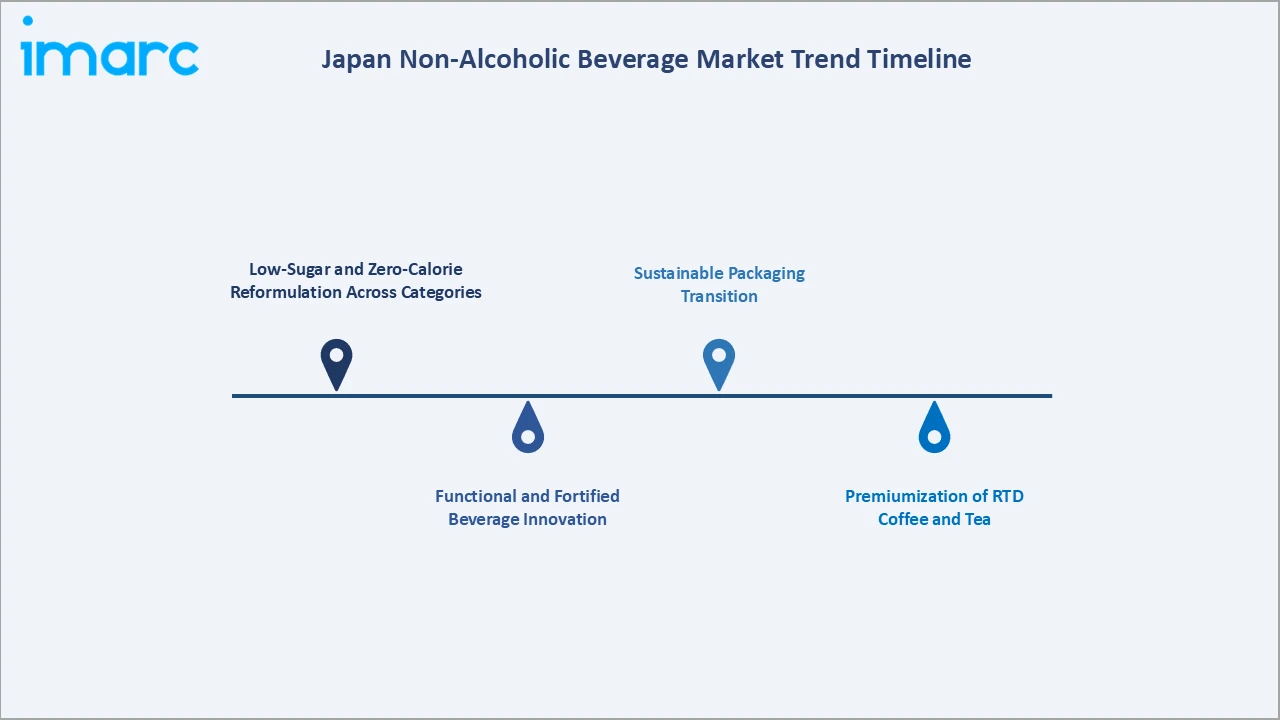
1. Low-Sugar and Zero-Calorie Reformulation Across Categories
Manufacturers are reformulating carbonated drinks, teas, and juices with reduced sugar content to align with health-conscious consumption trends. This reformulation wave spans both established national brands and emerging challenger brands, with taste parity becoming a key competitive battleground. Investment in natural sweetener blends and sensory testing panels is accelerating time-to-market for reformulated products.
2. Functional and Fortified Beverage Innovation
Growing interest in immunity, hydration, and gut-health benefits is driving launches of fortified RTD teas, waters, and juices. Companies are increasingly substantiating functional claims through clinical studies and third-party certifications to build consumer trust. This trend is also encouraging cross-industry collaboration between beverage manufacturers and nutraceutical or pharmaceutical research groups.
3. Sustainable Packaging Transition
Companies are shifting toward recycled PET, lightweight bottles, and carton packaging to meet sustainability commitments. Retailers are increasingly favoring suppliers with credible recycling and circular-economy commitments, adding commercial pressure alongside regulatory motivation. Several leading manufacturers have set public targets for 100% recyclable or reusable packaging within the next decade.
4. Premiumization of RTD Coffee and Tea
Rising demand for artisanal, specialty-grade RTD formats enables manufacturers to capture higher price points. Premium positioning is increasingly paired with limited-edition seasonal flavors and collaborations with well-known cafes and tea houses. This trend is expanding beyond convenience retail into premium supermarket and gifting channels.
Industry Value Chain Analysis
The Japan non-alcoholic beverage value chain integrates raw material sourcing, formulation and manufacturing, packaging, distribution and logistics, and retail and vending sale.
|
Stage |
Key Participants |
|
Raw Material & Ingredient Sourcing |
Suppliers of sugar, tea, coffee, fruit concentrate, and mineral water sourced domestically and internationally. |
|
Formulation & Manufacturing |
Beverage blending, brewing, carbonation, and processing facilities operated by domestic manufacturers. |
|
Packaging |
Bottle, can, and carton packaging providers, including recycled and sustainable material suppliers. |
|
Distribution & Logistics |
Logistics and cold-chain distribution providers supporting nationwide beverage transportation. |
|
Retail & Vending Sale |
Retail stores, convenience chains, vending machine operators, and online sales channels. |
|
Aftersales & Consumer Engagement |
Marketing, loyalty programs, customer feedback channels, and packaging recycling initiatives. |
The manufacturing and packaging tiers are the value chain's most commercially critical stages, as they directly determine cost structure, shelf differentiation, and sustainability positioning.
Technology Landscape in the Japan Non-Alcoholic Beverage Industry
Low-Sugar and Sugar-Free Formulation Technology
Advanced sweetener-blending and taste-masking technologies enable manufacturers to reduce sugar content while preserving flavor profiles across RTD tea, coffee, and carbonated categories. These formulation techniques are also being extended to functional and juice categories as consumer sugar sensitivity broadens beyond core beverage types.
Aseptic and Extended Shelf-Life Packaging Technology
Aseptic filling technology extends shelf life for RTD beverages without preservatives, supporting distribution across Japan's extensive vending and retail network. This technology is particularly valuable for premium tea and coffee formats that rely on natural ingredients without synthetic preservation.
Functional Fortification Technology
Microencapsulation and stabilization technologies allow vitamins, probiotics, and functional ingredients to be incorporated into beverages without compromising taste or stability. Continued advances in this area are expanding the range of functional claims manufacturers can credibly support at commercial scale.
Smart Vending and Cashless Payment Technology
IoT-enabled vending machines with cashless payment and real-time inventory tracking are improving replenishment efficiency and enabling dynamic pricing and promotional targeting across Japan's dense vending network. These systems are also generating granular consumption data that manufacturers use to refine product mix and regional distribution strategy.
Market Segmentation Analysis
The report covers the following segments:
|
Segment Category |
Leading Segment |
Market Share |
Year |
|
Product Type |
RTD Tea and Coffee |
31.6% |
2025 |
|
Packaging Type |
Bottles |
47.5% |
2025 |
|
Distribution Channel |
🔒 |
🔒 |
2025 |
|
Region |
Kanto Region |
38.9% |
2025 |

By Product Type
RTD Tea and Coffee at 31.6%, leads the market as ready-to-drink tea and coffee remain deeply embedded in daily consumption habits, supported by vending machine and convenience retail distribution. Continuous seasonal flavor launches and premium single-origin variants are helping sustain category momentum even as the segment matures.
To access detailed market analysis, Request Sample
Bottled Water at 24.8%, ranks second, driven by rising health consciousness, disaster-preparedness stockpiling culture, and demand for mineral and functional water variants. Premium and flavored water sub-segments are growing faster than plain bottled water as consumers seek differentiated hydration options.
By Packaging Type
Bottles at 47.5% dominate given convenience, resealability, and compatibility with Japan's vending infrastructure. Lightweighting initiatives are helping bottle formats retain share despite rising sustainability scrutiny on single-use plastics.
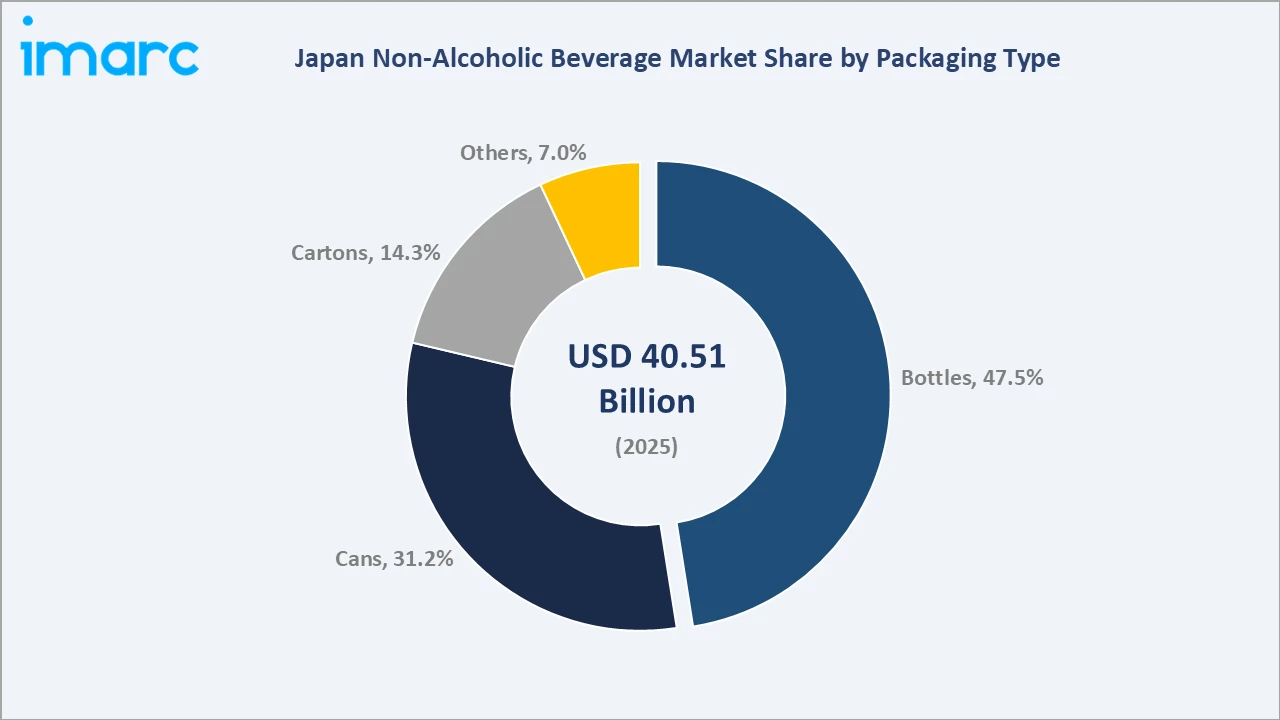
Cans at 31.2%, hold a strong second position, favored for RTD coffee, tea, and carbonated beverages. Aluminum's high recyclability is reinforcing its appeal among sustainability-focused retailers and consumers.
Regional Market Insights
|
Region |
Share (2025) |
Key Non-Alcoholic Beverage Market Drivers & Characteristics |
|
Kanto |
38.9% |
Driven by population density and retail infrastructure. |
|
Kansai/Kinki |
19.4% |
Supported by metropolitan consumption and retail density. |
|
Central/Chubu |
15.1% |
Benefits from manufacturing hub population base. |
|
Kyushu-Okinawa |
7.8% |
Growing with tourism and retail expansion. |
|
Tohoku |
5.9% |
Emerging demand from retail modernization. |
|
Chugoku |
5.2% |
Steady growth via convenience retail penetration. |
|
Hokkaido |
4.5% |
Niche growth from tourism and seasonal demand. |
|
Shikoku |
3.2% |
Smallest share, gradual retail-led growth. |
The Kanto region leads at 38.9%, driven by dense population, high urbanization, and concentrated retail and vending infrastructure. The Kansai/Kinki region follows at 19.4%, supported by strong metropolitan consumption in Osaka and Kyoto.
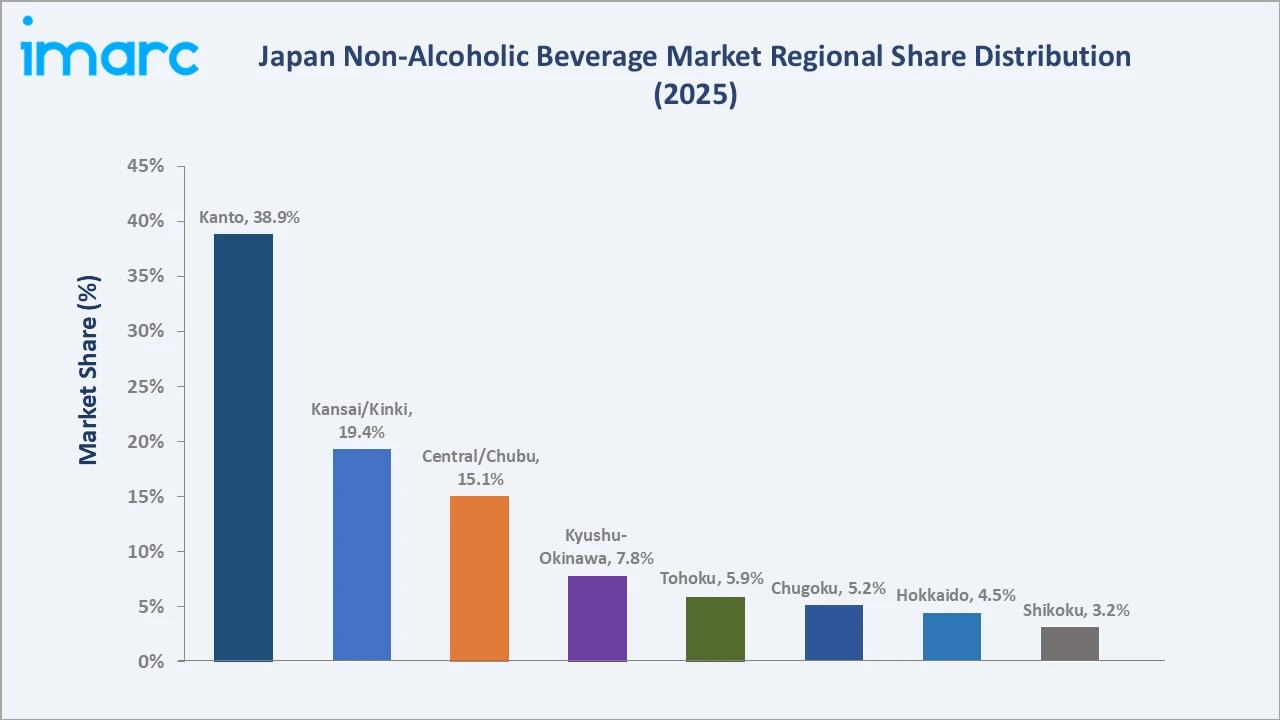
Central/Chubu at 15.1% benefits from manufacturing hub population density, while Kyushu-Okinawa, Tohoku, Chugoku, Hokkaido, and Shikoku collectively represent emerging, steadily growing regional demand pockets. These smaller regional markets are increasingly targeted through localized flavor variants and region-specific retail partnerships.
Competitive Landscape
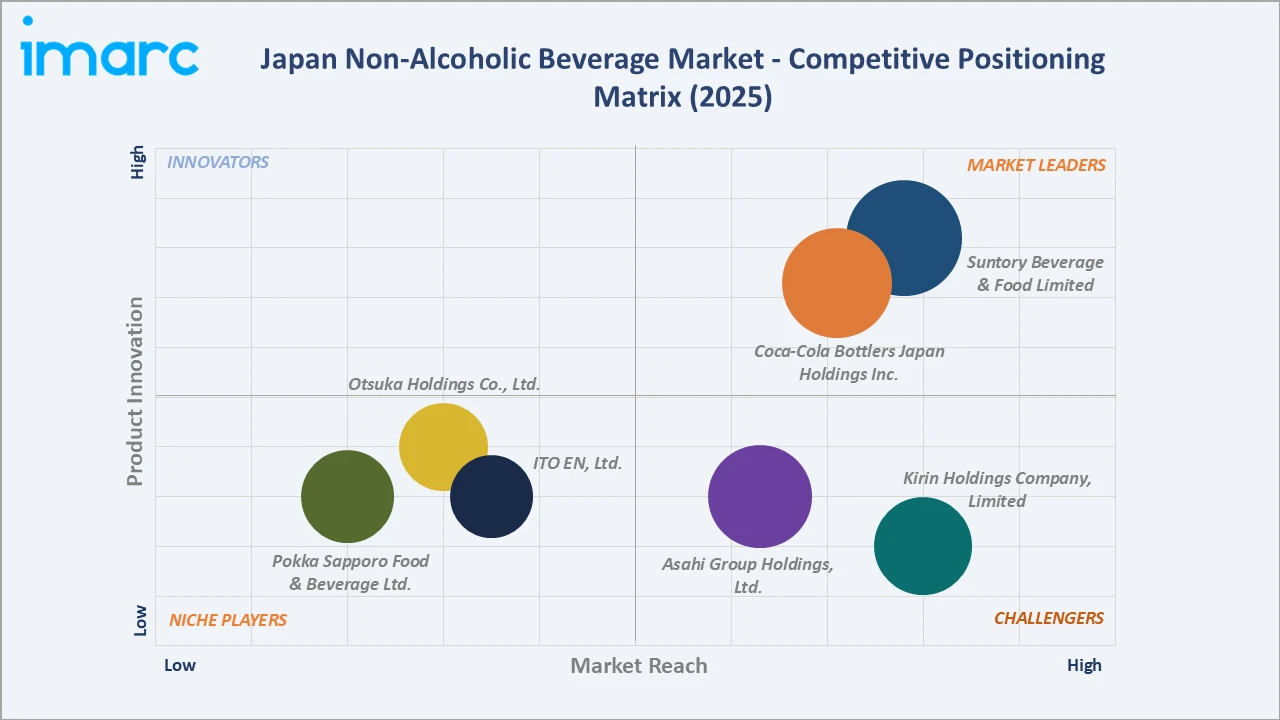
The Japan non-alcoholic beverage market is moderately consolidated, led by domestic beverage conglomerates with extensive bottling, vending, and retail distribution networks. Competitive success increasingly depends on the ability to rapidly commercialize functional and low-sugar innovations while maintaining cost-efficient nationwide distribution.
|
Company Name |
Key Products |
Market Position |
Core Strength |
|
Suntory Holdings Limited |
Iyemon RTD Tea, Suntory Tennensui, BOSS Coffee |
Market Leader |
Deep RTD tea and mineral water brand equity with nationwide bottling scale. |
|
Coca-Cola Bottlers Japan Holdings Inc. |
Coca-Cola, Georgia RTD Coffee, I LOHAS Water |
Market Leader |
Extensive vending machine network and carbonated drink distribution reach. |
|
Kirin Holdings Company, Limited |
Kirin Nama-cha, Fire RTD Coffee, Afternoon Tea |
Strong Challenger |
Broad functional beverage innovation pipeline through Kirin Beverage. |
|
Asahi Group Holdings, Ltd. |
Mitsuya Cider, Wilkinson, Calpis |
Strong Challenger |
Established carbonated soft drink and functional beverage portfolio. |
|
ITO EN, Ltd. |
Oi Ocha RTD Green Tea, Health Juice Range |
Niche Specialist |
Category leadership in green tea RTD with strong health positioning. |
|
Otsuka Holdings Co., Ltd. |
MATCH, CRYSTAL GEYSER ALPINE SPRING WATER, Sugoi Daizu |
Niche Specialist |
Strong functional and sports drink brand recognition. |
|
Pokka Sapporo Food & Beverage Ltd. |
Pokka RTD Coffee, Sapporo Juice Range |
Niche Specialist |
Established RTD coffee and juice presence in convenience retail. |
Key players include Suntory Holdings Limited, Coca-Cola Bottlers Japan Holdings Inc., Kirin Holdings Company, Limited, Asahi Group Holdings, Ltd., ITO EN, Ltd., Otsuka Holdings Co., Ltd., Pokka Sapporo Food & Beverage Ltd., and others.
Key Company Profiles
Suntory Holdings Limited
Suntory Holdings Limited operating through Suntory Beverage & Food Limited is a Japan-based beverage manufacturer with a leading presence in the non-alcoholic beverage market through its RTD tea, coffee, and mineral water portfolios sold under brands such as Iyemon and Suntory Tennensui. The company operates one of Japan's most extensive beverages bottling and distribution networks.
- Key Products: Iyemon RTD Green Tea, Suntory Tennensui Bottled Water, BOSS Coffee.
- Strategic Focus: Expanding functional and low-sugar RTD beverage portfolios while strengthening sustainable PET packaging initiatives. The company continues to invest in advanced tea extraction and cold-brew technology to enhance flavor consistency across its RTD tea range. It is also pursuing partnerships with domestic recyclers to increase the recycled-PET content of its bottled water packaging. Longer term, Suntory Beverage & Food aims to expand its functional beverage pipeline targeting immunity, hydration, and cognitive wellness benefits.
Kirin Holdings Company, Limited
Kirin Holdings Company, Limited operates a diversified non-alcoholic beverage business through Kirin Beverage, with a strong presence in RTD tea, coffee, and functional drink categories.
- Key Products: Kirin Nama-cha, Fire RTD Coffee, Kirin Afternoon Tea.
- Strategic Focus: Growing its functional beverage portfolio and enhancing supply chain efficiency to support nationwide distribution scale. Kirin Holdings is leveraging its biotechnology and fermentation research capabilities to develop next-generation functional ingredients for its beverage lineup. The company is also expanding regional production capacity to shorten distribution lead times and improve freshness for its RTD tea and coffee products. Kirin Beverage continues to explore collaborations with health and wellness brands to co-develop fortified beverage formats targeting specific consumer health needs.
Market Concentration Analysis
The Japan non-alcoholic beverage market is moderately concentrated, with the key players holding leading positions through extensive bottling and vending distribution networks, while mid-tier players compete on functional and regional product specialization. The top three players collectively account for a substantial share of category revenue, supported by decades-long brand equity, nationwide cold-chain logistics, and preferential vending machine placement. Mid-tier and niche manufacturers such as ITO EN and Otsuka Holdings maintain defensible positions through category leadership in specific formats such as green tea RTD and functional sports drinks. Barriers to entry remain elevated for new entrants given the capital intensity of nationwide bottling and vending infrastructure.
Investment & Growth Opportunities
Highest Growth Segments
RTD tea and coffee and bottled water represent the highest-volume growth segments, supported by sustained daily consumption habits and health-driven demand, alongside emerging functional beverage sub-categories. Sports and energy drinks, while smaller in absolute size, are growing from a lower base and are expected to outpace overall category growth as fitness culture continues to expand among working professionals.
Emerging Investment Opportunities
Functional and fortified beverage manufacturing represents the market's highest per-unit-value emerging opportunity, as premium RTD tea, coffee, and water formats command higher margins than legacy carbonated categories. Investment in domestic recycled-PET processing capacity also represents a significant opportunity given rising retailer and regulatory demand for sustainable packaging content.
Investment Themes
Sustainable packaging vertical integration as a structural cost advantage through 2034: Recycled PET and carton packaging capacity investment is becoming a key competitive differentiator across the value chain. Early movers in closed-loop packaging systems are likely to secure preferential retail partnerships as sustainability requirements tighten.
Functional beverage fortification manufacturing capturing Japan's fastest-growing premium consumption segment: Companies investing early in fortification technology are positioned to capture rising demand for health-oriented beverages. Strategic partnerships with biotechnology and nutraceutical firms are expected to accelerate time-to-market for next-generation functional formulations.
Future Market Outlook (2026-2034)
The Japan non-alcoholic beverage market is projected to grow from USD 40.51 Billion in 2025 to USD 43.48 Billion in 2026, reaching USD 76.45 Billion by 2034, delivering a 7.31% CAGR. The market is expected to reach approximately USD 57.65 Billion by 2030, with functional and low-sugar formats accounting for a progressively larger share of incremental revenue growth through the decade.
Three structural forces define market growth through 2034: sustained health-conscious consumption shift, functional beverage innovation, and continued expansion of vending and convenience retail infrastructure across Japan. Manufacturers that combine credible functional positioning with sustainable packaging commitments are best positioned to outperform the broader category average over the forecast period.
Research Methodology
Primary Research
Primary research comprised structured interviews with industry stakeholders, including beverage manufacturers, distributors, and retail and vending channel partners across Japan. Insights were triangulated across multiple stakeholder categories, including category managers, R&D leads, and supply chain executives, to validate demand trends and competitive positioning.
Secondary Research
Secondary research encompassed company annual reports, industry association publications, and government trade data covering Japan's beverage sector. Additional inputs included retail point-of-sale data, customs and trade statistics, and published sustainability disclosures from leading manufacturers.
Forecasting Models
Market revenue forecasts were developed using a consumption-based bottom-up model incorporating historical category growth rates, demographic trends, and retail channel expansion projections. The model was cross-validated against historical accuracy benchmarks and adjusted for anticipated regulatory and macroeconomic developments through the forecast period.
Japan Non-Alcoholic Beverage Market Report Coverage:
| Report Features | Details |
|---|---|
| Base Year of the Analysis | 2025 |
| Historical Period | 2020-2025 |
| Forecast Period | 2026-2034 |
| Units | Billion USD |
| Scope of the Report | Exploration of Historical and Forecast Trends, Industry Catalysts and Challenges, Segment-Wise Historical and Predictive Market Assessment:
|
| Product Types Covered | Carbonated Soft Drinks, Juices, Bottled Water, Sports and Energy Drinks, RTD Tea and Coffee, Others |
| Packaging Types Covered | Bottles, Cans, Cartons, Others |
| Distribution Channels Covered | Retail, Food Service, Supermarkets and Hypermarkets, Online Stores, Others |
| Regions Covered | Kanto Region, Kansai/Kinki Region, Central/ Chubu Region, Kyushu-Okinawa Region, Tohoku Region, Chugoku Region, Hokkaido Region, Shikoku Region |
| Companies Covered | Suntory Holdings Limited, Coca-Cola Bottlers Japan Holdings Inc., Kirin Holdings Company, Limited, Asahi Group Holdings, Ltd., ITO EN, Ltd., Otsuka Holdings Co., Ltd., Pokka Sapporo Food & Beverage Ltd., etc. |
| Customization Scope | 10% Free Customization |
| Post-Sale Analyst Support | 10-12 Weeks |
| Delivery Format | PDF and Excel through Email (We can also provide the editable version of the report in PPT/Word format on special request) |
Key Benefits for Stakeholders:
- IMARC’s industry report offers a comprehensive quantitative analysis of various market segments, historical and current market trends, market forecasts, and dynamics of the Japan non-alcoholic beverage market from 2020-2034.
- The research report provides the latest information on the market drivers, challenges, and opportunities in the Japan non-alcoholic beverage market.
- Porter's five forces analysis assist stakeholders in assessing the impact of new entrants, competitive rivalry, supplier power, buyer power, and the threat of substitution. It helps stakeholders to analyze the level of competition within the Japan non-alcoholic beverage industry and its attractiveness.
- Competitive landscape allows stakeholders to understand their competitive environment and provides an insight into the current positions of key players in the market.
Frequently Asked Questions About the Japan Non-Alcoholic Beverage Market Report
The Japan non-alcoholic beverage market size is estimated at USD 43.48 Billion in 2026, driven by RTD tea and coffee dominance at 31.6% and bottled water at 24.8%. Growth has been supported by rising health consciousness and sustained vending and convenience retail accessibility.
The market grows at a 7.31% CAGR during 2026-2034, reaching USD 76.45 Billion by 2034, supported by functional beverage innovation and expanding premium RTD demand.
RTD tea and coffee leads at 31.6%, supported by deep-rooted daily consumption habits and vending machine distribution. The segment continues to benefit from continuous flavor and functional innovation.
Bottles lead at 47.5%, owing to convenience and compatibility with retail and vending infrastructure, though cans and cartons are gaining share amid sustainability-driven packaging shifts.
The Kanto region leads at 38.9%, driven by population density and concentrated retail presence, followed by the Kansai/Kinki region at 19.4%.
Leading companies include Suntory Holdings Limited, Coca-Cola Bottlers Japan Holdings Inc., Kirin Holdings Company, Limited, Asahi Group Holdings, Ltd., ITO EN, Ltd., Otsuka Holdings Co., Ltd., Pokka Sapporo Food & Beverage Ltd., and others.
The market is projected to reach approximately USD 57.65 Billion by 2030, with functional and low-sugar beverages becoming a standard specification across most major product categories.
Priority opportunities include functional beverage fortification, RTD coffee and tea premiumization, and sustainable packaging investment, particularly in domestic recycled-PET processing capacity.
Need more help?
- Speak to our experienced analysts for insights on the current market scenarios.
- Include additional segments and countries to customize the report as per your requirement.
- Gain an unparalleled competitive advantage in your domain by understanding how to utilize the report and positively impacting your operations and revenue.
- For further assistance, please connect with our analysts.
 Request Customization
 Speak to an Analyst
 Request Brochure
 Inquire Before Buying
Benefits of Customization
- Personalize this research
- Triangulate with your data
- Get data as per your format and definition
- Gain a deeper dive into a specific application, geography, customer, or competitor
- Any level of personalization
Get in Touch With Us
UNITED STATES
Phone: +1-201-971-6302
INDIA
Phone: +91-120-433-0800
UNITED KINGDOM
Phone: +44-753-714-6104
Email: [email protected]
Client Testimonials




.webp)




.webp)













Related Reports

Choose your plan
*Please note that the prices mentioned below are starting prices for each bundle type. Kindly contact our team for further details.*
Single User License
- 1 User License, Access on 2 Devices
- PDF Report + Excel Dataset (Password Protected)
- Lifetime Access
- No Printing Rights
- 10% Free Report Customization
- 10–12 Weeks of Analyst Support
Five User License
- Access for 5 Users, 2 Devices per User
- PDF Report + Excel Dataset (Password Protected)
- Lifetime Access
- Dedicated Account Manager
- 12–14 Weeks of Analyst Support
- No Printing Rights
- 15% Free Report Customization
- 25% Discount on Your Next Purchase
Corporate User License
- Unlimited User Access (Within Your Organization)
- PDF Report + Excel Dataset
- Lifetime Access
- Dedicated Account Manager
- 14–20 Weeks of Analyst Support
- No Printing Rights
- 20% Free Report Customization
- 30% Discount on Your Next Purchase
Essential Insights
What's included:
3 reports
- Lifetime Access
- PDF Reports
- Excel Datasets
- 2 Weeks of Free Analyst Support
- 2 User Licenses
- Access on 2 Devices
- Printing Rights
- Complimentary PowerPoint (PPT) Version
- Complimentary License Upgrade
Professional Access
What's included:
5 reports
- Lifetime Access
- PDF Reports
- Excel Datasets
- 8 Weeks of Free Analyst Support
- 2 User Licenses
- Access on 2 Devices
- Printing Rights
- Complimentary PowerPoint (PPT) Version
- Complimentary License Upgrade
Business Advantage
What's included:
8 reports
- Lifetime Access
- PDF Reports
- Excel Datasets
- 14 Weeks of Free Analyst Support
- 2 User Licenses
- Access on 2 Devices
- Printing Rights
- Complimentary PowerPoint (PPT) Version
- Complimentary License Upgrade
Enterprise Intelligence
What's included:
10 reports
- Lifetime Access
- PDF Reports
- Excel Datasets
- 20 Weeks of Free Analyst Support
- 2 User Licenses
- Access on 2 Devices
- Printing Rights
- Complimentary PowerPoint (PPT) Version
- Complimentary License Upgrade