
Japan Retail Market Size, Share, Trends and Forecast by Product, Distribution Channel, and Region, 2026-2034
Japan Retail Market Size, Share, Trends & Forecast (2026-2034)
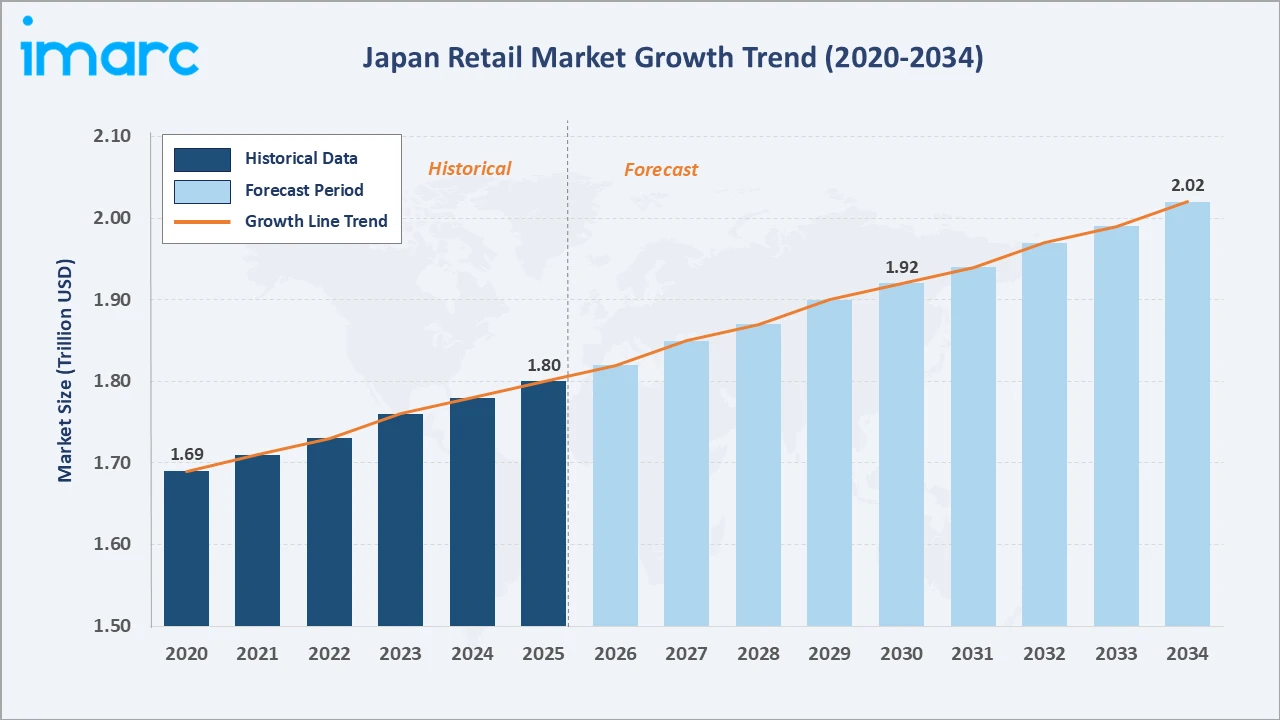
The Japan retail market grew from USD 1.80 Trillion in 2025 to USD 1.83 Trillion in 2026 and is projected to reach USD 2.02 Trillion by 2034, exhibiting a CAGR of 1.29% during 2026-2034. Japan's retail sector spans convenience stores, supermarkets, specialty outlets, and a fast-expanding online channel, supported by a dense urban population and one of the world's most efficient distribution networks.
Market Snapshot
|
Metric |
Value |
|
Base Year Market Size (2025) |
USD 1.80 Trillion |
|
Market Size (2026) |
USD 1.83 Trillion |
|
Forecast Market Size (2034) |
USD 2.02 Trillion |
|
CAGR (2026-2034) |
1.29% |
|
Base Year |
2025 |
|
Historical Period |
2020-2025 |
|
Forecast Period |
2026-2034 |
Japan's mature but resilient consumption base, combined with a steady inbound-tourism recovery and gradual e-commerce penetration, continues to underpin measured but consistent retail expansion despite a shrinking domestic population.
To get more information on this market, Request Sample
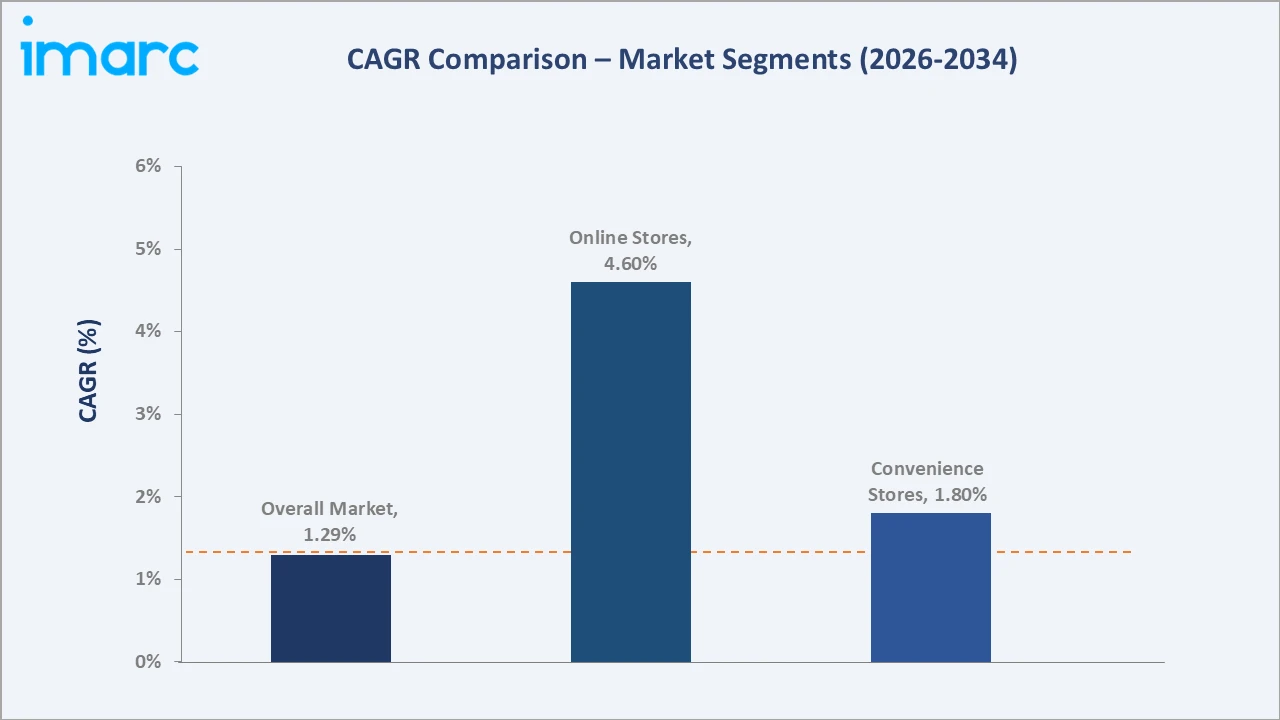
Online stores are expected to be the fastest distribution channel with an estimated ~4.6% CAGR (2026-2034), supported by rising smartphone-based purchasing and expanding last-mile logistics. Convenience stores follow at ~1.8% CAGR, reinforced by Japan's dense store network, while supermarkets, hypermarkets and specialty stores grow more gradually, below 1% annually, amid store-density saturation in core urban markets.
Executive Summary
The Japan retail market, which increased from USD 1.80 Trillion in 2025 to an estimated USD 1.83 Trillion in 2026, representing one of Asia's largest and most mature consumer markets. Japan's retail landscape is defined by an unusually dense convenience-store network, disciplined inventory practices, and a consumer base that prizes product freshness, service quality, and reliability over discount pricing. The market's modest 1.29% CAGR through 2034 reflects Japan's shrinking and aging population, offset by rising per-capita spending, inbound-tourism recovery, and gradual digitalization of retail formats.
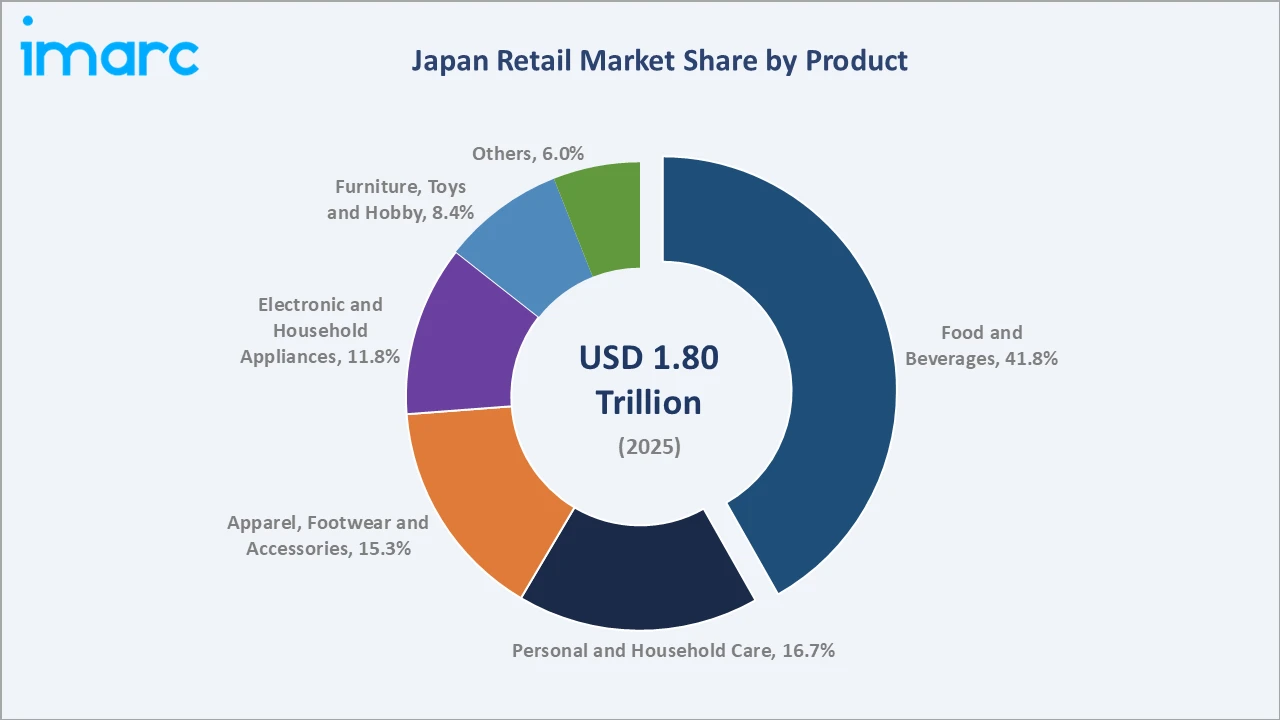
Food and beverages lead product segmentation at a 41.8% share (2025), followed by personal and household care at 16.7% and apparel, footwear and accessories at 15.3%. Convenience stores remain the leading distribution channel at 31.6% share, narrowly ahead of supermarkets and hypermarkets at 28.4%, while online stores, though smallest among major channels at 13.7%, are projected to grow the fastest as omnichannel retailing expands.
Key Market Insights
|
Insight |
Data |
|
Largest Product Segment |
Food and Beverages - 41.8% revenue share (2025) |
|
Leading Distribution Channel |
Convenience Stores - 31.6% share (2025) |
|
Fastest Growing Distribution Channel |
Online Stores - ~4.6% CAGR (2026-2034) |
|
Leading Region |
Kanto Region - 35.7% share (2025) |
|
Top Companies |
Seven & i Holdings Co., Ltd., AEON CO., LTD., FAST RETAILING CO., LTD., Rakuten Group, Inc. |
Key Analytical Observations Supporting the Above Data:
- Food and beverages at 41.8% (2025) anchored by Japan's daily fresh-food culture: convenience stores and supermarkets replenish perishable and ready-to-eat items multiple times daily, sustaining the category's dominant retail share.
- Convenience stores at 31.6% share (2025) supported by an unmatched store network: Japan's convenience-store count exceeded 56,054 outlets in 2025, with all-store sales reaching a record JPY 12.05 trillion (~USD 75.8 billion), per Japan Franchise Association data.
- Online stores are projected to be the fastest-growing distribution channel with ~4.6% CAGR: Japan's B2C e-commerce market reached JPY 26.1 trillion in 2024, up 5.1% year-on-year, according to the Ministry of Economy, Trade and Industry (METI).
- Kanto Region at 35.7% share (2025) driven by Tokyo's commercial density, large consumer base, extensive retail infrastructure, and strong concentration of supermarkets, department stores, convenience stores, and e-commerce operations.
- Seven & i Holdings Co., Ltd., AEON CO., LTD., and FAST RETAILING CO., LTD. anchor the competitive landscape: spanning convenience, general merchandise, and specialty apparel retail formats, respectively.
Japan Retail Market Overview
Japan's retail market encompasses the sale of food, beverages, personal care, apparel, electronics, and household goods through convenience stores, supermarkets, hypermarkets, specialty outlets, department stores, and online platforms. The ecosystem integrates domestic and international manufacturers, general trading houses, wholesale distributors, and a dense multi-format retail network serving Japan's approximately 123 million residents. Retail activity is shaped by the Ministry of Economy, Trade and Industry's (METI) commercial statistics frameworks and Japan's efficient just-in-time distribution culture.
Japan's retail landscape is further distinguished by its high consumer expectations around product quality, packaging precision, and seasonal merchandise cycles, with retailers investing heavily in private-label development, digital loyalty programs, and omnichannel fulfilment infrastructure to meet evolving shopper preferences across both urban metropolitan centers and rural regions.
Market Dynamics
To evaluate market opportunities, Request Sample
Market Drivers
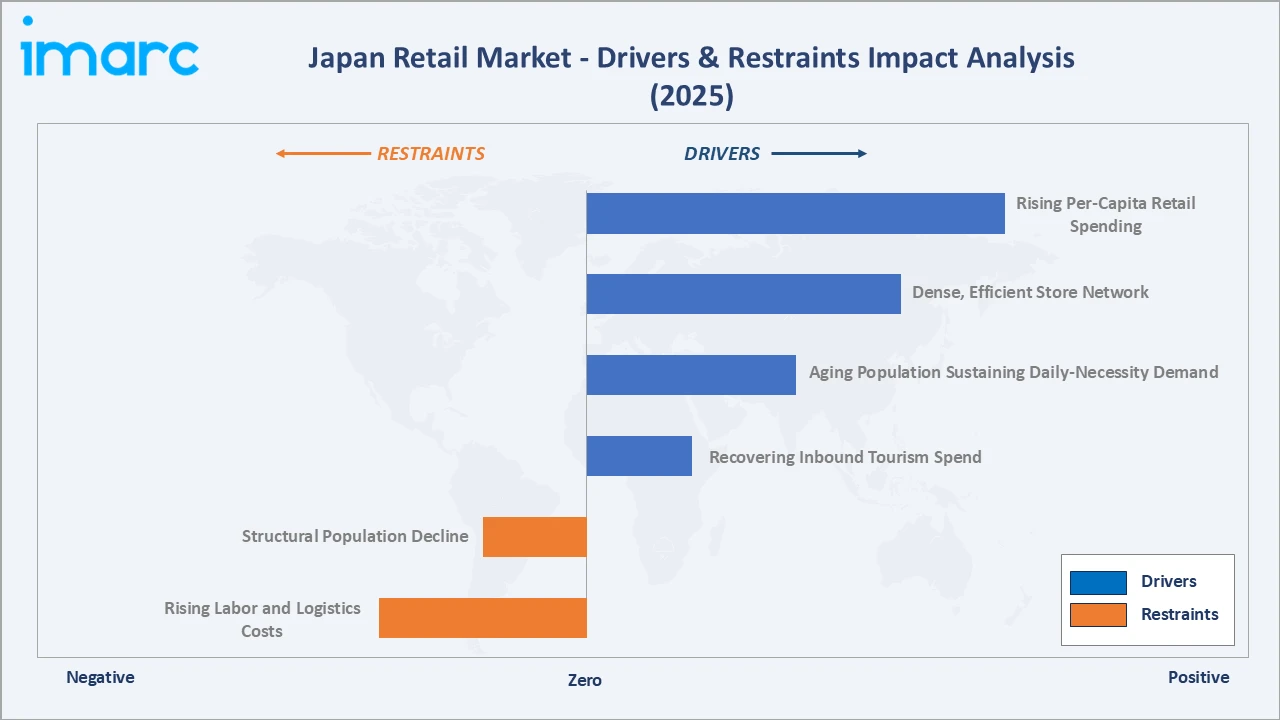
- Rising Per-Capita Retail Spending: Despite a shrinking population, Japan's per-store purchase value continues to climb; convenience-store per-customer spend rose 2.5% to JPY 737.9 in 2025 even as visitor counts declined slightly, reflecting price-led rather than volume-led retail growth (Japan Franchise Association, 2026).
- Dense, Efficient Store Network: Japan's convenience-store count exceeded 56,054 outlets in 2025, marking the fourth consecutive year of record all-store sales at JPY 12.05 trillion, underscoring the structural resilience of Japan's small-format retail model.
- Aging Population Sustaining Daily-Necessity Demand: According to Japan's Ministry of Internal Affairs and Communications, Japan's population aged 65 and above reached 29.3% in 2024, steadily lifting demand for daily food, pharmacy, and household-care retail purchases close to residential areas.
- Recovering Inbound Tourism Spend: Japan welcomed 42.7 million international visitors in 2025, a 15.8% increase on the previous high of 36.9 million in 2024, lifting convenience-store and specialty-retail sales in major urban and transit-linked locations.
Market Restraints
- Structural Population Decline: Japan's shrinking and aging population constrains long-term volume growth, pushing retailers toward price and premiumization strategies rather than unit expansion.
- Rising Labor and Logistics Costs: Convenience-store and supermarket chains face persistent wage inflation and delivery-cost pressure, compressing already thin retail margins across store formats.
Market Opportunities
- E-Commerce Penetration Headroom: Japan's B2C e-commerce ratio stood at just 9.8% of total commercial transactions in 2024 (METI), leaving substantial headroom for online-retail expansion relative to regional peers.
- Compact Urban Supermarket Formats: Chains such as Aeon's My Basket are expanding compact, convenience-store-sized supermarket formats, targeting a doubling of store count by 2030 to capture affordable, close-to-home shopping demand.
Market Challenges
- Foot Traffic Decline Despite Sales Growth: Convenience-store visitor counts fell slightly in 2025 even as sales rose, per Japan Franchise Association data, signaling reliance on price increases rather than customer growth.
- Franchise Model Rigidity: Convenience-store franchise structures limit operators' ability to cut prices directly, forcing reliance on digital coupons and loyalty programs to manage price-sensitive consumer behavior.
Emerging Market Trends
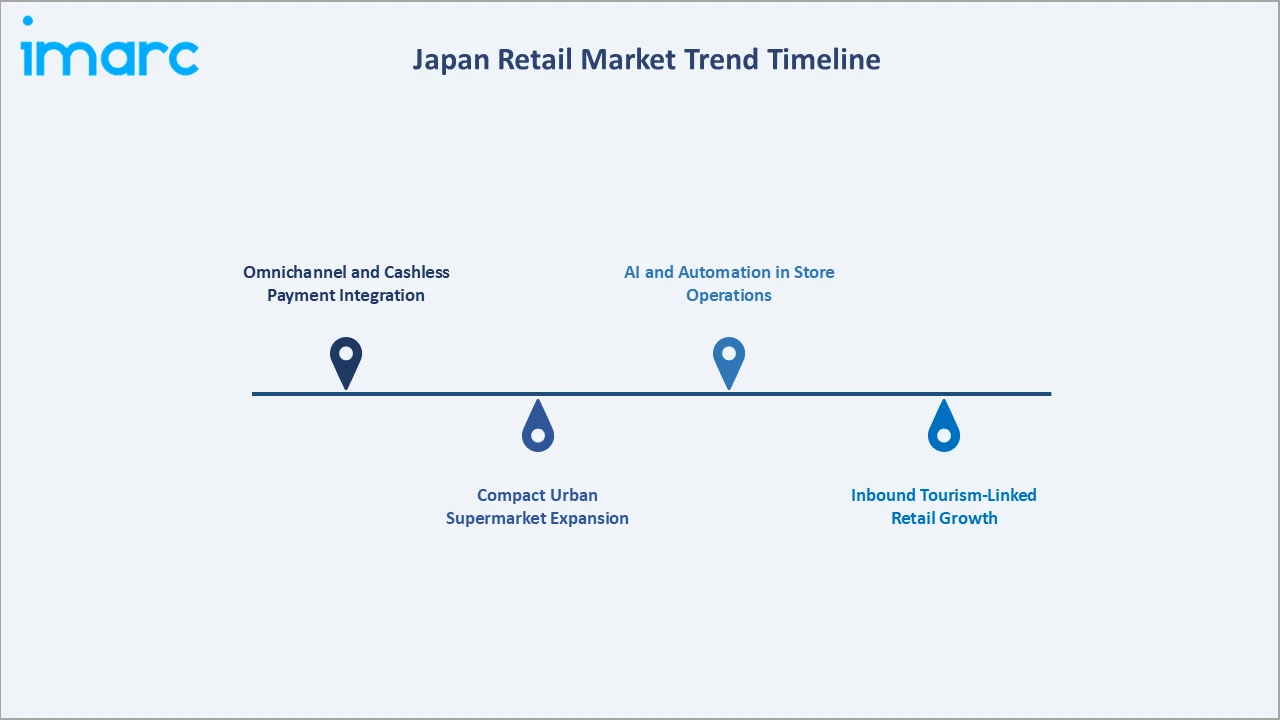
1. Omnichannel and Cashless Payment Integration
Japan's retailers are increasingly linking in-store and online operations, supported by unified mobile wallets and loyalty-point ecosystems. In November 2025, Rakuten Group, Inc. announced that Rakuten Card’s Q3 2025 shopping GTV increased 11.7% year-on-year to JPY 6.7 trillion, supported by customer growth, higher spending per user, and early demand for hometown tax purchases.
2. Compact Urban Supermarket Expansion
Aeon's My Basket chain plans to more than double its footprint to 2,500 stores by 2030, repurposing vacant convenience-store sites to roughly halve initial investment costs. The format targets affordable, close-to-home fresh-food shopping, addressing demand from Japan's growing single- and dual-person urban households.
3. AI and Automation in Store Operations
Convenience-store and supermarket chains are piloting AI-driven demand forecasting, automated checkout, and shelf-replenishment systems to offset Japan's persistent retail labor shortages. These technologies aim to preserve service-quality standards while containing rising wage costs across store networks.
4. Inbound Tourism-Linked Retail Growth
With international visitor arrivals accounting for 42.7 million in 2025 for the first time, retailers are expanding tax-free shopping counters, multilingual signage, and transit-adjacent store formats to capture rising tourist retail spending, particularly across convenience and specialty formats in the Kanto and Kansai regions.
Industry Value Chain Analysis
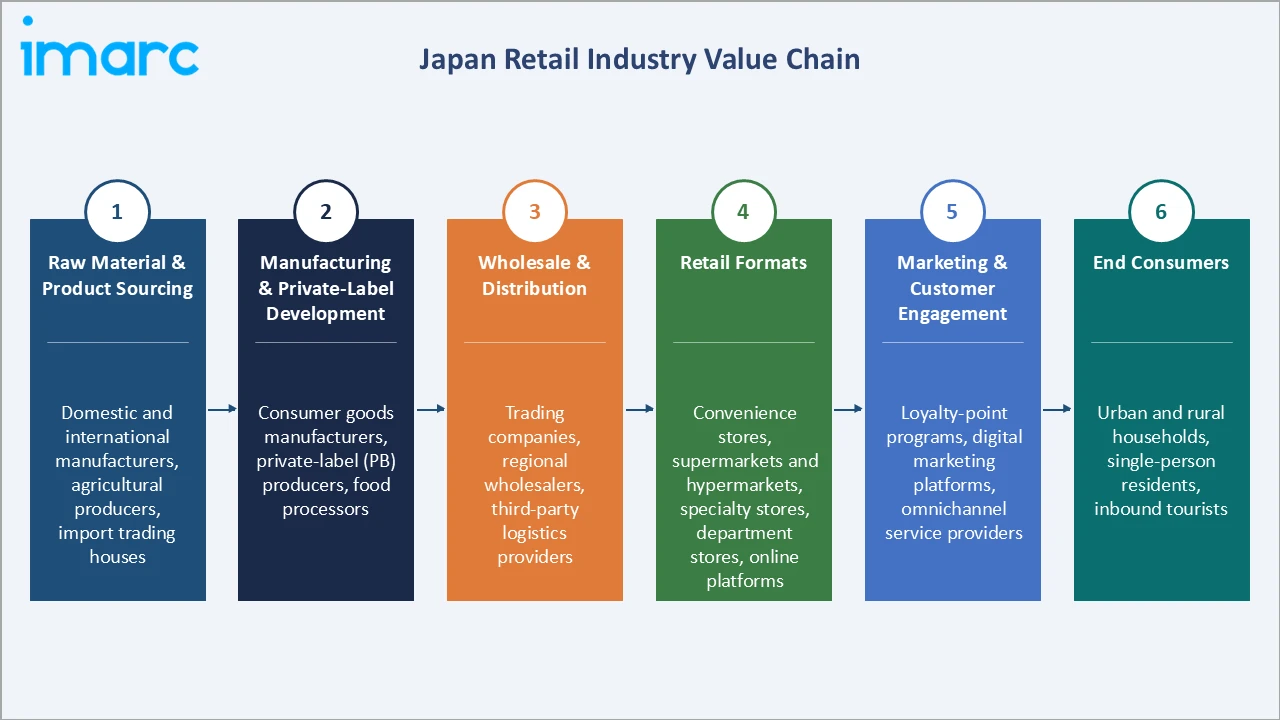
Japan's retail value chain integrates domestic and international product sourcing, manufacturing and private-label development, multi-tier wholesale distribution, and a dense network of retail formats serving households nationwide. General trading companies and regional wholesalers play an outsized role in Japan's distribution structure relative to many other developed retail markets.
|
Stage |
Key Participants |
|
Raw Material & Product Sourcing |
Domestic and international manufacturers, agricultural producers, import trading houses |
|
Manufacturing & Private-Label Development |
Consumer goods manufacturers, private-label (PB) producers, food processors |
|
Wholesale & Distribution |
Trading companies, regional wholesalers, third-party logistics providers |
|
Retail Formats |
Convenience stores, supermarkets and hypermarkets, specialty stores, department stores, online platforms |
|
Marketing & Customer Engagement |
Loyalty-point programs, digital marketing platforms, omnichannel service providers |
|
End Consumers |
Urban and rural households, single-person residents, inbound tourists |
Japan's multi-tier wholesale structure means many consumer goods pass through two to three distribution layers before reaching store shelves, a structure that supports reliable just-in-time replenishment but adds cost relative to more consolidated Western retail supply chains. Convenience-store chains in particular rely on highly coordinated distribution centers to enable multiple daily deliveries per store.
Technology Landscape in the Japan Retail Industry
E-Commerce and Omnichannel Technology
Japan's B2C e-commerce market reached JPY 26.1 trillion in 2024, up 5.1% year-on-year, though the e-commerce ratio remains a modest 9.8% of total commercial transactions, per METI. Retailers are integrating mobile apps, convenience-store pickup points, and unified loyalty ecosystems to bridge online and offline shopping.
Point-of-Sale and Payment Technology
Cashless payment adoption continues to expand across Japan's retail formats, with QR-code wallets and integrated mobile payment systems increasingly standard at convenience stores and supermarkets, reducing checkout friction and supporting faster transaction throughput during peak hours.
Supply Chain and Logistics Automation
Retailers are investing in automated distribution centers and demand-forecasting software to manage Japan's dense multi-daily delivery model, particularly across convenience-store networks that depend on precise, temperature-controlled replenishment cycles.
In-Store Digital Innovation
Self-checkout kiosks, electronic shelf labels, and AI-based inventory management are being piloted across supermarket and convenience-store chains to address Japan's persistent retail labor shortages while maintaining service-quality standards.
Market Segmentation Analysis
The report covers the following segments:
|
Segment Category |
Leading Segment |
Market Share |
Year |
|
Product |
Food and Beverages |
41.8% |
2025 |
|
Distribution Channel |
Convenience Stores |
31.6% |
2025 |
|
Region |
Kanto Region |
35.7% |
2025 |

By Product
Food and beverages lead Japan's retail product segmentation at a 41.8% share (2025), reflecting the country's daily fresh-food shopping culture and high convenience-store penetration. Personal and household care follows at 16.7%, supported by consistent replenishment demand, while apparel, footwear and accessories hold a 15.3% share, led by specialty and fast-fashion retailers such as UNIQLO.
To access detailed market analysis, Request Sample
Electronic and household appliances account for 11.8% share, concentrated among specialty electronics retailers, while furniture, toys and hobby holds 8.4%. Combined, these categories underscore Japan's diversified but food-and-essentials-anchored retail consumption pattern.
By Distribution Channel
Convenience stores lead Japan's distribution-channel segmentation at a 31.6% share (2025), reinforced by a network exceeding 56,054 stores nationwide and record sales of JPY 12.05 trillion in 2025. Supermarkets and hypermarkets follow closely at 28.4%, anchored by diversified operators such as Aeon Co., Ltd.
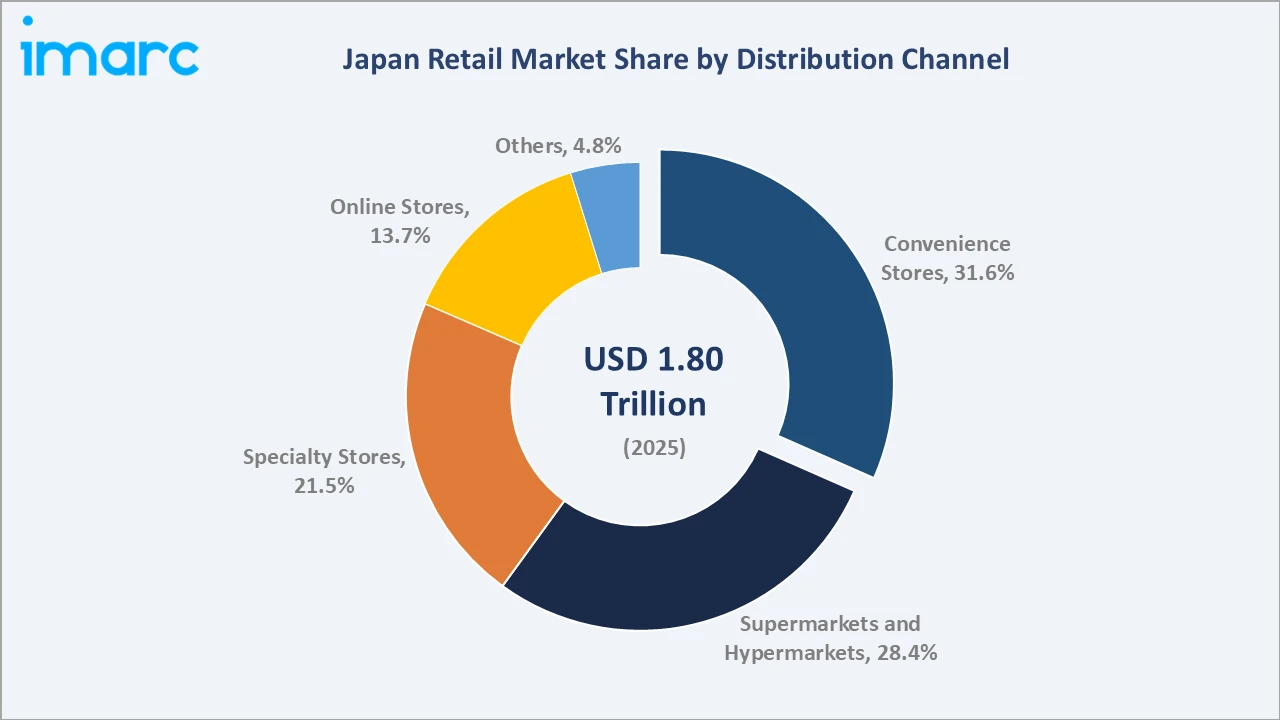
Specialty stores hold a 21.5% share, led by apparel, electronics, and drugstore chains, while online stores, at 13.7% share, represent the fastest-growing channel as e-commerce penetration gradually rises from Japan's still-low 9.8% EC ratio.
Regional Market Insights
Japan's retail demand is concentrated in its most densely populated regions, with the Kanto region alone accounting for over a third of national retail activity in 2025. Regional retail intensity closely tracks population density, urbanization, and proximity to Japan's primary logistics and e-commerce distribution hubs.
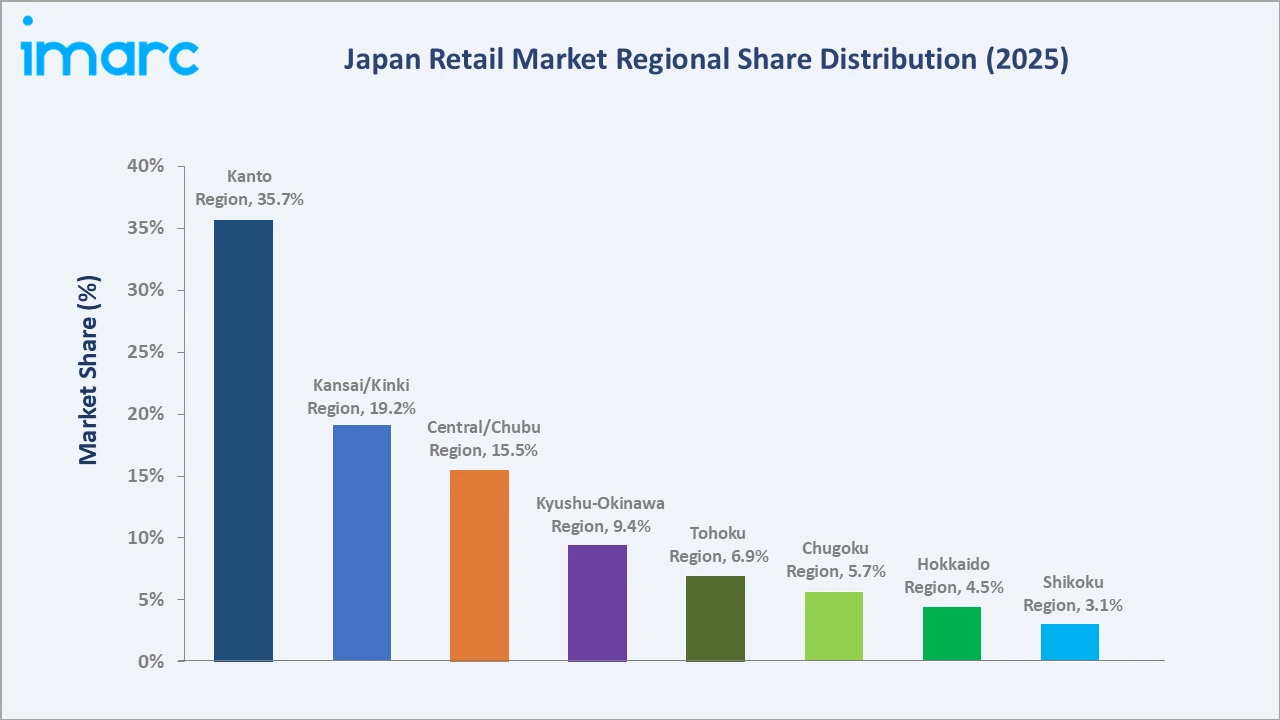
The Kanto region led national retail consumption at a 35.7% share in 2025, followed by the Kansai/Kinki region at 19.2% and the Central/Chubu region at 15.5%. Together, these three regions accounted for more than 70% of Japan's total retail market, reflecting the country's concentrated urban-industrial population distribution.
|
Region |
Market Share (2025) |
Retail Landscape Overview |
|
Kanto Region |
35.7% |
Dense urban retail hub anchored by Tokyo; concentration of flagship stores, e-commerce fulfilment centers, and premium retail formats |
|
Kansai/Kinki Region |
19.2% |
Diverse retail ecosystem centered on Osaka and Kyoto; blend of traditional shopping streets and modern retail complexes |
|
Central/Chubu Region |
15.5% |
Manufacturing-driven regional economy supporting suburban retail and roadside store formats |
|
Kyushu-Okinawa Region |
9.4% |
Growing inbound-tourism retail demand alongside agriculture-linked product distribution networks |
|
Tohoku Region |
6.9% |
Rural and semi-urban retail networks with strong convenience-store penetration |
|
Chugoku Region |
5.7% |
Mixed urban-rural retail base supported by regional supermarket chains |
|
Hokkaido Region |
4.5% |
Tourism and seasonal retail demand supported by strong local specialty-product distribution |
|
Shikoku Region |
3.1% |
Smaller regional retail footprint supported by community-based store formats |
Competitive Landscape
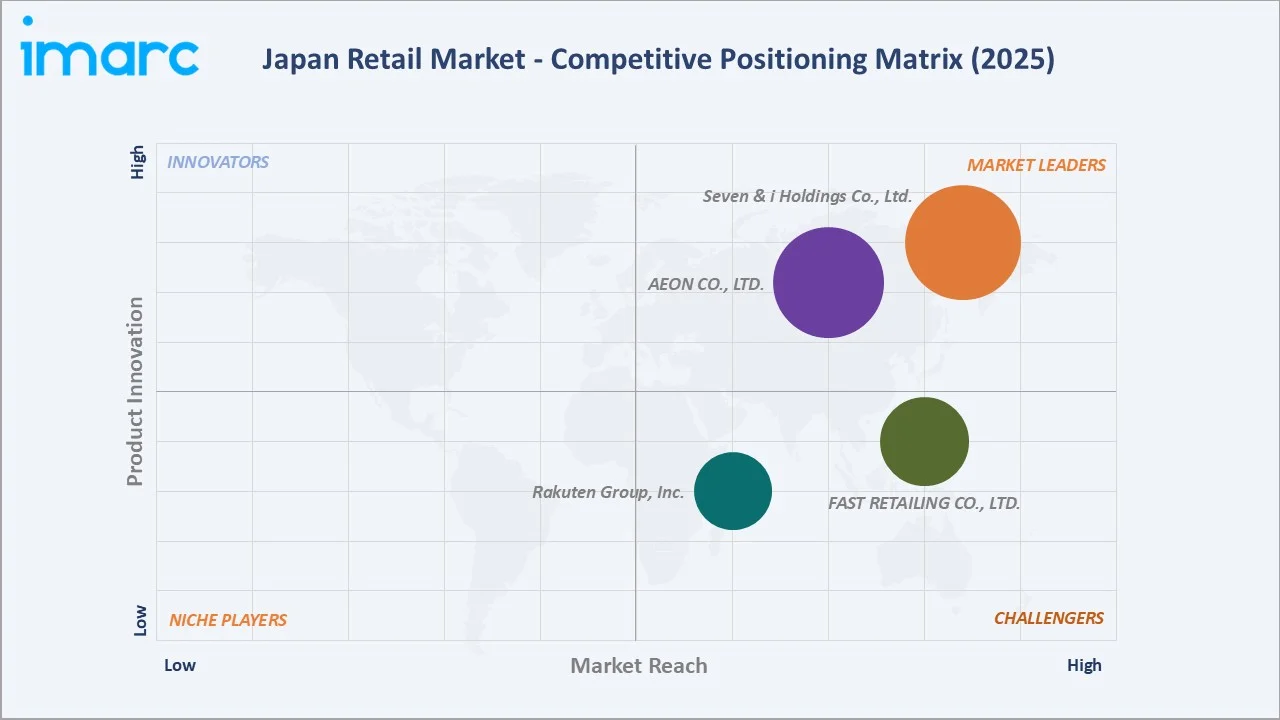
Japan's retail market is moderately consolidated at the large-format level, with key players commanding substantial convenience-store and supermarket share nationwide. Mid-tier convenience-store operators maintain significant but secondary positions within Japan's highly competitive convenience-retail landscape.
|
Company Name |
Brand / Product |
Market Position |
Core Strength |
|
Seven & i Holdings Co., Ltd. |
7-Eleven |
Leader |
Largest convenience-store network in Japan with high store density and daily-use product rotation |
|
AEON CO., LTD. |
Aeon, Ministop, Welcia, My Basket, among others |
Leader |
Diversified multi-format retail platform spanning supermarkets, drugstores, and shopping malls |
|
FAST RETAILING CO., LTD. |
UNIQLO, GU |
Challenger |
Vertically integrated specialty apparel retailing with strong private-label positioning |
|
Rakuten Group, Inc. |
Rakuten Market, Rakuten Books, Rakuten Kobo, Rakuten Fashion, Rakuten 24, among others |
Emerging |
Leading online retail marketplace anchored by an integrated loyalty-points ecosystem |
Convenience-store operators alone accounted for combined all-store sales exceeding JPY 12.05 trillion in 2025, illustrating the scale advantage of Japan's top-tier retail groups. Competitive intensity is increasingly shifting toward digital capability and omnichannel integration rather than pure store-count expansion.
Key Company Profiles
Seven & i Holdings Co., Ltd.
Seven & i Holdings Co., Ltd. is Japan's largest convenience-store-led retail group, operating the 7-Eleven brand domestically and internationally alongside supermarket and financial-services businesses.
- Product Portfolio: 7-Eleven convenience stores and in-house financial services.
- Recent Developments: In August 2025, Seven & i Holdings Co., Ltd. announced plans to add about 1,000 convenience stores in Japan by fiscal 2030, renovate more than 5,000 outlets, and strengthen food sales and delivery services.
- Strategic Focus: Sharpening focus on convenience-store operations and international 7-Eleven expansion following its 2025 corporate restructuring.
Aeon Co., Ltd.
Aeon Co., Ltd. is one of Japan's largest diversified retail groups, operating general merchandise stores, supermarkets, drugstores, and shopping malls across the country.
- Product Portfolio: Aeon supermarkets, My Basket compact supermarkets, Ministop convenience stores, and Welcia drugstores, among others.
- Recent Developments: In March 2026, AEON Co., Ltd. opened AEON Style Yamanouchi Komachi in Kyoto, focusing on fresh local produce, seafood, ready-to-eat meals, and regional specialty products. The compact supermarket also incorporates sustainability initiatives, including certified seafood, reduced packaging, recycling facilities, and locally designed WAON payment cards.
- Strategic Focus: Expanding compact urban store formats and digital transformation while integrating its health and wellness (drugstore) businesses.
Market Concentration Analysis
Japan's retail market exhibits moderate concentration at the large-format level, with key players anchoring a substantial share of convenience-store and supermarket retail nationwide. Consolidation trends continue across Japan's drugstore and health-retail segment, exemplified by Aeon's 2025 capital and business alliance integrating Tsuruha Holdings and Welcia Holdings to form one of Japan's largest drugstore operators. Independent regional supermarket chains face increasing pressure to consolidate or partner with larger groups to remain competitive.
Investment & Growth Opportunities
Fastest Growing Segments
Online stores (~4.6% CAGR) and compact urban supermarket formats represent Japan's fastest-growing retail investment segments through 2034, supported by rising e-commerce penetration from a still-low 9.8% EC ratio and shifting single-person household shopping patterns.
Emerging Market Opportunities
Inbound tourism-linked retail formats present a growing opportunity as international visitor arrivals reached 42.7 million in 2025, encouraging expanded tax-free shopping counters and transit-adjacent store formats across the Kanto and Kansai regions.
Investment Themes
- Compact-Format Supermarket Expansion: Chains repurposing vacant convenience-store sites for compact supermarket formats, such as Aeon's My Basket, are cutting initial investment costs roughly in half while capturing affordable, close-to-home shopping demand.
- Retail Automation and AI Integration: Investment in AI-driven demand forecasting, automated checkout, and shelf-replenishment systems offers a path to offset Japan's persistent retail labor shortages while preserving service-quality standards.
Future Market Outlook (2026-2034)
The Japan retail market is projected to grow from USD 1.80 Trillion in 2025 to USD 1.83 Trillion in 2026 and further to USD 2.02 Trillion by 2034, at a steady 1.29% CAGR reflecting Japan's mature, slow-growing but structurally stable consumption base. The market's USD 1.92 Trillion size in 2030 will mark continued, measured expansion driven by price-led growth, digital-retail adoption, and inbound-tourism spending rather than population-driven volume gains.
Three structural forces will anchor this growth through 2034: Japan's aging population sustaining daily-necessity and pharmacy-linked retail demand; gradual e-commerce penetration expanding from today's low base; and continued inbound-tourism recovery supporting retail spending in Japan's major urban and transit hubs.
Research Methodology
Primary Research
Primary research comprised structured interviews with retail industry stakeholders, including convenience-store and supermarket chain executives, e-commerce platform representatives, and retail distribution and logistics specialists across Japan's Kanto and Kansai regions.
Secondary Research
Secondary research encompassed Japan's Ministry of Economy, Trade and Industry (METI) e-commerce and commercial statistics surveys, Japan Franchise Association convenience-store statistics, Ministry of Internal Affairs and Communications (MIC) household and internet-usage surveys, and company annual reports and investor disclosures from major Japan-operating retail groups.
Forecasting Models
Market forecasts were developed using historical retail-spending trend extrapolation combined with population, e-commerce-penetration, and inbound-tourism-adjusted demand models, validated against METI commercial transaction statistics and Japan Franchise Association store-network data.
Japan Retail Market Report Coverage:
| Report Features | Details |
|---|---|
| Base Year of the Analysis | 2025 |
| Historical Period | 2020-2025 |
| Forecast Period | 2026-2034 |
| Units | Trillion USD |
| Scope of the Report | Exploration of Historical and Forecast Trends, Industry Catalysts and Challenges, Segment-Wise Historical and Predictive Market Assessment:
|
| Products Covered | Food and Beverages, Personal and Household Care, Apparel, Footwear and Accessories, Furniture, Toys and Hobby, Electronic and Household Appliances, Others |
| Distribution Channels Covered | Supermarkets and Hypermarkets, Convenience Stores, Specialty Stores, Online Stores, Others |
| Regions Covered | Kanto Region, Kansai/Kinki Region, Central/ Chubu Region, Kyushu-Okinawa Region, Tohoku Region, Chugoku Region, Hokkaido Region, Shikoku Region |
| Companies Covered | Seven & i Holdings Co., Ltd., AEON CO., LTD., FAST RETAILING CO., LTD., Rakuten Group, Inc., etc. |
| Customization Scope | 10% Free Customization |
| Post-Sale Analyst Support | 10-12 Weeks |
| Delivery Format | PDF and Excel through Email (We can also provide the editable version of the report in PPT/Word format on special request) |
Key Benefits for Stakeholders:
- IMARC’s industry report offers a comprehensive quantitative analysis of various market segments, historical and current market trends, market forecasts, and dynamics of the Japan retail market from 2020-2034.
- The research report provides the latest information on the market drivers, challenges, and opportunities in the Japan retail market.
- Porter's five forces analysis assist stakeholders in assessing the impact of new entrants, competitive rivalry, supplier power, buyer power, and the threat of substitution. It helps stakeholders to analyze the level of competition within the Japan retail industry and its attractiveness.
- Competitive landscape allows stakeholders to understand their competitive environment and provides an insight into the current positions of key players in the market.
Frequently Asked Questions About the Japan Retail Market Report
The Japan retail market size is estimated at USD 1.83 Trillion in 2026, covering convenience stores, supermarkets, specialty outlets, and online retail channels serving Japan's approximately 123 million residents.
The Japan retail market is projected to grow at a CAGR of 1.29% during 2026-2034, reaching USD 2.02 Trillion by 2034, driven by digital retail adoption, inbound tourism spending, and steady per-capita consumption growth.
Food and beverages lead at 41.8% share (2025), reflecting Japan's daily fresh-food shopping culture and extensive convenience-store network.
Convenience stores hold the largest share at 31.6% (2025), supported by a network exceeding 56,054 stores nationwide as of 2025.
Online stores are projected to grow fastest at an estimated ~4.6% CAGR (2026-2034), driven by rising e-commerce penetration from Japan's still-low 9.8% EC ratio.
The Kanto region leads at 35.7% share (2025), anchored by Tokyo's status as Japan's largest consumer and logistics hub.
Leading companies include Seven & i Holdings Co., Ltd., AEON CO., LTD., FAST RETAILING CO., LTD., and Rakuten Group, Inc., among others.
Japan's convenience-store network exceeded 56,054 outlets in 2025, generating record all-store sales of approximately JPY 12.05 trillion, per Japan Franchise Association data.
Need more help?
- Speak to our experienced analysts for insights on the current market scenarios.
- Include additional segments and countries to customize the report as per your requirement.
- Gain an unparalleled competitive advantage in your domain by understanding how to utilize the report and positively impacting your operations and revenue.
- For further assistance, please connect with our analysts.
 Request Customization
 Speak to an Analyst
 Request Brochure
 Inquire Before Buying
Benefits of Customization
- Personalize this research
- Triangulate with your data
- Get data as per your format and definition
- Gain a deeper dive into a specific application, geography, customer, or competitor
- Any level of personalization
Get in Touch With Us
UNITED STATES
Phone: +1-201-971-6302
INDIA
Phone: +91-120-433-0800
UNITED KINGDOM
Phone: +44-753-714-6104
Email: [email protected]
Client Testimonials




.webp)




.webp)













Related Reports

Choose your plan
*Please note that the prices mentioned below are starting prices for each bundle type. Kindly contact our team for further details.*
Single User License
- 1 User License, Access on 2 Devices
- PDF Report + Excel Dataset (Password Protected)
- Lifetime Access
- No Printing Rights
- 10% Free Report Customization
- 10–12 Weeks of Analyst Support
Five User License
- Access for 5 Users, 2 Devices per User
- PDF Report + Excel Dataset (Password Protected)
- Lifetime Access
- Dedicated Account Manager
- 12–14 Weeks of Analyst Support
- No Printing Rights
- 15% Free Report Customization
- 25% Discount on Your Next Purchase
Corporate User License
- Unlimited User Access (Within Your Organization)
- PDF Report + Excel Dataset
- Lifetime Access
- Dedicated Account Manager
- 14–20 Weeks of Analyst Support
- No Printing Rights
- 20% Free Report Customization
- 30% Discount on Your Next Purchase
Essential Insights
What's included:
3 reports
- Lifetime Access
- PDF Reports
- Excel Datasets
- 2 Weeks of Free Analyst Support
- 2 User Licenses
- Access on 2 Devices
- Printing Rights
- Complimentary PowerPoint (PPT) Version
- Complimentary License Upgrade
Professional Access
What's included:
5 reports
- Lifetime Access
- PDF Reports
- Excel Datasets
- 8 Weeks of Free Analyst Support
- 2 User Licenses
- Access on 2 Devices
- Printing Rights
- Complimentary PowerPoint (PPT) Version
- Complimentary License Upgrade
Business Advantage
What's included:
8 reports
- Lifetime Access
- PDF Reports
- Excel Datasets
- 14 Weeks of Free Analyst Support
- 2 User Licenses
- Access on 2 Devices
- Printing Rights
- Complimentary PowerPoint (PPT) Version
- Complimentary License Upgrade
Enterprise Intelligence
What's included:
10 reports
- Lifetime Access
- PDF Reports
- Excel Datasets
- 20 Weeks of Free Analyst Support
- 2 User Licenses
- Access on 2 Devices
- Printing Rights
- Complimentary PowerPoint (PPT) Version
- Complimentary License Upgrade