
Saudi Arabia Food Processing Machinery Market Size, Share, Trends and Forecast by Type, Application, and Region, 2026-2034
Saudi Arabia Food Processing Machinery Market Size, Share, Trends & Forecast (2026-2034)
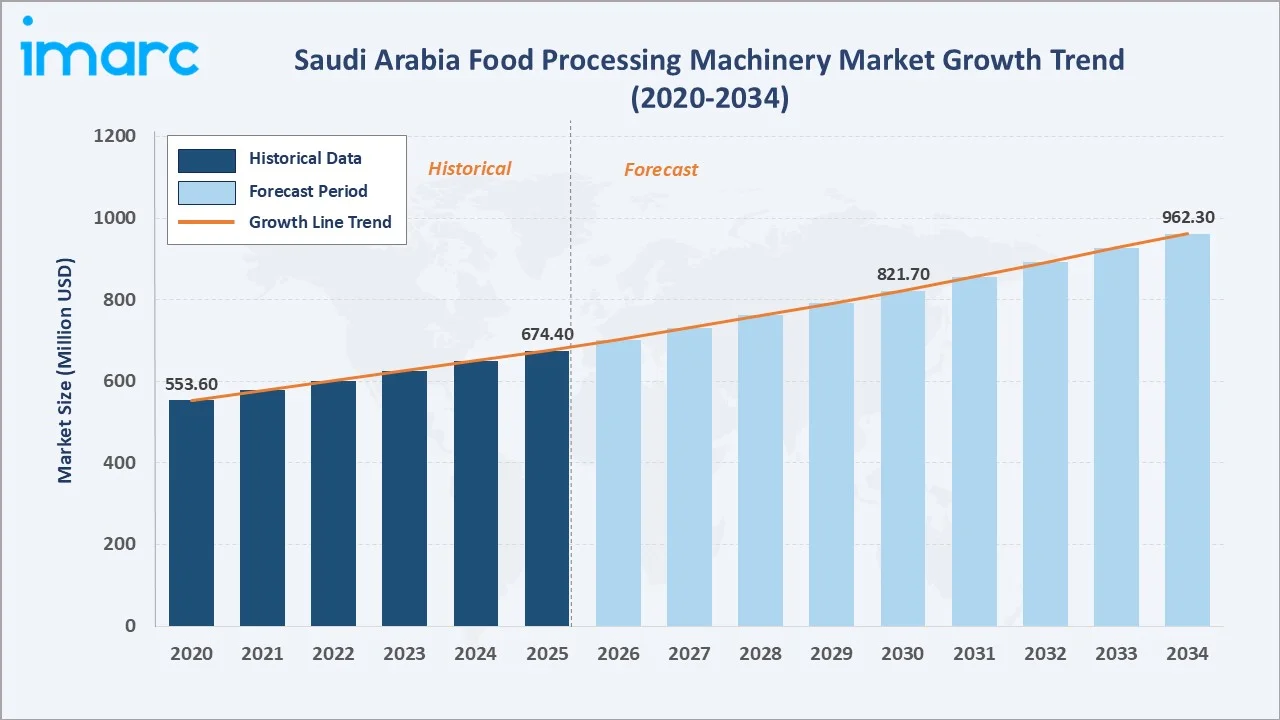
The Saudi Arabia food processing machinery market grew from USD 674.4 Million in 2025 to USD 701.6 Million in 2026 and is projected to reach USD 962.3 Million by 2034, growing at a CAGR of 4.03% during 2026-2034. The market is driven by expanding food processing investments under Vision 2030, growing food security initiatives, rising demand for processed food products, and increasing FDI in food manufacturing facilities across the Kingdom.
Vision 2030 localization goals, Saudi Food and Drug Authority (SFDA) standards compliance, and increasing demand for dairy, bakery, and meat processing lines are further supporting market growth. Processing Machinery and Equipment leads at 50.4%. Dairy and Dairy Alternatives dominates applications at 22.5%. Northern and Central Region commands 43.6% of the national market share.
Market Snapshot
|
Metric |
Value |
|
Base Year Market Size (2025) |
USD 674.4 Million |
|
Market Size (2026) |
USD 701.6 Million |
|
Forecast Market Size (2034) |
USD 962.3 Million |
|
CAGR (2026-2034) |
4.03% |
|
Base Year |
2025 |
|
Historical Period |
2020-2025 |
|
Forecast Period |
2026-2034 |
|
Dominant Type |
Processing Machinery and Equipment (50.4%, 2025) |
|
Dominant Application |
Dairy and Dairy Alternatives (22.5%, 2025) |
|
Leading Region |
Northern and Central Region (43.6%, 2025) |
The Saudi Arabia food processing machinery market size increased from USD 674.4 Million in 2025 to USD 701.6 Million in 2026 and is estimated to reach USD 821.7 Million by 2030. The market is forecast to grow to USD 962.3 Million by 2034 at a CAGR of 4.03%, supported by Vision 2030 industrial strategies and expanding food manufacturing infrastructure.
To get more information on this market, Request Sample
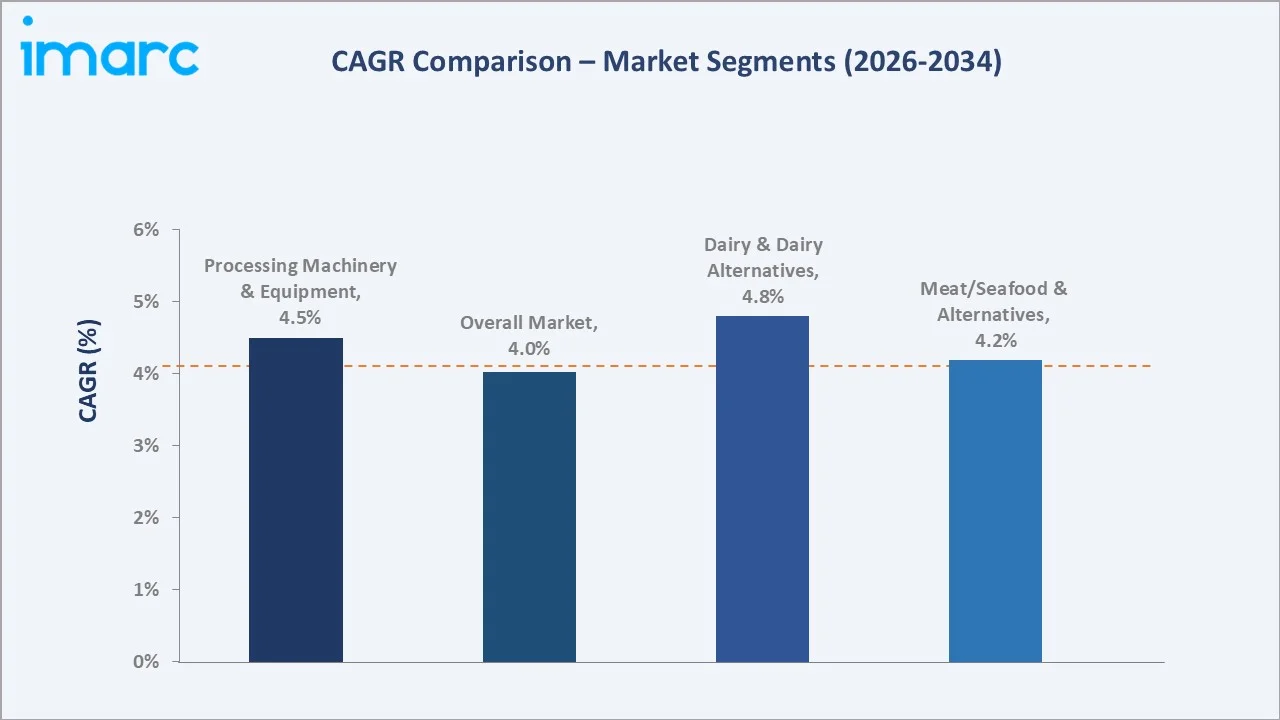
The processing machinery and equipment segment grows fastest at ~4.5% CAGR through Vision 2030 food localization mandates, SFDA compliance investments in dairy and meat processing, and automation upgrades by Saudi food manufacturers scaling production for regional export.
Executive Summary
The Saudi Arabia food processing machinery market expanded from USD 674.4 Million in 2025 to an estimated USD 701.6 Million in 2026, positioning it as the fastest-growing food equipment market in the GCC region. The market's scale is underpinned by Saudi Arabia's Vision 2030 food security strategy, SFDA food safety compliance investments, and a rapidly expanding food manufacturing sector targeting domestic production self-sufficiency.
These structural demand drivers are supporting the expansion of dairy and meat processing machinery at rates that outpace Saudi Arabia's overall industrial growth. Saudi Arabia food processing machinery market is commercially distinguished from other GCC markets by its extraordinary scale of investment in domestic food production capacity. The market is projected to reach USD 962.3 Million by 2034. Processing Machinery and Equipment at 50.4% leads through comprehensive commercial capability, Packaging Machinery and Equipment at 36.2%, and utilities at 13.4%.
Key Market Insights
|
Insight |
Data |
|
Dominant Type |
Processing Machinery and Equipment - 50.4% share (2025) |
|
Dominant Application |
Dairy and Dairy Alternatives - 22.5% market share (2025) |
|
Leading Region |
Northern and Central Region - 43.6% share (2025) |
|
Market Opportunity |
Halal food processing machinery; smart factory automation; Jizan Economic City agro-industrial zone machinery demand |
Key Analytical Observations Supporting the Above Data:
- Processing Machinery and Equipment at 50.4%: The processing machinery and equipment segment dominates due to Saudi Arabia's heavy investment in food processing facilities, including dairy, meat, and bakery lines, driven by Vision 2030 food security and localization mandates.
- Dairy and Dairy Alternatives at 22.5%: Dairy leads applications through government-backed expansion of domestic dairy production, Al Marai and NADEC capacity investments, and Saudi Arabia's food self-sufficiency targets for dairy products.
- Northern and Central Region at 43.6%: Northern and Central Region leads regionally through Riyadh's industrial zone concentration, SFDA headquarters proximity, and cluster of major food manufacturers and cold-chain logistics infrastructure.
Saudi Arabia Food Processing Machinery Market Overview
Saudi Arabia food processing machinery market is commercially positioned at a strategic intersection: the Arab world's largest consumer market with a Vision 2030-backed industrial transformation targeting food security and domestic production self-sufficiency. The Kingdom's food processing sector is undergoing rapid modernization, with processing machinery investments driven by government mandates for food localization and manufacturing capacity building.
Saudi Arabia food processing ecosystem integrates international machinery OEMs, regional distributors, Saudi food manufacturers, SFDA regulatory compliance investments, and growing automation adoption. Processing efficiency, SFDA food safety compliance, and operational cost reduction are the primary commercial drivers for machinery procurement decisions by Saudi food processors. Macroeconomic factors include Vision 2030 industrial diversification, FDI inflows, and a large working-age population creating strong domestic food consumption demand.
Market Dynamics
To evaluate market opportunities, Request Sample
Market Drivers
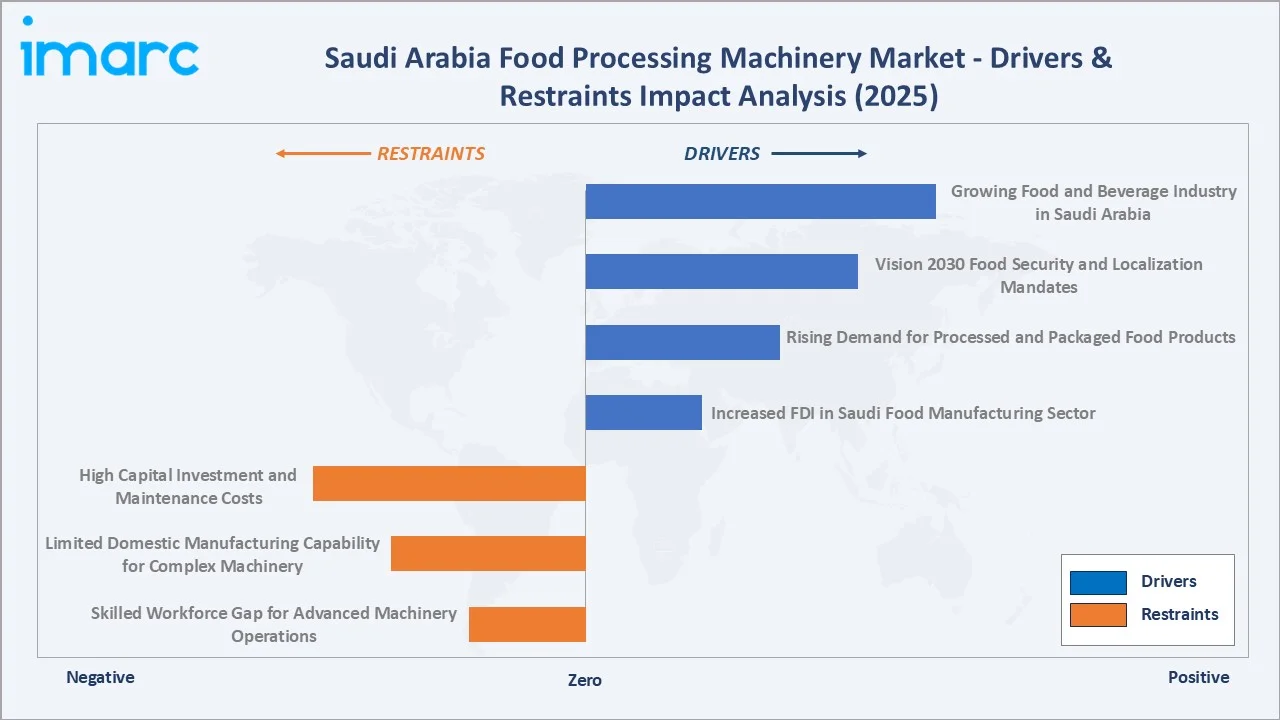
- Growing Food and Beverage Industry in Saudi Arabia: Saudi Arabia's food processing sector is expanding driven by rising population, urbanization, and Vision 2030 industrial diversification goals. Domestic food manufacturers are scaling capacity, requiring advanced processing and packaging machinery investments across dairy, poultry, bakery, and beverage processing categories. Saudi Arabia's GDP growth and expanding working-age population are driving sustained food manufacturing capacity expansion. The Kingdom's food import bill reduction target under Vision 2030 is directly accelerating domestic food processing plant investment.
- Vision 2030 Food Security and Localization Mandates: Vision 2030 mandates 40% food localization by 2030, directly driving machinery procurement by Saudi food manufacturers expanding dairy, poultry, grain, and bakery processing capacity to reduce import dependence. The Saudi Food and Drug Authority's food safety compliance framework is creating systematic machinery upgrade demand across all established food processing categories. Government investment through Saudi Industrial Development Fund (SIDF) financing is making capital-intensive machinery investments accessible for Saudi food manufacturers.
- Rising Demand for Processed and Packaged Food Products: Consumer preference for packaged, convenience, and ready-to-eat food products is accelerating food processing machinery demand. Saudi processors require high-speed filling, sealing, packaging, and sterilization equipment to meet modern retail shelf standards and extended shelf-life requirements. Saudi Arabia's modern retail expansion, including hypermarkets and convenience stores, is creating sustained demand for packaged food products that drive processing and packaging machinery investment.
- Increased FDI in Saudi Food Manufacturing Sector: Foreign direct investment in Saudi food manufacturing is increasing as Vision 2030's investment liberalization and industrial zone incentives attract global food companies to establish local production facilities. FDI inflows are driving greenfield food processing plant investments requiring comprehensive machinery procurement from international OEMs across all food processing categories.
Market Restraints
- High Capital Investment and Machinery Maintenance Costs: Advanced food processing machinery requires significant capital expenditure and skilled maintenance personnel. High machinery costs and long payback periods create adoption barriers for small and medium Saudi food processors. Imported machinery requires specialized spare parts and technical expertise that increases total cost of ownership and limits the speed of machinery upgrade cycles in the Saudi food processing sector.
- Limited Domestic Manufacturing Capability for Complex Machinery: Saudi Arabia has limited domestic production capability for complex food processing machinery, creating dependency on European, Japanese, and Chinese machinery imports. Import dependency creates supply chain risk, long procurement lead times, and foreign currency exposure that increases machinery procurement cost and complexity for Saudi food manufacturers.
- Skilled Workforce Gap for Advanced Machinery Operations: Operating advanced food processing machinery requires technically trained workforce. Saudi Arabia faces shortage of skilled machinery operators and maintenance engineers in its food manufacturing sector, increasing reliance on expatriate technical staff and adding operational cost and workforce management complexity.
Market Opportunities
- Halal Food Processing Equipment Demand: Saudi Arabia's role as global halal food hub creates specialized machinery demand for halal-certified processing lines. International machinery OEMs developing dedicated halal processing line solutions find strong commercial opportunity in Saudi and GCC export-oriented food processing sector.
- Smart Factory and Industry 4.0 Integration: Saudi food processors are adopting IoT, AI, and automation technologies to improve operational efficiency and reduce labor dependency. Smart food processing machinery represents the highest-growth technology investment in Saudi food manufacturing sector under Vision 2030 productivity mandates.
Market Challenges
- SFDA Compliance and Regulatory Complexity: Saudi Food and Drug Authority regulations impose stringent food safety and equipment standards compliance requirements. Navigating SFDA approval processes and ensuring machinery meets food-grade standards increases cost and timeline for new facility commissioning and machinery upgrade projects.
- Energy Cost Management for High-Capacity Processing Operations: High-capacity food processing machinery is energy-intensive. Vision 2030 sustainability goals create pressure on food processors to invest in energy-efficient machinery retrofits, adding capital expenditure complexity to equipment selection and procurement decisions.
Emerging Market Trends
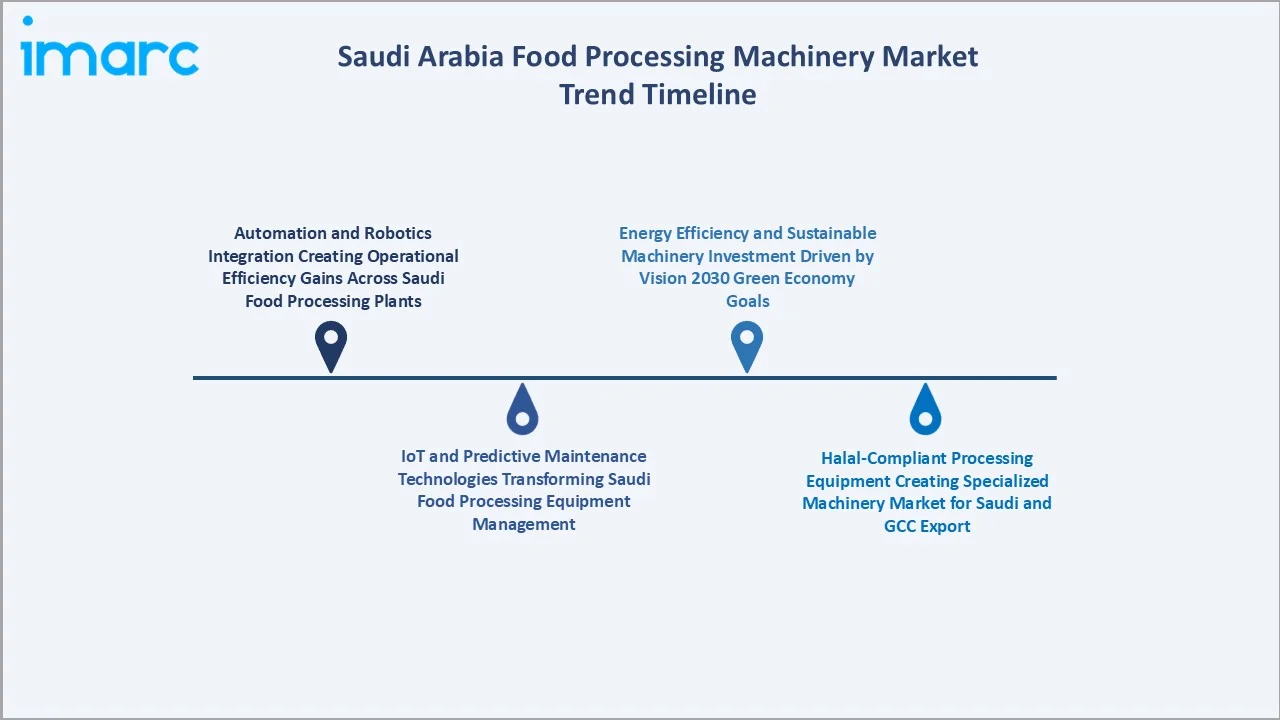
1. Automation and Robotics Integration Creating Operational Efficiency Gains Across Saudi Food Processing Plants
Automation and robotics adoption in Saudi food processing plants is accelerating, driven by labor cost pressures and Vision 2030 productivity mandates. Food processors are investing in robotic pick-and-place, automated filling lines, and AI-driven quality inspection systems to reduce manual labor dependency and improve production throughput. These advanced manufacturing technologies are enabling Saudi food manufacturers to achieve world-class production efficiency standards while reducing workforce management complexity in a market where technical labor remains a strategic constraint.
2. IoT and Predictive Maintenance Technologies Transforming Saudi Food Processing Equipment Management
IoT-enabled food processing machinery is enabling Saudi food manufacturers to implement predictive maintenance programs, reducing unplanned downtime and extending equipment life cycles. Real-time monitoring of machinery performance, energy consumption, and production metrics is becoming standard in new food processing facility designs across the Kingdom's expanding dairy, meat, and bakery processing sectors.
3. Halal-Compliant Processing Equipment Creating Specialized Machinery Market for Saudi and GCC Export
Saudi Arabia's positioning as global halal food export hub is driving specialized demand for halal-certified processing machinery. Machinery OEMs offering dedicated halal processing line solutions, with cross-contamination prevention, hygiene-grade materials, and halal compliance documentation, command premium pricing in the Saudi market and throughout the GCC food manufacturing sector.
4. Energy Efficiency and Sustainable Machinery Investment Driven by Vision 2030 Green Economy Goals
Vision 2030 sustainability targets are driving Saudi food processors to invest in energy-efficient processing machinery. High-efficiency motors, heat recovery systems, and water-recycling processing equipment are gaining market traction as Saudi manufacturers balance productivity with environmental and cost optimization targets aligned with the Kingdom's national sustainability framework.
Industry Value Chain Analysis
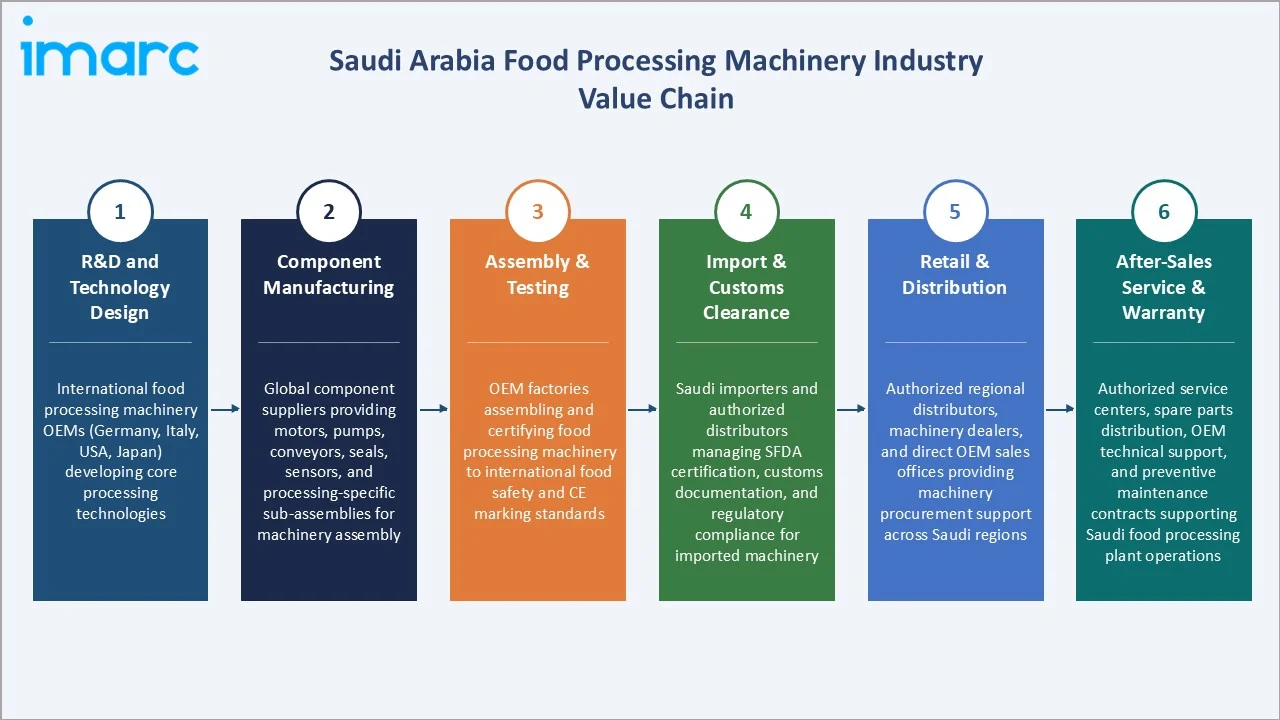
Saudi Arabia food processing machinery value chain is one of the most import-intensive industrial supply chains in the Kingdom. The value chain's commercial structure reflects Saudi Arabia's strategic dependency on international machinery OEMs for advanced food processing technology, while domestic value-add is concentrated in distribution, installation, and after-sales service segments.
|
Stage |
Key Participants |
|
R&D and Technology Design |
International food processing machinery OEMs (Germany, Italy, USA, Japan) developing core processing technologies and innovations |
|
Component Manufacturing |
Global component suppliers providing motors, pumps, conveyors, seals, sensors, and processing-specific sub-assemblies for machinery assembly |
|
Assembly & Testing |
OEM factories assembling and certifying food processing machinery to international food safety and CE marking standards |
|
Import & Customs Clearance |
Saudi importers and authorized distributors managing SFDA certification, customs documentation, and regulatory compliance for imported machinery |
|
Retail & Distribution |
Authorized regional distributors, machinery dealers, and direct OEM sales offices providing machinery procurement support across Saudi regions |
|
After-Sales Service & Warranty |
Authorized service centers, spare parts distribution, OEM technical support, and preventive maintenance contracts supporting Saudi food processing plant operations |
The import and customs clearance stage is Saudi Arabia's food processing machinery value chain's most commercially consequential regulatory stage, where Saudi importers spending on SFDA registration, certification, and compliance support add 8-15% to total machinery procurement cost. This cost structure creates strategic commercial advantage for machinery OEMs with established SFDA-registered Saudi distributors versus new market entrants requiring full regulatory setup investment.
Technology Landscape in the Saudi Arabia Food Processing Machinery Industry
Conventional and Semi-Automated Processing Technologies
Conventional and semi-automated food processing machinery provides the operational foundation of Saudi Arabia's mid-tier food processing sector. These technologies serve bakery, dairy, and beverage processors requiring reliable, cost-effective processing lines with moderate throughput capacity. Quartz-based control systems and hydraulic processing equipment maintain strong commercial demand across Saudi Arabia's expanding base of small and medium food manufacturers.
Advanced Automation and Smart Processing Systems
Advanced automation and smart processing systems are gaining commercial traction in Saudi Arabia's large-scale food manufacturing plants. These technologies integrate programmable logic controllers (PLCs), human-machine interfaces (HMIs), and SCADA systems to enable high-throughput, precision-controlled food processing operations that align with Saudi food manufacturers' Vision 2030 productivity and quality improvement objectives.
Hygiene and Food Safety Technology
Hygiene and food safety technology is a primary procurement criterion for Saudi food processing machinery buyers, driven by SFDA food safety regulations and halal processing compliance requirements. CIP (clean-in-place) systems, sanitary design standards, allergen control technologies, and digital traceability systems are core features in machinery selection for Saudi food manufacturers committed to SFDA compliance and export market qualification.
Market Segmentation Analysis
The report covers the following segments:
|
Segment Category |
Leading Segment |
Market Share |
Year |
|
Type |
Processing Machinery and Equipment |
50.4% |
2025 |
|
Application |
Dairy and Dairy Alternatives |
22.5% |
2025 |
|
Region |
Northern and Central Region |
43.6% |
2025 |

By Type
Processing Machinery and Equipment leads at 50.4% (2025). The processing machinery and equipment segment encompasses Saudi Arabia's most commercially diverse food processing investment, from dairy pasteurization and meat cutting lines, to bakery mixing and baking systems, beverage processing, and fruit and vegetable washing and sorting equipment. This segment's commercial leadership reflects Saudi Arabia's heavy investment in expanding domestic food production capacity across all major food categories under Vision 2030 food security mandates.
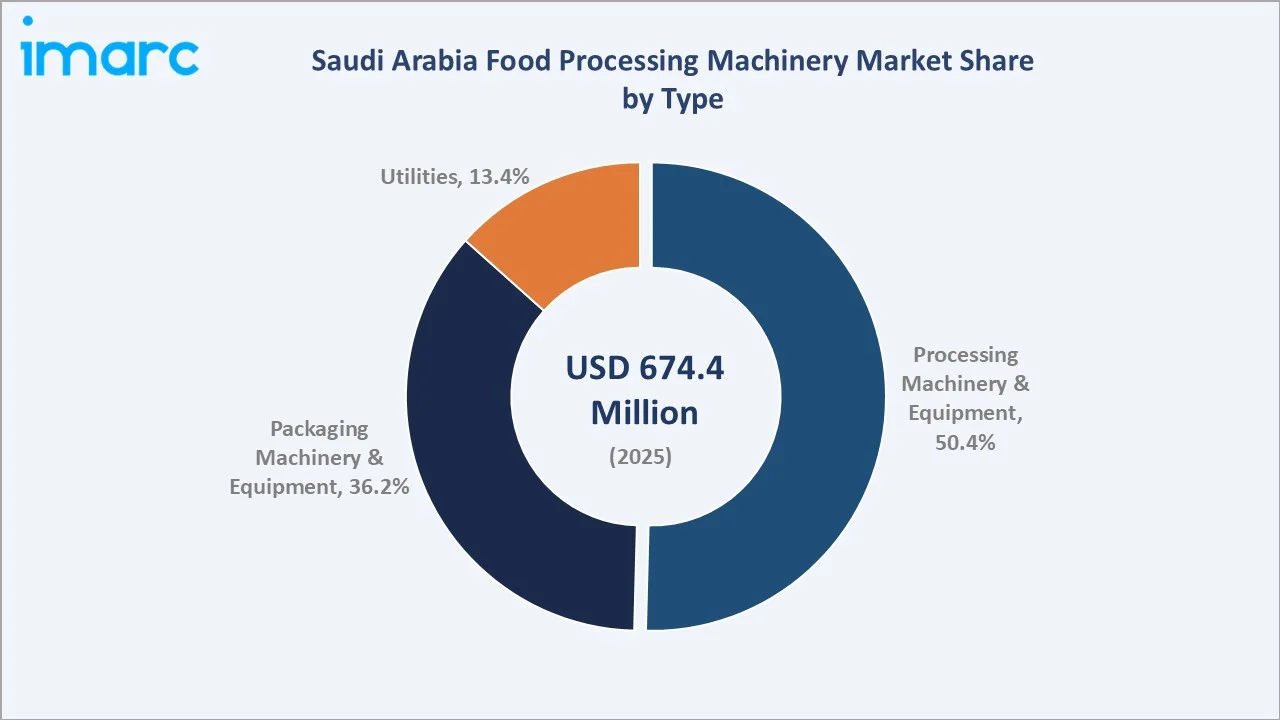
Packaging Machinery and Equipment at 36.2% is growing at ~3.8% CAGR through Saudi food retailers' modern trade shelf standard requirements, increasing export-oriented food production, and rising demand for extended shelf-life packaging solutions across Saudi dairy, bakery, and beverage manufacturers.
By Application
Dairy and Dairy Alternatives leads at 22.5% (2025). This segment serves Saudi Arabia's largest domestic food processing sub-sector, driven by Al Marai, Saudi Dairy & Foodstuff Company, and NADEC investments in expanding dairy processing capacity for Vision 2030 self-sufficiency targets. The dairy processing machinery segment encompasses pasteurization systems, homogenizers, separation equipment, and filling lines that form the core capital infrastructure of Saudi Arabia's dairy manufacturing sector.
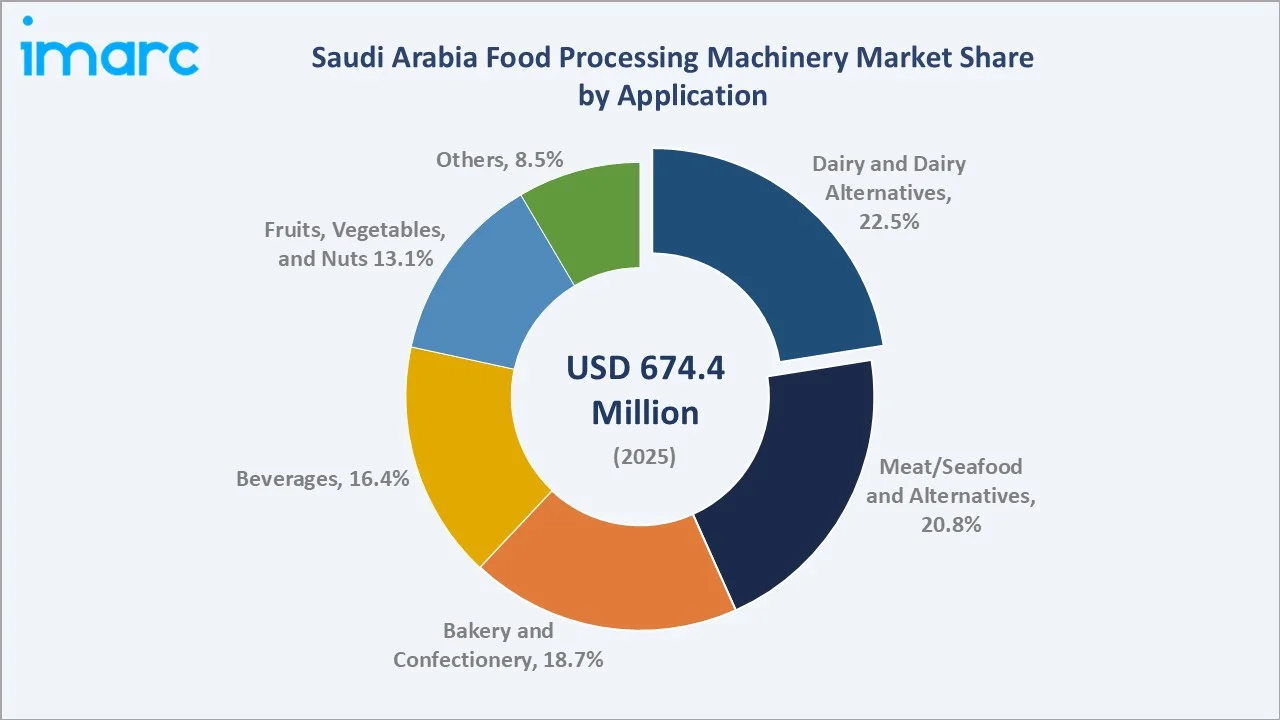
Meat/Seafood and Meat/Seafood Alternatives at 20.8% is growing through Saudi poultry processor expansion, halal meat processing investments, and increasing seafood processing capacity for Red Sea fisheries development aligned with Vision 2030 blue economy goals.
Regional Market Insights
|
Region |
Share (2025) |
Key Saudi Food Processing Machinery Market Drivers & Characteristics |
|
Northern and Central Region |
43.6% |
Driven by Riyadh industrial zone concentration, SFDA headquarters proximity, and cluster of Saudi Arabia's largest food manufacturers including dairy, bakery, and beverage processors |
|
Western Region |
25.4% |
Supporting widespread food import gateway operations, Jeddah food manufacturing cluster, and Makkah-Madinah pilgrim food supply chain processing infrastructure |
|
Eastern Region |
21.1% |
Reflects Dammam's industrial diversification, petrochemical sector employee population driving food consumption, and growing seafood processing investments along Eastern coastline |
|
Southern Region |
9.9% |
Rising food processing investment in Jizan Economic City, agricultural processing machinery for Asir region fruit and vegetable production, and Vision 2030 southern economic development programs |
Northern and Central Region's 43.6% market leadership reflects Riyadh's concentration of Saudi Arabia's largest food manufacturers, proximity to SFDA regulatory headquarters, and Riyadh industrial zone infrastructure that supports food processing machinery installation, commissioning, and maintenance service networks.
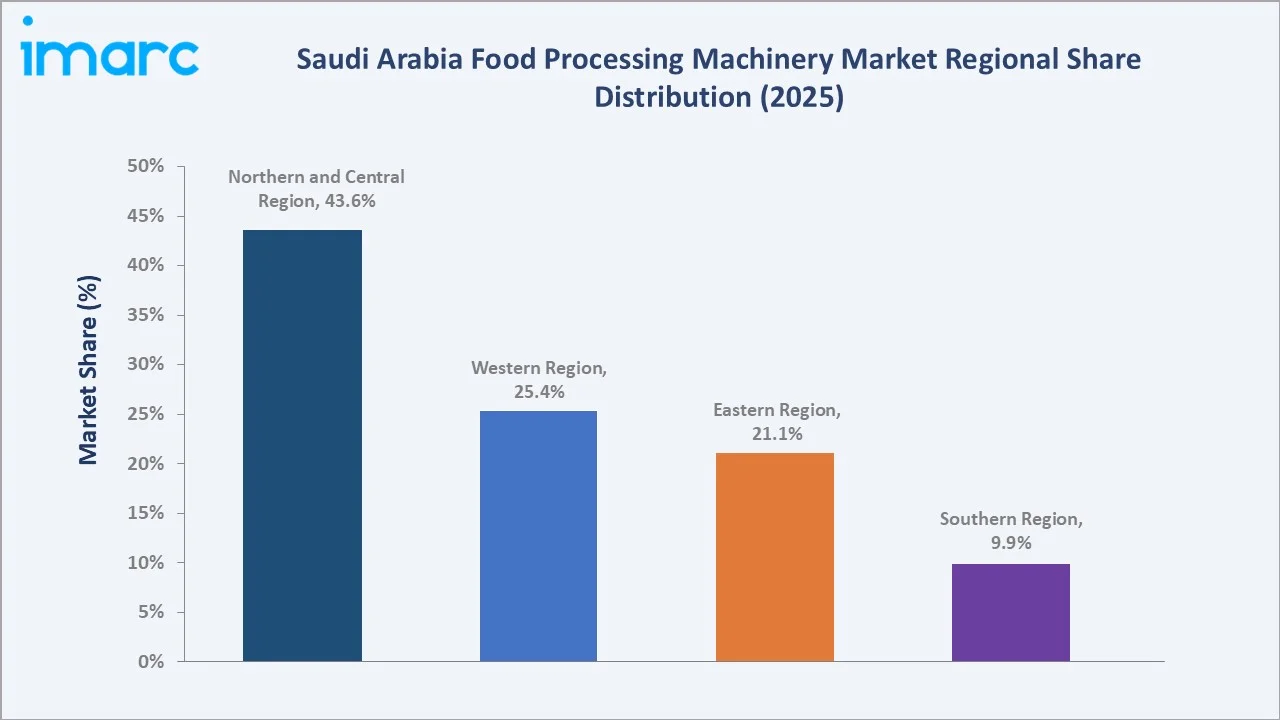
Western Region's 25.4% reflects Jeddah's role as Saudi Arabia's primary food import gateway, creating strong demand for food processing and packaging machinery. Eastern Region's 21.1% is driven by Dammam's industrial diversification and growing seafood processing. Southern Region's 9.9% is the most commercially underdeveloped, but growing above the overall market CAGR as Jizan Economic City food processing zone development creates structured machinery investment demand from a comparatively lower industrial penetration base.
Competitive Landscape
Saudi Arabia food processing machinery competitive landscape is commercially stratified between global OEM leaders, European machinery specialists, and regional distributors. The most commercially significant dynamic is the authorized distributor network structure, where international OEMs operate primarily through appointed Saudi agents who provide sales, installation, and after-sales support across the Kingdom's food manufacturing regions.
|
Company |
Key Brands |
Market Position |
Core Strength |
|
GEA Group Aktiengesellschaft |
Food Preparation Equipment |
Market Leader |
GEA Group holds leading position in Saudi Arabia's dairy and beverage processing machinery market through comprehensive processing solutions and established Saudi distributor network |
|
Alfa Laval AB |
Food processing Equipment |
Strong Challenger |
Alfa Laval serves dairy, beverage, and food processing segments with highly specified heat exchange and fluid processing technologies aligned with SFDA hygiene standards |
|
Tetra Pak International S.A. |
Dairy equipment, Cheese equipment, Food equipment |
Market Leader |
Tetra Pak commands the liquid food packaging machinery segment in Saudi Arabia through strong relationships with Al Marai, NADEC, and major Saudi dairy and juice processors |
|
JBT Corporation |
Stein TFF THERMoFIN® Conveyorized Thermal Fluid Immersion Fryer |
Strong Challenger |
JBT Corporation serves Saudi poultry and protein processing segments with specialized processing line solutions aligned with halal processing compliance requirements |
The competitive landscape's most commercially significant dynamic is increasing OEM direct presence in Saudi Arabia, with machinery manufacturers establishing regional offices to support Vision 2030 food industry expansion and respond to growing SFDA compliance technical support requirements from Saudi food manufacturers scaling production capacity.
Key Company Profiles
GEA Group Aktiengesellschaft
GEA Group Aktiengesellschaft is one of the world's largest suppliers of food processing technology, with strong commercial presence in Saudi Arabia's dairy, beverage, and meat processing machinery market. GEA serves Saudi Arabia through a comprehensive portfolio of processing, separation, and thermal treatment solutions aligned with SFDA food safety standards.
- Key Brands: Centrifuges, heat exchangers, evaporators, homogenizers, spray dryers, filling and packaging systems for dairy, beverage, and meat processing applications.
- Recent Developments: In 2026, GEA launched the PowerPak 5000 thermoformer for medium-sized food producers. The machine supports multiple pack sizes, scalable automation and medium-to-high production volumes. GEA demonstrated it as part of a One-Line Concept combining slicing, loading, thermoforming and labeling equipment, with line output of up to 600 kg/h.
- Strategic Focus: Strengthening market position in Saudi Arabia's dairy and beverage processing segments through complete processing line solutions, energy efficiency differentiation, and Vision 2030-aligned localization partnerships with Saudi industrial investors.
Tetra Pak International S.A.
Tetra Pak International S.A. is the dominant supplier of aseptic processing and packaging machinery in Saudi Arabia's liquid food segment, holding established commercial relationships with Al Marai, NADEC, and major Saudi dairy and juice processors. Tetra Pak serves the Saudi market through a comprehensive product portfolio and strong regional technical support infrastructure.
- Key Brands: Aseptic processing systems, filling machines, Tetra Pak packaging lines, dairy pasteurization and UHT processing equipment, beverage processing machinery.
- Strategic Focus: Maintaining leadership in Saudi Arabia's liquid food processing and packaging segment through integrated processing-packaging line solutions, sustainability technology leadership, and strong after-sales service partnerships.
Market Concentration Analysis
Saudi Arabia food processing machinery market is moderately concentrated, with global leaders GEA Group, Tetra Pak, and Alfa Laval commanding strong positions in the dairy and beverage processing segments, while the broader market includes numerous European, Asian, and regional machinery suppliers serving specialized food processing applications.
Market concentration is evolving through two dynamics: increasing direct OEM presence in Saudi Arabia as machinery manufacturers establish regional offices to capture Vision 2030 food processing investment growth, and growing competition from Chinese machinery manufacturers offering cost-competitive alternatives to European premium machinery brands in mid-tier Saudi food processing segment.
Investment & Growth Opportunities
Highest Growth Segments
Dairy and Dairy Alternatives (~4.8% CAGR through Al Marai and NADEC capacity expansion), Meat/Seafood and Meat/Seafood Alternatives (~4.2% CAGR through Saudi poultry self-sufficiency programs), smart factory automation equipment (~6%+ CAGR through Vision 2030 productivity mandates), Packaging Machinery and Equipment (~3.8% CAGR for export-oriented food producers), and Jizan Economic City agro-industrial processing zone machinery (~above-market CAGR through greenfield investment) represent Saudi Arabia's highest-growth food processing machinery investment opportunities through 2034.
Emerging Investment Opportunities
Saudi Arabia's Jizan Economic City food processing zone, the Kingdom's largest planned agro-industrial cluster, represents the most significant emerging infrastructure investment opportunity in Saudi food processing machinery market, creating demand for complete processing line equipment across fisheries, fruits, vegetables, and specialty food sectors.
Investment Themes
- Halal food processing technology investment for Saudi Arabia's GCC and global halal export positioning, creating specialized machinery demand with premium pricing and regulatory differentiation from conventional food processing equipment.
- Pre-owned and refurbished certified food processing machinery market investment for Saudi Arabia's cost-sensitive mid-tier food manufacturer segment, creating machinery accessibility and circular economy commercial opportunity within the Saudi industrial ecosystem.
Future Market Outlook (2026-2034)
The Saudi Arabia food processing machinery market is projected to grow from USD 674.4 Million in 2025 to USD 701.6 Million in 2026, reaching USD 962.3 Million by 2034, registering a CAGR of 4.03% during 2026-2034. The market's anchor value of USD 821.7 Million in 2030 represents Saudi Arabia food processing machinery market at a structural inflection. The dairy processing segment is growing as Vision 2030 dairy self-sufficiency investment creates first-time domestic processing capacity in categories previously served by imports.
Three structural forces define Saudi Arabia food processing machinery market growth through 2034: Saudi Arabia's Vision 2030 food security programs creating sustained machinery investment demand; growing halal food export ambition creating additional processing capacity investment; and automation and smart factory adoption increasing per-plant machinery investment value above raw production volume growth.
Research Methodology
Primary Research
Primary research comprised structured interviews with Saudi Arabia food processing industry stakeholders, including Plant Directors, Procurement Managers, and Operations Heads at Saudi food manufacturers, Saudi Distributor Networks for international machinery brands, SFDA-registered food facility technical managers, and Saudi Industrial Development Fund (SIDF) investment program contacts across dairy, bakery, beverage, and meat processing sectors.
Secondary Research
Secondary research encompassed Saudi industrial data from SFDA, SAGO, and SIDF reports, Saudi Arabia food manufacturing census data, international machinery OEM annual reports, Saudi trade statistics for food processing machinery imports, Vision 2030 food sector investment program documentation, and industry publications covering GCC food manufacturing sector development.
Forecasting Models
Market revenue forecasts were developed using a food processing capacity expansion model: Saudi Arabia's planned food processing facility investments under Vision 2030, historical machinery procurement data per food processing facility type, machinery replacement cycle analysis, automation investment uplift modeling, and segmentation shares applied proportionally across type and application categories were integrated to produce segment-level market size projections through 2034.
Saudi Arabia Food Processing Machinery Market Report Coverage:
| Report Features | Details |
|---|---|
| Base Year of the Analysis | 2025 |
| Historical Period | 2020-2025 |
| Forecast Period | 2026-2034 |
| Units | Million USD |
| Scope of the Report |
Exploration of Historical Trends and Market Outlook, Industry Catalysts and Challenges, Segment-Wise Historical and Future Market Assessment:
|
| Types Covered | Processing Machinery and Equipment, Packaging Machinery and Equipment, Utilities |
| Applications Covered | Dairy and Dairy Alternatives, Meat/Seafood and Meat/Seafood Alternatives, Bakery and Confectionery, Beverages, Fruits, Vegetables, and Nuts, Others |
| Regions Covered | Northern and Central Region, Western Region, Eastern Region, Southern Region |
| Companies Covered | GEA Group Aktiengesellschaft, Alfa Laval AB, Tetra Pak International S.A., JBT Corporation, etc. |
| Customization Scope | 10% Free Customization |
| Post-Sale Analyst Support | 10-12 Weeks |
| Delivery Format | PDF and Excel through Email (We can also provide the editable version of the report in PPT/Word format on special request) |
Key Benefits for Stakeholders:
- IMARC’s industry report offers a comprehensive quantitative analysis of various market segments, historical and current market trends, market forecasts, and dynamics of the Saudi Arabia food processing machinery market from 2020-2034.
- The research report provides the latest information on the market drivers, challenges, and opportunities in the Saudi Arabia food processing machinery market.
- Porter's five forces analysis assist stakeholders in assessing the impact of new entrants, competitive rivalry, supplier power, buyer power, and the threat of substitution. It helps stakeholders to analyze the level of competition within the Saudi Arabia food processing machinery industry and its attractiveness.
- Competitive landscape allows stakeholders to understand their competitive environment and provides an insight into the current positions of key players in the market.
Frequently Asked Questions About the Saudi Arabia Food Processing Machinery Market Report
Saudi Arabia food processing machinery market size is estimated at USD 701.6 Million in 2026, driven by Vision 2030 food security programs, expanding dairy and meat processing capacity, and growing food manufacturer investments in automation and processing efficiency upgrades across the Kingdom's food manufacturing sector.
Saudi Arabia food processing machinery market grows at 4.03% CAGR during 2026-2034, reaching USD 962.3 Million by 2034. Growth is sustained by Vision 2030 food localization mandates, increasing halal food exports, and accelerating smart factory adoption across Saudi food manufacturing sector.
Processing Machinery and Equipment leads at 50.4% through Saudi Arabia's dominant investment in dairy, meat, bakery, and beverage production line expansion aligned with Vision 2030 food self-sufficiency and domestic food processing capacity building programs across all major food manufacturing categories.
Dairy and Dairy Alternatives leads at 22.5% through Saudi Arabia's large-scale dairy expansion, Al Marai and NADEC capacity investments, and government-backed dairy self-sufficiency programs targeting domestic milk production and dairy product diversification under Vision 2030 food security mandates.
Northern and Central Region leads at 43.6% through Riyadh industrial zone concentration, SFDA headquarters proximity, and cluster of Saudi Arabia's largest food manufacturers, cold chain logistics infrastructure, and food processing plant service and support network concentration.
Leading companies include GEA Group Aktiengesellschaft, Alfa Laval AB, Tetra Pak International S.A., and JBT Corporation among others.
Saudi Arabia food processing machinery market is projected to reach approximately USD 821.7 Million by 2030, with dairy processing machinery and smart automation equipment segments growing as Vision 2030 food security investment programs and Jizan Economic City food processing zone development accelerate the Kingdom's domestic food production capacity expansion.
Three priority investment opportunities: halal food processing machinery for GCC and global export market positioning; smart factory and IoT-enabled processing line investment aligned with Vision 2030 productivity mandates; and Jizan Economic City agro-industrial processing zone machinery supply as Saudi Arabia's largest planned food processing infrastructure project representing the Kingdom's highest-concentration greenfield food processing machinery investment opportunity.
Need more help?
- Speak to our experienced analysts for insights on the current market scenarios.
- Include additional segments and countries to customize the report as per your requirement.
- Gain an unparalleled competitive advantage in your domain by understanding how to utilize the report and positively impacting your operations and revenue.
- For further assistance, please connect with our analysts.
 Request Customization
 Speak to an Analyst
 Request Brochure
 Inquire Before Buying
Benefits of Customization
- Personalize this research
- Triangulate with your data
- Get data as per your format and definition
- Gain a deeper dive into a specific application, geography, customer, or competitor
- Any level of personalization
Get in Touch With Us
UNITED STATES
Phone: +1-201-971-6302
INDIA
Phone: +91-120-433-0800
UNITED KINGDOM
Phone: +44-753-714-6104
Email: [email protected]
Client Testimonials




.webp)




.webp)













Related Reports

Choose your plan
*Please note that the prices mentioned below are starting prices for each bundle type. Kindly contact our team for further details.*
Single User License
- 1 User License, Access on 2 Devices
- PDF Report + Excel Dataset (Password Protected)
- Lifetime Access
- No Printing Rights
- 10% Free Report Customization
- 10–12 Weeks of Analyst Support
Five User License
- Access for 5 Users, 2 Devices per User
- PDF Report + Excel Dataset (Password Protected)
- Lifetime Access
- Dedicated Account Manager
- 12–14 Weeks of Analyst Support
- No Printing Rights
- 15% Free Report Customization
- 25% Discount on Your Next Purchase
Corporate User License
- Unlimited User Access (Within Your Organization)
- PDF Report + Excel Dataset
- Lifetime Access
- Dedicated Account Manager
- 14–20 Weeks of Analyst Support
- No Printing Rights
- 20% Free Report Customization
- 30% Discount on Your Next Purchase
Essential Insights
What's included:
3 reports
- Lifetime Access
- PDF Reports
- Excel Datasets
- 2 Weeks of Free Analyst Support
- 2 User Licenses
- Access on 2 Devices
- Printing Rights
- Complimentary PowerPoint (PPT) Version
- Complimentary License Upgrade
Professional Access
What's included:
5 reports
- Lifetime Access
- PDF Reports
- Excel Datasets
- 8 Weeks of Free Analyst Support
- 2 User Licenses
- Access on 2 Devices
- Printing Rights
- Complimentary PowerPoint (PPT) Version
- Complimentary License Upgrade
Business Advantage
What's included:
8 reports
- Lifetime Access
- PDF Reports
- Excel Datasets
- 14 Weeks of Free Analyst Support
- 2 User Licenses
- Access on 2 Devices
- Printing Rights
- Complimentary PowerPoint (PPT) Version
- Complimentary License Upgrade
Enterprise Intelligence
What's included:
10 reports
- Lifetime Access
- PDF Reports
- Excel Datasets
- 20 Weeks of Free Analyst Support
- 2 User Licenses
- Access on 2 Devices
- Printing Rights
- Complimentary PowerPoint (PPT) Version
- Complimentary License Upgrade