
Saudi Arabia Managed Services Market Size, Share, Trends and Forecast by Type, Deployment Mode, Enterprise Size, End Use, and Region, 2026-2034
Saudi Arabia Managed Services Market Size, Share, Trends & Forecast (2026-2034)
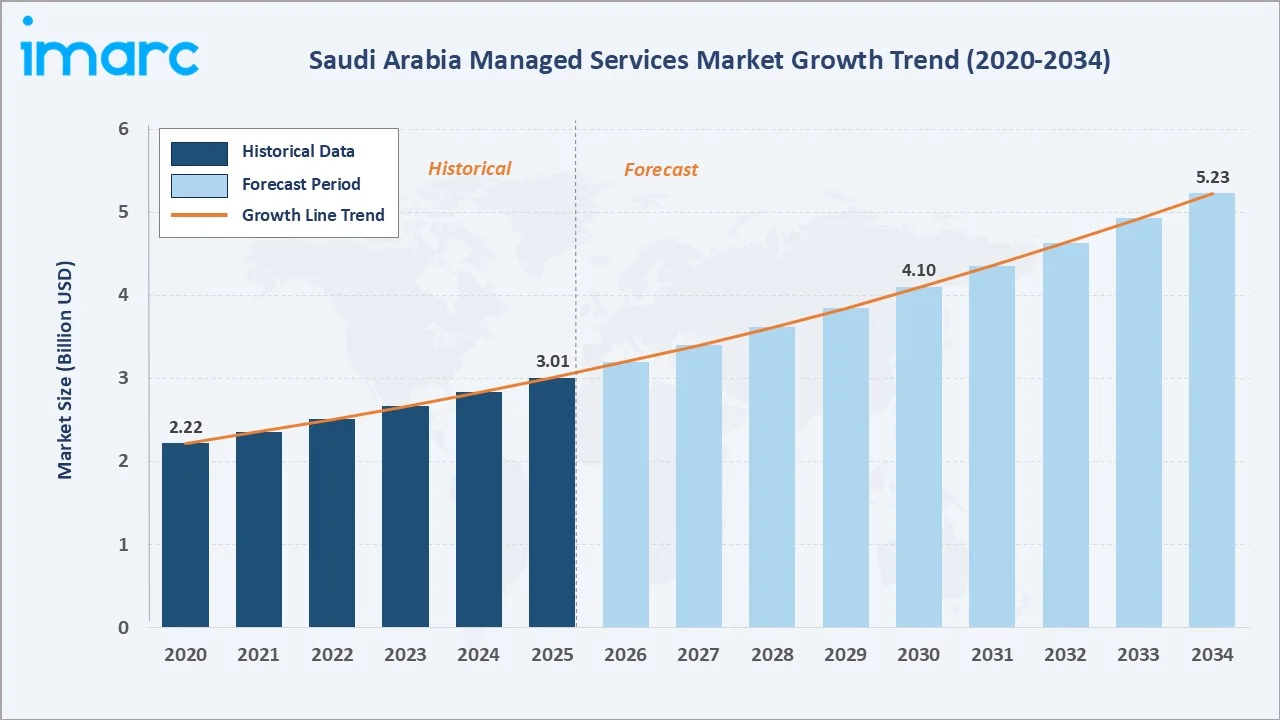
The Saudi Arabia managed services market reached USD 3.01 Billion in 2025 and is projected to reach USD 5.23 Billion by 2034, growing at a CAGR of 6.32% during 2026-2034. The market is driven by Vision 2030's digital transformation, escalating cybersecurity threats, and a growing shortage of skilled IT talent, creating new managed service demand segments. In September 2025, a threat actor operating under the alias “privilege” reportedly leaked a database containing 1,845 user records from a delivery and shipping management platform serving the MENA region. Similarly, a May 2024 breach involving Riyadh Airport reportedly exposed information associated with 864 employees. These incidents are encouraging Saudi organizations to strengthen their cybersecurity posture through managed security services. Managed infrastructure leads at 25.8% by type, cloud-based deployment dominates at 63.8%, and the Northern and Central region commands the largest share at 43.6%.
Market Snapshot
|
Metric |
Value |
|
Market Size (2025) |
USD 3.01 Billion |
|
Forecast Market Size (2034) |
USD 5.23 Billion |
|
CAGR (2026-2034) |
6.32% |
|
Base Year |
2025 |
|
Historical Period |
2020-2025 |
|
Forecast Period |
2026-2034 |
|
Dominant Type |
Managed Infrastructure (25.8%, 2025) |
|
Dominant Deployment Mode |
Cloud-based (63.8%, 2025) |
|
Leading Region |
Northern and Central Region (43.6%, 2025) |
The Saudi Arabia managed services market has grown from USD 2.22 Billion in 2020 to USD 3.01 Billion in 2025, reflecting steady expansion driven by Vision 2030's digital transformation programs and growing enterprise IT outsourcing. The market is projected to reach USD 4.10 Billion by 2030 and USD 5.23 Billion by 2034.
To get more information on this market, Request Sample
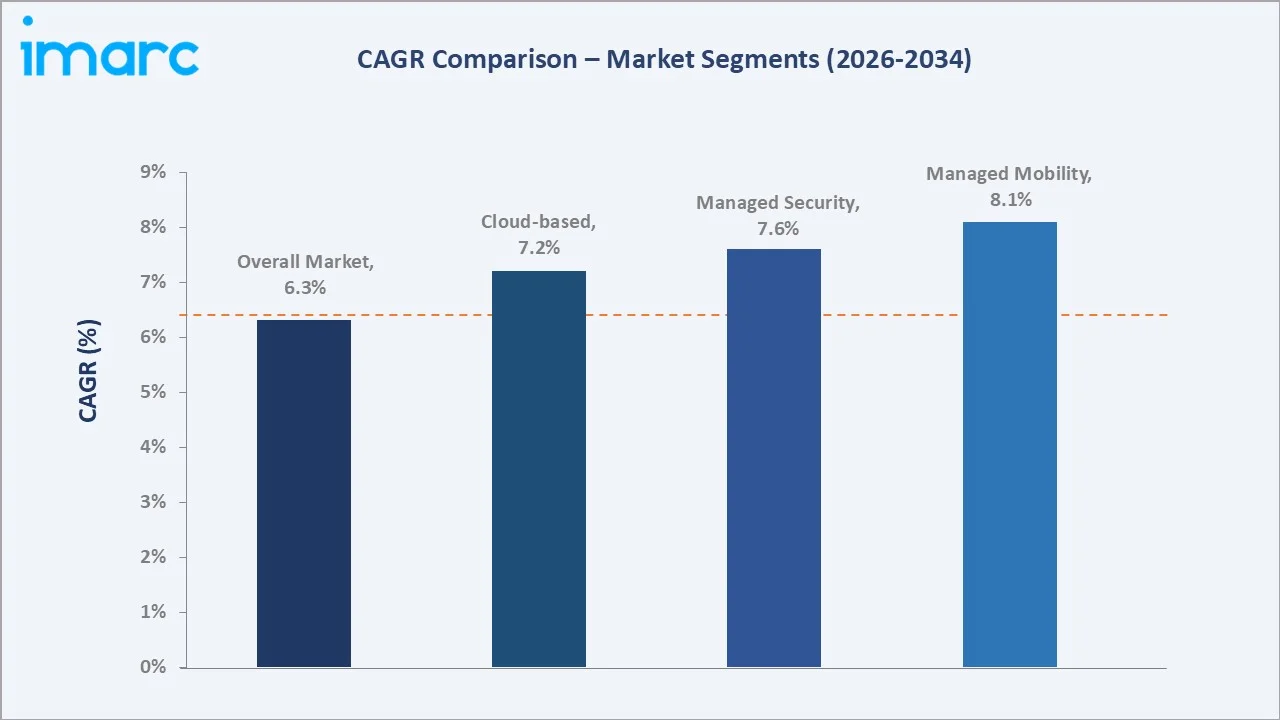
Managed mobility grows at ~8.1% CAGR through 5G enterprise adoption and mobile device management expansion. Managed security grows at ~7.6% CAGR through escalating cyber threat response. Cloud-based deployment grows at ~7.2% CAGR through hyperscaler platform expansion in Saudi Arabia.
Executive Summary
The Saudi Arabia managed services market is experiencing robust and sustained growth, anchored by the Kingdom's Vision 2030 transformation agenda that is fundamentally reshaping IT procurement patterns across government, financial services, healthcare, and commercial sectors. As Saudi Arabia accelerates its digital economy development, the complexity and scale of IT infrastructure requirements are rapidly exceeding the internal management capabilities of most organizations, creating structural and persistent demand for outsourced managed services across infrastructure, security, networking, communications, data center operations, and mobility management. Managed infrastructure at 25.8% leads through government IT outsourcing demand. Cloud-based at 63.8% leads through sovereign cloud adoption. Northern & Central region leads regionally at 43.6%.
Key Market Insights
|
Insight |
Data |
|
Dominant Type Segment |
Managed Infrastructure - 25.8% share (2025) |
|
Dominant Deployment Mode |
Cloud-based - 63.8% share (2025) |
|
Leading Region |
Northern & Central Region - 43.6% (2025) |
|
Key Opportunities |
Rising demand for managed cybersecurity services, cloud and hybrid IT management, AI-driven IT operations, data center outsourcing, network management, and 24/7 remote infrastructure monitoring |
Key Analytical Observations Supporting the Above Data:
- Managed Infrastructure at 25.8%: Managed infrastructure leads because Saudi Arabia's Vision 2030 government digitalization programs require large-scale IT infrastructure deployment and ongoing management across ministries and government agencies that lack sufficient internal IT staffing and expertise.
- Cloud-based at 63.8%: Cloud-based managed services dominate, as AWS, Microsoft Azure, and Google Cloud's Saudi Arabia regional data centers provide sovereign-compliant cloud infrastructure that enables government agencies to adopt cloud services previously restricted by data residency requirements.
- Northern & Central Region at 43.6%: The Northern and Central region's dominant position reflects Riyadh's concentration of federal government ministries, financial institutions, and large enterprise headquarters that collectively represent Saudi Arabia's largest institutional managed services procurement base.
Saudi Arabia Managed Services Market Overview
The Saudi Arabia managed services market encompasses IT services delivered by third-party managed service providers (MSPs) under service level agreements (SLAs) across a defined scope of infrastructure management, security monitoring, network operations, data center management, communication services, and mobility management. MSPs assume responsibility for proactive monitoring, management, maintenance, and optimization of client IT environments, enabling clients to transfer operational complexity while retaining strategic IT governance.
Key service categories include managed infrastructure (server, storage, end-user device management), managed security (SOC services, SIEM, vulnerability management, compliance monitoring), managed network (WAN management, SD-WAN, network performance monitoring), managed data center (colocation management, private cloud operations), managed communications (unified communications, collaboration tools management), and managed mobility (enterprise mobile device management, mobile application management).
Market Dynamics
To evaluate market opportunities, Request Sample
Market Drivers
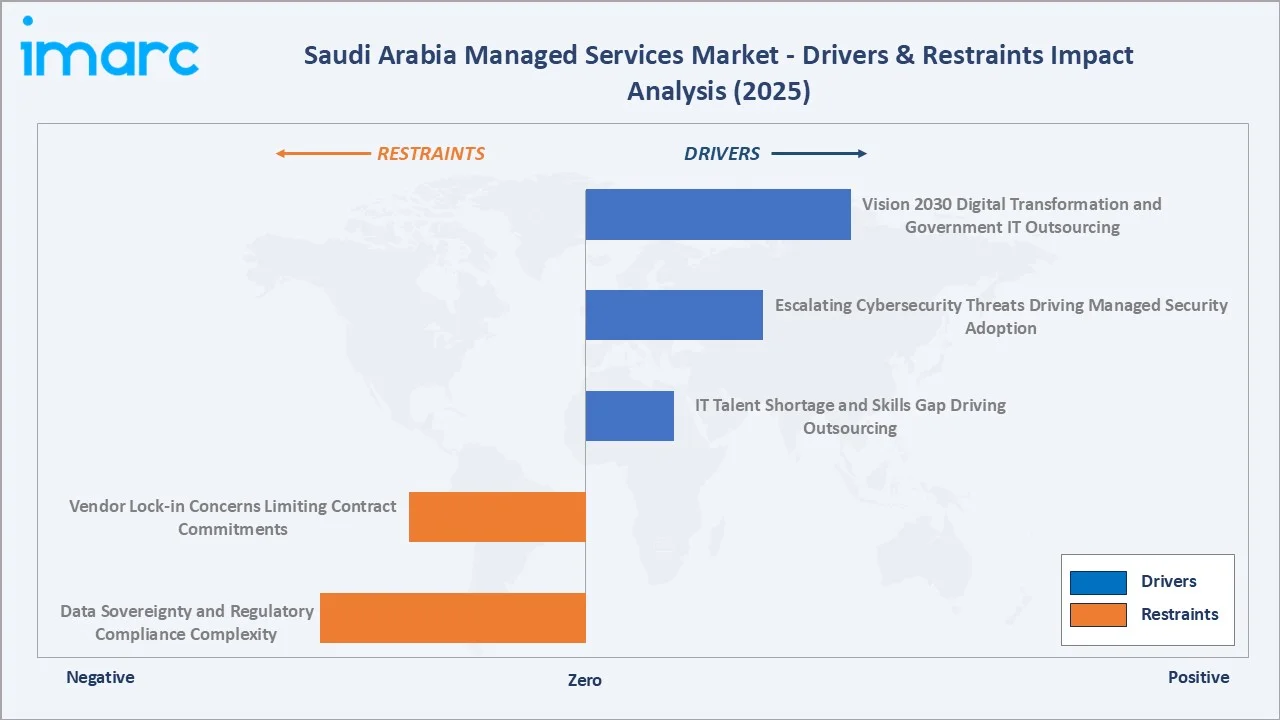
- Vision 2030 Digital Transformation and Government IT Outsourcing: Vision 2030's National Transformation Program and e-Government initiatives require comprehensive IT modernization across hundreds of Saudi government agencies, creating IT complexity and management requirements that exceed internal capabilities. Government procurement frameworks increasingly mandate outsourced managed services for IT infrastructure, cybersecurity, and cloud operations, positioning MSPs as essential delivery partners for the Kingdom's public sector digital agenda.
- Escalating Cybersecurity Threats Driving Managed Security Adoption: Saudi Arabia faces significant and growing cyber threats targeting its financial sector, government agencies, critical infrastructure, and oil and gas operations. Saudi Arabia faced several notable data breaches, including a September 2025 leak of 1,845 user records from a MENA logistics platform, the sale of a compromised recruitment database containing around 150,000 records, and a May 2024 Riyadh Airport breach affecting 864 employees. The complexity and cost of building in-house 24/7 SOC capabilities are prohibitive for most organizations, making managed security the practical compliance pathway.
- IT Talent Shortage and Skills Gap Driving Outsourcing: Saudi Arabia faces a significant shortage of skilled IT professionals across cybersecurity, cloud architecture, network engineering, and data center operations. Saudization requirements add additional complexity to hiring specialized technical talent. MSPs resolve this challenge by providing access to specialized expertise without the recruitment, training, and retention costs of building equivalent in-house teams, making managed services an economically rational solution for organizations of all sizes facing the Kingdom's IT talent constraints.
Market Restraints
- Data Sovereignty and Regulatory Compliance Complexity: Stringent data residency, cross-border data transfer restrictions, and cybersecurity compliance requirements create implementation complexity for international MSPs seeking to serve Saudi government and regulated industry clients. Compliance certification processes are lengthy and resource-intensive, creating barriers for smaller MSPs and international providers without established Saudi Arabia operations and compliance infrastructure.
- Vendor Lock-in Concerns Limiting Contract Commitments: Saudi enterprises and government agencies remain cautious about long-term managed service contracts due to concerns about proprietary platform dependency, migration complexity, and exit costs. The lack of standardized service portability frameworks and exit assistance provisions in MSP contracts creates organizational risk that slows decision-making and reduces average contract values and durations.
Market Opportunities
- Expansion of Localized Managed Cybersecurity Services: In January 2025, Honeywell established a new cybersecurity center in Jubail, Saudi Arabia, to provide localized Managed Security Services for critical industries such as energy, manufacturing, and utilities. The facility will offer solutions including Cyber Insight and Cyber Watch to support continuous compliance with the National Cybersecurity Authority’s OT Cybersecurity Controls, while also facilitating the adoption of automation and AI-enabled technologies. This launch highlights growing opportunities for locally delivered managed security services across Saudi Arabia’s energy, manufacturing, and utilities sectors, driven by stringent NCA compliance requirements and increasing adoption of AI and industrial automation.
- SME Managed Services Market Development: Saudi Arabia's SME sector, targeted for significant growth under Vision 2030's small business development programs, represents a largely underpenetrated managed services opportunity. As SMEs adopt cloud-based business applications and face increasing cybersecurity risks, affordable, cloud-delivered managed services designed for sub-enterprise organizations create a high-growth segment that most current MSP offerings do not adequately address. Simplified subscription-based managed services with transparent pricing and self-service portals would unlock this opportunity.
Market Challenges
- Saudization Requirements and Local Workforce Development: MSPs operating in Saudi Arabia must meet Saudization requirements for local workforce composition, creating operational challenges in recruiting sufficient Saudi nationals with advanced IT technical skills. Building domestic talent pipelines through training programs, university partnerships, and apprenticeship schemes requires sustained investment that increases operational costs while building long-term competitive advantages through local workforce capabilities.
- Price Pressure and Competitive Margin Compression: Intensifying competition between international MSPs, regional players, and Saudi domestic providers is creating downward price pressure on commodity managed service categories. Government procurement processes that prioritize lowest-price technically acceptable bids further compress margins in public sector engagements. MSPs must invest in automation, AI-powered operations, and service differentiation to maintain commercial viability in an increasingly competitive pricing environment.
Emerging Market Trends
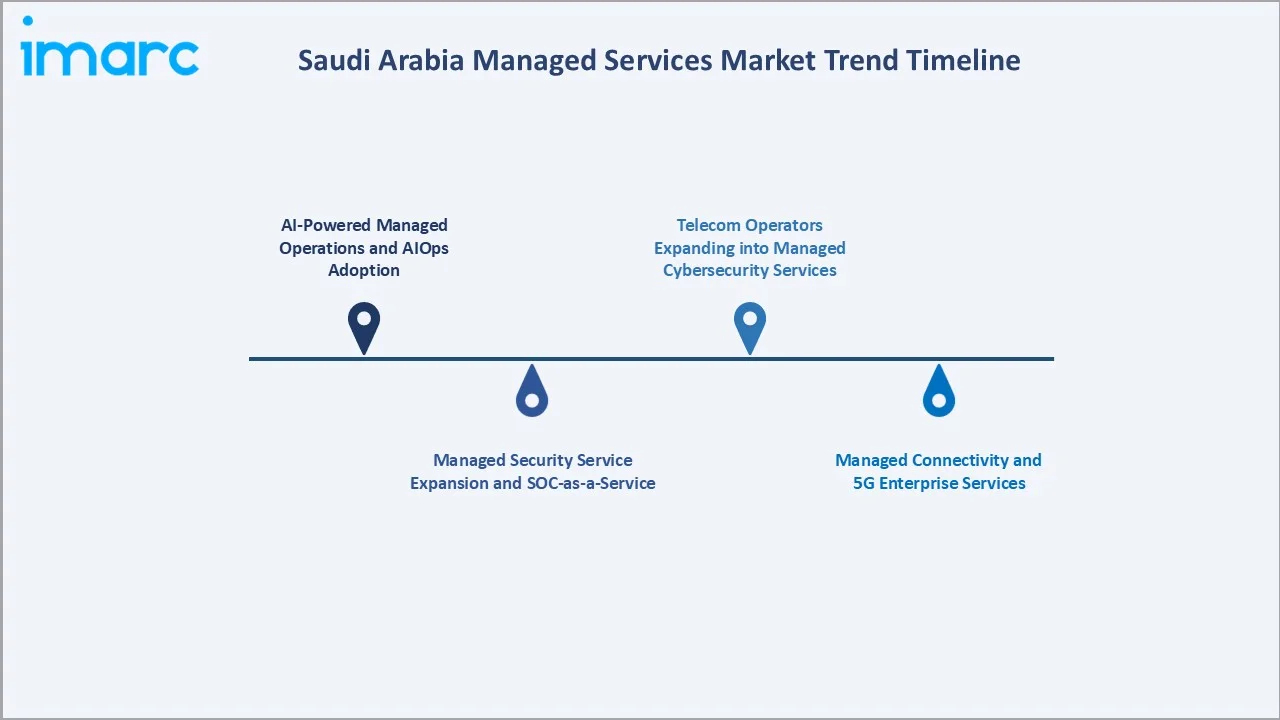
1. AI-Powered Managed Operations and AIOps Adoption
Artificial intelligence and machine learning are transforming managed service delivery in Saudi Arabia through AIOps platforms that automate incident detection, root cause analysis, predictive maintenance, and service optimization. Various AI platforms are being deployed by leading MSPs to replace manual monitoring with AI-driven autonomous operations that improve mean time to resolution (MTTR) while reducing operational costs.
2. Managed Security Service Expansion and SOC-as-a-Service
Saudi Arabia's managed security market is growing rapidly as NCA compliance requirements create mandated demand for 24/7 security operations center (SOC) services, SIEM management, and threat intelligence integration. SOC-as-a-Service delivery models enable organizations to access enterprise-grade security operations without the capital investment of building dedicated facilities. Leading platforms for cloud-native managed SIEM services are gaining adoption across Saudi government and financial sector clients.
3. Telecom Operators Expanding into Managed Cybersecurity Services
Saudi telecom providers are increasingly moving beyond connectivity into managed security and cloud-based cybersecurity services. In May 2026, Zain KSA secured a Tier 2 Managed Security Operations Center license, enabling it to expand advanced cybersecurity monitoring and managed security services in Saudi Arabia. The move supports the Kingdom’s cyber resilience and digital transformation goals while strengthening Zain KSA’s presence beyond traditional telecom services. This launch reflects this shift, as operators leverage existing network infrastructure and enterprise relationships to offer integrated monitoring, threat detection, and cyber resilience solutions.
4. Managed Connectivity and 5G Enterprise Services
Commercial 5G network deployments are creating demand for managed 5G enterprise services including network slicing management, private 5G implementation, and end-to-end SD-WAN with 5G integration. MSPs that can manage the transition from 4G/MPLS enterprise connectivity to 5G-enabled SD-WAN architectures are addressing a high-growth opportunity as Saudi enterprises modernize their network infrastructure for cloud-first application delivery.
Industry Value Chain Analysis
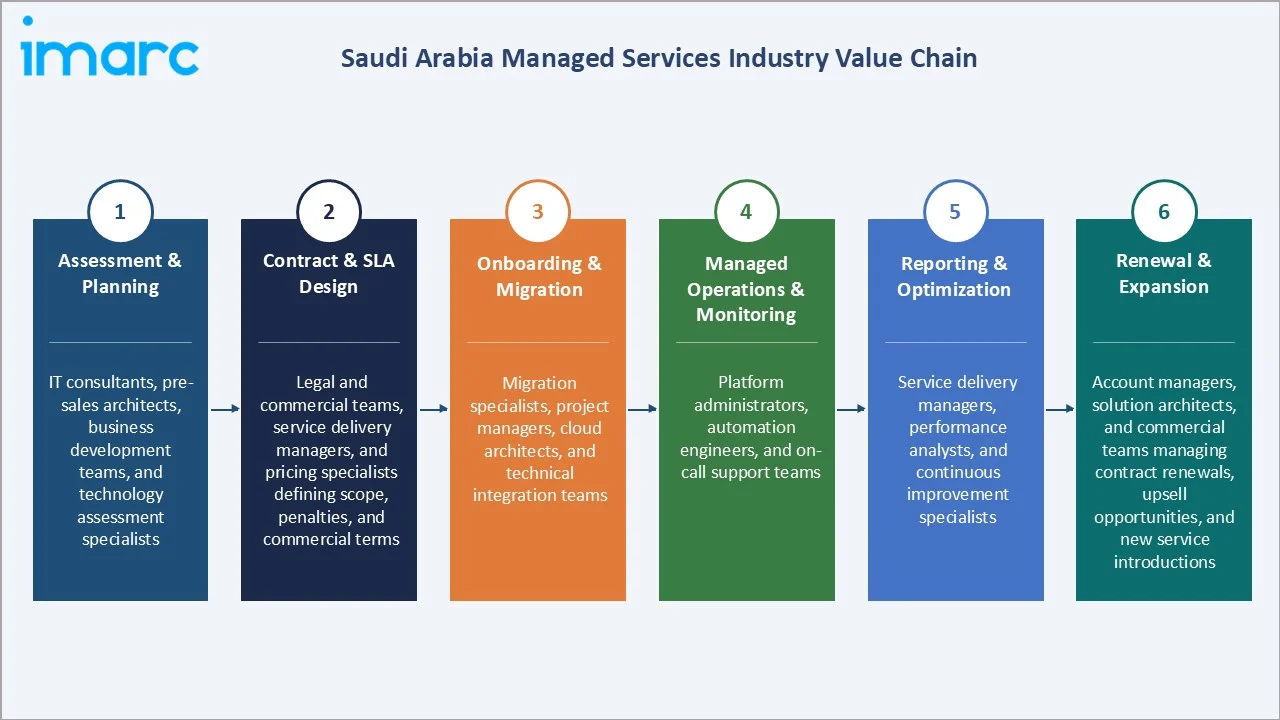
The Saudi Arabia managed services value chain integrates client assessment and planning, contract and SLA design, onboarding and migration, managed operations and monitoring, reporting and optimization, and contract renewal and service expansion across infrastructure, security, network, data center, communications, and mobility service lines.
|
Stage |
Key Participants |
|
Assessment & Planning |
IT consultants, pre-sales architects, business development teams, and technology assessment specialists. |
|
Contract & SLA Design |
Legal and commercial teams, service delivery managers, and pricing specialists defining scope, penalties, and commercial terms. |
|
Onboarding & Migration |
Migration specialists, project managers, cloud architects, and technical integration teams. |
|
Managed Operations & Monitoring |
Platform administrators, automation engineers, and on-call support teams. |
|
Reporting & Optimization |
Service delivery managers, performance analysts, and continuous improvement specialists. |
|
Renewal & Expansion |
Account managers, solution architects, and commercial teams managing contract renewals, upsell opportunities, and new service introductions. |
Managed operations and monitoring represent the highest-value and most operationally intensive stage of the Saudi Arabia managed services value chain. MSPs that invest in AI-powered NOC and SOC platforms, automation-driven service delivery, and skilled Saudi workforce teams for 24/7 monitoring achieve the operational efficiency and service quality differentiation that sustains client retention, enables SLA compliance, and generates the performance data that drives service expansion and contract renewal.
Technology Landscape in the Saudi Arabia Managed Services Industry
Cloud and Hybrid Infrastructure Management Technology
Cloud management platforms (CMP) enable MSPs to deliver unified management across hybrid cloud and on-premises environments from a single control plane. IT operations management (ITOM) is widely adopted for enterprise-grade managed infrastructure services requiring automated discovery, service mapping, and ITSM workflow integration. Saudi Arabia's hyperscaler data center availability enables MSPs to deliver fully sovereign cloud managed services that meet NCA data residency requirements without compromise.
Managed Security Technology and SIEM Platforms
Next-generation SIEM platforms are the primary technology foundations for managed security services in Saudi Arabia. These platforms aggregate security telemetry from client environments, apply AI-powered threat detection, and enable SOC analysts to respond to incidents at scale. NCA's requirement for integration with the National SOC's threat intelligence feeds creates a standardization environment that favors platforms with established NCA certification and API connectivity.
Network Operations and SD-WAN Management Technology
Network operations and SD-WAN management technologies enable centralized monitoring, optimization, and control of enterprise networks across multiple locations. SD-WAN dynamically routes traffic across available connections based on application requirements, network conditions, and defined policies. Managed service providers use these technologies to improve network performance, security, reliability, and visibility while reducing the complexity of managing distributed IT infrastructure.
Market Segmentation Analysis
The report covers the following segments:
|
Segment Category |
Leading Segment |
Market Share |
Year |
|
Type |
Managed Infrastructure |
25.8% |
2025 |
|
Deployment Mode |
Cloud-based |
63.8% |
2025 |
|
Enterprise Size |
🔒 |
🔒 |
2025 |
|
End Use |
🔒 |
🔒 |
2025 |
|
Region |
Northern and Central Region |
43.6% |
2025 |

By Type
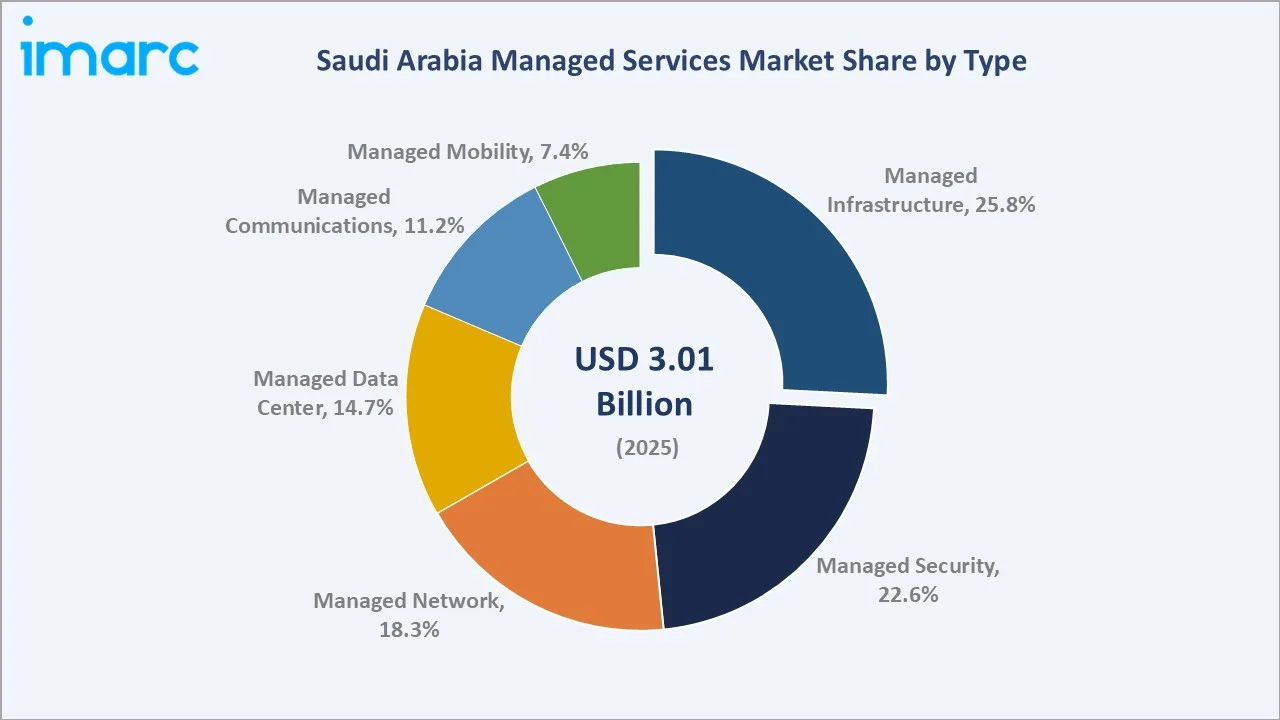
Managed infrastructure leads at 25.8% (2025), through government IT outsourcing requirements, rising enterprise IT complexity, and Vision 2030 program delivery demands that make outsourced infrastructure management the practical operational model for Saudi organizations across public and private sectors.
To access detailed market analysis, Request Sample
Managed security at 22.6% reflects NCA compliance mandates and escalating cyber threat response requirements. Managed network at 18.3% serves enterprise WAN transformation and SD-WAN adoption. Managed data center at 14.7% grows through colocation and private cloud outsourcing. Managed communications at 11.2% addresses UCaaS and collaboration service management. Managed mobility at 7.4% represents the fastest-growing type at ~8.1% CAGR through 5G enterprise and MDM expansion.
By Deployment Mode
Cloud-based deployment leads at 63.8% (2025), enabled by hyperscaler Saudi Arabia data center availability that provides sovereign-compliant cloud infrastructure for government and regulated enterprise workloads previously restricted by NCA data residency requirements.
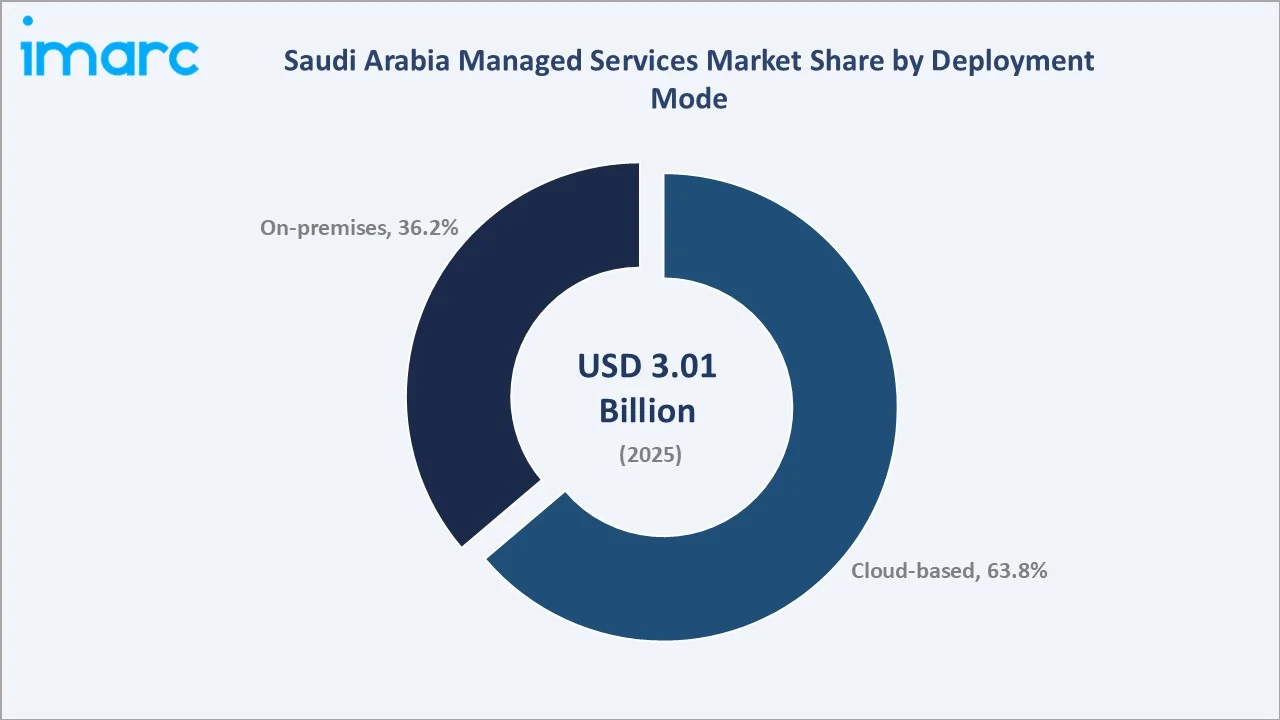
On-premises deployment at 36.2% retains significant share through classified government workloads, highly regulated financial sector systems, and critical infrastructure operations that require physical infrastructure control and air-gapped environments.
Regional Market Insights
|
Region |
Share (2025) |
Key Saudi Arabia Managed Services Market Drivers & Characteristics |
|
Northern & Central Region |
43.6% |
Reflecting the concentration of federal government ministries, large enterprise headquarters, and digital transformation program offices representing the Kingdom's highest managed services spending base. |
|
Western Region |
24.8% |
Reflecting Jeddah's commercial enterprise MSP demand, the Makkah and Madinah smart city and pilgrimage infrastructure management requirements, and the Red Sea Project's technology-intensive hospitality and tourism IT operations. |
|
Eastern Region |
20.3% |
Reflecting extensive managed IT services outsourcing, Jubail and Yanbu industrial complex operational technology management, and the region's large financial and logistics sector enterprise client base. |
|
Southern Region |
11.3% |
Reflecting growing managed services adoption in government digitalization, industrial IT management, and expanding SME managed IT outsourcing across southern Saudi provinces. |
The Northern and Central region's 43.6% dominance is anchored by Riyadh's concentration of federal government procurement alongside regulated financial sector institutions and the headquarters of large enterprises that collectively represent the Kingdom's highest-value managed service engagements. The Western region's 24.8% reflects Jeddah's established commercial enterprise base and the scale of hospitality and religious tourism IT infrastructure requiring managed operations.
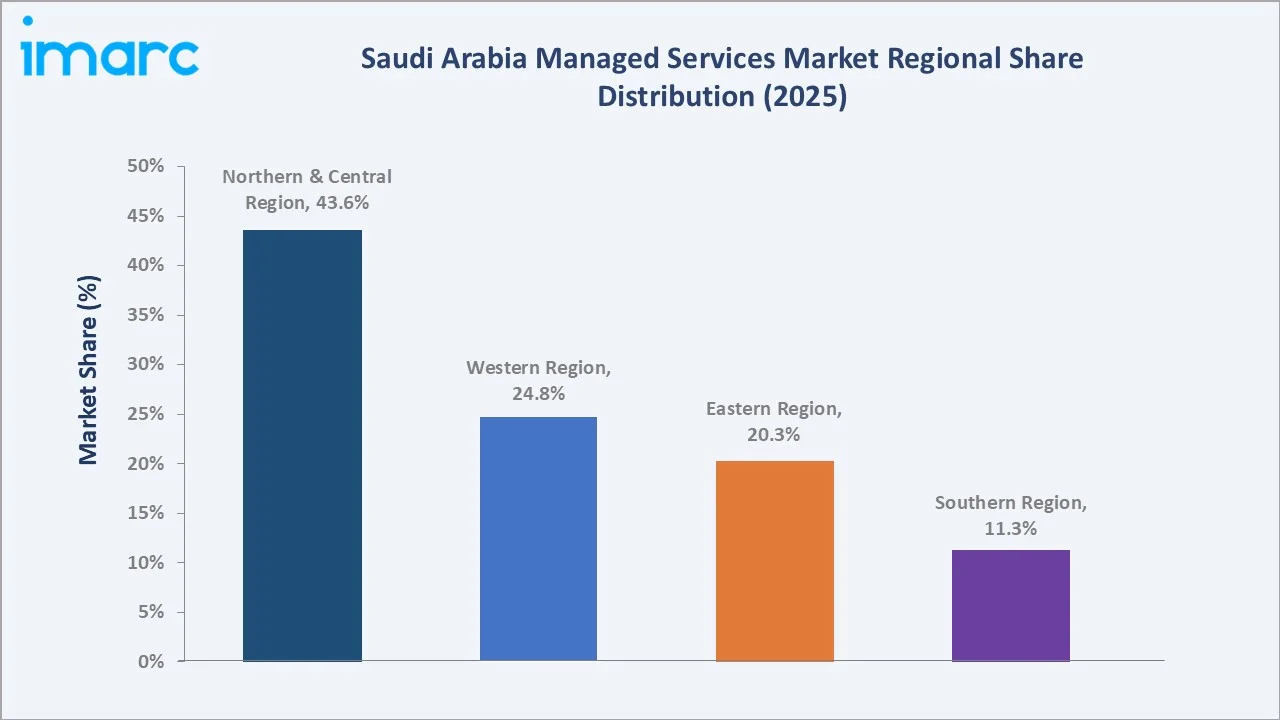
The Eastern region's 20.3% reflects leading status as the home for the largest oil companies and one of the largest single managed IT services buyers, with extensive outsourced IT infrastructure, cybersecurity, and operational technology management programs. The Southern region at 11.3% represents growing government-driven digital adoption as Vision 2030 regional development programs bring managed IT services to previously less-served provincial markets.
Competitive Landscape
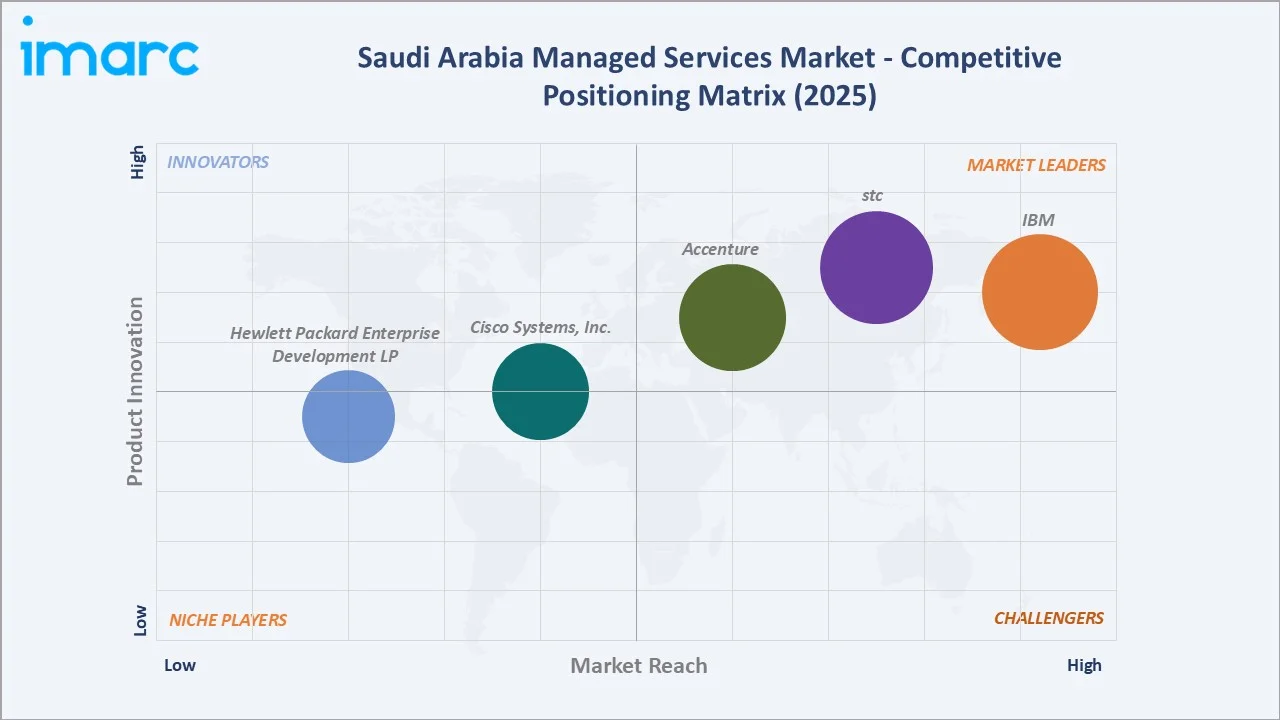
The Saudi Arabia managed services market is moderately concentrated, featuring global managed services leaders alongside domestic champion STC Cloud and regional specialists. Competition is intensifying as cloud hyperscalers partner with local MSPs, and new pure-play cloud managed service providers enter the market.
|
Company |
Key Offerings |
Market Position |
Core Strength |
|
IBM |
IBM Cloud Pak for Multicloud Management |
Market Leader |
IBM acts as a leading technology and managed services player in Saudi Arabia, supporting the Kingdom's Vision 2030 digital transformation. |
|
stc |
SD-Wan Service, RiCH – Managed Platform, Managed NOC (Network Operation Center), Managed WLAN - MODAR |
Market Leader |
stc cloud acts as the primary digital backbone for managed services in Saudi Arabia, driving enterprise and government IT operations toward the goals of Saudi Vision 2030. |
|
Accenture |
Application Managed Services, Infrastructure Managed Services, Cybersecurity Managed Services |
Market Leader |
Accenture acts as a leading strategic partner in Saudi Arabia's managed services and digital transformation landscape, aligning closely with the nation's Vision 2030 goals. |
|
Hewlett Packard Enterprise Development LP |
HPE Managed Services |
Established Player |
Hewlett Packard Enterprise (HPE) manages modern IT operations in Saudi Arabia through comprehensive monitoring, administration, and continuous optimization services. |
|
Cisco Systems, Inc. |
Cisco Managed Services for Collaboration, Cisco Managed Services for Security, Cisco Managed Services for Data Center, Cisco Managed Services for Enterprise Networks |
Established Player |
Cisco Systems, Inc. acts as a core strategic infrastructure provider and cloud-managed services enabler in Saudi Arabia, aligning heavily with Cisco and its alignment with Saudi Arabia's Vision 2030. |
Companies across the competitive landscape are investing in AI-powered service delivery automation, NCA cybersecurity certification, sovereign cloud capability development, Saudi workforce localization programs, and industry-specific managed service offerings for BFSI, healthcare, and government verticals. The market is expected to see intensified competition as hyperscaler-led managed service partnerships and Saudi government preferred vendor programs create both new opportunities and competitive barriers.
Key Company Profiles
IBM
IBM has established a comprehensive managed services presence in Saudi Arabia spanning government, financial services, healthcare, and large enterprise segments. IBM's Saudi Arabia operations deliver managed infrastructure, managed security, cloud operations, and AI-powered IT management services through a combination of Saudi-based delivery teams, offshore operations centers, and IBM Cloud platforms. IBM's certified security operations capabilities and compliance with Saudi data sovereignty requirements position it as a trusted partner for classified and regulated workloads.
- Key Offerings: IBM Cloud Pak for Multicloud Management.
- Strategic Focus: Expanding AI-powered managed operations capabilities through deployment that enables predictive infrastructure management, growing managed security service portfolio aligned with NCA compliance requirements, and strengthening STC partnership for integrated telecom and IT managed service delivery to Saudi government clients.
stc
stc is Saudi Arabia's largest telecommunications provider and, through its stc cloud subsidiary, operates as the Kingdom's most strategically positioned managed service provider. stc cloud's domestic cloud data center infrastructure, NCA compliance certifications, and integration with stc's national telecommunications network create competitive advantages unavailable to international MSPs. stc's relationships with every Saudi government ministry and the majority of the Kingdom's largest enterprises, built through decades of telecommunications service delivery, provide a uniquely privileged commercial foundation for managed service expansion.
- Key Offerings: SD-Wan Service, RiCH – Managed Platform, Managed NOC (Network Operation Center), Managed WLAN - MODAR.
- Strategic Focus: Accelerating stc cloud's transformation from telecommunications carrier to comprehensive managed IT services provider, expanding managed security platform adoption across government and BFSI sectors as the NCA-preferred domestic security operations provider, and developing managed 5G enterprise services leveraging stc's network infrastructure leadership.
Market Concentration Analysis
The Saudi Arabia managed services market exhibits moderate concentration, with IBM, stc, Accenture, Hewlett Packard Enterprise Development LP, and Cisco Systems, Inc., collectively commanding approximately 45-50% of total market revenues in 2025. The remaining share is distributed among specialist MSPs, regional providers, and system integrators offering managed service add-ons to core integration projects. stc cloud's unique position as a domestic carrier-owned MSP with sovereign data center infrastructure and government relationship depth creates structural competitive advantages that differentiate it from purely service-based competitors. Market concentration is expected to moderate slightly through 2034 as cloud-native MSPs, and Saudi domestic IT firms develop managed service capabilities with government support.
Investment & Growth Opportunities
Highest Growth Segments
Managed mobility (~8.1% CAGR), managed security (~7.6% CAGR), cloud-based managed services (~7.2% CAGR), AI-powered managed operations, and SME-focused managed IT subscriptions represent the highest-growth investment vectors in the Saudi Arabia managed services market through 2034.
Investment Themes
- NCA-compliant managed security service development: Building NCA-certified SOC capabilities, SIEM platforms, and cybersecurity managed service offerings creates a government-mandated revenue stream that is structurally growing as NCA compliance requirements cascade across an expanding range of regulated entities. MSPs with established NCA certification have significant competitive advantages in government and financial sector managed security procurement.
- Sovereign cloud managed service platform investment: Developing certified cloud managed service capabilities on AWS and Google Cloud Saudi Arabia regions enables MSPs to address the cloud-based deployment market with sovereign-compliant service delivery. Hyperscaler certification programs, local delivery team development, and NCA-aligned compliance frameworks are required investments for MSPs seeking to lead in cloud managed services.
Future Market Outlook (2026-2034)
The Saudi Arabia managed services market is projected to grow from USD 3.01 Billion in 2025 to USD 5.23 Billion by 2034, exhibiting a CAGR of 6.32% during 2026-2034. The market is projected to reach an anchor value of USD 4.10 Billion by 2030, representing the mid-period milestone at which Vision 2030's e-government programs reach implementation maturity and cloud-based managed services achieve mainstream adoption across all government tiers.
Three structural forces will define the Saudi Arabia managed services market through 2034. First, Vision 2030's sustained digital transformation mandate will continue driving IT outsourcing across government and enterprise sectors as implementation complexity and operational management requirements outpace internal IT capacity. Second, managed security services will transition from optional service enhancement to mandatory compliance capability as NCA regulations progressively expand their scope and enforcement. Third, the SME managed services market will emerge as a significant growth contributor as Vision 2030's SME development programs digitalize Saudi Arabia's small business sector.
Research Methodology
Primary Research
Primary research comprised in-depth interviews with managed service providers, IT outsourcing professionals, Saudi government IT procurement officers, CIOs and IT directors at large enterprises, and industry analysts. These discussions validated market size estimates, assessed service type adoption trends, evaluated competitive positioning, and provided insights into regulatory developments and future managed service evolution in the Saudi Arabia market.
Secondary Research
Secondary research encompassed company annual reports on IT and telecommunications market developments, cybersecurity framework publications, digital economy statistics, major MSP investor disclosures and Saudi Arabia market announcements, Saudi government digital transformation program documentation, and industry publications focused on Middle East IT services market development.
Forecasting Models
Forecasting models incorporated historical managed services market revenue trends, Vision 2030 digital investment commitment projections, IT outsourcing propensity trends across government and enterprise sectors, cloud adoption rate forecasts, cybersecurity regulatory expansion timelines, and competitive market share dynamics. Both top-down and bottom-up approaches were applied and cross-validated to ensure forecast consistency with sector-specific demand drivers.
Saudi Arabia Managed Services Market Report Coverage:
| Report Features | Details |
|---|---|
| Base Year of the Analysis | 2025 |
| Historical Period | 2020-2025 |
| Forecast Period | 2026-2034 |
| Units | Billion USD |
| Scope of the Report | Exploration of Historical and Forecast Trends, Industry Catalysts and Challenges, Segment-Wise Historical and Predictive Market Assessment:
|
| Types Covered | Managed Infrastructure, Managed Data Center, Managed Security, Managed Communications, Managed Network, Managed Mobility |
| Deployment Modes Covered | On-premises, Cloud-based |
| Enterprise Sizes Covered | Large Enterprises, Small and Medium-sized Enterprises |
| End Uses Covered | IT and Telecommunication, BFSI, Healthcare, Entertainment and Media, Retail, Manufacturing, Government, Others |
| Regions Covered | Northern and Central Region, Western Region, Eastern Region, Southern Region |
| Companies Covered | IBM, stc, Accenture, Hewlett Packard Enterprise Development LP, Cisco Systems, Inc., etc. |
| Customization Scope | 10% Free Customization |
| Post-Sale Analyst Support | 10-12 Weeks |
| Delivery Format | PDF and Excel through Email (We can also provide the editable version of the report in PPT/Word format on special request) |
Key Benefits for Stakeholders:
- IMARC’s industry report offers a comprehensive quantitative analysis of various market segments, historical and current market trends, market forecasts, and dynamics of the Saudi Arabia managed services market from 2020-2034.
- The research report provides the latest information on the market drivers, challenges, and opportunities in the Saudi Arabia managed services market.
- Porter's five forces analysis assist stakeholders in assessing the impact of new entrants, competitive rivalry, supplier power, buyer power, and the threat of substitution. It helps stakeholders to analyze the level of competition within the Saudi Arabia managed services industry and its attractiveness.
- A competitive landscape allows stakeholders to understand their competitive environment and provides an insight into the current positions of key players in the market.
Frequently Asked Questions About the Saudi Arabia Managed Services Market Report
The Saudi Arabia managed services market reached USD 3.01 Billion in 2025, driven by Vision 2030 government IT outsourcing, escalating cybersecurity threats mandating managed security services, IT talent shortage driving outsourcing decisions, cloud-first government policy enabling cloud MSP adoption, and expanding enterprise digital transformation requirements.
The Saudi Arabia managed services market is projected to grow at a CAGR of 6.32% during 2026-2034, sustained by Vision 2030-driven digital transformation, mandatory cybersecurity compliance driving managed security, hyperscaler cloud expansion enabling sovereign cloud MSP services, and SME managed services market development.
The market is projected to reach approximately USD 4.10 Billion by 2030, representing the mid-period milestone at which Vision 2030 e-government implementation reaches maturity, cloud-based managed services achieve mainstream government adoption, and NCA cybersecurity compliance requirements cascade across all regulated Saudi enterprises.
Managed infrastructure leads with a 25.8% share in 2025, through government IT outsourcing requirements, rising enterprise IT complexity, and Vision 2030 program delivery demands that make outsourced infrastructure management the practical operational model for Saudi organizations.
Cloud-based deployment dominates with a 63.8% share in 2025, enabled by AWS, Microsoft Azure, and Google Cloud Saudi Arabia data center availability that provides sovereign-compliant cloud infrastructure for government and regulated enterprise workloads previously restricted by NCA data residency requirements.
The Northern and Central region leads with a 43.6% share in 2025, driven by Riyadh's concentration of federal government ministries, regulated financial institutions, large enterprise headquarters, and digital transformation program offices representing the Kingdom's highest managed services spending base.
Key players include IBM, stc, Accenture, Hewlett Packard Enterprise Development LP, and Cisco Systems, Inc., among others.
The Saudi Arabia managed services market is projected to reach USD 5.23 Billion by 2034, sustained by government managed service contracts, growing managed security compliance demand, AI-powered managed operations adoption, and the emerging SME managed IT services market under Vision 2030 small business development programs.
Need more help?
- Speak to our experienced analysts for insights on the current market scenarios.
- Include additional segments and countries to customize the report as per your requirement.
- Gain an unparalleled competitive advantage in your domain by understanding how to utilize the report and positively impacting your operations and revenue.
- For further assistance, please connect with our analysts.
 Request Customization
 Speak to an Analyst
 Request Brochure
 Inquire Before Buying
Benefits of Customization
- Personalize this research
- Triangulate with your data
- Get data as per your format and definition
- Gain a deeper dive into a specific application, geography, customer, or competitor
- Any level of personalization
Get in Touch With Us
UNITED STATES
Phone: +1-201-971-6302
INDIA
Phone: +91-120-433-0800
UNITED KINGDOM
Phone: +44-753-714-6104
Email: [email protected]
Client Testimonials




.webp)




.webp)













Related Reports

Choose your plan
*Please note that the prices mentioned below are starting prices for each bundle type. Kindly contact our team for further details.*
Single User License
- 1 User License, Access on 2 Devices
- PDF Report + Excel Dataset (Password Protected)
- Lifetime Access
- No Printing Rights
- 10% Free Report Customization
- 10–12 Weeks of Analyst Support
Five User License
- Access for 5 Users, 2 Devices per User
- PDF Report + Excel Dataset (Password Protected)
- Lifetime Access
- Dedicated Account Manager
- 12–14 Weeks of Analyst Support
- No Printing Rights
- 15% Free Report Customization
- 25% Discount on Your Next Purchase
Corporate User License
- Unlimited User Access (Within Your Organization)
- PDF Report + Excel Dataset
- Lifetime Access
- Dedicated Account Manager
- 14–20 Weeks of Analyst Support
- No Printing Rights
- 20% Free Report Customization
- 30% Discount on Your Next Purchase
Essential Insights
What's included:
3 reports
- Lifetime Access
- PDF Reports
- Excel Datasets
- 2 Weeks of Free Analyst Support
- 2 User Licenses
- Access on 2 Devices
- Printing Rights
- Complimentary PowerPoint (PPT) Version
- Complimentary License Upgrade
Professional Access
What's included:
5 reports
- Lifetime Access
- PDF Reports
- Excel Datasets
- 8 Weeks of Free Analyst Support
- 2 User Licenses
- Access on 2 Devices
- Printing Rights
- Complimentary PowerPoint (PPT) Version
- Complimentary License Upgrade
Business Advantage
What's included:
8 reports
- Lifetime Access
- PDF Reports
- Excel Datasets
- 14 Weeks of Free Analyst Support
- 2 User Licenses
- Access on 2 Devices
- Printing Rights
- Complimentary PowerPoint (PPT) Version
- Complimentary License Upgrade
Enterprise Intelligence
What's included:
10 reports
- Lifetime Access
- PDF Reports
- Excel Datasets
- 20 Weeks of Free Analyst Support
- 2 User Licenses
- Access on 2 Devices
- Printing Rights
- Complimentary PowerPoint (PPT) Version
- Complimentary License Upgrade