
Saudi Arabia Solar PV Module Market Size, Share, Trends and Forecast by Technology, Product Type, Connectivity, Mounting, End Use, 2026-2034
Saudi Arabia Solar PV Module Market Size, Share, Trends & Forecast (2026-2034)
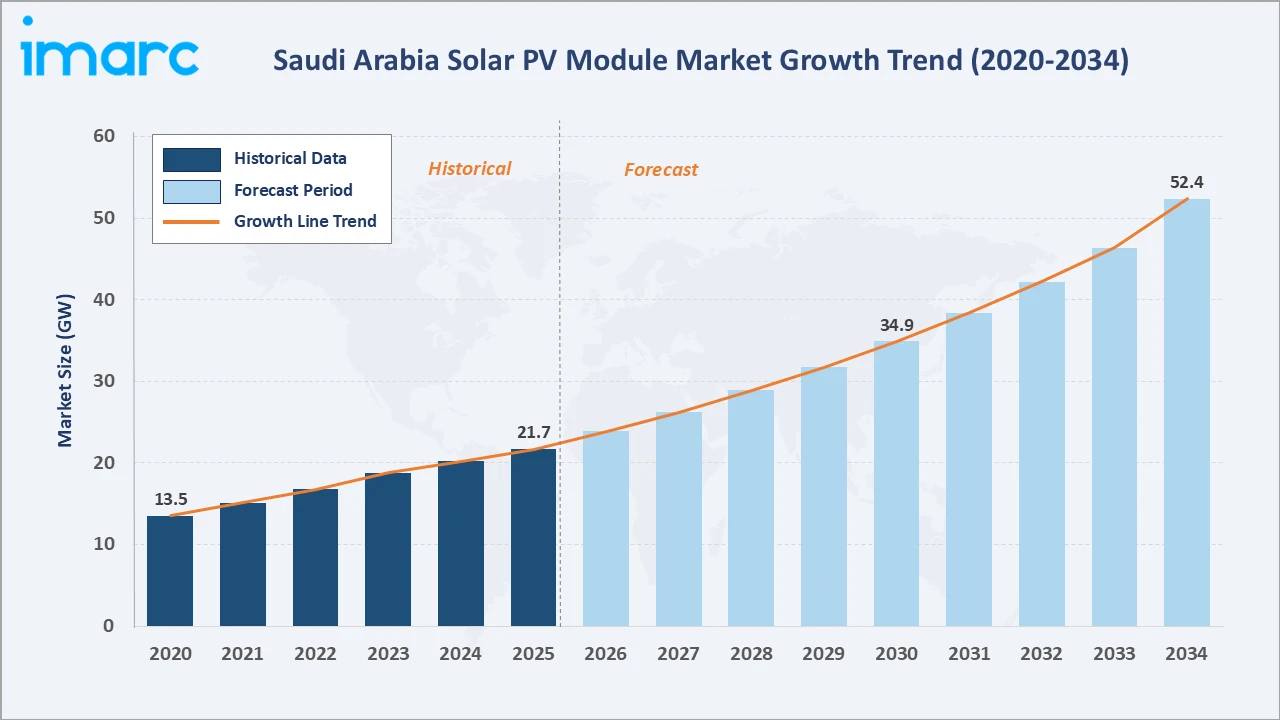
The Saudi Arabia solar PV module market reached a volume of 21.7 GW in 2025 and is projected to attain 52.4 GW by 2034, exhibiting a CAGR of 9.99% during 2026-2034. Saudi Arabia's Vision 2030 framework has established a national renewable energy target of 58.7 GW by 2030, creating powerful policy-driven momentum for sustained solar PV module deployment across residential, commercial, and industrial segments.
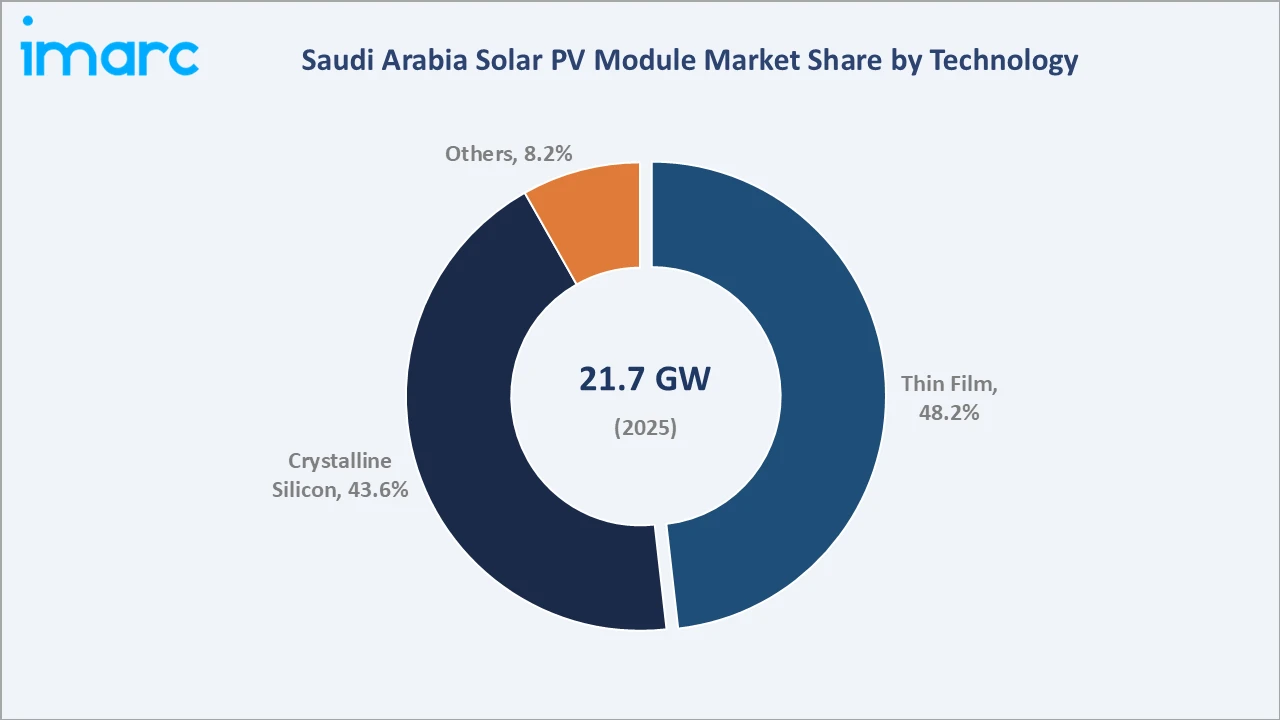
Thin film leads the technology segment at 48.2% and residential dominates the end use segment at 47.6%.
Market Snapshot
|
Metric |
Value |
|
Market Size (2025) |
21.7 GW |
|
Forecast Market Size (2034) |
52.4 GW |
|
CAGR (2026-2034) |
9.99% |
|
Base Year |
2025 |
|
Historical Period |
2020-2025 |
|
Forecast Period |
2026-2034 |
|
Leading Technology |
Thin Film (48.2%, 2025) |
|
Leading End Use |
Residential (47.6%, 2025) |
The Saudi Arabia solar PV module market expanded from 13.5 GW in 2020 to 21.7 GW in 2025, supported by accelerating utility-scale solar project deployments, continuous decline in module manufacturing costs, and growing residential rooftop adoption under the Kingdom's net metering framework. Anchored at 34.9 GW in 2030, the forecast to 52.4 GW by 2034 is supported by a sustained pipeline of Vision 2030 renewable energy tenders, expanding domestic solar manufacturing capacity, and rising commercial and industrial sector solar adoption.
To get more information on this market, Request Sample
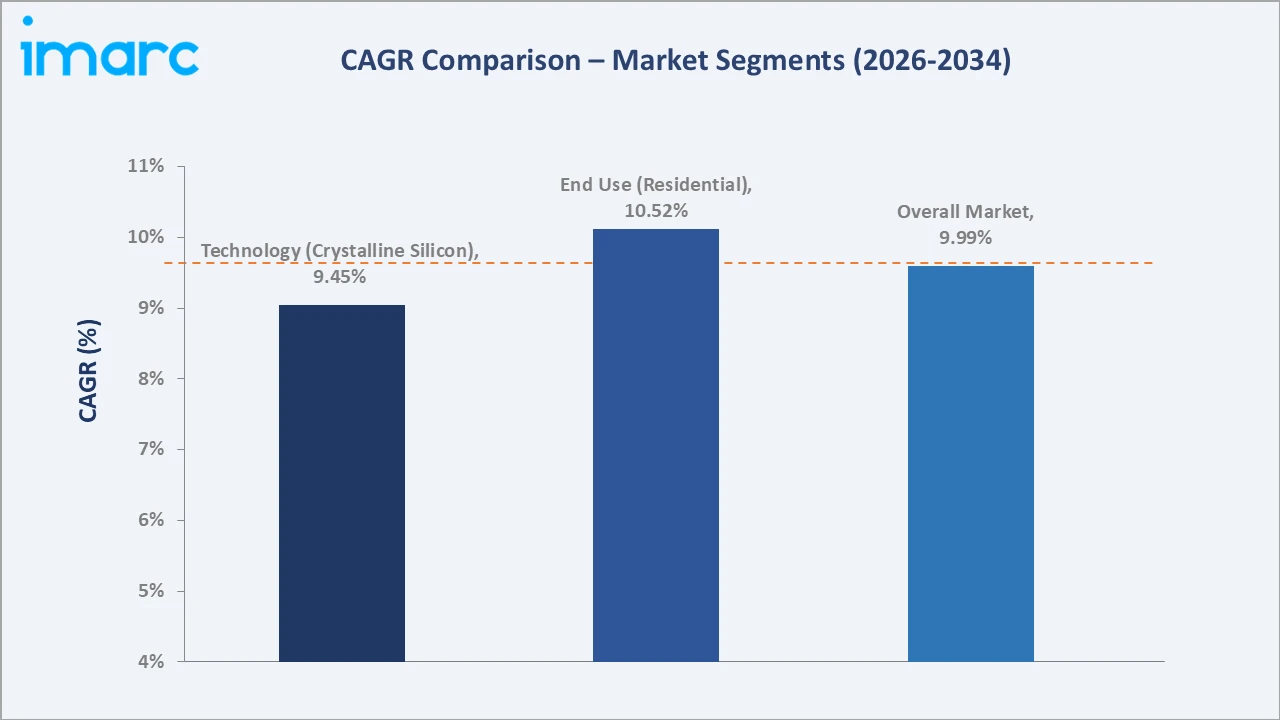
CAGR trajectories across technology and end use sub-segments show thin film and residential expanding faster than the overall 9.99% market CAGR, driven by declining module costs, expanding rooftop solar programs, and large-scale utility project deployments.
Executive Summary
The Saudi Arabia solar PV module market expanded from 13.5 GW in 2020 to 52.4 GW in 2034, driven by the accelerating deployment of utility-scale solar projects, widespread government incentives under Vision 2030, and the continuous decline in module manufacturing costs.
Based on technology, thin film commands 48.2% of the market, benefiting from superior performance in high-temperature, high-irradiation environments characteristic of the Kingdom. Residential leads end use at 47.6%, supported by rooftop solar incentive programs and net metering policies.
Key Market Insights
|
Insight |
Data |
|
Leading Technology |
Thin Film - 48.2% share (2025) |
|
Second Largest Technology |
Crystalline Silicon - 43.6% share (2025) |
|
Leading End Use |
Residential - 47.6% share (2025) |
|
Second Largest End Use |
Commercial - 29.3% share (2025) |
|
Top Companies |
LONGi Green Energy Technology Co., Ltd., JA Solar Technology Co., Ltd., Trina Solar Co., Ltd., Canadian Solar Inc. |
Key Analytical Observations Supporting the Above Data:
- Thin film leadership at 48.2% reflects its significant presence in the Saudi Arabia solar PV module market. Its adoption across different solar power installations supports its position as a major technology segment.
- Crystalline silicon share at 43.6% is anchored by its established use across rooftop and ground-mounted solar installations. Continued improvements in module efficiency, durability, and power output help sustain demand for crystalline silicon technology.
- Residential at 47.6% indicates strong adoption of solar PV systems for household electricity generation. Growing interest in rooftop installations, energy cost management, and decentralized power generation supports demand from the residential segment.
- Commercial share at 29.3% reflects expanding corporate sustainability commitments, declining module costs enabling faster return on investment timelines, and growing adoption among retail and hospitality establishments.
Saudi Arabia Solar PV Module Market Overview
Solar PV module converts sunlight directly into electrical energy using semiconductor materials. In Saudi Arabia, the market encompasses the procurement, installation, and management of PV modules across utility-scale, commercial, and residential applications.
The Saudi Arabia solar PV module ecosystem integrates raw material suppliers, global module manufacturers, engineering-procurement-construction contractors, government entities, and end users spanning residential, commercial, and industrial segments. The National Renewable Energy Program and the Saudi Vision 2030 framework together provide the regulatory and financial architecture driving market growth.
Market Dynamics
To evaluate market opportunities, Request Sample
Market Drivers
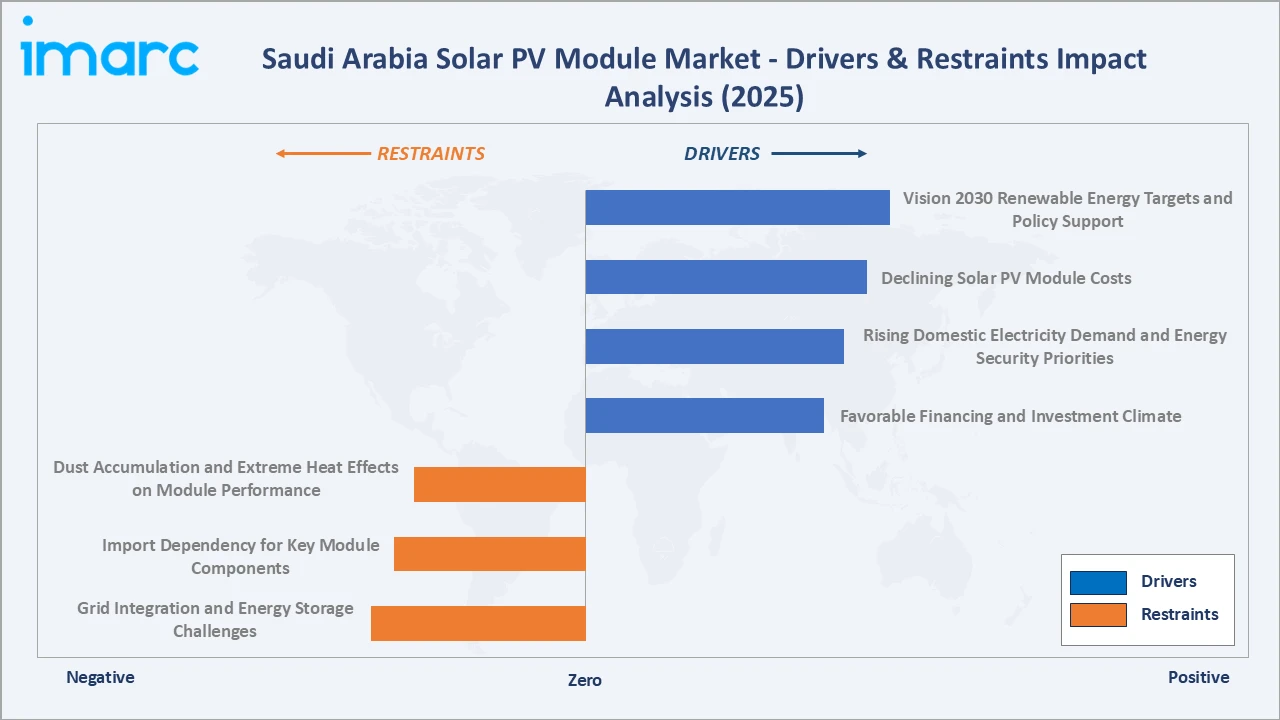
- Vision 2030 Renewable Energy Targets and Policy Support: Saudi Arabia’s renewable energy targets and supportive policy framework encourage investment in solar power generation and contribute to the expansion of solar PV installations. The government’s focus on increasing the share of renewables in the national energy mix strengthens the policy-driven demand for solar PV capacity.
- Declining Solar PV Module Costs: Sustained reductions in module manufacturing costs, particularly for thin film and monocrystalline silicon variants, have significantly lowered the levelized cost of electricity from solar installations. Falling costs are broadening the economic viability of solar across residential and commercial segments that were previously dependent on direct subsidies.
- Rising Domestic Electricity Demand and Energy Security Priorities: Rapid urbanization, expanding industrial activity, and a growing population are increasing Saudi Arabia's electricity consumption. As per Worldometer, in 2024, Saudi Arabia's per capita electricity usage was 11,954 kilowatt-hours, translating to 32.75 kilowatt-hours daily, ranking 12 globally. Solar PV offers the government a cost-competitive, indigenous energy source that reduces reliance on natural gas for power generation and preserves hydrocarbon exports.
- Favorable Financing and Investment Climate: International development finance institutions and regional sovereign wealth funds have increased solar project financing commitments across the Kingdom. The involvement of Public Investment Fund-backed entities and international IPP developers has strengthened project bankability and accelerated large-scale deployment timelines.
Market Restraints
- Grid Integration and Energy Storage Challenges: High solar penetration levels create intermittency management challenges for the Saudi electricity grid, requiring significant investment in grid flexibility measures and energy storage solutions, which can increase total project costs and complexity.
- Dust Accumulation and Extreme Heat Effects on Module Performance: Persistent dust storms and ambient temperatures frequently exceeding 45 degrees Celsius accelerate PV module degradation rates and increase operation and maintenance costs, posing a structural challenge to long-term yield optimization.
- Import Dependency for Key Module Components: Saudi Arabia relies heavily on imported PV modules and upstream components, such as silicon wafers and solar glass, exposing the market to global supply chain disruptions and currency fluctuation risks that can affect project economics.
Market Opportunities
- Green Hydrogen and Solar-Powered Desalination Projects: Saudi Arabia's ambitions in green hydrogen production and solar-driven desalination offer new large-scale demand vectors for solar PV modules beyond conventional electricity generation applications.
- NEOM and Giga-Project Solar Integration: The NEOM megacity and associated giga-projects represent multi-gigawatt solar deployment opportunities integrated with advanced urban infrastructure, creating demand for high-efficiency, next-generation solar PV module technologies.
Market Challenges
- Local Content Requirements and Supply Chain Localization: Increasing government requirements for domestic value-add in solar projects necessitate investment in local module manufacturing capabilities, creating execution complexity for international suppliers dependent on imported supply chains.
- Regulatory Complexity Across Project Development Cycles: Navigating permits, grid connection agreements, and power purchase contract structures across multiple government entities increases project development timelines and adds to overall project cost.
Emerging Market Trends
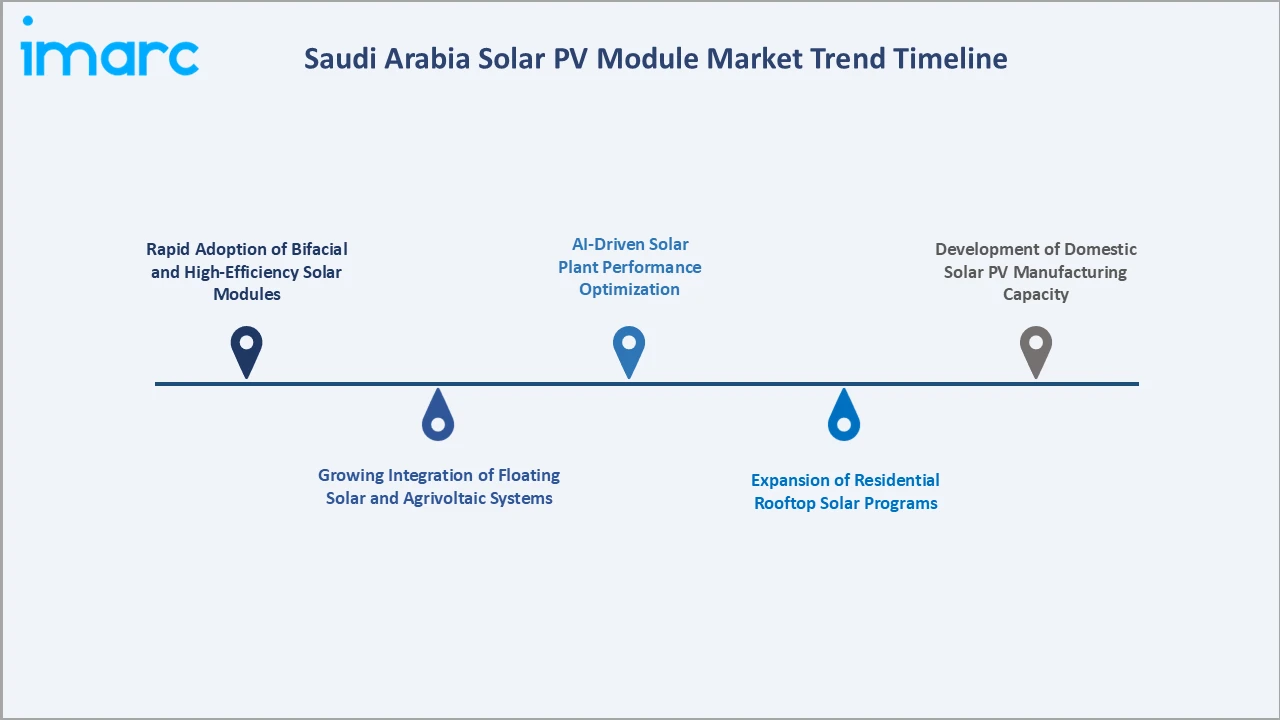
1. Rapid Adoption of Bifacial and High-Efficiency Solar Modules
Module manufacturers are advancing bifacial and n-type TOPCon technologies that capture reflected irradiance from both panel surfaces, improving energy yields in Saudi Arabia’s reflective desert terrain. This technology transition is accelerating adoption in utility-scale projects, where higher energy yields can support improved project economics and enhance the overall performance of solar installations.
2. Growing Integration of Floating Solar and Agrivoltaic Systems
Saudi Arabia is piloting floating solar installations on water reservoirs and agricultural agrivoltaic configurations to reduce land-use conflicts and improve water evaporation management in arid climates. These innovative deployment models are expanding the addressable market for solar PV modules beyond conventional ground-mount and rooftop configurations.
3. Expansion of Residential Rooftop Solar Programs
Government-backed residential solar financing programs and net metering regulations are enabling Saudi homeowners to install rooftop solar systems with greater financial flexibility. These initiatives lower barriers to residential solar adoption and encourage households to generate electricity through distributed solar systems, supporting continued demand for residential solar PV modules.
4. AI-Driven Solar Plant Performance Optimization
Solar plant operators in Saudi Arabia are deploying AI and IoT-based monitoring systems to optimize module cleaning schedules, predict soiling losses, and reduce preventive maintenance costs. These digital tools are improving plant availability factors and enabling more accurate energy yield forecasting.
5. Development of Domestic Solar PV Manufacturing Capacity
The Saudi government is actively supporting the establishment of domestic solar PV module manufacturing facilities to reduce import dependency and improve supply chain resilience. Several international module manufacturers have initiated joint venture discussions to establish Saudi-based production facilities aligned with local content mandates.
Industry Value Chain Analysis
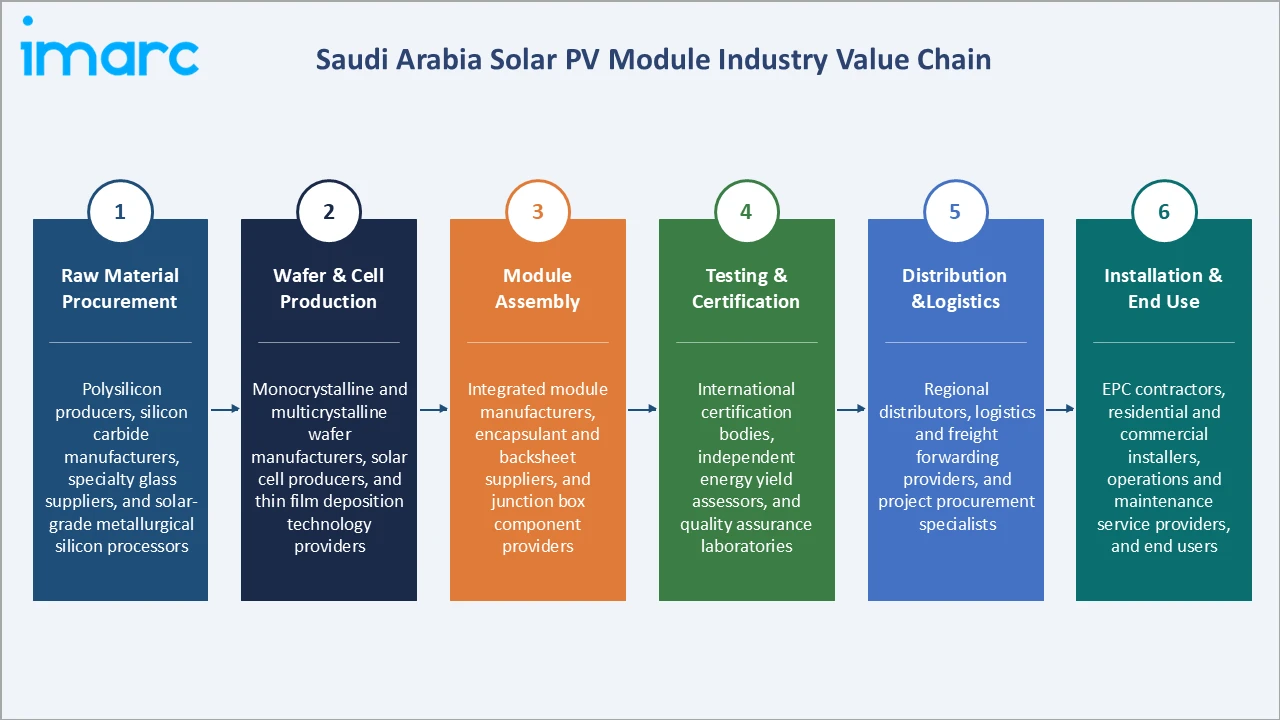
The Saudi Arabia solar PV module value chain spans six stages, from polysilicon and raw material procurement through end user installation and asset management. Module manufacturing, testing, and distribution capture the highest value-add, while post-installation operations and maintenance services increasingly determine long-term asset performance and competitive differentiation.
|
Stage |
Key Players / Examples |
|
Raw Material Procurement |
Polysilicon producers, silicon carbide manufacturers, specialty glass suppliers, and solar-grade metallurgical silicon processors |
|
Wafer & Cell Production |
Monocrystalline and multicrystalline wafer manufacturers, solar cell producers, and thin film deposition technology providers |
|
Module Assembly |
Integrated module manufacturers, encapsulant and backsheet suppliers, and junction box component providers |
|
Testing & Certification |
International certification bodies, independent energy yield assessors, and quality assurance laboratories |
|
Distribution & Logistics |
Regional distributors, logistics and freight forwarding providers, and project procurement specialists |
|
Installation & End Use |
EPC contractors, residential and commercial installers, operations and maintenance service providers, and end users |
Vertically integrated module manufacturers with in-house wafer and cell production capacity are positioned to capture superior margins compared to pure-play assemblers, particularly as Saudi Arabia's local content requirements increase preference for suppliers with established regional manufacturing presence.
Technology Landscape in the Saudi Arabia Solar PV Module Industry
Thin Film Technology
Thin film technology uses lightweight semiconductor materials deposited onto a substrate to form solar modules. Its flexible design, lower material requirements, and suitability for different installation conditions support its use across a range of solar PV applications. In Saudi Arabia, thin film modules can be deployed in both utility-scale and distributed solar installations, particularly where performance under high temperatures and varying environmental conditions is important.
Crystalline Silicon Technology
Monocrystalline and polycrystalline silicon modules remain widely used across the market, supported by continuous efficiency improvements and an established global supply chain. Bifacial monocrystalline modules are gaining traction in utility-scale projects as their ability to capture reflected sunlight from surrounding surfaces can enhance energy generation in high-albedo desert environments and improve overall project economics.
Advanced Cell Technologies
Next-generation technologies, including TOPCon, heterojunction (HJT), and perovskite-silicon tandem cells, are progressing toward broader commercial adoption in Saudi Arabia's large-scale solar project pipeline. These technologies offer higher conversion efficiency and improved energy generation potential, which can enhance site utilization and support lower balance-of-system costs in high-irradiance applications.
Smart Monitoring and Digital Integration
Solar PV installations across Saudi Arabia are increasingly integrating smart monitoring systems with real-time performance analytics, automated cleaning robot interfaces, and AI-driven soiling loss prediction models. These technologies help optimize system performance, identify operational issues, manage dust-related losses, and improve the efficiency of solar asset operation and maintenance.
Market Segmentation Analysis
The report covers the following segments:
|
Segment Category |
Leading Segment |
Market Share |
Year |
|
Technology |
Thin Film |
48.2% |
2025 |
|
Product Type |
Monocrystalline |
🔒 |
2025 |
|
Connectivity |
On-Grid |
🔒 |
2025 |
|
Mounting |
Ground Mounted |
🔒 |
2025 |
|
End Use |
Residential |
47.6% |
2025 |

By Technology
Thin film commands a 48.2% majority share in 2025, driven by its demonstrated performance advantages under high ambient temperatures and direct normal irradiance levels characteristic of Saudi Arabia's desert climate. The segment benefits from strong project-level economics, particularly in utility-scale installations where module degradation management directly impacts long-term revenue.
To access detailed market analysis, Request Sample
Crystalline silicon holds 43.6% share in 2025, supported by global supply chain depth, continuing efficiency improvements in bifacial monocrystalline modules, and established installer familiarity across residential and commercial rooftop applications in Saudi Arabia.
By End Use
Residential leads with a 47.6% share in 2025, reflecting the broad adoption of residential rooftop solar under Saudi Arabia's net metering framework and government-subsidized residential solar financing programs. Growing middle-class investment in energy efficiency and the declining cost of residential solar installations are sustaining strong segment momentum.
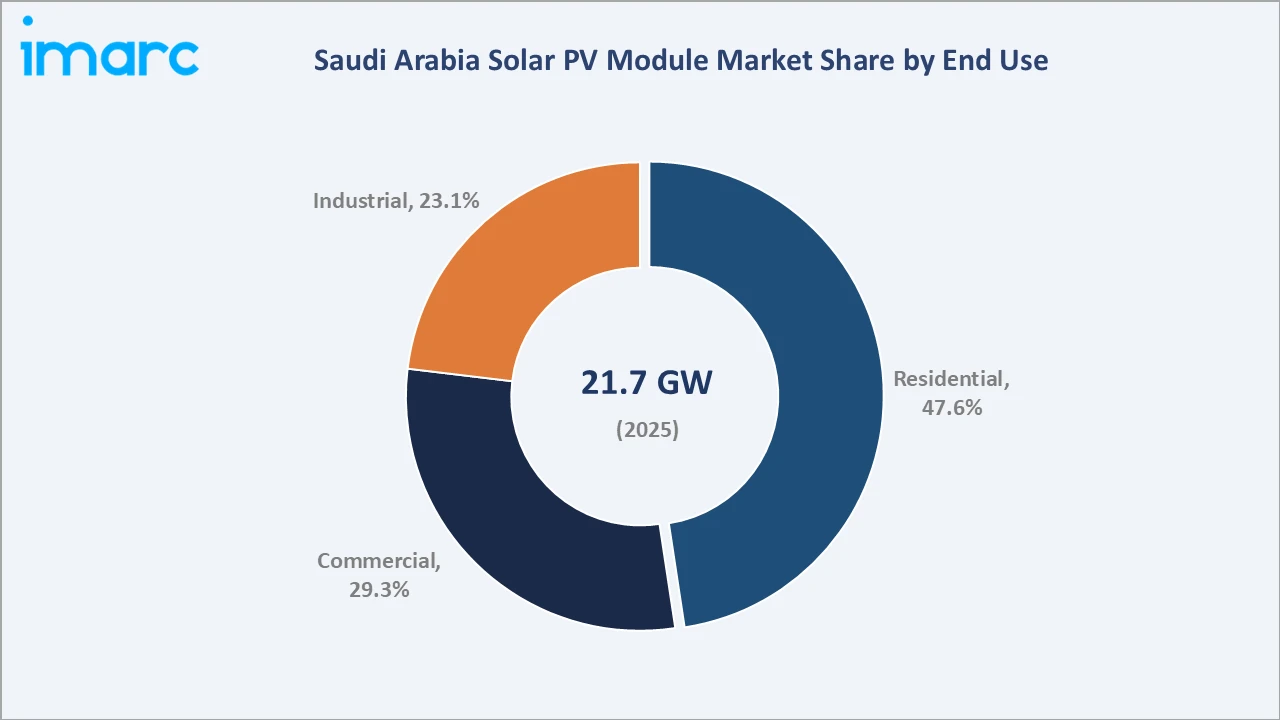
Commercial at 29.3% in 2025 encompasses retail, hospitality, education, and healthcare facilities progressively adopting solar to reduce commercial electricity expenditure, driven by improved module payback periods and corporate sustainability targets.
Competitive Landscape
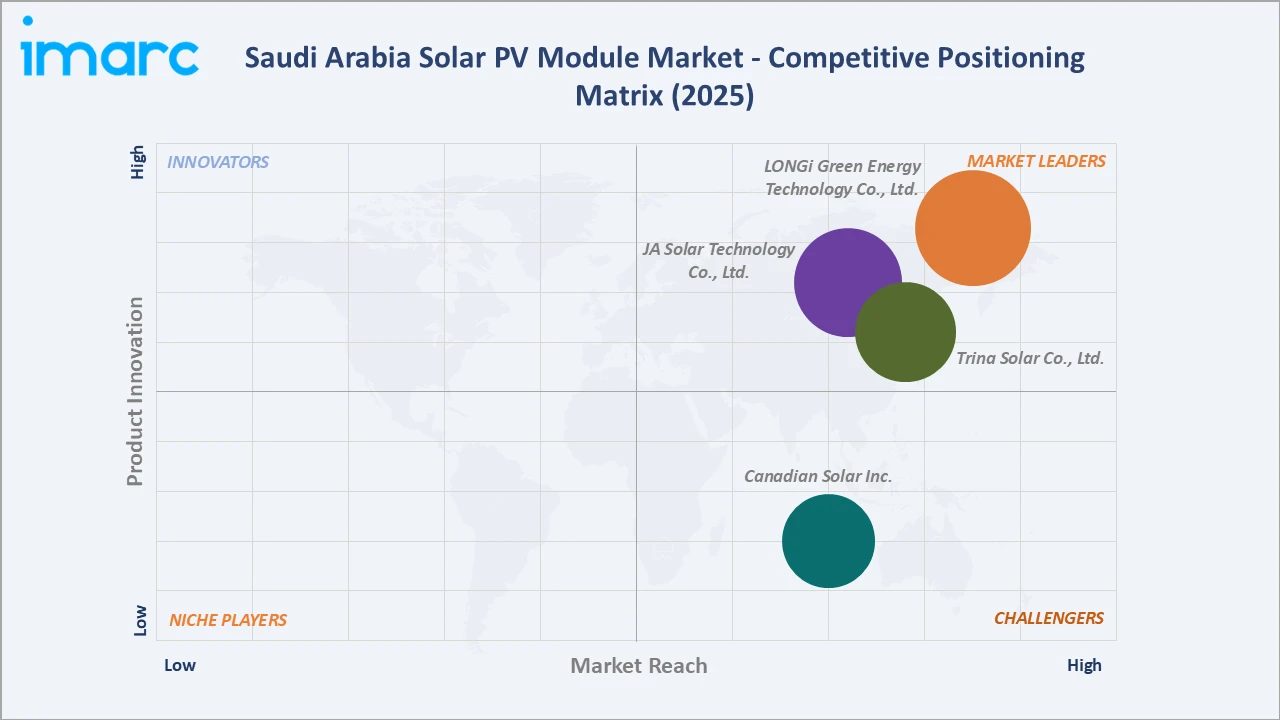
The Saudi Arabia solar PV module market is moderately fragmented, with global module manufacturers competing for large utility-scale tenders alongside regional distributors and emerging local assembly operations. Technology capability, supply chain reliability, after-sales service quality, and alignment with Saudi local content requirements form the key competitive differentiators.
|
Company Name |
Brand / Key Product |
Position |
Strategic Focus |
|
LONGi Green Energy Technology Co., Ltd. |
Hi-MO 9 / Hi-MO X10 |
Leader |
Expanding high-efficiency HPBC 2.0-powered module supply for utility-scale and distributed solar projects across Saudi Arabia |
|
JA Solar Technology Co., Ltd. |
DeepBlue 4.0 Pro / DeepBlue 5.0 |
Leader |
Growing module supply partnerships with Saudi EPC contractors and strengthening distribution network across Middle Eastern markets |
|
Trina Solar Co., Ltd. |
Vertex N / Vertex S+ Series |
Leader |
Expanding high-performance module offerings and strengthening partnerships with solar project developers and EPC contractors across Saudi Arabia |
|
Canadian Solar Inc. |
HiKu7, TOPBiHiKu7 |
Challenger |
Strengthening its presence in Saudi Arabia through advanced module solutions and partnerships supporting utility-scale and distributed solar projects |
Key players include LONGi Green Energy Technology Co., Ltd., JA Solar Technology Co., Ltd., Trina Solar Co., Ltd., and Canadian Solar Inc., among others.
Key Company Profiles
LONGi Green Energy Technology Co., Ltd.
LONGi Green Energy Technology Co., Ltd. is a China-based global leader in solar PV module manufacturing, with a broad international presence across utility-scale and distributed generation solar markets worldwide.
- Product Portfolio: Hi-MO 9 (utility-scale, high-efficiency back contact modules) and Hi-MO X10 (distributed generation and commercial rooftop applications), both based on the company's advanced HPBC 2.0 technology platform.
- Recent Developments: The company has been strengthening its global manufacturing and supply network to address the growing needs of utility-scale and distributed generation solar markets.
- Strategic Focus: Scaling its next-generation back contact module capabilities and deepening partnerships with utility-scale solar project developers and EPC contractors across international markets.
JA Solar Technology Co., Ltd.
JA Solar Technology Co., Ltd. is one of the world's leading solar PV module manufacturers, offering a broad portfolio of high-efficiency modules for utility-scale, commercial, and residential solar applications across international markets.
- Product Portfolio: DeepBlue 4.0 Pro and DeepBlue 5.0, targeting utility-scale and commercial solar project requirements with high power output and reliability.
- Recent Developments: The company has been expanding its module manufacturing capacity and international sales infrastructure to strengthen supply commitments to utility-scale and commercial solar projects across high-growth markets.
- Strategic Focus: Broadening its distribution network to capture rising solar module demand across emerging solar markets.
Trina Solar Co., Ltd.
Trina Solar Co., Ltd. is a global solar PV module manufacturer and smart energy solution provider, with manufacturing operations across multiple international locations and an established presence in the Saudi Arabia market.
- Product Portfolio: Vertex N Series and Vertex S+ Series, covering a broad range of power output requirements.
- Recent Developments: The firm has been strengthening its presence in the Saudi Arabia market through partnerships, project participation, and expansion of its local supply and manufacturing capabilities.
- Strategic Focus: Expanding manufacturing and project supply capabilities to deepen its presence across emerging markets.
Market Concentration Analysis
The Saudi Arabia solar PV module market is moderately fragmented, with the top global module manufacturers accounting for a substantial share of utility-scale project supply volumes. Market concentration is higher at the utility project supply level, where bankability requirements and local content compliance criteria favor established international manufacturers with proven large-scale delivery track records.
Barriers to entry include high capital requirements for module manufacturing scale, technical certification requirements under Saudi project specification standards, and increasing pressure from local content regulations that favor suppliers with Saudi-based assembly or manufacturing operations. These barriers are moderating new entrant competitive pressure while sustaining the competitive position of established global players.
Consolidation dynamics are emerging as global module manufacturers establish regional offices, warehousing, and technical service infrastructure in Saudi Arabia to improve customer proximity. Strategic partnerships between international module manufacturers and Saudi EPC contractors are shaping module supplier selection for new utility and commercial solar projects across the Kingdom.
Investment & Growth Opportunities
Fastest-Growing Segments
Residential is expanding fastest among end use categories, driven by Saudi Arabia's expanding net metering framework, residential solar financing programs, and growing homeowner awareness of rooftop solar economics.
Venture & Investment Trends
Investment is flowing into domestic solar module manufacturing initiatives supported by the Saudi Industrial Development Fund, green hydrogen solar supply chain development, and digital asset management platforms for Saudi solar installations. International private equity and infrastructure funds are also increasing exposure to Saudi Arabia's long-term contracted utility solar assets, enhancing overall project bankability and accelerating capacity expansion timelines.
Future Market Outlook (2026-2034)
The Saudi Arabia solar PV module market is forecast to expand from 21.7 GW in 2025 to 52.4 GW by 2034 at a CAGR of 9.99%, adding approximately 30.7 GW in incremental installed capacity over the forecast period.
Four forces will shape the market through 2034: continued utility-scale solar project deployment under Vision 2030 renewable energy targets; technology advancement in bifacial and high-efficiency module formats driving improved project economics; growing residential and commercial sector adoption supported by net metering expansion; and increasing domestic solar manufacturing investment reducing supply chain import dependency.
By 2034, the Saudi Arabia solar PV module market is expected to be defined by high-efficiency bifacial module formats achieving widespread adoption across utility and commercial segments, with thin film maintaining a competitive position in extreme-heat large-scale installations.
Research Methodology
Primary Research
Primary research included structured interviews with solar project developers, EPC contractors, module procurement specialists, energy ministry officials, and independent power producers, validating market sizing, technology adoption trends, and segment demand patterns in Saudi Arabia.
Secondary Research
Secondary sources included Saudi Ministry of Energy publications, Saudi Power Procurement Company project announcements, International Renewable Energy Agency reports, the National Renewable Energy Program documentation, and annual reports and investor presentations from listed solar module manufacturers active in the Saudi market.
Forecasting Models
Market forecasts used top-down and bottom-up modeling combining Saudi Arabia installed solar capacity projections, government tender pipeline data, segment adoption rates, and macroeconomic variables. Scenario analysis incorporated renewable energy policy developments, module cost trajectory assumptions, and grid integration investment timelines.
Report Coverage:
| Report Features | Details |
|---|---|
| Base Year of the Analysis | 2025 |
| Historical Period | 2020-2025 |
| Forecast Period | 2026-2034 |
| Units | GW |
| Scope of the Report | Exploration of Historical and Forecast Trends, Industry Catalysts and Challenges, Segment-Wise Historical and Predictive Market Assessment:
|
| Technologies Covered | Thin Film, Crystalline Silicon, Others |
| Product Types Covered | Monocrystalline, Polycrystalline, Cadmium Telluride, Amorphous Silicon, Others |
| Connectivities Covered | On-Grid, Off-Grid |
| Mountings Covered | Ground Mounted, Roof-Top |
| End Uses Covered | Residential, Commercial, Industrial |
| Companies Covered | LONGi Green Energy Technology Co., Ltd., JA Solar Technology Co., Ltd., Trina Solar Co., Ltd., Canadian Solar Inc., etc. |
| Customization Scope | 10% Free Customization |
| Post-Sale Analyst Support | 10-12 Weeks |
| Delivery Format | PDF and Excel through Email (We can also provide the editable version of the report in PPT/Word format on special request) |
Frequently Asked Questions About the Saudi Arabia Solar PV Module Market Report
The Saudi Arabia solar PV module market reached a volume of 21.7 GW in 2025, driven by Vision 2030 renewable energy targets, declining module costs, and expanding residential and utility-scale solar project deployment.
The market is projected to grow at a CAGR of 9.99% from 2026-2034, reaching 52.4 GW, supported by large-scale utility project pipelines and growing residential solar adoption.
Thin film leads the technology segment at 48.2% in 2025, driven by superior performance under Saudi Arabia's high ambient temperatures and intense solar irradiance conditions.
Residential dominates the end use at 47.6% in 2025, supported by Saudi Arabia's net metering framework, government residential solar financing programs, and declining installation costs.
Leading players include LONGi Green Energy Technology Co., Ltd., JA Solar Technology Co., Ltd., Trina Solar Co., Ltd., and Canadian Solar Inc., among others.
Vision 2030 establishes the overarching policy and financing framework driving Saudi Arabia's solar PV market expansion, committing the government to major renewable capacity targets and providing the demand certainty required to attract international module manufacturers and project developers.
Key opportunities include NEOM and giga-project solar integration, green hydrogen solar supply development, domestic module manufacturing initiatives, and expanding residential rooftop solar adoption under net metering and financing support programs.
Key challenges include grid integration complexity at high solar penetration levels, dust accumulation and heat-driven module degradation, import dependency for key components, and evolving local content requirements for solar project supply chains.
Need more help?
- Speak to our experienced analysts for insights on the current market scenarios.
- Include additional segments and countries to customize the report as per your requirement.
- Gain an unparalleled competitive advantage in your domain by understanding how to utilize the report and positively impacting your operations and revenue.
- For further assistance, please connect with our analysts.
 Request Customization
 Speak to an Analyst
 Request Brochure
 Inquire Before Buying
Benefits of Customization
- Personalize this research
- Triangulate with your data
- Get data as per your format and definition
- Gain a deeper dive into a specific application, geography, customer, or competitor
- Any level of personalization
Get in Touch With Us
UNITED STATES
Phone: +1-201-971-6302
INDIA
Phone: +91-120-433-0800
UNITED KINGDOM
Phone: +44-753-714-6104
Email: [email protected]
Client Testimonials




.webp)




.webp)













Related Reports

Choose your plan
*Please note that the prices mentioned below are starting prices for each bundle type. Kindly contact our team for further details.*
Single User License
- 1 User License, Access on 2 Devices
- PDF Report + Excel Dataset (Password Protected)
- Lifetime Access
- No Printing Rights
- 10% Free Report Customization
- 10–12 Weeks of Analyst Support
Five User License
- Access for 5 Users, 2 Devices per User
- PDF Report + Excel Dataset (Password Protected)
- Lifetime Access
- Dedicated Account Manager
- 12–14 Weeks of Analyst Support
- No Printing Rights
- 15% Free Report Customization
- 25% Discount on Your Next Purchase
Corporate User License
- Unlimited User Access (Within Your Organization)
- PDF Report + Excel Dataset
- Lifetime Access
- Dedicated Account Manager
- 14–20 Weeks of Analyst Support
- No Printing Rights
- 20% Free Report Customization
- 30% Discount on Your Next Purchase
Essential Insights
What's included:
3 reports
- Lifetime Access
- PDF Reports
- Excel Datasets
- 2 Weeks of Free Analyst Support
- 2 User Licenses
- Access on 2 Devices
- Printing Rights
- Complimentary PowerPoint (PPT) Version
- Complimentary License Upgrade
Professional Access
What's included:
5 reports
- Lifetime Access
- PDF Reports
- Excel Datasets
- 8 Weeks of Free Analyst Support
- 2 User Licenses
- Access on 2 Devices
- Printing Rights
- Complimentary PowerPoint (PPT) Version
- Complimentary License Upgrade
Business Advantage
What's included:
8 reports
- Lifetime Access
- PDF Reports
- Excel Datasets
- 14 Weeks of Free Analyst Support
- 2 User Licenses
- Access on 2 Devices
- Printing Rights
- Complimentary PowerPoint (PPT) Version
- Complimentary License Upgrade
Enterprise Intelligence
What's included:
10 reports
- Lifetime Access
- PDF Reports
- Excel Datasets
- 20 Weeks of Free Analyst Support
- 2 User Licenses
- Access on 2 Devices
- Printing Rights
- Complimentary PowerPoint (PPT) Version
- Complimentary License Upgrade