
Solar Farm Market Size, Share, Trends and Forecast by Type, End Use Industry, and Region, 2026-2034
Solar Farm Market Size, Share, Trends & Forecast (2026-2034)
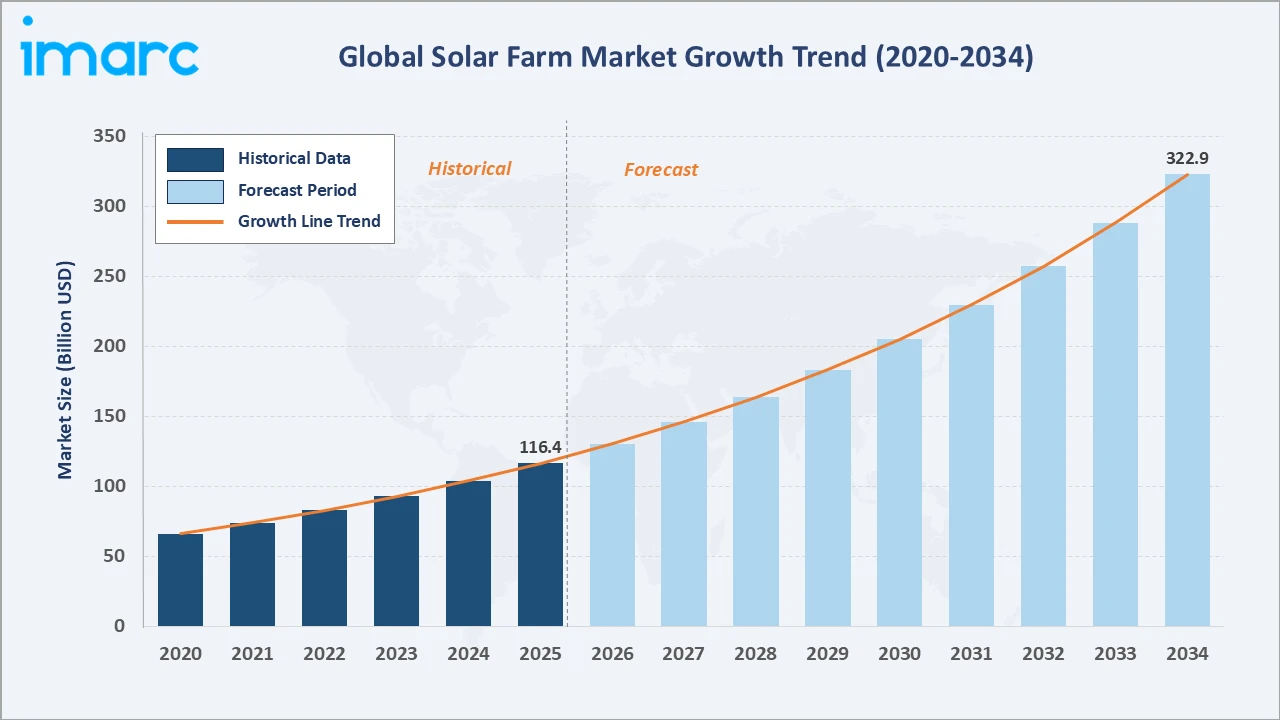
The global solar farm market reached USD 116.4 Billion in 2025 and is estimated at USD 130.3 Billion in 2026. It is projected to reach USD 322.9 Billion by 2034, growing at a CAGR of 12.01% during 2026-2034, supported by declining solar costs and decarbonization targets.
Rising electricity demand, corporate clean energy procurement, and advances in high-efficiency modules and energy storage are further supporting market growth. Utility-scale leads types at 58.0%. Commercial leads end use industries at 35.0%. Asia-Pacific commands 40.0% of the global market share.
Market Snapshot
| Metric | Value |
|---|---|
| Base Year Market Size (2025) | USD 116.4 Billion |
| Market Size (2026) | USD 130.3 Billion |
| Forecast Market Size (2034) | USD 322.9 Billion |
| CAGR (2026-2034) | 12.01% |
| Base Year | 2025 |
| Historical Period | 2020-2025 |
| Forecast Period | 2026-2034 |
| Dominant Type | Utility-scale (58.0%, 2025) |
| Dominant End Use Industry | Commercial (35.0%, 2025) |
| Leading Region | Asia-Pacific (40.0%, 2025) |
The global solar farm market size increased from USD 66.0 Billion in 2020 to USD 116.4 Billion in 2025 and is estimated to reach USD 130.3 Billion in 2026. The market is further expected to grow to USD 205.2 Billion by 2030 and USD 322.9 Billion by 2034.
To get more information on this market, Request Sample
The global solar farm market combines large-scale utility projects, distributed installations, and hybrid microgrids across developed and emerging economies. Module manufacturers, project developers, utilities, independent power producers, and EPC contractors are expanding capacity to meet growing clean electricity demand worldwide.
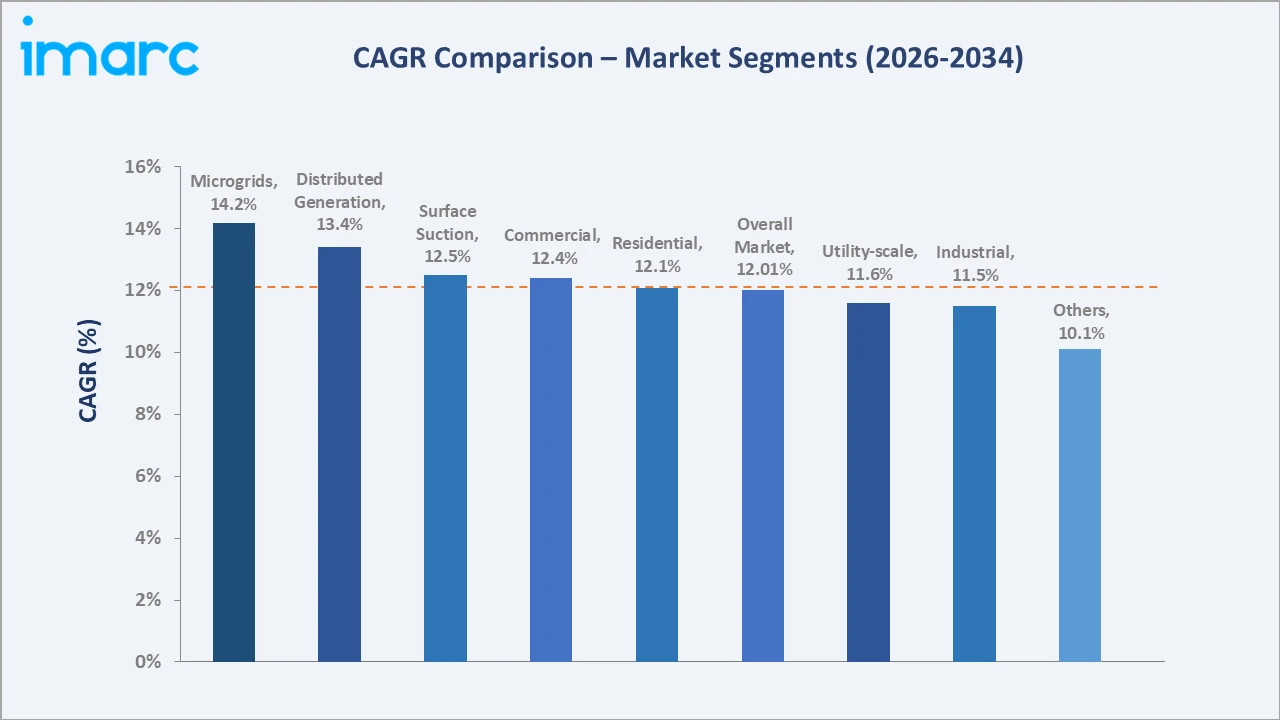
Microgrids grow fastest at ~14.2% CAGR as remote communities, campuses, and industrial sites adopt solar-plus-storage systems. Distributed generation advances at ~13.4% CAGR through rooftop and community solar, while surface suction systems grow at ~12.5% CAGR through flexible, non-penetrating installation approaches.
Commercial end use grows at ~12.4% CAGR through corporate clean energy targets, residential at ~12.1% CAGR through community and shared solar programs, and industrial at ~11.5% CAGR. Utility-scale grows at ~11.6% CAGR from a large base, while others advance at ~10.1% CAGR.
Executive Summary
The global solar farm market expanded from USD 116.4 Billion in 2025 to an estimated USD 130.3 Billion in 2026, reflecting strong investment in clean power generation. Solar farms have become one of the lowest-cost sources of new electricity in many countries, driving rapid capacity additions worldwide.
Market growth is underpinned by declining module and system costs, national decarbonization commitments, energy security priorities, and rising electricity demand from electrification and digital infrastructure. Utilities, corporations, and governments increasingly view solar farms as reliable, scalable, and cost-competitive generation assets.
The market is projected to reach USD 322.9 Billion by 2034. Utility-scale at 58.0% leads through large grid-connected projects. Commercial at 35.0% reflects corporate clean energy procurement. Asia-Pacific leads regionally at 40.0%.
Key Market Insights
| Insight | Data |
|---|---|
| Dominant Type | Utility-scale - 58.0% share (2025) |
| Dominant End Use Industry | Commercial - 35.0% market share (2025) |
| Leading Region | Asia-Pacific - 40.0% share (2025) |
| Market Opportunity | Solar-plus-storage hybrid farms; agrivoltaics and floating solar; corporate power purchase agreements; microgrids for remote and off-grid communities |
Key Analytical Observations Supporting the Above Data:
- Utility-scale at 58.0%: Utility-scale solar farms dominate as governments and utilities deploy large grid-connected projects to meet renewable energy targets. Economies of scale, competitive auctions, single-axis trackers, and bifacial modules make utility-scale projects among the lowest-cost sources of new electricity generation.
- Commercial at 35.0%: Commercial end use dominates as businesses, retailers, data centers, and service providers adopt solar power to reduce electricity costs and meet sustainability goals. Corporate power purchase agreements and on-site or offsite solar farms support long-term, predictable clean energy supply.
- Asia-Pacific at 40.0%: Asia-Pacific dominates regionally due to large-scale solar deployment in China, India, Japan, Australia, and Southeast Asia. Strong manufacturing bases, supportive government policies, abundant solar resources, and rapidly rising electricity demand sustain the region’s leadership in solar farm capacity additions.
Solar Farm Market Overview
The global solar farm market sits at the intersection of energy transition policies, falling technology costs, and growing electricity demand. Solar farms convert sunlight into electricity using photovoltaic modules, inverters, mounting structures, and grid connection infrastructure, serving utilities, businesses, and communities.
Project configurations differ across applications. Utility-scale farms feed large volumes of power into transmission networks, distributed generation projects serve local loads and communities, and microgrids combine solar with storage to provide reliable power for remote sites, campuses, and critical facilities.
The global solar farm ecosystem integrates polysilicon and wafer producers, cell and module manufacturers, inverter and tracker suppliers, project developers, EPC contractors, financiers, utilities, and asset managers. Macroeconomic factors include energy security concerns, climate commitments, interest rates, and electricity price trends.
The market operates within frameworks of renewable energy targets, competitive auctions, feed-in tariffs, tax incentives, and grid interconnection rules. Technical standards for modules, inverters, and grid compliance ensure safety and reliability, while local content and trade policies influence equipment sourcing decisions.
Market Dynamics
To evaluate market opportunities, Request Sample
Market Drivers
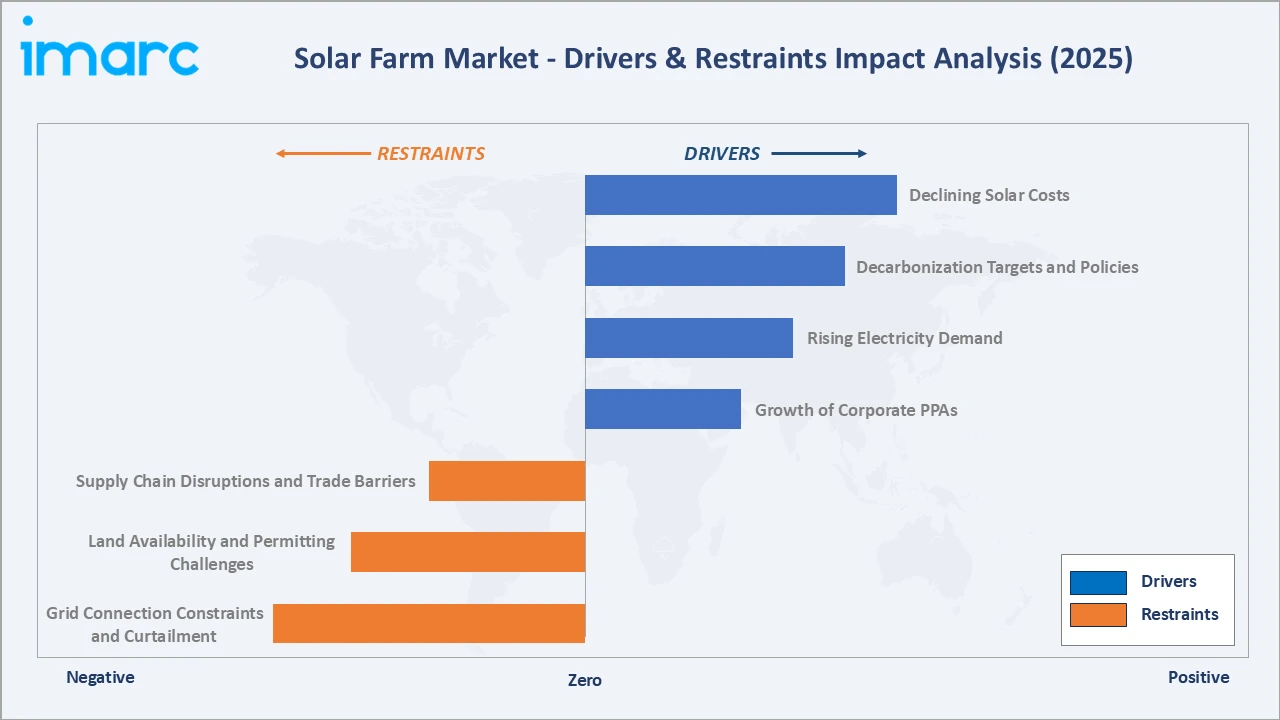
- Declining Solar Costs and Competitive Energy Prices: Continuous reductions in module, inverter, and installation costs have made solar farms one of the most cost-competitive sources of new electricity. Higher module efficiencies and larger project scales further improve economics, encouraging utilities and investors to expand solar capacity.
- Decarbonization Targets and Supportive Policies: National net-zero commitments, renewable energy targets, auctions, tax incentives, and carbon pricing mechanisms are accelerating solar farm development. Governments increasingly rely on solar power to reduce emissions, diversify energy supply, and strengthen long-term energy security.
- Rising Electricity Demand from Electrification and Data Centers: Growing electricity consumption from electric vehicles, heat pumps, industrial electrification, and data centers is increasing demand for new generation capacity. Solar farms offer fast deployment timelines and scalable capacity, making them attractive for meeting rising power needs.
- Growth of Corporate Power Purchase Agreements: Corporations are increasingly signing long-term power purchase agreements to secure clean electricity at predictable prices. These agreements provide stable revenue for project developers, support financing of new solar farms, and help companies achieve sustainability and emission reduction targets.
Market Restraints
- Grid Connection Constraints and Curtailment Risks: Limited transmission capacity, long interconnection queues, and grid congestion delay project commissioning in many markets. Curtailment during periods of high solar output reduces project revenues and highlights the need for grid upgrades and energy storage integration.
- Land Availability and Permitting Challenges: Large solar farms require significant land areas, which can face competition from agriculture, conservation, and community concerns. Lengthy permitting processes, environmental assessments, and local opposition can delay project timelines and increase development costs.
- Supply Chain Disruptions and Trade Barriers: Concentrated manufacturing of polysilicon, wafers, and modules exposes the industry to supply chain disruptions and trade measures. Tariffs, import restrictions, and local content rules can affect equipment availability, pricing, and project schedules in several markets.
Market Opportunities
- Solar-Plus-Storage Hybrid Projects: Combining solar farms with battery energy storage allows projects to shift output to peak demand periods, reduce curtailment, and provide grid services. Hybrid projects create significant opportunities for developers, equipment suppliers, and system integrators worldwide.
- Agrivoltaics and Floating Solar: Agrivoltaic systems combine crop production with solar generation, while floating solar uses reservoirs and water bodies. These approaches address land constraints, improve land-use efficiency, and open new development opportunities in densely populated and agricultural regions.
Market Challenges
- Intermittency and Grid Integration: Solar generation varies with weather and time of day, requiring grid flexibility, forecasting, and balancing resources. Integrating large volumes of solar power requires investment in storage, transmission, and advanced grid management systems to maintain reliability.
- End-of-Life Module Management: Growing installed capacity will create large volumes of retired modules in coming decades. Developing cost-effective recycling, material recovery, and circular supply chains is essential to manage waste, recover valuable materials, and meet environmental regulations.
Emerging Market Trends
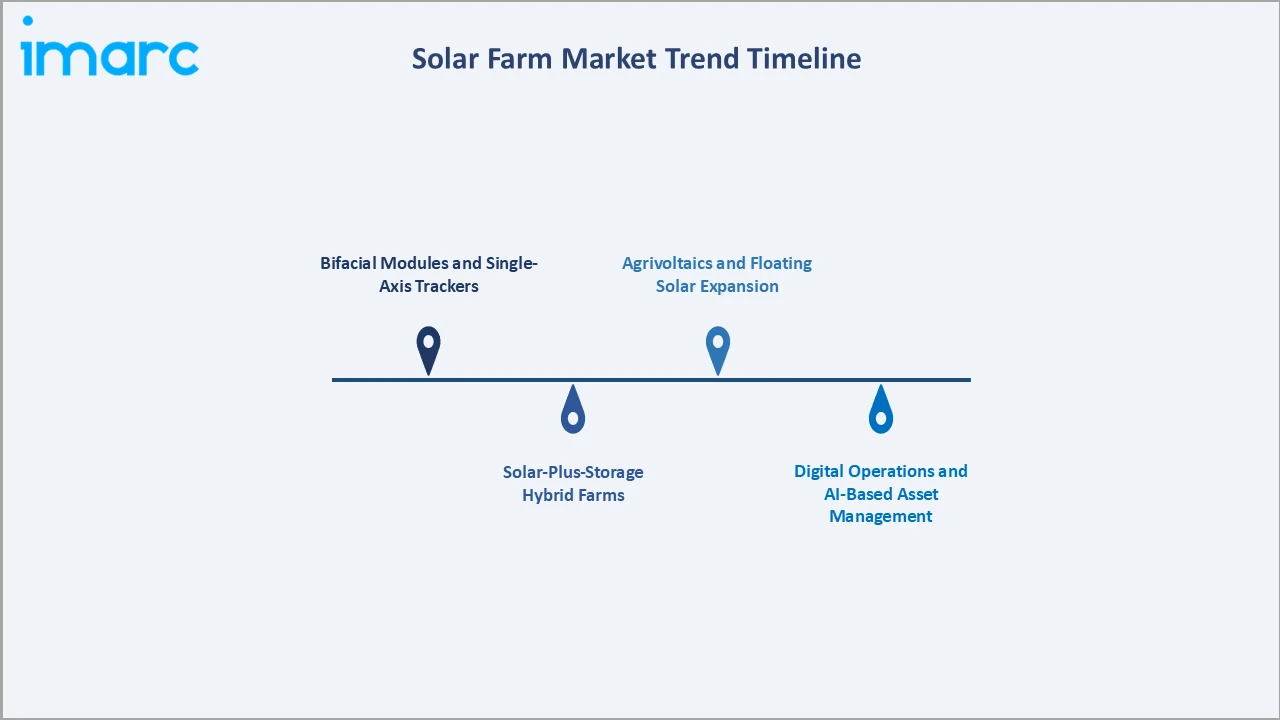
1. Bifacial Modules and Single-Axis Trackers
Bifacial modules that capture light on both sides, combined with single-axis trackers that follow the sun, are becoming standard in utility-scale projects. This combination increases energy yield per installed capacity, improves project economics, and maximizes land-use efficiency across diverse locations.
2. Solar-Plus-Storage Hybrid Farms
Developers are increasingly pairing solar farms with battery energy storage systems to deliver dispatchable power, reduce curtailment, and capture higher-value evening electricity prices. Hybrid configurations are becoming common in competitive auctions and corporate power purchase agreements worldwide.
3. Agrivoltaics and Floating Solar Expansion
Agrivoltaic installations and floating solar projects are expanding as land availability becomes more constrained. These configurations allow dual land use, reduce water evaporation, improve module cooling, and support community acceptance in regions with limited open land.
4. Digital Operations and AI-Based Asset Management
Solar farm operators are adopting drones, sensors, digital twins, and AI-based analytics to monitor performance, detect faults, and optimize maintenance. Digital asset management improves energy yield, reduces downtime, and lowers operating costs across large and geographically distributed project portfolios.
Industry Value Chain Analysis
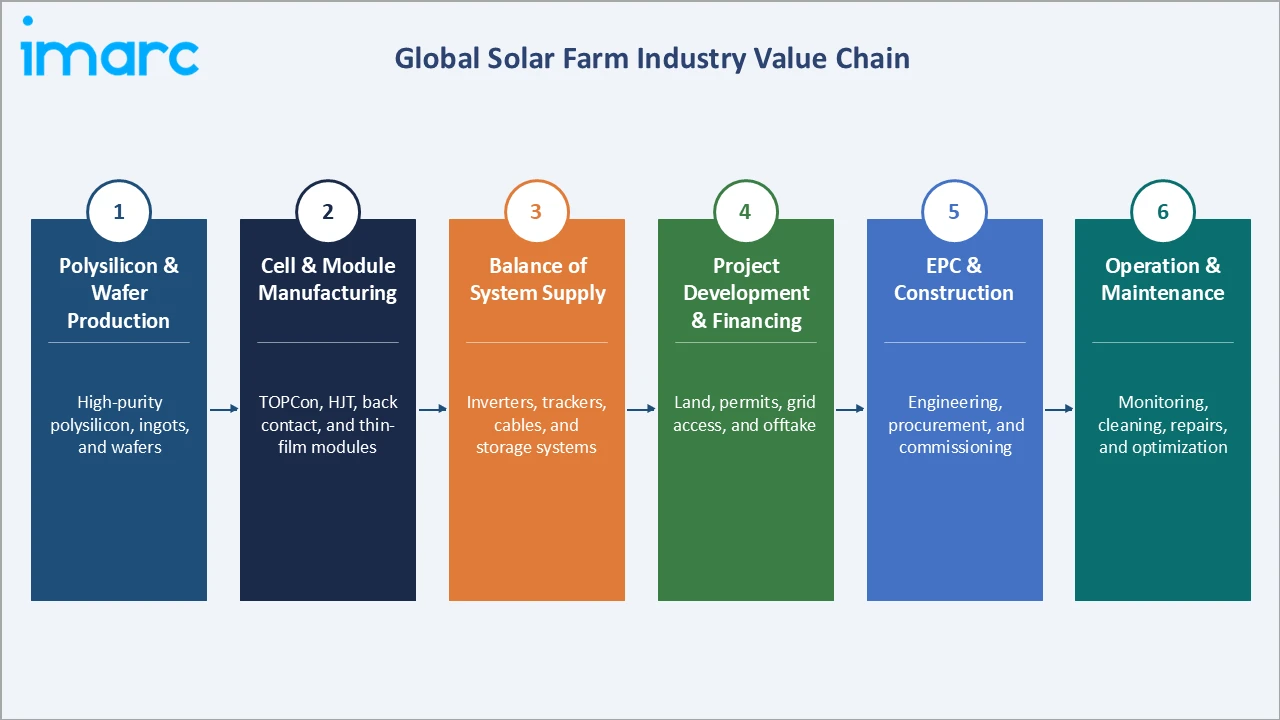
The global solar farm market value chain spans polysilicon and wafer production, cell and module manufacturing, balance of system supply, project development and financing, engineering and construction, and long-term operation. Each stage requires coordination between manufacturers, developers, financiers, contractors, and grid operators.
| Stage | Key Participants |
|---|---|
| Polysilicon & Wafer Production | Producers of high-purity polysilicon, ingots, and wafers supplying cell manufacturers |
| Cell & Module Manufacturing | Manufacturers producing TOPCon, HJT, back contact, and thin-film modules for solar farms |
| Balance of System Supply | Suppliers of inverters, trackers, mounting structures, cables, transformers, and storage systems |
| Project Development & Financing | Developers, independent power producers, utilities, and financiers securing land, permits, and offtake |
| EPC & Construction | Engineering, procurement, and construction contractors building and commissioning solar farms |
| Operation & Maintenance | O&M providers and asset managers handling monitoring, cleaning, repairs, and performance optimization |
Project development and financing is the most strategically consequential stage, as land, permits, grid connection, and offtake agreements determine project viability. Module manufacturing adds significant value through efficiency improvements, while operation and maintenance shapes long-term energy yield and asset performance.
Balance of system supply also plays a decisive role, as inverters, trackers, and storage systems influence project efficiency, reliability, and grid compliance. Integrated suppliers offering complete solar and storage solutions are gaining importance as projects become larger and more complex.
Technology Landscape in the Global Solar Farm Industry
High-Efficiency Cell Technologies
Solar farms increasingly use high-efficiency n-type cell technologies such as TOPCon, heterojunction, and back contact designs, alongside thin-film alternatives. These technologies deliver higher conversion efficiency, better temperature performance, and lower degradation, while perovskite tandem cells are emerging as a next-generation efficiency pathway.
Trackers, Bifacial Modules and Smart Inverters
Single-axis trackers, bifacial modules, and smart inverters are improving energy yield and grid compatibility. Advanced tracking algorithms optimize panel angles, while grid-forming inverters provide voltage and frequency support, enabling solar farms to contribute to grid stability as renewable penetration rises.
Energy Storage Integration and Digital Asset Management
Battery energy storage systems, energy management software, and digital monitoring platforms are transforming solar farm operations. Integrated storage enables dispatchable output, while AI-based analytics, drones, and digital twins support predictive maintenance, performance optimization, and efficient management of large project portfolios.
Market Segmentation Analysis
The report covers the following segments:
| Segment Category | Leading Segment | Market Share | Year |
|---|---|---|---|
| Type | Utility-scale | 58.0% | 2025 |
| End Use Industry | Commercial | 35.0% | 2025 |
| Region | Asia-Pacific | 40.0% | 2025 |

By Type
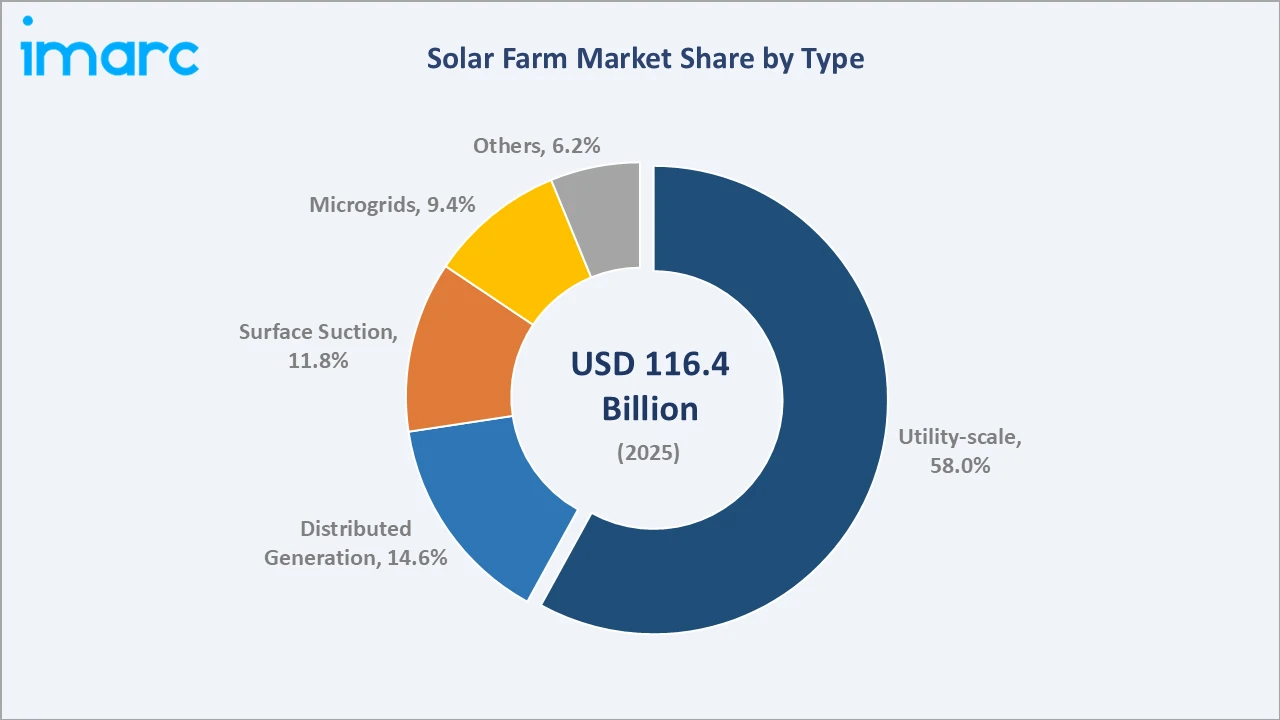
Utility-scale leads at 58.0% (2025). The segment benefits from large grid-connected projects procured through competitive auctions and long-term contracts. Economies of scale, advanced trackers, and high-efficiency modules make utility-scale farms highly cost-competitive for utilities and independent power producers worldwide.
To access detailed market analysis, Request Sample
Utility-scale projects are also increasingly integrating battery storage and grid-support technologies, allowing them to provide firm capacity and ancillary services. Larger project sizes and hybrid configurations continue to strengthen this segment’s role in national electricity systems.
Distributed generation holds 14.6% through community and rooftop-connected projects. Surface suction systems account for 11.8% using non-penetrating mounting approaches, while microgrids at 9.4% grow fastest at ~14.2% CAGR through remote and resilience applications. Others account for 6.2%.
Type preferences vary by region and grid conditions. Markets with strong transmission networks favor utility-scale projects, while regions with weak grids, islands, and remote communities increasingly adopt distributed generation and microgrids to improve energy access and reliability.
By End Use Industry
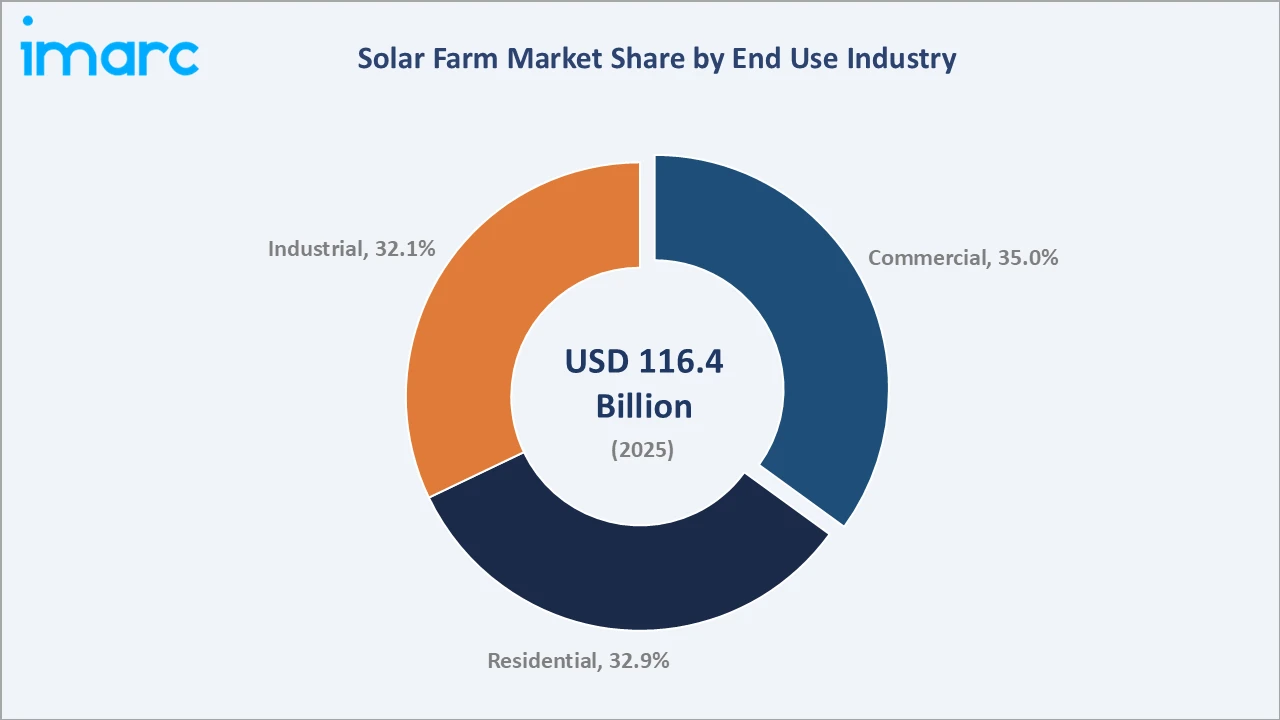
Commercial leads at 35.0% (2025). Businesses, retailers, data centers, and institutions adopt solar farm power through corporate power purchase agreements and dedicated projects. Cost savings, price stability, and sustainability commitments drive strong commercial demand for clean electricity supply.
Commercial demand is further supported by growing corporate reporting requirements and science-based emission targets. Companies with large electricity footprints increasingly secure long-term solar contracts to stabilize energy costs and demonstrate measurable progress toward sustainability goals.
Residential holds 32.9%, supported by community solar programs and utility-scale supply to household electricity users. Industrial accounts for 32.1%, driven by manufacturing plants, mining operations, and energy-intensive facilities seeking reliable, low-cost renewable power to reduce operating costs and emissions.
The relatively balanced split across end uses reflects the broad applicability of solar farm power. Utilities supply residential customers, while commercial and industrial users increasingly contract directly with project developers, supporting diversified demand across the forecast period.
Regional Market Insights
| Region | Share (2025) | Key Global Solar Farm Market Drivers & Characteristics |
|---|---|---|
| Asia-Pacific | 40.0% | Driven by large-scale deployment in China, India, Japan, and Australia, strong manufacturing bases, and supportive policies. |
| Europe | 21.4% | Supported by climate targets, energy security priorities, and solar expansion in Germany, Spain, Italy, and France. |
| North America | 17.9% | Driven by utility-scale projects in the United States, corporate power purchase agreements, and domestic manufacturing growth. |
| Latin America | 11.6% | Supported by strong solar resources in Brazil, Mexico, and Chile, and competitive renewable energy auctions. |
| Middle East and Africa | 9.1% | Driven by giga-scale projects in the Gulf region, excellent solar irradiation, and energy diversification strategies. |
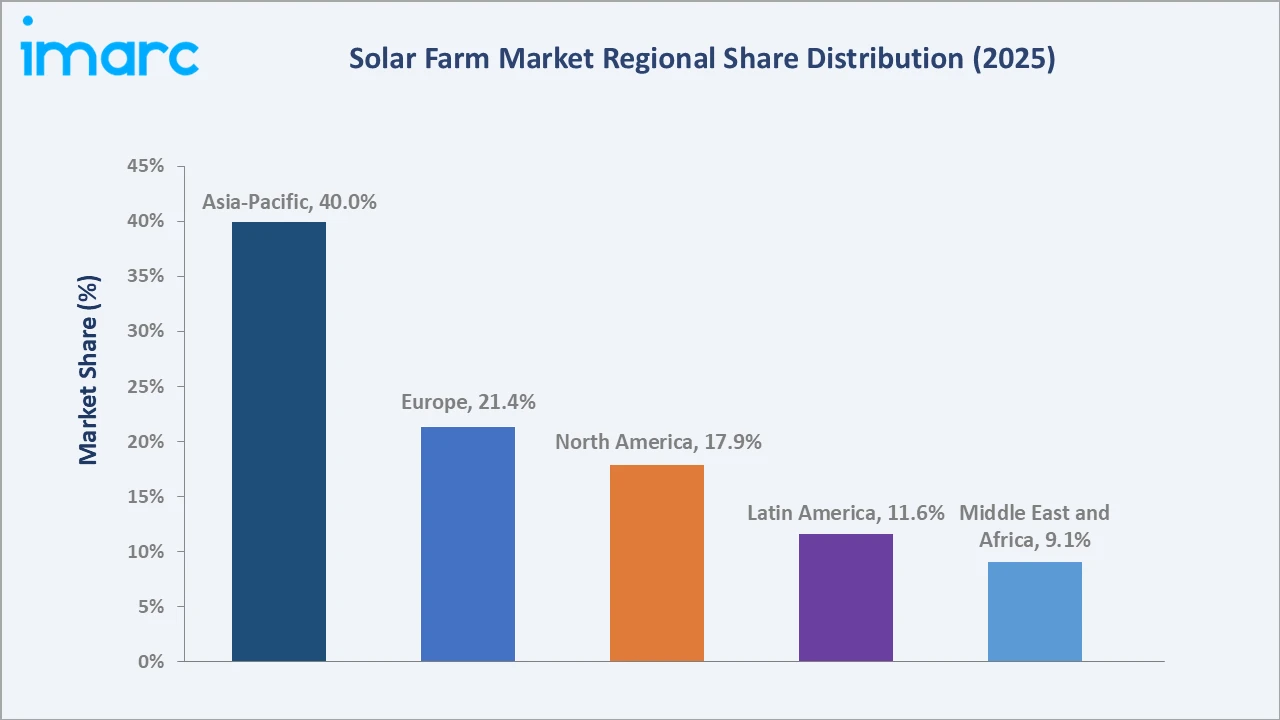
Asia-Pacific's 40.0% market leadership reflects China’s position as the world’s largest solar market, India’s ambitious renewable targets, and expanding deployment across Southeast Asia and Australia. Europe's 21.4% reflects decarbonization goals, energy security priorities, and strong utility-scale and distributed solar growth.
Regional growth is also shaped by solar resources and policy frameworks. High-irradiation regions offer attractive project economics, while markets with stable auctions, clear interconnection rules, and corporate procurement programs attract the largest share of international solar farm investment.
North America's 17.9% is supported by large utility-scale projects and corporate procurement. Latin America's 11.6% reflects excellent solar resources and competitive auctions, while the Middle East and Africa, at 9.1%, benefit from giga-scale projects and energy diversification strategies in Gulf countries.
Emerging regions are expected to gain share over the forecast period as financing access improves, grid infrastructure expands, and governments launch large renewable energy programs. Africa and Southeast Asia, in particular, offer significant potential for utility-scale farms, distributed generation, and solar-powered microgrids.
Competitive Landscape
The global solar farm market competitive landscape is moderately concentrated among leading module manufacturers, combined with integrated developers and utilities that build and operate large solar farms. Competition is intensifying through high-efficiency module launches, capacity expansions, localized manufacturing, and integrated solar-plus-storage offerings.
| Company | Key Brands | Market Position | Core Strength |
|---|---|---|---|
| LONGi | Hi-MO | Market Leader | Leading monocrystalline and back contact module technology at large scale. |
| Jinko Solar | Tiger Neo | Market Leader | High-volume n-type TOPCon module supply to utility-scale projects worldwide. |
| JA Technology Co., Ltd. | DeepBlue | Market Leader | Vertically integrated high-efficiency module manufacturing and global reach. |
| Canadian Solar | TOPBiHiKu, HiKu | Strong Challenger | Module manufacturing combined with project development and storage solutions. |
| First Solar | Series 6, Series 7 | Innovator | Thin-film cadmium telluride modules with growing US manufacturing footprint. |
| Hanwha Group | Qcells | Innovator | Integrated solar manufacturing and solutions across the United States and Asia. |
| Enel SpA | Enel Green Power | Niche Player | Global renewable developer operating large utility-scale solar portfolios. |
The competitive landscape's most significant dynamic is the race for technology leadership in high-efficiency cells while managing intense price competition. Manufacturers compete on efficiency, reliability, bankability, and supply localization, while developers compete on project pipelines, financing, and grid access.
Strategic priorities across leading participants include launching next-generation TOPCon, heterojunction, and back contact modules, expanding manufacturing in key demand markets, integrating energy storage, strengthening project development capabilities, and investing in recycling and low-carbon manufacturing processes.
Key Company Profiles
First Solar
First Solar is a leading US-headquartered solar technology company and manufacturer of thin-film cadmium telluride photovoltaic modules, supplying utility-scale and commercial solar projects through manufacturing facilities in the United States, India, Malaysia, and Vietnam.
- Key Brands: Series 6, Series 6 Plus, Series 7, among others.
- Recent Developments: In October 2026, First Solar inaugurated the first phase of its new manufacturing facility in Gaffney, South Carolina. The facility onshores final production processes for Series 6 Plus modules and will add 3.7 GW of annual US manufacturing capacity.
- Strategic Focus: Expanding US-based thin-film module manufacturing and advancing next-generation cell technologies for utility-scale solar.
LONGi
LONGi is a global solar technology company and one of the largest producers of monocrystalline silicon wafers, cells, and modules, serving utility-scale, commercial, and residential solar markets worldwide.
- Key Brands: Hi-MO, Hi-MO X, EcoLife.
- Recent Developments: In June 2026, LONGi launched its Hi-MO 9 Prime module series at Intersolar Europe. Built on HPBC 2.0 back contact cell architecture, the module targets utility-scale projects with up to 680 W output and 25.2% efficiency.
- Strategic Focus: Advancing back contact module technology and integrated solar-plus-storage solutions for utility-scale and distributed markets.
Canadian Solar
Canadian Solar is a global solar and energy storage company that manufactures solar modules and battery systems and develops utility-scale solar and storage projects across North America, Latin America, Europe, and Asia-Pacific.
- Key Brands: TOPBiHiKu, HiKu, SolBank.
- Recent Developments: In July 2026, Canadian Solar’s US subsidiary CS PowerTech opened the first phase of its heterojunction solar cell factory in Jeffersonville, Indiana, which is expected to exceed 6 GW of annual cell capacity at full buildout and supply its Texas module plant.
- Strategic Focus: Building a vertically integrated North American supply chain and expanding solar and storage project development.
Market Concentration Analysis
The global solar farm market is moderately concentrated in module manufacturing, where a few large producers account for a significant share of global shipments. Project development and ownership remain more fragmented, with utilities, independent power producers, and investment funds operating diverse portfolios.
Market concentration is evolving through two opposing forces. Leading manufacturers are consolidating positions through scale, technology leadership, and vertical integration. At the same time, localization policies and new regional manufacturers increase fragmentation by diversifying supply across North America, Europe, and India.
Entry barriers remain high in manufacturing, as success requires large capital investment, advanced technology, and bankability. In project development, barriers are moderate, depending on access to land, grid connections, financing, and long-term offtake agreements.
Investment & Growth Opportunities
Highest Growth Segments
Microgrids (~14.2% CAGR through remote and resilience applications), distributed generation (~13.4% CAGR through community solar), surface suction systems (~12.5% CAGR through flexible installations), and commercial end use (~12.4% CAGR through corporate procurement) represent the highest-growth investment vectors through 2034.
Emerging Investment Opportunities
Solar-plus-storage represents an emerging opportunity, as hybrid projects provide dispatchable power and grid services. Developers and suppliers offering integrated solar and battery solutions can capture growing demand from utilities and corporate buyers worldwide.
Emerging markets add further investment potential. Southeast Asia, Africa, the Middle East, and Latin America offer strong solar resources and rising electricity demand, creating opportunities for project developers, equipment suppliers, and financiers.
Investment Themes
- Hybrid solar-plus-storage projects in Asia-Pacific and North America: Investing in co-located solar and battery projects can capture higher-value electricity prices, reduce curtailment, and meet growing utility and corporate demand for firm clean power.
- Localized module and cell manufacturing: Building manufacturing capacity in key demand markets can reduce trade exposure, meet local content requirements, shorten supply chains, and strengthen relationships with developers and utilities.
Future Market Outlook (2026-2034)
The global solar farm market is projected to grow from USD 116.4 Billion in 2025 to USD 130.3 Billion in 2026, reaching USD 322.9 Billion by 2034, registering a CAGR of 12.01% during 2026-2034. The anchor value of USD 205.2 Billion in 2030 marks a structural inflection point.
By 2030, solar-plus-storage hybrids are expected to become standard in utility-scale development, high-efficiency n-type and back contact modules will dominate shipments, and agrivoltaic and floating solar installations will expand in land-constrained regions.
Three structural forces define market growth through 2034 declining technology costs improving project economics, decarbonization and energy security policies accelerating deployment, and rising electricity demand from electrification and digital infrastructure expanding the need for new generation capacity.
Over the forecast period, companies that combine high-efficiency technology with localized manufacturing, storage integration, and strong project pipelines are expected to gain share. Investments in grid integration, digital operations, and recycling will be critical for long-term competitiveness.
Policy stability will remain a key factor shaping regional growth. Markets offering transparent auctions, streamlined permitting, and predictable grid connection processes are likely to attract the largest share of new solar farm capacity and international investment through 2034.
Research Methodology
Primary Research
Primary research comprised structured interviews with global solar farm industry stakeholders, including module manufacturers, inverter and tracker suppliers, project developers, utilities, EPC contractors, financiers, and asset managers across Asia-Pacific, Europe, North America, Latin America, and the Middle East and Africa.
Secondary Research
Secondary research encompassed energy agency publications, government renewable energy statistics, auction results, company websites, press releases, annual reports, industry association publications, technical standards, and trade press coverage. Over 50 secondary sources were reviewed.
Forecasting Models
Market revenue forecasts were developed using a capacity-based model combining annual solar farm installations by type and region, average system costs, and project pipeline data. Policy targets, auction schedules, and corporate procurement trends were used to validate the aggregated forecast.
Report Coverage:
| Report Features | Details |
|---|---|
| Base Year of the Analysis | 2025 |
| Historical Period | 2020-2025 |
| Forecast Period | 2026-2034 |
| Units | Billion USD |
| Scope of the Report | Exploration of Historical Trends and Market Outlook, Industry Catalysts and Challenges, Segment-Wise Historical and Future Market Assessment:
|
| Types Covered | Surface Suction, Utility-scale, Distributed Generation, Microgrids, Others |
| End Use Industries Covered | Residential, Commercial, Industrial |
| Regions Covered | Asia Pacific, Europe, North America, Latin America, Middle East and Africa |
| Countries Covered | United States, Canada, Germany, France, United Kingdom, Italy, Spain, Russia, China, Japan, India, South Korea, Australia, Indonesia, Brazil, Mexico |
| Companies Covered | LONGi, Jinko Solar, JA Technology Co., Ltd., Canadian Solar, First Solar, Hanwha Group, Enel SpA, etc. |
| Customization Scope | 10% Free Customization |
| Post-Sale Analyst Support | 10-12 Weeks |
| Delivery Format | PDF and Excel through Email (We can also provide the editable version of the report in PPT/Word format on special request) |
Frequently Asked Questions About the Solar Farm Market Report
The global solar farm market size is estimated at USD 130.3 Billion in 2026, driven by declining solar costs, decarbonization targets, and rising electricity demand. Corporate clean energy procurement and solar-plus-storage adoption further support market expansion.
The global solar farm market grows at a 12.01% CAGR during 2026-2034, reaching USD 322.9 Billion by 2034. Growth is sustained by supportive policies, technology improvements, storage integration, and expanding deployment in emerging markets.
Utility-scale leads at 58.0% through large grid-connected projects procured via competitive auctions, supported by economies of scale and high-efficiency modules.
Commercial leads at 35.0% as businesses adopt solar power through corporate power purchase agreements to reduce costs and meet sustainability goals. Long-term contracts also provide stable pricing for commercial buyers.
Asia-Pacific leads at 40.0% through large-scale deployment in China, India, Japan, and Australia, supported by strong manufacturing bases and policies. Rising electricity demand and abundant solar resources further sustain regional leadership.
Leading companies include LONGi, Jinko Solar, JA Technology Co., Ltd., Canadian Solar, First Solar, Hanwha Group, and Enel SpA, among others.
The global solar farm market is projected to reach approximately USD 205.2 Billion by 2030, with solar-plus-storage becoming standard, high-efficiency modules dominating shipments, and agrivoltaics expanding.
Three priority investment opportunities include hybrid solar-plus-storage projects, localized module and cell manufacturing, and solar farm development in high-growth emerging markets.
Need more help?
- Speak to our experienced analysts for insights on the current market scenarios.
- Include additional segments and countries to customize the report as per your requirement.
- Gain an unparalleled competitive advantage in your domain by understanding how to utilize the report and positively impacting your operations and revenue.
- For further assistance, please connect with our analysts.
 Request Customization
 Speak to an Analyst
 Request Brochure
 Inquire Before Buying
Benefits of Customization
- Personalize this research
- Triangulate with your data
- Get data as per your format and definition
- Gain a deeper dive into a specific application, geography, customer, or competitor
- Any level of personalization
Get in Touch With Us
UNITED STATES
Phone: +1-201-971-6302
INDIA
Phone: +91-120-433-0800
UNITED KINGDOM
Phone: +44-753-714-6104
Email: [email protected]
Client Testimonials
















Related Reports

Choose your plan
*Please note that the prices mentioned below are starting prices for each bundle type. Kindly contact our team for further details.*
Single User License
- 1 User License, Access on 2 Devices
- PDF Report + Excel Dataset (Password Protected)
- Lifetime Access
- No Printing Rights
- 10% Free Report Customization
- 10–12 Weeks of Analyst Support
Five User License
- Access for 5 Users, 2 Devices per User
- PDF Report + Excel Dataset (Password Protected)
- Lifetime Access
- Dedicated Account Manager
- 12–14 Weeks of Analyst Support
- No Printing Rights
- 15% Free Report Customization
- 25% Discount on Your Next Purchase
Corporate User License
- Unlimited User Access (Within Your Organization)
- PDF Report + Excel Dataset
- Lifetime Access
- Dedicated Account Manager
- 14–20 Weeks of Analyst Support
- No Printing Rights
- 20% Free Report Customization
- 30% Discount on Your Next Purchase
Essential Insights
What's included:
3 reports
- Lifetime Access
- PDF Reports
- Excel Datasets
- 2 Weeks of Free Analyst Support
- 2 User Licenses
- Access on 2 Devices
- Printing Rights
- Complimentary PowerPoint (PPT) Version
- Complimentary License Upgrade
Professional Access
What's included:
5 reports
- Lifetime Access
- PDF Reports
- Excel Datasets
- 8 Weeks of Free Analyst Support
- 2 User Licenses
- Access on 2 Devices
- Printing Rights
- Complimentary PowerPoint (PPT) Version
- Complimentary License Upgrade
Business Advantage
What's included:
8 reports
- Lifetime Access
- PDF Reports
- Excel Datasets
- 14 Weeks of Free Analyst Support
- 2 User Licenses
- Access on 2 Devices
- Printing Rights
- Complimentary PowerPoint (PPT) Version
- Complimentary License Upgrade
Enterprise Intelligence
What's included:
10 reports
- Lifetime Access
- PDF Reports
- Excel Datasets
- 20 Weeks of Free Analyst Support
- 2 User Licenses
- Access on 2 Devices
- Printing Rights
- Complimentary PowerPoint (PPT) Version
- Complimentary License Upgrade