
United States Industrial Packaging Market Size, Share, Trends and Forecast by Product, Material, Application, and Region, 2026-2034
United States Industrial Packaging Market Size, Share, Trends & Forecast (2026-2034)
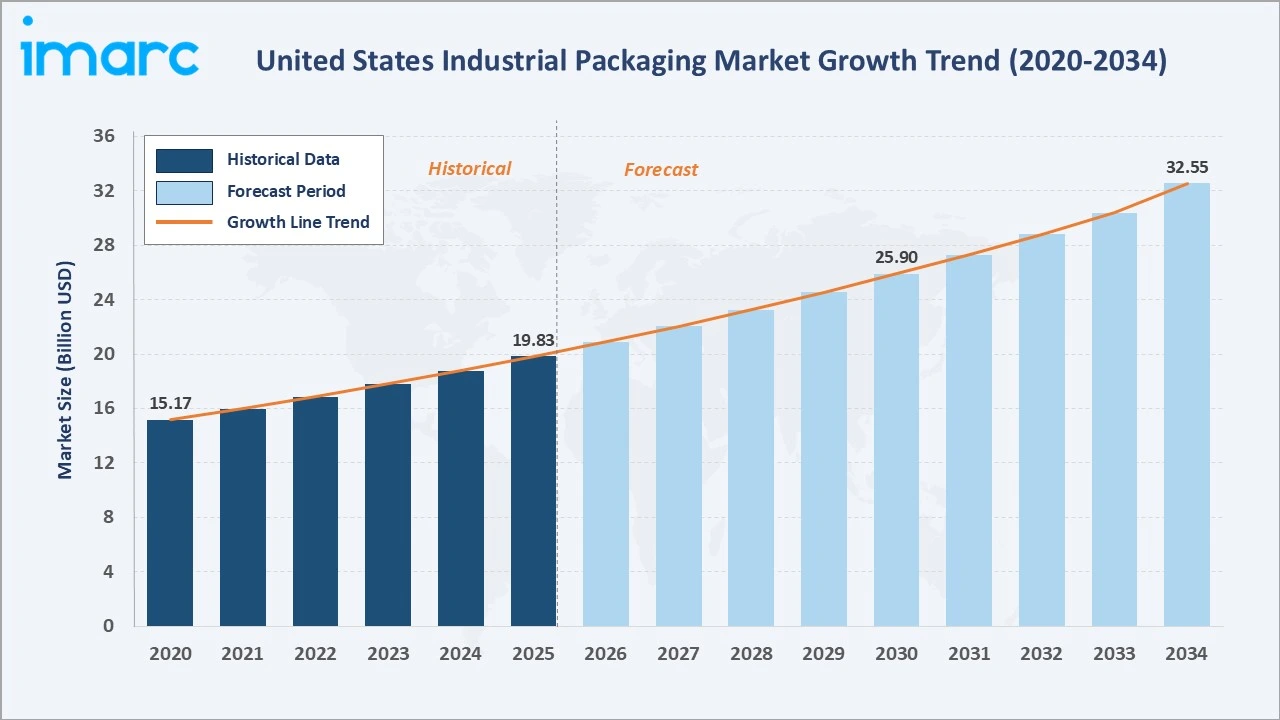
The United States industrial packaging market was valued at USD 19.83 Billion in 2025, USD 20.91 Billion in 2026, and is projected to reach USD 32.55 Billion by 2034, growing at a CAGR of 5.49% during 2026-2034. The market is driven by expanding chemical, pharmaceutical, and food processing industries, rising e-commerce and logistics demand, and stringent product safety regulations.
Plastic leads material share at 42.8%, Intermediate Bulk Containers (IBCs) dominate the product segment at 30.7%, and the South region has the largest regional share at 37.6%.
Market Snapshot
|
Metric |
Value |
|
Base Year Market Size (2025) |
USD 19.83 Billion |
|
Market Size (2026) |
USD 20.91 Billion |
|
Forecast Market Size (2034) |
USD 32.55 Billion |
|
CAGR (2026-2034) |
5.49% |
|
Base Year |
2025 |
|
Historical Period |
2020-2025 |
|
Forecast Period |
2026-2034 |
|
Dominant Product Segment |
Intermediate Bulk Containers (IBCs) - 30.7%, 2025 |
|
Dominant Material Segment |
Plastic - 42.8%, 2025 |
|
Leading Region |
South - 37.6%, 2025 |
The US industrial packaging market grew from USD 15.17 Billion in 2020 to USD 19.83 Billion in 2025, driven by manufacturing expansion, logistics infrastructure growth, and increased chemical and pharmaceutical production volumes. The market is estimated at USD 20.91 Billion in 2026 and is projected to reach USD 25.90 Billion by 2030. The market is projected to reach USD 32.55 Billion by 2034.
To get more information on this market, Request Sample
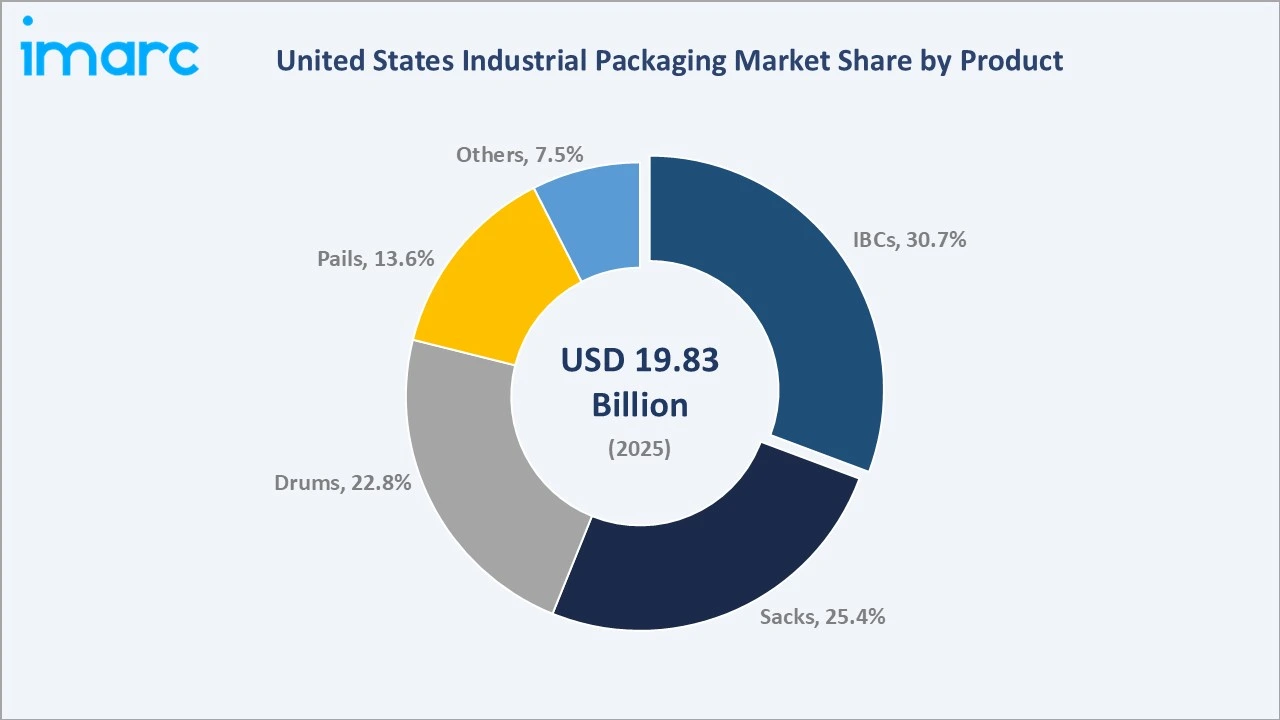
Drums and pails collectively represent approximately 36.4% of the product market, serving chemicals, lubricants, food, and pharmaceutical industries requiring precise volume control and hazardous material compliance. Sacks at 25.4% serve bulk dry goods across agriculture, construction, and chemicals.
Executive Summary
The United States industrial packaging market is projected to grow from USD 20.91 Billion in 2026 to USD 32.55 Billion by 2034, at a CAGR of 5.49%. The market benefits from robust chemical production, pharmaceutical manufacturing growth, expanding food and beverage processing, and rising demand for compliant hazardous material packaging across industrial supply chains. IBCs lead the product segment at 30.7%, driven by their cost efficiency and reusability in bulk liquid and solid transport.
Plastic leads the material landscape at 42.8%, supported by its versatility, chemical resistance, and cost efficiency across multiple end-use applications. The South leads regionally at 37.6%, anchored by Texas and Louisiana's petrochemical and industrial manufacturing clusters.
Key Market Insights
|
Insight |
Data |
|
Dominant Product Segment |
IBCs - 30.7% share (2025) |
|
Dominant Material Segment |
Plastic - 42.8% share (2025) |
|
Leading Region |
South - 37.6% share (2025) |
|
Fastest Growing Segment |
Plastic IBCs and sustainable packaging formats - ~6.3% CAGR |
|
Key Market Opportunity |
Sustainable/reusable IBC programs; smart packaging integration; pharmaceutical and chemical industry expansion in the South and Midwest |
Key Analytical Observations:
- IBCs at 30.7%: IBCs dominate because they offer the highest volume-to-cost efficiency ratio for bulk liquid and granular material transport, replacing multiple small drums with a single unit. Reusable IBC programs reduce total cost of ownership across chemical and food industries.
- Plastic at 42.8%: Plastic packaging leads due to its versatility across product types, chemical resistance, lightweight cost advantages, and compatibility with automated filling and handling systems. HDPE drums and plastic IBCs serve the broadest application range.
- South at 37.6%: The region's leadership reflects Texas and Louisiana's concentration of petrochemical, chemical, and energy manufacturing, the largest end-use cluster for drums, IBCs, and pails. Major chemical production corridors in the Gulf Coast generate the highest volume demand for hazardous material-compliant steel drums and certified plastic IBC.
United States Industrial Packaging Market Overview
The United States industrial packaging market serves as a critical enabler of the country's manufacturing sector, ensuring safe, compliant, and cost-efficient transport and storage of chemical, pharmaceutical, agricultural, and industrial goods. Industrial packaging encompasses bulk rigid containers designed for durability, regulatory compliance, and supply chain efficiency across multiple industries.
The market is supported by the world's largest chemical production industry, pharmaceutical sector, an expanding food and beverage processing base, and growing e-commerce logistics infrastructure. Sustainability regulations, circular economy mandates, and digital supply chain integration are reshaping material preferences and product innovation across all major packaging categories.
Market Dynamics
To evaluate market opportunities, Request Sample
Market Drivers
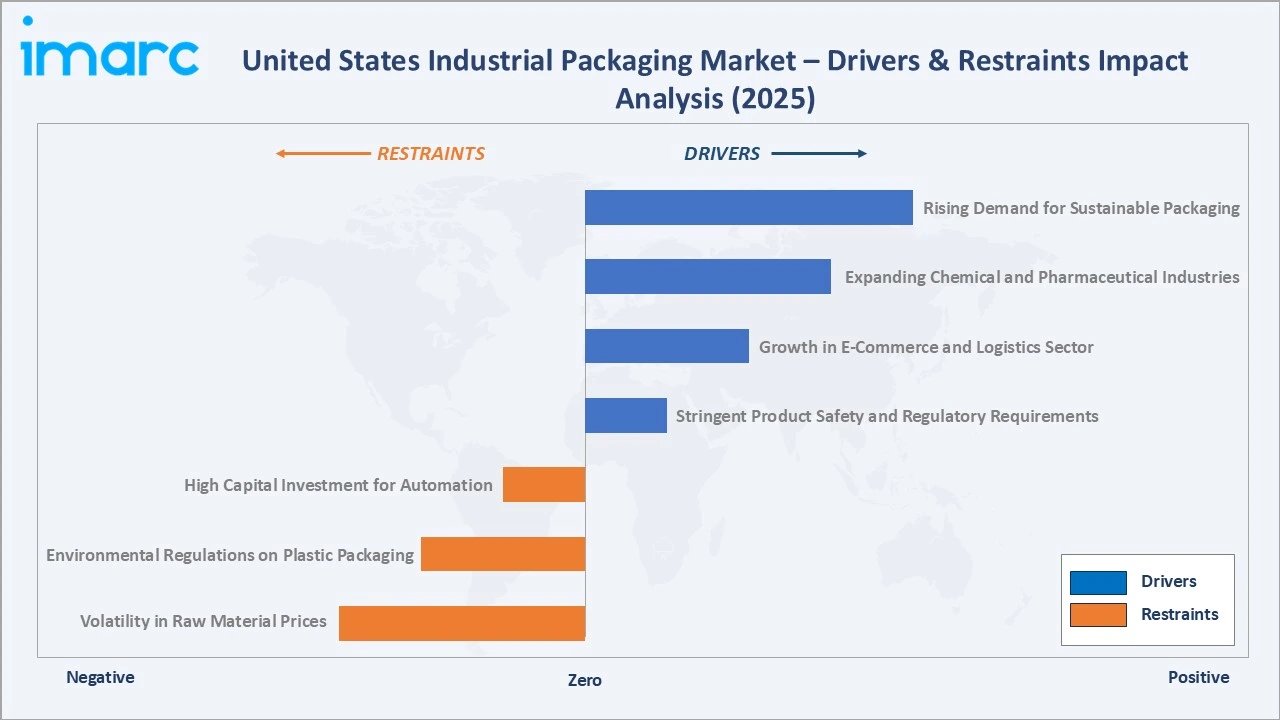
- Rising Demand for Sustainable Packaging: Corporate sustainability commitments and regulatory mandates are driving adoption of reusable IBCs, recycled-content drums, and bio-based plastic packaging. Greif, Mauser, and Schutz operate reconditioning networks that enable closed-loop IBC and drum programs, generating repeat institutional demand and reducing lifecycle environmental impact across petrochemical, food, and pharmaceutical supply chains that are under increasing regulatory and investor scrutiny on environmental performance.
- Expanding Chemical and Pharmaceutical Industries: The US chemical industry, the world's largest, generates consistent high-volume demand for UN-certified steel drums, plastic IBCs, and hazardous material-compliant pails. Pharmaceutical manufacturing expansion post-COVID and growing biopharmaceutical production are creating incremental demand for high-purity, contamination-controlled packaging. API and active ingredient production expansions across New Jersey, North Carolina, and Texas are generating new institutional demand for sterile IBCs and certified drums compliant with FDA packaging standards and 21 CFR requirements.
- Growth in E-Commerce and Logistics Sector: Expanding B2B e-commerce platforms and digital procurement of industrial inputs are increasing demand for standardized, pallet-compatible industrial packaging formats such as IBCs and bulk sacks. Logistics optimization is driving adoption of stackable, scannable, and RFID-enabled packaging. The growth of third-party logistics providers and fulfillment infrastructure is accelerating standardization of industrial packaging specifications, creating demand for consistent packaging formats that integrate efficiently with automated warehouse management and material handling systems.
- Stringent Product Safety and Regulatory Requirements: US DOT (49 CFR), EPA, and OSHA regulations on hazardous material packaging create non-discretionary, specification-driven demand for certified drums, IBCs, and pails. UN performance certification requirements mandate specific packaging specifications for chemical and pharmaceutical transport that sustain premium pricing for certified industrial packaging. State-level regulations in California and New York are extending compliance requirements further into industrial supply chains, broadening the addressable market for certified industrial packaging formats and creating barriers to non-compliant low-cost packaging substitution.
Market Restraints
- Volatility in Raw Material Prices: Steel, HDPE resin, and wood price volatility directly impacts manufacturing cost structures for drums, plastic IBCs, and wooden crates, compressing margins for packaging manufacturers operating on fixed-price contracts. Supply chain disruptions amplify input cost uncertainty, particularly for petroleum-derived plastics. HDPE resin prices, closely linked to crude oil and natural gas prices, can fluctuate by 20–35% annually, making cost management challenging for plastic IBC and drum manufacturers who cannot fully pass through input cost increases to long-term industrial supply contracts.
- Environmental Regulations on Plastic Packaging: Increasing federal and state regulatory pressure on single-use plastics and non-recyclable packaging formats is raising compliance costs for plastic drum and IBC manufacturers. Extended Producer Responsibility (EPR) legislation in California and other states is creating new financial obligations for industrial packaging producers. While sustainability regulations drive reusable packaging adoption long-term, they introduce near-term capital investment requirements for manufacturers needing to reformulate materials, redesign products, or establish reconditioning infrastructure to maintain compliance and market access.
- High Capital Investment for Automation: Industrial packaging manufacturing requires significant capital investment in automated fabrication, quality testing, and UN certification processes that creates barriers to capacity expansion and technology upgrades. Small and mid-sized packaging manufacturers face competitive disadvantages against large players with automated high-volume production facilities. Smart packaging integration further raises the capital threshold for product innovation, limiting participation to well-capitalized manufacturers and constraining the pace of technology-driven product differentiation across the broader US industrial packaging supply base.
Market Opportunities
- Reusable IBC Leasing and Circular Economy Programs: The growth of closed-loop IBC leasing models by Greif, Mauser, and Schutz creates a high-value recurring revenue stream while reducing end-user packaging capital expenditure. Corporate sustainability mandates are accelerating adoption. Pharmaceutical, food, and chemical companies are actively seeking certified reusable packaging partners with national reconditioning networks, creating long-term institutional supply relationships that provide predictable volumes and premium pricing for certified reusable IBC operators.
- Smart and Connected Industrial Packaging: RFID-enabled IBCs, QR-coded drums, and condition-monitoring pails represent a high-growth premium segment as industrial companies invest in supply chain visibility and track-and-trace capability. Integration with IoT and ERP systems creates institutional lock-in and premium pricing opportunities for technology-enabled packaging formats. The expanding pharmaceutical cold chain and chemical logistics sectors create the highest-value immediate addressable market for smart packaging adoption.
Market Challenges
- Competitive Pressure from Low-Cost Imports: Imported industrial packaging from lower-cost manufacturing regions exerts downward price pressure on domestic producers, particularly for commodity drums, pails, and sacks. Balancing cost competitiveness with quality and compliance certification is an ongoing challenge for US manufacturers. While tariff protections and supply chain reshoring trends provide some relief, sustained margin compression from Asian producers with lower labor and energy costs continues to challenge domestic manufacturers' ability to fund technology upgrades and capacity investments.
- Supply Chain Disruptions and Logistics Complexity: Industrial packaging manufacturers managing complex multi-tier supply chains face logistics disruptions, port congestion, and transportation cost volatility that increase delivery lead times and inventory costs. Chemical and pharmaceutical customers' just-in-time production requirements make supply chain reliability a critical performance criterion, raising the operational bar for certified industrial packaging suppliers and creating competitive disadvantages for smaller regional manufacturers lacking the logistics network depth of national players.
Emerging Market Trends
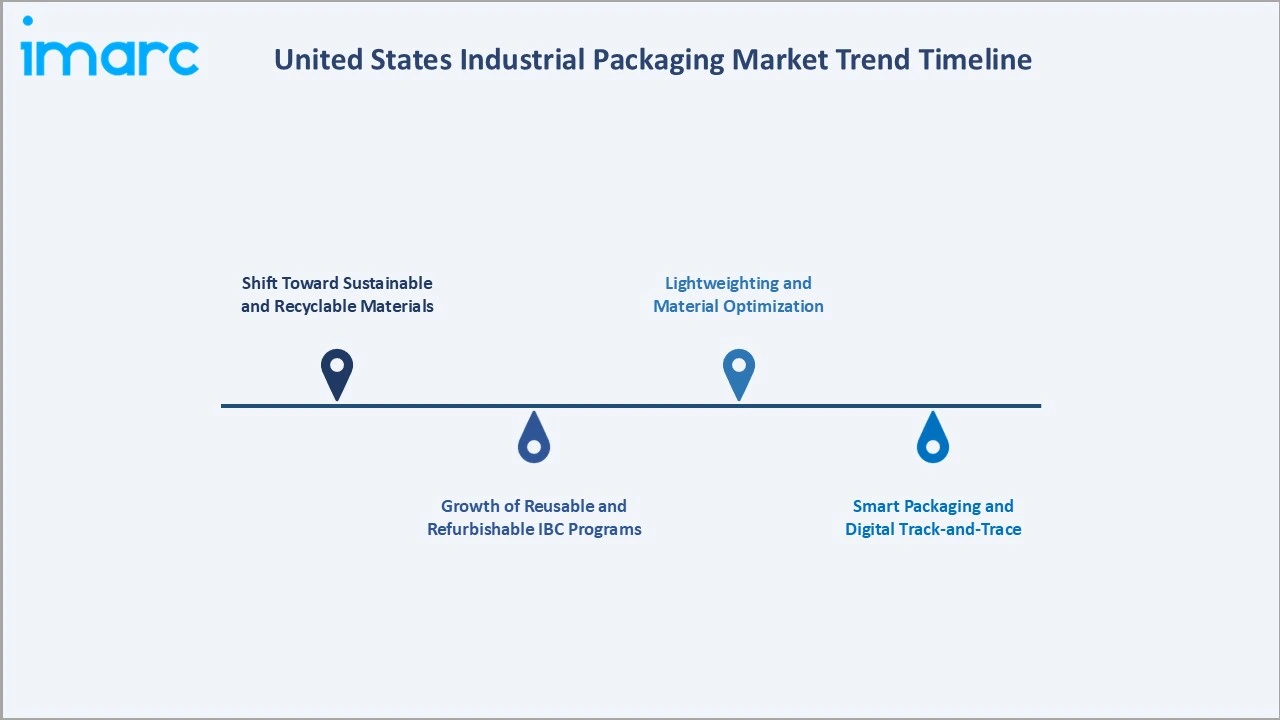
1. Shift Toward Sustainable and Recyclable Materials
Industrial packaging manufacturers are accelerating investment in recycled-content plastics, bio-based polyethylene, and sustainably sourced fiber as corporate sustainability mandates and EPR regulations drive material reformulation across the value chain. Recycled HDPE content in drums and IBCs is increasing, with major manufacturers committing to 30–50% post-consumer recycled content targets by 2030.
2. Growth of Reusable and Refurbishable IBC Programs
Reusable IBC networks operated by Greif, Mauser, and Schutz are expanding nationally, offering reconditioning, inspection, and recertification services that extend IBC service life. These programs reduce total packaging cost for industrial buyers while aligning with sustainability targets. Subscription-based IBC leasing is growing across chemical and food manufacturing industries.
3. Smart Packaging and Digital Track-and-Trace
RFID tags, QR codes, and embedded sensors are being integrated into industrial packaging to enable real-time location tracking, condition monitoring, and supply chain visibility. Pharmaceutical and chemical customers are driving adoption for regulatory compliance and loss prevention. This trend is creating a premium smart packaging tier with higher margins and longer institutional contract cycles.
4. Lightweighting and Material Optimization
Manufacturers are developing lighter-weight IBC liners, thinner-gauge steel drums, and optimized fiber sacks that maintain performance while reducing raw material consumption and shipping weight. Advances in polymer science and steel alloy processing are enabling strength-to-weight optimization that reduces per-unit material costs and improves environmental performance across high-volume product lines.
Industry Value Chain Analysis
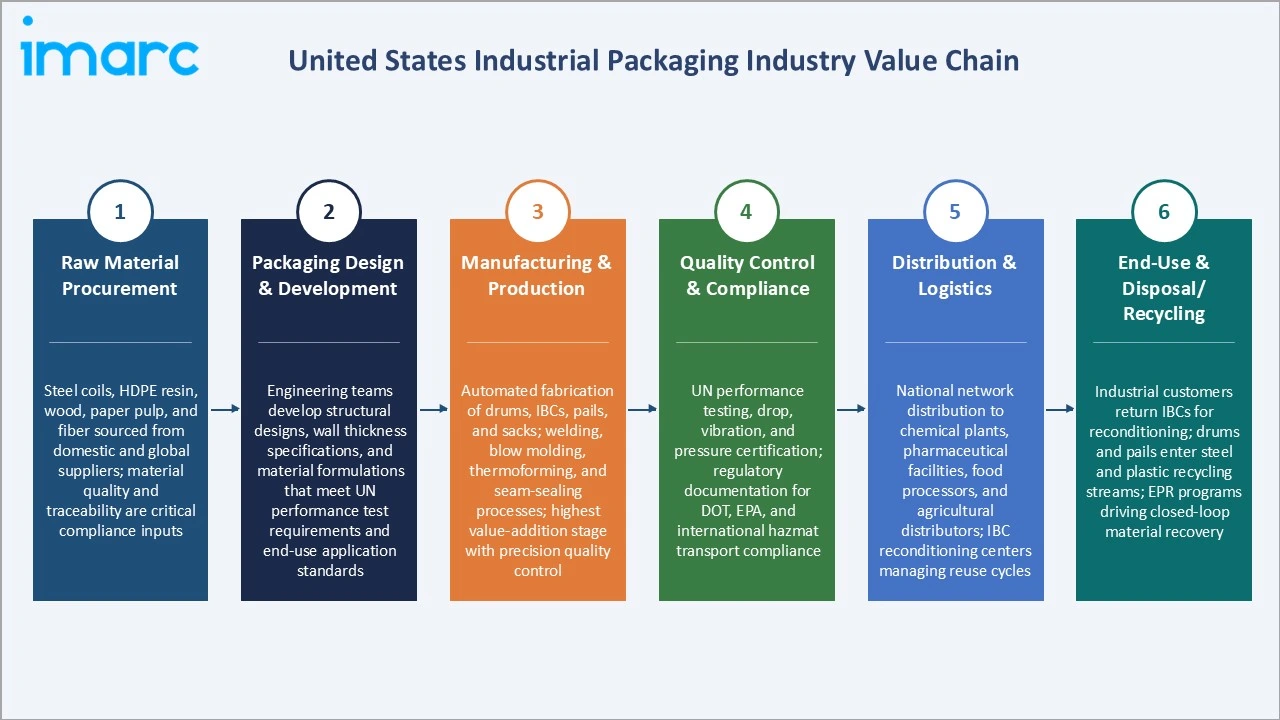
The United States industrial packaging value chain encompasses six stages, from raw material procurement through end-use disposal and recycling.
|
Stage |
Description |
|
Raw Material Procurement |
Steel coils, HDPE resin, wood, paper pulp, and fiber sourced from domestic and global suppliers; material quality and traceability are critical compliance inputs |
|
Packaging Design & Development |
Engineering teams develop structural designs, wall thickness specifications, and material formulations that meet UN performance test requirements and end-use application standards |
|
Manufacturing & Production |
Automated fabrication of drums, IBCs, pails, and sacks; welding, blow molding, thermoforming, and seam-sealing processes; highest value-addition stage with precision quality control |
|
Quality Control & Compliance |
UN performance testing, drop, vibration, and pressure certification; regulatory documentation for DOT, EPA, and international hazmat transport compliance |
|
Distribution & Logistics |
National network distribution to chemical plants, pharmaceutical facilities, food processors, and agricultural distributors; IBC reconditioning centers managing reuse cycles |
|
End-Use & Disposal/Recycling |
Industrial customers return IBCs for reconditioning; drums and pails enter steel and plastic recycling streams; EPR programs driving closed-loop material recovery |
The manufacturing and production stage delivers the highest value addition, generating product-differentiated revenues through certified design, precision fabrication, and compliance testing that sustain premium pricing above commodity packaging benchmarks.
Technology Landscape in the United States Industrial Packaging Industry
Smart Packaging and IoT Integration
IoT-enabled packaging incorporating RFID, NFC, and BLE sensors enables real-time monitoring of container location, fill level, temperature, and tamper status. Chemical and pharmaceutical shippers are adopting smart IBCs for regulatory traceability and cold chain compliance, driving premium adoption across high-value industrial supply chains.
Sustainable Material Innovation
Bio-based polyethylene from sugarcane, recycled HDPE with 30–50% post-consumer content, and fiber-based replacements for plastic components are being commercialized for industrial packaging. These materials reduce carbon footprint while maintaining the mechanical and chemical resistance properties required for certified industrial packaging.
Advanced Manufacturing Automation
Robotic welding, AI-vision quality inspection, and digital twin manufacturing simulations are improving production efficiency, reducing scrap, and enabling faster certification cycles. Automated reconditioning lines for IBCs use computer vision to assess structural integrity and automatically grade containers for recertification or recycling.
Digital Supply Chain Platforms
Cloud-based packaging management platforms integrate ERP, RFID tracking, and regulatory compliance documentation into unified supply chain management systems. These platforms enable automated replenishment, IBC fleet management, and real-time regulatory compliance reporting, reducing administrative burden and improving supply chain transparency.
Market Segmentation Analysis
The report covers the following segments:
|
Segment Category |
Leading Segment |
Market Share |
Year |
|
Product |
IBCs |
30.7% |
2025 |
|
Material |
Plastic |
42.8% |
2025 |
|
Application |
🔒 |
🔒 |
2025 |
|
Region |
South |
37.6% |
2025 |

By Product
Intermediate Bulk Containers (IBCs) lead the product segment at 30.7% in 2025, driven by their superior volume efficiency, reusability, and compliance with bulk liquid and solid transport requirements across chemical, food, and pharmaceutical industries.
To access detailed market analysis, Request Sample
Sacks at 25.4% serve bulk dry goods across agriculture, construction, and chemicals, supported by growth in food-grade packaging and construction materials. Drums at 22.8% remain the dominant format for hazardous chemicals and petroleum products requiring UN-certified steel packaging. Pails at 13.6% serve smaller-volume specialty chemicals, lubricants, and food ingredients. The Others segment at 7.5% encompasses flexible IBCs and specialty containers for advanced manufacturing applications.
By Material
Plastic leads the material segment at 42.8% in 2025, driven by HDPE's chemical resistance, lightweight advantages, and cost efficiency across IBC, drum, and pail applications. HDPE composite IBCs are most widely adopted industrial packaging format, serving chemical, food, and pharmaceutical industries with a standardized, globally compatible container.
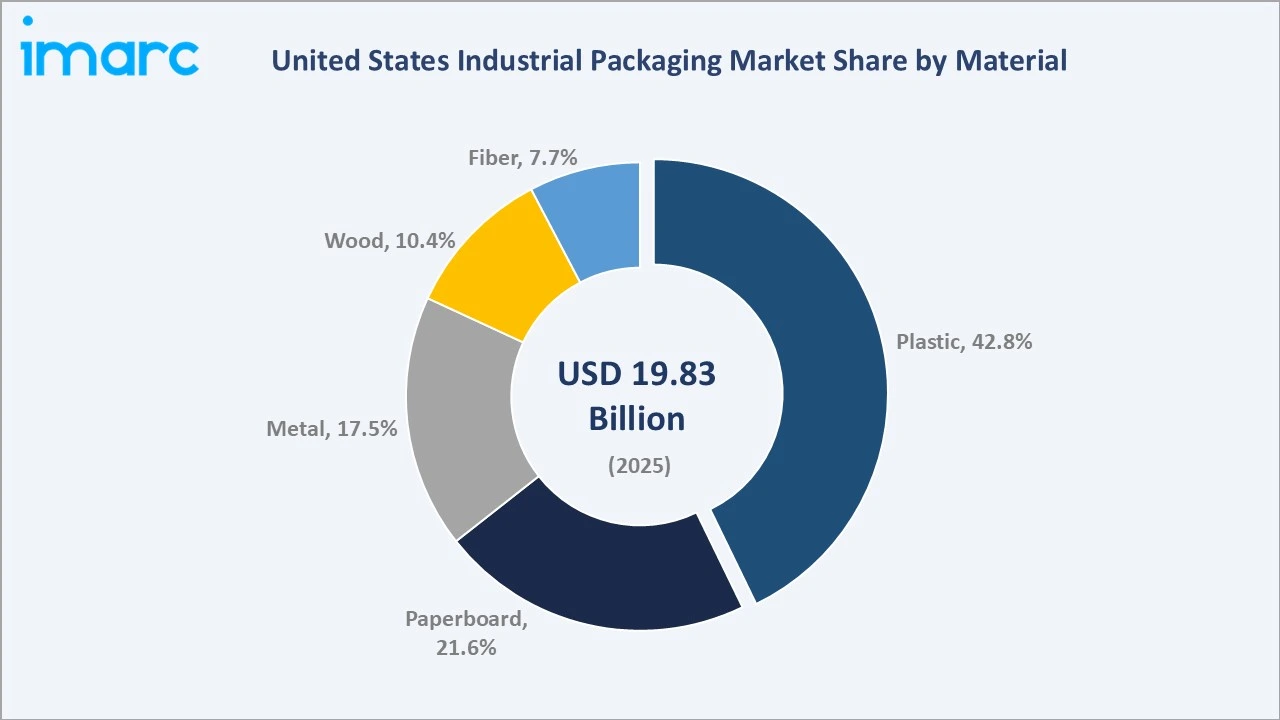
Paperboard at 21.6% is growing through expanding e-commerce logistics and regulatory preference for recyclable packaging in non-hazardous industrial applications. Metal at 17.5% maintains dominance in hazardous chemical and petroleum packaging where regulatory mandates require certified steel drums. Wood at 10.4% serves bulk sack and crate applications in construction and agriculture. Fiber at 7.7% supports bulk bag and industrial sack markets for granular materials.
Regional Market Insights
|
Region |
Share (2025) |
Key Market Characteristics |
|
South |
37.6% |
Anchored by Texas and Louisiana petrochemical corridors; largest chemical, energy, and agricultural packaging demand cluster; Gulf Coast industrial base drives IBC and drum volumes |
|
Midwest |
23.8% |
Strong manufacturing base across Ohio, Illinois, and Michigan; agri-industrial packaging demand from corn belt; automotive and heavy industry drive drum and IBC requirements |
|
West |
22.4% |
California food processing, pharmaceutical, and technology manufacturing; strong sustainability regulation driving reusable packaging adoption; agricultural packaging demand from Central Valley |
|
Northeast |
16.2% |
Pharmaceutical and biotech manufacturing in New Jersey and Massachusetts; specialty chemical packaging demand; advanced manufacturing and logistics clusters driving premium IBC adoption |
The South's 37.6% regional dominance reflects the Gulf Coast's concentration of the US chemical, petrochemical, and energy industries, collectively the largest national demand source for certified steel drums, UN-rated IBCs, and plastic pails. Midwest’s 23.8% share is underpinned by agricultural packaging demand from the corn belt, automotive and heavy industry drum requirements, and food processing packaging.
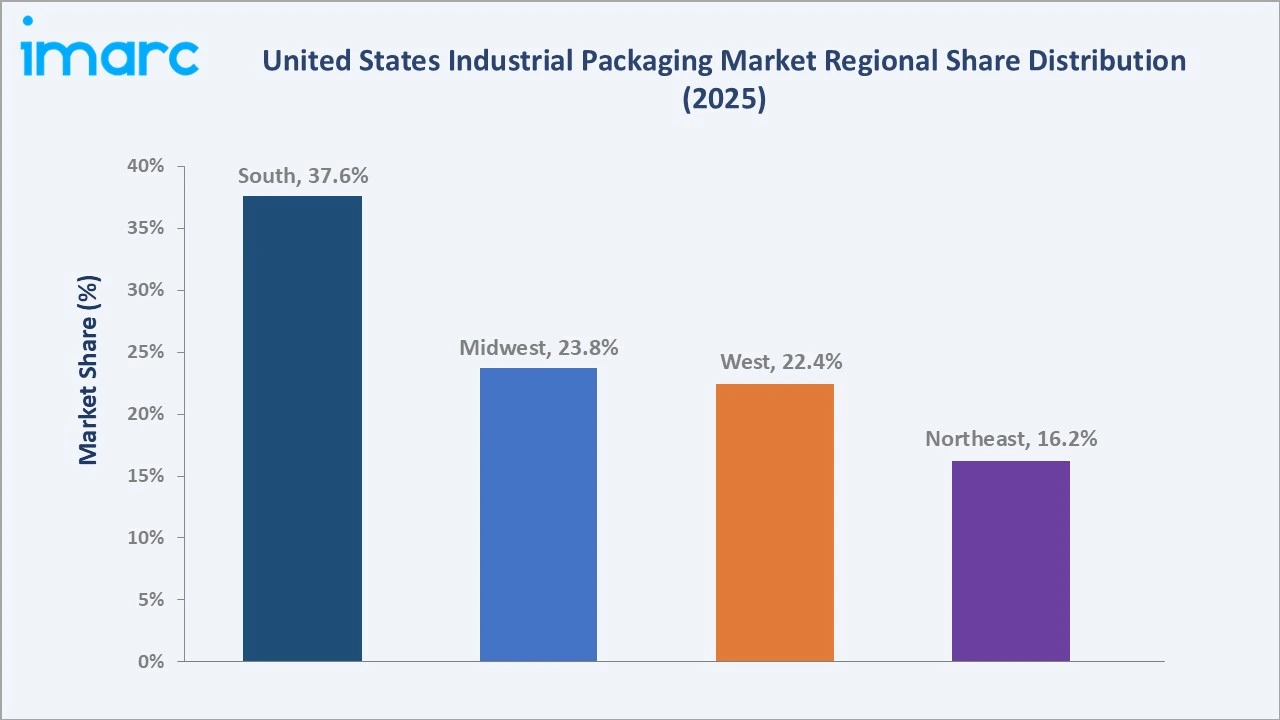
The West at 22.4% reflects California's food processing, pharmaceutical, and sustainability-driven reusable packaging market. The Northeast at 16.2% is the fastest-growing region for pharmaceutical-grade and specialty industrial packaging, driven by the Boston-New Jersey biotech corridor.
Competitive Landscape
The United States industrial packaging competitive landscape is dominated by a small number of large, vertically integrated manufacturers with national distribution networks, IBC reconditioning capabilities, and UN certification infrastructure.
|
Company |
Key Brands |
Market Position |
Core Strength |
| Greif | Steel and plastic drums, IBCs, fibre drums, reconditioning services, flexible packaging | Market Leader | Largest US industrial packaging network; comprehensive drum and IBC portfolio; global reconditioning operations |
| Mauser Packaging Solutions | UN-certified drums, IBCs, composite packaging, reconditioning and reuse programs | Strong Challenger | Leading IBC and drum reconditioning network; circular packaging programs; deep chemical industry relationships |
| Sonoco Products Company | Fibre drums, paper-based industrial packaging, reels, protective packaging, composite cans | Innovator | Leading fibre drum manufacturer; strong sustainable packaging portfolio; diversified industrial packaging solutions |
| Schütz GmbH & Co. KGaA | IBCs, composite drums, reconditioned containers, fill and collect programs | Niche Leader | Premium IBC innovation; closed-loop reuse programs; strong food, chemical, and pharmaceutical sector relationships |
| Hoover CS | Tank containers, flexitanks, IBCs, offshore containers, liquid storage and logistics | Emerging Player | Specialized offshore and bulk liquid IBC solutions; strong energy and petrochemical sector presence |
Key players include Greif, Mauser Packaging Solutions, Sonoco Products Company, Schütz GmbH & Co. KGaA, Hoover CS, and others.
Key Company Profiles
Greif
Greif is the leading global industrial packaging company headquartered in Delaware, Ohio, operating manufacturing and reconditioning facilities across the United States and internationally. The company offers one of the broadest industrial packaging portfolios, spanning steel drums, plastic drums, fiber drums, IBCs, and flexible packaging, serving chemical, pharmaceutical, food, and agricultural end markets with certified compliant packaging solutions and comprehensive reconditioning services.
- Key Offerings: Steel drums, plastic drums, fibre drums, intermediate bulk containers, reconditioning and recertification services, flexible intermediate bulk containers, and specialty packaging.
- Strategic Focus: Strengthening leadership through circular economy programs, reusable IBC leasing, reconditioning network expansion, and recycled-content packaging, while investing in smart packaging technology integration for pharmaceutical and chemical customers.
Mauser Packaging Solutions
Mauser Packaging Solutions is a leading global industrial packaging company with a strong US presence, specializing in UN-certified drums, composite IBCs, and reconditioning and reuse programs under its Industrial Packaging and Life Cycle Services divisions. Formed through the merger of Mauser Group and BWAY Corporation, Mauser serves chemical, pharmaceutical, food, and agricultural customers with compliant, reusable industrial packaging solutions supported by an extensive national reconditioning network.
- Key Offerings: UN-certified steel and plastic drums, composite IBCs, reconditioned containers, fill-and-collect programs, and industrial life cycle services including cleaning, inspection, and recertification.
- Strategic Focus: Driving growth through Life Cycle Services, expanding reconditioning capacity, growing the fill-and-collect IBC program, and building long-term circular packaging partnerships with major chemical and food companies. Mauser is investing in digital reconditioning tracking systems and sustainability certification that differentiate its reuse programs from commodity competitors.
Market Concentration Analysis
The United States industrial packaging market exhibits a moderately concentrated structure, with Greif, Mauser, Berry Global, and Sonoco collectively commanding the majority of institutional supply contracts. These players benefit from national distribution networks, UN certification capabilities, and IBC reconditioning infrastructure that create meaningful barriers to competitive displacement by smaller regional manufacturers.
Market concentration is being challenged at the premium tier by smart packaging innovators and specialty chemical packaging manufacturers offering technology-differentiated products for pharmaceutical and high-purity applications. Sustainability certification and circular economy program credibility are increasingly important competitive differentiators, with large industrial buyers requiring documented recycled content percentages, reconditioning program certifications, and carbon footprint data as preconditions for preferred supplier status.
Investment and Growth Opportunities
Highest Growth Segments
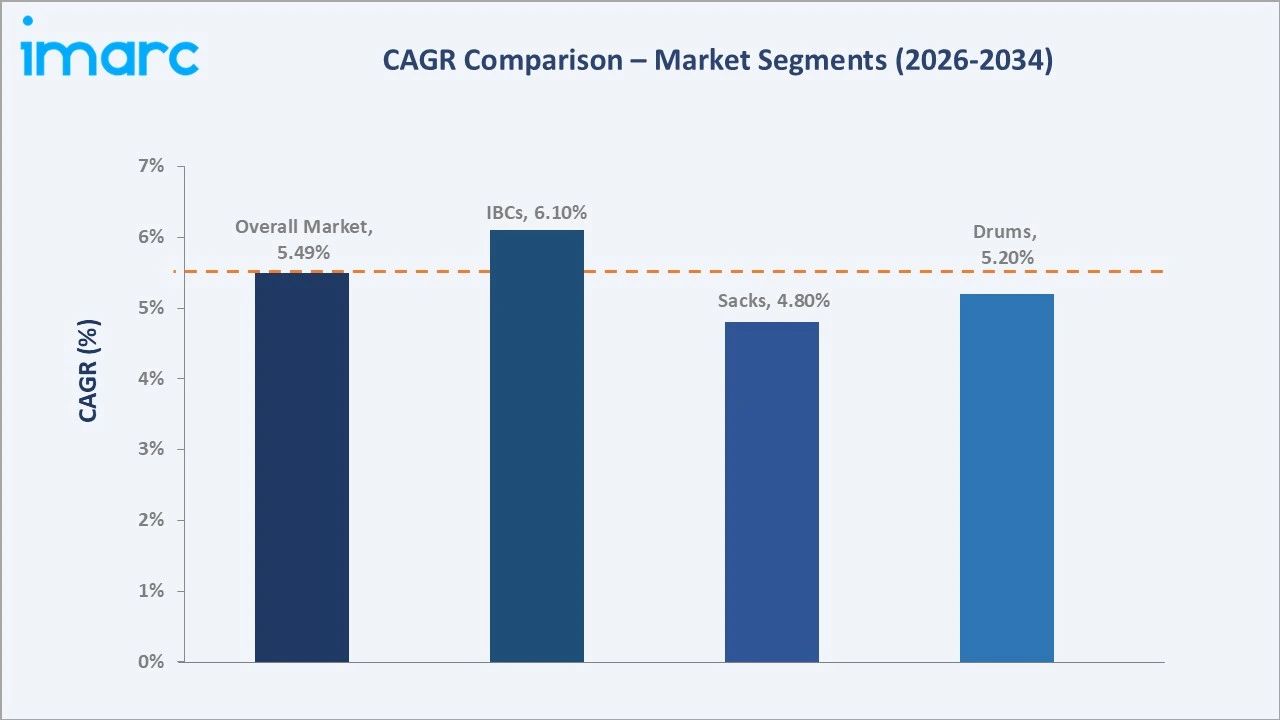
IBCs represent the fastest-growing segment in the United States industrial packaging market, projected to expand at a 6.10% CAGR, followed by plastic materials at 6.30% CAGR. Paperboard materials are expected to grow at 5.70% CAGR, while drums and sacks record comparatively slower growth rates of 5.20% and 4.80% CAGR, respectively, represent the highest-growth investment vectors in the US industrial packaging market through 2034.
Emerging Investment Opportunities
Pharmaceutical manufacturing reshoring is creating the highest-value near-term investment opportunity in US industrial packaging, with new biopharmaceutical and API production facilities requiring GMP-compliant IBCs and certified primary packaging. IBC reconditioning network expansion in the Midwest and Southeast represents a capital-efficient growth opportunity with strong recurring service revenue and sustainability positioning.
Investment Themes
- Reusable IBC and Circular Packaging Infrastructure: Investment in IBC reconditioning facilities, digital fleet management platforms, and closed-loop packaging programs offers high recurring revenue potential from institutional chemical and food company contracts that provide multi-year volume commitments. EPR regulatory tailwinds and corporate sustainability mandates are creating structural long-term demand that makes reconditioning infrastructure investment increasingly defensible across all major US industrial regions.
- Smart Packaging Technology Integration: Embedding RFID, NFC, and condition sensors into IBCs and drums for pharmaceutical and specialty chemical applications offers 15–25% premium pricing above commodity equivalents. Institutional lock-in through proprietary digital platforms and data services creates durable competitive moats for first-movers in the high-value pharmaceutical and regulated chemical industrial packaging segments.
Future Market Outlook (2026-2034)
The United States industrial packaging market is projected to grow from USD 20.91 Billion in 2026 to USD 32.55 Billion by 2034, growing at a CAGR of 5.49% during 2026-2034. Growth will be anchored by expanding chemical, pharmaceutical, and food processing industries, increasing demand for sustainable and smart packaging formats, and regulatory compliance requirements that sustain premium certified packaging demand.
Three structural themes will define the market's evolution through 2034: the sustainability transition driving reusable packaging and recycled material adoption across all product categories; pharmaceutical and biotech manufacturing expansion creating premium demand for certified, high-purity industrial packaging; and smart packaging integration adding digital intelligence to traditional container formats and creating new high-margin revenue streams for technology-leading manufacturers.
Research Methodology
Primary Research
Primary research comprised structured interviews with industrial packaging manufacturers, procurement managers at chemical and pharmaceutical companies, industry consultants, and distribution executives. Surveys of end-use industrial companies covered packaging product preferences, sustainability procurement policies, and unmet packaging capability needs across chemical, pharmaceutical, food, and agricultural application categories.
Secondary Research
Secondary research encompassed US DOT and EPA packaging regulations, company annual reports, USPTO packaging patents, ASTM and ISO packaging standards, trade publications, industry association reports from ISTA and ASTM International, and macroeconomic data from the US Census Bureau and BLS manufacturing surveys. Over 50 secondary sources were reviewed across institutional, regulatory, and industry dimensions.
Forecasting Models
Market revenue forecasts were developed using an industrial production-based demand model: US chemical, pharmaceutical, food, and agricultural output projections multiplied by sector-specific packaging intensity ratios, adjusted for sustainability-driven reuse program growth and smart packaging premium adoption. Bottom-up product segment forecasts were cross-validated against top-down macroeconomic indicators.
United States Industrial Packaging Market Report Coverage:
| Report Features | Details |
|---|---|
| Base Year of the Analysis | 2025 |
| Historical Period | 2020-2025 |
| Forecast Period | 2026-2034 |
| Units | Billion USD |
| Scope of the Report | Exploration of Historical and Forecast Trends, Industry Catalysts and Challenges, Segment-Wise Historical and Predictive Market Assessment:
|
| Products Covered | Bulk Containers (IBCs), Sacks, Drums, Pails, Others |
| Materials Covered | Paperboard, Plastic, Metal, Wood, Fiber |
| Applications Covered | Chemical and Pharmaceutical, Building and Construction, Food and Beverage, Oil and Lubricant, Agriculture and Horticulture, Others |
| Regions Covered | Northeast, Midwest, South, West |
| Companies Covered | Greif, Mauser Packaging Solutions, Sonoco Products Company, Schütz GmbH & Co. KGaA, Hoover CS, etc. |
| Customization Scope | 10% Free Customization |
| Post-Sale Analyst Support | 10-12 Weeks |
| Delivery Format | PDF and Excel through Email (We can also provide the editable version of the report in PPT/Word format on special request) |
Key Benefits for Stakeholders:
- IMARC’s industry report offers a comprehensive quantitative analysis of various market segments, historical and current market trends, market forecasts, and dynamics of the United States industrial packaging market from 2020-2034.
- The research report provides the latest information on the market drivers, challenges, and opportunities in the United States industrial packaging market.
- Porter's five forces analysis assist stakeholders in assessing the impact of new entrants, competitive rivalry, supplier power, buyer power, and the threat of substitution. It helps stakeholders to analyze the level of competition within the United States industrial packaging industry and its attractiveness.
- Competitive landscape allows stakeholders to understand their competitive environment and provides an insight into the current positions of key players in the market.
Frequently Asked Questions About the United States Industrial Packaging Market Report
The United States industrial packaging market size was valued at USD 20.91 Billion in 2026, driven by expanding chemical and pharmaceutical industries, rising logistics infrastructure investment, growing e-commerce, and stringent product safety regulations.
The United States industrial packaging market is projected to grow at a CAGR of 5.49% during 2026-2034, reaching USD 32.55 Billion by 2034, driven by sustained industrial production growth and accelerating sustainable packaging adoption.
Intermediate Bulk Containers (IBCs) lead the product segment at 30.7% in 2025, driven by their volume efficiency, reusability, and compliance with bulk liquid and solid transport requirements across chemical, food, and pharmaceutical industries.
Plastic leads the material segment at 42.8% in 2025, driven by HDPE's chemical resistance, lightweight advantages, and cost efficiency across IBC, drum, and pail applications. HDPE composite IBCs are the market's most widely adopted industrial packaging format.
The South leads at 37.6% in 2025, driven by Texas and Louisiana's petrochemical and chemical manufacturing concentration, the largest national demand cluster for certified steel drums, UN-rated IBCs, and plastic pails.
Leading companies include Greif, Mauser Packaging Solutions, Sonoco Products Company, Schütz GmbH & Co. KGaA, Hoover CS, and others.
The US industrial bulk packaging market is projected to reach approximately USD 25.90 Billion by 2030, supported by sustainable packaging program growth, pharmaceutical manufacturing expansion, and increasing smart packaging adoption.
Top opportunities include reusable IBC reconditioning network expansion, pharmaceutical-grade industrial packaging for biopharmaceutical manufacturing, smart RFID-enabled packaging for supply chain visibility, and sustainable recycled-content packaging formats.
Need more help?
- Speak to our experienced analysts for insights on the current market scenarios.
- Include additional segments and countries to customize the report as per your requirement.
- Gain an unparalleled competitive advantage in your domain by understanding how to utilize the report and positively impacting your operations and revenue.
- For further assistance, please connect with our analysts.
 Request Customization
 Speak to an Analyst
 Request Brochure
 Inquire Before Buying
Benefits of Customization
- Personalize this research
- Triangulate with your data
- Get data as per your format and definition
- Gain a deeper dive into a specific application, geography, customer, or competitor
- Any level of personalization
Get in Touch With Us
UNITED STATES
Phone: +1-201-971-6302
INDIA
Phone: +91-120-433-0800
UNITED KINGDOM
Phone: +44-753-714-6104
Email: [email protected]
Client Testimonials

















Related Reports

Choose your plan
*Please note that the prices mentioned below are starting prices for each bundle type. Kindly contact our team for further details.*
Single User License
- 1 User License, Access on 2 Devices
- PDF Report + Excel Dataset (Password Protected)
- Lifetime Access
- No Printing Rights
- 10% Free Report Customization
- 10–12 Weeks of Analyst Support
Five User License
- Access for 5 Users, 2 Devices per User
- PDF Report + Excel Dataset (Password Protected)
- Lifetime Access
- Dedicated Account Manager
- 12–14 Weeks of Analyst Support
- No Printing Rights
- 15% Free Report Customization
- 25% Discount on Your Next Purchase
Corporate User License
- Unlimited User Access (Within Your Organization)
- PDF Report + Excel Dataset
- Lifetime Access
- Dedicated Account Manager
- 14–20 Weeks of Analyst Support
- No Printing Rights
- 20% Free Report Customization
- 30% Discount on Your Next Purchase
Essential Insights
What's included:
3 reports
- Lifetime Access
- PDF Reports
- Excel Datasets
- 2 Weeks of Free Analyst Support
- 2 User Licenses
- Access on 2 Devices
- Printing Rights
- Complimentary PowerPoint (PPT) Version
- Complimentary License Upgrade
Professional Access
What's included:
5 reports
- Lifetime Access
- PDF Reports
- Excel Datasets
- 8 Weeks of Free Analyst Support
- 2 User Licenses
- Access on 2 Devices
- Printing Rights
- Complimentary PowerPoint (PPT) Version
- Complimentary License Upgrade
Business Advantage
What's included:
8 reports
- Lifetime Access
- PDF Reports
- Excel Datasets
- 14 Weeks of Free Analyst Support
- 2 User Licenses
- Access on 2 Devices
- Printing Rights
- Complimentary PowerPoint (PPT) Version
- Complimentary License Upgrade
Enterprise Intelligence
What's included:
10 reports
- Lifetime Access
- PDF Reports
- Excel Datasets
- 20 Weeks of Free Analyst Support
- 2 User Licenses
- Access on 2 Devices
- Printing Rights
- Complimentary PowerPoint (PPT) Version
- Complimentary License Upgrade