
United States Managed Security Services Market Size, Share, Trends and Forecast by Type, Deployment Mode, Enterprises Size, Vertical, and Region, 2026-2034
United States Managed Security Services Market Size, Share, Trends & Forecast (2026-2034)
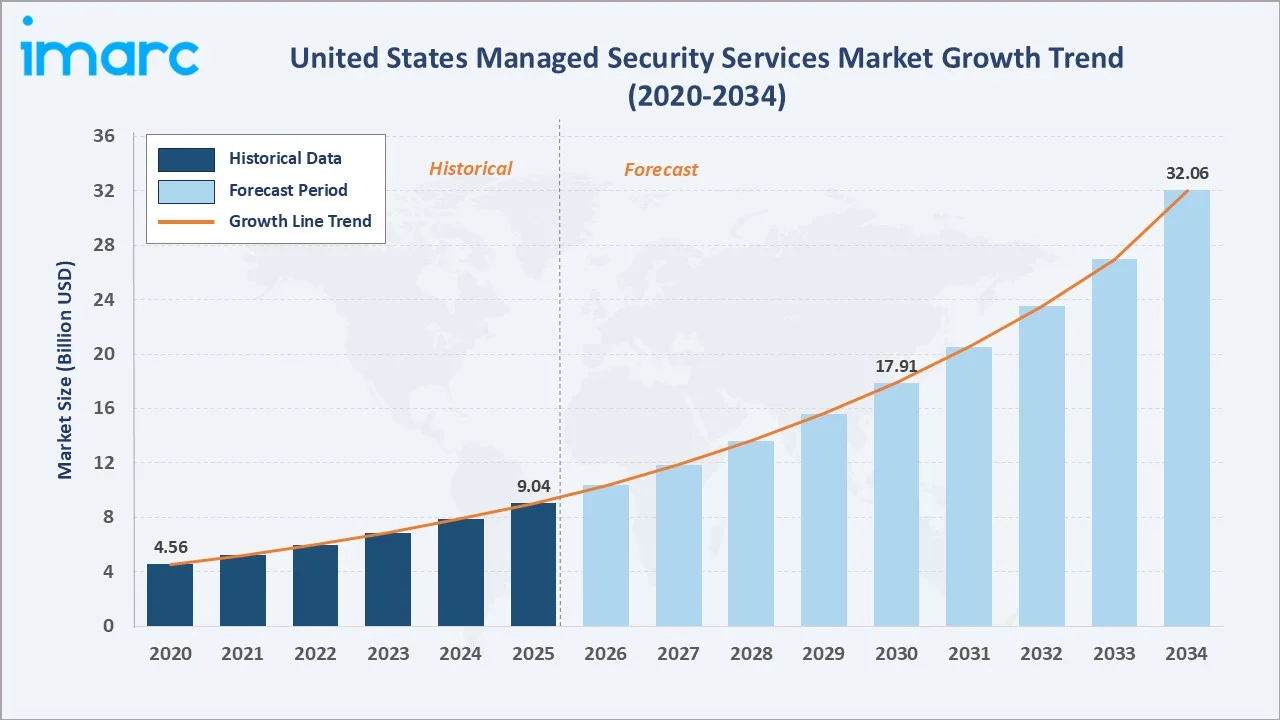
The United States managed security services market grew from USD 9.04 Billion in 2025 to USD 10.36 Billion in 2026 and is projected to reach USD 32.06 Billion by 2034, growing at a CAGR of 14.65% during 2026-2034. The market is driven by escalating cyber threats, surging ransomware attacks, mandatory federal cybersecurity regulations, and rapid enterprise cloud adoption. Managed SIEM leads at 27.6%. Cloud-based deployment commands 68.5%. The West region holds 32.8% of national market share.
Market Snapshot
|
Metric |
Value |
|
Base Year Market Size (2025) |
USD 9.04 Billion |
|
Market Size (2026) |
USD 10.36 Billion |
|
Forecast Market Size (2034) |
USD 32.06 Billion |
|
CAGR (2026-2034) |
14.65% |
|
Base Year |
2025 |
|
Historical Period |
2020-2025 |
|
Forecast Period |
2026-2034 |
|
Dominant Type |
Managed SIEM (27.6%, 2025) |
|
Dominant Deployment Mode |
Cloud-based (68.5%, 2025) |
|
Leading Region |
West (32.8%, 2025) |
The U.S. managed security services market size increased from USD 4.56 Billion in 2020 to USD 9.04 Billion in 2025 and is estimated to reach USD 10.36 Billion in 2026. The market is further expected to grow to USD 17.91 Billion by 2030 and USD 32.06 Billion by 2034. The market is commercially unique, combining the world's highest-value enterprise cybersecurity spend with federal mandates, a dense regulated-industry base, and the deepest pool of MSSP providers globally, creating a structurally durable demand cycle above commercial cycle variability.
To get more information on this market, Request Sample
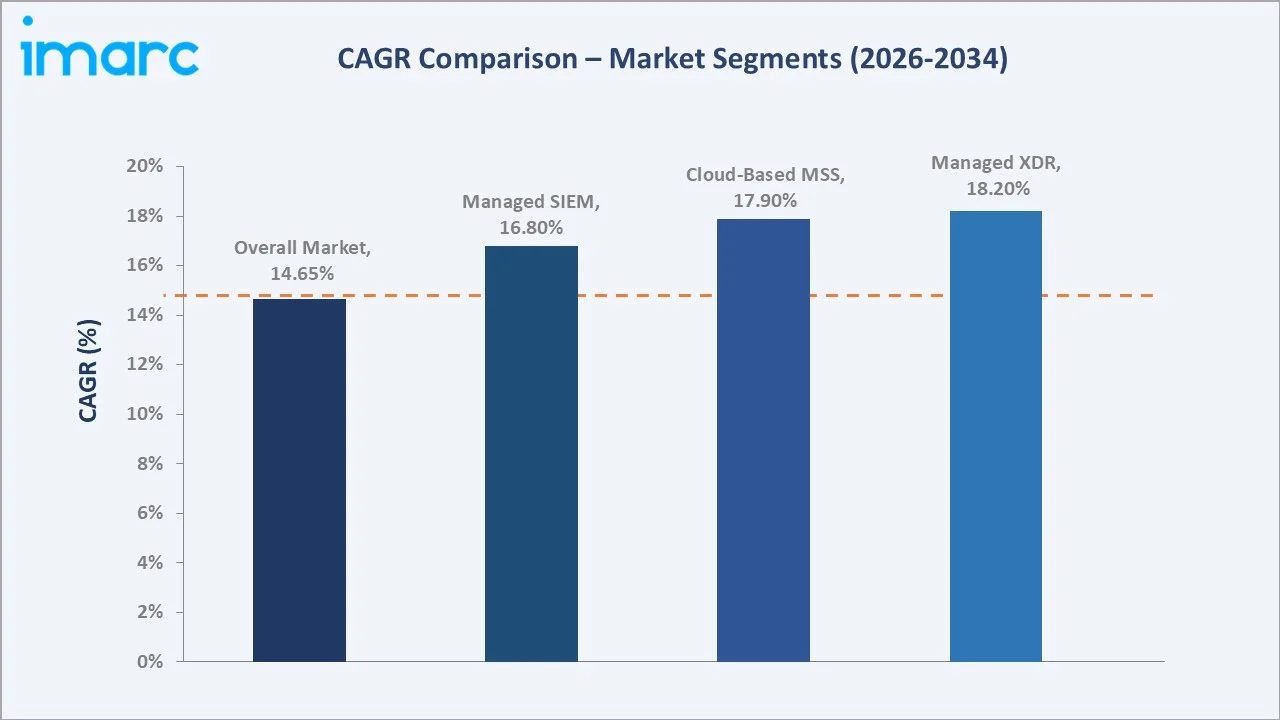
Managed XDR is the fastest-growing segment at ~18.2% CAGR through AI-powered extended detection and response adoption. Cloud-based MSS is expanding at ~17.9% CAGR. Managed SIEM grows at ~16.8% CAGR through enterprise SOC outsourcing and AI-enhanced log analytics platform demand.
Executive Summary
The U.S. managed security services market expanded from USD 9.04 Billion in 2025 to an estimated USD 10.36 Billion in 2026, positioning the U.S. as the world's largest national MSS market by value. The market is projected to reach USD 32.06 Billion by 2034. Managed SIEM at 27.6% leads type share. Cloud-based deployment at 68.5% underpins service delivery. The West region commands 32.8%.
Key Market Insights
|
Insight |
Data |
|
Dominant Type |
Managed SIEM – 27.6% share (2025) |
|
Dominant Deployment Mode |
Cloud-based – 68.5% market share (2025) |
|
Leading Region |
West – 32.8% share (2025) |
|
Market Opportunity |
Federal cybersecurity mandates; cloud-native MSSP expansion; AI-driven SOC automation; SME MSS adoption growth |
Key Analytical Observations Supporting the Above Data:
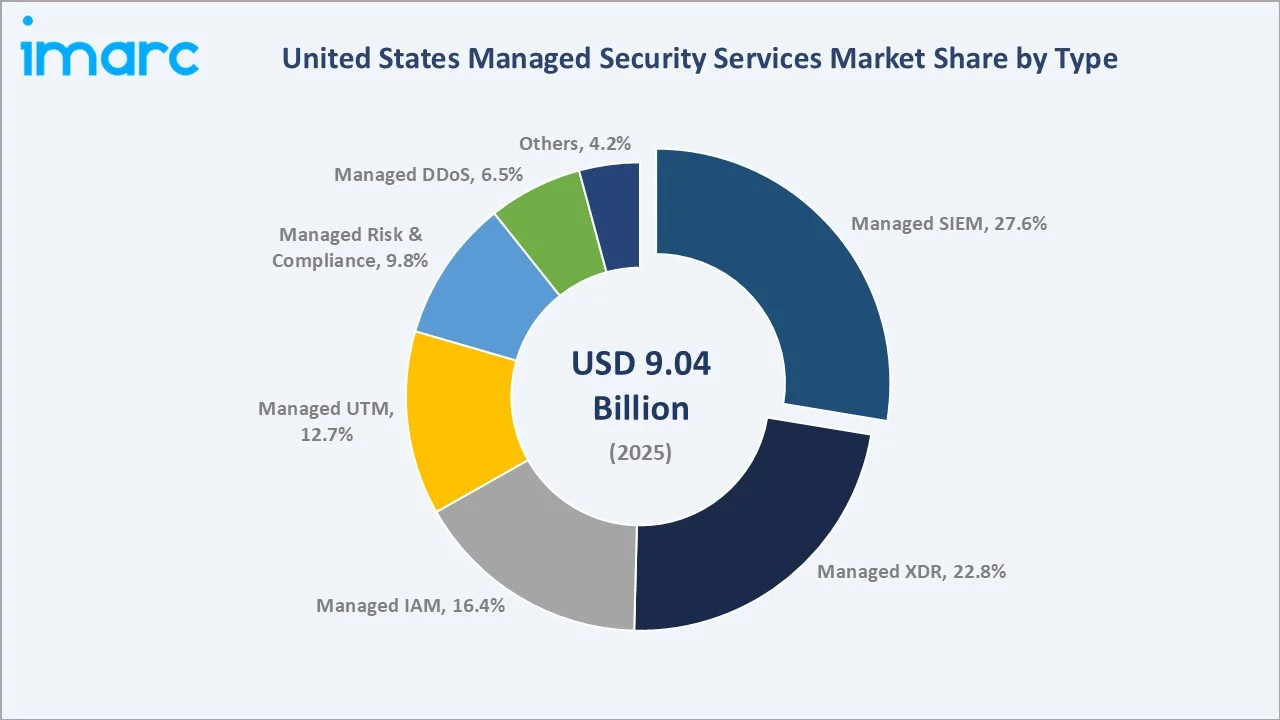
- Managed SIEM at 27.6%: The SIEM segment leads through its foundational role in enterprise threat detection, log aggregation, and compliance reporting. Regulatory requirements across HIPAA, PCI DSS, and NIST frameworks mandate SIEM capabilities, making it the most commercially embedded MSS category across U.S. enterprise and government markets.
- Cloud-based at 68.5%: Cloud deployment dominates through remote work normalization, cloud-native enterprise infrastructure, and MSSP platforms optimized for cloud-delivered security operations. Cloud-based MSS enables scalable, cost-efficient security without on-premises hardware requirements, driving adoption across SME and large enterprise segments.
- West at 32.8%: The West region leads through Silicon Valley's technology-sector density, high-value cloud-native enterprise concentration in California, and significant federal defense and intelligence agency cybersecurity spend in Washington and Colorado, creating the highest per-enterprise MSSP spending intensity nationally.
United States Managed Security Services Market Overview
The U.S. managed security services market occupies the most commercially consequential position in global cybersecurity: the nation with the highest absolute enterprise cybersecurity spend, the most complex regulatory environment, and the deepest structural talent shortage creating structural MSSP demand above any comparable national market globally.
The market ecosystem integrates threat intelligence providers, security product vendors, MSSP service layers, SOC operations, and end-user enterprises across BFSI, healthcare, manufacturing, government, and retail verticals. Federal frameworks including NIST CSF, CISA directives, and Executive Order 14028 create structural demand floors that sustain MSS investment above commercial economic cycles.
Market Dynamics
To evaluate market opportunities, Request Sample
Market Drivers
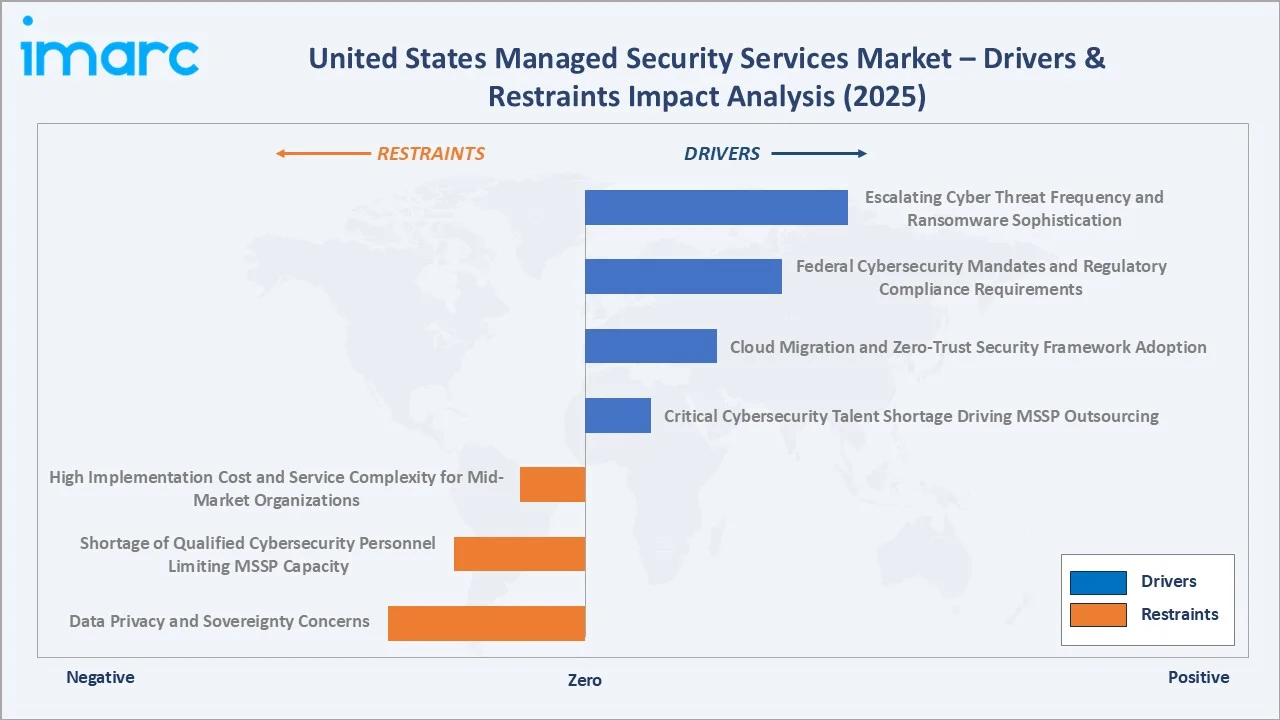
- Escalating Cyber Threat Frequency and Ransomware Sophistication: Escalating cyber threat frequency and ransomware sophistication are compelling organizations to outsource security operations to specialized MSSPs. Ransomware attacks on U.S. organizations increased significantly through critical infrastructure, healthcare, and financial services targeting, creating board-level security investment mandates. Organizations that cannot build in-house 24/7 security operations at competitive cost are systematically turning to MSSPs for continuous monitoring, threat detection, and rapid incident response capabilities that internal teams cannot replicate.
- Federal Cybersecurity Mandates and Regulatory Compliance Requirements: Federal cybersecurity mandates including Executive Order 14028, CISA binding directives, and FedRAMP requirements are creating non-discretionary MSS demand across government contractors, critical infrastructure operators, and federally regulated enterprises. These mandates require specific security capabilities including continuous monitoring, zero-trust architecture implementation, and incident detection and reporting that most organizations cannot meet independently.
- Cloud Migration and Zero-Trust Security Framework Adoption: Cloud migration across U.S. enterprises is fundamentally reshaping the security perimeter, creating demand for cloud-native managed security services that protect distributed, multi-cloud environments. Zero-trust architecture adoption, accelerated by federal mandates and remote work normalization, requires continuous identity verification, micro-segmentation, and lateral movement detection capabilities that MSSPs specialize in delivering as managed services.
- Critical Cybersecurity Talent Shortage Driving MSSP Outsourcing: The U.S. faces an estimated 750,000 unfilled cybersecurity positions, creating an acute structural talent gap that is forcing enterprises to outsource security functions to specialized MSSP providers. The talent shortage is most severe for experienced SOC analysts, threat hunters, and incident responders, precisely the specialized skills that MSSPs develop at scale through their multi-client operations model.
Market Restraints
- High Implementation Cost and Service Complexity for Mid-Market Organizations: High implementation cost and service complexity create adoption barriers for mid-market organizations evaluating MSS vendors. Enterprise MSS engagements require significant integration work with existing security infrastructure, legacy SIEM systems, and network architecture, creating implementation timelines and costs that can exceed initial budgets. The complexity of defining SLAs, escalation procedures, and incident response authorities between internal IT teams and MSSP providers creates organizational friction that delays procurement decisions and extends sales cycles for MSS vendors targeting mid-market enterprise segments.
- Shortage of Qualified Cybersecurity Personnel Limiting MSSP Capacity: The same talent shortage that drives MSS demand simultaneously constrains MSSP capacity to deliver high-quality services at scale. Leading MSSPs face significant challenges recruiting experienced threat analysts, incident responders, and security engineers, limiting their ability to expand service capacity proportional to market demand. This talent constraint forces MSSPs to invest heavily in automation, AI-driven alert triage, and orchestration tools to maintain service quality, creating technology investment requirements that increase MSSP operating costs and compress margins, particularly for mid-tier providers competing against well-resourced tier-1 MSSPs.
- Data Privacy and Sovereignty Concerns: Data privacy and sovereignty concerns create adoption friction for cloud-based managed security services, particularly among healthcare, financial services, and government customers subject to strict data residency requirements. Organizations must evaluate whether MSSP data handling practices comply with HIPAA, SOX, PCI DSS, and state privacy regulations before committing to cloud-delivered MSS, extending procurement cycles.
Market Opportunities
- AI-Powered Security Operations Automation Creating New MSS Value Proposition: AI-powered security operations automation is enabling MSSPs to deliver dramatically superior threat detection, false positive reduction, and response speed compared to manual SOC operations, creating a commercially compelling new MSS value proposition. Machine learning-driven behavioral analytics, AI-assisted threat hunting, and automated playbook execution are allowing MSSPs to process security telemetry at cloud scale, identifying sophisticated threats that manual analysis would miss. This AI capability gap between leading MSSPs and most in-house security teams is creating sustained enterprise demand for MSS as the only commercially accessible path to AI-grade security operations for most U.S. enterprises.
- SME Market Expansion Through Cloud-Native MSS Accessibility: The small and medium enterprise segment represents the largest under-penetrated MSS opportunity in the U.S. market, with most SMEs lacking adequate in-house security capabilities despite facing comparable threat exposure to large enterprises. Cloud-native MSS platforms are reducing the cost and complexity of enterprise-grade security to levels accessible to mid-market and SME budgets, creating a new addressable customer segment for MSSP providers. Federal incentive programs and cyber insurance requirements increasingly mandate minimum security standards that drive SMEs toward MSS adoption as the most cost-effective compliance pathway, creating structured demand growth above the enterprise segment.
Market Challenges
- Multi-Vendor Integration Complexity and Alert Fatigue Management: Multi-vendor integration complexity and alert fatigue are significant operational challenges for MSSPs managing heterogeneous enterprise security environments. Most enterprise customers run 30-50 discrete security tools from multiple vendors, creating integration complexity and alert correlation challenges that increase MSSP operational costs and response times. Alert fatigue from high-volume false positives across disparate security tools forces MSSPs to invest heavily in AI-driven correlation and triage capabilities to maintain the response SLAs that enterprise customers require, creating ongoing technology investment obligations that constrain MSSP margin expansion despite revenue growth.
- Rapidly Evolving Threat Landscape Requiring Continuous Platform Investment: The rapidly evolving threat landscape requires continuous MSSP platform investment to maintain detection capability against emerging attack techniques, AI-powered threats, and nation-state adversary tactics. MSSPs must continuously update threat intelligence feeds, detection rules, response playbooks, and analyst capabilities to remain effective against threats that evolve faster than any static security deployment can accommodate. This continuous investment requirement creates significant technology and talent cost obligations that new market entrants struggle to sustain, while established MSSPs must allocate substantial R&D budgets to maintain competitive detection capabilities, compressing industry-wide margins despite strong demand growth.
Emerging Market Trends
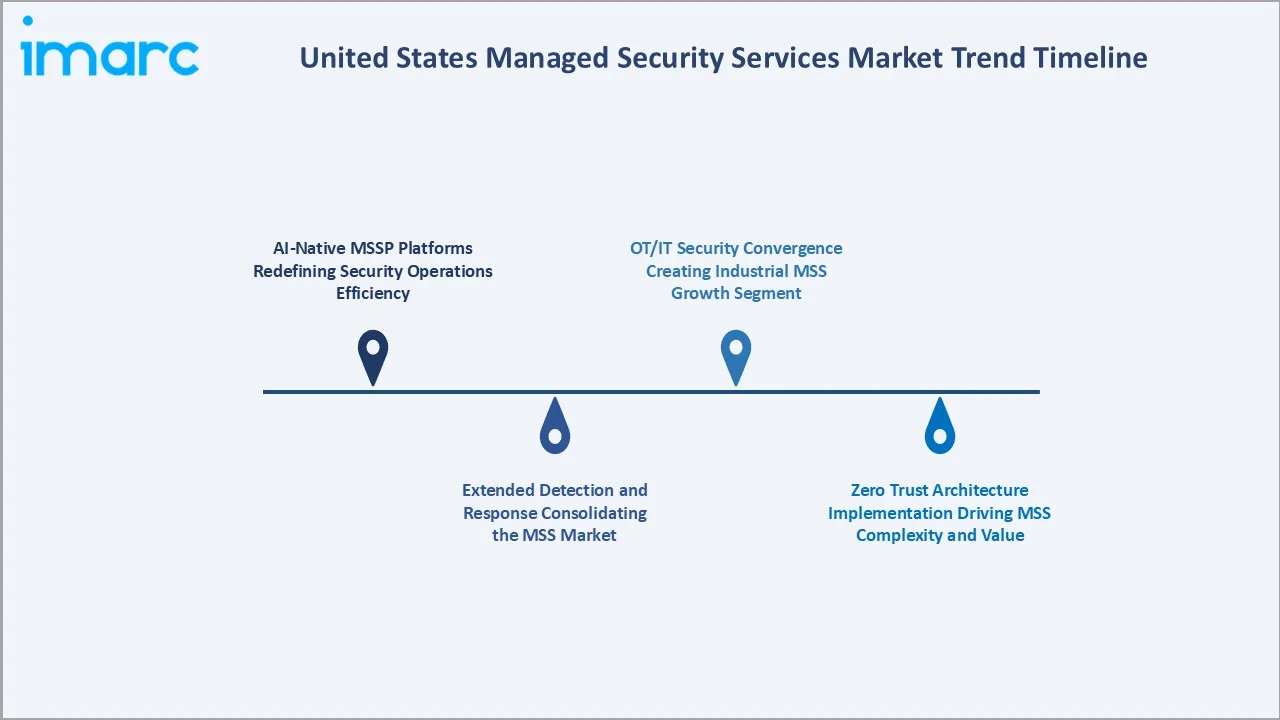
1. AI-Native MSSP Platforms Redefining Security Operations Efficiency
AI-native MSSP platforms integrating generative AI, machine learning behavioral analytics, and automated response are transforming SOC efficiency, enabling MSSPs to handle exponentially larger security telemetry volumes with fewer analysts.
2. Extended Detection and Response Consolidating the MSS Market
Managed XDR is becoming the dominant MSS service category through its ability to consolidate endpoint, network, cloud, and identity security telemetry into unified threat detection and response workflows. This consolidation trend is driving MSSP platform consolidation, with leading providers.
3. Zero Trust Architecture Implementation Driving MSS Complexity and Value
Zero trust architecture mandates from CISA and Office of Management and Budget are creating structured demand for managed identity security, managed access control, and continuous verification services that most enterprises cannot implement independently. MSS providers with zero trust implementation expertise are capturing premium service contract value as enterprises navigate the complex multi-year architectural transitions required by federal compliance timelines.
4. OT/IT Security Convergence Creating Industrial MSS Growth Segment
Operational technology and IT security convergence is creating a high-growth MSS segment as manufacturing, energy, and utilities sector digitization connects previously air-gapped industrial systems to enterprise networks. This OT/IT convergence creates new attack surfaces that specialized industrial MSS providers including Claroty, Dragos, and traditional MSSPs with OT capabilities are addressing, creating a distinct and rapidly growing subsegment within the broader MSS market.
Industry Value Chain Analysis
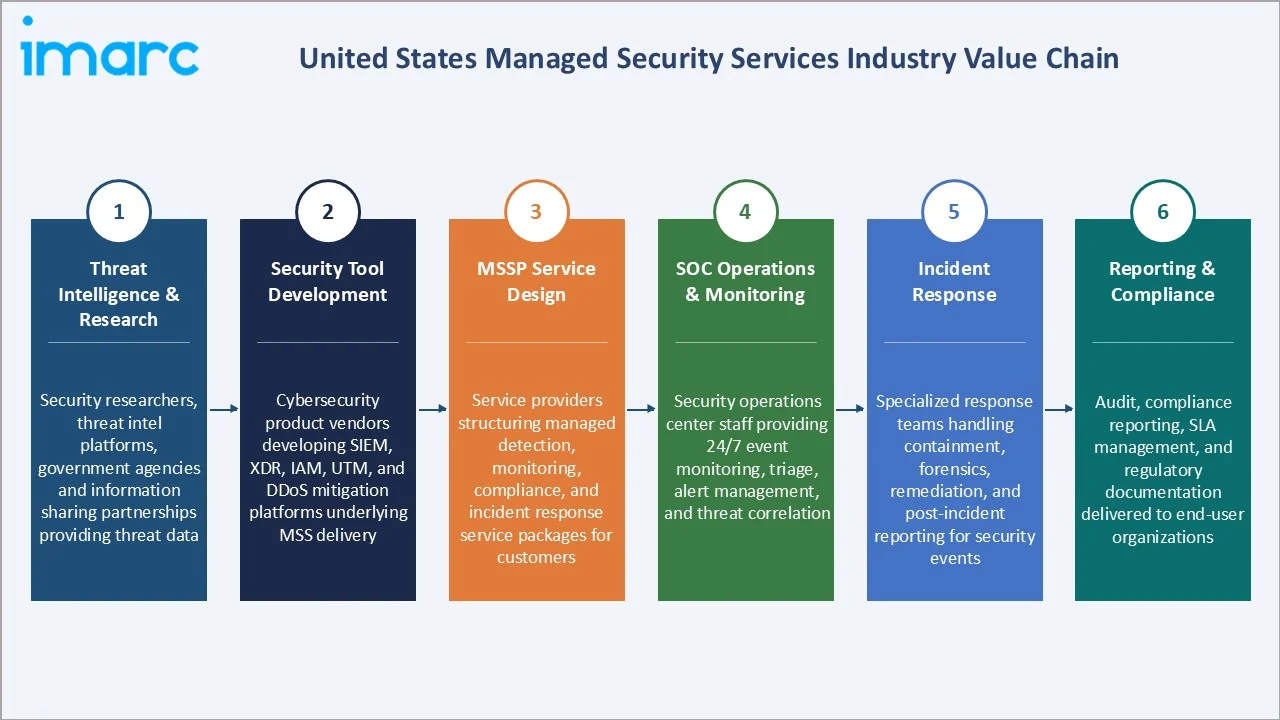
The U.S. managed security services value chain spans threat intelligence research, security product development, MSSP service design, SOC operations, incident response, and compliance reporting. The value chain's commercial structure creates compounding expertise advantages for leading MSSPs who develop proprietary threat intelligence, detection capabilities, and response playbooks through their multi-client operations scale.
|
Stage |
Key Participants |
|
Threat Intelligence & Research |
Security researchers, threat intel platforms, government agencies and information sharing partnerships providing threat data |
|
Security Tool Development |
Cybersecurity product vendors developing SIEM, XDR, IAM, UTM, and DDoS mitigation platforms underlying MSS delivery |
|
MSSP Service Design |
Service providers structuring managed detection, monitoring, compliance, and incident response service packages for customers |
|
SOC Operations & Monitoring |
Security operations center staff providing 24/7 event monitoring, triage, alert management, and threat correlation |
|
Incident Response |
Specialized response teams handling containment, forensics, remediation, and post-incident reporting for security events |
|
Reporting & Compliance |
Audit, compliance reporting, SLA management, and regulatory documentation delivered to end-user organizations |
The SOC operations and monitoring stage is the most commercially labor-intensive stage, where MSSP differentiation through analyst expertise, threat intelligence quality, and AI-driven automation creates sustainable competitive advantages. Leading MSSPs leverage their cross-client threat visibility to identify attack patterns earlier than any individual enterprise SOC could detect independently, creating a structural intelligence advantage that compounds with scale.
Technology Landscape in the U.S. Managed Security Services Industry
AI-Powered SIEM and Extended Detection and Response Platforms
AI-powered SIEM platforms integrating machine learning for behavioral analytics, automated alert correlation, and threat pattern recognition are transforming managed security service delivery efficiency. Next-generation XDR platforms unifying endpoint, network, cloud, and identity telemetry into single-pane threat detection workflows are becoming the dominant technical foundation for enterprise MSS delivery.
Cloud-Native Security Operations and SASE Integration
Cloud-native security operations platforms enabling elastic SOC scaling, multi-tenant MSS delivery, and cloud-delivered SASE security are fundamentally reshaping MSSP cost structures and service delivery models. Integration of Secure Access Service Edge frameworks with managed security services enables MSSPs to deliver unified network and security services from cloud-delivered infrastructure, eliminating legacy hardware dependencies and enabling rapid customer onboarding at dramatically lower deployment costs than traditional on-premises MSS architectures.
Generative AI and Autonomous Threat Response Automation
Generative AI integration into security operations is enabling automated threat investigation, incident summary generation, and response playbook execution without analyst intervention for common attack scenarios. Autonomous threat response capabilities, including AI-driven containment actions, lateral movement blocking, and automated forensics, are allowing MSSPs to reduce mean-time-to-respond from hours to minutes, creating measurable security outcome improvements that differentiate AI-native MSSP platforms from traditional rule-based security operations in enterprise procurement evaluations.
Market Segmentation Analysis
The report covers the following segments:
|
Segment Category |
Leading Segment |
Market Share |
Year |
|
Type |
Managed SIEM |
27.6% |
2025 |
|
Deployment Mode |
Cloud-based |
68.5% |
2025 |
|
Enterprises Size |
🔒 |
🔒 |
2025 |
|
Vertical |
🔒 |
🔒 |
2025 |
|
Region |
West |
32.8% |
2025 |

By Type
Managed SIEM leads at 27.6% in 2025. The SIEM segment encompasses security information and event management services including log collection, correlation, threat detection, and compliance reporting, serving as the foundational security analytics layer for enterprise security operations across all regulated industries and government organizations.
To access detailed market analysis, Request Sample
Managed XDR at 22.8% is the fastest-growing service category at ~18.2% CAGR through AI-driven unified threat detection consolidation across endpoint, network, and cloud security telemetry. Managed IAM at 16.4% reflects the surging demand for identity-first zero trust security services as identity-based attacks represent the leading initial access vector across U.S. enterprise breaches.
By Deployment Mode
Cloud-based deployment leads at 68.5% in 2025. Cloud-delivered managed security services provide elastic scaling, rapid deployment, and cost efficiency advantages over on-premises alternatives, enabling MSSPs to serve enterprise and SME customers with consistent security capabilities across geographically distributed environments without hardware constraints.
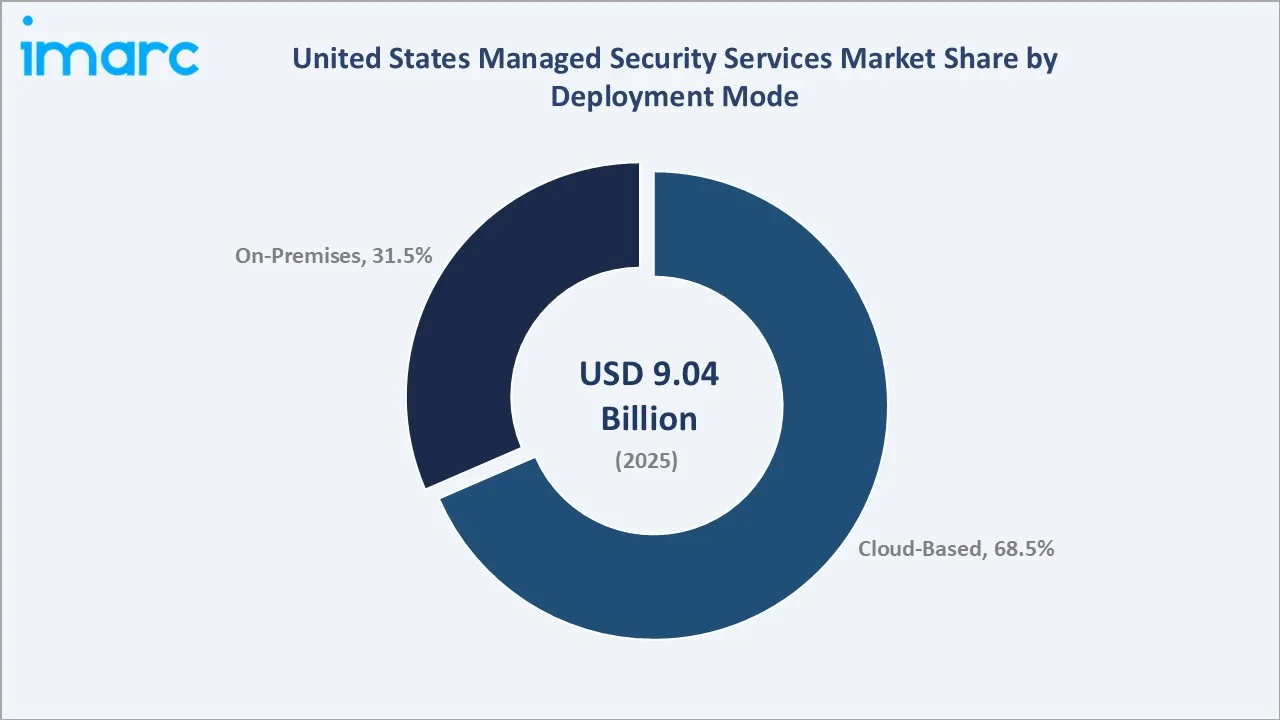
On-premises deployment at 31.5% persists through regulated industry data sovereignty requirements, air-gapped environment needs in defense and critical infrastructure, and legacy enterprise security architectures requiring on-site integration. Government and healthcare customers sustain on-premises MSS demand through data handling compliance requirements that cloud-based delivery cannot address within current regulatory frameworks.
Regional Market Insights
|
Region |
Share (2025) |
Key U.S. MSS Market Drivers & Characteristics |
|
West |
32.8% |
Driven by Silicon Valley technology concentration, high-value cloud-native enterprise density, and significant defense contractor and government agency cybersecurity spending in California and Washington State. |
|
South |
28.6% |
Supported by large financial services, healthcare, and energy sector concentrations in Texas, Florida, and Georgia, with growing demand for compliance-focused MSS in heavily regulated industries. |
|
Northeast |
21.4% |
Reflects dense BFSI and healthcare sector concentration in New York and Boston metropolitan areas, driving demand for SIEM, compliance management, and advanced threat detection services. |
|
Midwest |
17.2% |
Driven by manufacturing, automotive, and utilities sector digital transformation creating demand for OT/IT security convergence managed services and regulatory compliance support. |
The West's 32.8% market leadership reflects California's exceptional technology sector density, the highest concentration of cloud-native enterprises requiring cloud-delivered MSS, and significant federal defense and intelligence cybersecurity contracts in Washington and Colorado. The South's 28.6% reflects Texas's large financial services and energy sector base, Florida's healthcare and financial services concentration, and growing MSSP adoption among mid-market enterprises in rapidly expanding Southern business corridors.
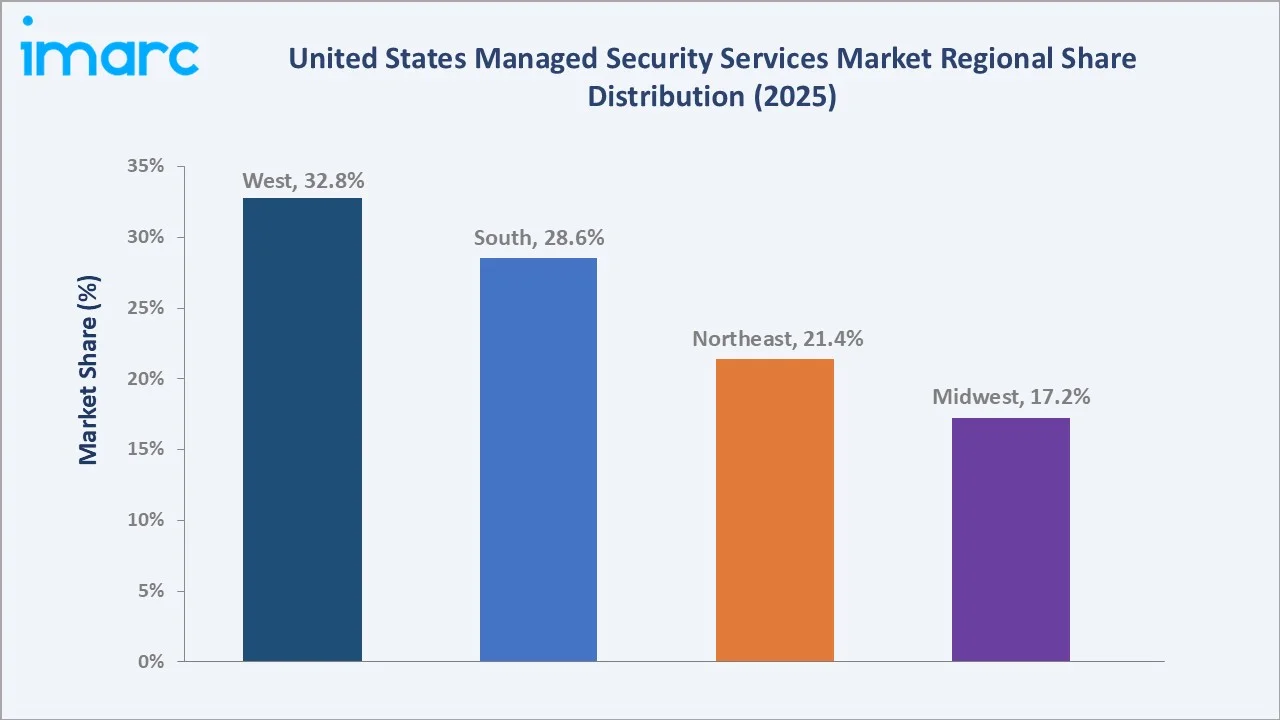
The Northeast's 21.4% reflects New York's extraordinary BFSI sector concentration, where financial regulatory requirements create non-discretionary SIEM and compliance MSS demand, and Boston's healthcare and biotech sector driving HIPAA-compliant managed security adoption. The Midwest's 17.2% is growing through manufacturing sector OT/IT convergence creating new industrial security MSS demand as automotive, aerospace, and heavy industry digitization expands industrial attack surfaces requiring specialized managed security protection.
Competitive Landscape
The U.S. managed security services competitive landscape is moderately concentrated at the top tier with International Business Machines Corporation, AT&T Inc., and Accenture plc commanding significant market share through global delivery infrastructure, enterprise client relationships, and integrated security service portfolios. Competition is intensifying through AI-native platform differentiation, XDR service consolidation, and pure-play MSSP expansion.
|
Company |
Key Services |
Market Position |
Core Strength |
|
Verizon |
Managed SOC, Threat Intel, SIEM |
Strong Challenger |
Verizon delivers managed security services through its security operations infrastructure, offering SIEM management, threat detection, and compliance services to enterprise and government customers. |
|
Palo Alto Networks |
Managed XDR, SASE, Cortex MDR, Unit 42 |
Innovator |
Palo Alto Networks, Inc. provides managed detection and response through Unit 42 and Cortex XSIAM, offering AI-driven threat intelligence, incident response, and comprehensive managed SOC services to enterprise customers. |
|
Cisco Systems, Inc. |
Managed Firewall, SIEM, XDR, Compliance |
Strong Challenger |
Cisco Systems, Inc. delivers managed security through Cisco Security Cloud, providing managed firewall, endpoint, and network security services integrated with AI-powered threat intelligence across its installed base. |
Key players include Verizon, Palo Alto Networks, Cisco Systems, Inc., and others.
Key Company Profiles
Cisco Systems, Inc.
Cisco Systems, Inc. is a global networking and cybersecurity leader providing managed security services through Cisco Security, delivering integrated threat defense, network security operations, and AI-powered managed detection and response across enterprise, government, and service provider customers worldwide.
- Key Services: Cisco Security Cloud managed services, managed firewall and network security, Cisco XDR managed detection and response, Duo managed identity security, Splunk-powered managed SIEM, and Cisco Talos threat intelligence services
- Strategic Focus: Accelerating platform consolidation by integrating Splunk's SIEM and observability capabilities with Cisco XDR, Talos threat intelligence, and Duo identity security into a unified managed security service offering, positioning Cisco Security Cloud as the enterprise security platform of choice for customers seeking to reduce multi-vendor complexity through a single managed security partner.
Palo Alto Networks
Palo Alto Networks, Inc. is a global cybersecurity leader providing managed security services through its Cortex and Unit 42 platforms, delivering AI-native threat detection and response, managed SOC operations, and strategic cybersecurity consulting to enterprise and government customers across the United States.
- Key Services: Cortex XSIAM managed detection and response, Unit 42 managed threat hunting and incident response, Prisma SASE managed network security, Cortex XDR endpoint protection, and AI-powered managed SOC services.
- Strategic Focus: Deepening platformization by consolidating network security, cloud security, security operations, and identity security into a unified AI-native Cortex platform, positioning Palo Alto Networks, Inc. as the preferred MSSP for enterprise customers pursuing security architecture simplification, while expanding Unit 42's managed threat intelligence and incident response retainer as a high-margin recurring revenue stream alongside core Cortex MDR services.
Market Concentration Analysis
The U.S. managed security services market is moderately concentrated at the enterprise tier, with the key players collectively accounting for an estimated 25-35% of total MSS revenue through their large enterprise and government client relationships. The market is highly fragmented in the mid-market and SME segment, where hundreds of regional and specialized MSSPs compete for customers below large enterprise contract sizes.
Market concentration is being influenced by two opposing forces: large technology companies expanding MSS offerings through platform integration, while pure-play MSSPs players and niche specialists compete through deeper security specialization and faster detection capabilities that differentiate them from broad-portfolio technology vendors.
Investment & Growth Opportunities
Highest Growth Segments
Managed XDR at ~18.2% CAGR through AI-driven threat detection consolidation, cloud-based MSS at ~17.9% CAGR through enterprise cloud migration, Managed IAM at ~15.4% CAGR through zero trust architecture adoption, OT/IT security managed services for industrial sector digitization, and AI-native SOC automation platforms represent the highest-growth U.S. MSS investment vectors through 2034.
Emerging Investment Opportunities
The SME MSS market, representing the largest under-penetrated customer segment, is becoming commercially accessible through cloud-native MSSP platforms that reduce deployment cost and complexity to SME-accessible levels. Federal cybersecurity mandate expansion and cyber insurance requirement growth are creating structured non-discretionary MSS demand that sustains investment above commercial economic cycles.
Investment Themes
- AI-native MSSP platform investment capturing the detection and response efficiency advantage: MSSPs with proprietary AI-driven threat detection, automated response orchestration, and generative AI investigation capabilities are commanding premium pricing above traditional rule-based MSS providers, creating investable differentiation that sustains above-market revenue growth as enterprise customers increasingly prioritize detection outcomes over price in security vendor selection.
- OT/IT security convergence MSS addressing the highest-growth emerging industrial security segment: Industrial sector digitization creating new OT attack surfaces represents an estimated $2+ billion addressable MSS segment growing at above-market rates as manufacturing, energy, and utilities enterprises require specialized managed security capabilities that combine IT security expertise with operational technology environment knowledge not available in traditional enterprise MSS providers.
Future Market Outlook (2026-2034)
The U.S. managed security services market is projected to grow from USD 9.04 Billion in 2025 to USD 10.36 Billion in 2026, reaching USD 32.06 Billion by 2034, registering a CAGR of 14.65% during 2026–2034. The market's anchor value of approximately USD 17.91 Billion in 2030 represents the U.S. MSS market at a structural inflection, with AI-native security operations becoming mainstream, XDR consolidation of point-product MSS categories accelerating, and federal zero-trust mandates driving above-commercial-cycle security investment across government-adjacent enterprise sectors.
Three structural forces define U.S. MSS market growth through 2034: the widening cybersecurity talent shortage creating durable structural MSSP demand above any level addressable by in-house security hiring; AI-native platform superiority creating measurable detection outcome advantages that drive MSSP adoption among enterprises previously maintaining in-house SOC capabilities; and regulatory mandate expansion sustaining non-discretionary MSS investment above economic cycle variability.
Research Methodology
Primary Research
Primary research comprised structured interviews with U.S. managed security services industry stakeholders including MSSP Sales Directors, CISO and VP of Security executives, SOC Operations Managers, federal cybersecurity procurement officials, and enterprise security budget holders across BFSI, healthcare, manufacturing, and government verticals.
Secondary Research
Secondary research encompassed CISA cybersecurity reports, SEC cybersecurity disclosure filings, company annual reports and investor presentations, NIST framework documentation, federal cybersecurity budget disclosures, and industry association data. Over 55 primary and secondary sources were reviewed and cross-referenced for data validation and triangulation.
Forecasting Models
Market revenue forecasts were developed using a demand-side model combining enterprise cybersecurity budget growth rates, MSSP adoption penetration across enterprise segments, regulatory mandate implementation timelines, and MSSP vendor revenue expansion trajectories, with AI-driven service category growth rate adjustments applied to AI-native service segments including Managed XDR and cloud-based MSS.
United States Managed Security Services Market Report Coverage:
| Report Features | Details |
|---|---|
| Base Year of the Analysis | 2025 |
| Historical Period | 2020-2025 |
| Forecast Period | 2026-2034 |
| Units | Billion USD |
| Scope of the Report |
Exploration of Historical Trends and Market Outlook, Industry Catalysts and Challenges, Segment-Wise Historical and Future Market Assessment:
|
| Types Covered | Managed SIEM, Managed UTM, Managed DDoS, Managed XDR, Managed IAM, Managed Risk and Compliance, Others |
| Deployment Modes Covered | On-premises, Cloud-based |
| Enterprises Sizes Covered | Small and Medium-Sized Enterprises, Large Enterprises |
| Verticals Covered | BFSI, Healthcare, Manufacturing, IT and Telecom, Retail, Defense/Government, Others |
| Regions Covered | Northeast, Midwest, South, West |
| Companies Covered | Verizon, Palo Alto Networks, Cisco Systems, Inc., etc. |
| Customization Scope | 10% Free Customization |
| Post-Sale Analyst Support | 10-12 Weeks |
| Delivery Format | PDF and Excel through Email (We can also provide the editable version of the report in PPT/Word format on special request) |
Key Benefits for Stakeholders:
- IMARC’s industry report offers a comprehensive quantitative analysis of various market segments, historical and current market trends, market forecasts, and dynamics of the United States managed security services market from 2020-2034.
- The research report provides the latest information on the market drivers, challenges, and opportunities in the United States managed security services market.
- Porter's five forces analysis assist stakeholders in assessing the impact of new entrants, competitive rivalry, supplier power, buyer power, and the threat of substitution. It helps stakeholders to analyze the level of competition within the United States managed security services industry and its attractiveness.
- A competitive landscape allows stakeholders to understand their competitive environment and provides an insight into the current positions of key players in the market.
Frequently Asked Questions About the United States Managed Security Services Market Report
The U.S. managed security services market size is estimated at USD 10.36 Billion in 2026, driven by escalating ransomware threats, federal cybersecurity mandates including Executive Order 14028, and accelerating enterprise cloud migration requiring cloud-native managed security services across BFSI, healthcare, and government sectors.
The U.S. managed security services market grows at a CAGR of 14.65% during 2026-2034, reaching USD 32.06 Billion by 2034. Growth is sustained by AI-native MSSP platform adoption, XDR service consolidation, zero-trust architecture mandate implementation, and the structural cybersecurity talent shortage driving enterprise MSSP outsourcing.
Managed SIEM leads at 27.6% through its foundational role in enterprise threat detection, log correlation, and regulatory compliance reporting. SIEM mandates across HIPAA, PCI DSS, and NIST frameworks create non-discretionary demand, making managed SIEM the most commercially embedded MSS category across all U.S. regulated industries.
Cloud-based deployment leads at 68.5% through enterprise cloud migration, remote work normalization, and MSSP platform optimization for cloud-delivered security operations. Cloud delivery enables elastic scaling, rapid onboarding, and cost efficiency that on-premises deployment cannot match, driving continued cloud MSS share expansion through 2034.
The West region leads at 32.8% through Silicon Valley technology sector density, high cloud-native enterprise concentration in California, and significant federal defense and intelligence cybersecurity spend in Washington and Colorado creating the highest per-enterprise MSSP spending intensity in the U.S. national market.
Leading companies include Verizon, Palo Alto Networks, Cisco Systems, Inc., and others.
Need more help?
- Speak to our experienced analysts for insights on the current market scenarios.
- Include additional segments and countries to customize the report as per your requirement.
- Gain an unparalleled competitive advantage in your domain by understanding how to utilize the report and positively impacting your operations and revenue.
- For further assistance, please connect with our analysts.
 Request Customization
 Speak to an Analyst
 Request Brochure
 Inquire Before Buying
Benefits of Customization
- Personalize this research
- Triangulate with your data
- Get data as per your format and definition
- Gain a deeper dive into a specific application, geography, customer, or competitor
- Any level of personalization
Get in Touch With Us
UNITED STATES
Phone: +1-201-971-6302
INDIA
Phone: +91-120-433-0800
UNITED KINGDOM
Phone: +44-753-714-6104
Email: [email protected]
Client Testimonials




.webp)




.webp)












Related Reports

Choose your plan
*Please note that the prices mentioned below are starting prices for each bundle type. Kindly contact our team for further details.*
Single User License
- 1 User License, Access on 2 Devices
- PDF Report + Excel Dataset (Password Protected)
- Lifetime Access
- No Printing Rights
- 10% Free Report Customization
- 10–12 Weeks of Analyst Support
Five User License
- Access for 5 Users, 2 Devices per User
- PDF Report + Excel Dataset (Password Protected)
- Lifetime Access
- Dedicated Account Manager
- 12–14 Weeks of Analyst Support
- No Printing Rights
- 15% Free Report Customization
- 25% Discount on Your Next Purchase
Corporate User License
- Unlimited User Access (Within Your Organization)
- PDF Report + Excel Dataset
- Lifetime Access
- Dedicated Account Manager
- 14–20 Weeks of Analyst Support
- No Printing Rights
- 20% Free Report Customization
- 30% Discount on Your Next Purchase
Essential Insights
What's included:
3 reports
- Lifetime Access
- PDF Reports
- Excel Datasets
- 2 Weeks of Free Analyst Support
- 2 User Licenses
- Access on 2 Devices
- Printing Rights
- Complimentary PowerPoint (PPT) Version
- Complimentary License Upgrade
Professional Access
What's included:
5 reports
- Lifetime Access
- PDF Reports
- Excel Datasets
- 8 Weeks of Free Analyst Support
- 2 User Licenses
- Access on 2 Devices
- Printing Rights
- Complimentary PowerPoint (PPT) Version
- Complimentary License Upgrade
Business Advantage
What's included:
8 reports
- Lifetime Access
- PDF Reports
- Excel Datasets
- 14 Weeks of Free Analyst Support
- 2 User Licenses
- Access on 2 Devices
- Printing Rights
- Complimentary PowerPoint (PPT) Version
- Complimentary License Upgrade
Enterprise Intelligence
What's included:
10 reports
- Lifetime Access
- PDF Reports
- Excel Datasets
- 20 Weeks of Free Analyst Support
- 2 User Licenses
- Access on 2 Devices
- Printing Rights
- Complimentary PowerPoint (PPT) Version
- Complimentary License Upgrade