
United States Rice Market Size, Share, Trends and Forecast by Product Type, Type, Grain Size, Distribution Channel, Application, and Region, 2026-2034
United States Rice Market Size, Share, Trends & Forecast (2026-2034)
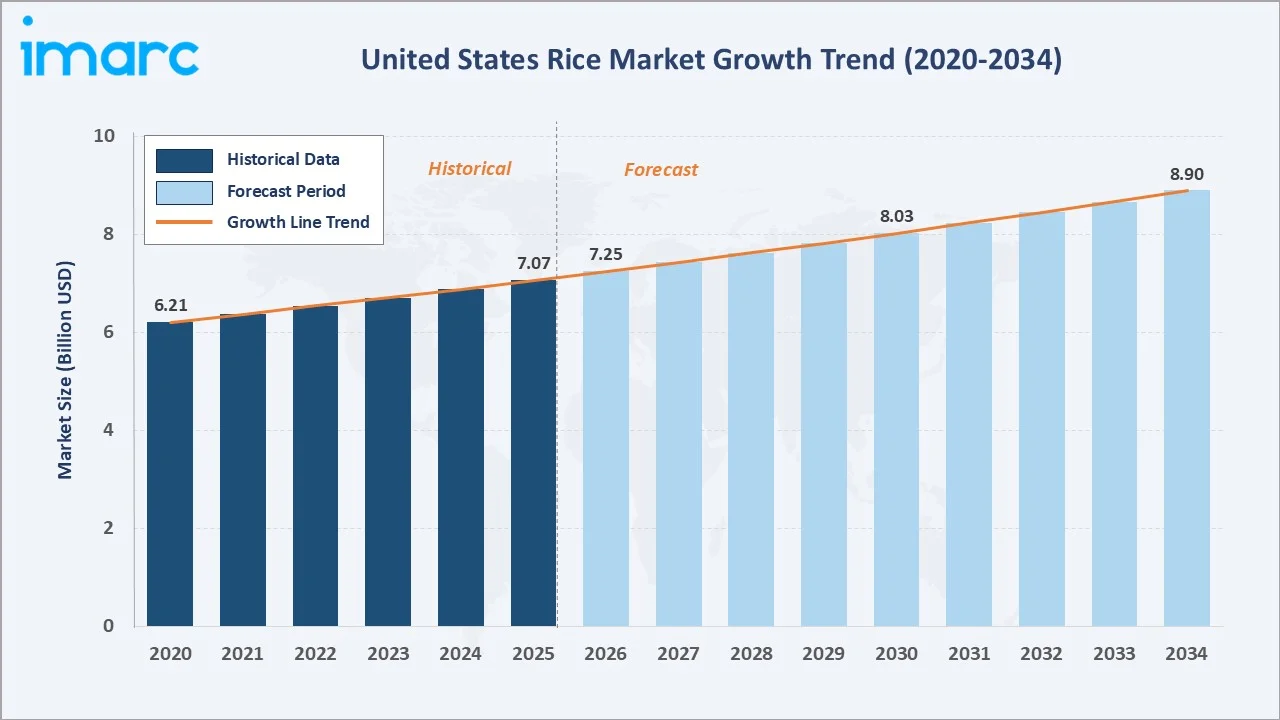
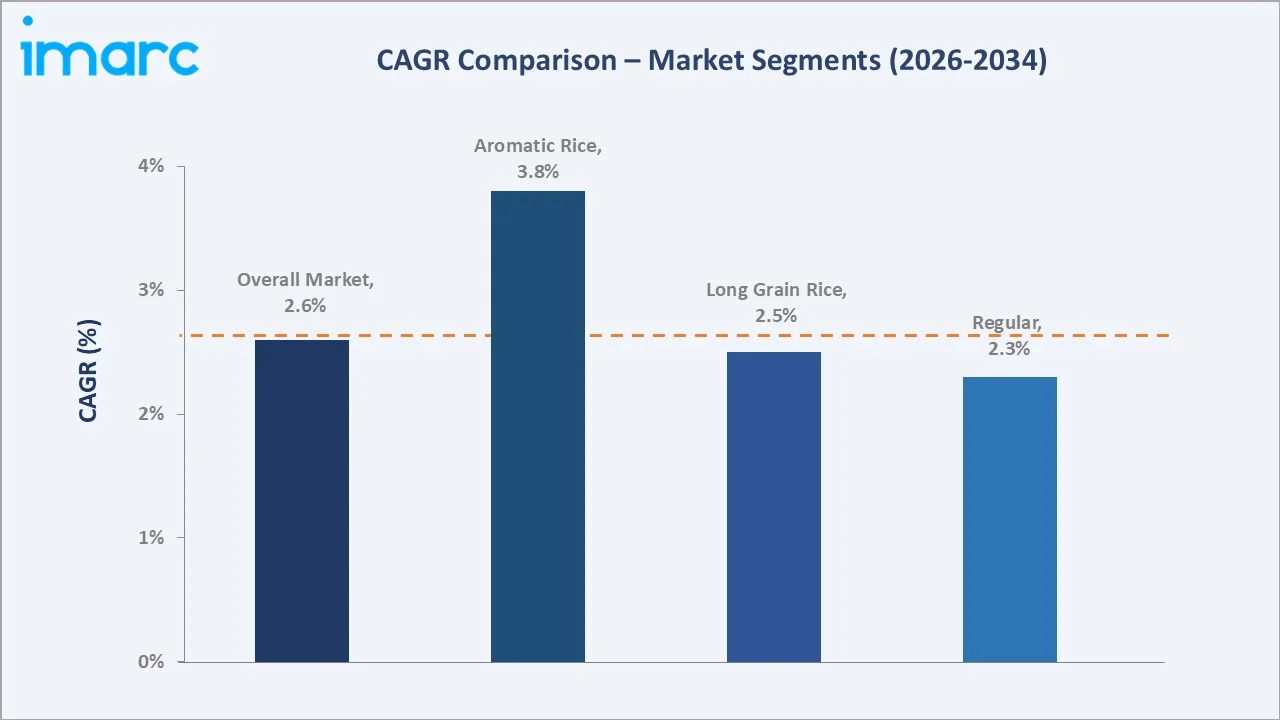
The United States rice market grew from USD 7.07 Billion in 2025 to USD 7.25 Billion in 2026 and is projected to reach USD 8.90 Billion by 2034, growing at a CAGR of 2.6% during 2026-2034. The market is driven by rising rice consumption as a staple food, changing dietary preferences, the flourishing food processing industry, and government support policies.
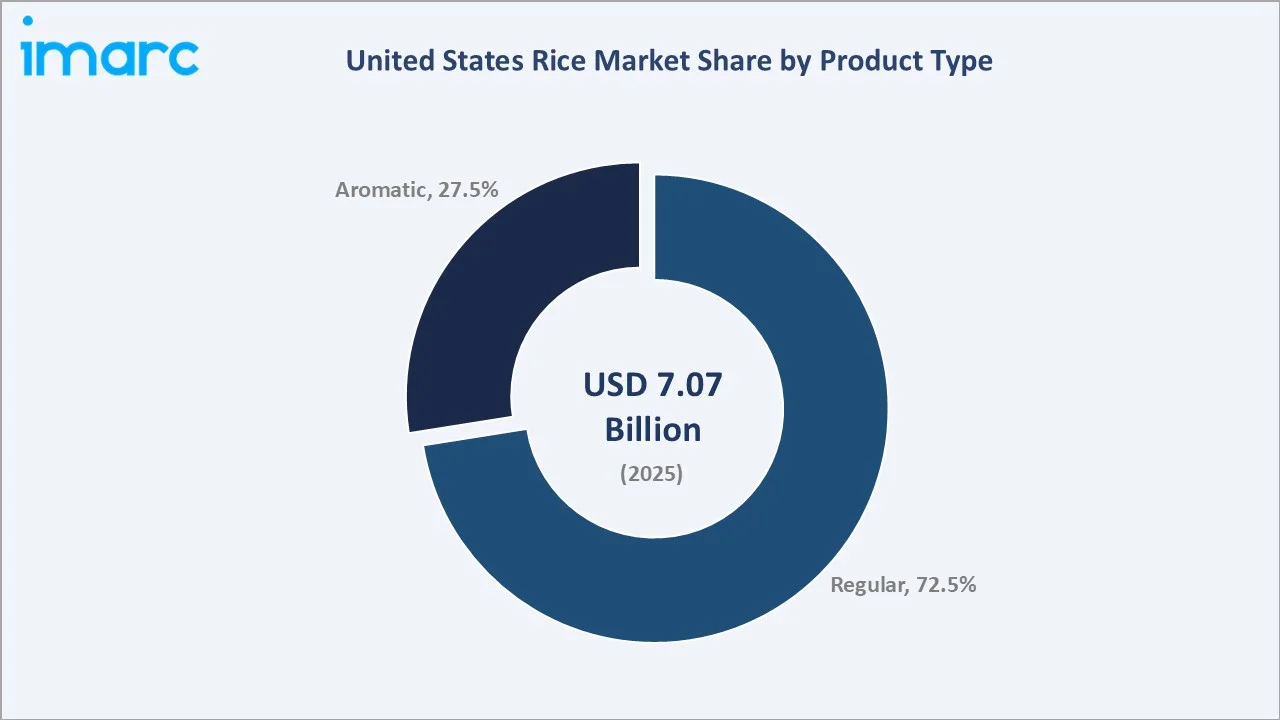
Regular rice dominates at 72.5%. Long grain leads grain size segments at 72.5%. The South region commands 36.5% of the national market share.
Market Snapshot
|
Metric |
Value |
|
Base Year Market Size (2025) |
USD 7.07 Billion |
|
Market Size (2026) |
USD 7.25 Billion |
|
Forecast Market Size (2034) |
USD 8.90 Billion |
|
CAGR (2026-2034) |
2.6% |
|
Base Year |
2025 |
|
Historical Period |
2020-2025 |
|
Forecast Period |
2026-2034 |
|
Dominant Product Type |
Regular (72.5%, 2025) |
|
Dominant Grain Size |
Long Grain (72.5%, 2025) |
|
Leading Region |
South (36.5%, 2025) |
The United States rice market size increased from USD 6.21 Billion in 2020 to USD 7.07 Billion in 2025 and is estimated to reach USD 7.25 Billion in 2026. The market is further expected to grow to USD 8.03 Billion by 2030 and USD 8.90 Billion by 2034.
The United States rice market is commercially significant as both a major domestic producer and importer. It uniquely combines a large mass-consumption base, a growing premium specialty segment, and a robust food processing industry that uses rice across multiple product categories.
To get more information on this market, Request Sample
The Aromatic segment grows at a higher rate of approximately 3.5–4.0% CAGR, driven by multicultural demographic growth and rising demand for basmati and jasmine varieties. Long grain remains dominant given its versatility across American, Latin, and ethnic cuisines.
Executive Summary
The United States rice market expanded from USD 7.07 Billion in 2025 to an estimated USD 7.25 Billion in 2026, positioning it among the world's most commercially significant national rice markets by value. The market is projected to reach USD 8.90 Billion by 2034.
The United States rice market stands apart from other global rice markets because it is both a domestic producer—concentrated in the South and West—and a significant net importer of specialty and aromatic rice varieties. This structure supports broad product diversity across all income levels and culinary segments.
Regular rice leads at 72.5% through mass-market dominance and widespread foodservice use. Long grain accounts for 72.5% in grain size, reflecting its preference across American and ethnic cuisines. The South leads regionally at 36.5% as the core domestic rice production and consumption zone of the country.
Key Market Insights
|
Insight |
Data |
|
Dominant Product Type |
Regular – 72.5% share (2025) |
|
Dominant Grain Size |
Long Grain – 72.5% share (2025) |
|
Leading Region |
South – 36.5% share (2025) |
|
Market Opportunity |
Organic rice, value-added products, ethnic cuisine expansion, premium aromatic varieties, online grocery retail, gluten-free product applications |
Key Analytical Observations Supporting the Above Data:
- Regular at 72.5%: Regular rice dominates owing to its affordability, cooking versatility, and entrenched role as a household staple. It forms the base of retail, foodservice, and institutional procurement, with strong demand from schools, hospitals, the military, and quick-service restaurants. Regular rice's wide availability across all retail formats and price points ensures consistent volume demand across all consumer demographics.
- Long Grain at 72.5%: Long grain rice leads the grain-size segment due to consumer preference for non-sticky, fluffy grains suited to pilaf, casseroles, stir-fry, and rice salads. Domestic production of long grain white and brown rice in Arkansas and Louisiana reinforces its availability and price competitiveness. Long grain varieties including basmati and jasmine are the fastest-growing sub-types within this dominant segment.
- South at 36.5%: The South leads regionally by virtue of being the primary domestic rice-producing region, hosting most of the rice milling, processing, and packaging capacity in the United States. Deep cultural food traditions centered on rice dishes such as jambalaya, red beans and rice, and Cajun-style rice preparations sustain high per-capita consumption across the Southern states.
United States Rice Market Overview
The United States rice market is positioned at a commercially significant intersection of domestic agricultural output, diverse import sourcing, and robust consumption across food, feed, and processing applications. The market serves as a key supplier to both the domestic food system and international export channels, supported by established infrastructure in the Southern and Western rice-growing states.
The market ecosystem integrates domestic rice farming concentrated in Southern states, large-scale milling and processing facilities, branded retail distribution, foodservice supply chains, and online retail channels. Macroeconomic factors supporting market growth include stable consumer spending on food staples, a growing multicultural population driving specialty rice demand, and the expansion of rice in health-focused and gluten-free product categories.
Market Dynamics
To evaluate market opportunities, Request Sample
Market Drivers
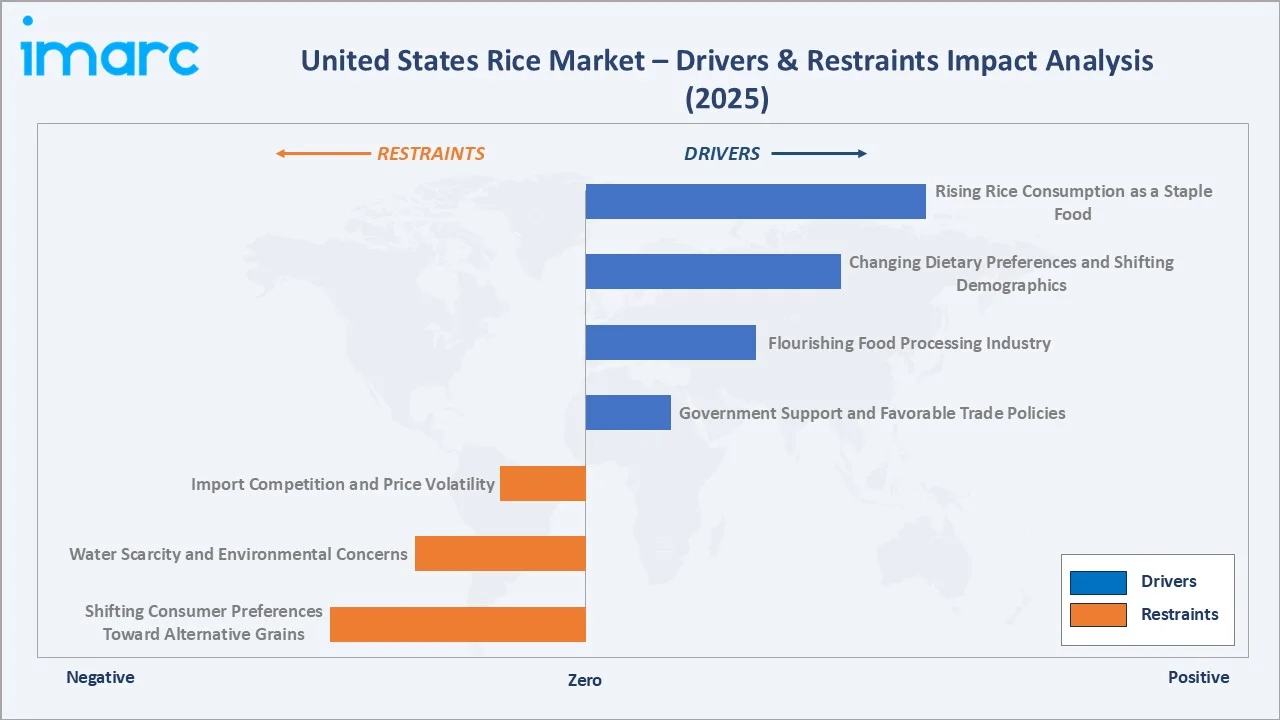
- Rising Rice Consumption as a Staple Food: Rice consumption in the United States continues to rise, driven by growing multicultural communities for whom rice is a daily dietary staple. Per-capita consumption growth, particularly among Asian American, Hispanic, and African-American populations, sustains broad-based demand across all market segments. The versatility of rice in cuisines from dozens of cultural traditions embedded in the American food landscape ensures sustained demand far beyond single-community consumption patterns.
- Changing Dietary Preferences and Shifting Demographics: Health-conscious consumers are increasingly choosing brown rice, wild rice, and organic rice options as nutritious, fiber-rich alternatives to refined grains. Simultaneously, the growing ethnic population is accelerating demand for specialty aromatic varieties including basmati and jasmine, expanding the premium rice category. The rise of plant-based diets and gluten-free eating patterns further amplifies rice consumption as a clean-label, naturally gluten-free carbohydrate source.
- Flourishing Food Processing Industry: Rice is a critical and versatile ingredient in the United States food processing sector, used in baby foods, breakfast cereals, rice crackers, rice flour, gluten-free baking products, rice-based beverages, and fermentation applications. The expanding packaged food and snack category's reliance on rice as a clean-label, gluten-free ingredient is a significant demand multiplier. The food processing sector's continued growth, driven by convenience food demand and population expansion, creates structural industrial demand for rice that is largely insulated from consumer preference cycles and retail seasonality.
- Government Support and Favorable Trade Policies: Domestic rice production in the United States is supported by USDA farm subsidies, crop insurance programs, and water management infrastructure investments that reduce production risk for Southern and Western rice farmers. Favorable trade frameworks ensure a diversified import supply chain, maintaining product variety and price competitiveness for American consumers and processors.
Market Restraints
- Import Competition and Price Volatility: United States domestic rice producers face persistent price competition from lower-cost imports from Thailand, Vietnam, Cambodia, and India. Fluctuations in global commodity prices, freight costs, and exchange rates can create market price instability, compressing margins for domestic millers and increasing procurement uncertainty for food processors and retailers. The structural cost advantage of Southeast Asian rice producers in long grain regular rice production creates a permanent pricing ceiling on domestic producer margins, particularly in the highly competitive mass-market retail segment where price sensitivity among buyers is highest.
- Water Scarcity and Environmental Concerns: Rice cultivation is highly water-intensive, averaging 1,200–2,000 liters per kilogram produced. Growing water scarcity in California's Sacramento Valley and increasing regulatory pressure on agricultural water use threaten domestic medium and short grain rice production capacity in the Western United States. Environmental regulations targeting methane emissions from flooded rice paddies impose additional compliance costs on domestic growers. The long-term structural constraint of water availability in key rice-growing regions represents a material risk to domestic supply growth, potentially shifting the supply balance further toward imports over the forecast period.
- Shifting Consumer Preferences Toward Alternative Grains: The rising popularity of quinoa, farro, cauliflower rice, and other low-carbohydrate grain substitutes among health- and sustainability-focused consumers represents a substitution risk for traditional rice products. This trend is most pronounced in premium retail and natural food channels, where rice brands must compete more aggressively with higher-protein, lower-carbohydrate grain alternatives that carry stronger health perception among target demographic segments. The accelerating popularity of low-carbohydrate dietary patterns such as keto and paleo diets creates headwinds for rice in specific consumer segments, requiring the rice industry to develop and market nutritionally differentiated products.
Market Opportunities
- Organic and Premium Rice Expansion: The growing consumer preference for organic, non-GMO, and sustainably produced food products creates a significant premium market opportunity for rice producers and brands. Certified organic rice commands price premiums of 30–50% above conventional varieties, creating attractive margin expansion opportunities for producers capable of meeting organic certification standards. The natural and specialty food retail channel is growing at above-market rates, and organic rice is benefiting from increasing distribution in mainstream grocery chains alongside specialty retailers, broadening the addressable consumer base for premium rice products beyond the traditional health food channel.
- Ethnic and Specialty Rice Category Growth: The United States's growing South Asian, Southeast Asian, Middle Eastern, and Latin American populations represent a structurally expanding demand base for specialty aromatic and ethnic rice varieties. Basmati, jasmine, arborio, and sushi rice are all benefiting from the rapid growth of ethnic cuisines in American restaurants and home cooking, creating opportunities for importers, specialty distributors, and branded marketers of premium rice varieties.
Market Challenges
- Rapid Technological Change in Agricultural Practices: The rice industry must continuously adapt to technological advancements in precision agriculture, biotechnology, and sustainability-driven farming practices. The capital investment required for modern irrigation systems, GPS-guided planting equipment, and data analytics platforms represents a significant challenge for smaller family farms that form the backbone of the Southern United States rice-growing community. The transition toward climate-resilient rice varieties and regenerative agricultural practices requires substantial investment in research, farmer education, and supply chain adaptation that may strain profitability during the transition period.
- Supply Chain Complexity and Cost Pressures: The United States rice market supply chain involves multiple stages from paddy production through milling, packaging, and retail distribution, each with distinct cost structures and margin pressures. Rising logistics costs, including transportation fuel costs, port fees, and warehousing expenses, have increased the total cost-to-serve for the rice industry. The growing complexity of multi-origin procurement strategies requires sophisticated supply chain management capabilities that represent a structural challenge for smaller market participants competing against large integrated processors.
Emerging Market Trends
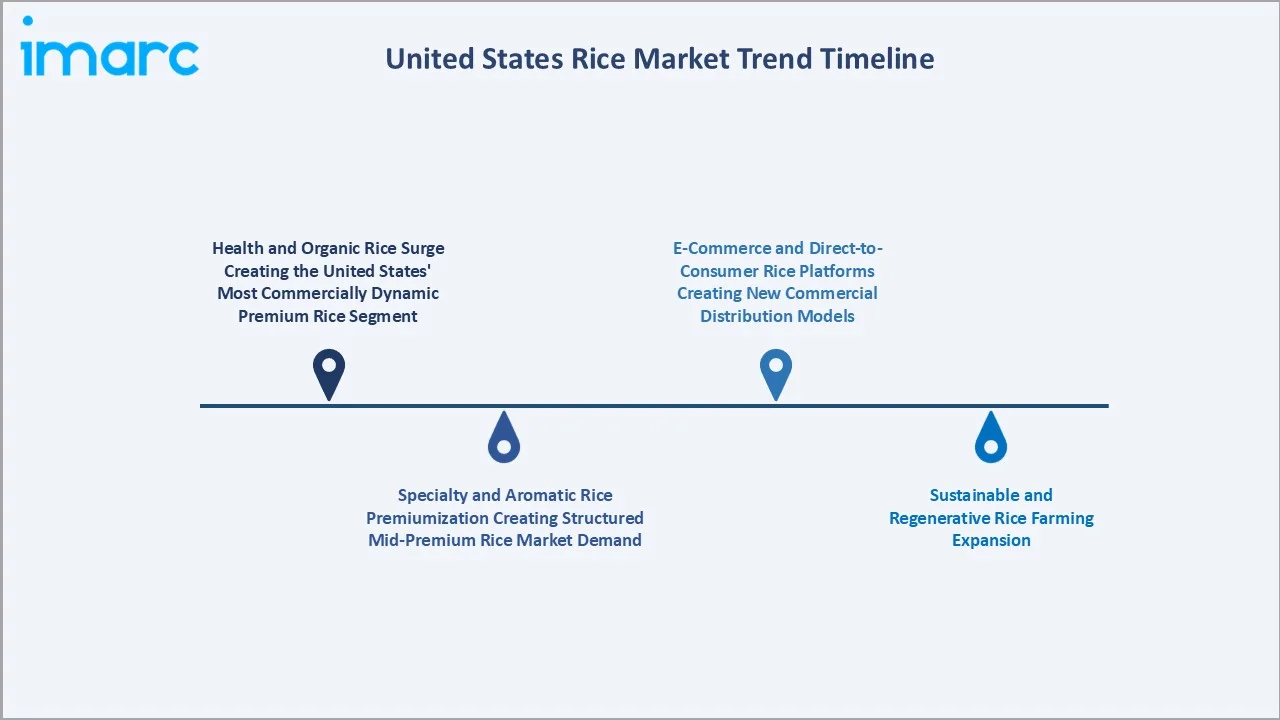
1. Health and Organic Rice Surge Creating the United States' Most Commercially Dynamic Premium Rice Segment
The health and organic rice trend is reshaping the premium end of the United States rice market, with consumers actively seeking brown rice, black rice, wild rice, and certified organic varieties as nutritious alternatives. The gluten-free food movement has significantly elevated rice flour and rice-based products across baking, snacking, and processed food categories, expanding rice's commercial footprint well beyond traditional grain consumption patterns.
2. E-Commerce and Direct-to-Consumer Rice Platforms Creating New Commercial Distribution Models
Online grocery platforms including Amazon Fresh, Instacart, and retailer digital channels are fundamentally changing how consumers discover, compare, and purchase rice products. The e-commerce channel's ability to carry a broader assortment of specialty and ethnic rice varieties than physical store shelves creates a structurally favorable environment for premium and niche rice brands. Direct-to-consumer subscription rice services are emerging, offering curated specialty rice subscriptions that create recurring revenue and deeper brand loyalty among premium rice consumers.
3. Specialty and Aromatic Rice Premiumization Creating Structured Mid-Premium Rice Market Demand
Premium aromatic rice varieties including basmati, jasmine, and specialty American-grown varieties like Texmati are growing in mainstream grocery distribution as American consumers develop more sophisticated rice purchasing behaviors. Brand investment in provenance storytelling, culinary education, and premium packaging is elevating aromatic rice from an ethnic specialty category into a mainstream premium food segment commanding meaningfully higher retail price points.
4. Sustainable and Regenerative Rice Farming Expansion
Consumer and retailer demand for sustainably produced rice is driving investment in regenerative farming practices across United States rice-growing regions. Water-efficient cultivation methods, reduced methane emission farming techniques, and certified sustainable rice programs are creating market differentiation opportunities. Major food brands are actively sourcing sustainably certified domestic rice to meet corporate sustainability commitments and consumer demand for environmentally responsible food sourcing.
Industry Value Chain Analysis
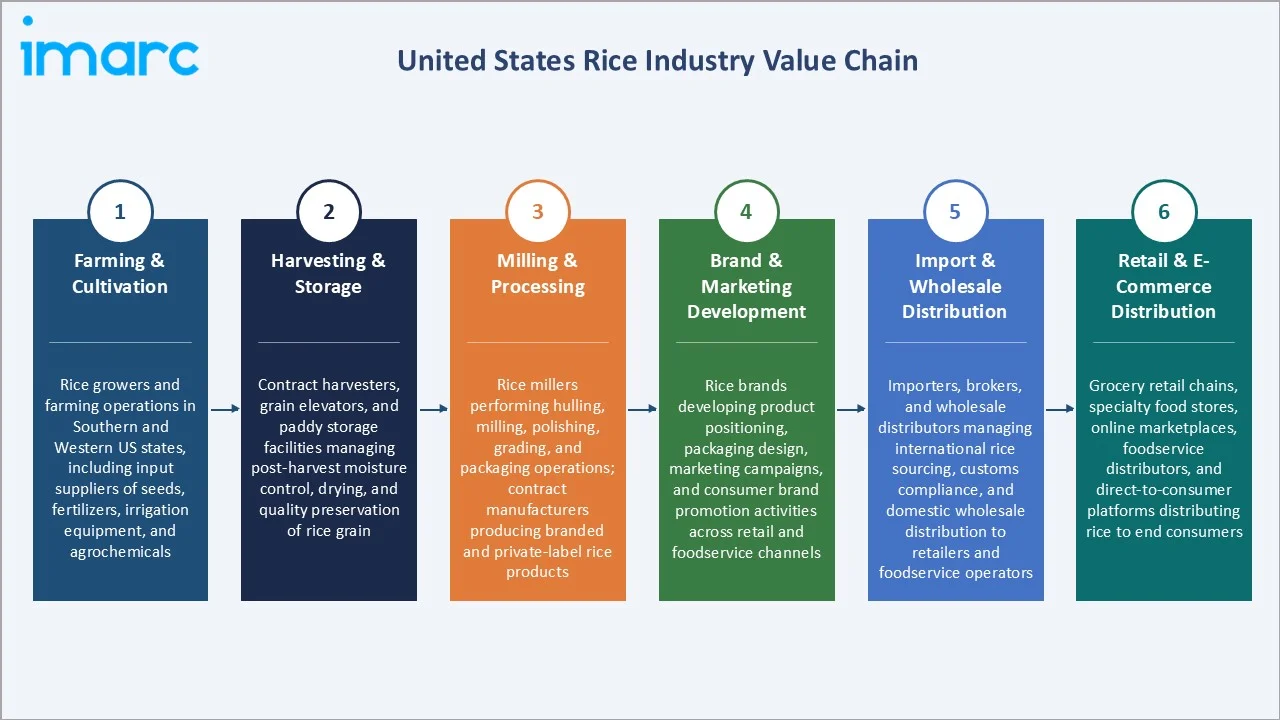
The United States rice value chain is among the most integrated of any agricultural commodity in the country. The value chain's commercial structure creates a unique market dynamic where domestic value addition competes alongside imported products at different price points, but with overlapping commercial objectives for the mass and mid-market consumer.
|
Stage |
Key Participants |
|
Farming & Cultivation |
Rice growers and farming operations in Southern and Western US states, including input suppliers of seeds, fertilizers, irrigation equipment, and agrochemicals |
|
Harvesting & Storage |
Contract harvesters, grain elevators, and paddy storage facilities managing post-harvest moisture control, drying, and quality preservation of rice grain |
|
Milling & Processing |
Rice millers performing hulling, milling, polishing, grading, and packaging operations; contract manufacturers producing branded and private-label rice products |
|
Brand & Marketing Development |
Rice brands developing product positioning, packaging design, marketing campaigns, and consumer brand promotion activities across retail and foodservice channels |
|
Import & Wholesale Distribution |
Importers, brokers, and wholesale distributors managing international rice sourcing, customs compliance, and domestic wholesale distribution to retailers and foodservice operators |
|
Retail & E-Commerce Distribution |
Grocery retail chains, specialty food stores, online marketplaces, foodservice distributors, and direct-to-consumer platforms distributing rice to end consumers |
The milling and processing stage is the United States rice value chain's most commercially consequential stage, where domestic processors invest in brand development, packaging innovation, and product range diversification to differentiate from commodity imports and capture higher retail margins.
Technology Landscape in the United States Rice Industry
Precision Agriculture and Smart Farming Technologies
Precision agriculture technologies including GPS-guided planting, soil moisture sensors, aerial drone imaging, and variable-rate application systems are improving yield efficiency across U.S. rice-growing regions. These tools enable farmers in Arkansas, Louisiana, and California to optimize water and fertilizer usage, improving profitability and sustainability across the Southern and Western rice belts.
Rice Milling and Processing Technology
Advanced milling technologies including optical color sorters, whitening systems, automated quality control platforms, and high-capacity continuous-flow dryers are improving milled rice quality and reducing breakage rates. These systems enable commercial millers to produce higher-grade white and brown rice consistently, supporting premium retail pricing and export quality standards across U.S. processing facilities.
Sustainable Cultivation and Water Management Technology
Water-efficient cultivation technologies including alternate wetting and drying irrigation, laser land leveling, and aerobic rice cultivation methods are reducing water consumption in flooded paddies. These are critical in California and Southern states where water scarcity and environmental regulations are accelerating adoption of sustainable, lower-emission rice production methodologies.
Market Segmentation Analysis
The report covers the following segments:
|
Segment Category |
Leading Segment |
Market Share |
Year |
|
Product Type |
Regular |
72.5% |
2025 |
|
Type |
🔒 |
🔒 |
2025 |
|
Grain Size |
Long Grain |
72.5% |
2025 |
|
Distribution Channel |
🔒 |
🔒 |
2025 |
|
Application |
🔒 |
🔒 |
2025 |
|
Region |
South |
36.5% |
2025 |

By Product Type
Regular rice leads at 72.5% (2025). The regular rice segment encompasses the United States' most commercially diverse price range, from mass-market institutional supply to branded retail products, covering everyday household consumption, foodservice, and food processing applications across the country's most commercially mature rice market segment.
To access detailed market analysis, Request Sample
Aromatic at 27.5% grows faster at approximately 3.5–4.0% CAGR through the United States's growing multicultural population, rising foodservice demand for global cuisines, and premiumization trends in the specialty food retail channel driving consumer trading-up from regular to aromatic varieties.
By Grain Size
Long grain rice leads at 72.5% (2025). This segment serves the United States mass consumer market through a wide variety of applications forming the commercial foundation of the domestic rice market. Long grain's commercial resilience reflects its versatility across American, Latin, Caribbean, and Asian cuisines that collectively represent the core of United States rice consumption patterns.
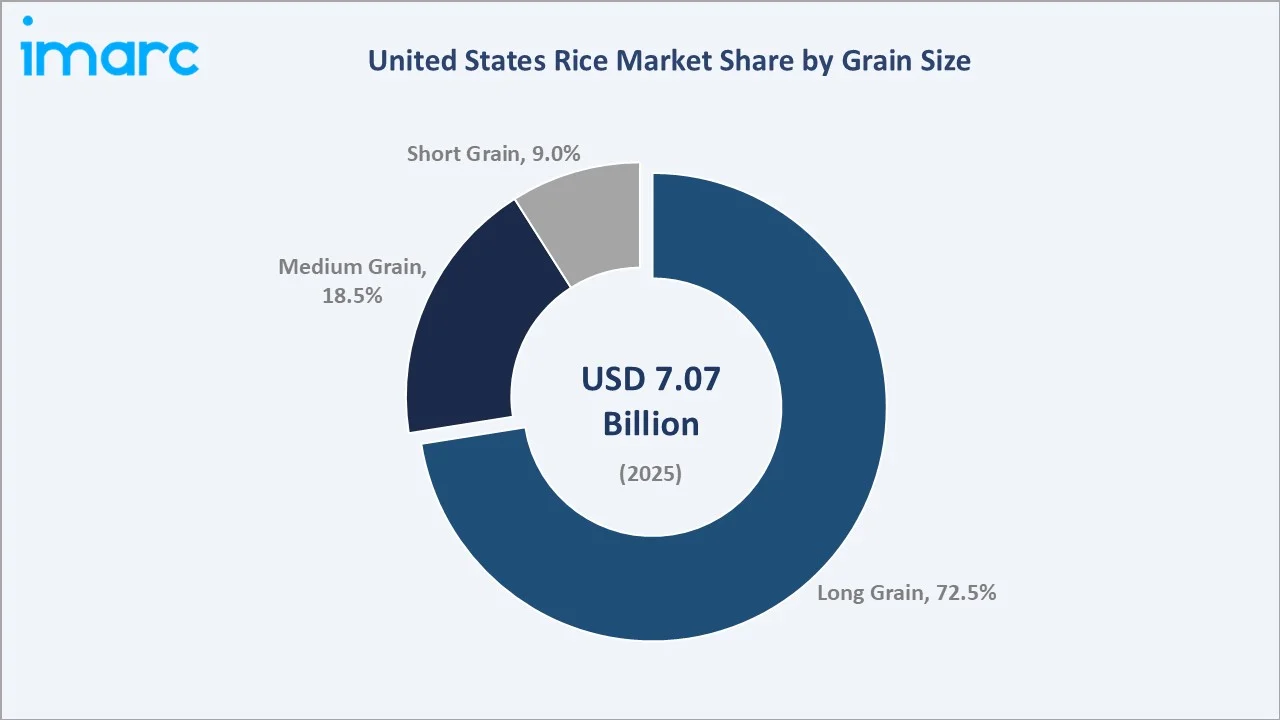
Medium grain at 18.5% is growing through Japanese cuisine expansion, California Calrose production strength, and growing sushi restaurant culture.
Regional Market Insights
|
Region |
Share (2025) |
Key Market Drivers & Characteristics |
|
South |
36.5% |
Driven by domestic rice production, deep culinary traditions, and strong retail and food processing infrastructure across Arkansas, Louisiana, Mississippi, and Texas. |
|
West |
25.5% |
Supporting widespread adoption of specialty aromatic, medium grain, and organic rice through California's large Asian-American population and premium food retail culture. |
|
Midwest |
22.0% |
Reflects Chicago, Detroit, and Minneapolis's diverse multicultural populations and the region's large food manufacturing and institutional food sector. |
|
Northeast |
16.0% |
Rising per-capita spending on premium and specialty rice products driven by dense urban populations and high concentration of diverse ethnic communities. |
The South's 36.5% market leadership reflects Arkansas's position as the largest domestic rice-producing state, Louisiana's Cajun and Creole culinary rice traditions, and the region's concentration of rice milling, processing, and export infrastructure. The West's 25.5% reflects California's Sacramento Valley's medium grain Calrose production and the state's large and commercially influential Asian-American consumer population.
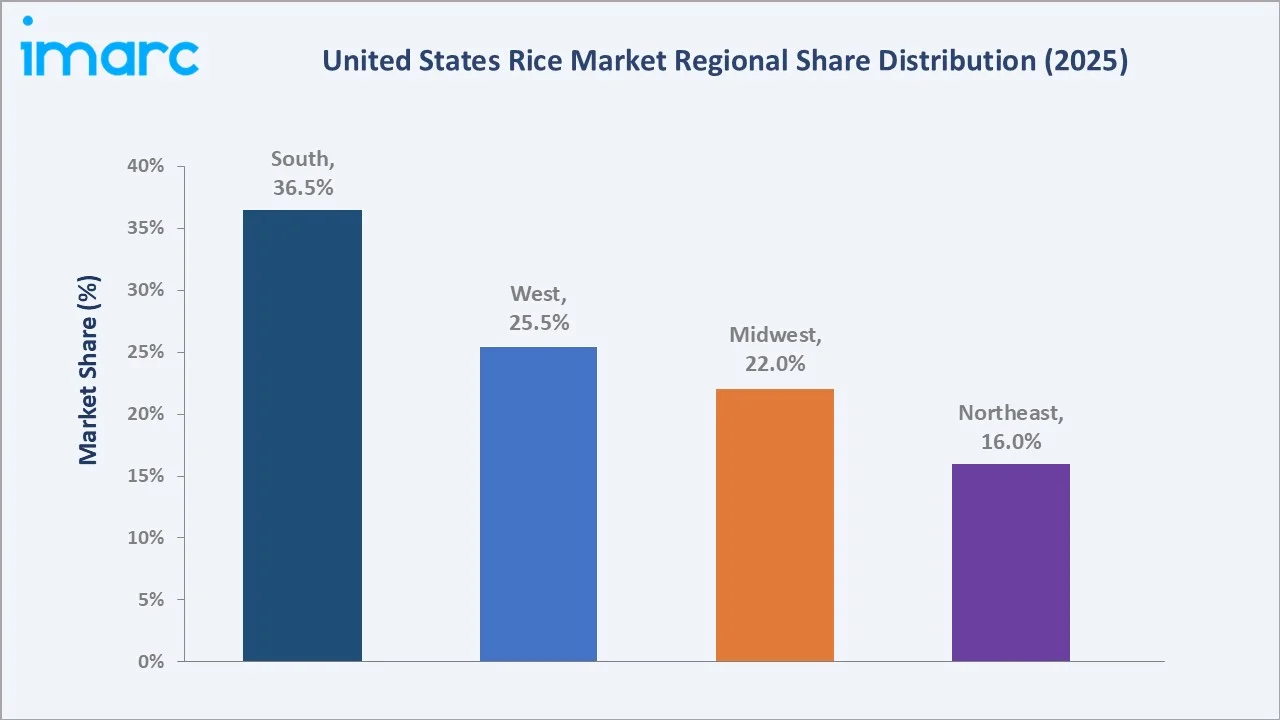
The Midwest's 22.0% is the most commercially underestimated regional market, driven by above-average growth in ethnic specialty rice demand and the region's significant food processing sector consumption.
Competitive Landscape
The United States rice market competitive landscape is commercially stratified, with large domestic integrated millers and branded companies competing alongside global trading firms and specialty importers. Competition is intensifying due to growing e-commerce adoption, rising demand for organic and specialty rice, and increasing consumer sophistication in rice purchasing decisions.
|
Company |
Key Brands |
Market Position |
Core Strength |
|
Ebro Foods, S.A. |
Success, Mahatma, Carolina, Minute Rice, RiceSelect, Tilda |
Market Leader |
Largest US rice processor with extensive Southern milling and multi-brand retail distribution infrastructure. |
|
Producers Rice Mill, Inc. |
Premium Parboiled Rice, Regular Milled Long Grain Rice, Regular Milled Medium Grain Rice, Whole Grain Brown Rice, Specialty Rice |
Market Leader |
Largest farmer-owned rice cooperative in the US with comprehensive milling and domestic export capabilities. |
|
Windmill Rice |
Long Grain Milled Rice, Medium Grain Milled Rice, Rice Bran |
Niche Player |
Established rice miller supplying regular and specialty grain varieties across retail and foodservice channels in the United States |
|
LaGrande Family Foods Group |
Daichi, Gen-Ji-Mai |
Niche Player |
Specialty rice brand focused on Japanese-style and premium Asian rice varieties, catering to health-conscious and ethnic cuisine-oriented consumer segments. |
Key players include Ebro Foods, S.A., Producers Rice Mill, Inc., Windmill Rice, LaGrande Family Foods Group, and others.
Key Company Profiles
Ebro Foods, S.A.
Ebro Foods, S.A., operating through Riviana Foods, is the largest rice processor and marketer in the United States, headquartered in Houston, Texas. As a wholly owned subsidiary of Spain's Ebro Foods, Riviana operates an extensive portfolio of branded rice products distributed across retail, foodservice, and industrial channels throughout North America.
- Key Brands: Success, Mahatma, Carolina, Minute Rice, RiceSelect, Tilda
- Recent Developments: In April 2025, Riviana Foods Expands Success Portfolio with New Boil-in-Bag Products: In April 2025, Riviana Foods expanded its Success Boil-in-Bag portfolio with the launch of Pearl Couscous and a family-size Jasmine Rice variant. The Pearl Couscous is designed as a convenient seven-minute meal solution, while the Jasmine Rice is offered in a larger 32-ounce format to cater to families and larger households.
- Strategic Focus: Maintaining market leadership through diversified brand portfolio management across all rice product types, grain sizes, and price segments from mass-market to premium. Riviana is actively expanding its organic and specialty rice capabilities to capture higher-margin premium segments while defending its dominant position in mainstream regular rice categories through operational efficiency and extensive distribution infrastructure.
Producers Rice Mill, Inc.
Producers Rice Mill is a farmer-owned rice cooperative headquartered in Stuttgart, Arkansas. It is among the largest rice milling and marketing cooperatives in the United States, with comprehensive capabilities spanning paddy procurement, milling, packaging, and domestic and export distribution.
- Key Brands: Producer's Pride brand and extensive private-label programs serving retail grocery chains, foodservice distributors, and industrial buyers.
- Strategic Focus: Leveraging cooperative structure to deliver competitive pricing and reliable supply to domestic and export customers while investing in value-added processing capabilities. The cooperative is prioritizing sustainability and traceability initiatives that differentiate its rice in an increasingly quality-conscious market where origin transparency and environmental credentials are becoming competitive differentiators for institutional and retail buyers.
Market Concentration Analysis
The United States rice market is moderately consolidated in the domestic milling and processing segment, with key players commanding an estimated 25–30% of the branded retail rice market by value, creating the most commercially dominant single-company position in the national rice market. The market is moderately fragmented in the specialty and aromatic segment, with multiple importers and specialty brands competing across regional and ethnic retail channels.
Investment & Growth Opportunities
Highest Growth Segments
Aromatic rice (~3.5–4.0% CAGR through multicultural demographic expansion), organic and specialty rice (~5–6% CAGR from health-conscious consumer demand), medium grain Calrose (~2.5% CAGR through Japanese cuisine adoption), e-commerce rice platform growth (~15–20% CAGR), and premium branded rice expansion in natural food retail (~6–8% CAGR) represent the United States rice market's highest-growth investment vectors through 2034.
Emerging Investment Opportunities
The United States certified organic rice market, growing at 5–6% annually, represents the highest-CAGR branded rice segment. The organic market's growth is driven by mainstream grocery distribution expansion, growing consumer willingness to pay premium prices for organic certification, and retailer private-label organic rice program development that is driving certified organic paddy demand above the growth of branded organic rice retail sales.
Investment Themes
- Premium aromatic and specialty rice brand development in the United States natural and specialty food retail channel, creating above-market growth opportunity through underserved premium consumer segments: The United States specialty rice market is significantly underpenetrated relative to the sophistication of American culinary culture, representing a commercially attractive entry point for new premium rice brands with strong provenance narratives and product differentiation.
- E-commerce and direct-to-consumer rice subscription platform investment for the United States rice market's most commercially dynamic growth channel: The e-commerce rice market investment opportunity is the most commercially accessible entry point for new rice market participants without established brick-and-mortar retail infrastructure. Online platforms require brand development, digital marketing capability, and logistics integration, creating an investable business model through focused brand and category management above primary rice manufacturing.
Future Market Outlook (2026-2034)
The United States rice market is projected to grow from USD 7.07 Billion in 2025 to USD 7.25 Billion in 2026, reaching USD 8.90 Billion by 2034, registering a CAGR of 2.6% during 2026–2034. The market's anchor value of USD 8.03 Billion in 2030 represents the United States rice industry at a structural inflection where premium and specialty rice segments begin contributing meaningfully to aggregate market value growth.
Three structural forces define United States rice market growth through 2034: the growing multicultural population creating the fastest-expanding specialty rice consumer base; the health and wellness trend's permanent commercial role sustaining premium and organic rice demand above standard food category growth; and the digital commerce channel's maturation, creating geographic and demographic democratization of premium rice access beyond traditional specialty food retail footprints.
Research Methodology
Primary Research
Primary research comprised structured interviews with United States rice industry stakeholders, including retail category managers, rice mill operations directors, commodity traders, brand managers, import specialists, e-commerce category executives, and consumer survey data from United States rice buyers across all four major regions, including premium, specialty, and mainstream rice purchasers.
Secondary Research
Secondary research encompassed USDA rice production and trade data, US Census Bureau demographic data, company annual reports, rice industry association publications, import-export statistics, investor presentations, and retail market scanner data. Over 60 secondary sources reviewed across government, industry, and commercial databases.
Forecasting Models
Market revenue forecasts were developed using a demographic consumption stratification model: United States population by ethnic segment and income tier multiplied by rice purchase frequency and average ticket size per segment, creating total market revenue by segment aggregation. Health trend multiplier and premiumization coefficient applied across premium and specialty segments.
United States Rice Market Report Coverage:
| Report Features | Details |
|---|---|
| Base Year of the Analysis | 2025 |
| Historical Period | 2020-2025 |
| Forecast Period | 2026-2034 |
| Units | Billion USD |
| Scope of the Report | Exploration of Historical and Forecast Trends, Industry Catalysts and Challenges, Segment-Wise Historical and Predictive Market Assessment:
|
| Product Types Covered | Regular, Aromatic |
| Types Covered | Red Rice, Arborio Rice, Black Rice, Grain Fragrance Rice, Brown Rice, Rosematta Rice, Grain Parboiled Rice, Sushi Rice, Others |
| Grain Sizes Covered | Long Grain, Medium Grain, Short Grain |
| Distribution channels Covered | Offline Stores, Online Stores |
| Applications Covered | Food, Feed, Others |
| Regions Covered | Northeast, Midwest, South, West |
| Companies Covered | Ebro Foods, S.A., Producers Rice Mill, Inc., Windmill Rice, LaGrande Family Foods Group, etc. |
| Customization Scope | 10% Free Customization |
| Post-Sale Analyst Support | 10-12 Weeks |
| Delivery Format | PDF and Excel through Email (We can also provide the editable version of the report in PPT/Word format on special request) |
Key Benefits for Stakeholders:
- IMARC’s report offers a comprehensive quantitative analysis of various market segments, historical and current market trends, market forecasts, and dynamics of the United States rice market from 2020-2034.
- The research study provides the latest information on the market drivers, challenges, and opportunities in the United States rice market.
- Porter's five forces analysis assist stakeholders in assessing the impact of new entrants, competitive rivalry, supplier power, buyer power, and the threat of substitution. It helps stakeholders to analyze the level of competition within the United States rice industry and its attractiveness.
- Competitive landscape allows stakeholders to understand their competitive environment and provides an insight into the current positions of key players in the market.
Frequently Asked Questions About the United States Rice Market Report
The United States rice market size is estimated at USD 7.25 Billion in 2026, driven by rising rice consumption as a staple food, growing multicultural population, health-conscious dietary preferences favoring brown and organic rice, and the flourishing food processing industry's demand for rice as a versatile ingredient.
The United States rice market grows at 2.6% CAGR during 2026-2034, reaching USD 8.90 Billion by 2034. Overall growth is sustained by demographic expansion, specialty rice premiumization, health-driven consumption shifts toward brown and organic rice, e-commerce channel democratization of premium rice access, and the food processing sector's growing reliance on rice as a gluten-free ingredient across multiple product categories.
Regular rice leads at 72.5% through the United States's dominant mass consumer demand for affordable, versatile rice across everyday household cooking, institutional procurement, foodservice operations, and food processing applications.
Long grain rice leads at 72.5% through the United States's broad-based consumer preference for non-sticky, fluffy grains that are suited to the widest variety of American and ethnic cuisine applications.
The South leads at 36.5% through the region's dominant domestic rice production capacity concentrated in Arkansas, Louisiana, Mississippi, and Texas, combined with deep culinary traditions centered on rice-based dishes.
Leading companies include Ebro Foods, S.A., Producers Rice Mill, Inc., Windmill Rice, LaGrande Family Foods Group, and others.
Need more help?
- Speak to our experienced analysts for insights on the current market scenarios.
- Include additional segments and countries to customize the report as per your requirement.
- Gain an unparalleled competitive advantage in your domain by understanding how to utilize the report and positively impacting your operations and revenue.
- For further assistance, please connect with our analysts.
 Request Customization
 Speak to an Analyst
 Request Brochure
 Inquire Before Buying
Benefits of Customization
- Personalize this research
- Triangulate with your data
- Get data as per your format and definition
- Gain a deeper dive into a specific application, geography, customer, or competitor
- Any level of personalization
Get in Touch With Us
UNITED STATES
Phone: +1-201-971-6302
INDIA
Phone: +91-120-433-0800
UNITED KINGDOM
Phone: +44-753-714-6104
Email: [email protected]
Client Testimonials




.webp)




.webp)













Related Reports

Choose your plan
*Please note that the prices mentioned below are starting prices for each bundle type. Kindly contact our team for further details.*
Single User License
- 1 User License, Access on 2 Devices
- PDF Report + Excel Dataset (Password Protected)
- Lifetime Access
- No Printing Rights
- 10% Free Report Customization
- 10–12 Weeks of Analyst Support
Five User License
- Access for 5 Users, 2 Devices per User
- PDF Report + Excel Dataset (Password Protected)
- Lifetime Access
- Dedicated Account Manager
- 12–14 Weeks of Analyst Support
- No Printing Rights
- 15% Free Report Customization
- 25% Discount on Your Next Purchase
Corporate User License
- Unlimited User Access (Within Your Organization)
- PDF Report + Excel Dataset
- Lifetime Access
- Dedicated Account Manager
- 14–20 Weeks of Analyst Support
- No Printing Rights
- 20% Free Report Customization
- 30% Discount on Your Next Purchase
Essential Insights
What's included:
3 reports
- Lifetime Access
- PDF Reports
- Excel Datasets
- 2 Weeks of Free Analyst Support
- 2 User Licenses
- Access on 2 Devices
- Printing Rights
- Complimentary PowerPoint (PPT) Version
- Complimentary License Upgrade
Professional Access
What's included:
5 reports
- Lifetime Access
- PDF Reports
- Excel Datasets
- 8 Weeks of Free Analyst Support
- 2 User Licenses
- Access on 2 Devices
- Printing Rights
- Complimentary PowerPoint (PPT) Version
- Complimentary License Upgrade
Business Advantage
What's included:
8 reports
- Lifetime Access
- PDF Reports
- Excel Datasets
- 14 Weeks of Free Analyst Support
- 2 User Licenses
- Access on 2 Devices
- Printing Rights
- Complimentary PowerPoint (PPT) Version
- Complimentary License Upgrade
Enterprise Intelligence
What's included:
10 reports
- Lifetime Access
- PDF Reports
- Excel Datasets
- 20 Weeks of Free Analyst Support
- 2 User Licenses
- Access on 2 Devices
- Printing Rights
- Complimentary PowerPoint (PPT) Version
- Complimentary License Upgrade