
Pasta Sauce Market Size, Share, Trends and Forecast by Product Type, Packaging Type, Distribution Channel, and Region, 2026-2034
Pasta Sauce Market Size and Share:
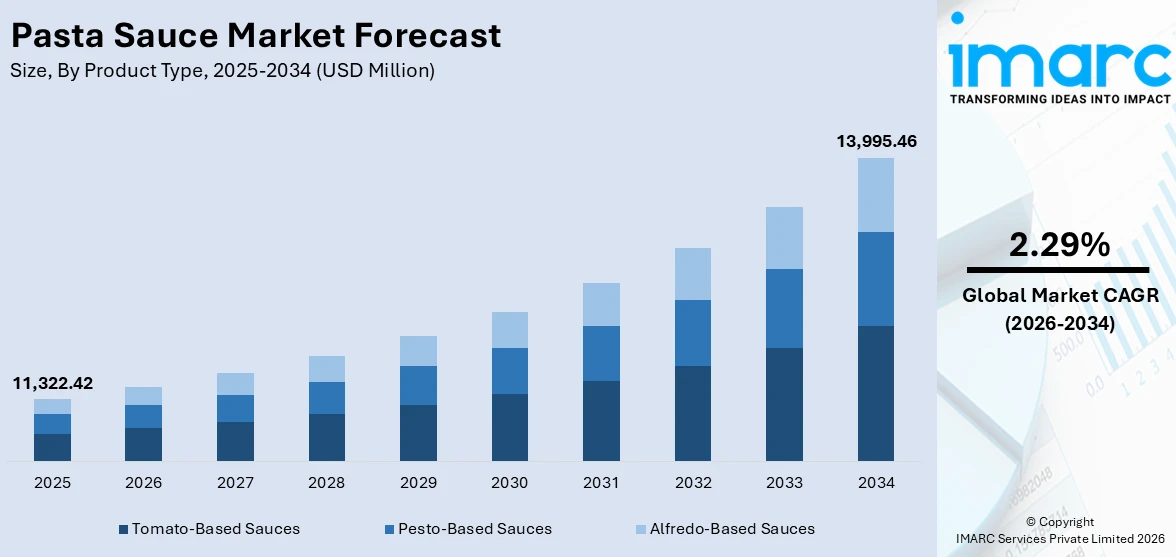
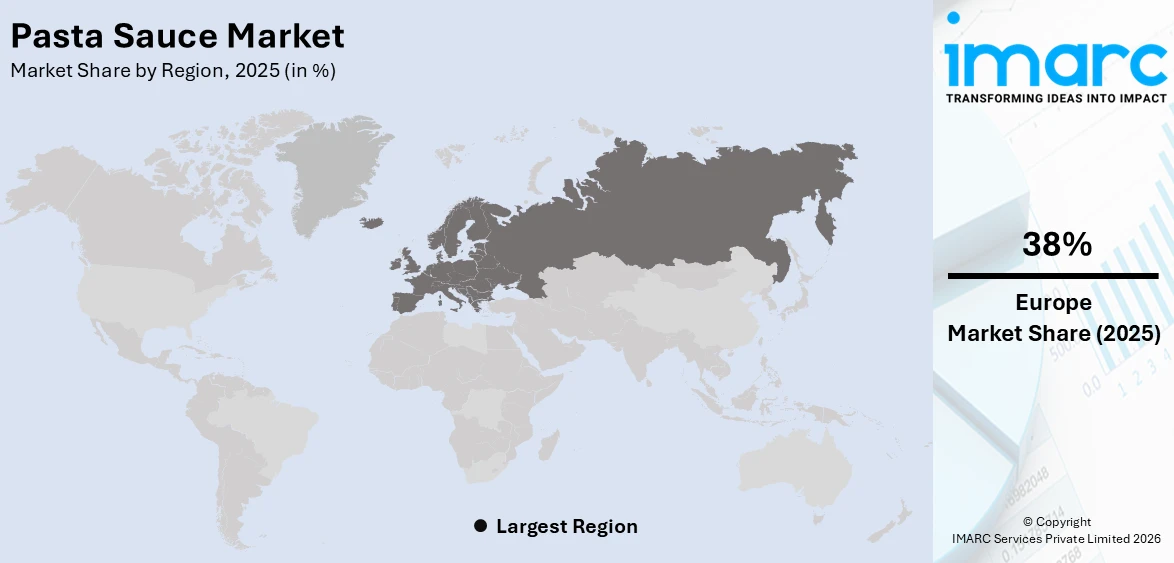
The global pasta sauce market size was valued at USD 11,322.42 Million in 2025. Looking forward, IMARC Group estimates the market to reach USD 13,995.46 Million by 2034, exhibiting a CAGR of 2.29% from 2026-2034. Europe currently dominates the market, holding a market share of 38% in 2025. Deeply ingrained Italian culinary traditions, high per capita pasta consumption, led by nations like Italy and Germany, a well-established retail infrastructure with a large selection of sauces, and a strong consumer preference for both traditional and premium pasta sauce products are all advantages for the region, all contributing to the pasta sauce market share.
The convergence of numerous important elements across consumer categories and geographies is propelling the worldwide pasta sauce market's continuous rise. The demand for packaged pasta sauces is rising dramatically globally due to the growing consumption of ready-to-eat and convenient food items brought on by busy urban lives and the rise in dual-income homes. Additionally, more customers are investigating pasta-based meal options as a result of the expanding globalization of food culture and the rising appeal of Italian cuisine in a variety of geographical areas. Health-conscious dietary shifts are further propelling the pasta sauce market growth, as manufacturers develop organic, low-sodium, gluten-free, and plant-based sauce variants to cater to evolving nutritional preferences. Product visibility and accessibility are being improved by the growth of contemporary retail channels, such as supermarkets, hypermarkets, and online grocery platforms. Additionally, the market landscape is becoming more valuable due to premiumization trends, where customers are looking for clean-label, chef-inspired, and artisanal sauces.
For a variety of reasons, the US has become a significant market for spaghetti sauce. Pasta's widespread use in households as a staple cuisine and the nation's strong Italian-American culinary tradition provide a solid basis for sauce demand. Pasta sauces that are clean-label, organic, and free of preservatives are becoming more and more popular among consumers, following general wellness trends. For instance, in February 2025, targeting upscale home-cooking experiences, Carbone Fine Food introduced five new pasta sauce tastes in the US, including Sweet Pepper and Onion, Mediterranean Marinara, Mac & Cheese Alfredo, Black Truffle Alfredo, and Lemon Pepper Alfredo. The proliferation of direct-to-consumer sales channels and the growing emphasis on restaurant-quality flavors at home are further reinforcing the pasta sauce market outlook in the United States, supported by aggressive product innovation from both established and emerging brands.
To get more information on this market Request Sample
Pasta Sauce Market Trends:
Rising Demand for Convenient Meal Solutions
The global pasta sauce market is being significantly influenced by the growing demand for quick and ready-to-use meal solutions among consumers. With the increasing number of dual-income households and the acceleration of urbanization, consumers are demanding food products that have good taste and require less preparation time. This requirement is fulfilled by packaged pasta sauces, which offer a variety of taste profiles that can quickly transform a simple pasta meal into restaurant-quality food. The demand for sauce has also accelerated with the development of the foodservice industry, which includes fast food establishments and cafes expanding their menus to include pasta offerings. In an effort to improve convenience for consumers, manufacturers are also responding with innovative packaging solutions such as shelf-stable pouches, single-serve packaging, and easy-pour packaging. Pasta sauce products are gaining popularity globally due to the increasing adoption of Western cuisine by emerging economies.
Growing Health and Wellness Consciousness
The consumer behavior of buying habits in the pasta sauce market is undergoing a transformation due to health and wellness trends. Consumers are increasingly becoming conscious about the nutritional content, ingredients, and absence of artificial additives in food products. This has compelled manufacturers to develop pasta sauce formulations that adhere to clean-label standards by being organic, non-GMO, low sugar, gluten-free, and preservative-free. Due to the increasing demand for healthy and transparent food options, consumers are deliberately avoiding artificial ingredients and scrutinizing the labels of food products before purchasing them. With an increasing trend towards healthy and plant-based food options, plant-based and vegan pasta sauce products are also gaining popularity. To differentiate themselves from competitors, manufacturers are incorporating healthy ingredients such as vegetables, herbs, and functional ingredients into their formulations. This pasta sauce market forecast reflects continued momentum toward healthier formulations as consumer awareness deepens and regulatory standards around food labeling become more stringent across major markets.
Premiumization and Flavor Innovation Trends
Premiumization and flavor innovation are emerging as pivotal growth drivers in the pasta sauce sector. Consumers are demonstrating a willingness to pay higher prices for artisanal, gourmet, and specialty pasta sauces that offer unique taste experiences beyond conventional tomato-based options. This trend is evident in the proliferation of truffle-infused, pesto, roasted garlic, and fusion-style sauces that cater to adventurous palates. Manufacturers are investing substantially in research and development to create distinctive flavor profiles that resonate with diverse regional preferences. For example, in January 2025, Sauz launched two new pasta sauce flavors, Miso Garlic Marinara and Brown Butter Alfredo, representing the first commercially available Asian-Italian fusion sauces, with distribution expanding to Whole Foods and Sprouts nationwide. Private label brands are also entering premium segments, intensifying competition and broadening consumer access to high-quality options. The pasta sauce market trends indicate that premiumization will continue driving value growth as consumers prioritize quality ingredients and culinary authenticity.
Pasta Sauce Industry Segmentation:
IMARC Group provides an analysis of the key trends in each segment of the global pasta sauce market, along with forecast at the global, regional, and country levels from 2026-2034. The market has been categorized based on product type, packaging type, and distribution channel.

Analysis by Product Type:
- Tomato-Based Sauces
- Traditional Sauce
- Marinara Sauce
- Meat Sauce
- Mushroom Sauce
- Roasted Garlic Sauce
- Cheese Sauce
- Tomato and Basil Sauce
- Others
- Pesto-Based Sauces
- Traditional Basil Pesto Sauce
- Sun-Dried Tomato Pesto Sauce
- Others
- Alfredo-Based Sauces
- Traditional Alfredo Sauce
- Garlic Alfredo Sauce
- Cheese Alfredo Sauce
- Others
Tomato-based sauces hold 55% of the market share. Tomato-based pasta sauces account for the biggest market share globally and are available in different forms, including traditional, marinara, meat, mushroom, roasted garlic, cheese, and tomato basil. The versatility, strong flavor, and health benefit of tomatoes as a key ingredient are the factors that make these pasta sauces so popular globally, as they can be prepared using different cooking methods and culinary styles. The high level of customer familiarity, easy availability in stores, and continuous innovation of products to meet the evolving preferences of health-conscious customers are all factors that make this market segment the leader. To meet the demands of health-conscious customers, manufacturers are introducing organic, low-sodium, and sugar-free versions of their tomato-based product offerings. For instance, Clean-label requirements in the premium market were generated in January 2025 when Bionaturae introduced its first line of certified organic pasta sauces in the US. These sauces included gluten-free, glyphosate-free, and non-GMO alternatives in the Marinara, Arrabbiata, and Tomato and Basil variations.
Analysis by Packaging Type:
- Glass Bottles
- PET
- Cans
- Pouches
- Cartons
Glass bottles lead the market with a share of 45%. Pasta sauces are still best packaged in glass bottles because of their exceptional ability to maintain product freshness, flavor purity, and aesthetic appeal on store shelves. In the premium and organic sauce markets, where ingredient authenticity is a crucial difference, the transparency of glass packaging enables customers to visually evaluate product quality prior to purchase. Because glass bottles are completely recyclable and are thought to be more environmentally friendly than plastic ones, they also fit in with the growing concerns about sustainability. Both well-known brands and artisanal producers who want to convey quality and tradition through their packaging choices strongly embrace this format. Furthermore, glass containers provide superior chemical inertness, which stops flavor migration and preserves sauces' original flavor character over long storage times. Stricter recyclability and sustainability requirements for food packaging are being emphasized by changing regulatory frameworks in major markets. This is supporting glass bottles' competitive position in the pasta sauce packaging market and promoting wider industry adoption of this format.
Analysis by Distribution Channel:
Access the comprehensive market breakdown Request Sample
- Direct
- Indirect
- Store-Based Retailing
- Supermarkets
- Specialty Stores
- Convenience Stores
- Online Retailing
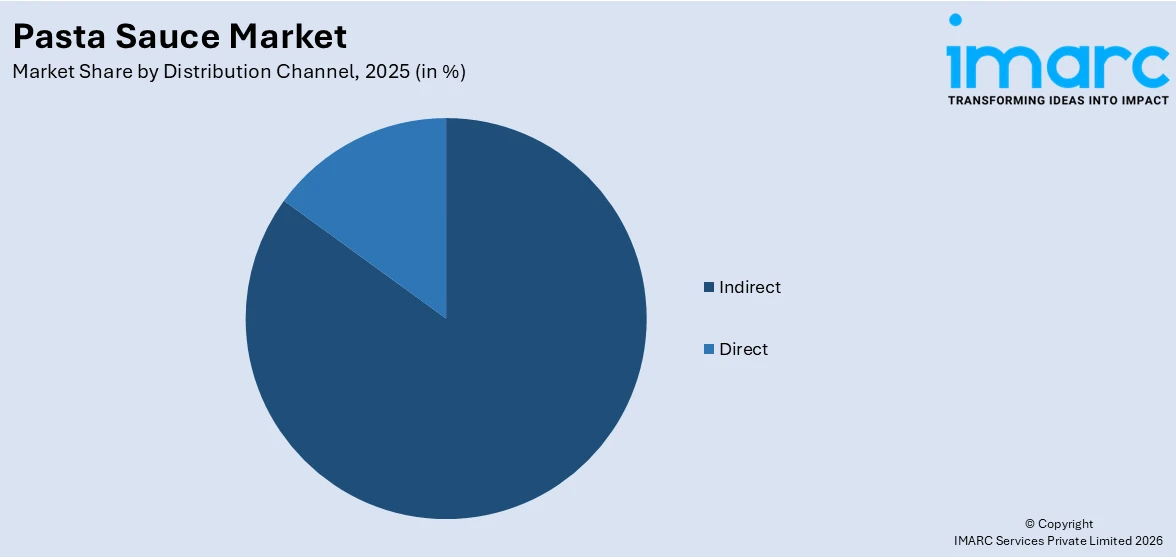
Indirect dominates the market, with a share of 85%. Indirect distribution channels, encompassing supermarkets, hypermarkets, specialty stores, convenience stores, and online retailing platforms, collectively represent the dominant pathway through which pasta sauces reach end consumers globally. The extensive reach and established infrastructure of modern retail networks enable manufacturers to achieve broad market penetration across diverse geographies and consumer demographics. Supermarkets and hypermarkets serve as primary purchase points, offering consumers wide product selections, competitive pricing, and promotional offers that drive repeat purchases. The rapid growth of e-commerce platforms has further expanded the indirect channel's dominance, with online grocery sales enabling consumers to access diverse brands, compare prices, and receive home deliveries conveniently. The accelerating digital transformation of food distribution is reshaping how consumers discover and purchase pasta sauce products, with online retail channels capturing an increasingly significant share of overall sales across major markets. Specialty stores and convenience outlets complement the broader retail ecosystem by catering to niche preferences and impulse purchasing behavior, ensuring comprehensive market coverage across varied consumer touchpoints.
Regional Analysis:
To get more information on the regional analysis of this market Request Sample
- North America
- United States
- Canada
- Europe
- Germany
- France
- United Kingdom
- Italy
- Spain
- Russia
- Others
- Asia Pacific
- China
- Japan
- India
- South Korea
- Australia
- Indonesia
- Others
- Latin America
- Brazil
- Mexico
- Argentina
- Colombia
- Chile
- Peru
- Others
- Middle East and Africa
- Turkey
- Saudi Arabia
- Iran
- United Arab Emirates
- Others
Europe, accounting for 38% of the share, enjoys the leading position in the market. The region's dominance is fundamentally rooted in its deep cultural connection to Italian cuisine, which has established pasta and associated sauces as dietary staples across the continent. Italy, as the largest producer, anchors the European market with an annual production of approximately 4.2 million tons, supported by strong domestic consumption and extensive export networks that supply markets worldwide. Because of their varied culinary tastes and increasing use of a wide range of pasta sauce types, Germany, France, the United Kingdom, and Spain all contribute to regional demand. A broad competitive landscape that accommodates a range of customer tastes, from value-oriented goods to premium gourmet products, is created by the significant presence of both regional artisanal producers and global businesses. Clean-label, organic, and sustainably packed pasta sauces are becoming more and more popular in Europe, which is pushing producers to experiment with different formulation and packaging techniques. The region's extensive supermarket networks and expanding e-commerce platforms are only two examples of the well-developed retail infrastructure that guarantees widespread product availability and consumer accessibility.
Key Regional Takeaways:
United States Pasta Sauce Market Analysis
The United States represents one of the most mature and innovation-driven markets for pasta sauce globally, characterized by robust household consumption patterns and a deeply embedded Italian-American culinary tradition. Consumers in the country are increasingly gravitating toward organic, gluten-free, low-sodium, and clean-label pasta sauce variants that align with broader health and wellness lifestyle trends. The premiumization wave is particularly strong, with artisanal and chef-inspired sauces gaining significant shelf space in both conventional and specialty retail outlets, attracting consumers willing to pay more for superior quality and unique flavor experiences. For instance, the United States pasta sauce market was valued at USD 2.54 billion in 2024, reflecting the country's substantial contribution to global demand. Direct-to-consumer and e-commerce distribution models are transforming how pasta sauces reach consumers, enabling brands to build stronger customer relationships and bypass traditional retail intermediaries. Private-label products from major retailers are intensifying competitive dynamics by offering affordable alternatives to established national brands. The growing Hispanic and Asian demographic segments are introducing new flavor expectations, prompting manufacturers to develop culturally diverse sauce portfolios that extend beyond traditional Italian-American recipes and address multicultural consumer palates.
North America Pasta Sauce Market Analysis
North America represents a mature yet continuously evolving market for pasta sauces, underpinned by deeply established Italian-American culinary traditions and consistently high household penetration of pasta as a staple meal across the region. The United States serves as the primary demand center, followed by Canada, where consumers increasingly seek premium, organic, and clean-label pasta sauce products that align with broader health and wellness lifestyle preferences. The growing emphasis on convenient meal solutions, driven by busy urban lifestyles and the rising prevalence of dual-income households, sustains robust demand for ready-to-use pasta sauces across both retail and foodservice channels. Premiumization trends are particularly pronounced, with artisanal, chef-inspired, and specialty sauces gaining significant traction among discerning consumers willing to pay more for superior quality and unique flavor experiences. The expanding direct-to-consumer and e-commerce distribution models are reshaping the competitive landscape, enabling both established brands and emerging producers to reach diverse consumer segments. Private-label products from major retailers are further intensifying competitive dynamics by offering affordable yet quality alternatives throughout the region.
Asia-Pacific Pasta Sauce Market Analysis
Due to factors like rising disposable incomes, rapid urbanization, and the growing acceptance of Western culinary culture in major nations, the Asia-Pacific region is the one with the fastest-growing pasta sauce industry. Significant changes in consumer food choices are occurring in nations including China, Japan, India, South Korea, and Australia. Young urban professionals and growing middle-class populations are finding pasta to be a practical and popular dinner alternative. Both domestic and foreign producers looking to take advantage of changing consumption trends are investing in the region due to the increased demand for pasta-based products. Producers are adapting their product lines to suit regional tastes by creating fusion sauces that combine regional ingredients like soy, chili, and miso with Italian customs. Modern retail channels and e-commerce platforms are growing quickly, improving product accessibility and encouraging consumers to try a variety of pasta sauces.
Latin America Pasta Sauce Market Analysis
Due to rising urbanization, growing middle-class populations, and increased exposure to global culinary trends, the Pasta Sauce Market in Latin America is becoming a promising growth segment, supported by increasing consumer demand for convenient and diverse meal options. Pasta has steadily gained popularity as an inexpensive and adaptable dinner alternative in Brazil and Mexico, which are the main demand centers. For example, Brazil is one of the biggest pasta-producing countries in the world, which is indicative of well-established domestic supply chains that aid in the growth of the sauce business. Convenient, ready-to-use meal solutions that fit hectic urban lifestyles are becoming more popular among consumers around the region. The region's consumer adoption rates are rising as a result of the modern retail infrastructure's expansion, which includes the growth of supermarkets and online grocery platforms.
Middle East and Africa Pasta Sauce Market Analysis
The market for pasta sauce has significant growth potential in the Middle East and Africa due to factors such rising urbanization, a younger population, and the expansion of the foodservice industries in important economies. The main demand hubs in the area are Iran, Saudi Arabia, the United Arab Emirates, and Turkey. With strong domestic production capabilities supporting both local consumption and expanding export activity across surrounding countries, Turkey has established itself as a major pasta-producing nation. Pasta sauce products are becoming more popular as a result of the increasing influence of Western food culture, especially Italian cuisine, through restaurant chains and social media exposure. The modernization of retail distribution networks and rising household incomes are progressively increasing product accessibility across the region, while the expanding hospitality and tourism sectors are creating additional demand channels for diverse pasta sauce offerings.
Competitive Landscape:
Established multinational firms and local specialty manufacturers coexist in the competitive environment of the global pasta sauce market, which is somewhat fragmented. To improve their market positions and seize new consumer segments, top businesses are aggressively pursuing strategies focused on premiumization, product innovation, strategic acquisitions, and regional development. Major firms can expand their product portfolios and obtain access to premium and niche market segments through mergers and acquisitions, which continue to be a popular strategic instrument. For instance, in December 2025, The Campbell's Company announced a USD 286 million investment to acquire a 49% stake in La Regina, the Italian manufacturer of Rao's pasta sauce, with options to purchase the remaining stake, reinforcing its commitment to premium product growth. In order to appeal to consumers who are concerned about their health and the environment, manufacturers are also spending money on digital marketing, clean-label formulations, and sustainable packaging. By providing high-quality substitutes at more affordable prices, private-label companies are escalating the pressure from competitors.
The report provides a comprehensive analysis of the competitive landscape in the pasta sauce market with detailed profiles of all major companies, including:
- Barilla G. e R. Fratelli S.p.A
- Bertolli (Mizkan Holdings)
- Conagra Brands, Inc.
- Del Monte Foods Inc.
- The Campbell's Company
- F.lli Saclà S.p.A.
- The Kraft Heinz Company
- Unilever PLC
- Mars, Incorporated
- General Mills, Inc.
Pasta Sauce Market Report Scope:
| Report Features | Details |
|---|---|
| Base Year of the Analysis | 2025 |
| Historical Period | 2020-2025 |
| Forecast Period | 2026-2034 |
| Units | Million USD |
| Scope of the Report | Exploration of Historical Trends and Market Outlook, Industry Catalysts and Challenges, Segment-Wise Historical and Future Market Assessment:
|
| Product Types Covered |
|
| Packaging Types Covered | Glass bottles, PET, Cans, Pouches, Cartons |
| Distribution Channels Covered |
|
| Regions Covered | North America, Europe, Asia Pacific, Latin America, Middle East and Africa |
| Countries Covered | United States, Canada, Germany, France, United Kingdom, Italy, Spain, Russia, China, Japan, India, South Korea, Australia, Indonesia, Brazil, Mexico, Argentina, Colombia, Chile, Peru, Turkey, Saudi Arabia, Iran, United Arab Emirates |
| Companies Covered | Barilla G. e R. Fratelli S.p.A, Bertolli (Mizkan Holdings), Conagra Brands, Inc., Del Monte Foods Inc., The Campbell's Company, F.lli Saclà S.p.A., The Kraft Heinz Company, Unilever PLC, Mars Incorporated, General Mills Inc. |
| Customization Scope | 10% Free Customization |
| Post-Sale Analyst Support | 10-12 Weeks |
| Delivery Format | PDF and Excel through Email (We can also provide the editable version of the report in PPT/Word format on special request) |
Key Benefits for Stakeholders:
- IMARC's report offers a comprehensive quantitative analysis of various market segments, historical and current market trends, market forecasts, and dynamics of the pasta sauce market from 2020-2034.
- The research study provides the latest information on the market drivers, challenges, and opportunities in the global pasta sauce market.
- The study maps the leading, as well as the fastest-growing, regional markets. It further enables stakeholders to identify the key country-level markets within each region.
- Porter's Five Forces analysis assists stakeholders in assessing the impact of new entrants, competitive rivalry, supplier power, buyer power, and the threat of substitution. It helps stakeholders to analyze the level of competition within the pasta sauce industry and its attractiveness.
- Competitive landscape allows stakeholders to understand their competitive environment and provides an insight into the current positions of key players in the market.
Frequently Asked Questions About the Pasta Sauce Market Report
The pasta sauce market was valued at USD 11,322.42 Million in 2025.
The pasta sauce market is projected to exhibit a CAGR of 2.29% during 2026-2034, reaching a value of USD 13,995.46 Million by 2034.
The pasta sauce market is primarily driven by increasing consumer demand for convenient and ready-to-use meal solutions, growing health awareness prompting preference for organic and clean-label products, the expanding popularity of Italian cuisine globally, and rising premiumization trends encouraging consumption of artisanal and gourmet sauce variants across diverse consumer segments.
Europe currently dominates the pasta sauce market, accounting for a share of 38%. The region's leadership is driven by deeply rooted Italian culinary traditions, high per capita pasta consumption, a well-developed retail infrastructure, and strong demand for both premium artisanal and value-oriented sauce products across key economies.
Some of the major players in the pasta sauce market include Barilla G. e R. Fratelli S.p.A, Bertolli (Mizkan Holdings), Conagra Brands, Inc., Del Monte Foods Inc., The Campbell's Company, F.lli Saclà S.p.A., The Kraft Heinz Company, Unilever PLC, Mars, Incorporated, General Mills, Inc., etc.
Need more help?
- Speak to our experienced analysts for insights on the current market scenarios.
- Include additional segments and countries to customize the report as per your requirement.
- Gain an unparalleled competitive advantage in your domain by understanding how to utilize the report and positively impacting your operations and revenue.
- For further assistance, please connect with our analysts.
 Request Customization
 Speak to an Analyst
 Request Brochure
 Inquire Before Buying
Benefits of Customization
- Personalize this research
- Triangulate with your data
- Get data as per your format and definition
- Gain a deeper dive into a specific application, geography, customer, or competitor
- Any level of personalization
Get in Touch With Us
UNITED STATES
Phone: +1-201-971-6302
INDIA
Phone: +91-120-433-0800
UNITED KINGDOM
Phone: +44-753-714-6104
Email: [email protected]
Client Testimonials




.webp)




.webp)













Related Reports

Choose your plan
*Please note that the prices mentioned below are starting prices for each bundle type. Kindly contact our team for further details.*
Single User License
- 1 User License, Access on 2 Devices
- PDF Report + Excel Dataset (Password Protected)
- Lifetime Access
- No Printing Rights
- 10% Free Report Customization
- 10–12 Weeks of Analyst Support
Five User License
- Access for 5 Users, 2 Devices per User
- PDF Report + Excel Dataset (Password Protected)
- Lifetime Access
- Dedicated Account Manager
- 12–14 Weeks of Analyst Support
- No Printing Rights
- 15% Free Report Customization
- 25% Discount on Your Next Purchase
Corporate User License
- Unlimited User Access (Within Your Organization)
- PDF Report + Excel Dataset
- Lifetime Access
- Dedicated Account Manager
- 14–20 Weeks of Analyst Support
- No Printing Rights
- 20% Free Report Customization
- 30% Discount on Your Next Purchase
Essential Insights
What's included:
3 reports
- Lifetime Access
- PDF Reports
- Excel Datasets
- 2 Weeks of Free Analyst Support
- 2 User Licenses
- Access on 2 Devices
- Printing Rights
- Complimentary PowerPoint (PPT) Version
- Complimentary License Upgrade
Professional Access
What's included:
5 reports
- Lifetime Access
- PDF Reports
- Excel Datasets
- 8 Weeks of Free Analyst Support
- 2 User Licenses
- Access on 2 Devices
- Printing Rights
- Complimentary PowerPoint (PPT) Version
- Complimentary License Upgrade
Business Advantage
What's included:
8 reports
- Lifetime Access
- PDF Reports
- Excel Datasets
- 14 Weeks of Free Analyst Support
- 2 User Licenses
- Access on 2 Devices
- Printing Rights
- Complimentary PowerPoint (PPT) Version
- Complimentary License Upgrade
Enterprise Intelligence
What's included:
10 reports
- Lifetime Access
- PDF Reports
- Excel Datasets
- 20 Weeks of Free Analyst Support
- 2 User Licenses
- Access on 2 Devices
- Printing Rights
- Complimentary PowerPoint (PPT) Version
- Complimentary License Upgrade