
India Air Compressor Market Size, Share, Trends and Forecast by Type, Technology, Lubrication Method, Power Rating, End User, and Region, 2026-2034
India Air Compressor Market Size, Share, Trends & Forecast (2026-2034)
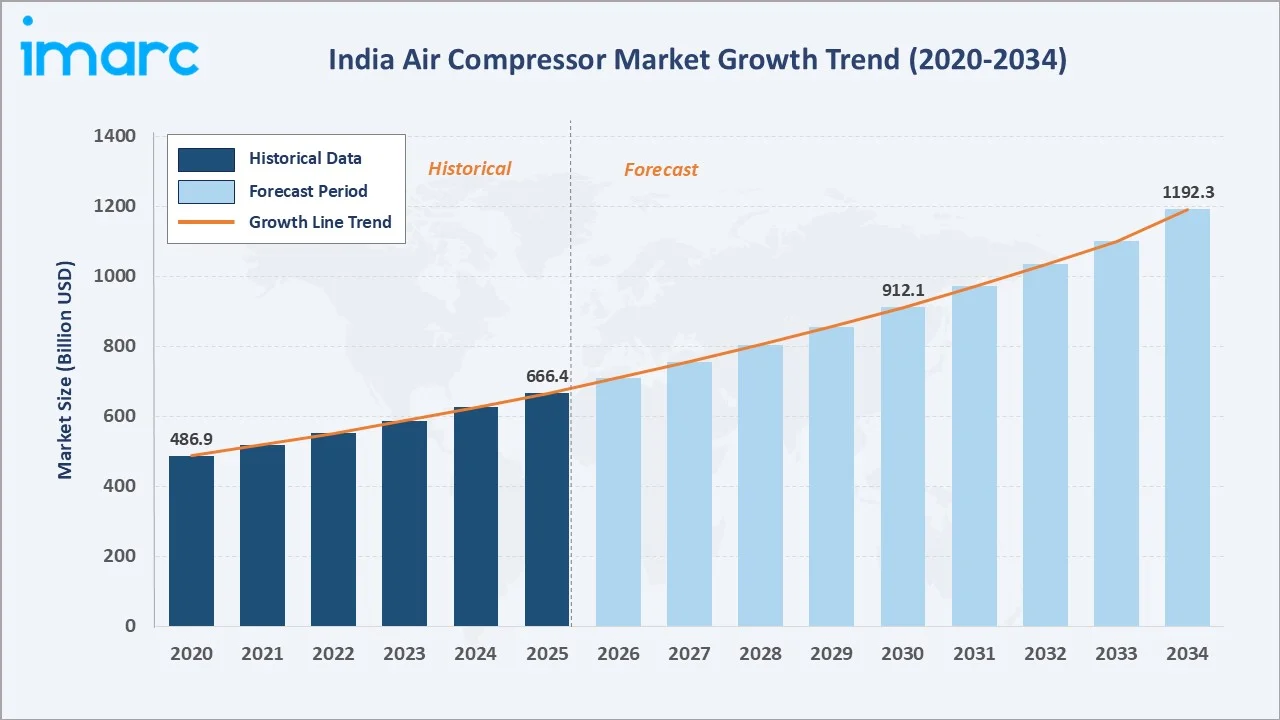
The India air compressor market size increased from USD 666.4 Million in 2025 to USD 721.7 Million in 2026 and is projected to reach USD 1,192.3 Million by 2034, exhibiting a CAGR of 6.48% during 2026-2034. This growth is driven by rising industrialization, expanding manufacturing activities, and increasing demand for energy-efficient compressed air systems.
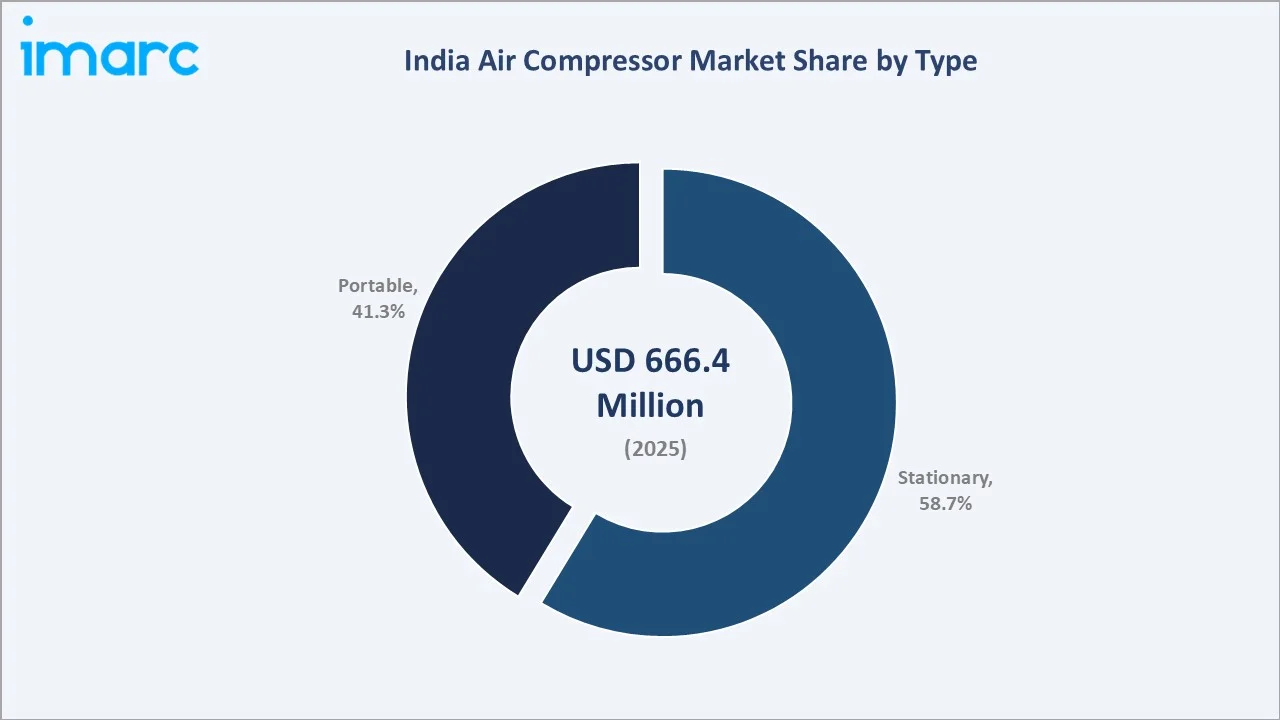
Stationary leads the type segment at 58.7%, rotary/screw accounts for 47.8% of the technology segment, and West and Central India commands 34.7% regional share in 2025.
Market Snapshot
|
Metric |
Value |
|
Base Year Market Size (2025) |
USD 666.4 Million |
|
Market Size (2026) |
USD 721.7 Million |
|
Forecast Market Size (2034) |
USD 1,192.3 Million |
|
CAGR (2026-2034) |
6.48% |
|
Base Year |
2025 |
|
Historical Period |
2020-2025 |
|
Forecast Period |
2026-2034 |
|
Largest Region |
West and Central India (34.7%, 2025) |
|
Second Largest Region |
South India (27.8%, 2025) |
|
Leading Type |
Stationary (58.7%, 2025) |
|
Leading Technology |
Rotary/Screw (47.8%, 2025) |
The India air compressor market expanded from USD 486.9 Million in 2020 to USD 666.4 Million in 2025 and an estimated USD 721.7 Million, driven by widening industrial capacity, growing infrastructure investment, and increasing adoption of energy-efficient pneumatic systems. The market is forecast to reach USD 912.1 Million by 2030 and USD 1,192.3 Million by 2034, supported by continued industrial expansion, modernization of manufacturing facilities, and rising demand for reliable compressed air solutions across diverse applications.
To get more information on this market, Request Sample
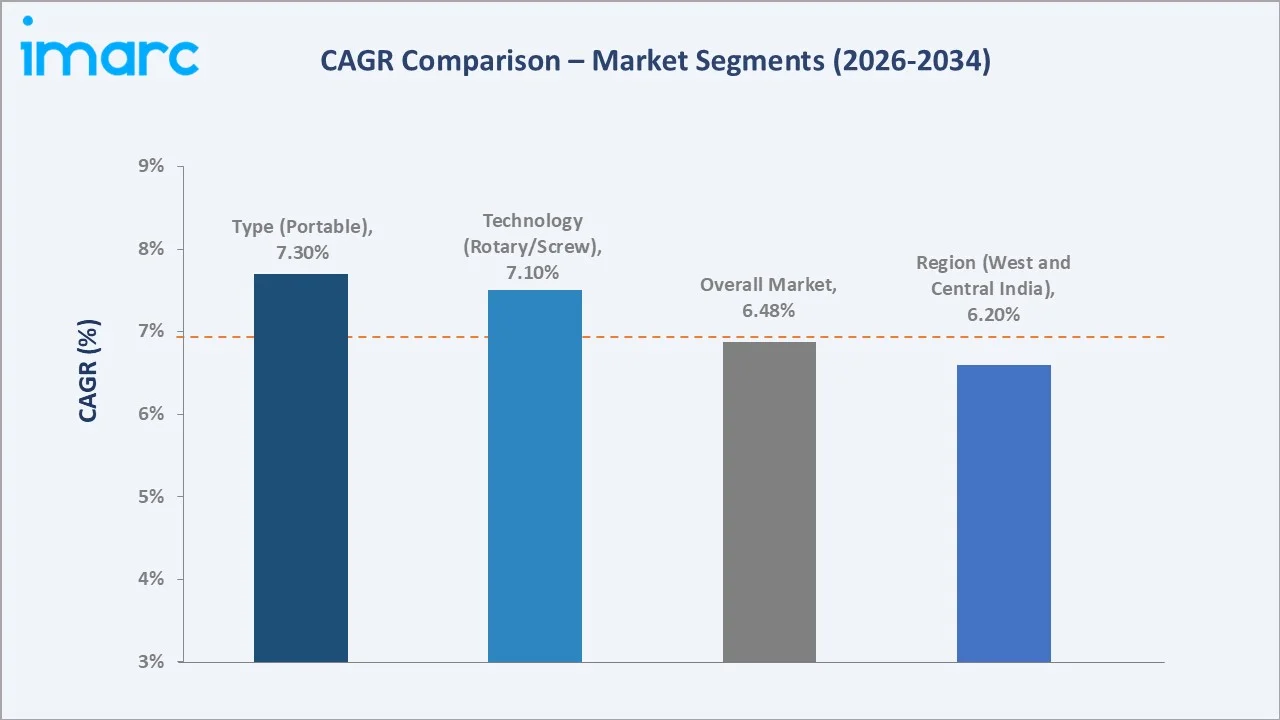
CAGR trajectories across type and technology sub-segments show portable and rotary/screw expanding faster than the overall 6.48% market CAGR, reflecting the accelerating shift toward energy-efficient, mobile, and variable-speed drive (VSD) systems.
Executive Summary
The India air compressor market is on a steady growth trajectory from USD 486.9 Million in 2020 to an estimated USD 721.7 Million in 2026 and is projected to reach USD 1,192.3 Million in 2034, driven by sustained industrial production growth, expanding infrastructure pipelines, and increasing adoption of energy-efficient pneumatic systems across manufacturing, construction, and mining sectors.
Based on type, stationary dominates with 58.7% share in 2025, underpinned by large-scale installations in automotive plants, refineries, and textile mills. Rotary/screw commands 47.8% share owing to continuous-duty efficiency advantages and lower lifecycle costs. West and Central India leads regional share at 34.7% in 2025, anchored by the dense industrial clusters of Maharashtra, Gujarat, and Madhya Pradesh.
Key Market Insights
|
Insight |
Data |
|
Leading Type |
Stationary – 58.7% share (2025) |
|
Second Largest Type |
Portable – 41.3% share (2025) |
|
Leading Technology |
Rotary/Screw – 47.8% share (2025) |
|
Second Largest Technology |
Reciprocating/Piston – 35.6% share (2025) |
|
Leading Region |
West and Central India – 34.7% share (2025) |
|
Second Largest Region |
South India – 27.8% share (2025) |
|
Top Companies |
Atlas Copco AB, Ingersoll Rand, Kaeser Kompressoren, ELGi Equipments Limited |
Key Analytical Observations Expanding On the Data Above:
- Stationary dominance at 58.7% is driven by large fixed installations in automotive assembly lines, chemical processing plants, and textile manufacturing hubs where continuous-duty, high-volume air supply is essential for operational efficiency.
- Portable at 41.3% is gaining ground rapidly, fueled by the growth of infrastructure projects under the National Infrastructure Pipeline, mining operations, and construction activity requiring mobile compressed air solutions.
- Rotary/screw leadership at 47.8% reflects strong demand for continuous-duty compressed air systems in manufacturing, automotive, food processing, and other industrial applications where consistent airflow, reliability, and energy efficiency are critical.
- Reciprocating/piston at 35.6% remains relevant for small and medium enterprises (SMEs) seeking lower upfront capital costs for intermittent-duty applications in workshops, auto repair centers, and light manufacturing.
- West and Central India at 34.7% dominates regional distribution, anchored by established industrial clusters, automotive and engineering manufacturing hubs, petrochemical facilities, and expanding infrastructure across key states in the region.
India Air Compressor Market Overview
An air compressor is a mechanical device that converts power into potential energy stored as pressurized air, which is then applied across a wide range of industrial, commercial, and consumer applications. In India, air compressors serve as critical utilities across automotive manufacturing, pharmaceuticals, food and beverage processing, textiles, construction, mining, and electronics assembly.
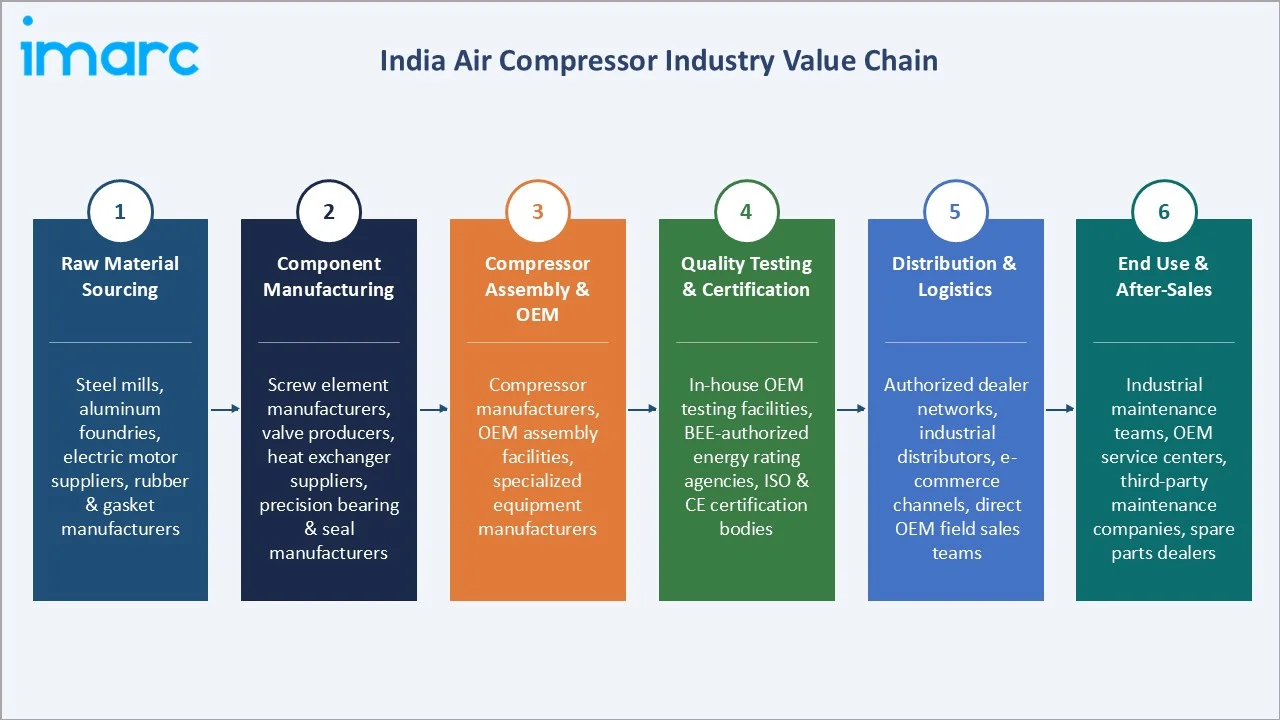
The Indian ecosystem integrates steel and casting raw material suppliers, motor and valve component manufacturers, original equipment manufacturers (OEMs), authorized distributors and dealers, and a structured after-sales service network. Increasing localization of manufacturing and expanding service capabilities are further strengthening the domestic air compressor supply chain.
Market Dynamics
To evaluate market opportunities, Request Sample
Market Drivers
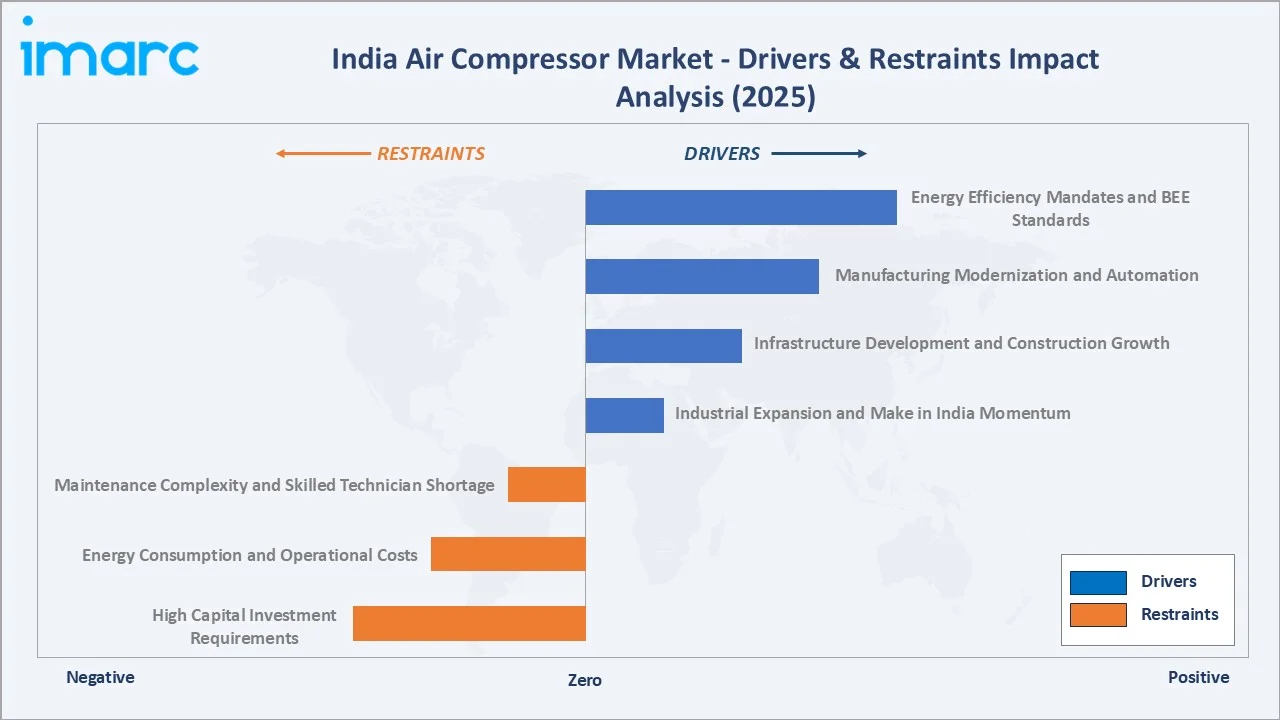
- Industrial Expansion and Make in India Momentum: India's industrial output continues to expand across the automotive, pharmaceuticals, textiles, and food processing sectors. Growth in the air compressor market size in India mirrors this momentum, as the government's production-linked incentive (PLI) schemes attracted over USD 26 Billion in committed investments across 14 key sectors in 2025-2026, directly driving demand for compressed air systems as a foundational utility.
- Infrastructure Development and Construction Growth: Massive public infrastructure investment under the National Infrastructure Pipeline is sustaining high demand for portable and stationary compressors in road construction, bridge building, metro rail projects, and large-scale real estate development.
- Manufacturing Modernization and Automation: Indian factories are upgrading from legacy equipment to modern rotary screw and oil-free compressor systems as part of broader plant automation and energy efficiency programs, creating replacement demand and expanding the addressable market for premium compressor segments.
- Energy Efficiency Mandates and BEE Standards: Tightening Bureau of Energy Efficiency regulations on industrial energy consumption are compelling manufacturers to replace aging reciprocating compressors with energy-efficient VSD-driven rotary screw units, stimulating both OEM sales and after-market upgrades across large and mid-scale industrial facilities.
Market Restraints
- High Capital Investment Requirements: Industrial-grade rotary screw and centrifugal compressors require substantial upfront capital outlays, which constrain adoption among SMEs with limited access to credit facilities and working capital financing.
- Energy Consumption and Operational Costs: Air compressors can consume substantial amounts of electricity, making energy efficiency a key consideration for end users. High power consumption, maintenance requirements, and associated operating expenses can increase the overall cost of ownership and discourage price-sensitive buyers from investing in advanced compressor systems.
- Maintenance Complexity and Skilled Technician Shortage: Advanced compressor systems require specialized maintenance expertise that is not uniformly available across India's tier-2 and tier-3 industrial centers, resulting in unplanned downtime and elevated service costs that discourage adoption.
Market Opportunities
- Oil-Free Compressor Demand in Pharmaceuticals and Food Processing: Stringent hygiene and contamination standards in pharmaceutical and food and beverage manufacturing are accelerating adoption of oil-free air compressors, creating a growing premium segment aligned with GMP and FSSAI regulatory compliance requirements.
- Expansion into Tier-2 and Tier-3 Industrial Markets: New industrial zones being developed under state government investment promotion programs in Rajasthan, Odisha, Madhya Pradesh, and Telangana are emerging as high-potential markets for mid-range compressor products.
Market Challenges
- Competition from Low-Cost Domestic and Chinese Imports: The market faces persistent pricing pressure from lower-cost domestic manufacturers and imported compressors, particularly in the small reciprocating segment, which squeezes margins for established OEMs and distributors.
- Supply Chain Vulnerabilities for Critical Components: Dependence on imported bearings, precision valves, and motor components exposes the Indian air compressor supply chain to foreign exchange volatility and international logistics disruptions that affect product availability and pricing stability.
Emerging Market Trends
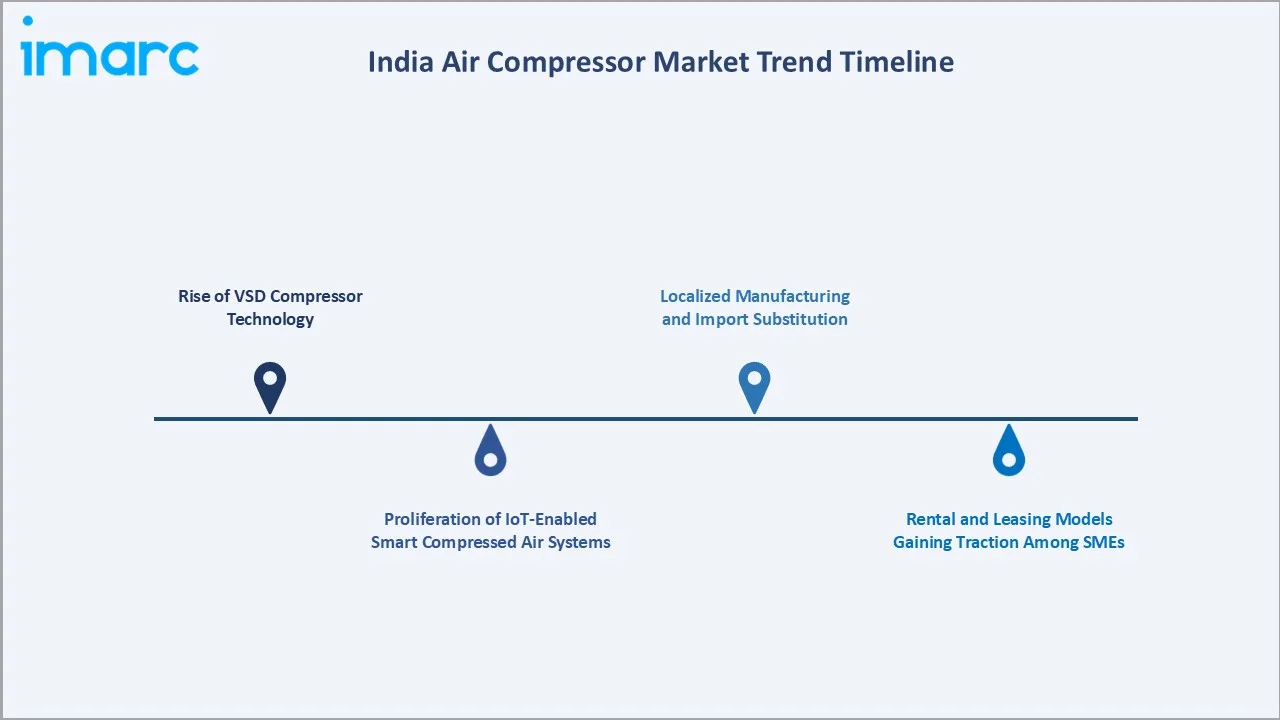
1. Rise of VSD Compressor Technology
VSD compressors are replacing fixed-speed models as Indian manufacturers prioritize energy efficiency and lower operating costs. By adjusting motor speed to match air demand, VSD units improve efficiency and reduce unnecessary energy consumption, making them increasingly attractive for modern manufacturing facilities.
2. Proliferation of IoT-Enabled Smart Compressed Air Systems
Leading OEMs are embedding IoT sensors, remote monitoring platforms, and predictive maintenance algorithms into compressor systems. These smart systems transmit real-time performance data covering pressure, temperature, vibration, and power consumption, enabling remote diagnostics and pre-emptive maintenance scheduling that reduces unplanned downtime by significant margins.
3. Rental and Leasing Models Gaining Traction Among SMEs
Compressor rental and compressed-air-as-a-service (CAaaS) models are emerging as viable alternatives to capital purchase for SMEs. These models transfer maintenance responsibility to service providers and convert large capital expenditures into predictable operating expenses, making advanced compressor technology accessible to a broader base of industrial buyers across India's fragmented SME manufacturing ecosystem.
4. Localized Manufacturing and Import Substitution
The India air compressor market outlook increasingly favors domestic manufacturing, with government import substitution initiatives encouraging global compressor OEMs to establish local assembly, service, and component manufacturing operations. Local manufacturing reduces lead times, lowers import duties, and enables competitive pricing, while simultaneously building the domestic engineering ecosystem for precision-manufactured compressor components.
Industry Value Chain Analysis
The India air compressor value chain spans six stages from raw material sourcing and component manufacturing through OEM assembly, quality testing, distribution logistics, and end-use service. Manufacturers that control proprietary compressor element design, motor integration, and direct service network relationships command superior margins and customer retention rates across the value chain.
|
Stage |
Key Players / Examples |
|
Raw Material Sourcing |
Steel mills, aluminum foundries, electric motor suppliers, rubber and gasket manufacturers across domestic and international supply chains |
|
Component Manufacturing |
Screw element manufacturers, valve producers, heat exchanger suppliers, precision bearing and seal manufacturers |
|
Compressor Assembly & OEM |
Compressor manufacturers, OEM assembly facilities, and specialized equipment manufacturers across domestic and international markets |
|
Quality Testing & Certification |
In-house OEM testing facilities, BEE-authorized energy rating agencies, ISO and CE certification bodies |
|
Distribution & Logistics |
Authorized dealer networks, industrial distributors, e-commerce channels, direct OEM field sales teams |
|
End Use & After-Sales |
Industrial maintenance teams, OEM service centers, third-party maintenance companies, spare parts dealers |
Vertically integrated players with captive foundry capabilities, in-house screw element manufacturing, and nationwide service networks are structurally advantaged in cost management, lead time reliability, and after-sales revenue generation.
Technology Landscape in the India Air Compressor Industry
Rotary Screw and Oil-Free Compression Technologies
Rotary screw technology holds a significant position in the air compressor market share in India, supported by its continuous-duty efficiency, lower noise levels, and compatibility with modern VSD drives. Two-stage screw compression systems are gaining adoption in high-pressure applications, while Class 0 oil-free screw compressors are increasingly specified by pharmaceutical, food processing, and electronics manufacturers requiring high air purity.
VSD and Motor Efficiency Innovations
Permanent magnet motors paired with VSDs are becoming the standard drivetrain for premium screw compressors in India. These integrated motor-drive systems eliminate gearbox losses, reduce starting current demand, and enable precise pressure control, delivering measurable energy savings versus conventional induction motor and belt-drive configurations.
IoT Integration and Predictive Maintenance Platforms
Leading OEMs offer factory-embedded IoT telemetry modules that stream real-time compressor performance data to cloud-based maintenance platforms. Predictive maintenance algorithms analyze vibration signatures, discharge temperature trends, and pressure differential patterns to anticipate bearing wear, valve degradation, and cooler fouling, enabling proactive service interventions before failure events disrupt production.
Market Segmentation Analysis
The report covers the following segments:
|
Segment Category |
Leading Segment |
Market Share |
Year |
|
Type |
Stationary |
58.7% |
2025 |
|
Technology |
Rotary/Screw |
47.8% |
2025 |
|
Lubrication Method |
🔒 |
🔒 |
2025 |
|
Power Rating |
🔒 |
🔒 |
2025 |
|
End User |
🔒 |
🔒 |
2025 |
|
Region |
West and Central India |
34.7% |
2025 |

By Type
Stationary holds a 58.7% majority share in 2025, driven by large-scale fixed installations across automotive assembly plants, petrochemical refineries, textile manufacturing hubs, and food processing complexes.
To access detailed market analysis, Request Sample
Portable at 41.3% in 2025 serves infrastructure construction, mining, natural gas transmission, and on-site service applications requiring mobile, self-contained compressed air.
By Technology
Rotary/screw commands 47.8% share in 2025, reflecting broad adoption across industrial end users seeking high operational efficiency, reduced noise, and continuous pressure delivery. The segment also benefits from increasing demand for energy-efficient compression solutions and the growing adoption of variable-speed drive systems across industrial facilities.
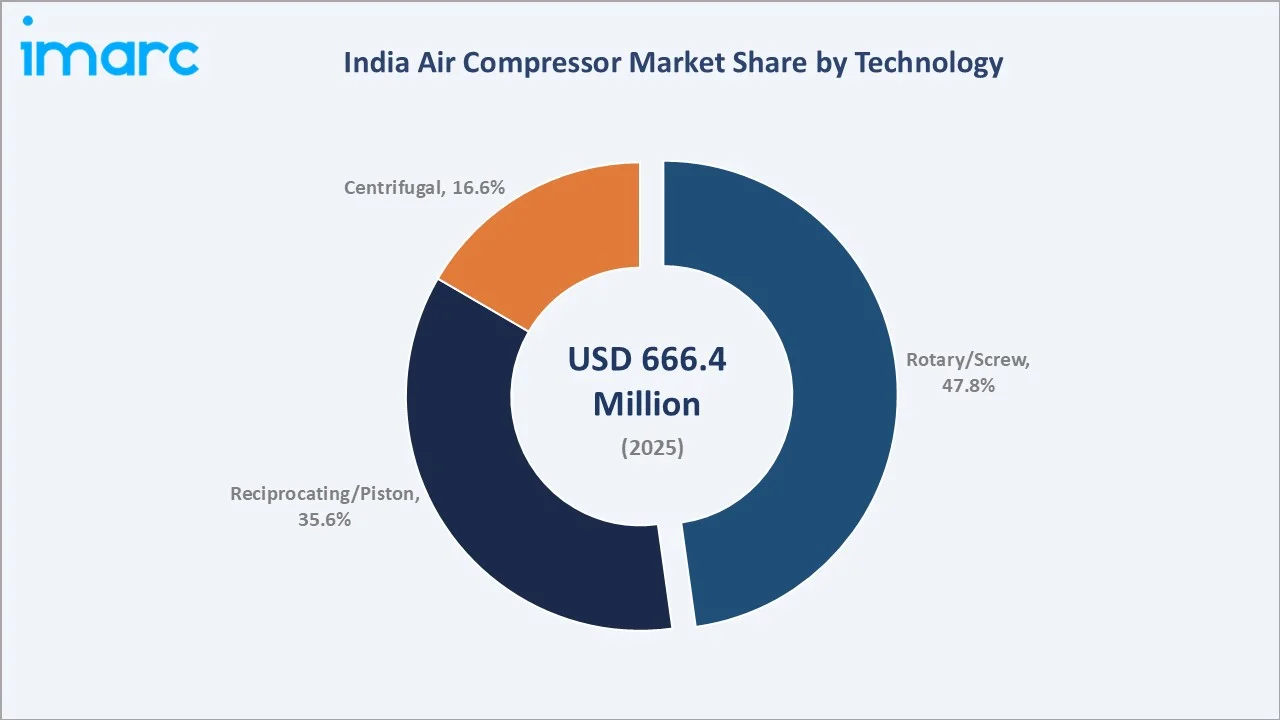
Reciprocating/piston retains a 35.6% share, continuing to serve SMEs, auto repair workshops, and standalone commercial applications where intermittent operation, lower initial cost, and simple maintenance are prioritized.
Regional Market Insights
|
Region |
Share (2025) |
Key Growth Drivers |
|
West and Central India |
34.7% |
Dense manufacturing clusters in Maharashtra and Gujarat, strong automotive and chemical industry presence, mature distribution networks |
|
South India |
27.8% |
Expanding electronics and pharmaceutical manufacturing, food processing growth, rising industrial investment and state incentive programs |
|
North India |
23.6% |
Large automotive and heavy engineering industries in NCR and Punjab, growing textile and packaging sectors, broad infrastructure development |
|
East and Northeast India |
13.9% |
Emerging industrial investment in mineral processing and cement, growing food processing and tea industry applications, infrastructure development |
West and Central India holds 34.7% regional share in 2025, anchored by Maharashtra's automotive and chemical manufacturing clusters, Gujarat's petrochemical and pharmaceutical industrial estates, and Madhya Pradesh's expanding food processing and textile production capacity. Dense industrial infrastructure and mature distributor networks support broad compressor adoption across the region.
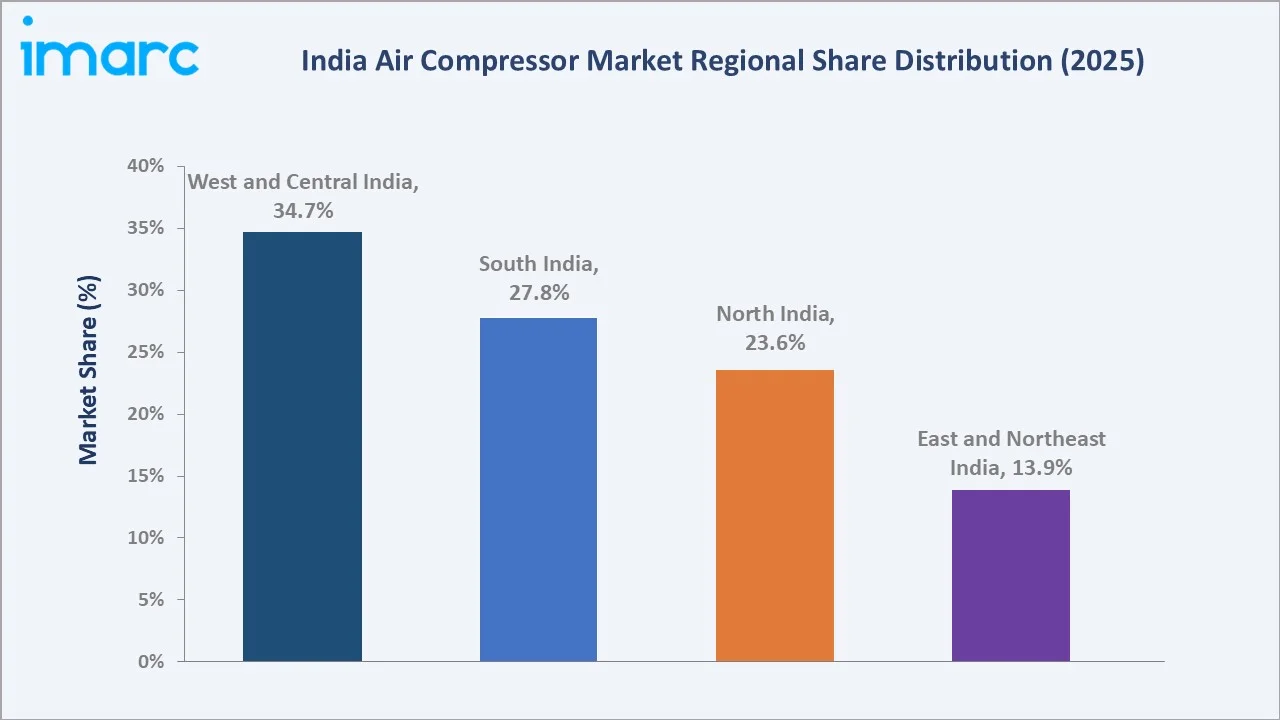
South India at 27.8% is the second largest region. Rapid expansion of electronics manufacturing in Tamil Nadu and Karnataka, pharmaceutical production clusters in Andhra Pradesh, and strong food and beverage processing infrastructure in Kerala and Telangana are anchoring the region's compressor demand.
Competitive Landscape
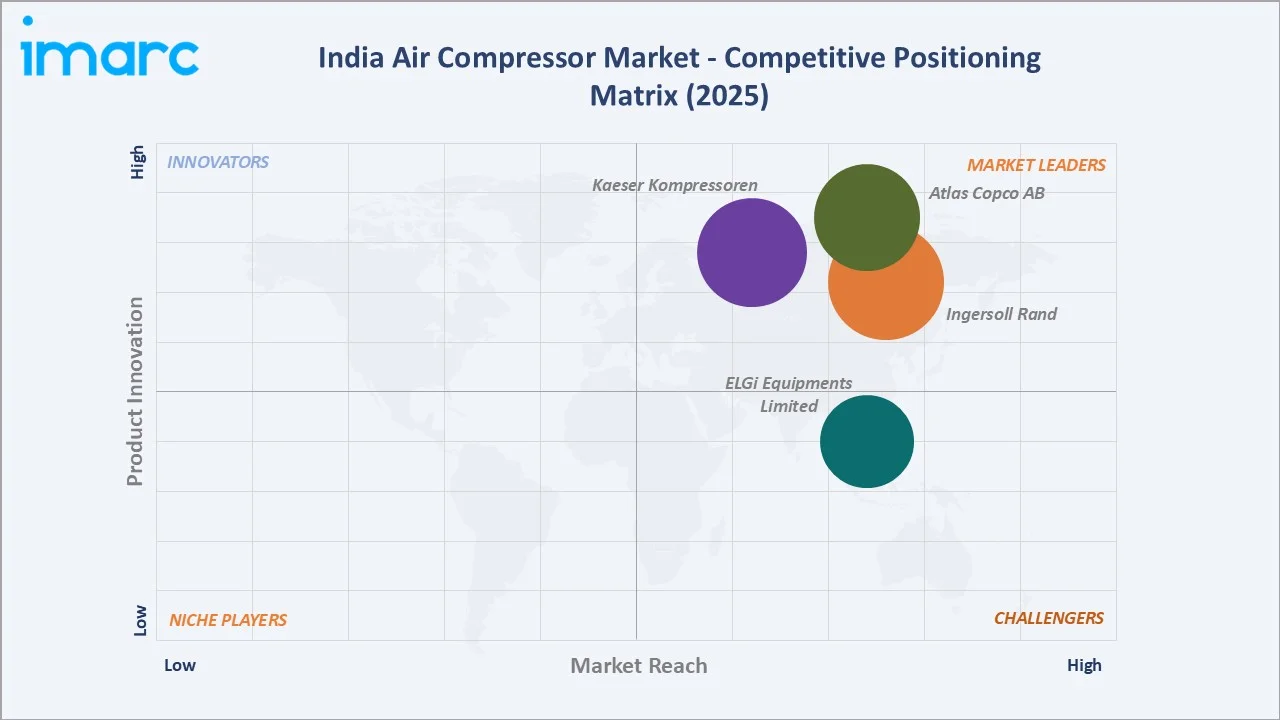
The India air compressor market is moderately consolidated, with global OEMs holding dominant market share in premium rotary screw and oil-free segments, while domestic manufacturers compete effectively in the reciprocating and mid-range portable segments.
|
Company Name |
Brand / Key Product |
Position |
Strategic Focus |
|
Atlas Copco AB |
GA / ZR Series Compressors |
Leader |
Energy-efficient rotary screw and oil-free compressor systems with VSD technology and IoT service platforms |
|
Ingersoll Rand |
Sierra / Nirvana Series |
Leader |
Comprehensive compressed air solutions with strong aftermarket service and energy audit programs across India |
|
Kaeser Kompressoren |
SIGMA Series Compressors |
Leader |
Strengthening energy-efficient compression solutions and expanding digital monitoring capabilities to improve industrial productivity and operational efficiency |
|
ELGi Equipments Limited |
EG / AB Series Compressors |
Challenger |
Locally manufactured energy-efficient compressors with competitive pricing and expanding global distribution reach |
Key players include Atlas Copco AB, Ingersoll Rand, Kaeser Kompressoren, and ELGi Equipments Limited, among others.
Key Company Profiles
Atlas Copco AB
Atlas Copco AB is a global industrial technology group headquartered in Nacka, Sweden. The company serves customers across the manufacturing, energy, pharmaceuticals, and construction sectors in numerous countries.
- Product Portfolio: GA series rotary screw compressors, ZR series oil-free rotary screw compressors, portable compressors, air treatment equipment, and energy recovery systems for industrial applications.
- Recent Developments: The company continues to expand its portfolio by introducing energy-efficient technologies, enhancing digital capabilities, and strengthening its global service and distribution network.
- Strategic Focus: Advancing energy-efficient and oil-free compressor solutions with integrated IoT and remote monitoring capabilities for critical process industries globally.
Ingersoll Rand
Ingersoll Rand is an industrial technology company headquartered in Davidson, North Carolina, United States, and listed on the New York Stock Exchange. The company provides flow creation and industrial solutions across manufacturing, energy, and infrastructure sectors in markets worldwide.
- Product Portfolio: Rotary screw compressors and compressed air management platforms for industrial applications.
- Recent Developments: The firm has expanded its product portfolio and service network across key industrial markets, with continued investments in energy-efficient compressed air technologies and aftermarket capabilities.
- Strategic Focus: Delivering comprehensive compressed air solutions with a focus on energy efficiency, aftermarket service excellence, and long-term customer partnerships across diverse industrial sectors.
Kaeser Kompressoren
Kaeser Kompressoren is a privately held German manufacturer of compressed air systems headquartered in Coburg, Germany. The company operates a global network of subsidiaries and distribution partners, serving industrial customers across manufacturing, food processing, pharmaceuticals, textiles, and construction sectors.
- Product Portfolio: SIGMA series compressors, offering efficient compressed air solutions.
- Recent Developments: The firm has continued the expansion of its compressed air management solutions and service network, with investments in energy optimization technologies and digital monitoring platforms for industrial customers.
- Strategic Focus: Strengthening energy-efficient compression solutions and expanding digital monitoring capabilities to improve industrial productivity and operational efficiency across global markets.
Market Concentration Analysis
The India air compressor market exhibits moderate concentration, with established domestic and international manufacturers maintaining strong positions across industrial, commercial, and process applications. Competition centers on energy efficiency, product reliability, after-sales service, technological differentiation, and the ability to provide customized compression solutions.
Barriers to entry include high upfront investment in manufacturing and engineering capabilities, stringent quality and performance requirements, established customer relationships, extensive service infrastructure, and the need for application-specific technical expertise.
Consolidation trends are emerging as international OEMs strengthen their Indian manufacturing footprints, expand authorized service networks, and introduce rental and as-a-service models that create long-term customer relationships.
Investment & Growth Opportunities
Fastest-Growing Segments
Portable represents the fastest growing type segment, supported by infrastructure project activity under the National Infrastructure Pipeline and expanding mining operations. Demand is further supported by the need for flexible, easy-to-deploy compression solutions across construction sites, remote industrial locations, and maintenance applications.
Emerging Markets
South India is the second largest and a high-growth region, with expanding electronics manufacturing clusters in Tamil Nadu, pharmaceutical production in Andhra Pradesh and Telangana, and food processing capacity additions in Kerala driving incremental compressed air demand. New industrial zones in East and Northeast India represent the next wave of greenfield market opportunity.
Venture & Investment Trends
Capital investment is flowing into CAaaS platform development, remote monitoring and IoT infrastructure buildout, and localized manufacturing of high-efficiency rotary screw compressor elements. Government PLI scheme incentives for electronics, pharmaceuticals, and textiles manufacturing are creating direct demand pull for compressed air utility investments in new plant construction and brownfield expansion projects.
Future Market Outlook (2026-2034)
The India air compressor market is forecast to expand from USD 666.4 Million in 2025 to USD 721.7 Million in 2026, reaching USD 1,192.3 Million by 2034 at a CAGR of 6.48%, adding approximately USD 525.9 Million in incremental revenues over the forecast period.
Four forces will shape the market through 2034: mandatory compliance with tightening energy efficiency standards; the rapid adoption of VSD-driven and IoT-enabled smart compressor systems; expansion of oil-free compressor demand from pharmaceutical and food processing industries; and the emergence of CAaaS models that broaden market access among India's large SME manufacturing base.
By 2034, the India air compressor market will be defined by technology-led differentiation, with energy-efficient VSD systems and oil-free compressors collectively accounting for a rising share of new installations.
Research Methodology
Primary Research
Primary research included structured interviews with compressor OEM executives, industrial procurement managers, authorized distributors, maintenance engineers, and energy audit consultants across India's key manufacturing regions. Insights were gathered from respondents across automotive, pharmaceutical, food processing, textile, and construction sectors.
Secondary Research
Secondary sources included Bureau of Energy Efficiency publications on industrial compressed air systems, Ministry of Commerce and Industry trade statistics, DPIIT investment data, industry association reports from the Fluid Power Society of India, company annual reports, product catalogs, press releases, and proprietary IMARC Group industry databases.
Forecasting Models
Market forecasts were developed using top-down and bottom-up models incorporating industrial production index data, sectoral output growth projections, compressor installation density benchmarks, replacement cycle assumptions, and macroeconomic scenario modeling. Forecasts were cross-validated against capacity addition announcements, government infrastructure spending plans, and technology adoption rate analysis.
India Air Compressor Market Report Coverage:
| Report Features | Details |
|---|---|
| Base Year of the Analysis | 2025 |
| Historical Period | 2020-2025 |
| Forecast Period | 2026-2034 |
| Units | Million USD |
| Scope of the Report | Exploration of Historical Trends and Market Outlook, Industry Catalysts and Challenges, Segment-Wise Historical and Future Market Assessment:
|
| Types Covered | Portable, Stationary |
| Technologies Covered | Reciprocating/Piston, Rotary/Screw, Centrifugal |
| Lubrication Methods Covered | Oil-Filled, Oil-Free |
| Power Ratings Covered | 0-100 kW, 101-300 kW, 301-500 kW, 501 kW and Above |
| End Users Covered | Manufacturing, Semiconductors and Electronics, Food and Beverages, Healthcare/Medical, Home Appliances, Energy, Oil and Gas, Others |
| Regions Covered | North India, West and Central India, South India, East and Northeast India |
| Companies Covered | Atlas Copco AB, Ingersoll Rand, Kaeser Kompressoren, ELGi Equipments Limited, etc. |
| Customization Scope | 10% Free Customization |
| Post-Sale Analyst Support | 10-12 Weeks |
| Delivery Format | PDF and Excel through Email (We can also provide the editable version of the report in PPT/Word format on special request) |
Key Benefits for Stakeholders:
- IMARC’s industry report offers a comprehensive quantitative analysis of various market segments, historical and current market trends, market forecasts, and dynamics of the India air compressor market from 2020-2034.
- The research report provides the latest information on the market drivers, challenges, and opportunities in the India air compressor market.
- Porter's five forces analysis assist stakeholders in assessing the impact of new entrants, competitive rivalry, supplier power, buyer power, and the threat of substitution. It helps stakeholders to analyze the level of competition within the India air compressor industry and its attractiveness.
- Competitive landscape allows stakeholders to understand their competitive environment and provides an insight into the current positions of key players in the market.
Frequently Asked Questions About the India Air Compressor Market Report
The India air compressor market size is estimated at USD 721.7 Million in 2026, driven by expanding industrial production, infrastructure development, and rising demand for energy-efficient compressed air systems across the manufacturing sector.
The market is projected to grow at a CAGR of 6.48% from 2026-2034, reaching USD 1,192.3 Million, supported by manufacturing expansion, infrastructure investment, and energy efficiency adoption.
Stationary leads the type segment with 58.7% share in 2025, driven by large-scale fixed installations across automotive assembly plants, petrochemical refineries, and textile manufacturing facilities requiring continuous-duty compressed air supply.
Rotary/screw commands the largest share at 47.8% in 2025, favored for its continuous-duty efficiency, low noise, and compatibility with VSDs that deliver significant energy savings across industrial applications.
West and Central India commands 34.7% regional share in 2025, anchored by dense manufacturing clusters in Maharashtra, Gujarat, and Madhya Pradesh spanning the automotive, chemical, and general engineering sectors.
Leading players include Atlas Copco AB, Ingersoll Rand, Kaeser Kompressoren, and ELGi Equipments Limited, among others.
IoT-enabled compressors with remote monitoring, predictive maintenance alerts, and energy consumption analytics are improving operational uptime and reducing lifecycle costs, driving adoption among large industrial and multi-site manufacturing customers.
Government manufacturing promotion initiatives are attracting investment in new industrial capacity across PLI-supported sectors, directly increasing demand for compressed air systems as a foundational production utility across greenfield and brownfield facilities.
Need more help?
- Speak to our experienced analysts for insights on the current market scenarios.
- Include additional segments and countries to customize the report as per your requirement.
- Gain an unparalleled competitive advantage in your domain by understanding how to utilize the report and positively impacting your operations and revenue.
- For further assistance, please connect with our analysts.
 Request Customization
 Speak to an Analyst
 Request Brochure
 Inquire Before Buying
Benefits of Customization
- Personalize this research
- Triangulate with your data
- Get data as per your format and definition
- Gain a deeper dive into a specific application, geography, customer, or competitor
- Any level of personalization
Get in Touch With Us
UNITED STATES
Phone: +1-201-971-6302
INDIA
Phone: +91-120-433-0800
UNITED KINGDOM
Phone: +44-753-714-6104
Email: [email protected]
Client Testimonials




.webp)




.webp)













Related Reports

Choose your plan
*Please note that the prices mentioned below are starting prices for each bundle type. Kindly contact our team for further details.*
Single User License
- 1 User License, Access on 2 Devices
- PDF Report + Excel Dataset (Password Protected)
- Lifetime Access
- No Printing Rights
- 10% Free Report Customization
- 10–12 Weeks of Analyst Support
Five User License
- Access for 5 Users, 2 Devices per User
- PDF Report + Excel Dataset (Password Protected)
- Lifetime Access
- Dedicated Account Manager
- 12–14 Weeks of Analyst Support
- No Printing Rights
- 15% Free Report Customization
- 25% Discount on Your Next Purchase
Corporate User License
- Unlimited User Access (Within Your Organization)
- PDF Report + Excel Dataset
- Lifetime Access
- Dedicated Account Manager
- 14–20 Weeks of Analyst Support
- No Printing Rights
- 20% Free Report Customization
- 30% Discount on Your Next Purchase
Essential Insights
What's included:
3 reports
- Lifetime Access
- PDF Reports
- Excel Datasets
- 2 Weeks of Free Analyst Support
- 2 User Licenses
- Access on 2 Devices
- Printing Rights
- Complimentary PowerPoint (PPT) Version
- Complimentary License Upgrade
Professional Access
What's included:
5 reports
- Lifetime Access
- PDF Reports
- Excel Datasets
- 8 Weeks of Free Analyst Support
- 2 User Licenses
- Access on 2 Devices
- Printing Rights
- Complimentary PowerPoint (PPT) Version
- Complimentary License Upgrade
Business Advantage
What's included:
8 reports
- Lifetime Access
- PDF Reports
- Excel Datasets
- 14 Weeks of Free Analyst Support
- 2 User Licenses
- Access on 2 Devices
- Printing Rights
- Complimentary PowerPoint (PPT) Version
- Complimentary License Upgrade
Enterprise Intelligence
What's included:
10 reports
- Lifetime Access
- PDF Reports
- Excel Datasets
- 20 Weeks of Free Analyst Support
- 2 User Licenses
- Access on 2 Devices
- Printing Rights
- Complimentary PowerPoint (PPT) Version
- Complimentary License Upgrade