
India Automotive Paints and Coatings Market Size, Share, Trends and Forecast by Resin Type, Technology, Layer, Application, and Region, 2026-2034
India Automotive Paints and Coatings Market Size, Share, Trends & Forecast (2026-2034)
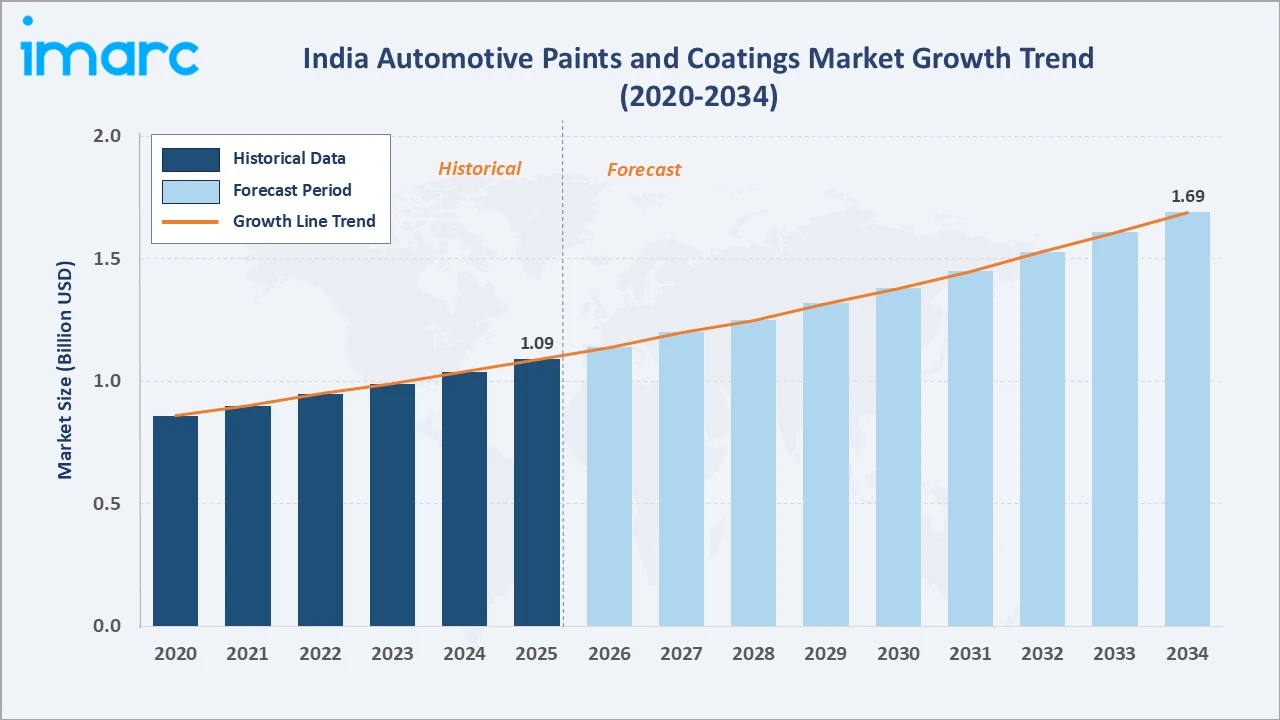
The India automotive paints and coatings market grew from USD 1.09 Billion in 2025 to USD 1.14 Billion in 2026 and is projected to reach USD 1.69 Billion by 2034, growing at a CAGR of 4.89% during 2026-2034. Demand is widening as vehicle manufacturers raise output across passenger vehicles, two-wheelers and commercial vehicles and as specifications move toward thinner films with lower solvent content. Supporting growth factors include rising vehicle output, waterborne adoption and expansion of organised refinish networks. Polyurethane dominates at 42.6%. Automotive OEM leads at 84.7%. West and Central India commands 36.8% of the regional market share.
Market Snapshot
| Metric | Value |
|---|---|
| Base Year Market Size (2025) | USD 1.09 Billion |
| Market Size (2026) | USD 1.14 Billion |
| Forecast Market Size (2034) | USD 1.69 Billion |
| CAGR (2026-2034) | 4.89% |
| Base Year | 2025 |
| Historical Period | 2020-2025 |
| Forecast Period | 2026-2034 |
| Dominant Resin Type | Polyurethane (42.6%, 2025) |
| Dominant Application | Automotive OEM (84.7%, 2025) |
| Leading Region | West and Central India (36.8%, 2025) |
The market size increased from USD 0.86 Billion in 2020 to USD 1.09 Billion in 2025 and is estimated to reach USD 1.14 Billion in 2026. The market is further expected to grow to USD 1.38 Billion by 2030 and USD 1.69 Billion by 2034.
To get more information on this market, Request Sample
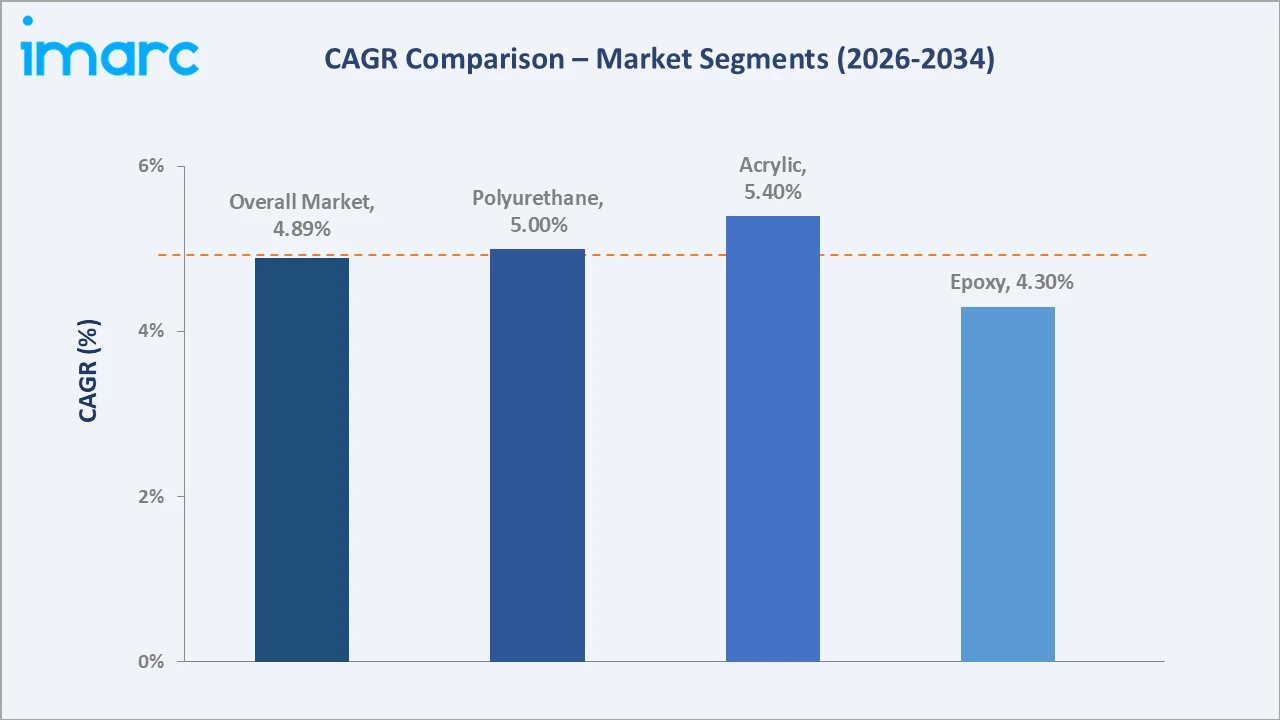
Acrylic at ~5.4% CAGR and polyurethane at ~5.0% CAGR are the fastest-growing resin types, supported by waterborne basecoat conversion in OEM paint shops and by clearcoat durability requirements on premium finishes.
Executive Summary
The India automotive paints and coatings market expanded from USD 1.09 Billion in 2025 to an estimated USD 1.14 Billion in 2026, with demand anchored in factory painting of passenger vehicles, two-wheelers and commercial vehicles, and in a repair and refinish aftermarket that grows with the installed vehicle parc. The fastest-developing areas are waterborne and high-solids systems, color-matched refinish products and coatings for electric vehicle bodies and battery enclosures, each outpacing the wider market because they combine tighter environmental compliance with higher value per liter.
Localization of resin, pigment and additive supply, expanding vehicle output and shorter model refresh cycles are widening the customer base beyond a handful of large OEM accounts. The market is projected to reach USD 1.69 Billion by 2034. Polyurethane at 42.6% leads through clearcoat and topcoat performance. Automotive OEM at 84.7% anchors volume through contracted line supply. West and Central India lead regionally at 36.8%.
Key Market Insights
| Insight | Data |
|---|---|
| Dominant Resin Type | Polyurethane - 42.6% share (2025) |
| Dominant Application | Automotive OEM - 84.7% market share (2025) |
| Leading Region | West and Central India - 36.8% share (2025) |
| Market Opportunity | Waterborne OEM conversion, refinish network formalization, electric vehicle and battery enclosure coatings, localized pigment and resin supply. |
Key Analytical Observations Supporting the Above Data:
- Polyurethane at 42.6%: Clearcoat and topcoat layers carry the appearance and durability that vehicle buyers judge, so polyurethane chemistry holds the largest position and supports premium pricing across exterior finishes.
- Automotive OEM at 84.7%: Factory painting applies several coating layers to every vehicle built and is contracted model by model, giving approved suppliers long, predictable volume tied to production schedules.
- West and Central India at 36.8%: Vehicle and component clusters around Mumbai, Pune, Nashik and Gujarat, together with the densest refinish distribution in the country, concentrate coating consumption in this region.
India Automotive Paints and Coatings Market Overview
The India automotive paints and coatings market serves two connected demand pools: factory painting at vehicle and component plants, and repair work at body shops. The supply chain runs from resin, pigment and additive producers through paint manufacturers, color laboratories and application engineers who install and tune processes inside customer paint shops.
Automotive OEM coatings cover pre-treatment, electrodeposition primer, primer surfacer, basecoat and clearcoat, each qualified against a specific model and paint line. Automotive refinish coatings reach workshops through distributors and are sold on color accuracy, drying speed and ease of application. Entry barriers are high at the OEM tier, where qualification, technical service and capital intensity decide who holds a line, and lower in refinish, where distribution reach and color libraries determine share across a dispersed workshop base.
Market Dynamics
To evaluate market opportunities, Request Sample
Market Drivers
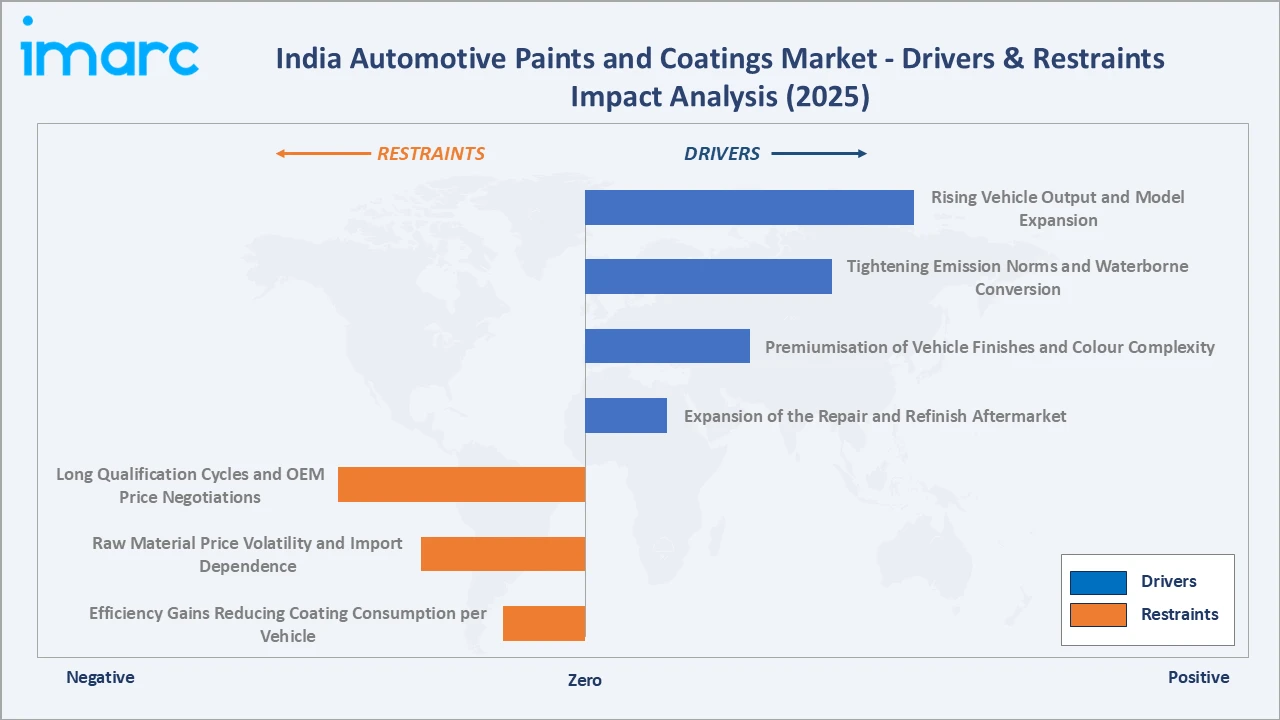
- Rising Vehicle Output and Model Expansion: Vehicle manufacturers continue to add capacity and refresh model lines across passenger vehicles, two-wheelers and commercial vehicles, and every additional unit carries a defined paint film built from primer, basecoat and clearcoat. New launches multiply color programs and add variants on shared platforms, so paint demand rises with both unit volume and color complexity. Component makers painting bumpers, mirrors and interior trims add a second stream of demand tied to the same assemblies.
- Tightening Emission Norms and Waterborne Conversion: Environmental limits on solvent emissions from paint shops are pushing vehicle manufacturers toward waterborne basecoats, high-solids clearcoats and thinner film builds. Conversion is capital intensive because it requires new application equipment, controlled humidity zones and reformulated products, and it changes the technical service burden carried by coating suppliers. Once a plant converts, the supplier that supports the transition usually holds the business through the model cycle.
- Premiumization of Vehicle Finishes and Color Complexity: Buyers are shifting toward sport utility vehicles, larger body surfaces, dual-tone roofs and specialty effects such as metallic, pearlescent and matte finishes, all of which consume more coating and demand tighter process control. Color palettes have widened sharply, and each additional tint raises the cost of color development, tinting machine inventory and paint shop changeovers.
- Expansion of the Repair and Refinish Aftermarket: A growing vehicle parc, longer ownership cycles and rising insurance penetration keep repair work steady, and every collision repair consumes refinish products matched to factory colors. As vehicles stay on the road longer, repaint and refurbishment work broadens beyond accident repair into fleet maintenance, used vehicle preparation and commercial vehicle refurbishment. Demand is spread across authorized body shops, independent workshops and fleet garages, which makes distribution reach as important as product performance.
Market Restraints
- Long Qualification Cycles and OEM Price Negotiations: Qualifying a coating system for a vehicle plant takes months of trials covering adhesion, durability, appearance and line speed, and approval is specific to a model, a substrate and a paint line. Suppliers carry engineering costs before any revenue arrives, and incumbents defend positions because switching carries operational risk.
- Raw Material Price Volatility and Import Dependence: Resins, titanium dioxide, effect pigments, aluminum flakes and specialty additives account for a large share of coating cost, and several of these inputs are imported or priced against global benchmarks. Currency movement and freight disruption pass through to input cost quickly, while selling prices to vehicle manufacturers adjust slowly under annual contracts. Effect pigments and some high-performance resins have limited domestic supply options, so suppliers hold inventory buffers that tie up working capital.
- Efficiency Gains Reducing Coating Consumption per Vehicle: Paint shops are improving transfer efficiency through electrostatic bell atomization, robotic paths, recovered overspray and integrated processes that combine primer and basecoat stages. Thinner film builds achieve the same appearance and protection with less material, and improved first-run capability reduces rework and repainting.
Market Opportunities
- Coatings for Electric Vehicles and Battery Enclosures: Electric vehicles change the coating task rather than removing it. Battery enclosures need dielectric, corrosion-resistant coatings applied to complex geometries, motor housings need thermal and insulation performance, and the absence of an engine shifts heat management toward new material stacks.
- Refinish Formalization and Waterborne Workshop Conversion: Much repair work still happens in small workshops with limited equipment and inconsistent color matching. Insurance-linked repair networks, fleet contracts and tighter local pollution rules are gradually pushing volume toward authorized body shops that use enclosed booths, mixing schemes and documented processes. Each converted workshop needs waterborne products, dispensing equipment, training and ongoing color support, which raises consumption per repair and shifts demand toward branded systems.
- Localization of Specialty Pigments, Resins and Additives: Domestic manufacturing incentives and supply chain de-risking are encouraging local production of inputs that have historically been imported, including effect pigments, specialty resins and application additives. Local supply shortens lead times, reduces currency exposure and allows smaller batch sizes that suit the wide color palettes used in Indian vehicle plants. Coatings makers that qualify local sources early can lower working capital and improve service levels without compromising appearance or durability.
Market Challenges
- Conversion Cost for Smaller Body Shops: Waterborne systems and enclosed booths demand capital that many independent workshops cannot justify on current volumes. Without financing, training and steady workflow, smaller repairers delay conversion and continue with solvent-based products, which slows formalization of the refinish channel and fragments quality across the market.
- Skilled Applicator and Technical Service Talent: Coating performance depends on surface preparation, film thickness control and booth conditions, and experienced applicators and application engineers are in short supply as paint shops modernize. Training takes time and is largely delivered by suppliers, adding cost before any commercial benefit appears. Talent shortages limit how quickly new lines and convert body shops reach target quality, and they constrain the pace at which advanced products can be introduced across a dispersed customer base.
- Unorganized and Imported Refinish Products: Lower-priced imported and unbranded refinished products reach workshops through informal channels, undercutting branded systems on price while offering limited color accuracy and durability. Counterfeit packaging of well-known brands adds a further layer of risk, eroding trust and complicating warranty support.
Emerging Market Trends
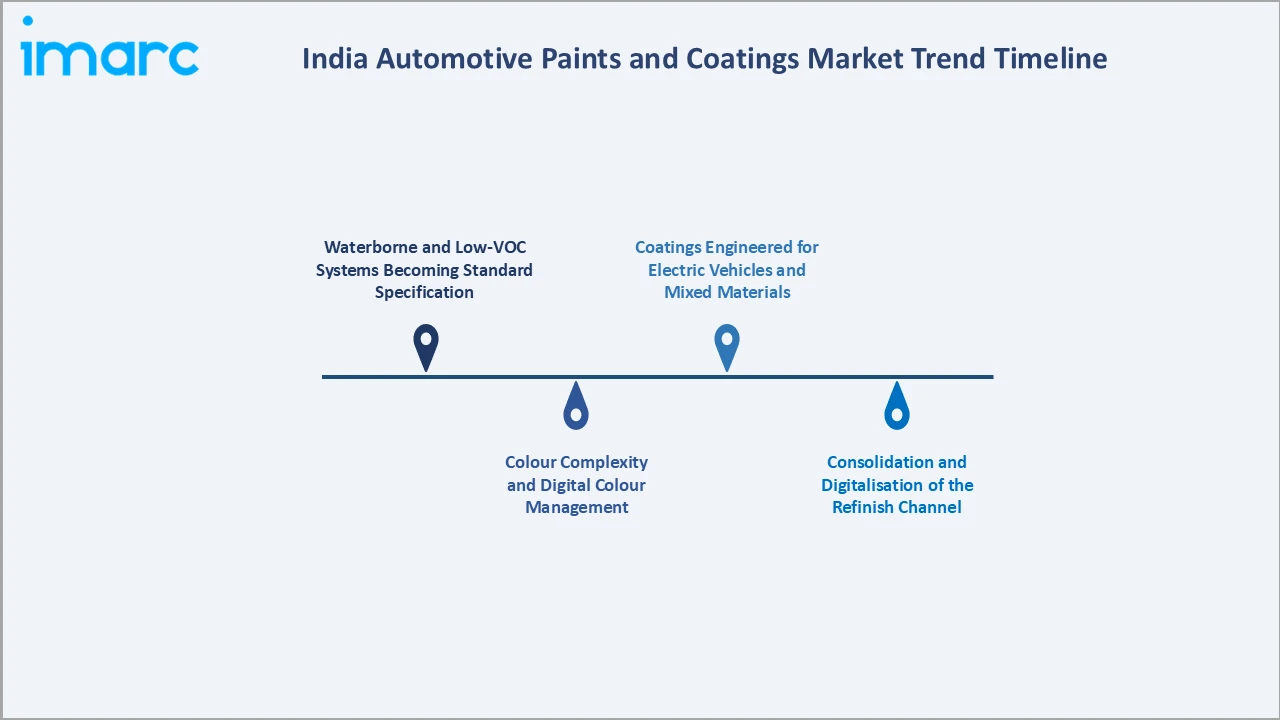
1. Waterborne and Low-VOC Systems Becoming Standard Specification
Waterborne basecoats and high-solids clearcoats are moving from trial programs to routine specification in vehicle plants, driven by emission limits, worker safety rules and the appearance benefits of controlled film builds. Conversion requires humidity-managed booths, new application equipment and reformulated products, so it favors suppliers with application engineering depth. The same shift is reaching body shops through local pollution rules, where enclosed booths and low-solvent thinners are increasingly required. Suppliers that support customers through the transition tend to hold the account afterwards, which makes conversion programs a competitive battleground rather than a simple product swap.
2. Color Complexity and Digital Color Management
Color ranges have expanded quickly, with more tints, three-layer effects and dual-tone combinations appearing on mainstream models rather than only premium ones. Each addition increases the burden on color laboratories, tinting machine inventory and paint shop changeover time. Digital color management, including spectrophotometer-based retrieval and automated dispensing, is being used to shorten matching time and reduce waste in both OEM and refinish settings.
3. Coatings Engineered for Electric Vehicles and Mixed Materials
Electric vehicle programs are reshaping substrate mixes, with aluminum closures, composite panels, high-strength steels and battery enclosures that require different pre-treatment and lower bake temperatures. Coatings must deliver dielectric strength, corrosion protection and thermal management on geometries that conventional line equipment handles poorly. Adhesion promoters and flexible primers are being developed for plastic and mixed-material assemblies, and suppliers are working with vehicle makers earlier in design cycles to qualify systems before tooling is fixed.
4. Consolidation and Digitalization of the Refinish Channel
Refinish distribution is consolidating as larger distributors add training centers, mixing schemes and delivery density to serve body shops that expect fast color support. Digital ordering, color retrieval applications and Bodyshop management software are becoming part of the offer, linking product supply to workflow and insurance documentation. Authorized repair networks preferred by insurers push volume toward workshops that can evidence process quality, which favors branded systems with auditable procedures.
Industry Value Chain Analysis
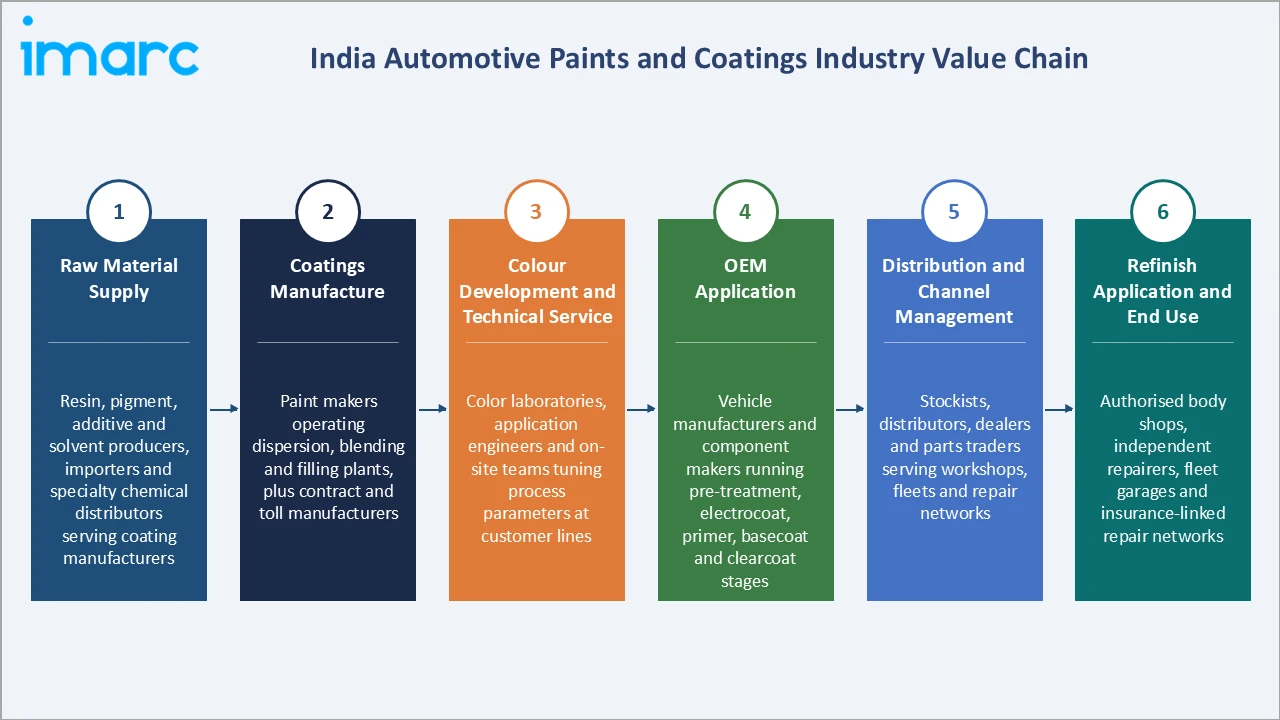
The industry value chain spans raw material supply, coatings manufacture, color development and technical service, application at vehicle plants, distribution into the refinish channel, and workshop application and end use. Value accumulates as commodity chemistry is converted into a qualified, color-matched system that performs on a specific line or panel.
| Stage | Key Participants |
|---|---|
| Raw Material Supply | Resin, pigment, additive and solvent producers, importers and specialty chemical distributors serving coating manufacturers. |
| Coatings Manufacture | Paint makers operating dispersion, blending and filling plants, plus contract and toll manufacturers. |
| Color Development and Technical Service | Color laboratories, application engineers and on-site teams tuning process parameters at customer lines. |
| OEM Application | Vehicle manufacturers and component makers running pre-treatment, electrocoat, primer, basecoat and clearcoat stages. |
| Distribution and Channel Management | Stockists, distributors, dealers and parts traders serving workshops, fleets and repair networks. |
| Refinish Application and End Use | Authorized body shops, independent repairers, fleet garages and insurance-linked repair networks. |
Color development and on-site technical service is the most commercially critical stage, because it converts a formulation into a reliably applied finish and decides whether a supplier holds a line or loses it at the next model change.
Technology Landscape in the India Automotive Paints and Coatings Industry
Cathodic Electrodeposition and Thin-Film Pre-Treatment
Cathodic electrodeposition applies a uniform primer coat to the entire body shell by immersing it in a paint bath and driving deposition with an electric current, reaching cavities and edges that spray application cannot cover. It remains the corrosion protection backbone of vehicle assembly. Modern lines pair it with thin-film zirconium-based pre-treatment instead of traditional phosphating, reducing sludge, water use and process stages while maintaining adhesion. Recent formulations lower bake temperature and cut volatile content, which matters as vehicles carry more temperature-sensitive components.
Waterborne Basecoat and High-Solids Clearcoat Systems
Waterborne basecoats replace much of the organic solvent in color layers with water, cutting volatile emissions while delivering metallic and pearlescent effects. They require controlled humidity and temperature in application zones, dedicated stainless steel handling and careful flash-off before clearcoat. High-solids clearcoats complement them by raising resin content and lowering solvent per liter, improving scratch resistance and gloss retention.
Robotic Application and Integrated Compact Paint Processes
Robotic bell atomization, automated color change and integrated processes that combine primer and basecoat stages have become the standard route to higher throughput and lower waste. Compact processes reduce the number of oven passes, cutting energy use and floor space while shortening the line. Electrostatic application improves transfer efficiency, and overspray recovery systems return unused paint to the circuit. The result is less material consumed per vehicle, better film consistency and faster model changeovers, all of which suit plants building several variants on one line.
Digital Colour Matching and Automated Refinish Dispensing
Refinish workshops are adopting spectrophotometer-based color retrieval, cloud color libraries and automated dispensing to cut matching time and material waste. A technician scans a vehicle panel, the system proposes a formula adjusted for variant and age, and a dispenser mixes the required quantity. This lowers the skill threshold for accurate matching and shortens repair cycle time, which matters where insurers and fleet operators set turnaround targets.
Market Segmentation Analysis
The report covers the following segments:
| Segment Category | Leading Segment | Market Share | Year |
|---|---|---|---|
| Resin Type | Polyurethane | 42.6% | 2025 |
| Technology | 🔒 | 🔒 | 2025 |
| Layer | 🔒 | 🔒 | 2025 |
| Application | Automotive OEM | 84.7% | 2025 |
| Region | West and Central India | 36.8% | 2025 |

By Resin Type
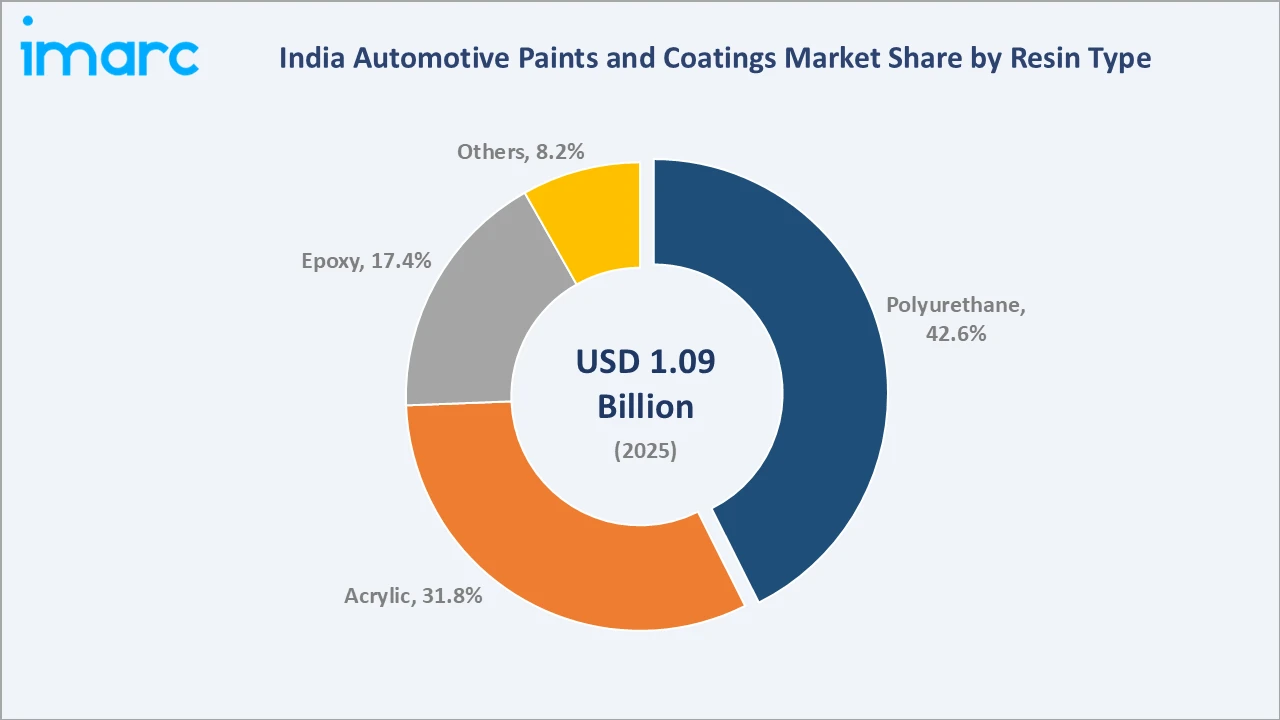
Polyurethane leads at 42.6% (2025). It carries clearcoat and topcoat layers where gloss retention, scratch resistance and weather durability are judged by vehicle buyers, and it is specified across a wide range of models and finishes. Its performance profile keeps it the default choice for exterior appearance surfaces.
To access detailed market analysis, Request Sample
Acrylic accounts for 31.8% and is the fastest-growing resin type at ~5.4% CAGR. Waterborne acrylic basecoats are being adopted as plants converted to lower-solvent processes, and acrylic chemistry adapts well to color development, fast drying and low-temperature bake requirements that suit mixed-material assemblies. Epoxy accounts for 17.4%, and others account for 8.2%.
By Application
Automotive OEM leads at 84.7% (2025). Factory painting covers every vehicle built, applies multiple coating layers in sequence and is contracted model by model, so it accounts for the bulk of coating volume. Long qualification cycles keep approved suppliers in place across model life cycles.
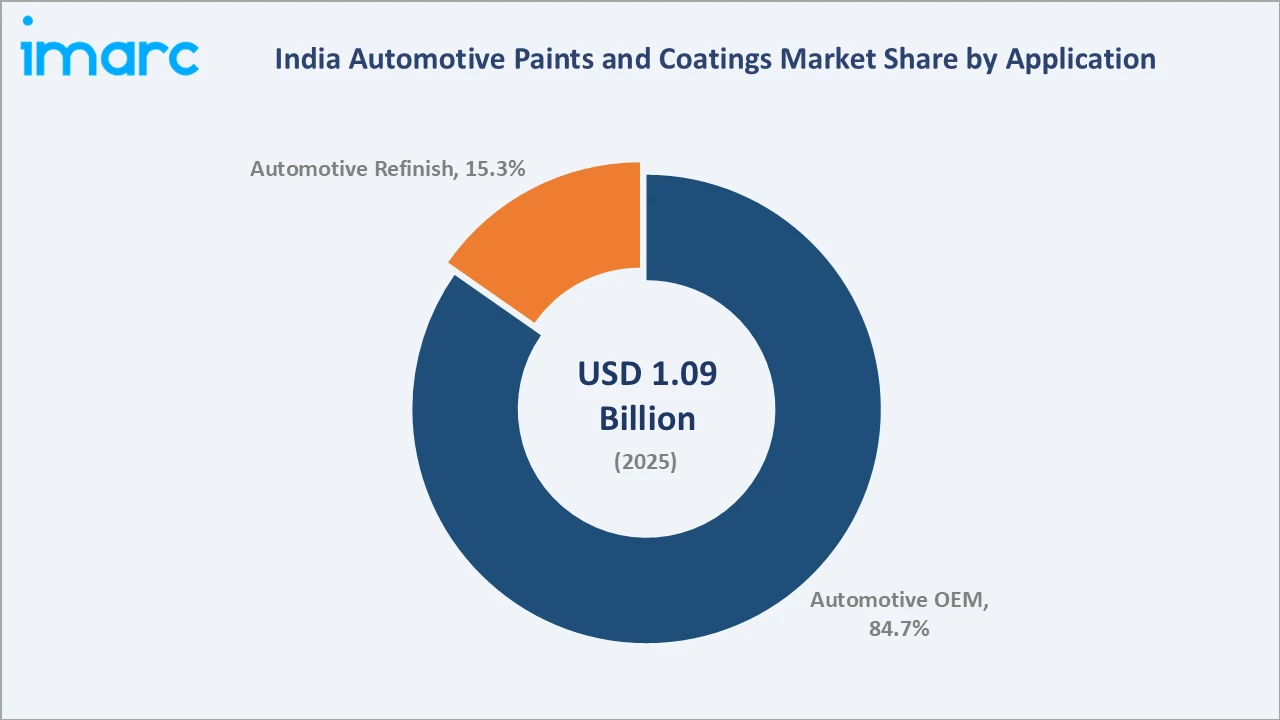
Automotive refinish accounts for 15.3% and is the fastest-growing application at ~5.4% CAGR. Repair volumes follow the size and age of the vehicle parc rather than new vehicle sales, and the shift toward waterborne products in body shops raises value per liter while organized repair networks steadily absorb work from informal workshops.
Regional Market Insights
| Region | Share (2025) | Key Drivers & Characteristics |
|---|---|---|
| West and Central India | 36.8% | Vehicle and component clusters around Mumbai, Pune, Nashik and Gujarat, plus the densest refinish distribution networks. |
| South India | 28.4% | Chennai, Hosur and Bengaluru vehicle and component manufacturing, with a strong premium passenger vehicle base. |
| North India | 22.1% | Delhi-NCR, Manesar and Haryana component clusters, with large two-wheeler output and a wide aftermarket. |
| East and Northeast India | 12.7% | Kolkata and Jamshedpur vehicle and component plants, with slower refinish formalization and lower spend per vehicle. |
West and Central India accounts for 36.8% of the India automotive paints and coatings market, anchored by vehicle and component clusters and by the country's densest refinish distribution. South India holds 28.4%, supported by vehicle and component manufacturing in Chennai, Hosur and Bengaluru and by a strong premium passenger vehicle base that favors higher-value finishes.
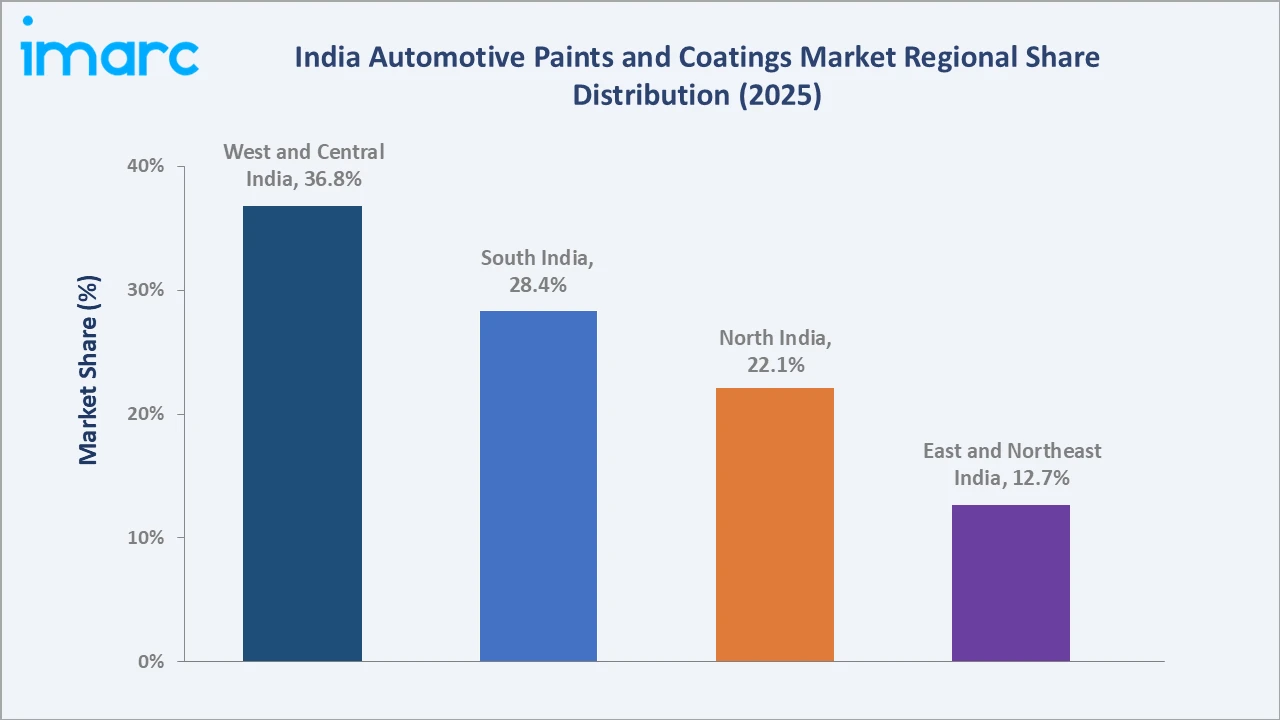
North India contributes 22.1%, shaped by vehicle and component output in Haryana and the Delhi-NCR belt and by a large two-wheeler and aftermarket base. East and Northeast India accounts for 12.7%, with vehicle and component plants in and around Kolkata and Jamshedpur but slower formalization of refinish demand and lower coating spend per vehicle.
Competitive Landscape
The competitive landscape is moderately concentrated at the OEM tier and fragmented in refinish. A small group of multinational and domestic coating makers holds approved positions on vehicle lines, competing on color development, application engineering and cost per vehicle. Refinish is contested by many brands through distributors, where color libraries, training and delivery speed decide share.
| Company | Key Brands | Market Position | Core Strength |
|---|---|---|---|
| Asian Paints PPG Pvt. Ltd. | PPG Asian Paints | Market Leader | Asian Paints PPG Pvt. Ltd. plays a major role in India's automotive paints and coatings sector through a 50:50 joint venture between India's Asian Paints Ltd. and PPG Industries Inc. |
| BASF | Glasurit, CathoGuard | Established Player | BASF plays a critical role in India's automotive paints and coatings sector by supplying high-performance OEM coatings, sustainable e-coat solutions, refinish products, and paint protection films to major local and global vehicle manufacturers. |
| Nippon Paint Holdings Co., Ltd. | Nippon | Innovator | Nippon Paint Holdings Co., Ltd. plays a major role in India’s automotive paints, OEM coatings, and aftermarket refinish sectors through its regional operations and manufacturing footprint. |
Refinish growth is contested through distributor networks, mixing schemes and training centers that raise switching costs for workshops. Waterborne conversion is now the pivot: suppliers that can fund and support a customer's transition gain multi-year attachment, while those selling on price alone lose ground as emission rules tighten. Localization of production and color development also shapes who can serve smaller cities profitably.
Key Company Profiles
Asian Paints PPG Pvt. Ltd.
Asian Paints PPG Pvt. Ltd. is a joint venture between Asian Paints and PPG Industries that supplies automotive and industrial coatings in India and neighboring markets. It combines PPG's coating chemistry and application technology with Asian Paints' distribution reach and local manufacturing footprint, giving it coverage across both OEM and refinish demand.
- Key Brands: PPG Asian Paints.
- Recent Developments: In August 2025, PPG renewed its joint venture agreement with Asian Paints Ltd. in India for another 15 years, extending the partnership from 2026 to 2041. The agreement will enable both companies to continue providing advanced coating solutions to customers across industrial, protective, marine, packaging, automotive, and powder coatings segments, while addressing evolving industry requirements and customer needs.
- Strategic Focus: The venture is leveraging its parentage to combine global chemistry with local reach, targeting component makers and refinish distributors as its main expansion routes. Training infrastructure and color support are being used to convert workshops to branded systems.
Nippon Paint Holdings Co., Ltd.
Nippon Paint Holdings Co., Ltd. is a paints and coatings manufacturer with a strong presence across automotive, decorative, and industrial coatings. In India, the company operates through its automotive coatings business, Berger Nippon Paint Automotive Coatings (BNPA), a joint venture with Berger Paints. It provides a range of coatings for passenger vehicles, commercial vehicles, automotive components, and parts manufacturers, catering to both OEM and automotive refinishing requirements.
- Key Brands: Nippon.
- Strategic Focus: Strengthening its presence in India's automotive coatings market through product innovation, advanced coating technologies, and strategic partnerships with automotive OEMs and component manufacturers.
Market Concentration Analysis
The India automotive paints and coatings market is moderately concentrated at the OEM tier and fragmented in refinish. Leading companies benefit from strong brand recognition, established relationships with automobile manufacturers, extensive distribution networks, advanced coating technologies, and well-developed research and development capabilities. Their presence across multiple automotive segments, including passenger vehicles, commercial vehicles, and two-wheelers, further strengthens their competitive positioning.
However, the market also comprises several regional manufacturers and niche coating suppliers that cater to specific applications, price-sensitive customers, and localized automotive requirements. While established players maintain their competitive edge through technological innovation, product differentiation, strategic partnerships, and capacity expansion, smaller participants compete through competitive pricing, customized formulations, and regional distribution capabilities. Consequently, the market demonstrates a combination of strong market leadership among major manufacturers and fragmented competition across specialized and aftermarket segments.
Investment & Growth Opportunities
Highest Growth Segments
Acrylic at ~5.4% CAGR and automotive refinish at ~5.4% CAGR, followed by polyurethane at ~5.0%, automotive OEM at ~4.8%, epoxy at ~4.3% and other resins at ~3.9%, are the primary investment vectors through 2034. These segments grow fastest because demand pull is moving toward lower-solvent systems that require new products, new application equipment and closer technical support, which raises value per liter even where unit volumes grow slowly.
Emerging Investment Opportunities
The most dynamic emerging opportunity is coatings for electric vehicle battery enclosures and mixed-material bodies, where dielectric, thermal and low-bake requirements create fresh qualification work. It scales first in passenger vehicles and two-wheeler programs built on new platforms, rewarding suppliers that engage at the design stage.
Investment Themes
- Localized waterborne production: Domestic capacity for waterborne basecoats and high-solids clearcoats shortens lead times, protects against currency swings and supports customer conversion programs.
- Refinish channel depth: Distributor training, color retrieval tools and mixing schemes raise switching costs and capture repair demand that follows the vehicle parc rather than new sales.
- Electric vehicle and mixed-material qualification: Early approval on battery enclosure and plastic or aluminum panel coatings attaches suppliers to platforms for their full production life.
Future Market Outlook (2026-2034)
The India automotive paints and coatings market is projected to grow from USD 1.09 Billion in 2025 to USD 1.14 Billion in 2026, reaching USD 1.69 Billion by 2034, registering a CAGR of 4.89% during 2026-2034. The market's anchor value of USD 1.38 Billion in 2030 reflects steady conversion to waterborne systems and the widening of the refinish base rather than a single demand spike, with West and Central India and South India sustaining leadership as vehicle and component clusters expand.
Three structural forces are shaping the growth of the market expanding automotive production, increasing technological advancements, and the growing emphasis on vehicle durability and sustainability. Rising demand for passenger vehicles, commercial vehicles, and two-wheelers is driving the consumption of automotive coatings across OEM and refinishing applications. Simultaneously, the adoption of advanced coating technologies, including waterborne, powder, and high-performance coatings, is supporting improved finish quality, corrosion resistance, and operational efficiency. Furthermore, stringent environmental regulations and increasing preference for low-VOC and eco-friendly formulations are encouraging manufacturers to invest in sustainable product development and innovative coating solutions.
Research Methodology
Primary Research
Primary research covered interviews with coating manufacturers, application engineers, distributors, body shop operators and vehicle plant paint shop managers across India, focused on qualification cycles, conversion costs, color development practices and refinish channel economics.
Secondary Research
Secondary research drew on company disclosures, industry association commentary, environmental regulation documents and trade data, triangulated to establish resin type and application splits and the regional distribution of coating demand across India.
Forecasting Models
Forecasting combined vehicle production and parc modelling with segment-level adoption curves for waterborne and high-solids systems, producing year-wise values from 2026 to 2034 and growth paths reconciled to the overall market CAGR.
India Automotive Paints and Coatings Market Report Coverage:
| Report Features | Details |
|---|---|
| Base Year of the Analysis | 2025 |
| Historical Period | 2020-2025 |
| Forecast Period | 2026-2034 |
| Units | Billion USD |
| Scope of the Report |
Exploration of Historical Trends and Market Outlook, Industry Catalysts and Challenges, Segment-Wise Historical and Future Market Assessment:
|
| Resin Types Covered | Polyurethane, Epoxy, Acrylic, Others |
| Technologies Covered | Solvent-borne, Water-borne, Powder, Others |
| Layers Covered | E-coat, Primer, Base Coat, Clear Coat |
| Applications Covered | Automotive OEM, Automotive Refinish |
| Regions Covered | North India, West and Central India, South India, East and Northeast India |
| Companies Covered | Asian Paints PPG Pvt. Ltd., BASF, Nippon Paint Holdings Co., Ltd., etc. |
| Customization Scope | 10% Free Customization |
| Post-Sale Analyst Support | 10-12 Weeks |
| Delivery Format | PDF and Excel through Email (We can also provide the editable version of the report in PPT/Word format on special request) |
Key Benefits for Stakeholders:
- IMARC’s industry report offers a comprehensive quantitative analysis of various market segments, historical and current market trends, market forecasts, and dynamics of the India automotive paints and coatings market from 2020-2034.
- The research report provides the latest information on the market drivers, challenges, and opportunities in the India automotive paints and coatings market.
- Porter's five forces analysis assist stakeholders in assessing the impact of new entrants, competitive rivalry, supplier power, buyer power, and the threat of substitution. It helps stakeholders to analyze the level of competition within the India automotive paints and coatings industry and its attractiveness.
- Competitive landscape allows stakeholders to understand their competitive environment and provides an insight into the current positions of key players in the market.
Frequently Asked Questions About the India Automotive Paints and Coatings Market Report
The market reached USD 1.09 Billion in 2025 and an estimated USD 1.14 Billion in 2026, supported by rising vehicle output, waterborne conversion in paint shops and steady growth in repair and refinish work.
The market is expected to register a CAGR of 4.89% during 2026-2034, rising from USD 1.14 Billion in 2026 to reach USD 1.69 Billion by 2034 on localization and refinish-led demand.
Polyurethane leads the resin type segment with a 42.6% share in 2025, reflecting its use in clearcoat and topcoat layers where gloss retention, scratch resistance and weather durability are essential.
Automotive OEM leads the application segment with an 84.7% share in 2025, driven by factory painting of every vehicle built and by model-specific qualification that keeps approved suppliers in place.
West and Central India leads with a 36.8% regional share in 2025, supported by vehicle and component clusters around Mumbai, Pune, Nashik and Gujarat and by the densest refinish distribution network.
Leading companies include Asian Paints PPG Pvt. Ltd., BASF, and Nippon Paint Holdings Co., Ltd., among others.
The market is projected to reach USD 1.38 Billion by 2030, driven by waterborne conversion, localization of specialty inputs and expanding repair demand as the vehicle parc grows.
Acrylic at ~5.4% CAGR, automotive refinish at ~5.4% CAGR and polyurethane at ~5.0% CAGR are the fastest-growing segments, alongside electric vehicle battery enclosure coatings and localized pigment supply.
Need more help?
- Speak to our experienced analysts for insights on the current market scenarios.
- Include additional segments and countries to customize the report as per your requirement.
- Gain an unparalleled competitive advantage in your domain by understanding how to utilize the report and positively impacting your operations and revenue.
- For further assistance, please connect with our analysts.
 Request Customization
 Speak to an Analyst
 Request Brochure
 Inquire Before Buying
Benefits of Customization
- Personalize this research
- Triangulate with your data
- Get data as per your format and definition
- Gain a deeper dive into a specific application, geography, customer, or competitor
- Any level of personalization
Get in Touch With Us
UNITED STATES
Phone: +1-201-971-6302
INDIA
Phone: +91-120-433-0800
UNITED KINGDOM
Phone: +44-753-714-6104
Email: [email protected]
Client Testimonials























Related Reports

Choose your plan
*Please note that the prices mentioned below are starting prices for each bundle type. Kindly contact our team for further details.*
Single User License
- 1 User License, Access on 2 Devices
- PDF Report + Excel Dataset (Password Protected)
- Lifetime Access
- No Printing Rights
- 10% Free Report Customization
- 10–12 Weeks of Analyst Support
Five User License
- Access for 5 Users, 2 Devices per User
- PDF Report + Excel Dataset (Password Protected)
- Lifetime Access
- Dedicated Account Manager
- 12–14 Weeks of Analyst Support
- No Printing Rights
- 15% Free Report Customization
- 25% Discount on Your Next Purchase
Corporate User License
- Unlimited User Access (Within Your Organization)
- PDF Report + Excel Dataset
- Lifetime Access
- Dedicated Account Manager
- 14–20 Weeks of Analyst Support
- No Printing Rights
- 20% Free Report Customization
- 30% Discount on Your Next Purchase
Essential Insights
What's included:
3 reports
- Lifetime Access
- PDF Reports
- Excel Datasets
- 2 Weeks of Free Analyst Support
- 2 User Licenses
- Access on 2 Devices
- Printing Rights
- Complimentary PowerPoint (PPT) Version
- Complimentary License Upgrade
Professional Access
What's included:
5 reports
- Lifetime Access
- PDF Reports
- Excel Datasets
- 8 Weeks of Free Analyst Support
- 2 User Licenses
- Access on 2 Devices
- Printing Rights
- Complimentary PowerPoint (PPT) Version
- Complimentary License Upgrade
Business Advantage
What's included:
8 reports
- Lifetime Access
- PDF Reports
- Excel Datasets
- 14 Weeks of Free Analyst Support
- 2 User Licenses
- Access on 2 Devices
- Printing Rights
- Complimentary PowerPoint (PPT) Version
- Complimentary License Upgrade
Enterprise Intelligence
What's included:
10 reports
- Lifetime Access
- PDF Reports
- Excel Datasets
- 20 Weeks of Free Analyst Support
- 2 User Licenses
- Access on 2 Devices
- Printing Rights
- Complimentary PowerPoint (PPT) Version
- Complimentary License Upgrade