
India Industrial Air Compressors Market Size, Share, Trends and Forecast by Product, Lubrication, Operation, Capacity, End User and Region, 2026-2034
India Industrial Air Compressors Market Size, Share, Trends & Forecast (2026-2034)
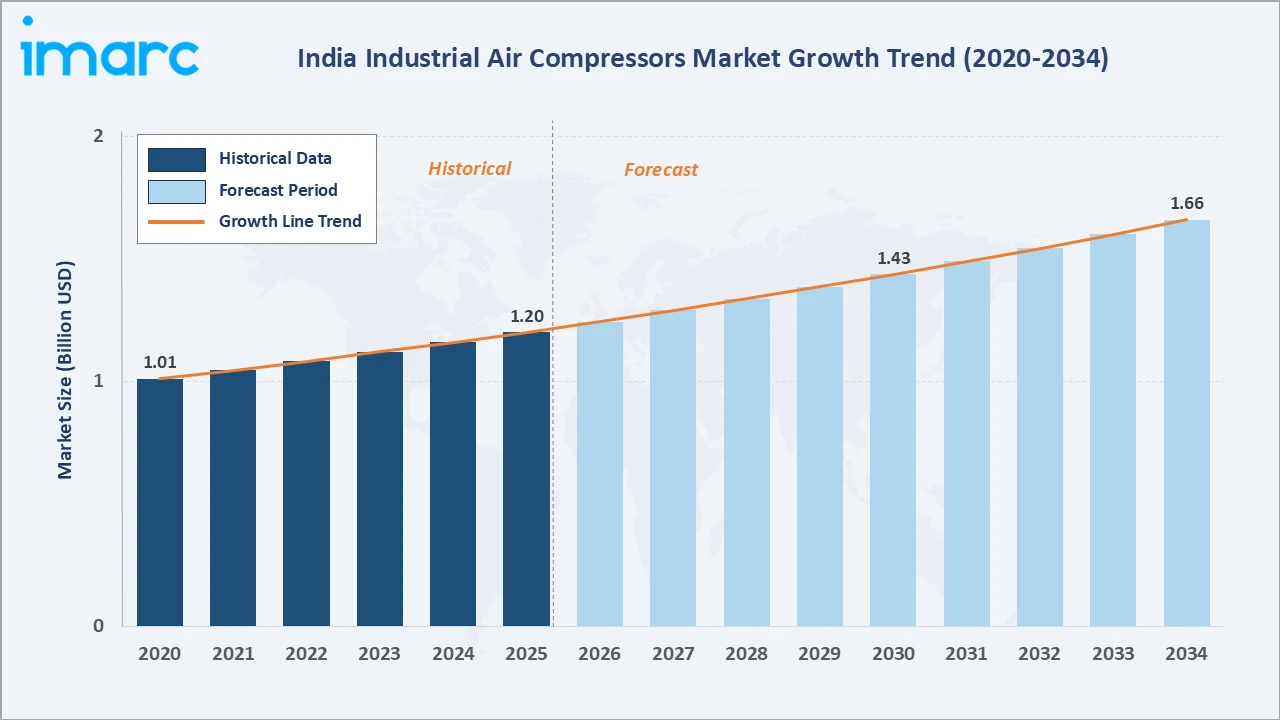
The India industrial air compressors market size increased from USD 1.20 Billion in 2025 to USD 1.26 Billion in 2026 and is projected to reach USD 1.66 Billion by 2034, exhibiting a CAGR of 3.49% during 2026-2034. India’s manufacturing sector is receiving strong policy and investment support, creating a favorable environment for industrial equipment demand. Between FY2014 and FY2025, the country attracted around INR 16.62 trillion (USD 184.2 billion) in manufacturing FDI. Under the Make in India and Viksit Bharat 2047 initiatives, manufacturing is targeted to contribute nearly 25% of GDP as India progresses toward a USD 35 trillion economy. Government priorities include expanding industrial corridors, ports, and power infrastructure, accelerating factory digitalization through IoT and advanced connectivity, strengthening workforce skills, and reducing logistics costs to around 8% of GDP. These developments are driving the market by supporting the expansion and modernization of manufacturing facilities. Electric operation dominates at 88.2%, oil filled lubrication leads at 76.4%, and West India accounts for the largest regional share at 34.8%.
Market Snapshot
|
Metric |
Value |
|
Base Year Market Size (2025) |
USD 1.20 Billion |
| Market Size (2026) | USD 1.26 Billion |
|
Forecast Market Size (2034) |
USD 1.66 Billion |
|
CAGR (2026-2034) |
3.49% |
|
Base Year |
2025 |
|
Historical Period |
2020-2025 |
|
Forecast Period |
2026-2034 |
|
Dominant Operation |
Electric – 88.2% (2025) |
|
Dominant Lubrication |
Oil Filled – 76.4% (2025) |
|
Leading Region |
West India – 34.8% (2025) |
The India industrial air compressors market expanded from USD 1.01 Billion in 2020 to USD 1.20 Billion in 2025 and an estimated USD 1.26 Billion in 2026, reflecting steady post-COVID industrial recovery, rising demand from pharmaceutical and food processing sectors, and significant capacity expansion in automotive manufacturing clusters. The market is projected to reach USD 1.43 Billion by 2030 and USD 1.66 Billion by 2034.
To get more information on this market, Request Sample
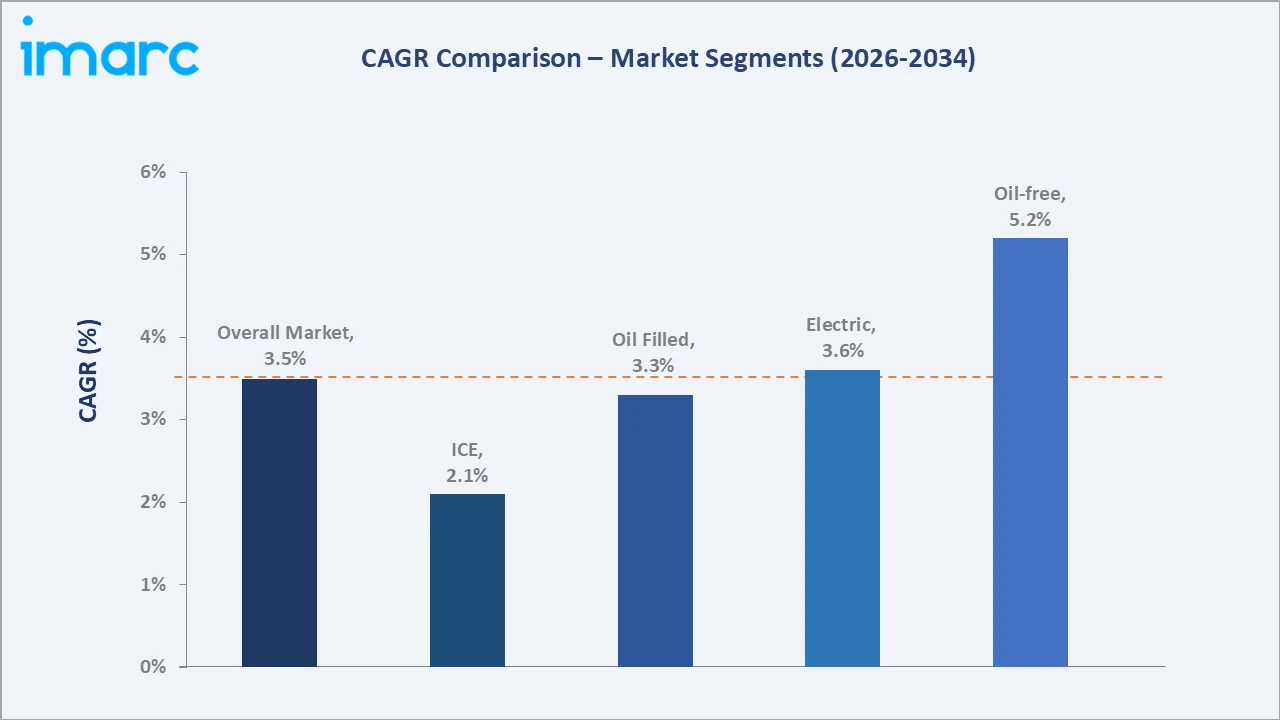
Oil-free lubrication grows fastest at ~5.20% CAGR through pharmaceutical, food & beverage, and electronics manufacturing clean-air requirements. Electric operation grows at ~3.60% CAGR through VFD adoption and BEE star labeling compliance. Oil filled lubrication grows at ~3.30% CAGR, sustaining market majority through manufacturing, automotive, and general industrial use. ICE-operated compressors grow at ~2.10% CAGR through remote construction and mining site applications.
India industrial air compressor market is positioned as a reliable and steadily growing segment of the country's broader industrial equipment landscape, where the sustained growth of manufacturing, infrastructure, healthcare, and energy sectors creates consistent demand for compressed air as an invisible but essential fourth utility in industrial operations. India compressor market is notable for the diversity of its end-use profile: from large centrifugal compressors serving oil & gas production platforms and steel plant blast furnaces, to medium rotary screw compressors serving automotive body shops and pharmaceutical manufacturing, to portable reciprocating compressors serving highway and railway construction sites across India's rapidly expanding infrastructure network.
Electric operation commands 88.2% market share through grid-connected industrial facilities where stable power enables the energy efficiency, operational control, and remote monitoring capabilities of modern electric-drive compressors. Oil filled compressors maintain 76.4% lubrication share through their lower acquisition cost, proven reliability across India's diverse industrial applications, and the established maintenance ecosystem of oil-lubricated rotary screw and reciprocating compressors. West India leads at 34.8% through Maharashtra and Gujarat's dense manufacturing clusters.
Key Market Insights
|
Insight |
Data |
|
Dominant Operation |
Electric – 88.2% share (2025) |
|
Dominant Lubrication |
Oil Filled – 76.4% share (2025) |
|
Leading Region |
West India – 34.8% share (2025) |
|
Market Opportunity |
Oil-free compressor demand from PLI-linked pharma/electronics manufacturing; green hydrogen compression technology development; IoT-enabled compressor-as-a-service (CaaS) rental models; energy audit-driven compressor replacement in MSME sector |
Key Analytical Observations:
- Electric Operation at 88.2% (2025): Electric-drive compressors, spanning fixed-speed direct-on-line (DOL), soft-start, and Variable Frequency Drive (VFD/VSD) configurations, dominate India's industrial air compressor market through the structure of India's industrial economy, where registered factories operate from grid-connected premises with three-phase electrical infrastructure.
- Oil Filled Lubrication at 76.4%: Oil-filled (oil-flooded) rotary screw and reciprocating compressors, where lubricating oil is injected into the compression chamber to seal rotor clearances, remove heat of compression, and lubricate moving parts, dominate India's market through their technical and economic advantages in the majority of industrial air applications.
- West India at 34.8% (2025): West India leads the market, supported by its strong manufacturing base across Maharashtra and Gujarat, with significant activity in automotive, chemicals, pharmaceuticals, engineering, and petrochemicals.
India Industrial Air Compressors Market Overview
India industrial air compressor industry encompasses the design, manufacture, import, distribution, installation, and service of positive displacement and dynamic air compressors serving 4-bar to 400+ bar working pressure applications across India's registered MSMEs and large industrial enterprises. Macroeconomic factors include India’s expanding manufacturing output, rising FDI inflows, infrastructure investment, industrialization, and supportive initiatives such as Make in India. Growth in automotive, chemicals, pharmaceuticals, metals, and engineering industries, coupled with increasing emphasis on energy efficiency and automation, supports demand for industrial air compressors.
Market Dynamics
To evaluate market opportunities, Request Sample
Market Drivers
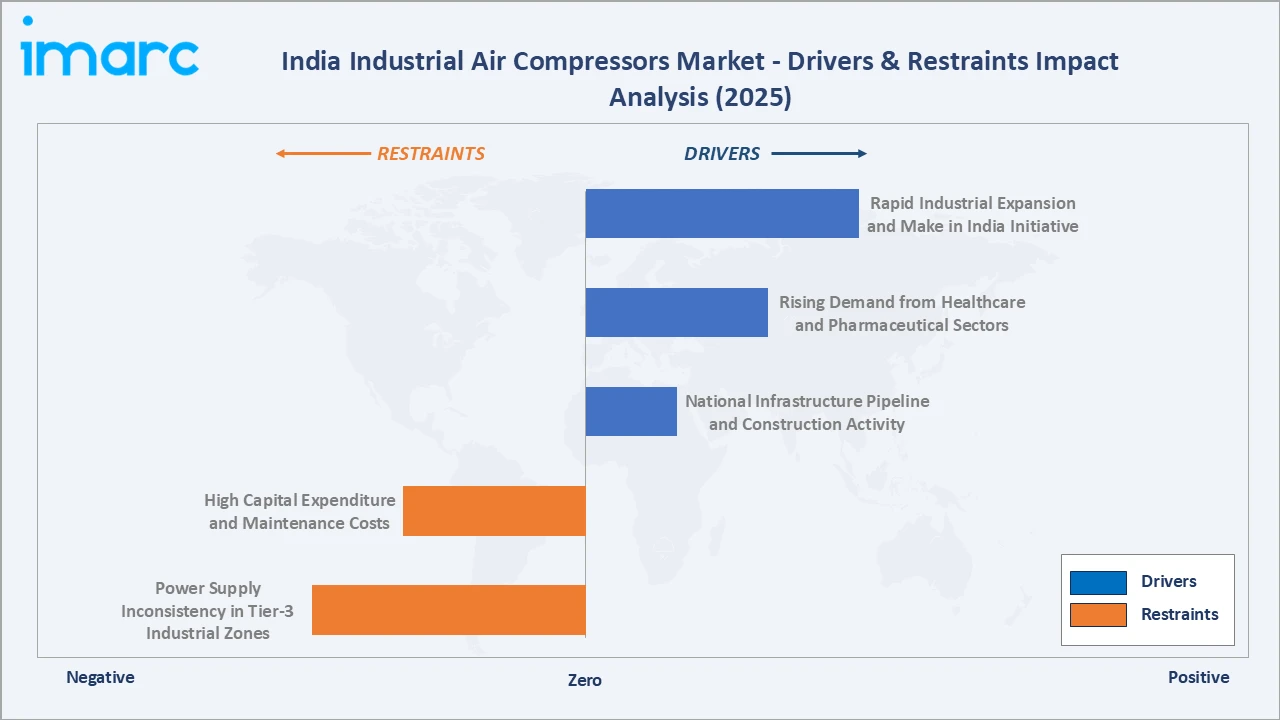
- Rapid Industrial Expansion and Make in India Initiative: Make in India 2.0 is accelerating technology adoption and industrial modernization, which could increase manufacturing’s contribution to India’s GDP to around 25% by 2035. Full-scale adoption of advanced technologies is projected to add nearly USD 1 trillion to manufacturing GDP by 2047. The Government of India's Make in India 2.0 policy is the single most consequential demand catalyst for India's industrial air compressor market. Production Linked Incentive (PLI) schemes across 14 champion sectors are incentivizing capacity creation that uniformly requires compressed air as a production utility. The semiconductor manufacturing push creates ultrapure compressed air demand of a scale and purity requirement that will add several hundred high-specification oil-free compressor installations.
- Rising Demand from Healthcare and Pharmaceutical Sectors: Under the Production Linked Incentive (PLI) Scheme for Bulk Drugs, the government has allocated a total outlay of INR 6,940 crore, of which INR 87.70 crore had been disbursed as incentives by March 2026. India's pharmaceutical industry is undergoing capacity expansion driven by PLI scheme incentives and post-COVID supply chain diversification as global pharma companies reduce dependence on Chinese API supply. Every new pharmaceutical formulation facility, API plant, and bulk drug manufacturing unit requires certified oil-free compressed air systems for tablet coating, blister packaging, lyophilization, and cleanroom instrumentation.
- National Infrastructure Pipeline and Construction Activity: The National Infrastructure Pipeline (NIP) was introduced with an estimated investment of INR 111 lakh crore (USD 1.5 trillion) for the 2020–2025 period. A substantial portion of the planned expenditure was directed toward key sectors such as energy, roads, urban infrastructure, and railways, creating the most sustained portable and stationary compressed air demand wave in India's infrastructure development history. Highway construction, railway tunneling, metro rail expansion, and urban water infrastructure all involve compressed air for jackhammering, pneumatic chiseling, drill-and-blast tunnel excavation, pneumatic testing of pipelines, and concrete spraying, creating sustained mobile and semi-portable ICE and electric compressor demand.
Market Restraints
- High Capital Expenditure and Maintenance Costs: High capital expenditure and maintenance costs limit the adoption of industrial air compressors, particularly among small and medium-sized manufacturers. Advanced compressors require significant upfront investment in equipment, installation, controls, and supporting infrastructure. In addition, recurring expenses related to servicing, spare parts, lubrication, and energy consumption increase total ownership costs. These financial pressures can delay replacement cycles and discourage investment in high-efficiency systems.
- Power Supply Inconsistency in Tier-3 Industrial Zones: Power supply inconsistency in Tier-3 industrial zones hampers the India industrial air compressors market by disrupting continuous compressor operations and reducing production efficiency. Frequent voltage fluctuations and outages can increase equipment downtime, maintenance requirements, and operating costs. Limited grid reliability also discourages smaller manufacturers from investing in advanced, electrically powered compressor systems.
Market Opportunities
- VFD and Energy-Efficient Compressor Replacement Wave: The growing replacement of conventional compressors with variable frequency drive (VFD) and energy-efficient systems creates a significant opportunity in the India industrial air compressors market. VFD compressors adjust motor speed according to air demand, helping manufacturers lower electricity consumption and operating costs. Rising energy prices, sustainability targets, and factory modernization are encouraging industries to upgrade aging compressor fleets, supporting replacement demand.
- Compressor-as-a-Service and IoT Rental Models: Compressor-as-a-Service (CaaS) and IoT-enabled rental models are reducing upfront capital requirements for manufacturers. Subscription and pay-per-use models provide access to modern compressors while bundling maintenance and servicing costs. IoT-based remote monitoring, predictive maintenance, and performance optimization can further reduce downtime and energy consumption, making these models particularly attractive to SMEs and rapidly expanding manufacturing facilities.
Market Challenges
- Chinese Import Competition and Price Pressure: India's industrial air compressor market faces increasing competitive pressure from Chinese-origin compressors imported through official channels and grey-market distribution networks, particularly in the India reciprocating compressor market and low-end rotary screw segment. Chinese reciprocating compressors are available in India at 30-50% lower prices than established brand equivalents, creating price erosion risk for domestic manufacturers and authorized multinational dealers in cost-sensitive MSME buying segments.
- Compressed-Air Leakage and Poor System Efficiency: Air leakage, incorrect pressure settings, inadequate piping design, and poorly maintained components can reduce the overall efficiency of compressed-air systems. These inefficiencies increase electricity consumption and operating costs while lowering compressor performance. Addressing them requires regular audits, monitoring, and preventive maintenance.
Emerging Market Trends
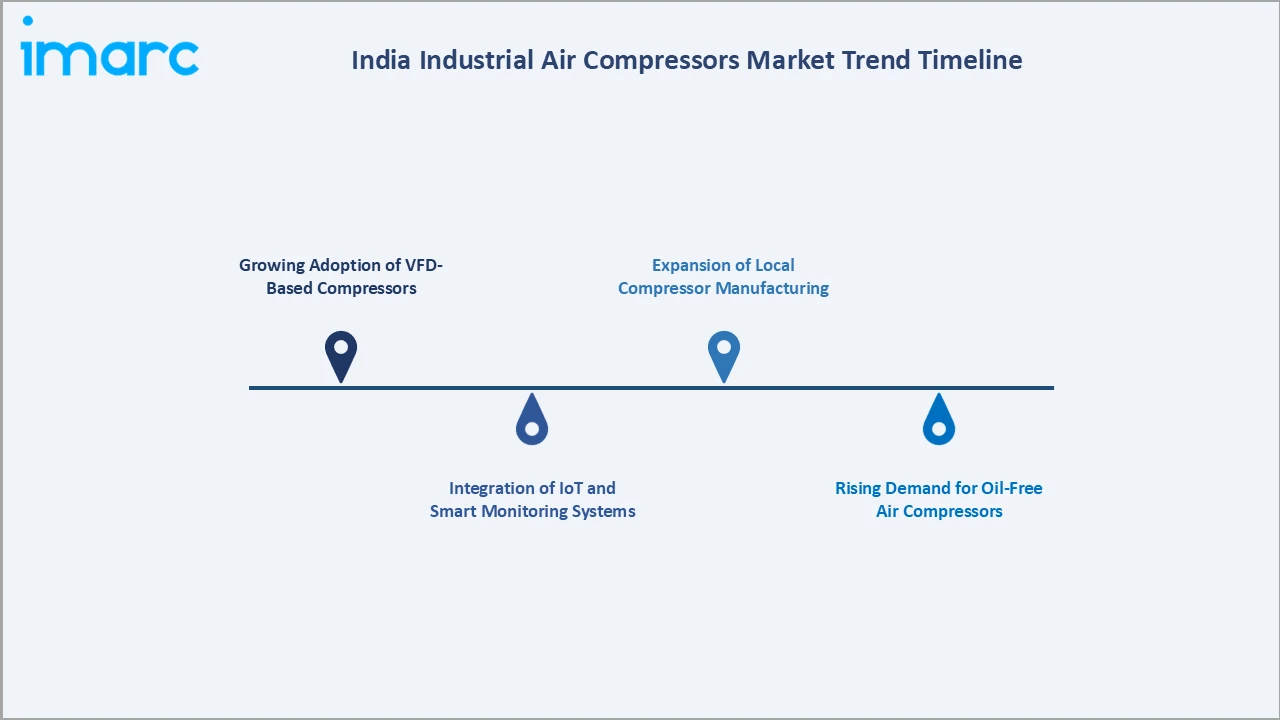
1. Growing Adoption of VFD-Based Compressors
Manufacturers are increasingly adopting variable frequency drive (VFD) compressors to match compressed-air output with fluctuating production requirements. These systems help reduce unnecessary electricity consumption and improve operational efficiency. In January 2026, Ingersoll Rand (India) Ltd introduced the RSbn Nirvana Series Screw Air Compressors, developed to improve energy efficiency and lower industrial operating costs. Available in capacities ranging from 7 kW to 250 kW, the series incorporates an integrated Variable Frequency Drive (VFD) and a high-efficiency IE5 Permanent Magnet motor. Demand is particularly increasing across automotive, pharmaceuticals, chemicals, and general manufacturing facilities.
2. Integration of IoT and Smart Monitoring Systems
Industrial air compressors are increasingly being equipped with IoT sensors, connected controllers, and remote monitoring capabilities. These technologies enable real-time tracking of pressure, temperature, energy consumption, and equipment condition. Predictive maintenance helps identify potential failures before they cause production downtime. Growing Industry 4.0 adoption is supporting wider deployment of digitally connected compressor systems.
3. Rising Demand for Oil-Free Air Compressors
Demand for oil-free compressors is expanding across pharmaceuticals, food and beverage, electronics, healthcare, and other contamination-sensitive industries. These systems provide cleaner compressed air while reducing the risk of oil contamination during production. In February 2026, Kirloskar Pneumatic Company Limited (KPCL) commercially introduced HYDRINO, which the company describes as India’s first oil-free, water-injected screw compressor. The system complies with ISO 8573 Class 0 requirements for oil-free compressed air, making it suitable for contamination-sensitive industries such as pharmaceuticals, food and beverage processing, and electronics manufacturing. Manufacturers are consequently expanding their portfolios of high-efficiency oil-free technologies.
4. Expansion of Local Compressor Manufacturing
Make in India initiatives and expanding domestic manufacturing activity are encouraging compressor companies to strengthen local production and supply chains. Localization can reduce import dependence, shorten delivery times, and improve access to replacement components and after-sales services. Growing industrial investment is also supporting capacity expansion by domestic suppliers. This trend is strengthening competition and product availability across India.
Industry Value Chain Analysis
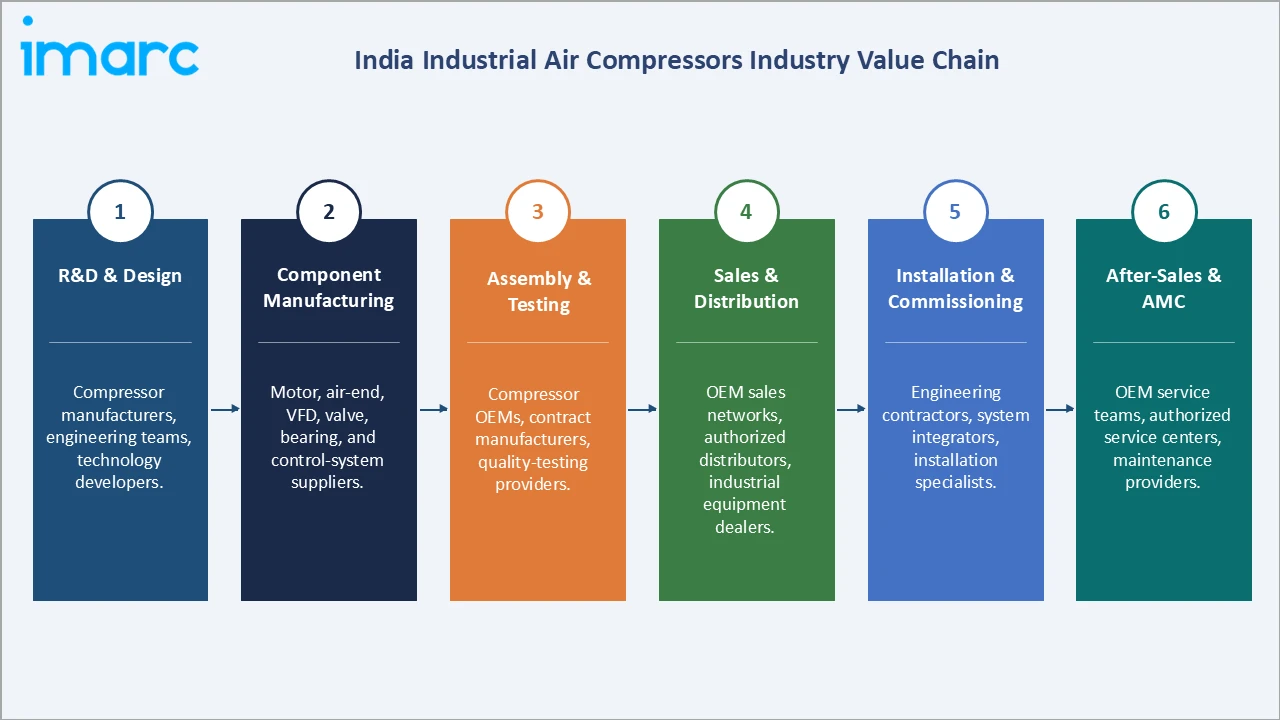
The India industrial air compressor value chain encompasses R&D and design, component manufacturing, assembly and testing, distribution and sales, installation and commissioning, and after-sales service, with significant variation between multinational OEMs and domestic manufacturers in value chain integration depth.
|
Stage |
Key Participants |
|
R&D & Design |
Compressor manufacturers, engineering teams, technology developers. |
|
Component Manufacturing |
Motor, air-end, VFD, valve, bearing, and control-system suppliers. |
|
Assembly & Testing |
Compressor OEMs, contract manufacturers, quality-testing providers. |
|
Sales & Distribution |
OEM sales networks, authorized distributors, industrial equipment dealers. |
|
Installation & Commissioning |
Engineering contractors, system integrators, installation specialists. |
|
After-Sales & AMC |
OEM service teams, authorized service centers, maintenance providers. |
R&D & design is the most value-added stage in the India industrial air compressors value chain, as it determines compressor efficiency, reliability, performance, and lifecycle costs. Development of VFD systems, oil-free technologies, advanced air ends, and IoT-enabled controls enables manufacturers to differentiate their products. Strong engineering capabilities also help meet increasingly stringent energy-efficiency and application-specific requirements.
Technology Landscape in the India Industrial Air Compressors Industry
Permanent Magnet Motor Technology
Permanent magnet motors provide higher efficiency and improved speed control compared with conventional induction motors in certain compressor configurations. Integration with VFD systems enables compressors to respond efficiently to changing air requirements. These motors can help reduce energy losses and operating expenses. Their use is expanding in premium energy-efficient screw compressor platforms.
Heat Recovery Technology
Heat recovery systems capture thermal energy generated during compressor operation and reuse it for other industrial processes. Recovered heat can support water heating, process heating, and other plant requirements. This improves overall facility energy utilization while lowering energy costs. The technology aligns with industrial decarbonization and energy-efficiency initiatives.
Two-Stage Compression Technology
Two-stage compressors divide the compression process across multiple stages to improve efficiency, particularly for higher-pressure and continuous-duty applications. Interstage cooling can reduce compression temperatures and energy requirements. In June 2026, Kirloskar Pneumatic Company Limited introduced the Tezcatlipoca A800 Model, strengthening its centrifugal compressor portfolio with an advanced industrial air compression solution. The two-stage centrifugal compressor delivers approximately 600–980 CFM of ISO 8573-1 Class 0 oil-free air and is designed to provide enhanced reliability, high air purity, and lower lifecycle costs for critical industrial applications. Manufacturers are improving two-stage designs to enhance efficiency and durability.
Market Segmentation Analysis
The report covers the following segments:
|
Segment Category |
Leading Segment |
Market Share |
Year |
|
Product |
🔒 |
🔒 |
2025 |
|
Lubrication |
Oil Filled |
76.4% |
2025 |
|
Operation |
Electric |
88.2% |
2025 |
|
Capacity |
🔒 |
🔒 |
2025 |
|
End User |
🔒 |
🔒 |
2025 |
|
Region |
West India |
34.8% |
2025 |

By Operation
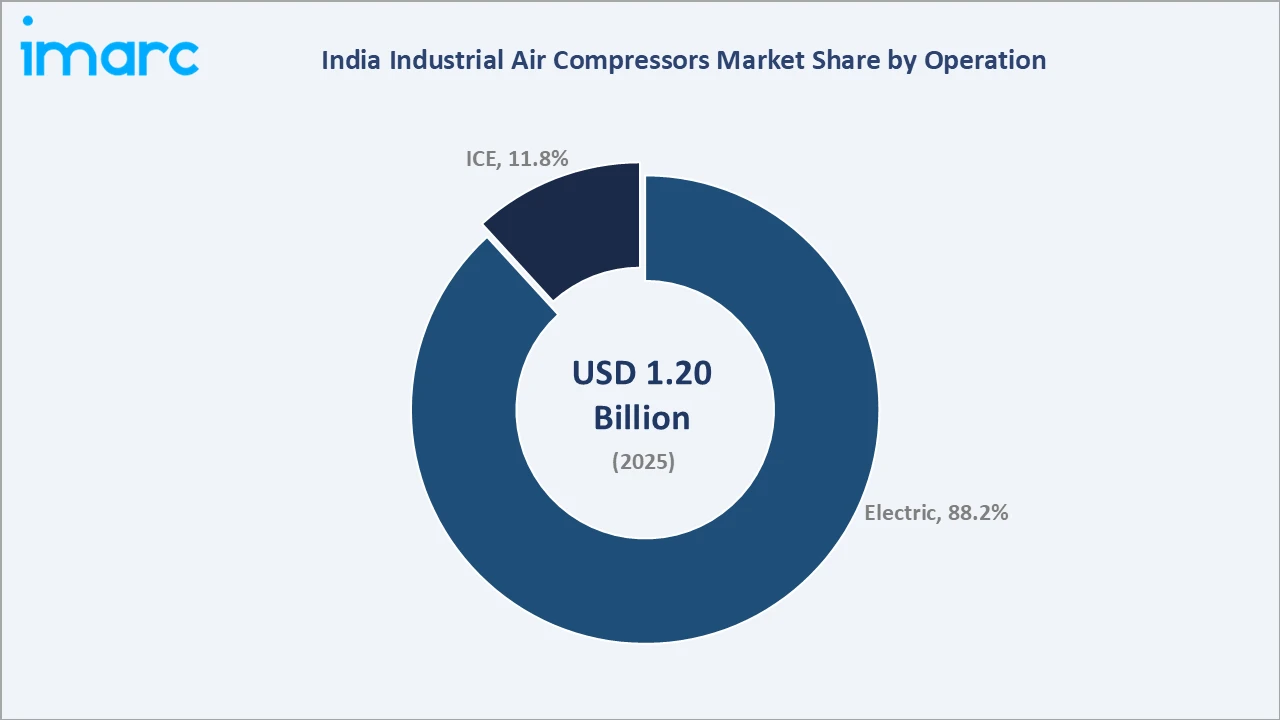
Electric leads at 88.2% (2025) through the structural dominance of grid-connected industrial facilities in India's manufacturing sector. VFD adoption within the electric segment is growing, driven by BEE star labeling compliance, rising electricity tariffs, and energy audit-mandated replacements.
To access detailed market analysis, Request Sample
The ICE segment's 11.8% share, while numerically small, represents India's most infrastructure-intensive compressor applications where the portability and energy-independence of diesel drive are non-negotiable operational requirements.
By Lubrication
Oil filled leads at 76.4% through its lower acquisition cost and proven performance across general manufacturing applications.
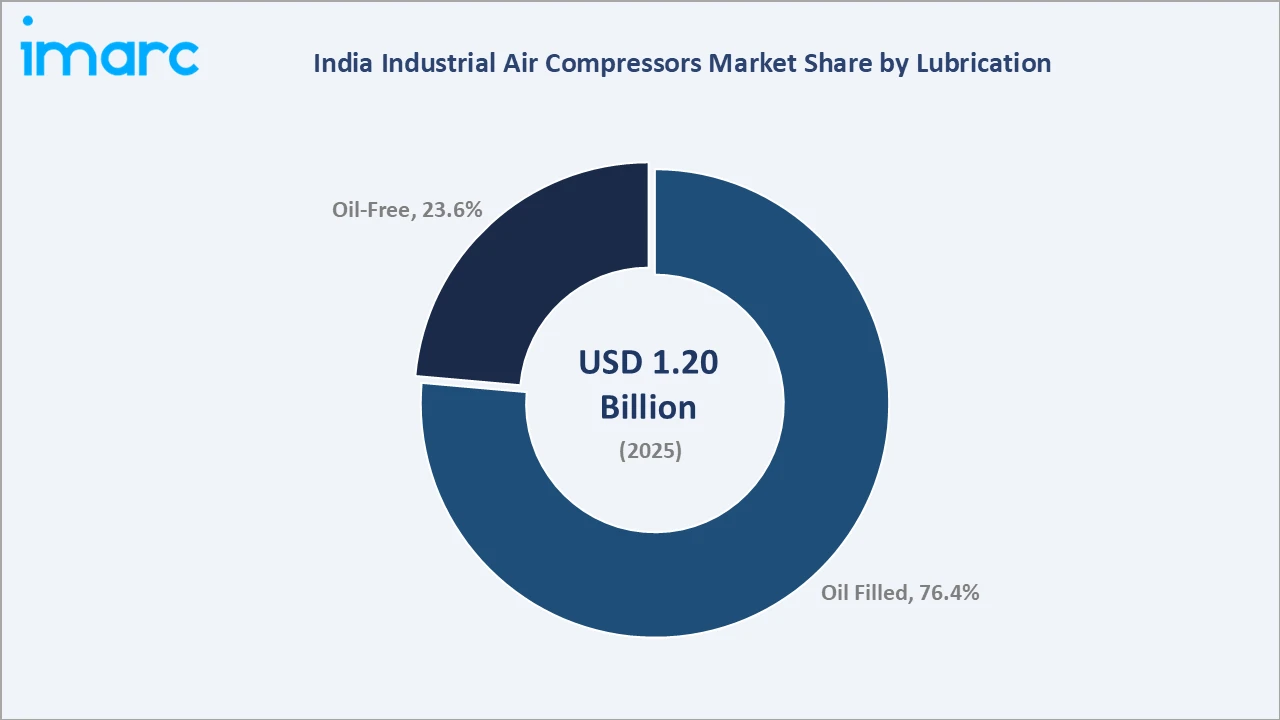
Oil-free at 23.6%, growing fastest at ~5.20% CAGR, through pharmaceutical, food, electronics, and textile machinery applications requiring compressed air quality certification.
Regional Market Insights
|
Region |
Share (2025) |
Key India Air Compressor Market Drivers & Characteristics |
|
West India |
34.8% |
Strong automotive, chemicals, pharmaceuticals, petrochemicals, and engineering manufacturing base |
|
South India |
28.7% |
Expanding automotive, electronics, machinery, aerospace, and industrial manufacturing clusters |
|
North India |
23.4% |
Growing automotive, food processing, metals, construction, and general manufacturing activities |
|
East India |
13.1% |
Presence of steel, mining, metals, power, and heavy engineering industries |
West India leads the market with a 34.8% share in 2025, supported by strong manufacturing clusters in Maharashtra and Gujarat across automotive, chemicals, pharmaceuticals, petrochemicals, and engineering. South India accounts for 28.7%, driven by automotive, electronics, aerospace, machinery, and industrial manufacturing activity in Tamil Nadu, Karnataka, Telangana, and Andhra Pradesh.
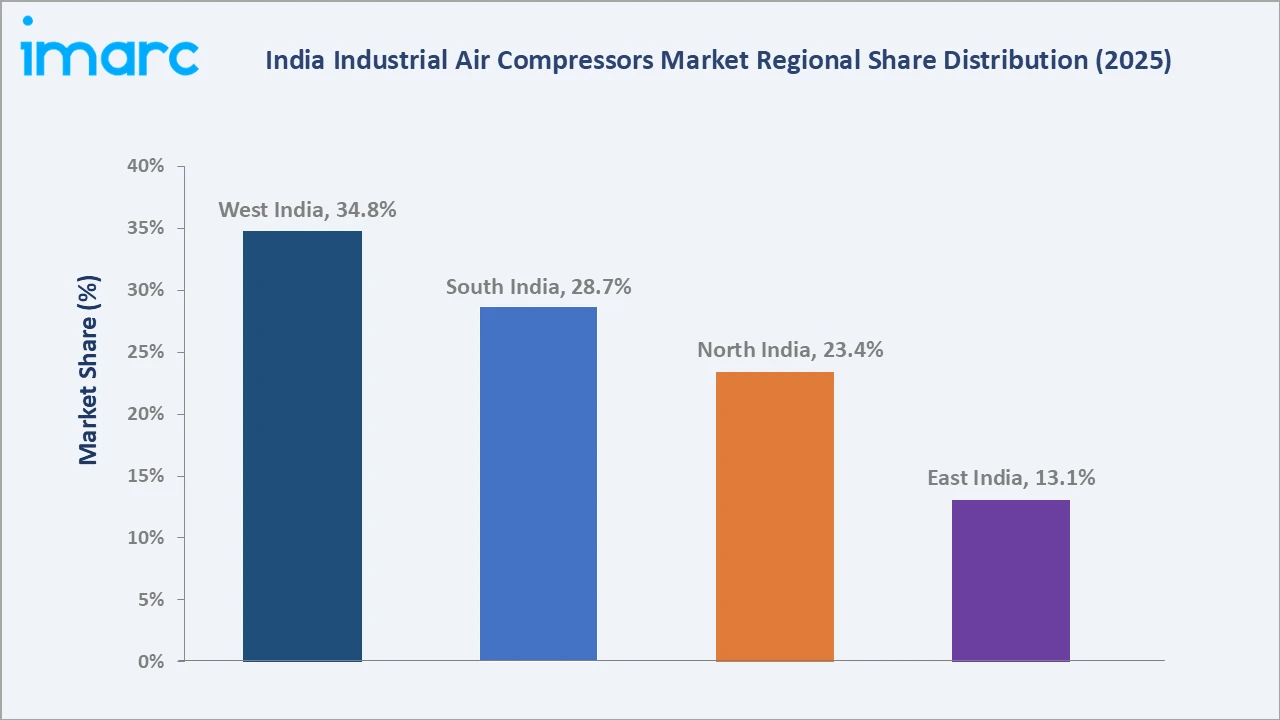
North India holds 23.4%, supported by automotive production, food processing, metals, construction, and general manufacturing across major industrial corridors. East India represents 13.1%, with demand concentrated in steel, mining, metals, power, and heavy engineering industries. Continued factory modernization, industrial corridor development, and investments in energy-efficient equipment are supporting compressor adoption across all regions.
Competitive Landscape
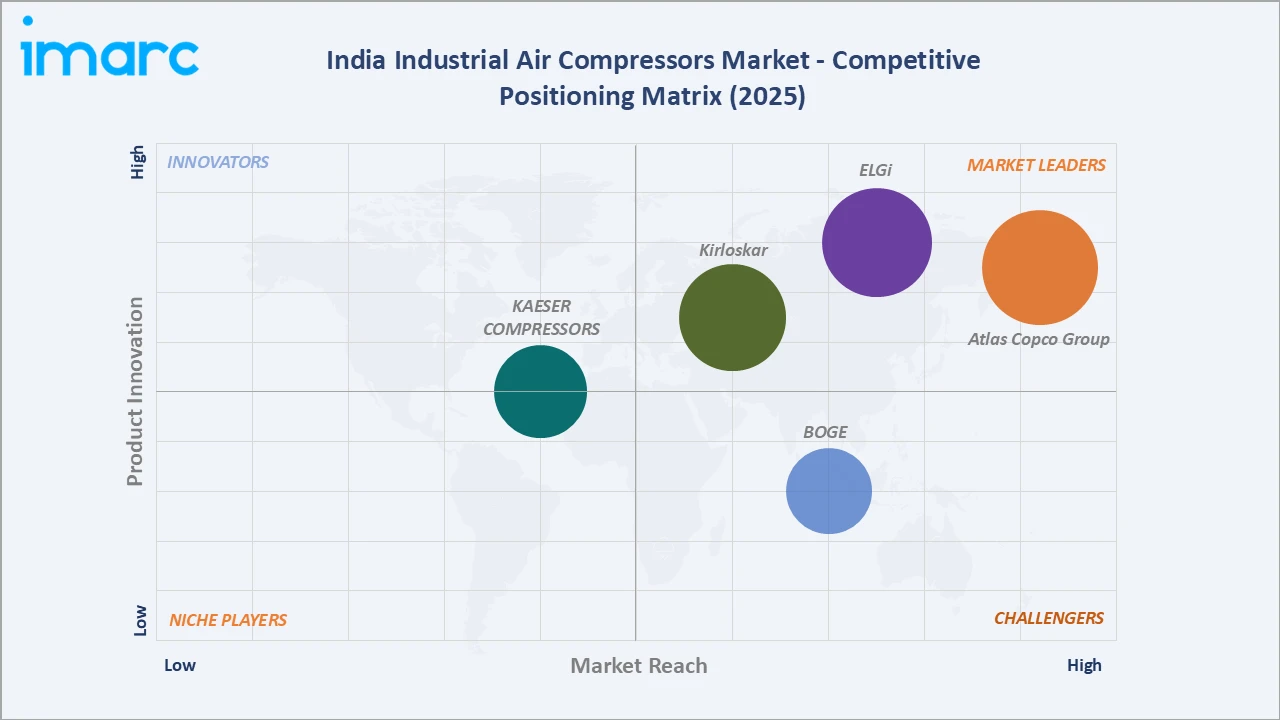
The India industrial air compressors market is moderately concentrated, with multinational and domestic manufacturers competing across product performance, energy efficiency, pricing, and after-sales service. Companies are increasingly focusing on VFD-equipped, oil-free, and IoT-enabled compressors to address evolving industrial requirements.
| Company | Key Products | Market Position | Core Strength |
|---|---|---|---|
| Atlas Copco Group | LFx compact oil-free piston compressors, LF oil-free aluminum piston compressors, LFs premium oil-free compressor, LT oil-lubricated low pressure piston compressor, LE/LF Snow piston compressors | Market Leader | Atlas Copco Group is a premier manufacturer in India's industrial air compressor market, driving productivity across sectors like automotive, pharmaceuticals, and food and beverage. |
| ELGi | EN Series Screw Compressors 2.2–15 kW, EQ Series Screw Air Compressors 11–45 kW, 5–15 HP Two-Stage Reciprocating Compressor, AB Series Oil-Free Screw Air Compressors | Market Leader | ELGi is anchoring the Indian industrial compressed air sector through high energy efficiency, low cost of ownership, and a vast portfolio. |
| Kirloskar | Tezcatlipoca, Reciprocating Horizontal Balanced Opposed Air Compressor, Reciprocating Gas Compressor, Vertical Reciprocating Compressor, Oil Injected Electric Screw Compressor | Market Leader | Kirloskar (via Kirloskar Pneumatic Company Ltd.) is a pioneering force in India’s industrial air compressor sector. |
| BOGE | E Series (up to 30 kW), C Series (up to 22 kW), P Series (up to 1.5 kW), SRD Series (up to 6.3 kW), SR Series (up to 15 kW), SC Series (up to 15 kW) | Challenger | BOGE plays a vital role in the Indian industrial sector by supplying premium, German-engineered compressed air systems. |
| KAESER COMPRESSORS | Rotary screw compressors with fluid cooling, Oil-free compression rotary screw compressors | Established Player | Kaeser Compressors plays a crucial role in India's industrial sector, renowned for its energy-efficient, German-engineered rotary screw compressors, oil-free systems, and smart controllers. |
India's industrial air compressor competitive landscape is defined by the coexistence of global technology leaders serving premium industrial buyers, a formidable domestic champion competing globally, and a deep-rooted domestic incumbent anchoring government and PSU procurement. The market's next competitive phase will be determined by the CaaS subscription model, IoT-driven service monetization, and energy advisory positioning.
Key Company Profiles
Atlas Copco Group
Atlas Copco Group is an industrial technology company with a significant presence in India’s compressed-air equipment industry. Its compressor portfolio includes oil-injected and oil-free air compressors, rotary screw and centrifugal systems, air treatment equipment, gas and process solutions, and portable compressors. The company serves industries including automotive, pharmaceuticals, food and beverage, electronics, chemicals, engineering, and general manufacturing. In India, Atlas Copco combines local manufacturing and service capabilities with energy-efficient technologies, digital monitoring, and lifecycle support to address diverse industrial compressed-air requirements.
- Key Products: LFx compact oil-free piston compressors, LF oil-free aluminum piston compressors, LFs premium oil-free compressor, LT oil-lubricated low pressure piston compressor, LE/ LF Snow piston compressors.
- Key Developments: In December 2025, Atlas Copco introduced the X-Air⁺ 750-20 portable air compressor in India, targeting demanding mining and drilling operations. The next-generation unit is designed to deliver improved fuel efficiency, reduced noise levels, and intelligent control, supporting the performance requirements of India’s expanding infrastructure and natural resource sectors.
- Strategic Focus: Strengthening its position in the India industrial air compressors market through energy-efficient, oil-free, and digitally connected compressed-air solutions. The company emphasizes variable-speed drive technology, intelligent monitoring, predictive maintenance, and energy optimization to help industrial customers reduce lifecycle costs.
Kirloskar
Kirloskar is an engineering company with an established presence in India's industrial compressed-air and gas systems. Its compressor portfolio includes reciprocating, screw, centrifugal, and oil-free compressors, serving applications across manufacturing, pharmaceuticals, food and beverage, chemicals, steel, power, and other process industries. The company combines domestic engineering and manufacturing capabilities with application-specific compressor technologies and aftermarket services. Its development of products such as HYDRINO oil-free water-injected screw compressors and Tezcatlipoca centrifugal compressors supports its presence in high-efficiency and contamination-sensitive industrial applications.
- Key Products: Tezcatlipoca, Reciprocating Horizontal Balanced Opposed Air Compressor, Reciprocating Gas Compressor, Vertical Reciprocating Compressor, Oil Injected Electric Screw Compressor.
- Key Developments: In June 2026, Kirloskar Pneumatic Company Limited unveiled the Tezcatlipoca A800, described as India’s first indigenously designed and manufactured centrifugal air compressor in the 600–980 CFM capacity range. The launch reinforces the company’s focus on developing innovative, energy-efficient compressed-air solutions for Indian industrial applications.
- Strategic Focus: Strengthening its position in the India industrial air compressors market through indigenous engineering, product innovation, and expansion of energy-efficient compressor technologies. The company is emphasizing oil-free, screw, and centrifugal compressor solutions, including products such as HYDRINO and Tezcatlipoca, to address contamination-sensitive and critical industrial applications.
Market Concentration Analysis
The India industrial air compressors market is moderately concentrated, with established multinational and domestic manufacturers maintaining strong positions through extensive product portfolios, distribution networks, and after-sales capabilities. Leading companies compete on energy efficiency, reliability, oil-free technology, digital monitoring, and lifecycle costs. Regional and smaller manufacturers remain important in price-sensitive and standardized compressor segments. Increasing localization, technology innovation, and service-based business models are expected to intensify competition further.
Investment & Growth Opportunities
Highest Growth Segments
Oil-free lubrication (~5.20% CAGR) and electric VFD operation (~3.60% CAGR) represent India's industrial air compressor market's highest-growth investment vectors through 2034.
Investment Themes
- Oil-Free Compressor Manufacturing for PLI-Linked Sectors: Investment in domestic oil-free compressor manufacturing offers strong potential as PLI-supported industries such as pharmaceuticals, electronics, and food processing expand production capacity. These industries require high-purity compressed air, creating opportunities for localized Class 0 compressor production and related technologies.
- Compressed Air as a Service (CaaS) for MSME Sector: CaaS represents an attractive investment theme by allowing MSMEs to access energy-efficient compressed-air systems without substantial upfront capital expenditure. Subscription or pay-per-use models combining equipment, maintenance, IoT monitoring, and energy optimization can generate recurring revenues while lowering operating risks for industrial users.
Future Market Outlook (2026-2034)
The India industrial air compressor market is projected to grow from USD 1.20 Billion in 2025 to USD 1.26 Billion in 2026, reaching USD 1.66 Billion by 2034, delivering a 3.49% CAGR that reflects a steady, structurally grounded expansion trajectory anchored in India's industrial deepening rather than cyclical infrastructure spending peaks. The anchor value of USD 1.43 Billion in 2030 is consistent with India's GDP growth-linked industrial investment trajectory and reflects the compressor market's characteristic resilience across industrial cycles through the breadth of its end-use application coverage.
First, India's manufacturing sector deepening under Make in India 2.0 and the PLI scheme ecosystem will create the most significant sustained wave of new compressor installations in India's industrial history. Second, the BEE star-labeling compliance wave for industrial air compressors will drive systematic replacement of India's inefficient fixed-speed compressors with BEE-star-rated VFD models over the 2026-2034 forecast period. Third, the CaaS (Compressed-Air-as-a-Service) subscription model will mature into a commercially significant market segment by 2030-2034 as financing infrastructure and IoT monitoring technology combine to make CaaS economically viable for MSME industrial buyers.
Research Methodology
Primary Research
Primary research comprised in-depth interviews with industrial air compressor manufacturers, end-user procurement and maintenance managers, BEE-certified energy auditors specializing in compressed air systems, authorized dealers in Maharashtra, Tamil Nadu, and Gujarat, and compressor rental operators. Discussions validated market size estimates, segment share dynamics, technology adoption rates, regional demand patterns, competitive positioning, and BEE compliance impact.
Secondary Research
Secondary research encompassed a detailed review of government publications, industry associations, company annual reports, regulatory databases, trade journals, and credible industry sources. The research focused on manufacturing trends, industrial investments, compressor technologies, energy-efficiency developments, competitive activities, and end-user demand across the India industrial air compressors market.
Forecasting Models
Forecasting models developed using historical India industrial air compressor market data, manufacturing sector GDP growth projections, PLI scheme investment timeline and capacity creation by sector, BEE PAT cycle designated consumer energy efficiency investment modeling, VFD penetration rate trajectory under BEE star labeling mandatory compliance, oil-free segment growth rate linked to pharmaceutical and food PLI capacity creation, regional market share stability analysis, competitive market share evolution under CaaS adoption, and technology adoption S-curve modeling for IoT monitoring and PM motor penetration. Both top-down and bottom-up methodologies were validated through primary research.
India Industrial Air Compressors Market Report Coverage:
| Report Features | Details |
|---|---|
| Base Year of the Analysis | 2025 |
| Historical Period | 2020-2025 |
| Forecast Period | 2026-2034 |
| Units | Billion USD |
| Scope of the Report |
Exploration of Historical Trends and Market Outlook, Industry Catalysts and Challenges, Segment-Wise Historical and Future Market Assessment:
|
| Products Covered | Reciprocating, Rotary/Screw, Centrifugal |
| Lubrications Covered | Oil-Free, Oil-Filled |
| Operations Covered | ICE, Electric |
| Capacities Covered | Up to 100, 101-200 Kw, 201-300 Kw, 301-500 Kw, 501 and Above |
| End Users Covered | Oil and Gas, Manufacturing, Healthcare/Pharmaceutical, Food and Beverage, Energy and Utility, Automotive, Construction, Others |
| Regions Covered | North India, South India, East India, West India |
| Companies Covered | Atlas Copco Group, ELGi, Kirloskar, BOGE, KAESER COMPRESSORS, etc. |
| Customization Scope | 10% Free Customization |
| Post-Sale Analyst Support | 10-12 Weeks |
| Delivery Format | PDF and Excel through Email (We can also provide the editable version of the report in PPT/Word format on special request) |
Key Benefits for Stakeholders:
- IMARC’s industry report offers a comprehensive quantitative analysis of various market segments, historical and current market trends, market forecasts, and dynamics of the India industrial air compressors market from 2026-2034.
- The research report provides the latest information on the market drivers, challenges, and opportunities in the India industrial air compressors market.
- Porter's five forces analysis assist stakeholders in assessing the impact of new entrants, competitive rivalry, supplier power, buyer power, and the threat of substitution. It helps stakeholders to analyze the level of competition within the India industrial air compressors industry and its attractiveness.
- Competitive landscape allows stakeholders to understand their competitive environment and provides an insight into the current positions of key players in the market.
Frequently Asked Questions About the India Industrial Air Compressors Market Report
The India industrial air compressors market size is estimated at USD 1.26 Billion in 2026, driven by Make in India manufacturing sector expansion, PLI scheme capacity creation in pharmaceuticals, food processing, and electronics requiring oil-free compressed air, National Infrastructure Pipeline construction activity generating ICE portable and electric stationary compressor demand, BEE star labeling compliance driving VFD upgrade cycle, and rising pharmaceutical GMP requirements mandating oil-free compressed air.
The market grows at 3.49% CAGR, reaching USD 1.66 Billion by 2034. Growth is supported by expanding manufacturing activity, industrial automation, and rising adoption of energy-efficient compressor systems.
Electric operation leads at 88.2% (2025) through the structural dominance of grid-connected industrial facilities across India's manufacturing sector.
Oil filled leads at 76.4% (2025) through its 30-50% lower acquisition cost versus oil-free equivalents and proven performance across India's diverse manufacturing applications.
West India leads at 34.8% through Maharashtra and Gujarat's combined industrial dominance: Pune's automotive cluster, Mumbai-Thane's pharmaceutical and petrochemical belt, Nashik's food processing, and Gujarat's emerging semiconductor, automotive, and chemical manufacturing at Sanand, Ahmedabad, and Hazira.
Leading companies include Atlas Copco Group, ELGi, Kirloskar, BOGE, and KAESER COMPRESSORS, among others.
The market is projected to reach USD 1.43 Billion by 2030, driven by PLI pharmaceutical and electronics manufacturing capacity creation reaching peak installation phase, NIP infrastructure projects at peak construction compressor demand, and MSME sector BEE star-labeled VFD compressor replacements achieving market penetration.
Top opportunities include oil-free compressor manufacturing, CaaS platform for the MSME sector, VFD compressor AMC and IoT monitoring service business, pharmaceutical compressed air validation service, portable diesel compressor rental fleet expansion, and heat recovery system retrofit.
Need more help?
- Speak to our experienced analysts for insights on the current market scenarios.
- Include additional segments and countries to customize the report as per your requirement.
- Gain an unparalleled competitive advantage in your domain by understanding how to utilize the report and positively impacting your operations and revenue.
- For further assistance, please connect with our analysts.
 Request Customization
 Speak to an Analyst
 Request Brochure
 Inquire Before Buying
Benefits of Customization
- Personalize this research
- Triangulate with your data
- Get data as per your format and definition
- Gain a deeper dive into a specific application, geography, customer, or competitor
- Any level of personalization
Get in Touch With Us
UNITED STATES
Phone: +1-201-971-6302
INDIA
Phone: +91-120-433-0800
UNITED KINGDOM
Phone: +44-753-714-6104
Email: [email protected]
Client Testimonials




.webp)




.webp)













Related Reports

Choose your plan
*Please note that the prices mentioned below are starting prices for each bundle type. Kindly contact our team for further details.*
Single User License
- 1 User License, Access on 2 Devices
- PDF Report + Excel Dataset (Password Protected)
- Lifetime Access
- No Printing Rights
- 10% Free Report Customization
- 10–12 Weeks of Analyst Support
Five User License
- Access for 5 Users, 2 Devices per User
- PDF Report + Excel Dataset (Password Protected)
- Lifetime Access
- Dedicated Account Manager
- 12–14 Weeks of Analyst Support
- No Printing Rights
- 15% Free Report Customization
- 25% Discount on Your Next Purchase
Corporate User License
- Unlimited User Access (Within Your Organization)
- PDF Report + Excel Dataset
- Lifetime Access
- Dedicated Account Manager
- 14–20 Weeks of Analyst Support
- No Printing Rights
- 20% Free Report Customization
- 30% Discount on Your Next Purchase
Essential Insights
What's included:
3 reports
- Lifetime Access
- PDF Reports
- Excel Datasets
- 2 Weeks of Free Analyst Support
- 2 User Licenses
- Access on 2 Devices
- Printing Rights
- Complimentary PowerPoint (PPT) Version
- Complimentary License Upgrade
Professional Access
What's included:
5 reports
- Lifetime Access
- PDF Reports
- Excel Datasets
- 8 Weeks of Free Analyst Support
- 2 User Licenses
- Access on 2 Devices
- Printing Rights
- Complimentary PowerPoint (PPT) Version
- Complimentary License Upgrade
Business Advantage
What's included:
8 reports
- Lifetime Access
- PDF Reports
- Excel Datasets
- 14 Weeks of Free Analyst Support
- 2 User Licenses
- Access on 2 Devices
- Printing Rights
- Complimentary PowerPoint (PPT) Version
- Complimentary License Upgrade
Enterprise Intelligence
What's included:
10 reports
- Lifetime Access
- PDF Reports
- Excel Datasets
- 20 Weeks of Free Analyst Support
- 2 User Licenses
- Access on 2 Devices
- Printing Rights
- Complimentary PowerPoint (PPT) Version
- Complimentary License Upgrade