
India Online Travel Market Size, Share, Trends and Forecast by Service Type, Platform, Mode of Booking, Age Group, and Region, 2026-2034
India Online Travel Market Size, Share, Trends & Forecast (2026-2034)
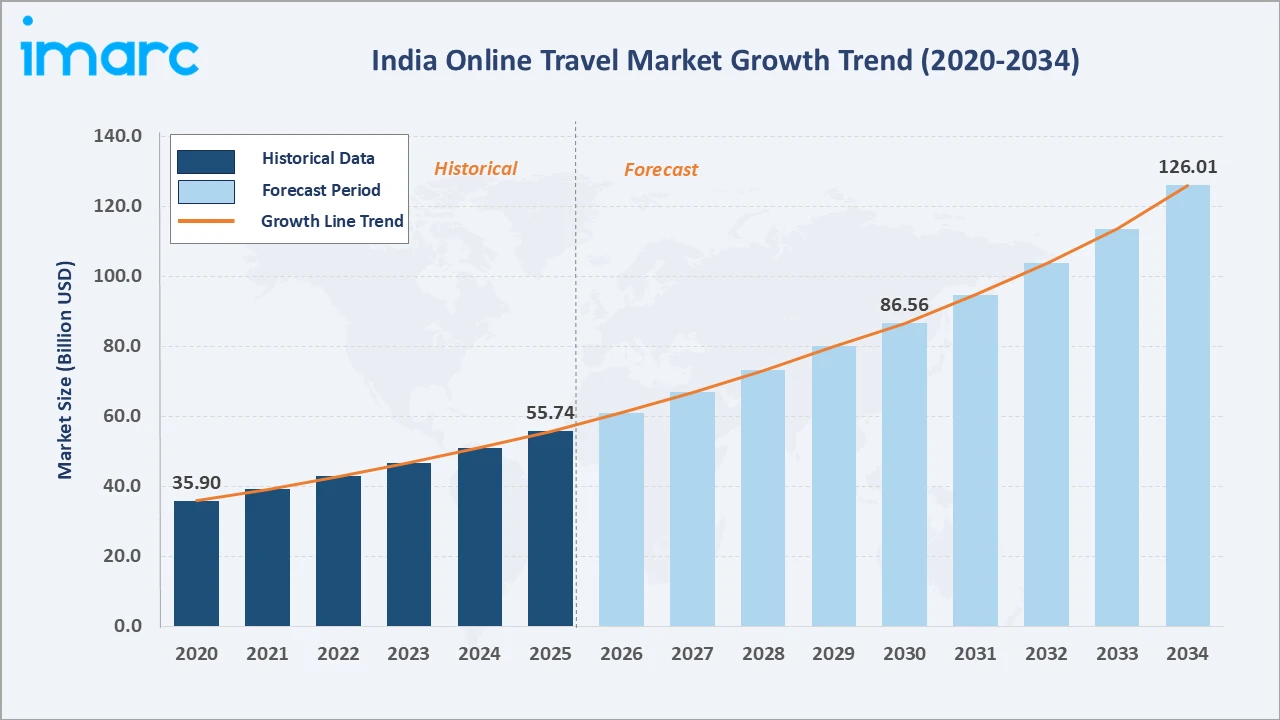
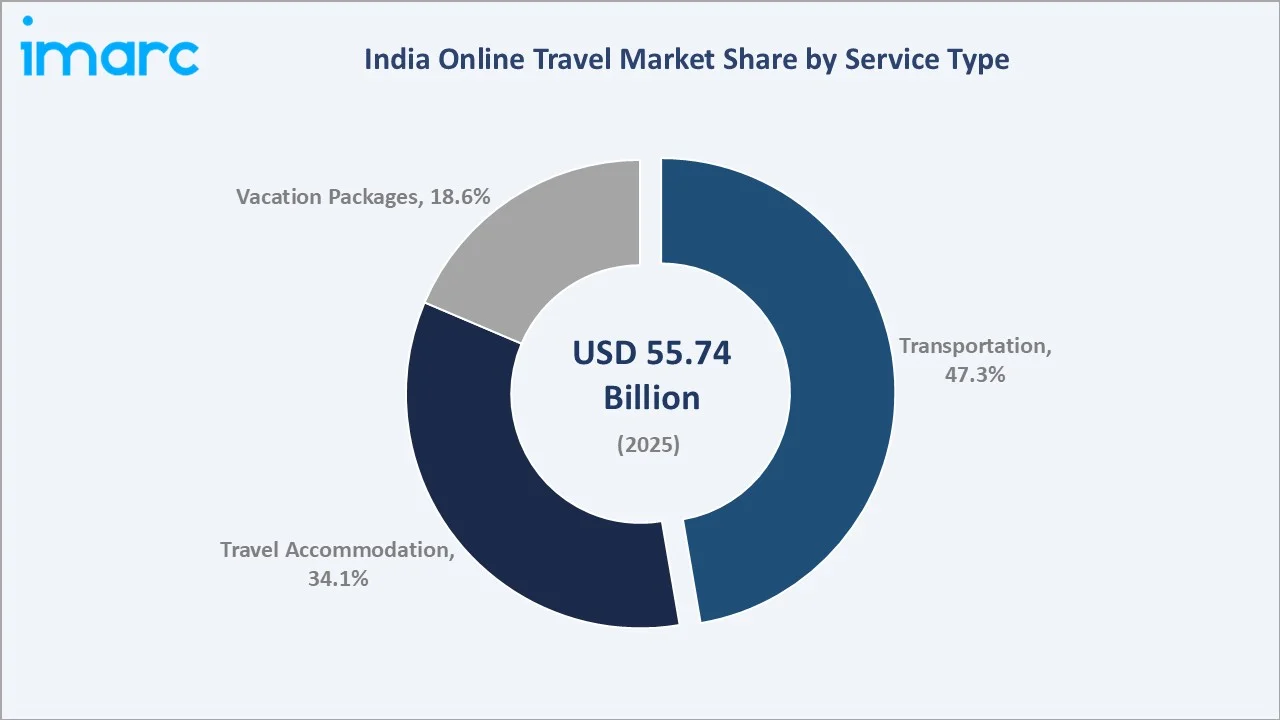
The India online travel market grew from USD 55.74 Billion in 2025 to USD 60.87 Billion in 2026 and is projected to reach USD 126.01 Billion by 2034, growing at a CAGR of 9.20% during 2026-2034. Growth is driven by mobile-first booking behavior, UPI-enabled digital payments, and rising internet access in Tier-2 and Tier-3 cities. Transportation leads the India online travel market share at 47.3%, followed by travel accommodation at 34.1% and vacation packages at 18.6%. Mobile platforms account for 78.4% of bookings, well ahead of desktop at 21.6%. West India commands the largest regional share at 35.8%, supported by Mumbai and Pune's e-commerce maturity.
Growing smartphone penetration, AI-led personalization, and expanding air and rail connectivity are further reinforcing India online travel market trends. Domestic tourist visits crossed 2,948 million in 2024, up 17.5% over 2023 per the Ministry of Tourism, reflecting the consumer base that platforms are converting into digital bookings across flights, hotels, trains, buses, and holiday packages.
Market Snapshot
|
Metric |
Value |
|
Base Year Market Size (2025) |
USD 55.74 Billion |
| Market Size (2026) | USD 60.87 Billion |
|
Forecast Market Size (2034) |
USD 126.01 Billion |
|
CAGR (2026-2034) |
9.20% |
|
Base Year |
2025 |
|
Historical Period |
2020-2025 |
|
Forecast Period |
2026-2034 |
|
Dominant Service Type |
Transportation (47.3%, 2025) |
|
Dominant Platform |
Mobile (78.4%, 2025) |
|
Leading Region |
West India (35.8%, 2025) |
India online travel market expanded from USD 35.90 Billion in 2020 to USD 55.74 Billion in 2025 and an estimated USD 60.87 Billion in 2026, is anchored at USD 86.56 Billion in 2030, and is forecast to reach USD 126.01 Billion by 2034. The market is commercially distinctive, combining one of the world's largest mobile-booking user bases, a rail-ticketing segment of unmatched scale through IRCTC, and a fast-formalizing Tier-2/Tier-3 travel base.
To get more information on this market, Request Sample
Vacation packages are the fastest-growing service type at an estimated ~11.4% CAGR through 2034, supported by demand for curated holiday bundles. Mobile bookings are expanding faster than desktop, at an estimated ~10.6% CAGR, as app-based checkout and push-notification-led flash sales convert browsing into bookings.
.webp)
Executive Summary
India online travel market, which increased from USD 55.74 Billion in 2025 to an estimated USD 60.87 Billion in 2026, ranks among the fastest-growing online travel economies globally, reflecting India's large internet user base and rapidly rising aspiration for app-based, personalized trip planning. The market is projected to reach USD 126.01 Billion by 2034, growing at a CAGR of 9.20% during 2026-2034, aided by a young, digitally native population and improving air, rail, and road connectivity.
Transportation, comprising flight, train, and bus ticketing, leads the India online travel market share at 47.3% in 2025, reflecting the scale of point-to-point travel nationwide. Travel accommodation follows at 34.1%, while vacation packages, though smallest at 18.6%, are growing the fastest as consumers shift toward curated packages. Mobile is the dominant platform at 78.4% share, underscoring how deeply app-based booking is embedded in everyday Indian consumer behavior.
West India leads regionally with a 35.8% share, followed by North India at 27.9%, South India at 24.3%, and East India at 12.0%. Looking ahead, the market outlook remains positive, underpinned by AI-led personalization, embedded travel fintech, and continued formalization of Tier-2/Tier-3 city demand.
Key Market Insights
|
Insight |
Data |
|
Dominant Service Type |
Transportation - 47.3% share (2025) |
|
Dominant Platform |
Mobile - 78.4% market share (2025) |
|
Leading Region |
West India - 35.8% share (2025) |
|
Fastest-Growing Segment |
Vacation Packages (~11.4% CAGR, 2026-2034) |
|
Market Opportunity |
Tier-2/Tier-3 city mobile travel penetration; AI-led trip personalization; embedded travel fintech (BNPL, UPI); rail and bus ticketing digitization |
Key Analytical Observations Supporting The Above Data:
- Transportation at 47.3%: The transportation segment leads because flight, train, and bus ticketing represent the highest-frequency, most habitual online travel purchase in India. IRCTC alone processed an average of 14.53 lakh e-tickets per day in 2025-26, with digital channels accounting for around 89% of all reserved rail tickets, reinforcing transportation's dominant share.
- Mobile at 78.4%: Mobile leads by platform due to India's mobile-first internet adoption, with broadband subscribers crossing 1 billion in November 2025 per TRAI data. App-based checkout, UPI autopay, and push-notification deals are converting a growing share of browsing into completed mobile bookings.
- West India at 35.8%: West India dominates regionally due to Mumbai and Pune's high e-commerce maturity, strong outbound and business travel demand, and dense concentration of corporate travel spend across Maharashtra and Gujarat.
- Vacation Packages fastest-growing: Vacation packages are scaling quickly as OTAs bundle flights, hotels, and local experiences into single-click itineraries, appealing to time-constrained urban travelers and first-time domestic explorers from smaller cities.
India Online Travel Market Overview
India online travel market sits at the intersection of the world's largest young internet population, a domestic tourism base that logged 2,948 million visits in 2024, and one of the most advanced digital-payments rails globally through UPI. The market spans transportation ticketing, accommodation booking, and vacation packages, distributed almost entirely through mobile apps, websites, and increasingly AI-assisted conversational interfaces.
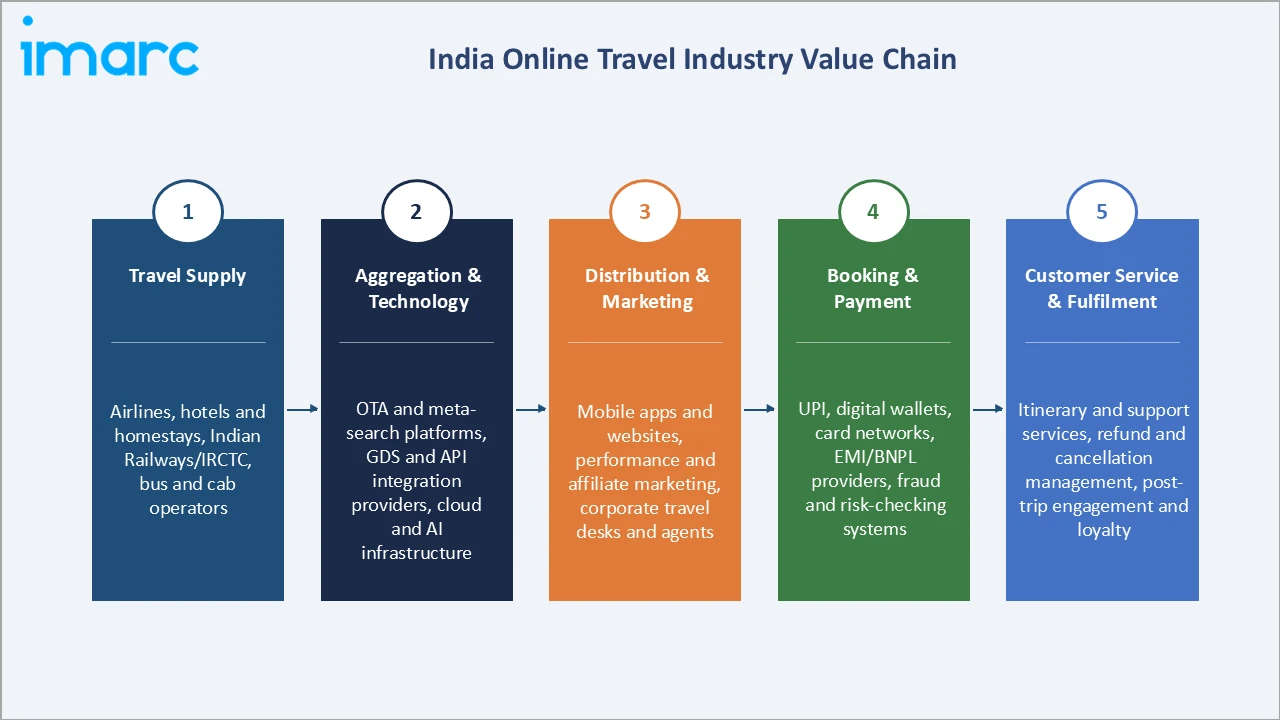
The ecosystem integrates travel suppliers (airlines, hotels, IRCTC, bus and cab operators), OTA and meta-search platforms, payment and fintech enablers, and travel agents serving both leisure and corporate travelers. Tailwinds include rising disposable incomes, broadband penetration exceeding 1 billion subscribers, and government-backed digital infrastructure such as UPI, all lowering the friction of booking travel online.
Market Dynamics
To evaluate market opportunities, Request Sample
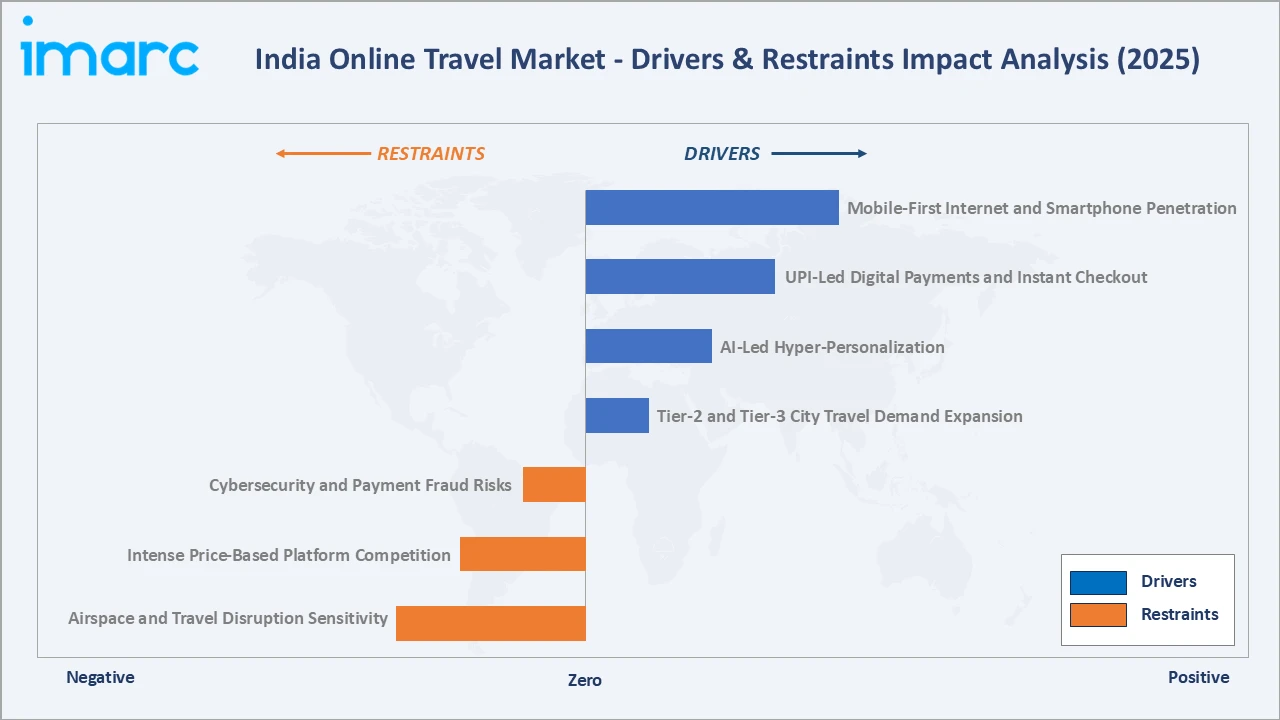
Market Drivers
- Mobile-First Internet and Smartphone Penetration: Rising smartphone ownership and affordable data are making apps the default interface for booking flights, hotels, and last-minute train tickets. TRAI reported India's internet subscriber base crossed 1,028.61 million by December 2025, with broadband users surpassing 1 billion, expanding the addressable base for app-based booking.
- UPI-Led Digital Payments and Instant Checkout: The dominance of UPI and other real-time payment rails is reducing checkout friction and cart abandonment across OTA platforms. Instant confirmation, saved credentials, and rising EMI/BNPL adoption are increasing order values and repeat purchases.
- AI-Led Hyper-Personalization: Platforms increasingly use machine learning to tailor recommendations. In March 2025, MakeMyTrip launched 'Collections,' an AI-powered feature personalizing hotel and homestay recommendations across 30-plus destinations based on user search and booking history.
- Tier-2 and Tier-3 City Travel Demand Expansion: Growing incomes and improved digital access in smaller cities are expanding the consumer base beyond metro India. MakeMyTrip's FY26 results showed over 45% of its AI assistant 'Myra' usage originating from Tier-2 and smaller cities.
Market Restraints
- Cybersecurity and Payment Fraud Risks: Rising digital transaction volumes have increased exposure to phishing and payment fraud, prompting platforms such as IRCTC to block over 3 crore suspicious user IDs in 2025 alone.
- Intense Price-Based Platform Competition: Market share is contested aggressively on price and cashback offers, compressing margins for smaller OTAs and raising customer acquisition costs as larger platforms deploy bigger marketing budgets.
Market Opportunities
- Embedded Travel Fintech: Buy-now-pay-later and travel-specific EMI products present a significant opportunity to convert price-sensitive, first-time online travelers, particularly in vacation packages and accommodation.
- AI-Native Trip Planning and Voice Booking: Conversational, voice-enabled booking assistants capable of completing an entire transaction are an emerging growth avenue as platforms compete on service depth over price.
Market Challenges
- Airspace and Travel Disruption Sensitivity: Periodic regional airspace closures have shown the ability to temporarily dent booking volumes, requiring resilient, diversified supply across air, rail, and road segments.
- Rural and Semi-Urban Digital Trust Gaps: Limited digital literacy and lingering preference for offline travel agents in smaller towns continue to moderate the pace of full online conversion outside major cities.
Emerging Market Trends
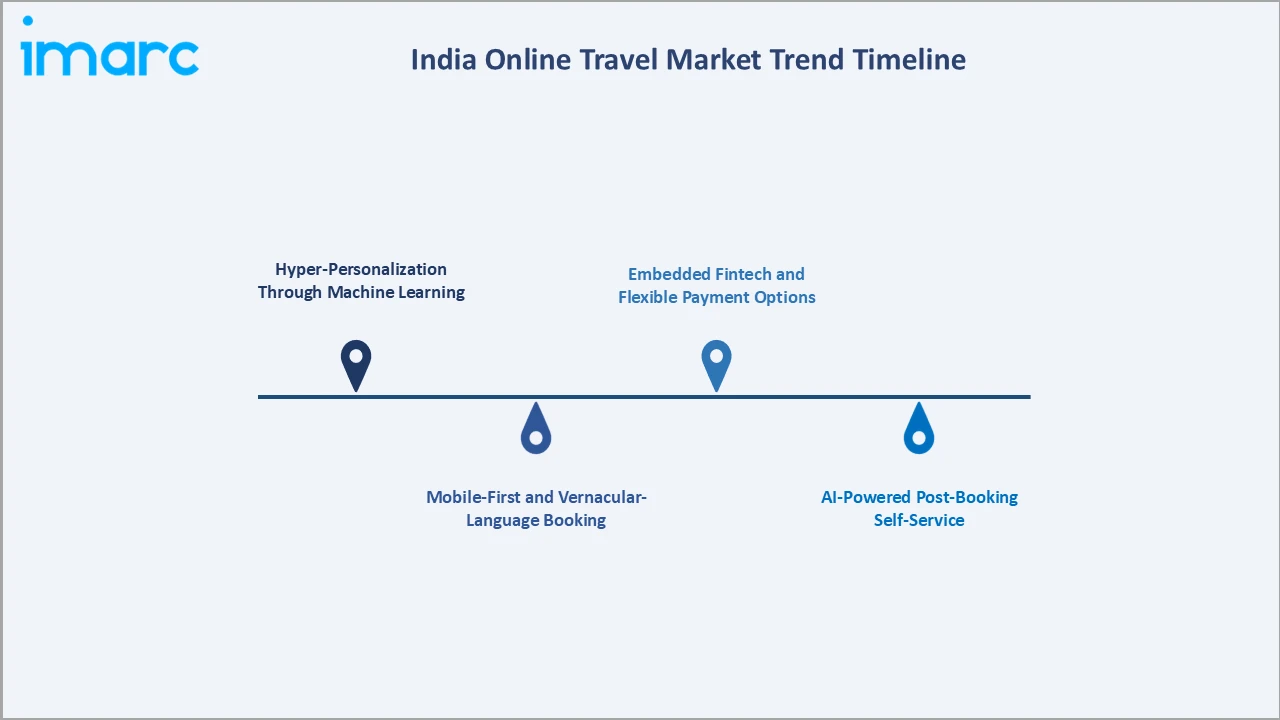
1. Hyper-Personalization Through Machine Learning
OTA platforms are using machine learning to analyze browsing patterns, past bookings, and budget preferences to serve tailored recommendations in real time. This is measurably influencing India online travel market share as users increasingly expect experiences matched to their specific interests.
2. Mobile-First and Vernacular-Language Booking
Mobile-first bookings are redefining how Indian consumers plan travel. In March 2025, Country Holidays Travel India launched a travel portal and Hotels & Flights API to streamline bookings, reflecting the broader shift toward mobile-native, vernacular-language interfaces for Tier-2/Tier-3 travelers.
3. Embedded Fintech and Flexible Payment Options
Instant, negotiable booking models are gaining traction. In February 2025, Stayflexi launched Bookflexi, a mobile app for last-minute travelers offering hotel rooms at up to 50% off within a three-day window, helping hotels fill unsold inventory.
4. AI-Powered Post-Booking Self-Service
Platforms are extending AI beyond discovery into post-booking servicing. In August 2024, Thomas Cook India and SOTC Travel launched a Customer Self-Service app simplifying access to booking details and real-time updates, achieving 50% customer adoption within its first year.
Industry Value Chain Analysis
The India online travel value chain spans travel suppliers, technology aggregation, distribution and marketing, booking and payment processing, and post-booking customer service. Each stage is increasingly digitized, with technology and payment layers now central to how value is captured across the ecosystem.
|
Stage |
Key Participants |
|
Travel Supply |
Airlines, hotels and homestays, Indian Railways/IRCTC, bus and cab operators |
|
Aggregation & Technology |
OTA and meta-search platforms, GDS and API integration providers, cloud and AI infrastructure |
|
Distribution & Marketing |
Mobile apps and websites, performance and affiliate marketing, corporate travel desks and agents |
|
Booking & Payment |
UPI, digital wallets, card networks, EMI/BNPL providers, fraud and risk-checking systems |
|
Customer Service & Fulfilment |
Itinerary and support services, refund and cancellation management, post-trip engagement and loyalty |
The booking and payment stage is the value chain's most consequential layer, where the shift to UPI and instant payment rails has structurally lowered checkout friction relative to card-only or cash-on-delivery models, directly supporting higher conversion rates.
Technology Landscape in the India Online Travel Industry
Artificial Intelligence and Conversational Booking
AI-powered assistants are moving from simple chatbots to full conversational booking agents. MakeMyTrip's AI assistant 'Myra' can take a traveler from initial search to a confirmed, paid booking within a single conversational interface, including by voice, handling over 54,000 daily conversations in Q4 FY26.
Digital Payments and Embedded Fintech
UPI-based instant payments, digital wallets, and travel-specific EMI options are becoming standard checkout features across OTA platforms, reducing drop-offs at the final purchase stage and supporting higher-value bookings.
Cloud Infrastructure and API-Led Aggregation
Cloud-native architecture and API integration with airline, hotel, and railway inventory systems let platforms aggregate real-time availability and pricing, a capability increasingly differentiating larger OTAs from smaller regional players.
Cybersecurity and Fraud Detection
As transaction volumes scale, AI and machine-learning-based fraud detection has become critical infrastructure. IRCTC's blocking of over 3 crore suspicious IDs in 2025 illustrates the scale of investment now required to secure high-volume digital ticketing platforms.
Market Segmentation Analysis
The report covers the following segments:
|
Segment Category |
Leading Segment |
Market Share |
Year |
|
Service Type |
Transportation |
47.3% |
2025 |
|
Platform |
Mobile |
78.4% |
2025 |
|
Mode of Booking |
🔒 |
🔒 |
2025 |
|
Age Group |
🔒 |
🔒 |
2025 |
|
Region |
West India |
35.8% |
2025 |

By Service Type
Transportation leads at 47.3% (2025). This segment covers flight, train, and bus ticketing, and represents India's highest-frequency online travel purchase, anchored by IRCTC's dominant position in digital rail ticketing and growing online bus and low-cost air ticketing volumes.
To access detailed market analysis, Request Sample
Travel accommodation follows at 34.1%, covering hotels, homestays, and alternative stays, supported by rising domestic leisure travel and growing homestay supply in smaller cities. Vacation packages, at 18.6%, are the fastest-growing service type at an estimated ~11.4% CAGR through 2034, as bundled itineraries gain preference over self-planned trips.
By Platform
Mobile leads at 78.4% (2025). India's mobile-first internet adoption, affordable data, and app-based UPI checkout have made smartphones the default booking interface, particularly outside metro cities.
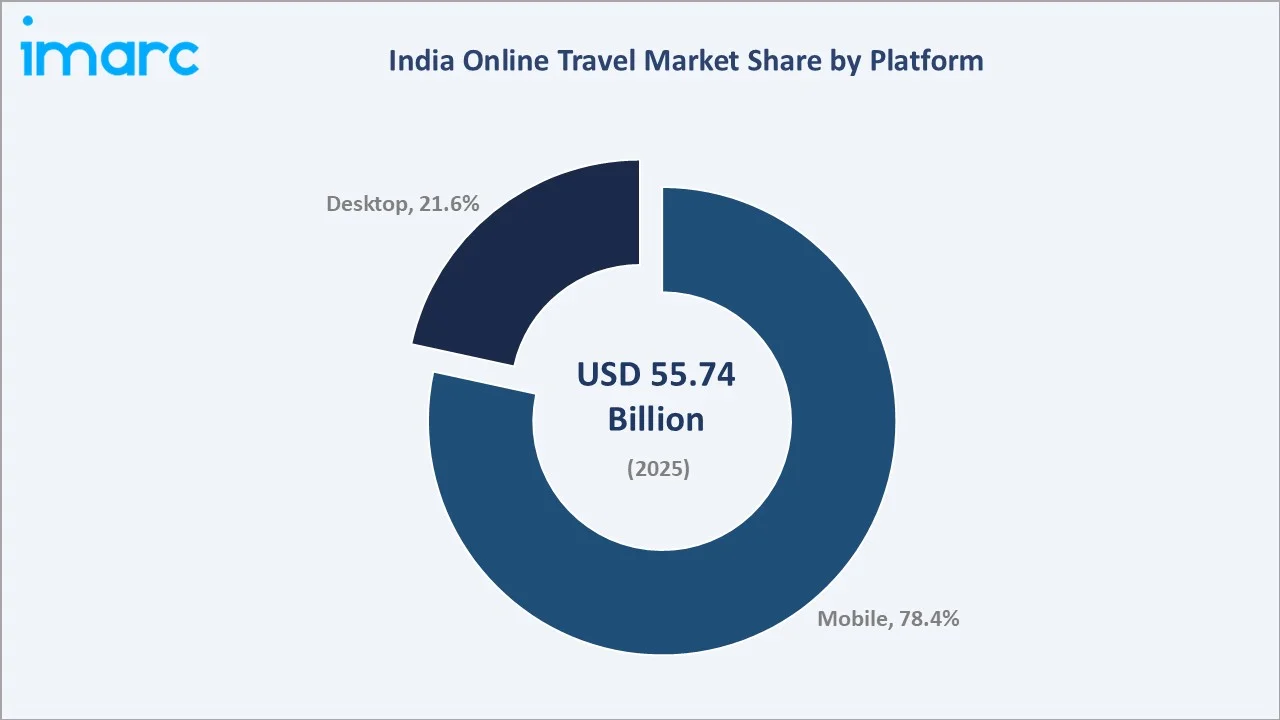
Desktop holds a 21.6% share, remaining relevant for higher-value, research-intensive bookings such as international vacation packages and corporate travel. Mobile's share is expected to keep expanding faster than desktop through the forecast period.
Regional Market Insights
West India leads the India online travel market with a 35.8% share in 2025, followed by North India at 27.9%, South India at 24.3%, and East India at 12.0%. Regional leadership is shaped by digital infrastructure maturity, corporate travel intensity, and the pace of Tier-2/Tier-3 city adoption.
|
Region |
Share (2025) |
Key India Online Travel Market Drivers & Characteristics |
|
West India |
35.8% |
Anchored by Mumbai and Pune's e-commerce maturity, strong corporate and outbound leisure travel demand, and dense OTA marketing penetration across Maharashtra and Gujarat. |
|
North India |
27.9% |
Driven by Delhi-NCR's high corporate travel volumes, strong rail and air connectivity, and rising demand from Punjab and Rajasthan's growing leisure travel base. |
|
South India |
24.3% |
Reflects Bengaluru, Hyderabad, and Chennai's tech-savvy, digitally mature population, creating strong demand for app-based, personalized, and premium travel experiences. |
|
East India |
12.0% |
The most underpenetrated region, but growing above the national CAGR as Kolkata's travel-tech adoption and improving connectivity to the Northeast expand the digital travel base. |
West India's 35.8% leadership reflects Mumbai's status as India's commercial capital, generating high-frequency business travel, alongside Pune's fast-growing IT workforce. North India's 27.9% share is underpinned by Delhi-NCR's dense corporate travel ecosystem and central position in India's rail and air network.
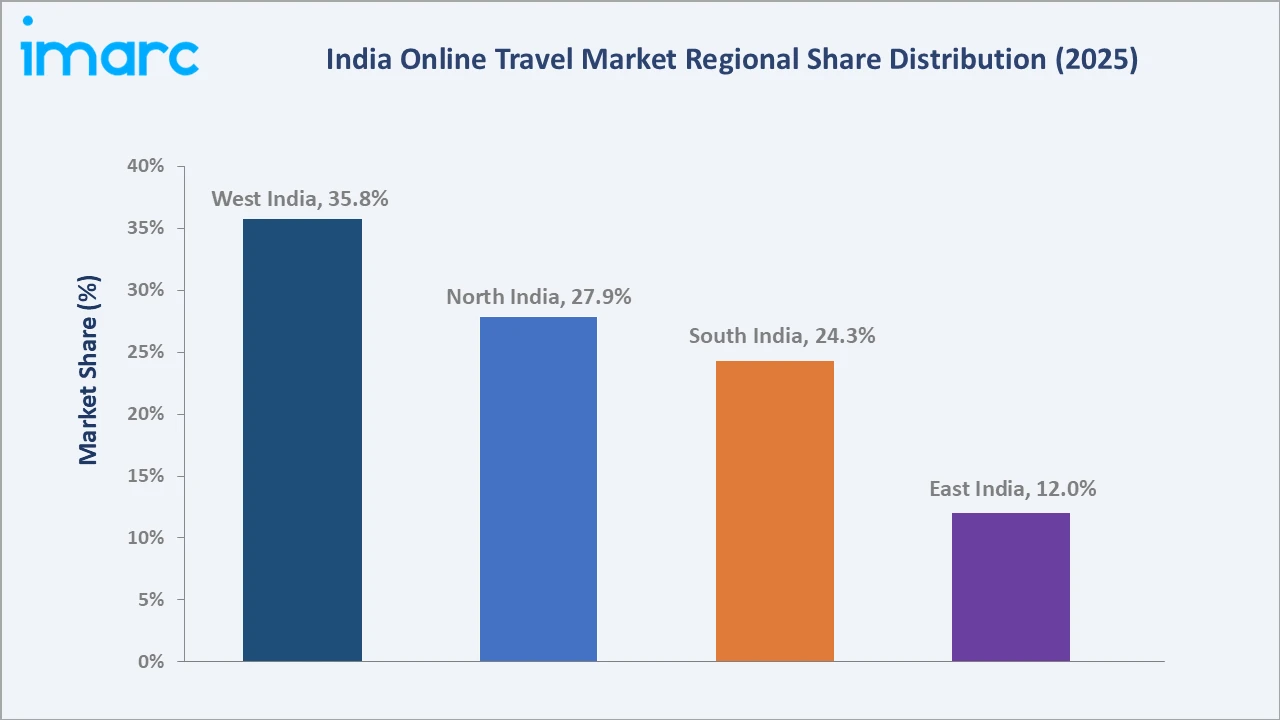
South India's 24.3% share reflects high smartphone and broadband penetration and preference for premium, experience-led travel among its urban IT workforces. East India's 12.0% share represents the most significant untapped opportunity as connectivity and digital literacy continue to improve.
Competitive Landscape
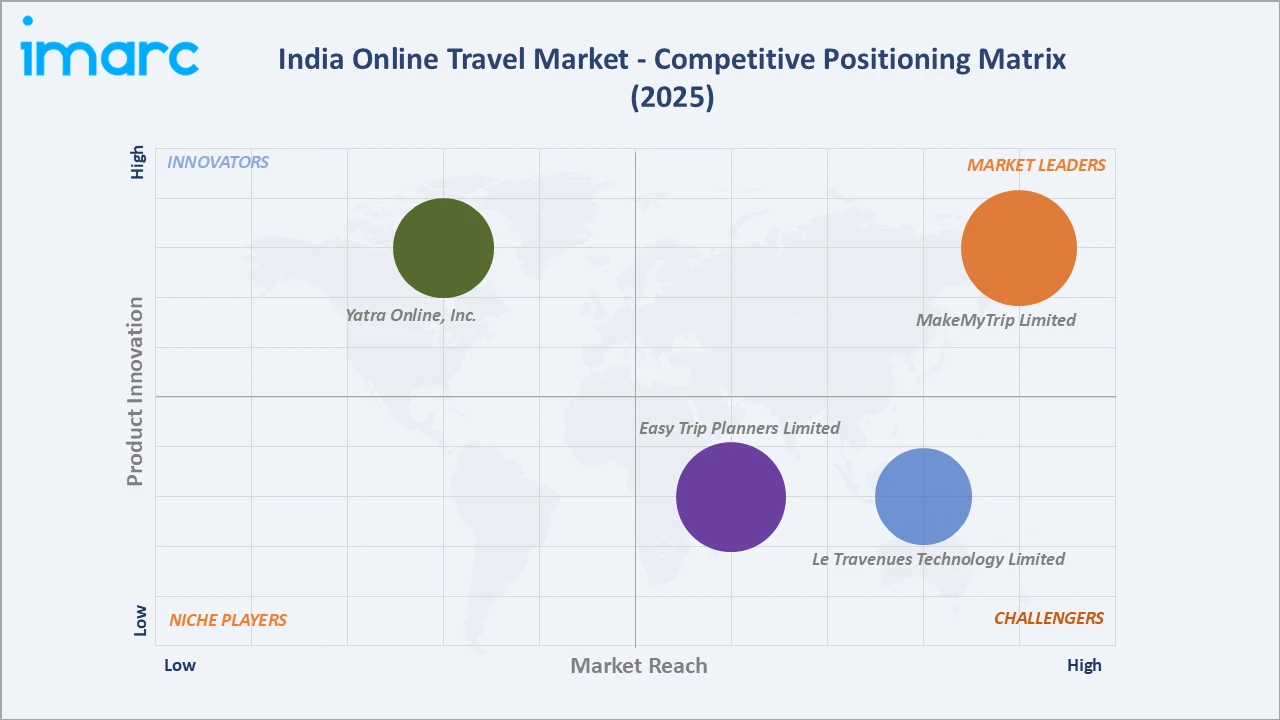
The India online travel market competitive landscape is led by a small set of scaled OTA platforms alongside the government-backed IRCTC in rail ticketing. Competition is intensifying through AI-led differentiation and consolidation of brands such as Goibibo and AbhiBus under larger parent platforms.
|
Company |
Key Brands / Platforms |
Market Position |
Core Strength |
|
MakeMyTrip Limited |
MakeMyTrip, Goibibo, redBus |
Market Leader |
MakeMyTrip Limited crossed USD 10.4 Billion in gross bookings in FY26, the highest ever, powered by its AI booking assistant Myra and deep Tier-2/Tier-3 reach. |
|
Le Travenues Technology Limited |
ixigo, AbhiBus, ConfirmTkt |
Strong Challenger |
ixigo holds a dominant position in online train ticketing, with revenue rising 31% YoY in Q3 FY26 and 544 million annual active users in FY25. |
|
Easy Trip Planners Limited |
EaseMyTrip, Yolobus |
Strong Challenger |
EaseMyTrip is India's profitable OTA since inception, posting a Gross Booking Revenue of ₹8,691 crore in FY25 with an asset-light, franchise-led model. |
|
Yatra Online, Inc. |
Yatra.com |
Innovator |
Yatra Online Limited (the Indian subsidiary) maintains a strong position in India's corporate travel segment, complementing its consumer-facing flight and hotel booking platform. |
The competitive landscape's most consequential dynamic is the shift from price-led discounting toward AI-native service differentiation, as leading platforms compete on booking speed and personalization depth rather than discounts alone.
Key Company Profiles
MakeMyTrip Limited
MakeMyTrip Limited is India's leading online travel platform, offering flights, hotels, holiday packages, and bus ticketing through its brands.
- Key Brands/Platforms: MakeMyTrip, Goibibo, redBus, and others.
- Strategic Focus: Deepening AI-led personalization and conversational booking while expanding reach into Tier-2 and smaller cities.
Le Travenues Technology Limited
Le Travenues Technology Limited operates ixigo, a technology-first travel platform focused on train, flight, and bus booking for India's next-billion internet users.
- Key Brands/Platforms: ixigo, AbhiBus, ConfirmTkt, and others.
- Strategic Focus: Scaling its AI-native travel assistant and train-ticketing leadership while expanding selectively into international rail markets.
Easy Trip Planners Limited
Easy Trip Planners Limited, operating as EaseMyTrip, is a Delhi-based online travel company and India's only consistently profitable OTA since its founding in 2008.
- Key Brands/Platforms: EaseMyTrip, Yolobus, and others.
- Strategic Focus: Maintaining profitability through an asset-light model while broadening offline franchise presence in Tier-2/Tier-3 India and select global markets.
Market Concentration Analysis
The India online travel market is moderately concentrated, with MakeMyTrip Limited commanding an estimated market share exceeding 50% of the organized OTA segment. IRCTC separately holds an estimated 80% direct share of railway e-ticketing, a structurally distinct, government-anchored segment of transportation.
Below the leaders, ixigo and EaseMyTrip compete closely for the second and third positions, alongside Cleartrip, Yatra, and international players such as Booking.com and Expedia, which hold a smaller presence in India's outbound and premium accommodation segments.
Investment & Growth Opportunities
Highest Growth Segments
Vacation packages (~11.4% CAGR), mobile bookings (~10.6% CAGR), and Tier-2/Tier-3 city travel penetration represent India's highest-growth online travel investment vectors through 2034, alongside embedded travel fintech and AI-native booking assistants.
Emerging Investment Opportunities
India's embedded travel-fintech opportunity, spanning UPI-linked instant payments, EMI, and buy-now-pay-later products, represents one of the most accessible entry points for new participants, requiring integration capability rather than large upfront travel-supply investment.
Investment Themes
- AI-native conversational booking platforms: Voice- and chat-based booking assistants capable of completing end-to-end transactions represent a differentiated, above-market-growth investment opportunity as larger OTAs like MakeMyTrip scale tools such as Myra.
- Tier-2/Tier-3 city travel-tech infrastructure: Platforms and payment enablers focused on smaller cities are positioned to capture disproportionate growth as India's broadband and smartphone penetration continues expanding beyond metro markets.
Future Market Outlook (2026-2034)
The India watch market is projected to grow from USD 55.74 Billion in 2025 to USD 60.87 Billion in 2026, reaching USD 126.01 Billion by 2034, registering a CAGR of 9.20% during 2026–2034. The market's anchor value of USD 86.56 Billion in 2030 represents a structural inflection point, as AI-led personalization, embedded fintech, and Tier-2/Tier-3 city penetration sustain above-average growth.
Three forces will define growth through 2034: continued mobile and broadband expansion creating new first-time online travelers, UPI and embedded fintech lowering payment friction, and AI-native booking assistants shifting competitive advantage toward service depth over discounting.
Research Methodology
Primary Research
Primary research comprised structured interviews with industry stakeholders, including OTA category managers, corporate travel managers, payment and fintech partners, and consumer survey data from travelers across North, West, South, and East India.
Secondary Research
Secondary research encompassed regulatory filings and investor disclosures of listed OTA platforms, Ministry of Tourism publications, TRAI telecom reports, IRCTC operational data, and company annual reports and press releases.
Forecasting Models
Market revenue forecasts were developed using a segment-wise bottom-up model: historical booking value combined with internet penetration trajectories, digital payment adoption rates, and Tier-2/Tier-3 city conversion assumptions to project total market value.
India Online Travel Market Report Coverage:
| Report Features | Details |
|---|---|
| Base Year of the Analysis | 2025 |
| Historical Period | 2020-2025 |
| Forecast Period | 2026-2034 |
| Units | Billion USD |
| Scope of the Report |
Exploration of Historical Trends and Market Outlook, Industry Catalysts and Challenges, Segment-Wise Historical and Future Market Assessment:
|
| Service Types Covered | Transportation, Travel Accommodation, Vacation Packages |
| Platforms Covered | Mobile, Desktop |
| Mode of Booking Covered | Online Travel Agencies (OTAs), Direct Travel Suppliers |
| Age Groups Covered | 22–31 Years, 32–43 Years, 44–56 Years, Above 56 Years. |
| Regions Covered | North India, South India, East India, West India |
| Companies Covered | MakeMyTrip Limited, Le Travenues Technology Limited, Easy Trip Planners Limited, Yatra Online, Inc. |
| Customization Scope | 10% Free Customization |
| Post-Sale Analyst Support | 10-12 Weeks |
| Delivery Format | PDF and Excel through Email (We can also provide the editable version of the report in PPT/Word format on special request) |
Key Benefits for Stakeholders:
- IMARC’s industry report offers a comprehensive quantitative analysis of various market segments, historical and current market trends, market forecasts, and dynamics of the India online travel market from 2020-2034.
- The research report provides the latest information on the market drivers, challenges, and opportunities in the India online travel market.
- Porter's five forces analysis assist stakeholders in assessing the impact of new entrants, competitive rivalry, supplier power, buyer power, and the threat of substitution. It helps stakeholders to analyze the level of competition within the India online travel industry and its attractiveness.
- Competitive landscape allows stakeholders to understand their competitive environment and provides an insight into the current positions of key players in the market.
Frequently Asked Questions About the India Online Travel Market Report
The India online travel market size increased from USD 55.74 Billion in 2025 and USD 60.87 Billion in 2026, driven by mobile-first booking behavior, UPI-enabled payments, and rising Tier-2/Tier-3 city internet penetration across the country.
The India online travel market is projected to grow at a CAGR of 9.20% during 2026-2034, reaching USD 126.01 Billion by 2034, supported by AI-led personalization and embedded travel fintech.
Transportation leads at 47.3% share in 2025, reflecting the scale of flight, train, and bus ticketing, anchored by IRCTC's dominant position in India's digital rail ticketing segment.
Mobile dominates at 78.4% share in 2025, driven by India's mobile-first internet adoption, affordable data plans, and app-based UPI checkout convenience across urban and semi-urban India.
West India leads at 35.8% share, driven by Mumbai and Pune's e-commerce maturity, strong corporate travel volumes, and dense OTA marketing penetration across Maharashtra and Gujarat.
Leading companies include MakeMyTrip Limited, Le Travenues Technology Limited, Easy Trip Planners Limited, and Yatra Online, Inc., among others.
The India online travel market is projected to reach approximately USD 86.56 Billion by 2030, with continued momentum from AI-native booking assistants and expanding Tier-2/Tier-3 city adoption.
Vacation packages are the fastest-growing service type, at an estimated ~11.4% CAGR through 2034, as bundled, curated itineraries gain preference over self-planned trip booking.
Need more help?
- Speak to our experienced analysts for insights on the current market scenarios.
- Include additional segments and countries to customize the report as per your requirement.
- Gain an unparalleled competitive advantage in your domain by understanding how to utilize the report and positively impacting your operations and revenue.
- For further assistance, please connect with our analysts.
 Request Customization
 Speak to an Analyst
 Request Brochure
 Inquire Before Buying
Benefits of Customization
- Personalize this research
- Triangulate with your data
- Get data as per your format and definition
- Gain a deeper dive into a specific application, geography, customer, or competitor
- Any level of personalization
Get in Touch With Us
UNITED STATES
Phone: +1-201-971-6302
INDIA
Phone: +91-120-433-0800
UNITED KINGDOM
Phone: +44-753-714-6104
Email: [email protected]
Client Testimonials




.webp)




.webp)













Related Reports

Choose your plan
*Please note that the prices mentioned below are starting prices for each bundle type. Kindly contact our team for further details.*
Single User License
- 1 User License, Access on 2 Devices
- PDF Report + Excel Dataset (Password Protected)
- Lifetime Access
- No Printing Rights
- 10% Free Report Customization
- 10–12 Weeks of Analyst Support
Five User License
- Access for 5 Users, 2 Devices per User
- PDF Report + Excel Dataset (Password Protected)
- Lifetime Access
- Dedicated Account Manager
- 12–14 Weeks of Analyst Support
- No Printing Rights
- 15% Free Report Customization
- 25% Discount on Your Next Purchase
Corporate User License
- Unlimited User Access (Within Your Organization)
- PDF Report + Excel Dataset
- Lifetime Access
- Dedicated Account Manager
- 14–20 Weeks of Analyst Support
- No Printing Rights
- 20% Free Report Customization
- 30% Discount on Your Next Purchase
Essential Insights
What's included:
3 reports
- Lifetime Access
- PDF Reports
- Excel Datasets
- 2 Weeks of Free Analyst Support
- 2 User Licenses
- Access on 2 Devices
- Printing Rights
- Complimentary PowerPoint (PPT) Version
- Complimentary License Upgrade
Professional Access
What's included:
5 reports
- Lifetime Access
- PDF Reports
- Excel Datasets
- 8 Weeks of Free Analyst Support
- 2 User Licenses
- Access on 2 Devices
- Printing Rights
- Complimentary PowerPoint (PPT) Version
- Complimentary License Upgrade
Business Advantage
What's included:
8 reports
- Lifetime Access
- PDF Reports
- Excel Datasets
- 14 Weeks of Free Analyst Support
- 2 User Licenses
- Access on 2 Devices
- Printing Rights
- Complimentary PowerPoint (PPT) Version
- Complimentary License Upgrade
Enterprise Intelligence
What's included:
10 reports
- Lifetime Access
- PDF Reports
- Excel Datasets
- 20 Weeks of Free Analyst Support
- 2 User Licenses
- Access on 2 Devices
- Printing Rights
- Complimentary PowerPoint (PPT) Version
- Complimentary License Upgrade