
India Power Quality Equipment Market Size, Share, Trends and Forecast by Equipment, Phase, End Use, and Region, 2026-2034
India Power Quality Equipment Market Size, Share, Trends & Forecast (2026-2034)
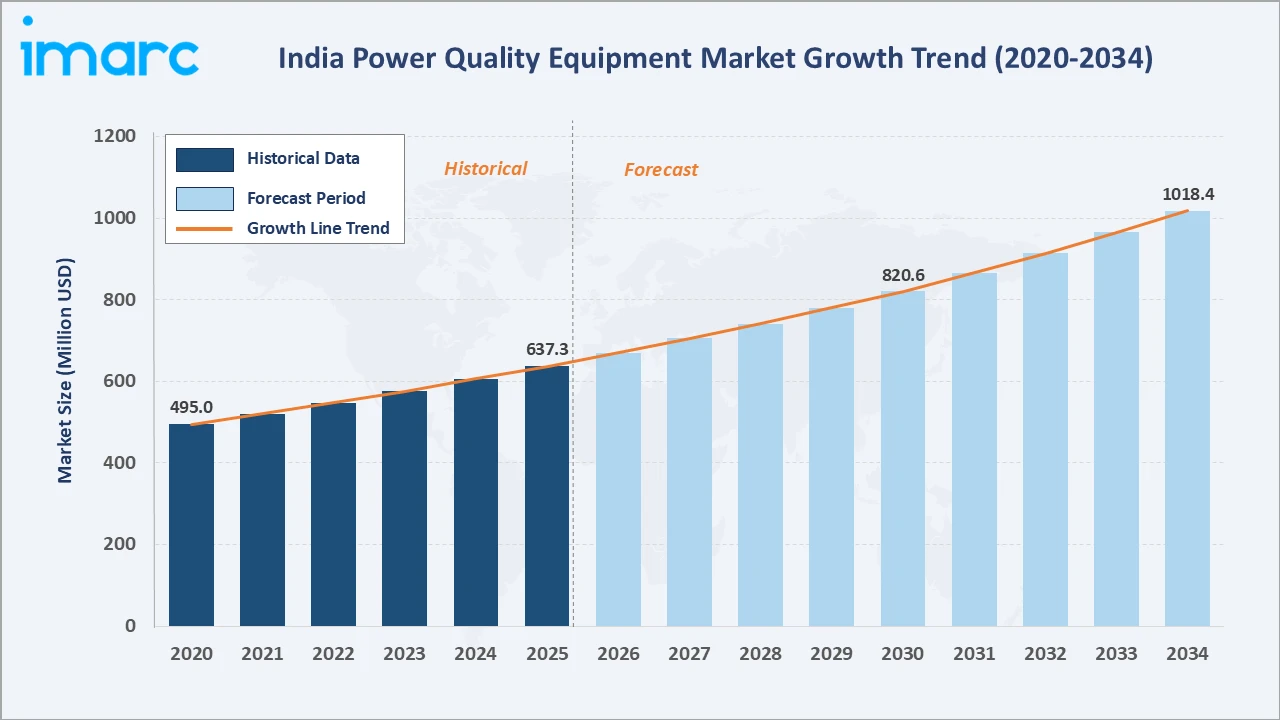
The India power quality equipment market was valued at USD 637.3 Million in 2025 and is projected to reach USD 1,018.4 Million by 2034, exhibiting a CAGR of 5.19% during 2026-2034. Rising industrial automation, grid modernization, and surging power quality awareness are the primary drivers shaping the market growth.
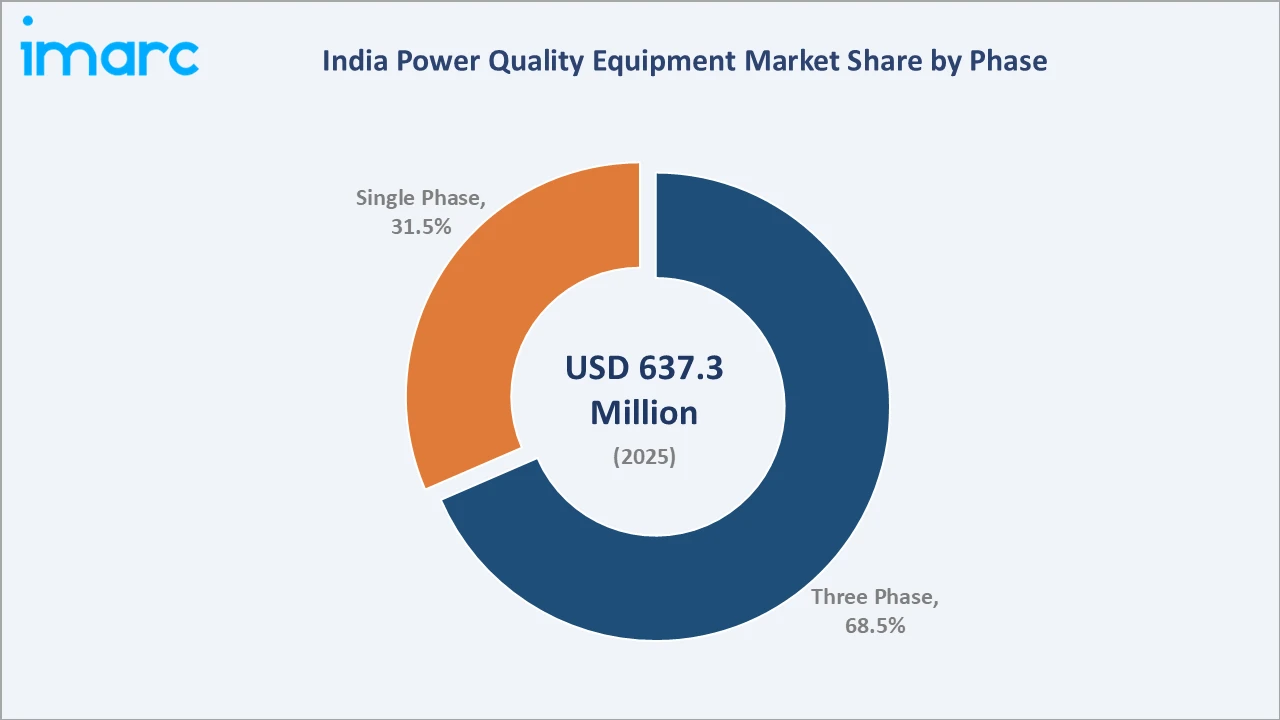
Three phase leads the phase segment at 68.5%, industrial and manufacturing dominate the end use segment at 46.8%, and West India commands 34.6% regional share.
Market Snapshot
|
Metric |
Value |
|
Market Size (2025) |
USD 637.3 Million |
|
Forecast Market Size (2034) |
USD 1,018.4 Million |
|
CAGR (2026-2034) |
5.19% |
|
Base Year |
2025 |
|
Historical Period |
2020-2025 |
|
Forecast Period |
2026-2034 |
|
Largest Region |
West India (34.6%, 2025) |
|
Second Largest Region |
South India (29.2%, 2025) |
|
Leading Phase |
Three Phase (68.5%, 2025) |
|
Leading End Use |
Industrial and Manufacturing (46.8%, 2025) |
The India power quality equipment market expanded from USD 495.0 Million in 2020 to USD 637.3 Million in 2025, driven by steady industrial capacity addition, rising grid modernization spend, and expanding data center infrastructure across urban clusters. Anchored at USD 820.6 Million in 2030, the forecast to USD 1,018.4 Million by 2034 is supported by accelerating renewable integration, EV charging infrastructure rollout, and stricter power quality compliance norms.
To get more information on this market, Request Sample
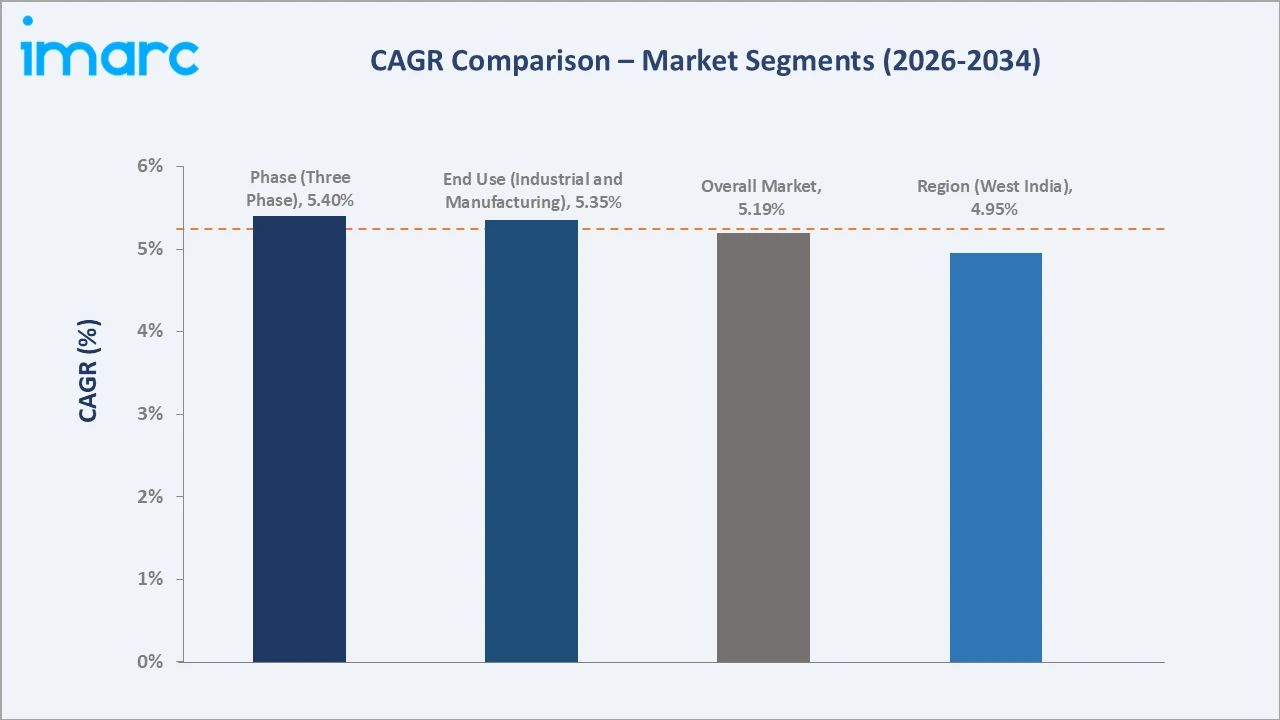
CAGR trajectories across phase, end use, and regional sub-segments show transportation and East India expanding faster than the overall 5.19% market CAGR, driven by electric mobility infrastructure build-out, warehousing growth, and a comparatively low regional base.
Executive Summary
The India power quality equipment market is on a steady growth trajectory, expanding from USD 495.0 Million in 2020 to USD 1,018.4 Million by 2034. The industry has shifted from basic voltage stabilization toward integrated, sensor-enabled equipment spanning uninterruptible power supplies, active harmonic filters, surge protection devices, and power factor correction systems. Rising automation, tighter grid codes, and expanding digital infrastructure are encouraging facility owners to adopt equipment that safeguards sensitive industrial and IT loads.
Three phase dominates the phase segment at 68.5% in 2025, reflecting its widespread use in industrial and utility-scale installations, while industrial and manufacturing lead the end use segment at 46.8%, supported by sustained capital investment in process industries. West India commands 34.6% of the regional share, led by dense industrial clusters across Maharashtra and Gujarat.
Key Market Insights
|
Insight |
Data |
|
Leading Phase |
Three Phase - 68.5% share (2025) |
|
Second Largest Phase |
Single Phase - 31.5% share (2025) |
|
Leading End Use |
Industrial and Manufacturing - 46.8% share (2025) |
|
Second Largest End Use |
Commercial - 24.3% share (2025) |
|
Leading Region |
West India - 34.6% share (2025) |
|
Second Largest Region |
South India - 29.2% share (2025) |
|
Top Companies |
ABB Ltd, Schneider Electric, Siemens AG, Eaton Corporation plc, Vertiv Holdings Co. |
Key Analytical Observations Supporting the Above Data:
- Three phase dominance at 68.5% is supported by widespread deployment in industrial and utility installations that demand higher power handling capacity and tighter voltage regulation.
- Single phase share at 31.5% is sustained by growth in small commercial establishments, residential inverters, and light commercial installations across tier-2 and tier-3 towns.
- Industrial and manufacturing leadership at 46.8% is driven by rising demand for reliable power quality solutions across factories, process industries, and automated production facilities requiring stable voltage and uninterrupted power supply.
- Commercial at 24.3% is expanding as office parks, retail chains, and hospitality establishments upgrade backup and voltage-conditioning equipment to protect sensitive electronic systems.
- West India leadership at 34.6% is anchored by Maharashtra and Gujarat's dense industrial and petrochemical clusters, along with a mature base of power equipment manufacturers and system integrators.
India Power Quality Equipment Market Overview
Power quality equipment includes uninterruptible power supplies, voltage stabilizers, active and passive harmonic filters, surge protection devices, power factor correction panels, and monitoring systems that maintain stable voltage, frequency and waveform quality across electrical networks. The market spans three phase and single phase configurations deployed across industrial and manufacturing, commercial, utility, residential, and transportation end uses.
The Indian ecosystem integrates component and raw material suppliers, equipment manufacturers, system integrators, distribution and channel partners, installation contractors, regulatory bodies such as the Bureau of Indian Standards and Central Electricity Authority, and end users spanning manufacturing plants, data centers, hospitals and transportation infrastructure. Together, they support reliable power delivery within an evolving grid landscape.
Market Dynamics
To evaluate market opportunities, Request Sample
Market Drivers
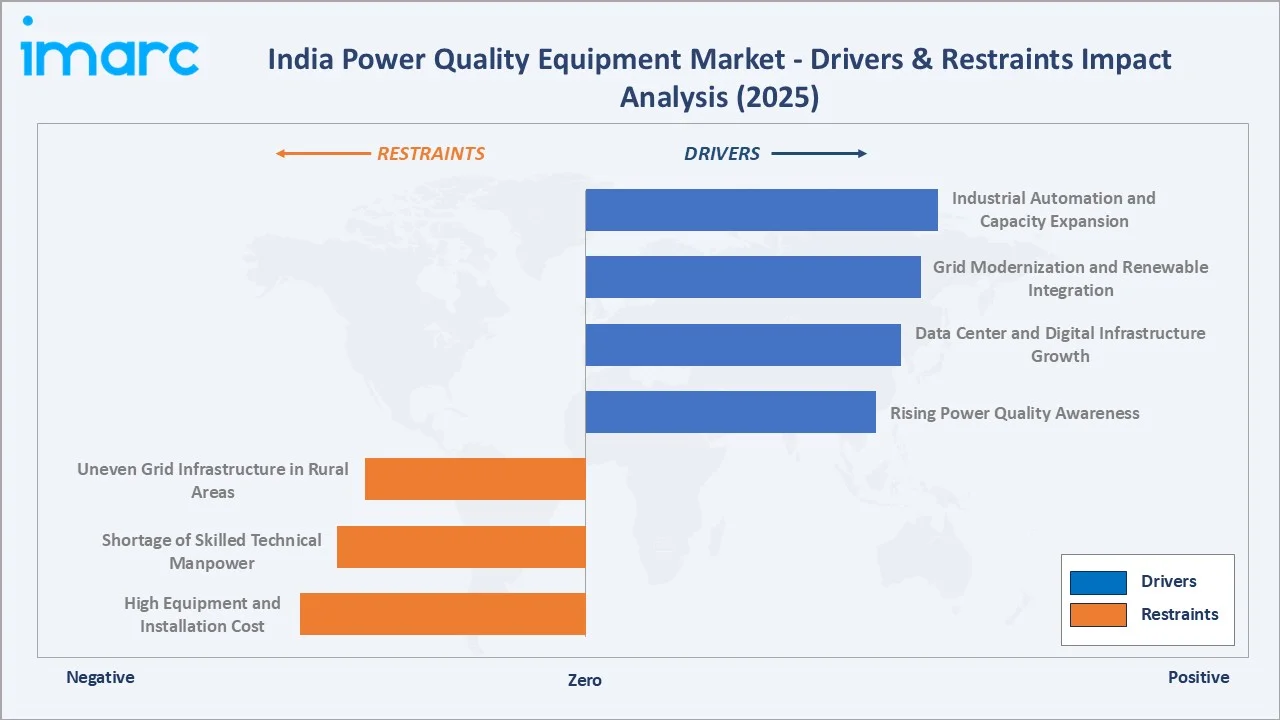
- Industrial Automation and Capacity Expansion: Rising capital expenditure in process industries, textiles, and automotive manufacturing is increasing sensitivity to voltage sags and harmonic distortion, driving continuous demand for protective power quality equipment.
- Grid Modernization and Renewable Integration: Expanding solar and wind capacity is introducing greater voltage and frequency variability, prompting utilities to deploy active filters and voltage regulation systems to preserve grid stability.
- Data Center and Digital Infrastructure Growth: Rapid expansion of data centers, cloud infrastructure, and digital services is increasing demand for high-reliability power quality equipment to minimize voltage disturbances, harmonics, and power interruptions affecting sensitive IT systems. As per IMARC Group, the India data center market size was valued at USD 5.55 Billion in 2025.
- Rising Power Quality Awareness: Growing recognition of the cost of downtime and equipment damage from poor power quality is encouraging facility managers across sectors to invest in preventive equipment.
Market Restraints
- High Equipment and Installation Cost: Advanced power quality systems such as active harmonic filters and precision voltage regulators require significant upfront investment, limiting adoption among small and medium enterprises.
- Shortage of Skilled Technical Manpower: Limited availability of trained engineers for design, commissioning, and maintenance of power quality systems constrains project execution timelines, particularly in smaller cities.
- Uneven Grid Infrastructure in Rural Areas: Inconsistent grid quality and infrastructure gaps in several rural and semi-urban regions slow the pace of power quality equipment deployment outside major industrial corridors.
Market Opportunities
- EV Charging Infrastructure: Expanding public and captive EV charging networks are creating new demand for power quality equipment that manages harmonic distortion and voltage stability at charging stations.
- Renewable-Linked Microgrids and Storage: Growth in behind-the-meter solar and battery storage installations is opening opportunities for integrated power conditioning and grid-interactive equipment.
Market Challenges
- Import Dependence for Critical Components: Reliance on imported semiconductors and power electronics components exposes manufacturers to currency and supply chain volatility.
- Price-Sensitive Buyer Behavior: Intense competition among domestic and international suppliers continues to compress margins, particularly in the price-sensitive single phase equipment segment.
Emerging Market Trends
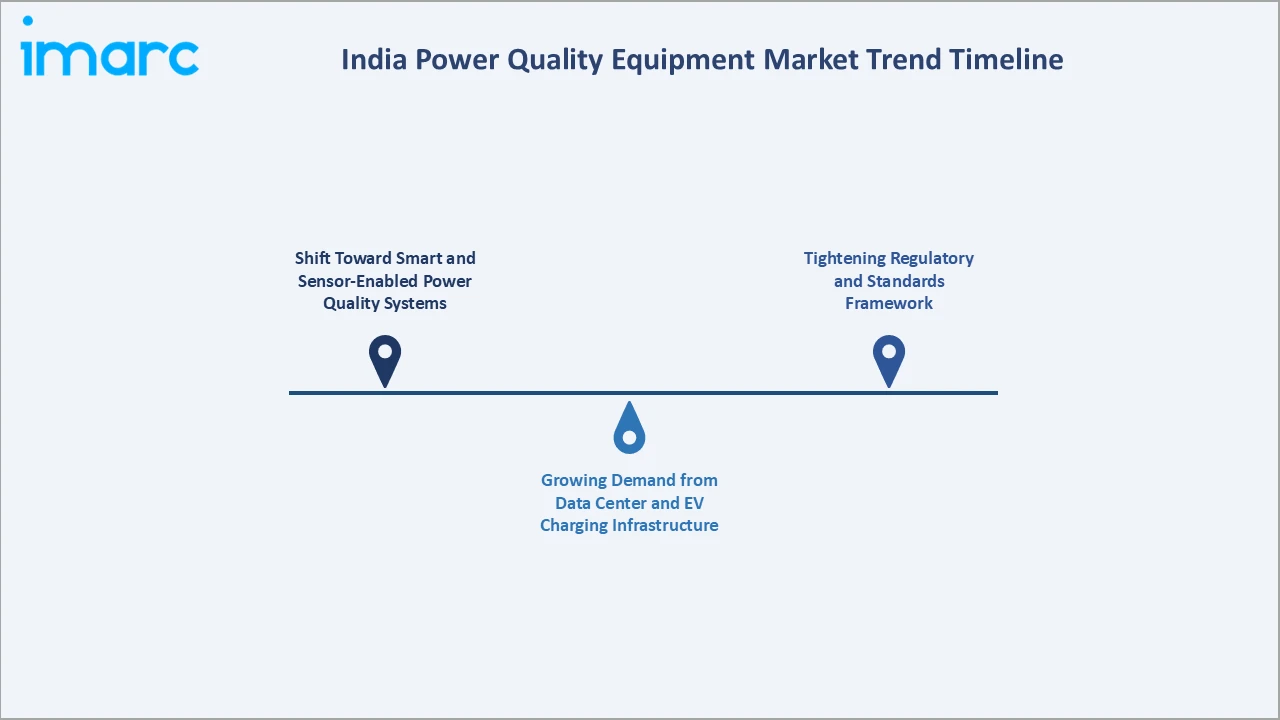
1. Shift Toward Smart and Sensor-Enabled Power Quality Systems
Manufacturers are integrating IoT-based monitoring and predictive analytics into UPS and stabilizer platforms, enabling remote diagnostics and reducing unplanned downtime across industrial facilities.
2. Growing Demand from Data Center and EV Charging Infrastructure
Expanding hyperscale and colocation facilities alongside public charging networks are lifting demand for high-availability, modular power conditioning equipment across major metro markets, shaping the India power equipment sector outlook.
3. Tightening Regulatory and Standards Framework
Updated Bureau of Indian Standards specifications for harmonics and surge protection are pushing manufacturers toward compliant, higher-specification product lines across industrial and commercial applications.
Industry Value Chain Analysis
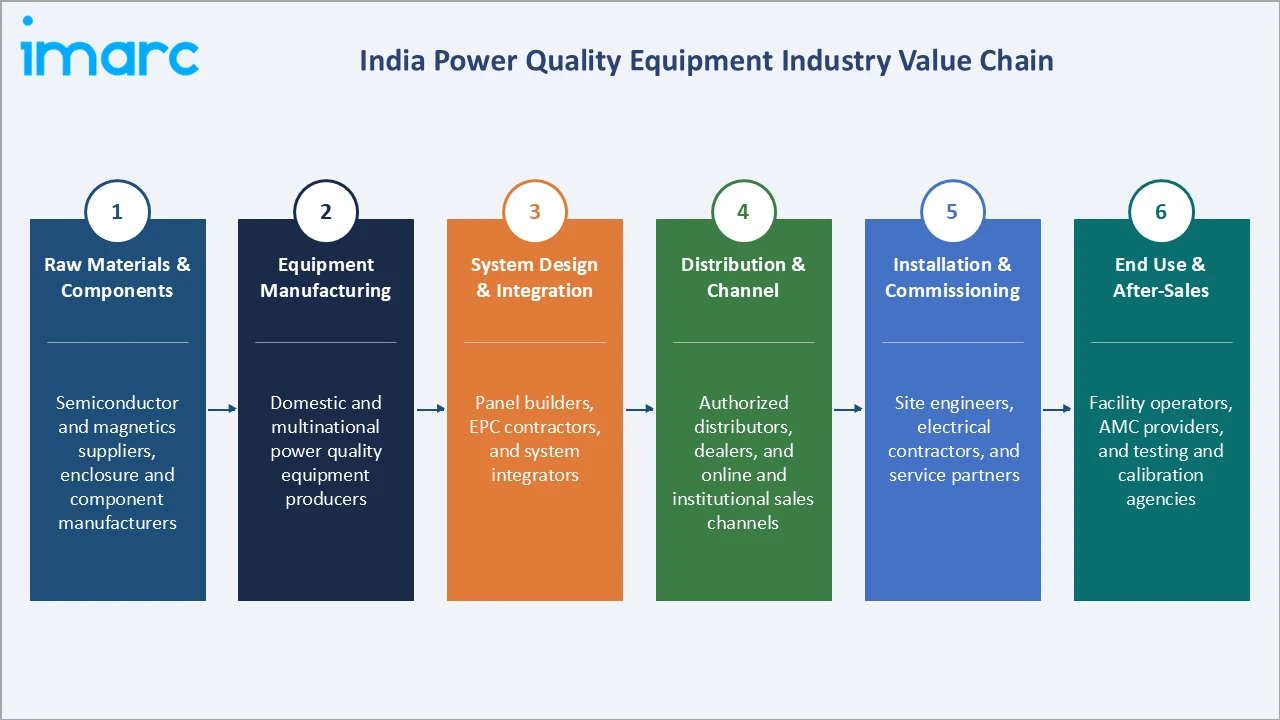
The India power quality equipment value chain spans six stages, from component sourcing through installation and after-sales support. Equipment manufacturing and system integration capture the highest value-add, while distribution reach and service quality increasingly determine competitive position as customers seek dependable long-term support.
|
Stage |
Key Players / Examples |
|
Raw Materials & Components |
Semiconductor and magnetics suppliers, enclosure and component manufacturers |
|
Equipment Manufacturing |
Domestic and multinational power quality equipment producers |
|
System Design & Integration |
Panel builders, EPC contractors, and system integrators |
|
Distribution & Channel |
Authorized distributors, dealers, and online and institutional sales channels |
|
Installation & Commissioning |
Site engineers, electrical contractors, and service partners |
|
End Use & After-Sales |
Facility operators, AMC providers, and testing and calibration agencies |
Vertically integrated players with strong distribution reach and after-sales service networks are best positioned to capture value across the chain, particularly as customers increasingly favor suppliers offering end-to-end support.
Technology Landscape in the India Power Quality Equipment Industry
Power Electronics & Semiconductor Advances
Modern power quality equipment increasingly relies on advanced power electronics and wide-bandgap semiconductors to improve efficiency, reduce equipment size, and enable faster response to voltage disturbances, supporting the shift toward compact, high-density UPS and active filtering systems.
Digital Monitoring & Connectivity
IoT-enabled sensors and cloud-connected monitoring platforms allow operators to track voltage, harmonics, and equipment health in real time, reducing unplanned downtime and supporting predictive maintenance across industrial and data center installations.
Materials & Thermal Management Innovation
Improved magnetic materials and thermal management designs are enhancing equipment efficiency and lifespan, particularly in high-density data center and industrial environments where space and heat dissipation are critical constraints.
Market Segmentation Analysis
The report covers the following segments:
|
Segment Category |
Leading Segment |
Market Share |
Year |
|
Equipment |
🔒 |
🔒 |
2025 |
|
Phase |
Three Phase |
68.5% |
2025 |
|
End Use |
Industrial and Manufacturing |
46.8% |
2025 |
|
Region |
West India |
34.6% |
2025 |

By Phase
Three phase commands a 68.5% majority share in 2025, driven by extensive deployment across industrial plants, utility substations, and large commercial establishments requiring higher power handling capacity. The segment benefits from established relationships with EPC contractors, growing capital expenditure in process industries, and its central role in grid-connected infrastructure.
To access detailed market analysis, Request Sample
Single phase holds 31.5% share in 2025, covering residential inverters, small commercial establishments, and light industrial applications. The segment remains relevant in tier-2 and tier-3 markets, where cost-sensitive customers prioritize simpler, lower-capacity backup and voltage protection systems.
By End Use
Industrial and manufacturing lead with 46.8% share in 2025, reflecting the sector's dependence on stable, high-quality power to protect automated production lines, motors, and process control systems from voltage fluctuations and harmonic distortion.
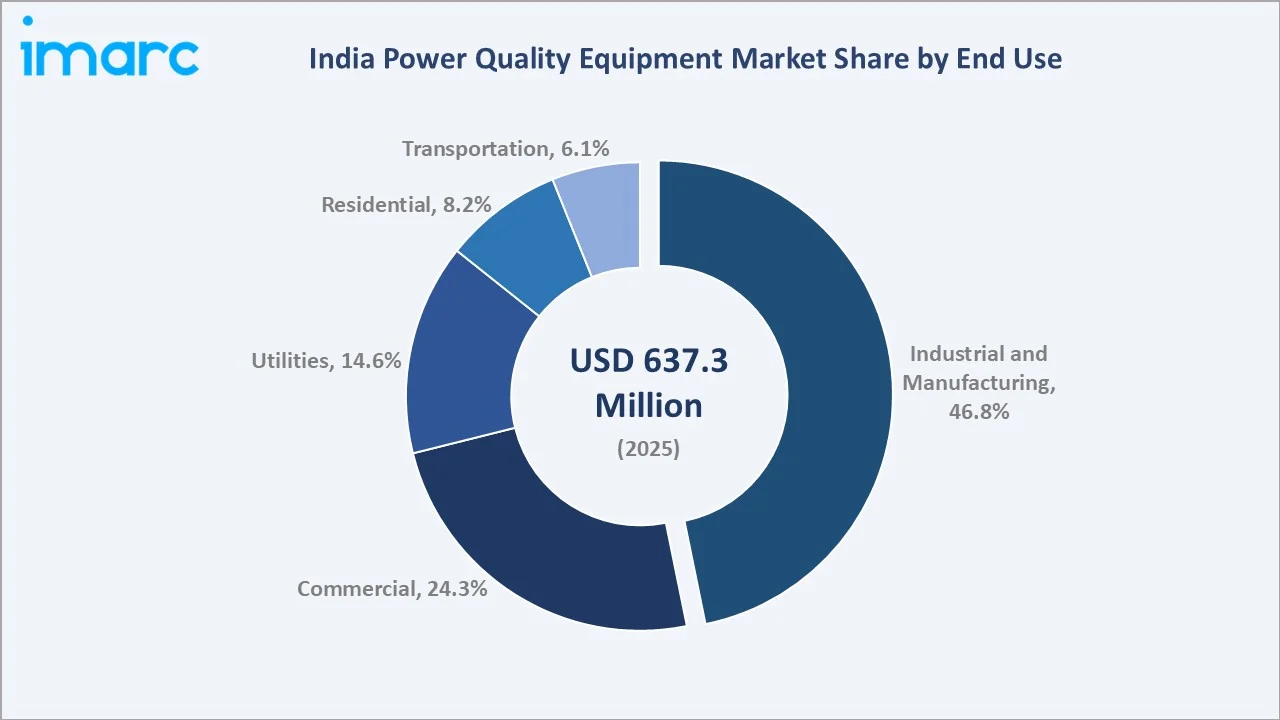
Commercial follows at 24.3%, supported by office parks, retail chains, and hospitality establishments upgrading backup power and voltage-conditioning infrastructure.
Regional Market Insights
|
Region |
Share (2025) |
Key Growth Drivers |
|
West India |
34.6% |
Dense industrial and petrochemical clusters, established manufacturing base, and strong presence of power equipment producers and system integrators |
|
South India |
29.2% |
Expanding IT and electronics manufacturing hubs, growing data center investment, and rising industrial automation adoption |
|
North India |
22.5% |
Large urban population, expanding commercial infrastructure, and government-led grid modernization initiatives |
|
East India |
13.7% |
Emerging industrial corridors, new infrastructure investment, and rising state-level focus on grid reliability |
West India at 34.6% in 2025 leads the regional landscape, anchored by Maharashtra and Gujarat's dense industrial and petrochemical clusters. A mature manufacturing base, strong distributor networks, and proximity to major ports support sustained regional leadership.
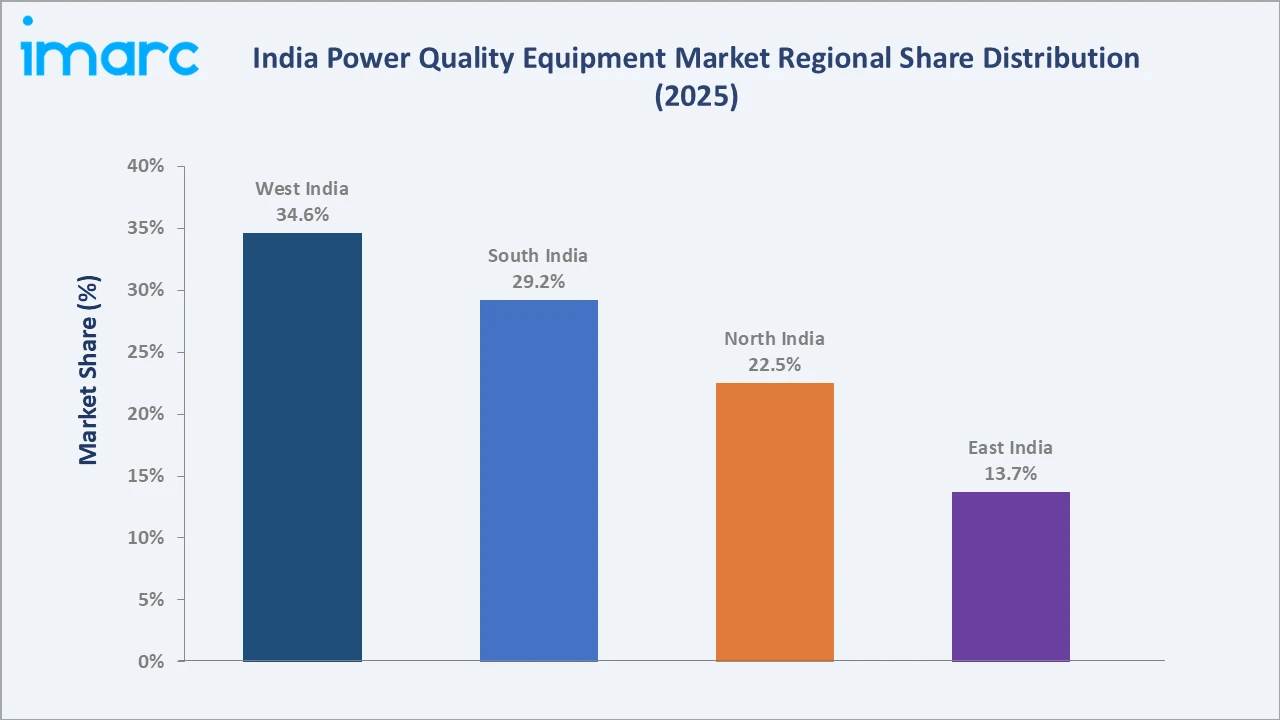
East India, while holding the smallest regional share at 13.7%, is emerging as a high-growth market. Expanding industrial corridors, new infrastructure investment, and rising government focus on grid reliability are accelerating regional expansion through 2034.
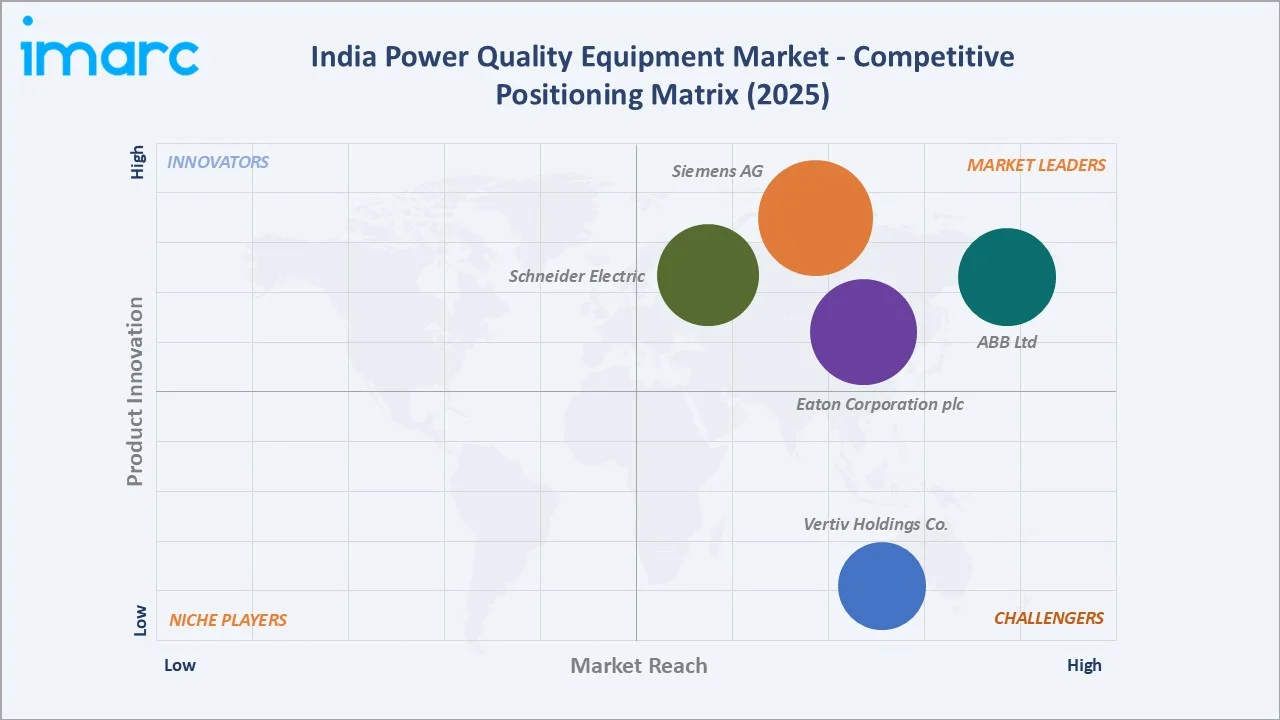
Competitive Landscape
The India power quality equipment market is moderately fragmented, with global electrification majors competing alongside domestic manufacturers across industrial, utility, and commercial segments. Brand strength, product breadth, service network depth, and compliance readiness form the key competitive differentiators as customers increasingly prioritize long-term reliability.
|
Company Name |
Brand / Key Product |
Position |
Strategic Focus |
|
ABB Ltd |
ABB |
Leader |
Electrification-driven low-voltage power quality portfolio |
|
Schneider Electric |
APC |
Leader |
Software-enabled energy management and power quality solutions |
|
Siemens AG |
Siemens |
Leader |
Smart Infrastructure-driven low-voltage electrification portfolio |
|
Eaton Corporation plc |
Eaton |
Leader |
Power management solutions with expanding data center focus |
|
Vertiv Holdings Co. |
Vertiv |
Challenger |
Critical digital infrastructure and data center power solutions |
Key players include ABB Ltd, Schneider Electric, Siemens AG, Eaton Corporation plc, and Vertiv Holdings Co., among others.
Key Company Profiles
ABB Ltd
ABB Ltd is a global technology leader in electrification and automation, headquartered in Zurich, Switzerland. The company serves industrial, utility, infrastructure and building customers worldwide, supplying power protection and quality equipment across its global operations.
- Product Portfolio: UPS solutions, low-voltage capacitor banks, surge protection devices and power quality monitoring solutions serving industrial, commercial and infrastructure customers.
- Recent Developments: ABB Ltd continues to strengthen its electrification portfolio through digital power management solutions, expanded service capabilities, and investments in technologies that improve power reliability and energy efficiency.
- Strategic Focus: Deepening its electrification and automation presence through localized manufacturing, expanded service networks and digitally connected power quality offerings.
Schneider Electric
Schneider Electric is a global specialist in energy management and automation, headquartered in France, with a long-standing presence across manufacturing, engineering and digital energy solutions serving industrial, commercial and data center customers worldwide.
- Product Portfolio: APC-branded UPS systems, power factor correction equipment, surge protection devices and connected power monitoring solutions.
- Recent Developments: The company has continued to expand its manufacturing and engineering investments, with continued focus on data center infrastructure and grid-edge power management technologies.
- Strategic Focus: Strengthening its position in the data center and industrial segments through integrated, software-enabled power quality and energy management solutions.
Siemens AG
Siemens AG is a global technology company headquartered in Germany, focused on industry, infrastructure and mobility. The company supplies low-voltage electrification and power quality equipment to industrial and commercial customers worldwide.
- Product Portfolio: Low-voltage capacitor banks and power quality monitoring solutions for industrial and commercial applications.
- Recent Developments: The company has continued to invest in its manufacturing base and digital infrastructure solutions, sharpening its focus on industrial and building technology customers.
- Strategic Focus: Expanding its Smart Infrastructure and Digital Industries footprint through localized manufacturing and digitally connected low-voltage power quality solutions.
Market Concentration Analysis
The India power quality equipment market is moderately fragmented, with established domestic manufacturers competing alongside global electrification companies across industrial, utility, and commercial segments. Leading players such as ABB Ltd, Schneider Electric, and Siemens AG hold strong positions in high-value three phase and industrial-grade equipment, supported by broad product portfolios and established service networks.
Barriers to entry include compliance with evolving Bureau of Indian Standards specifications, established distributor relationships and significant investment in manufacturing and testing infrastructure. These factors favor well-capitalized incumbents with diversified product lines and long-standing customer relationships.
Consolidation is gradually increasing as larger players expand manufacturing capacity and acquire specialized technology capabilities, while domestic manufacturers strengthen their position through localized production and cost-competitive offerings across price-sensitive segments.
Investment & Growth Opportunities
Fastest-Growing Segments
Transportation is expanding rapidly as EV charging infrastructure scales nationally, requiring dedicated power quality equipment to manage variable charging loads. Single phase is also gaining traction, as smaller commercial and residential installations adopt backup and voltage protection solutions.
Emerging Markets
East India is emerging as a high-growth market, supported by expanding industrial corridors, new data center announcements, and rising state-level infrastructure investment. Growing manufacturing activity and increasing adoption of digital infrastructure are further creating opportunities for power quality equipment providers across the region.
Venture & Investment Trends
Investment activity is concentrated in domestic manufacturing capacity expansion, digital monitoring platforms, and EV charging-linked power electronics, as both global and domestic players scale production to meet rising demand across India's industrial and digital infrastructure base.
Future Market Outlook (2026-2034)
The India power quality equipment market is forecast to expand from USD 637.3 Million in 2025 to USD 1,018.4 Million by 2034 at a CAGR of 5.19%, adding roughly USD 381.1 Million in incremental market value over the forecast period.
Three forces will shape the market through 2034: continued industrial automation and capacity expansion; accelerating renewable energy integration requiring advanced grid stabilization equipment; and the scaling of data center and EV charging infrastructure across urban and emerging regional markets.
By 2034, the market is expected to be defined by intelligent, connected power quality systems, with three phase and industrial and manufacturing applications maintaining leadership while transportation and East India regional demand grow at a faster pace than the overall market.
Research Methodology
Primary Research
Primary research included structured interviews with equipment manufacturers, system integrators, utility engineers, EPC contractors, and facility managers, validating market sizing, segment mix, and regional demand patterns across the India power quality equipment industry.
Secondary Research
Secondary sources included Ministry of Power and Central Electricity Authority publications, Bureau of Indian Standards specifications, Revamped Distribution Sector Scheme progress reports, and company annual reports and investor presentations from listed power equipment manufacturers.
Forecasting Models
Market forecasts used top-down and bottom-up models combining industrial capital expenditure trends, grid infrastructure investment, data center capacity additions, and regional demand patterns. Scenario analysis addressed regulatory changes, raw material costs, and technology adoption pace.
India Power Quality Equipment Market Report Coverage:
| Report Features | Details |
|---|---|
| Base Year of the Analysis | 2025 |
| Historical Period | 2020-2025 |
| Forecast Period | 2026-2034 |
| Units | Million USD |
| Scope of the Report |
Exploration of Historical Trends and Market Outlook, Industry Catalysts and Challenges, Segment-Wise Historical and Future Market Assessment:
|
| Equipment Covered | Power Quality Meters, Surge Protection Devices, Harmonic Filters, Voltage Regulators, Uninterruptible Power Supply (UPS), Others |
| Phases Covered | Single Phase, Three Phase |
| End Uses Covered | Residential, Commercial, Industrial and Manufacturing, Utilities, Transportation |
| Regions Covered | North India, South India, East India, West India |
| Companies Covered | ABB Ltd, Schneider Electric, Siemens AG, Eaton Corporation plc, Vertiv Holdings Co., etc. |
| Customization Scope | 10% Free Customization |
| Post-Sale Analyst Support | 10-12 Weeks |
| Delivery Format | PDF and Excel through Email (We can also provide the editable version of the report in PPT/Word format on special request) |
Key Benefits for Stakeholders:
- IMARC’s industry report offers a comprehensive quantitative analysis of various market segments, historical and current market trends, market forecasts, and dynamics of the India power quality equipment market from 2020-2034.
- The research report provides the latest information on the market drivers, challenges, and opportunities in the India power quality equipment market.
- Porter's five forces analysis assist stakeholders in assessing the impact of new entrants, competitive rivalry, supplier power, buyer power, and the threat of substitution. It helps stakeholders to analyze the level of competition within the India power quality equipment industry and its attractiveness.
- Competitive landscape allows stakeholders to understand their competitive environment and provides an insight into the current positions of key players in the market.
Frequently Asked Questions About the India Power Quality Equipment Market Report
The India power quality equipment market was valued at USD 637.3 Million in 2025, driven by industrial automation, grid modernization, and rising demand for reliable, uninterrupted power supply.
The market is projected to grow at a CAGR of 5.19% from 2026-2034, reaching USD 1,018.4 Million, supported by data center expansion and renewable integration.
Three phase dominates at 68.5% in 2025, driven by widespread industrial and utility-scale deployment requiring higher power handling capacity and tighter voltage regulation across installations.
Industrial and manufacturing dominate at 46.8% in 2025, fueled by sustained capital investment in process industries and the sector's dependence on stable, high-quality power supply.
West India commands 34.6% in 2025, led by dense industrial and petrochemical clusters across Maharashtra and Gujarat, along with a mature manufacturing and integration ecosystem.
Leading players include ABB Ltd, Schneider Electric, Siemens AG, Eaton Corporation plc, and Vertiv Holdings Co., among others.
IoT-enabled monitoring, predictive maintenance, and active harmonic filtering are helping operators reduce downtime, improve energy efficiency, and comply with tightening power quality standards.
High upfront equipment costs, a shortage of skilled technical manpower, and uneven grid infrastructure in rural areas continue to limit broader adoption across price-sensitive customer segments.
Need more help?
- Speak to our experienced analysts for insights on the current market scenarios.
- Include additional segments and countries to customize the report as per your requirement.
- Gain an unparalleled competitive advantage in your domain by understanding how to utilize the report and positively impacting your operations and revenue.
- For further assistance, please connect with our analysts.
 Request Customization
 Speak to an Analyst
 Request Brochure
 Inquire Before Buying
Benefits of Customization
- Personalize this research
- Triangulate with your data
- Get data as per your format and definition
- Gain a deeper dive into a specific application, geography, customer, or competitor
- Any level of personalization
Get in Touch With Us
UNITED STATES
Phone: +1-201-971-6302
INDIA
Phone: +91-120-433-0800
UNITED KINGDOM
Phone: +44-753-714-6104
Email: sales@imarcgroup.com
Client Testimonials




.webp)




.webp)













Related Reports

Choose your plan
*Please note that the prices mentioned below are starting prices for each bundle type. Kindly contact our team for further details.*
Single User License
- 1 User License, Access on 2 Devices
- PDF Report + Excel Dataset (Password Protected)
- Lifetime Access
- No Printing Rights
- 10% Free Report Customization
- 10–12 Weeks of Analyst Support
Five User License
- Access for 5 Users, 2 Devices per User
- PDF Report + Excel Dataset (Password Protected)
- Lifetime Access
- Dedicated Account Manager
- 12–14 Weeks of Analyst Support
- No Printing Rights
- 15% Free Report Customization
- 25% Discount on Your Next Purchase
Corporate User License
- Unlimited User Access (Within Your Organization)
- PDF Report + Excel Dataset
- Lifetime Access
- Dedicated Account Manager
- 14–20 Weeks of Analyst Support
- No Printing Rights
- 20% Free Report Customization
- 30% Discount on Your Next Purchase
Essential Insights
What's included:
3 reports
- Lifetime Access
- PDF Reports
- Excel Datasets
- 2 Weeks of Free Analyst Support
- 2 User Licenses
- Access on 2 Devices
- Printing Rights
- Complimentary PowerPoint (PPT) Version
- Complimentary License Upgrade
Professional Access
What's included:
5 reports
- Lifetime Access
- PDF Reports
- Excel Datasets
- 8 Weeks of Free Analyst Support
- 2 User Licenses
- Access on 2 Devices
- Printing Rights
- Complimentary PowerPoint (PPT) Version
- Complimentary License Upgrade
Business Advantage
What's included:
8 reports
- Lifetime Access
- PDF Reports
- Excel Datasets
- 14 Weeks of Free Analyst Support
- 2 User Licenses
- Access on 2 Devices
- Printing Rights
- Complimentary PowerPoint (PPT) Version
- Complimentary License Upgrade
Enterprise Intelligence
What's included:
10 reports
- Lifetime Access
- PDF Reports
- Excel Datasets
- 20 Weeks of Free Analyst Support
- 2 User Licenses
- Access on 2 Devices
- Printing Rights
- Complimentary PowerPoint (PPT) Version
- Complimentary License Upgrade