
Japan Candle Market Size, Share, Trends and Forecast by Product, Wax Type, Distribution Channel, and Region, 2026-2034
Japan Candle Market Size, Share, Trends & Forecast (2026-2034)
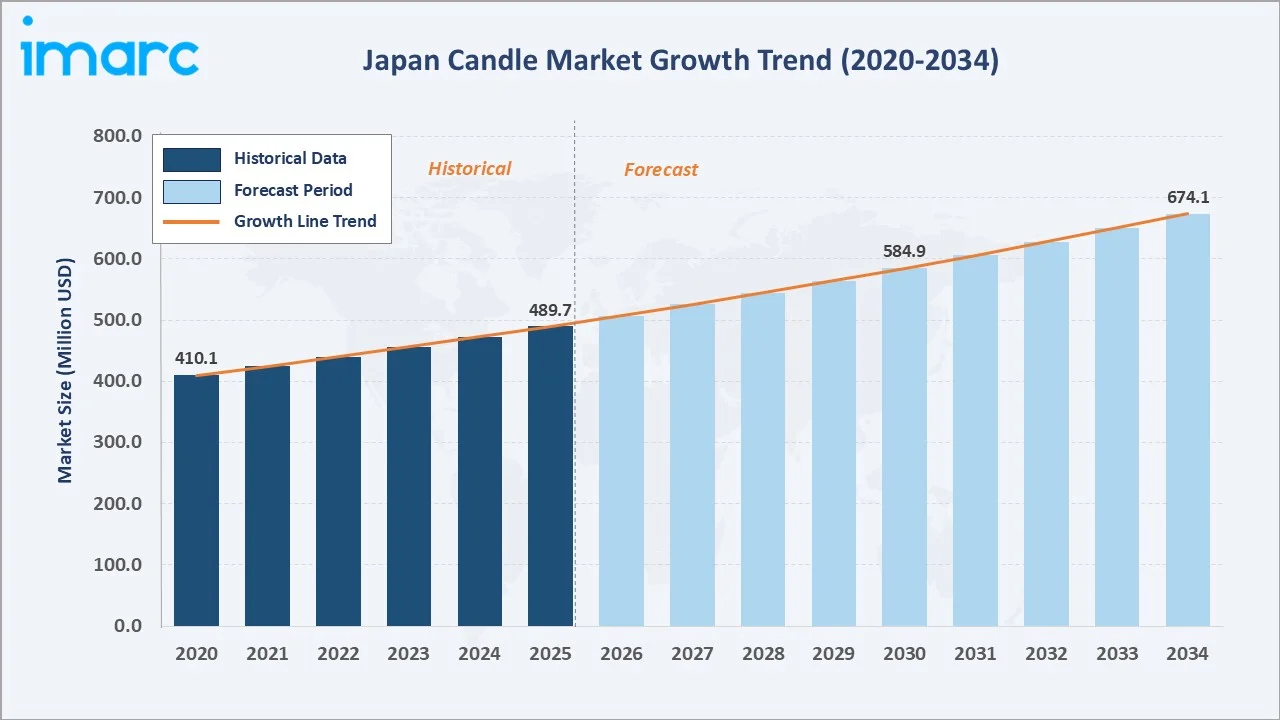
The Japan candle market grew from USD 489.7 Million in 2025 to USD 507.4 Million in 2026 and is projected to reach USD 674.1 Million by 2034, growing at a CAGR of 3.61% during 2026-2034. Rising home-decor spending, wellness-led aromatherapy habits, and a deep-rooted gifting culture continue to lift Japan candle market demand. Paraffin leads the wax-type mix at 46.3% share (2025), while soy wax is the fastest-scaling material as sustainability preferences reshape purchase decisions. The Kanto region anchors overall consumption at 39.4% share, supported by Tokyo's dense retail and e-commerce infrastructure.
Market Snapshot
|
Metric |
Value |
|
Base Year Market Size (2025) |
USD 489.7 Million |
|
Market Size (2026) |
USD 507.4 Million |
|
Forecast Market Size (2034) |
USD 674.1 Million |
|
CAGR (2026-2034) |
3.61% |
|
Base Year |
2025 |
|
Historical Period |
2020-2025 |
|
Forecast Period |
2026-2034 |
The market expanded from USD 410.1 Million in 2020 to USD 489.7 Million in 2025 and an estimated USD 507.4 Million in 2026, is anchored at USD 584.9 Million by 2030, and is forecast to touch USD 674.1 Million by 2034. Soy-wax adoption and premium gifting-candle ranges are lifting the Japan candle market's average realization above baseline paraffin-linked pricing.
To get more information on this market, Request Sample
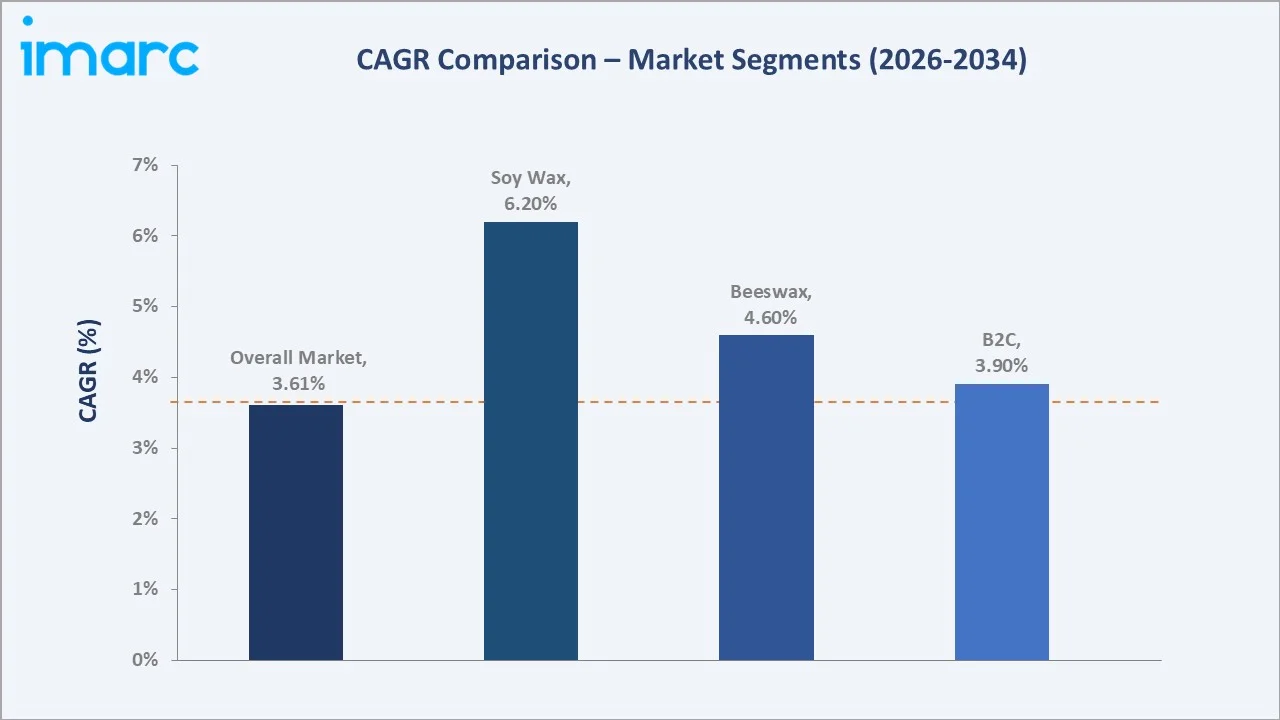
Soy wax grows fastest among wax types at an estimated ~6.2% CAGR (2026-2034), driven by consumer preference for cleaner-burning, biodegradable material. Beeswax follows at an estimated 4.6% CAGR, outpacing palm wax's 3.2%, as premium and wellness-linked candle ranges expand their addressable base through 2034.
Executive Summary
The Japan candle market, which increased from USD 489.7 Million in 2025 to an estimated USD 507.4 Million in 2026, supported by a mature retail base, a centuries-old candle and incense culture, and rising demand for home-fragrance products among urban households. Unlike commoditized Western markets, Japan's candle demand is shaped by ceremonial, seasonal-gifting, and interior-design use cases layered on top of everyday aromatherapy consumption, giving the category a structurally diverse revenue mix.
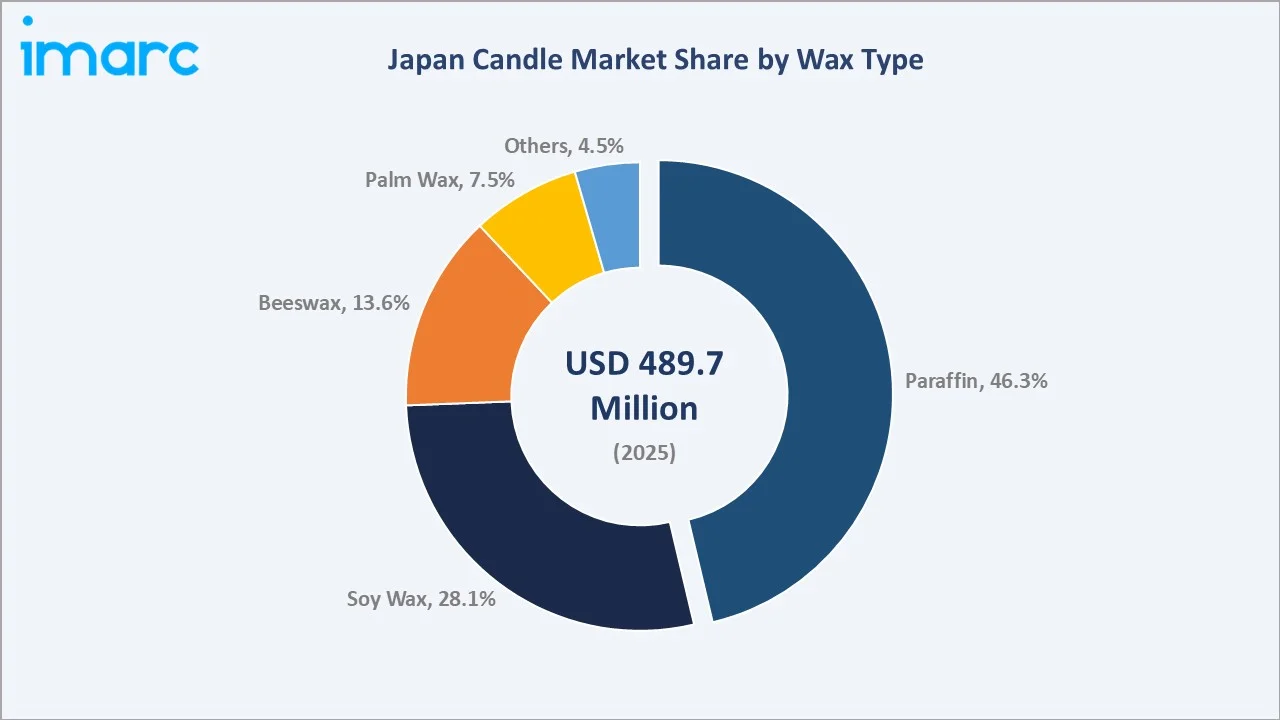
The market's 3.61% CAGR to USD 674.1 Million by 2034 reflects steady volume growth tempered by import-linked paraffin cost pressure, but supported by soy-wax premiumization and expanding e-commerce access. Paraffin holds the largest wax-type share at 46.3% (2025), while soy wax at 28.1% is closing the gap as sustainability preference strengthens across the country.
By distribution channel, B2C sales lead at 74.8% share (2025), spanning department stores, specialty gift shops, and online retail, while B2B demand at 25.2% is anchored by hospitality, spa, and religious-goods procurement. The Kanto region alone accounts for 39.4% of national demand, followed by Kansai/Kinki at 18.6%, underscoring the concentration of candle consumption around Japan's largest metropolitan markets.
Key Market Insights
|
Insight |
Data |
|
Largest Wax-Type Segment |
Paraffin - 46.3% revenue share (2025) |
|
Fastest-Growing Wax Type |
Soy Wax - ~6.2% CAGR (2026-2034) |
|
Leading Distribution Channel |
B2C - 74.8% share (2025) |
|
Leading Region |
Kanto Region - 39.4% share (2025) |
|
Top Companies |
Kameyama Co., Ltd., Nippon Kodo Co., Ltd., and DAIYO |
|
Market Opportunity |
Soy-wax premiumization and gifting-candle e-commerce expansion |
Key Analytical Observations Supporting The Above Data:
- Paraffin at 46.3% (2025) remains dominant on cost efficiency: Paraffin's lower per-unit cost and wide melting-point range keep it the default choice for mass-market votive and pillar candles sold through general merchandise and convenience retail.
- Soy wax at 28.1% is growing fastest as sustainability enters mainstream purchase criteria: Japanese consumers increasingly associate soy-based candles with cleaner burning and lower soot, a preference reinforced by growing wellness and eco-conscious retail merchandising.
- B2C channels at 74.8% dominate on gifting and self-care purchase occasions: Seasonal gift-giving around year-end, Obon, and wedding ceremonies continues to route most candle purchases through department stores, specialty shops, and direct-to-consumer e-commerce.
- Kanto region leads at 39.4% share, anchored by Tokyo's retail density: The region's concentration of flagship department stores, lifestyle boutiques, and fulfilment infrastructure supports faster new-product rollout than other prefectures.
- Beeswax at 13.6% share serves the premium and religious-candle niche: Beeswax candles are positioned at a price premium for ceremonial, butsudan (household altar), and high-end interior use, sustaining stable demand independent of mass-market price cycles.
- Kansai/Kinki at 18.6% share is the second-largest region: Osaka and Kyoto's blend of traditional craft retail and modern lifestyle stores gives the region a distinct mix of heritage and contemporary candle demand.
Japan Candle Market Overview
Japan's candle market covers paraffin, soy, beeswax, palm, and specialty-wax products used across religious, decorative, gifting, and aromatherapy applications. The ecosystem spans wax and fragrance-material suppliers, domestic manufacturers and artisan workshops, wholesale distributors, and a retail network of department stores, specialty shops, and e-commerce platforms serving households nationwide.
Japan's candle industry operates under Ministry of Economy, Trade and Industry (METI) trade oversight and Japanese Industrial Standards (JIS) product-safety norms, with fire-safety labeling requirements shaping packaging design. Macroeconomic drivers include Japan's import dependence on refined paraffin wax, yen-denominated raw-material costs, and steady household spending on home-decor and wellness categories.
Market Dynamics
To evaluate market opportunities, Request Sample
Market Drivers
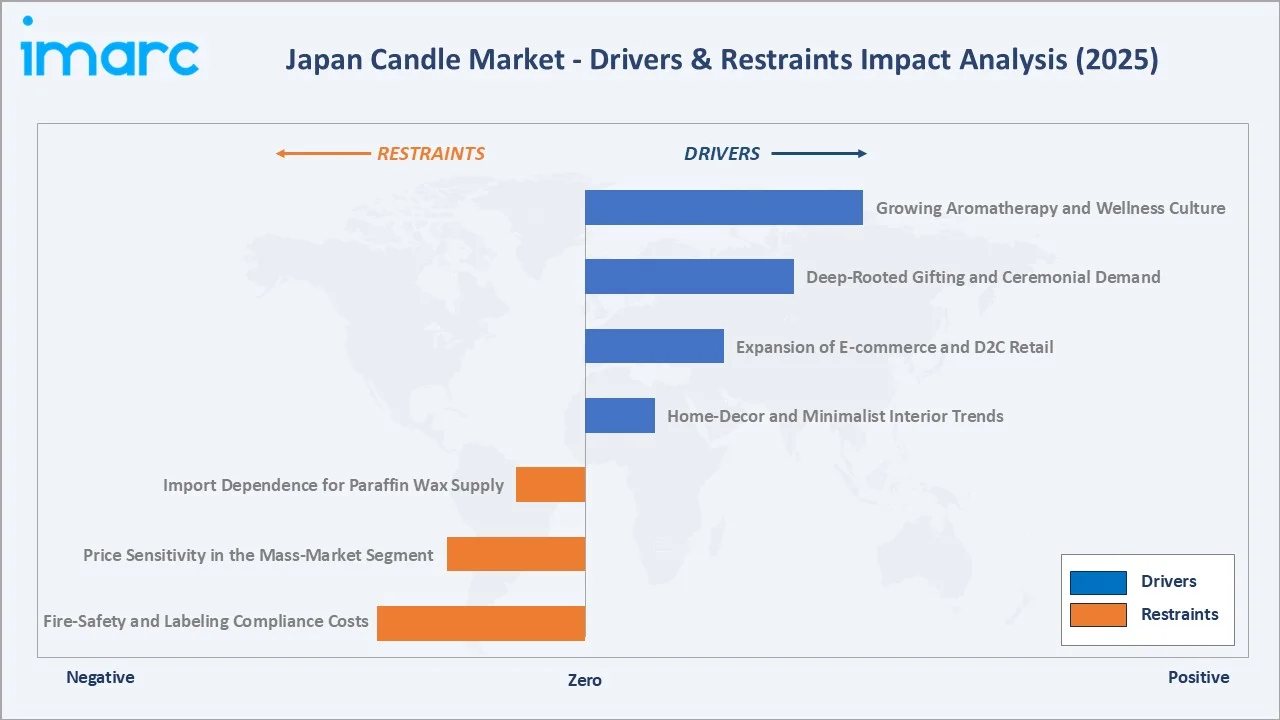
- Growing Aromatherapy and Wellness Culture: Rising interest in stress relief and at-home self-care is expanding scented-candle purchase frequency, particularly among urban working adults seeking affordable wellness rituals.
- Deep-Rooted Gifting and Ceremonial Demand: Seasonal gift-giving occasions and religious/household-altar candle use sustain a stable demand floor that is less exposed to discretionary-spending swings than in many Western candle markets.
- Expansion of E-commerce and D2C Retail: Growing online penetration is letting niche and artisan candle brands reach nationwide customers directly, widening product variety available to consumers beyond traditional department-store shelves.
- Home-Decor and Minimalist Interior Trends: Compact urban living is driving demand for multi-functional decorative candles that combine ambient lighting with interior styling, particularly in the Kanto and Kansai regions.
Market Restraints
- Import Dependence for Paraffin Wax Supply: Japan's paraffin wax import volume declined from close to 19.7 thousand metric tons in 2016 to around 9.2 thousand metric tons in 2020, per METI data, reflecting tightening feedstock access that keeps input costs sensitive to global refining cycles.
- Price Sensitivity in the Mass-Market Segment: Everyday paraffin candles compete on price against low-cost imports, limiting margin expansion for domestic manufacturers serving general merchandise retail.
Market Opportunities
- Soy-Wax and Sustainable Product Premiumization: Expanding soy and plant-based wax ranges gives manufacturers a premium-pricing lever as eco-conscious purchase criteria strengthen among younger consumers.
- Cross-Border and Inbound Tourism-Linked Retail: Traditional Japanese warōsoku and artisan candles are gaining appeal among inbound tourists, opening a premium souvenir and export-adjacent retail opportunity.
Market Challenges
- Fire-Safety and Labeling Compliance Costs: Compliance with Japan's product-safety and fire-labeling requirements adds cost and lead time for smaller manufacturers launching new scented or novelty candle lines.
- Artisan Workforce and Craft-Skill Succession: Traditional candle-making techniques, such as hand-dipped warōsoku production, face succession challenges as skilled artisan workshops see an aging workforce.
Emerging Market Trends
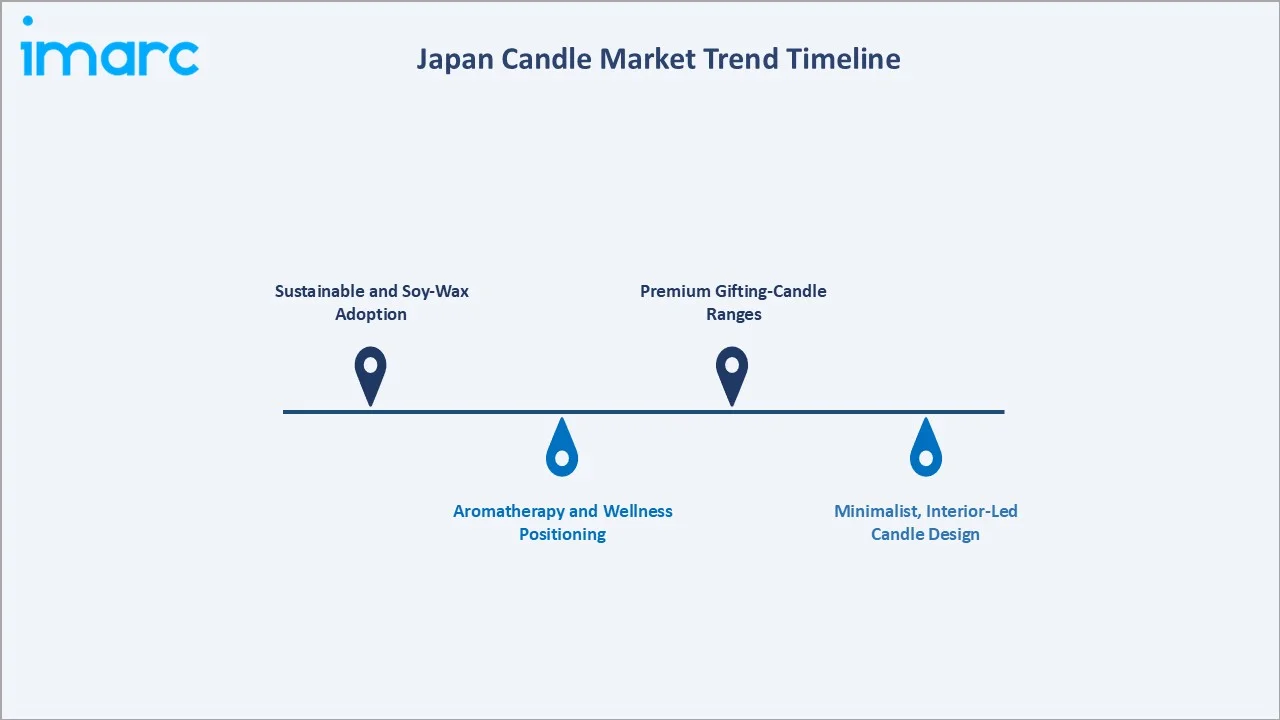
1. Sustainable and Soy-Wax Adoption
Manufacturers are reformulating votive and container candle lines around soy and other plant-based waxes to meet rising demand for biodegradable, low-soot products. This shift is gradually repositioning soy wax from a niche premium material toward a mainstream mass-market ingredient.
2. Aromatherapy and Wellness Positioning
Scented-candle brands are increasingly marketed around stress relief and sleep-wellness benefits rather than pure home fragrance, aligning candle purchases with Japan's broader self-care and wellness retail growth.
3. Direct-to-Consumer and E-commerce Expansion
Independent and artisan candle brands are scaling through direct online storefronts and marketplace listings, reducing reliance on department-store shelf space and enabling faster new-scent product cycles.
4. Premium Gifting-Candle Ranges
Limited-edition and seasonal gift-set candles, often paired with fragrance diffusers or ceremonial items, are commanding premium price points around year-end and wedding-gifting seasons.
5. Minimalist, Interior-Led Candle Design
Candle packaging and vessel design are trending toward minimalist aesthetics suited to compact urban interiors, with reusable glass and ceramic containers gaining share over disposable packaging.
Industry Value Chain Analysis
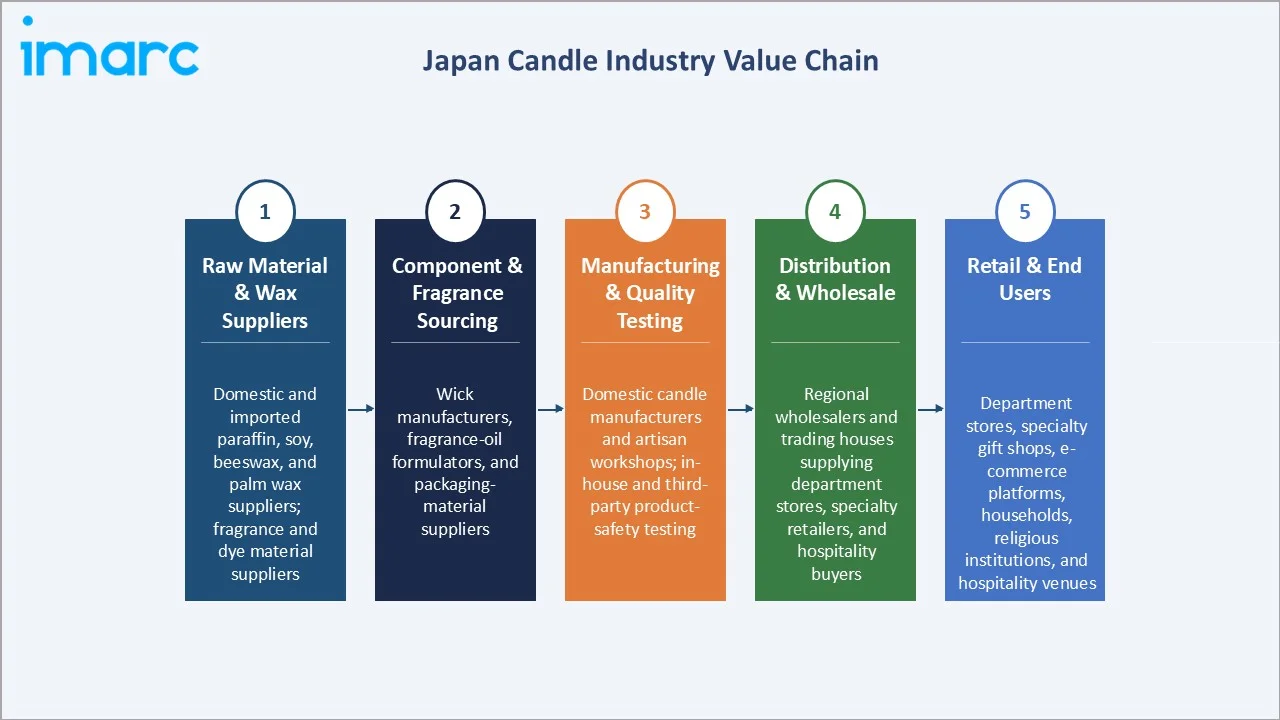
Japan's candle industry value chain runs from raw-material and wax sourcing through manufacturing, quality testing, wholesale distribution, and final retail or e-commerce delivery to end consumers.
|
Stage |
Key Participants |
|
Raw Material & Wax Suppliers |
Domestic and imported paraffin, soy, beeswax, and palm wax suppliers; fragrance and dye material suppliers |
|
Component & Fragrance Sourcing |
Wick manufacturers, fragrance-oil formulators, and packaging-material suppliers |
|
Manufacturing & Quality Testing |
Domestic candle manufacturers and artisan workshops; in-house and third-party product-safety testing |
|
Distribution & Wholesale |
Regional wholesalers and trading houses supplying department stores, specialty retailers, and hospitality buyers |
|
Retail & End Users |
Department stores, specialty gift shops, e-commerce platforms, households, religious institutions, and hospitality venues |
Japan's candle distribution structure favors established wholesale relationships between manufacturers and department-store chains, while e-commerce is opening a shorter, direct route between artisan producers and end consumers.
Technology Landscape in the Japan Candle Industry
Wax Formulation and Material Innovation
Manufacturers such as Kameyama Co., Ltd. have developed plant-based and natural-gas-derived wax formulations as alternatives to petroleum paraffin, targeting steadier flame performance and reduced soot output for environment-conscious buyers.
Traditional Craft and Artisan Techniques
Hand-dipped warōsoku candle production using vegetable-based HAZE wax continues alongside modern manufacturing, preserving a premium artisan segment distinct from mass-produced paraffin lines.
Fragrance and Scent-Delivery Innovation
Fragrance houses are refining slow-release scent-oil blends to extend burn-time consistency, supporting the wellness positioning of aromatherapy-oriented candle ranges sold through specialty retail.
Digital Retail and Direct-to-Consumer Platforms
Candle brands are adopting e-commerce storefronts and social-commerce channels to shorten the path between niche product launches and consumer discovery, particularly for limited-edition scent releases.
Market Segmentation Analysis
The report covers the following segments:
|
Segment Category |
Leading Segment |
Market Share |
Year |
|
Product |
🔒 |
🔒 |
2025 |
|
Wax Type |
Paraffin |
46.3% |
2025 |
|
Distribution Channel |
B2C |
74.8% |
2025 |
|
Region |
Kanto Region |
39.4% |
2025 |

By Wax Type
Paraffin leads at 46.3% market share (2025), supported by its low cost and consistent melting characteristics that suit mass-market votive, pillar, and religious-use candles sold through general retail.
To access detailed market analysis, Request Sample
Soy wax at 28.1% share is the fastest-growing wax type at an estimated ~6.2% CAGR through 2034, as sustainability preference and cleaner-burn positioning attracts premium and wellness-focused buyers. Beeswax at 13.6% serves religious and premium interior use, while palm wax (7.5%) and other specialty blends (4.5%) fill smaller decorative and niche craft applications.
By Distribution Channel
B2C channels lead at 74.8% market share (2025), spanning department stores, specialty gift retailers, and e-commerce platforms serving individual households and gift buyers.
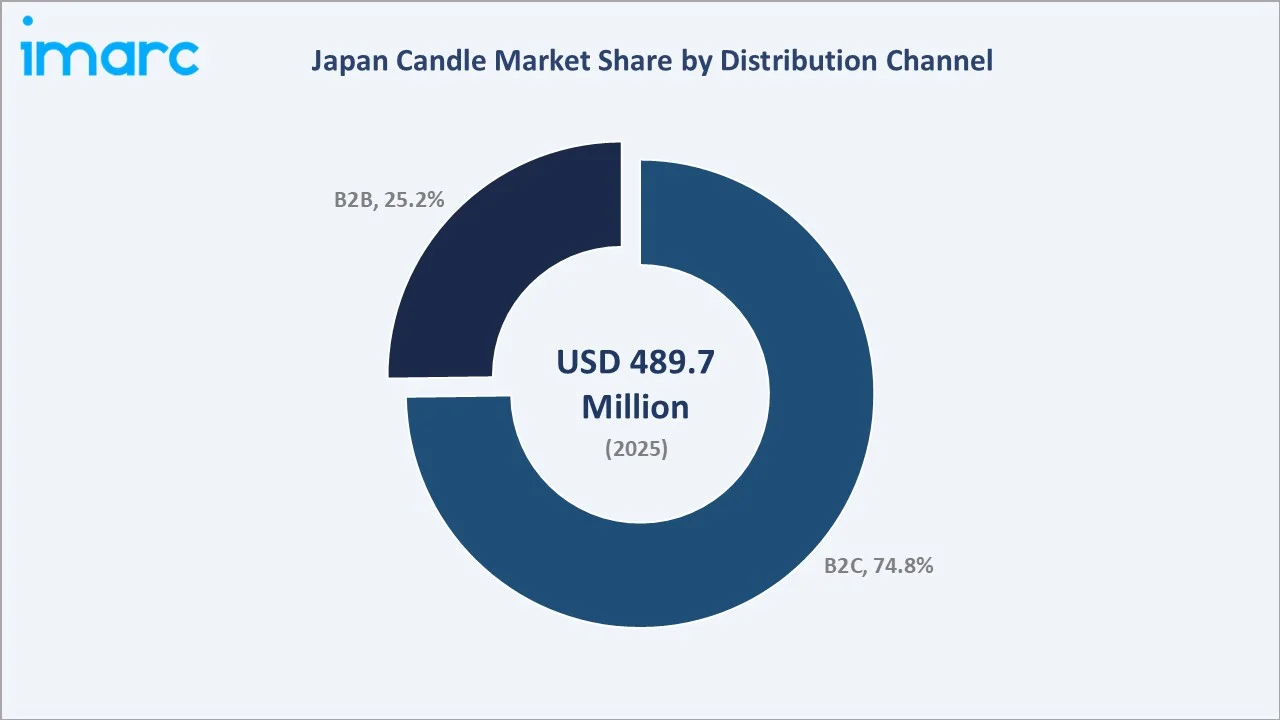
B2B demand at 25.2% share is anchored by hospitality venues, spas, religious institutions, and corporate-gifting procurement. The B2C channel is estimated to grow faster, at ~3.9% CAGR through 2034, compared with ~2.6% for B2B, as household aromatherapy and gifting purchases continue to expand.
Regional Market Insights
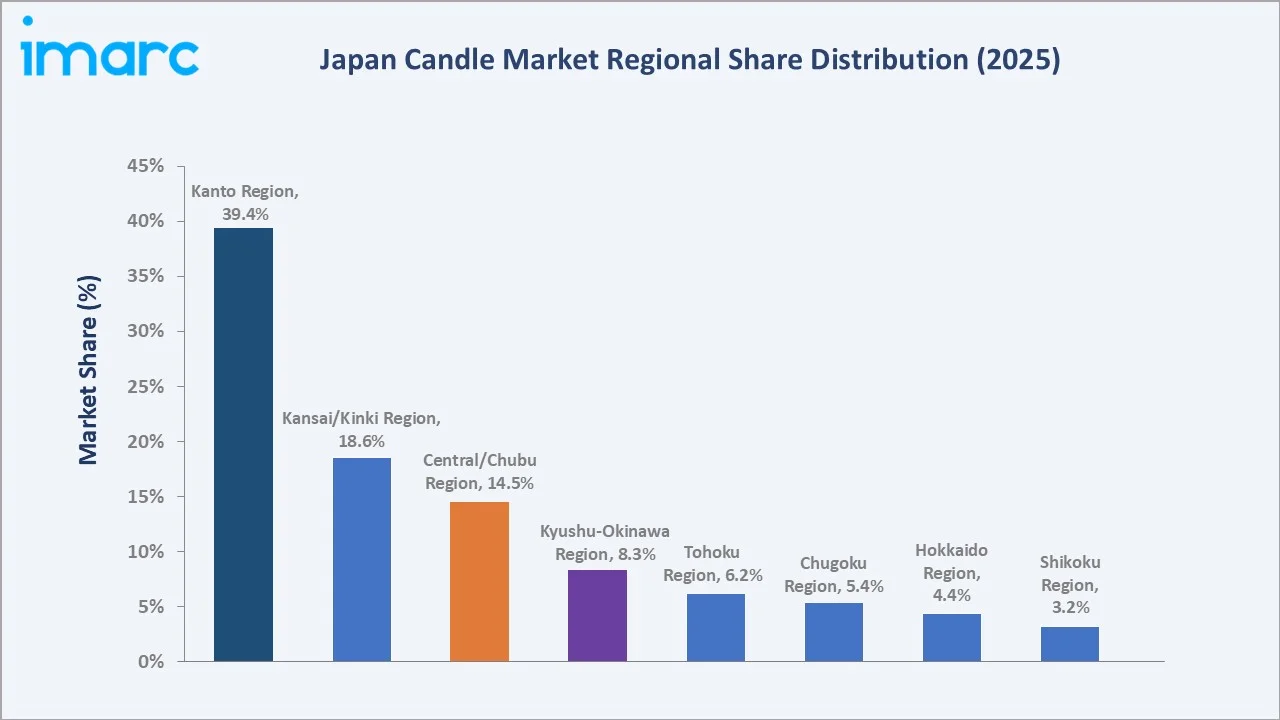
The Kanto region leads Japan's candle market at 39.4% share (2025), followed by Kansai/Kinki at 18.6% and Central/Chubu at 14.5%. Regional demand generally tracks population density, retail infrastructure, and proximity to major distribution hubs.
|
Region |
Share (2025) |
Market Characteristics |
|
Kanto Region |
39.4% |
Dense department-store and e-commerce fulfilment infrastructure; fastest new-product adoption |
|
Kansai/Kinki Region |
18.6% |
Blend of heritage craft retail and modern lifestyle stores; strong traditional-candle demand |
|
Central/Chubu Region |
14.5% |
Manufacturing-linked economy supporting steady industrial and household demand |
|
Kyushu-Okinawa Region |
8.3% |
Growing tourism-linked gifting and souvenir-candle retail |
|
Tohoku Region |
6.2% |
Seasonal and ceremonial candle demand tied to regional festivals and traditions |
|
Chugoku Region |
5.4% |
Moderate household demand supported by regional retail chains |
|
Hokkaido Region |
4.4% |
Winter-season demand supporting ambient and decorative candle use |
|
Shikoku Region |
3.2% |
Smaller population base with steady demand through local specialty retailers |
Kyushu-Okinawa, at 8.3% share, is gaining relative momentum as inbound tourism supports demand for artisan and souvenir candle products, while Hokkaido's 4.4% share benefits from longer indoor-lit winter seasons that lift ambient-candle usage.
Competitive Landscape
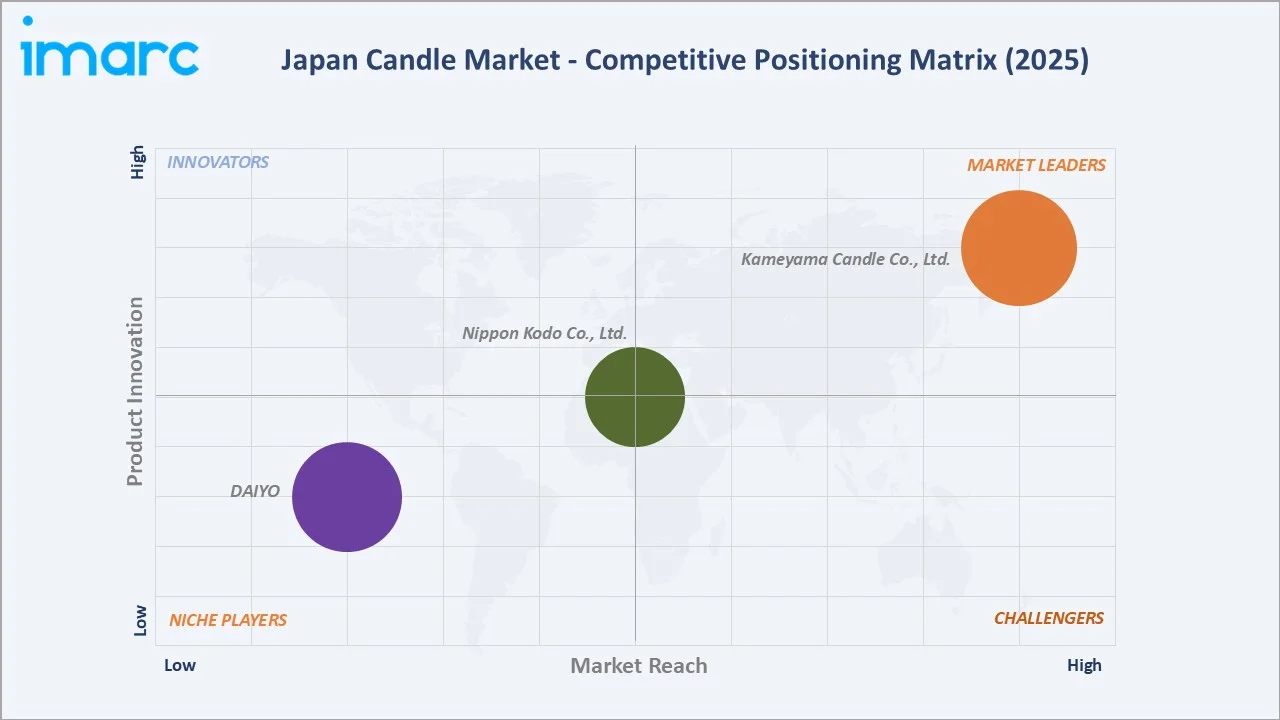
Japan's candle market is moderately fragmented, with Kameyama Co., Ltd. holding the leading position through its scale in religious, decorative, and aroma-candle categories, while traditional and heritage-incense makers compete in premium and niche segments.
|
Company Name |
Product Portfolio |
Market Position |
Core Strength |
|
Kameyama Co., Ltd. |
Lifestyle, interior, and gift-focused scented candles, handcrafted traditional style candles, everyday household Buddhist memorial candles |
Market Leader |
Broadest product range spanning religious, decorative, and aroma candles; nationwide retail and export presence |
|
Nippon Kodo Co., Ltd. |
Decorative candles, long-burn/memorial candles, everyday standard candles |
Established Player |
400+ year heritage in incense and fragrance craftsmanship extended into aroma-candle wellness products |
|
DAIYO |
Authentic, handmade traditional Japanese candles (wa-rosoku) crafted from 100% natural plant-based waxes |
Niche Player |
100+ years of hand-crafted vegetable-wax candle-making using traditional HAZE wax techniques |
Key Company Profiles
Kameyama Co., Ltd.
Founded in 1927, Kameyama Co., Ltd. is Japan's leading candle manufacturer, producing religious, decorative, and aroma candles under the Kameyama Candle House retail chain.
- Product Portfolio: Lifestyle, interior, and gift-focused scented candles, handcrafted traditional style candles, everyday household Buddhist memorial candles, and others.
- Strategic Focus: Broadening its non-petroleum wax portfolio while building toward its 100th anniversary in 2027 through expanded retail and workshop experiences.
Nippon Kodo Co., Ltd.
Nippon Kodo traces its incense-making heritage back more than 400 years, with the modern Nippon Kodo Group established in 1965 and headquartered in Tokyo.
- Product Portfolio: Decorative candles, long-burn/memorial candles, everyday standard candles, and others.
- Strategic Focus: Leveraging centuries of fragrance-blending expertise to build wellness-positioned aroma-candle products for both domestic and international buyers.
Market Concentration Analysis
Japan's candle market is moderately fragmented. Kameyama Co., Ltd. holds the largest single share through its broad religious, decorative, and aroma-candle portfolio, while heritage incense makers and traditional artisan workshops such as DAIYO compete in premium and niche categories.
The mass-market paraffin segment is more fragmented, with numerous small manufacturers and importers competing on price, while the soy-wax and premium-gifting segments are consolidating around brands able to invest in fragrance development and design-led packaging.
Investment & Growth Opportunities
Fastest Growing Segments
Soy wax (~6.2% CAGR), beeswax (~4.6% CAGR), and the B2C distribution channel (~3.9% CAGR) represent Japan's highest-growth candle-market investment vectors through 2034. Premium gifting-candle ranges and tourism-linked artisan retail also offer above-market growth potential.
Emerging Market Opportunities
Inbound tourism recovery is creating a souvenir and premium artisan-candle opportunity, particularly for traditional warōsoku products in the Kansai and Kyushu-Okinawa regions. E-commerce expansion is also opening direct-to-consumer channels for smaller regional candle brands previously limited to local retail.
Investment Themes
- Sustainable Wax Reformulation: Investment in soy and other plant-based wax production capacity can capture premium pricing as sustainability preference strengthens across Japan's candle-buying households.
- Direct-to-Consumer Digital Retail: Building dedicated e-commerce and social-commerce storefronts allows both heritage and emerging candle brands to reach nationwide buyers without dependence on department-store shelf space.
Future Market Outlook (2026-2034)
The Japan candle market is projected to grow from USD 489.7 Million in 2025 to USD 507.4 Million in 2026 and further to USD 674.1 Million by 2034, at a steady 3.61% CAGR reflecting stable household demand offset by import-linked paraffin cost pressure, with net positive growth driven by soy-wax premiumization, gifting-candle ranges, and e-commerce expansion. The market's USD 584.9 Million milestone in 2030 will mark continued momentum toward the 2034 forecast.
Three structural forces anchor this outlook: continued household preference for wellness and home-fragrance products; the gradual shift from paraffin toward soy and other plant-based waxes as sustainability becomes a mainstream purchase criterion; and e-commerce infrastructure that is widening market access for artisan and regional candle brands beyond their traditional retail footprint.
Research Methodology
Primary Research
Primary research included structured discussions with candle manufacturers, wholesale distributors, and specialty and department-store retail buyers across Japan's Kanto and Kansai regions, alongside interviews with fragrance and wax-material suppliers.
Secondary Research
Secondary research drew on Ministry of Economy, Trade and Industry (METI) trade statistics on paraffin wax imports, company disclosures from leading candle and fragrance manufacturers, and industry publications covering Japan's home-decor and wellness retail categories.
Forecasting Models
Market forecasts were developed using historical revenue-trend extrapolation combined with wax-type and distribution-channel penetration modeling, validated against METI trade data and company-level production and distribution disclosures. Key inputs include historical CAGR trends (2020-2025), wax-substitution assumptions, and regional demand-distribution patterns through 2034.
Japan Candle Market Report Coverage:
| Report Features | Details |
|---|---|
| Base Year of the Analysis | 2025 |
| Historical Period | 2020-2025 |
| Forecast Period | 2026-2034 |
| Units | Million USD |
| Scope of the Report |
Exploration of Historical and Forecast Trends, Industry Catalysts and Challenges, Segment-Wise Historical and Predictive Market Assessment:
|
| Products Covered | Votive, Container Candle, Pillars, Tapers, Others |
| Wax Types Covered | Paraffin, Soy Wax, Beeswax, Palm Wax, Others |
| Distribution Channels Covered | B2B, B2C |
| Regions Covered | Kanto Region, Kansai/Kinki Region, Central/ Chubu Region, Kyushu-Okinawa Region, Tohoku Region, Chugoku Region, Hokkaido Region, Shikoku Region |
| Companies Covered | Kameyama Co. Ltd., Nippon Kodo Co. Ltd., DAIYO, etc. |
| Customization Scope | 10% Free Customization |
| Post-Sale Analyst Support | 10-12 Weeks |
| Delivery Format | PDF and Excel through Email (We can also provide the editable version of the report in PPT/Word format on special request) |
Key Benefits for Stakeholders:
- IMARC’s industry report offers a comprehensive quantitative analysis of various market segments, historical and current market trends, market forecasts, and dynamics of the Japan candle market from 2020-2034.
- The research report provides the latest information on the market drivers, challenges, and opportunities in the Japan candle market.
- Porter's five forces analysis assist stakeholders in assessing the impact of new entrants, competitive rivalry, supplier power, buyer power, and the threat of substitution. It helps stakeholders to analyze the level of competition within the Japan candle industry and its attractiveness.
- Competitive landscape allows stakeholders to understand their competitive environment and provides an insight into the current positions of key players in the market.
Frequently Asked Questions About the Japan Candle Market Report
The Japan candle market size is estimated at USD 507.4 Million in 2026, covering paraffin, soy, beeswax, and palm-wax candles sold through B2C and B2B distribution channels nationwide.
The Japan candle market is projected to grow at a CAGR of 3.61% during 2026-2034, reaching USD 674.1 Million by 2034, driven by soy-wax premiumization and e-commerce expansion.
Paraffin leads at 46.3% market share (2025), supported by its low cost and consistent performance across mass-market votive, pillar, and religious-use candles.
Soy wax is the fastest-growing wax type at an estimated ~6.2% CAGR (2026-2034), driven by rising demand for cleaner-burning, biodegradable candle products.
B2C channels hold the largest share at 74.8% (2025), spanning department stores, specialty gift retailers, and e-commerce platforms serving individual households.
The Kanto region leads at 39.4% share (2025), anchored by Tokyo's dense retail and e-commerce fulfilment infrastructure.
Leading companies include Kameyama Co., Ltd., Nippon Kodo Co., Ltd., and DAIYO, among other regional and artisan candle makers.
Japan's candle market is projected to reach approximately USD 584.9 Million by 2030, supported by continued soy-wax adoption and gifting-candle demand.
Growth is driven by rising aromatherapy and wellness culture, gifting and ceremonial demand, e-commerce expansion, and growing home-decor and minimalist interior trends.
Key challenges include import dependence for paraffin wax supply, price sensitivity in the mass-market segment, and fire-safety and labeling compliance costs for new product launches.
Need more help?
- Speak to our experienced analysts for insights on the current market scenarios.
- Include additional segments and countries to customize the report as per your requirement.
- Gain an unparalleled competitive advantage in your domain by understanding how to utilize the report and positively impacting your operations and revenue.
- For further assistance, please connect with our analysts.
 Request Customization
 Speak to an Analyst
 Request Brochure
 Inquire Before Buying
Benefits of Customization
- Personalize this research
- Triangulate with your data
- Get data as per your format and definition
- Gain a deeper dive into a specific application, geography, customer, or competitor
- Any level of personalization
Get in Touch With Us
UNITED STATES
Phone: +1-201-971-6302
INDIA
Phone: +91-120-433-0800
UNITED KINGDOM
Phone: +44-753-714-6104
Email: [email protected]
Client Testimonials




.webp)




.webp)













Related Reports

Choose your plan
*Please note that the prices mentioned below are starting prices for each bundle type. Kindly contact our team for further details.*
Single User License
- 1 User License, Access on 2 Devices
- PDF Report + Excel Dataset (Password Protected)
- Lifetime Access
- No Printing Rights
- 10% Free Report Customization
- 10–12 Weeks of Analyst Support
Five User License
- Access for 5 Users, 2 Devices per User
- PDF Report + Excel Dataset (Password Protected)
- Lifetime Access
- Dedicated Account Manager
- 12–14 Weeks of Analyst Support
- No Printing Rights
- 15% Free Report Customization
- 25% Discount on Your Next Purchase
Corporate User License
- Unlimited User Access (Within Your Organization)
- PDF Report + Excel Dataset
- Lifetime Access
- Dedicated Account Manager
- 14–20 Weeks of Analyst Support
- No Printing Rights
- 20% Free Report Customization
- 30% Discount on Your Next Purchase
Essential Insights
What's included:
3 reports
- Lifetime Access
- PDF Reports
- Excel Datasets
- 2 Weeks of Free Analyst Support
- 2 User Licenses
- Access on 2 Devices
- Printing Rights
- Complimentary PowerPoint (PPT) Version
- Complimentary License Upgrade
Professional Access
What's included:
5 reports
- Lifetime Access
- PDF Reports
- Excel Datasets
- 8 Weeks of Free Analyst Support
- 2 User Licenses
- Access on 2 Devices
- Printing Rights
- Complimentary PowerPoint (PPT) Version
- Complimentary License Upgrade
Business Advantage
What's included:
8 reports
- Lifetime Access
- PDF Reports
- Excel Datasets
- 14 Weeks of Free Analyst Support
- 2 User Licenses
- Access on 2 Devices
- Printing Rights
- Complimentary PowerPoint (PPT) Version
- Complimentary License Upgrade
Enterprise Intelligence
What's included:
10 reports
- Lifetime Access
- PDF Reports
- Excel Datasets
- 20 Weeks of Free Analyst Support
- 2 User Licenses
- Access on 2 Devices
- Printing Rights
- Complimentary PowerPoint (PPT) Version
- Complimentary License Upgrade