
Japan Material Testing Market Report by Type (Universal Testing Machines, Servohydraulic Testing Machines, Hardness Testing Machines, Impact Testing Machines, Non-Destructive Testing Machines), Material (Metals and Alloys, Plastics, Rubber and Elastomers, Ceramics and Composites, and Others), End Use Industry (Automotive, Construction, Education, Aerospace and Defense, Oil and Gas, Energy and Power, and Others), and Region 2026-2034
Market Overview:
The Japan material testing market size reached USD 443.5 Million in 2025. Looking forward, IMARC Group expects the market to reach USD 598.5 Million by 2034, exhibiting a growth rate (CAGR) of 3.28% during 2026-2034.
|
Report Attribute
|
Key Statistics
|
|---|---|
|
Base Year
|
2025
|
|
Forecast Years
|
2026-2034
|
|
Historical Years
|
2020-2025
|
| Market Size in 2025 | USD 443.5 Million |
| Market Forecast in 2034 | USD 598.5 Million |
| Market Growth Rate (2026-2034) | 3.28% |
Access the full market insights report Request Sample
Material testing refers to a technique used to measure the physical and mechanical properties of raw composite materials and components, such as ceramics, plastics, and metals, under different conditions. It is performed in laboratories or research institutes to analyze the performance and measure the optimal condition of products based on their elongation, compression, tensile strength, and ductility. Several manufacturers operating in Japan are nowadays launching innovative machines and instruments that can make accurate and repeatable force measurements.
Japan Material Testing Market Trends:
Significant growth in the construction industry, coupled with the increasing demand for improving and maintaining the quality of ceramics and other building products, represents one of the key factors driving the market in Japan. Apart from this, the rising adoption of material testing in the automotive industry to ensure material strength and offer optimal performance is contributing to the market growth. In addition to this, due to the growing food safety concerns across the country, material testing is gaining traction in the food and beverage (F&B) industry to enhance the safety of packaged products and minimize the risk of contamination.
Key Market Segmentation:
IMARC Group provides an analysis of the key trends in each segment of the Japan material testing market report, along with forecasts at the country and regional levels from 2026-2034. Our report has categorized the market based on type, material and end use industry.
Breakup by Type:
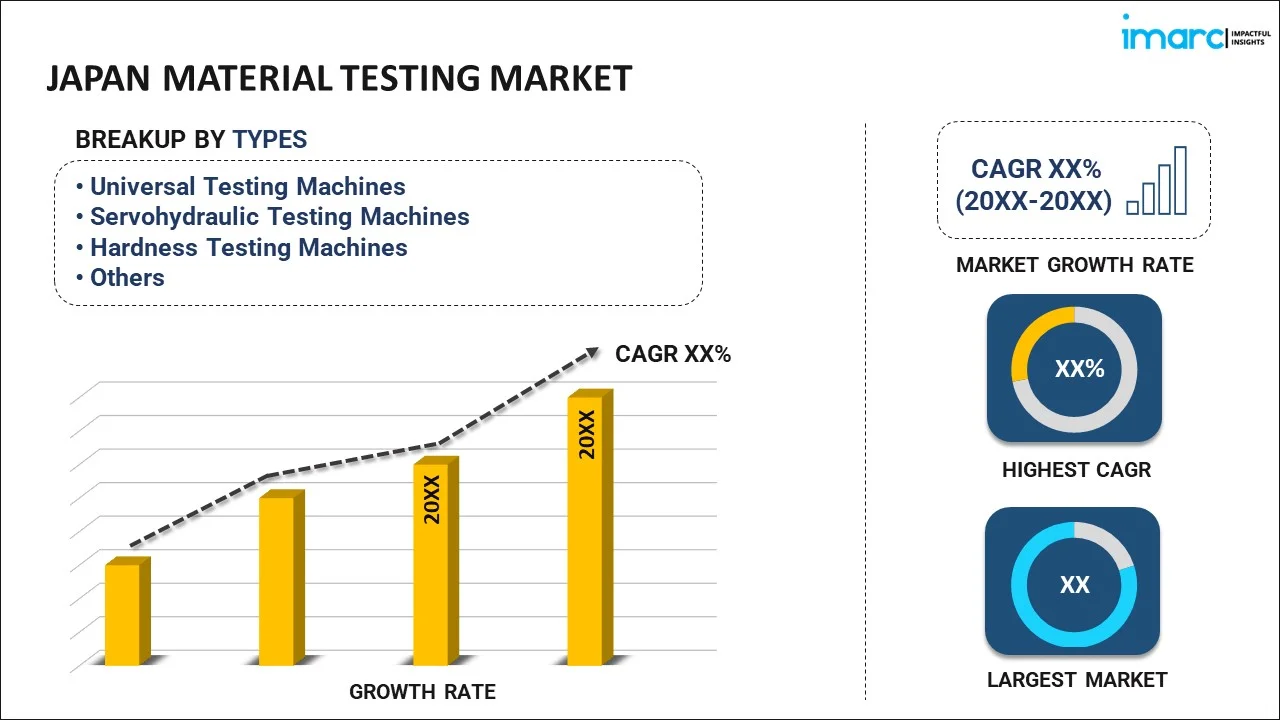
To get detailed segment analysis of this market Request Sample
- Universal Testing Machines
- Servohydraulic Testing Machines
- Hardness Testing Machines
- Impact Testing Machines
- Non-Destructive Testing Machines
Breakup by Material:
- Metals and Alloys
- Plastics
- Rubber and Elastomers
- Ceramics and Composites
- Others
Breakup by End Use Industry:
- Automotive
- Construction
- Education
- Aerospace and Defense
- Oil and Gas
- Energy and Power
- Others
Breakup by Region:
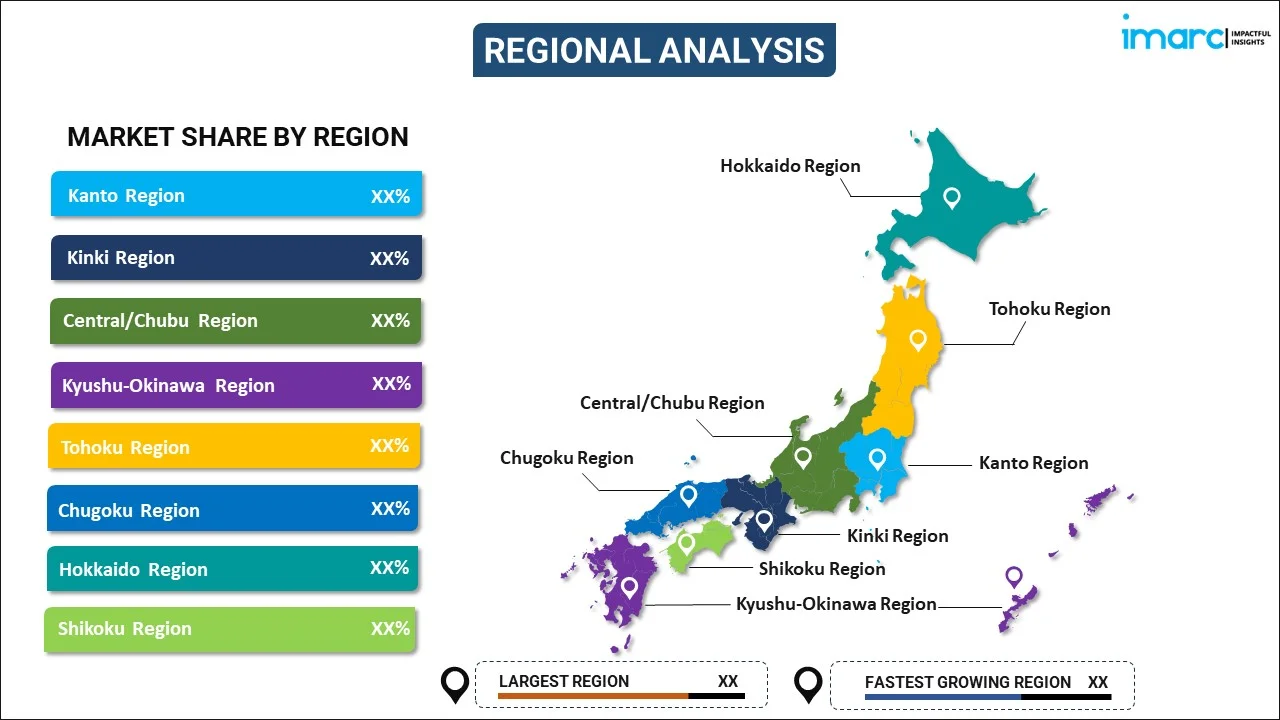
To get detailed regional analysis of this market Request Sample
- Kanto Region
- Kinki Region
- Central/ Chubu Region
- Kyushu-Okinawa Region
- Tohoku Region
- Chugoku Region
- Hokkaido Region
- Shikoku Region
.webp)
Competitive Landscape:
The competitive landscape of the industry has also been examined along with the profiles of the key players.
Report Coverage:
| Report Features | Details |
|---|---|
| Base Year of the Analysis | 2025 |
| Historical Period | 2020-2025 |
| Forecast Period | 2026-2034 |
| Units | Million USD |
| Segment Coverage | Type, Material, End Use Industry, Region |
| Region Covered | Kanto Region, Kinki Region, Central/ Chubu Region, Kyushu-Okinawa Region, Tohoku Region, Chugoku Region, Hokkaido Region, Shikoku Region |
| Customization Scope | 10% Free Customization |
| Post-Sale Analyst Support | 10-12 Weeks |
| Delivery Format | PDF and Excel through Email (We can also provide the editable version of the report in PPT/Word format on special request) |
Frequently Asked Questions About the Japan Material Testing Market Report
The Japan material testing market reached a value of USD 443.5 Million in 2025.
The market is projected to grow at a CAGR of 3.28% during 2026-2034, reaching USD 598.5 Million by 2034.
Key growth drivers include increasing demand for quality assurance in manufacturing, expanding construction activities, strict safety regulations, rising infrastructure development projects, and the growing adoption of advanced testing services across industrial sectors.
The report covers segmentation by type, material, end use industry, and region. Each segment includes detailed market size and forecast analysis.
Key trends include integration of automated testing equipment, adoption of digital inspection technologies, wider use of non-destructive testing methods, and increasing implementation of data-driven quality monitoring systems.
Need more help?
- Speak to our experienced analysts for insights on the current market scenarios.
- Include additional segments and countries to customize the report as per your requirement.
- Gain an unparalleled competitive advantage in your domain by understanding how to utilize the report and positively impacting your operations and revenue.
- For further assistance, please connect with our analysts.
 Request Customization
 Speak to an Analyst
 Request Brochure
 Inquire Before Buying
Benefits of Customization
- Personalize this research
- Triangulate with your data
- Get data as per your format and definition
- Gain a deeper dive into a specific application, geography, customer, or competitor
- Any level of personalization
Get in Touch With Us
UNITED STATES
Phone: +1-201-971-6302
INDIA
Phone: +91-120-433-0800
UNITED KINGDOM
Phone: +44-753-714-6104
Email: [email protected]
Client Testimonials




.webp)




.webp)













Related Reports

Choose your plan
*Please note that the prices mentioned below are starting prices for each bundle type. Kindly contact our team for further details.*
Single User License
- 1 User License, Access on 2 Devices
- PDF Report + Excel Dataset (Password Protected)
- Lifetime Access
- No Printing Rights
- 10% Free Report Customization
- 10–12 Weeks of Analyst Support
Five User License
- Access for 5 Users, 2 Devices per User
- PDF Report + Excel Dataset (Password Protected)
- Lifetime Access
- Dedicated Account Manager
- 12–14 Weeks of Analyst Support
- No Printing Rights
- 15% Free Report Customization
- 25% Discount on Your Next Purchase
Corporate User License
- Unlimited User Access (Within Your Organization)
- PDF Report + Excel Dataset
- Lifetime Access
- Dedicated Account Manager
- 14–20 Weeks of Analyst Support
- No Printing Rights
- 20% Free Report Customization
- 30% Discount on Your Next Purchase
Essential Insights
What's included:
3 reports
- Lifetime Access
- PDF Reports
- Excel Datasets
- 2 Weeks of Free Analyst Support
- 2 User Licenses
- Access on 2 Devices
- Printing Rights
- Complimentary PowerPoint (PPT) Version
- Complimentary License Upgrade
Professional Access
What's included:
5 reports
- Lifetime Access
- PDF Reports
- Excel Datasets
- 8 Weeks of Free Analyst Support
- 2 User Licenses
- Access on 2 Devices
- Printing Rights
- Complimentary PowerPoint (PPT) Version
- Complimentary License Upgrade
Business Advantage
What's included:
8 reports
- Lifetime Access
- PDF Reports
- Excel Datasets
- 14 Weeks of Free Analyst Support
- 2 User Licenses
- Access on 2 Devices
- Printing Rights
- Complimentary PowerPoint (PPT) Version
- Complimentary License Upgrade
Enterprise Intelligence
What's included:
10 reports
- Lifetime Access
- PDF Reports
- Excel Datasets
- 20 Weeks of Free Analyst Support
- 2 User Licenses
- Access on 2 Devices
- Printing Rights
- Complimentary PowerPoint (PPT) Version
- Complimentary License Upgrade