
Spain Logistics Market Size, Share, Trends and Forecast by Model Type, Transportation Mode, End Use, and Region, 2026-2034
Spain Logistics Market Size, Share, Trends & Forecast (2026-2034)
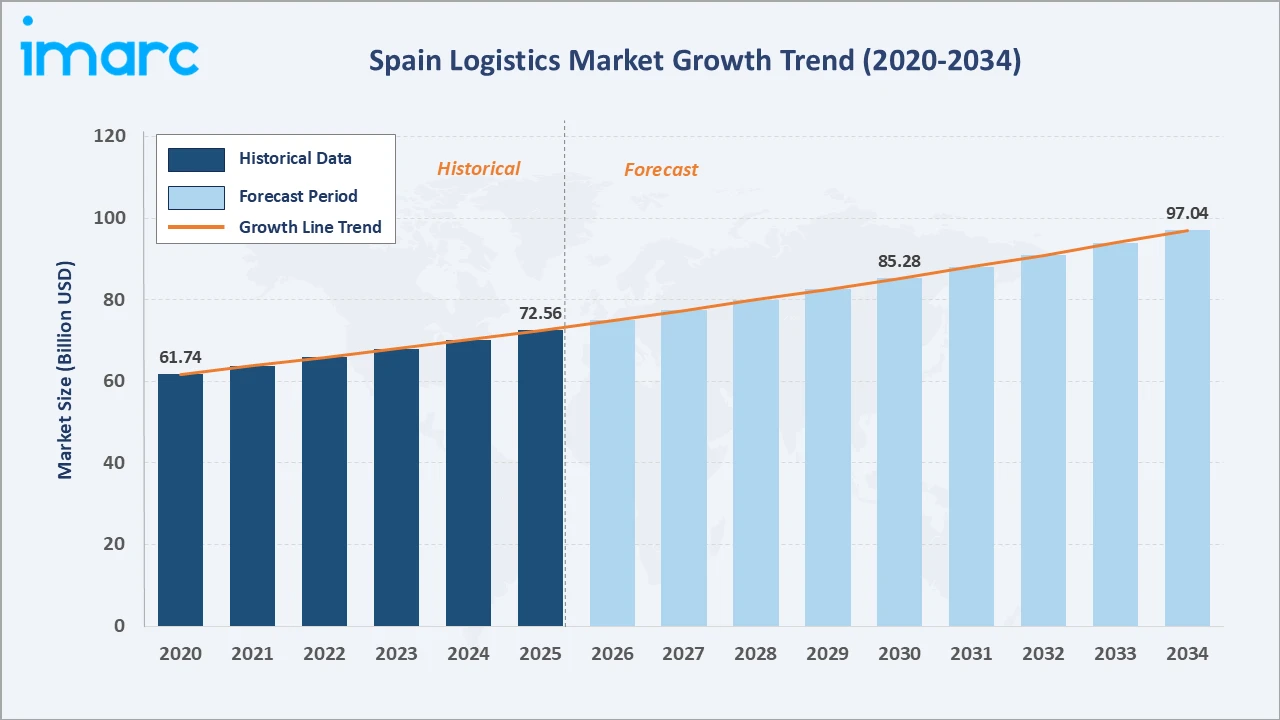
The Spain logistics market reached USD 72.56 Billion in 2025 and is projected to reach USD 97.04 Billion by 2034, exhibiting a CAGR of 3.28% during 2026-2034. Logistics investment in Spain reached €690 million in the first half of 2026, representing a 24% increase year over year compared with the same period in 2025. This rising capital inflow is driving the Spain logistics market by supporting the development and modernization of warehouses, distribution centers, and logistics infrastructure while strengthening capacity for e-commerce, retail, and industrial supply chains. 3PL leads the model type at 58.6%, roadways dominate the transportation mode at 68.4%, and Central Spain accounts for the largest regional share at 32.8%.
Market Snapshot
|
Metric |
Value |
|
Market Size (2025) |
USD 72.56 Billion |
|
Forecast Market Size (2034) |
USD 97.04 Billion |
|
CAGR (2026-2034) |
3.28% |
|
Base Year |
2025 |
|
Historical Period |
2020-2025 |
|
Forecast Period |
2026-2034 |
|
Dominant Model Type |
3 PL – 58.6% (2025) |
|
Dominant Transportation Mode |
Roadways – 68.4% (2025) |
|
Leading Region |
Central Spain – 32.8% (2025) |
The Spain logistics industry size grew from USD 61.74 Billion in 2020 to USD 72.56 Billion in 2025, driven by the e-commerce logistics boom, rapid 3PL outsourcing by manufacturing, consumer goods, and healthcare companies, the strategic expansion of Spain’s dedicated logistics infrastructure, and the progressive integration of digital Transport Management Systems (TMS) and Warehouse Management Systems (WMS), reducing operating costs. The market is projected to reach USD 85.28 Billion by 2030 and USD 97.04 Billion by 2034.
To get more information on this market, Request Sample
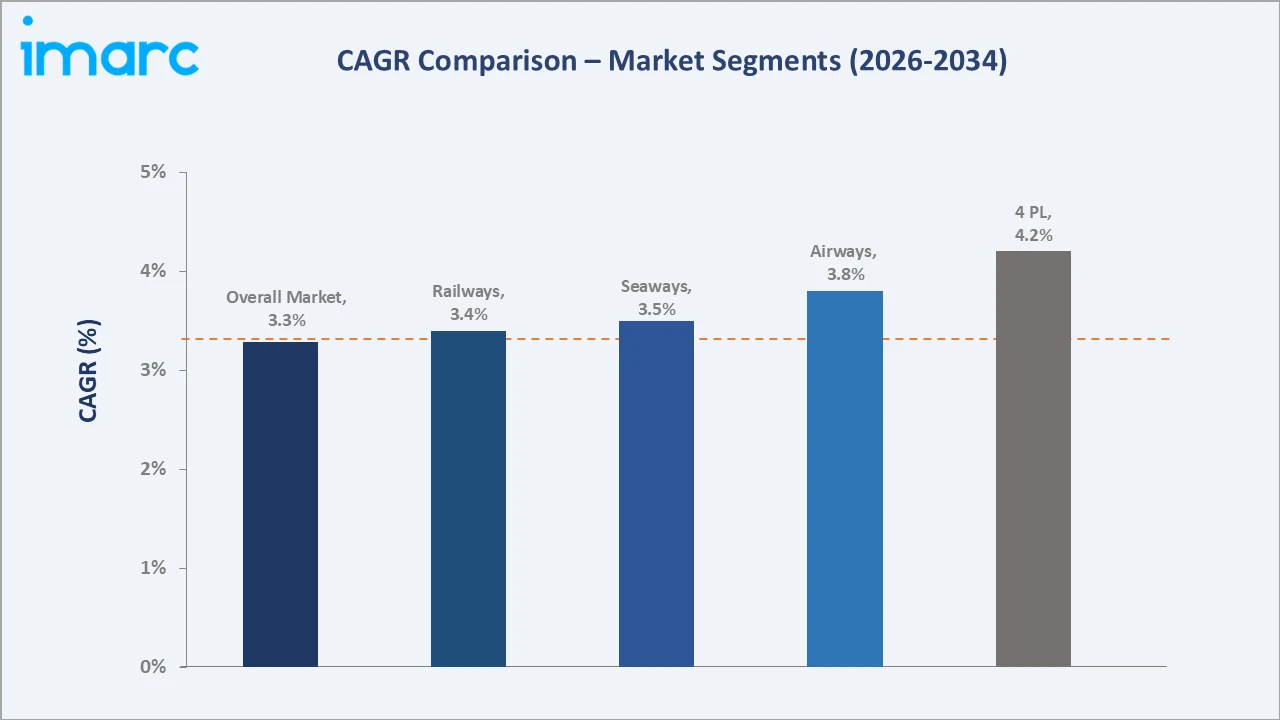
4PL model type grows fastest at ~4.20% CAGR through integrated supply chain orchestration demand from multinational manufacturers. Airways logistics grow at ~3.80% CAGR through pharmaceutical cold chain, high-value electronics, and e-commerce express shipment demand. Seaways grow at ~3.50% CAGR through container port expansion. Railways grow at ~3.40% CAGR through Corredor Mediterraneo freight capacity enhancement and EU modal shift targets.
Executive Summary
Spain logistics industry growth occupies a strategically vital position in the European supply chain ecosystem, serving simultaneously as the EU’s largest agricultural export logistics platform, the automotive industry’s critical supply chain hub, the gateway to Latin America, and the Mediterranean’s largest maritime logistics corridor anchor.
3PL commands 58.6% model type share through its versatility in serving Spain’s fragmented SME manufacturing base alongside multinational retail, healthcare, and automotive clients who progressively consolidate logistics functions with specialized 3PL operators offering scale, technology, and network density advantages over in-house operations. Roadways’ 68.4% transportation mode share reflects Spain’s road network combined with the Spanish trucking industry’s fleet providing door-to-door distribution.
Key Market Insights
|
Insight |
Data |
|
Dominant Model Type |
3 PL – 58.6% share (2025) |
|
Dominant Transportation Mode |
Roadways – 68.4% share (2025) |
|
Leading Region |
Central Spain – 32.8% share (2025) |
|
Market Opportunity |
Green logistics decarbonization investment for EU Carbon Border Adjustment Mechanism (CBAM) compliance; pharmaceutical cold chain expansion leveraging Spain’s authorized pharmaceutical laboratories; Corredor Mediterraneo rail freight for intermodal truck-to-rail modal shift; 4PL integrated control tower services for Spanish multinational supply chain optimization |
Key Analytical Observations Supporting the Above Data:
- 3 PL at 58.6% (2025): Third-party logistics (3PL) providers, offering contracted transportation management, warehousing, inventory management, pick-and-pack fulfillment, customs brokerage, and value-added services to shippers who retain strategic supply chain ownership, constitute Spain’s largest logistics model by revenue through the structural outsourcing of logistics functions by Spanish manufacturers, retailers, and e-commerce operators.
- Roadways at 68.4% (2025): Spain’s road freight sector dominates Spanish logistics through its ubiquity, flexibility, and the inability of rail or maritime to replicate door-to-door service for the Spanish territory where direct port or rail terminal access is impractical. Around 95% of freight transport in Spain is carried by road, supported by a road network extending more than 165,600 km. Approximately 2,500 km comprise freeways, including over 600 km of toll-free routes, highlighting the country’s strong road-based freight infrastructure.
- Central Spain at 32.8% (2025): Central Spain leads the market due to Madrid’s strategic location, dense road and rail connectivity, large consumer base, and concentration of national distribution centers. Its central position enables efficient nationwide freight movement and supports strong demand for warehousing, e-commerce fulfillment, and third-party logistics services.
Spain Logistics Market Overview
The Spain logistics market encompasses the planning, transportation, storage, and distribution of goods across domestic and international supply chains. Key services include road, rail, maritime, and air freight, warehousing, freight forwarding, courier and express delivery, and third-party logistics (3PL). The market serves industries such as retail, e-commerce, automotive, manufacturing, food and beverages, and pharmaceuticals. Macroeconomic factors include GDP growth, international trade volumes, industrial production, consumer spending, e-commerce expansion, inflation, and fuel costs.
Market Dynamics
To evaluate market opportunities, Request Sample
Market Drivers
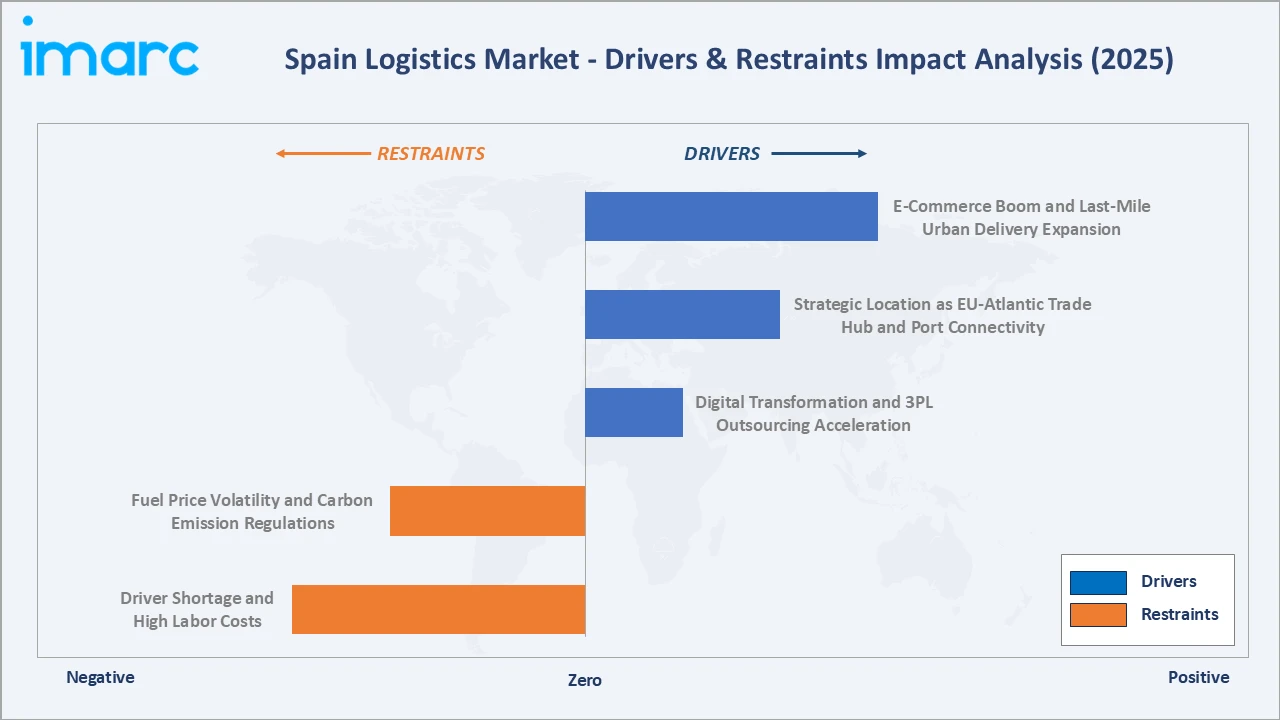
- E-Commerce Boom and Last-Mile Urban Delivery Expansion: Spain’s e-commerce market is the primary structural driver of Spain’s logistics market acceleration above the economy-wide 3.28% CAGR baseline. Spain’s urban logistics policy is creating investment demand for electric LCV (light commercial vehicle) fleets, micro-fulfillment center development in urban cores, and parcel locker networks.
- Strategic Location as EU-Atlantic Trade Hub and Port Connectivity: Spain’s geographic position provides a structural geographic advantage for maritime transshipment and freight hub operations that landlocked European logistics markets cannot replicate. The Port of Algeciras in Spain handles approximately 5 million TEUs annually, placing it among the 30 busiest container ports worldwide. The port has more than 30 commercial berths, while its main container terminal spans roughly 300,000–460,000 square meters, supporting large-scale maritime freight and container operations.
- Digital Transformation and 3PL Outsourcing Acceleration: The progressive digitalization of Spain’s logistics industry is simultaneously increasing Spain’s logistics sector productivity (reducing transit times and empty running rates through AI route optimization) and accelerating 3PL outsourcing as Spanish manufacturers recognize that Spain digital logistics market capability requires scale investment beyond individual company capacity.
Market Restraints
- Driver Shortage and High Labor Costs: A shortage of qualified heavy goods vehicle (HGV) drivers is hampering the Spain logistics market by constraining road freight capacity and increasing delivery lead times. Rising wages, recruitment expenses, and retention costs are also rising operating costs for logistics providers, putting pressure on margins and freight rates.
- Fuel Price Volatility and Carbon Emission Regulations: Fuel price volatility and stricter carbon emission regulations are hampering the Spain logistics market by increasing operating and compliance costs for road freight and logistics providers. Higher investment requirements for low-emission fleets, alternative fuels, and cleaner technologies can further pressure margins, particularly for small and mid-sized operators.
Market Opportunities
- Green Logistics Decarbonization Investment: Green logistics decarbonization investment represents a significant opportunity as operators transition toward lower-emission freight and distribution networks. Investment in electric and alternative-fuel vehicles, charging infrastructure, renewable-powered warehouses, and energy-efficient logistics facilities can reduce emissions and long-term operating costs. Companies adopting greener logistics solutions can also strengthen regulatory compliance and meet growing sustainability requirements from shippers and corporate customers.
- Mediterranean Corridor Transport Infrastructure: Spain’s Mediterranean Corridor attracted EUR 2.9 billion in investment between January 2024 and March 31, 2026. The funding supported the construction, upgrading, and modernization of railway sections, stations, and access connections to major cities and ports, strengthening the country’s transport infrastructure. Modernized infrastructure can support faster freight movement, greater intermodal transportation, and reduced dependence on road freight. Improved port and rail access can also strengthen Spain’s role as a strategic logistics gateway for European and Mediterranean trade.
Market Challenges
- Infrastructure Congestion Around Major Logistics Hubs: High freight volumes around Madrid, Barcelona, Valencia, and major port areas can create congestion and increase transit times. Bottlenecks on key road corridors and urban access restrictions can reduce delivery efficiency. Logistics providers must increasingly optimize routes, schedules, and distribution networks to maintain service reliability.
- Digital Transformation and Cybersecurity Risks: Increasing adoption of IoT, cloud platforms, warehouse automation, AI, and real-time tracking systems is making logistics operations more digitally connected. However, implementation costs, legacy-system integration, and cybersecurity threats remain significant challenges. Companies must continuously invest in secure digital infrastructure and workforce capabilities.
Emerging Market Trends
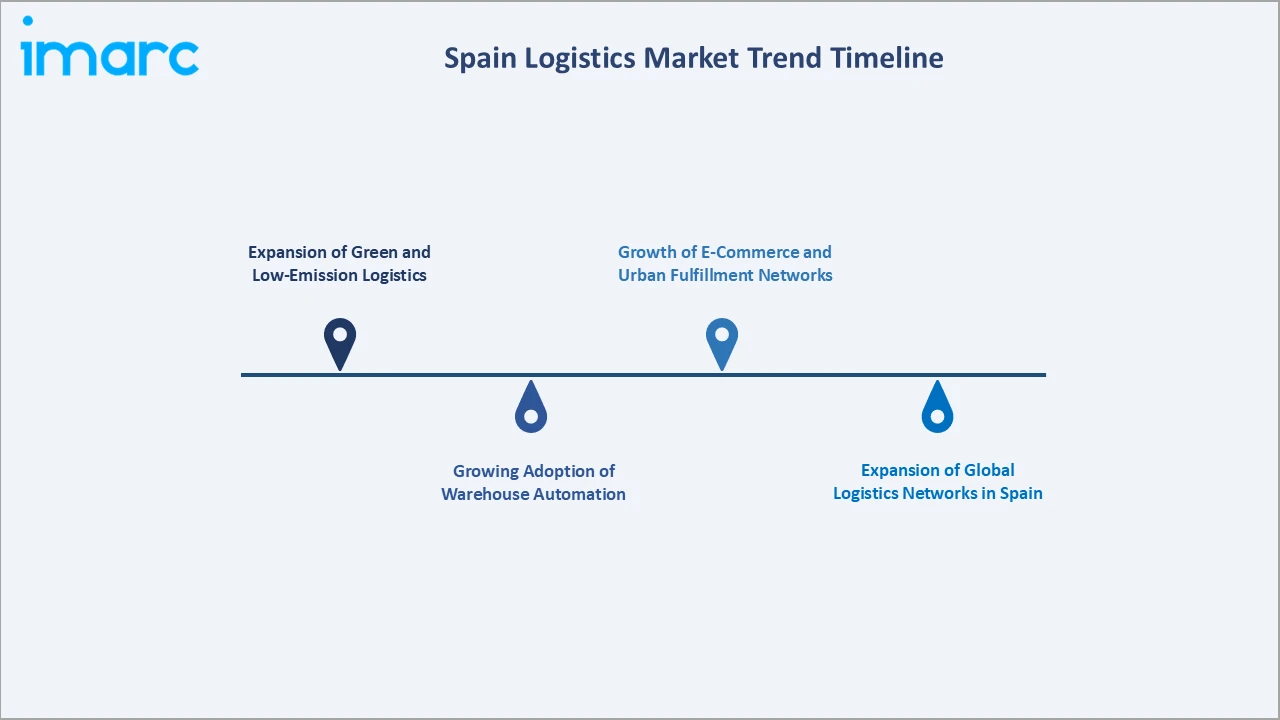
1. Expansion of Green and Low-Emission Logistics
Spain’s logistics sector is increasingly shifting toward electric delivery vehicles, alternative fuels, renewable-powered warehouses, and energy-efficient logistics facilities. Decarbonization requirements are encouraging fleet operators and logistics companies to reduce dependence on conventional fuels. This trend is particularly visible in urban distribution and last-mile logistics.
2. Growing Adoption of Warehouse Automation
Logistics operators are increasingly deploying automated storage and retrieval systems, robotics, conveyor systems, and automated sorting technologies. Automation enables warehouses to process larger shipment volumes while improving speed, accuracy, and space utilization. Rising labor costs and e-commerce fulfillment requirements are further supporting technology adoption.
3. Expansion of Global Logistics Networks in Spain
In November 2025, Logistics Plus, Inc. expanded its European presence with the launch of Logistics Plus Spain (LP Spain), headquartered in Barcelona. The new operation will initially provide project logistics, import-export management, customs brokerage, warehousing, and local transportation services, while supporting the company’s broader European network. The expansion represents another step in Logistics Plus’ global growth strategy, with plans to potentially establish additional operations across Spain and Portugal. Increasing investment in project logistics, customs brokerage, warehousing, and import-export services is enhancing Spain’s role as a strategic logistics gateway between European and international markets.
4. Growth of E-Commerce and Urban Fulfillment Networks
Continued e-commerce development is increasing demand for urban warehouses, micro-fulfillment centers, parcel hubs, and last-mile delivery infrastructure. Logistics providers are positioning inventory closer to major population centers to enable faster deliveries. This is driving demand for technology-enabled and strategically located logistics facilities.
Industry Value Chain Analysis
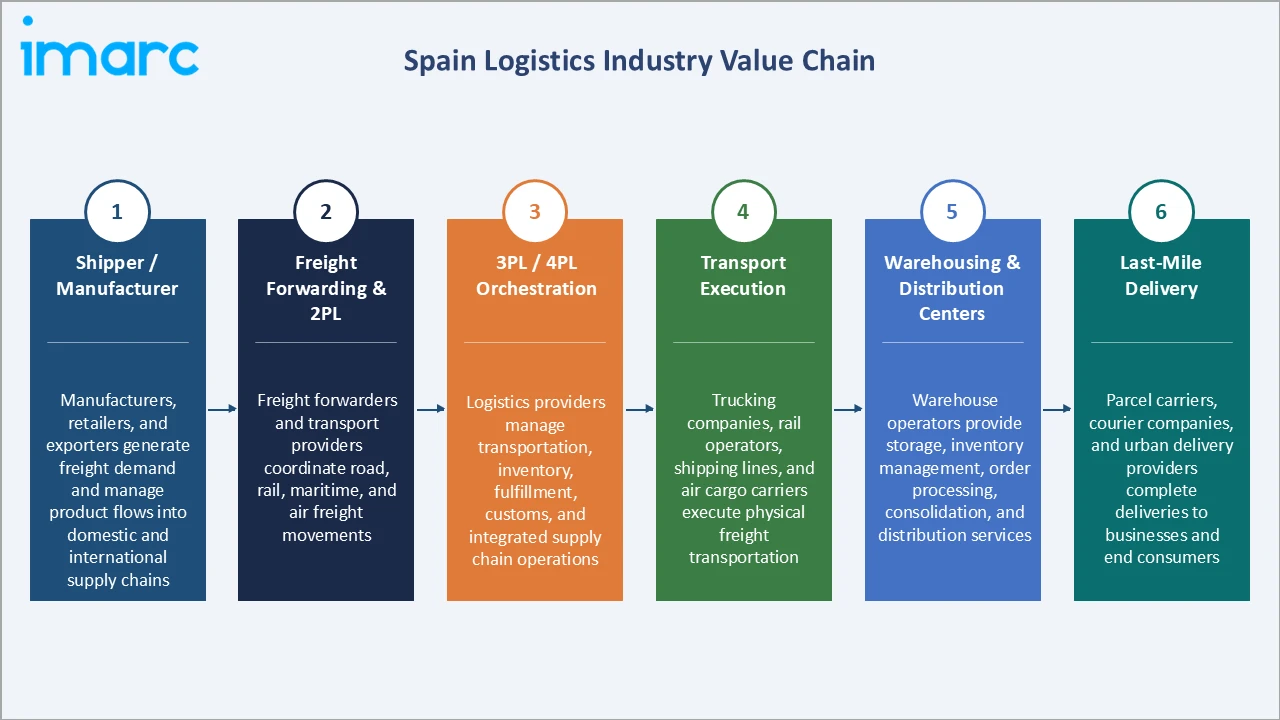
Spain’s logistics value chain integrates shipper/manufacturer consignment origination, freight forwarding and asset provision, 3PL/4PL orchestration, multi-modal transport execution, warehousing and distribution center operations, and last-mile delivery to end customers across Spain municipalities.
|
Stage |
Key Participants & Details |
|
Shipper / Manufacturer |
Manufacturers, retailers, and exporters generate freight demand and manage product flows into domestic and international supply chains. |
|
Freight Forwarding & 2PL |
Freight forwarders and transport providers coordinate road, rail, maritime, and air freight movements. |
|
3PL / 4PL Orchestration |
Logistics providers manage transportation, inventory, fulfillment, customs, and integrated supply chain operations. |
|
Transport Execution |
Trucking companies, rail operators, shipping lines, and air cargo carriers execute physical freight transportation. |
|
Warehousing & Distribution Centers |
Warehouse operators provide storage, inventory management, order processing, consolidation, and distribution services. |
|
Last-Mile Delivery |
Parcel carriers, courier companies, and urban delivery providers complete deliveries to businesses and end consumers. |
3PL / 4PL orchestration is the most value-added stage as it integrates transportation, warehousing, inventory management, customs, technology, and supply chain planning into a coordinated solution. Advanced analytics, real-time visibility, and network optimization enable providers to improve efficiency, reduce logistics costs, and strengthen supply chain performance.
Technology Landscape in the Spain Logistics Industry
Artificial Intelligence and Predictive Analytics
AI and machine learning are increasingly used for demand forecasting, route optimization, inventory planning, and capacity management. These technologies allow logistics operators to analyze large volumes of operational data and anticipate disruptions. Predictive analytics also supports more efficient fleet utilization, delivery planning, and resource allocation.
Warehouse Automation and Robotics Technology
Modern logistics facilities are adopting automated storage and retrieval systems (AS/RS), autonomous mobile robots, robotic picking, and automated sorting systems. In June 2026, Mercadona opened its first semi-automated “Colmena” warehouse in Madrid, investing EUR 54 million in a 32,000-square-meter facility equipped with 70 robots. The center can prepare up to 5,000 online orders per day and is expected to help Mercadona reach about 95% municipal coverage in Madrid by the end of 2026. These technologies increase warehouse throughput while reducing repetitive manual operations.
Electric and Alternative-Fuel Fleet Technology
Logistics operators are gradually adopting battery-electric vehicles, alternative-fuel trucks, charging infrastructure, and energy-management systems to reduce transportation emissions. These technologies are particularly suitable for urban and last-mile distribution. Their adoption supports Spain’s broader shift toward lower-carbon freight transportation.
Market Segmentation Analysis
The report covers the following segments:
|
Segment Category |
Leading Segment |
Market Share |
Year |
|
Model Type |
3 PL |
58.6% |
2025 |
|
Transportation Mode |
Roadways |
68.4% |
2025 |
|
End Use |
🔒 |
🔒 |
2025 |
|
Region |
Central Spain |
32.8% |
2025 |

By Model Type
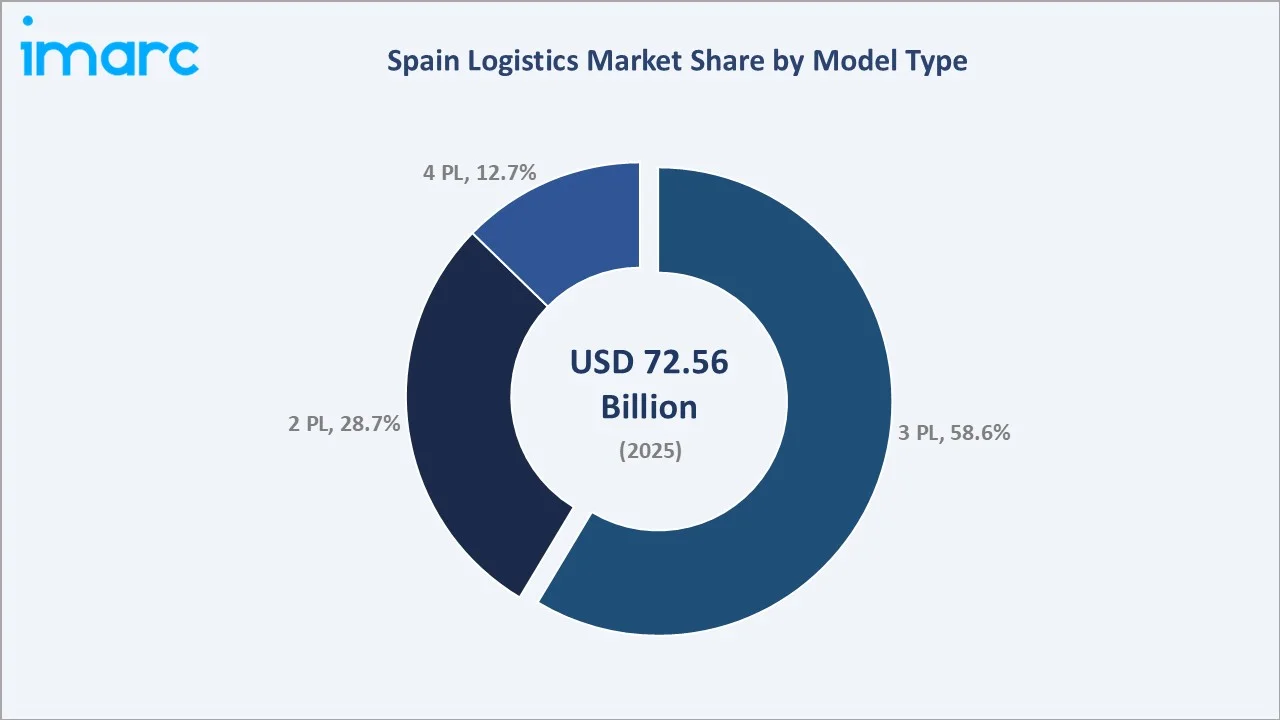
3 PL leads at 58.6% (2025) through contracted outsourced logistics services for Spain’s manufacturing, retail, and e-commerce sectors requiring specialist logistics capability at scale.
To access detailed market analysis, Request Sample
2 PL at 28.7% represents asset-based direct transport services across road, sea, rail, and air. 4 PL at 12.7%, growing fastest at ~4.20% CAGR, through integrated supply chain management for Spanish multinationals and complex manufacturing clients.
By Transportation Mode
Roadways leads at 68.4% (2025) through Spain’s extensive highway network and the trucking industry’s ubiquitous door-to-door service capability. Seaways, at 17.8%, serves maritime import, export, and transshipment through Spain’s port network.
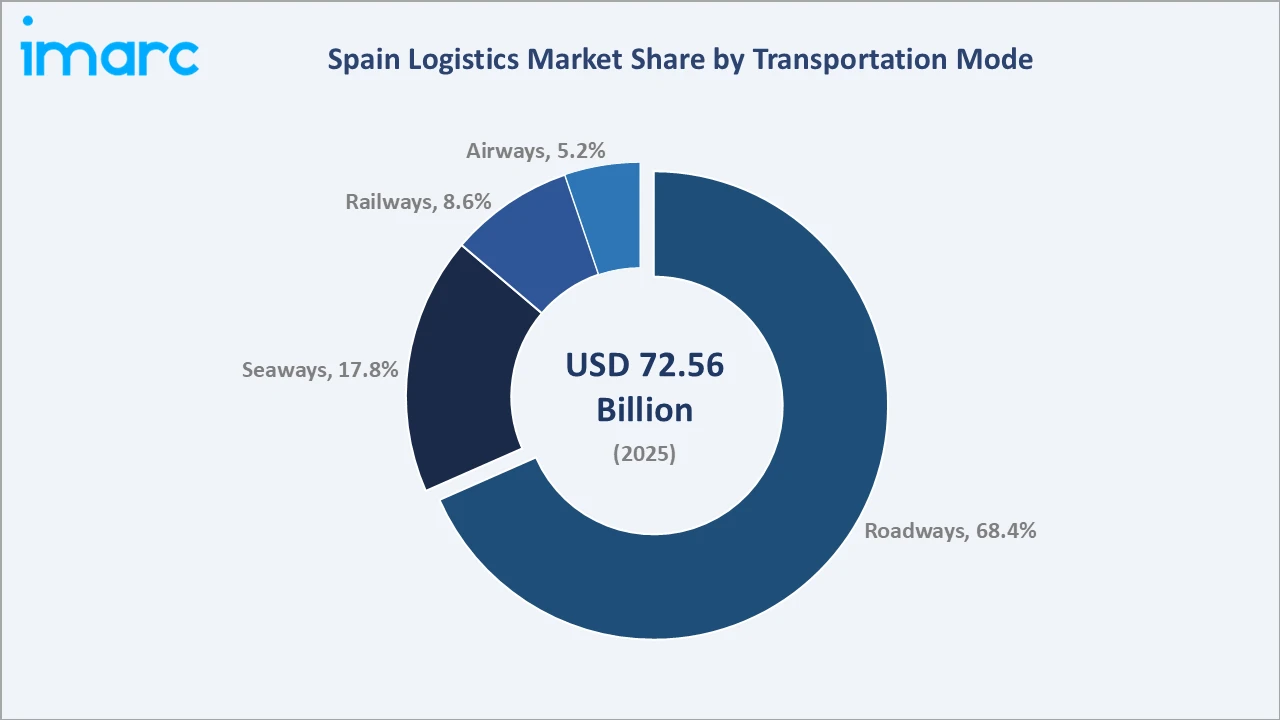
Railways at 8.6% grow at ~3.40% CAGR through Corredor Mediterráneo capacity enhancement. Airways at 5.2%, growing fastest at ~3.80% CAGR, through pharmaceutical cold chain, electronics, and e-commerce express air freight.
Regional Market Insights
|
Region |
Share (2025) |
Key Logistics Market Drivers & Characteristics |
|
Central Spain |
32.8% |
Madrid’s central location, extensive road connectivity, large consumer base, and concentration of warehouses and national distribution hubs support market leadership. |
|
Eastern Spain |
25.6% |
Strong port infrastructure, manufacturing activity, and international trade through Valencia and Barcelona support freight and warehousing demand. |
|
Northern Spain |
22.4% |
Industrial activity, Atlantic port connectivity, and cross-border trade with France and wider European markets strengthen logistics operations. |
|
Southern Spain |
19.2% |
Major maritime gateways, including Algeciras, along with agricultural exports and trade links with Africa and Mediterranean markets, support regional logistics demand. |
Central Spain leads with a 32.8% share in 2025, supported by Madrid’s strategic central location, dense road connectivity, and strong concentration of national distribution centers. Eastern Spain accounts for 25.6%, benefiting from major ports such as Valencia and Barcelona, along with strong manufacturing and international trade activity.
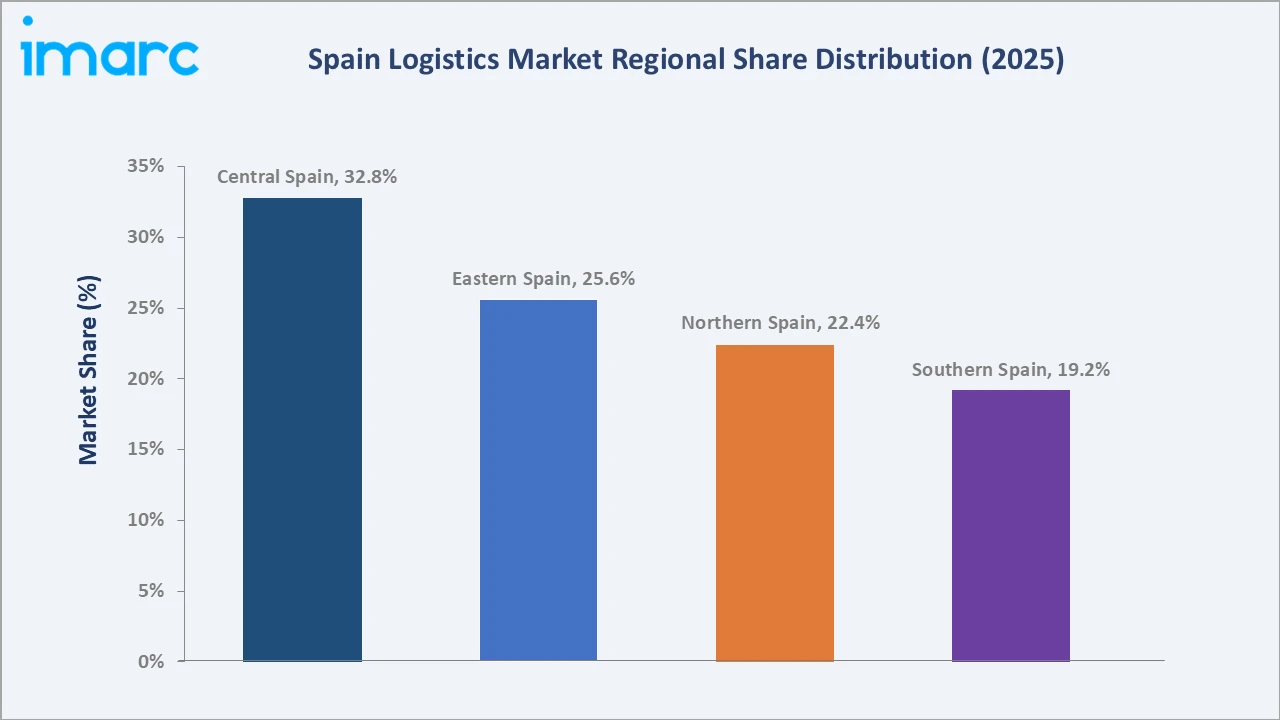
Northern Spain holds a 22.4% share, supported by industrial clusters, Atlantic port access, and cross-border connectivity with France and other European markets. Southern Spain represents 19.2%, driven by the Port of Algeciras, agricultural exports, and trade links with North Africa and Mediterranean markets.
Competitive Landscape
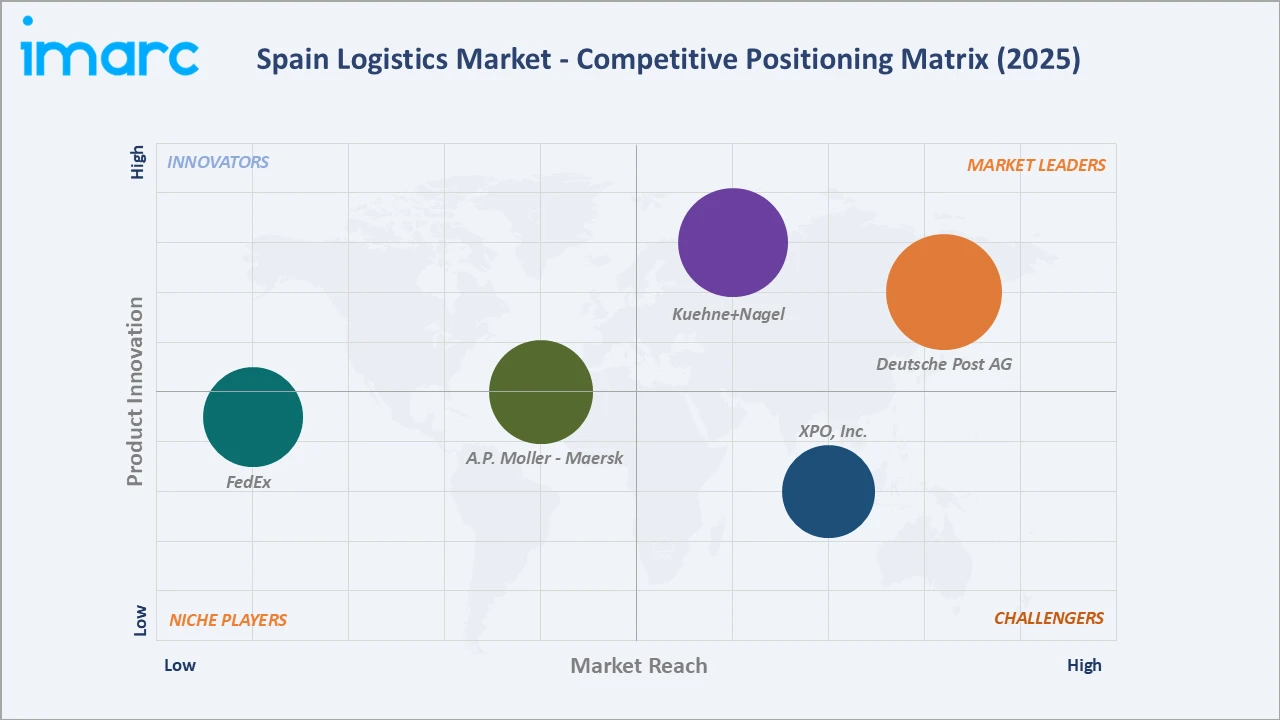
The Spain logistics market is moderately concentrated, with large international logistics groups competing alongside established domestic and regional operators across freight forwarding, warehousing, 3PL, and parcel delivery.
|
Company |
Key Brands |
Market Position |
Core Strength |
|
Deutsche Post AG |
DHL Supply Chain |
Market Leader |
Deutsche Post AG manages its Spanish operations through its master international logistics brand, DHL Group. |
|
XPO, Inc. |
XPO Logistics |
Challenger |
XPO, Inc. is a leading end-to-end supply chain partner in Europe, operating as the number one provider of Less-Than-Truckload (LTL) and full truckload services in Spain. |
|
FedEx |
FedEx Logistics |
Established Player |
FedEx anchors Spain's logistics network by connecting local SMEs to various countries and territories. |
|
A.P. Moller - Maersk |
Maersk |
Established Player |
A.P. Moller - Maersk acts as a global integrator in Spain, connecting ocean shipping, port operations, rail/truck distribution, and warehousing. |
|
Kuehne+Nagel |
Kuehne+Nagel |
Market Leader |
Kuehne+Nagel plays a leading role in Spain’s supply chain, providing end-to-end air, sea, and road freight. |
Spain’s logistics competitive landscape is characterized by the dominance of international logistics groups whose global network scale, technology investment, and multi-modal capabilities create competitive advantages over domestic operators across all premium service tiers. Domestic operators compete effectively in specialized segments where local network density and relationship advantages outweigh global scale.
Key Company Profiles
Deutsche Post AG
Deutsche Post AG, operating globally under the DHL Group, is a major logistics and transportation company providing express delivery, freight forwarding, contract logistics, e-commerce fulfillment, and supply chain management services. In Spain, DHL maintains an established presence through businesses, serving domestic and international customers across multiple industries. The company supports Spanish businesses through air, ocean, road, and rail freight services, alongside warehousing, customs, and integrated logistics solutions. Its extensive global network, advanced fulfillment capabilities, and technology-driven supply chain services strengthen its position within the Spain logistics market.
- Key Brands: DHL Supply Chain
- Strategic Focus: Strengthening its position in the Spain logistics market through digitalization, sustainability, e-commerce logistics, and operational efficiency. The company is expanding the use of automation, robotics, WMS/TMS platforms, and data-driven supply chain visibility to improve warehousing and fulfillment productivity.
XPO, Inc.
XPO, Inc. is a major transportation and logistics provider with an established presence in Spain, offering solutions across pallet distribution, full truckload, less-than-truckload, last-mile delivery, and integrated transportation services. The company uses its extensive European network to help customers manage freight efficiently across domestic and cross-border supply chains. In Spain, XPO also deploys high-capacity vehicles, including duo-trailers and mega-trucks, to increase freight capacity and improve transportation efficiency. Its emphasis on technology, operational efficiency, customer service, and lower-emission transportation supports its competitive position in the Spain logistics market.
- Key Brands: XPO Logistics.
- Strategic Focus: Strengthening its position in the market through transport efficiency, digitalization, sustainability, and high-capacity freight solutions. The company is expanding its use of duo-trailers and mega-trucks on strategic Spanish corridors to increase load capacity, reduce trips, and lower CO₂ emissions.
Market Concentration Analysis
The Spain logistics industry analysis is moderately concentrated, with large multinational and domestic operators competing alongside numerous regional and specialized providers. Large operators benefit from extensive transportation networks, warehousing capacity, technology platforms, and integrated service portfolios, creating scale advantages. However, significant market share remains distributed among medium-sized and regional companies, maintaining competitive intensity. Competition is particularly strong across 3PL, freight forwarding, e-commerce fulfillment, last-mile delivery, and contract logistics. Continued consolidation, technology investments, and demand for integrated logistics solutions are expected to gradually strengthen the position of larger operators.
Investment & Growth Opportunities
Highest Growth Segments
4 PL model type (~4.20% CAGR) and airways transportation mode (~3.80% CAGR) represent Spain’s logistics market’s highest-growth investment vectors through 2034, followed by seaways (~3.50% CAGR) and railways (~3.40% CAGR) through modal shift investment.
Investment Themes
- Green Logistics Infrastructure: Investment opportunities are expanding in energy-efficient warehouses, rooftop solar, EV charging infrastructure, electric delivery fleets, automation, and low-emission logistics facilities as operators seek to reduce operating costs and supply-chain emissions. Growing demand for technically advanced and energy-efficient logistics warehouses further supports investment in sustainable distribution assets across Spain.
- Corredor Mediterráneo Rail Intermodal Logistics: The Mediterranean Corridor creates investment opportunities in rail freight terminals, port connectivity, intermodal hubs, warehousing, and associated freight services linking Spain with major European markets. Spain has accelerated corridor investment, strengthening the potential for shifting freight toward rail-based logistics.
Future Market Outlook (2026-2034)
The Spain logistics market is projected to grow from USD 72.56 Billion in 2025 to USD 97.04 Billion by 2034, delivering a steady 3.28% CAGR that reflects the structural growth characteristics of a mature but dynamically evolving EU logistics market supported by Spain’s strategic geographic advantages, sustained e-commerce demand expansion, and significant government and private sector infrastructure investment. The anchor value of USD 85.28 Billion in 2030 matches precisely the 2020-2025 growth rate and confirms the structural consistency of Spain’s logistics market growth trajectory anchored in durable trade and consumption fundamentals.
First, Spain’s e-commerce market’s structural expansion provides the most reliable and highest-CAGR demand driver for Spain’s logistics market through 2034. Spain’s B2C e-commerce penetration retains meaningful catch-up growth potential as Spain’s digital commerce adoption continues converging with Northern European benchmarks. Second, Spain’s strategic position as Europe’s maritime transshipment gateway and the EU-LATAM trade corridor anchor provides an irreplaceable geographic asset that will continue driving Spain’s logistics market above EU average growth rates independent of domestic economic cycles. Third, Spain’s green logistics transition will generate a green logistics investment wave in Spain through 2034.
Research Methodology
Primary Research
Primary research comprised in-depth interviews with logistics company senior management, supply chain directors at Spanish manufacturing and retail companies, Spanish port authority and individual port authority representatives, ADIF (railway infrastructure administrator) freight capacity planning team, logistics policy officials, and freight forwarding association representatives.
Secondary Research
Secondary research encompassed a comprehensive review of government publications, industry associations, company annual reports, logistics operator websites, trade databases, and sector-specific reports to assess the Spain logistics market. The research also examined trends in freight transportation, warehousing, e-commerce logistics, infrastructure investment, technology adoption, sustainability, and competitive dynamics to validate market estimates and identify key growth opportunities.
Forecasting Models
Forecasting models developed using historical Spain logistics market data (2020-2025), Spain GDP growth projection, e-commerce market growth trajectory model, port throughput growth projection, rail freight modal shift projection, 3PL outsourcing penetration rate evolution, green logistics investment impact on market growth, and segment-level CAGR differentiation reflecting individual growth drivers.
Spain Logistics Market Report Coverage:
| Report Features | Details |
|---|---|
| Base Year of the Analysis | 2025 |
| Historical Period | 2020-2025 |
| Forecast Period | 2026-2034 |
| Units | Billion USD |
| Scope of the Report | Exploration of Historical Trends and Market Outlook, Industry Catalysts and Challenges, Segment-Wise Historical and Future Market Assessment:
|
| Model Types Covered | 2 PL, 3 PL, 4 PL |
| Transportation Modes Covered | Roadways, Seaways, Railways, Airways |
| End Uses Covered | Manufacturing, Consumer Goods, Retail, Food and Beverages, IT Hardware, Healthcare, Chemicals, Construction, Automotive, Telecom, Oil and Gas, Others |
| Regions Covered | Northern Spain, Eastern Spain, Southern Spain, Central Spain |
| Companies Covered | Deutsche Post AG, XPO, Inc., FedEx, A.P. Moller – Maersk, and Kuehne+Nagel, etc. |
| Customization Scope | 10% Free Customization |
| Post-Sale Analyst Support | 10-12 Weeks |
| Delivery Format | PDF and Excel through Email (We can also provide the editable version of the report in PPT/Word format on special request) |
Key Benefits for Stakeholders:
- IMARC’s industry report offers a comprehensive quantitative analysis of various market segments, historical and current market trends, market forecasts, and dynamics of the Spain logistics market from 2020-2034.
- The research report provides the latest information on the market drivers, challenges, and opportunities in the Spain logistics market.
- Porter's five forces analysis assist stakeholders in assessing the impact of new entrants, competitive rivalry, supplier power, buyer power, and the threat of substitution. It helps stakeholders to analyze the level of competition within the Spain logistics industry and its attractiveness.
- Competitive landscape allows stakeholders to understand their competitive environment and provides an insight into the current positions of key players in the market.
Frequently Asked Questions About the Spain Logistics Market Report
The Spain logistics market reached USD 72.56 Billion in 2025, driven by Spain’s e-commerce market growth, Corredor Mediterráneo freight railway Valencia-Barcelona section, green logistics infrastructure investment, and expansion of automated logistics centers.
The market grows at 3.28% CAGR, reaching USD 97.04 Billion by 2034, supported by rising e-commerce activity, infrastructure development, and growing demand for integrated logistics services.
3 PL leads at 58.6% (2025) through contracted outsourced logistics serving Spain’s fragmented SME manufacturing base alongside multinational retail, healthcare, and automotive clients.
Roadways leads at 68.4% (2025) through Spain’s road network (EU’s most extensive by length per capita) and HGV fleet providing door-to-door service to Spain’s municipalities.
Central Spain leads at 32.8% due to Madrid’s strategic central location, dense transport connectivity, large consumer base, and concentration of major distribution and warehousing hubs. Its strong road and rail links enable efficient nationwide freight movement and support high logistics activity.
Leading companies include Deutsche Post AG, XPO, Inc., FedEx, A.P. Moller – Maersk, and Kuehne+Nagel, among others.
The market is projected to reach USD 85.28 Billion by 2030, driven by Spain’s e-commerce market expansion, the Corredor Mediterráneo standard gauge reaching the French border, enabling direct rail connection to the European standard gauge network, and carbon pricing extension to road transport from 2027, accelerating electric fleet investment.
Top investment opportunities include e-commerce last-mile electric delivery fleet, corredor Mediterráneo rail intermodal logistics, pharmaceutical cold chain GDP logistics expansion, automated 3PL fulfillment center for e-commerce, green logistics park development, and 4PL control tower platform for Spanish multinational supply chains.
Need more help?
- Speak to our experienced analysts for insights on the current market scenarios.
- Include additional segments and countries to customize the report as per your requirement.
- Gain an unparalleled competitive advantage in your domain by understanding how to utilize the report and positively impacting your operations and revenue.
- For further assistance, please connect with our analysts.
 Request Customization
 Speak to an Analyst
 Request Brochure
 Inquire Before Buying
Benefits of Customization
- Personalize this research
- Triangulate with your data
- Get data as per your format and definition
- Gain a deeper dive into a specific application, geography, customer, or competitor
- Any level of personalization
Get in Touch With Us
UNITED STATES
Phone: +1-201-971-6302
INDIA
Phone: +91-120-433-0800
UNITED KINGDOM
Phone: +44-753-714-6104
Email: [email protected]
Client Testimonials




.webp)




.webp)













Related Reports

Choose your plan
*Please note that the prices mentioned below are starting prices for each bundle type. Kindly contact our team for further details.*
Single User License
- 1 User License, Access on 2 Devices
- PDF Report + Excel Dataset (Password Protected)
- Lifetime Access
- No Printing Rights
- 10% Free Report Customization
- 10–12 Weeks of Analyst Support
Five User License
- Access for 5 Users, 2 Devices per User
- PDF Report + Excel Dataset (Password Protected)
- Lifetime Access
- Dedicated Account Manager
- 12–14 Weeks of Analyst Support
- No Printing Rights
- 15% Free Report Customization
- 25% Discount on Your Next Purchase
Corporate User License
- Unlimited User Access (Within Your Organization)
- PDF Report + Excel Dataset
- Lifetime Access
- Dedicated Account Manager
- 14–20 Weeks of Analyst Support
- No Printing Rights
- 20% Free Report Customization
- 30% Discount on Your Next Purchase
Essential Insights
What's included:
3 reports
- Lifetime Access
- PDF Reports
- Excel Datasets
- 2 Weeks of Free Analyst Support
- 2 User Licenses
- Access on 2 Devices
- Printing Rights
- Complimentary PowerPoint (PPT) Version
- Complimentary License Upgrade
Professional Access
What's included:
5 reports
- Lifetime Access
- PDF Reports
- Excel Datasets
- 8 Weeks of Free Analyst Support
- 2 User Licenses
- Access on 2 Devices
- Printing Rights
- Complimentary PowerPoint (PPT) Version
- Complimentary License Upgrade
Business Advantage
What's included:
8 reports
- Lifetime Access
- PDF Reports
- Excel Datasets
- 14 Weeks of Free Analyst Support
- 2 User Licenses
- Access on 2 Devices
- Printing Rights
- Complimentary PowerPoint (PPT) Version
- Complimentary License Upgrade
Enterprise Intelligence
What's included:
10 reports
- Lifetime Access
- PDF Reports
- Excel Datasets
- 20 Weeks of Free Analyst Support
- 2 User Licenses
- Access on 2 Devices
- Printing Rights
- Complimentary PowerPoint (PPT) Version
- Complimentary License Upgrade