How Big Will Be the India E-commerce Logistics Industry by 2033?
Growing Online Shopping Increasing Parcel Movement Nationwide:
The exponential rise in online shopping is fueling unprecedented parcel movement across India. Consumers are increasingly relying on e-commerce platforms for everyday essentials, including fashion, electronics, grocery, and lifestyle products. Additionally, the rise of direct-to-consumer (D2C) brands has added a new dimension to the logistics ecosystem, with a growing emphasis on speed, reliability, and personalized delivery experiences.
Fashion and electronics remain dominant segments, accounting for a major share of total shipments due to frequent product launches and high order volumes. Meanwhile, the grocery and FMCG segments are witnessing the fastest growth, driven by increased adoption of online grocery delivery services in both urban and semi-urban areas. The shift in consumer preferences toward convenience and time efficiency has resulted in higher parcel volumes across pin codes, even in remote regions.
Moreover, India’s expanding digital infrastructure powered by affordable internet access and mobile commerce has democratized e-commerce beyond metro cities. Logistics companies are leveraging this momentum by investing in regional warehouses, last-mile delivery hubs, and tech-enabled fleet management systems to ensure faster order fulfillment. The integration of logistics platforms with e-commerce marketplaces has further streamlined the end-to-end delivery process, reducing lead times and improving customer satisfaction.
Explore in-depth findings for this market, Request Sample
Market Size and Growth Opportunity:
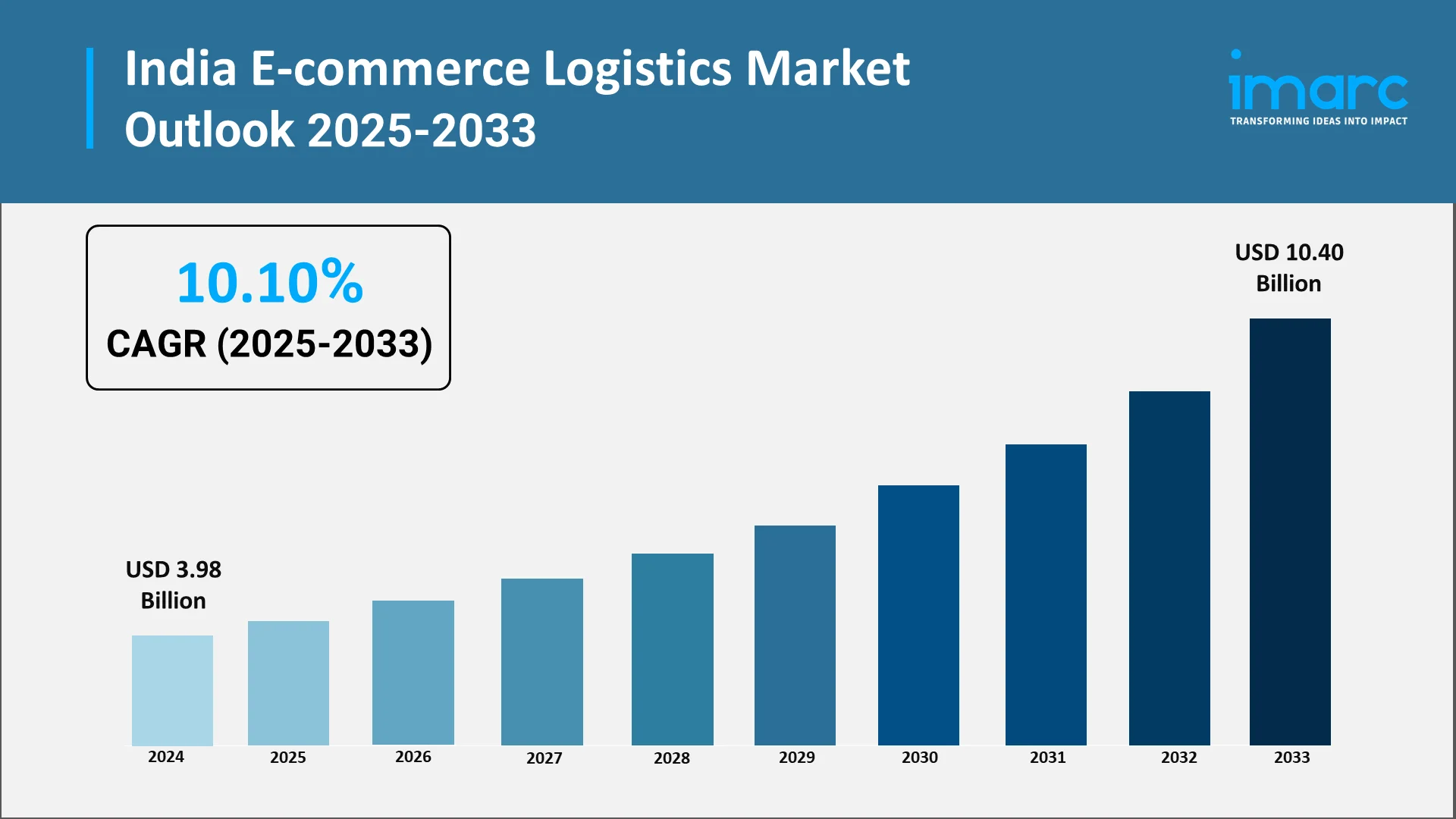
The India e-commerce logistics market size was valued at USD 3.98 Billion in 2024 and is projected to reach USD 10.40 Billion by 2033, growing at a CAGR of 10.10% during 2025–2033. This exponential growth reflects the expanding base of online shoppers, increased order frequency, and the growing penetration of organized logistics infrastructure across India’s urban and rural regions.
The market currently handles billions of deliveries annually, with volumes expected to multiply over the next decade. Tier-2 and Tier-3 cities are emerging as new growth frontiers, contributing significantly to shipment volumes as e-commerce platforms intensify their regional expansion strategies. Rising disposable incomes, improved logistics connectivity, and the proliferation of affordable smartphones have been instrumental in driving this growth.
Furthermore, government initiatives such as Digital India and the development of multimodal logistics parks under the National Logistics Policy are strengthening supply chain resilience. The adoption of electric vehicles for last-mile deliveries and sustainable logistics practices is expected to create new opportunities for eco-efficient operations.
As competition intensifies, logistics service providers are shifting from traditional models to agile, data-driven operations, focusing on faster delivery turnarounds and enhanced transparency. The introduction of hybrid delivery models combining centralized fulfillment centers with localized micro-warehouses is enabling companies to scale efficiently and manage peak order periods more effectively.
Same-day and Next-day Delivery Transforming Customer Expectations:
The rise of same-day and next-day delivery services has redefined consumer expectations in India’s e-commerce landscape. Shoppers now expect rapid, predictable, and transparent delivery experiences as a standard offering. In July 2025, Amazon launched its 10-minute delivery service, Amazon Now, in New Delhi, competing with Blinkit, Instamart, and Zepto. Supported by a INR 2,000 crore investment, the service aims to enhance its dark store network for faster deliveries. This move reinforces Amazon's focus on quick commerce in India's evolving market. This shift is compelling logistics players to rethink their distribution networks, warehouse placement, and inventory management strategies.
To meet these growing expectations, many e-commerce platforms are establishing dark stores and micro-fulfillment centers closer to key consumer clusters. These smaller, tech-enabled warehouses allow rapid dispatch and reduce delivery lead times, particularly in densely populated urban areas. The adoption of automated picking and packing solutions, along with predictive demand analytics, ensures inventory is strategically positioned to meet fluctuating order volumes.
The competition among e-commerce platforms to deliver faster has also spurred collaborations between retailers and logistics service providers. By integrating real-time tracking, advanced route optimization, and flexible delivery windows, businesses can enhance both efficiency and customer experience. Express logistics and hyperlocal delivery startups are further accelerating this trend, providing on-demand logistics solutions for everything from groceries to electronics.
In the long term, same-day and next-day delivery will become the benchmark standard across most categories, pushing companies to continuously innovate in warehouse automation, last-mile routing, and AI-driven delivery forecasting. For logistics providers, the ability to execute fast, accurate, and cost-effective deliveries will be a decisive factor for competitive advantage in the evolving market.
Smart Warehousing, Automation, and Real-Time Tracking Gaining Adoption:
Technology is revolutionizing the e-commerce logistics sector in India. Smart warehousing systems, powered by robotics, automation, and artificial intelligence, are transforming how goods are stored, sorted, and dispatched. These advancements enhance productivity, reduce manual errors, and optimize resource utilization, resulting in faster turnaround times.
AI-enabled inventory management tools are improving forecasting accuracy by analyzing purchasing patterns, seasonal trends, and regional demand variations. Meanwhile, robotic sorting systems are helping warehouses handle higher order volumes with greater precision, particularly during festive or promotional sale periods. Real-time tracking and data analytics provide end-to-end visibility across the supply chain, empowering logistics managers to make informed decisions and improve service reliability.
Moreover, Internet of Things (IoT) integration allows real-time monitoring of vehicle conditions, temperature-sensitive goods, and route performance. Combined with GPS-enabled tracking systems, this ensures transparent, traceable, and secure delivery operations. Blockchain technology is also gradually being adopted for improving transaction transparency, shipment verification, and fraud prevention in high-value consignments.
As India’s logistics ecosystem becomes more digitally integrated, automation will play a pivotal role in achieving scale, efficiency, and sustainability. The adoption of green logistics technologies such as electric delivery vehicles, automated packaging systems, and AI-based route optimization is further aligning with India’s vision for a resilient and sustainable logistics infrastructure.
.webp)
Top Companies in the India E-commerce Logistics Market:
Key companies driving the India e-commerce logistics market growth include:
- Delhivery: In November 2025, Delhivery launched its intracity delivery service, Delhivery Direct, in Delhi-NCR and Bengaluru, competing with Uber and Rapido. The app enables 15-minute pickups for both small and large parcels using various vehicles. This move aims to capture the growing same-day delivery market in India, enhancing opportunities for drivers.
- Ecom Express: In March 2025, Ecom Express launched ‘Pragati’, a learning program aimed at upskilling over 4,000 delivery center managers in last-mile logistics. Utilizing a hybrid learning model, the initiative focuses on career development and local hiring, reinforcing the company’s commitment to operational excellence and a skilled workforce in India's logistics sector.
- Shadowfax: In October 2025, Shadowfax Technologies, supported by Flipkart, received Sebi approval for its IPO, targeting INR 2,000–2,500 crore to achieve an INR 8,500 crore valuation. The company aims to enhance capacity and drive growth in India’s expanding logistics sector, where e-commerce contributes 75% to its revenue.
How IMARC Group Supports Innovation in India’s E-commerce Logistics Industry:
IMARC Group provides in-depth insights into India’s rapidly expanding e-commerce logistics ecosystem, helping stakeholders navigate growth opportunities, operational challenges, and digital transformation trends. Our research empowers logistics providers, retailers, and investors to make informed, data-driven decisions through:
- Market Intelligence: We deliver actionable insights on key market shifts from rising parcel volumes and the dominance of fashion and grocery segments to the surge of D2C brands transforming delivery networks. Our analysis covers evolving consumer behavior, logistics automation, and the impact of Tier-2 and Tier-3 market expansion on distribution models.
- Forecasting and Opportunity Mapping: IMARC Group’s forecasting framework evaluates emerging opportunities in express delivery, warehousing automation, and sustainable logistics. We provide detailed projections of the India e-commerce logistics market size, revenue potential by segment, and expected CAGR trends through 2033 helping clients plan capacity, investment, and expansion strategies with precision.
- Competitive Benchmarking: We assess strategic developments among top logistics players, including innovations in last-mile delivery, technology adoption, and regional diversification. Our competitive benchmarking highlights how key companies are optimizing performance through partnerships, automation, and data-driven fleet management.
- Policy and Infrastructure Analysis: Our studies examine the impact of government initiatives such as the National Logistics Policy, Gati Shakti Master Plan, and Digital India on supply chain resilience and infrastructure expansion. We analyze how public–private collaborations and sustainability mandates are shaping the future of India’s logistics network.
- Tailored Consulting Solutions: Whether optimizing last-mile operations, evaluating warehousing strategies, or exploring new investment regions, IMARC Group offers customized consulting solutions designed to align with business objectives. Our domain expertise ensures clients stay agile, competitive, and future-ready in an evolving logistics landscape.
With the India e-commerce logistics market projected for significant growth, IMARC Group remains a trusted intelligence partner delivering strategic clarity, technological foresight, and actionable insights that drive sustainable growth across the logistics value chain. For detailed insights, data-driven forecasts, and strategic advice, see the complete report here: https://www.imarcgroup.com/india-e-commerce-logistics-marketket
Our Clients










Contact Us
Have a question or need assistance?
Please complete the form with your inquiry or reach out to us at
Phone Number
+91-120-433-0800+1-201-971-6302
+44-113-547-7077
Previous Post

The GCC outbound travel and tourism market has experienced remarkable transformation, driven by economic prosperity, demographic shifts, and evolving consumer preferences. Citizens across the Gulf Cooperation Council nations, including Saudi Arabia, United Arab Emirates, Qatar, Kuwait, Bahrain, and Oman, increasingly venture beyond borders to explore international destinations.
The UAE cold chain logistics market has emerged as a critical component of the nation's broader economic diversification strategy. As the country positions itself as a leading regional hub for trade, commerce, and healthcare, the demand for sophisticated temperature-controlled supply chain solutions continues to intensify.
The Indian online food-delivery ecosystem is undergoing a rapid expansion, propelled by multiple structural shifts in technology, consumer behaviour, and delivery infrastructure. According to a recent report by Bain & Company and Swiggy, the overall food-services market in India is projected to grow from roughly INR 5.5?lakh crore in 2023 to around INR 9–10?lakh crore by 2030.
The Philippines travel and tourism industry is thriving, with travelers drawn to its islands, heritage, and vibrant city life. IMARC Group estimates the market reached USD 14.0 Billion in 2025, reflecting the country’s growing appeal as a global destination. Stronger air connectivity, better infrastructure, and widespread use of digital booking platforms are boosting both leisure and business travel.
The Mexico 3PL market has emerged as a critical pillar supporting the country's economic transformation and integration into global trade networks. As multinational corporations are increasingly viewing Mexico as a strategic manufacturing and distribution hub, the industry is evolving from a supporting service sector into a fundamental driver of competitive advantage.
An e-rickshaw is an electric-powered three-wheeled vehicle designed to transport passengers and goods over a short distance. It is an efficient, low-cost, eco-friendly substitute for conventional fuel-based auto-rickshaws and cycle rickshaws. The general specification of an e-rickshaw involves an electrical motor ranging from 650W to 1500W powered by a rechargeable lead-acid or lithium-ion battery, a lightweight chassis manufactured from mild steel or reinforced metal, and a simple drivetrain system.
Speed, reliability, and supply chain precision have become cornerstones of global commerce. As businesses operate across borders and customers expect shorter delivery times, the need to move products efficiently across continents has become essential. Air freight isn’t just connecting time zones—it’s enabling fast, predictable service that modern logistics depend on.
A truck radiator is an essential part of the truck's cooling system, which is used to control engine temperature by dispersing the excess heat produced during running. The radiator functions by circulating a coolant liquid around the engine, absorbing heat, and then releasing the heat to the air through the radiator's finned surface.
Australia's third-party logistics (3PL) industry is witnessing a revolution, driven by the integration of artificial intelligence (AI), digital infrastructure, and e-commerce growth. Initially based on manual procedures and operations, contemporary logistics chains are now being transformed by real-time data streams, predictive analytics, and smart automation.
Dropshipping is a streamlined e-commerce fulfillment model where sellers promote products without the need to maintain inventory. Instead of managing stock, sellers pass customer orders to third-party suppliers, often manufacturers or wholesalers, who handle packaging and shipping directly to the customer.
The logistics industry, encompassing transportation, warehousing, and distribution, is undergoing significant transformation in 2025. This growth is driven by technological advancements, evolving consumer expectations, and the need for more resilient supply chains.
The logistics sector is a vital component of the supply chain, encompassing the management and transportation of goods and services from their origin to their destination. It involves a broad spectrum of activities such as transportation, warehousing, inventory management, packaging, and goods handling, alongside information flow and supply chain management. The sector ensures the efficient movement of goods through various supply chain stages to meet consumer demand, playing a crucial role in facilitating trade and commerce, supporting economic growth, and serving diverse industries, including manufacturing, consumer goods, retail, food and beverages, IT hardware, healthcare, and chemicals.