Junction Box Manufacturing Cost Analysis: The Connection Equation

What is Junction Box?
The junction box, generally made from plastic, metal, or composite materials, houses wire connections, terminations, and protective components to allow the safe distribution and routing of electrical circuits. The junction box will provide insulation, mechanical protection, and a secure environment to avoid accidental contact with live electrical parts, moisture intrusion, or dust accumulation. Junction boxes are central points where several cables converge, by which branching, splicing, or transitioning could be done between the circuits. They serve such important functions as maintaining electrical safety, meeting code requirements, and supporting reliable power across residential, commercial, industrial, automotive, and solar photovoltaic systems.
Key Applications Across Industries:
The junction box plays a key role in electrical infrastructure, industrial automation, renewable energy, automotive systems, telecommunications, and building services. In residential and commercial buildings, junction boxes are used in both concealed and surface-mount wiring for connection organization and to support lighting circuitry, switches, and sockets while offering protection against possible environmental or mechanical damage to splices. They enable electricians to locate fault points easily and perform maintenance or upgrading work with minimal effort.
Junction boxes in industrial plants are normally rated to survive severe environments, often using IP-rated or explosion-proof enclosures. They protect sensor wiring, motor control connections, automation interfaces, and field instrumentation while allowing for safe signal transmission within factories, refineries, and chemical plants.
In the solar industry, photovoltaic junction boxes are mounted on solar panels to house bypass diodes and cable terminations, enabling efficient energy transfer and protecting modules from hot-spot damage. These solar junction boxes are designed for UV, heat, and weather resistance.
In the automotive industry, junction boxes, often part of a body control module, organize power distribution, relay control, and signal routing for key vehicle functions including lighting, infotainment, safety systems, and sensors.
Other specialized applications include telecommunications networks, marine installations, and outdoor electrical installations that need weatherproof and corrosion-resistant designs. Junction boxes, in all sectors, ensure organized wiring, guaranteeing increased safety and long-term reliability of the electrical systems.
What the Expert Says: Market Overview & Growth Drivers
The global junction box market reached a value of USD 4.77 Billion in 2025. According to IMARC Group, the market is projected to reach USD 8.14 Billion by 2034, at a projected CAGR of 6.1% during 2026-2034. The junction box market grows with increasing investments in infrastructure development, electricity distribution networks, the deployment of renewable energy, and industrial automation. One of the strongest drivers is continuous growth in the construction sector, especially in emerging economies where urbanization and commercial development require extensive electrical installation. Building codes that enforce safe wiring practices also drive up the adoption of high-quality junction boxes in residential and commercial buildings.
Another major growth catalyst is the rapid expansion of the solar photovoltaic industry. Each solar panel has a junction box, and thus the demand for PV-specific junction boxes increases correspondingly with the surge in global solar capacity, whether rooftop, utility-scale, or hybrid renewable systems. In addition, advanced junction boxes are needed for superior thermal performance, diodes, and weatherproofing because high-efficiency solar panels are the trend.
The increasing usage of sensors, control systems, and motor-driven machinery in industrial automation and manufacturing processes demands more robust enclosures that can withstand dust, moisture, chemicals, and mechanical stress. Junction boxes with IP ratings, flameproof, and explosion-proof are in high demand for oil and gas, mining, power plants, and the chemical industry. Increasing vehicle electrification and digitalization of automotive systems also influence the market. A modern vehicle relies on several power-distribution modules and junction boxes for managing complex wiring harnesses. The requirement for next-generation, heat-resistant, compact junction boxes increases because of the proliferation of EVs across the globe.
Moreover, expansion in the field of smart home technologies, telecom networks, and backup power systems (inverters, batteries, rooftop solar) is also acting in favor of the market. All in all, safety regulations, renewable energy adoption, industrial modernization, and vehicle electrification are the core drivers contributing to stable demand for junction boxes worldwide.

Case Study on Cost Model of Junction Box Manufacturing Plant:
Objective
One of our clients reached out to us to conduct a feasibility study for setting up a medium scale junction box manufacturing plant.
IMARC Approach: Comprehensive Financial Feasibility
We developed a comprehensive financial model for the setup and operation of a proposed junction box manufacturing plant in India. This plant is designed to manufacture 1 million units of junction box annually.
Manufacturing Process: The manufacturing process of a junction box comprises of material selection, molding or fabrication, component assembly, and rigorous quality testing to ensure safety and durability as per electrical standards are involved. Manufacturing starts with the selection of the raw material, usually thermoplastics such as PVC, polycarbonate, or ABS, which can work for indoor applications, while for outdoor or solar applications, the material should be UV-resistant or flame-retardant polymers. For metal junction boxes, galvanized steel, aluminum, or stainless-steel sheets are used. In the case of plastic junction boxes, the material is melted and injected into precision injection-molding machines where dies shape the box body, lid, and internal mounting structures. As for the production of metal boxes, the process involves several sheet-metal fabrication steps: cutting, punching, bending, stamping, and surface finishing by galvanizing or powder coating to enhance corrosion resistance. Once the box housing is formed, fittings and accessories are added, including cable glands, terminals, grommets, conduit knockouts, and mounting brackets. Internal terminals or bus bars are manufactured by copper stamping or molding-in inserts and are assembled with automated screw-tightening or riveting systems. Solar junction boxes further include bypass diodes, potting materials, and high-temperature cables that must be installed to tolerate heat and weather conditions. Every box, after assembly, undergoes quality inspections to evaluate dimensional accuracy, mechanical strength, dielectric insulation, IP rating against dust and water protection, and flame-retardancy performance. Functional tests verify the integrity of terminals, connections, and lid-locking mechanisms. Boxes intended for high-reliability environments, such as those demanded by industrial, automotive, or photovoltaic applications, are subjected to thermal cycling, UV exposure, salt-spray resistance, and electrical stress. The junction boxes are labelled and packaged, batch-coded for traceability, and ready for sale. This manufacturing process ensures safe, durable enclosures suitable for diverse electrical installations across buildings, industries, and renewable-energy systems.
Get a Tailored Feasibility Report for Your Project Request Sample'
Raw Material Required:
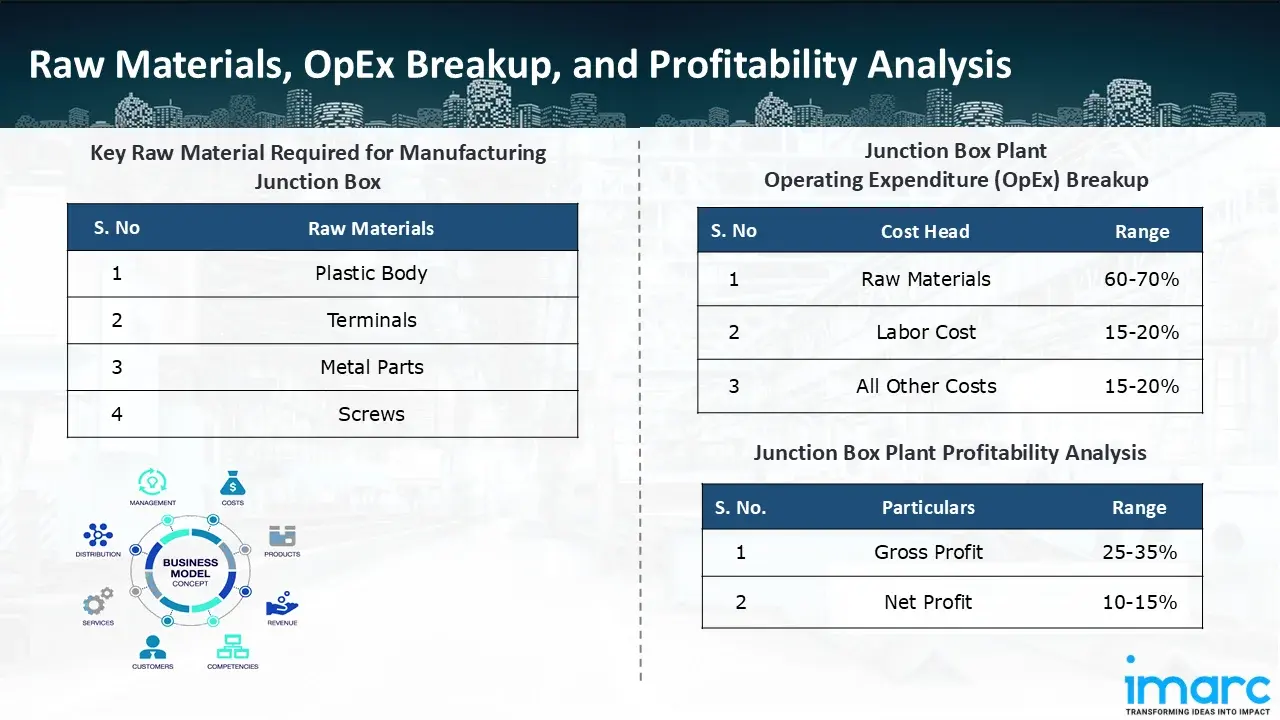
The basic raw materials required for junction box manufacturing include:
- Plastic Body
- Terminals
- Metal Parts
- Screws
Machine Section or Lines Required:
- Injection Molding
- Terminal Stamping
- Assembly
- Testing
Techno-Commercial Parameter:
- Capital Expenditure (CapEx): Capital expenditure (CapEx) in a manufacturing plant includes various investments essential for its setup and long-term operations. It covers machinery and equipment costs, including procurement, installation, and commissioning. Civil works expenses involve land development, factory construction, and infrastructure setup. Utilities such as power, water supply, and HVAC systems are also significant. Additionally, material handling systems, automation, environmental compliance, and safety measures are key components. Other expenditures include IT infrastructure, security systems, and office essentials, ensuring operational efficiency and business growth.
- Operating Expenditure (OpEx): Operating expenditure is the cost incurred to operate a manufacturing plant effectively. Opex in a manufacturing plant typically includes the cost of raw materials, utilities, depreciation, taxes, packing cost, transportation cost, and repairs and maintenance. The operating expenses are part of the cost structure of a manufacturing plant and have a significant effect on profitability and efficiency. Effective control of these costs is necessary for maintaining competitiveness and growth. Furthermore, raw material cost in junction box manufacturing plant ranges between 60-70%, labor cost ranges between 15% to 20%, and all other costs ranges between 15-20% in the proposed plant.
- Profitability Analysis Year on Year Basis: We assisted our client in developing a detailed cost model, which projects steady growth, with revenue rising throughout the projected period. Moreover, gross profit margins lie between a range of 25-35%, and net profit lie between the range of 10-15% during the income projection years, highlighting strong financial viability and profitability.
Conclusion & IMARC's Impact:
Our financial model for the junction box manufacturing plant was meticulously developed to meet the client’s objectives, providing an in-depth analysis of production costs, including raw materials, manufacturing, capital expenditure, and operational expenses. By addressing the specific requirements of manufacturing 1 million units of junction box annually, we successfully identified key cost drivers and projected profitability, considering market trends, inflation, and potential fluctuations in raw material prices. This comprehensive financial model equipped the client with valuable insights into strategic decision-making, demonstrating our commitment to delivering high-quality, client-focused solutions that ensure the long-term success of large-scale manufacturing ventures.
Latest News and Developments:
- In November 2025, a new bifacial solar panel with a 475 W output and a 23.27% power conversion efficiency has been introduced to the Australian market by Chinese company Phono. The panels have an IP 68-rated junction box, a temperature coefficient of -0.26% per degree Celsius, an operating temperature range of -40 to 85 degrees Celsius, and a maximum system voltage of 1,500 volts.
- In November 2025, Indian solar equipment producer DhaSh PV announced its plans to begin producing composite frames for solar modules as part of its next diversification strategy.
- In October 2024, GenX PV India has announced plans to establish a fully integrated aluminium frame manufacturing facility in Raipur. It is also hiking up junction box manufacturing capacity from 20 GW to 50 GW by FY 2025.
Why Choose IMARC?
IMARC's Financial Model Expertise: Helping Our Clients Explore Industry Economics
IMARC is a global market research company that offers a wide range of services, including market entry and expansion, market entry and opportunity assessment, competitive intelligence and benchmarking, procurement research, pricing and cost research, regulatory approvals and licensing, factory setup, factory auditing, company incorporation, incubation services, recruitment services, and marketing and sales.
Under our factory setup services, we assist our clients in exploring the feasibility of their plants by providing comprehensive financial modeling. Additionally, we offer end-to-end consultation for setting up a plant in India or abroad. Our financial modeling includes an analysis of capital expenditure (CapEx) required to establish the manufacturing facility, covering costs such as land acquisition, building infrastructure, purchasing high-tech production equipment, and installation. Furthermore, the layout and design of the factory significantly influence operational efficiency, energy consumption, and labor productivity, all of which impact long-term operational expenditure (OpEx). So, every parameter is covered in the analysis.
At IMARC, we leverage our comprehensive market research expertise to support companies in every aspect of their business journey, from market entry and expansion to operational efficiency and innovation. By integrating our factory setup services with our deep knowledge of industry dynamics, we empower our clients to not only establish manufacturing facilities but also strategically position themselves in highly competitive markets. Our financial modeling and end-to-end consultation services ensure that clients can explore the feasibility of their plant setups while also gaining insights into competitors' strategies, technological advancements, and regulatory landscapes. This holistic approach enables our clients to make informed decisions, optimize their operations, and align with sustainable practices, ultimately driving long-term success and growth.
Our Clients










Contact Us
Have a question or need assistance?
Please complete the form with your inquiry or reach out to us at
Phone Number
+91-120-433-0800+1-201-971-6302
+44-113-547-7077
Previous Post

The Japan power electronics market is poised to grow substantially, driven by rising demand in automotive, energy, industrial automation, and infrastructure sectors. According to IMARC Group, the Japan power electronics market is studied from 2019 to 2024 with projections extending to 2033.
Japan's printed circuit board (PCB) industry is the world leader in technology innovation, enabling consumer electronics, automotive, and next-generation communication system development. As a key enabler of modern electronic products, PCBs provide the essential building blocks for embedding semiconductors, sensors, and microchips into miniaturized, high-performance devices. Japan, through its world-class manufacturing base and engineering expertise, remains the hub of the global PCB supply chain.
Aluminum-Air (Al-Air) battery is a new energy storage technology that has attracted interest as a future alternative to conventional lithium-ion batteries, specifically for electric vehicle (EV) use. As opposed to normal rechargeable batteries, the Al-Air battery is a metal-air electrochemical cell with aluminum as the anode, oxygen from the ambient air as the cathode reactant, and a liquid electrolyte (commonly sodium hydroxide or potassium hydroxide) as the medium through which the reaction occurs.
Aluminium wire is an essential industrial commodity commonly employed in power transmission, electrical distribution, building construction, and manufacturing processes owing to its high conductivity-to-weight ratio, resistance to corrosion, and cost advantage over copper. Produced by methods including continuous casting, rolling, and drawing, aluminum wire is available in various grades and alloys to serve the wide demands, from overhead transmission conductors and building wiring to automotive harnesses and electronic applications.
Air conditioners are electromechanical devices used to control indoor climate by extracting heat and humidity and ensuring optimum air circulation. Generally consisting of a compressor, condenser, evaporator, refrigerant fluid, filters, fans, and electronic controls, air conditioners work based on the principle of heat exchange, moving heat from indoor areas to the external environment. Contemporary units come in diverse configurations, such as split systems, window units, central air systems, and portable models, supporting respective residential, commercial, and industrial applications. Some of the major characteristics are efficiency in cooling, energy use, noise rating, and environmental footprint in relation to refrigerant type.
E-waste, or electronic waste, is electrical and electronic equipment that has been discarded, such as computers, cell phones, television sets, servers, and household appliances. It is among the world's fastest-growing streams of waste, consisting of a heterogeneous combination of metals, plastics, glass, and toxic substances. E-waste contains valuable metals like copper, aluminum, gold, silver, palladium, and rare earth elements, in addition to toxic materials like lead, mercury, cadmium, and brominated flame retardants.
Polished silicon wafers are very pure, ultra-flat semiconductor substrates that are produced from high-quality single-crystal silicon. The wafers act as the material base for making integrated circuits, power devices, and MEMS (Microelectromechanical Systems). The wafers are made of monocrystalline silicon ingots using the Czochralski or Float-Zone process, from which the wafers are cut, lapped, etched, and polished to atomic-scale flatness and defect-free surfaces.
AI is revolutionizing Japan’s semiconductor industry by boosting innovation and efficiency across the entire value chain. Advanced artificial intelligence (AI)-powered Electronic Design Automation (EDA) tools significantly shorten chip design cycles, improving performance and energy efficiency.
Recent projections indicate that Australia semiconductor market, including services, is growing at a steady compound annual growth rate as the nation deepens its tech infrastructure. The importance of semiconductors spans electronics, defense systems, telecommunications, and emerging AI applications, which position the local ecosystem as strategically vital for growth.
Fiber optic cables are high-tech communications cables that carry information like bursts of light along extremely thin glass or plastic strands, providing high-speed, high-bandwidth connectivity with little loss of signal. Fiber optic cables make up the foundation of contemporary telecommunications, carrying internet, cloud computing, 5G networks, and smart infrastructure.
CAT (Category) cables are twisted-pair Ethernet cables utilized for copper-based wired network communications, varying from CAT5e to CAT8 standards. The cables carry data through copper conductors, but with different speeds (up to 40 Gbps for CAT8) and bandwidths, supporting networks such as LANs, data centers, and smart buildings.
India's semiconductor industry is undergoing a revolutionary phase driven by rising demand from industries like consumer electronics, automotive technologies, industrial automation, and telecom infrastructure.
USB data cables are critical elements of contemporary digital connectivity, enabling high-speed and consistent data transfer and power supply for a broad scope of electronic products. They provide the foundation for charging and synchronizing smartphones, tablets, laptops, and other peripherals, with significant applications in consumer electronics, industrial automation, and new technologies. With technologies like USB-C, the cables today carry faster data speeds, more power output, and universal compatibility, making them essential in a world that is connected.
Thin-film-transistor (TFT) liquid-crystal display (LCD) is a type of display technology used in many electronic devices, such as smartphones, tablets, laptops, and televisions (TVs). A backlight, colour filters, a thin-film transistor array, and a liquid crystal layer are among the layers that make up this flat-panel display. TFT LCDs are made to produce sharp images with superb viewing angles, strong contrast, and accurate colour reproduction. They are made up of thousands of tiny transistors that regulate how much light enters each pixel. This makes it possible for the display to generate crisp, detailed images at rapid refresh rates. TFT LCD technology's low power consumption is one of its main benefits, which makes it perfect for battery-operated gadgets.
Polycrystalline solar photovoltaic (PV) modules are a key component of solar energy systems, harnessing sunlight and converting it into electricity through the photovoltaic effect. These modules are composed of multiple interconnected solar cells, each made from polycrystalline silicon. Polycrystalline solar panels are renowned for their efficiency, affordability, and versatility, making them a popular choice for various applications such as solar installations, commercial and industrial projects, off-grid systems and solar farms.
The LED chip is the core component of an LED bulb, comprising semiconductor layers that enable the free flow of protons and electrons. Employed in all LED lighting fixtures—from bulbs to tubes—the LED chip fundamentally determines light quality, with variations in brightness, voltage, and wavelength. These chips are manufactured through a process called MOCVD (metal-organic chemical vapor deposition), which creates the semiconductor layers that facilitate electric flow. Major applications of these chips include backlighting, illumination, automotive lighting, signs, and signals.
Semiconductors are crucial components in the modern electronics industry, used in electronic equipment and devices to manage and control the flow of electricity. They are found in consumer items like smartphones, wearables, smart TVs, and advanced equipment used in industrial applications, defense, and aerospace. Semiconductors are further divided into four broad categories: optoelectronics, discrete components, integrated circuits, and sensors. Memory devices, logic devices, analog ICs, MPUs, discrete power devices, MCUs, and sensors are some of the major components of semiconductors.