Corrugated Box Plant Setup Cost in India: Manufacturing Process Flow, Machinery, DPR & Financial Model 2026
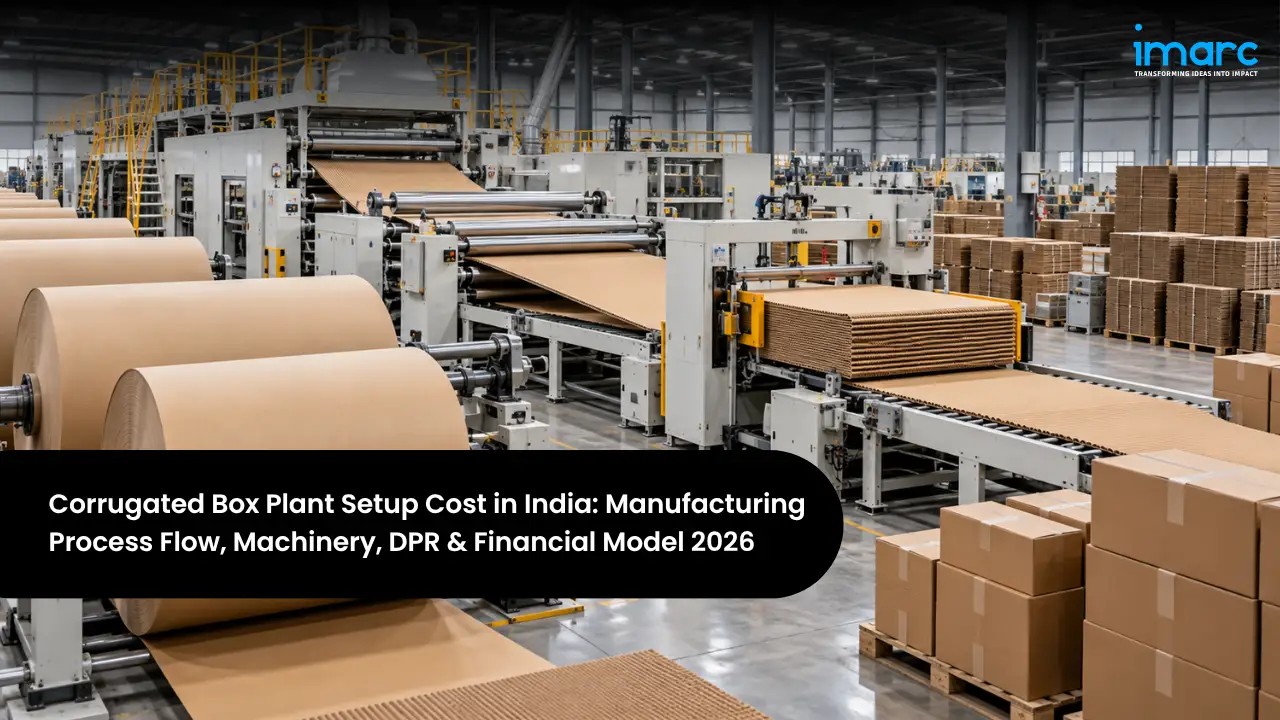
Setting up a Corrugated Box Manufacturing Plant in India is a high-demand, packaging-driven venture, powered by the country's booming e-commerce, FMCG, and export sectors, and the steady shift toward recyclable paper-based packaging. Corrugated boxes are the standard shipping and storage container for almost every product, and demand rises with every online order, factory output, and consignment dispatched. With abundant kraft paper supply, simple and proven technology, and universal, repeat demand, a Corrugated Box Manufacturing Plant is one of the more accessible and dependable opportunities in the packaging economy.
The Corrugated Box Manufacturing Plant Cost depends on capacity, level of automation, and whether the unit runs a full corrugator or converts purchased board, with total project investment typically ranging from INR 2 crore to INR 30 crore. Kraft paper is by far the largest operating input, so paper sourcing and conversion efficiency are the most important financial decisions in the project, and together they shape the overall Corrugated Box Investment Cost. At healthy capacity utilisation, a well-run unit in India delivers a net profit margin of 6 to 12% and an IRR of 18 to 28%, with payback typically achieved within 3 to 5 years, with returns turning on volume and efficient paper use rather than fat unit margins.
This guide is written for investors and entrepreneurs asking how to start a Corrugated Box manufacturing plant in India. It covers what the business involves, why demand is rising, the process flow, the machinery and raw materials required, location and infrastructure planning, a detailed cost and financial breakdown, the licenses you must secure, and how a project report and DPR turns all of this into a bankable plan.
India Market Snapshot
| Key Facts | Details |
|---|---|
| India Packaging Market | Large, multi-billion dollar (indicative) |
| Primary Products | Corrugated boxes and cartons |
| Projected Market CAGR (2026–2034) | 9–13% (indicative) |
| Typical Plant Capacity | Few to tens of thousands of boxes/day |
| Indicative Total Investment | INR 2–30 Crore |
| Typical Payback Period | 3–5 Years |
The snapshot captures why a Corrugated Box Manufacturing Plant in India attracts strong investor interest: an essential packaging product, broad and growing demand across e-commerce and industry, and abundant raw material. The wide investment range reflects a genuine choice of scale and automation, from a semi-automatic unit to a fully automatic corrugator plant serving large volumes. Because corrugated boxes are a fast-moving, repeat-purchase item needed by almost every business, the demand base is resilient, which is part of why lenders view well-run units favourably. The rest of this guide unpacks that decision in detail.
Investment Highlights
Indicative Project Cost in India (2026)
| Parameter | Value |
|---|---|
| Plant Capacity (Typical) | Few to tens of thousands boxes/day |
| Total Project Investment | INR 2 – 30 Crore |
| Payback Period | 3 – 5 Years |
| Net Profit Margin | 6 – 12% |
| IRR | 18 – 28% |
| Best Locations | Maharashtra, Gujarat, Tamil Nadu, Delhi-NCR, Karnataka |
| Mandatory Approvals | Factory License, GST, Pollution Consent, Fire NOC, EPF/ESI |
| Primary Revenue | Corrugated boxes and packaging |
These indicative parameters give a realistic frame for early feasibility work. The returns are attractive, but they depend on managing kraft paper cost, running an efficient line, and building steady buyers among FMCG, e-commerce, industrial, and export customers. A well-prepared Corrugated Box Feasibility Report tightens each of these numbers to your specific location, capacity, and product range.
Table of Contents
- What is Corrugated Box Manufacturing?
- Why is Corrugated Box Manufacturing Growing in India?
- Corrugated Box Manufacturing Process
- Raw Materials and India Sourcing
- Location, Land & Infrastructure
- Machinery and Equipment Required
- Corrugated Box Manufacturing Plant Setup Cost in India (CapEx & OpEx)
- Financial Analysis and Profitability
- Licenses and Approvals for Corrugated Box Manufacturing Plant in India
- Recent Developments in the India Corrugated Box Manufacturing Industry
- How a Corrugated Box Manufacturing Project Report and DPR Helps Investors
- Frequently Asked Questions
What is Corrugated Box Manufacturing?
Corrugated box manufacturing is the production of shipping and packaging boxes from corrugated board, made by gluing fluted paper between flat liners to create a strong, lightweight material. The process converts kraft paper reels into corrugated board and then cuts, prints, creases, and folds it into finished boxes of many sizes and strengths. The output is used across e-commerce, FMCG, food, pharmaceuticals, electronics, and exports, where the box protects goods in storage and transit at low cost.
From a business perspective, what makes this sector attractive in India is the combination of universal, recurring demand and a broad customer base. Every manufacturer, e-commerce packer, food and FMCG brand, and exporter is a repeat buyer, and abundant kraft paper supply supports production. A manufacturer that produces strong, consistent, well-made boxes and delivers reliably is positioned to serve a large, essential, and fast-growing market driven by the packaging needs of an expanding economy.
- Regular Slotted Boxes: Standard shipping cartons, the highest-volume and most common product.
- Die-Cut Boxes: Custom-shaped and printed boxes for branding and specific products.
- Multi-Wall Boxes: Double- and triple-wall boxes for heavy-duty and export packaging.
- Printed & Value-Added: High-quality printed and laminated boxes that command better prices.
The Main Segments in Corrugated Box Manufacturing
Understanding which segment your unit will serve is the foundational decision, because it drives machinery, printing, and value:
| Segment | Typical Products | Key Property | Primary Demand |
|---|---|---|---|
| Standard Boxes | Slotted cartons | High volume | General industry |
| Die-Cut | Custom boxes | Shaped, printed | Branding and retail |
| Multi-Wall | Heavy-duty boxes | High strength | Export and heavy goods |
| Printed / Value-Added | High-print boxes | Better margin | FMCG and premium |
This choice shapes the entire unit, because standard boxes are a high-volume commodity while die-cut, multi-wall, and high-print boxes command better margins but need better printing, die-cutting, and process control. Many Indian entrants begin with standard and printed boxes, the largest and most accessible segment, and add die-cut and multi-wall products as they build capability and buyers. The segment decision drives everything from machinery to the level of investment required.
Why is Corrugated Box Manufacturing Growing in India?
Key Growth Drivers in the Indian Market
India's corrugated packaging sector is being propelled by several structural factors that combine an e-commerce boom with industrial growth and a shift to sustainable packaging. Few products ride as many favourable trends at once:
- E-commerce boom: Rapid growth in online retail drives enormous demand for shipping boxes.
- FMCG and industrial growth: Rising consumer-goods and industrial output increases demand for packaging across sectors.
- Shift to sustainable packaging: A move from plastic to recyclable, paper-based packaging expands corrugated demand.
- Exports and organized retail: Growing exports and modern retail require quality, branded corrugated packaging.
- Abundant kraft paper: A large domestic kraft paper base provides reliable, competitively priced raw material.
India-Specific Market Opportunity
| Segment | India Market Context | Box Role |
|---|---|---|
| E-commerce | Booming online retail | Shipping boxes |
| FMCG | Large consumer market | Product packaging |
| Food & Pharma | Hygiene-focused demand | Protective boxes |
| Exports | Rising trade volumes | Heavy-duty boxes |
| Electronics | Growing output | Cushioned packaging |
The strongest opportunity lies in supplying e-commerce, FMCG, industrial, and export customers with consistent, competitively priced, well-made boxes, ideally near both paper supply and demand clusters. A manufacturer that runs efficiently and delivers reliably can lock in steady, repeat orders. Moving into die-cut, multi-wall, and high-print boxes, where margins are better and competition thinner, further strengthens a unit's position in a large, growing market.
Corrugated Box Manufacturing Process
Understanding how a box is actually made helps you plan equipment, material flow, and the main cost drivers. Production is a sequential operation that turns kraft paper into corrugated board and then into finished boxes, with quality control throughout. The typical flow moves paper through corrugation and board making to cutting, printing, and folding:
The Corrugated Box Manufacturing Process
In this flow, kraft paper is corrugated to form fluting, glued between liners to make corrugated board, then cut and creased to size, printed, slotted, and folded and joined into finished boxes by stitching or gluing. Consistent board quality and accurate cutting are essential to boxes that are strong, well-sized, and attractive at a competitive cost.
| Unit Operation | Key Activity |
|---|---|
| Paper Reel Intake | Kraft paper reels received |
| Corrugation | Paper fluted on the single facer |
| Board Making | Fluting glued between liners |
| Board Cutting | Board cut and creased to size |
| Printing | Design printed by flexo printer |
| Slotting & Scoring | Slots and creases made |
| Folding | Board folded into box shape |
| Joining | Stitched, glued, or taped |
| Inspection & Bundling | Checked and bundled |
| Dispatch | Boxes packed and dispatched |
Two points determine profitability across this flow. First, paper yield and board quality drive both strength and cost, so corrugation and board control directly govern outcomes, because paper is the dominant input. Second, efficient conversion with low wastage is a decisive margin lever, since trimming and rejects waste expensive paper. Consistent inspection, for strength, dimensions, and print, is what allows a manufacturer to supply reliable boxes and win repeat orders. Because packers and brands want boxes that protect goods and look good, consistent quality matters as much to them as headline price.
Raw Materials and India Sourcing
The main input is kraft paper, in liner and fluting grades, and securing it at competitive prices and consistent quality is by far the biggest determinant of a unit's viability. Because paper dominates cost and its price varies with pulp and waste-paper cycles, procurement strategy and a reliable supplier network materially affect margin, alongside the adhesive, inks, and consumables the process needs.
| Raw Material | Role in Process | India Sourcing | % of OpEx |
|---|---|---|---|
| Kraft Paper (Liner/Fluting) | Board material | Domestic paper mills | 65–75% |
| Adhesive (Starch/Gum) | Bonding board layers | Domestic suppliers | 3–6% |
| Printing Inks | Box printing | Domestic suppliers | 2–5% |
| Stitching Wire / Tape | Joining boxes | Domestic suppliers | 2–4% |
| Consumables & Strapping | Finishing and packing | Domestic suppliers | 2–4% |
Because kraft paper is such an overwhelming share of cost, paper management is the defining lever on profitability in this business. Paper prices track pulp and waste-paper markets, so a manufacturer must buy carefully, maintain sensible inventory, and often price boxes against paper cost, since the margin is a conversion spread. India has a large domestic kraft paper base, so supply is available but competitive. Adhesive, inks, and consumables are smaller costs but important to quality, and minimising paper wastage through efficient cutting and low rejects is what makes the economics work.
Location, Land & Infrastructure
Choosing the best location for Corrugated Box manufacturing plant setup significantly affects paper access, power reliability, and, above all, proximity to customers, because boxes are bulky and costly to freight. Being near industrial and e-commerce clusters, paper supply, and reliable power shapes site selection, alongside adequate covered space for the line, paper storage, and finished-box handling.
Best States for Corrugated Box Manufacturing Plant Setup in India
| State | Why It Works | Key Advantage |
|---|---|---|
| Maharashtra | Large industrial market | Demand and logistics |
| Gujarat | Industry and ports | Demand and exports |
| Tamil Nadu | Manufacturing cluster | Demand and workforce |
| Delhi-NCR | Industrial and e-commerce | Buyers and market |
| Karnataka | Industry and e-commerce | Demand and ecosystem |
| Uttar Pradesh | Large market | Demand and paper |
The strongest locations combine reliable paper supply and power with close proximity to customers, because corrugated boxes are bulky and freight-sensitive, so being near demand is critical. Maharashtra, Gujarat, and Tamil Nadu offer large industrial and export demand, while Delhi-NCR, Karnataka, and Uttar Pradesh add e-commerce, industry, and paper access. Because the product is light but voluminous, proximity to customers, covered production and storage space, and good road access should weigh heavily in the final choice, alongside room to add capacity as demand grows.
Infrastructure Requirements (Mid-Sized Plant)
| Infrastructure Element | Specification | India-Specific Note |
|---|---|---|
| Total Shed Area | 1,500 – 10,000 sq. meters | Covered production space |
| Corrugation Section | Single facer and board line | Board making |
| Conversion Area | Cutting and slotting | Box forming |
| Printing Section | Flexo printing | For printed boxes |
| Finishing & Joining | Stitching and gluing | Box assembly |
| Paper & FG Storage | Covered storage | For reels and finished boxes |
| Power & Utilities | Reliable power and boiler | For corrugation and drying |
Infrastructure for a box unit centres on the corrugation section, conversion and printing areas, and finishing, because output, quality, and delivery depend on smooth material flow between them. Ample paper and finished-goods storage is important given how bulky reels and boxes are, and reliable power and steam keep the corrugator running. Planning the shed with room to add lines or automation later makes future expansion far cheaper than reconfiguring a cramped layout, so scalable design pays off early.
Machinery and Equipment Required
The equipment set spans corrugation, conversion, printing, and finishing, and the line-up scales with capacity and automation. Because quality and productivity depend on the right machines matched to the product, machinery selection is central to both cost and output. The core machinery, from corrugation through box finishing, is summarized below.
| Equipment | Function | Key Specification |
|---|---|---|
| Reel Stand | Hold paper reels | Feeds the line |
| Single Facer | Corrugate the paper | Forms fluting |
| Corrugator / Board Plant | Make corrugated board | Single to multi-wall |
| Board Cutter | Cut board to size | Rotary or sheet cutter |
| Flexo Printer Slotter | Print and slot | Printing and slotting |
| Die Cutter | Cut custom shapes | Rotary or flatbed |
| Creasing / Scoring | Score for folding | Accurate creasing |
| Folder Gluer | Fold and glue boxes | Automatic assembly |
| Stitching Machine | Stitch boxes | For stitched boxes |
| Bundling / Strapping | Bundle and pack | For dispatch |
Equipment selection should follow your product range and capacity rather than the other way around. A semi-automatic unit centres on a single facer, cutting, printing, and stitching, while a fully automatic plant uses a full corrugator line, auto printer slotters, and folder gluers for high volumes. Corrugation quality and conversion efficiency are easy to under-plan yet decisive, because they determine board strength, paper yield, and speed, and therefore the cost per box and the ability to meet volumes and quality.
Corrugated Box Manufacturing Plant Setup Cost in India (CapEx & OpEx)
The tables below give you a breakdown of both the upfront capital investment and the ongoing operating costs, based on industry analysis of a mid-sized facility in India. The actual Corrugated Box Manufacturing Plant Cost for your specific project will depend on your chosen location, capacity, automation, and product range.
Capital Expenditure (CapEx) Cost Structure
| CapEx Component | % of Total CapEx | What It Covers |
|---|---|---|
| Corrugation & Board Machinery | 25–35% | Single facer and corrugator |
| Conversion & Printing | 18–25% | Cutting, printing, slotting |
| Finishing Machinery | 8–12% | Folder gluer and stitching |
| Shed & Civil Works | 12–18% | Production shed and interiors |
| Utilities & Power | 5–8% | Power, boiler, and air |
| Pre-operative & Contingency | 5–8% | Engineering, DPR, and buffer |
| Working Capital | 15–22% | Paper stock, WIP, and receivables |
The CapEx profile depends on automation, with a semi-automatic unit lighter on machinery and a full corrugator plant much heavier. Working capital is unusually important because kraft paper must be bought and stocked ahead of production, and customer credit ties up cash. Under-provisioning working capital or corrugation quality is a common and costly mistake, so both are modelled carefully in the Corrugated Box Business Plan and Financial Model.
Operating Expenditure (OpEx) Cost Structure
| OpEx Component | % of Total OpEx | India-Specific Note |
|---|---|---|
| Kraft Paper | 65–75% | Largest cost; price varies with cycles |
| Adhesive & Inks | 5–8% | Starch and printing inks |
| Power & Utilities | 5–8% | Corrugation and drying |
| Labour & Manpower | 5–10% | Line operators and helpers |
| Maintenance & Consumables | 3–6% | Machine upkeep and wire |
| Logistics & Overheads | 3–6% | Freight and factory costs |
With kraft paper overwhelmingly dominating operating cost, this is fundamentally a paper-conversion business, and margin depends on efficient paper buying, high yield, and low wastage far more than on the thin conversion spread. Paper prices move with pulp and waste-paper cycles, so a financial model should track them closely and build in price pass-through and tight paper control, since wastage is expensive at these volumes. Volume, yield, and disciplined pricing are what make the economics work, with printed and value-added boxes lifting the blended margin.
Financial Analysis and Profitability
Based on analysis of a mid-sized box facility in India, the financial profile is volume-driven and steady, supported by essential, growing demand and abundant paper. Because paper management and volume drive economics, the profitability of Corrugated Box manufacturing business in India improves markedly with efficient paper buying, high yield, strong utilisation, and a move toward higher-value printed and specialty boxes.
| Financial Metric | Indicative Value | India Context |
|---|---|---|
| Gross Profit Margin | 12–20% | Driven by conversion spread and mix |
| Net Profit Margin | 6–12% | After depreciation and Indian corporate taxes |
| Payback Period | 3–5 Years | Faster with high volumes |
| IRR (Internal Rate of Return) | 18–28% | Higher for printed and specialty boxes |
| Capacity Utilization (stable ops) | 70–90% | Volume favours high run rates |
| Break-even Capacity Utilization | 55–65% | Steady demand supports throughput |
Paper management, volume, and yield are the factors that most determine outcomes, because unit margins are thin and a box line must run at high volumes to earn well on a large paper turnover. An operator with efficient paper buying, high utilisation, and steady demand can build strong returns on volume, while one with high wastage or poor paper discipline will struggle despite high sales. This is why paper management and efficiency are as central to the financial model as the machinery itself, more so than in most manufacturing.
There are several ways to strengthen returns in the Indian context: buying and managing kraft paper efficiently with price pass-through, minimising wastage through good corrugation and cutting, moving into printed, die-cut, and multi-wall boxes, keeping the line well utilised, and staying close to customers to cut freight. Reliable buyer relationships further stabilize order flow and pricing. Delivering consistent quality and good service also helps a unit win long-term supply arrangements with FMCG and e-commerce customers, which smooths out the demand swings that pressure smaller, order-to-order producers and supports steady growth.
Key Risks and Mitigation
The principal risks are kraft paper price volatility, thin conversion margins, and competition. Paper risk is mitigated by careful buying, pass-through pricing, and tight inventory; margin risk is mitigated by high yield, low wastage, and a shift to printed and value-added boxes; and competition risk is mitigated by quality, service, and customer proximity. A manufacturer that treats paper management, efficiency, and service as core priorities is far better placed to sustain healthy returns.
Licenses and Approvals for Corrugated Box Manufacturing Plant in India
The approvals for this business are straightforward but important, because a box unit is a factory operation using machinery and, in some cases, a boiler. Manufacturers planning to establish a Corrugated Box Manufacturing Plant generally need to obtain the following before commencing operations, and factory and safety compliance are especially central:
- Factory License: Factory establishment and operation approval under the Occupational Safety, Health and Working Conditions Code, 2020.
- Business & Tax Registration: Company or firm incorporation, GST registration, and Udyam (MSME) registration.
- Pollution Control Consent: Consent from the State Pollution Control Board for the manufacturing process.
- Fire Safety NOC: Fire safety compliance, important for a paper-handling unit.
- Boiler Approval: Boiler registration where steam is used in corrugation.
- Import-Export Code (IEC): IEC for units importing paper or exporting packaging.
- Labour Registrations: EPF, ESI, and other workforce-welfare registrations required for factory employment.
For a box unit, the factory License, pollution-control consent, and fire compliance are the critical items and should be pursued early, in parallel with shed setup, because a plant with machinery cannot operate without them. Boiler approval, where steam is used, and IEC for importers or exporters should be arranged early too. Engaging a consultant familiar with factory and safety regulations is usually worth the cost, since delays can idle a ready line. Sequencing approvals well, alongside paper and customer development, can shave weeks off the project timeline.
Note: The exact approvals, registrations, Licenses, and compliance requirements may vary depending on factors such as plant location, capacity, processes used, and applicable regulations. Businesses are advised to undertake a detailed regulatory assessment during the project planning stage to ensure full compliance and timely implementation.
Recent Developments in the India Corrugated Box Manufacturing Industry
A few structural trends give useful context for investors considering entry into this industry:
- E-commerce and packaging growth: Sustained growth in online retail and organized industry continues to drive strong box demand.
- Automation and quality: Adoption of automatic corrugators and high-quality printing is raising productivity and standards.
- Sustainability and recycling: The shift to recyclable paper packaging and use of recycled kraft supports demand and cost efficiency.
The common thread is a market growing with e-commerce, industry, and sustainable packaging, with quality, automation, and service increasingly important. For a new entrant, the implication is clear: the window to establish an efficient line and build a customer base is open, and those who build paper discipline, quality, and customer proximity into their model from the start will be best placed as demand grows through the decade.
How a Corrugated Box Manufacturing Project Report and DPR Helps Investors
A comprehensive Corrugated Box Project Report, prepared as a Detailed Project Report (DPR), provides a structured roadmap for establishing the facility by evaluating every aspect of the venture, from market demand and product mix to machinery selection, plant layout, and economics. It helps investors determine the optimal capacity and automation, estimate capital expenditure (CapEx) and operating expenditure (OpEx), assess profitability, and identify potential risks before implementation.
The report also brings together a Corrugated Box Business Plan with revenue forecasts, production costs, cash flow analysis, break-even assessment, return on investment (ROI), and payback period calculations, supported by a detailed Corrugated Box Financial Model. These insights enable investors, lenders, and stakeholders to make informed decisions and evaluate the long-term viability of the project. Many investors engage a Corrugated Box Business Plan Consultant in India or a Corrugated Box Manufacturing Consultant in India to prepare and validate these documents.
For a box project specifically, a strong DPR also clarifies the paper-management strategy, the product and automation focus, and the target customer segments, which are the factors most likely to determine success in this volume-driven business. By modelling utilisation against realistic demand and testing margins against paper-price swings and pass-through, the report turns a competitive but essential-product opportunity into an executable plan that lenders and partners can trust. It also maps the phased scale-up and working-capital needs, so investors can see how the unit grows and when each tranche of funding is needed.
Frequently Asked Questions
How to start a corrugated box manufacturing plant in India?
Begin by choosing your product mix, capacity, and automation, then prepare a feasibility report and DPR, secure a shed close to customers and paper supply, arrange corrugation, conversion, printing, and finishing machinery, tie up kraft paper suppliers and buyers, and obtain factory, pollution, and fire approvals. A detailed project report maps each step for your target setup.
What is the corrugated box manufacturing plant cost in India?
It typically ranges from INR 2 crore to INR 30 crore depending on capacity and automation, and the wider Corrugated Box Investment Cost is driven by machinery and paper working capital. Equipment and paper stock are the largest components, with a full corrugator plant costing much more than a semi-automatic unit.
What is the corrugated box manufacturing process?
The process runs from kraft paper reel intake and corrugation, through board making, cutting, and creasing, to printing, slotting, folding, and joining by stitching or gluing, followed by inspection, bundling, and dispatch, with strength and quality checks throughout.
What machinery is required for a corrugated box plant?
Key equipment includes a reel stand, a single facer and corrugator or board plant, a board cutter, a flexo printer slotter, a die cutter, creasing and scoring machines, a folder gluer, a stitching machine, and bundling and strapping equipment, with automation scaled to capacity.
What is the best location for corrugated box manufacturing plant setup?
The ideal site combines reliable paper supply and power with close proximity to customers, since boxes are bulky and freight-sensitive. Maharashtra, Gujarat, Tamil Nadu, Delhi-NCR, and Karnataka are leading choices.
What is the profitability of corrugated box manufacturing business in India?
It is volume-driven, with a typical 6 to 12% net profit margin and an 18 to 28% IRR, and a 3 to 5 year payback at healthy utilization. Because unit margins are thin and paper-heavy, returns depend on efficient paper management, high volumes, low wastage, and a shift to printed and value-added boxes.
How do I get a project report or feasibility report for a corrugated box plant?
A Corrugated Box Project Report and Corrugated Box Feasibility Report cover the full plant setup and financials. Many investors engage a Corrugated Box Plant Project Report Consultant in India or a Corrugated Box Manufacturing Feasibility Study Consultant to prepare and validate them.
Our Clients










Contact Us
Have a question or need assistance?
Please complete the form with your inquiry or reach out to us at
Phone Number
+91-120-433-0800+1-201-971-6302
+44-113-547-7077
Previous Post

Setting up a Pallets Manufacturing Plant in India is a high-demand, logistics-driven venture, powered by the country's booming warehousing, e-commerce, and organized-retail sectors, and the steady formalization of supply chains after GST.
The GCC biodegradable food service disposables market size is undergoing a remarkable change as environmental sustainability takes center stage in regional business and regulatory agendas. Throughout the Gulf Cooperation Council nations, which include countries like Saudi Arabia, the UAE, Qatar, Kuwait, Oman, and Bahrain, significant players within the food service packaging sector are powerfully embracing novel packaging solutions that not only reduce environmental impact but also cater to modern-day consumers' needs for convenience and efficiency.
PVC blisters packaging is a type of thermoforming packaging wherein polyvinyl chloride (PVC) material is heated to mold it into packaging cavities to securely place individual items inside, which is then closed with either aluminum foil or paper-based lidding materials. PVC packaging exhibits clarity, strength, and moldability, making it possible to view the individual items while also protecting them against external damage.
A PET bottle is a type of rigid packaging packaging that is produced using a thermoplastic called polyethylene terephthalate, also known as polyester. The production of a PET bottle involves an injection stretch-blow molding technique that provides a lightweight and durable package with high clarity, strength, and impermeability.
Paper cups are a type of beverage container made mostly from paperboard. The paperboard gives the container strength. The lining of the paperboard varies and usually consists of waterborne coatings, bio-based coatings, and polymer coatings. This facilitates the paper cup to hold hot and cold fluids for an amount of time. Paper cups come in various sizes and different wall structures. This makes the paper cup functional for the desired purpose and environment.
Bagasse kraft paper is a green packaging material made from bagasse, the fibrous byproduct that is left when juice is extracted from sugarcane. Kraft paper is generally produced traditionally using wood pulp via the sulfate process, but bagasse offers a sustainable, non-wood source used in promoting green manufacturing and less reliance on forest resources. Bagasse fibers have high cellulose, moderate fiber length, and good bonding properties, making them ideal for manufacturing strong and long-lasting kraft paper. Production includes bagasse collection from sugar mills, purification to eliminate impurities, and processing into pulp either by chemical or mechanical pulping.
Bagasse biodegradable cutlery is made from the fibrous material remaining after extracting sugarcane stalk juice, a low-value agricultural residue also known as bagasse. The material is harvested from sugar mills, washed, pulped and mechanically molded into wet-molded forms; those wet parts are dried, pressed in heat-resistant molds and thermally cured to create rigid, food-grade spoons, forks and knives that are grease- and water-resistant but not covered with plastic coatings.
The global food packaging market is evolving as consumer expectations, sustainability concerns, and technological advancements redefine the way food is kept safe, secure, and delivered. Packaging is no longer merely a container; it has transformed into a critical enabler that drives purchase decisions, improves product shelf life, and communicates brand values. As demand for ready-to-eat, convenience, and packaged foods grows, packaging has emerged to convey sustainability, safety, and innovation.
Aluminum foil is a flexible, thin, and extremely versatile aluminum sheet that has gained universal application in different industries owing to its superior barrier, thermal, and mechanical characteristics. Usually made by rolling aluminum slabs or ingots into extremely thin sheets, aluminum foil is 0.006 mm to 0.2 mm thick.
Glass bottles are rigid, non-porous, and chemically inert packages commonly employed in the packing of beverages, foods, drugs, cosmetics, and specialty chemicals. Constructed mainly from silica sand, soda ash, and limestone, glass bottles are prized for their preservation of product purity, inhibition of chemical leaching, and retention of flavor character.
The corrugated box industry is powered by its versatility, strength, and sustainability, rendering it crucial for shipping, storage, and retail packaging. Crafted from kraft paper, the boxes are strong, cushioned, and protective, serving e-commerce, food & beverage, electronics, and pharmaceuticals industries. Online retailing demand, sustainability drives, and innovation in packaging are driving the growth of the market.
Aluminium cans are common packaging solutions in the food, beverage, and industrial sectors because they are strong, lightweight, and highly recyclable. They ensure product freshness by shielding contents from light, air, and pathogens thanks to their exceptional barrier qualities. Because of its limitless recyclability and little environmental impact, aluminium cans have become the favoured option as sustainability awareness has grown.