Solar Glass Manufacturing Cost Analysis: Harnessing Light, Measuring Costs
_11zon.webp)
What is Solar Glass?
Solar glass is a type of specialty glass that has high transmittance and is designed exclusively for use in solar energy systems. Unlike regular flat glass, solar glass is designed to have maximum light transmission with minimal losses due to reflection and absorption. Solar glass is normally produced from low-iron raw materials to increase its optical clarity and may also have textured surfaces or anti-reflective coatings to enhance solar energy harvesting. Solar glass also has high mechanical strength, thermal stability, and resistance to environmental stress. This makes it suitable for protecting photovoltaic components while allowing maximum sunlight to hit solar cells.
Key Applications Across Industries:
Solar glass is mainly applied in photovoltaic (PV) modules, where it acts as the front cover protecting solar cells and allowing efficient light transmission. In crystalline silicon solar panels, solar glass is the outermost layer, protecting solar cells from dust, moisture, mechanical damage, and ultraviolet radiation. The optical properties of solar glass have a direct impact on the power output and efficiency of solar modules.
In addition to traditional solar panels, solar glass is applied in building-integrated photovoltaics (BIPV). In this case, solar glass is used as a building material and an energy conversion surface. It is applied in building façades, roofs, skylights, windows, and curtain walls, which enable buildings to produce electricity while retaining architectural functionality.
Solar glass is also used in solar thermal energy systems, where it covers solar collectors used for heating water or industrial purposes. In such applications, the solar glass needs to be able to resist high temperatures while remaining clear and durable. Solar glass is also being used in agrivoltaic systems, greenhouse roofs, and solar canopies, where the ability to transmit light and resist the environment is essential.
New uses for solar glass include bifacial solar panels, which employ solar glass on both sides of the panel to transmit reflected and diffused sunlight. This gives solar glass a more active role in solar panel performance, going beyond its traditional role of protection. Solar glass enables a variety of applications in the energy and infrastructure sectors related to the use of solar energy.
What the Expert Says: Market Overview & Growth Drivers
The global solar photovoltaic glass market reached a value of USD 20.3 Billion in 2025. According to IMARC Group, the market is projected to reach USD 80.4 Billion by 2034, at a projected CAGR of 16.02% during 2026-2034.
The primary driving factor for the global solar glass market is the fast-growing adoption of solar energy around the world. As nations shift towards a low-carbon economy, solar energy has become a backbone of a renewable energy plan. This, in turn, leads to a growing demand for solar photovoltaic modules, as solar glass is a crucial raw material for solar module manufacturing.
Government policies and regulations are key drivers for the solar glass market. Supportive policies for the adoption of renewable energy, long-term strategies for a low-carbon economy, and energy security issues lead to large-scale solar energy investments. Such policy-led developments create a stable demand for solar modules and, consequently, solar glass. In several regions, ‘Make in the Country’ developments also support the manufacturing of solar glass.
Advances in solar module technology also promote the market. The trend towards high-efficiency solar modules, bifacial solar modules, and building-integrated photovoltaics boosts the demand for solar glass in terms of quantity and quality. The industry requires the provision of glass with high transparency, improved surface treatment, and increased mechanical strength, which promotes value-added growth rather than just volume growth.
Urbanization and infrastructure development also promote the market. The growth of urban centers and the adoption of energy-efficient designs for buildings promotes the use of solar glass in construction materials. In addition, the increasing demand for electricity and the instability of fossil fuel markets accelerates the adoption of solar energy as a stable source of electricity in the long term.
In terms of sustainability, solar glass has the advantage of aligning with global environmental objectives. The use of solar glass in facilitating the generation of clean energy makes it a strategic material in the energy transition. As such, government support, technological advancements, infrastructure development, and sustainability drivers are contributing to the solar glass production market globally.

Case Study on Cost Model of Solar Glass Manufacturing Plant:
Objective
One of our clients reached out to us to conduct a feasibility study for setting up a medium scale solar glass manufacturing plant.
IMARC Approach: Comprehensive Financial Feasibility
We developed a comprehensive financial model for the setup and operation of a proposed solar glass manufacturing plant in India. This plant is designed to manufacture 1,000 tons of solar glass per day.
Manufacturing Process: The solar glass manufacturing process is a precision-based process aimed at creating glass with high optical quality, strength, and durability for solar energy applications. The solar glass manufacturing process starts with the selection and batching of raw materials, mainly high-quality silica sand with very low iron content, soda ash, and limestone. Low iron content is essential in this process as it ensures low absorption of light, resulting in high solar transmittance.
The raw materials are then melted in a high-temperature furnace at temperatures above 1,600°C to create a molten glass. The molten glass is then processed using the float glass technique, where the molten glass is floated on a bath of molten tin to create a flat sheet of glass with high thickness precision. The glass thickness is precisely controlled to meet solar module requirements.
The glass is then cooled in an annealing lehr to remove stresses. However, for solar energy applications, the glass is further processed, mainly through surface texturing or acid etching, to increase light trapping. Anti-reflective coatings are also applied to the glass to improve optical properties.
The glass is then tempered by heating and rapidly cooling to enhance its mechanical strength and thermal shock resistance. This process is critical in ensuring the glass is durable enough to withstand outdoor environmental conditions. The final processes involve cutting, edge treatment, and quality checks, where the glass is tested for parameters such as transmittance, strength, flatness, and defects. The solar glass is then packaged and delivered to photovoltaic module manufacturers.
Get a Tailored Feasibility Report for Your Project Request Sample
Raw Material Required:
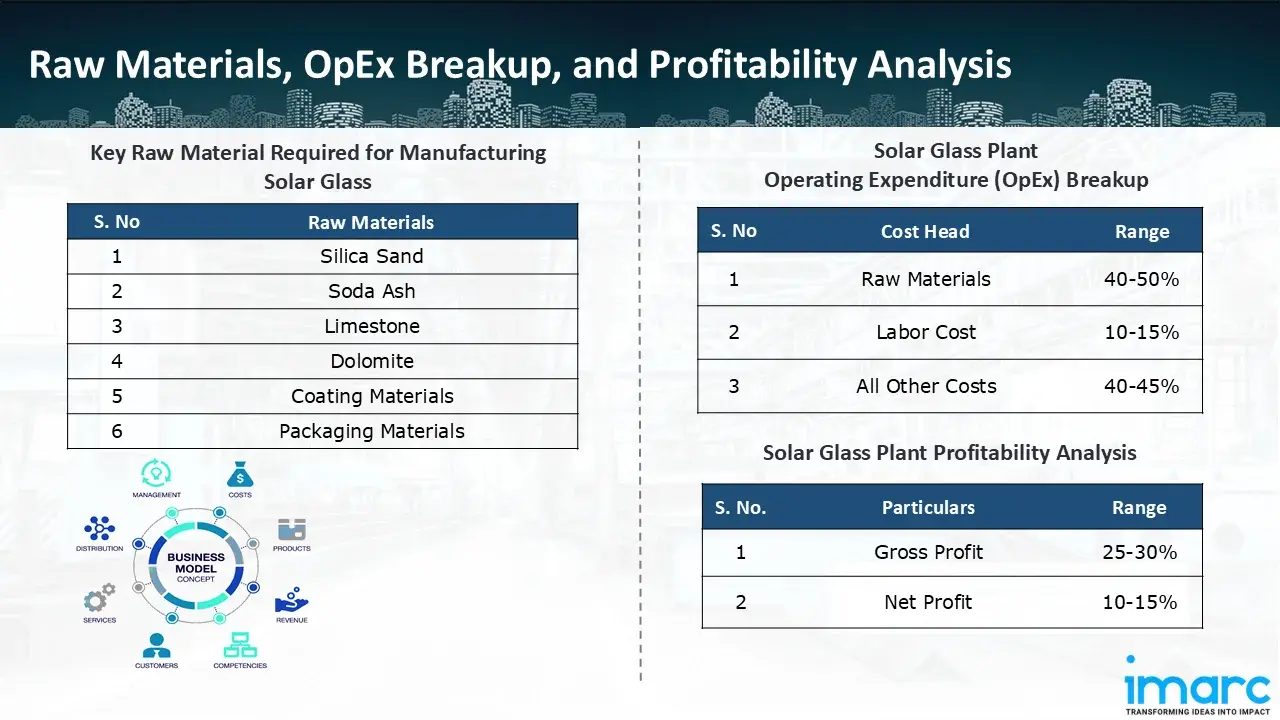
The basic raw materials required for solar glass manufacturing include:
- Silica Sand
- Soda Ash
- Limestone
- Dolomite
- Coating Materials
- Packaging Materials
Machine Section or Lines Required:
- Batch Mixing
- Melting
- Tin Bath
- Annealing
- Coating
- Cutting
- Packing
Techno-Commercial Parameter:
- Capital Expenditure (CapEx): Capital expenditure (CapEx) in a manufacturing plant includes various investments essential for its setup and long-term operations. It covers machinery and equipment costs, including procurement, installation, and commissioning. Civil works expenses involve land development, factory construction, and infrastructure setup. Utilities such as power, water supply, and HVAC systems are also significant. Additionally, material handling systems, automation, environmental compliance, and safety measures are key components. Other expenditures include IT infrastructure, security systems, and office essentials, ensuring operational efficiency and business growth.
- Operating Expenditure (OpEx): Operating expenditure is the cost incurred to operate a manufacturing plant effectively. OpEx in a manufacturing plant typically includes the cost of raw materials, utilities, depreciation, taxes, packing cost, transportation cost, and repairs and maintenance. The operating expenses are part of the cost structure of a manufacturing plant and have a significant effect on profitability and efficiency. Effective control of these costs is necessary for maintaining competitiveness and growth. Furthermore, raw material cost in solar glass manufacturing plant ranges between 40-50%, labor cost ranges between 10% to 15%, and all other costs ranges between 40-45% in the proposed plant.
- Profitability Analysis Year on Year Basis: We assisted our client in developing a detailed cost model, which projects steady growth, with revenue rising throughout the projected period. Moreover, gross profit margins lie between a range of 25-30%, and net profit lie between the range of 10-15% during the income projection years, highlighting strong financial viability and profitability.
Conclusion & IMARC's Impact:
Our financial model for the solar glass manufacturing plant was meticulously developed to meet the client’s objectives, providing an in-depth analysis of production costs, including raw materials, manufacturing, capital expenditure, and operational expenses. By addressing the specific requirements of manufacturing 1000 tons of solar glass per day, we successfully identified key cost drivers and projected profitability, considering market trends, inflation, and potential fluctuations in raw material prices. This comprehensive financial model equipped the client with valuable insights into strategic decision-making, demonstrating our commitment to delivering high-quality, client-focused solutions that ensure the long-term success of large-scale manufacturing ventures.
Latest News and Developments:
- In April 2025, Almaden, a major Chinese producer of solar glass with headquarters in Changzhou, Jiangsu province, has announced intentions to construct a 500,000-ton solar glass production facility in the United Arab Emirates as part of a larger strategic move into international markets.
- In March 2025, Borosil Renewables announced a INR 900 crore investment in order to increase its solar glass production capacity to 10 GW by 2026. The action is intended to boost domestic manufacturing capacity, lessen reliance on imports, and assist India's expanding solar energy industry. The development will assist in fulfilling the growing national demand for solar glass in renewable energy projects.
- In January 2025, Gold Plus, a manufacturer of float glass, announced putting into service a new facility that can produce 109,500 metric tonnes of solar glass annually. With new facility, Gold Plus has expanded the range of products it offers by joining the solar glass market and increasing its capacity for float glass.
Why Choose IMARC?
IMARC's Financial Model Expertise: Helping Our Clients Explore Industry Economics
IMARC is a global market research company that offers a wide range of services, including market entry and expansion, market entry and opportunity assessment, competitive intelligence and benchmarking, procurement research, pricing and cost research, regulatory approvals and licensing, factory setup, factory auditing, company incorporation, incubation services, recruitment services, and marketing and sales.
Under our factory setup services, we assist our clients in exploring the feasibility of their plants by providing comprehensive financial modeling. Additionally, we offer end-to-end consultation for setting up a plant in India or abroad. Our financial modeling includes an analysis of capital expenditure (CapEx) required to establish the manufacturing facility, covering costs such as land acquisition, building infrastructure, purchasing high-tech production equipment, and installation. Furthermore, the layout and design of the factory significantly influence operational efficiency, energy consumption, and labor productivity, all of which impact long-term operational expenditure (OpEx). So, every parameter is covered in the analysis.
At IMARC, we leverage our comprehensive market research expertise to support companies in every aspect of their business journey, from market entry and expansion to operational efficiency and innovation. By integrating our factory setup services with our deep knowledge of industry dynamics, we empower our clients to not only establish manufacturing facilities but also strategically position themselves in highly competitive markets. Our financial modeling and end-to-end consultation services ensure that clients can explore the feasibility of their plant setups while also gaining insights into competitors' strategies, technological advancements, and regulatory landscapes. This holistic approach enables our clients to make informed decisions, optimize their operations, and align with sustainable practices, ultimately driving long-term success and growth.
Our Clients









Contact Us
Have a question or need assistance?
Please complete the form with your inquiry or reach out to us at
Phone Number
+91-120-433-0800+1-201-971-6302
+44-113-547-7077
Previous Post

A solar inverter is a vital component in solar photovoltaic (PV) systems, responsible for transforming the direct current (DC) electricity produced by solar panels into alternating current (AC) electricity. This AC power is then suitable for use by the electrical grid, various appliances, and industrial equipment.
Australia has firmly established itself as a dominant force in the global liquefied natural gas (LNG) market, maintaining its position as one of the world's leading exporters. The country's strategic geographical location in the Asia-Pacific region, combined with substantial natural gas reserves, has enabled it to become a critical energy supplier to rapidly growing Asian economies, particularly China, Japan, and South Korea.
Japan's lead acid battery market stands as a cornerstone of the nation's energy storage infrastructure, demonstrating remarkable resilience and adaptability in an era dominated by rapid technological evolution. Despite the global shift toward lithium-ion technologies, the Japanese lead acid battery sector continues to thrive, driven by its unmatched cost-effectiveness, proven reliability, and exceptional recyclability.
Green hydrogen is the cleanest form of hydrogen available, as it is produced through water electrolysis using the electricity generated from renewable energy sources such as solar, wind, or hydropower. Carbon dioxide emissions are zero since no fossil fuels are used. Essentially, an electrolyzer is used in the electrolysis process to split water molecules into hydrogen and oxygen. The resulting hydrogen is refined by purification, compression, or liquefaction and then fed into various applications. Green hydrogen is considered a cornerstone of the global energy transition because it can store renewable energy, decarbonize hard-to-abate sectors, and serve as a sustainable alternative to fossil-fuel-based hydrogen.
Japan’s thermal power plant industry remains a crucial pillar of the nation’s energy infrastructure, providing a stable and reliable source of electricity for both industrial and residential consumption. Thermal power generation, which primarily involves the combustion of fossil fuels such as coal, natural gas, and oil, continues to play a key role despite increasing investments in renewable energy.
An electrical panel, also called a distribution board or switchboard, is an important installation in electrical infrastructure that acts as the main center for the distribution, control, and protection of electrical power within residential, commercial, and industrial systems. It acts as the point at which electrical energy is received from the utility or a source of power generation and is distributed to various circuits and equipment in an organized manner.
The global oil and gas EPC market is currently experiencing a remarkable transformation as it positions itself at the intersection of traditional energy demands and technological innovation. As of 2024, the market is demonstrating robust growth, reaching USD 52.9 Billion in 2024, depending on regional scope and market segmentation approaches. This substantial market base is supporting a major number of capital projects worldwide, including offshore platform projects and onshore installations that are collectively shaping the energy landscape.
Bamboo pellets are a biomass fuel type created through the compression of bamboo residues like shavings, sawdust, and chips into thick cylindrical pellets. They are an environmentally friendly substitute for conventional fossil fuels like natural gas and coal. Due to the fast growth rate and high biomass yield of bamboo, it has become one of the most renewable raw materials for the production of bioenergy.
Biomass briquettes are dense, solid fuel blocks made of compressed organic waste materials like sawdust, agricultural wastes, wood shavings, coconut shells, rice husk, or herbaceous biomass. The briquetting process usually involves drying the biomass to lower the moisture content (usually down to 10-15%), grinding or milling for a fine particle size uniformity, and then compressing under high pressure with or without a binding agent.
Biogas is a renewable energy form generated by the anaerobic fermentation of organic matter including agricultural residues, animal waste, municipal solid waste, sewage sludge, and food waste. Microorganisms in the absence of oxygen break down organic substances in the process and produce a gaseous mixture of mainly methane (CH4) and carbon dioxide (CO2), with traces of hydrogen sulfide (H2S) and water vapor.
A battery is an electrochemical energy storage system that transforms chemical energy into electrical energy by way of redox reactions between its electrodes and electrolyte. It consists of a single or multiple electrochemical cells, each having a positive electrode (cathode), a negative electrode (anode), and an electrolyte for ion transfer. Batteries are categorically divided into primary (non-rechargeable) and secondary (rechargeable) types.
The global energy landscape is undergoing a seismic transformation, with green hydrogen emerging as one of the most promising solutions to achieve deep decarbonization across sectors. Far from a niche technology, green hydrogen is emerging as a critical pillar of the future energy system, offering a pathway to a sustainable and resilient economy.
Transmission line towers are essential support components of transmission lines installed on overhead to distribute high-voltage electricity over long distances. Towers are made of galvanized steel, primarily, and are designed to tolerate mechanical stress, environmental loads, and electrical safety. Some of the important characteristics of transmission line towers are high structural strength, corrosion resistance, adaptability for modular design, and high service life. They are normally produced in lattice form (tubular or free-standing towers) or tubular form, with types including suspension towers, tension towers, angle towers, and terminal towers based on use.
The energy storage revolution is here, and it's powered by graphene. While the world struggles with the limitations of conventional lithium-ion batteries, a new technology is emerging that promises to shatter every performance barrier we've accepted as unchangeable.
Australia is undergoing a significant energy transformation, underscoring the growing role of renewable energy sources. These sources are key to combating climate change by reducing greenhouse gas emissions, the primary cause of global warming and air pollution. Beyond environmental benefits, renewable energy strengthens energy security by diversifying power sources and reducing dependence on volatile fossil fuel imports, contributing to greater energy independence.
Learn how to plan capital investment, manage raw material costs, post manufacturing cost and optimize operations for setting up solar panel plant.
Battery Energy Storage System (BESS) represents a power grid technology that stores electricity to enhance electric power grid reliability while increasing operational efficiency. BESS permits battery recharging during periods of low demand or extra grid supply capacity. BESS provides three principal operational functionalities which include power grid stabilization during supply disruptions, control of energy supply variations, and integration of intermittent renewable generation from wind and solar resources.
China's economic presence is expanding globally, and Latin America and the Caribbean (LAC) have become a focal point for its investments, especially within the energy sector. The region, rich in natural resources and experiencing rising energy demands, offers strategic opportunities for Chinese energy giants looking to invest and expand. LAC is currently leading a transformative movement towards sustainable energy. From 2015 to 2022, the region increased its renewable energy capacity by an impressive 51%, now generating 64% of its electricity from renewables such as hydropower, wind, and solar. This shift addresses the global demand for cleaner energy while supporting local economic growth and enhancing energy security.
Hydrogen is a clean, renewable, and widely available energy source that can be produced through various methods. Production techniques such as coal gasification, steam methane reforming, electrolysis, and thermochemical processes highlight its versatility. Hydrogen is essential in several critical sectors, including methanol and ammonia production, petroleum refining, transportation, power generation, as well as in electronics, metal industries, and as a rocket propellant. The increasing concern over carbon emissions and greenhouse gases has led to a shift towards cleaner fuel options. Hydrogen is recognized for its cleanliness and versatility as an energy carrier. Additionally, supportive government initiatives and favorable policies are driving the growth of hydrogen production globally.
Hydrogen is a clean, renewable, and abundant energy source derived from various methods. Its applications span across transportation, heating, and power generation. Diverse production methods, including coal gasification, steam methane reforming, electrolysis, and thermochemical processes, contribute to its versatility. Hydrogen plays a pivotal role in crucial sectors like methanol and ammonia production, petroleum refining, transportation, power generation, as well as in electronics, metal industries, and as a rocket propellant.
A floating solar farm is a renewable energy installation in which solar panels are mounted on floating structures in water bodies such as lakes, reservoirs, ponds, or even the sea. This technology, also known as a floating photovoltaic (PV) system, or “floatovoltaics,” enables solar power generation in areas with limited available land or where land use is restricted for other purposes. Floating solar farms offer various benefits, including improved solar panel efficiency through cooling, land conservation, reduction of evaporation and algae growth, and integration with hydropower facilities to generate both solar and hydroelectric power in the same location.
Nuclear power utilizes nuclear reactions to generate heat, which is then converted into electricity. This energy is released from the nucleus—the core of atoms composed of protons and neutrons. Nuclear power can be derived from nuclear fission, nuclear decay, and nuclear fusion reactions. Across the globe, nuclear power plants predominantly use the fission of uranium and plutonium to produce electricity. The heat generated from fission is used to create steam, which drives turbines connected to generators. Nuclear power offers several advantages over fossil fuels, such as minimal greenhouse gas emissions and a higher energy density, meaning a small amount of nuclear fuel produces a large amount of energy.