Two-wheeler Clutch Plate Manufacturing Cost Analysis: Grip, Gear & Margins
What is Two-wheeler Clutch Plate?
A two-wheeler clutch plate is an essential transmission system part in motorcycles and scooters that helps to engage and disengage the engine power to the drivetrain. The clutch plate is a part of the clutch system, which usually consists of friction plates and steel plates, and is designed to transmit torque smoothly from the engine to the gearbox. The clutch plate works on the principle of friction, which enables smooth power transmission during the starting, gear shifting, and braking processes of the vehicle. Two-wheeler clutch plates are made of friction materials attached to metal substrates and are designed to resist high temperatures, friction, and repeated loading.
Key Applications Across Industries:
Two-wheeler clutch plates are mainly employed in motorcycles and geared scooters with varying engine capacities, from small commuter motorcycles to high-performance sports bikes. The primary purpose of two-wheeler clutch plates is to facilitate smooth engagement and disengagement of engine power, enabling the rider to start the vehicle without stalling and shift gears efficiently while riding. During acceleration and braking, clutch plates assist in regulating torque transmission, preventing abrupt jerks and protecting the transmission system.
In urban commuting motorcycles, clutch plates are made to be long-lasting and smooth-acting, even when subjected to frequent stop-and-go traffic. Such applications require clutch plates to exhibit consistent friction, resistance to glazing, and low wear even when used repeatedly. In performance and sports motorcycles, clutch plates are required to support higher torque and higher temperatures, which call for the use of highly advanced friction materials that exhibit high grip force without sacrificing smoothness.
Another area where clutch plates are in high demand is in the aftermarket replacement and maintenance market. Because of normal wear and tear over time, clutch plates are considered consumable items, thus ensuring a steady stream of demand in the service and spare parts market. They are replaced during routine servicing, performance upgrades, or when the motorcyclist complains of slippage and loss of power transmission.
Two-wheeler clutch plates are also used in motorsports and off-road motorcycles, where they are exposed to extreme operating conditions such as high temperatures, dust, and sudden changes in loading. In such applications, the need for higher material strength and heat resistance is paramount. In general, clutch plates are a crucial component in ensuring ride quality, vehicle reliability, and drivetrain durability.
What the Expert Says: Market Overview & Growth Drivers
The global automotive clutch market reached a value of USD 14.2 Billion in 2025. According to IMARC Group, the market is projected to reach USD 21.1 Billion by 2034, at a projected CAGR of 4.2% during 2026-2034.
The two-wheeler clutch plate market is driven by the popularity of motorcycles and scooters as an economical and efficient means of transportation. In developing countries, two-wheelers are the primary means of personal transportation due to their low cost of ownership, fuel efficiency, and ease of mobility in congested roads. This directly contributes to the demand for clutch plates in the replacement market.
The rising number of vehicles on the road and the average age of vehicles are major factors in the replacement market. Clutch plates are wear-out components that need to be replaced periodically, thus ensuring a constant demand for the component throughout the vehicle’s life. Organized service networks and awareness about preventive maintenance also contribute to the demand for replacement.
Urbanization and traffic congestion are also factors that affect the wear and tear of clutch plates, as constant gear shifting and stop-and-go traffic patterns tend to wear out the friction material faster. This results in a higher replacement rate, especially in urban areas with high population density. Moreover, the rising trend of delivery services using motorcycles and shared mobility vehicles increases vehicle usage, thereby increasing wear and tear and driving the demand for robust clutch plates.
Technological advancements in the field of friction materials and production techniques also aid in the growth of the market. Improved heat resistance, smoother engagement, and longer lifespan make the latest clutch plates more desirable for both producers and consumers. Government focus on vehicle efficiency and emissions indirectly promotes improved clutch system design, as smoother power transmission enhances overall drivetrain efficiency.
Lastly, the trend of high-performance motorcycles and motorsports has also driven the demand for high-performance clutch plates in a niche market. Along with the rising trend of two-wheeler sales and regular replacement cycles, all these factors together have driven the demand for two-wheeler clutch plate manufacturing.

Case Study on Cost Model of Two-wheeler Clutch Plate Manufacturing Plant
Objective
One of our clients reached out to us to conduct a feasibility study for setting up a medium scale two-wheeler clutch plate manufacturing plant.
IMARC Approach: Comprehensive Financial Feasibility
We developed a comprehensive financial model for the setup and operation of a proposed two-wheeler clutch plate manufacturing plant in India. This plant is designed to manufacture 2 million sets of two-wheeler clutch plate annually.
Manufacturing Process: The production process of two-wheeler clutch plates is a precision-based process that aims to ensure consistent friction properties, durability, and heat resistance. The process starts with raw material selection, where steel sheets are selected for the core plate and friction materials are developed by mixing fibers, resins, fillers, and friction modifiers. These friction compounds are developed to ensure stable torque transmission with minimal wear and heat resistance.
The subsequent step involves the steel core plates being punched and machined to the desired size, including inner and outer teeth to enable engagement with the clutch hub and basket. The punched plates then receive surface treatments like cleaning, roughening, or phosphating to enhance friction material bonding. Simultaneously, friction linings are developed using mixing, calendaring, or molding techniques to ensure equal thickness and density.
The bonding process ensues, wherein the friction material is bonded to both sides of the steel core using heat-resistant adhesives or direct molding under heat and pressure. This is necessary for ensuring good adhesion and thickness control. After bonding, the clutch plates are cured and heat-treated to improve material properties and heat resistance.
Next, the plates are ground and finished to ensure accurate flatness, thickness tolerance, and surface finish. This is essential for smooth engagement of the clutch. The finished plates are then tested for quality, involving checks for dimensions, friction coefficient, torque capacity, and heat resistance.
Lastly, the approved clutch plates are cleaned, packaged, and shipped to original equipment manufacturers or the aftermarket. Contemporary manufacturing practices focus on automation, traceability, and quality control to ensure consistent performance under varying operating conditions.
Get a Tailored Feasibility Report for Your Project Request Sample
Raw Material Required:
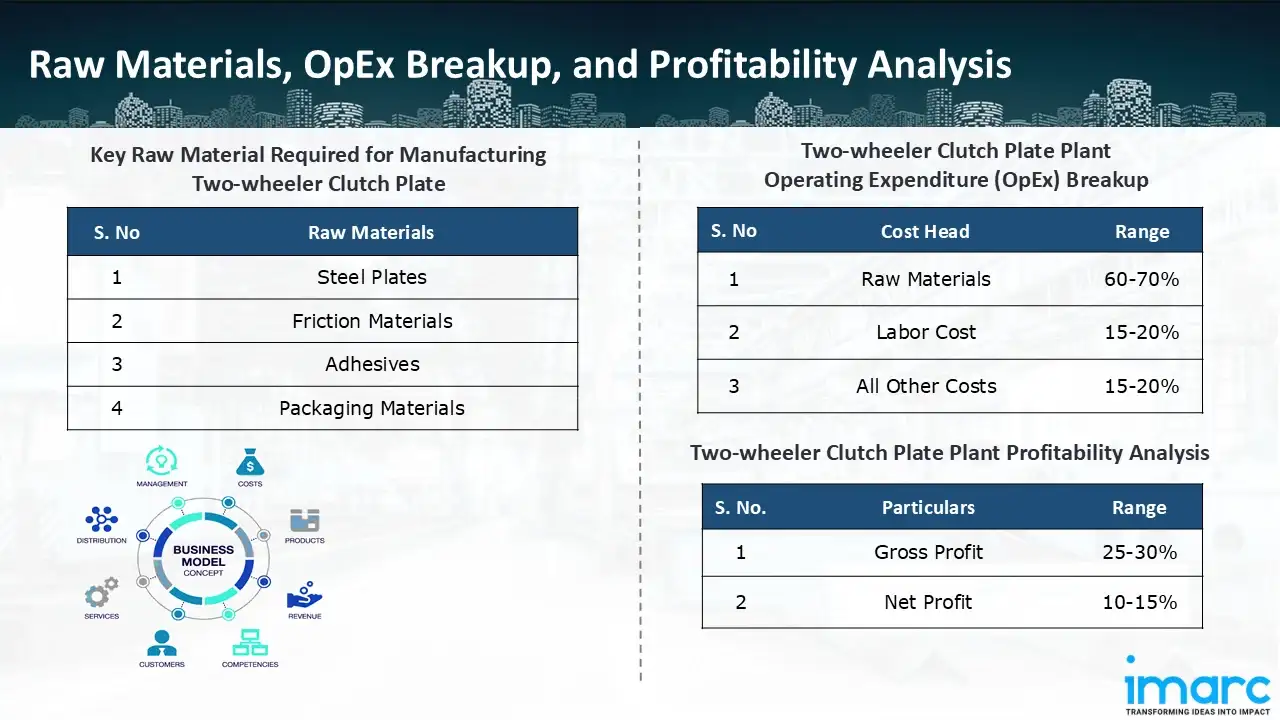
The basic raw materials required for two-wheeler clutch plate manufacturing include:
- Steel Plates
- Friction Materials
- Adhesives
- Packaging Materials
Machine Section or Lines Required:
- Stamping
- Bonding
- Riveting
- Grinding
- Packing
Techno-Commercial Parameter:
- Capital Expenditure (CapEx): Capital expenditure (CapEx) in a manufacturing plant includes various investments essential for its setup and long-term operations. It covers machinery and equipment costs, including procurement, installation, and commissioning. Civil works expenses involve land development, factory construction, and infrastructure setup. Utilities such as power, water supply, and HVAC systems are also significant. Additionally, material handling systems, automation, environmental compliance, and safety measures are key components. Other expenditures include IT infrastructure, security systems, and office essentials, ensuring operational efficiency and business growth.
- Operating Expenditure (OpEx): Operating expenditure is the cost incurred to operate a manufacturing plant effectively. OpEx in a manufacturing plant typically includes the cost of raw materials, utilities, depreciation, taxes, packing cost, transportation cost, and repairs and maintenance. The operating expenses are part of the cost structure of a manufacturing plant and have a significant effect on profitability and efficiency. Effective control of these costs is necessary for maintaining competitiveness and growth. Furthermore, raw material cost in two-wheeler clutch plate manufacturing plant ranges between 60-70%, labor cost ranges between 15% to 20%, and all other costs ranges between 15-20% in the proposed plant.
- Profitability Analysis Year on Year Basis: We assisted our client in developing a detailed cost model, which projects steady growth, with revenue rising throughout the projected period. Moreover, gross profit margins lie between a range of 25-30%, and net profit lie between the range of 10-15% during the income projection years, highlighting strong financial viability and profitability.
Conclusion & IMARC's Impact:
Our financial model for the two-wheeler clutch plate manufacturing plant was meticulously developed to meet the client’s objectives, providing an in-depth analysis of production costs, including raw materials, manufacturing, capital expenditure, and operational expenses. By addressing the specific requirements of manufacturing 2 million sets of two-wheeler clutch plate annually, we successfully identified key cost drivers and projected profitability, considering market trends, inflation, and potential fluctuations in raw material prices. This comprehensive financial model equipped the client with valuable insights into strategic decision-making, demonstrating our commitment to delivering high-quality, client-focused solutions that ensure the long-term success of large-scale manufacturing ventures.
Latest News and Developments:
- In January 2026: Schaeffler India Limited, a player in the clutch industry, announced that it would be attending SIAT 2026 and showcasing a variety of automotive technology intended for India's developing car market.
- In February 2025, Schaeffler India announced strengthening its presence in the two- and three-wheeler segments, leveraging its existing capabilities in internal combustion engine (ICE) components and its recent expansion into electric powertrain solutions through the Vitesco Technologies acquisition.
Why Choose IMARC?
IMARC's Financial Model Expertise: Helping Our Clients Explore Industry Economics
IMARC is a global market research company that offers a wide range of services, including market entry and expansion, market entry and opportunity assessment, competitive intelligence and benchmarking, procurement research, pricing and cost research, regulatory approvals and licensing, factory setup, factory auditing, company incorporation, incubation services, recruitment services, and marketing and sales.
Under our factory setup services, we assist our clients in exploring the feasibility of their plants by providing comprehensive financial modeling. Additionally, we offer end-to-end consultation for setting up a plant in India or abroad. Our financial modeling includes an analysis of capital expenditure (CapEx) required to establish the manufacturing facility, covering costs such as land acquisition, building infrastructure, purchasing high-tech production equipment, and installation. Furthermore, the layout and design of the factory significantly influence operational efficiency, energy consumption, and labor productivity, all of which impact long-term operational expenditure (OpEx). So, every parameter is covered in the analysis.
At IMARC, we leverage our comprehensive market research expertise to support companies in every aspect of their business journey, from market entry and expansion to operational efficiency and innovation. By integrating our factory setup services with our deep knowledge of industry dynamics, we empower our clients to not only establish manufacturing facilities but also strategically position themselves in highly competitive markets. Our financial modeling and end-to-end consultation services ensure that clients can explore the feasibility of their plant setups while also gaining insights into competitors' strategies, technological advancements, and regulatory landscapes. This holistic approach enables our clients to make informed decisions, optimize their operations, and align with sustainable practices, ultimately driving long-term success and growth.
Our Clients










Contact Us
Have a question or need assistance?
Please complete the form with your inquiry or reach out to us at
Phone Number
+91-120-433-0800+1-201-971-6302
+44-113-547-7077
Previous Post

The bus industry in Australia is an important sector of the national public transport system, conveying people in urban and regional settings. It has recently gone through a remarkable expansion due to fast urbanization and the growth of population in major cities. With such factors, the demand for public transportation with considerable sustainable and effective mass transit solutions has surged noticeably.
The Saudi Arabia road freight transport market represents one of the key building blocks of the economic infrastructure in the Kingdom, providing for cargo movement across various domestic supply chains. It also involves road freight operations, which allow for the distribution of goods-from manufactured goods, consumer goods, and industrial supplies to agricultural produce-across its large and wide geography.
The exponential rise in online shopping is fueling unprecedented parcel movement across India. Consumers are increasingly relying on e-commerce platforms for everyday essentials, including fashion, electronics, grocery, and lifestyle products. Additionally, the rise of direct-to-consumer (D2C) brands has added a new dimension to the logistics ecosystem, with a growing emphasis on speed, reliability, and personalized delivery experiences.
The GCC outbound travel and tourism market has experienced remarkable transformation, driven by economic prosperity, demographic shifts, and evolving consumer preferences. Citizens across the Gulf Cooperation Council nations, including Saudi Arabia, United Arab Emirates, Qatar, Kuwait, Bahrain, and Oman, increasingly venture beyond borders to explore international destinations.
The UAE cold chain logistics market has emerged as a critical component of the nation's broader economic diversification strategy. As the country positions itself as a leading regional hub for trade, commerce, and healthcare, the demand for sophisticated temperature-controlled supply chain solutions continues to intensify.
The Indian online food-delivery ecosystem is undergoing a rapid expansion, propelled by multiple structural shifts in technology, consumer behaviour, and delivery infrastructure. According to a recent report by Bain & Company and Swiggy, the overall food-services market in India is projected to grow from roughly INR 5.5?lakh crore in 2023 to around INR 9–10?lakh crore by 2030.
The Philippines travel and tourism industry is thriving, with travelers drawn to its islands, heritage, and vibrant city life. IMARC Group estimates the market reached USD 14.0 Billion in 2025, reflecting the country’s growing appeal as a global destination. Stronger air connectivity, better infrastructure, and widespread use of digital booking platforms are boosting both leisure and business travel.
The Mexico 3PL market has emerged as a critical pillar supporting the country's economic transformation and integration into global trade networks. As multinational corporations are increasingly viewing Mexico as a strategic manufacturing and distribution hub, the industry is evolving from a supporting service sector into a fundamental driver of competitive advantage.
An e-rickshaw is an electric-powered three-wheeled vehicle designed to transport passengers and goods over a short distance. It is an efficient, low-cost, eco-friendly substitute for conventional fuel-based auto-rickshaws and cycle rickshaws. The general specification of an e-rickshaw involves an electrical motor ranging from 650W to 1500W powered by a rechargeable lead-acid or lithium-ion battery, a lightweight chassis manufactured from mild steel or reinforced metal, and a simple drivetrain system.
Speed, reliability, and supply chain precision have become cornerstones of global commerce. As businesses operate across borders and customers expect shorter delivery times, the need to move products efficiently across continents has become essential. Air freight isn’t just connecting time zones—it’s enabling fast, predictable service that modern logistics depend on.
A truck radiator is an essential part of the truck's cooling system, which is used to control engine temperature by dispersing the excess heat produced during running. The radiator functions by circulating a coolant liquid around the engine, absorbing heat, and then releasing the heat to the air through the radiator's finned surface.
Australia's third-party logistics (3PL) industry is witnessing a revolution, driven by the integration of artificial intelligence (AI), digital infrastructure, and e-commerce growth. Initially based on manual procedures and operations, contemporary logistics chains are now being transformed by real-time data streams, predictive analytics, and smart automation.
Dropshipping is a streamlined e-commerce fulfillment model where sellers promote products without the need to maintain inventory. Instead of managing stock, sellers pass customer orders to third-party suppliers, often manufacturers or wholesalers, who handle packaging and shipping directly to the customer.
The logistics industry, encompassing transportation, warehousing, and distribution, is undergoing significant transformation in 2025. This growth is driven by technological advancements, evolving consumer expectations, and the need for more resilient supply chains.
The logistics sector is a vital component of the supply chain, encompassing the management and transportation of goods and services from their origin to their destination. It involves a broad spectrum of activities such as transportation, warehousing, inventory management, packaging, and goods handling, alongside information flow and supply chain management. The sector ensures the efficient movement of goods through various supply chain stages to meet consumer demand, playing a crucial role in facilitating trade and commerce, supporting economic growth, and serving diverse industries, including manufacturing, consumer goods, retail, food and beverages, IT hardware, healthcare, and chemicals.