Australia Fertilizer Industry: Sustainable Trends, Economic Impact, and Opportunities
Introduction:
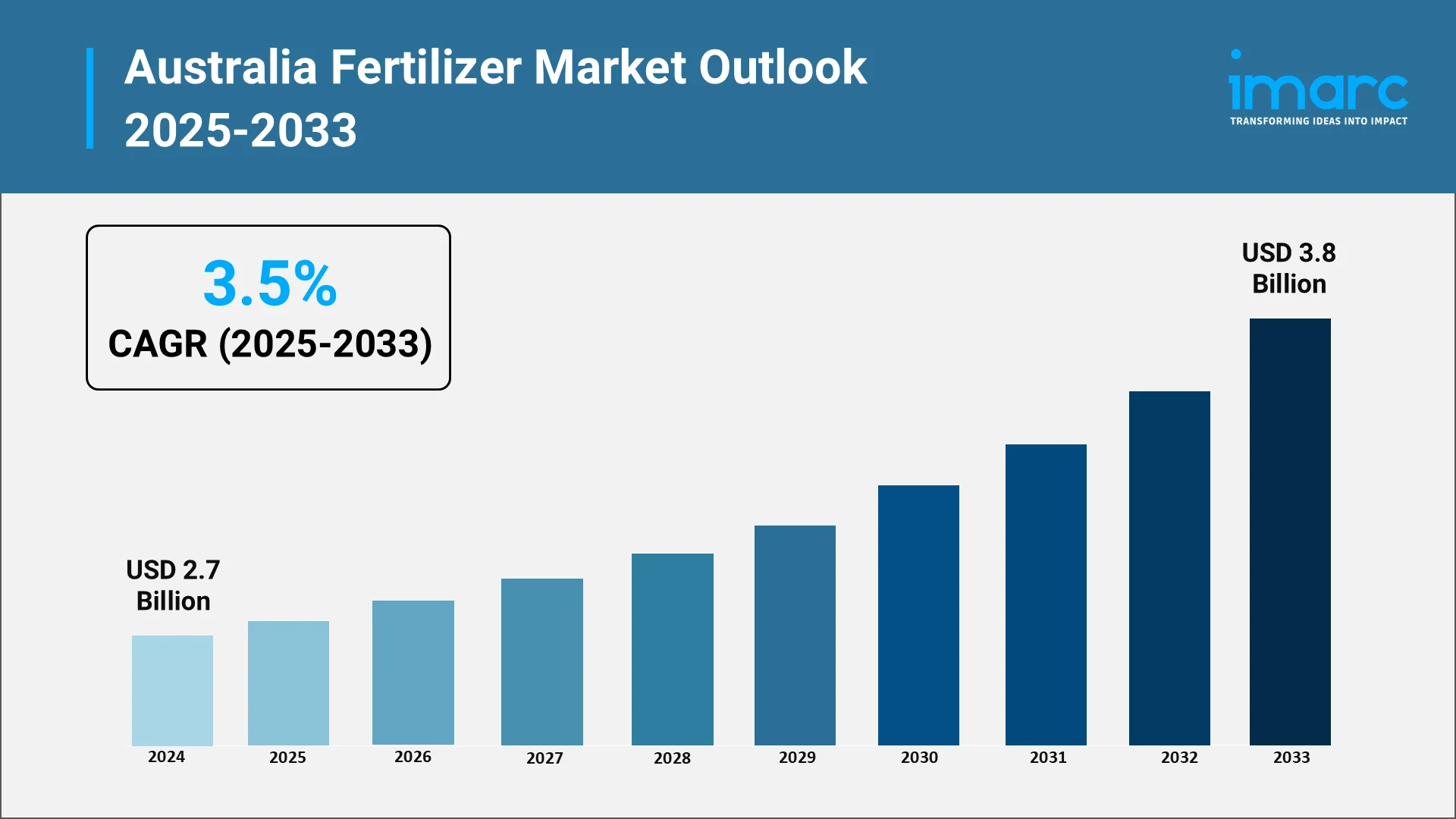
Australia fertilizer industry is one of the key pillars of the country's farm setup. Fertilizers are a critical input in soil productivity, boosting crop output and the uniform production of food and other farm products. Australia has a wide and varied agricultural scene with grain growing horticulture, livestock, and specialty crops. Every industry depends upon fertilizers to optimize production and ensure soil fertility, especially in areas where the natural soil nutrients are nil or climatic conditions are unsuitable. The Australia fertilizer market size reached USD 2.7 Billion in 2024, and looking forward, it is expected to reach USD 3.8 Billion by 2033, exhibiting a growth rate (CAGR) of 3.5% during 2025–2033.
Apart from their value in agriculture, fertilizers also have wider economic importance. They underpin rural livelihoods, add value to the chain through supply and logistics networks, and drive research and development work in farm science. In 2024, Australian farmers began adopting Lono, an innovative fertilizer by Levity Crop Science, to enhance sustainability and crop yield. With environmental pressure increasing worldwide, the industry is increasingly being challenged to innovate and embrace sustainable methods that reduce ecological footprint without sacrificing productivity. This double emphasis on agricultural performance and environmental sustainability is defining the course of the fertilizer sector in Australia, generating new opportunities for expansion and innovation.
Sustainability has become the underlying theme, as stakeholders look for options that minimize environmental impacts but do not come at the expense of crop yields. The sector is slowly moving away from traditional chemical fertilizers to higher-value products, such as controlled-release fertilizers, nutrient-efficient formulations, and bio-based or organic inputs. These innovations are aimed at enhancing the efficiency of nutrient uptake, reducing wastage, and mitigating greenhouse gas emissions and soil degradation concerns. As a result, the Australian fertilizer industry is transforming into a more technologically oriented, environmentally friendly, and robust business that responds to existing agricultural needs as well as future ecological objectives.
Explore in-depth findings for this market, Request Sample
Recent Market Trends and Substantial Research and Development:
The Australian fertilizer market has experienced significant research, innovation, and uptake of technology, with a strong focus on efficiency and sustainability. There has been a drive towards researching fertilizers with enhanced nutrient use efficiency, including controlled-release products and nutrient-stabilizing additives, that improve crop yield with less adverse impact on the environment through water pollution and greenhouse gas emissions.
Other fertilizer sources, such as organic fertilizers and biofertilizers, are also becoming popular because they enhance soil structure, increase microbial activity, and facilitate slow, long-term nutrient release. These biologically based materials supplement traditional fertilizers in a way that supports an integrated, sustainable soil management strategy in keeping with contemporary agricultural farming methods.
Precision agricultural technology has also revolutionized fertilizer use. Devices such as soil sensors, satellite photography, and data analysis allow for focused nutrient delivery, waste minimization, cost reduction, and increased yield. Accompanied by policies to reduce carbon emissions and greenhouse gases, these innovations mark a fertilizer sector increasingly focused on sustainability, science, and pragmatic, green solutions.
Government Policy Support:
Policies of the government are responsible for influencing Australia's fertilizer sector by offering regulatory guidelines, technical advice, and monetary benefits that support sustainability. Effective regulations guarantee product quality and safety and mitigate hazards like heavy metals in products and chemical residues, while conserving soil and water resources without sacrificing agricultural output. In 2024, the Australian government announced $63 million to support emissions reductions in the agriculture and land sector, highlighting its commitment to sustainable farming practices and climate-smart initiatives.
In addition to regulation, government programs support more sustainable farming practices by promoting climate-smart initiatives, technical assistance, and advisory services that assist farmers in maximizing the use of nutrients while preserving soil quality. Economic incentives, such as research funding and subsidies, promote innovation in nutrient-efficient fertilizers and low-carbon products, while extension programs and knowledge transfer programs support uptake of best practices, building a support system for a sustainable and resilient fertilizer industry.
Top Companies in the Australia Fertilizer Industry:
The Australian fertilizer market is marked by the existence of a number of prominent companies dominating production, distribution, and the development of fertilizer products. These businesses specialize in various segments, such as nitrogen-based, phosphorus-based, potassium-based, and specialty fertilizers. Their business models tend to emphasize enhancing crop nutrition, enhancing soil health, and exploring research and development undertakings for the creation of innovative and sustainable products. In 2024, Nutrien Ag Solutions commenced work on a new modern and efficient bulk fertilizer distribution center in Rockingham, Western Australia, following a fire at its Kwinana facility. This $70 million investment aims to serve farmers and enable food production for both Western Australia and export markets.
Sustainable business is practiced by numerous top companies to minimize environmental footprint and address increasing consumer demands for ethical agricultural inputs. For instance, there is an emphasis on controlled-release formulations, nutrient-efficient fertilizers, and bio-based inputs. Strategic partnerships with agricultural research centers, technology suppliers, and farming communities allow these companies to introduce innovations that are practical as well as scientifically proven.
The sector comprises a combination of local and international companies, with a range of products to cater to the diversified requirements of Australian farming. There are those that deal with traditional chemical fertilizers, with affordable options for mass-scale crop cultivation. Others deal with high-priced specialty fertilizers, ranging from micronutrient mixes and organic products, for horticulture, specialty crops, and environmentally friendly farming systems.
Sustainability is growing at the heart of corporate policy for leading fertilizer market participants. Research investment, process improvement, and new product line development not only secure market share but also enable the universal objective of sustainable agricultural development. As the industry continues to transform itself, these players will be key contributors to developing the uptake of sophisticated fertilization methods and enhancing the resilience of Australia's agriculture sector.
Opportunities and Challenges in the Australia Fertilizer Industry:
Opportunities
The Australian fertilizer sector is positioned to take advantage of opportunities triggered by advances in technology, concerns over the environment, and changing market demands. The implementation of precision agriculture technologies presents a notable growth area with the ability of farmers to utilize fertilizers more effectively, minimize wastage, and maximize nutrient management. Technologies like soil mapping, satellite imagery, and sophisticated data analytics enable precision fertilization, enhancing crop yields while reducing environmental impact. In 2024, Incitec Pivot announced plans to divest its fertilizer business, including the sale of its distribution assets and the closure of several manufacturing facilities. This strategic shift aims to focus on its explosives division and reflects broader industry trends toward consolidation and specialization. In parallel, the growing organic and biofertilizer market is huge in potential. Increasing consumer demand for sustainably produced, chemical-free farm products is fueling interest in bio-based fertilizers, microbial inoculants, and slow-release organic formulations, providing opportunities for businesses to innovate and serve this emerging segment.
Collaboration and strategic partnerships further boost growth opportunities for the sector. By collaborating with research institutions, technology suppliers, and policymakers, fertilizer firms can speed up innovation, gain access to advanced knowledge, and create solutions tackling contemporary agricultural issues. Such partnerships also facilitate knowledge transfer and the uptake of sophisticated fertilization practices by farmers. In addition, Australian fertilizer manufacturers can seek opportunities for exports, providing products suited to various crop systems, soils, and sustainability levels within regional and international markets. By incorporating technological innovation, sustainability, and expansionary strategy, the sector is likely to meet both economic development and environmental care.
Challenges
In spite of the abundance of growth possibilities, the Australian fertilizer sector encounters some challenges that need strategic consideration. Environmental issues are a top priority, since overuse or improper use of fertilizers can lead to nutrient runoff, water pollution, and enhanced greenhouse gas emissions. Mitigating these effects requires investment in cleaner production technology, precision delivery systems for nutrients, and sustainable application practices. Firms need to reconcile productivity with environmental conservation, so that sustainability becomes a part of both product planning and operational strategies. This emphasis not only reduces environmental risks but also supports larger national and international efforts fostering climate action and sustainable agriculture.
Aside from environmental forces, competition in the market is a major challenge. Local and foreign competitors intensely vie for market share, compelling the need for ongoing innovation, efficiency gains, and cost control in order to sustain profitability. Supply chain weaknesses, such as irregularities in raw material supply and transportation logistics, make production and distribution stability more challenging. Compliance with changing environmental regulations, product quality control, and safety guidelines adds to the complexity. Investment in monitoring, reporting, and technology enhancements are needed to address these necessities. Successfully overcoming these challenges requires strategic planning, stakeholder coordination, and a focus on sustainable practices in all operations to provide long-term resilience and competitiveness for the Australian fertilizer industry.
.webp)
Future Outlook: Australia Fertilizer Industry
The future of the Australian fertilizer industry will be influenced by sustainability, technological innovation, and policy frameworks that are supportive. Growing focus on environmentally friendly fertilizers is propelling the use of controlled-release formulations, nutrient-efficient products, and bio-based products. These innovations allow farmers and firms to produce high productivity while reducing ecological footprints. Concurrently, the incorporation of digital technologies, data analysis, and precision farming methods is reshaping nutrient management, optimizing application, and improving decision-making. Those companies that utilize these technologies will be well-positioned to meet changing market requirements and strict regulation demands.
Government assistance will remain a key driver of the industry's expansion. Policies promoting sustainable agriculture, innovation and development, and knowledge sharing ensure a conducive environment for innovation and cooperation. These help businesses deal with environmental and operational issues while venturing into local and export markets. Generally, the Australian fertilizer industry is well-positioned to become a more sustainable, technology-based, and resilient industry. Through driving innovation, building partnerships, and embedding environmental stewardship in business, the industry can sustain agricultural productivity, improve rural economies, and respond to the challenges of an increasingly changing global context.
Advancing Growth: IMARC’s Strategic Insights into the Australia Fertilizer Market
IMARC Group equips stakeholders in the agriculture and fertilizer industry with data-driven strategies to excel in the evolving Australia fertilizer market. Our research and advisory services help clients identify growth opportunities, manage risks, and foster innovation in product development, nutrient management solutions, and sustainable farming practices.
- Market Insights: Track regional trends shaping the Australia fertilizer market, including increasing demand for precision agriculture, eco-friendly fertilizers, and crop-specific nutrient solutions.
- Strategic Forecasting: Anticipate advancements in controlled-release fertilizers, digital soil analysis, automated application technologies, and regulatory shifts impacting production, labeling, and distribution.
- Competitive Intelligence: Benchmark leading players’ strategies, monitor product innovations, and assess the integration of technology-driven solutions such as smart farming platforms, farm management software, and customer engagement tools.
- Policy and Regulatory Analysis: Evaluate how Australian agricultural policies, environmental guidelines, and sustainability mandates influence fertilizer usage, market accessibility, and product innovation.
- Customized Consulting Solutions: Access tailored guidance for market entry, product portfolio expansion, pricing strategies, and partnerships with distributors, agri-tech platforms, and farm cooperatives. IMARC’s consulting services enable stakeholders to navigate the dynamic Australia fertilizer market while remaining environmentally responsible, technologically adept, and aligned with farmer needs.
Our Clients










Contact Us
Have a question or need assistance?
Please complete the form with your inquiry or reach out to us at
Phone Number
+91-120-433-0800+1-201-971-6302
+44-113-547-7077
Previous Post

The Japan agritourism industry is experiencing remarkable transformation as travelers increasingly seek authentic connections with rural landscapes and agricultural traditions. Agritourism represents a dynamic fusion of agriculture and tourism, offering visitors immersive experiences through farm stays, hands-on agricultural activities, and cultural immersion in Japan's countryside.
HDPE pipes are thermoplastic piping systems made from high-strength polyethylene resin, which features excellent flexibility, high impact resistance, and strong chemical and corrosion resistance. HDPE pipes are produced by extruding molten polyethylene into a variety of diameters and pressure ratings. Their seamless structure, along with their low friction and resistance to internal pressure and external load, makes them ideal for the transport of fluids. HDPE pipes boast superior endurance, long service life, and leak-free performance, since it is possible to join them through heat fusion, thus creating monolithic, continuous pipelines that are suitable for buried, aboveground, or underwater installations.
The Brazil agricultural machinery market stands as a cornerstone of the nation's agricultural modernization drive, experiencing robust expansion fueled by technological innovation, government support initiatives, and the imperative to enhance agricultural productivity across the world's largest soybean producer. According to IMARC Group's comprehensive market analysis, the Brazil agricultural machinery market reached a valuation of USD 3.1 Billion in 2024, reflecting the accelerating adoption of advanced farm equipment Brazil offers across diverse agricultural landscapes spanning grain production, sugarcane cultivation, coffee farming, and livestock operations. This impressive growth trajectory positions the industry for continued prosperity, with projections indicating the market will reach USD 4.5 Billion by 2033, exhibiting a compound annual growth rate (CAGR) of 4.1% during the 2025-2033 forecast period.
The smart agriculture market is revolutionizing the global agriculture industry through the integration of cutting-edge technologies such as Internet of Things (IoT), artificial intelligence (AI), robotics, sensors, and big data analytics. As the world population continues to grow, farmers and agribusinesses face mounting pressure to increase productivity while minimizing environmental impact.
Australia's agribusiness sector is at a crossroads, combining its historic advantage in bulk farming with new-generation technologies and green practices. The industry is pivotal to the nation's economy, adding billions to GDP and underpinning exports to overseas markets. Increasing food security demands and climate change pressures have compelled Australian farmers and agribusiness companies to take up innovation at an unprecedented scale.
A fertilizer is any natural or manufactured material containing one or more nutrients that are applied to the soil or plant tissues and that are usually beneficial for plant growth by improving fertility. The elements that plants need in large quantities, namely nitrogen (N), phosphorus (P), and potassium (K), are known as the primary macronutrients. The other secondary nutrients include calcium, magnesium, and sulfur; micronutrients include zinc, iron, manganese, and copper.
Coco peat, or coir pith or coir dust, is a fibrous natural byproduct generated during the processing of coconut husks to extract coir fiber. Coco peat is an organic, renewable, and biodegradable product that has gained international significance as a sustainable substitute for peat moss in horticulture, agriculture, and hydroponics. The coco peat production process starts with the gathering of coconut husks, which are retted, soaked, and mechanically treated to exclude long coir fibers that are employed in ropes, mats, or brushes. The leftover fine material, the pith is washed, sieved, dried, and compressed into briquettes, blocks, or grow bags.
Bamboo is a poaceous grass which regrows rapidly, has a high yield of biomass and good material properties, ranging from tiny clumping species to huge timber-grade culms over 20 meters tall; genera of economic importance are Bambusa, Phyllostachys and Dendrocalamus. Botanically, bamboo integrates the regenerative benefit of an agricultural crop (short rotation, annual or multi-annual yield) with certain mechanical characteristics of softwoods like large specific strength, good tensile performance, and natural hollow culm geometry for light-weight structural property.
Sustainability is reshaping the future of agriculture, energy, and environmental management, with biochar emerging as a transformative force within the ecosystem. Produced from biomass through pyrolysis, biochar enriches soils, strengthens crop resilience, and reduces dependence on chemical fertilizers. According to reports, long-term application delivers measurable benefits—boosting average crop yields by 10.8% and increasing soil organic carbon by 52.5%—underscoring its role in restoring soil health while combating degradation.
Sesame seeds are one of the oldest oilseed crops known to humankind, prized for their high oil content, distinctive nutty flavor, and valuable nutritional profile. They are composed of approximately 50–60% oil and 20–25% protein, making them an essential raw material for edible oil, bakery, confectionery, and health food industries. The seeds are also rich in antioxidants such as sesamol and sesamin, which contribute to their oxidative stability and health-promoting properties. Processing of sesame seeds typically involves cleaning, dehulling, roasting, pressing, and solvent extraction, depending on the end-use product.
The global seed industry plays an important role in ensuring food security and the sustainability of agricultural practices. As the world grapples with food insecurity, climate volatility, and shrinking arable land, the market has emerged as a critical enabler of agricultural resilience.
Explore how to start a biofertilizer manufacturing business, from setup and licenses to market trends, investment, and sustainable growth strategies.
World Environment Day, observed on June 5th each year, serves as an important reminder to protect and preserve our planet. This day inspires millions of people from across the globe to reflect on environmental issues and take tangible measures toward securing the world for future generations.
Bamboo is one of the sustainable and versatile materials that are being used in several different industries. Bamboo provides a very environmentally friendly option for food packaging, as it reduces plastic use. At high temperatures, bamboo is burnt to produce bamboo biochar. This is a soil enhancer for soil health and carbon sequestration. Bamboo is also a sustainable building material and is used in the construction industry. Due to its antibacterial properties, bamboo vinegar, which is a byproduct of bamboo charcoal manufacturing, is used in skincare and agriculture.
The global poultry market is growing at a fast pace, driven by several factors, such as rising demand for affordable and protein-rich food sources, especially in developing countries. The growing preference for white meat over red meat due to health considerations, as well as urbanization and increasing disposable incomes, also contributes to higher consumption of poultry products. Moreover, technological advancements in poultry farming, such as improved breeding techniques and feed conversion ratios (FCR), enhance productivity and efficiency, further boosting market growth. As per IMARC Group, the global animal feed market size reached US$ 518.4 Billion in 2023 and is expected to reach US$ 674.7 Billion by 2032, exhibiting a growth rate (CAGR) of 2.9% during 2024-2032.