Biodegradable Disposable Tableware Plant Setup Cost in India: Manufacturing Process Flow, Machinery, DPR & Financial Model 2026
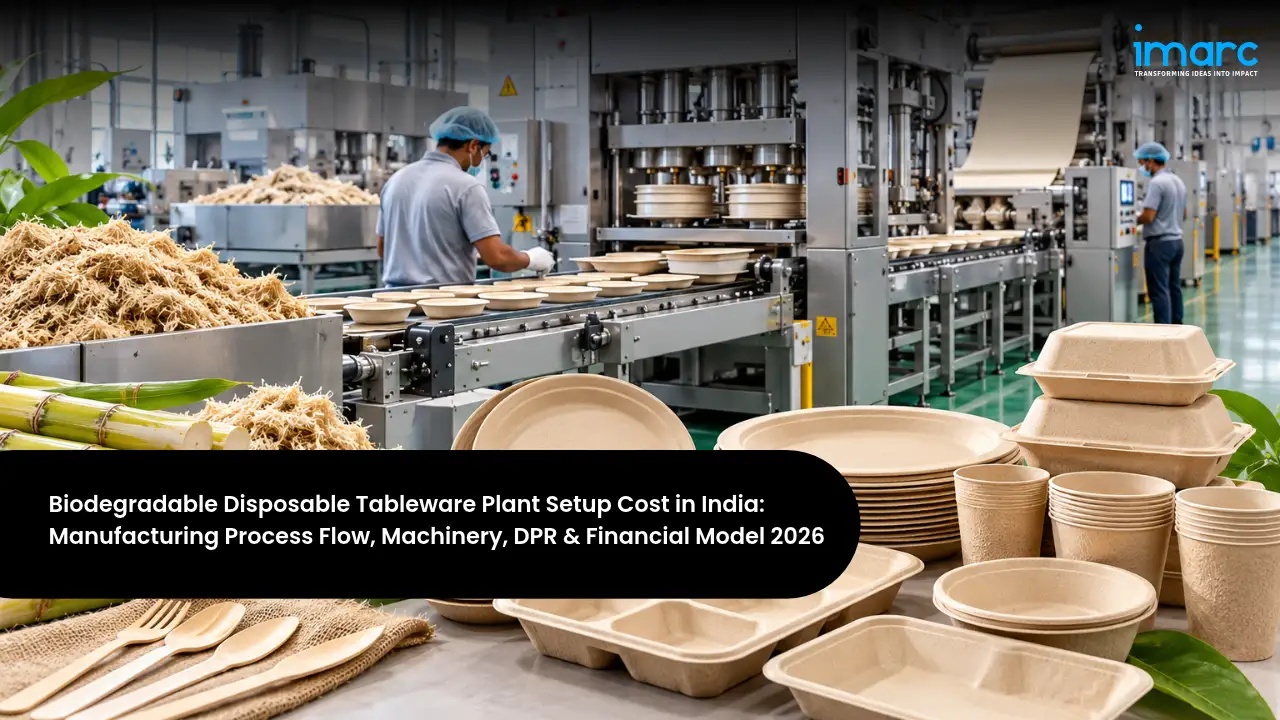
Biodegradable tableware covers plates, bowls, trays, cups, food containers, clamshells, and cutlery made from plant-based materials such as sugarcane bagasse, bamboo and wheat straw fibre, areca palm leaves, paper, wood, and certified compostable bioplastics. These products break down naturally after use and replace the single-use plastic and polystyrene items that India banned from 1 July 2022. India's biodegradable tableware and packaging market is projected to reach about USD 3.23 billion by 2030, driven by the plastic ban, food delivery growth, and demand from caterers, restaurants, institutions, and export buyers. Together these factors make Biodegradable Disposable Tableware Manufacturing Plant Setup in India an attractive opportunity for packaging companies, sugar mills, and green-product entrepreneurs.
Investment depends mainly on the material and process chosen, capacity, the level of automation, and whether the plant makes its own pulp. The Biodegradable Disposable Tableware Manufacturing Plant Cost ranges from about INR 3–8 crore for a small unit of 1 to 3 tonnes a day to INR 30–70 crore for a plant of 10 to 20 tonnes a day, and INR 120–250 crore for a large integrated plant of 40 tonnes a day or more. Raw materials make up 60 to 70% of operating cost and utilities another 15 to 25%, so pulp prices, energy use, and yields shape profitability. A well-run plant typically earns a gross margin of 25 to 30% and a net margin of 10 to 15%.
This guide is written for investors exploring how to start a Biodegradable Disposable Tableware manufacturing plant in India. It focuses on a bagasse moulded-fibre plant of about 5,000 tonnes a year, or roughly 15 tonnes a day, making plates, bowls, trays, and food containers for caterers, food delivery, retail, and export buyers, and also explains small units and large integrated plants. It covers products and markets, the demand outlook, the production process flow, machinery and raw materials, location and infrastructure, a detailed cost and financial breakdown, approvals and certifications, and how a DPR and financial model turn all of this into a bankable plan.
India Market Snapshot
| Key Facts | Details |
|---|---|
| India Market Forecast (2030) | About USD 3.23 Billion |
| Forecast Growth (2024–2030) | About 6.0% CAGR |
| Single-Use Plastic Ban | In Force Since 1 July 2022 |
| Asia-Pacific Share of Global Market | About 38.1% |
| Typical Plant Capacity | About 5,000 Tonnes a Year |
| Indicative Total Investment | INR 3 Crore to 250 Crore |
The snapshot shows a market created and protected by regulation, with steady growth from food delivery, catering, and institutional buyers. India's large sugar industry produces abundant bagasse, giving moulded-fibre producers a low-cost, renewable raw material close to many markets, while export buyers in the US and Europe are looking for certified compostable products. The wide investment range reflects a real choice between a small unit, an automatic plant with its own pulping, and a large integrated facility. The sections below work through that choice.
Investment Highlights
Indicative Project Cost in India (2026)
| Parameter | Value |
|---|---|
| Product Range | Plates, bowls, trays, containers, cutlery |
| Plant Capacity | 1 – 40+ Tonnes per day |
| Total Project Investment | INR 3–8 Crore (small unit) to 120–250 Crore (integrated plant) |
| Payback Period | 3 – 5 Years |
| Net Profit Margin | 10 – 15% |
| IRR | 16 – 24% |
| Preferred States | Uttar Pradesh, Maharashtra, Karnataka, Tamil Nadu, Gujarat, Telangana |
| Key Requirement | Pulp supply, good moulds, certifications |
These ranges provide a realistic frame for early planning, but actual returns depend on bagasse pulp prices, energy costs for hot pressing, mould quality and cycle times, rejection rates, the mix of plates, bowls, and containers, export certifications, and competition from paper, areca leaf, and imported products. A site-specific Biodegradable Disposable Tableware Feasibility Report narrows each of these assumptions to your chosen material, capacity, location, and customers.
Table of Contents
- What is Biodegradable Disposable Tableware Manufacturing?
- Why is Biodegradable Disposable Tableware Manufacturing Growing in India?
- Biodegradable Disposable Tableware Manufacturing Process Flow
- Raw Materials Required for Biodegradable Disposable Tableware Manufacturing
- Location, Land & Infrastructure
- Biodegradable Disposable Tableware Manufacturing Machinery and Equipment
- Biodegradable Disposable Tableware Manufacturing Plant Setup Cost in India (CapEx & OpEx)
- Financial Analysis and Profitability
- Licenses and Approvals for Biodegradable Disposable Tableware Manufacturing in India
- Recent Developments in the India Biodegradable Disposable Tableware Manufacturing Industry
- How a Biodegradable Disposable Tableware Manufacturing Project Report and DPR Helps Investors
- Frequently Asked Questions
What is Biodegradable Disposable Tableware Manufacturing?
Biodegradable tableware is single-use food service ware made from natural or compostable materials that break down through microbial action after disposal. The largest category is moulded fibre, in which sugarcane bagasse or other plant fibres are pulped, formed on moulds, and hot-pressed into rigid plates, bowls, trays, and containers that can hold hot and oily food and are often safe in microwaves and freezers. Other categories include pressed areca leaf plates, paper plates and cups with water-based barrier coatings, wooden and bamboo cutlery, and items made from certified compostable bioplastics such as PLA. Food-contact safety and freedom from harmful chemicals are as important as biodegradability.
Commercially, these products are sold to caterers and event organisers, restaurants and quick-service chains, food delivery and cloud kitchens, institutions such as railways, hospitals, and temples, retail and e-commerce channels, and export buyers. A Biodegradable Disposable Tableware Manufacturing Plant can supply distributors and wholesalers, restaurant chains and delivery platforms, institutional buyers, private-label brands, and importers in the United States, Europe, and the Middle East. Buyers value strength and leak resistance, food safety, compostability certification, consistent sizes, and competitive pricing.
- Catering & Events: Plates and bowls for weddings and functions.
- Food Delivery & QSR: Containers, clamshells, and trays.
- Institutions: Railways, hospitals, temples, and canteens.
- Retail & Exports: Branded packs and certified export products.
The Main Biodegradable Disposable Tableware Products and Applications
Choosing the product range is the most important commercial decision, because it determines materials, moulds, machines, and customers:
| Product Type | Description | Key Property | Primary Demand |
|---|---|---|---|
| Bagasse Plates & Bowls | Moulded sugarcane fibre | Sturdy, heat-safe | Caterers, QSR |
| Clamshells & Containers | Moulded, with lids | Leak-resistant | Food delivery |
| Areca Leaf Plates | Pressed palm leaves | Natural look | Premium, exports |
| Paper Plates & Cups | Coated paperboard | Low cost | Mass market |
| Wood & Bamboo Cutlery | Spoons, forks, stirrers | Rigid | QSR, events |
| Compostable Bioplastics | PLA or starch items | Plastic-like feel | Cutlery, lids |
These choices shape the whole plant. Moulded-fibre plates, bowls, and containers need pulping, forming, hot pressing, and trimming lines with many moulds, while areca leaf plates need only cleaning and heated presses but depend on seasonal leaf collection. Paper products need printing, coating, and forming machines, and bioplastic items need injection moulding and certification as compostable. Most new entrants therefore start with bagasse plates, bowls, and containers, the highest-volume products, and add clamshells, cups, and cutlery as their moulds, customers, and certifications grow.
Why is Biodegradable Disposable Tableware Manufacturing Growing in India?
Key Growth Drivers in India and Export Markets
Demand is supported by regulation, changing food habits, sustainability goals, and export opportunities:
- Plastic ban: India banned single-use plastic plates, cups, cutlery, trays, and straws from July 2022.
- Food delivery growth: Online ordering and cloud kitchens need large volumes of containers.
- Corporate sustainability: Restaurant chains, airlines, and caterers are switching to compostable products.
- Institutional demand: Railways, temples, hospitals, and canteens buy in bulk.
- Export markets: Plastic restrictions in the US, EU, and Middle East create demand for certified Indian products.
India-Specific Market Opportunity
| Segment | Market Context | Manufacturing Role |
|---|---|---|
| Food Delivery & QSR | Online orders growing | Containers, clamshells |
| Catering & Events | Weddings and functions | Plates and bowls |
| Institutional | Railways, hospitals, temples | Bulk plates |
| Retail Packs | Supermarkets, e-commerce | Branded packs |
The strongest opportunity for new entrants lies in bagasse containers and plates for food delivery and restaurant chains, in bulk supply to caterers and institutions, and in certified compostable products for export buyers, which usually pay better prices. Producers that combine consistent quality, food-safe and fluorine-free barrier treatments, and reliable delivery will be best placed to grow.
Biodegradable Disposable Tableware Manufacturing Process Flow
Understanding the process helps you plan equipment, layout, and where cost and quality are decided. Production runs from raw material receipt through pulping, refining and additive dosing, stock preparation, wet forming, hot pressing, edge trimming, inspection, and sterilisation to packing and dispatch. Mould design and pressing conditions decide strength, finish, and cycle time, while hot pressing is the largest user of energy.
The Biodegradable Disposable Tableware Manufacturing Process Flow
The sequence below reflects a bagasse moulded-fibre plant. Areca leaf and paper products follow simpler pressing or forming processes.
| Unit Operation | Key Activity |
|---|---|
| Raw Material Receipt | Pulp or bagasse checked |
| Pulping | Fibre dispersed in water |
| Refining & Additives | Barrier agents added |
| Stock Preparation | Consistency adjusted |
| Wet Forming | Fibre formed on moulds |
| Hot Pressing | Pressed and dried |
| Edge Trimming | Excess fibre cut |
| Inspection | Defects removed |
| UV Sterilisation | Hygienic finishing |
| Packing & Dispatch | Stacked and wrapped |
Two factors decide profitability across this flow. The first is mould and cycle efficiency, because well-designed moulds with multiple cavities and short pressing cycles raise output per machine and reduce energy per piece, while poor moulds cause cracks, uneven thickness, and rejects. The second is energy and water efficiency, since hot pressing uses a lot of heat or electricity and pulping uses large volumes of water, so heat recovery, efficient heating systems, and recycling of process water cut operating costs significantly.
Raw Materials Required for Biodegradable Disposable Tableware Manufacturing
The main inputs are bleached or unbleached bagasse pulp, or raw bagasse for integrated plants, other plant fibres such as bamboo and wheat straw, food-safe oil and water repellents, wet strength agents, process water, and packaging such as shrink film and cartons. India's sugar industry produces large volumes of bagasse, though much of it is burned in mill boilers, so securing pulp or bagasse supply at stable prices is central to planning.
| Raw Material | Role in Product | India Sourcing | % of OpEx |
|---|---|---|---|
| Bagasse Pulp | Main fibre | Sugar mills, pulp makers | 40–50% |
| Oil & Water Repellents | Barrier properties | Domestic, imports | 6–10% |
| Wet Strength Agents | Strength when wet | Domestic suppliers | 3–5% |
| Other Fibres | Bamboo, wheat straw | Domestic suppliers | 2–4% |
| Packaging | Shrink film, cartons | Domestic suppliers | 5–7% |
Pulp is the largest cost, and its price depends on sugar mill operations, competing uses of bagasse, and seasonal crushing. Long-term contracts with sugar mills or pulp makers, buying during the crushing season, blending other fibres, and choosing fluorine-free barrier agents that meet export rules help manage cost, supply, and compliance risk.
Location, Land & Infrastructure
Site selection for a moulded-fibre plant is driven by access to bagasse pulp from sugar mills, proximity to large food service markets, and the cost of power or fuel for hot pressing. Other factors include water availability, good road connectivity, port access for exports, and state incentives for green and MSME manufacturing. Because pulp is bulky and finished products are light but voluminous, the best locations balance raw material freight against delivery costs to customers. Locating close to a sugar mill can also allow the use of mill steam or power, which lowers energy costs considerably.
Choosing the Best Location for Biodegradable Disposable Tableware Manufacturing Plant Setup
| State / Region | Why It Works | Key Advantage |
|---|---|---|
| Uttar Pradesh | Largest sugarcane belt | Bagasse, NCR market |
| Maharashtra | Sugar mills, Mumbai, Pune | Bagasse and demand |
| Karnataka | Sugar belt, Bengaluru | Bagasse, areca leaves |
| Tamil Nadu | Sugar mills, Chennai | Bagasse and ports |
| Gujarat | Food processing, ports | Export access |
| Telangana | Hyderabad food market | Strong demand |
Uttar Pradesh and Maharashtra combine large sugar industries with major consumer markets, while Karnataka offers both bagasse and areca leaves. Tamil Nadu and Gujarat provide ports for exports, and Telangana has a large and growing food service market around Hyderabad. The final choice should weigh pulp supply, energy cost, market and port access, incentives, and land cost.
Quality, Safety and Environmental Systems
Buyers test products for strength, leak and oil resistance, heat tolerance, and dimensional accuracy, and food-contact materials must meet Indian food packaging regulations, with migration testing for chemical safety. Export buyers also expect compostability certification to standards such as EN 13432 or ASTM D6400 and increasingly require products free of PFAS chemicals. A credible plant needs an in-house laboratory for physical and leak tests, hygienic finishing and packing areas, and lot traceability. Safety focuses on hot presses, moving machinery, and fire risk from stored pulp and finished goods. Environmental systems cover process water recycling and treatment and reuse of trimmings. An experienced Biodegradable Disposable Tableware Manufacturing Consultant in India can help plan product mix, mould strategy, energy systems, and certifications so the plant meets regulatory and customer requirements from the start.
Infrastructure Requirements (5,000 TPA Plant)
| Infrastructure Element | Specification | India-Specific Note |
|---|---|---|
| Total Land Area | 2 – 4 acres | Industrial area |
| Pulping Section | Pulpers and tanks | Water recycling |
| Forming Hall | Forming and pressing | Heat and ventilation |
| Finishing & Packing | Trimming, UV, packing | Hygienic area |
| Utilities | Power, thermal oil, water | 1.5 – 3 MW load |
| Water Treatment | White water recycling | Closed loop |
| Warehouse | Finished goods | Dry storage |
A well-ventilated forming hall with reliable power or thermal heating and a closed-loop water system are the most important infrastructure requirements, since they decide output and operating cost. Hygienic finishing and packing areas, dry storage for pulp and products, and good road and port access complete the core needs.
Biodegradable Disposable Tableware Manufacturing Machinery and Equipment
The equipment set covers pulping, refining, stock preparation, forming, hot pressing, trimming, vacuum and compressed air, heating, sterilisation, packing, and testing. Forming and pressing machines and their moulds account for most of the machinery budget. The main items are summarised below.
| Equipment | Function | Key Specification |
|---|---|---|
| Hydrapulper | Disperse fibre | With agitator |
| Refiner | Refine fibre | Disc refiner |
| Stock Tanks & Dosing | Prepare slurry | Additive dosing |
| Forming Machine | Vacuum forming | Semi or fully automatic |
| Hot Press | Press and dry | Electric or thermal oil |
| Moulds & Dies | Shape products | CNC-machined |
| Trimming Machine | Cut edges | Hydraulic punching |
| Vacuum & Air Systems | Support forming | Pumps, compressors |
| Thermal Oil Heater | Heat presses | Biomass or gas fired |
| UV & Packing Line | Sterilise and pack | Shrink wrapping |
| QC Instruments | Test products | Leak, oil, heat tests |
Machinery should follow the product plan. A small unit can use semi-automatic forming and pressing machines with bought-in pulp board and manual trimming, while an automatic plant adds fully automatic forming and pressing with robotic transfer, its own pulping and refining, and automated trimming and packing. Large integrated plants add bagasse cleaning and pulping, steam from sugar mills, and many more moulds, which are a significant and recurring investment for each new product size.
Biodegradable Disposable Tableware Manufacturing Plant Setup Cost in India (CapEx & OpEx)
The tables below break down capital and operating costs for a moulded-fibre plant of about 5,000 tonnes a year in India. The final Biodegradable Disposable Tableware Investment Cost for your project will depend on capacity, automation, pulping, heating systems, mould range, land cost, and location.
Capital Expenditure (CapEx) Cost Structure
| CapEx Component | % of Total CapEx | What It Covers |
|---|---|---|
| Plant & Machinery | 45–55% | Pulping, forming, pressing |
| Moulds & Tooling | 8–12% | Product moulds |
| Building & Civil Works | 15–20% | Halls and warehouse |
| Land & Site Development | 5–10% | Land and approvals |
| Pre-operative & Certification | 2–4% | Trials, compostability tests |
| Working Capital | 10–15% | Pulp stocks, receivables |
Machinery and moulds make up most of the capital budget, and certifications are important because export buyers and large chains will not buy without them. Working capital covers pulp bought during the crushing season, finished goods across many sizes, and credit to distributors and chains. Because pricing is competitive and energy costs are high, a detailed Biodegradable Disposable Tableware Business Plan should model sales by product, channel, and market, pulp and energy costs, cycle times and rejection rates, mould investments, and payment terms together, so that funding supports the business through its early years.
Operating Expenditure (OpEx) Cost Structure
| OpEx Component | % of Total OpEx | India-Specific Note |
|---|---|---|
| Raw Materials & Packaging | 60–70% | Pulp, additives, film |
| Utilities (power, heat, water) | 15–25% | Hot pressing |
| Labour | 6–10% | Operators and packers |
| Maintenance & Moulds | 2–4% | Mould upkeep |
| Logistics | 3–5% | Bulky, light products |
| Overheads & Certification | 2–4% | Testing and audits |
With pulp and energy making up most of the cost, margins depend on pulp prices, cycle times, rejection rates, product mix, and selling prices. A good operating model tracks pulp consumption per thousand pieces, energy use per kilogram, machine output and uptime, rejection rates, and realised prices by product and channel, and tests margins against higher pulp or power prices and lower selling prices.
Financial Analysis and Profitability
Based on analysis of a 5,000 TPA moulded-fibre plant, the financial profile is steady, supported by regulation-driven demand and moderate capital needs, but returns depend on energy efficiency, pulp costs, and pricing. The profitability of Biodegradable Disposable Tableware manufacturing business in India improves markedly with low-cost pulp near sugar mills, efficient heating, multi-cavity moulds, high machine utilisation, a good share of containers and export orders, and long-term contracts with chains and distributors.
| Financial Metric | Indicative Value | India Context |
|---|---|---|
| Gross Profit Margin | 25–30% | Pulp and energy driven |
| Net Profit Margin | 10–15% | After overheads and taxes |
| Payback Period | 3–5 Years | Moderate capital needs |
| IRR (Internal Rate of Return) | 16–24% | Higher with exports |
| Capacity Utilization (stable ops) | 60–80% | Order-driven |
| Break-even Capacity Utilization | 40–50% | Energy-heavy costs |
Product mix and channels decide where a plant lands within these ranges. Plants selling certified containers and clamshells to chains and export buyers earn better margins, while units focused on basic plates for local distributors compete mainly on price. Compartment trays, lidded containers, and premium export products typically carry better margins than standard plates.
Returns can be strengthened by locating near sugar mills, using biomass or mill steam for heating, investing in multi-cavity moulds and automation, obtaining compostability and PFAS-free certifications, building export and chain accounts, and adding cups, lids, and cutlery.
Key Risks and Mitigation
The main risks are pulp supply and price swings, high energy costs, weak enforcement of the plastic ban, price competition from paper, areca, and imported products, quality complaints such as leaks, and changing export rules on chemicals. Supply risk is reduced through contracts with sugar mills; energy risk by efficient heating and biomass fuel; enforcement risk by targeting chains, institutions, and exports; competition risk by quality and certifications; and compliance risk by fluorine-free formulations and regular testing. Promoters often work with a Biodegradable Disposable Tableware Business Plan Consultant in India to test these scenarios before committing capital.
Licenses and Approvals for Biodegradable Disposable Tableware Manufacturing in India
Approvals for a tableware plant cover environmental, food-contact, compostability, and factory requirements. Promoters setting up a Biodegradable Disposable Tableware Manufacturing Plant in India generally need the following:
- Pollution Control Consents: Consent to Establish and Consent to Operate from the State Pollution Control Board, covering process water.
- Food-Contact Compliance: Compliance with FSSAI packaging regulations, with migration and safety testing.
- Compostability Certification: Certification to EN 13432, ASTM D6400, or similar standards for export buyers.
- CPCB Registration: Certification from the CPCB where compostable bioplastic items are produced.
- Factory, Boiler & Fire Safety: Factory license, boiler or heater approvals, and fire NOC.
- Legal Metrology & Labelling: Packaged commodity registration and accurate compostability claims.
- Business & Trade Registrations: Business registration, GST, Udyam, trademark, and Import Export Code.
Pollution control consents, food-contact testing, and compostability certification are usually on the critical path, since chains and export buyers will not place orders without them. Starting certification testing with pilot samples while the plant is being built shortens the time from investment decision to regular sales.
Note: The exact approvals, registrations, licenses, and certification requirements may vary depending on factors such as plant location, capacity, products, state pollution control categories, customer specifications, and applicable regulations. Businesses are advised to undertake a detailed regulatory assessment during the project planning stage to ensure full compliance and timely implementation.
Recent Developments in the India Biodegradable Disposable Tableware Manufacturing Industry
Several recent developments give useful context for investors considering this market:
- Plastic ban in force: From 1 July 2022, the Ministry of Environment, Forest and Climate Change banned the manufacture, sale, and use of identified single-use plastic items, including plates, cups, cutlery, and straws.
- Capacity additions: Dinearth, a bagasse tableware brand, set up its third manufacturing unit, with output of about 500 tonnes a month.
- Product expansion: CHUK, the tableware brand of Yash Pakka, expanded into cutlery and food delivery containers, sourcing bagasse from within 200 km of its plant.
- New paper products: In May 2024, SOLO launched SOLO Bold Hold, a heavyweight paper plate range.
The common thread is steady growth in demand and capacity, driven by regulation and changing food habits. New entrants who secure pulp, run energy-efficient plants, and obtain the right certifications will be best placed to grow in domestic and export markets.
How a Biodegradable Disposable Tableware Manufacturing Project Report and DPR Helps Investors
A detailed DPR provides a structured roadmap for the venture, from market demand and product selection to raw material sourcing, plant design, certifications, and economics. It helps investors decide the right products, capacity, and location, estimate capital and operating expenditure, assess profitability, and identify risks before committing funds.
At its core is a detailed Biodegradable Disposable Tableware Financial Model covering revenue by product, channel, and market, pulp, additive, energy, and packaging costs, cycle times, rejection rates, labour, mould investments, working capital, debt servicing, cash flows, break-even, return on investment, and payback under different price and demand scenarios. Banks and investors rely on this model to judge long-term viability, which is why many promoters appoint a Biodegradable Disposable Tableware Plant Project Report Consultant in India to prepare the report and validate its assumptions against current market data.
For a tableware project, a strong DPR also clarifies the pulp sourcing strategy, the energy and heating plan, the product and mould plan, and the certification and channel strategy, which together are the factors most likely to decide success. By testing margins against pulp and energy prices and competitive pricing, the report turns a regulation-driven opportunity into a plan that lenders and partners can trust.
Frequently Asked Questions
What are the first steps to set up a biodegradable disposable tableware manufacturing plant in India?
Start by choosing your products, such as plates, bowls, and containers, and your channels, including caterers, chains, delivery platforms, and exports. Then commission a feasibility study and DPR, secure bagasse pulp supply, select a site near sugar mills and markets, obtain pollution control consents, install forming and pressing machines with moulds, complete food-contact and compostability testing, and line up distributors and buyers.
How much does it cost to set up a biodegradable disposable tableware manufacturing plant in India?
Investment ranges from about INR 3–8 crore for a small unit of 1 to 3 tonnes a day to INR 30–70 crore for a plant of 10 to 20 tonnes a day, and INR 120–250 crore for a large integrated plant of 40 tonnes a day or more.
What are the main steps in making biodegradable disposable tableware?
The flow runs from raw material receipt through pulping, refining and additive dosing, stock preparation, wet forming, hot pressing, edge trimming, inspection, UV sterilisation, and packing and dispatch.
Which machinery does a biodegradable disposable tableware manufacturing plant need?
Key equipment includes hydrapulpers, refiners, stock tanks and dosing systems, forming machines, hot presses, moulds and dies, trimming machines, vacuum and compressed air systems, thermal oil heaters, UV and packing lines, and quality testing instruments.
What raw materials are used to make biodegradable disposable tableware?
The main raw materials are bagasse pulp or raw bagasse, other plant fibres such as bamboo and wheat straw, food-safe oil and water repellents, wet strength agents, process water, and packaging.
How profitable is biodegradable disposable tableware manufacturing in India?
A well-run plant typically earns a 25 to 30% gross margin and a 10 to 15% net margin, with payback in about 3 to 5 years. Profitability depends on pulp and energy costs, cycle times, product mix, and channels.
Which approvals does a biodegradable disposable tableware manufacturing plant need in India?
Typical approvals include pollution control consents, food-contact compliance, compostability certification for exports, CPCB certification for any bioplastic items, a factory license, heater approvals, fire NOC, Legal Metrology registration, and GST, Udyam, trademark, and Import Export Code registrations.
How do I get a feasibility study or DPR for a biodegradable disposable tableware manufacturing project?
A detailed feasibility study and DPR covers market demand, products, raw materials, plant design, certifications, and full financials. Investors usually engage a Biodegradable Disposable Tableware Manufacturing Feasibility Study Consultant with experience in packaging and green products to prepare the report and validate it for lenders.
Our Clients









Contact Us
Have a question or need assistance?
Please complete the form with your inquiry or reach out to us at
Phone Number
+91-120-433-0800+1-201-971-6302
+44-113-547-7077
Previous Post

Setting up a Corrugated Box Manufacturing Plant in India is a high-demand, packaging-driven venture, powered by the country's booming e-commerce, FMCG, and export sectors, and the steady shift toward recyclable paper-based packaging.
Setting up a Pallets Manufacturing Plant in India is a high-demand, logistics-driven venture, powered by the country's booming warehousing, e-commerce, and organized-retail sectors, and the steady formalization of supply chains after GST.
The GCC biodegradable food service disposables market size is undergoing a remarkable change as environmental sustainability takes center stage in regional business and regulatory agendas. Throughout the Gulf Cooperation Council nations, which include countries like Saudi Arabia, the UAE, Qatar, Kuwait, Oman, and Bahrain, significant players within the food service packaging sector are powerfully embracing novel packaging solutions that not only reduce environmental impact but also cater to modern-day consumers' needs for convenience and efficiency.
PVC blisters packaging is a type of thermoforming packaging wherein polyvinyl chloride (PVC) material is heated to mold it into packaging cavities to securely place individual items inside, which is then closed with either aluminum foil or paper-based lidding materials. PVC packaging exhibits clarity, strength, and moldability, making it possible to view the individual items while also protecting them against external damage.
A PET bottle is a type of rigid packaging packaging that is produced using a thermoplastic called polyethylene terephthalate, also known as polyester. The production of a PET bottle involves an injection stretch-blow molding technique that provides a lightweight and durable package with high clarity, strength, and impermeability.
Paper cups are a type of beverage container made mostly from paperboard. The paperboard gives the container strength. The lining of the paperboard varies and usually consists of waterborne coatings, bio-based coatings, and polymer coatings. This facilitates the paper cup to hold hot and cold fluids for an amount of time. Paper cups come in various sizes and different wall structures. This makes the paper cup functional for the desired purpose and environment.
Bagasse kraft paper is a green packaging material made from bagasse, the fibrous byproduct that is left when juice is extracted from sugarcane. Kraft paper is generally produced traditionally using wood pulp via the sulfate process, but bagasse offers a sustainable, non-wood source used in promoting green manufacturing and less reliance on forest resources. Bagasse fibers have high cellulose, moderate fiber length, and good bonding properties, making them ideal for manufacturing strong and long-lasting kraft paper. Production includes bagasse collection from sugar mills, purification to eliminate impurities, and processing into pulp either by chemical or mechanical pulping.
Bagasse biodegradable cutlery is made from the fibrous material remaining after extracting sugarcane stalk juice, a low-value agricultural residue also known as bagasse. The material is harvested from sugar mills, washed, pulped and mechanically molded into wet-molded forms; those wet parts are dried, pressed in heat-resistant molds and thermally cured to create rigid, food-grade spoons, forks and knives that are grease- and water-resistant but not covered with plastic coatings.
The global food packaging market is evolving as consumer expectations, sustainability concerns, and technological advancements redefine the way food is kept safe, secure, and delivered. Packaging is no longer merely a container; it has transformed into a critical enabler that drives purchase decisions, improves product shelf life, and communicates brand values. As demand for ready-to-eat, convenience, and packaged foods grows, packaging has emerged to convey sustainability, safety, and innovation.
Aluminum foil is a flexible, thin, and extremely versatile aluminum sheet that has gained universal application in different industries owing to its superior barrier, thermal, and mechanical characteristics. Usually made by rolling aluminum slabs or ingots into extremely thin sheets, aluminum foil is 0.006 mm to 0.2 mm thick.
Glass bottles are rigid, non-porous, and chemically inert packages commonly employed in the packing of beverages, foods, drugs, cosmetics, and specialty chemicals. Constructed mainly from silica sand, soda ash, and limestone, glass bottles are prized for their preservation of product purity, inhibition of chemical leaching, and retention of flavor character.
The corrugated box industry is powered by its versatility, strength, and sustainability, rendering it crucial for shipping, storage, and retail packaging. Crafted from kraft paper, the boxes are strong, cushioned, and protective, serving e-commerce, food & beverage, electronics, and pharmaceuticals industries. Online retailing demand, sustainability drives, and innovation in packaging are driving the growth of the market.
Aluminium cans are common packaging solutions in the food, beverage, and industrial sectors because they are strong, lightweight, and highly recyclable. They ensure product freshness by shielding contents from light, air, and pathogens thanks to their exceptional barrier qualities. Because of its limitless recyclability and little environmental impact, aluminium cans have become the favoured option as sustainability awareness has grown.