Ready Mix Concrete Manufacturing Cost Analysis: From Batch to Build

What is Ready Mix Concrete?
Ready mix concrete (RMC) is a precisely engineered construction material produced in a controlled environment within a batching plant and delivered to construction sites in a freshly mixed, plastic state. It is formulated by combining cement, aggregates, water, and chemical or mineral admixtures in carefully proportioned quantities to achieve specific performance characteristics. Unlike site-mixed concrete, RMC ensures consistent quality, uniformity, and superior workability through automated production and quality control processes. The concrete is transported using transit mixers or agitator trucks, maintaining its workability until it reaches the point of placement. By eliminating on-site mixing, RMC minimizes labor requirements, reduces material wastage, and improves construction efficiency and structural reliability.
Key Applications Across Industries:
Ready mix concrete is used extensively across residential, commercial, industrial, and infrastructure projects, valued for its quality, efficiency, and versatility.
In residential construction, RMC is commonly used for foundations, slabs, beams, columns, driveways, and flooring. Its consistent quality ensures structural strength and long-term durability while significantly reducing construction time. For both low-rise and high-rise housing developments, RMC provides a dependable and time-saving solution.
In commercial and industrial projects, such as office buildings, shopping complexes, warehouses, factories, and data centers, RMC is preferred for its ability to meet specific engineering and performance requirements. Centralized batching plants can produce specialized concrete grades such as high-strength or fast-setting concrete, tailored for heavy loads, architectural precision, and large-volume pours.
In infrastructure development, ready mix concrete plays a pivotal role in constructing roads, highways, bridges, flyovers, tunnels, airports, and ports. Its ability to be produced in large quantities with consistent quality makes it ideal for long-span and high-durability projects. Urban infrastructure applications include drainage systems, pavements, retaining walls, and utility structures, where uniformity and speed are critical.
Additionally, RMC is widely used in precast concrete elements, mass concrete applications, and specialized formulations such as waterproof, self-compacting, and high-strength concretes. Its adaptability to a wide range of technical and structural requirements has established RMC as an essential material in modern construction.
What the Expert Says: Market Overview & Growth Drivers
The global ready mix concrete market reached a value of USD 1,084.58 Billion in 2025. According to IMARC Group, the market is projected to reach USD 2,278.92 Billion by 2034, at a projected CAGR of 8.6% during 2026-2034. The global ready mix concrete market continues to expand, driven by urbanization, infrastructure investment, and growing demand for efficient, high-quality construction materials.
Rapid urban growth and increasing population levels are fueling continuous demand for residential housing, commercial complexes, and public infrastructure, all of which depend on reliable concrete supply. RMC is increasingly preferred over site-mixed alternatives because it delivers better quality control, reduced material waste, and faster project completion. Infrastructure development is a key growth catalyst. Governments and private investors worldwide are channeling resources into roads, bridges, public transport, water systems, and utilities. Large-scale projects require concrete that meets strict performance and durability standards, which batching plants can consistently achieve through automated, quality-assured production.
Labor shortages and the push for construction efficiency further support the adoption of RMC. By centralizing production and eliminating on-site mixing, RMC reduces the need for skilled labor and simplifies logistics, improving site safety and minimizing environmental impact. Technological progress also plays a significant role. Advances in chemical admixtures, automation, and digital quality monitoring have led to the production of innovative concrete types such as self-compacting, low-permeability, and high-performance mixes, that meet evolving structural, and sustainability demands.
Environmental sustainability is another major driver. Centralized batching allows precise control over raw material use, water consumption, and emissions, while the incorporation of supplementary cementitious materials (like fly ash or slag) supports carbon reduction goals. Together, these factors including urban expansion, infrastructure growth, labor efficiency, technological innovation, and sustainability initiatives are driving sustained global demand and continuous evolution in ready mix concrete manufacturing.

Case Study on Cost Model of Ready Mix Concrete Manufacturing Plant:
Objective
One of our clients reached out to us to conduct a feasibility study for setting up a medium scale ready mix concrete manufacturing plant.
IMARC Approach: Comprehensive Financial Feasibility
We developed a comprehensive financial model for the setup and operation of a proposed ready mix concrete manufacturing plant in India. This plant is designed to manufacture 200,000 cubic meters of ready-mix concrete annually.
Manufacturing Process: The manufacturing of ready-mix concrete (RMC) involves a sequence of controlled material handling, precise batching, and systematic mixing operations carried out in a centralized batching plant. This controlled production environment ensures uniform quality, high efficiency, and compliance with stringent construction standards. The process begins with the selection and storage of raw materials like cement, fine aggregates (sand), coarse aggregates, water, and chemical or mineral admixtures. Each material undergoes testing and approval to ensure it meets required quality specifications. Aggregates are stored in separate bins to prevent cross-contamination, while cement is kept in sealed silos to protect it from moisture and maintain consistency.
The next critical step is batching, where raw materials are measured according to a predefined mix design that specifies the desired concrete strength, durability, and workability. Modern RMC plants use fully automated batching systems with computerized controls to ensure precise weighing and consistent proportions for every batch. Once the materials are accurately batched, they are transferred to a mixer, which may be a central stationary mixer or directly integrated into a transit mixer truck. Mixing is carried out for a controlled duration to achieve a homogeneous blend of cement paste, aggregates, and water, ensuring uniform quality throughout the batch.
After mixing, the fresh concrete is loaded into transit mixers for delivery to the construction site. The rotating drum of the mixer keeps the concrete in motion during transport, preventing segregation and premature setting. Depending on travel distance and site conditions, admixtures such as retarders or superplasticizers may be added to maintain workability and ease of placement upon arrival. At the construction site, the ready-mix concrete is discharged directly into formwork, concrete pumps, or buckets for placement. The material’s fresh properties are verified through slump tests, temperature checks, and compressive strength sampling to ensure compliance with design requirements.
Throughout the process, quality control is maintained at every stage from raw material inspection to final delivery. This centralized production approach minimizes material wastage, optimizes resource use, and guarantees consistent, high-quality concrete delivered on time to meet the demands of modern construction projects.
Get a Tailored Feasibility Report for Your Project Request Sample
Raw Material Required:
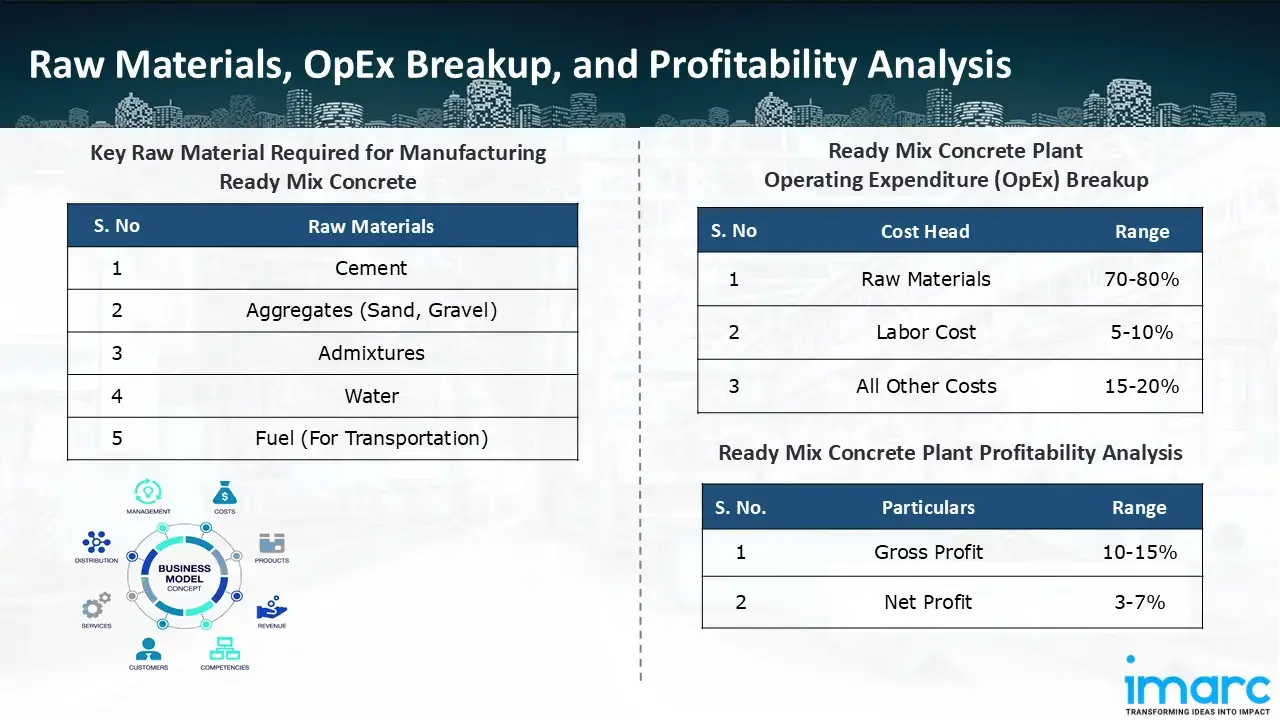
The basic raw materials required for ready mix concrete manufacturing include:
- Cement
- Aggregates (Sand, Gravel)
- Admixtures
- Water
- Fuel (For Transportation)
Machine Section or Lines Required:
- Batching Plant
- Mixing Unit
- Laboratory
- Transportation Fleet (Transit Mixers
Techno-Commercial Parameter:
- Capital Expenditure (CapEx): Capital expenditure (CapEx) in a manufacturing plant includes various investments essential for its setup and long-term operations. It covers machinery and equipment costs, including procurement, installation, and commissioning. Civil works expenses involve land development, factory construction, and infrastructure setup. Utilities such as power, water supply, and HVAC systems are also significant. Additionally, material handling systems, automation, environmental compliance, and safety measures are key components. Other expenditures include IT infrastructure, security systems, and office essentials, ensuring operational efficiency and business growth.
- Operating Expenditure (OpEx): Operating expenditure is the cost incurred to operate a manufacturing plant effectively. OpEx in a manufacturing plant typically includes the cost of raw materials, utilities, depreciation, taxes, packing cost, transportation cost, and repairs and maintenance. The operating expenses are part of the cost structure of a manufacturing plant and have a significant effect on profitability and efficiency. Effective control of these costs is necessary for maintaining competitiveness and growth. Furthermore, raw material cost in ready mix concrete manufacturing plant ranges between 70-80%, labor cost ranges between 5% to 10%, and all other costs ranges between 15-20% in the proposed plant.
- Profitability Analysis Year on Year Basis: We assisted our client in developing a detailed cost model, which projects steady growth, with revenue rising throughout the projected period. Moreover, gross profit margins lie between a range of 10-15%, and net profit lie between the range of 3-7% during the income projection years, highlighting strong financial viability and profitability.
Conclusion & IMARC's Impact:
Our financial model for the ready-mix concrete manufacturing plant was meticulously developed to meet the client’s objectives, providing an in-depth analysis of production costs, including raw materials, manufacturing, capital expenditure, and operational expenses. By addressing the specific requirements of manufacturing 200,000 cubic meters of ready-mix concrete annually, we successfully identified key cost drivers and projected profitability, considering market trends, inflation, and potential fluctuations in raw material prices. This comprehensive financial model equipped the client with valuable insights into strategic decision-making, demonstrating our commitment to delivering high-quality, client-focused solutions that ensure the long-term success of large-scale manufacturing ventures.
Latest News and Developments:
- In April 2024, CRH announced that it has acquired Northgate Ready Mix, LLC and BoDean Company Inc. in Santa Rosa, California. These purchases strengthen CRH's capacity to offer integrated solutions to clients in the lucrative Northern California market and mark the company's first foray into the state of California through its Materials Solutions division.
- In February 2024, Nuvoco Vistas Corp. Ltd., the fifth-largest cement company in India, expanded its operational footprint with the opening of its second cutting-edge Ready-mix Concrete Plant (RMX), known as Patna-II.
Why Choose IMARC?
IMARC's Financial Model Expertise: Helping Our Clients Explore Industry Economics
IMARC is a global market research company that offers a wide range of services, including market entry and expansion, market entry and opportunity assessment, competitive intelligence and benchmarking, procurement research, pricing and cost research, regulatory approvals and licensing, factory setup, factory auditing, company incorporation, incubation services, recruitment services, and marketing and sales.
Under our factory setup services, we assist our clients in exploring the feasibility of their plants by providing comprehensive financial modeling. Additionally, we offer end-to-end consultation for setting up a plant in India or abroad. Our financial modeling includes an analysis of capital expenditure (CapEx) required to establish the manufacturing facility, covering costs such as land acquisition, building infrastructure, purchasing high-tech production equipment, and installation. Furthermore, the layout and design of the factory significantly influence operational efficiency, energy consumption, and labor productivity, all of which impact long-term operational expenditure (OpEx). So, every parameter is covered in the analysis.
At IMARC, we leverage our comprehensive market research expertise to support companies in every aspect of their business journey, from market entry and expansion to operational efficiency and innovation. By integrating our factory setup services with our deep knowledge of industry dynamics, we empower our clients to not only establish manufacturing facilities but also strategically position themselves in highly competitive markets. Our financial modeling and end-to-end consultation services ensure that clients can explore the feasibility of their plant setups while also gaining insights into competitors' strategies, technological advancements, and regulatory landscapes. This holistic approach enables our clients to make informed decisions, optimize their operations, and align with sustainable practices, ultimately driving long-term success and growth.
Our Clients









Contact Us
Have a question or need assistance?
Please complete the form with your inquiry or reach out to us at
Phone Number
+91-120-433-0800+1-201-971-6302
+44-113-547-7077
Previous Post

The construction industry across the Gulf Cooperation Council (GCC) member states is at the core of a monumental economic transformation. Far exceeding traditional building activities, the sector now serves as the principal vehicle for national economic diversification strategies, moving these nations beyond reliance on oil revenues.
Paver blocks are precast construction material made basically from cement, aggregates, sand, and pigments for constructing surfacing. They are produced in standardized shape and thickness, allowing each unit to interlock to form a strong, load-bearing surface with no need for continuous concrete pouring. Paver blocks possess high compressive strength, abrasion resistance, and are easy to lay and maintain.
The Brazil ceramic tiles market has witnessed stable growth, reflecting broader trends in the construction and building materials industries of the country. The Brazil ceramic tiles market size was valued at USD 1.6 Billion in 2025. The market is expected to reach USD 2.2 Billion by 2034, exhibiting a CAGR of 3.91% during 2026-2034.
MDF is an engineered wood product produced by breaking down hardwood or softwood residuals into wood fibers, which are then combined with resin binders under heat and pressure. MDF exhibits a homogeneous density, a smooth surface, and fine texture, ensuring a much more workable material compared to natural wood.
Float glass is a type of flat glass that is manufactured by floating molten glass on a bed of molten tin. This produces a smooth, uniform surface and consistent thickness. The float process was developed by Pilkington in the 1950s and revolutionized glassmaking because it enabled the production of large, flawless sheets of glass without needing polishing or grinding. The basic raw materials used-silica sand, soda ash, limestone, and dolomite-are heated in the furnace to a very high temperature, then continuously poured onto the tin bath, where the molten glass spreads out into an even layer. It cools and solidifies into a perfectly flat and perfectly transparent sheet. As it provides optical clarity and strength and is easily processed into coated, laminated, or toughened forms, float glass is used as a basic product for various applications, ranging from architectural and automotive to industrial applications.
ERW steel pipes can be identified as one of the most important categories of welded pipes and find wide applications in infrastructure, construction, and other industries because of their precision, cost-effectiveness, and reliability. The raw material to produce these pipes is either hot-rolled or cold-rolled steel coils that are longitudinally formed and welded by the application of high-frequency electric resistance welding.
Drill bits are specifically designed cutting instruments intended to produce cylindrical holes in various materials, ranging from soft woods and plastics to hardened steels, stone, and rock. Although they seem straightforward, drill bits consist of various specialized shapes, coatings, and materials that are designed to suit the cutting characteristics of the intended material and the requirements of the drilling task.
Concrete is among the most widely used construction materials in the world due to its strength, versatility, and durability. It is a composite material largely made of cement, water, aggregates-sand, gravel, or crushed stone-and in some cases, admixtures which give special properties to the concrete.
Clay bricks are one of the oldest and most extensively used construction materials in the globe, appreciated for their strength, durability, insulation against heat, and beauty. They are produced mainly from natural clay and shale, which are fashioned, dried, and subjected to high-temperature firing to produce a hard, dense material that can resist multiple environmental and structural stresses. The mix generally consists of alumina, silica, lime, iron oxide, and magnesia that collectively decide the color, texture, and performance properties of the brick.
Metal beam crash barriers and high mast light poles are essential infrastructural features providing security and visibility on highways, city roads, and industrial sites. Metal beam crash barriers or guardrails are made of galvanized steel beams, typically W-beam or Thrie-beam, that are designed to dissipate the impact energy on impact with a vehicle and minimize death and damage to vehicles.
Laminated plywood is an engineered wood material that is produced by laminating several layers of thin veneers of wood together with powerful adhesives and covering them with a protective or decorative laminate sheet. This amalgamation not only increases the strength of the plywood but also its beauty, which is why it is extremely versatile for use in furniture, cabinetry, floors, paneling, and interior design.
Ductile iron pipes (DIP) are a key part of new water and wastewater infrastructure, providing enhanced performance capabilities over older piping materials. Cast from ductile cast iron, a material that has the strength of steel combined with the resistance to corrosion of cast iron, these pipes are designed to endure high-pressure use while still being flexible enough to absorb stress without cracking.
The real estate sector plays a critical role in driving economic growth and shaping communities. It significantly contributes to national economies by generating jobs, influencing investment flows, and boosting government revenues through taxes. Beyond these economic benefits, real estate development directly affects the quality of life by creating homes, enhancing infrastructure, and revitalizing urban areas.
Gypsum boards, also referred to as drywall or plasterboard, are lightweight, strong and fireproof building materials that are frequently used for partitions, walls and ceilings. Constructed from a gypsum core encased in paper liners, they provide improved acoustics, cost effectiveness, and speedy installation. Gypsum boards are favoured in industrial, commercial, and residential construction because of its environmentally beneficial qualities, ability to withstand moisture, and ability to insulate against heat. They are an essential part of efficient and sustainable construction methods because of their adaptability to contemporary building processes.
A frameless shower door is a modern and aesthetically appealing bathroom fixture that has gained popularity for its sleek and minimalist design. They are constructed without the bulky metal framing that surrounds the glass panels and are typically made from thick, tempered glass that is securely attached to the wall and floor using hinges or brackets.