Ashwagandha Powder Plant Setup Cost in India: Manufacturing Process Flow, Machinery, DPR & Financial Model 2026
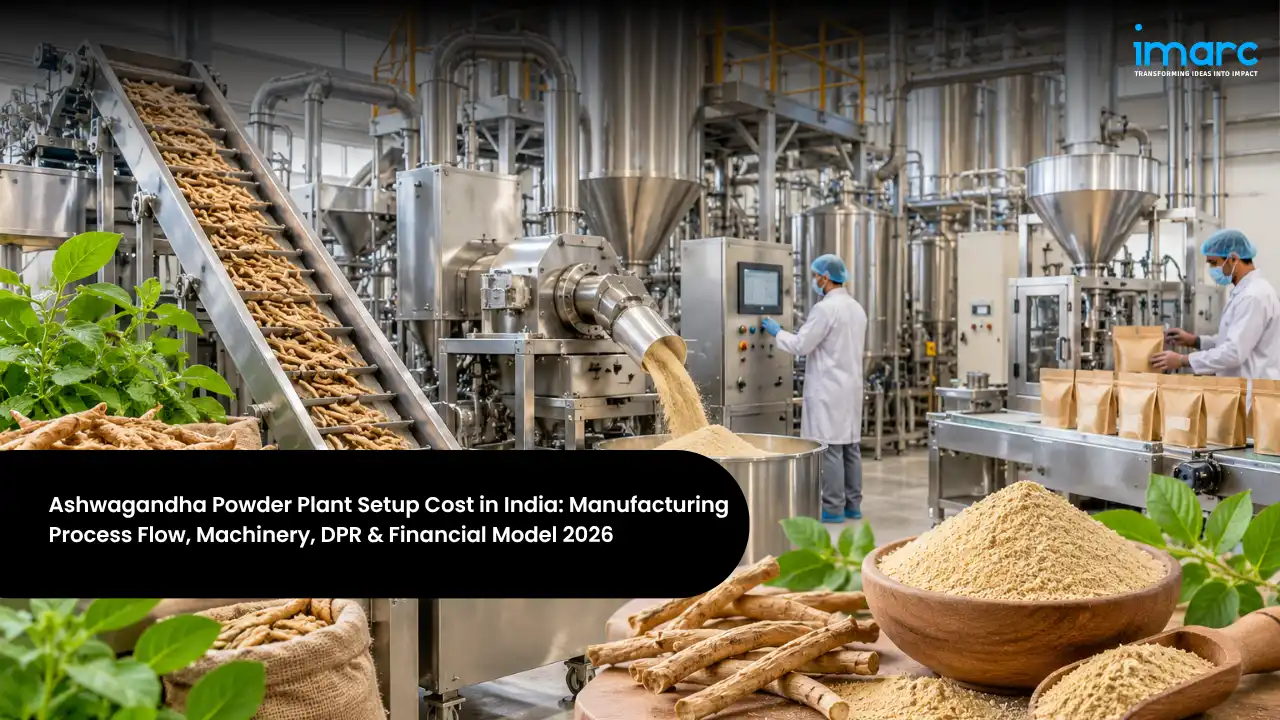
Ashwagandha, or Withania somnifera, is one of the most important herbs in Ayurveda, valued as an adaptogen for stress, sleep, energy, and overall wellness. Its dried root is ground into a fine powder sold on its own, filled into capsules and tablets, blended into health drinks, and used as a base for standardised extracts. India is the world's main producer and exporter of ashwagandha, and its Ayush and herbal product exports reached about USD 689 million in 2024-25, while global demand for ashwagandha is growing at around 9% a year. Together these factors make Ashwagandha Powder Manufacturing Plant Setup in India an attractive opportunity for agri-processors, Ayurvedic companies, and nutraceutical exporters.
Investment depends above all on scale, quality standards, and whether the plant stops at powder or goes on to capsules and extracts. A small unit that cleans, dries, grinds, and packs roots is a very modest project, a GMP-certified powder plant with steam sterilisation, testing, and capsule filling is a moderate investment, and an integrated plant that also makes standardised extracts needs more capital. The Ashwagandha Powder Manufacturing Plant Cost ranges from about INR 0.5–1.5 crore for a small unit of 50 to 100 tonnes a year to INR 4–10 crore for a GMP plant of 150 to 500 tonnes a year, and INR 30–60 crore for an integrated powder and extract plant processing 1,000 tonnes of roots a year or more. Raw materials, mainly dried roots, make up 60 to 70% of operating cost, so root quality, buying at harvest, and product mix shape profitability. A well-run plant typically earns a gross margin of 40 to 55% and a net margin of 20 to 30%.
This guide is written for investors exploring how to start an Ashwagandha Powder manufacturing plant in India. It focuses on a GMP-certified plant of about 200 tonnes a year making sterilised root powder in bulk and consumer packs, along with capsules, for Ayurvedic brands, nutraceutical companies, retailers, and export buyers, and also explains small units and larger plants with extraction. It covers products and markets, the demand outlook, the production process flow, machinery and raw materials, location and infrastructure, a detailed cost and financial breakdown, approvals, and how a DPR and financial model turn all of this into a bankable plan.
India Market Snapshot
| Key Facts | Details |
|---|---|
| Global Ashwagandha Market (2025) | USD 837.5 Million |
| Projected Global Market (2035) | USD 2,014 Million, 9.17% CAGR |
| India Ayush & Herbal Exports (2024-25) | USD 689 Million, up 6.11% |
| Cultivation in Madhya Pradesh | Over 5,000 Hectares |
| Plant Part Allowed (April 2026) | Root only; leaves barred |
| Indicative Total Investment | INR 0.5 Crore to 60 Crore |
The snapshot shows a fast-growing global market led by supplements and wellness products, in which India is the main source of supply. New rules allowing only the root in food and Ayush products raise the bar for quality and traceability, favouring producers who source carefully and test every batch. The wide investment range reflects a real choice between a small powder unit, a GMP plant, and an integrated plant with extraction. The sections below work through that choice.
Investment Highlights
Indicative Project Cost in India (2026)
| Parameter | Value |
|---|---|
| Product Range | Root powder, organic powder, capsules, tablets, and standardised extracts |
| Plant Capacity | 50 – 1,000+ Tonnes Per Year |
| Total Project Investment | INR 0.5–1.5 Crore (small unit) to 30–60 Crore (with extraction) |
| Payback Period | 2 – 4 Years |
| Net Profit Margin | 20 – 30% |
| IRR | 22 – 35% |
| Preferred States | Madhya Pradesh, Rajasthan, Gujarat, Uttarakhand, Karnataka, Kerala |
| Key Requirement | Quality roots, GMP systems, testing, and reliable buyers |
These ranges provide a realistic frame for early planning, but actual returns depend on root prices, which swing with each harvest, root quality and withanolide content, contamination and testing costs, the product mix between bulk powder and branded packs, export certifications, and competition from many small processors. A site-specific Ashwagandha Powder Feasibility Report narrows each of these assumptions to your chosen products, capacity, location, and customers.
Table of Contents
- What is Ashwagandha Powder Manufacturing?
- Why is Ashwagandha Powder Manufacturing Growing?
- Ashwagandha Powder Manufacturing Process Flow
- Raw Materials Required for Ashwagandha Powder Manufacturing
- Location, Land & Infrastructure
- Ashwagandha Powder Manufacturing Machinery and Equipment
- Ashwagandha Powder Manufacturing Plant Setup Cost in India (CapEx & OpEx)
- Financial Analysis and Profitability
- Licenses and Approvals for Ashwagandha Powder Manufacturing in India
- Recent Developments in the India Ashwagandha Powder Manufacturing Industry
- How an Ashwagandha Powder Manufacturing Project Report and DPR Helps Investors
- Frequently Asked Questions
What is Ashwagandha Powder Manufacturing?
Ashwagandha powder is made from the dried roots of the ashwagandha plant, which are cleaned, dried, ground, sieved, and usually sterilised to produce a fine, light brown powder with a characteristic earthy smell. The root contains active compounds called withanolides, along with alkaloids and other constituents, which are linked to its adaptogenic effects. The powder is taken with milk or water as a traditional Ayurvedic preparation, filled into capsules and tablets, blended into health drinks and gummies, and used as the starting material for standardised extracts. Quality depends on root grade, freshness, moisture, microbial load, and freedom from contaminants such as heavy metals and pesticides.
Commercially, ashwagandha powder is sold in bulk to Ayurvedic and nutraceutical companies and exporters, and in consumer packs through pharmacies, health stores, and online channels. An Ashwagandha Powder Manufacturing Plant can supply Ayurvedic medicine makers, nutraceutical and supplement brands, health drink and functional food companies, contract manufacturers, export buyers in the US, Europe, and other markets, and retail and e-commerce channels under its own brand. Buyers value root-only authenticity, consistent withanolide content, low microbial counts, clean test reports, and reliable supply.
- Ayurvedic Companies: Bulk powder for churnas, tablets, and formulations.
- Nutraceutical Brands: Capsules, gummies, and blends.
- Export Buyers: Organic and tested powder for overseas markets.
- Retail & E-commerce: Branded consumer packs.
The Main Ashwagandha Products and Applications
Choosing the product range is the most important commercial decision, because it determines processing, testing, certification, and customers:
| Product | Description | Key Property | Primary Demand |
|---|---|---|---|
| Root Powder | Fine-ground dried root | Traditional form | Ayurvedic and retail |
| Organic Root Powder | Certified organic roots | Premium, traceable | Exports, premium brands |
| Tested Root Powder | Withanolide content assured | Consistent potency | Nutraceutical brands |
| Capsules & Tablets | Powder in dosage form | Convenient dosing | Retail and pharmacies |
| Standardised Extract | Concentrated root extract | High potency | Supplement makers |
| Blends & Health Drinks | Mixed with other herbs | Ready to consume | Wellness brands |
These choices shape the whole plant. Plain root powder needs simple cleaning, drying, grinding, and packing equipment, while tested and organic powders add sourcing controls, sterilisation, and laboratory testing. Capsules and tablets need dosage-form equipment and stricter GMP, and extracts need solvent extraction, concentration, and spray drying. Most new entrants therefore start with sterilised root powder in bulk and consumer packs, and add capsules, organic certification, and extracts once their quality systems and customer base are established.
Why is Ashwagandha Powder Manufacturing Growing?
Key Growth Drivers in the Indian and Export Markets
Demand is supported by wellness trends, scientific interest, Ayurveda's global reach, and new product formats:
- Stress and sleep wellness: Consumers worldwide are turning to natural adaptogens for stress, sleep, and energy.
- Global Ayurveda: Government promotion and growing exports are taking Ayurvedic products to new markets.
- Clinical research: Studies on root extracts are building confidence among supplement brands and consumers.
- New formats: Gummies, health drinks, and functional foods are widening the range of products using ashwagandha.
- E-commerce: Online channels let small and new brands reach consumers across India and abroad.
India-Specific Market Opportunity
| Segment | India Market Context | Manufacturing Role |
|---|---|---|
| Ayurvedic Industry | Large and growing sector | Bulk root powder |
| Nutraceuticals | Fast-growing supplements | Tested powder, capsules |
| Retail & Online | Rising wellness spending | Branded packs |
| Contract Manufacturing | Many new brands | Private label products |
The strongest opportunity for new entrants lies in supplying tested, root-only powder to nutraceutical brands and exporters who now need full traceability, in organic powder for premium export markets, and in private-label capsules for new wellness brands. Producers that source authentic roots, test every batch, and build trusted relationships with buyers will be best placed to grow.
Ashwagandha Powder Manufacturing Process Flow
Understanding the process helps you plan equipment, layout, and where cost and quality are decided. Production runs from root procurement and grading through cleaning, washing and drying, size reduction, pulverising, sieving, sterilisation, blending and testing, packing, and storage and dispatch. Root quality and drying decide potency and shelf life, while root cost, grinding losses, and testing are the largest controllable costs.
The Ashwagandha Powder Manufacturing Process Flow
The sequence below reflects a GMP-certified powder plant. Plants making extracts add solvent extraction, concentration, and spray drying after size reduction.
| Unit Operation | Key Activity |
|---|---|
| Root Procurement & Grading | Dried roots checked and graded |
| Cleaning & Sorting | Soil, stones, stems removed |
| Washing & Drying | Washed and dried to low moisture |
| Size Reduction | Roots cut into pieces |
| Pulverising | Ground to fine powder |
| Sieving | Sifted to uniform mesh |
| Sterilisation | Steam treatment for microbes |
| Blending & Testing | Batch mixed, lab tested |
| Packing | Bags, pouches, jars, capsules |
| Storage & Dispatch | Cool, dry warehouse |
Two factors decide profitability across this flow. The first is root quality and authenticity, because good-grade roots with proper withanolide content and no leaf or stem material command better prices and pass buyer tests, while poor roots lead to rejections. The second is contamination control, since microbial counts, moisture, and foreign matter decide whether powder meets export and nutraceutical standards, so careful drying, sterilisation, dust control, and hygienic handling protect margins.
Raw Materials Required for Ashwagandha Powder Manufacturing
The main input is dried ashwagandha root, bought from farmers, traders, and mandis or grown under contract farming, along with packaging materials, capsule shells and excipients for dosage forms, and laboratory consumables. Roots are by far the largest cost, and their price and quality vary from harvest to harvest, so sourcing strategy is central to project planning.
| Raw Material | Role in Product | India Sourcing | % of OpEx |
|---|---|---|---|
| Dried Ashwagandha Roots | Main raw material | Madhya Pradesh, Rajasthan | 55–62% |
| Packaging Materials | Bags, pouches, jars, labels | Domestic suppliers | 5–8% |
| Capsule Shells & Excipients | Dosage forms | Domestic suppliers | 2–4% |
| Lab Testing & QC | Quality assurance | In-house and external labs | 1–2% |
| Processing Aids | Cleaning, sterilisation | Local | 0.5–1% |
India's ashwagandha roots come mainly from Madhya Pradesh and Rajasthan, with smaller volumes from other dry states, and are harvested once a year. Buying at harvest when prices are lower, contract farming with defined seed and practices, testing roots before purchase, and storing them properly through the year help manage cost, quality, and supply risk.
Location, Land & Infrastructure
Site selection for an ashwagandha powder plant is driven by proximity to root-growing areas and herb markets, access to buyers in the Ayurvedic and nutraceutical industry, and connections to ports or airports for exports. Other factors include a dry climate for storage, reliable power, availability of trained staff, and state incentives for food and herbal processing.
Choosing the Best Location for Ashwagandha Powder Manufacturing Plant Setup
| State / Region | Why It Works | Key Advantage |
|---|---|---|
| Madhya Pradesh | Main growing area, herb mandis | Root sourcing |
| Rajasthan | Major growing belt | Root supply and dry climate |
| Gujarat | Herbal processors, ports | Exports and logistics |
| Uttarakhand | Ayurveda manufacturing hub | Ayurvedic buyers |
| Karnataka | Botanical extract industry | Nutraceutical buyers |
| Kerala | Ayurveda tradition | Ayurvedic market |
Madhya Pradesh and Rajasthan offer the closest access to root supply and herb markets, which suits primary processing. Gujarat combines herbal processing with ports, Uttarakhand and Kerala host many Ayurvedic manufacturers, and Karnataka is home to leading botanical extract companies. The final choice should weigh root sourcing, buyer proximity, export logistics, land cost, and incentives.
Quality, Safety and Environmental Systems
Ashwagandha powder must meet Ayurvedic pharmacopoeia standards or food safety standards depending on how it is sold, along with buyer specifications for withanolide content, moisture, microbial limits, heavy metals, pesticide residues, and root-only authenticity. A credible plant needs GMP-compliant premises, a laboratory with HPLC for withanolide testing, microbiology testing, batch traceability back to the farm or lot, and certifications such as GMP, ISO 22000 or HACCP, and organic certification for export lines. Safety focuses on dust in grinding areas and machine guarding, while environmental systems cover dust collection and disposal of root waste. An experienced Ashwagandha Powder Manufacturing Consultant in India can help plan GMP layout, sourcing systems, and testing so the plant meets regulatory and buyer requirements from the start.
Infrastructure Requirements (200 TPA Plant)
| Infrastructure Element | Specification | India-Specific Note |
|---|---|---|
| Total Land Area | 0.5 – 1 acre | Food or herbal park preferred |
| Built-up Area | 8,000 – 15,000 sq ft | GMP-compliant layout |
| Raw Root Store | Dry, pest-controlled | Holds a year of roots |
| Processing Area | Grinding and sieving rooms | Dust control essential |
| Power Supply | 100 – 200 kW | Stable supply with backup |
| QC Laboratory | HPLC and microbiology | In-house testing |
| Packing & Warehouse | Clean packing hall | Cool, dry storage |
Dry, pest-controlled storage for a full year of roots and a clean, dust-controlled processing area are the most important infrastructure requirements, since they protect quality and shelf life. A well-equipped laboratory, a hygienic packing hall, and good road access to buyers and ports complete the core needs.
Ashwagandha Powder Manufacturing Machinery and Equipment
The equipment set covers root cleaning, washing, drying, size reduction, grinding, sieving, sterilisation, blending, dosage forms, packing, and testing. Pulverisers, dryers, sterilisers, and packing machines account for most of the machinery budget. The main items are summarised below.
| Equipment | Function | Key Specification |
|---|---|---|
| Root Cleaner & Destoner | Remove soil and stones | Vibratory and air |
| Root Washer | Wash roots | Food-grade steel |
| Tray or Belt Dryer | Dry roots | Controlled temperature |
| Root Cutter | Cut roots into pieces | Uniform size |
| Pulveriser | Grind to powder | Hammer or impact mill |
| Vibro Sifter | Sieve powder | Mesh screens |
| Steam Steriliser | Reduce microbial load | Batch or continuous |
| Blender | Mix batches | Double-cone or ribbon |
| Capsule Filling Machine | Fill capsules | Semi- or fully automatic |
| Powder Filling & Packing | Pack pouches and jars | Weighing and sealing |
| Dust Collector & Lab Equipment | Control dust, test quality | Bag filter, HPLC |
Machinery should follow the capacity plan and product mix. A small unit needs mainly a cleaner, dryer, pulveriser, sifter, and packing machine, while a GMP plant adds sterilisation, blending, capsule filling, and a full laboratory. Extract plants add extractors, evaporators, and spray dryers, and stainless steel contact parts, low-heat grinding, and good dust control protect product quality.
Ashwagandha Powder Manufacturing Plant Setup Cost in India (CapEx & OpEx)
The tables below break down capital and operating costs for a GMP-certified powder plant of about 200 tonnes a year in India. The final Ashwagandha Powder Investment Cost for your project will depend on capacity, product mix, sterilisation and testing facilities, certifications, land cost, and location.
Capital Expenditure (CapEx) Cost Structure
| CapEx Component | % of Total CapEx | What It Covers |
|---|---|---|
| Plant & Machinery | 35–45% | Processing and packing lines |
| Building & GMP Fit-out | 25–30% | Clean rooms, stores, warehouse |
| Land & Site Development | 8–12% | Land or park allotment |
| QC Laboratory | 6–10% | HPLC, microbiology, instruments |
| Pre-operative & Certifications | 3–5% | Licenses, GMP, organic |
| Working Capital | 12–18% | Root stocks and receivables |
Machinery and GMP-compliant buildings make up most of the capital budget, while working capital is significant because roots are harvested once a year and are best bought at harvest, so the plant must hold several months of stock. Because root prices swing between years and buyers increasingly demand testing and traceability, a detailed Ashwagandha Powder Business Plan should model sales by product and customer, root prices and buying seasons, testing costs, certifications, inventory, and payment terms together, so that funding supports steady operation through the year.
Operating Expenditure (OpEx) Cost Structure
| OpEx Component | % of Total OpEx | India-Specific Note |
|---|---|---|
| Raw Materials | 60–70% | Dried roots dominate |
| Utilities (power, steam) | 15–20% | Drying, grinding, sterilisation |
| Labour | 5–8% | Operators and QC staff |
| Packaging & Logistics | 4–6% | Retail packs and freight |
| Maintenance | 1–2% | Mills and dryers |
| Overheads & Testing | 2–4% | Administration and lab tests |
With roots making up most of the cost, margins depend on buying well at harvest, processing yields, testing pass rates, and the share of higher-value products. A good operating model tracks root cost per kilogram of powder, drying and grinding losses, batch test results, sterilisation costs, and realised prices by product and buyer, and tests how margins respond when root prices rise after a poor harvest.
Financial Analysis and Profitability
Based on analysis of a 200 TPA GMP powder plant, the financial profile is attractive, supported by modest capital needs, strong global demand, and India's position as the main source of supply, but returns depend on root sourcing and quality compliance. The profitability of Ashwagandha Powder manufacturing business in India improves markedly with buying roots at harvest or through contract farming, consistent test results, organic and export certifications, a richer mix of capsules and branded packs, and long-term supply contracts with nutraceutical brands and exporters.
| Financial Metric | Indicative Value | India Context |
|---|---|---|
| Gross Profit Margin | 40–55% | Depends on root cost |
| Net Profit Margin | 20–30% | After depreciation and taxes |
| Payback Period | 2–4 Years | Low capital intensity |
| IRR (Internal Rate of Return) | 22–35% | Higher for branded products |
| Capacity Utilization (stable ops) | 60–80% | Order-driven production |
| Break-even Capacity Utilization | 30–40% | Low fixed costs |
Product mix and quality decide where a plant lands within these ranges. Plants selling tested, organic, or branded products to exporters and nutraceutical brands earn healthy margins, while those selling plain bulk powder in local markets compete with many small processors on price. Capsules, organic powder, and extracts typically carry much better margins than bulk powder.
Returns can be strengthened by contract farming for authentic roots, investing in testing and certifications, adding capsules and private-label services, developing an own brand for online sales, and building export relationships.
Key Risks and Mitigation
The main risks are root price swings between harvests, adulteration with leaves or stems, contamination and failed tests, changing regulations at home and in export markets, competition from many small processors, and dependence on a few buyers. Price risk is reduced through harvest buying and contract farming; authenticity risk by supplier audits and testing; contamination risk by GMP and sterilisation; regulatory risk by root-only sourcing and documentation; and buyer risk by diversifying markets. Promoters often work with an Ashwagandha Powder Business Plan Consultant in India to test these scenarios before committing capital.
Licenses and Approvals for Ashwagandha Powder Manufacturing in India
Approvals for an ashwagandha powder plant depend on whether products are sold as Ayurvedic medicines, foods, or supplements. Promoters setting up an Ashwagandha Powder Manufacturing Plant in India generally need the following:
- Ayush Manufacturing License: License from the State Ayush Licensing Authority for Ayurvedic products, with GMP under Schedule T.
- FSSAI License: License for products sold as food, health supplements, or nutraceuticals.
- Root-Only Compliance: Use of root only and declaration of plant parts on labels, as required since April 2026.
- Quality & Export Certifications: WHO-GMP, ISO 22000 or HACCP, and organic certification for export markets.
- Pollution Control Consent: Consent or registration from the State Pollution Control Board, depending on category.
- Factory License & Fire Safety: Factory license where applicable, and fire NOC.
- Business & Trade Registrations: Business registration, GST, Udyam, Import Export Code, and trademark registration.
The Ayush or FSSAI license and GMP inspection are usually on the critical path, together with export certifications, which buyers often require before placing orders. Preparing GMP documentation, sourcing systems, and laboratory validation in parallel with construction shortens the time from investment decision to first sales.
Note: The exact approvals, registrations, licenses, and certification requirements may vary depending on factors such as plant location, capacity, products, state pollution control categories, customer specifications, and applicable regulations. Businesses are advised to undertake a detailed regulatory assessment during the project planning stage to ensure full compliance and timely implementation.
Recent Developments in the India Ashwagandha Powder Manufacturing Industry
Several recent developments give useful context for investors considering this market:
- Root-only rule: In April 2026, the Ministry of Ayush directed manufacturers to use only ashwagandha root and label all plant parts, and FSSAI advised against using leaves in any form in food products.
- Industry response: Root-only extract makers welcomed the move, while some companies using root and leaf blends said they would appeal, and buyers are tightening authenticity testing.
- Scrutiny in Europe: Denmark banned ashwagandha in 2023, and a wider EU review of its safety is pending, which raises documentation needs for exporters.
- Export growth: India's Ayush and herbal product exports rose 6.11% to about USD 689 million in 2024-25.
The common thread is strong global demand combined with tighter rules on authenticity, safety, and documentation. New entrants who source authentic roots, test every batch, and build trusted relationships with buyers will be best placed to grow.
How an Ashwagandha Powder Manufacturing Project Report and DPR Helps Investors
A detailed DPR provides a structured roadmap for the venture, from market demand and product selection to root sourcing, plant design, machinery, testing, approvals, and economics. It helps investors decide the right products, capacity, and certifications, estimate capital and operating expenditure, assess profitability, and identify risks before committing funds.
At its core is a detailed Ashwagandha Powder Financial Model covering revenue by product and buyer, root prices and buying seasons, yields, testing, packaging, labour, utilities, working capital, debt servicing, cash flows, break-even, return on investment, and payback under different price and demand scenarios. Banks and investors rely on this model to judge long-term viability, which is why many promoters appoint an Ashwagandha Powder Plant Project Report Consultant in India to prepare the report and validate its assumptions against current market data.
For an ashwagandha project, a strong DPR also clarifies the root sourcing and contract farming plan, the regulatory route as an Ayurvedic or food product, the testing and certification plan, and the target export markets, which together are the factors most likely to decide success. By testing margins against root prices, quality rejections, and regulatory changes, the report turns a fast-growing herbal opportunity into a plan that lenders and partners can trust.
Frequently Asked Questions
What are the first steps to set up an ashwagandha powder manufacturing plant in India?
Start by choosing your products and target buyers, and by deciding whether you will sell under an Ayush or FSSAI license. Then commission a feasibility study and DPR, arrange root sourcing or contract farming, secure land or a shed near growing areas or buyers, obtain licenses and GMP approval, install the processing line and laboratory, and build relationships with brands, exporters, and retailers.
How much does it cost to set up an ashwagandha powder manufacturing plant in India?
Investment ranges from about INR 0.5–1.5 crore for a small unit of 50 to 100 tonnes a year to INR 4–10 crore for a GMP plant of 150 to 500 tonnes a year, and INR 30–60 crore for an integrated powder and extract plant processing 1,000 tonnes of roots a year or more.
What are the main steps in making ashwagandha powder?
The flow runs from root procurement and grading through cleaning and sorting, washing and drying, size reduction, pulverising, sieving, sterilisation, blending and testing, packing, and storage and dispatch.
Which machinery does an ashwagandha powder manufacturing plant need?
Key equipment includes a root cleaner and destoner, a root washer, a tray or belt dryer, a root cutter, a pulveriser, a vibro sifter, a steam steriliser, a blender, a capsule filling machine, powder filling and packing machines, and a dust collector and laboratory equipment.
What raw materials are used to make ashwagandha powder?
The main raw material is dried ashwagandha root, along with packaging materials, capsule shells and excipients for dosage forms, and laboratory testing consumables.
How profitable is ashwagandha powder manufacturing in India?
A well-run plant typically earns a 40 to 55% gross margin and a 20 to 30% net margin, with payback in about 2 to 4 years. Profitability depends on root prices, quality, product mix, and buyer relationships.
Which approvals does an ashwagandha powder manufacturing plant need in India?
Typical approvals include an Ayush manufacturing license with GMP or an FSSAI license, root-only compliance and labelling, quality and export certifications, pollution control consent, a factory license and fire NOC, and GST, Udyam, and export registrations.
How do I get a feasibility study or DPR for an ashwagandha powder manufacturing project?
A detailed feasibility study and DPR covers root sourcing, market demand, plant design, testing, approvals, and full financials. Investors usually engage an Ashwagandha Powder Manufacturing Feasibility Study Consultant with experience in herbal and nutraceutical projects to prepare the report and validate it for lenders.
Our Clients










Contact Us
Have a question or need assistance?
Please complete the form with your inquiry or reach out to us at
Phone Number
+91-120-433-0800+1-201-971-6302
+44-113-547-7077
Previous Post

Chicory is mainly Cichorium intybus, a perennial herb that is grown for its root, leaves, and sometimes seeds. In industrial applications, the chicory root is the most valuable part. The chicory root contains inulin, a natural soluble dietary fiber, as well as sugars and bioactive compounds. When roasted and dried, chicory root has a similar taste to coffee and is often used as a coffee extender or substitute.
Agriculture in India is and has always been something more than an occupation; it's a way of life that keeps millions of households going and the country's economy running. Yet, in a rapidly changing world, traditional methods cannot alone meet the growing demand for food, fiber, and raw materials.
Australia's agricultural machinery industry stands as a cornerstone of the nation's farming modernization drive, experiencing robust expansion fueled by technological innovation and evolving agricultural demands. According to IMARC Group's comprehensive market analysis, the Australia agricultural machinery market reached a valuation of USD 4.0 Billion in 2024, reflecting the accelerating adoption of advanced farming equipment across the continent's diverse agricultural landscapes.
Australia fertilizer industry is one of the key pillars of the country's farm setup. Fertilizers are a critical input in soil productivity, boosting crop output and the uniform production of food and other farm products. Australia has a wide and varied agricultural scene with grain growing horticulture, livestock, and specialty crops. Every industry depends upon fertilizers to optimize production and ensure soil fertility, especially in areas where the natural soil nutrients are nil or climatic conditions are unsuitable.
The Japan agritourism industry is experiencing remarkable transformation as travelers increasingly seek authentic connections with rural landscapes and agricultural traditions. Agritourism represents a dynamic fusion of agriculture and tourism, offering visitors immersive experiences through farm stays, hands-on agricultural activities, and cultural immersion in Japan's countryside.
HDPE pipes are thermoplastic piping systems made from high-strength polyethylene resin, which features excellent flexibility, high impact resistance, and strong chemical and corrosion resistance. HDPE pipes are produced by extruding molten polyethylene into a variety of diameters and pressure ratings. Their seamless structure, along with their low friction and resistance to internal pressure and external load, makes them ideal for the transport of fluids. HDPE pipes boast superior endurance, long service life, and leak-free performance, since it is possible to join them through heat fusion, thus creating monolithic, continuous pipelines that are suitable for buried, aboveground, or underwater installations.
The Brazil agricultural machinery market stands as a cornerstone of the nation's agricultural modernization drive, experiencing robust expansion fueled by technological innovation, government support initiatives, and the imperative to enhance agricultural productivity across the world's largest soybean producer. According to IMARC Group's comprehensive market analysis, the Brazil agricultural machinery market reached a valuation of USD 3.1 Billion in 2024, reflecting the accelerating adoption of advanced farm equipment Brazil offers across diverse agricultural landscapes spanning grain production, sugarcane cultivation, coffee farming, and livestock operations. This impressive growth trajectory positions the industry for continued prosperity, with projections indicating the market will reach USD 4.5 Billion by 2033, exhibiting a compound annual growth rate (CAGR) of 4.1% during the 2025-2033 forecast period.
The smart agriculture market is revolutionizing the global agriculture industry through the integration of cutting-edge technologies such as Internet of Things (IoT), artificial intelligence (AI), robotics, sensors, and big data analytics. As the world population continues to grow, farmers and agribusinesses face mounting pressure to increase productivity while minimizing environmental impact.
Australia's agribusiness sector is at a crossroads, combining its historic advantage in bulk farming with new-generation technologies and green practices. The industry is pivotal to the nation's economy, adding billions to GDP and underpinning exports to overseas markets. Increasing food security demands and climate change pressures have compelled Australian farmers and agribusiness companies to take up innovation at an unprecedented scale.
A fertilizer is any natural or manufactured material containing one or more nutrients that are applied to the soil or plant tissues and that are usually beneficial for plant growth by improving fertility. The elements that plants need in large quantities, namely nitrogen (N), phosphorus (P), and potassium (K), are known as the primary macronutrients. The other secondary nutrients include calcium, magnesium, and sulfur; micronutrients include zinc, iron, manganese, and copper.
Coco peat, or coir pith or coir dust, is a fibrous natural byproduct generated during the processing of coconut husks to extract coir fiber. Coco peat is an organic, renewable, and biodegradable product that has gained international significance as a sustainable substitute for peat moss in horticulture, agriculture, and hydroponics. The coco peat production process starts with the gathering of coconut husks, which are retted, soaked, and mechanically treated to exclude long coir fibers that are employed in ropes, mats, or brushes. The leftover fine material, the pith is washed, sieved, dried, and compressed into briquettes, blocks, or grow bags.
Bamboo is a poaceous grass which regrows rapidly, has a high yield of biomass and good material properties, ranging from tiny clumping species to huge timber-grade culms over 20 meters tall; genera of economic importance are Bambusa, Phyllostachys and Dendrocalamus. Botanically, bamboo integrates the regenerative benefit of an agricultural crop (short rotation, annual or multi-annual yield) with certain mechanical characteristics of softwoods like large specific strength, good tensile performance, and natural hollow culm geometry for light-weight structural property.
Sustainability is reshaping the future of agriculture, energy, and environmental management, with biochar emerging as a transformative force within the ecosystem. Produced from biomass through pyrolysis, biochar enriches soils, strengthens crop resilience, and reduces dependence on chemical fertilizers. According to reports, long-term application delivers measurable benefits—boosting average crop yields by 10.8% and increasing soil organic carbon by 52.5%—underscoring its role in restoring soil health while combating degradation.
Sesame seeds are one of the oldest oilseed crops known to humankind, prized for their high oil content, distinctive nutty flavor, and valuable nutritional profile. They are composed of approximately 50–60% oil and 20–25% protein, making them an essential raw material for edible oil, bakery, confectionery, and health food industries. The seeds are also rich in antioxidants such as sesamol and sesamin, which contribute to their oxidative stability and health-promoting properties. Processing of sesame seeds typically involves cleaning, dehulling, roasting, pressing, and solvent extraction, depending on the end-use product.
The global seed industry plays an important role in ensuring food security and the sustainability of agricultural practices. As the world grapples with food insecurity, climate volatility, and shrinking arable land, the market has emerged as a critical enabler of agricultural resilience.
Explore how to start a biofertilizer manufacturing business, from setup and licenses to market trends, investment, and sustainable growth strategies.
World Environment Day, observed on June 5th each year, serves as an important reminder to protect and preserve our planet. This day inspires millions of people from across the globe to reflect on environmental issues and take tangible measures toward securing the world for future generations.
Bamboo is one of the sustainable and versatile materials that are being used in several different industries. Bamboo provides a very environmentally friendly option for food packaging, as it reduces plastic use. At high temperatures, bamboo is burnt to produce bamboo biochar. This is a soil enhancer for soil health and carbon sequestration. Bamboo is also a sustainable building material and is used in the construction industry. Due to its antibacterial properties, bamboo vinegar, which is a byproduct of bamboo charcoal manufacturing, is used in skincare and agriculture.
The global poultry market is growing at a fast pace, driven by several factors, such as rising demand for affordable and protein-rich food sources, especially in developing countries. The growing preference for white meat over red meat due to health considerations, as well as urbanization and increasing disposable incomes, also contributes to higher consumption of poultry products. Moreover, technological advancements in poultry farming, such as improved breeding techniques and feed conversion ratios (FCR), enhance productivity and efficiency, further boosting market growth. As per IMARC Group, the global animal feed market size reached US$ 518.4 Billion in 2023 and is expected to reach US$ 674.7 Billion by 2032, exhibiting a growth rate (CAGR) of 2.9% during 2024-2032.