Aluminium Cans Plant Setup Cost in India: Manufacturing Process Flow, Machinery, DPR & Financial Model 2026
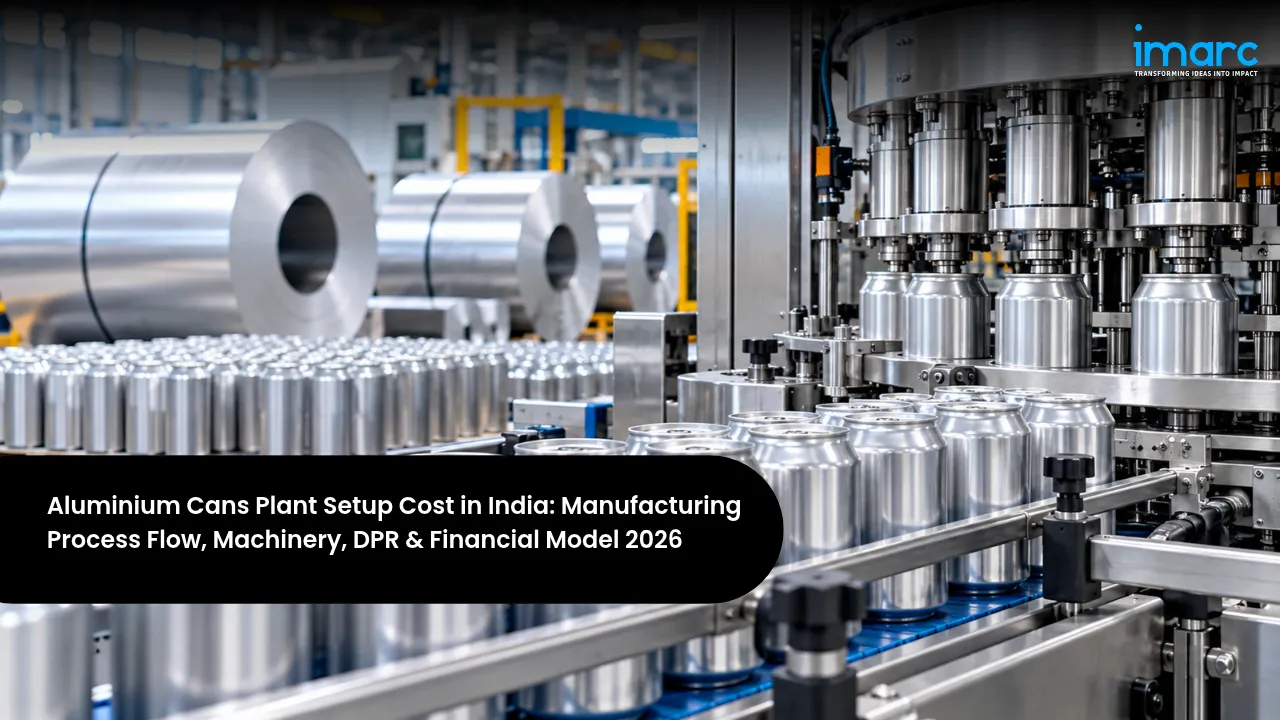
A two-piece beverage can is made by punching shallow cups from thin aluminium coil, drawing and ironing them into tall, seamless bodies at very high speed, then washing, printing, lacquering inside, and necking them to take an easy-open end that is seamed on after filling. Light, unbreakable, quick to chill, and infinitely recyclable, beverage cans are rapidly replacing glass and PET for beer, soft drinks, energy drinks, and ready-to-drink teas and coffees. IMARC estimates the Indian market at about 44.78 billion units in 2025, growing 4.7% a year, and cans now account for more than a quarter of soft drink and beer sales. With domestic capacity fully used, imports doubling, and mandatory BIS certification favouring local supply, Aluminium Cans Manufacturing Plant Setup in India is one of the most attractive packaging opportunities for industrial investors.
Investment depends mainly on line speed and annual output, the range of can sizes, whether ends are made in-house or bought, the number of decorating colours, the level of automation and inspection, and utilities such as gas-fired ovens and effluent treatment. The Aluminium Cans Manufacturing Plant Cost ranges from about INR 40–80 crore for a specialty unit making 50 to 100 million impact-extruded or aerosol pieces a year, to INR 650–900 crore for a single high-speed beverage line of about 1.5 billion units a year, and INR 1,250–1,500 crore for a two-line plant with its own ends, in line with CANPACK's USD 150 million greenfield investment. Aluminium coil makes up 65 to 75% of operating cost and is usually passed through to customers, so conversion efficiency and line uptime decide competitiveness. A well-run plant typically earns a gross margin of 18 to 25% and a net margin of 8 to 12%.
This guide is written for investors exploring how to start an Aluminium Cans manufacturing plant in India. It focuses on a greenfield plant with one high-speed line of about 1.5 billion units a year, running at roughly 2,800 to 3,000 a minute, making 330 ml, 500 ml, and sleek sizes for brewers, soft drink bottlers, and energy drink brands under long-term supply contracts, and also explains specialty units and two-line plants. It covers products and markets, the demand outlook, the production process flow, machinery and raw materials, location and infrastructure, a detailed cost and financial breakdown, certification and approvals, and how a DPR and financial model turn all of this into a bankable plan.
India Market Snapshot
| Key Facts | Details |
|---|---|
| India Market (2025) | About 44.78 Billion Units |
| India Market Forecast (2034) | 67.73 Billion Units, 4.7% CAGR |
| Global Market (2025) | About USD 57.0 Billion |
| Can Share of Drinks Sales | Over 25% (Soft Drinks, Beer) |
| Beer Can Shortfall (2025) | 120 – 130 Million 500 ml Units |
| Indicative Total Investment | INR 40 Crore to 1,500 Crore |
The snapshot shows a market where demand has outrun local supply. Cans have doubled their share of soft drink and beer sales in about two years, brewers faced a shortfall of over 120 million 500 ml units in 2025, and beverage firms import around a fifth of what they use, leaving clear room for new domestic capacity.
Investment Highlights
Indicative Project Cost in India (2026)
| Parameter | Value |
|---|---|
| Product Range | 180–500 ml bodies, ends, aerosol |
| Plant Capacity | 50 million – 3 Billion Units Per Year |
| Total Project Investment | INR 40–80 Crore (specialty unit) to 650–900 Crore (1.5 billion line) |
| Payback Period | 5 – 7 Years |
| Net Profit Margin | 8 – 12% |
| IRR | 15 – 20% |
| Preferred States | Maharashtra, Andhra Pradesh, Uttar Pradesh, Telangana, Karnataka, Haryana |
| Key Requirement | BIS license, anchor buyers, coil supply |
These ranges provide a realistic frame for early planning, but actual returns depend on LME aluminium prices and how fully they pass through to customers, conversion fees, line speed and spoilage, the mix of can sizes, gas and power costs, coil and end supply, the length and terms of customer contracts, seasonal peaks in beer and soft drink demand, and the timing of new capacity from established producers. A site-specific Aluminium Cans Feasibility Report narrows each of these assumptions to your chosen capacity, location, product mix, and buyers.
Table of Contents
- What is Aluminium Cans Manufacturing?
- Why is Aluminium Cans Manufacturing Growing in India?
- Aluminium Cans Manufacturing Process Flow
- Raw Materials Required for Aluminium Cans Manufacturing
- Location, Land & Infrastructure
- Aluminium Cans Manufacturing Machinery and Equipment
- Aluminium Cans Manufacturing Plant Setup Cost in India (CapEx & OpEx)
- Financial Analysis and Profitability
- Licenses and Approvals for Aluminium Cans Manufacturing in India
- Recent Developments in the India Aluminium Cans Manufacturing Industry
- How an Aluminium Cans Manufacturing Project Report and DPR Helps Investors
- Frequently Asked Questions
What is Aluminium Cans Manufacturing?
A two-piece beverage can has a seamless body, drawn and ironed from a single disc of thin alloy sheet, and a separate end with a stay-on tab that is seamed on after filling. A modern 330 ml body weighs only about 10 grams, with walls only about a tenth of a millimetre thick, yet it holds carbonated drinks under pressure. The inside is sprayed with a food-safe lacquer so the metal never touches the drink, and the outside is printed in up to eight colours. Wall thickness, dome strength, coating coverage, print quality, and dimensional accuracy decide value.
Commercially, cans are supplied under annual or multi-year contracts to brewers, cola and soft drink bottlers, energy drink and ready-to-drink tea and coffee brands, packaged water and juice companies, and dairy and nutrition drink makers, with smaller volumes going to craft breweries and exporters. An Aluminium Cans Manufacturing Plant can serve all these buyers by changing sizes, prints, and coatings on the same line. Buyers value consistent quality that runs smoothly on their filling lines, reliable supply during the summer peak, sharp printing, and competitive conversion prices.
- Beer: 500 ml and 330 ml packs.
- Soft drinks: Colas, sodas, small packs.
- Energy drinks: Sleek premium sizes.
- RTD: Teas, coffees, juices.
The Main Products and Applications
Choosing the size mix is the most important commercial decision, because it determines tooling, line changeovers, customers, and margins:
| Product | Description | Key Property | Primary Demand |
|---|---|---|---|
| Standard 330 ml | Regular body | Most common | Soft drinks, beer |
| Tall 500 ml | Larger body | Value per ml | Beer |
| Sleek 250–300 ml | Slim body | Premium look | Energy drinks, RTD |
| Small 180–200 ml | Mini pack | Low price point | Mass soft drinks |
| Ends & Tabs | Easy-open lids | Seal and open | All filled packs |
| Aerosol Cans | Impact extruded | Pressure rated | Personal care |
These choices shape the whole project. Standard and tall sizes give high volume from brewers and bottlers, while sleek and small sizes serve fast-growing energy drink and low-price segments but need extra tooling and more frequent changeovers.
Why is Aluminium Cans Manufacturing Growing in India?
Key Growth Drivers in India
Demand is supported by changing drinking habits, sustainability goals, and supply shortages:
- Beer and soft drinks: Cans now make up more than a quarter of soft drink and beer sales.
- Small packs: Brands have launched 200 ml packs priced from INR 10.
- Recyclability: Aluminium is recycled again and again, supporting plastic reduction goals.
- New categories: Energy drinks, RTD coffee, and dairy drinks are moving to cans.
- Import substitution: BIS certification rules favour certified domestic supply.
India-Specific Market Opportunity
| Segment | Market Context | Manufacturing Role |
|---|---|---|
| Brewers | Can shortfall in 2025 | 500 ml supply |
| Soft Drink Bottlers | Small packs | 200–330 ml lines |
| Energy & RTD Brands | Fast growth | Sleek sizes |
| Dairy & Nutrition | Retort drinks | Special coatings |
The strongest opportunity for new entrants lies in long-term supply contracts with brewers and bottlers that are short of local supply, in sleek sizes for energy and RTD brands, and in plants close to filling hubs that cut freight on bulky empty packs. Producers that combine high-speed lines, reliable coil supply, and anchor customers will be best placed to grow.
Aluminium Cans Manufacturing Process Flow
Understanding the process helps you plan equipment, layout, and where cost and quality are decided. The flow runs from uncoiling and lubricating the coil through cupping, drawing and ironing in bodymakers, trimming, washing and drying, base coating and printing, internal lacquer spraying, oven curing, necking and flanging, and finally light testing, vision inspection, and palletising. Bodymaker tooling and alignment decide wall thickness and spoilage, while the washer, coaters, and ovens decide coating quality and food safety.
The Aluminium Cans Manufacturing Process Flow
The sequence below reflects a two-piece beverage body line. Ends are made on a separate press line from coated end stock, or bought in.
| Unit Operation | Key Activity |
|---|---|
| Uncoiling & Lubrication | Feed coil |
| Cupping | Blank and draw cups |
| Body Making | Draw and wall iron |
| Trimming | Uniform height |
| Washing & Drying | Remove lubricant |
| Decorating | Base coat, print |
| Internal Spray | Food-safe lacquer |
| Oven Curing | Bake coatings |
| Necking & Flanging | Shape for the end |
| Testing & Palletising | Light test, vision |
Two factors decide profitability across this flow. The first is metal efficiency, because coil makes up most of the cost, so thinner walls, low spoilage, and recycling of trim scrap and rejects directly set the cost of each thousand units. The second is line speed and uptime, since conversion margins are earned per unit, so well-maintained bodymakers, fast changeovers between sizes and prints, and high overall equipment effectiveness decide the return on a very capital-intensive line.
Raw Materials Required for Aluminium Cans Manufacturing
The main input is can body stock, a thin 3104-alloy coil, together with 5182-alloy end stock where ends are made in-house, external base coats, inks, and over-varnishes, internal food-grade lacquers, forming lubricants, washer chemicals, and pallets, tier sheets, and stretch film for dispatch.
| Raw Material | Role in Product | India Sourcing | % of OpEx |
|---|---|---|---|
| Can Body Stock | Body coil | Rolling mills, imports | 65–72% |
| Ends & End Stock | Lids and tabs | In-house or bought | 8–12% |
| Inks & Varnishes | Decoration | Coating makers | 1–2% |
| Internal Lacquer | Food-safe lining | Coating makers | 1–2% |
| Lubricants & Chemicals | Forming, washing | Domestic suppliers | About 1% |
Coil is by far the largest cost, and its price follows the LME with rolling premiums, so supply contracts with mills and price pass-through clauses with customers are essential.
Location, Land & Infrastructure
Site selection for a can plant is driven by closeness to breweries and bottling plants, because empty cans are bulky and freight quickly eats into thin conversion margins. Other factors include access to ports or rolling mills for coil, reliable high-capacity power, natural gas or LPG for ovens, water and effluent treatment, skilled technicians, and state incentives on capital, power, and land. Locating near a cluster of fillers cuts freight, allows just-in-time supply, and strengthens long-term contracts.
Choosing the Best Location for Aluminium Cans Manufacturing Plant Setup
| State / Region | Why It Works | Key Advantage |
|---|---|---|
| Maharashtra | Taloja, Pune, Aurangabad | Brewers, ports |
| Andhra Pradesh | Sri City | Port, south fillers |
| Uttar Pradesh | Noida, Lucknow belt | Northern demand |
| Telangana | Hyderabad region | Breweries |
| Karnataka | Bengaluru region | Beer, RTD brands |
| Haryana | NCR belt | Bottling hubs |
Maharashtra and Andhra Pradesh already host established can plants near major fillers and ports, while Uttar Pradesh is attracting new greenfield lines to serve northern India. The final choice should weigh filler locations, coil logistics, power and gas, and incentives.
Quality, Food Safety and Environmental Systems
Beverage cans sold in India must carry the BIS mark under the quality control order covering cans for foods and beverages, and the inside coating must meet food-contact requirements under FSSAI packaging rules and customers' own standards. A credible plant needs inline light testers and camera inspection on every unit, laboratory checks of wall thickness, dome reversal and axial load strength, coating porosity, and print quality, along with FSSC 22000 or ISO 22000 and ISO 9001 systems that major brands expect. Safety focuses on high-speed presses, ovens, and solvent-based coatings. Environmental systems cover oven and coating emissions, washer effluent, and recycling of aluminium scrap. An experienced Aluminium Cans Manufacturing Consultant in India can help plan capacity, size mix, technology, and BIS and customer approvals so the plant meets regulatory and customer requirements from the start.
Infrastructure Requirements (1.5 Billion Units a Year)
| Infrastructure Element | Specification | India-Specific Note |
|---|---|---|
| Plant Land | 15 – 25 acres | Near filling hubs |
| Built-up Area | 2 – 3 lakh sq ft | High-bay halls |
| Power Supply | 6 – 8 MVA | Presses, ovens |
| Fuel for Ovens | Natural gas or LPG | Steady supply |
| Water & ETP | Washer effluent | Pollution norms |
| Compressed Air | Large capacity | Conveying, presses |
| Finished Goods Store | Palletised stock | Summer peak buffer |
A stable high-capacity power supply, reliable gas for curing ovens, and a large warehouse to build stock ahead of the summer peak are the most important infrastructure requirements, since they decide both output and service levels.
Aluminium Cans Manufacturing Machinery and Equipment
The equipment set covers the front end that forms the bodies, the coating and decorating section, the back end that necks and inspects them, and utilities. Cupping presses, bodymakers, and the decorator account for most of the investment, followed by washers, ovens, and inspection systems.
| Equipment | Function | Key Specification |
|---|---|---|
| Cupping Press | Blank and draw cups | Multi-die |
| Bodymakers | Draw and iron walls | High speed |
| Trimmers | Cut to height | Spin trimming |
| Can Washer | Clean bodies | Multi-stage |
| Decorator | Print outside | Up to 8 colours |
| Internal Spray Machines | Coat inside | Food-safe lacquer |
| Curing Ovens | Bake coatings | Pin and IBO ovens |
| Necker-Flanger | Shape top | Multi-stage die |
| Light & Vision Testers | Find defects | Every unit |
| Palletiser | Stack for dispatch | Automatic |
| ETP & Scrap Baler | Treat, recycle | Effluent, scrap |
Machinery should follow the project plan. A specialty unit uses impact extrusion presses, trimming, internal coating, printing, and necking for aerosol and monobloc packs, while a beverage plant needs a complete high-speed body line, and a two-line plant adds a second line and an ends press with tab and liner machines.
Aluminium Cans Manufacturing Plant Setup Cost in India (CapEx & OpEx)
The tables below break down capital and operating costs for a plant with one high-speed beverage line of about 1.5 billion units a year in India. The final Aluminium Cans Investment Cost for your project will depend on capacity, size mix, in-house ends, decorating capability, utilities, land cost, and location.
Capital Expenditure (CapEx) Cost Structure
| CapEx Component | % of Total CapEx | What It Covers |
|---|---|---|
| Front End | 28–32% | Cupper, bodymakers |
| Washer, Coaters & Ovens | 18–22% | Cleaning, curing |
| Decorator & Back End | 15–18% | Printing, necking |
| Utilities & ETP | 8–10% | Power, gas, air |
| Land & Buildings | 12–15% | High-bay plant |
| Pre-operatives & Working Capital | 6–9% | Coil stock, fees |
The forming, coating, and decorating equipment makes up most of the capital, while coil stock ties up working capital ahead of the summer peak. Because of this, a detailed Aluminium Cans Business Plan should model LME and rolling premium trends, pass-through terms, conversion fees by size, line speed and spoilage, changeovers, gas and power use, end supply, customer contracts, seasonal stock building, receivables, and financing costs together, so that funding supports the plant through ramp-up.
Operating Expenditure (OpEx) Cost Structure
| OpEx Component | % of Total OpEx | India-Specific Note |
|---|---|---|
| Aluminium Coil | 65–72% | LME linked |
| Ends & Coatings | 10–14% | Lids, inks, lacquer |
| Power & Gas | 5–7% | Presses, ovens |
| Labour | 3–5% | Technicians, operators |
| Maintenance & Tooling | 3–5% | Dies, spares |
| Freight & Overheads | 4–6% | Pallets, insurance |
With coil making up most of the cost and usually passed through, margins depend on conversion fees, spoilage, and uptime. A good operating model tracks metal per thousand units, spoilage by stage, line efficiency, gas and power per thousand units, and realised conversion prices by customer, and tests results against metal price swings, lower utilisation outside the summer season, or new competing capacity.
Financial Analysis and Profitability
Based on analysis of a 1.5 billion unit plant, the financial profile is capital intensive, with steady conversion margins under long-term contracts and strong returns once the line runs near capacity. The profitability of Aluminium Cans manufacturing business in India improves markedly with anchor contracts with brewers and bottlers, full metal pass-through, high line speeds and low spoilage, a richer mix of sleek and specialty sizes, in-house ends, location near fillers, and a second line added once the first is full.
| Financial Metric | Indicative Value | India Context |
|---|---|---|
| Gross Profit Margin | 18–25% | Conversion driven |
| Net Profit Margin | 8–12% | After depreciation, taxes |
| Payback Period | 5–7 Years | Capital intensive |
| IRR (Internal Rate of Return) | 15–20% | Contract backed |
| Capacity Utilization (stable ops) | 80–95% | Tight supply |
| Break-even Capacity Utilization | 50–60% | High fixed costs |
Contracts and utilisation decide where a plant lands within these ranges. Plants with anchor customers and high uptime earn steady, infrastructure-like returns, while those without long-term contracts face price pressure when new capacity arrives.
Returns can be strengthened by adding an ends line, offering sleek and small sizes, building recycling partnerships for used beverage cans, exporting to neighbouring markets, and phasing a second line to share utilities and overheads.
Key Risks and Mitigation
The main risks are metal price swings, new capacity from established global producers, customer concentration, seasonal demand, coil supply, and technical complexity of high-speed lines. Metal risk is reduced by pass-through clauses; competition risk by long-term contracts; concentration risk by a mix of beer, soft drink, and RTD customers; seasonality by stock building and size flexibility; coil risk by multiple mills; and technical risk by experienced equipment suppliers and trained teams. Promoters often work with a Aluminium Cans Business Plan Consultant in India to test these scenarios before committing capital.
Licenses and Approvals for Aluminium Cans Manufacturing in India
Approvals for a can plant centre on BIS certification, food-contact compliance, environmental consents, and factory safety, along with customer approvals and standard business registrations. Promoters setting up an Aluminium Cans Manufacturing Plant in India generally need the following:
- BIS License: Certification under the quality control order for cans for foods and beverages.
- Food Contact: Compliance with FSSAI packaging rules and brand-owner specifications.
- Pollution Control: Consent to Establish and Operate covering coating emissions and effluent.
- Factory & Fire: Factory license, building plan approval, and fire NOC.
- Fuel Storage: PESO license where LPG is stored above set limits.
- Quality Systems: ISO 9001, FSSC 22000, and customer audits.
- Business & Trade Registrations: Business registration, GST, Udyam, trademark, and Import Export Code.
BIS certification and customer line trials are usually on the critical path, followed by pollution consents and fuel approvals.
Note: The exact approvals, registrations, licenses, and certification requirements may vary depending on factors such as plant location, capacity, products, state pollution control categories, customer specifications, and applicable regulations. Businesses are advised to undertake a detailed regulatory assessment during the project planning stage to ensure full compliance and timely implementation.
Recent Developments in the India Aluminium Cans Manufacturing Industry
Several recent developments give useful context for investors considering this market:
- New greenfield: In January 2025, CANPACK committed USD 150 million to its third Indian plant, in Uttar Pradesh.
- Expansion: In November 2025, Ball invested USD 60 million at Sri City and said it expects India's market to grow about 10% a year.
- Quality rules: In January 2026, BIS deadlines were extended to October 2026 for large units, as imports doubled amid shortages.
- More capacity: In September 2026, Ball announced a two-line greenfield plant in Uttar Pradesh, due to start in 2029.
The common thread is strong demand running ahead of supply, with global producers investing heavily. New entrants who secure anchor customers, reliable coil, and certified high-speed lines will be best placed to grow.
How an Aluminium Cans Manufacturing Project Report and DPR Helps Investors
A detailed DPR provides a structured roadmap for the venture, from market demand and customer strategy to technology selection, plant design, coil sourcing, certification, approvals, and economics. It helps investors decide the right capacity, location, and size mix, estimate capital and operating expenditure, assess profitability, and identify risks before committing funds.
At its core is a detailed Aluminium Cans Financial Model covering metal prices and pass-through, conversion fees by size, line speed, spoilage, ends, coatings, power and gas, labour, tooling, freight, seasonal stock, working capital, depreciation, taxes, financing, debt servicing, cash flows, break-even, return on investment, and payback under different demand and price scenarios. Banks and investors rely on this model to judge long-term viability, which is why many promoters appoint an Aluminium Cans Plant Project Report Consultant in India to prepare the report and validate its assumptions against current market data.
For a can-making project, a strong DPR also clarifies the anchor customer contracts, the technology and equipment partner, the coil sourcing plan, and the BIS approval path, which together are the factors most likely to decide success.
Frequently Asked Questions
What are the first steps to set up an aluminium cans manufacturing plant in India?
Start by securing anchor customers among brewers, bottlers, and drink brands. Then commission a feasibility study and DPR, choose a site near filling hubs with power and gas, select an equipment partner, arrange coil supply, apply for BIS certification and pollution consents, and arrange project financing.
How much does it cost to set up the aluminium cans manufacturing plant in India?
Investment ranges from about INR 40–80 crore for a specialty unit making 50 to 100 million pieces a year to INR 650–900 crore for a single 1.5 billion unit beverage line, and INR 1,250–1,500 crore for a two-line plant with ends.
What are the main steps in making aluminium cans?
The flow runs from uncoiling and lubrication through cupping, body making, trimming, washing and drying, decorating, internal spraying, oven curing, necking and flanging, and testing and palletising.
Which machinery does the aluminium cans manufacturing plant need?
Key equipment includes a cupping press, bodymakers, trimmers, a can washer, a decorator, internal spray machines, curing ovens, a necker-flanger, light and vision testers, a palletiser, and effluent treatment and scrap balers.
What raw materials are used for aluminium cans manufacturing?
The main raw material is can body stock coil, along with end stock or bought-in ends, base coats, inks, varnishes, internal lacquers, lubricants, and washer chemicals.
How profitable is aluminium cans manufacturing plant in India?
A well-run beverage line typically earns an 18 to 25% gross margin and an 8 to 12% net margin, with payback in about 5 to 7 years. Profitability depends on contracts, line efficiency, spoilage, and metal pass-through.
Which approvals does the aluminium cans manufacturing plant need in India?
Typical approvals include a BIS license under the quality control order for food and beverage cans, food-contact compliance, pollution board consents, factory license and fire NOC, PESO approval for LPG where applicable, and GST, Udyam, trademark, and Import Export Code registrations.
How do I get a feasibility study or DPR for the aluminium cans manufacturing project?
A detailed feasibility study and DPR covers market and customers, technology, plant layout, coil sourcing, certification, approvals, and full financials. Investors usually engage an Aluminium Cans Manufacturing Feasibility Study Consultant with experience in packaging and metals projects to prepare the report and validate it for lenders.
Our Clients









Contact Us
Have a question or need assistance?
Please complete the form with your inquiry or reach out to us at
Phone Number
+91-120-433-0800+1-201-971-6302
+44-113-547-7077
Previous Post

PET preforms are test-tube-shaped mouldings of polyethylene terephthalate with a finished threaded neck, which bottlers heat and stretch-blow into bottles for drinking water, soft drinks, juices, edible oil, dairy, pharmaceuticals, personal care, and household products.
Biodegradable tableware covers plates, bowls, trays, cups, food containers, clamshells, and cutlery made from plant-based materials such as sugarcane bagasse, bamboo and wheat straw fibre, areca palm leaves, paper, wood, and certified compostable bioplastics.
Setting up a Corrugated Box Manufacturing Plant in India is a high-demand, packaging-driven venture, powered by the country's booming e-commerce, FMCG, and export sectors, and the steady shift toward recyclable paper-based packaging.
Setting up a Pallets Manufacturing Plant in India is a high-demand, logistics-driven venture, powered by the country's booming warehousing, e-commerce, and organized-retail sectors, and the steady formalization of supply chains after GST.
The GCC biodegradable food service disposables market size is undergoing a remarkable change as environmental sustainability takes center stage in regional business and regulatory agendas. Throughout the Gulf Cooperation Council nations, which include countries like Saudi Arabia, the UAE, Qatar, Kuwait, Oman, and Bahrain, significant players within the food service packaging sector are powerfully embracing novel packaging solutions that not only reduce environmental impact but also cater to modern-day consumers' needs for convenience and efficiency.
PVC blisters packaging is a type of thermoforming packaging wherein polyvinyl chloride (PVC) material is heated to mold it into packaging cavities to securely place individual items inside, which is then closed with either aluminum foil or paper-based lidding materials. PVC packaging exhibits clarity, strength, and moldability, making it possible to view the individual items while also protecting them against external damage.
A PET bottle is a type of rigid packaging packaging that is produced using a thermoplastic called polyethylene terephthalate, also known as polyester. The production of a PET bottle involves an injection stretch-blow molding technique that provides a lightweight and durable package with high clarity, strength, and impermeability.
Paper cups are a type of beverage container made mostly from paperboard. The paperboard gives the container strength. The lining of the paperboard varies and usually consists of waterborne coatings, bio-based coatings, and polymer coatings. This facilitates the paper cup to hold hot and cold fluids for an amount of time. Paper cups come in various sizes and different wall structures. This makes the paper cup functional for the desired purpose and environment.
Bagasse kraft paper is a green packaging material made from bagasse, the fibrous byproduct that is left when juice is extracted from sugarcane. Kraft paper is generally produced traditionally using wood pulp via the sulfate process, but bagasse offers a sustainable, non-wood source used in promoting green manufacturing and less reliance on forest resources. Bagasse fibers have high cellulose, moderate fiber length, and good bonding properties, making them ideal for manufacturing strong and long-lasting kraft paper. Production includes bagasse collection from sugar mills, purification to eliminate impurities, and processing into pulp either by chemical or mechanical pulping.
Bagasse biodegradable cutlery is made from the fibrous material remaining after extracting sugarcane stalk juice, a low-value agricultural residue also known as bagasse. The material is harvested from sugar mills, washed, pulped and mechanically molded into wet-molded forms; those wet parts are dried, pressed in heat-resistant molds and thermally cured to create rigid, food-grade spoons, forks and knives that are grease- and water-resistant but not covered with plastic coatings.
The global food packaging market is evolving as consumer expectations, sustainability concerns, and technological advancements redefine the way food is kept safe, secure, and delivered. Packaging is no longer merely a container; it has transformed into a critical enabler that drives purchase decisions, improves product shelf life, and communicates brand values. As demand for ready-to-eat, convenience, and packaged foods grows, packaging has emerged to convey sustainability, safety, and innovation.
Aluminum foil is a flexible, thin, and extremely versatile aluminum sheet that has gained universal application in different industries owing to its superior barrier, thermal, and mechanical characteristics. Usually made by rolling aluminum slabs or ingots into extremely thin sheets, aluminum foil is 0.006 mm to 0.2 mm thick.
Glass bottles are rigid, non-porous, and chemically inert packages commonly employed in the packing of beverages, foods, drugs, cosmetics, and specialty chemicals. Constructed mainly from silica sand, soda ash, and limestone, glass bottles are prized for their preservation of product purity, inhibition of chemical leaching, and retention of flavor character.
The corrugated box industry is powered by its versatility, strength, and sustainability, rendering it crucial for shipping, storage, and retail packaging. Crafted from kraft paper, the boxes are strong, cushioned, and protective, serving e-commerce, food & beverage, electronics, and pharmaceuticals industries. Online retailing demand, sustainability drives, and innovation in packaging are driving the growth of the market.
Aluminium cans are common packaging solutions in the food, beverage, and industrial sectors because they are strong, lightweight, and highly recyclable. They ensure product freshness by shielding contents from light, air, and pathogens thanks to their exceptional barrier qualities. Because of its limitless recyclability and little environmental impact, aluminium cans have become the favoured option as sustainability awareness has grown.