Battery Plant Setup Cost in India: Manufacturing Process Flow, Machinery, DPR & Financial Model 2026
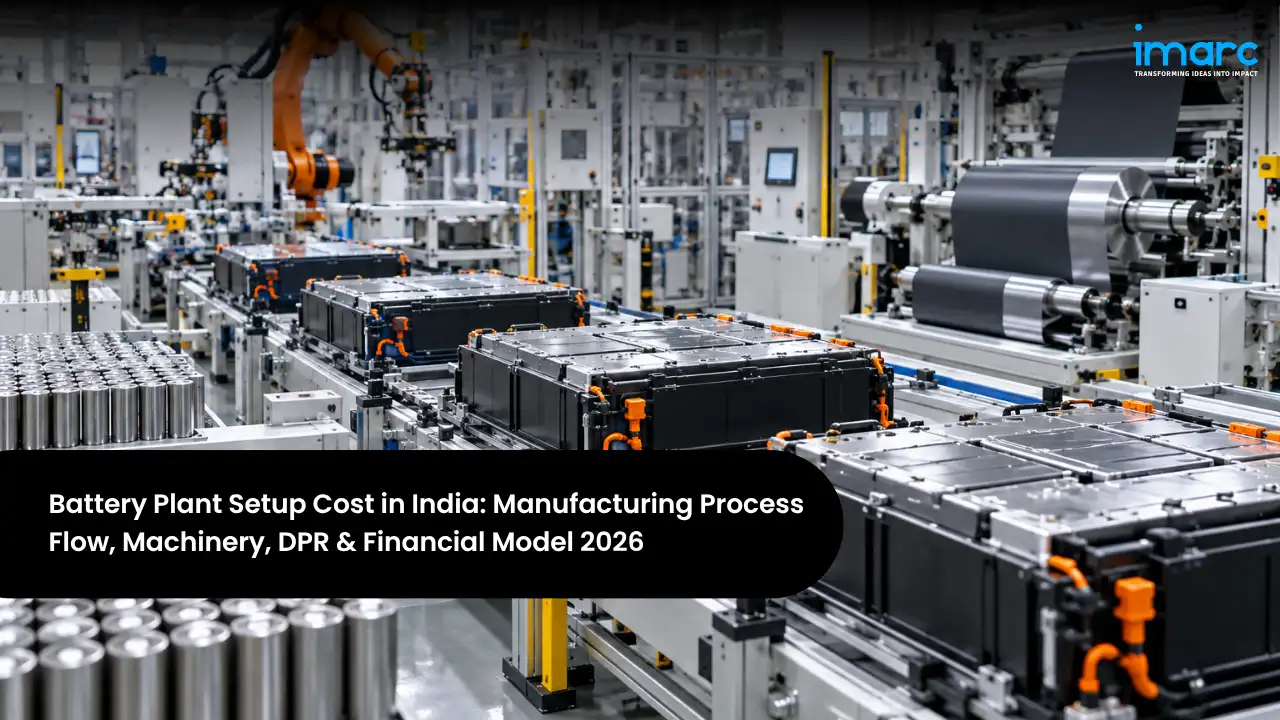
Setting up a Battery Manufacturing Plant in India is a high-demand, energy-driven venture, powered by the country's booming automotive sector, huge power-backup market, and the fast-growing shift to electric vehicles and renewable storage. Batteries store and deliver electricity for vehicles, inverters, telecom, and increasingly for EVs and the grid, and demand rises with electrification, mobility, and reliable power needs. With a large replacement market, strong policy support, and both established lead-acid and emerging lithium-ion technologies, a Battery Manufacturing Plant is one of the more strategic and scalable opportunities in the energy-storage economy.
The Battery Manufacturing Plant Cost depends heavily on battery type, capacity, and technology, and because the range spans simple assembly to advanced cell making, total project investment typically ranges from INR 10 crore to INR 500 crore. Active materials, chiefly lead for lead-acid or cell materials for lithium-ion, are the largest operating inputs, so material sourcing and process efficiency are the most important financial decisions in the project, and together they shape the overall Battery Investment Cost. At healthy capacity utilisation, a well-run plant in India delivers a net profit margin of 8 to 15% and an IRR of 18 to 26%, with payback typically achieved within 4 to 6 years.
This guide is written for investors and entrepreneurs asking how to start a Battery manufacturing plant in India. It covers what the business involves, why demand is rising, the process flow, the machinery and raw materials required, location and infrastructure planning, a detailed cost and financial breakdown, the license you must secure, and how a project report and DPR turns all of this into a bankable plan.
India Market Snapshot
| Key Facts | Details |
|---|---|
| India Battery Market | Large, multi-billion dollar (indicative) |
| Primary Products | Lead-acid and lithium-ion batteries |
| Projected Market CAGR (2026–2034) | 10–16% (indicative) |
| Typical Plant Capacity | Lakhs to millions of units/year |
| Indicative Total Investment | INR 10–500 Crore |
| Typical Payback Period | 4–6 Years |
The snapshot captures why a Battery Manufacturing Plant in India attracts strong investor interest: an essential energy-storage product, broad and growing demand across automotive, power backup, and mobility, and a large replacement market. The wide investment range reflects a genuine choice of technology and scale, from a lead-acid battery unit or lithium-ion pack-assembly plant to a large advanced-cell facility. Because batteries are essential across many sectors and benefit strongly from electrification and EV trends, the demand base is resilient and growing, which is part of why lenders view well-run plants favourably. The rest of this guide unpacks that decision in detail.
Investment Highlights
Indicative Project Cost in India (2026)
| Parameter | Value |
|---|---|
| Plant Capacity (Typical) | Lakhs to millions of units/yr |
| Total Project Investment | INR 10 – 500 Crore |
| Payback Period | 4 – 6 Years |
| Net Profit Margin | 8 – 15% |
| IRR | 18 – 26% |
| Best Locations | Maharashtra, Gujarat, Tamil Nadu, Karnataka, Haryana |
| Mandatory Approvals | Factory License, GST, BIS, Pollution & EPR, Fire NOC |
| Primary Revenue | Automotive, inverter, and EV batteries |
These indicative parameters give a realistic frame for early feasibility work. The returns are attractive, but they depend on securing competitively priced materials, running an efficient line, ensuring compliance, and building steady buyers among automakers, OEMs, dealers, and EV and storage customers. A well-prepared Battery Feasibility Report tightens each of these numbers to your specific location, capacity, and battery type.
Table of Contents
- What is Battery Manufacturing?
- Why is Battery Manufacturing Growing in India?
- Battery Manufacturing Process
- Raw Materials and India Sourcing
- Location, Land & Infrastructure
- Machinery and Equipment Required
- Battery Manufacturing Plant Setup Cost in India (CapEx & OpEx)
- Financial Analysis and Profitability
- Licenses and Approvals for Battery Manufacturing Plant in India
- Recent Developments in the India Battery Manufacturing Industry
- How a Battery Manufacturing Project Report and DPR Helps Investors
- Frequently Asked Questions
What is Battery Manufacturing?
Battery manufacturing is the production of energy-storage devices that convert chemical energy into electricity, built from electrodes, an electrolyte, separators, and a housing. The most common products in India are lead-acid batteries for vehicles, inverters, and industry, and lithium-ion batteries for electric vehicles, electronics, and storage. Lead-acid making involves grid casting, pasting, assembly, and formation, while lithium-ion involves cell making or pack assembly with battery management, and both demand precise process and quality control.
From a business perspective, what makes this sector attractive in India is the combination of essential, recurring demand and a strong shift toward electrification. Every automaker, inverter and UPS maker, telecom operator, EV producer, and storage developer is a potential buyer, and a large replacement market ensures repeat sales. A manufacturer that produces reliable, certified batteries and controls materials and quality is positioned to serve a large, essential, and fast-growing market driven by mobility, power backup, and the energy transition.
- Automotive (SLI) Batteries: Lead-acid starting, lighting, and ignition batteries for vehicles, a high-volume segment.
- Inverter & Industrial: Lead-acid batteries for power backup, UPS, and telecom, a large steady market.
- Lithium-Ion Packs: Lithium-ion batteries and packs for EVs and electronics, the fast-growing segment.
- Storage & Specialty: Batteries for renewable and grid storage and specialty uses that command better prices.
The Main Segments in Battery Manufacturing
Understanding which technology and market your plant will serve is the foundational decision, because it drives process, machinery, and value:
| Segment | Typical Products | Key Property | Primary Demand |
|---|---|---|---|
| Automotive Lead-Acid | SLI batteries | High volume | Vehicles and replacement |
| Inverter / Industrial | Backup batteries | Steady demand | Power backup and telecom |
| Lithium-Ion | Cells and packs | High growth | EV and electronics |
| Storage & Specialty | Storage batteries | Higher value | Renewables and grid |
This choice shapes the entire plant, because lead-acid batteries use a mature, moderate-cost process while lithium-ion cell making is far more capital-intensive, and pack assembly sits in between. Many Indian entrants begin with lead-acid batteries or lithium-ion pack assembly, the most accessible segments, and move toward advanced cells and storage as capability, demand, and policy support grow. The technology decision drives everything from machinery to the level of investment required.
Why is Battery Manufacturing Growing in India?
Key Growth Drivers in the Indian Market
India's battery sector is being propelled by several structural factors that combine automotive demand with electrification and energy storage. Few products ride as many favourable trends at once:
- Electric vehicle boom: Rapid EV adoption is driving strong, fast-growing demand for lithium-ion batteries and packs.
- Automotive and replacement market: A large vehicle fleet and steady replacement demand underpin lead-acid battery sales.
- Power backup and telecom: Inverter, UPS, and telecom demand keeps industrial battery volumes high.
- Renewable energy storage: Growing solar and grid storage creates new demand for battery systems.
- Policy support and localisation: Incentive schemes and localisation drives actively encourage domestic battery manufacturing.
India-Specific Market Opportunity
| Segment | India Market Context | Battery Role |
|---|---|---|
| Automotive | Large vehicle fleet | SLI batteries |
| Electric Vehicles | Fast-growing EV market | Lithium-ion packs |
| Power Backup | Unreliable grid areas | Inverter batteries |
| Telecom | Wide network | Backup power |
| Renewables | Storage build-out | Storage batteries |
The strongest opportunity lies in supplying automakers, OEMs, dealers, and EV and storage customers with reliable, certified, competitively priced batteries, ideally near both material supply and demand clusters. A manufacturer that runs efficiently and maintains quality can lock in steady, repeat orders and replacement demand. Moving into lithium-ion, EV, and storage batteries, where growth and margins are strongest, further strengthens a plant's position in a large, expanding market.
Battery Manufacturing Process
Understanding how a battery is actually made helps you plan equipment, workflow, and the main cost drivers. Production is a sequential operation that builds electrodes, assembles cells or batteries, and charges and tests them, with quality control throughout. The flow differs by technology, but both lead-acid and lithium-ion move materials through electrode making and assembly to formation and testing:
The Battery Manufacturing Process
For lead-acid batteries, lead grids are cast, pasted, cured, assembled with separators, filled with acid, and formed by charging. For lithium-ion, electrodes are coated and assembled into cells, filled with electrolyte, and formed, then built into packs with battery management. In both routes, precise electrode and assembly control and proper formation are essential to batteries that perform and last reliably at a competitive cost.
| Unit Operation | Key Activity |
|---|---|
| Electrode Preparation | Grids cast or electrodes coated |
| Active Material | Paste applied or electrode made |
| Curing / Drying | Electrodes cured and dried |
| Assembly | Plates or cells assembled |
| Separator & Housing | Separators and container fitted |
| Electrolyte Filling | Acid or electrolyte added |
| Formation | Battery charged and activated |
| Testing | Capacity and quality tested |
| Pack Assembly (Li-ion) | Cells built into packs with BMS |
| Finishing & Dispatch | Finished and dispatched |
Two points determine profitability across this flow. First, electrode quality and material use drive both performance and cost, so electrode and assembly control directly govern outcomes, because active materials are expensive. Second, formation and testing are decisive, because a battery that fails to form or test correctly is scrap and can harm reputation. Rigorous testing, for capacity, life, and safety, is what allows a manufacturer to certify batteries to standards and win OEM orders. Because vehicle, EV, and industrial buyers rely on batteries meeting rated performance and safety, consistent quality matters as much to them as headline price.
Raw Materials and India Sourcing
The main inputs are active materials, lead for lead-acid or cell materials for lithium-ion, along with acid or electrolyte, separators, and housings, and securing them at competitive prices and consistent quality is the single biggest determinant of a plant's viability. Because materials dominate cost and their prices move with commodity and cell markets, procurement strategy and a reliable supplier network materially affect margin, alongside the components the process needs.
| Raw Material | Role in Process | India Sourcing | % of OpEx |
|---|---|---|---|
| Lead / Cell Materials | Active material | Domestic and imports | 55–70% |
| Acid / Electrolyte | Ion transport | Domestic and imports | 5–10% |
| Separators | Isolate electrodes | Domestic and imports | 4–8% |
| Containers & Components | Housing and parts | Domestic suppliers | 5–10% |
| Consumables & Utilities | Process and power | Domestic suppliers | 4–8% |
Because active materials are such a large share of cost, material management is the biggest lever on profitability. For lead-acid, lead prices track the metal market, so careful buying, recycling, and pass-through pricing matter, while for lithium-ion, cell and cathode materials are largely imported and price-sensitive, making sourcing strategy critical. India is building domestic capacity for cells and materials, but supply security remains important. Separators, containers, and components are smaller but critical to quality, so supplier qualification matters as much as price for these inputs.
Location, Land & Infrastructure
Choosing the best location for Battery manufacturing plant setup significantly affects material access, power reliability, and proximity to automotive and EV demand. Being near component supply, automotive and industrial clusters, and skilled labour shapes site selection, alongside adequate space and, for lead-acid, the environmental infrastructure that hazardous-material handling demands.
Best States for Battery Manufacturing Plant Setup in India
| State | Why It Works | Key Advantage |
|---|---|---|
| Maharashtra | Auto and industry hub | Demand and OEMs |
| Gujarat | Industrial and port base | Material and logistics |
| Tamil Nadu | Auto and EV cluster | Demand and workforce |
| Karnataka | EV and industry base | EV demand and talent |
| Haryana | Auto belt | OEM demand |
| Telangana | Growing industry base | Demand and access |
The strongest locations combine reliable material and component supply with proximity to automotive, EV, and industrial demand. Maharashtra, Gujarat, and Tamil Nadu offer strong auto and industrial ecosystems, while Karnataka, Haryana, and Telangana add EV clusters and OEM demand. Because battery making needs reliable power and, for lead-acid, careful handling of hazardous materials, power reliability, skilled labour, environmental infrastructure, and proximity to demand should weigh heavily in the final choice, alongside adequate space for the process line and storage.
Infrastructure Requirements (Mid-Sized Plant)
| Infrastructure Element | Specification | India-Specific Note |
|---|---|---|
| Total Built-up Area | 3,000 – 20,000 sq. meters | Space for lines and stores |
| Electrode Section | Casting or coating | Electrode preparation |
| Assembly Line | Assembly stations | Battery or cell assembly |
| Formation Area | Charging banks | Battery formation |
| Testing Laboratory | Capacity and safety tests | Quality assurance |
| Environmental Systems | Fume and effluent control | For lead-acid handling |
| Power & Storage | Reliable power and stores | For process and material |
Infrastructure for a battery unit centres on the electrode section, assembly line, formation area, and a testing laboratory, because output, performance, and quality depend on all of them. For lead-acid, environmental control for lead fumes and acid effluent is especially important given strict regulation, while lithium-ion needs clean, controlled assembly. Reliable power and a well-equipped test lab are essential, and planning the layout with room to add lines or capability later makes future expansion far cheaper than reconfiguring a cramped site.
Machinery and Equipment Required
The equipment set spans electrode making, assembly, formation, and testing, and the line-up depends on battery type and capacity. Because performance and safety depend on precise, well-controlled processes, machinery must be accurate and well matched to the product. The core machinery, from electrode preparation through battery testing, is summarized below.
| Equipment | Function | Key Specification |
|---|---|---|
| Grid Casting / Coating | Make electrodes | Lead casting or coating |
| Paste Mixer / Mixing | Prepare active material | Sized to output |
| Pasting / Calendering | Apply active material | Electrode forming |
| Curing Chambers | Cure electrodes | Controlled curing |
| Assembly Line | Assemble batteries/cells | Manual or automatic |
| Formation Chargers | Charge and activate | Formation banks |
| Electrolyte Filling | Fill acid or electrolyte | Precise filling |
| Testing Equipment | Test batteries | Capacity and safety |
| Pack Assembly (Li-ion) | Build packs with BMS | For lithium-ion |
| Environmental Systems | Control emissions | Fume and effluent |
Equipment selection should follow your battery type and capacity rather than the other way around. A lead-acid unit needs grid casting, pasting, assembly, and formation, while a lithium-ion operation needs coating and cell assembly or pack-assembly and BMS lines, and both need testing. Formation, testing, and, for lead-acid, environmental equipment are easy to under-plan yet decisive, because they determine battery quality, safety, and compliance, on which the business and its reputation depend.
Battery Manufacturing Plant Setup Cost in India (CapEx & OpEx)
The tables below give you a breakdown of both the upfront capital investment and the ongoing operating costs, based on industry analysis of a mid-sized facility in India. The actual Battery Manufacturing Plant Cost for your specific project will depend on your chosen location, capacity, battery type, and technology.
Capital Expenditure (CapEx) Cost Structure
| CapEx Component | % of Total CapEx | What It Covers |
|---|---|---|
| Process Machinery | 30–42% | Electrode, assembly, formation |
| Building & Civil Works | 12–18% | Shop and foundations |
| Formation & Testing | 10–15% | Charging and test equipment |
| Environmental Systems | 6–10% | Fume and effluent control |
| Utilities & Power | 6–10% | Power and services |
| Pre-operative & Contingency | 5–8% | Engineering, DPR, and buffer |
| Working Capital | 15–22% | Material stock and receivables |
The CapEx profile depends heavily on technology, with lead-acid and pack-assembly units more moderate and advanced lithium-ion cell making far more capital-intensive. Working capital is significant because active materials, especially lead or cells, are expensive and must be financed ahead of sales. Under-provisioning working capital, formation and testing, or environmental systems is a common and costly mistake, so all are modelled carefully in the Battery Business Plan and Financial Model.
Operating Expenditure (OpEx) Cost Structure
| OpEx Component | % of Total OpEx | India-Specific Note |
|---|---|---|
| Active Materials | 55–70% | Largest cost; prices move with markets |
| Components & Separators | 8–14% | Housings, separators, parts |
| Power & Utilities | 5–10% | Formation is energy-using |
| Labour & Manpower | 5–10% | Skilled operators and QC |
| Maintenance & Consumables | 3–6% | Plant upkeep |
| Compliance & Logistics | 3–6% | Environmental norms and freight |
With active materials dominating operating cost, this is fundamentally a materials-and-technology business, and margin depends on efficient material use, high yield, and reliable quality. Lead and cell-material prices move with markets, so a financial model should track them closely and build in pass-through where possible, while recognising that EV and storage batteries carry stronger growth and margins. Material efficiency, low scrap, and a shift toward higher-value lithium-ion and storage products are what lift the blended margin above commodity lead-acid levels.
Financial Analysis and Profitability
Based on analysis of a mid-sized battery facility in India, the financial profile is attractive, supported by essential, growing demand and a strong replacement market. Because material management and product mix drive economics, the ROI of Battery manufacturing business in India improves markedly with efficient sourcing, high yield, strong utilisation, and a move toward lithium-ion, EV, and storage batteries.
| Financial Metric | Indicative Value | India Context |
|---|---|---|
| Gross Profit Margin | 18–30% | Driven by material cost and product mix |
| Net Profit Margin | 8–15% | After depreciation and Indian corporate taxes |
| Payback Period | 4–6 Years | Faster with a premium mix |
| IRR (Internal Rate of Return) | 18–26% | Higher for lithium-ion and storage |
| Capacity Utilization (stable ops) | 70–90% | Volume favours high run rates |
| Break-even Capacity Utilization | 55–65% | Steady demand supports throughput |
Material cost, product mix, and utilisation are the factors that most determine outcomes, because a battery line must run at good volumes to spread its fixed costs, and its margin depends heavily on the technology and product mix. An operator with efficient material management, strong quality, and steady demand can achieve healthy margins, while one exposed to material swings or stuck in commodity products will see thinner returns. This is why sourcing and product strategy are as central to the financial model as the machinery itself.
There are several ways to strengthen returns in the Indian context: managing lead or cell materials efficiently with pass-through pricing and, for lead-acid, recycling, raising yield and quality, moving into lithium-ion, EV, and storage batteries, keeping the line well utilised, and building relationships with OEMs and the replacement market. Reliable quality and certification further stabilize order flow and pricing. Riding the EV and storage growth wave is the single biggest value driver, because it transforms a commodity lead-acid maker into a higher-margin supplier aligned with the energy transition.
Key Risks and Mitigation
The principal risks are material price volatility, technology shift, and safety and environmental compliance. Material risk is mitigated by careful buying, recycling, and pass-through pricing; technology risk is mitigated by building lithium-ion and storage capability alongside lead-acid; and compliance risk is mitigated by strong environmental and safety systems and adherence to battery-waste rules. A manufacturer that treats material management, technology strategy, and compliance as core priorities is far better placed to sustain the returns the model promises.
Licenses and Approvals for Battery Manufacturing Plant in India
The approvals for this business are important, because batteries are safety products and, especially lead-acid, involve hazardous materials and regulated waste. Manufacturers planning to establish a Battery Manufacturing Plant generally need to obtain the following before commencing operations, and product-standard and environmental compliance are especially central:
- BIS / Product Standards: Compliance with relevant Indian Standards for batteries, often required for sale.
- Pollution Control Consents: Consent from the State Pollution Control Board, central for lead-acid and hazardous handling.
- Battery Waste / EPR Compliance: Registration and compliance under battery-waste management and extended producer responsibility rules.
- Factory License: Factory establishment and operation approval under the Occupational Safety, Health and Working Conditions Code, 2020.
- Business & Tax Registration: Company or firm incorporation, GST registration, and Udyam (MSME) registration.
- Fire & Safety Approvals: Fire safety and workplace-safety compliance, important for hazardous materials.
- Import-Export & Labour Registrations: IEC for importing materials or cells, and EPF and ESI registrations.
For a battery unit, product-standard compliance, pollution-control consents, and battery-waste or EPR registration are the critical items and should be pursued early, in parallel with setup, because standards and environmental rules gate both sales and operation, especially for lead-acid. Engaging a consultant familiar with battery standards and environmental regulations is usually worth the cost, since a delayed certification or consent can shut out buyers or idle the plant. Sequencing approvals well, alongside material and buyer development, can shave weeks off the project timeline.
Note: The exact approvals, registrations, licenses, and compliance requirements may vary depending on factors such as plant location, capacity, battery type, and applicable regulations. Businesses are advised to undertake a detailed regulatory assessment during the project planning stage to ensure full compliance and timely implementation.
Recent Developments in the India Battery Manufacturing Industry
A few structural trends give useful context for investors considering entry into this industry:
- EV and lithium-ion growth: Rapid EV adoption and policy support are driving strong investment in lithium-ion cells and packs.
- Energy storage expansion: Growing renewable and grid storage is creating a large new market for battery systems.
- Localisation and recycling: Localisation drives and battery-recycling rules are shaping a more organised, sustainable industry.
The common thread is a market growing with mobility, power backup, and energy storage, with technology, quality, and compliance increasingly important. For a new entrant, the implication is clear: the window to establish an efficient, certified plant and build OEM and replacement-market relationships is open, and those who build material discipline, quality, and a move toward lithium-ion and storage into their model from the start will be best placed as demand grows through the decade.
How a Battery Manufacturing Project Report and DPR Helps Investors
A comprehensive Battery Project Report, prepared as a Detailed Project Report (DPR), provides a structured roadmap for establishing the facility by evaluating every aspect of the venture, from market demand and battery type to machinery selection, plant layout, and economics. It helps investors determine the optimal capacity and technology, estimate capital expenditure (CapEx) and operating expenditure (OpEx), assess profitability, and identify potential risks before implementation.
The report also brings together a Battery Business Plan with revenue forecasts, production costs, cash flow analysis, break-even assessment, return on investment (ROI), and payback period calculations, supported by a detailed Battery Financial Model. These insights enable investors, lenders, and stakeholders to make informed decisions and evaluate the long-term viability of the project. Many investors engage a Battery Business Plan Consultant in India or a Battery Manufacturing Consultant in India to prepare and validate these documents.
For a battery project specifically, a strong DPR also clarifies the material-management strategy, the technology and product focus, and the certification and environmental pathway, which are the factors most likely to determine success in this materials-and-technology business. By modelling utilisation against realistic demand and testing margins across the product mix with material pass-through, the report turns a competitive but essential-product opportunity into an executable plan that lenders and partners can trust. It also maps the phased scale-up and technology roadmap, so investors can see how the unit grows and when each tranche of funding is needed.
Frequently Asked Questions
How to start a battery manufacturing plant in India?
Begin by choosing your battery type and capacity, then prepare a feasibility report and DPR, secure space near material supply and demand, arrange electrode, assembly, formation, and testing machinery, tie up material suppliers and buyers, and obtain product-standard, pollution, battery-waste, and factory approvals. A detailed project report maps each step for your target setup.
What is the battery manufacturing plant cost in India?
It typically ranges from INR 10 crore to INR 500 crore depending on battery type, capacity, and technology, and the wider Battery Investment Cost is driven by process machinery and material working capital, with lithium-ion cell making far costlier than lead-acid. Equipment and material stock are the largest components.
What is the battery manufacturing process?
For lead-acid, the process runs from grid casting and pasting, through curing, assembly, acid filling, and formation, to testing and dispatch; for lithium-ion, electrodes are coated and assembled into cells, filled with electrolyte, formed, and built into packs with battery management, with quality and safety checks throughout.
What machinery is required for a battery plant?
Key equipment includes grid casting or electrode coating, paste mixing and pasting or calendering, curing chambers, an assembly line, formation chargers, electrolyte filling, testing equipment, and, for lithium-ion, pack-assembly and BMS lines, along with environmental systems for lead-acid.
What is the best location for battery manufacturing plant setup?
The ideal site combines reliable material and component supply with proximity to automotive, EV, and industrial demand. Maharashtra, Gujarat, Tamil Nadu, Karnataka, and Haryana are leading choices.
What is the profitability of Battery manufacturing business in India?
It is attractive, with a typical 8 to 15% net profit margin and an 18 to 26% IRR, and a 4 to 6 year payback at healthy utilization. Returns improve with efficient material management, high yield, lithium-ion and storage products, and strong utilization, though margins track lead and cell-material prices.
How do I get a project report or feasibility report for a battery plant?
A Battery Project Report and Battery Feasibility Report cover the full plant setup and financials. Many investors engage a Battery Plant Project Report Consultant in India or a Battery Manufacturing Feasibility Study Consultant to prepare and validate them.
Our Clients










Contact Us
Have a question or need assistance?
Please complete the form with your inquiry or reach out to us at
Phone Number
+91-120-433-0800+1-201-971-6302
+44-113-547-7077
Previous Post

Setting up a Liquefied Natural Gas (LNG) Manufacturing Plant in India is a capital-intensive, strategically important venture, powered by the country's push toward a gas-based economy, the shift to cleaner fuels in transport and industry, and rising demand for LNG as a truck, bus, and industrial fuel.
The India carbon credit market is moving from a voluntary, project-by-project trade into a regulated national system with binding targets, a central registry, and exchange-based price discovery. According to IMARC Group, the market was valued at USD 33.69 Billion in 2025, grew to USD 44.42 Billion in 2026, and is projected to reach USD 405.47 Billion by 2034, expanding at a CAGR of 31.84% (2026–2034).
Setting up a Syngas Production Plant in India is a capital-intensive but strategically valuable venture, driven by the country's push for cleaner industrial fuels, coal and biomass utilization, and chemical self-reliance. Syngas, or synthesis gas, is a mixture of hydrogen and carbon monoxide produced by gasifying carbon-rich feedstocks, and it serves as a versatile building block for power, chemicals, hydrogen, and synthetic fuels. With abundant biomass, coal, and waste feedstock and growing policy support for gasification, India offers a favourable environment for new plants.
Setting up a Battery Energy Storage System Manufacturing Plant in India is a capital-efficient, high-growth venture, driven by the country's renewable energy expansion, grid modernization, and supportive storage policies. As solar and wind capacity scales up and the grid needs to balance variable generation, battery energy storage systems have become essential infrastructure.
Setting up a Lithium-ion Battery Recycling Plant in India is a capital-intensive but high-potential venture. India's rapid rise as a major electric-vehicle market, its large consumer-electronics base, and its fast-growing energy-storage sector are together creating one of the deepest and fastest-expanding pools of end-of-life lithium-ion batteries in the world.
Solar glass is a type of specialty glass that has high transmittance and is designed exclusively for use in solar energy systems. Unlike regular flat glass, solar glass is designed to have maximum light transmission with minimal losses due to reflection and absorption.
A solar inverter is a vital component in solar photovoltaic (PV) systems, responsible for transforming the direct current (DC) electricity produced by solar panels into alternating current (AC) electricity. This AC power is then suitable for use by the electrical grid, various appliances, and industrial equipment.
Australia has firmly established itself as a dominant force in the global liquefied natural gas (LNG) market, maintaining its position as one of the world's leading exporters. The country's strategic geographical location in the Asia-Pacific region, combined with substantial natural gas reserves, has enabled it to become a critical energy supplier to rapidly growing Asian economies, particularly China, Japan, and South Korea.
Japan's lead acid battery market stands as a cornerstone of the nation's energy storage infrastructure, demonstrating remarkable resilience and adaptability in an era dominated by rapid technological evolution. Despite the global shift toward lithium-ion technologies, the Japanese lead acid battery sector continues to thrive, driven by its unmatched cost-effectiveness, proven reliability, and exceptional recyclability.
Green hydrogen is the cleanest form of hydrogen available, as it is produced through water electrolysis using the electricity generated from renewable energy sources such as solar, wind, or hydropower. Carbon dioxide emissions are zero since no fossil fuels are used. Essentially, an electrolyzer is used in the electrolysis process to split water molecules into hydrogen and oxygen. The resulting hydrogen is refined by purification, compression, or liquefaction and then fed into various applications. Green hydrogen is considered a cornerstone of the global energy transition because it can store renewable energy, decarbonize hard-to-abate sectors, and serve as a sustainable alternative to fossil-fuel-based hydrogen.
Japan’s thermal power plant industry remains a crucial pillar of the nation’s energy infrastructure, providing a stable and reliable source of electricity for both industrial and residential consumption. Thermal power generation, which primarily involves the combustion of fossil fuels such as coal, natural gas, and oil, continues to play a key role despite increasing investments in renewable energy.
An electrical panel, also called a distribution board or switchboard, is an important installation in electrical infrastructure that acts as the main center for the distribution, control, and protection of electrical power within residential, commercial, and industrial systems. It acts as the point at which electrical energy is received from the utility or a source of power generation and is distributed to various circuits and equipment in an organized manner.
The global oil and gas EPC market is currently experiencing a remarkable transformation as it positions itself at the intersection of traditional energy demands and technological innovation. As of 2024, the market is demonstrating robust growth, reaching USD 52.9 Billion in 2024, depending on regional scope and market segmentation approaches. This substantial market base is supporting a major number of capital projects worldwide, including offshore platform projects and onshore installations that are collectively shaping the energy landscape.
Bamboo pellets are a biomass fuel type created through the compression of bamboo residues like shavings, sawdust, and chips into thick cylindrical pellets. They are an environmentally friendly substitute for conventional fossil fuels like natural gas and coal. Due to the fast growth rate and high biomass yield of bamboo, it has become one of the most renewable raw materials for the production of bioenergy.
Biomass briquettes are dense, solid fuel blocks made of compressed organic waste materials like sawdust, agricultural wastes, wood shavings, coconut shells, rice husk, or herbaceous biomass. The briquetting process usually involves drying the biomass to lower the moisture content (usually down to 10-15%), grinding or milling for a fine particle size uniformity, and then compressing under high pressure with or without a binding agent.
Biogas is a renewable energy form generated by the anaerobic fermentation of organic matter including agricultural residues, animal waste, municipal solid waste, sewage sludge, and food waste. Microorganisms in the absence of oxygen break down organic substances in the process and produce a gaseous mixture of mainly methane (CH4) and carbon dioxide (CO2), with traces of hydrogen sulfide (H2S) and water vapor.
A battery is an electrochemical energy storage system that transforms chemical energy into electrical energy by way of redox reactions between its electrodes and electrolyte. It consists of a single or multiple electrochemical cells, each having a positive electrode (cathode), a negative electrode (anode), and an electrolyte for ion transfer. Batteries are categorically divided into primary (non-rechargeable) and secondary (rechargeable) types.
The global energy landscape is undergoing a seismic transformation, with green hydrogen emerging as one of the most promising solutions to achieve deep decarbonization across sectors. Far from a niche technology, green hydrogen is emerging as a critical pillar of the future energy system, offering a pathway to a sustainable and resilient economy.
Transmission line towers are essential support components of transmission lines installed on overhead to distribute high-voltage electricity over long distances. Towers are made of galvanized steel, primarily, and are designed to tolerate mechanical stress, environmental loads, and electrical safety. Some of the important characteristics of transmission line towers are high structural strength, corrosion resistance, adaptability for modular design, and high service life. They are normally produced in lattice form (tubular or free-standing towers) or tubular form, with types including suspension towers, tension towers, angle towers, and terminal towers based on use.
The energy storage revolution is here, and it's powered by graphene. While the world struggles with the limitations of conventional lithium-ion batteries, a new technology is emerging that promises to shatter every performance barrier we've accepted as unchangeable.
Australia is undergoing a significant energy transformation, underscoring the growing role of renewable energy sources. These sources are key to combating climate change by reducing greenhouse gas emissions, the primary cause of global warming and air pollution. Beyond environmental benefits, renewable energy strengthens energy security by diversifying power sources and reducing dependence on volatile fossil fuel imports, contributing to greater energy independence.
Learn how to plan capital investment, manage raw material costs, post manufacturing cost and optimize operations for setting up solar panel plant.
Battery Energy Storage System (BESS) represents a power grid technology that stores electricity to enhance electric power grid reliability while increasing operational efficiency. BESS permits battery recharging during periods of low demand or extra grid supply capacity. BESS provides three principal operational functionalities which include power grid stabilization during supply disruptions, control of energy supply variations, and integration of intermittent renewable generation from wind and solar resources.
China's economic presence is expanding globally, and Latin America and the Caribbean (LAC) have become a focal point for its investments, especially within the energy sector. The region, rich in natural resources and experiencing rising energy demands, offers strategic opportunities for Chinese energy giants looking to invest and expand. LAC is currently leading a transformative movement towards sustainable energy. From 2015 to 2022, the region increased its renewable energy capacity by an impressive 51%, now generating 64% of its electricity from renewables such as hydropower, wind, and solar. This shift addresses the global demand for cleaner energy while supporting local economic growth and enhancing energy security.
Hydrogen is a clean, renewable, and widely available energy source that can be produced through various methods. Production techniques such as coal gasification, steam methane reforming, electrolysis, and thermochemical processes highlight its versatility. Hydrogen is essential in several critical sectors, including methanol and ammonia production, petroleum refining, transportation, power generation, as well as in electronics, metal industries, and as a rocket propellant. The increasing concern over carbon emissions and greenhouse gases has led to a shift towards cleaner fuel options. Hydrogen is recognized for its cleanliness and versatility as an energy carrier. Additionally, supportive government initiatives and favorable policies are driving the growth of hydrogen production globally.
Hydrogen is a clean, renewable, and abundant energy source derived from various methods. Its applications span across transportation, heating, and power generation. Diverse production methods, including coal gasification, steam methane reforming, electrolysis, and thermochemical processes, contribute to its versatility. Hydrogen plays a pivotal role in crucial sectors like methanol and ammonia production, petroleum refining, transportation, power generation, as well as in electronics, metal industries, and as a rocket propellant.
A floating solar farm is a renewable energy installation in which solar panels are mounted on floating structures in water bodies such as lakes, reservoirs, ponds, or even the sea. This technology, also known as a floating photovoltaic (PV) system, or “floatovoltaics,” enables solar power generation in areas with limited available land or where land use is restricted for other purposes. Floating solar farms offer various benefits, including improved solar panel efficiency through cooling, land conservation, reduction of evaporation and algae growth, and integration with hydropower facilities to generate both solar and hydroelectric power in the same location.
Nuclear power utilizes nuclear reactions to generate heat, which is then converted into electricity. This energy is released from the nucleus—the core of atoms composed of protons and neutrons. Nuclear power can be derived from nuclear fission, nuclear decay, and nuclear fusion reactions. Across the globe, nuclear power plants predominantly use the fission of uranium and plutonium to produce electricity. The heat generated from fission is used to create steam, which drives turbines connected to generators. Nuclear power offers several advantages over fossil fuels, such as minimal greenhouse gas emissions and a higher energy density, meaning a small amount of nuclear fuel produces a large amount of energy.