How Will India's Carbon Credit Trading Scheme Dictate Prices and Overall Ecosystem Value?
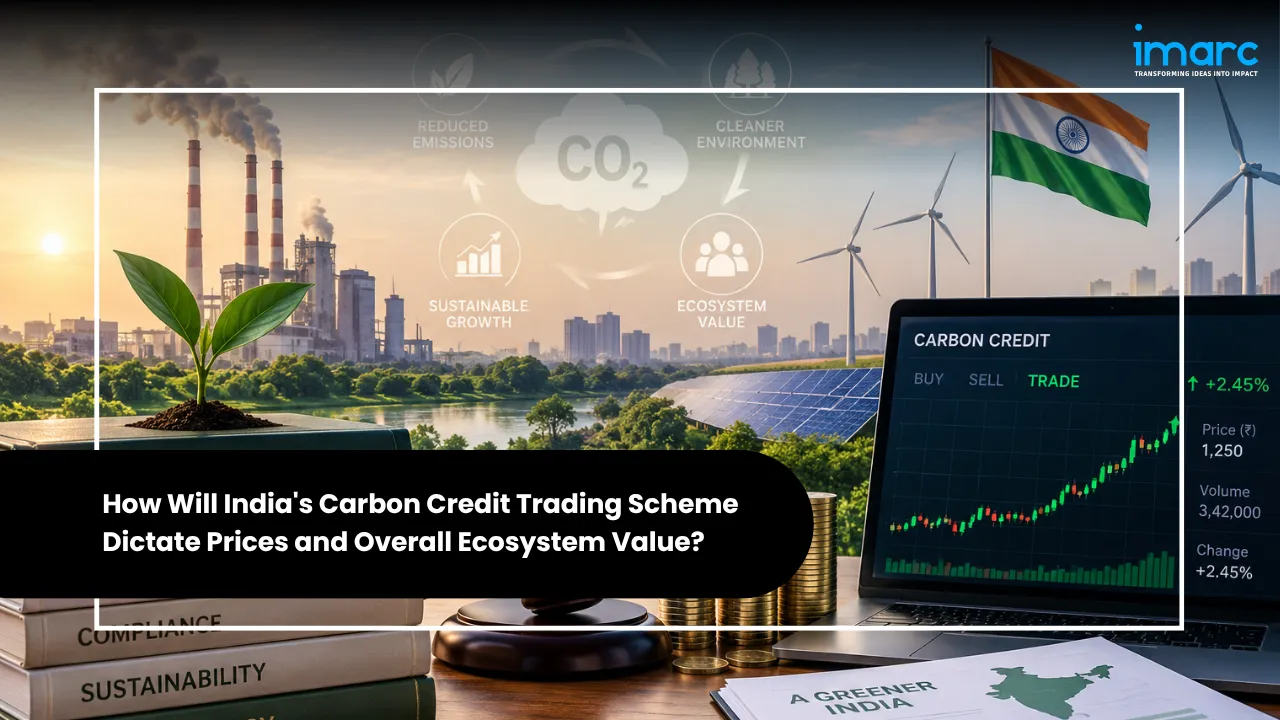
Introduction: India's Carbon Ecosystem Enters a New Regulatory Era
The India carbon credit market is moving from a voluntary, project-by-project trade into a regulated national system with binding targets, a central registry, and exchange-based price discovery. According to IMARC Group, the market was valued at USD 33.69 Billion in 2025, grew to USD 44.42 Billion in 2026, and is projected to reach USD 405.47 Billion by 2034, expanding at a CAGR of 31.84% (2026–2034).
The pivot point is the Carbon Credit Trading Scheme (CCTS). As of fiscal year 2025–26, compliance obligations are in force for approximately 490 entities across seven energy-intensive sectors. Once Carbon Credit Certificates (CCCs) begin trading on power exchanges, the price that heavy industry pays for a shortfall will start to set a domestic benchmark for every tonne of carbon in the country.
Meanwhile, global buyers keep signing multi-year removal offtakes with Indian developers. Together, compliance obligations and voluntary offtake will determine India's carbon credit ecosystem value and ecosystem growth through 2034.
This blog examines the India carbon credit market's size and segments, recent announcements, the trends reshaping 2026, regional hotspots, competitive strategies, policy risks, and the long-range forecast, helping emitters, developers, investors, and verification providers position ahead of the first compliance trades.
Key Takeaways
- The India carbon credit market was valued at USD 33.69 Billion in 2025 and is forecast to reach USD 405.47 Billion by 2034, at a CAGR of 31.84% (2026–2034).
- Voluntary credits lead the type segment at 58.04%, avoidance/reduction projects hold 52.1% of project-type activity, and power is the largest end-use industry at 20.05%.
- North India is the largest regional demand hub with a 31.0% share, followed by South India at 27.4%, while West India is the fastest-growing region.
- The CCTS now binds about 490 entities across seven sectors, and the Indian Carbon Market Portal launched in March 2026 digitizes registration, verification, and CCC issuance.
- Nature-based removals, green hydrogen-linked credits, and biochar are projected to outpace the broader market, backed by offtakes from Google, Microsoft, and GSK.
Ecosystem Size, Share & Growth Outlook
According to IMARC Group, demand in the India carbon credit industry is spread across credit types, project categories, and end-use sectors, with voluntary credits still ahead of compliance credits. Corporate ESG disclosure is a structural demand driver: SEBI's Business Responsibility and Sustainability Reporting (BRSR) framework made sustainability disclosures mandatory for the top 1,000 listed companies from FY2022–23, pushing large corporates to measure emissions and source offsets. The leading segments are:
- Type: Voluntary credits lead with a 58.04% share, against 41.96% for compliance credits, reflecting corporate Net Zero commitments and Verra and Gold Standard registrations that predate the CCTS.
- Project Type: Avoidance/reduction projects account for 52.1%, covering renewable energy generation, energy efficiency, fuel switching, and industrial process upgrades, while removal/sequestration projects, spanning forestry, agroforestry, biochar, and other nature-based and technology-based removals, make up the remaining 47.9%; approved methodologies also cover landfill methane recovery and mangrove afforestation.
- End-Use Industry: Power leads with a 20.05% share, as renewable generators supply credits while thermal utilities face decarbonization pressure; renewable energy carbon offset project demand in India remains the backbone of historical issuance.
- Region: North India commands 31.0%, anchored by industrial corridors in Uttar Pradesh, Haryana, Punjab, and Delhi NCR.
Recent News & Mega Announcements
The past year has combined rapid rule-making for the compliance market with large corporate purchases of Indian removal credits:
- In September 2026, GSK signed an eight-year agreement with Varaha to purchase 600,000 carbon credits from a regenerative agriculture project in northern India, sourced from smallholder farms.
- In June 2026, Microsoft agreed to buy 36,920 tonnes of carbon removal credits from Alt Carbon's Darjeeling Revival Project by 2029, its first enhanced rock weathering deal in Asia.
- In March 2026, Union Power Minister Manohar Lal launched the Indian Carbon Market Portal at Prakriti 2026 in New Delhi, the central platform for entity registration, verification, and CCC issuance in the ICM rollout.
- In February 2026, the Central Electricity Regulatory Commission notified the regulations for the purchase and sale of Carbon Credit Certificates, setting exchange-based trading with floor and forbearance prices between obligated and non-obligated entities.
Together, these developments show the compliance plumbing is nearly complete while private buyers are already locking in long-dated Indian supply at scale.
Ecosystem Trends Shaping 2026
Three trends are redefining how value is created and captured in the India carbon credit ecosystem in 2026:
1. Shift from Voluntary to Compliance Markets
The national carbon credit trading scheme compliance framework converts the old Perform, Achieve and Trade (PAT) energy-efficiency programme into emission intensity targets. Covered entities have legally binding targets for 2025–26 and 2026–27 against a FY2023–24 baseline, with the first compliance date on July 31 for the 2025–26 compliance year. The first four sectors (aluminium, cement, chlor-alkali, and pulp and paper) were notified in October 2025, followed by petroleum refining, petrochemicals, and textiles in January 2026. This shift moves pricing power from voluntary buyers to regulated emitters that must either beat their targets or buy certificates.
2. Integration of Green Hydrogen and Renewable Energy Credits
India's National Green Hydrogen Mission targets production capacity of at least 5 million metric tonnes per annum by 2030, and approved offset methodologies now cover green hydrogen production and renewable energy with storage. In May 2024, Yara Clean Ammonia signed an agreement with Greenko ZeroC (AM Green) for long-term supply of renewable ammonia from its Kakinada facility, showing how hydrogen derivatives and renewable power are being bundled with carbon attributes. IMARC estimates green hydrogen-linked credits will grow at about 36% annually through 2034, faster than the overall market.
3. Blockchain-Based Verification and Digital MRV
Digital monitoring, reporting, and verification (dMRV) is becoming standard. In April 2026, Pi Green Innovations and EcoGuard Global partnered to digitize carbon capture methodologies and deploy dMRV with traceable transactions on distributed ledger technology. Bengaluru-based RenewCred, which uses IoT sensors, AI verification, and blockchain, issued its first carbon credits in April 2026.
.webp)
Geographic Hotspots
North India leads the India carbon credit market with a 31.0% share, followed by South India at 27.4%, West India at 22.3%, and East India at 19.3%. North India also has a strong agricultural and forestry offset pipeline. In December 2025, IIT Roorkee and the Uttar Pradesh government launched a farmer carbon credit programme expected to deliver Rs 5,000–Rs 8,000 per hectare in supplementary income.
South India draws on large renewable portfolios such as Greenko's Kakinada complex in Andhra Pradesh. West India is the fastest-growing region, driven by industrial decarbonization in the Dahej and Hazira chemical clusters and the solar and wind belts of Rajasthan. The West is also a removal-credit hub: Google's 100,000-tonne biochar purchase from Varaha comes from a pyrolysis facility in Gujarat, and Microsoft's January 2026 deal with Varaha draws on cotton stalks from Maharashtra's cotton belt. East India, with forestry-rich states and coal-linked steel and aluminium assets, supports REDD+ pipelines, while Alt Carbon's Darjeeling project adds enhanced rock weathering supply.
Competitive Landscape & Key Players' Strategies
The India carbon credit market is moderately fragmented, with the top five developers holding an estimated 35–40% of voluntary credit issuance. Developers aim to maximize price by moving from low-cost avoidance credits toward removal credits with durable storage and strong co-benefits. Key players include:
- Alt Carbon: Scales enhanced rock weathering in Darjeeling tea estates, backed by a multi-year Microsoft offtake.
- EKI Energy Services Ltd.: Has supplied over 200 million offsets across 40+ countries and is preparing Article 6.4 readiness through its Surya Nutan and Oorja Biogas projects.
- Greenko Group: Combines pumped hydro storage, solar, and wind with green ammonia exports from Kakinada.
- MITCON Consultancy & Engineering Services Limited: Has facilitated carbon credits valued at over USD 9 million from 150+ projects and commissioned a biochar plant in March 2025.
- NTPC: Anchors high-volume renewable energy credit issuance from its utility-scale clean power portfolio.
- ReNew: Anchors high-volume renewable energy credit issuance from its solar and wind assets.
- Varaha: Aggregates smallholder regenerative agriculture, biochar, and removal projects, securing offtakes from Google, Microsoft, and GSK.
Verification agencies such as TÜV SÜD South Asia, DNV, and Bureau Veritas compete on accreditation depth and turnaround time, while developers compete on credit durability, co-benefits, and buyer-grade MRV data.
Policy & Regulatory Landscape, Challenges & Risks
Indian carbon registry and greenhouse gas emission regulations now form a layered architecture:
- Carbon Credit Trading Scheme, 2023: Governed by a National Steering Committee, with Grid Controller of India Limited as the Registry and the Bureau of Energy Efficiency as the Administrator.
- GHG Emission Intensity Targets: Notified by the Ministry of Environment, Forest and Climate Change for seven sectors covering about 490 entities; the full scheme is designed to cover more than 740 installations across nine sectors.
- CERC CCC Regulations, 2026: Govern CCC trading through power exchanges, with floor and forbearance prices to limit manipulation and volatility.
- Offset Mechanism: BEE issued Version 1 of the detailed offset procedures in March 2025, and nine methodologies had been notified by March 2026.
Key challenges and risks include:
- Price discovery and volatility: Compliance CCC prices will only emerge once trading opens, expected around October 2026, so early sessions may see thin liquidity and wide spreads within the regulated price band.
- International export uncertainty: Guidelines for trading carbon credit certificates outside India are still to be formulated on the recommendation of the National Steering Committee, leaving Article 6 transfers and corresponding adjustments uncertain for exporters.
- Compliance cost exposure: Missing targets without surrendering certificates triggers a 2x non-compliance penalty, raising financial risk for emitters in cement, aluminium, and refining.
Forecast 2026–2034: The Post-Disruption Outlook
IMARC Group projects the India carbon credit market to grow from USD 44.42 Billion in 2026 to USD 405.47 Billion by 2034, a CAGR of 31.84% (2026–2034). The disruption of moving from PAT to the CCTS will give way to a two-track market in which compliance certificates set a floor for domestic prices and voluntary removals command premiums.
On pricing, voluntary credits in India typically sell for INR 500–INR 2,500 per tonne for soil carbon and INR 1,500–INR 4,000 for agroforestry in 2026, while early estimates place CCC prices at around INR 500–INR 1,500 per tonne. The average carbon credit price in India for corporate offsets will therefore depend on project type and verification quality rather than a single benchmark. Nature-based removals (~34%), green hydrogen-linked credits (~36%), and biochar (~33%) are expected to grow faster than the overall market, with West India gaining share fastest.
Opportunities for Stakeholders
- Heavy-Industry Emitters: Beat intensity targets early to generate surplus CCCs, and secure offset supply before exchange prices firm up.
- Renewable Energy Developers: Pair solar, wind, and storage assets with green hydrogen and newly approved methodologies to earn higher-value credits.
- Climate-Tech Verification Platforms: Supply dMRV, satellite monitoring, and ledger-based traceability that buyers and the ICM registry increasingly require.
- Investors & Project Financiers: Back biochar, agroforestry, and enhanced rock weathering developers with long-dated corporate offtakes.
Conclusion: Securing India's Decarbonization Targets
The India carbon credit market is entering its most consequential phase: binding targets cover hundreds of industrial units, the registry and portal are live, trading rules are notified, and global buyers are signing multi-year removal deals. With a projected CAGR of 31.84% (2026–2034), the scheme's price signals will increasingly determine where capital flows across India's decarbonization economy.
For enterprises, the priority is to treat carbon as a balance-sheet item and plan compliance positions now. For investors, the strongest returns lie in durable removals and verification infrastructure. For policymakers, clear export guidelines, stable price bands, and credible MRV will decide whether the India carbon credit market becomes a trusted global supply hub.
Our Clients









Contact Us
Have a question or need assistance?
Please complete the form with your inquiry or reach out to us at
Phone Number
+91-120-433-0800+1-201-971-6302
+44-113-547-7077
Previous Post

Setting up a Syngas Production Plant in India is a capital-intensive but strategically valuable venture, driven by the country's push for cleaner industrial fuels, coal and biomass utilization, and chemical self-reliance. Syngas, or synthesis gas, is a mixture of hydrogen and carbon monoxide produced by gasifying carbon-rich feedstocks, and it serves as a versatile building block for power, chemicals, hydrogen, and synthetic fuels. With abundant biomass, coal, and waste feedstock and growing policy support for gasification, India offers a favourable environment for new plants.
Setting up a Battery Energy Storage System Manufacturing Plant in India is a capital-efficient, high-growth venture, driven by the country's renewable energy expansion, grid modernization, and supportive storage policies. As solar and wind capacity scales up and the grid needs to balance variable generation, battery energy storage systems have become essential infrastructure.
Setting up a Lithium-ion Battery Recycling Plant in India is a capital-intensive but high-potential venture. India's rapid rise as a major electric-vehicle market, its large consumer-electronics base, and its fast-growing energy-storage sector are together creating one of the deepest and fastest-expanding pools of end-of-life lithium-ion batteries in the world.
Solar glass is a type of specialty glass that has high transmittance and is designed exclusively for use in solar energy systems. Unlike regular flat glass, solar glass is designed to have maximum light transmission with minimal losses due to reflection and absorption.
A solar inverter is a vital component in solar photovoltaic (PV) systems, responsible for transforming the direct current (DC) electricity produced by solar panels into alternating current (AC) electricity. This AC power is then suitable for use by the electrical grid, various appliances, and industrial equipment.
Australia has firmly established itself as a dominant force in the global liquefied natural gas (LNG) market, maintaining its position as one of the world's leading exporters. The country's strategic geographical location in the Asia-Pacific region, combined with substantial natural gas reserves, has enabled it to become a critical energy supplier to rapidly growing Asian economies, particularly China, Japan, and South Korea.
Japan's lead acid battery market stands as a cornerstone of the nation's energy storage infrastructure, demonstrating remarkable resilience and adaptability in an era dominated by rapid technological evolution. Despite the global shift toward lithium-ion technologies, the Japanese lead acid battery sector continues to thrive, driven by its unmatched cost-effectiveness, proven reliability, and exceptional recyclability.
Green hydrogen is the cleanest form of hydrogen available, as it is produced through water electrolysis using the electricity generated from renewable energy sources such as solar, wind, or hydropower. Carbon dioxide emissions are zero since no fossil fuels are used. Essentially, an electrolyzer is used in the electrolysis process to split water molecules into hydrogen and oxygen. The resulting hydrogen is refined by purification, compression, or liquefaction and then fed into various applications. Green hydrogen is considered a cornerstone of the global energy transition because it can store renewable energy, decarbonize hard-to-abate sectors, and serve as a sustainable alternative to fossil-fuel-based hydrogen.
Japan’s thermal power plant industry remains a crucial pillar of the nation’s energy infrastructure, providing a stable and reliable source of electricity for both industrial and residential consumption. Thermal power generation, which primarily involves the combustion of fossil fuels such as coal, natural gas, and oil, continues to play a key role despite increasing investments in renewable energy.
An electrical panel, also called a distribution board or switchboard, is an important installation in electrical infrastructure that acts as the main center for the distribution, control, and protection of electrical power within residential, commercial, and industrial systems. It acts as the point at which electrical energy is received from the utility or a source of power generation and is distributed to various circuits and equipment in an organized manner.
The global oil and gas EPC market is currently experiencing a remarkable transformation as it positions itself at the intersection of traditional energy demands and technological innovation. As of 2024, the market is demonstrating robust growth, reaching USD 52.9 Billion in 2024, depending on regional scope and market segmentation approaches. This substantial market base is supporting a major number of capital projects worldwide, including offshore platform projects and onshore installations that are collectively shaping the energy landscape.
Bamboo pellets are a biomass fuel type created through the compression of bamboo residues like shavings, sawdust, and chips into thick cylindrical pellets. They are an environmentally friendly substitute for conventional fossil fuels like natural gas and coal. Due to the fast growth rate and high biomass yield of bamboo, it has become one of the most renewable raw materials for the production of bioenergy.
Biomass briquettes are dense, solid fuel blocks made of compressed organic waste materials like sawdust, agricultural wastes, wood shavings, coconut shells, rice husk, or herbaceous biomass. The briquetting process usually involves drying the biomass to lower the moisture content (usually down to 10-15%), grinding or milling for a fine particle size uniformity, and then compressing under high pressure with or without a binding agent.
Biogas is a renewable energy form generated by the anaerobic fermentation of organic matter including agricultural residues, animal waste, municipal solid waste, sewage sludge, and food waste. Microorganisms in the absence of oxygen break down organic substances in the process and produce a gaseous mixture of mainly methane (CH4) and carbon dioxide (CO2), with traces of hydrogen sulfide (H2S) and water vapor.
A battery is an electrochemical energy storage system that transforms chemical energy into electrical energy by way of redox reactions between its electrodes and electrolyte. It consists of a single or multiple electrochemical cells, each having a positive electrode (cathode), a negative electrode (anode), and an electrolyte for ion transfer. Batteries are categorically divided into primary (non-rechargeable) and secondary (rechargeable) types.
The global energy landscape is undergoing a seismic transformation, with green hydrogen emerging as one of the most promising solutions to achieve deep decarbonization across sectors. Far from a niche technology, green hydrogen is emerging as a critical pillar of the future energy system, offering a pathway to a sustainable and resilient economy.
Transmission line towers are essential support components of transmission lines installed on overhead to distribute high-voltage electricity over long distances. Towers are made of galvanized steel, primarily, and are designed to tolerate mechanical stress, environmental loads, and electrical safety. Some of the important characteristics of transmission line towers are high structural strength, corrosion resistance, adaptability for modular design, and high service life. They are normally produced in lattice form (tubular or free-standing towers) or tubular form, with types including suspension towers, tension towers, angle towers, and terminal towers based on use.
The energy storage revolution is here, and it's powered by graphene. While the world struggles with the limitations of conventional lithium-ion batteries, a new technology is emerging that promises to shatter every performance barrier we've accepted as unchangeable.
Australia is undergoing a significant energy transformation, underscoring the growing role of renewable energy sources. These sources are key to combating climate change by reducing greenhouse gas emissions, the primary cause of global warming and air pollution. Beyond environmental benefits, renewable energy strengthens energy security by diversifying power sources and reducing dependence on volatile fossil fuel imports, contributing to greater energy independence.
Learn how to plan capital investment, manage raw material costs, post manufacturing cost and optimize operations for setting up solar panel plant.
Battery Energy Storage System (BESS) represents a power grid technology that stores electricity to enhance electric power grid reliability while increasing operational efficiency. BESS permits battery recharging during periods of low demand or extra grid supply capacity. BESS provides three principal operational functionalities which include power grid stabilization during supply disruptions, control of energy supply variations, and integration of intermittent renewable generation from wind and solar resources.
China's economic presence is expanding globally, and Latin America and the Caribbean (LAC) have become a focal point for its investments, especially within the energy sector. The region, rich in natural resources and experiencing rising energy demands, offers strategic opportunities for Chinese energy giants looking to invest and expand. LAC is currently leading a transformative movement towards sustainable energy. From 2015 to 2022, the region increased its renewable energy capacity by an impressive 51%, now generating 64% of its electricity from renewables such as hydropower, wind, and solar. This shift addresses the global demand for cleaner energy while supporting local economic growth and enhancing energy security.
Hydrogen is a clean, renewable, and widely available energy source that can be produced through various methods. Production techniques such as coal gasification, steam methane reforming, electrolysis, and thermochemical processes highlight its versatility. Hydrogen is essential in several critical sectors, including methanol and ammonia production, petroleum refining, transportation, power generation, as well as in electronics, metal industries, and as a rocket propellant. The increasing concern over carbon emissions and greenhouse gases has led to a shift towards cleaner fuel options. Hydrogen is recognized for its cleanliness and versatility as an energy carrier. Additionally, supportive government initiatives and favorable policies are driving the growth of hydrogen production globally.
Hydrogen is a clean, renewable, and abundant energy source derived from various methods. Its applications span across transportation, heating, and power generation. Diverse production methods, including coal gasification, steam methane reforming, electrolysis, and thermochemical processes, contribute to its versatility. Hydrogen plays a pivotal role in crucial sectors like methanol and ammonia production, petroleum refining, transportation, power generation, as well as in electronics, metal industries, and as a rocket propellant.
A floating solar farm is a renewable energy installation in which solar panels are mounted on floating structures in water bodies such as lakes, reservoirs, ponds, or even the sea. This technology, also known as a floating photovoltaic (PV) system, or “floatovoltaics,” enables solar power generation in areas with limited available land or where land use is restricted for other purposes. Floating solar farms offer various benefits, including improved solar panel efficiency through cooling, land conservation, reduction of evaporation and algae growth, and integration with hydropower facilities to generate both solar and hydroelectric power in the same location.
Nuclear power utilizes nuclear reactions to generate heat, which is then converted into electricity. This energy is released from the nucleus—the core of atoms composed of protons and neutrons. Nuclear power can be derived from nuclear fission, nuclear decay, and nuclear fusion reactions. Across the globe, nuclear power plants predominantly use the fission of uranium and plutonium to produce electricity. The heat generated from fission is used to create steam, which drives turbines connected to generators. Nuclear power offers several advantages over fossil fuels, such as minimal greenhouse gas emissions and a higher energy density, meaning a small amount of nuclear fuel produces a large amount of energy.